




Abstract
We exploit a rare natural experiment, a recent reform of local elections in Poland, to study an extension of Duverger’s laws. We analyse party system fragmentation under single-member plurality rule vis-à-vis a proportional representation formula accompanied by a legal threshold. We demonstrate that the presence of a threshold alters Duverger’s ‘psychological’ effect. Proportional representation with a threshold tends to be on a par with single-member plurality as regards restricting the effective number of electoral parties, largely due to the absence of smaller groupings with spatially concentrated support. At the same time, Duverger’s ‘mechanical’ effect takes a rather standard form, single-member plurality being relatively powerful at constraining the effective number of legislative parties.
Keywords
Introduction
Duverger’s (1959) laws of the impact of electoral rules on party systems’ fragmentation are among long-standing political science concepts. The original proposition maintains that the implementation of the single-member plurality (SMP) system shall result in the emergence of a two-party system (Duverger, 1959: 217), while multiparty systems shall tend to form under proportional representation (PR) rules (Duverger, 1959: 239). Accordingly, the vast majority of the empirical studies of this concept compare the SMP formula with PR systems. Relatively little is known, however, about how the apparent divergence between those two is altered when a PR rule is accompanied by a legal threshold. In this study, we attempt to throw a new light on this issue. We draw on the seminal Moser’s (1999) study on electoral systems effects in post-communist states, most notably on his comparisons of the effects of PR formulas with a threshold to those of plurality and majority rules. We hypothesize the following effects of a replacement of PR with a threshold by SMP. First, the abolition of the threshold shall result in a sharp increase in the raw number of parties due to a proliferation of smaller groupings with spatially concentrated support. Second, SMP shall generate strong incentives for voters to coordinate along viable candidates and thus the effective number of electoral parties shall remain relatively stable. Finally, Duverger’s ‘mechanical’ effect shall operate in a rather standard manner, SMP reducing the effective number of legislative parties. All the aforementioned polity-level regularities shall occur while SMP remaining relatively restrictive at the district level. We present empirical evidence to support the aforementioned claims. Our evidence, we argue, addresses the main general concern raised with respect to the vast majority of studies of Duverger’s laws. Namely, electoral system choice literature (Colomer, 2005) has suggested that the shape of the pre-existing party system affects the selection of the electoral system in a given polity. The direction of causality is thus potentially opposite to what Duverger predicted and so the observational studies of his concept might be plagued by endogeneity problems. We study the effects of the recent reform of the electoral systems used during municipality council elections in Poland. We argue that the sort of reform we focus on delivers a case where a rapid electoral system change is exogenous – in this case, imposed on municipalities from above rather than decided case by case within those municipalities – and, as such, it allows for valid causal inferences to be drawn on the impact of electoral rules on party systems’ fragmentation. One of the components of this reform, introduced in a subset of municipalities, was a replacement of PR with a legal threshold of 5% by SMP. Our analysis yields results largely consistent with the ideas briefly sketched above.
The article proceeds as follows: The next section touches upon the nuances of Duverger’s laws and the possibility of extending this concept to PR formulas with a legal threshold. It offers propositions explaining the effects of a replacement of the aforementioned formulas by SMP on party systems’ fragmentation. The third section emphasizes the potentially endogenous relationship between electoral systems and levels of party systems’ fragmentation. The fourth section depicts a recent reform of electoral systems used during the elections to the councils of Polish municipalities as an example of a plausibly exogenous change of electoral rules. The fifth section deals with hypotheses, research design issues and data. The sixth section contains the presentation and discussion of the results we obtain. The last section concludes and summarizes the article.
Duverger’s laws: What role of legal threshold?
Duverger’s proposition – holding that the SMP system favours an emergence of a two-party system (Duverger, 1959: 217), while PR favours multi-partism (Duverger, 1959: 239) – has received much attention from political scientists. A great deal of effort has been devoted to demonstrate empirically that the parameters of an electoral system, most notably district magnitude, affect the number of parties in a polity (Amorim Neto and Cox, 1997; Benoit, 2002; Cox, 1997; Ordeshook and Shvetsova, 1994; Taagepera, 2007; Taagepera and Shugart, 1989). The vast majority of this body of research has focused on studying the effects of district magnitude on party system fragmentation by comparing SMP elections with electoral contests held under PR formulas. The main conclusion of those research efforts maintains that SMP restricts the number of parties in comparison to what is observed under PR systems. This is hypothesized to occur in two consecutive stages. First, there is a (Duverger’s) ‘psychological effect’ whereby the political elite decide to form fewer parties (Blais and Carty, 1991) and voters tend to avoid supporting smaller parties (Taagepera and Shugart, 1989). As a result, the number of parties in the electorate shall decline. Second, in a purely mechanical fashion (Benoit, 2002), the number of parties in a legislature of a polity utilizing the SMP system might be reduced further when popular votes are converted into seats.
As long as PR and SMP formulas are considered, Duverger’s claims regarding the impact of electoral rules on party system fragmentation have received substantial empirical support. At the same time, however, political science literature has paid rather scant attention to PR formulas accompanied by legal (polity-level) thresholds, that is, the arrangements excluding parties who failed to reach a stipulated proportion of popular vote from participation in the allocation of legislative seats. One of the reasons for this fairly limited interest is certainly the fact that established democracies have rarely used such thresholds. Where mechanisms of this sort were relied on, they often applied only to upper tiers of the respective electoral systems or were set at relatively low levels. By contrast, new democracies have relied on thresholds much more intensely (Birch, 2001). This is especially true in the case of the post-communist states of Central and Eastern Europe, having entered a democratic transition era in the early 1990s. The seminal Moser’s (1999) study offers an excellent account of the effects of electoral systems in the aforementioned context. Moser demonstrates suggestively how the post-communist states used legal thresholds in order to prevent excessive fragmentation of their respective national legislatures. The constraining effects of thresholds were nearly drastic in some cases. For instance, a threshold of 5% of popular vote (at the country level) was introduced in Poland as early as 1993. Its introduction had resulted in a decrease in the effective number of legislative parties from 10.87 in 1991 to 3.86 in 1993 (Moser, 1999: 371). Another intriguing regularity, demonstrated by Moser (1999: 371–375), is the apparent lack of Duverger’s mechanical effect of plurality and majority rules in Russia and Ukraine. To explain the above, Moser points to poorly institutionalized party systems; in the absence of strong parties, SMP and majority rules facilitate the election of local candidates running on their own or on behalf of small political groupings, which in turn results in an extremely fragmented legislature.
More importantly, however, Moser (1999: 371–375) relies on the case of Hungary, a country with a segmented electoral system, in his effort to compare the effects of PR with a (5%) threshold to those of majoritarian rules. (Although majority formulas differ somewhat from SMP, we would argue that the differences are altogether negligible from our viewpoint. 1 ) The results of that comparison are certainly most relevant for the understanding of the mechanics of legal thresholds. First and foremost, the Hungarian example indicates that PR with a threshold might slightly outperform the majoritarian rules in constraining the effective number of electoral parties (ENEP). At the same time, the mechanical effect of the majority rule is entirely consistent with Duverger’s concept, resulting in a very small number of legislative parties emerging from the majoritarian segment of the system. We believe that the Hungarian regularities, briefly described above, constitute an ideal starting point for generating hypotheses comparing the effects of PR with a threshold to those of SMP rule.
As follows from the aforementioned considerations, a satisfactory explanation of the effects of PR with a threshold as compared to those of SMP should account for the unexpected shape of the ‘psychological’ effect. In other words, we have to explain the respective differences in the numbers of electoral parties and, more precisely, the surprising effectiveness of thresholds in constraining the number of parties running in PR elections. In the argumentation that follows, we do not depart from the notion of SMP being relatively restrictive at the district level. On the contrary, we emphasize the system’s ‘usual’ effects at this level. SMP elections are greatly affected by the fact that under this rule the threshold of exclusion – that is, ‘the maximum [vote] share that a party can possibly win while still failing to obtain a seat’ (Gallagher, 1992: 485) – reaches its maximum value of 50%. Such a high threshold of exclusion tends to discourage parties from contesting districts where their expected vote shares are not very substantial. A shift from a PR formula to SMP should thus result in a decline in the raw number of electoral parties (RNEP) – that is, the simple count of parties – at the district level. At the same time, we expect an opposite effect at the level of the entire polity. In a situation where a threshold is abolished, the political groupings whose support bases are concentrated in specific spatial locations will be incentivized to contest elections on their own rather than form larger electoral coalitions (Birch, 2005). They will thus target subsets of single-member districts where they expect to be successful. An extreme manifestation of this sort of pre-electoral calculation would be a proliferation of individual (independent) candidates, a phenomenon entirely absent under PR with a legal threshold. In order to demonstrate our reasoning more explicitly, let us look at the following, slightly stylized, example. Table 1 describes the distribution of the expected support for three hypothetical parties: A, B and C. The support bases of all of them are limited to fairly small subsets of single-member districts, 10–15%, while their expected vote shares in those districts are quite high, ranging from 35% to 45%. As it is not uncommon for a district-level contest under SMP to be won by a candidate with a vote share of 35%, all the three parties are likely to decide to run on their own rather than as members of broader coalitions. At the same time, the parties’ expected polity-level vote shares are not at all impressive. Parties B and C do not even reach the threshold of 5%, relied on in post-communist states such as Hungary or Poland (Moser, 1999). The vote share of party C barely exceeds this level. It is thus reasonable to expect that under PR with a threshold all the three parties would deem contesting elections on their own a risky venture, thus seeking alliances (coalitions) or deciding not to enter the competition. From this perspective, we can conclude that, under PR with a threshold, relatively many parties in districts might still mean relatively few parties in a polity, as long as the composition of the contestant pool is relatively constant across districts. Accordingly, we expect the polity-level raw number of parties to be substantially smaller under PR with a threshold than under SMP.
Local parties’ fortunes under PR with a threshold and SMP: An example.

Note: PR: proportional representation; SMP: single-member plurality. Equal turnout across districts is assumed.
We also expect that, following a shift from PR with a threshold to SMP, voters shall react with an increased propensity to vote strategically. There are at least two reasons to argue so. First, a practical consequence of the aforementioned high threshold of exclusion is that citizens find themselves in a situation where their vote can be easily ‘wasted’. They would thus be incentivized to cast a ballot for their second-preference candidate if they believe that candidate has a greater chance to be elected than the first-preference one. Furthermore, not only does SMP motivate voters to engage in strategic voting but it also facilitates such electoral coordination efforts. In general, electoral coordination becomes easier as district magnitude decreases (Crisp et al., 2012). Obviously, under SMP it is usually straightforward for voters to assess if they have to support their second-preference candidate in order to prevent the victory of the least preferred one. We thus expect massive coordination efforts under SMP. As a result, we expect a shift from PR with a threshold to SMP to result in a decline in the district-level ENEP. More importantly, we posit that, unlike with the polity-level RNEP, the polity-level ENEP shall not increase substantially following a shift from PR with a threshold to SMP. The ENEP, most usually calculated according to the formula proposed by Laakso and Taagepera (1979; but see Golosov, 2010, for an alternative measure), takes into account parties’ vote shares. As such, it reflects both parties’ decisions on whether or not to run on their own and voters’ decisions on whether or not to vote strategically. If it remains relatively stable in the situation of a substantial increase in the raw number parties, determined solely by parties’ behaviour, a conclusion can be drawn that intense coordination efforts on the part of voters have occurred. On top of that, we expect that, assuming the stability of the ENEP, a ‘regular’ Duverger’s mechanical effect shall occur under SMP (Moser, 1999: 371–375). Therefore, summarizing, we expect that, at the polity level, a shift from PR with a legal threshold to SMP shall cause (a) a substantial increase in the RNEP, (b) little change as regards the ENEP and, finally, (c) a substantial decline in the effective number of legislative parties. In addition, at the district level, we expect the aforementioned change of electoral rules to result in (a) a substantial decline in the RNEP and (b) a substantial decline in the ENEP. 2
Duverger’s laws: Straight or upside down?
An important feature of our empirical comparison of PR with a legal threshold to SMP is the fact that our study addresses a more general concern regarding the vast majority of studies of Duverger’s laws. Namely, a number of authors have argued that the electoral system selected in a given polity might, in the first place, reflect the shape of the pre-existent party system (Grumm, 1958; Lipson and Hanus, 1964; Negretto, 2009; Remmer, 2008; Shamir, 1985). In particular, based on, among others, Boix’s (1999) work on the choice of electoral systems in established democracies at the turn of the 20th century, Colomer (2005) concludes that since it is parties that choose electoral systems then Durverger’s propositions should be turned upside down. Moreover, he presents cross-country evidence suggesting that multiparty systems predated the actual introduction of PR electoral rules. At the same time, there seems to be little change to party systems immediately following electoral reforms (see also Best, 2012; Remmer, 2008). Obviously, the presence of the ‘reverse Duverger’s laws’ yields endogeneity concerns and thereby complicates highly the causal interpretation of the observed short-term effects of any institutional shifts (Singer, 2015). It is so especially as the medium-term effects of electoral system reforms on levels of party system fragmentation tend to be substantial (Best, 2012). Natural experimental solutions have thus been proposed. Studies of this sort offer an exploration of plausibly exogenous variation in electoral rules and thereby seek to enhance the validity of causal claims relating to electoral systems effects (see Blais et al., 2011; Pellicer and Wegner, 2014; Singer, 2015). Our study aims to contribute to this stream of research.
Searching for an exogenous change of electoral rules: Local election reform in Poland
In an attempt to observe effects of (plausibly) exogenous variation in district magnitude on party system fragmentation, we focus on the recent reform of electoral systems applied during the elections at the lowest level of local government in Poland. In Poland, as in numerous other countries, the decentralization of public sector makes local government responsible for providing citizens with services and goods that are directly related to their daily needs. It is the municipalities that provide citizens with, among others, primary education services and basic healthcare facilities (Bober et al., 2013). The aforementioned reform of the elections to the municipality councils was passed as a nation-level law in January 2011 and took effect during the most recent local elections, held in November 2014. In what we call medium-sized municipalities, with population sizes ranging between (roughly) 20,000 and 80,000 and with councils comprising 21 or 23 members, open-list PR was in use prior to the 2014 election. The system was accompanied by a legal threshold of 5% of the total popular vote at the level of an entire municipality, required in order for a party to be eligible to participate in the allocation of seats. The magnitude of a district from which a median councillor was elected ranged between 5 and 8 seats. Starting from the 2014 local election, the PR formula was replaced by the SMP system. By contrast, no electoral system change was introduced in cities and towns with county status. Municipalities comprising the latter category continue to elect their councils by means of open-list PR (with a 5% threshold) and thus we utilize them as a ‘control’ group.
We argue that the electoral reform briefly depicted above constitutes a case where the relevant variation in electoral rules can be considered plausibly exogenous. As thoroughly explicated by Vernby (2013) in his recent study of policy effects of non-citizen suffrage, reforms initiated voluntarily by respective polities shall, in all likelihood, be implemented mainly in cases where the expected consequences are believed not to threaten the status quo within the particular polity. Such a situation results in self-selection bias and thus serious concerns arise as to the validity of causal inferences drawn from observational data of this sort. The situation is entirely different when uniform institutional arrangements are imposed on a group of polities from above and take effect everywhere, irrespective of whether they would reinforce or alter the polity-level status quo. This is exactly what is observed in the case of Polish municipalities that were forced by the national parliament to introduce the SMP system starting from the 2014 elections. Thus, as the reform affected medium-sized municipalities regardless of their particular (within-municipality) incentive structure, we can plausibly argue that it provides us with a setting free from the aforementioned self-selection bias.
We also believe that our analysis constitutes a step forward in comparison to the previous natural experimental studies of Duverger’s laws. In particular, our study exploits a more radical change of electoral rules than do the recent Singer’s (2015) and Pellicer and Wegner’s (2014) studies. The aforementioned studies analyse the impact of varying district magnitudes (Singer, 2015) or varying legal threshold levels (Pellicer and Wegner, 2014) on the number of parties. In our study, the electoral rule varies more radically, shifting from PR with a threshold to SMP. In a way, of course, this may be considered an obstacle as in our design two crucial factors, the formula and the presence (absence) of a threshold, vary at the same time. On the other hand, however, there have been plenty of studies (see above) that have compared the effects of PR with no threshold to those of SMP, having concluded quite unequivocally that PR is substantially more permissive than SMP. Any regularities we find that depart from this picture can thus be rather safely attributed to the threshold accompanying a PR formula. Furthermore, we follow in Pellicer and Wegner’s (2014) footsteps in that our inferences are based on a comparison made over time. This way, we avoid a serious difficulty encountered by Blais et al.’s (2011) notable quasi-experimental study, based on an analysis of simultaneous vote elections in Switzerland and Japan. The outcomes of such elections tend to be affected by ‘contamination effects’ (Ferrara et al., 2005) whereby the votes cast simultaneously influence each other. In particular, voters might be motivated to behave congruently across the different choice sets they are presented with, thus to an extent disregarding the incentives on part of the electoral rules. This casts doubt on the validity of the comparison between behaviours occurring simultaneously under varying institutional arrangements. A comparison made over time, such as that presented later in this article, thus appears superior, especially as we utilize what we believe is an appropriate control group and conduct comprehensive placebo tests. We thus minimize the common threats to validity of inferences made from comparisons made over time, most notably the threat posed by the potentially nonparallel trends.
Finally, although studying Duverger’s laws in the context of local politics is an established practice (Benoit, 2001; Geys, 2006; Pellicer and Wegner, 2014), a few words must be said about the advantages and disadvantages stemming from the fact that, unlike most studies of Duverger’s laws, our analysis focuses on municipality councils rather than on national legislatures. Here, in addition to the exogenous nature of electoral rules, elaborated on above, an emphasis should be put on the relatively large number of observations available for an analysis: 957 overall, that is, for the ‘treatment’ and control group taken together (three observations per municipality). Furthermore, as argued by Benoit (2001: 205), studying local elections within one country allows one to hold constant a number of country-specific variables, including ‘basic social cleavages, general issue dimensions and cultural factors’. Benoit’s (2001) study of Duverger’s laws in the context of Hungarian local elections benefited from an additional desirable feature, namely the fact that nearly all local ‘party systems’ comprised largely the same national parties. We do not enjoy such a situation as Polish national parties tend to be weak at the local level. Local party systems thus often comprise various local committees unaffiliated with major parties (Gendźwiłł and Żółtak, 2014). This might potentially be considered unfortunate; for a concern might arise as to the comparability of all those party systems. On the other hand, in the analyses that follow we study solely the within-municipality effects of electoral system change. As long as the specificity of local ‘cleavages’ can be considered constant over the 8-year period analysed (2006–2014), our results should not suffer from the aforementioned problem.
Hypotheses, research design and data
Before specific hypotheses concerning the impact of electoral systems on party systems’ fragmentation are presented, a general issue regarding our analytical strategy needs to be touched upon. Our approach can be classified as following a standard pattern of the difference-in-differences method. Thus, to rule out concerns regarding the potential impact of unobserved between-unit (between-municipality) heterogeneity, we have decided to rely on a fixed-effects approach. In the analyses that follow, the effects are estimated on the basis of a comparison made over time within municipalities (Angrist and Pischke, 2008: 221–247). The comparisons are made separately for the treatment group (medium-sized municipalities) and the control group (cities and towns with county status). We first conduct placebo tests, that is, comparisons of the changes having taken place between 2006 and 2010 when no electoral reform was implemented. Then, we analyse the corresponding changes in the period 2010–2014, that is, the effects induced by the reform. In the first step of our analyses, we rely on the fixed-effects approach to estimate the following model regarding the impact of electoral rules on the RNEP:
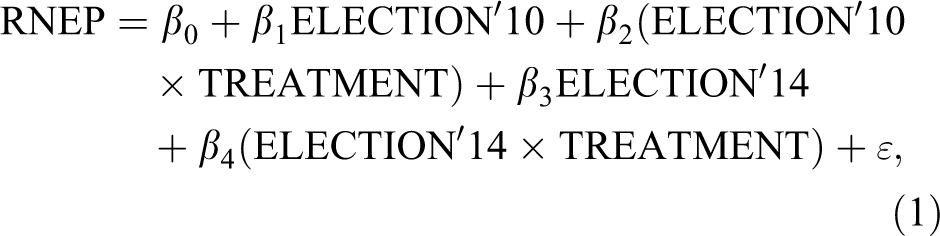
where
RNEP – the raw number of electoral parties, ELECTION’10 – a dummy variable equal to 1 for the 2010 election and equal to 0 otherwise,
ELECTION’14 – a dummy variable equal to 1 for the 2014 election and equal to 0 otherwise,
TREATMENT – a dummy variable equal to 1 if the municipality belongs to the treatment group – that is, medium-sized municipalities – and equal to 0 if the municipality belongs to the control group – that is, cities and towns with county status, with the treatment (electoral reform) applied solely in 2014,
∊ – stochastic error term.
An additional remark regarding the model specified in formula (1) should be made. As we rely on a comparison made over time within municipalities, estimating our model via fixed effects, the variables constant within a municipality may enter the equation only in the form of an interaction with a variable that varies within municipalities. For this reason, the variable TREATMENT enters the equation solely in interaction with election year dummies. That said, the following hypotheses can be put forward regarding the impact of the change in electoral rules on the raw number of parties at the municipality level and at the district level.
In the second step, we attempt to explain the impact of electoral institutions on the ENEP. We estimate the following equation:
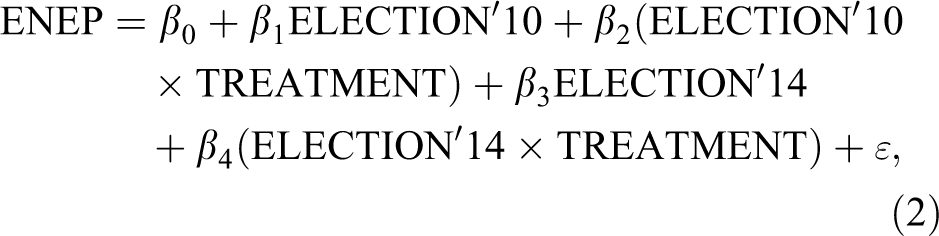
where
ENEP – the effective number of electoral parties, calculated according to the formula proposed by Laakso and Taagepera (1979), all other variables being the same as in formula (1).
We posit the following:
Finally, we also study Duverger’s mechanical effect, that is, the effect that occurs when electorate votes are converted into seats in municipality councils. We estimate the following equation:
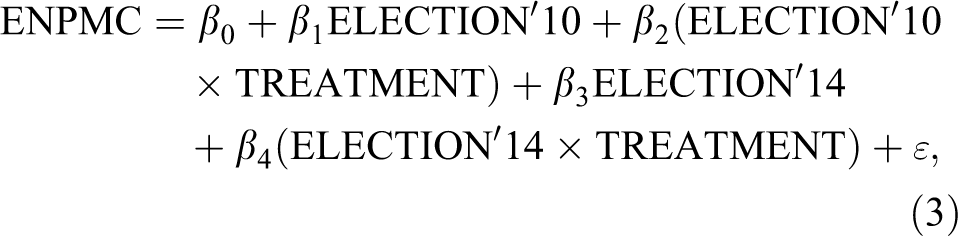
where
ENPMC – effective number of parties in a municipality council (equivalent of the effective number of legislative parties focused upon by the studies of fragmentation of national parliaments, calculated according to the formula put forward by Laakso and Taagepera (1979)), all other variables being the same as in formulas (1) and (2).
On the basis of formula (3), we present our last hypothesis.
Two additional remarks regarding our research design are necessary. First, in formulas (2) and (3), we explicitly refrain from controlling for the variable explained by the previous equation. In doing so, we do not follow the established practice of, for instance, controlling for the ENEP while explaining the effective number of legislative parties (Benoit, 2002). Unfortunately, this practice leads to serious concerns as controlling for a post-treatment variable might introduce selection bias (Elwert and Winship, 2014). Our estimates could thus no longer be interpreted in terms of average causal effects of the electoral reform. Second, we acknowledge the fact that most studies of Duverger’s laws operationalize electoral rules relying on the notion of district magnitude of a median legislator’s district. We would argue that in our study this notion is less essential. For the control group, it remained unchanged throughout the entire analysed period. For the treatment group, it was set at relatively high levels – 5 to 8 – in the pre-reform period before shifting to the value of 1 following the introduction of SMP. We thus believe that simplifying our model by not taking into account the initial (pre-reform) district magnitudes is an optimal strategy here. The above claim is supported by additional analyses (see Online Appendix 2).
All the hypotheses presented above shall be tested using data on elections to Polish municipality councils in the years 2006, 2010 and 2014. 4 The overall number of medium-sized municipalities, affected by the electoral reform in 2014, was equal to 255. Occasional data unavailability problems and recent changes to the legal status of several municipalities result in a reduction of the above number to 240. Our control group comprises 63 cities (and towns) with county status as well as 16 districts of the capital city of Warsaw. 5 Overall, our analysis is based on 957 observations (319 units observed at three time points). A potential criticism of our comparisons between the two aforementioned groups of municipalities would certainly point to the divergence with respect to population sizes and district magnitudes (under PR rule). 6 However, we believe that our analysis of pre-treatment trends (see below) – that is, the trends observed under the same electoral rule (PR) – indicate strongly that the comparisons are valid.
Results and discussion
Table 2 presents fixed-effects linear regression estimates for the models explaining the municipality-level and the district-level RNEP, the municipality-level and the district-level ENEP and the ENPMC. Figure 1 allows a deeper inspection of the regularities with respect to the municipality-level raw number of parties in both periods analysed here. The effects in the period 2006–2010 (placebo test) are very similar, the respective 95% confidence intervals largely overlapping. For the control group, the RNEP drops by 1.62 (18.3%) on average, whereas for the treatment group, the corresponding figure decreases by 1.24 (16.8%). In 2014 – that is, the year the treatment (electoral reform) is implemented – the situation changes nearly drastically. While in the case of the control group the raw number of parties changes only slightly, an increase by 0.47 (6.5%), it nearly explodes for the treatment group. The introduction of SMP and the associated abolition of the 5% legal threshold is followed by an increase in the RNEP by approximately 3.45 (56.4%) on average. The two effects are thus incomparable, especially as the respective 95% confidence intervals do not overlap. The results with respect to the district-level RNEP (see Figure 2) might at first appear somewhat more problematic. This is because the pre-reform trends are not as clearly parallel as in the case of the municipality-level raw number of parties, the negative effect being stronger for the control than for the treatment group (−1.80 and −1.09, respectively). In addition, while the 95% confidence intervals accompanying the pre-treatment effects neighbour very closely, they do not overlap. On the other hand, the proportional changes in the district-level raw number of parties are equal to −21.8% and −15.7% in the control and the treatment groups, respectively. They are thus rather comparable and, as such, indicate that our between-group comparison of post-reform regularities can be interpreted in causal terms, even if with a degree of caution. This comparison supports our thesis that, while the municipality-level RNEP should increase following a shift to SMP, its district-level counterpart should actually decline. For the treatment group, the district-level raw number of parties drops by 0.76 (13.0%). At the same time, for the control group, the analogous figure increases by 0.86 (13.3%), compensating for the substantial decline in the preceding election. We thus see strong evidence here to suggest that there exist genuine incentives toward a decline in the district-level RNEP following a shift from PR to SMP, even if the former is accompanied by a rather high legal threshold. This negative effect is also an ultimate piece of evidence supporting our thesis that the increase in the polity-level RNEP under SMP – as compared to a PR formula with a threshold – is due to a proliferation of smaller political groupings contesting selected districts only. (Only under such a scenario is the co-occurrence of a decline in the district-level raw number of parties and an increase in the municipality-level raw number of parties at all possible.) Our hypotheses concerning the RNEP (hypotheses 1 and 2) and a deeper reasoning behind them can thus be considered supported by the aforementioned analyses. 7
Predictors of party system fragmentation in Polish municipalities (elections of 2006, 2010 and 2014): Fixed-effects linear regression estimates.

Note: RNEP: raw number of electoral parties; ENEP: effective number of electoral parties; ENPMC: effective number of parties in a municipality council. Main entries are unstandardized regression coefficients and the numbers in round brackets are robust standard errors.
**p < 0.01 (one-tailed tests).
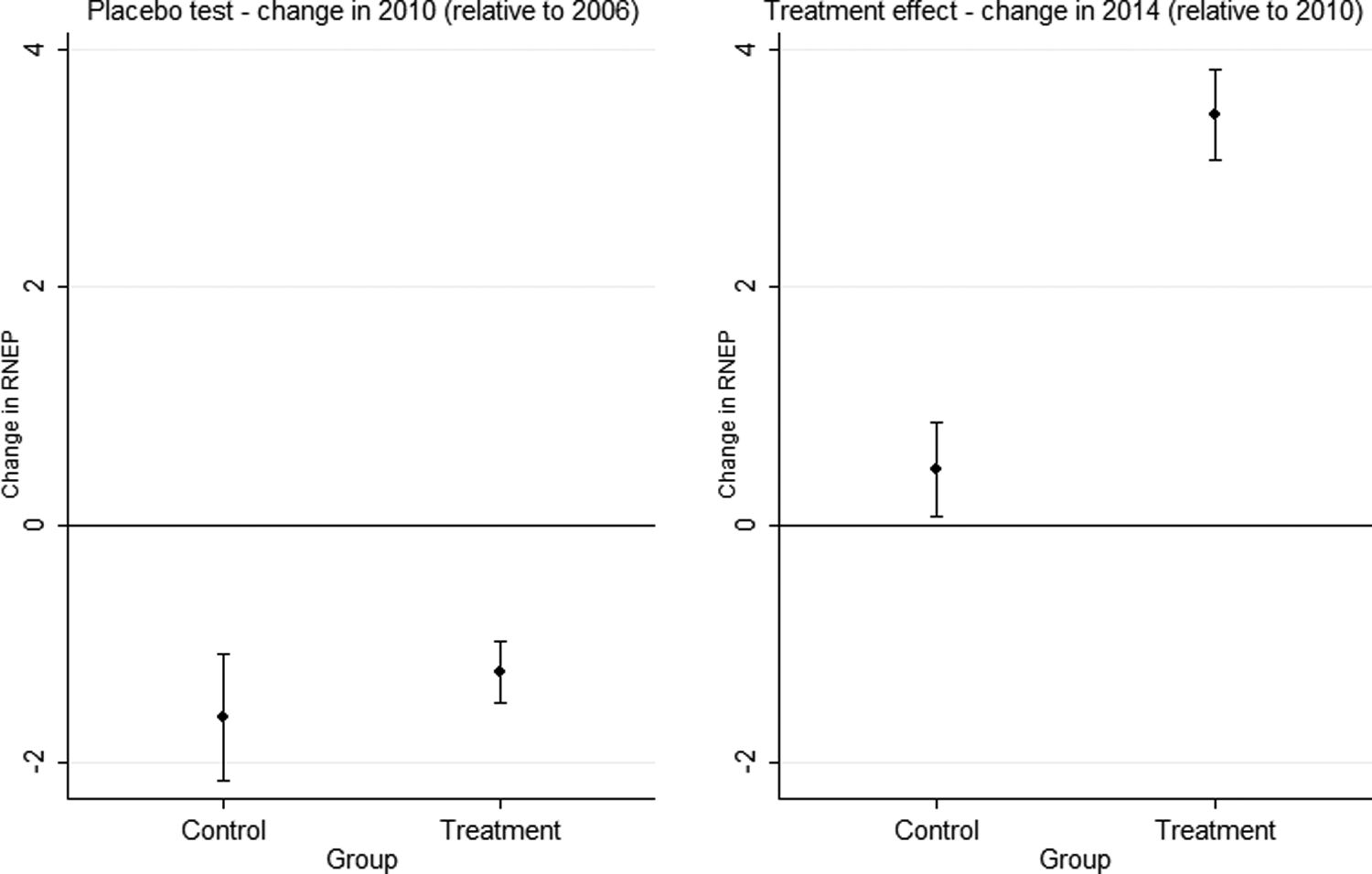
Municipality-level changes in the raw number of electoral parties (2006–2014). Note: The vertical bars represent 95% confidence intervals.
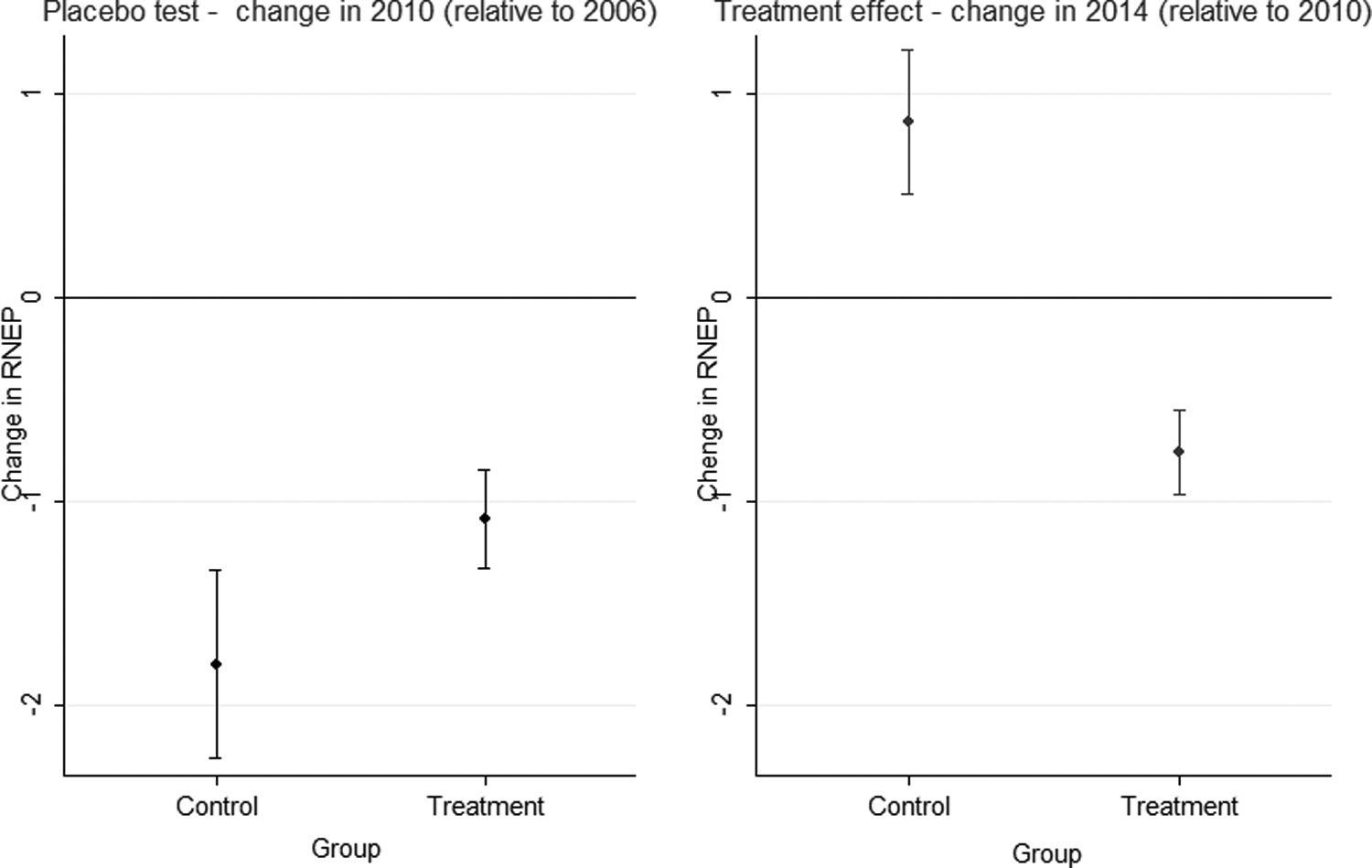
District-level changes in the raw number of electoral parties (2006–2014). Note: The vertical bars represent 95% confidence intervals.
Figure 3 presents graphically our results with respect to the municipality-level ENEP. Again, the respective changes in the period 2006–2010 suggest that we deal with parallel trends in the control and the treatment group. In the former, we see a decline in the ENEP by 0.43 (9.1%), while in the latter, the analogous figure drops by 0.52 (10.0%). In the period 2010–2014, we see a slight to moderate increase in the ENEP in both groups: 6.7% and 10.0%, respectively, in the control and the treatment groups. At first look, it might thus seem that the regularities with respect to the ENEP are driven solely by a common trend. We argue, however, that this would not be an exhaustive interpretation. In the control group, the relative stability as regards the ENEP mirrors the relative stability as regards the RNEP (see above). We thus cannot distinguish strong coordination efforts on the part of voters in this case. In the treatment group, on the contrary, the ENEP remains relatively stable despite the nearly drastic increase in the RNEP. Substantively, it means that intense coordination efforts on the part of voters had to occur for the ENEP in the treatment group to remain fairly stable relative to 2010. Not only is our hypothesis 3 largely supported here but we also see clearly the municipality-level structure of the psychological effect, induced by a shift from PR with a legal threshold to SMP. SMP incentivizes an increase in the RNEP, which in turn creates a potential for an increase in the ENEP. The potential, however, remains largely unrealized due to voters’ reacting to the introduction of SMP with intensified efforts to avoid ‘vote wastage’ (Crisp et al., 2012). Such an interpretation seems to be additionally strengthened by the trends at the district level (Figure 4). The pre-reform trends are nearly perfectly parallel. The post-reform election sees an increase for the control group by 0.29 (6.9%), a weak but statistically significant effect. At the same time, for the treatment group, the district-level ENEP decreases by 0.78 (17.1%). Our hypothesis 4 is thus supported as well. It is so especially as the aforementioned decline in the RNEP at the district level was not as strong as to necessitate a decline in the district-level ENEP. Last but not least, we must also emphasize the fact that the parties (candidates) running under SMP tend to be pre-selected on a different basis than under PR formulas. More precisely, they tend to be recruited from among those who believe to be able to attract substantial proportions of the (district-level) popular vote. In such a situation, the negative effect of the electoral reform on the ENEP at the district level is an indicator of voter choice under SMP being affected strongly by strategic calculations.
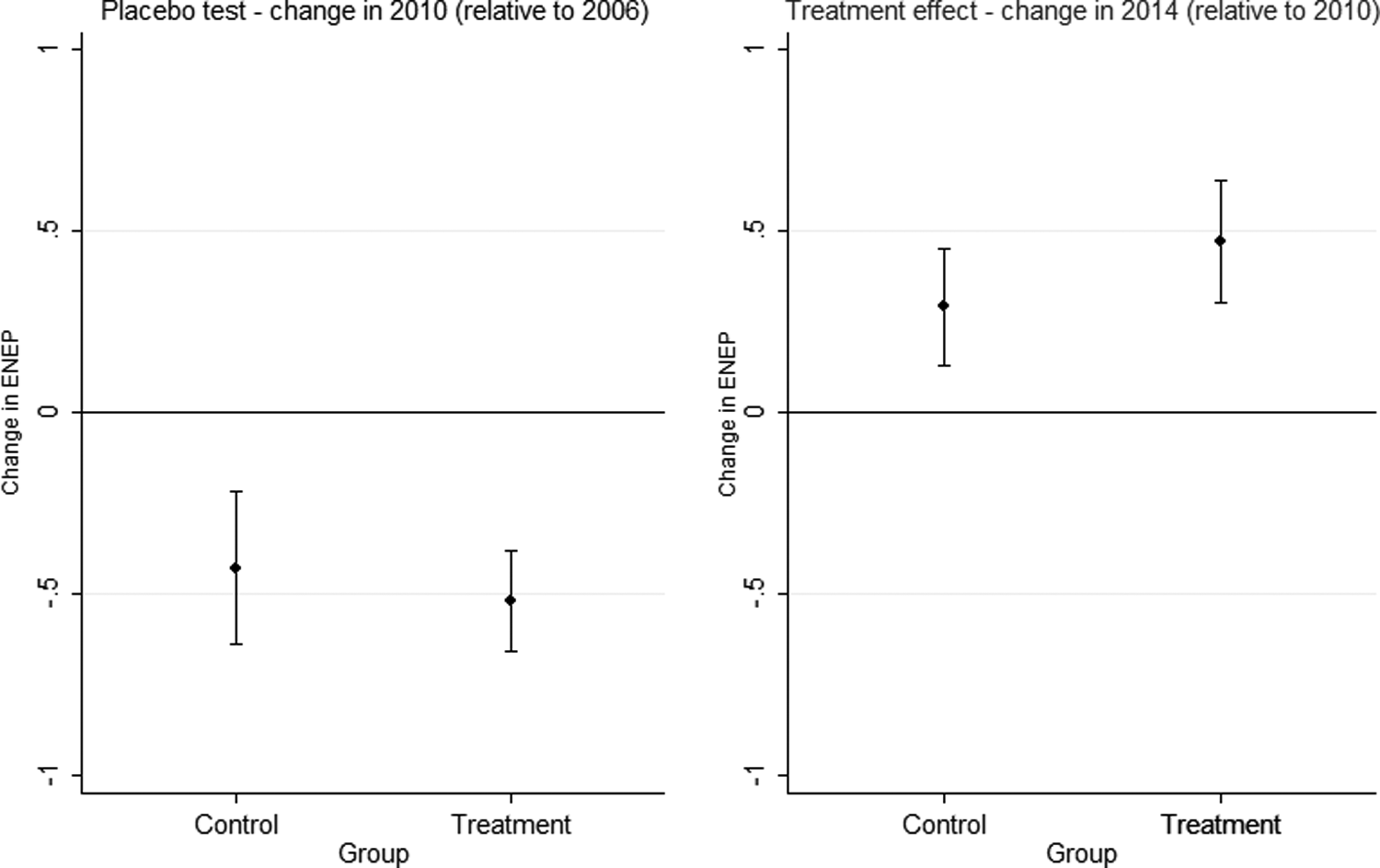
Municipality-level changes in the effective number of electoral parties (2006–2014). Note: The vertical bars represent 95% confidence intervals.
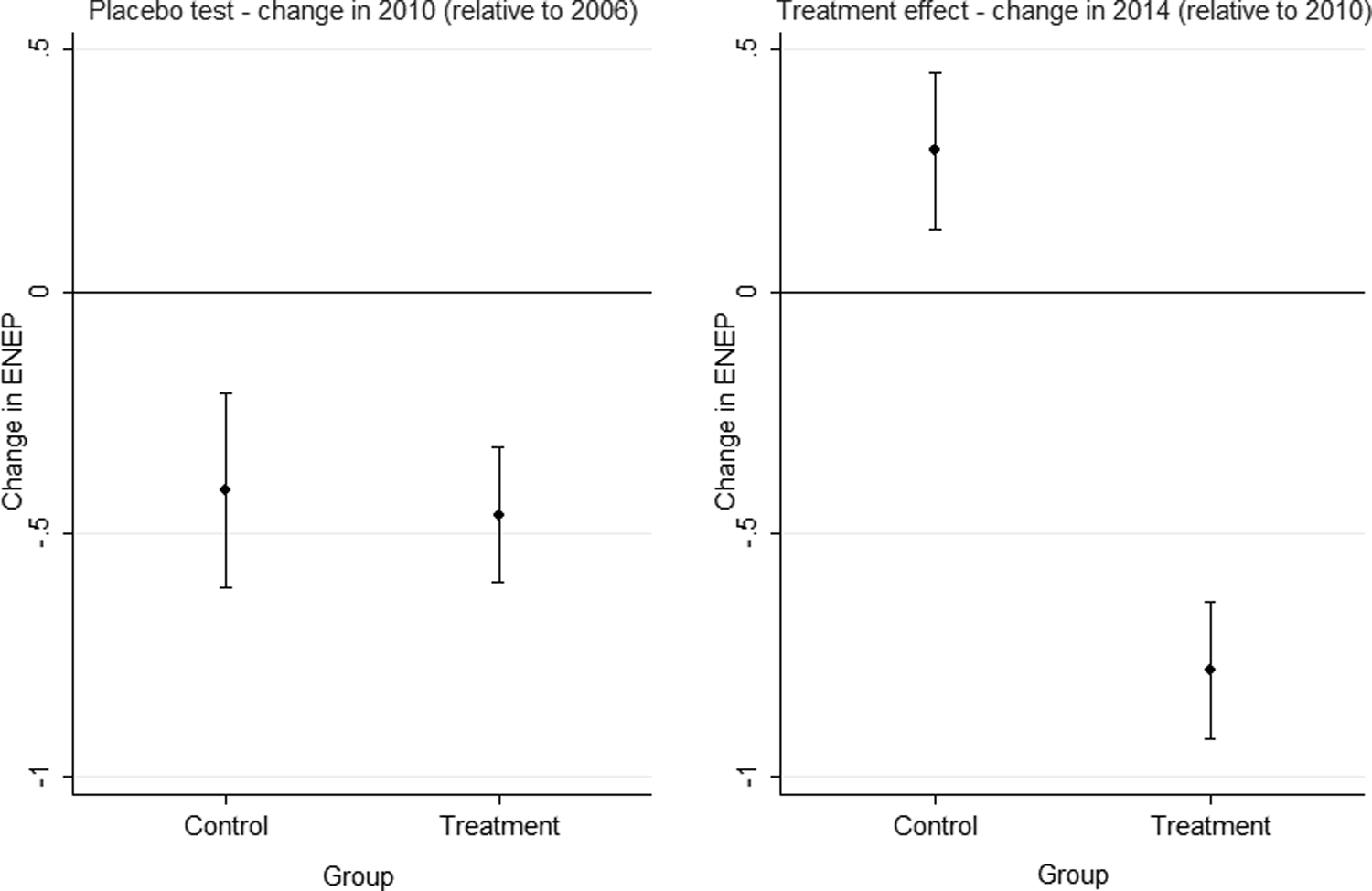
District-level changes in the effective number of electoral parties (2006–2014). Note: The vertical bars represent 95% confidence intervals.
Finally, Figure 5 demonstrates the fluctuations with respect to the ENPMC. Evidence for parallel pre-reform trends is again strong. At the same time, post-reform regularities are different between the control and the treatment group. For the control group, the ENPMC is subject to only a miniscule and statistically insignificant change. In the treatment group, we observe a decline in the ENPMC by 0.60 (16.0%) on average, a statistically significant effect. While this effect is moderately strong, it should be remembered that it occurs in a situation where the municipality-level ENEP increases somewhat. In other words, we observe this negative effect in a situation where there exists a natural tendency for an increase rather than a decrease in fragmentation. Hence, this result constitutes a strong piece of evidence to support our last hypothesis (H5): In a purely mechanical fashion, SMP eventually tends to reduce the fragmentation of party systems.
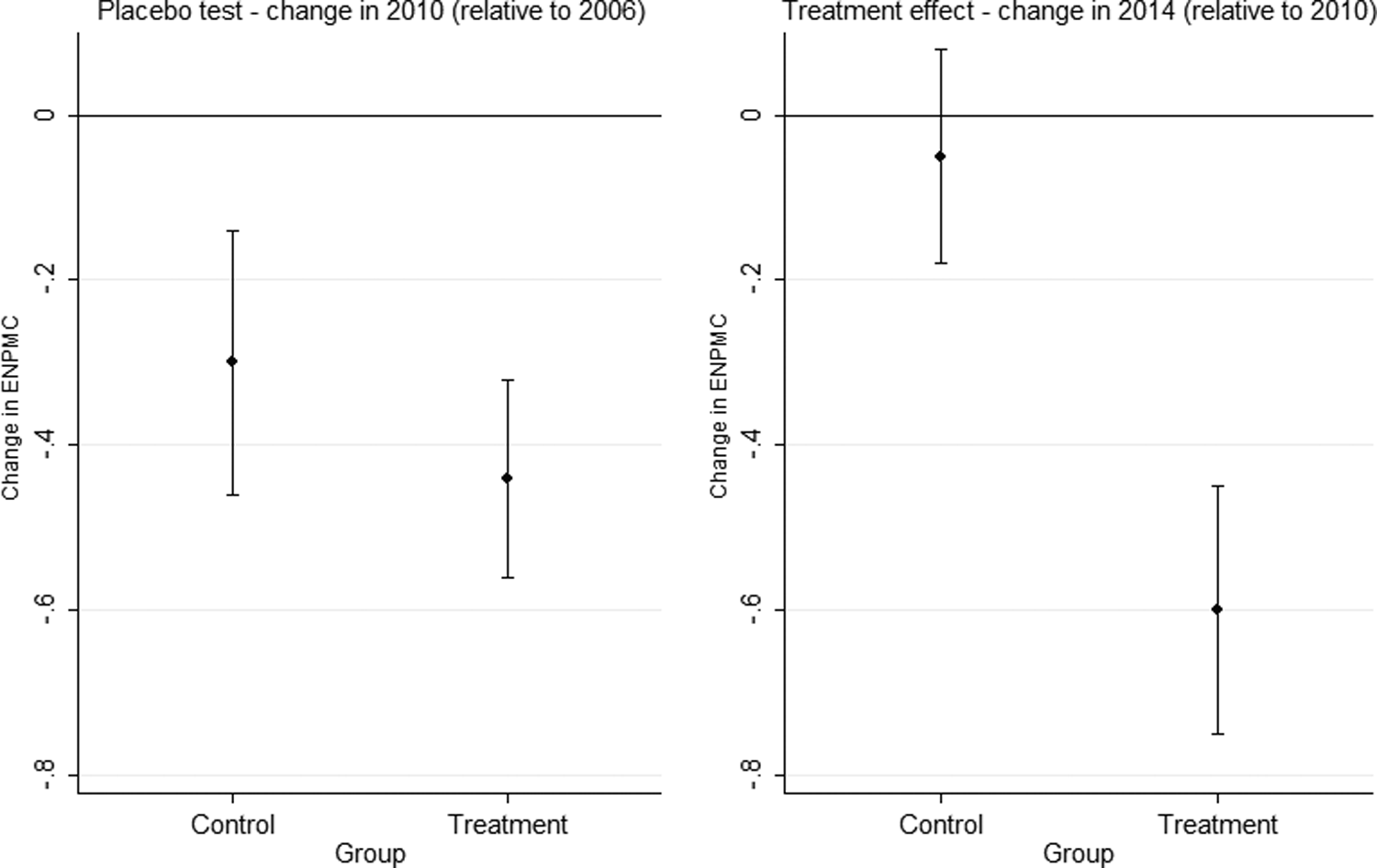
Changes in the effective number of parties in a municipality council (2006–2014). Note: The vertical bars represent 95% confidence intervals.
Conclusion
Duverger’s laws continue to be one of the central themes of the reflection on electoral politics and attract undiminished interest on the part of empiricists. While in the original version of the concept an emphasis was put on a comparison between electoral formulas, SMP and PR, the presence of additional parameters of electoral systems might modify somewhat the processes theorized by Duverger. A legal threshold accompanying PR formulas is certainly one of such parameters. In this study, we have exploited a natural experiment having occurred in municipality council elections in Poland to explore such a potential deviation from the original Duverger’s propositions. We have drawn on Moser’s (1999) work on the effects of electoral systems in post-communist states and the observation that PR with a threshold might actually be reasonably effective at reducing the effective number of electoral parties in a polity, sometimes (surprisingly) more effective than are systems with single-member districts. We have developed an explanation emphasizing divergent tendencies in the behaviour of the political elite (parties) and voters, induced by a potential shift from PR with a threshold to SMP. In such a situation, we posit, parties’ behaviour shall favour greater fragmentation, resulting in a substantial increase in the RNEP. At the same time, strategic voting shall be prevalent under SMP, a tendency preventing the translation of the increase in the RNEP into a comparable increase in the ENEP. The latter figure shall thus remain relatively stable under the conditions of the aforementioned electoral system change. Despite such a deviation in the structure of Duverger’s psychological effect, the mechanical effect shall take a more regular form. The introduction of SMP shall thus eventually lead to a reduction in the effective number of legislative parties in a polity. Our empirical analyses largely support the aforementioned propositions. (Our evidence was also additionally strengthened once we resorted to analysing the psychological effect at the district level.) More research is obviously needed to demonstrate these phenomena more comprehensively. For instance, a deeper inspection of the relationships between the RNEP and the ENEP in the context explored by Moser (1999) would certainly be worth an effort, especially as a large number of additional elections were held in the post-communist states following the publication of Moser’s work. The current study should contribute to future research endeavours of this sort.
Supplemental Material
PPQ688360_Appendix - Electoral formula, legal threshold and the number of parties: A natural experiment
PPQ688360_Appendix for Electoral formula, legal threshold and the number of parties: A natural experiment by Maciej A Górecki, and Paula Kukołowicz in Party Politics
Footnotes
Authors’ note
At the time of this research the author Paula Kukołowicz was affiliated to University of Warsaw, Poland and now she is an independent researcher.
Acknowledgements
We thank Daniel Rackiewicz for his help with the data. An earlier version of this article was presented at the European Political Science Association 5th Annual General Conference, Vienna, 25–27 June 2015. We are grateful to Valentin Schroeder and other participants for their comments there. Last but not least, we thank two anonymous referees from this journal for their suggestions on a later draft.
Declaration of Conflicting Interests
The author(s) declared no potential conflicts of interest with respect to the research, authorship, and/or publication of this article.
Funding
The author(s) received no financial support for the research, authorship, and/or publication of this article.
Supplemental Material
Supplemental material for this article is available online.
Notes
References
Supplementary Material
Please find the following supplemental material available below.
For Open Access articles published under a Creative Commons License, all supplemental material carries the same license as the article it is associated with.
For non-Open Access articles published, all supplemental material carries a non-exclusive license, and permission requests for re-use of supplemental material or any part of supplemental material shall be sent directly to the copyright owner as specified in the copyright notice associated with the article.
