



Abstract
Recent research has shown that niche parties are both increasing in importance in European party systems and behave differently than their more mainstream counterparts. Indeed, there is growing evidence that the dynamic between green parties and social democratic parties is especially nuanced. Regionalist parties differ from other niche parties in that they can be found on the left, right, and center of the ideological spectrum. We find that regionalist parties benefit from increasing the ideological distance between themselves and the mainstream party that most often wins at the national level. However, regionalist parties’ relationship with the mainstream party that most often wins in their home region is more nuanced. Regionalist parties must be distinct enough from the mainstream rival in their home region to be an alternative but close enough to serious compete for the same voters.
In recent years, there has been increasing attention given to the so-called niche parties (e.g. Ezrow, 2008; Jensen and Spoon, 2007, 2011; Jolly, 2007, 2015; Mequid, 2005; Spoon, 2007, 2009, 2011; Spoon et al., 2014). A common theme of this research is that niche parties are both increasing in importance in European party systems and behave differently than their more mainstream counterparts. Indeed, there is growing evidence that the dynamic between green parties and social democratic parties is especially nuanced (Spoon, 2011). There is reason to believe, though, that regionalist parties differ from other niche parties in that they can be found on the left, right, and center of the ideological spectrum (e.g. Toubeau and Wagner, 2013). We are interested in parties that define themselves based on a regionalist identity rather than mainstream parties that have a particular geographical concentration of electoral support. For example, the British Conservative party derives the majority of its electoral support from voters in England. However, the Conservatives are not an English regionalist party. Rather our analysis focuses on parties with an explicitly regionalist identity, such as the Scottish National Party (SNP) or the Northern League.
In this article, we examine the relationships between regionalist parties and their mainstream party rivals. A novel contribution of our analysis is that we differentiate between mainstream rivals at the national level and mainstream rivals in the local region where the regionalist party operates. For each regionalist party in our study, we identify a historically dominant mainstream party at the national level and a historically dominant mainstream party within the region where the regionalist party operates. We find evidence that regionalist parties realize electoral benefits when they increase the distance between their own ideological positions and those of the mainstream party that most often wins elections at the national level. Regionalist parties’ electoral gains, however, depend on finding a sweet spot that is close enough to the local mainstream rival to be a viable alternative for local voters, but which is still far enough away to be a distinct choice. This nuanced relationship echoes findings first identified in an analysis of the dynamic between greens and social democrats by Spoon (2011). Our findings build on this by generalizing Spoon’s argument beyond green parties and the left to include parties that can be found throughout the ideological spectrum. Our finding that regionalist parties’ relationships to their mainstream rivals is conditioned by the local or national success of that rival is a novel contribution that makes an important contribution to our understanding of regionalist parties in particular and parties in general.
The remainder of this article is divided into several sections. First, we examine the existing literature on parties with particular focus on niche parties and regionalist parties. From this, we derive our main hypotheses. In the next section, we discuss the data we use and our use of a quadratic analysis to identify the existence of sweet spots in the ideological distance between regionalist parties and their local mainstream rivals. The next section presents the results of our analysis in the context of the existing literature. We conclude with a discussion of the implications of our findings for research on regionalist parties and political parties in general.
Regionalist parties in party systems
Political scientists are increasingly interested in the politics of parties’ changing ideological positions. Tavits (2007) distinguished between pragmatic policy shifts and principled policy shifts. Tavits (2007) argued that pragmatic policy shifts could yield increased vote shares while principled policy shifts risked losing vote share. Recent scholarship has found that while there seems to be little direct evidence that voters examine the manifestos of parties (Adams, 2012; Adams et al., 2012), there is evidence that voters examine the broader context of the party system in assessing the ideological positions of parties (Adams et al., 2012; Bawn and Somer-Topcu, 2012; Fortunato and Stevenson, 2013). Bawn and Somer-Topcu (2012) argue that voters perceive parties in government as being more moderate, even when they take extreme positions. They further point out that parties in opposition have an incentive to take more moderate positions because voters do not apply the same moderating filter to opposition parties. Fortunato and Stevenson (2013) found that voters perceive that parties in the same coalition have similar policy positions.
There is growing consensus that niche and regionalist parties do not behave the same way as mainstream political parties (Ezrow, 2008; Jensen and Spoon, 2010; Mequid, 2005; Wagner, 2012). Jensen and Spoon (2010) found that niche parties’ focus on local issues lead to differences in their behavior in the European Parliament. Mequid (2005) argues that the positions of niche parties are highly sensitive to changes initiated by larger mainstream parties. Other scholars have found that niche parties try to locate themselves carefully with regard to mainstream parties (Ezrow, 2008; Spoon, 2011).
Further research has shown that niche parties will also compete with mainstream parties on dimensions beyond merely the left–right dimension. Rovny (2012) found that niche parties will strategically blur their positions on an issue dimension that is not their primary policy focus. By being ambiguous on secondary issue dimensions, a niche party is able to keep loyalists from deserting the party due to disagreement on a peripheral issue dimension. Moreover, numerous scholars have proposed that not only are niche parties aware of other issue dimensions but that they are able to adopt policy positions on noncore issues strategically (see Elias, 2009; Elias et al., 2015; Zuber, 2012). While we focus on the left–right positioning of regionalist parties for this project, we view the debate surrounding unidimensional, blurring, and two-dimensional strategies as evidence that niche parties as a whole, and regionalist parties in particular, can benefit from their locations vis-à-vis mainstream parties. We further contend that our approach does not conflict with the findings of this literature since we do not dismiss the importance of other dimensions that our study does not include.
We follow the established research in defining mainstream parties as those belonging to the Social Democratic, Christian Democratic, and Liberal party families. We follow Doring and Manow’s (2016) categorization of regionalist parties, including all of those parties they indicated were either regionalist or ethnic in their party family classification. This includes parties like the Northern League in Italy but excluded parties like the Christian Social Union in Germany, although it operates exclusively in Bavaria.
Our analysis focuses on regionalist parties. Much of the research on regionalist parties to date has tended to focus on single case analyses of particular regionalist parties with cursory attention paid to regionalist parties in other countries (see De Winter and Tursan, 2003; Heller, 2002; Hough and Jeffrey, 2006), or the focus has been on the effect European Union integration has had on regionalist parties (see De Winter and Cachafeiro, 2002; Jolly, 2007, 2015). Jolly’s work examines the changing role of regionalist parties in their respective party systems as European integration progresses. Jolly argues that European integration allows voters to see autonomy or even independence for their region as a more viable option. This, in turn, leads to more electoral success for regionalist parties. Although Jolly examines the relationship between regionalist parties’ positions regarding European integration and their left-right position, he does not examine positions of regionalist parties relative to the other parties in the system.
A common theme of work on regionalist parties is that they build their support by opposing the political leadership at the national level (Brancati, 2005, 2008; Heller, 2002; Jolly, 2015; Massetti and Schakel, 2013; Massetti and Toubeau, 2013; Toubeau and Wagner, 2013). Furthermore, much of this line of research points out that in some countries regionalist parties are located on the left of the left–right spectrum and on the right or center in others.
We build on these observations by arguing that regionalist parties benefit from distancing themselves from the mainstream parties most commonly associated with national politics at the center.
1
That is, when there is a mainstream party that wins national elections, regionalist parties can tap into general opposition to the national political atmosphere by emphasizing the contrast between their positions and the positions of that party most commonly associated with the central government. Their ability to translate their identity and grievance-centered campaigns into votes will be enhanced if they can point to significant differences in policy preferences between themselves and the party that tends to dominate at the national elections. A recent statement by Nicola Sturgeon, the leader of the SNP illustrates this well. Patiently and respectfully, we will seek to convince you that independence really does offer the best future for Scotland. A future shaped not by perpetual Tory governments that we don’t vote for, but by our own choices and our own endeavours. (quoted in Brooks, 2016)
Past analyses have argued that niche parties either are penalized for proximity to mainstream parties (Ezrow, 2008) or find an ideal distance from the median voter (Adams, Merrill III, & Grofman, 2005) or the most proximate mainstream party (Spoon, 2011) that is neither too far nor too close to it. The most thorough empirical examination of this phenomenon (Spoon, 2011) found that green parties try to find a balancing point between being so far from the Social Democratic Party that they no longer seen as viable alternatives for voters and being so close to the Social Democrats that they are not seen as a distinct alternative at all. While green parties nearly always stake positions on the center left and so are ideologically closest to a Social Democratic or Labour party, there is no reason to assume that regionalist parties will stake out positions on the center left or center right. Students of regionalist parties have found that where regionalist decentralization fits on the left–right dimension varies from one party system to another (Toubeau and Wagner, 2013) and that economic conditions and political institutions also drive party positions on regionalist reform (Massetti and Toubeau, 2013). Massetti and Schakel (2013) find that decentralizing reforms have different effects on the vote shares of regionalist parties depending on their secessionist or autonomist ideologies. Furthermore, Heller (2002) argued that regionalist parties influence policy by compromising on policy content in exchange for more authority over the policy being transferred to the local/regionalist level. We intend to explore the relationship between regionalist parties’ ideological positions relative to the largest mainstream parties. Parties like the SNP have positions very similar to the largest center-left party. But parties like the Lega Nord in Italy are located on the political right. Furthermore, Toubeau and Wagner (2013) found that the politics of decentralization has a different relationship to the left–right dimension in different party systems. If regionalist parties do not have an obvious left- or right-wing position and the politics of decentralization maps onto the left–right dimension differently across democracies, what are the electoral consequences of regionalist party positions relative to mainstream parties?
We extend Spoon’s (2011) analysis to the more ideologically flexible regionalist parties. The regionalist party version of Spoon’s argument is that regionalist parties will seek a balancing point between being too far from their mainstream party competitors and being too close. This suggests that there should be a nonlinear relationship between the ideological distance between regionalist parties and their mainstream competitor and the electoral success of the regionalist party in question.
Data collection and methods
The data collected for this project all originate from official government sources or from established data sets commonly used in other political science research. We rely on data that have been collected from official government sources, and which then have been centralized into a large data set by Döring and Manow (2012) or ElectionResources.org (Alvarez-Rivera, 2015) elections data sets. In deciding which parties were regionalist and which were not, we rely on Parlgov’s classification in determining which parties are included in our data set. To make a clear distinction of whether a party is competitive in a region, we adopt a policy of only including parties that have won at least one lower house seat over the past five election cycles.
Our dependent variable is the regionalist party’s vote share in the national election within regions where it is competitive. Our data set includes regional-level electoral results from 1983 to 2015, although for some countries we have few election years. For example, we use the SNP’s general parliamentary election vote share within the region of Scotland. This follows the approach of previous work on regionalist parties (see e.g. Jolly, 2015; Mequid, 2005). We do this for several reasons. First, we are interested in comparing the relationship between regionalist parties and their primary competitors nationally and locally in national elections. Comparing the regional election results for the regionalist parties’ relationship to their local mainstream competition but national election results for their relationship to their national mainstream competition raises problems. Regional elections are second-order elections, and as such they have important differences in the level of turnout and the characteristics of the voters who do turn out. Second, not all the countries we are examining report election results for regional elections. Finally, in some countries, one regionalist party is active in several districts. Even if we did have data for all the relevant local elections, we would be over sampling those regionalist parties in countries where the regionalist party is active in more than one designated region. 3 We chose vote share rather than seat share because we are interested in the electoral benefit of parties that, by their nature, are often small and sensitive to institutional constraints imposed by the electoral system. The vote share is more volatile than the seat share and provides us with greater variation. The election results data are drawn from both Parlgov and ElectionResources.org and cross-referenced to ensure that vote share totals are accurate. Our unit of analysis is party-national election year. There are three principal reasons for why we do this. First, as was mentioned earlier, regionalist parties need to be judged in the regions where they are competitive. Second, Spain is responsible for a disproportionate number of regionalist parties in our data set. Focusing on national results only would exacerbate the Spanish dominance of the data. We gain more observations and variance by setting the regionalist party election year at the regionalist level as our unit of analysis. 4 Third, which mainstream party is the historically dominant party varies across regions. This allows us to capture the relationship that the same regionalist party may have with two or more different historical locally dominant mainstream parties. By adopting this type of unit of analysis, we are able to reach 169 observations on which to test our hypotheses. Table 1 provides a list of the regionalist parties we examine. 5
List of regionalist parties by country.

Because we are interested in the relationship between regionalist and mainstream parties, we needed to identify which mainstream parties were the historically dominant ones both nationally and locally. In both cases, we define the historically dominant party as the political party with the majority of successes over the previous five election cycles. For newer democracies such as Romania or Slovakia, the first party to have been the most successful twice is considered to be the historically dominant party. 6 We analyze two types of historically dominant mainstream parties: historical nationally dominant (HNAT) and historical locally dominant (HLOC). HNAT is that mainstream party which won the majority of national elections up to that point, so this party will be the constant for all party-election observations for each specific election cycle but can vary over time. HLOC observations allow for variation across regions as well as time because certain mainstream parties will dominate certain regions while other mainstream parties will dominate in others.
An example of an HNAT party is the British Conservative Party in the years 1987–1997. For each of those years, the Conservatives had been the party with the highest vote share in the preceding five elections. This is not to say that the Labour party was never the party with the highest vote share. Rather we are interested in measuring the dominant trend in the party system up until that particular election. The idea is to identify the party most associated with the central government and the politics surrounding it.
An example of an HLOC party is the British Labour party in Scotland between 1983 and 2015. Two features of the HLOC party are important to note. First, the HLOC party can be different than the HNAT party. This is the case for many of our Scottish observations. For many years, the Conservatives won the greatest vote share nationwide while the Labour party was the mainstream party with the greatest vote share in Scotland. Second, it is not necessary for the HLOC party to have the largest vote share in the respective region. There are instances where the regionalist party we are examining actually won the greatest vote share in the region. However, we are still interested in the historically largest mainstream party in that region. In the event that the SNP won a greater vote share than the Labour party, the Labour party would still be the HLOC party. Table 2 shows the regions we examine in our analysis. When we identify an HLOC party, we are pointing to a mainstream party that meets the thresholds of success in national elections in the regions listed in Table 2.
List of regions by country.

Our main independent variable is the ideological distance between the regionalist party and the historically largest mainstream parties; both national and local. To measure these distances, we rely on Chapel Hill Expert Survey data (Bakker et al., 2015) for each party’s left–right score. The ideological scores on a scale of 1–10 with 1 being the extreme Left and 10 being the extreme Right. To check for robustness, we also tested ideological scores from the Comparative Manifesto Project (CMP; Lehmann et al., 2015) and Parlgov’s composite scores. These other data sets have limitations that prevent us from using them for our main results. The Parlgov composite scores are constant over time. The CMP data measures salience rather than position per se. We use the Chapel Hill data because it measures ideological position with variation over time. Our independent variables of interest are the absolute ideological distance between a regionalist party and the historically dominant mainstream parties at the national and local levels. We use the Chapel Hill left–right ideological scores for measuring the distance between the two types of parties, and we use the absolute distance because we hypothesize that regionalist parties will face ideological competition bidirectionally. Regionalist parties differ from other types of niche parties, which typically are found only to one side of a particular mainstream party. 7 Regionalist parties can be located ideologically on either side of a mainstream party both on the left or on the right. By examining the absolute value of the ideological distance, we are able to expand the analysis to include regionalist parties at both ends of the ideological distribution. Our approach depends on the assumption that when a regionalist party has a distance of x to the left of a mainstream party that is has the same substantive meaning as a distance of x to the right of a mainstream party.
To control for economic and institutional conditions, we include the Eurostat unemployment rate lagged by 6 months (Pacek, 1994; Roberts, 2008). We do this because the literature on economic voting suggests that opposition parties will do significantly better when economic conditions worsen. Given that regionalist parties are often excluded from government, we hope to control for the structural component of their vote shares. We use national unemployment rates because we could not obtain reliable unemployment data at the regional level. 8 We also control for average district magnitude because regionally concentrated parties can be expected to have an advantage in low-magnitude systems, especially single-member district systems. Regionalist parties tend to have small vote shares. None of the regionalist parties in our data set has ever established themselves as one of the two largest parties in their respective countries. Regionalist parties’ supporters are, by their nature, geographically concentrated. This can be an advantage for increasing vote share by improving the chances of winning seats. This advantage is especially likely if we take Duverger’s psychological effect seriously (Duverger, 1951). By controlling for district magnitude, we can be confident that our findings are not merely an institutional effect of disproportional electoral systems.
We test our hypotheses using two approaches. First, we conduct a series of two-way plots that include a 95% confidence interval and fitted line to demonstrate that there is a clear slope. We examined two sets of bivariate plots in which we examine a linear and quadratic relationship plotted against our data. The first set examines the two bivariate approaches as applied to the ideological distance between the regionalist parties and their respective HNAT parties. The second set examines the same two models as applied to the ideological distance between the regionalist parties and their respective HLOC parties.
We next tested for statistical significance of the relationships our two-way plots indicated. To test for significance, we use an ordinary least squares (OLS) regression. Moreover, because hypothesis 2 predicts a curvilinear relationship indicating an ideological sweet spot, we employ both a standard linear OLS regression and a quadratic equation that we also run using OLS (Fox, 2008). Quadratic equations are set up by including an additional term that is the square of the variable of interest. If the predicted curvilinear relationship exists, then the squared terms will be significant, indicating support for hypothesis 2.
Our data are structured as a cross-sectional data set rather than a panel. Because some regionalist parties only competed in one election cycle, while others competed in several, and while still others competed in a maximum of eight elections, we also tested our data using a cross-sectional time series with standard errors clustered by region and we had the same results that indicated that a cross-sectional approach was optimal. Lastly, because there were no shared time periods across our data and the number of regionalist parties far exceeded time periods, it is not recommended to run a panel-corrected standard errors approach (see Colin and Trivedi, 2009).
For further robustness checks, we tested our models using CMP data and Parlgov composite data. We found the same approximate relationship using CMP data even though it measures salience rather than a strictly ideological score. We found even stronger findings using Parlgov’s static ideological composite data, which may indicate that voters only have long-term abstract notions of parties’ ideological position. However, for this project, we focus primarily on the nuanced and dynamic ideological positions that competing parties will adopt in order to best place themselves to be competitive.
Confronting nationally, competing locally
We hypothesize that regionalist parties will have a different ideological relationship with mainstream parties that are dominant on the national and local levels. Intuitively, regionalist parties ought to have an oppositional relationship to the mainstream party in power at the national level, since their primary reason for existence is typically to secure more regional autonomy that comes at the expense of the party in power nationally. Conversely, we posit that regionalist parties will need to compete with, rather than be in opposition to, the mainstream party at the local level. This means that graphically there should be a linear relationship between regionalist parties and the HNAT party, and a curvilinear relationship between regionalist parties and the HLOC party that reflects an ideological sweet spot where regionalist parties will be the most competitive electorally.
In testing our first hypothesis, we find evidence that regionalist parties benefit electorally the further they distance themselves ideologically from the HNAT party. In Table 3, we test the effect of ideological distance between regionalist parties and the historically dominant party at the national level. Model 1 shows the straightforward OLS regression in which the depended variable is the regionalist party vote share. Model 1 shows a barely significant and positive relationship between the absolute ideological distance between the regionalist party and the HNAT party. This result supports the intuition from much of the regionalist party research that regionalist parties benefit from increased conflict with the center (as represented by HNAT). To investigate whether this relationship might be curvilinear, we also run a quadratic OLS regression to compare to our linear regression models. Model 3 shows the same model as model 1 with the squared term added. The absolute ideological distance with HNAT is no longer significant and the squared term is also not statistically significant.
Statistical analysis of ideological distance between regionalist parties and historically dominant mainstream parties.

Note: HNAT: historical nationally dominant; HLOC: historical locally dominant.
*p < 0.10; **p < 0.05; ***p < 0.01.
The results from model 1 and model 3 together allow us to rule out the possibility of a curvilinear relationship between the absolute ideological distance between the regionalist party and HNAT. Figure 1 presents a plot of regionalist party vote share and our explanatory variable absolute ideological distance (HNAT).
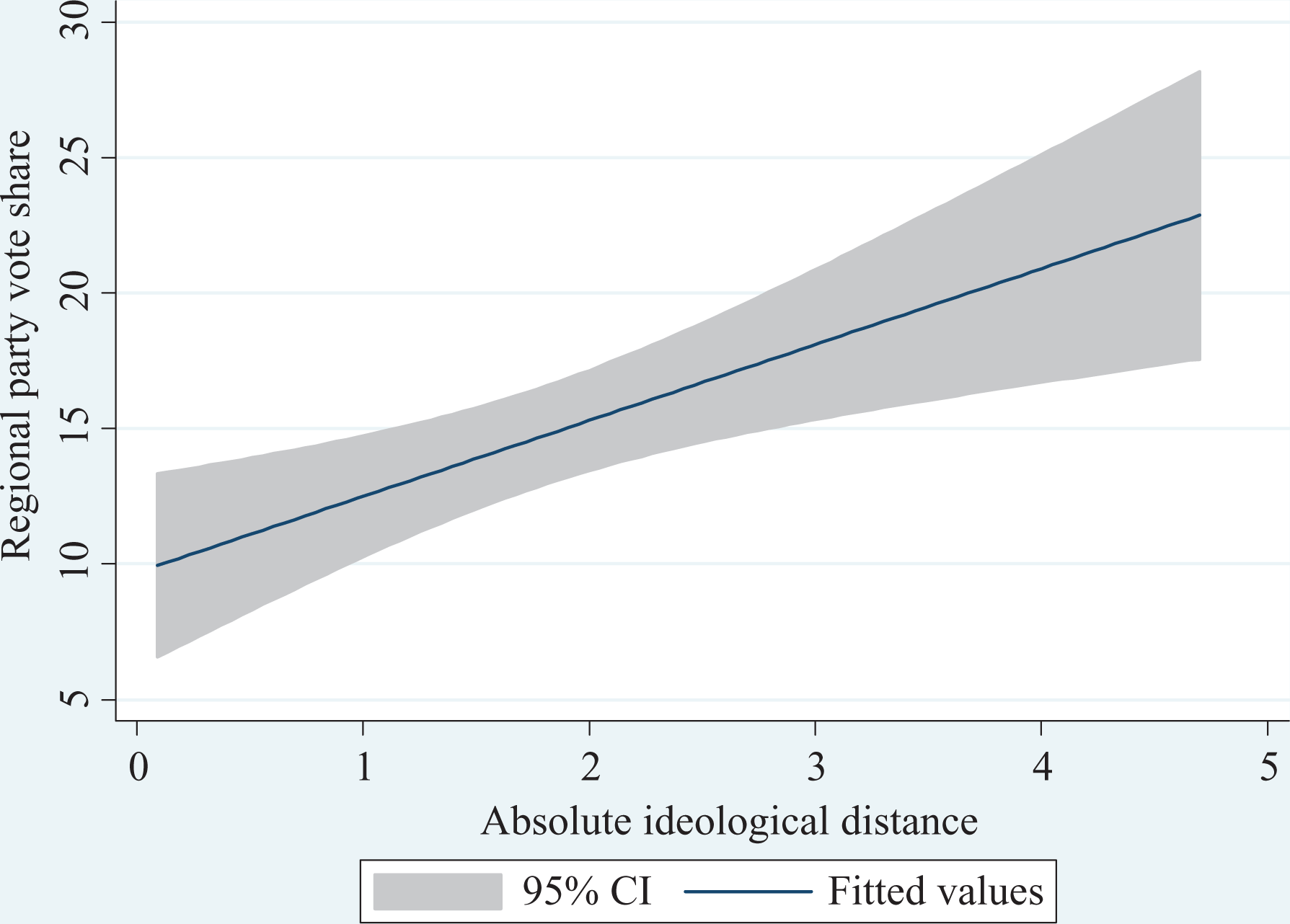
Linear relationship between ideological distance between regionalist parties and historically dominant mainstream party at the national level and electoral success of the regionalist party.
Figure 1 supports our hypothesis that regionalist parties benefit electorally by distancing themselves as strongly as possible from the HNAT party. Even if this oppositional relationship is only being played by the regionalist party, it will continue to benefit from railing against the party associated with the far-away capital. Furthermore, and in contrast to competing locally, it appears that a regionalist party does not risk distancing itself too far away from the HNAT party because the linear models in Table 3 and the plot in Figure 1 are a much better fit than the quadratic models in Table 3 and a curvilinear bivariate plot.
Our second hypothesis posits that in contrast to the relationship between regionalist parties and the HNAT party, regionalist parties will have a different relationship with the HLOC party. Specifically, we argue that there will be an ideological sweet spot where regionalist parties can place themselves in order to maximize their electoral success. The presence of such a sweet spot would be represented by a curvilinear relationship between absolute ideological distance (HLOC) and regionalist party vote share. In order to test whether there is any ideological dancing occurring, we see in Table 3 that the quadratic model in model 4 outperforms our linear model in model 2. 9 Model 2 represents a linear specification of the relationship of interest. The results are not significant. Model 4 includes the square of the absolute distance between the regionalist party and the HLOC. That the squared distance is significant model 4 shows that the relationship between the absolute distance between regionalist parties and the HLOC party and regionalist party vote share is curvilinear.
It is noteworthy that when we compare how regionalist parties relate to nationally and locally dominant mainstream parties, there is a clear divergence in regionalist parties’ relative positions and their vote share levels. When regionalist parties are competing with the locally dominant mainstream party, they benefit from greater ideological differences from their mainstream competition regardless of whether they are a left-leaning or right-leaning party. This is consistent with our second hypothesis. Furthermore, this finding extends Spoon’s (2011) argument of an ideological sweet spot beyond the particular relationship between Greens and Socialists but is also occurring between regionalist parties on the left and the right and their competition with the Socialists or the Christian Democrats, respectively. Furthermore, this curvilinear relationship is even clearer in Figure 2 when regionalist party vote share is graphed in a bivariate plot with absolute ideological distance.

Quadratic relationship between ideological distance between regionalist parties and historically dominant mainstream party at the local level and electoral success of the regionalist party.
Regionalist parties’ vote shares decline if their positions are not distinguished sufficiently from their locally dominant mainstream competition but their electoral losses are even lower if they are located in positions too far from their mainstream competition. There is clearly an ideological sweet spot for regionalist parties to position themselves for electoral success, and it is between 2 and 3 ideological units (of a 10 point scale) from their local mainstream rivals. A regionalist party’s election strategy must contend with the possibility that it could overreach in distancing itself ideologically from what is popular locally. Regionalist parties will start to see marginal loses once they start to approach 3 ideological units away from their local mainstream opponent. They do not face this risk when they campaign against their national mainstream opponent.
The clearest example of this is the SNP in Scotland. Our findings suggest that the SNP would face no electoral costs the further they place themselves away from HNAT, the Conservatives. However, the SNP would benefit electorally from being located more closely to the mainstream party that dominates in Scotland, Labour. Indeed, the SNP’s left–right position is quite close to that of Labour. Likewise, Plaid Cymru, the majority of the Basque parties, and the ethnic Hungarian parties in Romania and Slovakia typically find themselves ideologically at odds with the nationally dominant mainstream party, but ideologically close to the locally dominant mainstream party.
To comprehensively test our arguments, we conducted a unified model including the distance between the regionalist party and the historically dominant parties at both the national (HNAT) and local/regional level (HLOC). Because the squared term was not significant for the HNAT model in model 3, we included only the square of the distance between the regionalist party and the HLOC party. The results of this analysis are reported in model 5. The results in model 5 are largely the same as those in the earlier models. We find that the relationship between the regionalist party’s position relative to the HLOC party and the regionalist party’s electoral success is a curvilinear relationship. Furthermore, we find that in the unified model, the absolute distance between regionalist party position and the HNAT party is not a significant predictor of regionalist party electoral success. We believe the results of the unified model suggest that electoral success of regionalist parties is driven by the politics of their home regions more than by their relationship with HNAT. This finding that emphasizes different factors from much of the literature on regionalist parties. Regionalist parties realize greatest electoral benefit when they are similar but not too similar to the historically dominant mainstream party in their home region. This emphasis on local political dynamics shifts some of the focus away from the periphery versus center confrontation that is so important in most analyses of regionalist parties.
Another complicating factor for our analysis is the possibility that the HLOC and the HNAT are the same party. Model 6 includes a dummy variable for those cases in which HLOC and HNAT are the same party. The results are largely unchanged from model 5 to model 6 showing that our results are not driven by case selection. This also shows the robustness of our finding that the electoral benefits of regionalist parties’ positions relative to the mainstream party that dominates their home region is curvilinear.
Conclusion
We set out to examine the relationship between regionalist parties and mainstream parties in parliamentary democracies. We derived two hypotheses from the previous research on niche parties. In testing these, we have made an intriguing discovery. Regionalist parties appear to unambiguously benefit from distancing themselves ideologically from the dominant mainstream parties at the national level. However, regionalist parties’ relationship to the dominant mainstream parties in their home regions is more nuanced. Like green parties’ relationship with social democratic parties (Spoon, 2011), regionalist parties have to balance the benefits of being ideological distinct from their local mainstream rivals against the costs of being too distant from the mainstream to be appealing to voters. The result is that we identify a sweet spot where the electoral benefit to regionalist parties maximizes.
Our findings are particularly interesting because they show that regionalist parties are best understood in a multilevel context. Our findings in models 1 and 3 confirm the usual thinking that regionalist parties thrive by distinguishing themselves from the national center. Regionalist parties receive an electoral benefit from distancing themselves from the nationally dominant mainstream party. In effect, regionalist parties get a straightforward benefit from confrontation with the political center. However, our findings in models 2, 4, 5, and 6 add nuance to this periphery versus center story. We find that regionalist parties realize electoral gains when they approximate a sweet spot that is close but not too close to the ideological position of the historically dominant mainstream party in their home region. This suggests that regionalist parties operate on two levels simultaneously. On level 1, they confront nationally dominant mainstream parties. On level 2, however, they are engaged in a nuanced competition with locally dominant mainstream parties.
These findings shed important new light on the nature of regionalist party competition with mainstream parties. Regionalist parties seem to be in confrontation with the mainstream parties that dominate the national political scene. The relationship between ideological distance and electoral benefit is linear and they benefit continuously from increasing their ideological distance from whichever party tends to dominate nationally. This is consistent with what we know about regionalist parties. They often rise and thrive in an environment when the voters of a particular region feel poorly served by national politics. In such an environment, the regionalist party can enhance its electoral appeal by drawing the starkest contrast possible with the dominant mainstream party on the national scene.
In contrast, regionalist parties appear to be in less confrontational competition with dominant mainstream parties in the home regions. Like green parties, regionalist parties seek to distinguish themselves from parties that they are competing with for some of the same voters. Having an overly similar ideological position risks being absorbed by the larger, mainstream party (Mequid, 2005). Having a position that is too dissimilar abdicates the voter-rich ideological territory to the competition. The difference between regionalist parties and green parties is that regionalist parties’ focus is geographical rather than ideological. This means where green parties are only in competition with mainstream parties of the center left, especially social democratic parties, regionalist parties may find themselves in competition with parties on the center left or center right.
Our finding makes two contributions to the political science literature on niche parties. First, we generalize Spoon’s (2011) theory of green party competition with the center left. Our finding of a similar dynamic in regionalist parties extends and confirms Spoon’s theory in a previously unexplored sample. We add another category of niche party to the list of those parties to which her theory applies. Furthermore, because regionalist parties are not inherently left of center or right of center, we extend her theory to both sides of the left–right divide. Second, we show that the geographical focus of regionalist parties forces them to consider multiple levels. They face one set of strategic incentives at the national level and another locally. This is a complicating but not intractable problem for them. Especially when the nationally dominant and locally dominant mainstream parties are different parties, regionalist parties can simultaneously confront the national center while avoiding taking positions that directly contradict those of the most popular party locally.
One implication of our findings is that in regionalist parties will be sensitive to changes in the identity of locally dominant mainstream party. One possibility is that following a change in HLOC party, a region party would change its own position to maintain its position at the sweet spot of maximum electoral benefit. Alternatively, the regionalist party could hold its position steady but see its electoral success change in response. Finally, these implications suggest that in regions where more than one regionalist party operates, that regionalist party that most closely holds the sweet spot ideological position will see the greatest electoral success. 10
Our research suggests that regionalist parties have much in common with niche parties in general. However, their particular geographical focus imposes strategic circumstances that are unique to regionalist parties. At the same time, regionalist parties are emerging as important parties throughout much of Europe. Regionalist parties have proven indirectly critical to determining the winner of national elections, as in the United Kingdom, and even directly important to the formation of governments, as in Italy. Our findings show that in addition to being increasingly important to democratic politics, regionalist parties a distinct and theoretically interesting subject of study within the broader research on parties.
Supplemental material
APPENDIX - Confrontation and competition: The electoral benefits of regionalist parties’ positions in parliamentary democracies
APPENDIX for Confrontation and competition: The electoral benefits of regionalist parties’ positions in parliamentary democracies by Nathan Henceroth, and Christian B Jensen in Party Politics
Footnotes
Acknowledgments
Jensen would like to acknowledge financial support for this research from the UNLV College of Liberal Arts Summer Research Program and the UNLV Faculty Opportunity Award. He would also like to thank Moritz Rissmann for valuable research assistance.
Declaration of Conflicting Interests
The author(s) declared no potential conflicts of interest with respect to the research, authorship, and/or publication of this article.
Funding
The author(s) disclosed receipt of the following financial support for the research, authorship, and/or publication of this article: The financial support for this research was obtained from the UNLV College of Liberal Arts Summer Research Program and the UNLV Faculty Opportunity Award.
Supplemental material
Supplemental material for this article is available online.
Notes
References
Supplementary Material
Please find the following supplemental material available below.
For Open Access articles published under a Creative Commons License, all supplemental material carries the same license as the article it is associated with.
For non-Open Access articles published, all supplemental material carries a non-exclusive license, and permission requests for re-use of supplemental material or any part of supplemental material shall be sent directly to the copyright owner as specified in the copyright notice associated with the article.
