




Abstract
In the postcommunist period, political parties in Central and Eastern Europe (CEE) had to convincingly demonstrate that they are a vital part of a functioning democratic society. Well-developed intraparty democracy (IPD) is one way of accomplishing this. By asking what factors are relevant to an explanation of IPD formation, we present an analytical framework in which the formation of IPD can be investigated and explore the patterns of IPD and their determinants. We draw on a newly constructed data set based on standardized content analysis, including 129 party statutes from 14 major political parties from Hungary, Romania, and Slovakia between 1989 and 2011. Relying on unit fixed-effects regression approaches, our analyses suggest that especially imperatives related to party origin and Europeanization have important implications for the formation of IPD within CEE parties.
Introduction
Despite partisan dealignment and declining membership numbers, political parties are still central actors in the decision-making process in modern representative democracies (Cross and Katz, 2013: 1). Thus, they are also important actors in the process of democratic consolidation in young democratic political systems such as in the Central and Eastern European (CEE) context (Pridham, 2014). This assessment is based on a normative interpretation of the concept of intraparty democracy (IPD) that considers it as being crucial for the fulfillment of basic functions of political parties such as representation, accountability, and implementation. Viewed from this perspective, IPD becomes a way for parties to demonstrate that they are responsive to people’s wishes, which raises the question of how internally “democratic” CEE parties are actually organized.
There are also contrasting viewpoints. According to Schumpeter (1942), parties have to be responsive to voters, not to members, if they want to have a positive effect on democracy. Others go one step further and argue that too much IPD might detach a party from the preferences of the electorate (Katz and Cross, 2013: 171–173). In the CEE context, however, this is of minor importance. From a theoretical perspective, the focus on CEE countries after the breakdown of their communist regimes in 1989 has to take into account that a major part of the transformation of their political and economic systems was democratic consolidation (Merkel, 2011). The key argument related to this is that the practice of IPD has the potential to positively affect democratic consolidation since it is critical to a healthy and functioning democracy. Understanding the dynamics of party institutionalization and democratization is crucial especially given that parties without institutionalized internal democratic structures would be unable to accommodate social demands. The empirical relevance of this particular focus is also highlighted by Katz (2006: 44) who stresses that studying IPD in former communist regimes is desirable, because it meaningfully expands our knowledge that has been previously collected by studying Western European countries.
But what actually is IPD? In an ideal democratic party, the will should be formed “bottom up” and power should not be concentrated in one organ (Cular, 2004: 32). This implies that IPD is a two-dimensional concept consisting of “inclusiveness” and “decentralization” (von dem Berge et al., 2013). While inclusiveness refers to the scope of the circle of decision makers (the wider the circle, the more inclusive), decentralization refers to the extent of autonomy that subnational party units enjoy in making decisions and the extent to which they are able to influence decisions on the national party level.
In general, it is quite surprising that only a few studies have been interested in explaining why IPD, or some of its conceptual aspects, vary between political parties and countries (see e.g. Kenig, 2008; Lundell, 2004; Pennings and Hazan, 2001). In the CEE context, findings of previous studies on the formation 1 of IPD are mostly based on case studies of single countries, or focus on a very narrow number of political parties (for a summary, see Bäck, 2008). The main conclusion regarding CEE parties is that they remain rather “oligarchic” with respect to their leadership selection procedures (Chiru and Gherghina, 2012). This finding can be explained in terms of structural constraints that played a major role during the initial phase of party institutionalization. It has been previously observed that the structural settings of an overall weak institutionalization were characterized by exclusive control of the parliamentary party over leadership selection and a rather limited involvement of the parties membership base (Kostelecký, 2002; Tavits, 2013). Furthermore, as compared to Western European democracies, the newly forming countries in CEE had “little experience with multi-party democracy or the practice of pluralist politics” because their democratic experience was interrupted by emerging communist regimes (Lewis, 2000: 6).
Overall, due to the lack of comparative evidence regarding the formation of IPD in CEE countries, our main research question is the following: What factors are relevant to the explanation of the formation of IPD within CEE parties? Against this background, the time period between 1989 and 2011 is of great interest, because it encompasses more than the first two decades of the newly emerging parties and democratic political systems after the collapse of communism in CEE. To answer our research question, we use Harmel’s (2002) typology of “party organizational change” as an overarching theoretical framework. Within this framework, we generate specific hypotheses about the formation of IPD within CEE parties. Subsequently, these hypotheses are tested empirically.
Theoretical framework: IPD formation as a variant of party organizational change
In dealing with factors that contribute toward an explanation of IPD, we have to consider that, in the absence of a general theory, there are several strands of the literature providing important insights and suggesting relevant hypotheses. Broadly defined as change in “party rules, structures, policies, strategies or tactics” (Harmel and Janda, 1994: 272), the concept of party change (e.g. Harmel, 2002; Harmel and Janda, 1994) provides an useful reference point for theorizing about IPD formation in CEE. In particular, we are invariably dealing with party organizational change (Harmel, 2002) because, broadly speaking, IPD refers to the implementation of a minimum set of norms within the organizations of political parties (Rahat and Shapira, 2016). The reasons for party organizational change can be internal (within the party) and/or external (outside of the party). But in the end, also externally motivated changes have to be implemented within the party by those who are in power, which have to respond to the environmental stimulus (Harmel, 2002: 129, 132).
Harmel (2002) suggests three main theoretical approaches that can be used to explain party organizational change: the “lifecycle approach,” the “system-level trends approach,” and the “discrete change approach.” The lifecycle approach and the system-level trends approach can be considered as rather “evolutionary models of party change,” whereas the discrete change approach is rather to be viewed as a “developmental model of party change.” While especially the lifecycle approach (“evolutionary model”) describes to a large extent the natural process of party institutionalization and stabilization, the discrete change approach (“developmental model”) considers primarily political events and circumstances as reasons for party organizational change. We use all three types of party organizational change to explain the formation (i.e. evolution and development) of IPD within CEE parties.
The lifecycle approach
From the perspective of the lifecycle approach, organizational changes of CEE parties can be interpreted in terms of “evolutionary changes” that occur over time as parties mature, because these parties were (re-)founded in the early 1990s after the collapse of communism and therefore undergo a kind of “natural evolutionary” process. In this sense, all CEE parties are at more or less similar “evolutionary stages” in which organizational changes can be considered as ordinary events on the way to stabilization and institutionalization. Broadly speaking, especially in the 1990s, but also in the early 2000s, CEE parties and party systems were only weakly institutionalized when evaluated on the basis of the two main indicators “age” and “electoral volatility” and became more institutionalized as time went on (e.g. Powell and Tucker, 2014). Therefore, one can argue that parties in democratic systems become more internally democratic as time progresses. First, because increasing democratic experience over time leads to “democratic professionalization” of decision makers and staff and should therefore improve IPD. Second, the first thing new parties have to do in order to survive is to set the foundations of their organizations, for example, a network of local branch offices and a professional central office staff (Tavits, 2013: 2). Only after accomplishing this first step, they can turn toward more “normative” issues like IPD.
A reversed line of reasoning is plausible as well. In his “iron law of oligarchy,” Michels (1911) argues that all parties—which were not oligarchic from the beginning—are very likely to develop oligarchic and centralized structures. We argue that this does not apply to young democratic parties in the CEE context, because after 1989 these parties had to adapt to the newly emerged democratic political systems that were consolidating themselves, which means that they underwent extensive transformational changes. And this is exactly what also the young democratic parties had to do: implement and perform “democratic consolidation.”
Besides party age, the development of party systems in the studied countries is characterized by the emergence of parties with different degrees of organizational continuity. Especially, Kopecký (2001: 74–75) and Kostelecký (2002: 76–79) differentiate between “genuinely new parties,” “continuous parties” that emerged as a result of the transformation of previously communist parties and “revived parties” with precommunist historical traditions. As compared to the latter two, we expect the newly emerged parties to be more inclusive (Chiru and Gherghina, 2012: 513; Cross and Blais, 2012: 130, 134–135).
The account of Bozóki and Ishiyama (2002: 51) is instructive in terms of explaining the lack of “willingness to engage in reform” for both, revived and continuous parties, and suggests that this is the result of clientelistic patronage networks and strategic decisions remaining confined within a rather limited circle of party elites holding on to “centralist party structures” (see also Gherghina, 2014: 38–40; Scarrow, 2005: 5). The expectation regarding genuinely new parties is therefore based on two main arguments: first, inclusive intraparty institutions help new parties to become more attractive to voters and second, for these parties, it is easier to establish such institutions because there are no established party elites that could potentially feel that their position is threatened. Furthermore, genuinely new parties can be expected to be more democratic—as compared to continuous and revived parties—because they were formed after the breakdown of the previous autocratic regimes in a democratic context and openly profess their conviction toward its values. This argument is not restricted to CEE parties, but applies to parties in all post-autocratic countries.
The system-level trends approach
The system-level trends approach explains party change as an adaptive response to changes in the environments of parties (Harmel, 2002: 119, 129). These changes occur at particular periods of history: “Dramatic environmental changes” in the historic evolution of political parties “effect fundamental change in the nature of party organization” (Harmel, 2002: 128, see also 124–125).
In our framework, “system level” is more narrowly defined as the national and European political system. The “historic stage” of the political systems influences its characteristics which in turn influence the political parties existing within these systems. We are therefore looking for major-impact developments and changes of the environment of political parties that lie beyond imperatives related to day-to-day party competition. In our contribution, we are able to cover the time period between 1989 and 2011 and during this time there are two system-level processes which led to fundamental and even radical transformations of the political systems in CEE: Europeanization 2 and Democratization (Pridham, 2014).
Starting with Europeanization, one can expect party organizational change over time, because within the European Union (EU), CEE parties work together closely with West European parties that constitute their new “European” environment. Furthermore, von dem Berge and Poguntke (2013: 316) expect that those CEE parties which integrate into one of the two main “Europarties” European People’s Party (EPP) and Party of European Socialists tend to democratize their intraparty procedures over time. The reason is that “Europarties are supposed to require a minimum of intra-party democracy, because they regard themselves as promoters of democracy [….] and, equally important, undemocratic membership parties would undermine the legitimacy of the Europarty” (von dem Berge and Poguntke, 2013: 316). As this process of Europarty Eastern enlargement takes place within the superordinate process of EU Eastern enlargement on the level of nation states (Delsoldato, 2002: 270), it is conceptualized as a system-level trend. This does not apply to all CEE parties, but only to parties from countries which have joined the EU in 2004 and 2007.
Democratization is also expected to lead to organizational changes within CEE parties. Since the collapse of the Soviet bloc, CEE countries have experienced fundamental transformations in the political, socioeconomic, and cultural sphere and have become more democratic (see e.g. Merkel, 2011). In the context of party change theory, based on the party adaptation premise (Harmel and Janda, 1994), the expected positive influence of state-level democracy on IPD can be interpreted in terms of the emergence and pervasiveness of democratic norms and values that were one of the cornerstones of the transformation after the abolition of the countries’ autocratic regimes (Merkel, 2011). Besides, a structural argument can be made, stressing that the experience of party officials and elites with democratic procedures is crucial for IPD. Also, democratic norms and trends at the political system level create incentives for parties to adopt democratic intraparty structures such that they “gain advantage in inter-party competition” (Barnea and Rahat, 2007: 378).
Furthermore, at the system level, the mere existence of a “party law” might influence the IPD levels of parties. In fact, almost half of the party laws in Europe refer to IPD (van Biezen and Piccio, 2013: 47). Moreover, van Biezen and Piccio (2013: 48) find that “IPD constitutes a significant and increasing area of national regulation.” And most importantly, if party laws intervene in intraparty processes, this is usually done in favor of IPD (van Biezen and Piccio, 2013). As many CEE countries took Germany as a “democratic role model” during their democratic transformation processes, one can expect that these countries are likely to implement a party law similar to the German one, which refers quite precisely to IPD. Furthermore, CEE parties are suitable objects to test this assumption because from 1989 until 2011, there were periods with and without party laws.
The discrete change approach
Discrete party changes are less sweeping than lifecycle or system-level changes (Harmel, 2002: 125). As compared to the previously discussed “evolutionary” reasons for party change, these “developmental” changes are more commonly the results of short-term single events. Events causing IPD development can be either external and thus traced back to the environment of political parties and/or confined to the internal functioning of political parties themselves (Harmel, 2002: 119, 125).
Regarding the external reasons, electoral defeat is argued to be the “mother of party change” (Janda, 1990: 5), because it forces parties to reevaluate the ideological positioning as well as the functioning of their internal structures and processes (Harmel and Janda, 1994). The main argument behind this expectation is that a party which suffers from a poor electoral performance might increase its IPD in order to attract more voters and/or counter a decline in party membership. The reason is that many parties believe that enhancing the rights of members in decision-making processes has a positive effect on the public image of the party (Cross and Blais, 2012: 130). All this is arguably particularly true for the CEE context, where electoral volatility is widespread (Powell and Tucker, 2014).
Concerning the internal reasons for party organizational change, one of the most important factors is leadership change (Harmel, 2002: 126–127; Harmel and Janda, 1994; Müller, 1997). In the CEE context, this phenomenon has been observed in a case study of the Hungarian Socialist Party (Ágh, 1995: 501). In this vein, Harmel (2002: 128, 139) asks who could doubt that the resignation of an older leader and/or the selection of “a younger and more dynamic leader” might create conditions for party organizational change. The direction of change (lower or higher IPD levels) depends on the preferences of the new leadership. In the case of CEE parties, the role of the party leader is particularly important because parties are more elite driven as compared to Western Europe (Olson, 1998: 447). Party leaders in CEE have a very strong position within their parties and are often the decision makers who decide about internal rules. From this point of view, it seems plausible that party leaders try to hamper the enhancement of IPD in order to preserve their intraparty power. Otherwise, a new leader can also have different preferences, which might be norm driven as compared to power based. For example, a younger leader who is politically socialized in the postcommunist period with positive attitudes toward the West might have different ideas about policies and intraparty structures than an older leader who is socialized in the communist period. In this case, one can expect an increase in IPD levels.
Case selection and operationalization
Case selection
We include information on major political parties (for an overview, see Online Appendix 1) from all available party statutes in three CEE countries, namely, Hungary, Romania, and Slovakia (for more information on the data set, see von dem Berge et al., 2013). The focus on the mentioned countries is advantageous in view of the hypotheses we wish to test, because political parties in these countries faced similar challenges with respect to their internal development due to extensive transformation processes in the political, economic, and societal sphere after the collapse of communism in 1989 (see e.g. Merkel, 2011).
Also, the institutional context of the countries is largely comparable: All three are unitary states with parliamentary systems and proportional representation (Ismayr, 2010). Furthermore, the most important key figures regarding the structure of party systems such as volatility, effective number of parties, and polarization are largely similar in all three countries (see Online Appendix 2 and Armingeon et al., 2016). This is the main reason why factors such as the structure of the party competition, electoral system, or availability of party funding are not modeled explicitly, despite the fact that plausible hypotheses could be devised. Rather, potentially arising differences and relevant specifics of the countries are taken into consideration through our modeling approach (linear regression models with unit fixed effects).
Strictly speaking, the case selection only allows for generalizing the results to parties from CEE countries that have joined the EU in 2004 and 2007. Nevertheless, similar but maybe weaker effects can be expected in the case of parties from EU neighboring countries with connections to Europarties.
Dependent variable
One of the main challenges of studying the formation of IPD is that there is no dominant approach toward measuring it. A substantial part of the scholarly discussion focuses on single case studies (for an overview, see Cross and Katz, 2013). Available comparative studies that provide explanations for varying levels of IPD often rely on self-reported assessments of party members (Bäck, 2008) or focus on certain aspects of the overall concept of IPD only (Kenig, 2008).
For the dependent variable IPD, we use data based on deductive and standardized content analysis of party statutes (von dem Berge et al., 2013). In this approach, IPD consists of two main conceptual criteria: inclusiveness and decentralization. Both are applied to three main categories of IPD which are theoretically derived: members’ rights, organizational structure, and decision-making (especially leadership and candidate selection as well as decision on manifestos). Based on further theoretical considerations, individual items are derived from these three main categories ultimately resulting in an overall IPD measure being available for each of the individual party statutes. The overall IPD measure is an equally weighted average of all covered items, subcategories and main categories with a value range between −1 and +1, where higher values indicate higher levels of IPD (see Online Appendix 3 for further information on the IPD index and its construction).
Alternative conceptualizations of IPD consider, besides inclusiveness and decentralization, additional categories such as representation, competitiveness, and accountability. However, these approaches include such categories as explanatory variables based on characteristics of the candidate selection procedures (Rahat et al., 2008). Apart from that, there are advantages and disadvantages of using written texts when analyzing IPD (discussed in von dem Berge et al., 2013: 2–3). As von dem Berge et al. (2013) argue a substantial advantage is that in the CEE context statutes provide a viable way of investigating changes in IPD over time from 1989 onward and are a valid way of collecting and analyzing data on IPD when there is the need to go back in time for more than 25 years.
Independent variables
From the perspective of the lifecycle approach, party age (hypothesis 1) is measured as the length of time (in years) since a given party was formed starting with 1989. In line with the argument put forward by Lundell (2004: 32), a “renovation of the ‘old’ party organization or a change of party name is not considered a birth of a new party” (see Online Appendix 1). Information on whether one of both applies to the selected parties has been derived from the literature (e.g. Rose and Munro, 2009). Furthermore, the difference between “newly emerging parties” and “parties with past experience” (hypothesis 2) is operationalized as a binary variable indicating if a party emerged as a genuinely new organization after the collapse of communism as compared to previously communist party organizations and historical precommunist parties. 3
There are three variables based on the system-level trends approach that need to be specified. First, regarding Europeanization, the membership of CEE parties in European party organizations is expected to have a positive influence on IPD (hypothesis 3). The variables summarized under Europarty membership, which are used to test this expectation, are dummy variables for each of the three accession stages which CEE parties had to accomplish when joining the Europarties: observer, associate member, and full member, with no membership as a reference category. This variable has been coded based on the information provided by the Europarties and von dem Berge (2015). Second, for measuring democratization, the democracy level of a country at any given year is measured by drawing on the Polity IV database 4 (hypothesis 4). Third, in order to determine the influence of the presence of party laws (hypothesis 5) on IPD, a dummy variable 5 is incorporated based on the Party Law in Modern Europe Database (van Biezen, 2015). The variable is coded “1” if in any given year there is any sort of legal regulation on political parties in a given country, otherwise it is “0”.
Within the discrete change approach, two variables are important. Electoral loss (hypothesis 6) is based on a party’s vote share difference between two succeeding general elections. If parties lost votes, this variable is coded 1, otherwise it is 0. This variable was coded based on information provided by the European Election Database (EED) 6 (see also control variable party size below). Party leadership change is again a dummy variable which indicates whether in any given year there was a personnel change of the party leader (hypothesis 7). It was coded based on information provided by the European Journal of Political Research Political Data Yearbook.
To account for other potential explanatory factors previously proposed by the literature that might influence IPD development, in our models, we also control for ideological distance. Lundell (2004: 32) argues that extreme parties are more “authoritarian” and therefore tend to be more centralized and exclusive. To measure ideological distance as the distance of a given party from the neutral center on the left–right dimension, we rely on a simple linear transformation (Ezrow, 2007: 185) of the “rile” variable available in the Manifesto Project Database (Volkens et al., 2016).
Furthermore, party size is included as a control variable measured as the vote share of any given party in the preceding parliamentary elections based on data from the EED. The underlying expectation derived from party change theory is that for organizational reasons, IPD might be easier to implement in small parties than in large parties (Lundell, 2004: 32). Also, Pennings and Hazan (2001: 269) argue that electoral loss (reduced party size in terms of vote share) creates incentives for parties to open up and allow a larger share of party members to actively participate in internal party affairs.
Analysis and results
Considering specifics of CEE parties
Studies dealing with IPD have previously observed that CEE parties can be expected to have relatively low levels of IPD because they tend to “keep their doors closed,” are unlikely to implement inclusive procedures for leadership selection, and are strongly elite dominated (Chiru and Gherghina, 2012). They also possess extensive relationships with the state and are characterized by “clientelistic practices” (Chiru and Gherghina, 2012: 514).
A descriptive view at the formation of IPD over time in the analyzed countries shows that, generally speaking, parties have changed substantially in terms of their IPD levels (see Figure 1). A simplifying argument contending that parties did not become internally more democratic therefore does not fit the picture. The overall trend points toward a somewhat steady, but also nonlinear increase. Especially, parties in Romania and Slovakia experienced a substantial increase of IPD between 1990 and 1994. This phenomenon can be plausibly considered to be the result of an overall evolution of party organizational structures, that is, as parties quickly became more complex, the need to regulate their internal affairs with statutory provisions increased. Furthermore, in the case of older parties with roots before 1989, it might be a result of abrupt democratization after the collapse of communism which acted on these parties as an “external shock” (Harmel and Janda, 1994).
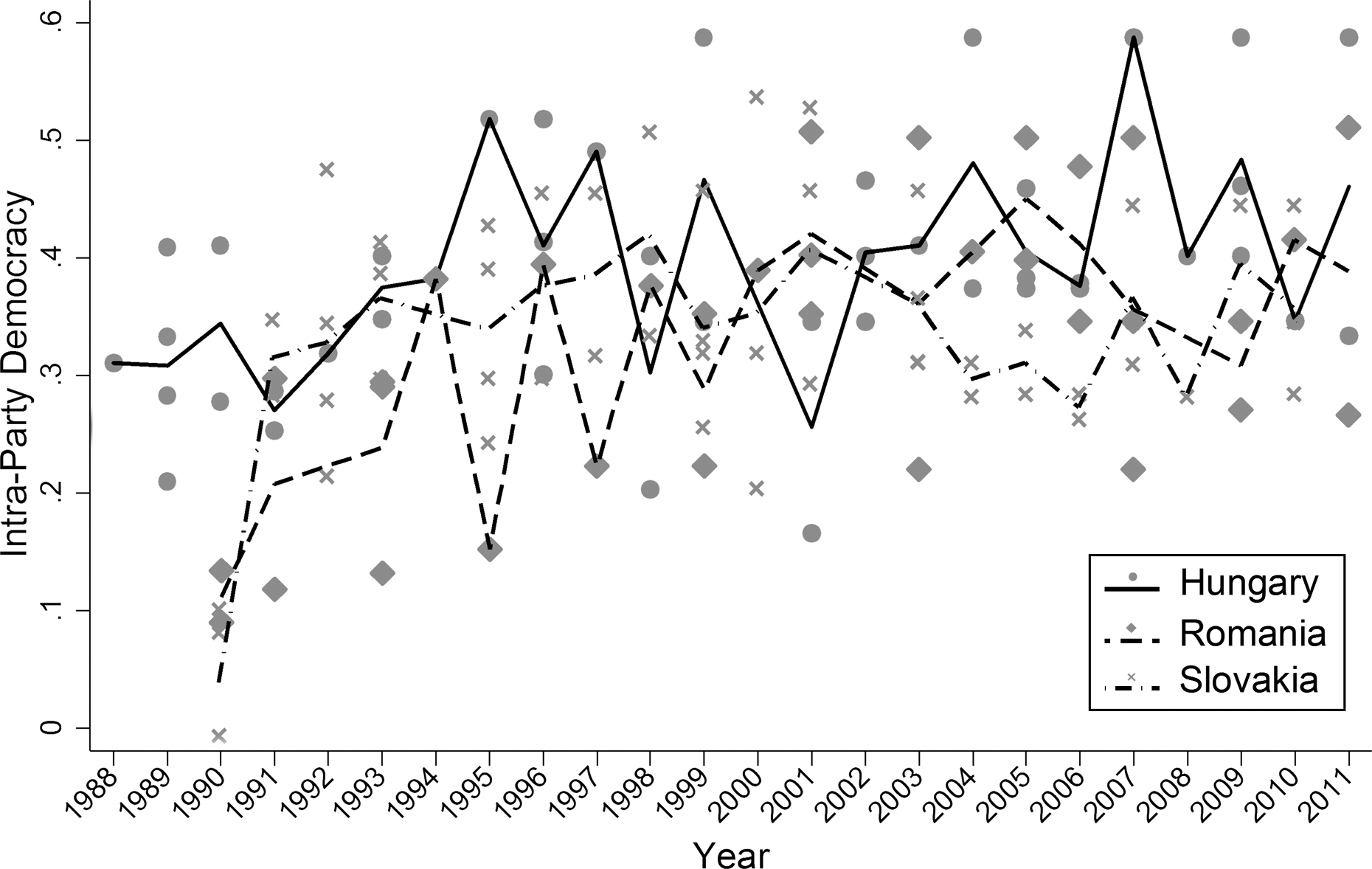
Formation of IPD in Hungary, Romania, and Slovakia over time. IPD: intraparty democracy.
Furthermore, we can also take a closer look at the cross-sectional differences between parties (over time) with regard to their IPD levels (see Figure 2). The overview shows that the roots of some of the parties with the highest levels of IPD can be traced back to reform-oriented wings of their respective communist parties that existed during the period before 1989. In Hungary, the MSZP (Hungarian Socialist Party) was founded by members of a neo-liberal wing of the Hungarian Socialist Workers’ Party that ruled during the autocratic period. Similarly, in Romania, the PD(-L) (Democratic [Liberal] Party) emerged from the FSN (National Salvation Front). Its founding members were previously members of the Romanian Communist Party; they, however, began to question mismanagement under the rule of Nicolae Ceauşescu. In Slovakia, the SDL (Party of the Democratic Left) was also founded by reform-oriented members of the Communist Party of Slovakia who were in favor of creating a modern European social democratic party.
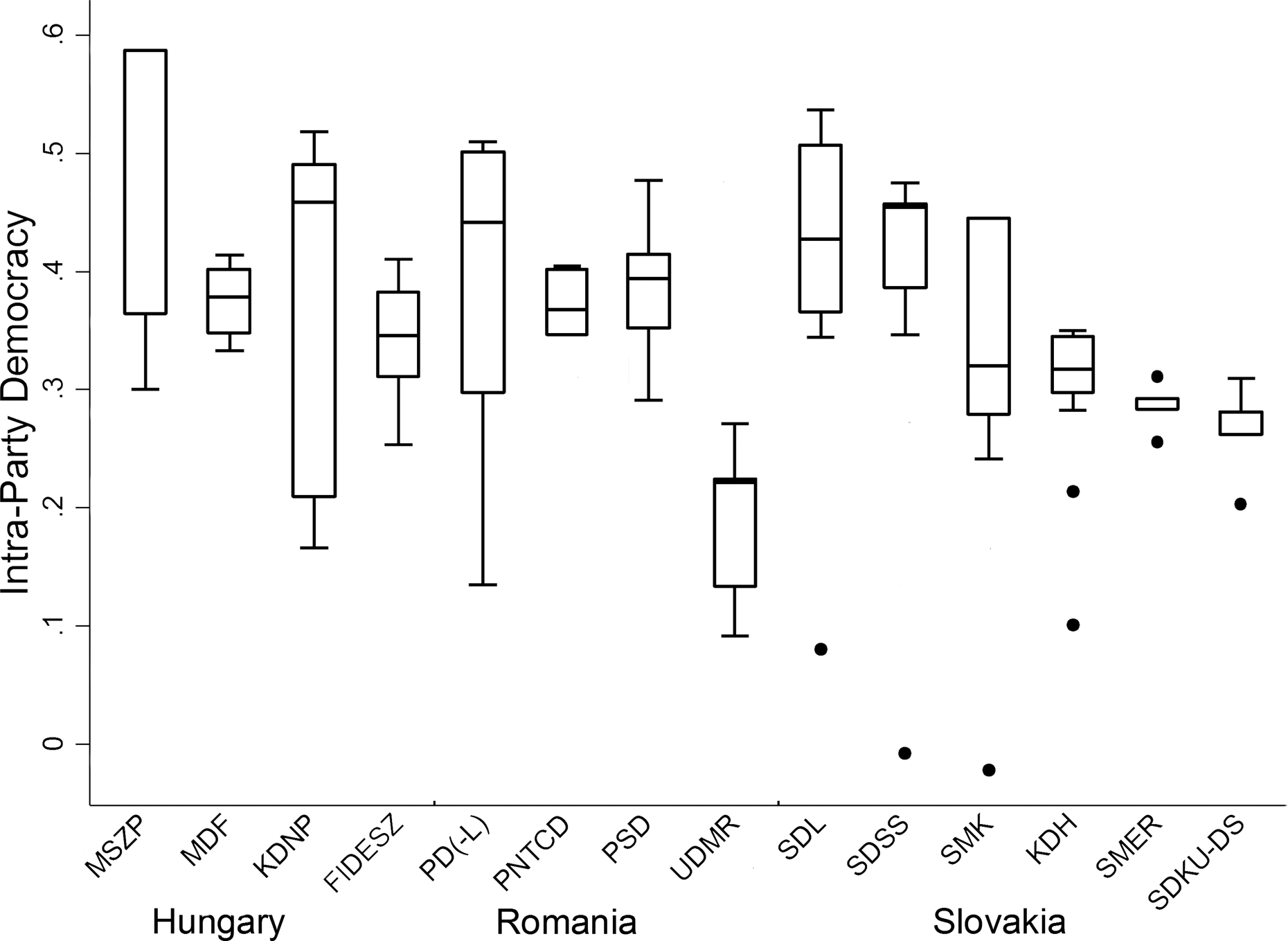
Cross-sectional heterogeneity of IPD in studied CEE parties. IPD: intraparty democracy; CEE: Central and Eastern Europe.
In line with our theoretical argument presented earlier, we understand the empirically observed steady increase of IPD between 1989 and 2011 as party organizational change. How this type of party organizational change can be explained is explored in the following section.
Testing the hypotheses: What factors influence the formation of IPD over time?
Since our analysis is based on time-series cross-sectional data, the following models have been estimated using regression analysis with unit fixed effects that allow us to eliminate the cumulative influence of all time-invariant characteristics, that is, any unmeasured time-invariant country-level effects including that of electoral systems or any broader historical or socioeconomic background. In addition, to account for potential heteroscedasticity, we also used robust standard errors. 7 Given the limited number of observations available for our analysis, we proceed by sequentially including explanatory variables that are associated with the three explanatory complexes presented in the theoretical discussion 8 and also report a full model including all variables (model 9) and a final model that takes into account variables that have proven to be statistically significant in the previous analyses (model 10).
Starting with the evaluation of the hypotheses that were ascribed to the lifecycle approach, we consider indicators of party age and origin. The results presented in Table 1 show that the impact of party age on IPD is statistically highly significant and consistent across all estimated models providing support for hypothesis 1. This can be explained in terms of parties becoming more complex organizations (Bojinova, 2007: 13) therefore creating the need to formally “regulate (…) issues that initially had not been regulated” (Cular, 2004: 32) leading to the inception and implementation of explicit rules in party statutes enhancing overall levels of IPD.
Determinants of IPD: fixed-effects regression analysis.
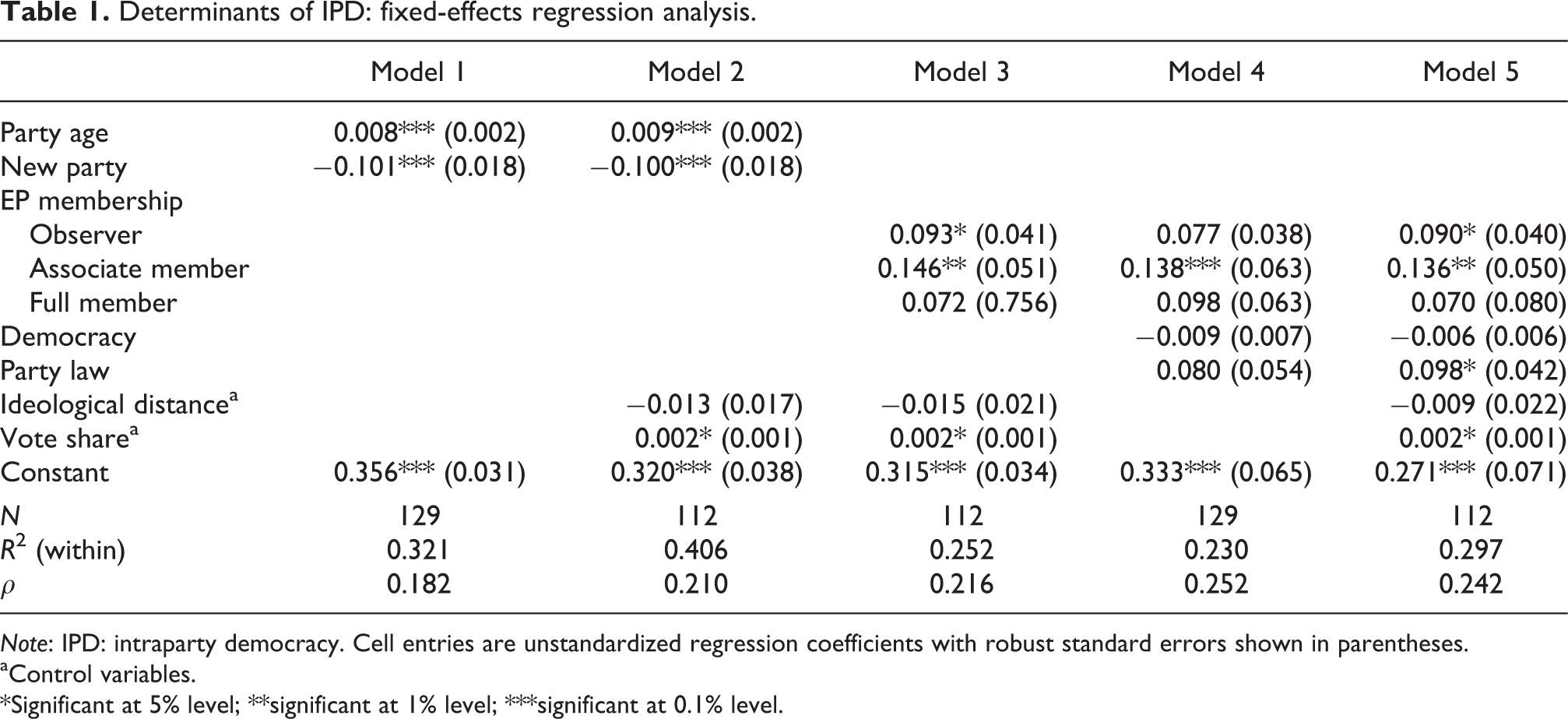
Note: IPD: intraparty democracy. Cell entries are unstandardized regression coefficients with robust standard errors shown in parentheses.
aControl variables.
*Significant at 5% level; **significant at 1% level; ***significant at 0.1% level.
In hypothesis 2, we expected newly emerging parties to display higher levels of IPD than parties with organizational ties with previously existing parties (continuous and revived parties). The results presented in Table 1, however, clearly reject this hypothesis. Contrary to our expectation, the statistically significant and substantial negative effect points toward new parties having lower levels of IPD. One possible explanation based on party change theory is that especially continuous parties experienced the transformation as an external shock (Harmel and Janda, 1994), which—according to party change theory—might lead to fundamental party change. Genuinely new parties without previously existing organizational roots, on the other hand, did not experience this external shock. Another equally plausible explanation takes into account that newly emerging political movements or groups did not define themselves as parties. The FIDESZ (Federation of Young Democrats) in its founding years consciously avoided organizational party structures and the MDF (Hungarian Democratic Forum) was strongly leader-based without actual local branches or party activists (Kostelecký, 2002: 154).
Turning to explanatory factors that scrutinize the three hypotheses which deal with the impact of system-level changes over time on changes in IPD levels, we start with the impact of Europarties (hypothesis 3). The evidence presented in models 3 and 4 (Table 1) and model 10 (Table 2) clearly supports this hypothesis. In general, the role of European party organizations in shaping CEE parties is contested. Some argue that Europarties played a key role in facilitating the evolution and development of parties and their internal structures in CEE countries (e.g. Pridham, 2014). In contrast, others argue that Europarty influence has been superficial at best, leaving “the internal roots of the party organizations [in CEE countries] largely untouched” (Holmes and Lightfoot, 2011: 34).
Determinants of IPD: fixed-effects regression analysis.

Note: IPD: intraparty democracy. Cell entries are unstandardized regression coefficients with robust standard errors shown in parentheses.
aControl variables.
*Significant at 5% level; **Significant at 1% level; ***Significant at 0.1% level.
Our results clearly support the first view. As for their influence, a statistically significant and substantial positive impact can be found for the associate member accession stage. Thinking one step further, the reason for this might not be the associated status itself, but rather the full membership status promise. CEE parties benefited from the connection to the Europarties in several ways, but the most important benefit was the full membership status (von dem Berge, 2015). Being aware of this, Europarties exerted strong influence on their CEE partner parties by applying “membership conditionality,” which means that CEE parties could only become full members if they were willing to fulfill criteria demanded by the Europarties. And one of these demands was the improvement of IPD (Pridham, 2014). This is also validated by von dem Berge (2015: 423–435) who shows that Europarties were not only interested in the “written IPD,” that is, the EPP visited party congresses of their CEE partners in order to check if the written rules were also applied in reality.
Our results do not lend any support to hypotheses 4 and 6. The independent variables (degree of democracy and electoral loss 9 ) are not statistically significant, which leads us to reject both hypotheses. Based on hypothesis 5, we were interested in estimating the impact of introducing legal regulations (party laws) on IPD and presumed that this should have a positive impact on IPD. Our results provide mixed evidence on the impact of legal regulations, suggesting that there might be a statistically significant positive effect (models 5 and 9). This would mean that the introduction of legal regulations on political parties leads to an increase of their IPD levels.
With reference to the discrete change approach, for hypothesis 7, the literature acknowledges that a change of the party leader is a major event for every party and thus might lead to a change in party organizational structures (Müller, 1997). Our results show that a change of the party leader is, to a certain extent, associated with a boost in IPD (models 7 and 8). It is conceivable that this positive effect might be explained by a shift from elite-dominated CEE parties that often relied on the personal reputation of the party leader toward the devolution of power to a set of rules (Ágh, 1995). A prominent change of a party leader that closely corresponds with increasing levels of IPD in our data set, and is consistent with this type of explanation, includes the Hungarian MSZP where in 1998 the charismatic party leader Gyula Horn, who played a key role in the peaceful transition of Hungary in 1989, relinquished his position in favor of László Kovács by not seeking reelection (Ilonszki and Kurtán, 1999: 414).
As a second plausible explanation, it should be considered that a change of the party leader is often a process requiring the active participation of the party congress and the rank-and-file members. Therefore, a successful change not only provides a proof of concept of internally democratic practices to party members but also might serve as an opportunity to communicate this to the electorate. An excellent example for this line of reasoning can be found in the Romanian PD(-L) leadership change from Petre Roman to Traian Băsescu in 2001 that was based on a decision of an Extraordinary National Convention held in 2001 at which—for the first time since the party’s inception—there was more than one candidate for the position of the party leader (Chiru and Gherghina, 2012: 517).
Conclusion
At its core, the central starting observation of our contribution is that remarkably little is known about the formation of IPD within CEE parties and only few empirically secured findings exist. Available studies often advocate a somewhat “pessimistic” view: low levels of IPD in CEE parties are expected because “the greater volatility of the electoral and partisan market in Eastern Europe might lead to fears that internal party democracy would threaten party unity” (Bojinova, 2007: 27). Furthermore, several studies have previously argued that IPD has—comparatively speaking—not a high priority, because the party organizations themselves are postpositional relative to the goals of effective management and to the goals of party leaders (Cular, 2004: 31).
A fair share of the data we have collected suggests that there are no strong autocratic or oligarchic tendencies inside the CEE parties we have investigated. As a matter of fact, especially parties in Slovakia show a remarkable increase in their IPD levels between 1990 and 1994 followed by further, albeit slowed down, internal democratization.
With a particularly strong effect, the analysis demonstrates that the ability of parties to develop and sustain internal democracy greatly depends on their cooperation with and integration into Europarties. Approaching this from the angle of mixed expectations based on the prevailing discussion, this further validates empirical studies that argue that Europarties are a crucial driving force of IPD within CEE parties (Pridham, 2014). To put it in a nutshell, the integration of CEE countries into the EU leads to a democratization of CEE parties.
New parties founded after 1989, despite the fact that they emerged and consolidated themselves within the general conditions of a democratic system, systematically display lower levels of IPD as compared to continuous communist or revived precommunist parties. To some extent, this comes as a surprise, because previous studies have suggested that due to their “oligarchic inertia” (Chiru and Gherghina, 2012: 511) previously established parties with “past experience” can be expected to be and remain internally fairly autocratic. However, party change theory delivers a plausible explanation for this phenomenon: While older parties with organizational roots before 1989 experienced the regime change toward democracy as an external shock which might lead to fundamental party change, newly founded parties after 1989 did not, because they emerged afterward. Furthermore, our results can be viewed from the angle of studies that deal with the electoral performance and success of new parties in general. In this line of reasoning, it has been suggested that the ability of parties to perform well in the electoral arena is contingent upon them having more experience and a support base (Bolleyer and Bytzek, 2013: 783). Similarly for IPD, new parties might struggle with creating functioning internal structures that correspond to the ideal of democratic organizations, whereas parties with past experience can adapt existing structures to do so.
It seems that intervening via large-scale legal regulations like party laws that are potentially “out of sync with existing opportunity structures for political mobilization” (van Biezen and Piccio, 2013: 48) does not necessarily warrant that political parties will become internally more democratic. We have shown that more in line with what drives CEE parties to become internally more democratic are incentives related to their membership in Europarties and the imperatives of their organizational roots.
Supplemental material
Supplemental Material, pp-2016-0125-File003 - Intraparty democracy in Central and Eastern Europe: Explaining change and stability from 1989 until 2011
Supplemental Material, pp-2016-0125-File003 for Intraparty democracy in Central and Eastern Europe: Explaining change and stability from 1989 until 2011 by Benjamin von dem Berge, and Peter Obert in Party Politics
Footnotes
Declaration of Conflicting Interests
The author(s) declared no potential conflicts of interest with respect to the research, authorship, and/or publication of this article.
Funding
The author(s) disclosed receipt of the following financial support for the research, authorship, and/or publication of this article: Research for this article was supported by funding granted by the German Research Foundation (DFG), grant No. DE 630/16-1. The principal investigators were Jan W. van Deth and Thomas Poguntke.
Supplemental material
Supplemental material for this article is available online.
Notes
References
Supplementary Material
Please find the following supplemental material available below.
For Open Access articles published under a Creative Commons License, all supplemental material carries the same license as the article it is associated with.
For non-Open Access articles published, all supplemental material carries a non-exclusive license, and permission requests for re-use of supplemental material or any part of supplemental material shall be sent directly to the copyright owner as specified in the copyright notice associated with the article.
