



Abstract
Why are voters in advanced democracies turning away from established mass parties to take their electoral chances elsewhere? This article draws on concepts from marketing scholarship, specifically branding and brand equity, to apply a ‘consumer’ lens that assesses the major parties in Australia as failing ‘brands’ being left behind by disillusioned voters. An initial sample of 200 voters were asked what words or phrases came to mind when they thought of each of four Australian federal political parties. The strength of associations for each party, elicited from this sample, was then validated on a broader sample of 1015 voters, in addition to whether the association was considered positive, neutral or negative. Data revealed distinct brand associations for each party and the extent of penetration and brand equity across subgroups of voters. We find that Australian mass parties are caught in a downward spiral of negative brand associations and low brand penetration, leading to voter dissatisfaction.
There is now strong evidence across advanced democracies that established mass parties are in decline (Cross and Gauja, 2014; Whiteley, 2011), although effects are not uniform (Kölln, 2016). This is contributing to outcomes such as higher vote counts for some minority parties (e.g. Borisyuk et al., 2007; Cutts and Goodwin, 2014; Hartcher, 2016), a turn towards ‘populist’ parties (Bowler et al., 2017) or to populist capture of existing mass parties through ‘outsider’ leaders such as Donald Trump and Jeremy Corbyn (Diamond, 2016). In a social media age, such minority parties and outsider leaders have been able to fashion ever more direct connections with voters that circumvent the filtering effects of traditional media. But why are voters turning away from established parties and ‘traditional’ leaders to take their chances elsewhere? We approach this puzzle by drawing on concepts from marketing scholarship to apply a ‘consumer’ lens that assesses established mass parties as failing ‘brands’ being left behind by disillusioned voters. We examine the Australian case to establish what voters think their political parties stand for and what is revealed about why established mass parties may be finding themselves out of favour.
Our empirical focus is on two research questions: What are the ‘brand attributes’ that voters associate with Australian political parties, and their strength and favourability? To what extent do these attributes vary by voters’ own political preferences?
Utilizing a mixed methods approach through a two-stage survey, we examine these questions for Australia’s two major parties – the Australian Labor Party and the Liberal Party of Australia – and for two long-established minor parties – the National Party of Australia and the Australian Greens. We find that while minor parties enjoy a higher brand equity and greater brand penetration, this does not necessarily translate into a wider electoral appeal. For the major parties, we find lower levels of brand equity and overwhelmingly negative brand associations in the minds of most voters. We argue that mass parties are caught between having to carve out a broad appeal – to be all things to all people – while still maintaining perceptions of their trust and authenticity when they are unable to deliver on the full breadth of their promises. In other words, we suggest that mass parties in the Australian context may have no choice but to accept a low brand equity to cast as wide a net as possible, only to find that the brand perceptions that follow are increasingly negative ones in the eyes of the public. As we note later in the ‘Discussion’ section, further research is needed in other jurisdictions to test this claim more widely and to establish whether such negative brand perceptions can be mitigated by charismatic leaders able to superimpose their own positive brand over that of their party. In the sections that follow, we review key arguments from the political branding literature, before explaining the structure of the current study and the methods adopted. In analysing the data, we draw out the existing brand associations, while also outlining possible future directions for research.
Political branding
The literature on political branding has developed its own distinct trajectory as a subfield of political marketing over the course of the last two decades. Scholars such as Scammell (2015) and Needham (2005) have sought to position ‘the brand’ as the conceptual tool that can best capture both the tangible and intangible components that work together to construct the reputation and image of political leaders and of parties (see also Lees-Marshment, 2014: 103). For them, studying brands allows for the simultaneous analysis of ‘…the rational and apparently irrational, the hard and soft elements of voter choice, the big dimensions of political reputation and the seemingly trivial details of appearance and tone of voice’ (Scammell, 2015: 7). Time also emerges as an important factor, with the literature emphasizing that a brand cannot be built through a one-off transaction alone (Cosgrove, 2012: 107) and instead needs to be nurtured over time through a relationship marketing approach (Needham, 2005).
In a branding sense, political parties and politicians can be conceptualized of as offering products – an ‘amalgam of policy, leader image, inherited memory, promise…’ (O’Shaughnessy, 2001: 1048) – or services – the ‘promise of [what is] to be delivered in the future’ which is ‘sold on trust’ (Nielsen and Larsen, 2014: 154). Pich et al. (2016: 103) further reinforce the services perspective of a political brand, arguing that the act of governing is ‘intangible, complex and heavily reliant on people’. This view of a political brand as an amalgam of factors – and indeed, as an ‘overall packaged concept’ that can’t easily be unbundled (Lock and Harris, 1996) – also makes it clear that perceptions of a party leader are closely intertwined with perceptions of a party as a whole, and of local candidates. This means that in studying party brands we are in fact studying a composite of contributing variables. In this regard, while leadership can be crucial to how a political party brand is perceived, as our results will show, it is but one element of the brand tableau (Pich et al., 2016; Scammell, 1995). As political branding scholars have also noted, the rise of ‘message simplicity’ (see Marland et al., 2017: 136–137) means that ever less complex formulations are being used to frame this composite collection of factors, thus also facilitating message control. As we discuss later, the Liberal Party’s ‘stop the boats’ mantra in Australia is an excellent example.
Creating a strong brand offers parties the opportunity to package their political products into an easily digestible shorthand form (Needham, 2005), thus creating the message simplicity mentioned above. Brands also have the potential to instill in a political product or service a symbolic value which may enhance voter loyalty and attachment (Pich et al., 2016). As stated above, a brand is typically thought of as an intangible concept (Downer, 2016; MacDonald et al., 2015), but may be represented as ‘a name, term, sign, symbol or design, or a combination of these, intended to identify the goods or services of one seller or group of sellers’ (Kotler et al., 2005: 549). A brand is regarded as a source of competitive advantage and differentiation, and applied to politics may be used to differentiate one party’s ‘product’ from that of its rivals thus leading, in theory, to greater electoral performance (French and Smith, 2010; Nielsen and Larsen, 2014). This will be particularly the case if a political party enjoys a favourable level of ‘brand equity’, a term used to refer to the overall value of a brand (Downer, 2016; French and Smith, 2010; Quester et al., 2014). Following this argument, the stronger the political brand equity, the more the brand will be recognizable to voters as a point of differentiation for the party. A brand, in this regard, becomes a heuristic in the minds of voters – what Butler and Powell (2014: 494) term an ‘informational short cut’ – which makes the voting decision easier and less complicated when confronted with ‘complex bundles of alternatives’ (Nielsen and Larsen, 2014: 154). French and Smith’s (2010) observation is particularly salutatory here that while many citizens have a low level of involvement with party politics, they are still likely to use heuristics when making voting decisions. This may especially be the case in times of uncertainty and doubt (Green, 2016).
Butler and Powell (2014) hark back to Stokes (1963) to outline the two components of a political party’s brand that can influence not just the voting behaviour of electors but also the voting decisions of elected members within the legislature as they consider different pieces of legislation. The two components include first, the role of a brand in encapsulating a party’s ideological positioning, and second, its valence, capturing the ways in which the non-ideological components of a brand influence both voters and party members. Brand valence can also interact with ideological positioning. This has been noted previously in the United States (e.g. Cox and McCubbins, 2005) but is also very pertinent for Australian politics. For example, the consistent leadership infighting in the Australian Labor Party Government 2010–2013 established questions of ‘leadership’ as a core brand association in a way that may have damaged the brand equity of the party by undermining its valence. At the same time, the leadership questions were fought through the lens of arguments about particular ideologically based policy positions, such as what to do about the number of asylum seekers entering Australia by boat.
In this study, we adopt a consumer-oriented rather than a management-oriented approach to examining political brand equity (Marland and Flanagan, 2013; Nielsen and Larsen, 2014). As Johns and Brandenburg (2014: 90) note, there is a relative dearth of political marketing research focussing on voters, with most studies examining the perspectives of ‘sellers rather than buyers in the market for votes’. In a management-oriented approach, political branding is examined from a strategic marketing perspective, with the application of concepts such as marketing orientation or brand orientation to the activities of political parties, as well as a focus on how an integrated brand infrastructure can assist in such things as message control for a party and its representatives (e.g. O’Shaughnessy et al., 2012). With a consumer-oriented perspective, brands and branding are examined by looking at consumer/voter learning (French and Smith, 2010), or in other words, how various brand associations are formed about a political party in the mind of the voter. From this point of view, brands are represented in memory as ‘associative networks’, with a ‘central note’ signifying the name of the brand and a number of other features that have become associated, via learning, with this central note (Nielsen and Larsen, 2014: 155).
French and Smith (2010) similarly apply the term ‘knowledge structures’ which surround an object (e.g. a political party) and are retrievable from memory as related nodes of information. Following French and Smith’s (2010) explication, the Liberal Party of Australia is an information node (or central note) to which other nodes might be associated, such as current leader Malcolm Turnbull or former leader Tony Abbott (each with their own associations), the term ‘stop the boats’, the economy, conservatism and so forth. Other associations subsequently span out from these. Brand associations are most likely to be the result of low-involvement cognitive learning, developed through a process of iconic rote learning (e.g. associating words/slogan/phrases with parties), though in some circumstances high-involvement learning may occur through more complex reasoning processes (e.g. analysing and considering political party information in order to structure associations and concepts) (Quester et al., 2014). That said, brand associations are not typically the result of systematic information search (O’Cass, 2002). As such, the ‘brand voter’ is open to changes in public sentiment, trends and shifts in political momentum (Nielsen and Larsen, 2014), and the brand associations they adopt are not necessarily going to be consistent with the image promulgated by the given political party.
The current study
From a consumer point of view, brand equity can be measured in a number of ways, including brand awareness, loyalty, perceived quality, as well as by brand associations, which is the focus of the current research (French and Smith, 2010). Keller (1993) noted that brand associations may have strength (number of associations), favourability (positivity/negativity of associations) and uniqueness (distinctiveness of associations). To this list can be added brand penetration, which in a political branding sense refers to the reach and depth of a brand association across different subsets of voters (Ehrenberg and Goodhardt, 2002). French and Smith (2010) undertook brand concept mapping for the two main political parties in the United Kingdom: Conservative and Labour. In their methodology, respondents chose to rate the party they felt greatest affinity with; that is, only Conservative voters rated the Conservative party and so forth.
In order to assess brand equity across the four main federal political parties in Australia, we adopt a different approach by considering how political party brands are viewed by all voters – regardless of their pre-established party loyalties – in order to assess how far a political party brand association may have reached across the electorate. One of the critiques of the current state of political branding research is that it hones in on elections and their lead-up, potentially creating a distorted view of voters’ brand perceptions based on saturation election coverage. As Schneider and Ferie (2015: 65) assert: ‘limiting empirical research on political brands to electoral races ignores the importance of brands as essential facilitators of the continuous party–voter relationship, which does not cease in between elections’. We address this concern by capturing the perceptions of Australian voters about party brands 2 years into a normal 3-year Australian electoral cycle. While this does not entirely exclude electoral effects on brand perceptions, it does enable us to examine which aspects of Australian party brands loom the largest in voter consciousness outside of the focussing environment of an election. As Needham (2005: 356–7) notes, the ‘challenge for an incumbent is to provide post-purchase reassurance, and maintain their winning coalition of voters until the next opportunity for a sale’. She suggests that this requires a relationship marketing approach that builds reassurance over time, rather than the transactional ‘sale’ of policies that occurs at election time.
Australia operates as a federation, with one national/federal parliament, and state and territory-based parliaments in the various regions. The federal parliament is bicameral, with a UK style lower house populated from single-member electorates and a US style senate made up of elected senators from each state or territory. At both federal and state levels, as mentioned earlier, the two major parties are the Australian Labor Party and the Liberal Party of Australia, while the Australian Greens and the country-based National Party of Australia have minority representation. The nature of this federal system means that party brands may be different at state and national levels, and there may be cross-pollution of positive and negative associations in the minds of voters who might be satisfied with a party at a state level but not nationally, or vice versa. To counteract this cross-pollution as much as possible, our survey instruments focussed specifically on the federal iterations of each party. As we outline below, this study adopts a two-stage qualitative and quantitative research approach to elicit brand associations for Australian political parties and then test the equity of those associations across the electorate.
In addition, the survey was administered 2 years into the term of the conservative Coalition government, 1 which had campaigned hard on tightening immigration as a central part of the platform it took to the 2013 election. The slogan ‘stop the boats’ had been a ubiquitous part of the Coalition’s electoral message and, as we outline below, it continued to show up as the single strongest brand association for the Liberal Party in the survey responses even 2 years after the election. Equally, prior to the 2013 election, there had been consistent infighting for the leadership within the Labor government between Julia Gillard and Kevin Rudd, and this also loomed large in the responses.
Method
Sample frame and characteristics
Data were collected via online surveys through an Australian commercial research panel provider in October–November, 2015. Participants were matched to the broader Australian population in terms of age and gender and spread across Australian states and territories. An initial elicitation sample of 200 participants was surveyed to generate lists of associations for the four federal political parties mentioned above. A second, different validation sample of 1015 participants was subsequently surveyed to test the strength and favourability of the associations developed by the elicitation sample. To be included in the study, participants had to respond ‘yes’ to the question: ‘are you eligible to vote in Australian Federal Elections?’ Table 1 provides a summary of sample characteristics for the larger validation sample, including their voting intentions.
Validation sample characteristics.

Survey instruments and procedure
Stage one of the research involved a qualitative online survey to elicit brand associations for each of the four political parties. At the beginning of the survey, an introductory statement explained the nature of the study and emphasized that all responses were anonymous. After some demographic questions, participants were asked the following open-ended question for each party: ‘What words, phrases or associations come to mind when you think of the (political party)?’ Participants were encouraged to write as many associations as they wished. The order of presentation of the political parties was randomized to minimize the impact of item-context effects (Feldman and Lynch, 1988). Counterbalancing of items, along with anonymity, is also suggested by Podsakoff et al. (2003) as procedural remedies to control for common method bias. Participants were then asked the question: ‘If a Federal election was held tomorrow, which political party would you be most likely to vote for; that is, which party would you give your primary vote to?’ The order of presentation of the political parties (as well as an ‘other’ category) was also randomized.
Stage two of the research, which occurred 1 month after stage one, involved a quantitative online survey, aimed at validating the brand associations collected in stage one. For each party, a list of associations mentioned at least twice by the elicitation sample was developed. Again, the order of presentation of the political parties was randomized, as was the order of the associations for each party. For each of the associations, two closed-ended questions were asked: ‘To what extent do you associate the following words or phrases with the (political party)?’ (1–5 scale from ‘never’ to ‘always’), and ‘Do you think the word or phrase is (negative, neutral, positive)?’ As with stage one, the stage two survey included an introductory statement on the nature of the study that also assured anonymity of response and demographic questions were asked. Participants were also asked to which party they would give their primary vote, with the order of presentation of the parties randomized. Finally, a range of questions on voter engagement were asked, which are beyond the scope of this article.
Both online surveys were piloted on a convenience sample of 10 Australian voters in order to gauge intelligibility and to assess the time taken for completion. As a result of this, changes were made to the response scale for the strength of associations in the stage two survey so as to provide a more logical response format. Aside from this refinement, the survey was completed as intended and the layout was determined to be suitable and easy to follow. No feedback was received from any of the actual participants post-administration that indicated any problems with the surveys. The relevant survey questions are provided as an Online Appendix to this article.
Results and discussion
Stage one – elicitation data
As stated above, the aim of the elicitation stage of the research was to develop lists of brand associations for each of the four federal political parties under study. This resulted in lists of 23 associations that were mentioned at least twice by respondents for the Labor Party, 26 for the Liberal Party, 15 for the National Party and 30 for the Greens. Only four associations were mentioned for more than one party – conservative (Liberal and National), infighting (Labor and Liberal), left wing and progressive (Labor and Greens) – indicating a high degree of brand uniqueness. The associations for each party, and the number of times they were mentioned, can be seen in Table 2. As Table 2 shows, there are already some associations which stand out: good for business, conservative and right wing for the Liberal Party; unions, supports workers and large spenders for Labor; protecting the environment (very prominently), green and social justice for the Greens, and a country party, supports farmers and junior partner to the Liberals for the National Party.
Elicitation sample party brand associations (number of times mentioned).

Stage two – validation data
In order to validate the associations found in the elicitation phase, as discussed earlier, the associations for each party mentioned at least twice were tested on a larger, different sample of voters. Participants were asked to rate each association in terms of the extent to which they thought it represented the party, as well as the favourability of the association.
To gain an initial understanding of how the various brand associations within each party related to one another, data were subjected to multidimensional scaling (MDS) analysis using Proxscal in SPSS. MDS is a multivariate procedure, akin to factor analysis, which uses proximities/distances between objects in a data set to determine the underlying, or ‘hidden’, structure (Kruskall and Wish, 1978). In our case, the ‘objects’ are the brand associations for each political party, for which MDS uses a measure of Euclidian distance to provide a visual map or plot of their interrelationships. The closer the objects, the stronger the relationship between them; the further apart, the weaker the relationship. For the current data, two-dimensional plots were used. This was to aid in presentation and interpretability (see Kruskall and Wish, 1978, for a discussion of considerations in deciding the level of dimensionality). Moreover, in each case, stress testing revealed scores in the acceptable range of 0.05 to 0.1 for each solution, with scree plots showing that using three or more dimensions would not have meaningfully improved the level of stress in the data. The MDS maps of the brand associations for each political party are shown in Figures 1 –4.

Multidimensional scaling plot: Liberal Party of Australia.

Multidimensional scaling plot: Australian Labor Party.

Multidimensional scaling plot: Australian Greens.

Multidimensional scaling plot: National Party of Australia.
These figures reveal both clusters of brand associations for each party, as well as how individual associations are related to others. In Figure 1 for the Liberal Party, it is possible to discern clusters associated with economic management on the right of the figure (e.g. balance the budget, economic growth), wealth and big business on the left (e.g. rich, pro big business), as well as a series of specifically negative associations (e.g. not compassionate, liars, untrustworthy) on the lower left. It is also noteworthy that the association closest to the word Liberal is stop the boats, indicating the strength of this brand attribute for the Liberal Party. For the Labor Party in Figure 2, there are clusters concerning workers’ and general rights on the right (e.g. working conditions, social conscience, for people), unionism and infighting on the lower left (e.g. union dominated, factions), and incompetence and corruption on the left (e.g. dishonest, incompetent). Unions as an association can also be seen to be quite distant from socialist and closer to both working class and infighting, suggesting that voters don’t link unionism with its ideological roots but rather with more contemporary connotations.
In Figure 3 for the Greens, there is a large cluster of negative associations on the right of the plot which encompasses both structural (e.g. leadership vacuum, antibusiness, un-Australian) and more specifically disparaging (e.g. hippies, loonies/idiots, naïve) elements. On the left of the figure are a range of positive associations, which include clusters specifically on the environment and climate (e.g. trees/forests, protecting the environment) and on more general policy standpoints (e.g. social justice, sustainability). Intimating a clear brand identity, the word green appears in the environment cluster, closest to trees/forests. For the Nationals in Figure 4, noting the smaller overall number of associations as mentioned above, there is a cluster on the lower right which encompasses a group of positive values (e.g. hardworking, caring), a cluster to the left of this that relates to the party’s rural base (e.g. supports farmers, rural), and two broader groupings to the top of the plot regarding the political leaning of the party (e.g. conservative, junior partner to the Liberals), and its negative links (e.g. old-fashioned, rednecks, small). There does appear to be evidence of an understood identity in the fact that The Nationals, as an association, is closest to the rural-based cluster (accepting, however, that The Nats, a shorthand association for the party, is within the political leaning grouping).
The MDS plots provide an understanding of how the various party associations are linked in the minds of the participants, that is, their ‘associative networks’ (Nielsen and Larsen, 2014) or ‘knowledge structures’ (French and Smith, 2010). The plots thus allow for the evaluation of distinct clusters of brand attributes. The next stage is to assess their strength and favourability. Tables 3–6 show the top 10 associations for each of the four federal political parties, as well as the level of favourability of these associations (red = negative (1), black = neutral (2), green = positive (3)). In order to assess if an association was neutral, a range of ±0.1 around the centred neutral rating of 2 was arbitrarily chosen. Outside of this range, an association was judged as either negative or positive. The mean level of association for each party was also determined (based on the 1–5 scale from ‘never’ to ‘always’), which is shown in the tables. Analysis of variance indicated no significant difference across the four parties (F(3,88) = 1.34, p > 0.05). Notwithstanding this result, as already indicated, there were differences in terms of the number of associations elicited for each party, with the Greens (at 30) having the most and the Nationals (at 15) having the least.
Top 10 voter associations – Liberal Party of Australia (out of 26;

Note: red = negative; black = neutral; green = positive. (Colour version of this table is available online.)
Top 10 voter associations – Australian Labor Party (out of 23;

Note: red = negative; black = neutral; green = positive. (Colour version of this table is available online.)
Top 10 voter associations – Australian Greens (out of 30;

Note: red = negative; black = neutral; green = positive. (Colour version of this table is available online.)
Top 10 voter associations – National Party of Australia (out of 15;
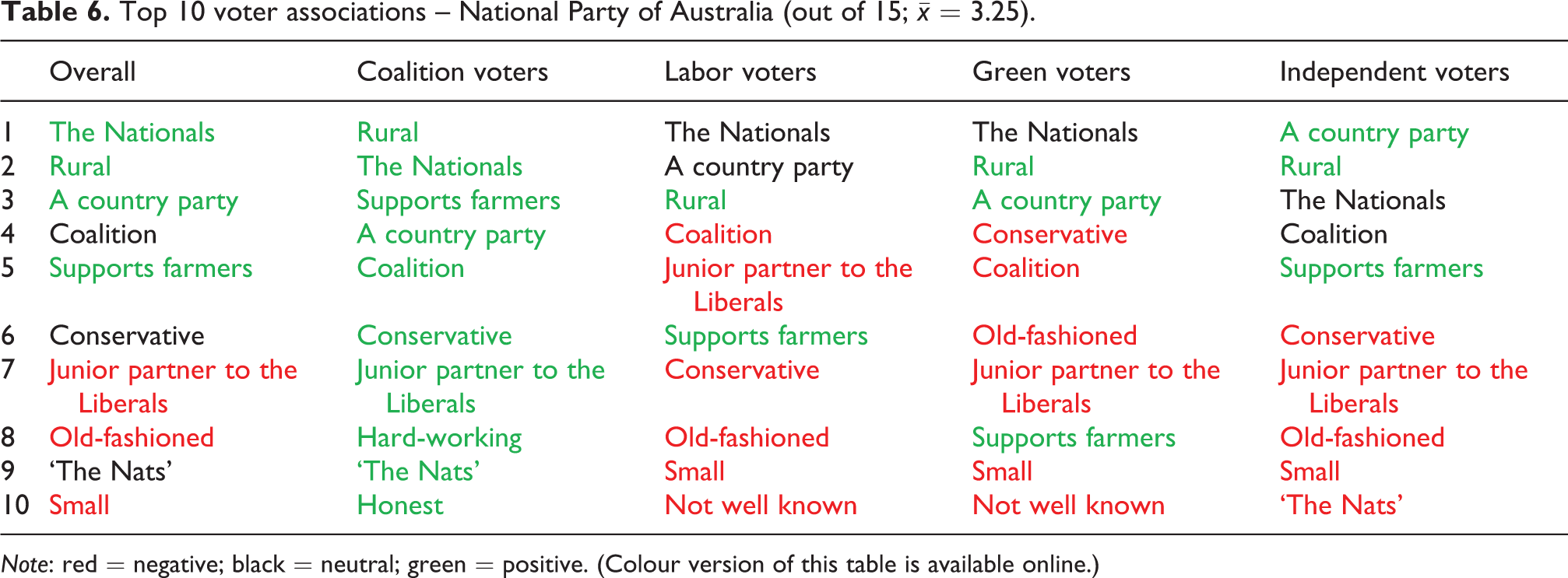
Note: red = negative; black = neutral; green = positive. (Colour version of this table is available online.)
The information provided in Tables 3–6 permits an examination of the favourability of the brand associations for each party and their penetration across subgroups of voters. To begin with the Liberal Party, there is one overall highly rated positive association – Liberal – and six overall negative associations – pro big business, looking after the rich, rich, high end of town, right wing, arrogant. Stop the boats is the highest overall association (in this case, a neutral one), despite it being only mentioned by three participants in the elicitation sample. There are also significant differences across different voter groups. Due to there only being 4.6% of the validation sample who indicated they would vote for the National Party, this subset was collapsed into the Liberal Party subset to create a single group of Coalition voters. Perhaps not surprisingly, all of the associations among Coalition voters are positive; in addition, they differ greatly from the other voters in content. For example, these are the only voters to rate highly associations around economic management and being good for business. In comparison, all of the associations with the Liberal Party are negative for Labor and Green voters, with only one positive for Independent/other voters: stop the boats. No associations are mentioned by every voting group, with eight associations mentioned by three voting groups, all but one (again, stop the boats) being negative associations. This paints a picture of low favourability for the Liberal party and low-moderate penetration.
For the Labor Party, there are three overall highly rated positive associations – working class, working conditions, supports workers – and seven overall negative associations – unions, union-dominated, large spenders, infighting, factions, poor leadership and debt creators. The highly rated associations for Labor also accord with the elicitation sample data. Turning to the different voter groups, there appears to be some commonality between Coalition and Independent voters, and between Labor and Green voters; in the latter case, there are positives mentioned by both groups. However, only the Labor voters have all positive associations rated highly. Negative associations appear to have the greater reach across the voting groups. One association is mentioned by every voting group – unions (only positive for Labor voters) – with four associations mentioned by three voting groups, all being negative associations. This reveals an impression of low-moderate favourability for the Labor party and low-moderate penetration.
The Australian Greens have six overall highly rated positive associations – green, trees/forests, climate, protecting the environment, supporting same-sex issues, sustainability – and one overall negative association – minor party. As with Labor, the Greens’ highly rated associations accord with the elicitation sample data. For the Greens, there seems to be more commonality across all voting groups, both in terms of content and favourability. For example, all but one of the high associations for the Greens are positive for Labor voters, and all for Greens voters. There are five associations mentioned by every voting group – largely similar to the overall positive list – with a further one association mentioned by three voting groups. This suggests moderate–high favourability for the Australian Greens and high penetration.
Finally, the Nationals have four overall highly rated positive associations – the Nationals, rural, a country party, supports farmers – and three overall negative associations – junior partner to the Liberals, old-fashioned, small. The Nationals’ highly rated associations also accord with the elicitation sample data. There appears to be a lot of commonality of content across the different voter groups, but less in terms of the level of favourability; Coalition voters have all positive associations in their top 10, but the other voting groups, on balance, have more negative associations. There are seven associations mentioned by every voting group – largely similar to the overall positive list with three additions: Coalition, conservative, junior partner to the Liberals – and a further two associations mentioned by three voting groups. This suggests moderate favourability for the National Party and high penetration.
On the basis of our results, the party with the highest level of brand equity is the Australian Greens and the party with the lowest is the Liberal Party of Australia.
General discussion
The aim of this research was to investigate the ‘brand attributes’ that voters associate with four Australian political parties and the extent of penetration across voter subgroups. By applying the marketing concept of branding, the intention was to shed new light on the party associations that have embedded themselves sufficiently into the consciousness of Australian voters as to now be synonymous with the parties themselves. Our research suggests that the brands of Australian political parties reflect both contemporary and historical factors. The historical factors seem to harden over time into brand associations in voters’ minds that are hard to change based on contemporary debates. For the major parties in particular, this can have both positive and negative effects. For example, the association of the Labor Party brand with workers and worker’s rights appears deeply ingrained, but this coexists with related negative perceptions about the power of unions within the party. Similarly, the Liberal Party brand is strongly associated with sound economic management (at least for Coalition voters) but is balanced by an equally deep impression that the party supports the ‘top end of town’. This means that when either party seeks to go outside its positive brand associations to counteract negative views, it is facing deeply ingrained perceptions about what the party stands for (Cox and McCubbins, 2005).
These deeply embedded historical aspects coexist as brand associations in the minds of voters with the more contemporary political and policy issues of the day. For example, ‘stop the boats’ was revealed as the number one brand association for the Liberal Party, based on their contemporary policy position on how to respond to asylum seekers trying to reach Australian shores by boat. Similarly, ‘infighting’ and ‘poor leadership’ emerged as key brand attributes for the Labor Party based on recent political events that clearly loomed large in the minds of voters responding to the survey. This suggests that at the point the survey was administered, the Liberal Party had more successfully exercised message control to maintain the kind of cohesive ‘high-level partisan brand’ that Cosgrove (2012) associates with the Reagan era Republican Party in the United States and the Harper Government in Canada.
Perhaps because of their need to appeal to the widest possible cross section of voters in order to be able to form government, the major parties had lower brand equity than a party such as the Greens. While the leaders of the Greens seek to assert that the values and policies of the party extend far beyond caring for the environment, this remains the overriding brand association among voters from across the political spectrum. This gives them a high-brand equity, but one grounded in a narrow perception of their policy focus. Our data suggest that the electoral benefits of having a high level of brand equity are not necessarily immediately apparent, despite an assumption that brand equity leads to performance (Aaker, 2009). Further study is needed to investigate the extent to which high brand equity translates into positive voting choices that might not occur if the brand equity was lower. There is clearly a complicated relationship between brand equity and party performance, and as Downer (2016) argues, not enough emphasis is placed on voter-perceived equity and how to harness it.
The scale of the task facing the major parties is particularly highlighted by the fact that the majority of their existing brand associations are seen as negative by our sample of voters as a whole – and it is a negativity from which it is not easy to escape. Independent voters, in particular, view the brand attributes of both major parties as almost entirely negative. These potentially damaging associations are consistently targeted by the political marketing campaigns of the parties themselves at election time, as each tries to activate negative associations of the other in voters’ minds. Evidence from the literature on negative political advertising shows that this kind of focus can be especially effective with voters who have an otherwise low level of involvement in politics (Geer, 2006; Jackson, Mondak and Huckfeldt, 2009; Stone et al., 2013).
These data suggest that major parties are to some extent caught in a negativity trap as they seek to sharpen and define their party brands. As parties who hope to form government, they need to be able to generate a wide brand appeal. In other words, they need to spread their brand across the widest possible playing field, which in the process dilutes the focus on core attributes. At the same time, as parties of government, they carry the electoral baggage of having actually made hard or unpopular decisions that can bleed over into the party brand in a way that clearly doesn’t apply to minor parties. What results for both Labor and Liberal is a type of brand image that is dominated by negative associations. In contrast, while the Greens and to a lesser extent the National Party enjoy greater brand equity, and more positive associations, this does not translate into wider electoral popularity. They remain shackled to their core ideological brand associations, unable to translate those positive attributes into a wider set of brand associations capable of propelling them into contention as parties of government in their own right (notwithstanding the important role of the Nationals in Coalition governments with the Liberal Party).
If established minor parties are proving unable to translate their strong brand equity into a higher share of votes, then to whom are disillusioned voters turning? Certainly in the Australian case, the answer seems to be to newer ‘populist’ alternatives. The results from the last two Australian elections saw strong outcomes in 2013 for the Palmer United Party (a very new party centred on high-profile businessman Clive Palmer), and in 2016 for the One Nation Party (a party with a 20-year history centred around the high-profile former lower-house MP, and now Senator, Pauline Hanson). Interesting work is already emerging on the recent performance of these parties (e.g. Kefford and McDonnell, 2016), and further research into the brand attributes of such consciously ‘populist’ minor parties could shed light on how newer parties are able to shape the brand associations that will define them over time.
If mass political parties are to continue as governing parties into the future, it is pertinent to ask whether they can in fact break out of their low brand equity/negativity spiral? Further research is needed on the extent to which choice of leader is a key variable. It is possible leaders might be able to superimpose their own personal brand on top of that of their party and in the process create a higher brand equity by relying on their personal popularity to popularize the wider party brand. For example, Cosgrove (2012) suggests that in the United States, the positive Obama brand was able to eclipse the weaker and more dispersed Democratic Party brand. Arguably, a leader such as Prime Minister Justin Trudeau in Canada is harnessing such an effect, and clearly the Liberal Party in Australia were searching for something similar when they replaced Tony Abbott as Prime Minister in 2015 with the then highly popular Malcolm Turnbull. In a sobering result for parties looking to the personal brand of a popular leader as a path to political salvation, our results (and subsequent polling in Australia) suggest that Turnbull’s popularity did not translate across into more positive brand associations for his party. Indeed, Downer (2016) points out that there is a risk associated with parachuting in a new ‘saviour’ party leader who ultimately is not effective, with the tainted leader’s brand subsequently threatening the party brand. This argument is supported by Davies and Mian (2010) who, in their study of leader and party reputations in British General Elections, found that such reputations are related but distinct, with the leader’s reputation affecting the reputation of the party more than the reverse.
By focussing the research for this study 2 years into a normal 3-year governing term, the data reveal just how deeply embedded the associations created during an election campaign remain in the minds of voters long after the campaign is over. For example, the Liberal Party ran very hard during the 2013 election campaign on their promise to ‘stop the boats’. Our research shows that 2 years later, that remained the top brand association for the Liberal Party. More work is needed to analyse whether that association resulted from the election campaign or whether it simply followed the focus of government policy at the time of the survey. The fact that two of the top Labor associations were around infighting and poor leadership suggest that voters have longer memories – and brand associations have greater depth – than simply being an association formed at election time, and then forgotten. This supports Needham’s (2005) argument that a relationship marketing perspective – which focusses on maintaining connection with a brand over time – is indeed central to the ability of a political party to persuade voters not to abandon them on election days.
The findings of this study suggest some potentially fruitful areas for further research, as already indicated. First, further longitudinal research is needed to test whether recent Australian experience is typical, or whether our results reflect the fact that the particularly bitter partisanship of the past few years has translated more readily across into perceptions of party brands. Second, it is unclear from the data whether voters are making judgements about the authenticity of politicians who seek to draw on the positive brand attributes of their party. Some existing research suggests that brand authenticity is a key factor in its utility for swaying voters (Lees-Marshment, 2011), and more research is needed on this in the Australian setting. Third, the data from this study suggest that longer term brand attributes can be so engrained that voters are deaf to attempts by parties to change them. So, do parties simply have to live within the confines of their existing brands or are there realistic strategies for altering them?
Conclusion
Clearly, contemporary political behaviour and slogans do matter and do translate into strong brand associations. Rather than replacing older associations, they operate in addition to longer established voter perceptions about the ideological positions and values of the party. Thus, Labor are still perceived as being associated with unions, and the Liberals as being close to big business – but these attributes are then joined by more contemporary judgements about leadership, or policies such as ‘stop the boats’. A lesson from this research may be that the persistence and depth of the older associations, even if they are subsequently added to, explains why party change is so hard to achieve. What is less clear from these data is whether the contemporary associations – ‘stop the boats’; ‘infighting’ – fall away over time to be replaced by other ‘attributes of the moment’; or whether they can harden into more entrenched aspects of the brand. Either way, this study suggests that analysing voters as consumers of party ‘brands’ offers a promising lens for understanding the heuristics that are guiding voter behaviour when they step into the polling booth.
Supplemental material
Supplemental Material, PPQ710585_Appendix - Political branding: A consumer perspective on Australian political parties
Supplemental Material, PPQ710585_Appendix for Political branding: A consumer perspective on Australian political parties by Martin Grimmer, and Dennis C Grube in Party Politics
Footnotes
Acknowledgements
The authors would like to thank the reviewers for their constructive comments, and acknowledge the support and interest of their colleagues in the Tasmanian School of Business and Economics, the Institute for the Study of Social Change at the University of Tasmania, and the Department of Politics and International Studies at the University of Cambridge. Earlier versions of this paper have been presented at the annual conferences of the Australian and New Zealand Academy of Management, and the British Academy of Management.
Declaration of conflicting interests
The author(s) declared no potential conflicts of interest with respect to the research, authorship, and/or publication of this article.
Funding
The author(s) disclosed receipt of the following financial support for the research, authorship, and/or publication of this article: Funding for this research was provided by the University of Tasmania through its Cross-Disciplinary Incentive Grants scheme, and through the Tasmanian School of Business and Economics Small Grants Scheme.
Supplemental material
Supplementary material for this article is available online.
Note
References
Supplementary Material
Please find the following supplemental material available below.
For Open Access articles published under a Creative Commons License, all supplemental material carries the same license as the article it is associated with.
For non-Open Access articles published, all supplemental material carries a non-exclusive license, and permission requests for re-use of supplemental material or any part of supplemental material shall be sent directly to the copyright owner as specified in the copyright notice associated with the article.
