




Abstract
Scholars have emphasized the decline of party membership and a decrease in party activism. Yet these general patterns hide a diversity of party members with distinct profiles, attitudes and behavior. Using Portugal as a case study, this article examines the heterogeneity of party members based on the different motivations for joining the party and distinct levels of involvement. The findings support previous typologies that distinguished between more activist versus more passive party members. The results also suggest that different party types present a distinct proportion of the two types of affiliates. In addition, these two types of members display distinct levels of ideological congruence with the party.
Introduction
The role of political parties in contemporary democracies is changing and significant transformations have occurred in terms of organizational characteristics. Parties are experiencing two common trends: an increasing personalization (Poguntke and Webb, 2005), on the one hand, and a crisis of membership organizations, on the other (van Biezen et al., 2012). These trends have especially affected the characteristics and roles played by the ‘party on the ground’. In particular, a number of studies have shown that parties are increasingly disconnected from society and that partisan forms of mobilization have declined (Dalton et al., 2000; van Biezen et al., 2012). In addition, parties have faced growing difficulties in establishing organizational linkages with the electorate (Poguntke, 2006; van Biezen and Poguntke, 2014), whereas new tools of mass communication have reduced the importance of party structures for communicating with the electorate.
Although some scholars have even called into question the need of parties to recruit members for developing their basic functions (Katz, 1990), the fact is that the crisis of party organizations has not led to the disappearance of their members. A number of studies have shown that members still play a valuable role for parties, not only in terms of recruitment, but also in terms of legitimacy (Gauja, 2015; Heidar, 2006; Scarrow, 1996; van Haute and Gauja, 2015). Moreover, parties seem to have rediscovered party members also for the purpose of mobilization, as shown by the emergence of ‘citizen-initiated campaigns’ (Gibson, 2015). Therefore, members are still an important asset for party organizations in order to strengthen their electoral performance and competitive advantages.
In a recent contribution intended to assess the ‘state of the art’ on party membership, Heidar recognized that ‘very little is known about different types of activists’ (2006: 307). Traditionally, distinct types of party members were associated to different party types, such as the ‘propagandists’ for the communist parties, or the ‘fans’ for cadre liberal parties (see Scarrow, 2015). However, a more sophisticated understanding of the dynamics underlying different profiles of membership is in order. The purpose of the present article is to contribute to a critical discussion of types of party members and provide new evidence by testing extant typologies to a new case. Drawing on a set of original surveys conducted to Portuguese political parties, the article examines how party members vary in terms of their motivations to join the party and degree of participation and analyzes some attitudinal consequences.
The article proceeds as follows. The next section provides an examination of existing typologies by reviewing the literature on varieties of party membership. The third section deals with data and methods, while the fourth examines how members differ with regard to motivations to join the party organization and strength of participation. The fifth section deals with the differences between member types in terms of ideological congruence. The final section summarizes the results and discusses some possible implications for the study of party organizations and party membership.
Types of party members: Theoretical approaches and findings
The analysis of party membership is one of the most developed issues in the literature. 1 Several attempts have been made to capture this multi-faceted reality, although most works are mainly of a theoretical nature. Another major shortcoming is that the use of different terms and typologies is often associated to cultural specificities, thus making it difficult to export concepts created in a specific context or to generate comparable findings. In the French tradition, for example, a number of scholars have used the term party ‘militant’ to characterize the type of membership associated to ideological parties where members display a particular worldview and belong to a specific community (see Kriegel, 1968; Subileau, 1981).
Traditional studies have conceptualized party membership through distinct layers according to their degree of activism. In particular, early studies have conceived party membership as a pyramid where leaders occupy the top positions, followed by party bureaucrats and the remaining – mostly non-active – party members (Michels, 1968 [1911]).
Following this approach, Duverger (1981) proposed the theory of ‘concentric circles’. Compared to Michels’ typology, the innovation of this classification relies on the figure of supporters, which are defined as those who ‘declare their support to the party ideology and give some forms of support, but they do not belong to the organization and party community’ (Duverger, 1981: 201). In other words, supporters are not formally party members but they are more than people who usually vote for the party. Duverger warns that this notion is complex and rather vague (1981: 165) because it does not correspond to a clear profile of party members. In any case, he specifies that supporters recognize their partisan leaning and publicly defend the party, sometimes also supporting financially the party organization. In contemporary parties, this category coincides with the notion of party sympathizers, which is becoming increasingly relevant in party organizations (Scarrow, 2005). Activists are located at the center of the bulls-eye diagram and are characterized not only by the strong degree of involvement in party life, but also by the strength of partisan attachments. Party activists are formally members of the party, regularly pay their fees, participate (more or less actively) in party events and show strong ideological ties to the party.
It is worth emphasizing that in Duverger’s theory, the relevance of each category of party member varies according to distinct party types. While activists are particularly important for mass parties, cadre parties are mainly based on supporters. One of the problems of this typology is that it is based on formal criteria of membership that are not always easy to identify. Some parties display no clear boundaries between members and non-members, while others may adopt informal criteria that are not identifiable a priori. For example, the so-called cadre parties are based on loose structures with ad hoc and flexible forms of mobilization, thus making it difficult to exactly define who party members are. Duverger further complicates the task of distinguishing different party members by introducing another category based on party ‘adherents’, which seems to be created specifically to cope with the informal structure of committees typical of elite parties.
Other typologies have been created based upon similar criteria (see Scarrow, 1994; van Haute, 2009; Ware, 1996). Recently, the innovation in mass communication tools and changing forms of participation have led Scarrow to theorize the rise of ‘multi-speed membership’ parties (Scarrow, 2015). This new typology starts by considering traditional and new forms of affiliation, as well as the variation in the type of party membership adopted by distinct party models. Leaving aside voters, we find seven distinct types of members: traditional members, activists, news audience, followers, sustainers, cyber-members and light members. This classification relies merely on the supply side of party organizations, without taking into account the ‘demand’ component and members’ point of view. However, Scarrow’s contribution has the merit of gauging the evolution of party membership and considering how new digital tools affect party activism. These transformations have made it more difficult to distinguish what party engagement actually means because the boundaries between internal and external activities have become blurred, and party work may signify very distinct things according to the specific social, cultural and historical contexts. Moreover, parties are now operating more according to ‘open-source’ criteria and party organizations are meant above all to facilitate connections and horizontal linkages of individuals, rather than structuring hierarchical and stable echelons within the party. These general trends call for the rejection of the typologies based on formal criteria or the formal status/position within the party.
Another important criterion for distinguishing party members is based on members’ motivations. Clark and Wilson’s (1961) seminal study distinguished between three groups of incentives (or motivations) for joining a party. Purposive motivations are based on ideological stances and the importance of achieving specific policy goals. The second category is related to social motivations, which focus on the importance of social networks (family, friends and neighbours) to exert social pressures on individuals to behave as members of a partisan community. Finally, there are material incentives centered on specific benefits linked to professional life or private gains.
Drawing on this literature, Bruter and Harrison (2009) identify three different types of members: social-, moral- and professional-minded members. These categories differ in terms of attitudes and behavior and they experience different trajectories within party organizations, mainly due to the reasons behind joining. The first category – moral minded – corresponds to more ideological members, which are more prone to display higher levels of participation and to adopt also more radical forms of mobilization. The category of social-minded members is based on solidarity incentives and associates this type of members to the need to participate in social or entertainment activities. This means that the degree of participation is very low and mobilization happens on an irregular basis, and they also display weaker loyalties. Finally, the professional minded are defined as those more attached to material incentives, such as to pursue a political career or to obtain a job from their political involvement.
Unsurprisingly, the results indicate that most young party members fall in the moral (ideological) category, while the professional-minded grassroots are a very small proportion. This finding is also confirmed by other case studies, which suggest that this type of members is a minority in the overall base of party support (Cross and Young, 2002). The comparative work conducted by van Haute and Gauja (2015) shows that ideological motivations dominate members’ reasons for joining. Most of party members decide to adhere to a political party because of policy or ideological commitments, while another important motivation is based on process incentives.
The classification proposed by Bruter and Harrison is similar to the distinction made by May (1973) between ‘ideologues and pragmatists’, which is mainly based on the intensity of their opinions and values (Gallagher and Marsh, 2004; Kennedy et al., 2006; Narud and Skare, 1999). This contribution is important because it links the heterogeneity of party members not to different party types but to distinct degrees of members’ involvement within the party. In particular, more activists (‘top leaders’) correlate with more instrumental motivations, where as grassroots members hold more ideological views. The association between types of motivations and degree of involvement has been consistently confirmed by empirical studies. Bruter and Harrison (2009) found that social-minded members were the least active, whereas professional-minded members showed more intense levels of political engagement. The findings reported in the comparative work edited by van Haute and Gauja (2015) also suggest that professional-minded members are more likely to participate in party activities, while the majority of party members are, for the most part, inactive.
From the literature discussed above, it seems clear that motivations and degree of involvement are two key dimensions that help distinguish party members. We will test this proposition in the empirical section, arguing that two main types of party members exist within political parties. On the one hand, there are more participated-oriented and professionalized members; on the other, there are more passive members, those who usually pay their fee but do not participate regularly in party activities. As a consequence, our first hypothesis states that party members differ in terms of motivations and degree of involvement, giving rise to two distinct types of party members (hypothesis 1).
Yet, we know that the position within the party influences members’ values and attitudes. In particular, middle-level elites usually display a more positive evaluation of intra-party life, they often hold public offices and are more involved in party activities (Niedermayer, 1986; Pierre, 1986). Most of them are professional politicians and ensure the basic functions played by party organizations. Given that party delegates are more interested in a political career and securing jobs related to their political profile, our expectation is that this type of members will be more likely to display higher levels of participation and to give (relatively) more importance to material incentives (hypothesis 2).
A number of studies have also found that party types are important and different parties have distinct organizational culture (e.g., Belchior and Freire, 2013; van Haute and Carty, 2012). As Heidar put it (2006: 308), ‘different parties are expected to attract different people’ and there is significant diversity among party types in terms of intensity of participation and strategies of mobilization. For example, Bruter and Harrison found instrumental motivations are more widespread in cadre (e.g., liberals) or catch-all parties (e.g., conservatives). Thus, we hypothesize that more activists and professionally oriented members are more important in mainstream and governing parties, namely the PS (Socialist Party) and PSD (Social Democratic Party) 2 , compared to small parties of the same ideological camp (hypothesis 3). This qualification accounts for the office-seeking behavior that characterizes bigger and moderate parties compared to more radical and policy-oriented parties.
Finally, we will also assess the extent to which the ideological fit between members and their parties is affected by their membership profile. Van Haute and Carty (2012) do not find a robust association between the motivations behind the decision to join the party and being an ideological ‘misfit’, defined as those members ‘who recognise a marked distance between their own orientation and that of their party’ (van Haute and Carty, 2012: 886). However, they do find significant differences in terms of activism, as the ideological fits display higher levels of involvement in party activities. In addition, a recent study on Swedish party members found that more activist members are likely to show more congruent positions (Kölln and Polk, 2017). Given this, we expect to find a stronger ideological mismatch between party members and their party in more passive affiliates and with a more ideological-driven profile (hypothesis 4). Such party members will be more likely to take their ideological commitments more seriously, and consequentially to make a more critical assessment of their position vis-à-vis the party, in comparison with those that report a more instrumental-oriented profile.
Data and methods
We use the case of Portuguese parties to consider the varieties of party activism and the types of party members. Portuguese parties are worthy of examination on several – theoretical and empirical – grounds. First, they show a significant variation in terms of organizational models, ranging from typical catch-all parties (moderate parties) to elite-based types (the right-wing Social Democratic Center-Popular Party, CDS-PP), as well as ‘movement’ party type (Left Bloc, BE). This allows us to investigate whether party member types are associated to specific parties – as conventional wisdom suggests – or whether they may be found across distinct party types. Second, data on party members are very difficult to collect, and there have been few attempts to examine the profile of party members through surveys. This is particularly true for Portuguese parties, which have been largely neglected by international and national scholars. Some studies have investigated the democratization of party organizations and the growing powers granted to members, especially with regard to leadership selection (Lisi, 2010; Lisi and Freire, 2014). Other works have examined members’ attitudes towards internal functioning and intra-party democracy (Coelho, 2014; Lisi, 2015a; Sanches and Razzuoli, 2017). Yet, to our knowledge, there are no systematic studies that investigate types of members within and across parties.
Overall, Portuguese political parties have been traditionally characterized by a high level of centralization and leaders have displayed significant powers. To a large extent, this is the consequence of being internally created parties with important organizational resources concentrated in the hands of the main leaders and party bodies. With the exception of the Portuguese Communist Party (PCP), which has remained an anti-government party since 1976, all main parties have occupied government positions immediately after the emergence of the democratic regime, benefiting from both public subsidies and media visibility. Consequently, party members have displayed a marginal role, especially since the full consolidation of the democratic regime, and this is reflected in the steady decrease in party membership registered since the mid-1980s (Lisi, 2015b: 70–73).
As for party characteristics, both PS and PSD are close to the catch-all party model, while the CDS-PP has been characterized as a ‘party with a head but no body’ given the lack of a strong structure on the ground, thus adopting some traits of the cadre parties (Lopes, 2004: 33–38). In addition, Portuguese parties differ in terms of organizational development. While the PS and CDS-PP followed a top-down process of penetration, local party structures were extremely important in the formation of the PSD, with notables playing a significant role in party mobilization and member recruitment (Jalali, 2006). Finally, we should mention the peculiarity of the BE, a radical left party that displays features conventionally associated to libertarian or movement parties (Kitschelt, 2006). In particular, it has adopted a collegial leadership style, a much factionalized functioning, an emphasis on participatory tools and bottom-up mobilization. It also shows an intensive use of new digital information technology and more open and close linkages to social movements and civic organizations. Finally, we also include in this study the case of LIVRE (Free), a recently created party that pioneered the introduction of open party primaries adopted for the 2014 European elections and the 2015 legislative elections (Cancela et al., 2016).
The two catch-all parties (PS and PSD) have adopted moderate and centrist positions on socio-economic issues, and their voters share similar orientations on the ideological left–right axis. On the other hand, the CDS-PP has emphasized conservative and liberal values, as well as ‘law and order’ issues. The BE, founded in 1999, was able to politicize post-materialist and libertarian values. While this new party shares with the PCP the same anti-capitalist attitudes and the emphasis on the welfare state, it diverges with regard to the soft euroscepticism and its stances towards democracy (Freire and Lisi, 2016). Finally, LIVRE emerged around a strategic issue, namely its willingness to cooperate with the socialists and to support a left-wing government, thus opposing the anti-government position of the two radical left parties.
It is worth noting that party membership in Portugal takes place through direct affiliation only, and party statutes generally recognize just one category of party members. While party organizations have increasingly differentiated party structures – for example, through the creation of cyber or thematic sections, ‘opinion clubs’ and so on – only the PS and LIVRE currently recognize the figure of party sympathizers. In addition, it is important to emphasize that party organizations have generally adopted very loose rules for accessing their membership, especially in terms of fees, probationary period or adherence to principles.
Our analysis draws upon five surveys to members of Portuguese parties. The surveys were made available to the universe of party members or delegates via online platforms directed to all parties with parliamentary representation, plus the newly created LIVRE (Espírito Santo and Lisi, 2014). 3 Details about data collection are available in the Online Appendix.
Motivations, participation and types of party members
In this section, we report the results of our analysis of the attitudes and behavior of Portuguese party members and delegates. We start by assessing whether there are different patterns of motivations for joining the party and the extent to which members participate within their party. Then, we examine whether these dimensions constitute distinct profiles of party membership. Finally, we evaluate how widespread these different types of members are across parties.
The survey upon which this study relies contains an extensive set of questions about the motivations for joining the party. Concretely, respondents were asked about the importance of eight specific factors in their decision to join the party on a 5-point scale, ranging from not important at all (1) to very important (5). The distribution of responses is shown in Table 1. The most emphasized item, by both members (panel B) and delegates (panel C), is ‘Helping putting my ideals in practice’, followed by ‘Wanted to be politically active’. The least frequently mentioned motivations are ‘obtaining professional advantage from politics’ and ‘influence of family context’. Panel D provides the results of a series of t-tests of comparison of means, which show that overall delegates and party members tend to attribute equivalent levels of importance to the motivations included in the survey. The main exception is the item ‘To make a political career’, to which delegates are more likely to attribute a higher importance than party members. The influence of family context also seems to be more relevant in the case of delegates, while the purpose of helping the party financially is slightly more important for party members. The remaining differences between members and delegates are negligible.
Distribution of motivations (1–5 scale).

Note: Panel A reports the mean and standard deviation (SD) for the whole sample. Panels B and C report the mean and standard deviation for each of the two subsamples. Panel D reports the difference between the values of each subsample and the p value of a t-test difference between means.
Participation in the activities of the party is another critical variable that allows distinguishing between intensity of engagement within party life. A vast literature has dealt with party activism, in an effort to find the most significant factors explaining variation in engagement in party activities (Heidar, 2006; Whiteley and Seyd, 2002). In considering the operationalization of party activism, the main challenge is to choose the most appropriate way to measure this concept. A standard measure of party activism in political parties is the number of hours a member dedicates (on average) to the party (see, e.g., Cross and Young, 2004; Gallagher and Marsh, 2004; Pedersen et al., 2004; Seyd and Whiteley, 1992; Whiteley et al., 1994). This measurement is useful as it captures a member’s time commitment to the party, but it can be problematic insofar as it assumes respondents accurately report the time they invest in the party. Thus, we opt for a distinct approach by taking into account how frequently respondents performed a series of different forms of participation within the party.
Concretely, respondents were asked how frequently members’ activities – both inside and outside the party – occur, with answers ranging from 1 (never) to 5 (frequently). Distributing propaganda, fulfilling other campaign duties and discussing politics with fellow members are the most usual activities; donating money (in addition to membership fees) is the least common (Table 2). Delegates are more likely to perform all these activities except donating money and meeting with outsiders to discuss politics.
To determine whether the observed differences in terms of reported motivations and degree of involvement effectively correspond to different types of party members, we performed a cluster analysis. Cluster analysis is a statistical technique that allows us to find groups of observations based on the commonalities of values for different variables. According to Mooi and Sarstedt (2011, 240), conducting a cluster analysis requires four key choices. The first step is deciding on the clustering variables; second, a clustering procedure must be picked; third, the number of clusters must be selected; and finally, the cluster solution must be validated and interpreted.
The first decision concerns the variables to be incorporated in the analysis. The common practice is limiting the number of clustering variables (m) such that the number of observations (n) does not exceed 2 m (Mooi and Sarstedt, 2011: 240). Since our dataset contains 2745 complete observations for the motivation and participation variables, this limits the number of variables to be included in the analysis to at most 11.
Our theoretical dimensions of interest are the nature of motivations for joining the party and the intensity of participation. Regarding the former, we aim to capture distinct underlying reasons for joining the party. For instance, Bruter and Harrison (2009) provide a typology of party members that distinguishes between those joining for ideological, social or professional reasons. They find that most members tend to fit in one of their categories. By conducting a principal component analysis (PCA), we obtain two latent dimensions of reasons for joining the party (see the Online Appendix). The first dimension can be identified with the instrumental side of party life, while the second dimension is connected to the ideological realm. We thus pick the two pairs of variables that are more highly associated with each of these two dimensions: ‘getting to know active people’, ‘making a political career’, ‘help putting my ideals in practice’ and ‘wanted to be politically active’.
Regarding the participation dimension, we follow an analogous procedure. We conduct a PCA of different participation activities within the party which yields a single dimension (reported in the Online Appendix); we then select the acts of participation that present a loading score over a threshold of 0.35: ‘helping in local meetings’, ‘helping in activities of the party’, ‘helping in outreach activities’, ‘meeting with other members to discuss politics’ and ‘distributing propaganda’.
Distribution of participation activities (1–5 scale).
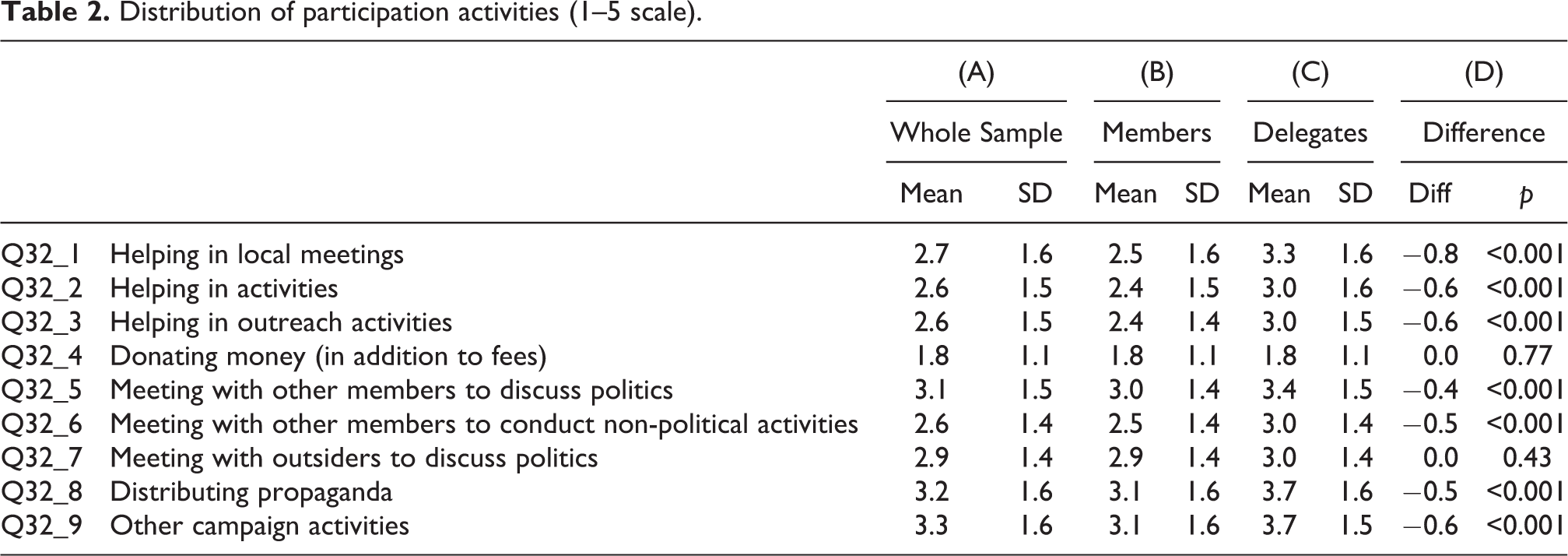
The second decision concerns the choice of the clustering method. As the nine variables used as input to our cluster analysis can be handled as analogous to continuous variables, the standard approach would consist of using the k-means method (Kaufman and Rousseeuw, 1990: 113). However, we choose partitioning around medoids (PAM), which is ‘based on the search for k representative objects among the objects of the data set…the so-called medoids’ (Kaufman and Rousseeuw, 1990: 68); after finding these ‘medoids’, the PAM algorithm constructs the clusters by ‘assigning each object of the data set to the nearest representative object’ (Kaufman and Rousseeuw, 1990: 68). We chose PAM as it tends to yield more robust results than k-means (Reynolds et al., 2006).
Next, in order to determine the appropriate number of clusters, we run a series of analyses, ranging from two up to eight clusters, and examine each of the associated silhouette width values. The highest silhouette width value is obtained for two clusters, and so we preserve those for the remainder of the analysis. 4
The final task is validating and interpreting the results. There are two medoids which differ on two key dimensions. For all the contemplated types of participation, the intensity of participation is higher in cluster 1 than in cluster 2. Furthermore, the relevance of two specific motivations, namely ‘being politically active’ and ‘making a political career’, is also higher for the medoid of cluster 1 than it is for the medoid of cluster 2 (Table 3). Therefore, the main distinction seems to be between members that are more likely to participate and those that are not. Furthermore, while wanting to pursue a political career is a secondary motivation for most respondents, those who are more active are more likely to attribute a relatively higher importance to it. Individuals belonging to cluster 1 can thus be labelled as ‘activists’, whereas individuals belonging to cluster 2 can be classified as ‘passive members’. This distinction relies on previous theoretical classifications that differentiate the subset of members with higher levels of partisan engagement from those who do not regularly participate in party life (see, among others, Ware, 1996: 65; Scarrow, 2015). Our first hypothesis, according to which patterns of participation and motivations would allow us to establish a distinction between members, is thus validated.
Medoids (‘central’ observations) for the two clusters.

Note: Each cell represents the ‘typical’ value for the two central observations, one for each cluster
How are these types of members distributed across the five parties in our sample? The first point to retain is that there is a difference between the proportion of the types depending on whether we are looking at delegates or members. As Table 4 shows, while 70% of delegates are more active members, only 45% of ordinary members fall into this category. This is in line with the expectation formulated in our second hypothesis.
Distribution of member types across parties.
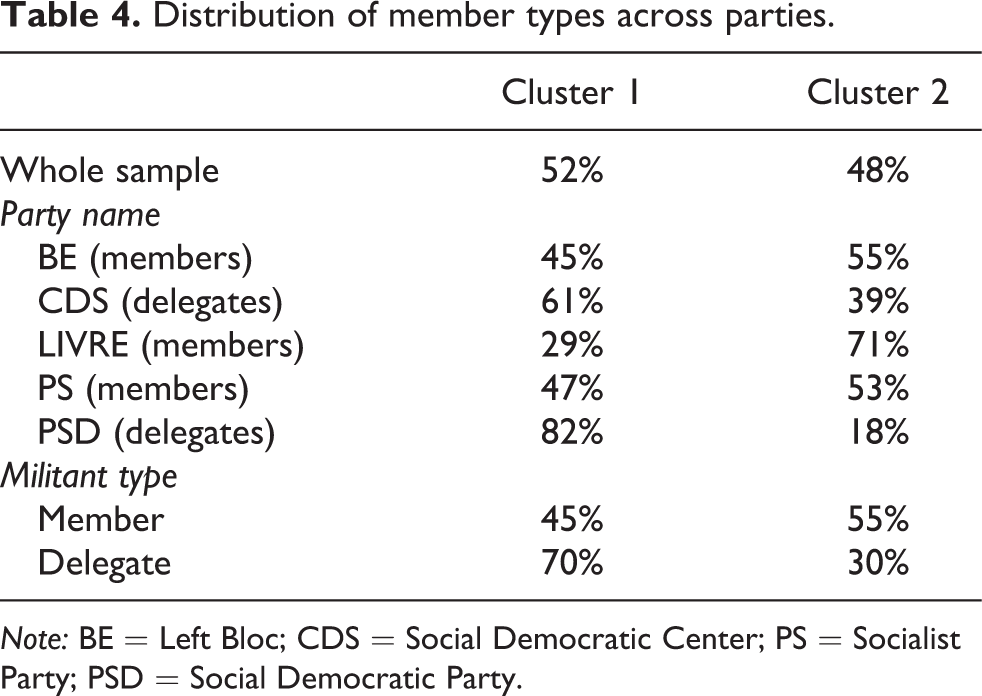
Note: BE = Left Bloc; CDS = Social Democratic Center; PS = Socialist Party; PSD = Social Democratic Party.
Within delegates, those from PSD are more likely to be active members than respondents from CDS, which is in line with our third hypothesis. Within members, on the other hand, there are no significant differences between members from the PS and BE; however, members of LIVRE are more likely to be more passive. This might be due to the fact that the party had been only recently created by the time of the survey. Our third hypothesis is thus only met in the case of delegates, but not party members.
Interestingly, we do not find any significant differences between the two clusters in terms of gender, age, education or socio-economic status. Party membership data indicate that Portuguese party members are predominantly male, middle-aged, with high levels of education and above-average income (see the Online Appendix). Despite some differences between parties, party members form a quite homogenous group, showing a distinct profile compared to the general population. And yet our empirical analysis confirms the existence of two distinct types of party members, diverging in terms of motivations and degree of involvement in party activities. In addition, this distinction has important implications for members’ opinion and ideological position. This is the topic we address in the subsequent section.
Types of party members and ideological congruence
The results reported in the previous section show that party members can be distinguished based on the combination of their motivations and participation profiles, and that different parties have diverse compositions of those types of members. This section tests whether these differences are consequential in terms of members’ attitudes towards their party. Concretely, we measure the impact of membership type on the ideological congruence between respondents and their parties.
The dependent variable that we seek to account for using membership type as our independent variable is ideological congruence – the degree of ideological identification between an individual and her party. The survey includes two questions asking about the placement of the respondent and the party on a [1–10] left–right ideological scale. Using answers to these questions, we measure ideological congruence as the absolute value of the difference between the perceived position of the party and the self-assessment of the individual. Higher values thus imply a larger distance between a member and her party. Previous research on ideological divergence between members and their parties by van Haute and Carty (2012: 891–892) did not find a solid relationship between the reasons for joining and being an ‘ideological misfit’. On the other hand, Kölln and Polk (2017), examining both grassroots members and mid-level elites, found a significant impact of activism on ideological congruence. As we consider both variables and our analysis includes both members and delegates separately, we might be able to better qualify these findings.
To address this question, we fit an ordinary least squares regression using as a dependent variable the absolute value of distance between the position of the member and her own party. Since we need to control the effect of factors not contemplated in the cluster analysis, we also include age, sex, education, leadership and party as independent variables. The results are reproduced in Table 5. The coefficient for membership type is significant in the three samples. ‘Activists’ are therefore more likely to be ideologically closer to their party, whereas more passive members, who have a less participation-intensive membership, are more likely to distance themselves from the party. Our fourth hypothesis is thus corroborated. Interestingly, holding a leadership position, being male and having a higher level of education also make members more likely to distance themselves from the ideological position attributed to the party.
Regression with ideological congruence as a dependent variable.
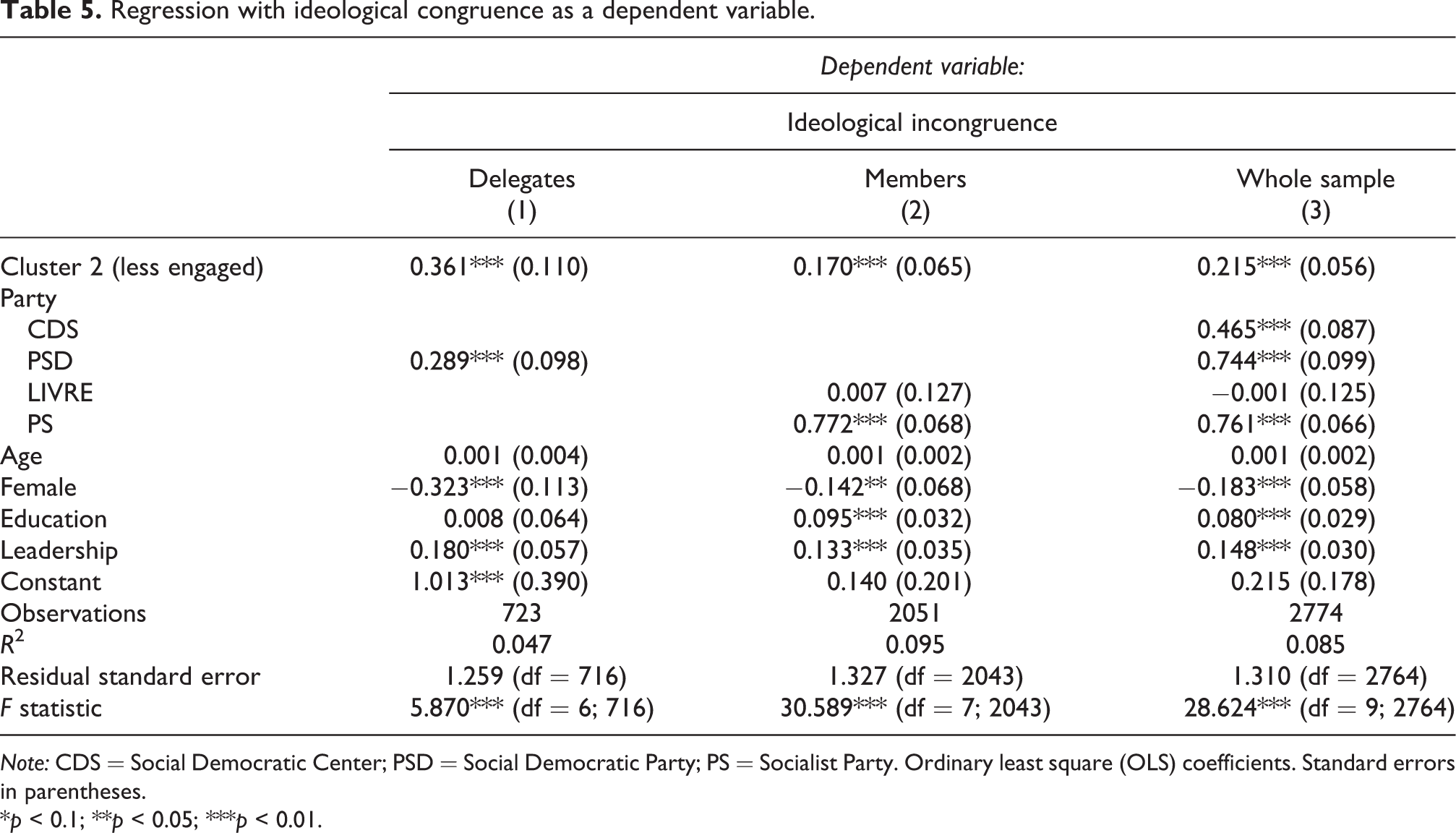
Note: CDS = Social Democratic Center; PSD = Social Democratic Party; PS = Socialist Party. Ordinary least square (OLS) coefficients. Standard errors in parentheses.
*p < 0.1; **p < 0.05; ***p < 0.01.
The coefficients associated with each specific party are also noteworthy. Members of the left-wing parties BE and LIVRE and, to a lesser extent, delegates belonging to the conservative CDS-PP are less likely to report an ideological distance towards their parties in comparison to the more ideologically centrist PS and PSD. Being catch-all parties, they seem to aggregate a more diverse set of members than smaller parties. Further examination of the data also provides an interesting distinction between members of the PS and delegates of the PSD. The deviation of PS members is typically oriented towards the left; in the case of the PSD, on the other hand, the deviations are both towards the left and the right. Thus, while the PS seems to attract members that systematically locate themselves to the left, the PSD delegates are more ideologically diverse.
Conclusions
For all the laments about their waning, party organizations remain a key element of representative democracies, at least in Europe. In particular, party members are still a valuable resource for political parties and the introduction of new rights and the use of new communication tools (see Scarrow, 2015) are an illustration of the attention that party leadership has concentrated on this important aspect of party life. These emerging trends underline the need to further investigate how distinct types of party members differ. From this viewpoint, the contribution of this study is twofold. First, we test whether party members can be distinguished on the basis of internal participation and motivations, and examine how different types of members exhibit distinct levels of ideological congruence. Second, we provide new data on a neglected case by drawing on a web survey among members of five Portuguese parties differing in size, government participation and ideology.
Our analysis clearly identifies two types of members according to their intensity of participation and motivations for joining – activists versus more passive members. This finding holds true when we consider congress delegates and rank-and-file members. More interestingly, we show that belonging to one of these distinct types of party members has substantive implications in terms of their attitudes. Namely, we observe that ideological fit with the party is significantly associated with different profiles, even when controlling for other relevant variables. These results are rather conservative because we could only test for specific effects, given the limited extension of the questionnaire.
One of the insights that our analysis provides is the notion that not only grassroots members, but also middle-level elites may present distinct types of motivations and levels of engagement within party organizations. In addition, we have also observed that catch-all, mainstream parties are different from small ones, regardless of the type of members – both PSD delegates and PS members are more likely to display ideological differences with the party than delegates of the conservative CDS-PP and members of left-wing BE and LIVRE. A fruitful avenue for future research consists of investigating the linkage between types of party members and patterns of engagement and participation –for example, kinds of activities or instruments of mobilization.
Our findings add to previous research on the importance of distinguishing distinct types of party members (Heidar, 2006: 308; Scarrow, 2015: 26–34). As party membership is increasingly shrinking, there may be a feedback loop in which activists become more important vis-à-vis passive members, thus reinforcing the asymmetry between more engaged and professional-minded members, on the one hand, and mere party supporters, on the other. If party membership takes this direction we might observe a trend towards a growing professionalization and an increasing importance of the auto-referential character of party life, as suggested by the cartel party theory. Hypotheses about the interplay between motivations and participation, as well as its impact on other relevant aspects of party politics –for example, candidate selection and intra-party democracy – can be tested in studies addressing the longitudinal change in party membership.
Our data bring advantages but also impose some limitations. On the one hand, the data come from five different parties, constituting quite a large and broad sample of party members. On the other hand, the results are based on the analysis of a single country. Therefore, more comparative research is needed to assess whether these findings apply to other countries as well. Although we believe that Portugal provides an excellent opportunity to examine the heterogeneity of party membership, we encourage researchers to analyze this topic in other countries that have experienced different democratic trajectories or have displayed distinct traditions of party politics, such as France or Italy. A second limitation is that although we cover five parties, we were unable to survey members and delegates in all of them. By diversifying respondents within parties as much as possible, researchers will be able to better grasp the relevance and implications of distinct membership profiles. A third limitation is related to the questionnaire, which does not include several potential relevant topics, such as participation in intra-party elections, use of new communication tools or the evaluation of party/leadership performance. Finally, methodological concerns should be further explored, thus testing the robustness of our findings through distinct research strategies and methods.
Despite a vast amount of studies dealing with party membership, scholarly work on the empirical foundation of members’ profile and opinion is still very rare, especially in relation to the heterogeneity of party members. This research, combining insights from the study of more established democracies, and applying them to original data from a newer democracy, helps fill this scholarly gap, and also generates new questions. For example, this article does not address the question of how different types of members are associated to distinct patterns of communication. Furthermore, as parties are necessarily nested within national party systems, our analysis is not able to address whether the prevalence of a given profile may be the product of the interaction among individual-, party- and national-level variables. Such questions, being related to local politics, party structures, grassroots mobilization and different structures of incentives, are best addressed with comparative still-to-be-gathered data and utilizing different research methodologies. A related and highly relevant question that stems from the conclusions of this study concerns the opinion structure of party members. The analysis of different types of members may enhance our understanding of factionalism and intra-party conflicts, as well as why party members leave their party, thus contributing to the explanation of short-medium term dynamics of the evolution of party membership. These and other questions related to the multi-faceted dimensions of party membership represent an active new agenda for scholars interested in newer democracies and beyond.
Supplemental material
Supplemental Material, Online_appendix03082017 - Types of party members and their implications: Results from a survey of Portuguese party members
Supplemental Material, Online_appendix03082017 for Types of party members and their implications: Results from a survey of Portuguese party members by Marco Lisi and João Cancela in Party Politics
Footnotes
Declaration of Conflicting Interests
The author(s) declared no potential conflicts of interest with respect to the research, authorship, and/or publication of this article.
Funding
The author(s) disclosed receipt of the following financial support for the research, authorship, and/or publication of this article: This work was supported by Portuguese National Funds through the Fundação para a Ciência e a Tecnologia (FCT) in the framework of the projects ‘UID/CPO/04627/2013’ and ‘PTDC/IVCCPO/1864/2014’.
Supplemental material
Supplementary material for this article is available online.
Notes
References
Supplementary Material
Please find the following supplemental material available below.
For Open Access articles published under a Creative Commons License, all supplemental material carries the same license as the article it is associated with.
For non-Open Access articles published, all supplemental material carries a non-exclusive license, and permission requests for re-use of supplemental material or any part of supplemental material shall be sent directly to the copyright owner as specified in the copyright notice associated with the article.
