




Abstract
Party identification provides citizens with an anchor from which they derive many of their political attitudes and issue preferences. But what happens when people encounter political debates that place their partisan identities and policy attitudes into conflict with one another? This article draws on an original experiment designed to study the effect of debates that cut across people’s partisan identities and policy attitudes. The results show that cross-cutting debates make people less likely to engage in selective exposure, more likely to feel ambivalent toward their political party, and less likely to rely on party cues when rendering a judgment.
The current era of polarized political parties in the United States means that debates often fall neatly along a single dimension of partisan conflict. Congressional voting is largely explained by partisanship (Lebo et al., 2007), while voters’ policy attitudes are increasingly linked to their party identifications (Hetheringon, 2001; Levendusky, 2010). Yet not all issues fall neatly along party lines. In recent years, debates about immigration reform, building the Keystone Pipeline, and free trade have cut across party lines at both the mass and elite levels. President Obama, for example, openly opposed building the Keystone Pipeline while nine Democratic Senators broke with their party to support passing legislation to build it. 1 Further, in one survey 56% of Democrats supported the project, while only 36% opposed it. 2 In short, sizable numbers of Democratic voters were explicitly out of step with the leader of their party.
How do voters make sense of cross-cutting debates like these? Do voters who are out of step with their party attempt to adhere to their partisan priors or are they motivated to understand the contours of the debate? On the one hand, party identification is a central social identity that anchors people’s political worldviews (Campbell et al., 1960; Green et al., 2002). Party motivates selective exposure to congenial information (e.g., Iyengar and Hahn, 2009; Stroud, 2008, 2011) and favorable processing of co-partisan information (Bartels, 2002; Taber and Lodge, 2006; Taber et al., 2009). These works suggest that people may attempt to view cross-cutting debates through a partisan lens as they would any other issue. On the other hand, cross-cutting debates may lead voters to deemphasize party and to instead pay greater attention to the substance of available information. Voters’ attitudes are less likely to be colored by partisanship when evaluating a policy supported by some members of their party and opposed by others (Bolsen et al., 2014). Further, voters pay attention to more than party cues when provided the opportunity. As Bullock (2011: 512) notes, citizens’ attitudes were affected by policy information “at least as much” as they were by party cues in his study.
There is good reason to care about how voters react to cross-cutting debates. Electoral accountability requires citizens to learn about issues, to understand the positions of their political parties and representatives, and to use that information as a basis for evaluating those representatives. Some argue that elite polarization makes accountability easier by clarifying elite issue positions (Dancey and Sheagley, 2016; Levendusky, 2010). While this may be true overall, it is less clear what happens when voters are confronted with debates and issues that do not fall along party lines. If voters treat a cross-cutting debate as they would any other—such as by viewing it through a partisan lens—this indicates that they may struggle to reward or punish legislators for their positions and fail to understand the nuance of policies.
This article advances our understanding of partisan information exposure and processing in two ways. The first is by focusing specifically on cross-cutting debates and how they affect party cue use and judgment. The second is by examining multiple stages of the decision-making process, including information search, information processing, and judgment. This is accomplished using an original experiment, the results from which show that people exposed to debate that cut across their policy views and party identifications are less selective when seeking information, more prone to be ambivalent toward their political party, and less likely to rely on party cues when rendering a decision.
Party identification, information search, and information processing
Party identification lies at the heart of political decision-making for two reasons. Partisanship is an identity that is socialized during childhood and endures in power over the course of one’s life (Green et al., 2002). This leads to party structuring many attitudes and beliefs rather than vice versa (Dancey and Goren, 2010; Lenz, 2012). The centrality of a partisan identity to an individual’s self-concept creates incentives to engage in behaviors aimed at protecting and reinforcing that identity. The result is that party identification operates as, “…a pervasive dynamic force shaping citizens’ perceptions of, and reactions to, the political world” (Bartels, 2002: 138).
Second, partisanship is shortcut that voters draw on to simplify decision-making. Party cues allow voters to make inferences without becoming fully informed about a policy or candidate (Lau and Redlawsk, 2006; Sniderman et al., 1991). For example, learning where a party elite stands on an issue can help voters identify the contours of a political debate, especially if the policy area is one in which the voter lacks familiarity or has a weaker opinion (Boudreau and MacKenzie, 2014; Ciuk and Yost, 2016).
Both factors lead party identification to be a powerful cause of political behavior. Voters prefer to access information they perceive as consistent with their partisan identities (Iyengar and Hahn, 2009; Stroud, 2008). Thus, they rely on news mediums and networks they believe are ideologically congenial and they allow their partisanship to dictate consumption of specific pieces of information (Stroud, 2011). Party also shapes how people process information (e.g., Lau and Redlawsk, 2001; Rahn, 1993; Zaller, 1992). As Rahn (1993: 492) writes, “…when voters have both particular information and party stereotypes available…[t]hey neglect policy information in reaching evaluations; they use the label rather than policy attributes in drawing inferences.”
These works suggest that individuals’ policy attitudes are largely devoid of substance. Rather, people root their policy views in their partisanship and adopt the positions held by members of their political party. One example of this perspective is in recent work by Lenz (2012) on the tendency for citizens to adopt the positions held by co-party politicians. Lenz finds evidence that when voters learn where members of their party stand on an issue, they adopt those positions rather than updating their evaluations of that politician given new information about her policy positions. These works lead one to expect that voters are motivated to prioritize partisanship even in the face of cross-cutting issues or debates.
Yet recent work has begun identifying situations in which party is not the dominant driver of judgment. Garrett and Stroud (2014) find that people are willing to access information that has a mixture of proattitudinal and counterattitudinal evidence. Further, one of the more general conclusions in selective exposure research is that people are selective because it is easy and congenial information operates as a sort of heuristic (cf., Stroud 2012, p. 170). Cross-cutting debates and information may to some degree negate the perceived value people see in selective exposure to partisan information.
There is also reason to believe that the effect of party is weaker when processing information about a cross-cutting issue or debate. Citizens rely on policy information despite the presence of party cues (Bullock, 2011), even when that information conflicts with party cues (Boudreau and MacKenzie, 2014). In the case of Boudreau and MacKenzie (2014), when policy information directly conflicted with party cues, participants typically held attitudes that suggested these conflicting pieces of information cancelled each other out. Party cues are also weaker when elites within parties are less homogenous (Druckman et al., 2013) or hold diverging positions on an issue (Bolsen et al., 2014). Finally, Lenz (2012) notes that people may be less likely to follow party leaders on issues related to identity or when they have access to detailed policy information.
There is a strong theoretical reason to believe that people should be willing to engage with political messages and to rely on information even when it conflicts with party cues. Ultimately, people are cognitive misers who prefer to minimize mental effort while also striving to hold correct beliefs (Petty and Wegener, 1998). Often the most effective strategy for maintaining this balance is the use of directional goals and motivated reasoning (Kunda, 1990; Taber and Lodge, 2006). Avoiding challenging information and processing information to favor existing attitudes and identities—like party—helps one to efficiently maintain the belief that they are correct. This is likely one of the reasons voters simply adopt the positions held by elites rather than engaging in the more effortful process of identifying their own policy positions (Lenz, 2012).
However, counter stereotypical cues and information highlighting conflicts between one’s party and policy views make it more difficult to maintain the baseline of minimal effort and directional goals. Cross-cutting information should create a tension between an individual’s partisan identity and their other attitudes, which they should be motivated to alleviate. Thus, they more closely scrutinize information (Ditto et al., 1998) and generate thoughts aimed at protecting the challenged identity (Taber and Lodge, 2006). It is less clear how this process plays out when faced with a cross-cutting issue. What do directional goals look like when an individual encounters policy information they agree with but which conflicts with their party’s stance and/or which is advocated by the opposition party?
Cross-cutting debates and information processing
There is already strong evidence that voters will rely on information, even when it conflicts with their policy views, to inform their attitudes about specific policies (Boudreau and MacKenzie, 2014). There is also reason to believe that encountering information like this may have additional consequences for how people view the political parties and make decisions. For example, people who encounter competing information tend to hold considerations on both sides of the issue, regardless of their prior position (Chong and Druckman, 2007). Processing information when it conflicts with party cues could lead people to hold competing considerations related to the issue and the parties, which, in turn, could affect how people view the political parties.
It is unlikely that these considerations would lead someone to change their partisan identity given its role as a central social identity (Green et al., 2002). However, research on partisan ambivalence shows that it is possible for voters to feel conflicted toward their political party in the short term while maintaining a stable partisan identity in the long term (Basinger and Lavine, 2005; Greene, 2005; Lavine et al., 2012; Thornton, 2013). The argument of work in this area is that an individual’s partisan identity is distinct from her short-term evaluations of the political parties and that people often hold a mixture of positive and negative evaluations of the political parties.
These evaluations form two underlying, largely uncorrelated, dimensions: party-consistent evaluations (positive in-party evaluations and negative out-party evaluations) and party-inconsistent evaluations (positive out-party evaluations and negative in-party evaluations; Greene, 2005; Lavine et al., 2012). At a given moment, some members of the electorate hold relatively more party-consistent evaluations and fewer party-inconsistent evaluations (these voters are “univalent partisans”), some hold the opposite—more party-inconsistent evaluations and fewer party-consistent evaluations—and are labeled “ambivalent partisans”—while the remaining electorate has a relatively even mix of both.
While related conceptually, partisan ambivalence is distinct from attitude ambivalence both operationally and in terms of measurement (see Lavine et al., 2012: 53–60). Attitude ambivalence is, “The endorsement of competing considerations towards political objects…” (Rudolph, 2011: 561), while partisan ambivalence is the conflict between long-term identities and short-term evaluations. Thus, whereas attitude ambivalence relates to the simultaneous holding of conflicting attitudes, partisan ambivalence occurs when one holds a stable partisan identity but has short-term considerations that conflict with that identity. This means that the typical antecedents of attitude ambivalence, like information about both sides of a policy, should not heighten partisan ambivalence (Keele and Wolak, 2008). Rather, partisan ambivalence requires a context that highlights or creates a tension between one’s partisan identity and her feelings about that party. One such context could be cross-cutting debates.
Hypotheses
I have three hypotheses that map onto the different stages of the decision-making process. The first relates to information access and selective exposure. While people prefer to access congenial information, there is also evidence that people are willing to access information with a mixture of pro- and counterattitudinal information. Further, when information cuts across party identification and policy views, this may motivate people to be more open to counterattitudinal information. This leads me to propose the following hypothesis:
My second hypothesis focuses on how cross-cutting debates will affect information processing and how participants evaluate their political party. Some work suggests that people will favor partisanship over policy information (e.g., Lenz, 2012; Zaller, 1992), while other scholars suggest that the effect of party will be attenuated by cross-cutting information (e.g., Boudreau and MacKenzie, 2014). This leads to the following hypothesis:
My final expectation pertains to the last stage of the decision-making process: rendering a judgment. In observational work, ambivalent partisans rely less heavily on their partisan identities when forming judgments, like vote choice (Basinger and Lavine, 2005; Lavine et al., 2012). It follows then that exposure to cross-cutting information may also affect how people render a decision in a related policy domain. However, the traditional perspective suggests that people will uncritically rely on party (Lenz, 2012; Rahn, 1993). This leads to my final hypothesis:
To summarize, my general expectation is that exposure to political debates that create cross-pressures between an individual’s partisan identity and political attitudes could affect multiple stages of decision-making. However, it may be the case that people may rely on party cues regardless of information context.
Study design and key measures
A total of 383 participants were recruited to participate in a web-based experiment from April to May 2012. The core feature of the study was an experiment that embedded participants in information environments that randomly varied if they contained information that cut across a participant’s party identification and policy views. The study consisted of three phases: a pre-treatment questionnaire, the information environment experiment, and a post-treatment questionnaire.
The environments were created using the dynamic process tracing environment (DPTE; Lau and Redlawsk, 2006). The DPTE presents information to participants as individual text boxes with headlines describing their content and participants are free to click on the textbox to read the content it contains or to ignore the information. The environment is dynamic, meaning that the information available to the participant changes over the course of the study. This has the effect of forcing participants to access information they think is especially relevant or else run the risk of that information becoming unavailable.
Participants in the study were asked to cast a vote on a hypothetical ballot initiative aimed at curtailing illegal immigration. The language was based on reforms in Arizona in 2010. 3 Participants read about the initiative after completing the pre-treatment questionnaire. They then proceeded to the argument portion of the study where they had 5 min to read any information available in their environment. Once time had elapsed, participants were automatically taken to a screen where they could vote on the ballot initiative.
The study focused on immigration reform because of variation in the positions held by Republican and Democratic Party elites and members of the mass public. In recent years, members of both parties cast votes to ease or strengthen restrictions on undocumented immigrants. For example, 14 Republican Senators joined 52 Democrats to support comprehensive immigration reform in 2013 (Parker and Martin, 2013). At the time, voters did not perceive either party has having an advantage in handling immigration reform, which made it plausible to attribute arguments on each side of the issue to either Democratic or Republican elites. 4
There is also evidence that the issue cut across partisan lines at the mass level. For example, a CNN/ORC International Poll from June 2013 revealed that 59% of Democrats and 48% of Republicans supported increasing border security and providing a path to citizenship for undocumented immigrants. A 2010 CBS/New York Times poll that asked a national sample about their support for the Arizona immigration law revealed that 2/3 of Republicans supported the measure while about 40% of Democrats agreed with the measure. Finally, in my sample, 1/3 of self-identified Democrats held negative attitudes about immigrants while 26% of Republicans held positive views.
Participants were recruited from the Amazon.com Mechanical Turk (MTurk) system (Berinsky et al., 2012; Buhrmester et al., 2011). They were required to be residents of the United States and were compensated $1 for their participation. While participants who complete studies on MTurk do not mirror the general population in the United States, MTurk studies better reflect characteristics of the US population than convenience samples typically used for experimental work (Berinsky et al., 2012). An important demographic difference between my participants and a nationally representative sample was the distribution of party identification (roughly 60% of participants were self-reported Democrats, leaners coded as partisans). I include more detail about the other sample characteristics in the supporting information.
While there are differences between my sample and the general population, this should not raise concerns about the validity of my conclusions. The goal of my experiment is to develop a detailed understanding of how information environments affect multiple stages of decision-making. Ultimately, this requires sacrificing some external validity in the service of greater internal validity (Lau and Redlawsk, 2006). Some have criticized MTurk studies due to the potential for participants from MTurk being familiar with known experimental frameworks (e.g., Chandler et al., 2014). My study does not rely on a common paradigm in political science nor do I rely on questions aimed at measuring subtle or implicit attitudes, thus minimizing this concern.
Experimental manipulation
Participants in my study were randomly assigned to one of three information environments that simulated elite debate about immigration reform. All the environments contained an even split of pro-immigration (anti-initiative) and anti-immigration (pro-initiative) information. The information in the first environment was non-partisan, while the second and third environments included a party cue manipulation. The second environment attached Democratic Party cues to the pro-immigration positions and Republican cues to the anti-immigration positions. The third environment was the reverse, with Republicans advocating the pro-immigration side and Democrats holding anti-immigration positions. The substance of the information did not vary across environments save for party cue manipulation, which was implemented by attributing the content of each argument to an explicitly partisan source and by modifying the headline of each partisan argument to include the appropriate party source. 5
I combined the experimental manipulation with pre-treatment measures of participants’ party identifications and views about undocumented immigrants to code whether participants were embedded in an environment containing a cross-cutting partisan debate. Participants randomly assigned to the non-partisan environment are labeled as being in the non-partisan condition (n = 189) because it contained an even split of pro- and counterattitudinal non-partisan information. Environment 2 (the party consistency condition, n = 102) contained information in which co-party elites advocated the proattitudinal position and opposition party elites held the counterattitudinal position. Participants in environment 3 (the party inconsistency condition, n = 92) saw counterattitudinal information from co-party elites and proattitudinal information from the opposition party. 6
For example, if a self-identified Democrat who held anti-immigrant views was randomly assigned to the environment in which Republican cues were attached to the anti-immigration position and Democratic cues were attached to the pro-immigration position, then she would be coded as being in the party-inconsistent condition. If the same participant had been randomly assigned to the partisan environment in which Democratic cues were attached to the anti-immigration position and Republicans advocated for the pro-immigration position, then she would be coded as being in the party consistent condition.
Party identification was measured using the traditional 7-point scale with independent leaners coded as partisans. Views about immigration were measured using responses to an agree/disagree question with the following stem: “Illegal immigrants pose a threat to public safety in the United States.” The responses were 1—Strongly agree, 2—Moderately agree, 3—Slightly agree, 4—Slightly disagree, 5—Moderately disagree, 6—Strongly disagree. Scores from 1 to 3 were treated as anti-immigrant views (49% of the sample), while 4–6 were positive immigrant views (51% of the sample).
Each argument was roughly 150 words long and contained a thesis statement, supporting information from a fictional source, and a conclusion. 7 A pro-initiative argument, for instance, could highlight the dangers undocumented immigrants pose to public safety while an anti-initiative argument could emphasize the lack of danger posed by undocumented immigrants. Examples of each kind of argument are included in the supporting information. A given environment contained 10 pro-initiative and 10 anti-initiative arguments. There were 5 unique arguments of each type, with each argument repeating once, yielding a total of 20 arguments for a participant to access.
Measuring partisan ambivalence
Partisan ambivalence was measured using a series of questions administered on the pre- and post-treatment questionnaires, which allows me to explore how the information environment changed levels of partisan ambivalence. Participants were asked a series of questions about their likes and dislikes of each party. I used these measures to generate estimates of conflict evaluations (in-party negativity and out-party positivity) and consistent evaluations (in-party positivity and out-party negativity). Because my focus in this article is on understanding how exposure to partisan disagreement leads to changes in ambivalence, I coded participants who had increases in conflict evaluations and decreases in consistent evaluations as more ambivalent. Those who had the same pre- to post-treatment conflict and consistency evaluations or equal increases or decreases in both types of evaluations were coded as having no change. Participants who had higher consistency evaluations and lower conflict evaluations were categorized as less ambivalent. All analyses omit pure independents because they do not identify with a party and cannot experience partisan ambivalence (Lavine et al., 2012).
Results
Analysis 1—information search
The first hypothesis pertains to the initial informational search stage of the decision-making process. Specifically, that people will favor proattitudinal information but that this tendency will be attenuated when faced with cross-cutting debates. One of the features of the DPTE is that it tracks information access. This allows me to examine the factors that led a participant to access a specific piece of information and if those factors vary depending on the nature of the information available in their environment. Participants accessed an average of 10.4 arguments in their environment, a little over half of the available information.
I test H1 by coding the total number of proattitudinal and counterattitudinal arguments each participant accessed while they navigated the DPTE. I begin by considering pro and counterattitudinal information separately. When examining the entire sample, there is evidence that participants accessed more proattitudinal information than counterattitudinal information (proattitudinal mean = 5.27, counterattitudinal mean = 5.02; difference = 0.25, p = 0.02, two-sided). Evidence to support H1 would be that the preference for proattitudinal information is weaker for participants embedded in the party-inconsistent environment. Table 1 shows the mean number of pro- and counterattitudinal pieces of information accessed by participants in each type of information environment and the significance tests of the difference between each type.
Type of information accessed by information environment.

Note: All p values are reported from two-sided hypothesis tests.
Participants embedded in the non-partisan and party consistent environments accessed more proattitudinal information than counterattitudinal information. The preference for proattitudinal information is statistically weaker in the party consistent environment (p = 0.08) than it was in the non-partisan environment. However, the magnitude of the differences (0.40 vs. 0.31) is similar and the sample size is much smaller in the party consistent environment. There is no evidence that participants in the party-inconsistent environment accessed different amounts of proattitudinal and counterattitudinal information.
For a second test, I created a dependent variable that indicated a preference for proattitudinal or counterattitudinal information. I did this by subtracting the mean number of counterattitudinal arguments a participant accessed from the number of proattitudinal arguments they accessed. Thus, positive values indicate a preference for proattitudinal information and negative values indicate a preference for counterattitudinal information. Figure 1 displays the density of this variable in each of the information environments.
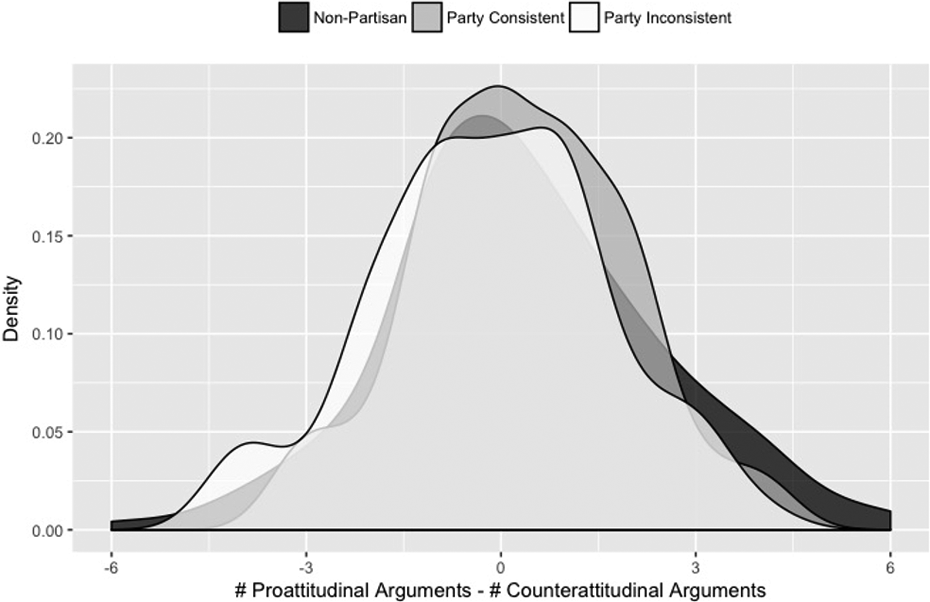
Distribution of type of argument accessed by information environment.
Participants in the non-partisan and party consistent environments had more positive values on the dependent variable compared to participants in the party-inconsistent environment. Specifically, participants in the party-inconsistent environment accessed roughly one half fewer proattitudinal arguments than counterattitudinal arguments. 8 In all, this and the previous tests provide support for my first hypothesis that exposure to cross-cutting debates can attenuate the tendency for people to engage in selective exposure. When proattitudinal information was sourced to the opposition party and counterattitudinal information was linked to the participant’s party—as was the case in the party-inconsistent environment—there was no preference for pro over counterattitudinal information. Given the composition of this environment, this means that participants neither favored solely prior attitudes nor their political party when seeking information. 9
Analysis 2—changes in partisan ambivalence
The first analysis shows that people who are exposed to a cross-cutting political debate were willing to access information that cut across their party identifications and policy attitudes. The next question is how people process this information. I test H2 by examining if there is a relationship between the information environments and levels of partisan ambivalence. If participants engage in defensive strategies, then we would expect the environments to have no effect on levels of ambivalence, or even to lead to a strengthening of partisan evaluations due to counter arguing and other ego-defensive strategies (Taber et al., 2009). However, if participants process information in a more evenhanded fashion, then the party-inconsistent condition should make them feel more negatively about their own political party and/or more favorable toward the opposition party.
The dependent variable for this analysis is a three-category variable capturing whether a participant became more ambivalent, less ambivalent (more univalent), or experienced no change in ambivalence toward their party from pre- to post-treatment. In all, 10% of participants became more ambivalent, 17% became more univalent (less ambivalent), and 73% did not change pre- to post-treatment. The primary independent variables are two dummy variables corresponding to the information environment conditions, with the non-partisan environment serving as the omitted category. The model also includes controls for strength of partisan identification (higher values more extreme), political sophistication (higher values more sophisticated), and how personally important the issue of immigration reform is to the participant (higher values correspond to greater importance). 10
The dependent variable is modeled using an unordered logistic regression. Table 2 displays the estimates from this model. Column 1 shows the contrast between becoming more univalent versus no change and column 2 reports the results for the more ambivalent versus no change contrast.
Ambivalence type by information environment.
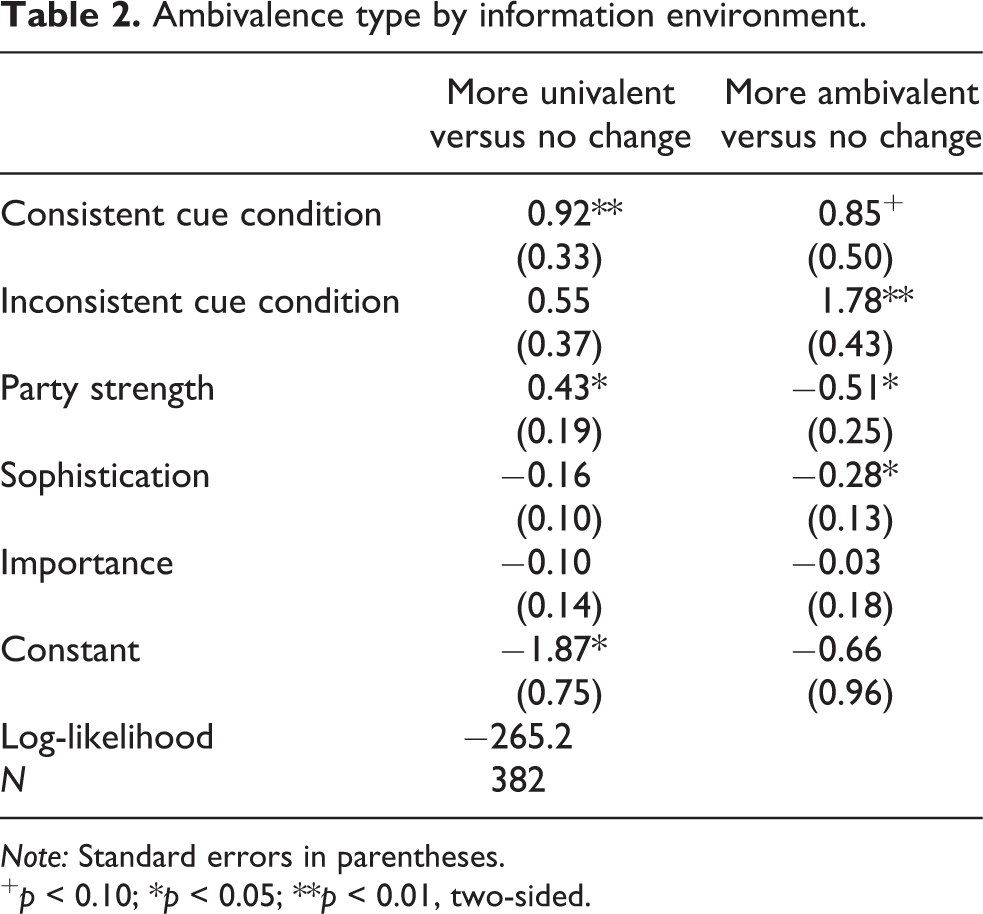
Note: Standard errors in parentheses.
+ p < 0.10; *p < 0.05; **p < 0.01, two-sided.
The coefficients in Column 1 reveal that participants in consistent party cue environments are more likely to become more univalent than are participants in the non-partisan information environment. Shifting to the second column, participants assigned to the consistent party cue environment are marginally more likely to become more ambivalent compared to those in the non-partisan condition. However, participants in the inconsistent environment are substantially more likely to have a higher level of partisan ambivalence than are those in the non-partisan condition. This suggests that processing cross-cutting partisan information resulted in changes in how people viewed their political party.
These results are better illustrated using predicted probabilities. The probabilities are simulated by setting all other variables in the model at the mean or mode for the participants included in the analysis. Figure 2 displays the results from these simulations. The lines running through the bars are 95% confidence intervals.
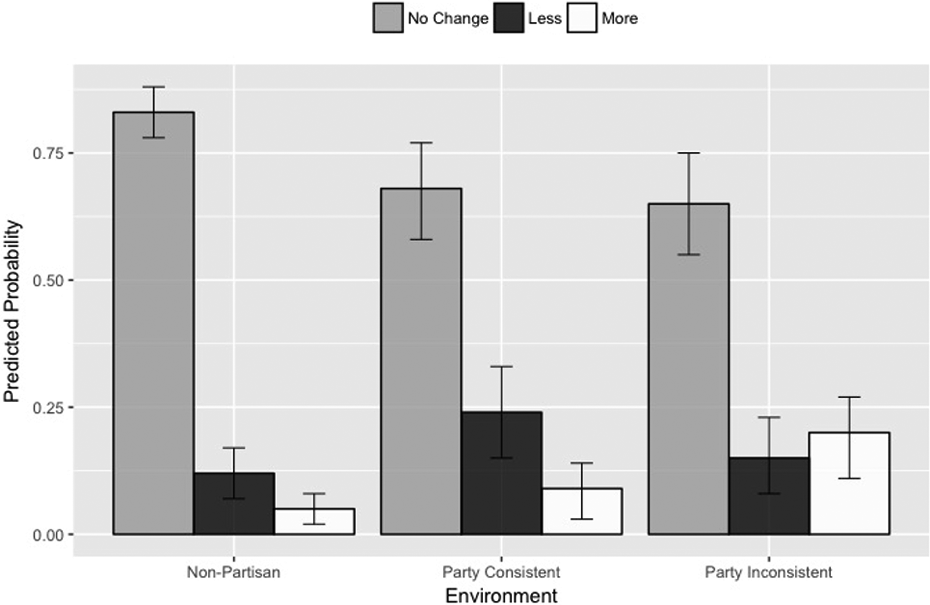
Predicted probability of ambivalence type by information environment. Figure displays the predicted probability of each category of partisan ambivalence by information environment. The lines in each bar correspond to 95% confidence intervals.
The modal outcome in all environments is a high predicted probability of no change in partisan ambivalence. This is not necessarily a surprising finding given the focus on one political issue and the relatively short duration between the two ambivalence measurements. Reassuringly, participants in the non-partisan conditions had the highest level of stability while those in the two party cue conditions were more likely to change.
The patterns of change observed in the party consistent and party-inconsistent condition offer support for H2, that conflictual information can heighten partisan ambivalence. The middle set of bars reveal that participants in the consistent cue condition had a greater probability of becoming less ambivalent than they had of becoming more ambivalent. For example, participants in the consistent cue condition were about twice as likely to become less ambivalent toward their political party than were participants in the non-partisan environment (diff = 0.12, p = 0.01). Thus, attaching co-party cues to proattitudinal arguments seems to reinforce positive images of one’s political party.
The dynamics change when examining the inconsistent party cue condition. Participants embedded in this environment had a significantly higher predicted probability of becoming more ambivalent. Participants in the inconsistent cue condition were almost four times more likely to become more ambivalent than were those in the non-partisan condition (diff = 0.15, p = 0.001). They were also roughly twice as likely as those in the consistent cue condition to become more ambivalent (diff = 0.12, p = 0.02). The inconsistent cue environment also led some participants to have a greater probability of becoming less ambivalent, indicating that some participants did favor their party identification over their policy attitudes.
In short, participants in the inconsistent cue environment were significantly more likely to experience heighted levels of partisan ambivalence compared to participants in the other environments. This suggests that participants did not uncritically rely on party cues when faced with a cross-cutting debate. Rather, the higher levels of partisan ambivalence experienced by participants in the party-inconsistent environment indicate that policy information can influence attitudes despite the presence of party cues that should predispose participants to dismiss the information.
Analysis 3—judgment and cue use
My final hypothesis relates to how cross-cutting political debates affect how people make judgments. To assess these expectations, I analyzed how the three information environments affected the tendency for people to rely on their immigration attitudes and partisan identifications when rendering a vote on the hypothetical anti-immigrant ballot initiative. The dependent variable for these analyses is the participant’s vote on the ballot initiative. The variable is coded 1 if a participant supported the initiative (a “Yes” vote for the initiative restricting the rights of immigrants) and 0 if they voted against the initiative. Roughly, two-thirds (67%) of participants voted against the initiative while the remainder (33%) supported the initiative.
The first independent variable is a participant’s immigration attitudes, which are measured using an immigration attitude battery (anti-immigration attitudes coded as higher values). The scale runs from 1 to 6, with higher values corresponding to more anti-immigration/pro-initiative attitudes (Mean = 3.20, SD = 1.45). 11 The second is a dummy for party identification (1 = Democrat, 0 = Republican). The final variable is a categorical measure of the type of information environment a participant was assigned to, with the omitted category again being the non-partisan information condition. The model also includes the same controls from the previous analysis (strength of party ID, political sophistication, and immigration importance).
I test if the information environments shape cue use and prior attitudes on ballot support by interacting the information environment variable with the dummy for party identification and the prior attitudes scale. Support for the ballot initiative is modeled using a logistic regression. Results are displayed in Table 3. Model 1 shows the main effect of each variable while Model 2 shows the results from the interaction model.
Ballot support by prior attitude, party identification, and information environment.

Note: Standard errors in parentheses.
+ p < 0.10; *p < 0.05; **p < 0.01, two-sided.
Model 1 reveals that prior attitudes are strongly related to ballot support. The positive sign on the immigration attitude variable indicates that people who have negative attitudes about immigration are more supportive of the initiative. Further, even controlling for prior attitudes, Democrats are less supportive of the initiative. There is no direct effect of information environment type on ballot support.
Model 2 allows for a direct test of if a cross-cutting debate attenuates the effect of party cues. This is accomplished by simulating the predicted probability of ballot support for prior attitudes and party identification for participants within each of the three information environments. If participants rely on party cues regardless of circumstance, then party should be a consistent predictor of ballot support in all three conditions. If cue use is conditioned by the information environment, then the effect of partisanship should depend on the environment.
Figure 3 displays the change in the predicted probability of ballot support by changes in party identification and prior attitudes. The change in party identification is the effect going from identifying as a Democrat to identifying as a Republican. The change in prior attitudes corresponds to a standard deviation shift in the immigration scale, which corresponds to a shift from 1 standard deviation above the mean to 1 standard deviation below the mean (a 3-point shift). Positive values indicate a greater likelihood of ballot initiative support with a change in the IV, while negative values indicate a lower likelihood of support.
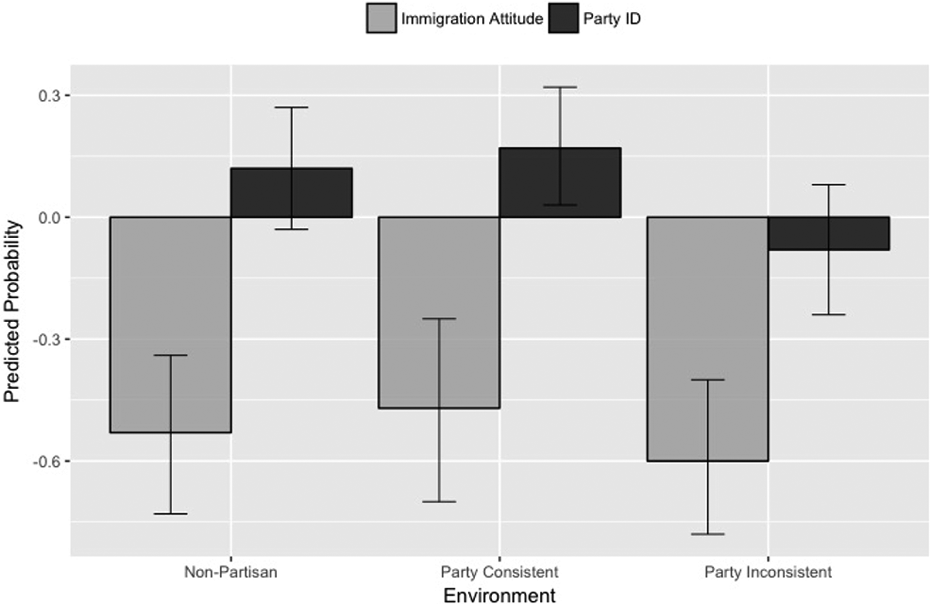
Change in predicted probability of voting “Yes” by information environment, party ID, and prior attitudes. Figure displays the change in the predicted probability of voting “Yes” on the ballot initiative by changes in party identification and immigration attitudes. The lines in each bar correspond to 95% confidence intervals.
Figure 3 reveals that the effect of changes in prior attitudes on support for the initiative is large and consistently statistically significant in all three environments. There is also no evidence that the effect of prior attitudes varies across the three environments. There is, however, evidence that the effect of party varies across the information environments. In the consistent cue condition, the effect of a participant’s party identification on ballot support is stronger than in the party-inconsistent condition. Republicans compared to Democrats are 0.17 more likely to support the initiative in the consistent cue condition, while in the inconsistent cue condition they are −0.08 less likely to support the initiative. The difference between these quantities is large (0.26) and statistically significant (p = 0.02).
Substantively, these results offer support for H3 in that the effect of party identification on ballot support was weaker when a participant was embedded in an environment containing information that cut across their party identification and policy attitudes. Further, that policy attitudes remained a strong predictor of ballot support in the cross-cutting environment indicates that participants were not simply less certain about how to vote on the issue.
Conclusion
Polarization between the Democratic and Republican parties defines contemporary American politics. Some claim that heightened polarization contributes to better accountability because voters are better able to recognize and align their preferences with political elites (Dancey and Sheagley, 2016; Levendusky, 2010). While this claim may be true overall, it is not clear how voters react to political debates and issues that cut across their partisan identities and political attitudes. This article argues that cross-cutting political debates can motivate voters to be less selective about the information they consume, to feel ambivalent toward their political party, and to rely less heavily on partisanship when rendering a judgment.
Like all work that relies on experimental methods my results have limitations. One shortcoming of this work is my focus on cross-cutting debates, which are rare in a polarized environment. That said, while the public is polarized (Hare et al., 2015), the mass public is still more moderate than political elites (Caughey et al., 2016; Fiorina et al., 2006). Thus, we should expect that elites will continue to take positions that do not align with those of partisans in the mass public.
A second question relates to the generalizability of these findings to other cross-cutting debates or issues. To the degree that immigration reform was a high salience issue at the time of my study, this may have resulted in participants being less susceptible to party cues (Ciuk and Yost, 2016). However, the crux of my findings relates to comparing party cue use across situations while holding the issue constant. Thus, the patterns of difference I observe between information environments should not be explained by my focus on immigration reform. Similarly, future work would benefit from recruiting a more diverse sample to better understand if there are partisan asymmetries in these processes.
These findings have several broader implications to existing scholarship. First, this work contributes to the emerging body of findings showing that party cue use is neither automatic nor unconditional (e.g., Arceneaux, 2008; Boudreau and MacKenzie, 2014; Bullock, 2011). Rather, people are less receptive to party cues when they do not align with their prior attitudes on an issue. In fact, the evidence presented in this article indicates that cross-cutting party cues may motivate voters to more carefully seek and process information.
This is an important finding considering much of the work showing that voters tend to expend minimal effort when forming attitudes about policies and candidates (e.g., Lenz, 2012; Zaller, 1992). While to a degree my research pushes back on the notion that voters uncritically adopt elite positions, it is also important to consider how my approach differs from these works. First, I focus on an issue that implicates identity, which Lenz (2012) acknowledges, could make people less susceptible to elite influence. Voters were also evaluating a ballot initiative and not a political candidate. Perhaps familiarity with specific candidates serves as a stronger motivation of bias than does a vote on the ballot initiative.
Finally, this work demonstrates the central role that political context and information play in shaping judgment. Ultimately, voters are not making judgments divorced from political context. Rather, the contours of their information environments play a central role in shaping the availability and structure of information. Like work that highlights the importance of factors such as elite polarization (Druckman et al., 2013) and political competition (Chong and Druckman, 2007), this research identifies the importance of cross-cutting information and debates. As this research shows, the structure of an individual’s information environment has a significant influence on how they think and reason about politics.
Supplemental material
Supplemental Material, pp-2017-0034-File002-supplementary - The effect of cross-cutting partisan debates on political decision-making
Supplemental Material, pp-2017-0034-File002-supplementary for The effect of cross-cutting partisan debates on political decision-making by Geoffrey Sheagley in Party Politics
Footnotes
Acknowledgements
The author would like to thank members of the American Politics Proseminar at the University of Minnesota for feedback on an earlier version of this article. I would also like to thank the anonymous reviewers and editor for their many helpful comments.
Declaration of Conflicting Interests
The author(s) declared no potential conflicts of interest with respect to the research, authorship, and/or publication of this article.
Funding
The author(s) disclosed receipt of the following financial support for the research, authorship, and/or publication of this article:This research was partially supported by a grant from the University of Minnesota, Twin Cities.
Supplemental material
Supplementary material for this article is available online.
Notes
References
Supplementary Material
Please find the following supplemental material available below.
For Open Access articles published under a Creative Commons License, all supplemental material carries the same license as the article it is associated with.
For non-Open Access articles published, all supplemental material carries a non-exclusive license, and permission requests for re-use of supplemental material or any part of supplemental material shall be sent directly to the copyright owner as specified in the copyright notice associated with the article.
