



Abstract
This article uses an original data set of 3262 party activities to examine how the local activism of a Greek far right party, the Golden Dawn, affected its electoral performance. Whereas most studies of activism focus on its intensity, this article examines how a neglected dimension, the consistency of activism, affects electoral outcomes. It also distinguishes between those activities local parties undertake indoors to communicate with activists and those organized outdoors to communicate with voters. Instead of gauging the efficacy of activism shortly prior to elections, the study measures the effects of activism from one election to the next. The article demonstrates that consistent outdoor activism is electorally competitive. The findings have implications for the study of local activism, especially that of really extreme parties, like the Golden Dawn.
This article uses a data set of 3262 party activities to examine how the local activism of a Greek far right party, the Golden Dawn (GD), affects its electoral performance. Despite the sizable body of works focusing on the electoral performance of far right parties (e.g. Betz, 1994; Golder, 2016; Kitschelt and McGann, 1995; Mudde, 2007; Norris, 2005), studies of far right activism remain rare (Art, 2011; Goodwin, 2010; Klandermans and Mayer, 2006). Systematic empirical investigations of the electoral impact of far right activism are even rarer (Cutts and Goodwin, 2014). This article uses original data to examine how the local activism of one of the most extreme far right parties in Europe affects its electoral outcomes.
There is already a substantial body of literature that can inform this investigation into the link between local party activism and electoral outcomes. Undertaken at a time when parties are increasingly less able to recruit and mobilize partisans (Dalton and Wattenberg, 2000; Mair and van Biezen, 2001; van Biezen et al., 2012; Whiteley, 2011), this research shows that party activism can make a difference in electoral turnout or vote share (Denver et al., 2004; Fisher et al., 2006, 2016; Gerber and Green, 2000; Huckfeldt and Sprague, 1992; Pattie et al., 1994, 1995; Whiteley and Seyd, 1994). Literature on party activism mostly relies on the analyses of activism undertaken by well-established parties in the United States and the United Kingdom, which have easier access to state (Katz and Mair, 1995) and communicative (Farrell and Webb, 2000; Panebianco, 1988) resources that their smaller or newer competitors often lack. Moreover, this literature mostly gauges the intensity of mobilization efforts undertaken prior to elections, rather than across a longer stretch of time.
Far right activism gives a new urgency to the analysis of how parties go about establishing links with their electorates. Far right parties seek to mobilize activists at a time when most parties are increasingly less able or willing to do so (Dalton and Wattenberg, 2000). Lacking the means to employ “modern” or “post-modern” forms of campaigning (Farrell and Webb, 2000; Norris, 2004), really extreme far right parties, like the one examined here, tend to rely on “pre-modern” forms of political mobilization. This is especially the case with far right “movement parties” (Kitschelt, 2006) which tend to combine conventional and “cause” activism (Norris, 2004: 8) reminiscent of the forms of political participation employed by social movements. More contentious than the conventional activism of mainstream parties and hence harder to quantify and study, far right activism poses a series of questions regarding its effectiveness that remain unexplored.
This article examines thousands of local activities organized by the GD in-between national elections to investigate how local party activism affects electoral outcomes. The article offers a new look at party activism by focusing on the actual activities local parties undertake to mobilize support rather than on usual measures of activism. Measuring the effects of actual activities and eliminating possible confounders to these activities, the article examines the entire cycle of local activism from one election to the next. Moreover, the article disaggregates party activism into its component parts, enabling the consideration of a broader range of party activities and the efforts parties make to convince activists and voters alike. This longer and broader view of activism allows a consideration of how the consistency, rather than the intensity, of activism affects electoral outcomes.
Local party activism and electoral outcomes
Evidence from earlier studies conducted in the United States (Crotty, 1971; Cutright and Rossi, 1958; Katz and Eldersveld, 1961) and subsequent work in the United Kingdom (Pattie et al., 1994, 1995) has shown that local campaigns can affect voter preferences. The effect of activism on voting can be direct, through face-to-face mobilization deemed more effective than other methods of mobilization (Gerber and Green, 2000; Kramer, 1970). The electoral effects of activism can also be indirect, by setting off a cascade of mobilization that largely relies on sending informational cues (Huckfeldt and Sprague, 1992) or by helping the recruitment of candidates to contest elections (Frendreis et al., 1990).
The various works on local activism have devised different ways of measuring local activism. For example, Seyd and Whiteley (2002) gauge the effects of a number of campaign activities undertaken by local Labour Party members, ranging from door-to-door canvassing to fund raising and leafleting. Similarly, earlier works relied on self-reports of local party leaders on a wide range of political activities undertaken prior to the elections (Cutright and Rossi, 1958; Katz and Eldersveld, 1961). A different gauge of organizational efforts surveys voter recollections of party canvassing to measure its efficacy (Beck and Heidemann, 2014; Karp et al., 2008; Kramer, 1970). The availability of local campaign spending data has opened yet another venue for gauging party organizational efforts (Carty and Eagles, 1999; Pattie et al., 1994, 1995; Seyd and Whiteley, 2003). Instead of relying on what party functionaries, activists or voters report, this approach uses the money spent for local campaigns as a proxy for capturing modern campaign efforts (Fisher et al., 2016; Trumm and Sudulich, 2016).
The operationalization of local party efforts has had notable consequences in the study of local activism. First, although the literature acknowledges the transition to more “permanent” forms of campaigning (Farrell and Webb, 2000; Norris, 2004), the various ways of gauging the efficacy of the party canvass prime the activities undertaken by local parties shortly prior to elections. This is a reasonable choice, especially for pre-modern, labor-intensive campaigns requiring the temporal concentration of effort. “Party activists can be mobilized to work very hard at activities such as canvassing at a rate difficult to sustain in a longer campaign” (Whiteley and Seyd, 1994: 243). Nevertheless, this focus on organizational efforts undertaken shortly before elections risks treating campaigns solely as short-term engagements rather than more lasting attempts to engage with voters. Second, the operationalization of local activism rests on specific assumptions about different party organizational efforts. This is especially the case with voter surveys of local party contacts but it is also true of aggregate measures of local activism, which ascribe the same value to different local activities. Work measuring the differential effects of various types of activities is suggestive of the utility of disaggregating local organizational efforts (Fisher and Denver, 2009; Fisher et al., 2016; Gerber and Green, 2000; Trumm and Sudulich, 2016).
Reexamining local activism
The analysis of local activism can benefit from a reexamination of its scope to include a longer period and a broader range of local organizational efforts. The analysis of local activism across a longer stretch of time can facilitate a fuller appreciation of grassroots dynamics. These dynamics can best be captured when party activism is treated as a collective endeavor undertaken at a given instance, with effects that go well beyond both the particular time and space. This means understanding the patterns or sequence of party activity and the way activities interrelate. The effects of local activism might be the result of this interrelation between various political acts and the patterns of activity across a longer stretch of time than most studies of political activism usually examine. This means that the standard way of measuring local activism, its intensity at a given point in time, need not be the only gauge of local mobilization. To capture the interrelation of local activism across time, it is necessary to also consider the consistency of local activism in-between elections. Especially for movement parties engaging in cause activism, the consistency of activism might be just as important as intensity. Once viewed across a longer stretch of time, it is plausible:
And
Relatedly, to gain a fuller understanding of the mobilization cascade, the analysis of local organizational efforts must be expanded to include a broader range of party activities. To take a wider range of party activism into account, it is necessary to take cues from Huckfeldt and Sprague (1992), who distinguish between two distinct organizational efforts local parties undertake, with their own activists and with potential voters. The mobilization cascade begins when parties prepare activists to get out in the field and bring in the vote. “Organizations make contact with potential activists who, in turn, make contact with the population at large” (1992: 83–84). The part of the literature that distinguishes between various types of campaign activities (Fisher and Denver, 2009; Gerber and Green, 2000) shows the potential insights of this approach. In line with this literature, it is plausible:
And
Data and methods
This article operationalizes this longer and broader view of local organizational efforts and utilizes it to understand the association between the local activism and electoral results of the far right GD in Greece. Whereas the literature on party activism largely focuses on the organizational efforts of relatively large and well-established parties, the focus here is on a relatively small party, which received 6.92% in June 2012 election and 6.28% in the January 2015 snap election. 1 Despite its relatively small size, the party makes an intrinsically important source of insights for activism because of its extreme ideology and violent tactics (Dinas et al., 2013; Ellinas, 2013; Georgiadou, 2013; Vasilopoulou and Halikiopoulou, 2015), which in 2013 prompted Greek authorities to prosecute and temporarily imprison its leadership for setting up a criminal organization (Ellinas, 2015). 2
To examine the link between local activism and electoral results, this research draws on a unique and rich data set which consists of (a) an original inventory of all local activities reported in-between elections by the 69 local branches of the GD and (b) the electoral performance of the GD in these two elections in the 69 municipalities across Greece where the party set up local branches.
The most important component of the data set consists of an inventory of the 3262 activities of each of the 69 local GD branches, for the 31 months between its electoral breakthrough of June 2012 to the snap elections of January 2015. Since June 2012, the GD has systematically reported on its web page information about all its local and national activities. For all reported activities, GD has published a short text which describes the nature of the activity, who organized it and where it took place. In almost all the cases, the reports are supported by several pictures, and often, by video footage. The reliability of the reported activities was confirmed through an elaborate triangulation design, which took advantage of the available pictures and video but also through information put together from secondary sources and a series of in-depth interviews with GD leaders and activists (Ellinas and Lamprianou, 2016). We consider the inventory of local party activities an improvement on existing methods employed to measure local activism because it is based on actual activities instead of on the recollection of contacts or activities by voters or activists. It also avoids the problem of using proxies, such as local campaign funding or local party members (Cutts and Goodwin, 2014 ), as a gauge of local activism. More importantly, this inventory allows the development of new variables to examine the four hypotheses developed earlier.
The electoral data set is based on the official results as reported on the website of the Greek Ministry of Interior. 3 For each of the 69 municipalities where the GD had an office in the period under examination, we recorded for both elections the number of registered voters as well as the percentage of valid votes awarded to the GD. 4 This group of municipalities is geographically dispersed and mirrors the main characteristics of the population of the 1034 municipalities across Greece. For example, the 69 municipalities belong to 42 out of 51 prefectures and they cover all 13 geographic regions of the country. The smallest municipality had (circa) 4000 registered voters in the 2015 election and the largest 240,000 thereby covering pretty well nearly the whole range of municipality sizes.
The activities data collected for each branch relies on 4 years of contextual and qualitative research on the party, which gave insights into the process of developing its local network after its 2012 electoral breakthrough and allowed triangulation of sources to verify its reliability. More importantly, in-depth interviews with national party leaders provided evidence about the rationale the party followed in decisions to set up local branches. Given the possibility that the electoral results of 2012 could have a confounding effect on subsequent activism, the interviews sought to examine whether the central party leadership followed an electoral logic in deciding where to establish local presence (Ellinas and Lamprianou, 2016). All our interviewees denied that there was such logic. Instead of following an electoral logic, the party claims to have followed an “activist logic,” setting up an office wherever there were five or more loyal and devoted enough activists to run it. As the leader of the party notes: It is important who wants to set up a branch. That is, if this comes from a person who has been a member of the Golden Dawn for some time and who is a fervent or active member. We do not want opportunists in the party.
5
The operational definition of the variables reflects the attempt to accommodate a longer and broader view of local activism. We sought to capture the patterns of local activism from one election to the other by devising the dual measures of intensity and consistency. As discussed earlier, the intensity of political activism is one of the main gauges used in analyses of campaign activism and it is usually assessed by measuring the concentration of activity within a specific period of time, usually prior to elections (Denver et al., 2004; Whiteley and Seyd, 2003). For each local party, we operationalized the intensity of activism with three different measures: (a) the raw count of activities for the whole duration between the two elections, (b) the average number of activities per month from one election to the next (which adjusts for the fact that different local branches were established—and thus, activated—at different points in time), and (c) a population-adjusted version of the measure where we divided the intensity by the logarithm of the number of registered voters in the municipality.
Going beyond most studies of local activism, we also operationalized another set of indicators to capture the consistency (in contrast to intensity) of local party activism. We quantified the consistency of activism of each branch as the degree to which a local branch had continuous activity for successive units of time (i.e. month after month) from one election to the next. Consistency was computed by counting the number of inactive months, dividing by the number of all months for which the local branch was open for business, and subtracting this number from 1. This resulted to a consistency index which ranged from 0 to 1 (or 0% to 100%) with larger indices representing more consistent local branches. For example, if a branch had three periods of inactivity, each one lasting for three months out of a total period of 31 months, then the consistency of this local branch would be
To accommodate a broader view of local activism, and to take into account the insights from the qualitative component of the research, we also developed a measure that reflects the distinction made by Huckfeldt and Sprague (1992) between contacting potential activists and potential voters. To capture this distinction, we coded all activities as “indoors” or “outdoors,” depending on where they were held. As indicated by the qualitative component of the research, contacts with activists are primarily captured by activities organized internally, usually in the local party premises. These activities mostly involve the analysis of current political affairs, ideological and historical training, and ultimately, the mobilization of local militants to get involved in other party activities. Contacts with voters are primarily captured by activities organized externally, on the street or in open-air venues, thereby aiming at impressing potential voters. These activities mostly involve the distribution of party material, the participation in celebrations and commemorations, protest marches, and social activism. Some of these outdoor activities turned violent, involving some form of conflict with police authorities or political opponents.
In line with the overall aim of the study to accommodate a longer and broader view of activism, each measure of intensity and consistency was calculated separately for the indoor and the outdoor activities. In effect, then, this study has taken a multivariate approach where the impact of four different variables is investigated to assess the change in the 2015 electoral results (Figure 1). One of the main innovations of our study is that these measures were computed across the entire period in-between elections instead of in the short period prior to elections. Nevertheless, since the literature mostly gauges the latter, we also computed the indoor and outdoor consistency and intensity measures of each local branch only for the last two months before January 2015 election. 7
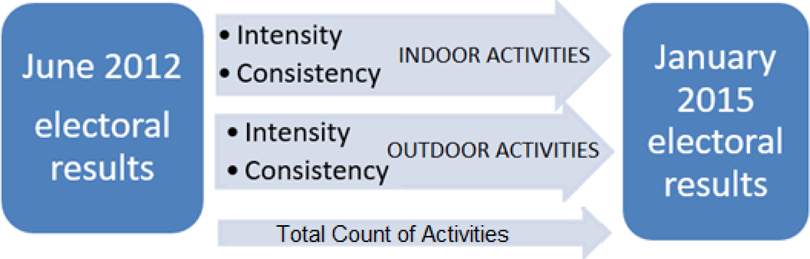
A visualization of the model used to test the four hypotheses regarding the effect of local activism on electoral outcomes.
Exploration of the main variables
The data set includes 3262 activities for the period of the 31 months from the June of 2012 to January 2015. The indoor activities primarily include lectures on current affairs by party functionaries and leaders, taking place in the party branch and are typically attended by 10 to 50 people. Outdoor activities include leafleting, marches, and commemorations usually attended by 10 to 50 people, although on rarer occasions there are more participants. On average, each local branch organized 47.3 activities with a median of 34 activities and a standard deviation (SD) of 49.1. There was a very large variability between the number of activities organized by each local branch with a minimum of 1 activity and a maximum of 295 activities for the whole period. Approximately 31% in the data set are outdoor activities and the rest are indoor activities. During the 31 months from one election to the next, the intensity of the aggregate local activism of GD demonstrates a periodicity, which can be attributed to various reasons, for example, the summer months are often more quiet than the previous months. Nevertheless, at the aggregate level, the 69 branches of the party maintain consistent activity across this period, even after October 2013 when almost all of its leadership was arrested and imprisoned (Figure 2).

The distribution of indoor and outdoor activities (the x-axis demonstrates time measured in months).
The consistency measures of the 69 local branches range from 0 to 1, where 0 means no consistency at all and 1 means perfect consistency (at least one activity every month). The mean outdoor consistency was 0.41 (SD = 0.27), whereas the mean indoor consistency was 0.54 (SD = 0.32). There is a statistically significant difference between the two means (t(68) = 5.942, p < 0.001) which suggests that local branches organize indoor events much more regularly than they organize outdoor activities. For example, the local branch in Patra had an indoor consistency of 0.74, whereas its outdoor consistency was 0.19. There are, however, some exceptions to this pattern; for example, Kavala had an indoor consistency of 0.90 and an outdoor consistency of 0.93.
The intensity measures of the 69 local branches range from 0 to any small positive value, where 0 means nil activities per month and a positive value, say 2, means an average of 2 activities every month. The mean outdoor intensity of the 69 local branches was 0.51 (SD = 0.41) and the mean indoor intensity was 1.13 (SD = 1.35). There is a statistically significant difference between the two means (t(68) = 4.302, p < 0.001) which, interestingly, suggests that the local branches tend to engage in more activities indoors than outdoors.
Comparing the patterns of activities for different local branches demonstrates the difference between the concepts of consistency and intensity. As shown in Figure 3, the GD branch of Aspropyrgos in West Attica is a good example of an intense and consistent local branch, because it has been organizing a relatively large number of indoor activities for almost every one of the 31 months (internal intensity = 2.29, internal consistency = 1.0). The local branch of Alexandroupolis in Evros is less intense (1.23) and consistent (0.77) than Aspropyrgos. It organized fewer activities since its opening with a number of temporal gaps, some of which are rather long (there are many consecutive months with no internal activity at all). The branch in the island of Corfu is an example of a local branch with high indoor intensity, even higher than that of Alexandroupolis (1.40), but low indoor consistency (0.53). Finally, Kastoria is an example of a local branch with low indoor intensity (0.28) and consistency (0.36).

Four examples of the distribution of indoor activities across time (31 months).
As might probably be expected, branches tend to be similarly active when they organize indoor and outdoor activities. The correlations between the variables are relatively large, ranging from 0.52 to 0.91. However, although these correlations are numerically large, inspecting the left scatterplot of Figure 4 suggests that the two measures are not empirically interchangeable; on the contrary, there is a number of outlying local branches which have significantly larger outdoor consistency compared to their indoor consistency (e.g. Thasos, Kilkis, and Karditsa). Similarly, “atypical” local branches can be found in the right-hand scatterplot of Figure 4.

Scatterplots between indoor and outdoor consistency and intensity. The size of the circles illustrates the size of the municipalities.
Accounting for change in electoral results
In line with existing literature, one might expect the electoral results of June 2012 to be a good predictor of the electoral results of January 2015 (e.g. Carty and Eagles, 1999; Denver and Hands, 1997; Denver et al., 2004; Seyd and Whiteley, 1992). 8 Indeed, the correlation between the two variables was nearly perfect with r = 0.89, p < 0.001. This is a suggestion that removing the shared variance between the two electoral results would leave too little variance for any additional predictor to achieve statistical significance.
To examine the effect of activism on the 2015 electoral results, we first investigated whether the total number of activities organized by each local branch was a good predictor of the change in the electoral results between June 2012 and January 2015. The correlation between the change in electoral performance and the total number of activities organized by each branch was not statistically significant (r = 0.11, p = 0.354). This suggests that the crude aggregate count of activities is not a good predictor of the change in electoral performance.
We then applied our more nuanced measures of local activism by fitting four different linear regression models. All four models had the electoral results of 2015 as a dependent variable and the electoral results of 2012 as an explanatory variable. However, each of the four models had an additional explanatory variable, namely the indoors consistency, indoors intensity, outdoors consistency, and outdoors intensity. Table 1 (models 1–4) presents the results for each of the models. In all models, the electoral results of June 2012 have a large and statistically significant coefficient. However, out of the four activism measures, only the outdoor consistency had a statistically significant predictor of the change in the electoral results between 2012 and 2015.
Explaining the electoral results of January, 2015 using the results of June, 2012 and activism indices for the 31 months between the two elections.

Interestingly, none of the indoor and outdoor intensity and consistency measures for the last two months before the elections were significant predictors of the change in the electoral performance of the GD. This comes as a surprise, in the sense that one would expect recent activities to have a higher impact on the electoral results than activities undertaken across a longer stretch of time.
To control for possible municipality size effects (e.g. André and Depauw, 2016; Oliver, 2000), we created voter-adjusted versions of the outdoor consistency and outdoor intensity variables. In effect, we divided the outdoor consistency of each of the GD branch by the logarithm of the number of registered voters. Then, we multiplied by 10 so as to create a variable that would range roughly from 0 to 1. The mean voter-adjusted outdoor consistency ranged from 0 to 0.91, with a mean value of 0.39 and a median of 0.38 (SD = 0.25). Substituting the outdoor consistency measure with the voter-adjusted version gives very similar results, only better: the effect size of the variable gets larger and its statistical significance improves (Table 1, model 5). 9 In a similar way, we created a voter-adjusted outdoor intensity measure which ranged from 0 to 1.78, with a mean value of 0.48 and a median of 0.38 (SD = 0.37). Substituting the outdoor intensity measure with the voter-adjusted version gives similar results as the unadjusted measure, only this time the results are statistically marginally significant (Table 1, model 6).
The impact of the voter-adjusted outdoor consistency on the improvement of the electoral results of 2015 is remarkable, especially when we consider that we have already removed the effect of the electoral results of 2012. In terms of the actual effect, a local branch that obtained 7% of the votes in 2012 would be predicted to receive around 5.9% in 2015 if it had a near-zero outdoor consistency. On the other hand, if the same branch had an outdoor consistency of around 100%, then we would expect it to obtain around 7.2% in 2015. This represents an increase of 1.3% in absolute value, or an improvement of 22% compared to the previously predicted 5.9%.
Looking for confounding effects
To further test our basic model, we examined contextual and organizational confounders to our dependent variable (i.e. the change in electoral results) and our main independent variable (i.e. the measures of activism).
Following up on the qualitative evidence from the interviews, we first examined whether the experience of local organizational units confounded the electoral results of 2012. We checked whether the municipalities with the 12 branches set up prior to the electoral breakthrough of 2012 performed differently in the 2015 elections than the 57 branches set up after 2012 (after controlling for the 2012 results) but found no significant differences between them 10 ; thus, the experience with activism did not seem to benefit the electoral results of the local branch. We then used cues from the literature on the effects of MP incumbency (e.g. Cain et al., 1984; Whiteley and Seyd, 1994) and investigated whether winning a seat in the previous election had a significant effect on the change of the electoral results, but again, we only found marginal effects. 11 We also tested whether the 12 branches located in settings where violent or criminal GD-related incidents occurred had different electoral outcomes but we did not find statistically significant differences. 12
We then looked for possible confounders to various patterns of activism. We first examined whether the electoral results of 2012 dampened or energized activism (Fisher et al., 2006; Goodwin et al., 2013; Whiteley and Seyd, 1998 ) but found that all the correlations between the patterns of activism and the electoral results of June 2012 were close to zero and statistically nonsignificant. We further probed the relationship between electoral context and activism by correlating the four activism indices before and after the May 2014 local, regional, and European elections. We found correlations ranging from 0.66 to 0.89, which show that the activism patterns did not change much (all correlations were statistically significant at the 0.001 level). We then checked whether branches in districts that elected an MP in 2012 displayed different patterns of activism than those in districts that did not. Again, we found no observable impact on the consistency or intensity of a local branch. However, another contextual characteristic, district magnitude, provided a significant boost across all measures of activism: Local branches in districts awarded three or more seats were more likely to be active than those in single- or two-member districts, which practically have no chances of electing an MP. 13 Moving from the electoral context to the organizational level, we tested, again, whether more experienced branches displayed different patterns of activism than less experienced ones, but found no significant results. 14 However, there are some indications that more “ideological training”—measured by the absolute number of indoor ideological speeches they held throughout this period—seems to be a driver of outdoor activism. 15 To take into account various particularities of this really extreme and sometimes violent party, we also examined whether the 12 branches located in settings where violent or criminal GD-related incidents occurred had different activism indices than the rest of the branches but found no statistically significant differences for any of the four indices. 16 We then gauged activism patterns before and after the GD arrests and found correlations of the four activism indices between 0.46 and 0.82, which shows that there were no dramatic changes in grassroots mobilization after September 2013 (all statistically significant at the 0.001 level). 17
Discussion
The literature on political parties has long recognized the importance of local activism for electoral performance but mostly focused on mainstream political parties in the United Kingdom and the United States. This article breaks new ground using original data of a really extreme party to show how different measures of activism affect its electoral outcomes. Whereas most measures of activism focus on its intensity prior to elections, this article shows that only the consistency of outdoor activities has a statistically significant effect on electoral results. Those party branches consistently organizing outdoor activities across the period in-between national elections managed to achieve better results than those with more sporadic outdoor presence. Consistent outdoor activities like disseminating party material or participating in demonstrations can change the performance of the party in the municipality where this activity takes place by as much as 22%.
Whereas outdoor party activities can improve electoral results, indoor activities cannot. Both the intensity and the consistency of indoor party activities are shown to have no effect on electoral performance. This is surprising because the local branches of the GD pay considerable attention to the organization of such activities. The original data presented here show that more than two-thirds of the 3262 activities organized by the 69 local branches of the GD were indoors. Why do local parties bother putting together hundreds of such events if they do not have any direct effect on performance? In line with Huckfeldt and Sprague (1992), it is plausible to conceive of indoor party activities as a catalyst rather than a direct instrument of voter mobilization. Parties organize indoor events to train “ambassadors to the community” (Scarrow, 1994) who in turn go out to mobilize voters. The link between indoor and outdoor activism is shown by the relatively high correlations between them. This link between indoor and outdoor party activities is also indicated by the relatively high and statistically significant correlation between internal ideological speeches and external political activism. Although we generally lack an understanding of what happens “inside” local far right parties, the evidence presented here suggests how the internal workings of local parties could affect their capacity for voter mobilization.
The rare availability of data on thousands of local party events as they unfolded in-between elections has helped yield precious insights on the effects of various patterns of activism on election results. This unique study of a single party, though, raises external validity issues that need to be addressed. The very nature of this party might make findings less applicable for other party organizations or settings. It is plausible that the consistency of outdoor activism is more important for movement parties (Kitschelt, 2006), which tend to combine conventional with cause activism (Norris, 2004). Parties like the German National Democratic Party, the British National Party, the Italian Casa Pound and Forza Nuova, the Hungarian Jobbik and the Kotleba—People’s Party Our Slovakia employ a similar mix of conventional and contentious activism that sometimes prompts national authorities to take measures against them (Art, 2011; Goodwin, 2011; Mammone, 2015 ). Although highly controversial and often disruptive, this type of activism is shown here to be electorally beneficial, when consistent. Future research can determine whether the consistency of this outdoor action is electorally valuable not only for such extreme parties but also for other types of parties, especially those which lack institutional resources (Katz and Mair, 1995) and are still reliant on pre-modern forms of mobilization (Farrell and Webb, 2000; Norris, 2004). More research is also needed to examine how more violent forms of activism affect voting.
Despite the obvious particularities of the case, some of the findings reported here are similar to those reported in more general studies of activism. In line with earlier research, which emphasizes how levels of competitiveness in marginal or battleground districts affects political activism (e.g. Beck and Heidemann, 2014; Seyd and Whiteley, 1992), this study also found that the probability of future electoral success—measured by the number of seats awarded in the district—can have a notable effect on patterns of activism. Also, past electoral success—for example, electing an MP or achieving good electoral results—does not seem to energize activists. Unlike Goodwin et al., we find no “virtuous cycle” between electoral results and activism (2013: 899). It is plausible that in movement parties, activist “burn-out” works in similar ways as in more conventional parties: Trying hard in the previous election dampens subsequent activism rather than leading to a “spiral of mobilization” (Whiteley and Seyd, 1998). Or, more interestingly, parliamentary duties for a party with no prior parliamentary experience might reduce the capacity of local party leaders–turned MPs to organize activism in their constituency. Alternatively, MP incumbency could give rise to internal feuds about the distribution of selective incentives (Panebianco, 1988) that ultimately weaken the capacity for activism.
Conclusion
This article opens the “black box” (Goodwin, 2010: 50) of a far right organization and systematically examines the electoral effects of its activism. Building on but also extending the findings of the existing literature on party activism, the analysis of thousands of local party activities demonstrates that, rather than being a mere exercise in constituency representation (Kitschelt, 1989), far right activism is electorally competitive. Even in a hostile environment for far right activism, local party branches can substantially improve their electoral standing by having their activists spend more time on the street. This article shows that the electoral rewards of far right activism come with patterns of activism previous analyses missed. By investigating local party efforts in-between elections, this study points to the importance of consistent street presence rather than intense activism a few months prior to elections.
Further research is needed to reinforce the generality of our findings and to examine how they hold for other far right parties; for niche parties located elsewhere in the political spectrum (Meguid, 2005; Meyer and Miller, 2015); or for more established parties in other settings. Although limited to this particular setting, the analysis undertaken here allows to reinforce the emphasis placed in the literature on the primacy of more direct (Gerber and Green, 2000) or labor-intensive (Fisher et al., 2016; Pattie and Johnston, 2003 ) methods of voter mobilization and also point to an underexplored cost of ignoring them. Major parties are known, of course, to largely supplement traditional activism with modern and post-modern means of mobilization. But the neglect of their local branches might allow smaller competitors to fill the potential mobilization void they leave behind. By showing the electoral effects of far right activities, this article shows the importance of devoting organizational resources to local activism and reinforces the emphasis placed in the literature on the development of local organizational capacity (Tavits, 2013 ). Assessing the full effect of local party mobilization requires methodological techniques that capture a longer but also a broader view of activism. The consistency of this activism outside the electoral cycle and the way voters perceive it might prove a fruitful area for future research.
Supplemental Material
Supplemental Material, pp-2017-0010-Appendix - Far right activism and electoral outcomes
Supplemental Material, pp-2017-0010-Appendix for Far right activism and electoral outcomes by Antonis A Ellinas and Iasonas Lamprianou in Party Politics
Footnotes
Acknowledgements
The two authors contributed equally to this article and name ordering reflects the principle of rotation. We are grateful to Demetris Comodromos for his excellent research assistance. Earlier drafts of the article were presented at the Cyprus Association of Political Science, the Competence Center for Empirical Research Methods of the University of Kassel and the GrEPOP. We thank Maria Avraamidou, Elias Dinas, Vasiliki Georgiadou, Iannis Konstantinidis, Takis Pappas, Lamprini Rori, Volker Stocké, Susannah Verney and the anonymous referees for useful comments and critiques.
Declaration of Conflicting Interests
The author declared no potential conflicts of interest with respect to the research, authorship, and/or publication of this article.
Funding
The author disclosed receipt of the following financial support for the research, authorship, and/or publication of this article: We are grateful for financial support from the Research Committee of the University of Cyprus and our Department.
Notes
Supplemental material
Supplementary material for this article is available online.
References
Supplementary Material
Please find the following supplemental material available below.
For Open Access articles published under a Creative Commons License, all supplemental material carries the same license as the article it is associated with.
For non-Open Access articles published, all supplemental material carries a non-exclusive license, and permission requests for re-use of supplemental material or any part of supplemental material shall be sent directly to the copyright owner as specified in the copyright notice associated with the article.
