



Abstract
Issue reframing occurs when parties, while addressing an issue, shift the frame toward other policy domains. The literature has found that party issue framing affects how voters think about issues, yet scholars remain largely in the dark as to when and how parties frame issues. The study at hand theorizes and investigates when and how parties reframe issues in their external communication. Drawing on novel Belgian data about parties’ official stances regarding a large number of policy issues combined with their verbal argumentation of why they took this exact position, we test a new theory about the drivers and mechanisms of issue reframing. We find that parties reframe issues in terms of policy domains that are both salient to the general public and that are salient to the party itself—meaning that it has a history of devoting attention to the policy domain and “owns” it.
Introduction
In their external communication, parties often emphasize some issues while ignoring others. Various studies show that parties selectively (de)emphasizing some issues to increase their electoral support (e.g. Budge and Farlie, 1983; Petrocik, 1996; Sides, 2007; Simon, 2002). A variety of studies have examined the determinants of parties’ issue emphasis strategies finding them to be strongly strategic (Budge and Farlie, 1983; Petrocik, 1989).
But parties do not only address advantageous issues. They are often forced to address issues they would prefer not to communicate about (Dolezal et al., 2014; Sigelman and Buell, 2004). Various factors such as external events (Ansolabehere and Iyengar, 1994), the actions of other parties (Green-Pedersen and Mortensen, 2010), or requests by journalists force parties to address issues they would rather avoid.
When forced to discuss disadvantageous issues, parties can still optimize their communication by emphasizing specific aspects of these issues while ignoring others. This is called issue framing: selectively emphasizing an issue’s subdimension (De Vreese, 2005). A relatively small but growing literature examines these issue framing efforts of parties and/or politicians, trying to understand the dynamics of elites’ framing strategies (Chong and Druckman, 2007b). This research is important, as parties’ issue frame choices are consequential: they exert influence on public opinion (Kinder, 2003). Various studies, ranging from experimental designs (Jacoby, 2000; Slothuus, 2010) to studies of real-life issue debates (Hänggli and Kriesi, 2010; Holian, 2004; Nadeau et al., 2010), have shown that elites’ issue framing affects what the public thinks.
Here, we zoom in one specific aspect of issue framing that we label issue reframing. This is the process by which parties, in their presentation of an issue, do not resort to emphasizing subdimensions from the policy domain in which the policy issue is situated, but rather frame the issue in terms of considerations related to other policy domains. In other words, one possible strategy of parties when forced to talk about a policy issue is to emphasize aspects of the issue that relate to other, more advantageous policy domains. This article examines when, how, and to what extent parties reframe issues.
Our endeavor contributes to the literature in a number of ways. First, as Chong and Druckman argued, “developing a model of elite strategies of framing” remains a key challenge (2007b: 118). The number of studies examining the determinants of parties’ issue framing strategies is very limited (Borah, 2011). As a general rule, party elites are expected to emphasize advantageous aspects of issues to gain the upper hand. Consequently, parties tend to “talk past one another” (Schattschneider, 1960; Simon, 2002, but see Jerit, 2007). But apart from this general expectation of divergent framing, there is little theoretical work regarding parties’ use of some issue frames over others. Our framework holds that it is the salience of the issues at stake—both on the side of the voters and on the side of the party—that determines when issue reframing happens. Our study builds on prior work arguing that parties’ issue ownership is a determinant of issue framing (Hänggli and Kriesi, 2010) but also incorporates the idea that parties’ strategic communication is partly determined by public perceptions (e.g. Arbour, 2014).
Second, the concept of issue reframing draws attention to the fact that, although issue framing is commonly conceptualized as focusing on subdimensions of an issue (e.g. Arbour, 2014), just as often parties’ political rhetoric is not confined to the policy domain in which the issue is situated. For example, a party which discusses a health-care bill in terms of the tax burden caused by the bill (see e.g. Jerit, 2007) shifts the debate toward a different policy domain (taxes) altogether. Extant research does not distinguish between these two distinct strategic behaviors, but we demonstrate that issue reframing is an integral part of parties’ strategic communication.
Finally, we evaluate our theoretical framework through unique data, moving beyond the predominant approach of studying single issues or cases in real-life campaigns (e.g. Holian, 2004; Jerit, 2007; van de Wardt, 2015). While externally valid, this approach does not allow for systematic comparisons across issues, parties, and policy domains. Our study analyzes parties’ issue reframing across a wide range of issues. Our data contain communications of all parties on all issues and allow for a systematic analysis of parties’ issue reframing strategies.
More specifically, we draw on party communications gathered for voting advice applications (VAAs) available prior to the Belgian elections of 2007, 2009, and 2014. All Flemish political parties were asked to take a formal position on a large number of policy statements. Parties were also invited to provide an argumentation for their position. By comparing the issue mentioned in the policy statement and the issue mentioned in the argumentation, we can directly observe parties’ issue reframing—bringing in additional issues belonging to different policy domains.
We find that parties frequently reframe issues and that there is a clear pattern to how they do so. Salience is key: Parties reframe policy issues into policy domains that are salient to themselves and—to a lesser extent—to the general public. When parties reframe issues is more difficult to determine and is, contrary to expectations, not significantly related to public or partisan issue salience.
Issue reframing by parties
In their competition over issues, parties can take roughly two strategies—they can either stick to their own message or engage with other parties’ messages (Simon, 2002). Issues are specific public policy matters which have become the subject of political debate. In general, emphasizing issues related to a policy domain on which a party holds an advantage is considered a good strategy (Budge and Farlie, 1983; Petrocik, 1996; Simon, 2002). Yet, even if parties address issues that risk favoring their opponents, they may still do so in a way that limits the damage by framing the issue in the most favorable way.
We examine a specific subtype of framing here, which we label issue reframing: the strategy to frame a specific policy issue in terms of a different policy domain altogether. For example, in their rhetoric on Clinton’s health-care bill, which belongs to the domain of health care, US republicans emphasized the implications of the bill for other policy domains—specifically taxation and the budget (Jerit, 2007). This strategy can be considered as a kind of framing, being an “emphasis in salience of different aspects of a topic” (De Vreese, 2005: 53). Yet, whereas issue framing is commonly conceptualized as emphasizing different subdimensions of an issue (Arbour, 2014; e.g. De Vreese, 2005), issue reframing casts the issue in terms of an entirely different policy domain. Issue reframing occurs when a party puts emphasis on another policy domain, taking attention away from the initial policy domain in which the issue is embedded.
Prior studies on issue framing have found that parties routinely talk about other policy domains when formally addressing an issue (Jerit, 2007; Williams, 2006). Sides (2006: 427) argues that this strategy, in which issues are connected to more advantageous policy domains, is often feasible: “most political issues are broad enough to encompass a wide variety of secondary ‘subissues’ …on which each of the parties has an advantage.” We extend that literature here and develop a theoretical framework of when and how parties engage in issue reframing.
Such a theoretical framework of issue reframing can shed new light on broader trends in party communication. Classic issue ownership theory, for example, posits that parties should stick to their issues, yet recent research suggests that parties engage less in selective issue emphasis than expected. Rather, parties converge in terms of the issues they emphasize (Dolezal et al., 2014; Sigelman and Buell, 2004). These studies, however, only examine whether parties discuss the same issues, not how they discuss these issues (Lipsitz, 2013; van de Wardt, 2015). Parties might be emphasizing similar issues because these are issues of concern to voters, but they may still avoid true dialogue by applying different frames. As such, extant work developing theory regarding selective emphasis between issues (e.g. Budge and Farlie, 1983; Damore, 2004, 2005; Dolezal et al., 2014; Petrocik, 1996) needs to be complemented with a theory about the determinants of selective emphasis within issues: a theory of elite issue framing (Chong and Druckman, 2007b).
We know surprisingly little about what causes certain frames to be employed in the first place (Borah, 2011; Chong and Druckman, 2007b). That parties frame issues strategically is described in various subsets of literature. We can assume that parties frame issues to advance their own interests, for example, to gain public support or to win the rhetorical struggle. At the most general level, issue framing implies emphasizing certain aspects of an issue (De Vreese, 2005). Parties emphasize those aspects that are most favorable to them. Simon (2002) developed a model of rhetorical strategy in which the rhetoric edge is achieved by staying “on message” while avoiding those aspects of the issue that favor the opposition. Similarly, Riker’s (1993) dominance principle implies that parties focus on those aspects of issues that give them the upper hand, highly similar to the issue reframing process we analyze here. Sides (2006) builds upon the dominance principle by connecting it to issue framing, arguing that framing is particularly effective when dealing with issues that are favorable to political opponents.
A number of studies have examined the determinants of party issue framing. Van de Wardt (2015) found that parties’ issue framing is determined by their office-seeking: Mainstream parties develop more similar frames compared to challenger parties, and electoral gains make parties use more similar frames. Helbling et al. (2010) argue that membership of party families drives parties to favor some frames over others, as does prior government participation. We also know that parties tend to frame issues in terms of policy domains on which they hold stronger reputations. For example, Hänglli and Kriesi (2010) found that in the Swiss referendum campaign about asylum, the two camps stuck mainly to their “own” frames. Finally, Sides (2006) finds that when parties deal with issues on which their political opponent has a reputational advantage, they tend to frame the issue in terms of the aspects on which they hold a reputational advantage—in effect, the frames over which they have ownership. As such, despite the relative scarcity of studies on the production of frames more generally, and parties’ issue framing strategies more specifically, the literature suggests that parties’ status and their reputations on issues matter.
We build on this research and develop our framework around the notion of salience. Our expectations are based on two types of salience: the salience of policy domains for the public and for the party. We first consider the salience voters attribute to policy domains. Public opinion is an important driver of parties’ issue reframing strategies, we argue. Issues of importance to the public draw more attention of voters, and parties have less leeway to resort to issue reframing on these issues. Parties want to avoid appearing disingenuous, especially on issues that the public finds highly important. By applying an issue frame that shifts the problem or cause toward another policy domain, parties’ risk being seen as dodging a matter of importance to the public (Ansolabehere and Iyengar, 1994). Indeed, Druckman and colleagues (2010) find that congressional candidates are more likely to directly engage each other on highly salient issues. The public salience of an issue not only decreases the chance that this issue will be reframed; it also has consequences for which issue will be used to reframe the original issue. Since parties can score more points on issues that are salient to many people, it is also to be expected that parties, when they engage in issue reframing, would reframe an existing issue in terms of a salient policy domain. This increases the chance that the diversion strategy of drawing attention away from the initial issue will be successful. So, salience of issues on the voters’ side leads to two expectations:
A second determinant of parties’ issue reframing efforts is how salient parties find policy domains to be. Issue ownership theory holds that parties have an advantage on specific domains because they have established a strong reputation on them (Petrocik, 1996). This reputation is established through a party’s continued attention to policy issues from that domain: “It is a reputation for policy and program interests, produced by a history of attention, initiative, and innovation towards these problems” (Petrocik, 1989: 826). This “history of attention” results in a two-fold mechanism driving parties to reframe issues in terms of those policy domains to which they are committed and on which they hold favorable reputations. First, a party’s reputational advantage provides a direct incentive for parties to reframe issues in terms of owned policy domains: “‘Issue ownership’ appears to provide the kind of advantage that Riker would describe as ‘dominance’” (Sides, 2006: 411). Reframing issues toward owned policy domains enhances parties’ ability to dominate their opponents: not only because they are perceived as being comparatively better than their competitors on the issue but also because issue owning parties focus their legislative efforts on issues related to policy domains they own (Egan, 2013; Vliegenthart and Walgrave, 2011). As a result, they have more substantive policy implementations to show off to voters. Second, parties are also constrained by their history. Issue reputations do not materialize out of thin air but are the product of a party’s prolonged attention—and thus communications—on issues related to these policy domains. Party supporters expect the party to keep on prioritizing these issues: parties have to attend to these policy domains (Budge, 2015).
So, a first expectation is that parties are less prone to reframe issues embedded in policy domains they own (to which they have given more attention in the past). Again, we complement this with a second expectation, namely that parties will try to actively reframe issues belonging to nonowned policy domains in terms of the owned policy domain. Hence, two formal hypotheses:
Data and methods
We rely on Belgian (Flemish) data collected prior to the 2007, 2009, and 2014 elections for a VAA De Stemtest. The six main Flemish parties 1 were asked to take a position on a large number of concrete issues (N = 288). We operationalize issues as specific policy proposals or statements. An example from the 2014 election is “Flanders should spend less money on development aid”. First, the parties indicated their position (agree or disagree) on the policy statement. Second, the parties provided an argumentation for their position. This argumentation is what we study here, as it allows parties to reframe the issue. For example, a party that disagreed with the statement above said: “The Flemish government has not accomplished the promised financial efforts for development aid (formulated in Pact2020: Flanders in Action). So, it should not spend less, but more on development aid.” This party’s argumentation sticks closely to the policy domain in which the issue is embedded (in this case: Foreign affairs and development aid). Another party—agreeing with the statement—gave other arguments: “The money for development aid should primarily be invested in the countries of origin from immigrants. It should be dependent on the willingness of these countries to accept foreigners deported by us.” This party does not stick to the policy domain in which the issue is embedded but clearly links the argument toward another (domestic) policy domain, Immigration and integration. What the latter party does is what we call “issue reframing.”
The parties’ issue positions and argumentations were made public on the VAA website attracting a large number of voters (e.g. 2.7 million participants in 2014). Moreover, parties’ positions were scrutinized in the media. So, it is fair to say that the actual position and the argumentation were highly visible and many voters have been exposed to them. All in all, these data offer a rare direct measure of party communication, unmediated by mass media or other gatekeepers. They allow us to test our hypotheses about issue reframing and the role of salience therein.
To assess issue reframing, all policy statements and parties’ argumentations were coded according to the codebook of the Comparative Agendas Project (CAP). This codebook, originally developed by Baumgartner and Jones (1993) for the United States (see: www.comparativeagendas.net), and afterward slightly adapted to the Belgian context, contains 21 major policy domain codes (e.g. “Macro-economics,” “Immigration and integration,” “Foreign affairs and development aid,”…). The issue coding of statements and argumentations into these major policy domains was done automatically by means of a topic dictionary. Dictionary coding is very straightforward: It simply assesses the frequency of words. Dictionary approaches are effective for the texts we code here because the language used in them is relatively formal and relates to clearly demarcated policy domains, which are relatively easily identified using a finite set of keywords. Our Dutch dictionary contains a key set of words for each major policy domain. 2 It was validated by comparing it with human-coded text, with satisfying average recall and precision scores between 0.60 and 0.61, respectively. 3 We used Lexicoder (see: www.lexicoder.com) to count how many words of each policy domain occur in each statement and in each argumentation.
Dependent variable
The dependent variable in this study is Issue Reframing. For every statement–issue combination, we coded whether a policy domain was mentioned in the statement, and we coded whether a policy domain was mentioned by a party in its argumentation. A statement or argumentation “belongs” to a policy domain if it contains at least one word listed under this policy domain in the dictionary. If a policy domain was mentioned in the statement itself and in a party’s argumentation, issue reframing has a value of “0” for that party. In that case, the party is sticking to the policy domain of the statement and is not trying to bring in another policy domain. Table 1 provides an example. For the first line of Table 1, the column “Policy Domain in Statement” indicates that Lexicoder coded policy domain 10—“Mobility and Transport”—as being mentioned in statement 1 (e.g. “airport” is considered part of this policy domain by the dictionary). Party 1’s argumentation was also coded as mentioning this policy domain (e.g. this argumentation also mentions “airports”)—but this is no indicator of issue reframing (0) as the policy domain was already mentioned in the original statement as well. The second line of Table 1, however, deals with the Environment policy domain. Lexicoder did not detect any words related to this policy domain in the statement itself (“No” in the column “Policy Domain in Statement”), but the party’s argumentation did contain words referring to the Environment policy domain (e.g. the word “environment”). Because the statement did not refer to the environment, but the party’s argumentation did, the party’s argumentation is coded as reframing the issue toward the environment policy domain (1).
Illustration of coding procedure (dictionary-based).

Note: Statement 1: Flanders should not subsidize regional airports Argumentation of party × Regional airports are expensive and harmful for the environment and public health as a consequence of noise pollution, air pollution, and olfactory nuisance.
The data set consists of observations nested in statements (N = 288), parties (N = 6), and policy domains (N = 21). For each statement–party–policy domain combination, we track whether the respective party reframed the respective statement in terms of the respective policy domain.
Independent variables
To measure the public saliency of the various statements, we rely on three voter surveys among eligible Flemish voters, conducted in 2007 (CATI, n = 1000), 2009 (online, n = 1000), and 2014 (online, n = 1052), respectively. The field work was conducted by TNS in 2007 and 2014 and by Ivox in 2009. Respondents were recruited from research panels maintained by these polling companies. The response rates are 22% (2009) and 17% (2014). We use these data to construct the public salience variable needed to test H1 and H2.
The public salience of a statement was assessed through the following question in 2007 and 2009: Is issue X one of the three policy domains which are decisive for you when making a choice for a political party and its positions? (0 = not decisive; 1 = decisive). In 2014, the importance of policy domains was measured slightly differently: Can you indicate, for each policy domain, to what extent it would be decisive for your voting choice? (on a scale from 0 = not decisive at all to 10 = very decisive). We recoded the answers into a dummy variable similar to that for 2007/2009: values 9 or 10 (very decisive) turned into value 1; all others values became 0. 4 Respondents were asked these questions for a whole range of policy domains that mapped onto the CAP typology of policy domains. The salience of a policy domain is the mean value across all respondents in a campaign—and so it varies across the three campaigns. For instance, in 2007 (national elections), the topic “Immigration and integration” was decisive for the vote choice of 16.5% of the electorate; in 2009 (regional elections), this was the case for 14.8% of the voters; and in 2014, for 19.7% (as a national policy domain) and 25.0% (as a regional policy domain) of the voters.
To create the variable Public Salience of Initial Policy Domain (H1), we need to determine the main policy domain of each statement. To do so, we take the policy domain for which the dictionary counted most words. In the example statement above (see Table 1), only one word from the statement matched the dictionary (“airports” was coded into topic Mobility and Transport), so the main policy domain of that statement is Mobility and Transport. To break ties—when statements contain an equal amount of words from multiple domains—we take the topic that is mentioned first. If a statement contains no words from the dictionary at all, no policy domain was attributed. In total, we could classify 73% of the statements into policy domains—the other statements are dropped from the analyses in which the variable Public Salience of Initial Policy Domain is included. The same procedure and saliency scores were used to create Public Salience of Reframing Policy Domain (H2), which reflects the public salience of the reframing policy domain.
To examine H3 and H4 dealing with parties’ issue saliency, we need information about how important parties consider the various policy domains to be. We employ party manifestoes to measure how much attention a party devotes to various policy domains, a common approach to assess issue ownership 5 (see e.g. Vliegenthart and Walgrave, 2011; Walgrave and Swert, 2007). In the framework of the Belgian CAP project, all party manifestos from 1977 to 2007 were manually coded using the same CAP coding scheme used here for the statements and argumentations. All information about the data collection and coding of party manifestoes can be found on www.comparativeagendas.net/belgium. Across all manifestos of a given party, we calculate the share of attention given by that party to each policy domain. So, the measure taps parties’ long-term attention to the various policy domains. We see for instance that the Green party, more than other parties, pays attention to the environment: 10% of their manifestos is about this domain, whereas this figure lies between 2% and 5% for the other parties (for an overview of all parties and policy domains, see Table SM6 in the Supplementary Material). This leads to two variables: Party Ownership of Initial Policy Domain and Party Ownership of Reframing Policy Domain.
A (fictive) example of the data structure is shown in Table SM2 in the Supplementary Material. As can be seen, Public Salience of Initial Policy Domain varies over statements. Public Salience of Reframing Policy Domain varies over policy domains. Party Ownership of Initial Policy Domain varies over party–statement combinations. Party Ownership of Reframing Policy Domain varies over party–policy domain combinations as well. The dependent variable, Issue Reframing, varies over statement–party–policy domain combinations.
Control variables
The analyses incorporate several control variables. It may be the case that government parties are different from opposition parties when it comes to reframing issues (Helbling et al., 2010). For each parliament/election in our study (2007, 2009, 2014), we indicate whether a party belonged to the incumbent government or not (Government Party).
On some statements, parties held popular positions shared by the majority of the voters while on other positions they held a minority view. This may have affected their tendency to reframe issues in terms of other policy domains. For every combination of a party and a policy statement, a value for the variable Party’s Position Unpopularity was calculated. The variable is based on the surveys reported above, in which a random sample of the population was asked about their own position regarding the same policy statements, as well as their voting choice at the last election. As a result, for instance, if only 23% of the citizens who voted for a party agree with a statement, the party has an unpopularity score of 0.77 if it is in favor of the statement. Increasing values indicate less popular positions.
Finally, we also control for the number of words each argumentation consisted of, simply because longer argumentations have a larger chance of touching upon multiple policy domains (Word Count).
Modeling choice
The resulting data set has observations nested in policy domains, statements, and parties. The full data set counts 36,288 observations (21 policy domains × 288 statements × 6 parties). The control variable Party’s Position Unpopularity has a number of missing values, as not all policy statements rated by parties were also rated by citizens. Also for Public Salience of Initial Policy Domain and Party Ownership of Initial Policy Domain, there are missing values, because we could not attribute a policy domain to all statements (as explained above). Moreover, we do not have Public Salience data for all policy domains because not all domains were included in the surveys. Technical information about the precise sample sizes is provided in Table 2. Descriptive statistics are provided in Table 3.
Technical information about sample sizes.

Descriptive statistics.

*Low = below median. High = above median.
**Low = below one standard deviation from the mean. Moderate = within one standard deviation from the mean. High = above one standard deviation from the mean.
To analyze the data, we use crossed-effects logistic multilevel models. Those include crossed random effects on the level of policy domains and statements. These random factors control for the fact that some policy domains, generally speaking, are used more often for reframing purposes and for the fact that parties in general diverge more on some statements than on others. We also include fixed effects on the party level (dummy variables) to account for the fact that some parties may employ reframing strategies more often than other parties.
Results
By way of exploring the data, the upper part of Table 3 shows the mean amount of reframing across all party–statement combinations and for select subgroups of party–statement combinations. It shows that parties reframe policy domains in 42% of the cases. The subsequent lines signal that some of the independent variables affect issue reframing. It occurs more often when the public salience of the initial policy domain is low (41%) than when it is high (33%) (but if we consider specific policy domains, this pattern is less straightforward, see further). Issue reframing also happens more often when the party ownership of this initial policy domain is low (45%) than when it is moderate (36%) or high (38%). Finally, this part of the table shows that the statements are reframed into 0 (minimum) to 9 (maximum, happened only once) different domains, with an average of 0.59. Generally, a statement is reframed into 1 to 3 other issues.
The lower part of Table 3 provides similar descriptions for all party–statement–policy domain combinations. In 2.8% of all issue–statement–party combinations, an argumentation refers to a specific policy domain that was not the same as the initial policy domain of the statement. Note that this figure is low only because there are many zeros in our data set due to the inclusion of all policy domains (for each party–statement combination). In the remainder of Table 3, we provide the mean amount of reframing, split over key independent variables. The results confirm the expectations: Reframing happens more often toward domains with high public salience (5%) than toward domains with low public salience (3%) and more often toward domains with high party ownership (5%) than toward domains with low party ownership (1%).
Figure 1 presents, for each policy domain, the share of statements that are reframed by parties. We expected that the salience of the initial policy domain (H1) and parties’ salience of the initial policy domain (H3) would depress issue reframing.
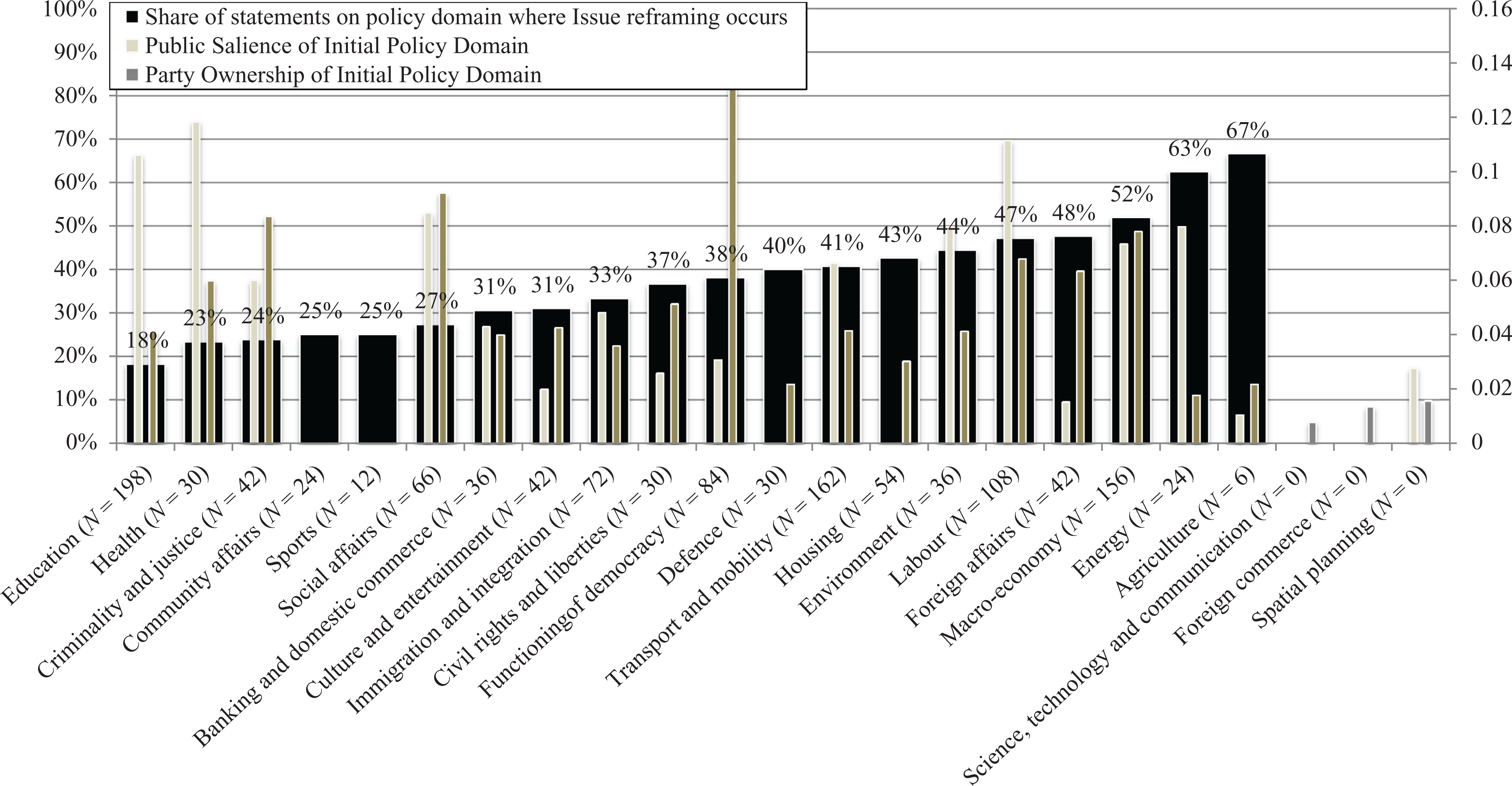
Issue reframing, per policy domain (N = 1254 party–statement combinations).
Figure 1 shows that when considering specific policy domains, the relationship between public salience and party ownership of the initial policy domain on the one hand, and issue reframing on the other, is not straightforward. For example, only 18% (see left Y axis) of the party argumentations on statements within the Education policy domain (leftmost black bar in the graph) reframed the issue. Education is the policy domain least reframed. This finding partially matches our expectation because the public salience of Education is high, as is shown by the tall, thin light bar: a little more than 10% (see right Y axis) of the people consider education as an important policy domain. Hence, we expected there to be little issue reframing. At the same time, we see that parties do not consider education as important; relative party salience hovers around a not particularly high 4% (see darker thin bar on the right Y axis). Such a moderate party salience score would have made us expect moderate issue reframing, while we see little. H1 and H3 make us expect a negative relationship between the broad black bars (% of issue reframing per policy domain) and both the light and darker thin bars (the public salience and party ownership of the initial policy domain). But such a negative relationship is not evident from the graph. Rather, the picture is blurred and no clear pattern emerges.
Figure 2 shows the reverse evidence and presents the data from the perspective of the policy domains that are used to reframe statements toward. According to H2 and H4, we expected a positive relationship between the broad black bars and two lighter bars. These expectations appear to be warranted by the facts. Looking at Macro-economy on the right side—the domain used most to reframe issues toward—it shows that Macro-economy is used in 20% of all instances of issue reframing. Compare that to the 0% reframing toward Foreign commerce on the left side. The graph suggests that the share of issue reframing is positively correlated with the two independent variables captured by the thin light (public salience of reframing policy domain) and the thin darker bar (party ownership of reframing policy domain). For example, both the public salience and party ownership of Macro-economy are relatively high while they are exceedingly low for Foreign commerce.

Toward which policy domains are initial issues reframed (N = 1013 party–statement combinations in which issue reframing occurs).
We now move to multivariate models shown in Table 4. Because the N of the final model (Model 4) is drastically reduced due to missing cases, we run three models with only part of the independent variables and build up the models in blocks.
Mixed-effects logistic model explaining Issue Reframing (crossed random effects on statement and policy domain level).

†p < 0.10; *p < 0.05; **p < 0.01; ***p < 0.001.
Hypothesis 1, stating that parties reframe statements less when the initial policy domain is salient to the public, is not corroborated by the facts. The effect of Public Salience of Initial Policy Domain goes in the expected, negative direction but never reaches significance. It is not the case that parties shy away from issue reframing especially for important policy domains.
Hypothesis 2 gets some support from the data, though, as can be seen by the positive and (almost) significant (p = 0.057) effect of Public Salience of Reframing Policy Domain in model 2. Parties tend to reframe issues in terms of the policy domains the public cares about most. This makes perfectly sense. Why would parties reframe issues by mentioning policy domains the public does not care about? The chance this could successfully divert and draw attention away from the initial policy domain is small. The effect is not significant in model 4 (reduced N). Taken together, the findings suggest that the public salience of the policy domain of an issue explains not so much whether parties will reframe statements but, if they reframe statements, it does predict to some extent which policy domains they use to reframe toward.
Similarly to the above, we find no support for hypothesis 3. The coefficients of Party Ownership of Initial Policy Domain are negative, as predicted, but they do not reach statistical significance. This means that parties do not resort more to issue reframing when they address a statement from a policy domain they do not own.
Hypothesis 4 gets strong confirmation though. Party Ownership of Reframing Policy Domain is a strong predictor of issue reframing. When parties care a lot about a policy domain, the chance that they will use this domain to reframe statements belonging to other domains increases substantially. Again, our theory does better in explaining how issues will be reframed than whether issues will be reframed.
An illustration of this last effect is parties’ argumentation in response to the statement “Flanders should not subsidize regional airports.” The Green party, owning the environmental policy domain, agrees with the statement, arguing that “Regional airports are expensive and harmful for the environment and the public health as a consequence of noise pollution, air pollution, and olfactory nuisance.” They clearly link the statement, which is originally embedded in the Mobility and Transport domain, to Environment, the policy domain they own. In contrast, the liberal party—which generally pays a lot of attention to economy-related matters—agrees with the statement as well, but gives the following argumentation: “The development of regional airports is important for economic growth. The government can support this via infrastructure subsidies. But the exploitation should be paid with private means.” A similar statement leads parties to reframe the issue toward owned policy domains.
The effect of party ownership on the use of policy domains for reframing is rather substantial. Predicted probabilities (based on model 4, fixed part only), keeping all other variables in the model at their means, show that the probability that an issue is reframed in terms of another policy domain increases from 0.8% for policy domains with very low public saliency (variable at its minimum) to 1.9% for domains with very high public saliency (variable at its maximum). For party ownership, the likelihood of reframing an issue to a policy domain goes up from 0.6% to 8.2% when the domain is not salient to the party (variable at its minimum) to when it is salient to the reframing party (variable at its maximum).
Some of the control variables in the models in Table 4 also exert an effect on issue reframing. In contrast to our expectations, government parties do not reframe more or less than opposition parties. Moreover, parties do not reframe more if they hold an unpopular position on the issue—the effect even goes in the opposite direction. And, the chance of issue reframing increases with the length of the argumentation that is given by the parties.
Finally, we tested our findings’ robustness by running separate models for the regional and national issues and for the three consecutive elections. We present the results in Tables SM4 and SM5 in the Supporting Material section. Results do not substantially change when selecting these smaller subsamples of all data.
Conclusion and discussion
This article’s goal was to develop and test a theory of party issue reframing—talking about an issue in terms of a different policy domain. Issue reframing is a subcategory of more general issue framing strategies parties use. It is an extreme version of issue framing in the sense that it entails a substantial shift away from the initial conception of the issue at hand. While we have a fairly good idea of the effect of parties’ issue framing strategies on voter attitudes, an explanatory account of when and how parties reframe issues is still largely missing. Our goal in this study was to offer such a framework and to test it empirically.
Following prior work about parties’ selective issue emphasis, our model was centered on the salience of issues, and the policy domains in which these issues are embedded, both for the voters and for the parties that reframe the issues. Our results show that the salience of an issue’s policy domain explains how parties will reframe an issue. More specifically, parties reframe toward domains that are important to the party itself (the party owns the issue) and to a lesser extent to issues that are important for the public at large. These findings corroborate prior work by Hänglli and Kriesi (2010) and Sides (2006), suggesting that parties’ ownership over issues determines their ability to frame issues. That said, the salience of the initial issue’s policy domain does not explain when parties reframe issues. So, our theory is a useful first step but explains only part of the issue reframing process.
The results suggest that parties do leverage their dominance on the domains they own. They hold stronger arguments on these policy domains and thus try to refer to these arguments if they have to explain a position on issues embedded in other domains (Riker, 1993; Sides, 2006). Additionally, parties appear to be aware that it is in their best interest to address important issues to avoid appearing as disconnected from the public’s concerns (Ansolabehere and Iyengar, 1994). They shift the debate toward policy domains that the public cares about in particular, even if the issue they are asked to address is embedded in another policy domain.
Our data have various strengths, chiefly that we directly examine how parties reframe a large number of specific issues across a wide range of policy domains and over several electoral cycles. Also, robustness tests indicate that the results hold up for multiple elections and with an alternative operationalization of issue ownership.
The main weakness is that our data remain confined to a single country—actually a single region. As Belgium is a country with a highly fragmented party system, it remains unclear to what extent parties’ issue reframing strategies would differ in less crowded party systems. Public issue salience and party issue ownership can be expected to drive parties’ issue reframing in other, majoritarian party systems as well. In fact, issue ownership theory has been originally developed for the emblematic two-party system of the United States (Petrocik, 1996) and it may be expected to drive both voter and party behavior even more in those systems. Sides’ 2006 findings with regard to the Democrat’s reframing of crime suggests that issue reframing toward more favorable policy domains is a realistic strategy in majoritarian systems as well. Yet, on the other hand, in crowded party systems, in which parties have a harder time distinguishing themselves from one another, issue ownership may be a more important tool to accomplish this distinction goal.
The fact that our data come from a public VAA could be considered as a limitation. Parties may communicate their arguments differently when communicating via a VAA compared to when they use other communication channels (see Dalmus et al., 2015 for an analysis of how parties communicate different issues in different communication channels). However, VAA data tap directly into parties’ own unfiltered communication regarding issues they have not chosen themselves. The external validity of this situation in which parties are forced to address issues may therefore be high. Still, it remains to be seen whether similar issue reframing practices also occur when parties are asked in other situations to address issues they have not chosen themselves. Examples are a minister answering parliamentary questions he/she would rather dodge, party leaders being interviewed by journalists about issues they would rather avoid talking about at all, or parliamentary debates about an issue a party would like to neglect. Although we cannot simply generalize our findings to these other occasions in which we expect issue reframing to happen, we think similar mechanisms of public issue saliency and party issue ownership might be at play. We leave it to future studies to assess the impact of issue salience on parties’ issue framing strategies in different contexts. For now, our study has demonstrated that parties use reframing strategies when presenting issues to the public and that issue salience systematically determines parties’ tendency to reframe issues.
Supplemental material
Supplemental Material, pp-2016-0209-File003 - Issue reframing by parties: The effect of issue salience and ownership
Supplemental Material, pp-2016-0209-File003 for Issue reframing by parties: The effect of issue salience and ownership by Jonas Lefevere, Julie Sevenans, Stefaan Walgrave and Christophe Lesschaeve in Party Politics
Footnotes
Declaration of Conflicting Interests
The author(s) declared no potential conflict of interest with respect to the research, authorship, and/or publication of this article.
Funding
The author(s) received no financial support for the research, authorship, and/or publication of this article.
Notes
Supplemental material
Supplemental material for this article is available online.
References
Supplementary Material
Please find the following supplemental material available below.
For Open Access articles published under a Creative Commons License, all supplemental material carries the same license as the article it is associated with.
For non-Open Access articles published, all supplemental material carries a non-exclusive license, and permission requests for re-use of supplemental material or any part of supplemental material shall be sent directly to the copyright owner as specified in the copyright notice associated with the article.
