



Abstract
The economic crisis within the European Union has had a significant impact on domestic politics in the member states, affecting the links between parties and citizens and accentuating the tensions parties face between governing responsibility and being responsive to public opinion. This article examines whether parties in EU countries have shifted their left–right ideological positions during the current crisis and whether such shifts are a direct response to the pressures of wider economic conditions or are more affected by changes in the preferences of the median voter. Party-based and citizen-based data are examined between 2002 and 2015, encompassing both the precrisis and crisis periods. The main findings are that the economic crisis has made parties less responsive to public opinion on the left–right dimension, and this effect is more pronounced for parties that have been in government.
Introduction
The economic crisis in the European Union (EU) has had a multifaceted impact on domestic politics in the member states, reshaping relations between citizens, parties and political institutions. The crisis has clearly affected political representation in those countries worst affected by the economic crisis, with governing parties particularly facing difficult and often unpopular trade-offs. These parties face the conflicting demands of governing responsibly and being responsive to public preferences (Mair, 2009, 2013). These trade-offs have been particularly acute for those Eurozone countries who needed recourse to external funding bailouts which came with strict conditionality attached, requiring greater fiscal discipline and structural reform.
As the European economic crisis has unfolded in recent years, parties in the member states have been caught between the conflicting demands of, on the one hand, being responsive to domestic electorates’ growing calls for a clear political alternative to – or at least a significant easing of – austerity, and, on the other, the responsibility to carry out significant policy reform and fiscal retrenchment as demanded by external actors, including the EU and the IMF (Mair 2009, 2013).
Over the longer term, moreover, the European integration process has impacted on and constrained party competition in the member states (Mair, 2000). A process of programmatic convergence has entailed mainstream parties of right and left moving closer, particularly on economic policy, in response to the constraints of EU membership and its supranational policy outputs (Dorussen and Nanou, 2006; Nanou and Dorussen, 2013). Given the long-standing impact of the EU on party competition and policy feasibility, particularly on the left–right dimension, the economic crisis in the EU provides an important opportunity to examine political representation in terms of whether and how party positioning on left–right ideology has changed in the context of shifts in the median voter. As Giger et al. have noted: ‘The Great Recession is a particularly fruitful and importance instance for studying the effect of variation in the macro-economic context on responsiveness’ (2016: 3). Accordingly, this study similarly shares scholarly ‘interest in the capacity of representation of parties in times of dire economic crisis’ (Giger et al., 2016: 3).
This article makes two important contributions. First, it extends the literature examining how, over time and across countries, external pressures and domestic opinion have shaped party positioning and responsiveness (Adams et al., 2009; Ezrow and Hellwig, 2014; Haupt, 2010; Steiner and Martin, 2012; Ward et al., 2011 , 2015). Second, this article contributes to the emerging literature focusing on how the economic crisis has impacted political representation and party–citizen links in the EU, particularly those countries in southern Europe which have been most affected in terms of the severity of the economic dislocation and its impact on domestic politics (Belchior et al., 2016; Freire et al., 2014; Karyotis et al., 2014; Kriesi, 2014). It provides the first robust, cross-national analysis of how the economic crisis has affected party responsiveness to the median voter on the left–right dimension in the EU. It examines changes in party responsiveness on the left–right dimension in EU member states between 2002 and 2015. In so doing, it advances the under-researched area of how external factors, including economic integration, ‘influence party responsiveness to changes in voter preferences’ (Ezrow and Hellwig, 2014: 817).
The article is structured as follows. First, it develops the key themes of responsibility and responsiveness faced by parties within the context of the European economic crisis. Second, it reviews existing research looking at parties’ positional responsiveness in the context of citizens’ preferences and external economic pressures, deriving hypotheses to be tested in the empirical analysis. Third, the data sources and analytical procedures are explained. Fourth, the model results are presented and key findings discussed. Fifth, the conclusions are drawn and areas for further research identified.
The economic crisis and political parties in the EU: Responsibility and responsiveness
The commitments entailed by EU membership have contributed to the convergence of mainstream party programmes, narrowing the policy options available to voters (Dorussen and Nanou, 2006; Mair, 2000; Nanou and Dorussen, 2013). Mainstream parties in the EU face tensions and trade-offs between the functions of responsiveness and responsibility (Mair, 2009: 15). Governing parties can find it increasingly difficult to reconcile the demands of being responsive to the preferences of voters with the pressures of responsibility – namely, implementing policies (frequently stemming from the need for compliance with external constraints) aimed at addressing important social and economic problems and that may not be in line with the preferences of the median voter. As Bardi et al. (2014: 236, emphasis in original) observe: However, while classic democratic theory considers it desirable for the parties in government (and the opposition, as well) to be sympathetically responsive to their supporters and to public opinion and, at the same time, responsible towards the internal and international systemic constraints and compatibilities, these two roles seem to have become more difficult to reconcile and even increasingly incompatible. the claims of audiences other than the national electoral audience, including the international markets that ensure their financial alimentation, the international commitments and organizations that are the root of their international credibility and, in the European context in particular, the heavy transnational conditions of constraint that are the result of a common currency and common market. (Bardi et al., 2014: 237)
These conflicting pressures between responding to citizens and implementing ‘responsible’ policies demanded by those audiences beyond the domestic level have been evident for parties in some member states during the economic crisis (Mair, 2013). Most obviously, those Eurozone countries (Greece, Ireland, Spain and Portugal) have been (or still are) the recipients of major rescue packages provided by the ‘troika’ of the European Commission, European Central Bank (ECB) and the International Monetary Fund (IMF). In exchange, these countries had to accept a number of conditions, entailing significant fiscal retrenchment and economic reforms. Governing parties in these countries have been under increasing strain caused by, on the one hand, the responsibility for enacting austerity policies under the aegis of international organizations and, on the other, the need to respond to growing demands for political alternatives to austerity. As Hobolt and Tilley have noted ‘the external constraints on national governments’ room to manoeuvre have never been more obvious, especially in the countries facing a sovereign debt crisis’ (2016: 3).
The situation of Greece shows how the crisis has deepened tensions between the responsive and responsible aspects of representative government (Gemenis and Nezi, 2015). The parties were unable to forge a parliamentary consensus in response to the crisis, and governing parties were ‘pushed towards a “responsible” conceptualisation of government claiming that they could deliver a way out of the crisis, at odds with their representative function’ (Gemenis and Nezi, 2015: 30). Moreover, as The Economist observed: ‘The conditions attached to the bailouts drastically reduce the government’s control over economic policy. For many Greeks, this makes politics itself pointless’ (2017: 29). Similarly, Katsanidou and Otjes (2016: 263) note that the ‘bailout came with memoranda that set the main lines of Greek economic policy for the coming years’. This reiterates how external constraints derived from the crisis – in this case, the bailout packages and accompanying reforms – can affect relations between citizens and parties, restricting how responsive parties can be to shifts in citizens’ preferences when they have to balance the demands of responsibility in office.
Party responsiveness to the median voter on the left–right dimension: Theoretical expectations
In the dynamic model of representation, a core aspect of political representation entails parties being responsive to changes in citizens’ preferences – that is, parties changing their positions in the same direction as shifts in citizens’ positions (Erikson et al., 2002; Stimson et al., 1995). As Ezrow et al. (2011) observe, parties can be responsive to the median voter (the ‘general electorate’ model) or to their own supporters (the ‘partisan constituency’ model). Party responsiveness to public preferences within democracies is affected by a range of institutional and contextual factors operating at the country level and by external pressures at the regional or global level (for reviews of this literature, see Adams 2012 and Fagerholm 2016). There has been, however, very limited research into the specific issue of how external factors affect party responsiveness to citizens’ preferences. Ezrow and Hellwig note that no previous studies have assessed the ‘the theoretical question of whether and how global economic ties influence party responsiveness to changes in voter preferences. When public opinion provides one signal and the global economy another, how do elites respond?’ (2014: 817). They expected that the responsiveness of parties to the median voter would be weaker in countries more deeply integrated into the global economy. Ezrow and Hellwig found globalization conditioned party responsiveness (particularly those parties with governing experience) on the left–right scale, concluding that ‘globalization enhances the political relevance of market actors over voters, distracting political elites from the electorate’ (2014: 824).
The current crisis provides an important case for testing whether and how worsening economic conditions, and the bailouts in which the EU has participated, have affected party responsiveness in general and that of particular types of party. Based on the results of existing research, and informed by the work of Mair (2009, 2013) in relation to the demands parties face in terms of responsibility and responsiveness, hypotheses are specified which are then tested in the empirical analyses.
It is expected that, within the EU, the current economic crisis has entailed parties facing a choice between ‘responding to voters and “responding” to markets’ (Ezrow and Hellwig (2014) – the dilemma between responsibility and responsiveness. Further, the crisis has increased the political relevance of external actors – such as ‘troika’ of the European Commission, ECB and the IMF and global markets – compared to voters. It is expected that parties in those countries worst affected by the economic crisis would be less responsive to shifts in the median voter and so be more likely to be responsive to external considerations pertaining to the economic crisis.
Such weakened responsiveness during the crisis would be an indicator of the external economic pressures on parties to implement ‘responsible’ policies. As Giger et al. observe, ‘in bailout countries, governments have to comply with the conditions attached to the bailout loans and have to implement the harsh austerity measures despite the increasing opposition among the electorate’ (2016: 7). The second hypothesis is a modified version of hypothesis 1, applied to a subset of countries. It is expected that party responsiveness will be more affected within the particular subset of Eurozone member states worst impacted by the economic crisis, which have had recourse to bailout programmes and which clearly have experienced a more stringent set of external constraints on domestic policy. As Ward et al. observe: ‘If a supranational body sets the policy, parties are no longer free to offer alternatives to that policy’ (2015: 1231). In short, parties in these countries have had much less leeway to shape economic policy in response to the crisis (Giger et al., 2016). The following hypothesis is specified:
The tension between responsiveness and responsibility varies across parties. It is particularly acute for parties in government during the economic crisis. These are the parties that need to respond to external constraints and implement policies in very difficult circumstances to address the crisis. Ezrow and Hellwig (2014) argued that parties would not respond in a uniform way faced with the conflicting pressures of economic constraints and the demands of voters. They expected that parties that had the responsibility of office would deem external economic considerations more salient than citizens’ preferences (2014: 818), finding that ‘parties with governing experience do not respond systematically to citizen demands in open economics’ (2014: 825). Moreover, as Rose has observed, ‘a governing party’s attempt to manage its national economy is greatly constrained by transnational influence’ (2014: 254).
The literature on the EU and party convergence has shown that it tends to be mainstream parties – often with governing experience, or aspiring to office – that have converged programmatically, particularly on economic policy, responding to the external constraints of EU membership and legislative outputs (Dorussen and Nanou 2006; Hix 2003; Nanou and Dorussen 2013; Ward et al. 2015). Based on these insights, it is expected that parties in government during the economic crisis will face the most acute trade-off between responsibility and responsiveness (Mair, 2009, 2013) and will be more likely than parties not in government to prioritize responsibility over responsiveness. As Bardi et al. (2014: 243) note, it is generally historical and established parties that ‘tend to present themselves as primarily “responsible” parties’, and this seems to apply most clearly to incumbent parties. External constraints arising from the economic situation will be more salient for parties in office during the crisis.
The next section sets out how these hypotheses are tested, discussing the data sources used and analytical procedures followed.
Data and methods
The data on party positions come from the Manifestos Project (MARPOR) data set (Volkens et al., 2016), a continuation of the Comparative Manifestos Project (Budge et al., 2001; Klingemann et al., 2006). The MARPOR data set contains information about the content of party manifestos. The MARPOR data set contains information on more than 1000 parties from over 50 countries, covering the period from 1945 to the present day. The main reason for using the MARPOR data set is because party manifestos provide the most direct and complete view of party official positions on different issues. Users of the MARPOR data have argued that these advantages compensate for the issue of reliability identified in the literature (Budge, 2013; Benoit et al., 2009; Mikhaylov et al., 2012).
Since the focus is on EU countries and given the availability of data from the European Social Survey (ESS) from 2002 onwards, a subset of MARPOR data is used corresponding to national elections held in member states between 2002 and 2015. In total, this encompasses 27 countries (excluding Malta), 91 different elections, and 294 parties, which provides a total of 651 party-election observations. This total is, however, affected by the requirement for at least four election observations per party (in order to compute, at least, three shifts in party positions, and one of them to build the lagged dependent variable included in the analyses) and the need for party observations to be matched with corresponding data for the positions of citizens (see Table 1B in the Online Appendix). The final number for the analyses is 180 party-election observations for 15 countries. The full list of countries, parties and elections included in the analysis is provided in Table 1A in the Online Appendix.
Multivariate analysis of parties’ ideological left–right shifts before and during the crisis (2002–2015).

Note: GDP, gross domestic product. Robust standard errors clustered by country and election in parentheses. The individual country dummy estimates are not reported in the table but are available upon request.
***p < 0.01; **p < 0.05; *p < 0.1.
Measurement of the dependent and independent variables
The analysis focuses on party responsiveness to the median voter on the left–right dimension. The focus on the left–right dimension is motivated both by the central concern with this aspect of positional representation in existing research (Adams et al., 2009; Haupt, 2010; Ward et al., 2011 , 2015) and by its core role in structuring party competition and citizens’ preferences in European democracies.
The operationalization of the dependent variable relies on estimates of party left–right positions from MARPOR and follows the procedures set out in Laver and Budge (1992). 1 The MARPOR left–right positional scores range from −100 to +100. These scores were rescaled from 0 to 10 (where 0 represents the most left-wing position and 10 represents the most right-wing position) to match the 0–10 scale used for citizens’ left–right self-placements from the ESS. The dependent variable used in the analysis measures the shifts in party positions between election t and election t−1 on the left–right axis (MARPOR: Rile t − Rile t −1). A negative sign indicates a shift to the left; a positive sign shows a shift to the right. Descriptive statistics for the dependent variable are reported in Table 1C in the Online Appendix.
Regarding the independent variables, three variables were used to account for the effects of the economic crisis on responsiveness. To examine how parties responded to the worsening economic situation, the annual percentage change in gross domestic product (GDP) was utilized as a general indicator of a country’s economic performance. 2 This operationalization was chosen – and not, for instance, changes in GDP between elections or the average GDP growth during the period – since it is assumed that, when elaborating their manifestos, parties take into account the salience of more recent economic developments (using the average GDP growth or changes between elections could show more favourable images of the current economic situation). This measure is constructed as lagged variable, based on the assumption that parties usually develop their manifestos within a reasonable time span before an election (Däubler 2012; Dolezal et al., 2012). 3
The GDP variable captures the effect of changing economic conditions on party responsiveness. In addition, the analyses included a dummy variable (Crisis period) to capture any effects since the onset of the crisis on party responsiveness. This Crisis period variable differentiates national elections occurring before and after 1 January 2009. The crisis became a global recession (in terms of the objective definition set by the IMF – a general decline in annual world real GDP per capita) in 2009 (IMF, 2009). January 2009 is used as the dividing line between the two periods, so all national elections occurring after that date are classified as occurring in the crisis period. 4 A third variable aims to capture the specific effects of the crisis in those countries worst affected which were forced to resort to external financial assistance programmes provided by the EU and international organizations. A dummy variable, Conditionality, captures those countries and periods subject to any financial assistance programmes. 5
To examine the responsiveness to public opinion, the models include shifts in the positions of citizens on the left–right dimension. For this variable, data are taken from different rounds of the ESS. The ESS’s core module of questions offers a consistent measure of citizens’ self-positioning on a left–right scale. 6 The operationalization of the public opinion shift variable used in the analyses is the mean self-position of citizens on the 0–10 left–right scale between ESS round t and t−1 by country/party and election. 7 The ESS round (t) preceding each election year was used, considering the fieldwork period for each country. This means that if an election took place in March 2004, but the fieldwork of round 2 (2004) in that country was carried out from September 2004 to January 2005, data are used from round 1 (2002). This decision has a limitation – in using citizen data, observations are lost because some elections in 2002 took place before the first ESS round. However, the advantages of this choice outweigh this limitation. Firstly, it better addresses the problem of endogeneity in citizens’ positions, because, using postelection data risk, these are being affected by the previous electoral campaign. Secondly, and related to this, ESS information on citizens’ positions is probably prior or contemporary to the drafting of party manifestos, as the average number of days between election day and the mid-fieldwork date was 328.
To capture the effect of the crisis on party left–right responsiveness to shifts in the mean voter’s positions, the models included the corresponding interactions between the variables measuring public opinion shifts and the three economic crisis measures (GDP growth, crisis period and conditionality).
The literature on party responsiveness – in general or in focusing on economic integration – has also demonstrated the effects of specific party characteristics on parties’ policy shifts (Adams et al., 2009; Ezrow et al., 2011; Haupt, 2010; Ward et al., 2011). Following this literature and in accordance with hypothesis 3, alternative estimations included a dummy variable Incumbent, which identifies parties in office during the electoral period. 8 Existing studies have demonstrated that variation in party system characteristic – over time and across countries – can affect policy linkages between parties and citizens (Budge and McDonald, 2007; Ezrow, 2007). This is operationalized as a variable measuring the Effective number of parties (Laakso and Taagepera, 1979). The Effective number of parties variable was calculated from the MARPOR data to capture the effects of changes in the institutional system in the same country across time (Laakso and Taagepera, 1979), as a country fixed effects estimator was used. A higher effective number of parties is associated with increased dispersal of party positions (Nanou and Dorussen, 2013), which could impact on individual party responsiveness. A variable (Social democratic) was included to control for the effects of the ideological position of this type of party. The economic crisis potentially presents a ‘unique window of opportunity’ for social democratic parties to increase their electoral competitiveness by diverging from centre-right parties, particularly concerning defence of welfare provision (Anonymous, this issue). Alternatively, social democratic parties will arguably have more reason than their centre-right competitors to signal their commitment to implementing austerity policies in response to the crisis, in order to establish competence on an issue where they have traditionally had a less favourable reputation (Kraft, 2016). Descriptive statistics for the independent variables are presented in Table 1C in the Online Appendix.
Model specification
Given the small number of time periods (elections between 2002 and 2015), there is more of an unbalanced panel data structure compared to the time series cross-sectional structure often used in the party responsiveness literature. A pooled OLS estimator was used, with robust standard errors clustered by election to correct for heteroscedasticity and serial correlation problems 9 and country fixed effects to account for bias stemming from unmeasured country-level factors. The addition of the lagged dependent variable is to address the issue of serial correlation (Beck and Katz, 2011). 10
The basic model is as follows:
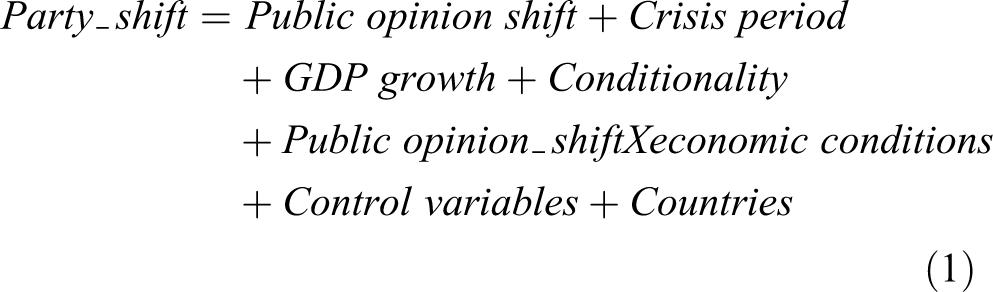
where Party_shift stands for the dependent variable (left–right), Party_shift(t−1) is the lagged dependent variable, and Public opinion shift represents the shifts in the median voter’s left–right positions. To test the hypotheses, interaction terms between shifts in mean citizens’ positions with economic conditions (either the Crisis period variable or in alternative specifications with Conditionality and with GDP growth) are included in the models. These estimates can help to assess whether parties responded differently to public opinion during the crisis period due to changing economic circumstances.
Results and discussion
Table 1 reports the OLS regression results with robust standard errors clustered by country election with a full set of country fixed effects. Models 1–3 report the results for the different models estimated for left–right ideology. 11
The results provide support for hypothesis 1. The positive and significant coefficients in the estimates for Crisis period and Public opinion shift, and the negative coefficient in the interaction between both variables in model 1, indicate that parties responded differently to public opinion during the crisis period. Figure 1 offers a more intuitive interpretation of these effects. Before the crisis, the average marginal effect of a shift in public opinion (the slope of the corresponding line in Figure 1) is 1.96, while during the crisis, the effect is −2.58. Both effects are statistically significant. Before the crisis, the parties tended to respond to the shifts in public opinion by moving in the same direction. However, during the crisis, this pattern is reversed, with parties’ left–right shifts tending to differ from that of the median voter.
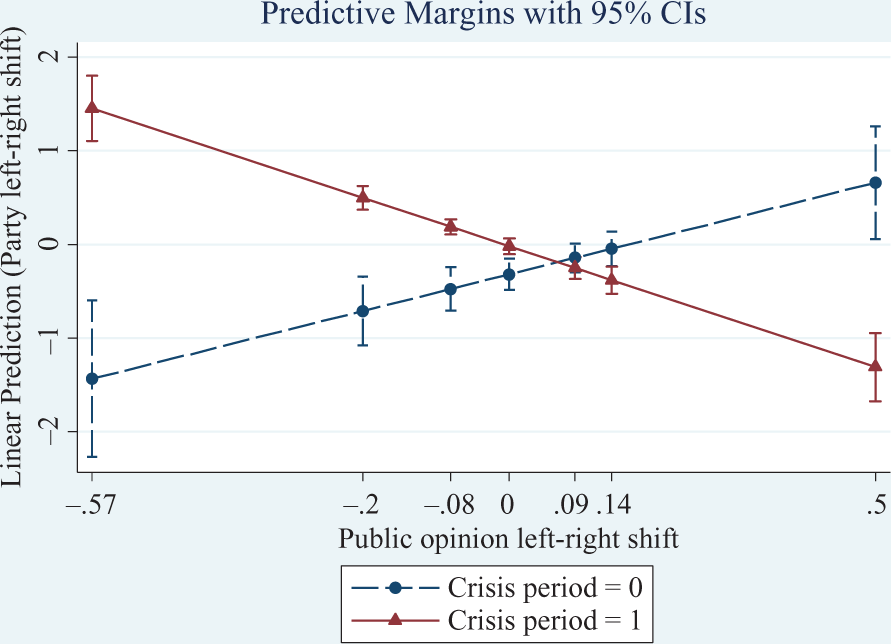
Adjusted means of party shifts on the left–right dimension, as a function of public opinion shift and crisis period (model 1 in Table 1).
This result seems in line with the findings of previous studies on party responsiveness in Europe for the precrisis period, which find parties change their policy stances in reaction to shifts in mean voter positions (Adams and Somer-Topcu, 2009; Adams et al., 2004; Ezrow et al., 2011). The results of the coefficients for GDP growth (t−2), and for the interaction of this variable with Public opinion shift in model 2, are also statistically significant. They are represented in Figure 2(a) and (b). They show that parties tended to shift their positions in the opposite direction from the public when the economic situation worsened; while they became indifferent to public opinion when the levels of economic growth reached about 3%.
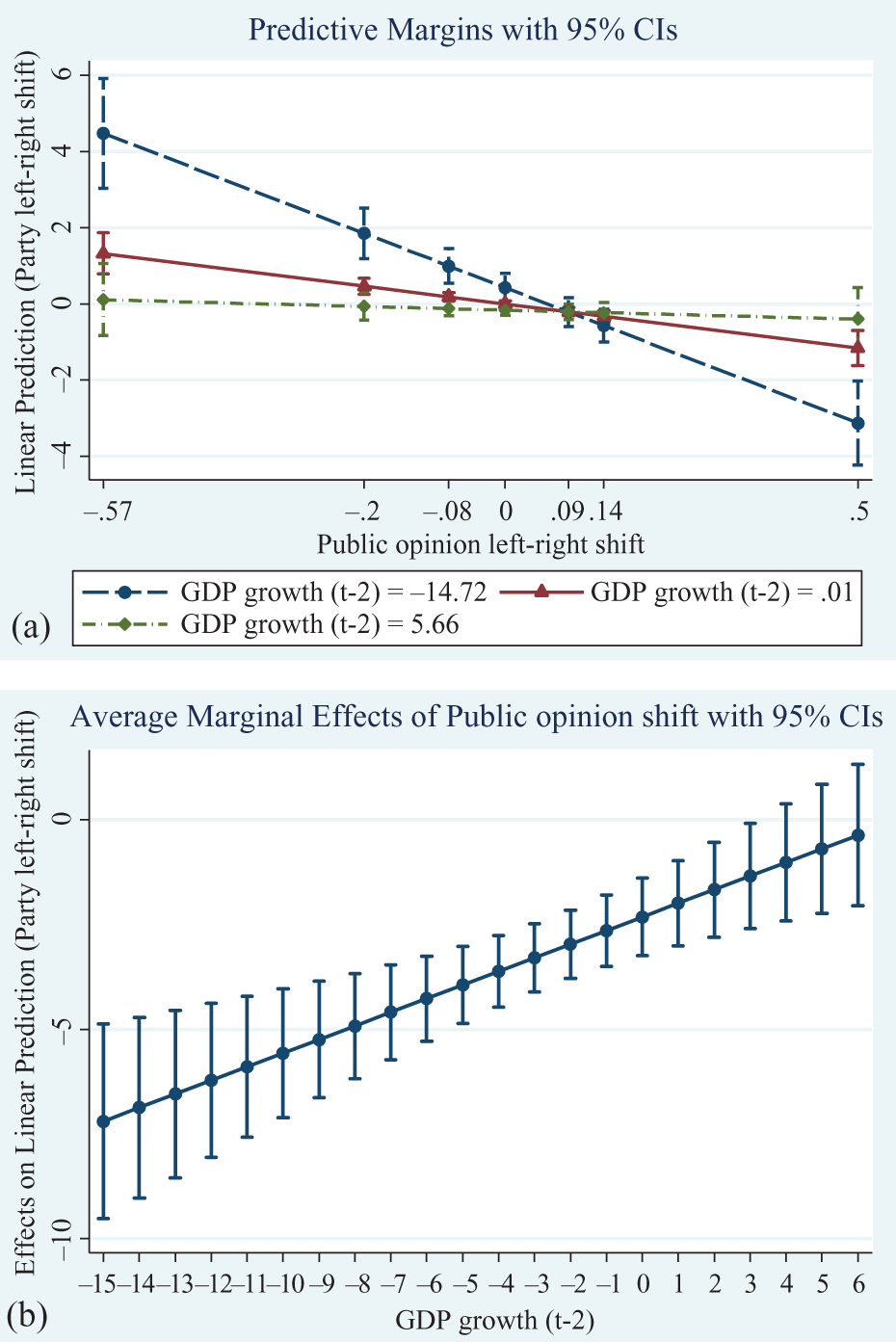
(a) Adjusted means of party shifts on the left–right dimension, as a function of public opinion shift and GDP growth (t−2; model 2 in Table 1). (b) Average marginal effects of average public opinion shift on party left–right shift, conditioned on GDP growth (t−2; model 2 in Table 1). GDP: gross domestic product.
The interaction between Public opinion shift and Conditionality is statistically significant in model 3 of Table 1. Though parties in all countries tended to be not responsive to public opinion shifts (on the contrary, party shifts run in the opposite direction), in countries subject to conditionality, nonresponsiveness is more accentuated. This is shown in Figure 3 through the steeper, negative slope of the average predicted marginal effects for the triple interaction in the conditionality countries. However, from Figure 3, it can also be seen that, in countries under conditionality, there is also a margin (when citizens’ shift to the right up to 0.11 points) where parties in countries under conditionality programmes appear to be responsive.
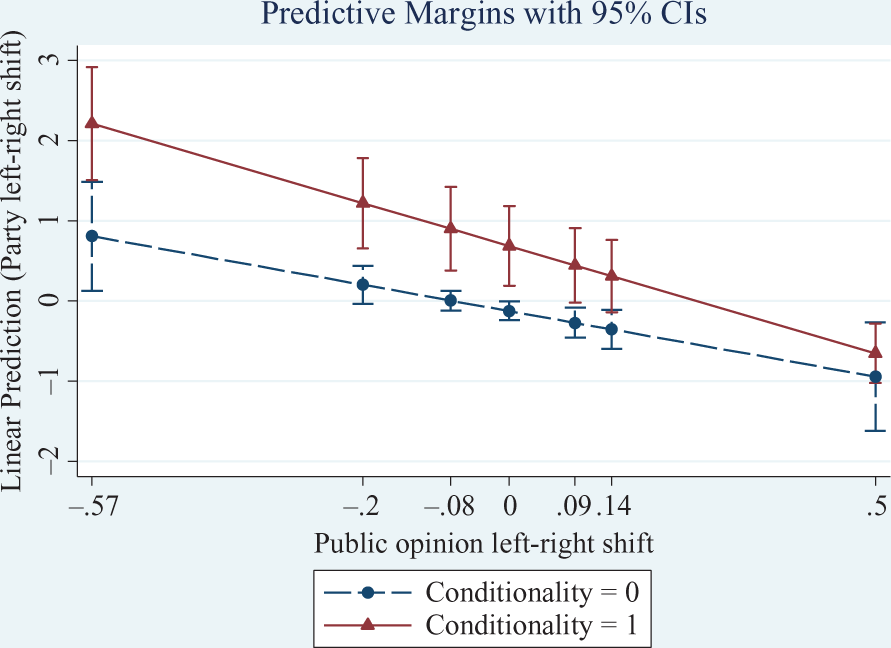
Adjusted means of party shifts on the left–right dimension, as a function of public opinion shift and conditionality (model 3 in Table 1).
An interpretation of the results of models 1–2 suggests that party responsiveness before the crisis was independent from economic factors, but that the crisis and the negative economic conditions associated with it have significantly eroded the level of responsiveness. Hypothesis 2 is not confirmed for the general left–right shifts (model 3), though, in models 1 through 3, Conditionality has positively signed and statistically significant coefficients – meaning that, everything else equal, parties turned towards more right-wing positions in countries subject to external bailout programmes.
Hypothesis 3 stipulated that the effects of the crisis are more pronounced for incumbent parties. Governing parties are the ones that had to negotiate financial assistance programmes with EU institutions, other external organizations and creditor countries. Their manifestos needed to balance the need to respond to public opinion with a responsible stance towards the creditors’ demands and the requirement to signal to the markets that they are committed to prescribed austerity measures to address the crisis. Models 4–6 in Table 1 were estimated, which examined the conditioning effect of governing status on party responsiveness to public opinion on the left–right dimension before and during the crisis period.
In model 4, in addition to the significant interaction between Crisis period and Public opinion shift, the interaction between Crisis period and Incumbent is statistically significant. Though the main effects for both variables are not significant, the interaction could be interpreted as showing that, during the crisis, parties in government moved significantly to the right compared with opposition parties. The nonsignificant coefficient for the interaction of Incumbent × Public Opinion Shift × Crisis Period demonstrates that this change is not a response to shifts in public opinion. 12 The result from a joint F test shows that the mediating impact of the crisis period was not statistically significant for incumbent parties (F = 0.49, p = 0.615).
The triple interaction is significant in model 5. The results from a joint F test show that the mediating effect of economic growth is statistically significant for incumbent parties (F = 3.73, p = 0.062). However, neither the main effects for Incumbent and GDP nor any of the two-way interactions between the variables of interest are statistically significant. Figure 4(a) and (b) suggests that, the more the economic situation deteriorated, incumbent parties moved in the opposite direction to that of public opinion.
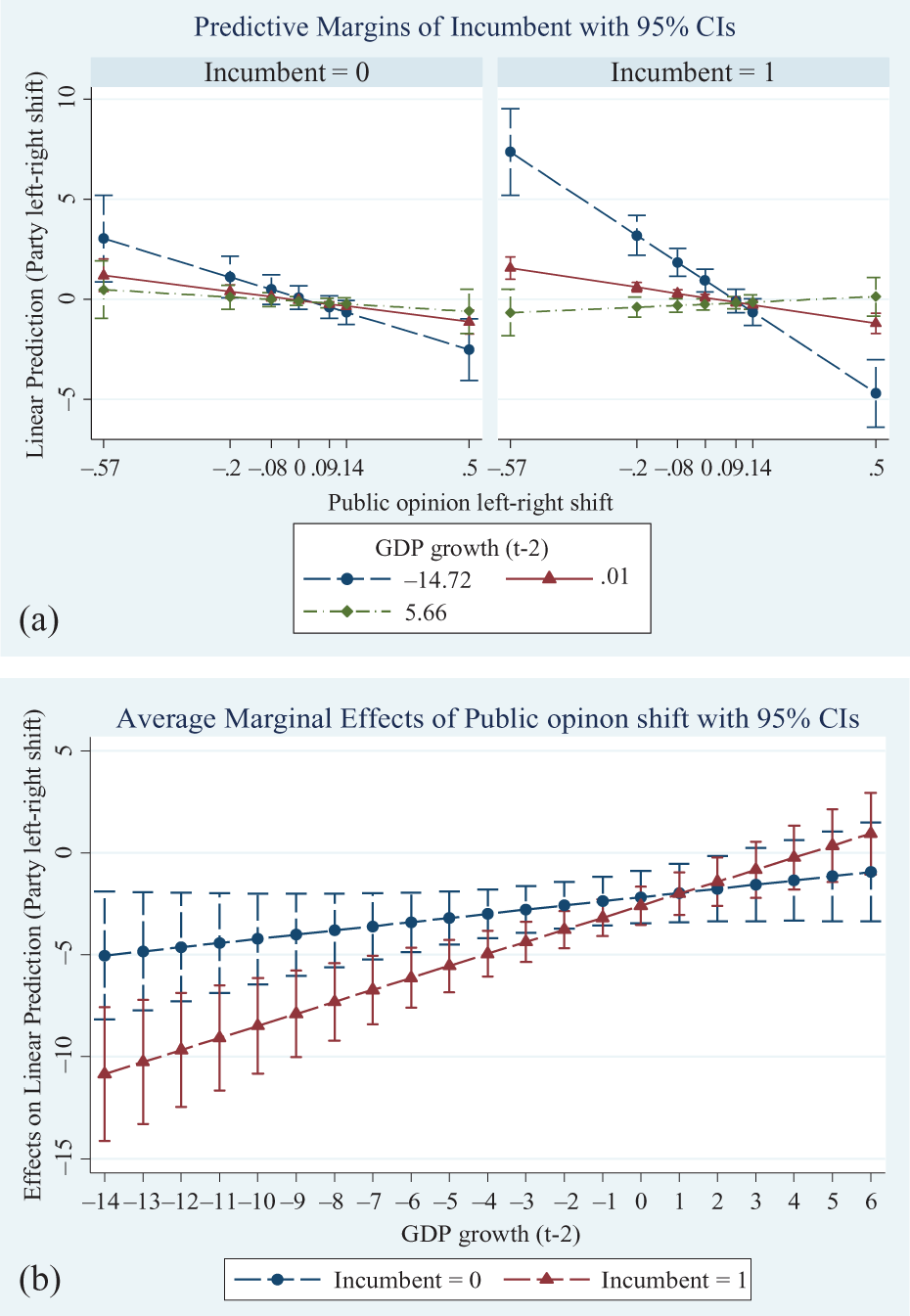
(a) Adjusted means of party shifts on the left–right dimension, as a function of public opinion shift, GDP, and incumbency (model 5 in Table 1). (b) Average marginal effects of average public opinion shift on party left–right shift, conditioned on GDP growth (t−2) and incumbency (model 5 in Table 1). GDP: gross domestic product.
Model 6 tests hypothesis 3 for those countries subject to financial assistance programmes. As in the previous model, the main effects of Public opinion shift and Conditionality are statistically significant. The same applies to the Conditionality × Incumbent interaction and the three-way interaction with Public opinion shift. The result from a joint F test carried out for the three-way interaction shows that conditionality had a statistically significant mediating impact (F = 15.4, p = 0.000). Figure 5 shows the differential behaviour of incumbent parties in countries subject to conditionality – they tended to be much less responsive compared with incumbent parties in other countries, while for the other parties, there is no significant difference.
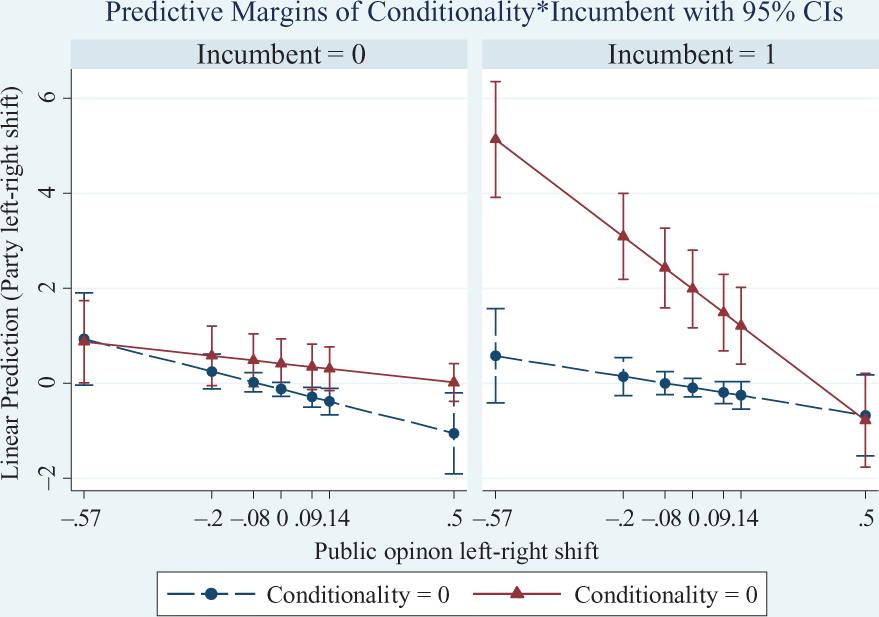
Adjusted means of party shifts on the left–right dimension, as a function of public opinion shift, conditionality and incumbency (model 6 in Table 1).
Overall, the results indicate that the decline in party responsiveness in countries subject to financial assistance programmes demonstrates the influence of external pressures on parties’ left–right positioning. The results also show that this reduced responsiveness is mainly a matter of degree, since parties in countries not subject to conditionality display a similar, if less pronounced, pattern during the crisis period. In line with the study of Ezrow and Hellwig (2014), this finding was particularly noticeable among parties in government, highlighting the greater salience of responsibility compared to responsiveness.
Conclusion
This study has provided new findings into the impact of a significant period of economic crisis on parties’ positional responsiveness. The main results showed that, as expected, the crisis has made parties less responsive to public opinion on the left–right dimension: they have moved in the opposite direction to the shifts of the median voter. The effects were more pronounced for incumbent parties: they moved significantly to the right compared with parties not in office. In the time period covered by the data (2002–2015), with a sustained economic crisis and growing political contestation over the integration process in member states, the findings may indicate some changes in how parties respond to citizens. In this period, parties – as Mair argues (2009, 2013) – are caught between the conflicting demands for responsiveness to citizens who shifted to the left during this period asking for an alternative to – or at least an easing of – austerity and the responsibility to reform and retrench as demanded by external creditors, the EU and the IMF. The results indicate that parties are not only less responsive to their citizens due to worsening economic conditions but also due to the realization of an additional crisis, the crisis of sovereignty taking place at the same time. During the crisis, parties in member states have therefore been paying greater heed to ‘the claims of audiences other than the national electoral audience’ (Bardi et al., 2014: 237).
Further research can examine the impact of the economic crisis on the polarization of citizens’ preferences and how this might affect responsiveness, which, according to the data, seems to have been greatly reduced during the first decade of the 21st century. This includes looking at party–voter linkages on specific areas of policy, disaggregating the broader left–right dimension focused on here. Parties might not only be constrained by EU institutions and the markets, which negatively affect responsiveness, but they also might find it more difficult to read citizens’ preferences, which could also affect responsiveness. More specifically, given that a small number of cases examined were under conditionality, case studies could examine, in greater depth, the conditions under which financial assistance programmes pose constraints on party responsiveness in particular countries.
Footnotes
Authors’ note
This article is part of the special issue edited by Nicolò Conti, Swen Hutter, and Kyriaki Nanou—Party competition and political representation in crisis: A comparative perspective
Acknowledgements
Ben Clements would like to acknowledge a period of study leave provided by the University of Leicester.
Declaration of Conflicting Interests
The author(s) declared no potential conflict of interest with respect to the research, authorship and/or publication of this article.
Funding
The author(s) received no financial support for the research, authorship, and/or publication of this article.
Supplemental material
Supplementary material for this article is available online.
Notes
References
Supplementary Material
Please find the following supplemental material available below.
For Open Access articles published under a Creative Commons License, all supplemental material carries the same license as the article it is associated with.
For non-Open Access articles published, all supplemental material carries a non-exclusive license, and permission requests for re-use of supplemental material or any part of supplemental material shall be sent directly to the copyright owner as specified in the copyright notice associated with the article.
