



Abstract
The entry and success of new parties has become a regular event in modern democracies. From the emergence of green to protest parties, new movements have entered the electoral arena. This article addresses one of the less studied aspects of new parties: the dynamic process of party exit and entry into politics. The article argues that changes to the party system, produced by the collapse of a political party, can lead to the successful entrance of new parties in the next election. The premise is that one party’s loss is a future one’s gain. The empirical results provide strong evidence that the size of the policy space created by a party collapse has a substantial impact on the level of new party’s success.
Political parties and party systems, while ideally stable (cf. Mainwaring and Scully, 1995), need to evolve in order to accommodate changes in society. If parties don’t adapt quickly enough, shifts in social demands can create programmatic space that new parties can fill (Hug, 2001; Zons, 2013). Of course, parties adapt to societal changes (Adams et al., 2006; Ezrow et al., 2011; Spoon and Klüver, 2014). For example, when one compares the British Labour Party’s manifestos during the Tony Blair government (1997–2007) with those of Clement Attlee (1945–1951), it is evident that the party’s policy proposals changed substantially (Volkens et al., 2015). However, adaptation by mainstream parties may not be enough to accommodate all the new social demands and new parties may still emerge. Such has been the case with environmental, anti-immigration and regional autonomy parties, among others, in Europe (cf. Meguid, 2005, 2008).
When do new parties emerge? This article argues that an opportunity for a successful entry is created when a party collapses (defined as losing more than 50% of the party’s vote share from one election to the next). A party collapse would leave a group of voters without adequate representation, creating space for new parties to enter in the next election. It is hypothesized that the larger the space created by a collapse could lead to higher vote shares for new parties. However, it is argued that this effect would depend on the permissibility of electoral formula, as high thresholds create barriers to entry that can potentially discourage new parties even when the space is open. An example of how a party collapse can lead to a future party entry is the crash of the Christian Democracy in Italy in 1992 and the rise to power of Silvio Berlusconi’s Forza Italia in 1994.
This study’s empirical findings provide robust evidence in favour of these arguments. Estimations were conducted on a broad data set on new party entries in 33 developed democracies between 1945 and 2011. The results provide strong evidence that the size of the collapsed party (a measure of the policy space created) is positively associated with new party electoral success. However, there is evidence that the magnitude of this effect is conditioned by the permissibility of the electoral system. The results are robust to multiple methods of estimation, different operationalizations of the dependent variable and controls for outliers in the sample.
The contributions of this study are twofold. The first is its focus on variations in a country’s party system over time in order to improve one’s understanding of when opportunities are created for potential new parties to successfully enter. Until recently, a large majority of the literature on new party entry has focused on relatively stable cross-country variations, such as institutions and social cleavages (see Cox, 1997; Harmel and Robertson, 1985; Hug, 2001; Tavits, 2006, 2008, among others). These studies provide important insights on the institutional conditions that favour entry but do not explain the circumstances under which new parties emerge within a given institutional and social structure. Institutional designs can make it easier (or harder) for new parties to enter, but in the United Kingdom, where the institutions make it difficult for new parties to enter, the UK Independence Party (UKIP) emerged and triggered fundamental changes (i.e. Brexit). It is, therefore, fundamental to understand the circumstances that increase the likelihood of successful new party entry.
The second contribution is to the spatial literature on political parties. This is, to my knowledge, the first empirical test (using data for multiple countries over time) of the argument that parties have incentives to enter when there is a policy space that isn’t adequately occupied by parties in the system (see Cox, 1997; Downs, 1957; Hug, 2001; Kitschelt, 1988; Meguid, 2008; Rohrschneider, 1993, among others). The collapse of a political party is an expression of voter dissatisfaction with existing representation and serves as a measure of the size of the (previously occupied) policy space that can be generated. Identifying this effect encounters a serious problem of endogeneity (cf. Laver and Schilperoord, 2007) that has been addressed here using a simple and intuitive approach, which can improve one’s insights into the party exit/entry dynamic.
The endogeneity problem is as follows, a party can lose votes because of their actions or policy failures. However, vote loss can also be caused by new parties coming in and actively competing for electors. Think of the Spanish 2015 general elections, the governing Partido Popular (PP) lost its parliamentary majority while at the same time Podemos obtained 20.66% of the votes in its first general election. 1 The rise of Podemos could have been caused by corruption scandals in the PP or by Podemos’ anti-austerity message, or both. 2 If one looks at the exit/entry process at one point in time (t0), the empirical models would pick up both the effect of the collapsing party’s errors and the new party’s efforts to gain votes. This would make it very difficult to clearly associate a new party’s results with an opening in policy space.
To address the endogeneity/identification problem, this article measures the effect of party collapse in the previous election (t−1) on the vote share for new parties in the current one (t0). A new party in the present (t0) cannot cause a party to collapse in the past (t−1), simply because the new party did not exist as an electoral alternative at the time. By estimating the impact of a party collapse in t−1, one can identify the effect of an opening in the policy space on the results of a new party in t0 without the contamination of the new party’s behaviour.
Literature and theories on new party entry
One line of research on new party entry studies the impact of institutions and how they alter the costs and benefits for new parties (cf. Cox, 1997). One of the key results is that the permissiveness of the electoral system is a strong enabler of new party entry (Cox, 1997; Harmel and Robertson, 1985; Tavits, 2006). There is further empirical evidence that country characteristics, such as the time since democratization, the level of ethnic heterogeneity and the population, are associated with the number of new parties (Hug, 2001; Tavits, 2006, 2008; van Biezen and Rashkova, 2014).
A complementary perspective, and the one used in this study, centres the analyses on policy supply. According to the spatial literature on political parties, these emerge when there is open policy space (see Downs, 1957; Hug, 2001; Kitschelt, 1988; Meguid, 2008; Rohrschneider, 1993, among others). If acting rationally, parties will only enter when and where they have opportunities to gain enough votes (benefits) to counteract the costs of competing (Cox, 1997; Osborne and Slivinski, 1996). This situation occurs when enough voters are located in a policy position that is not occupied by existing parties. One example of this is the emergence of green/environmentalist parties (Kitschelt, 1988; Meguid, 2008). Following this argument, Zons (2013) states that new parties are more likely to enter when there is less diversity in programmatic offers. In other words, when the voters are not represented (or satisfied) with the policies offered by existing parties.
Lago and Martínez (2011) measure the effect of electoral market failures (Defined as level of turnout), seat threshold and voter elasticity (i.e. volatility) on new party entry. They argue that ‘market failures occur when a significant number of individuals are left dissatisfied by the partisan choices available to them’ (Lago and Martínez, 2011: 7) and that this leads to successful new party entry if there are permissible electoral formulas.
One could add that a mismatch between voter preferences and party offers can occur for at least two reasons. The first is the appearance of relevant new issues (Hug, 2001: 89–99). For example, the appearance of environmental parties in Europe (and abroad) in the 1970s (cf. Adams et al., 2006; Meguid, 2005, among others). The second is because of errors committed by existing parties that leave voters dissatisfied and open to alternatives or abstaining from voting. For example, a party can lose support because of a political scandal, corruption or an economic crisis, among other reasons (cf. Duch and Stevenson, 2008; Maier, 2011, among many others). The present study focuses on the second argument suggesting that when existing parties stop representing their constituents (for non-policy-related reasons), the ideological space opens and new parties have the opportunity to enter. A collapse of a political party is one way of identifying voter dissatisfaction with that party. 3 Of course, as people can abstain from voting, one needs to account for turnout levels to estimate the size of the policy space that effectively opens. If all the former collapsed party voters exit the electoral process, no space would open. However, if those dissatisfied voters keep on participating, a collapsed party can open the space in the next election.
Open policy space created by a collapsed party
The process of party collapse and new party entry in the next election is not as easy to spot (or remember) as when they occur simultaneously (and endogenously). However, the 1979–1986 elections in Spain and the 1992–2000 elections in Lithuania can provide some insight. In the 1979 Spanish general elections, the Union of the Democratic Centre (UCD) party obtained 35% of the votes. In the 1982 general elections, the UCD crashed, getting only 6.8% of the votes, losing 156 seats and disintegrating a few months later. 4 This crash stirred up the party system and in 1986, four new parties obtained seats in the national assembly – Canary Islands Group, Valencian Union, Galician Nationalist Block and Popular Democratic Party. In Lithuania, the Democratic Labour Party of Lithuania (LDDP) obtained 43.98% of the votes in 1992, but crashed in 1996, getting only 10.01% of the votes. The LDDP continued to exist, but in the 2000 elections four new parties emerged and one of them, the New Union (NS), obtained 19.64% of the votes (Döring and Manow, 2012).
One reason a party collapse can open policy space in the next election is because when a party loses more than 50% of its vote share, it can create doubts as to whether the party has a viable future. Voters for a party that held 15% of the votes in one election may stop believing in its ability to get into office if that party only obtains 7% of the votes in the next election. If so, any person still voting for the collapsed party (the remaining 7% in the example) would be incentivized to look for an alternative that satisfies their preferences. Furthermore, the swing voters who generated the party collapse (the 8% that left) will not necessarily keep on voting for their ‘alternative’ party in the future. Political identity and biases against other parties can limit a citizen’s willingness to vote for an opposing party, even if they are dissatisfied with the party they usually vote for (see Bartels, 2002; Green et al., 2004; Iyengar et al., 2012; Tajfel et al., 1971, among others). Biases against existing opposition parties can make a new party attractive by giving voters an alternative to their original (unsatisfactory) party without generating social identity costs.
Not all collapsed parties can open enough space for a viable new party entry; that would depend on the space previously occupied by the collapsed party. Larger collapsed parties, measured as vote share, can open more space, injecting higher numbers of swing voters into the system, adding uncertainty in the next election and increasing viability for new party entry. For example, a party that used to control 30% of the votes would need to lose 15%, at least, of the total vote share to be classified as a collapsed party, leaving a large group of people with unsatisfactory representation. On the contrary, a small party (e.g. 3% vote share) would not generate as many dissatisfied voters, even if it loses all of its support.
Even if a party’s collapse can open policy space, both new and existing parties have incentives to compete for those voters. However, it is unlikely that existing parties will have a complete policy shift (cf. Robertson, 1976; Zons, 2013). Limitations to party movement can come from internal party politics, especially if it affects party members’ probabilities of re-election. A move too far into the collapsed party’s location can alienate voters on the other extreme of the party and threaten current legislators’ seats. One would expect these legislators to do everything possible to restrict party movement. Further limitations to policy shifts can come from active party members who, if they disagree with the new policies, can threaten to stop working for the party, leading to additional campaign costs. Similarly, large party donors could withdraw financial support if policy shifts go beyond their preferences. Furthermore, a large policy shift by a party with a long-standing policy tradition may not be credible to voters (Tavits, 2007). Take, for example, some traditional Labour voters’ dissatisfaction with the more centrist New Labour policies and the effect this had (among other factors) on the collapse of the 2015 general election Labour vote in Scotland when voters turned to the more left-wing Scottish Nationalist Party (Volkens et al., 2015). 5 Finally, if a party does move too far in another policy direction, the voters, alienated by this shift, would be incentivized to ‘shop around’ for a party that offers policies closer to their preferences. Therefore, space could open for a new party at the collapsed party location or at the other extremes of the existing parties that move too far into the collapsed party’s policy space.
A party collapse can also have an effect on new party entry through the collapsed party’s location on the policy space. Assume any non-flat voter distribution over a left–right scale. If a party collapses in a location where there are a large proportion of voters, this would leave a large group of people without adequate representation. As preference distributions do not necessarily match vote distributions, the inadequately represented voters would include potential and effective former collapsed party supporters. A new party can come in and attempt to capture all the voters in that location, including those who did not previously support the collapsed party. If one assumes preferences to be loosely normally distributed, one can expect more space to open when a party collapses towards the centre of the left–right ideological scale than on the extremes.
The size and location of the collapsed party could impact the size of the policy space that opens; however, this may not be enough to convince potential supporters of a new party’s viability. The electoral system can limit a new party’s ability to transform votes into seats. For example, in a first-past-the-post (FPTP) system, a party collapse that generated a large open policy space equivalent to 15% of the national votes may not be enough to get a party into office. Unless those votes are territorially concentrated, even a new party that manages to absorb the full extent of those votes may not be able to win a seat because of the high entry thresholds, making the new party a risky/unviable option (cf. Cox, 1997; Duverger, 1959).
This would not be the case in countries with proportional electoral rules (PR) where the seat threshold is substantially lower. If one assumes that voters understand how elections work in their country and adjust their expectations accordingly, then one could expect them to react less to the opening of a policy space under FPTP than under PR.
Given the arguments stated above, one can predict that:
Estimation strategy and data
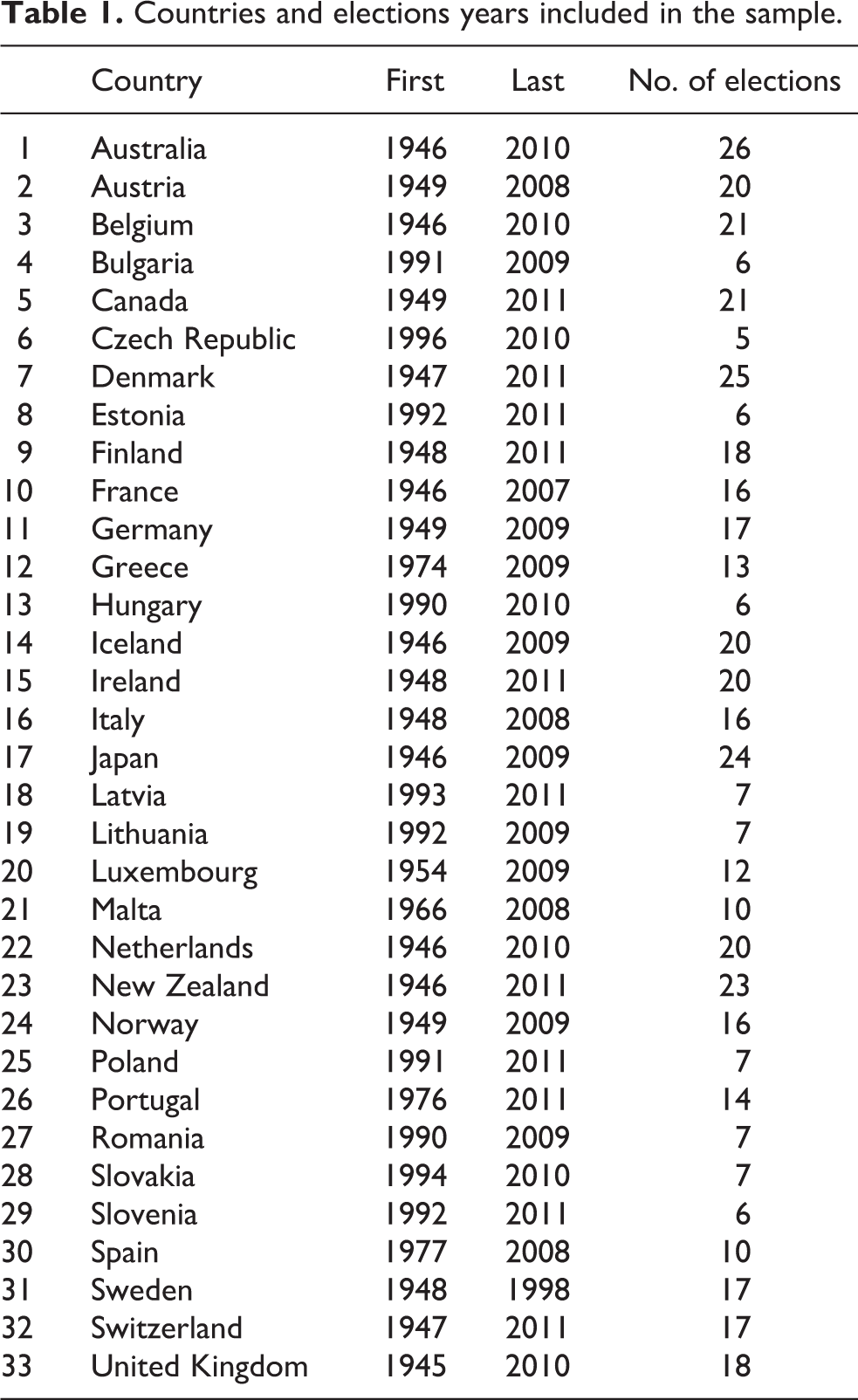
The hypotheses are tested using panel estimations on a time-series cross-sectional data set including elections in 33 developed democracies between 1945 and 2011. Table 1 presents a list of the countries and years included in the sample. The dependent and independent variables of interests are created and recoded from the ParlGov database (Döring and Manow, 2012) on political parties.
Countries and elections years included in the sample.
The dependent variable is the sum of vote shares obtained by new parties at each election. Following the influential research by Hug (2001: 14), ‘new parties’ are defined as ‘a genuinely new organization that appoints, for the first time, candidates at a general election to the system’s representative assembly’. This definition excludes electoral alliances and party mergers but counts as new parties that result existing party splits (where the original party is still in competition) or emerge independently (Tavits, 2006; Zons, 2013). However, parties that change their name, but are for all intents and purposes the same party, are not counted as new. 6
The independent variables of interest are: The share of votes held by the collapsed party the election before it collapsed (t−2). A ‘collapsed party’ is operationally defined as one that loses more than 50% of the vote share from one election to the next. For example, if in election t−2 the party had obtained 30% of the valid votes and in election t−1 it only won 14.5%, the party would be counted as collapsed. This implies a party can collapse more than once in the data set. The 50% threshold is used as it represents a substantive proportion of a party’s vote share and losing such a large amount of votes can cast doubts on the future viability of that party. Robustness tests using a 70% threshold or defining collapsed parties as those that completely exited the electoral arena produce equivalent results (tables in Online Appendix). Parties that drop out of the electoral competition altogether are, of course, counted as collapsed, but parties that merge with others or form alliances are not. Political alliances, where the sum of votes for the member parties in the next election does not reach 50% of the alliance results, are counted as a party collapse, as the effect it produces is equivalent to a single party collapse.
7
The ideological location of the collapsed party, measured as the absolute value of the distance between the party’s location and the centre of the ideological scale, creating a 0–5 point scale, with 0 indicating a party collapsed at the centre and 5 indicating a party collapse at one of the extremes. Party locations are taken from expert surveys.
8
As more than one party can collapse at one point in time, the variable measures the mean location of the collapsed parties at each election; and Permissibility of the electoral formula, included as the mean district magnitude and as a dummy variable for FPTP electoral formulas (Bormann and Golder, 2013).
As indicated in the introduction, if one simply looks at the co-occurrence of new party entry and parties collapsing, it is very difficult to identify what causes what. For this reason, the empirical analysis focuses on the lagged effect of party collapse and its characteristics. Party collapse in t−1 (no matter what the cause) cannot be influenced by a new party entering in the present. One concern with this approach might be that party collapse (t−1) and new party entry (t0) are caused by the same time trend. However, this is unlikely to impact results, as the variables used to estimate the size of the policy space generated by a collapsed party depend on that party’s vote share and location before it collapsed (t−2), leaving a two election interval between the independent and dependent variables.
To control for variables that can affect both the likelihood of a party collapsing (t−1) and new party entry (t0), the empirical models are estimated including: 9
(1) the existence of compulsory voting (yes/no); (2) the percentage of turnout, to account for changes in participation 10 ; (3) a control for the effect of time, measured as the log of the number of elections since democratization (+1). This is included because Tavits (2008) argues that the number of new parties decreases as democratic systems mature, and time can also have an effect on the stability of the party system; (4) the absolute number of parties in competition in the past election, to control for the amount of policy supply available in the party system before the new party entered; and a standard set of country characteristics (5) controls for population (logged); (6) the percentage change GDP per capita (with respect to the year before the election); and (7) inflation (logged). 11 A summary of the variables included in the models is presented in Table 2.
Summary statistics.
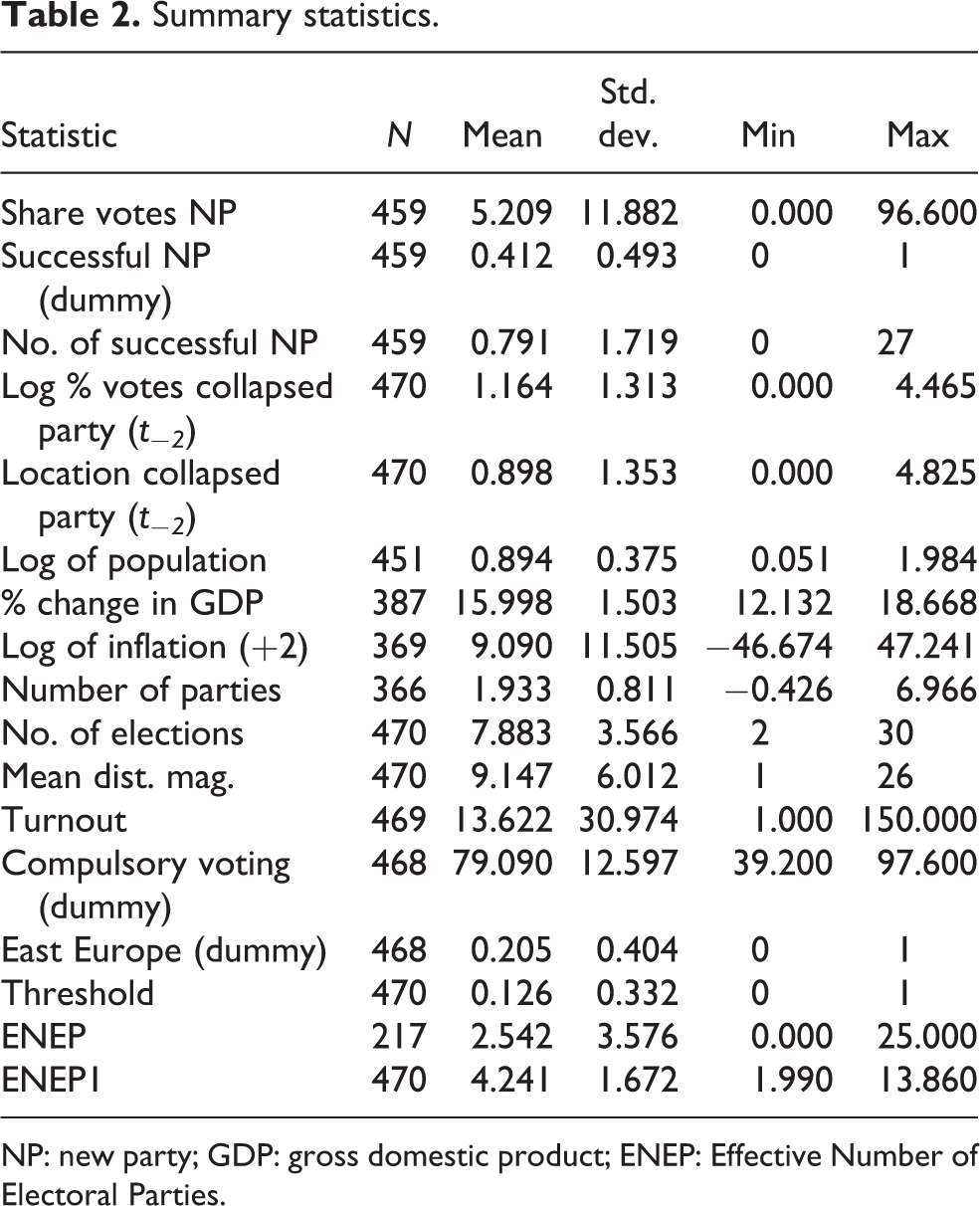
NP: new party; GDP: gross domestic product; ENEP: Effective Number of Electoral Parties.
It is important to note that the majority of large party collapses occurred in former Soviet countries after their transition to democracy in the early 1990s. In order to evaluate the generalizability of results, a series of robustness tests were conducted to control for outliers that may bias estimations, including controls for elections in East European countries and bootstrapped coefficients. The robustness of results attests to the internal and external validity of the estimations. However, they cannot eliminate all potential sources of bias, therefore one would caution against a strict causal interpretation of coefficients.
Data analyses
The sum of vote shares obtained by new parties in a given election has a substantive level of variation. As can be observed in the left panel of Figure 1, in most elections, new parties gain a very small amount of votes. However, at the 95th percentile, new parties receive 28.82% of votes, illustrating how strongly new parties can impact a party system. Figure 1 also indicates that the values of the dependent variable are not normally distributed. As with any voting model, the values can never be below zero (or above 100) and the distribution is considerably skewed to the right. The skewness can lead to problems of heteroskedasticity in linear model estimations; for this reason, a log-transformed version of the dependent variable (Figure 1 right panel) is used for the statistical analyses. 12
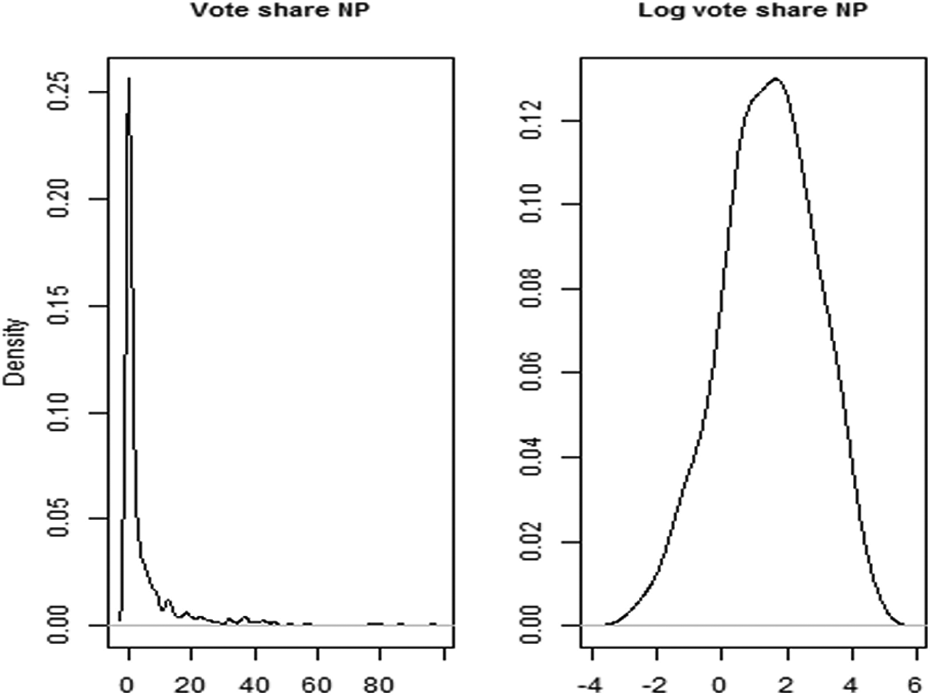
Share of votes obtained by new parties. The left panel displays the density of the share of votes. The right panel provides the density of the logged share of votes.
A potential source of concern with the empirical estimations is a correlation between the share of votes previously held by collapsed parties and their location on the left–right scale. If this is the case, the variables could be measuring the same phenomenon, and including both in the model would lead to problems of multicollinearity. However, in the sample, both variables are only correlated at 0.32. Figure 2 presents a scatter plot of collapsed party size and location, with the black line representing the correlation coefficient. As can be observed, there is some correlation, but not enough to strongly influence the results.
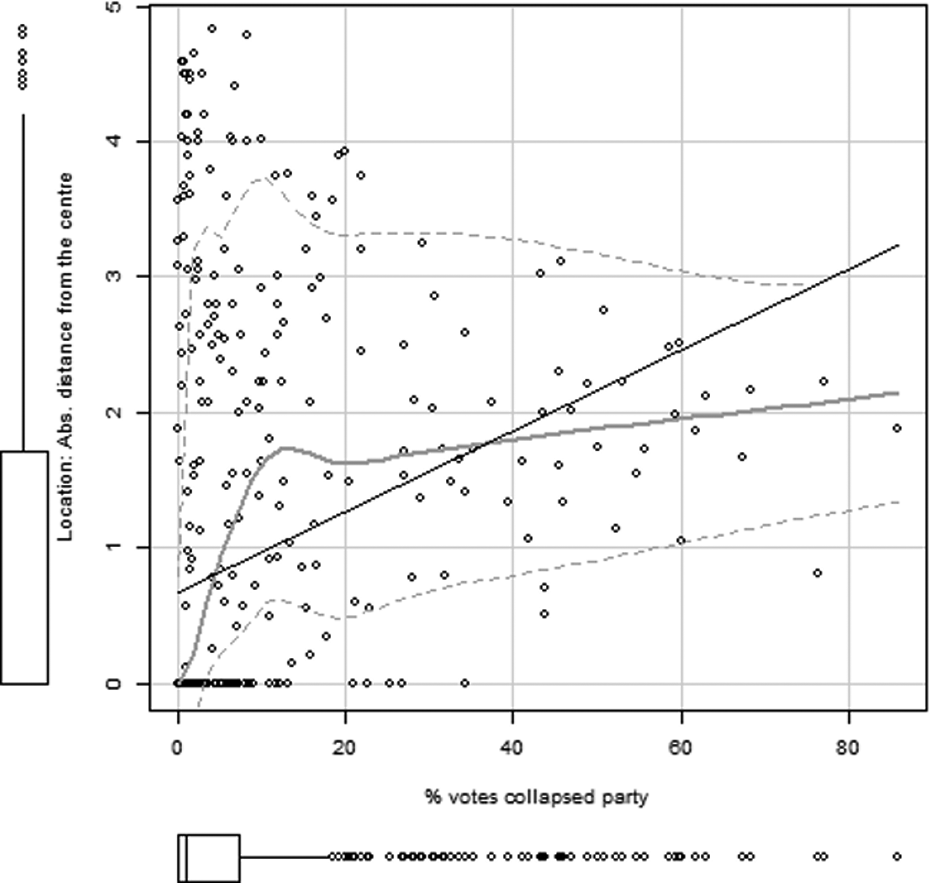
Scatter plot of the location of the collapsed party and the vote share it held before the collapse. Location is the absolute distance from the centre (i.e. 5 in the 0–10 left–right ideological scale).
Models M1–3 in Table 3 present the estimations for collapsed party size (log % of vote share (t−2)) and location (t−2) using pooled and unit and time fixed effects (FE) estimations. For the estimations, the collapsed party size is log transformed to maintain scale equivalence with the dependent variable. The variables of interest are lagged by two elections (t−2) because they indicate the location and size of the party before it collapsed; and the collapse occurs in t−1, the election before new party entry (in t0). To test for robustness of estimations to the inclusion of alternative control variables, the models are estimated using the effective number of electoral parties (t−1) (in exchange for the number of parties in t−1), the legal threshold for obtaining a seat and an FPTP dummy instead of the mean district magnitude. The results of these robustness tests are in the Online Appendix and they do not alter the conclusions.
Empirical models on the association between size of party crash, its location and interaction of size with electoral system.

Note: The dependent variable is the logged vote share for new parties.
FPTP: first-past-the-post; NP: new party; GDP: gross domestic product; FE: fixed effects.
***p < 0.001, **p < 0.01, *p < 0.05, ·p < 0.1 Arellano-Bond s.e. in parentheses
M1 presents a basic model that includes the two main variables of interest in a pooled estimation. The model includes a control for the lagged dependent variable, to deal with potential problems of autocorrelation in the data. More importantly, a control for lagged new party success can account for possible confounding effects. The success of new parties in previous elections could have caused a party to collapse and generate expectations for new party success in the future; leading to omitted variable bias if it’s not included.
As predicted by hypothesis 1, M1 presents a statistically significant and positive association between collapsed party size and new party entry. New parties appear to be winning roughly a quarter of former collapsed party’s vote share, ceteris paribus. The magnitude of this effect is large and consistent with the argument that the opening of policy space can generate opportunities for new parties to successfully enter. Of course, these are aggregate results and it is not possible to know who the new party voters are. They do, nevertheless, suggest that the collapse of a medium to large party can have a substantive impact on the new party’s electoral outcomes.
The effect of location is negative, as predicted by hypothesis 2, suggesting the share of new party votes are higher when party crashes occur closer to the centre of the policy space. The magnitude of its effect is low, with a one-point increase in the extremeness of party location associated with less than one percentage point increase in new party vote share (e−0.09 = 0.91), ceteris paribus. This is a small effect considering location is measured on a 0–5 scale. Therefore, differences in the location of the collapsed parties do not have a substantive effect on new party vote shares, ceteris paribus.
Models M2–3 re-estimate M1 accounting for unit and time FE in the data, to control for constant country-specific characteristics and situations that affect all countries at one point in time (e.g. the fall of the Berlin Wall). These models only estimate coefficients based on changes within a country over time, discarding cross-country variations. In M2, the coefficient for collapsed party size is reduced by half, nevertheless, the size is statistically significant and in line with hypothesis 1. The coefficient for location in M2 maintains the negative association predicted in hypothesis 2, with a stable magnitude that is significant at a 95% confidence level, ceteris paribus. These findings provide evidence that a party collapse affects a new party entry within a country.
Model M3 includes a test for hypothesis 3 with an interaction between the collapsed party size and the existence of an FPTP electoral formula. 13 The impact of the interaction effect is represented in Figure 3. The slope for the size of party collapse is significant for both FPTP (grey line) and PR (black line) systems. However, the line for countries with some level of PR is significantly steeper than for FPTP. This finding is in line with the expectation that voters adjust their perceptions of new party viability based on the threshold for obtaining a seat and are more willing to vote for new parties when barriers are lower.

Scatter plot of the interaction effect of collapsed party size and electoral formula. The graph presents the predicted new party vote shares based on the results of model M7.
Robustness tests
A series of robustness tests were conducted to control for the sensitivity of results to the characteristics of the sample. As previously mentioned, a big proportion of the elections that include large party collapses occurred in the early 1990s in former Soviet countries. To account for this feature, models were estimated with an interaction between a dummy variable for elections in East European countries (after 1990) and the variables of interest. The coefficient tables for these results are in the Online Appendix.
The interaction effect of East European elections is evident in Figures 4 and 5. In Figure 4, one can observe the interaction with the size of the collapsed party. The grey line represents the predicted new party vote share in East European counties and the black line represents all the rest. As one can see, size has a stronger effect in East European countries; nevertheless, the slope for other countries is still significant. The interaction with location is in Figure 5; again the slope for East European elections is substantive and significant, but the straight black line indicates location is not a relevant predictor of other countries. One reason for this could be that, given a shorter electoral history, location is a stronger cue for the potential to obtain votes than in established democracies. In countries with longer electoral histories, voters can rely on actual vote shares as a guideline for the policy space once held by a party. However, in new democracies, voters have less information about parties’ electoral trajectories and can rely on location as an estimate for long-term vote potential (cf. Ezrow et al., 2014). Nevertheless, more research including other developing countries would need to be conducted in order to fully explain this difference.
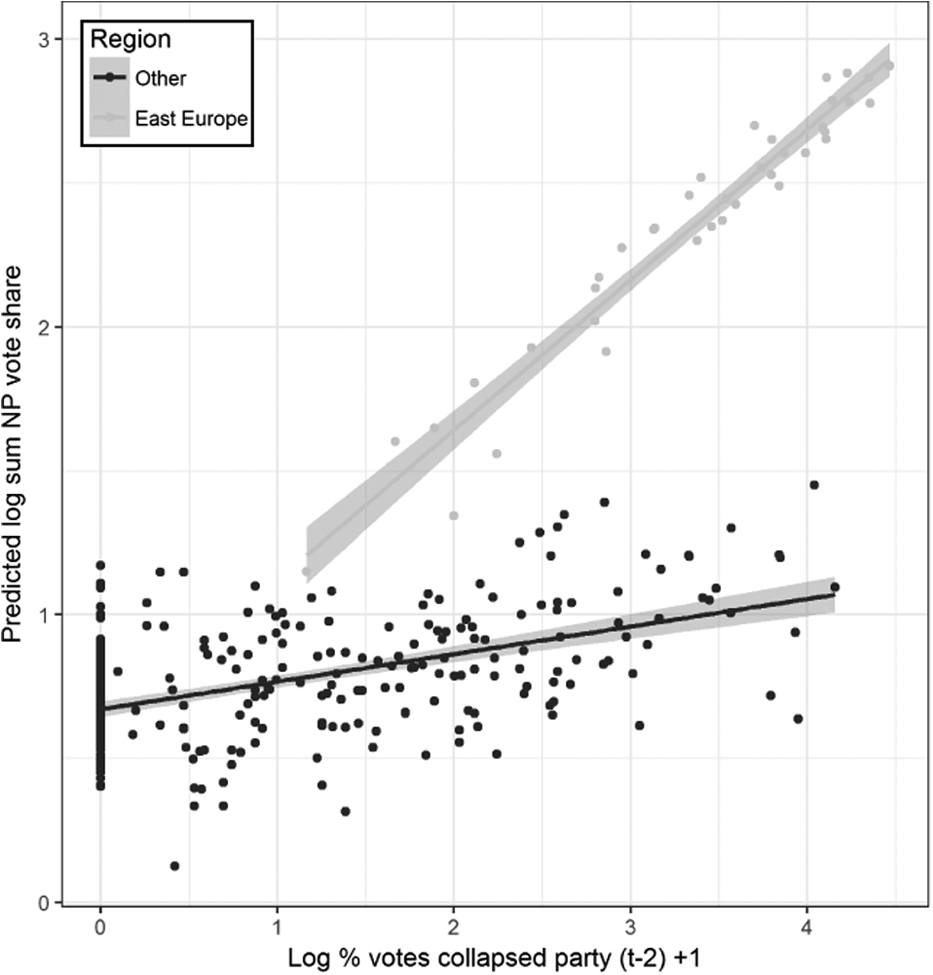
Predicted log vote share for new parties, interaction of East European country dummy with size.
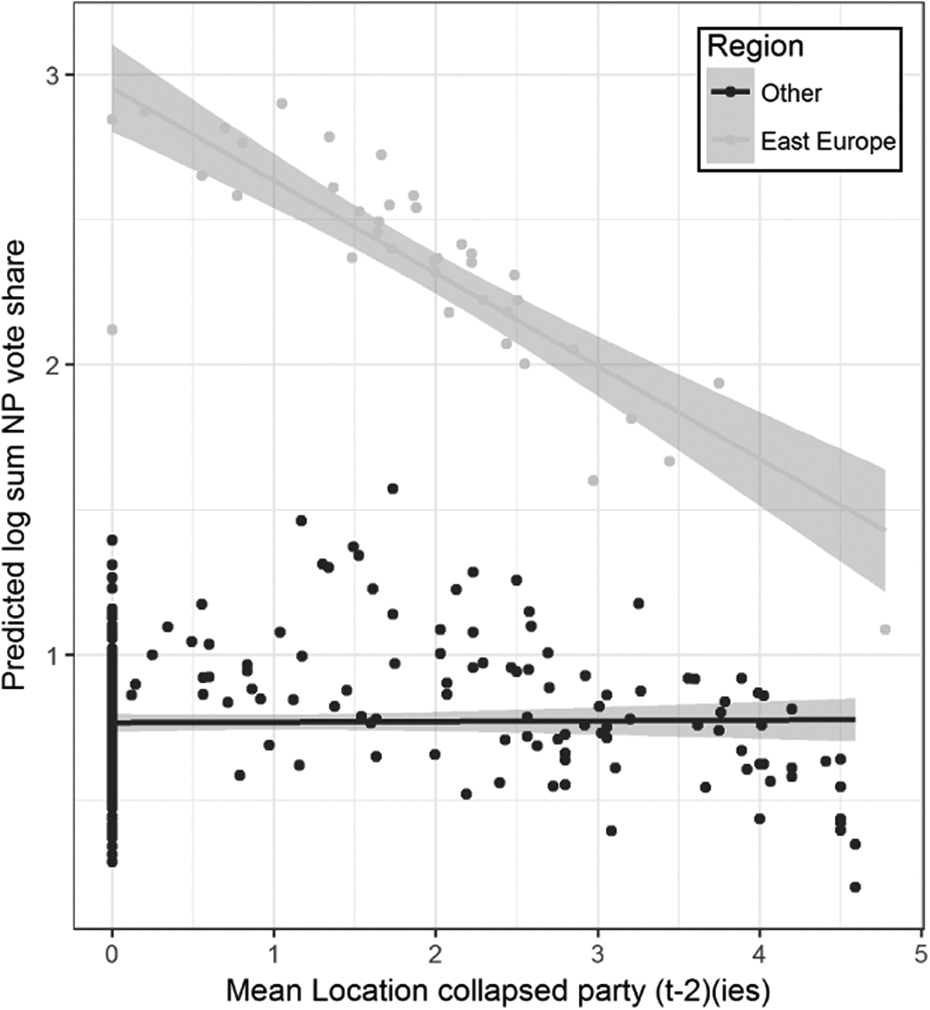
Predicted log vote share for new parties, interaction of East European country dummy with location (right).
A set of bootstrapped estimations are conducted to control for any other outliers or characteristics of the sample that could bias results (see Online Appendix). The coefficients for size are systematically positive and significantly different from zero. However, that is not the case for location. It is likely that the significant effects of location in the first models are capturing its relevance in East European countries, but this is not sustained for other countries in the sample.
Further robustness tests include sensibility of the results to the operationalization of the dependent variable. The literature on new party entry uses two other definitions, a count of the successful number of new parties in a competition (Hug, 2001; Tavits, 2006, 2008) and a binary yes/no existence of successful new parties (Lago and Martínez, 2011; Zons, 2013). Overall, the discrete versions of the dependent variable support the findings described above (results in Online Appendix).
Conclusions
The emergence of relevant new political parties is an important phenomenon present in most modern democracies. From ecological movements to protest parties, new political parties regularly enter electoral competitions and attempt to establish themselves as viable alternatives (Hug, 2001; Meguid, 2008; Tavits, 2008; Zons, 2013, among others). There is strong evidence that structural factors such as electoral institutions and party financing have an impact on successful entry. However, less is known about how the dynamics of the party system play a role in the success of new party entry. This article sheds light on this aspect by testing the impact of an opening in the policy space on the success of new party entry.
The empirical analyses present robust evidence that new parties obtain higher electoral outcomes the larger the vote share previously held by the collapsed party. The result corresponds with the hypothesis that a party collapse can open policy space for new parties to successfully enter an electoral competition. These effects are sustained independently of how successful new party entrance is defined, whether it is the vote share for new parties, the presence of a successful new party or a count of how many entered a given election. The results are also robust to controls for outliers and specific characteristics of the sample, such as elections in East European democracies.
In line with previous research on the impact of electoral institutions, the evidence here suggests that there is an interaction effect of the electoral system on the impact of an opening in the policy space (Lago and Martínez, 2011). New parties were less likely to be successful under plurality electoral rules, even when the collapsed party had previously held a large share of the votes. However, the results indicate that this moderating effect may impact the share of votes obtained by new parties more than the number of new party entries or the ability to gain seats.
The evidence in favour of an impact of the location of the collapsed party on the left–right policy space is not strong. A first set of estimations hint at a negative association, with collapsed parties at the extremes less likely to create opportunities for new party entry. However, this result is only evident for East European countries and cannot be generalized across other democracies. It is possible that the effect of location is present in countries that are less institutionalized or with a shorter democratic history, but more research would have to be conducted, including new democracies from outside the former Soviet sphere.
Research into how changes in the party system can affect new party entry is still fairly scarce. Until recently, most of the evidence has been based on cross-country variation that explains why some party systems are more stable while others have a regular presence of new actors. Much less is known about the conditions that can lead to the emergence of a relevant new actor within an existing institutional setting. This article proposes one such situation occurring when an existing party loses a substantial number of votes, leaving a group of dissatisfied voters willing to give new alternatives an opportunity. However, there is still much to study regarding the conditions that can lead to changes within a party system. One possibility is that new party success in a neighbouring country can generate contagion effects on new party entry (Gilardi, 2010, 2013; Zachary Elkins, 2005, among others). For example, Böhmelt et al. (2016) find evidence that parties adjust policy positions in reaction to foreign party results. It is possible that external influences can inform potential new parties about the viability of their policy proposals and condition their entry.
Supplemental material
Supplemental Material, pp-2017-0002-File003 - Party collapse and new party entry
Supplemental Material, pp-2017-0002-File003 for Party collapse and new party entry by Denise Laroze in Party Politics
Footnotes
Acknowledgement
I would like to give thanks to Thomas Plümper, Thomas Scotto, Jonathan Slapin, Tim Hicks, Lawrence Ezrow, Jae-Jae Spoon and two anonymous reviewers for comments on earlier versions of this paper, your feedback and insights have greatly improved this study.
Declaration of conflicting interests
The author(s) declared no potential conflicts of interest with respect to the research, authorship, and/or publication of this article.
Funding
The author(s) received no financial support for the research, authorship, and/or publication of this article.
Supplemental material
Supplemental material for this article is available online.
Notes
References
Supplementary Material
Please find the following supplemental material available below.
For Open Access articles published under a Creative Commons License, all supplemental material carries the same license as the article it is associated with.
For non-Open Access articles published, all supplemental material carries a non-exclusive license, and permission requests for re-use of supplemental material or any part of supplemental material shall be sent directly to the copyright owner as specified in the copyright notice associated with the article.
