



Abstract
In this article, we examine the static and dynamic factors that explain the use of the Twitter social media platform by all active Members of the European Parliament (MEPs) during the Fall and Winter of 2015–2016. Our analysis demonstrates that MEPs have an incentive to take to Twitter that varies across the European Parliament's (EP) highly segmented legislative calendar, but that MEPs are also affected by more constant differences in their national political parties and electoral systems of origin, as well as by their home constituencies. Our findings contribute to a picture of the EP as a diverse legislature that fosters diverse legislator interests with respect to voter outreach.
Introduction
Mayhew’s (1974) seminal work on the “electoral connection” between rational legislators and voters has long conditioned legislative scholarship in the US Congress and abroad. This electoral connection emanates from a “permanent campaign” for reelection and is thus likewise a permanent feature. However, legislative calendars challenge legislators to respond to dynamic demands from their intramural duties as party members and extramural duties as representatives in different ways and at different times. Therefore, if politicians have the permanent incentive to cultivate an electoral connection with voters, but legislative calendars present varying demands of the job, how do connections between politicians and voters adapt to the ever-changing legislative calendar? Do legislators have stronger incentives to engage in outreach at certain times or do these incentives remain fixed across time? How do legislator personal backgrounds, constituencies, and partisan incentives intervene in this process? In this article, we investigate the impact of the dynamic legislative calendar and static, structural factors such as electoral system variables on the electoral connection at a time removed from immediate campaigning.
An analysis of Members of the European Parliament (MEPs) offers an interesting backdrop for these questions. The European Parliament (EP) is host to directly elected representatives from 28 member states, selected by dozens of national political parties. MEPs typically rotate weekly among four different scheduling modes: both an opaque and technical week of amendments in specialized legislative committees and a politicized week of strategic discussions with transnational party groups take place in Brussels, Belgium, while a heavily scripted and theatrical week in the full plenary occurs in Strasbourg, France. The cycle concludes with a week devoted to constituent service at home. The four weeks repeat themselves monthly throughout the legislative session, which theoretically leads to a rhythm whereby policy experts first amend legislation, before subjecting these amendments to an increasingly generalized set of political interests. The final week at home leaves a reserved space for public comment (Busby, 2013). Given this harried rotation, how might the presence of an electoral connection persist under such diverse conditions?
One way to examine this question is to look to social media behavior for evidence. The advent of social media has undoubtedly refined traditional patterns of political communication (Lilleker, 2014). In particular, applications like the microblogging Twitter platform have allowed for politicians to interact with voters constantly and costlessly (e.g. Adi et al., 2014; Golbeck et al., 2010; Jackson and Lilleker 2011; Kruikemeier 2014; Lassen and Brown, 2010). And within the EP, specifically, Twitter—as one case of social media—has been shown to be used “constructively” to foster necessary connections with voters at election time (Obholzer and Daniel, 2016). However, less is known about the nature of social media usage outside of election time. The granularity of the digital footprints that it leaves behind can offer clues as to how politicians interact with voters at various points in the legislative cycle.
Our decision to analyze the EP—one of the world’s largest and most diverse democratic legislatures and one in which the presence of an electoral connection has been challenged by consistent charges of its “second-order” nature (Hix and Marsh, 2011; Hobolt and Wittrock, 2011; Reif and Schmitt, 1980)—presents us with a particularly promising case for such an inquiry into the variation of a broad set of variables. In short, our ability to assess whether MEPs are able to strategically connect with voters including their constituents, particularly when elections are far removed from the minds of legislators, expands the application of Mayhew’s (1974) classic work in a new and exciting way.
Our principal interest is to assess how MEPs use Twitter to “permanently” raise their profiles with voters—as the Mayhew hypothesis anticipates—and whether the diverse incentives of MEPs lead to different online roles as the EP legislative calendar varies over time. Our selection of a five-month period during Fall 2015 and Winter 2016 that is well removed from campaign season allows us to examine this question during a period of otherwise “normal” legislative business. We expect that social media can be used to manage public impressions or even to interact with voters directly and that these interactions will be, to an extent, cultivated by the institutional constraints of an MEP’s national political party and electoral system (Lilleker and Koc-Michalska, 2013, but also Obholzer and Daniel, 2016).
In the following section, we examine new uses of social media by politicians in Europe and elsewhere, before discussing the EP context, specifically. We derive and test a set of hypotheses related to MEP social media usage, assembling originally collected data on all of the more than 300,000 tweets made by the 642 MEPs using Twitter during the period from August 31, 2015, to January 24, 2016. Our general findings indicate that MEPs are most likely to use the Twitter platform during scheduled weeks in Strasbourg and Brussels, rather than during periods reserved for constituent service. However, we also find that national variation in the electoral and party systems, as well as the home constituencies that MEPs represent, further conditions the usage of social media, both irrespective of and in conjunction with the legislative calendar.
Political uses of social media
The use of social media platforms has facilitated the possibility of greater interactions between voters and their representatives in a host of international contexts (e.g. Golbeck et al., 2010; Graham et al., 2013; Lassen and Brown, 2010; Lilleker, 2014). Dubbed as “Web 2.0” platforms, the bulk of the existing literature on the uses of interactive social media by politicians has revealed that these platforms may typically just exacerbate or “amplify” a user’s offline persona (refer to the works of Adi et al., 2014: 63, and also the works of Jackson and Lilleker, 2011). Perhaps no platform is better suited for this purpose than Twitter, which allows users to broadcast, relay, and interact with one another in real time, using pithy statements of 140 characters or less 1 (Gainous and Wagner, 2014). However, if Twitter users are simply bringing their existing behaviors online, then we might expect tweeting MEPs to still adopt similar strategies to those posited by Mayhew (1974).
In his assessment of legislator behavior, Mayhew (1974) describes the combination of advertising, credit claiming, and position taking used by legislators, in order to cultivate what he refers to as an electoral connection with voters. A small cottage industry has since developed around political uses of Internet media, in order to see whether new technologies continue to foster an electoral connection online (e.g. Golbeck et al., 2010; Graham et al., 2013; Kruikemeier et al. 2015; Lassen and Brown 2010; Margarreten and Gaber, 2014). Within the EP, specifically, recent work by Obholzer and Daniel (2016) and Rodríguez and Madariaga (2016) confirms that MEPs do make a “constructive” use of social media and other online platforms come election time, taking to the Internet more or less, depending upon their party background, their national electoral system of origin, and their perceived electoral safety.
However, perhaps Lilleker and Koc-Michalska’s (2013) article comes closest to approximating the original dimensions of Mayhew’s work for online communication in the EP. In their article, the pair examines contrasting uses of personal web pages by 440 MEPs during the 7th EP to interact with voters. A content analysis reveals that, whereas older and more senior MEPs are most likely to use web pages as a way of cultivating a “home style” of communicating with (as in Fenno, 1978) and providing an “information service” to their constituents, younger and freshmen MEPs are more likely to use the web as a way of “impression management” and perhaps (in limited cases) even as a platform for directly interacting with voters.
The ideas of information service, impression management, and participation are each seemingly compatible with the strategies used in Mayhew’s world of fostering electoral connections. More interesting, however, is that the content analysis is undertaken in the winter of 2010—more than a year after the 2009 EP elections and well before the start of the 2014 campaign. This raises another question, however: might the rhythm of the EP calendar, particularly well outside of election season, lead to differentiated uses of social media by MEPs, whose strategies for the creation and maintaining of an electoral connection with voters vary across time?
The notion that a given legislature’s position on the calendar might influence its collective behavior is not a new one. The political “business cycle” model, first developed by Nordhaus (1975) as a way of describing government spending in the lead-up to an election (see also notable works on the topic by Alesina et al., 1993; Schultz, 1995; Shi and Svensson, 2006), has since been expanded to examine the impact of the electoral calendar on everything from party switching (Mershon and Shvetsova, 2008) to contrasting electoral rhythms at multiple levels of government (Jeffery and Hough, 2001; Reif, 1984). However, might less dramatic cycles within the legislature also exist that could still directly condition the behavior of legislators?
At the most minute level, daily variations in the EP’s schedule have not gone unnoticed. The traveling assembly, with some MEPs flying in from as far away as Cyprus and others taking a metro or tram stop a few blocks from home, has long fascinated scholars of European politics (e.g. Abélès, 1992). However, weekly changes in the EP’s focus—committee work, group work, plenary debates or votes, and constituent service—likely have a more direct effect on MEP behavior. As discussed by Busby (2013: 6), the “ubiquitous” EP calendar “shows us how the EP’s formal organization temporally enables MEPs to perform their multiple roles across time and space.” Thus, the MEP is confronted on a daily—if not weekly—basis with a different set of tasks, either in Brussels or Strasbourg or at home, and should accordingly be expected to behave differently vis-à-vis voters, depending upon the time and location at hand. Naturally, however, the more static institutional constraints faced by an MEP (i.e. electoral systems and home district size) should also influence their communication styles.
Theory and hypotheses
The EP’s committee week is the genesis of the legislature’s role as amender of EU legislation. Twenty standing committees, along with two subcommittees, review and propose changes to commission proposals. The process is directed by the committee rapporteur, whose contributions are typically based upon his or her expertise or legislative seniority (Daniel, 2013; Kaeding, 2004) and the expertise of the committee’s resulting decision is typically respected by the general population of the EP during plenary votes (Ringe, 2010). Thus, if MEPs take to social media during committee week, we might expect the bulk of these tweets to be logically related to the substance of the technical debates. In other words, if MEPs are communicating with voters during committee week, then they are likely signaling their role as producers of “good public policy,” as described by Mayhew.
The EP’s group week typically follows committee week and is the time at which MEPs return to one of a handful of ideological transnational party groups to discuss the group’s stance on issues being debated by the legislature. This week has a special importance for the EP, as MEPs come from not only 28 different countries, but also from dozens of different national parties who form the transnational groups. Thus, the group week provides a crucial moment for smoothing out differences between the national parties and setting a uniform political strategy. Therefore, if MEPs are particularly active on Twitter during group week, then we can expect that they might be using social media to raise attention for their party’s positions. In the language of Mayhew, such MEPs may be using Twitter as a means of “achieving influence” in the EP.
At the end of group and committee debates in Brussels typically comes the highly staged monthly plenary week in Strasbourg, where MEPs convene for formal plenary debates and legislature-wide votes. Although the plenary sessions are necessary for the passage of legislation, the substance of the public debates and the outcome of the plenary votes themselves are mostly a foregone conclusion by this stage in the legislative process (Reh et al., 2013). As such, MEP Twitter usage during plenary week should reach the zenith of legislator broadcasting or “advertising” to voters during this period.
Following plenary week, the EP usually transitions to a “green week” period
2
, in which MEPs are free to return home for constituent service time. This is the period in which MEPs should be most likely to interact directly with the segment of the public that will be voting for them in the next election. In a Mayhewian world, green weeks should provide MEPs with the greatest incentive to “claim credit” for their accomplishments, as well as to undertake what Lilleker and Koc-Michalska (2013) might refer to as “participatory” interactions with voters.
Whereas each of the above four positions hypothesize various aspects of the general contention that the legislature’s calendar will condition an MEP’s use of social media, it is also reasonable to expect that a variety of static aspects of an MEP’s background origins might also affect MEP Twitter usage. In particular, Obholzer and Daniel’s (2016) discussion of MEP Twitter usage at campaign time showed that social media usage was heavily driven by both national electoral system factors, as well as the heterogeneous demands for social media usage made by citizens, themselves.
With respect to electoral systems, we might expect MEPs to take Twitter to heightened levels as a way of distinguishing themselves as individual politicians. Even outside of election time, this theory is in keeping with Lilleker and Koc-Michalska’s (2013) discussion of “home style” cultivation and individual “impression management” that is discussed above and should be particularly present in electoral systems that favor individual-style campaigning. In the comparative institutions literature, this distinction is typically identified as the difference between candidate- and party-centered systems (e.g. Bowler and Farrell, 1993; Bowler and Farrell, 2011; Farrell and Scully, 2010). For the purposes of this article, we identify candidate-centered election systems as those that offer voters the possibility of preferring singular candidates (instead of crowded party lists).
Social media platforms also represent an important functional improvement, in terms of efficiency gains, as they are mostly costless to use. This suggests that MEPs from larger constituencies may make use of social media as a means of swiftly broadcasting positions taken or claiming credit. However, while the “supply” of electoral systems and districts found in the EP is highly diverse, so too are the “demands” of European citizens, themselves, with respect to social media usage. In our study, we consider the proposition that not all voters are created equal in their propensity to use “Web 2.0” platforms. Namely, we expect that MEPs will take to social media more often when their constituents will be most likely to listen to them on the platform. What good is it to attempt broadcasting, credit claiming, or constituent interaction on social media when ones constituents do not use social media? In order to capture this demand for social media, we posit the following:
Finally, it may be that different MEPs from different types of institutional backgrounds have varied incentives for using Twitter in a way that is conditional upon week types. While we are agnostic about the directionality of this interaction, we anticipate that MEPs with more candidate-centered backgrounds (coming from preferential voting systems) may behave differently than those MEPs with more party-centered orientations (coming from systems without preferential voting). For this reason, we posit an additional, conditional hypothesis:
Data and method
In order to test the usage of Twitter by MEPs during the normal legislative period, we collect data that captures a five-month period starting after the summer recess of August 2015 (when legislative activity comes to halt) and concludes at the end of January 2016. The selection of this period is well removed from the May 2014 European elections—putting it in relief to Obholzer and Daniel’s (2016) work—and comes with the additional advantage of capturing several cycles of plenary weeks (six weeks observed), group weeks (seven), and committee weeks (five), as well periods reserved for external parliamentary business in the constituencies (two) and holidays (one).
We collect information on MEPs’ Twitter handles from the public list of the EP and the EP website. Using the Tweetcatcher software package (Brooker et al., 2015), we extracted tweets and meta-information on MEP Twitter usage via the Twitter API. We then combined this social media data with publicly available information on MEP backgrounds and national- and party-level variables used in Obholzer and Daniel (2016), Daniel (2015), and Daniel and Thierse (2018). In sum, our data represent all 642 MEPs (out of the total 756 who served) 3 using Twitter during the period studied. 4
Figure 1 displays a weekly count of the total number of Tweets emitted by MEPs 5 during the period studied and offers a few descriptive examples of the data, prior to delving into the regression analysis. While an ebb-and-flow rhythm of Twitter usage is apparent, what is driving this seemingly cyclical effect?
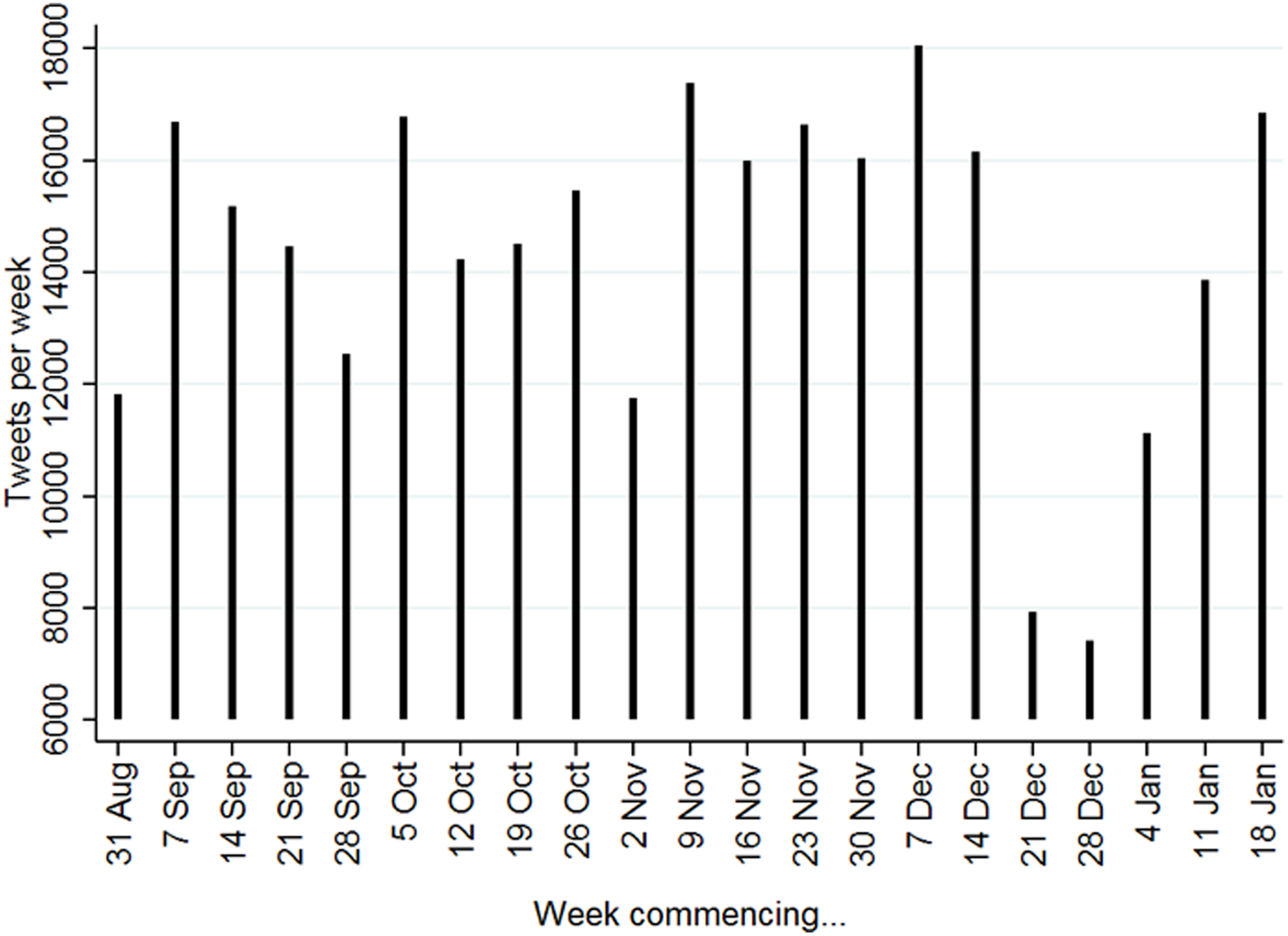
MEP tweets per week, August 31, 2015, to January 18, 2016.
Dependent variables
The dependent variables used in the remaining analysis are taken from four different forms of MEP tweet counts. Following the calendar of the EP, we divide the period from end of August 2015 to end of January 2016 into weekly intervals and use individual-level counts of tweets in order to measure the level Twitter activity. The strategy allows us to distinguish between different types of messages. As part of the total volume of tweets emitted in a week, a user may send an original tweet that is pushed into the newsfeeds of all of his or her followers. Second, they may decide to share the tweets of other users with their followers (re-tweets). Third, they may interact with specific twitter users by addressing tweets directly to them (replies). These are in principle visible to everyone, but are only pushed into the feeds of those directly addressed.
While we do not develop hypotheses on the individual types of tweet counts used, the differentiation means that we can provide nuance to our findings, as well as explore a finer grained analysis of MEP Twitter usage. In particular, the different dependent variables allow us to differentiate between broadcasting uses of Twitter, in which the platform is used as a one-way street to send out messages, and truer forms of interaction, in which users engage in a dialogue with elected MEPs.
Independent variables
We include a number of independent and control variables to explain varying levels of Twitter usage over the week types and across different national and party political backgrounds. Hypothesis 1 captures the variation found across weeks in the parliamentary calendar. Accordingly, we include dummy variables for: plenary weeks, when the EP is in session and adopts legislation; committee weeks, during which many of the key decisions are taken and the bulk of the nitty-gritty detailed legislative work is done in the EP’s legislative committees; green weeks, when MEPs are scheduled for work in their constituencies; and group weeks, during which time MEPs coordinate and strategize with likeminded parliamentarians from across their transnational party group to attain their preferred policies. The Christmas holiday period, in which MEPs were on vacation and tweet volumes were the lowest of all, is used as a reference category.
However, incentives and aptitude to use social media may also vary. First, as discussed in hypothesis 2, we focus on features of electoral systems and home constituencies that may make an MEP’s origins more candidate- or party-centered. We include a dummy variable for preferential vote, which is coded 1 for MEPs from member states that allow voters to indicate a preference for a specific candidate. These include open lists, ordered lists, and single-transferable vote systems. Similarly, we include the average district magnitude of an MEP’s home country, and an interaction between the two. This is to test the expectation that incentives for campaigning for a personal vote might increase as district magnitude increases in countries with preferential voting systems, while the opposite might be the case elsewhere (Carey and Shugart, 1995, but also Bowler and Farrell, 1993).
While district magnitude captures the number of delegates elected in a district, hypothesis 3 posits that the number of voters per district might likewise influence the usage of Twitter, since it lends itself in particular to communicating remotely. Citizens represented measures (in tens of thousands) the average number of voters per MEP in a member state. This measure is particularly pertinent in the EP, with its system of regressive proportionality, whereby there are substantial differences between small and larger member states.
As discussed in hypothesis 4, a number of variables affect the demand of voters for interaction through social media. First, we need to control for social media usage patterns in the different countries. To this end, we draw upon the autumn 2013 Eurobarometer survey (European Commission, 2014) to create social network usage, the percentage of people who use social media in a given country, at least once a week. Second, we can look at variation among voters of specific national parties. Some parties may target predominantly younger or older voters, rendering the use of social media unequally effective. We therefore include the national party voter mean age as well as the national party voter Internet use, by looking at whether the voters used the Internet “often.” These are based upon the 2014 European Election study (Popa et al., 2015; Schmitt et al., 2015). Likewise, at the individual level, we control for how many followers an MEP has and how many accounts they are following, to measure how committed they are to the platform and much they have to gain by using Twitter.
Finally, as discussed in hypothesis 5, we construct interaction terms in later models to test the differentiation between week type and MEPs from countries with preferential voting systems in European elections.
Control variables
Because national party resources may affect whether parties resort to cheap social media outreach (Gibson and Römmele, 2009; Lilleker et al., 2011; Small, 2008), we control for whether a national party is in government (National party government) and its National party seat share in the national legislature, to proxy for those MEPs hailing from the most successful (and likely best funded) national parties. We also see if national elections (and referenda) held in the week of interest affect MEP Twitter usage. We also control for whether MEPs’ functions and seniority in the institution, measured by membership of the EP bureau (European Parliament leadership), membership of a party group’s bureau (European Party Group leadership), or holding a committee leadership role ((Vice-)Chair), affects their propensity to use Twitter. Additional individual-level variables control for gender (female), MEP age, and whether they were initially seated in (and thus elected to) EP 8.
We also consider whether or not an MEP’s usage of Twitter may be conditioned upon their professional and political backgrounds. For this, we use data collected by Daniel and Thierse (2018) on MEPs who previously worked as journalists or who have international experience in intergovernmental organizations or as diplomats. We also consider prior political experience by controlling for MEPs with local experience, national parliamentary experience, or national party office experience, in order to see whether such “party animals” treat Twitter usage differently. We use the distance to Brussels, measured as the distance between Brussels and the national capital of the MEP, in order to test whether MEPs from more remote constituencies take to social media as a substitute to more personalized forms of constituent interaction. Finally, we include fixed effects for an MEP’s party group of origin, in order to see whether certain party groups tweet more frequently than others.
Each observation relates to the Twitter activity of one MEP during 1 week. As a consequence, the data set includes 21 observations for each MEP who served during the entire period from end of August 2015 to end of January 2016. Given the structure of the data with multiple observations per MEP, we opt for a multilevel model with a random intercept to control for any effect related to individual MEPs. Since the distribution of the count data is marked by a variance that is larger than its mean, we opt for mixed-effects negative binomial regressions.
Results and analysis
Table 1 displays the results of our regressions. Model I uses a count of all tweets as the dependent variable. Model II excludes re-tweets from the analysis, focusing on original tweets only. Model III focuses on replies, that is, MEPs’ more personal interactions with other Twitter users. Model IV looks only at re-tweets, which likely contain the least amount of personalized content. The characterization of the results is robust across all four specification strategies, although the nuance of the results does change somewhat.
The effect of time and background on MEP Twitter use (mixed-effects negative binomial regression).

Note: Weeks without any scheduled activities (holidays) are the baseline week type. EPP is the baseline party group. Standard errors are in parentheses.
***p < 0.01; **p < 0.05; *p < 0.1.
Broadly speaking, our results indicate that MEPs use Twitter more regularly during committee and plenary weeks, but the substantive differences between the types of weeks are relatively small. In contrast to weeks without activities scheduled, tweet counts increase steeply. Since the coefficients are hard to interpret directly, we use predictive margins to explore substantive significance. Using model I, we find the predicted tweet count more than triples from about 15 to 50 when comparing weeks without scheduled activities and plenary weeks, when all other values are held at their means. Within the three further types of working weeks found at the EP, we find the average MEP is expected to tweet 48 times for committee week, 39 times for group week, and 29 times for green weeks. However, confidence intervals for these predicted values partly overlap. 6
We find that electoral system features have only a very limited effect on Twitter activity, which is somewhat in contrast to our expectations from hypothesis 2. We do not find that ballot structure (i.e. preferential voting) has independent, significant effects. Obholzer and Daniel (2016) found support for this hypothesis only at the very height of the campaign, that is, during the final week before election. Thus, it is perhaps not surprising that the finding does not seem to hold during periods of normal legislative business.
Nevertheless, other electoral features do matter. As suggested by model II, in systems without preferential voting, we find a significant and conditional effect for district magnitude. Here, each additional MEP elected to a district leads to a corresponding drop in tweets of only 0.18. Interestingly, the combined presence of preferential voting and high district magnitudes leads to a decrease in both replies and re-tweets (models III and IV), despite stronger incentives to seek a personal vote under these circumstances (Carey and Shugart, 1995).
As posited by hypothesis 3, we find that the number of citizens represented is a strong predictor of social media activity, with the number of tweets increasing by 1.14 per additional 10,000 citizens represented, as estimated in model I and displayed in Figure 2. The larger an MEP’s constituency, the more they will tweet, and the more frequently will they engage in interactive exchanges with other users, as model III also suggests.

The effect of constituency size on the predicted number of MEP tweets.
When focusing on factors driving demand for MEP social media engagement, the results robustly support that the extent of general social media usage in a given country significantly affects MEPs’ outreach efforts via Twitter, as posited by hypothesis 4. This suggests that MEPs are responsive to citizens’ media consumption, irrespective of the electoral and legislative calendars. The analysis is given further credence by the effects of national party voters’ characteristics. The younger a party’s voters or the higher their Internet affinity, the more active MEPs will be on Twitter, with each additional year younger leading to a corresponding increase of 1.27 tweets in model I. The MEP’s Twitter network is also correlated with Twitter activity. This holds in particular for the number of accounts an MEP follows him or herself. MEPs who seem to use Twitter to read others’ tweets are considerably more active than those who do not. Following an additional 1000 accounts means an MEP’s tweet count will increase by 9.17.
Moving to hypothesis 5, which discussed the interacted effect of the calendar on electoral systems, we display four additional models in Table 2 that interact the four different week types with the preferential vote dummy. While the results from models V through VIII echo the general findings of those found in Table 1, the models suggest that certain types of MEPs might behave differently during certain weeks. More specifically, model V indicates that MEPs from preferential voting systems are actually less likely to tweet during committee weeks. On the other hand, they are significantly more likely to tweet during plenary weeks than those MEPs elected from non-preferential systems, as seen in model VII. While the technical policy minutiae relevant during committee weeks seem more attractive to MEPs hailing from party-centered electoral systems, the plenary week result suggests that MEPs who attempt to cultivate an individual persona—necessary for winning preferential votes—are more likely to tweet during plenary sessions. This might suggest that these particular MEPs are more likely to use Twitter as a means of claiming credit for positions and output adopted.
The effect of time and background on MEP Twitter use (mixed-effects negative binomial regression).

Note: Weeks without any scheduled activities (holidays) are the baseline week type. EPP is the baseline party group. Standard errors are in parentheses.
***p < 0.01; **p < 0.05; *p < 0.1.
In contrast, most control variables are not borne out by the results. An MEP’s age is significant, with older MEPs tweeting less—a logical finding that is also largely corroborated by the comparative literature on social media usage. MEPs are also shown to tweet more during weeks prior to a national election or referendum in their home country. However, we do not find evidence that MEPs’ function as leaders of the EP, a party group, or of a committee affects their Twitter activity, nor does their national party’s size or situation in government (both of which proxy for party resources). Professional and political background also rarely matters. Finally, it might be worth mentioning that green MEPs seem to be particularly active on Twitter, while far right and Eurosceptic MEPs from the EFDD and ENF groups seem to adopt a social media strategy that is notably less focused on interacting with other Twitter users, as model III suggests.
Conclusion
The advent of interactive social media tools in politics is both evident on the campaign trail, as well as during normal legislative periods. This article has attempted to shed some light on the latter, by examining the usage of the Twitter platform by MEPs, across a legislative period that falls outside of campaign season. Our findings indicate that while MEPs do continue to tweet, even when not running for an imminent (re-)election, their level of communication on social media is sensitive to both the EP legislative cycle, as well as to national institutional variations. This allows us to paint a more general picture of MEP Twitter activity than is available in the extant literature, while also highlighting the presence of an ongoing connection that is, to some extent, conditioned by the voters.
However, our results also provide additional nuance to the topic. MEPs are far more likely to tweet while the EP is “in session”—particularly during plenary weeks—and this tendency is amplified for MEPs from preferential voting systems. This could indicate either that MEPs tweet as a way of broadcasting their work “to the minute” with their constituents or as a means of claiming credit for a publicly taken position. Interestingly, green weeks dedicated to constituent service appear to have a lesser influence on Twitter behavior. This may indicate that MEPs are actually interacting with their constituents the old-fashioned way: in person! Each of these findings is in keeping with the spirit of Mayhew’s (1974) electoral connection thesis.
In terms of the national party and institutional sources of variation, we find that the nature of an MEP’s constituency matters greatly for their level of social media participation. MEPs tweet more frequently, all else equal, when they represent larger groups of citizens, are elected on shorter lists, and represent voters that are, themselves, more predisposed to the use of social media. Domestic political factors also affect social media use, albeit in limited ways. We find that party size in the national parliament and government status do not affect Twitter usage, even though they might be indicative of resources at a party’s disposal. In terms of parties’ voter bases, the results suggest that MEPs are sensitive to a demand for social media communication, with MEPs from parties with younger voters making more frequent use of Twitter.
In sum, we find that an electoral connection may yet be present during “normal” EP business, in a way that has yet to be identified by the literature. Naturally, the next step is to examine not just when and how frequently MEPs use Twitter, but just what these MEPs are saying—a distinct and challenging research agenda itself, given the multilingual nature of communication in perhaps the world’s most multilingual parliament. Likewise, it can be argued that legislators use Twitter not only to directly reach voters, but also to reach journalists who can convey their positions to a broader audience beyond the social media platform. Investigating the extent to which social media activity affects media visibility of MEPs (see Gattermann and Vasilopoulou, 2015) would lead to valuable insights on the incentives to use social media and the effectiveness of Twitter.
Supplemental Material
Supplemental Material, pp-2017-0208-File007 - Static and dynamic incentives for Twitter usage in the European Parliament
Supplemental Material, pp-2017-0208-File007 for Static and dynamic incentives for Twitter usage in the European Parliament by William T Daniel, Lukas Obholzer and Steffen Hurka in Party Politics
Footnotes
Acknowledgements
The authors are grateful for the input of the three anonymous reviewers, as well as earlier comments from Michael Lewis-Beck, Magda Giurcanu, Stefan Thierse, Léa Roger, and Thomas Winzen. The authors are also grateful for feedback from participants at the 2016 EPSA General Conference, the 2016 ECPR Standing Group on Parliaments and European Union conferences, and the “‘European movements’ and transnational debates in the European Union” workshop at the Technical University of Kaiserslautern.
Declaration of Conflicting Interests
The author(s) declared no potential conflict of interest with respect to the research, authorship, and/or publication of this article.
Funding
The author(s) received no financial support for the research, authorship, and/or publication of this article.

Supplemental material
Supplemental material for this article is available online.
Notes
References
Supplementary Material
Please find the following supplemental material available below.
For Open Access articles published under a Creative Commons License, all supplemental material carries the same license as the article it is associated with.
For non-Open Access articles published, all supplemental material carries a non-exclusive license, and permission requests for re-use of supplemental material or any part of supplemental material shall be sent directly to the copyright owner as specified in the copyright notice associated with the article.
