




Abstract
When Green parties emerged in the 1970s and 1980s, their political project included a strong commitment to a new type of internal party organization, giving power to the ‘grass roots’. With Green parties having become well established in most West European party systems, has the vision of ‘grass-roots democracy’ survived the party foundation stage? What drives the ongoing or waning commitment to grass-roots democracy? Analysing party membership survey data from 15 parties collected in the early 2000s when many Green parties had for the first time become involved in national government, we find that it is the social movement oriented, pacifist, left-wing membership that is most committed to grass-roots democracy. It is the current involvement in social movements rather than past activity that is most important. Support for grass-roots democracy is also stronger in ‘Latin Europe’ and Greece but weaker in parties which have become established in parliament and government.
Introduction
The study of intra-party democracy has been one of the perennial themes of the political sociology of political parties. After the classical studies of Ostrogorski (1902) and Michels (1911), however, the achievement of internal party democracy seemed to constitute a utopian dream. Later analyses went further claiming a contradiction between internal party democracy and a party’s political effectiveness (Duverger, 1964: 134) and even an incompatibility with democratic government (McKenzie, 1982: 195).
This academic rejection of the concept of internal party democracy has more recently given way to a growing literature that examines a range of organizational features empirically (cf. Poguntke et al., 2016). The starting point for this renewed interest in questions of party organization appears to have been the introduction of plebiscitary elements in some Western European parties in the 1990s (Scarrow, 1999; Seyd, 1999). While the exact implications of these recent reforms for the nature of party democracy are still to unravel, they follow on from an earlier development to challenge the dominant philosophy of party organization which has not attracted a lot of systematic attention: the attempt to introduce ‘grass-roots democracy’ in Green parties.
More than any other parties, Green parties have been associated with the endeavour to relaunch the idea of internal party democracy. Rejection of established parties and their way of operating was an essential part of the political context in which Green parties emerged in the 1970s and 1980s. The new parties sought to put into practice an idea borrowed from the agenda of the new social movements. The hierarchical nature of established parties and their non-responsiveness to demands made by ordinary citizens (including party members) had to be overcome by creating a ‘new type of politics’. For the new Green parties, this meant the introduction of ‘grass-roots democracy’, with the emphasis on giving power to ordinary members rather than party leaders or a party elite.
Their attempt to create a ‘new politics’ with a commitment to participatory democracy and rejection of traditional party politics attracted some considerable attention in the 1980s when Green parties first managed to enter national parliaments in most West European countries. The concept of grass-roots democracy was arguably not well defined. It was, first of all, a rejection of established party politics, and how exactly to give power to the ‘grass roots’ remained an issue of contention within Green parties (cf. Heinrich, 1993; Sarkar, 1994). New concepts such as the ‘rotation’ of public offices and term limitations for party positions were introduced. Holding public and party offices was widely seen as incompatible. Perhaps most visibly, Green parties rejected the hierarchical nature of established parties and the concept of ‘party leadership’, opting instead for decisions to be made by the ‘grass roots’ and a collective approach of representing the party to the outside world. While some early ideas, such as a the ‘rotation’ of offices, were fairly quickly abandoned and many Green parties went through a number of organizational reforms, the agenda of giving the grass roots a significant role was generally retained, giving contemporary Green parties a ‘distinctive organisational style’ (Rihoux, 2016: 299).
Two broad interpretations of the grass-roots democracy phenomenon in Green parties have emerged. The first is influenced by the idea of political parties following a standard development path of parties and was first outlined by Robert Michels (1911) and later became a key element of other classical theories, for example, Panebianco’s theory of party institutionalization (Panebianco, 1988). This strand of argument sees Green parties passing through different development passes that eventually will see them, or at least the successful Green parties, embracing essentially the same organizational principles and practices that established parties have adopted. With the ‘social movement’ character of Green parties disappearing and having to meet the demands of parliamentary politics, and more recently, of governmental participation, Green parties are seen as forced to reorganize (or ‘modernize’) their internal structures if they want to survive, requiring a rejection of major elements of grass-roots democracy. In the literature of Green parties, the need for Green parties to follow such a path and ‘modernize’ has been strongly articulated in national case studies, in particular of the German Greens (e.g. Bukow and Rammelt, 2003; Blühdorn and Szarka, 2004; Raschke, 2001).
The alternative view challenges such a linear model that ties specific organizational principles to particular development phases. Comparative studies of the development of Green party organization have shed doubts on the view that parliamentary and governmental responsibilities are intrinsically linked to specific organizational reforms (Rihoux, 2001). This would suggest a ‘party family’ (Mair and Mudde, 1998) model of Green party organization. While this leaves open the possibility that grass-roots democracy is not just a characteristic of the early development of Green parties but will survive as an essential element of Green political identity, it raises the question of how embedded the concept of grass-roots democracy is within Green parties.
Most previous studies of Green party organizations have focused on the analysis of party debates and observed changes over time as well as differences between countries (Burchell, 2001, 2002; Frankland et al., 2008; Miragliotta, 2015; Rihoux, 2001, 2006, 2016). One aspect that has not been studied recently is the views of Green party members on questions of Green party organizations. Within the empirical literature on party members, the analysis of members’ attitudes to specific organizational principles is relatively rare (but cf. Hansen and Saglie, 2005; Young and Cross, 2002). For Green parties, party members are obviously crucial for any concept of grass-roots democracy. We seek to explore to what extent grass-roots democracy is supported by party members and what factors determine attitudes to internal party democracy in Green parties.
Herbert Kitschelt’s path-breaking work on the internal dynamics of the German and Belgian Green parties in the 1980s, based on extensive interviews as well as membership surveys, is an obvious starting point for such an endeavour (Kitschelt, 1988, 1989, 1990; Kitschelt and Hellemans, 1990). The field work for these studies was undertaken some time ago in the early years of Green party development. Since then, many Green parties in Western Europe have established themselves in the political system. Looking at the organizational level of Green parties, the main changes involving a certain movement away from some of the more extreme elements of grass-roots democracy could be observed during the late 1980s and 1990s (Rihoux, 2001). Between the early 2000s and the present, there have been some incremental changes but key elements of the internal structure of Green parties remain in place and questions of party organization have not dominated internal party debate to the extent this could be observed in earlier years (Rihoux, 2016).
Apart from exploring the sources of support for grass-roots principles at the individual level, a key question is the impact of contextual factors. One might expect that certain aspects of political socialization and values held would increase the potential of support for grass-roots democracy, but it is uncertain whether this applies to the same degree depending on the kind of political context in which Green parties find themselves. In particular, we have to ask whether it makes a difference whether a party is at the margins of politics or has risen to political relevance. Also from that perspective, the timing of the survey is particularly useful. By the early 2000s, there was some considerable variation in the development stages reached by Green parties. Some Green parties, for example, in Greece and Norway, were extremely marginal and were not seen as having a realistic chance of winning parliamentary representation at national level. At the other extreme, several Green parties had for the first time entered coalition government at national level in the late 1990s. This provides a unique opportunity to test for the import of development stages.
This article seeks to contribute to the study of intra-party democracy by analysing the attitudes of Green party members to grass-roots democracy in the early 2000s. The chief data source for this study is an extensive comparative survey of Green party members, covering 18 parties in 15 countries, undertaken in 2002 and 2003. 1
Theory and hypotheses
The historical analyses of the formation and early development of Green parties identify a range of pertinent factors that led to these parties taking up grass-roots democracy: These were parties emerging from the ‘new’ social movements of the 1960s, 1970s and 1980s, with a constituency strongly influenced by the values of the ‘New Left’ (e.g. Müller-Rommel, 1989; O’Neill, 1997; Parkin, 1989; Richardson and Rootes, 1995). While there are many political factors that contributed to Green parties placing a strong emphasis on a rejection of party hierarchy and the establishment of a ‘truly’ democratic party, the influence of the experience of the ‘new social movements’, in conjunction with a ‘libertarian’ left outlook within a broadly ‘anarchist’ framework, played a dominant role (Doherty and Geus, 1996: 5; Hay, 2002: 277–282; Kitschelt, 1988: 129, 134).
This would lead us to expect, first, that Green party members who have been active in ‘new social movements’ should be more supportive of grass-roots democracy than those without such an experience. The effect could be expected to be stronger among members who were engaged in social movement activity at the time of the survey. The antiglobalization movement was arguably the main contemporary social movement at the time which had a strong anti-hierarchical, anarchist ideology (el-Ojeili, 2014), which might thus particularly lend itself to views sympathetic to grass-roots democracy.
Moving on to questions of political attitudes, the literature referred to would suggest that Green party members embracing more ‘left-wing’ political views should be more amenable to the ideas of grass-roots democracy. Furthermore, one might expect members who continue to support the key demands of the new social movements most closely associated with Green parties during their foundation phase to be more supportive of grass-roots democracy. We have a range of possible variables to consider here,
2
but we chose to concentrate on two key indicators important for Green politics in the early 1980s: left-wing attitudes and pacifism.
If we follow Kitschelt’s writings on the German and Belgian Green parties in the 1980s (Kitschelt, 1989; Kitschelt and Hellemans, 1990), then activists with a strong commitment to grass-roots democracy should be those restricting their activity to party activity, taking little or no interest in obtaining public office. Party ‘busybodies’ know the rules of the game best and can use them to their advantage, which often means trying to challenge the dominance of parliamentary parties and reasserting the rights of party activists to keep office holders under control. Holders of public office, on the other hand, could be expected to be more sceptical about grass-roots democracy as its use undermines rather than supports their position.
Having looked at these individual-level determinants of support for grass-roots democracy, we finally turn to the possible impact of contextual factors. One major reference point is the theory of a standard development path as advanced by Michels (1911) and Panebianco (1988). We use the party lifespan model first developed by Pedersen (1982, 1991) to distinguish between distinct phases of party development determined by thresholds they have to overcome (cf. also Müller-Rommel, 2002). Different thresholds might make different types of demand on parties. At first, parties have to generate public support in order to register and make it onto the ballot paper; forming broad coalitions of people willing to support the party is here crucial. Once a party is formally constituted and admitted to the electoral process, the party will want to take the next threshold, that of electoral representation. Once this threshold is taken, the focus of the party should switch to the participation in the political process; the parliamentary party is likely to become an important focus. Making an effort to become ‘relevant’ in terms of government formation may be a turning point as the focus of the party may switch from membership mobilization and representation to being represented in the media in a certain way to underline its suitability as a coalition partner; this having been successfully accomplished, the actual joining of a government coalition is likely to impose further burdens on the party as compromises to stay in power have to be ‘sold’ to the party and the membership at large.
What we might expect is that the more advanced a Green party is along this path, the less likely party members are interested in maintaining principles of grass-roots democracy. Instead, the party should become dominated by the need to attract electoral support and to achieve and maintain credibility as a partner in government. In Kitschelt’s terminology, the focus of Green parties should change from a ‘logic of constituency representation’ to a ‘logic of party competition’ (Kitschelt, 1988: 129). The pressures of parliamentary and governmental politics should provide a greater challenge to Green party members to confront their traditional commitment to grass-roots democracy, strengthening views that Green parties have to ‘modernize’ in order to be more effective in terms of electoral competition and being considered a trustworthy partner in government.
Data and methodology
The analysis presented in this article is based on a unique set of comparative data that has been collected by the ‘European Green Party Membership’ project funded by the British Academy. 3 A research group with members in most West European countries met for the first time in 2001 to agree on a common core questionnaire that was fielded during 2002 and 2003 in 15 countries. A total of 18 parties agreed to be part of the project. Details of the fieldwork are documented in Online Appendix 4.
To our knowledge, no survey of party members has tried to measure support for grass-roots democracy. 4 We thus had to develop our own instruments to reflect the state of the discourses on grass-roots democracy in the early 2000s. The danger we faced was that indicators of grass-roots democracy could be culturally tied to specific national contexts. Poguntke in his discussion of the principles of ‘Basisdemokratie’ in the German Greens gives a long list of very different elements of party organization (Poguntke, 1993: 136–171), some of which are closely tied to the specifics of the German political culture. At the other extreme, attitudes to abstract theoretical principles as discussed by political theorists (e.g. Doherty and de Geus, 1996) do not lend themselves easily to survey research.
After detailed discussions, 5 the research group decided on a number of questions aiming to confront members with statements that established important principles but were specific enough to elicit responses also from those not familiar with abstract Green principles. In order to create the dependent variable, we concentrated on four elements that are closely related to key elements defining grass-roots democracy within a comparative context, as recently outlined by Rihoux (2016).
First, the issue of collective leadership had been an element of high ‘symbolic’ importance to many parties that sought to emphasize a break with traditional party politics. Most Green parties thus started out rejecting the idea of the party being ‘led’ by a single leader and opted for some form of collective leadership. However, by the early 2000s, some parties had adopted the concept of a single leader. The first element of the dependent variable consists on attitudes towards a ‘single leader’ (for details on the construction of the dependent variable, see Online Appendix 2).
In addition to the leadership issue, we developed – and added to the dependent variable – a battery of questions that included other measurements of grass-roots democracy. These questions consisted on 1–5 agreement scales with a series of statements. The key element of the Green debates of the 1980s and 1990s had been to avoid the formation of a party elite, or at least limit its powers. Measures were thus discussed (and introduced in many cases) that imposed restrictions on what party elites could do.
The first of these elements relates to term limits for party offices. Most Green parties also included limitations to combine public and party offices, and this statement has been tested in the questionnaire. Finally, elected representatives were also expected to contribute a substantial part of their salary to party funds. 6 The wording of all questions used for the analysis is documented in Online Appendix 2 and the responses to the individual questions are documented in Online Appendix 3.
The question we need to ask is whether these four principles derived from the international history of Green party debates about key issue of party organization, including the question on a ‘single leader’, are actually measuring the same latent phenomenon: Grass-roots democracy may be a concept known to academic students of Green politics and long-term activists, but ordinary party members may not necessarily interpret questions about individual items of party organization in that way. Also, there is the question whether grass-roots democracy is essentially a unidimensional phenomenon.
A number of tests were conducted to shed light on these questions. Factor analyses were conducted for the international data set and each national study: They revealed little or no evidence of multidimensionality. In most countries, the factor analysis only produced one valid factor, a second factor fell just below the margin of the eigenvalue 0.≥1 criterion. In only a handful of countries, this second factor just passed the margin of 1. All four variables are inter-correlated, although not quite as strongly and consistently as one might have expected. However, the case to form one scale for the measurement of attachment to grass-roots democracy is essentially based on considerations of the substance of Green politics: These four statements historically stand for key principles of grass-roots democracy. The degree to which they all are representing the same principle by party members is a question to be explored.
A number of options were explored to construct a dependent variable combining all four elements. These included the construction of various additive indexes. In the end, the factor scores provided the best option. Given the heterogeneity of the data, all multivariate analyses were run with different formats of the dependent variable, as well as on each question individually, but the results did not vary to any significant degree, suggesting that our results are robust.
The operationalization of individual-level variables follows well-established procedures, but the definition of the party-level variable may require some explanation. In order to distinguish different parts of the party ‘lifespan’, as inspired by the work of Mogens Pedersen, Green parties were allocated to four different groups according to their progress. Parties not having achieved parliamentary representation (at national level) were distinguished from parties that had entered parliament but were not considered ‘relevant’ in terms of government formation. A further distinction was made between ‘relevant’ parties that had not attained a role in national government and parties that had entered government coalitions at national level. The effect of party lifespan position on grass-roots democracy is to be examined with the help of a multilevel model.
Of crucial importance was the inclusion of control variables. For individual-level predictors, we included age and gender. Age here is particularly important as a control for historical social movement activity as older members would obviously had more opportunities to become involved in various social movement activities.
The inclusion of control variables at the contextual level proved particularly challenging. Given the relatively small number of parties included (15), it was important to specify a parsimonious model that would allow us to control effectively for the variation between countries while, at the same time, observe the relevant differences in our variables of interest. 7 Looking at the results on the cross-national differences in support for grass-roots democracy (see Online Appendix 3), it became obvious that support was much higher in Southern European countries (Greece, Italy, Spain) but also in France and the French-speaking part of Belgium. These parties were at very different stages in the party ‘lifespan’ model. What, apart from representing ‘Latin Europe’ (apart from Greece), do these countries have in common? Looking at indicators such as trust in political parties, interpersonal trust, and also perception of corruption, there was a clear difference between ‘Latin’ countries and Greece on the one hand and Northern European countries on the other (European Commission, 2002; ESS Round 1: European Social Survey Round 1 Data (2002); Transparency International, 2002; Inglehart et al., 2004: A165). These differences also manifested themselves within countries: Trust in political parties was substantially higher among the Flemish-speaking and lower among the French-speaking population of Belgium. A detailed analysis of the historical development of organizational structures of Green parties in Belgium suggests that, unlike members of their Flemish sister party, ECOLO members ‘still have a tradition of lack of confidence in their representatives and professionals’ (Buelens and Delwit 2008: 90). This is despite the fact that, historically, the Flemish Greens had a higher degree of involvement with social movements, 8 suggesting broader cultural differences may be responsible.
The exact nature of the reasons why members of Green parties in Latin Europe and Greece have a more positive attitude to grass-roots democracy will require some further detailed analysis which goes beyond this article. For our model, this raises two questions which we can answer: Are the individual-level predictors different for parties in Northern and Southern Europe, and how does this factor impact on the relation between party lifespan position and attitudes to grass-roots democracy? In order to answer these questions, we thus decided to create a simple dummy variable, distinguishing between ‘Latin’ and Greek countries on the one hand and Northern European countries on the other, to be used a control variable in the model.
Results
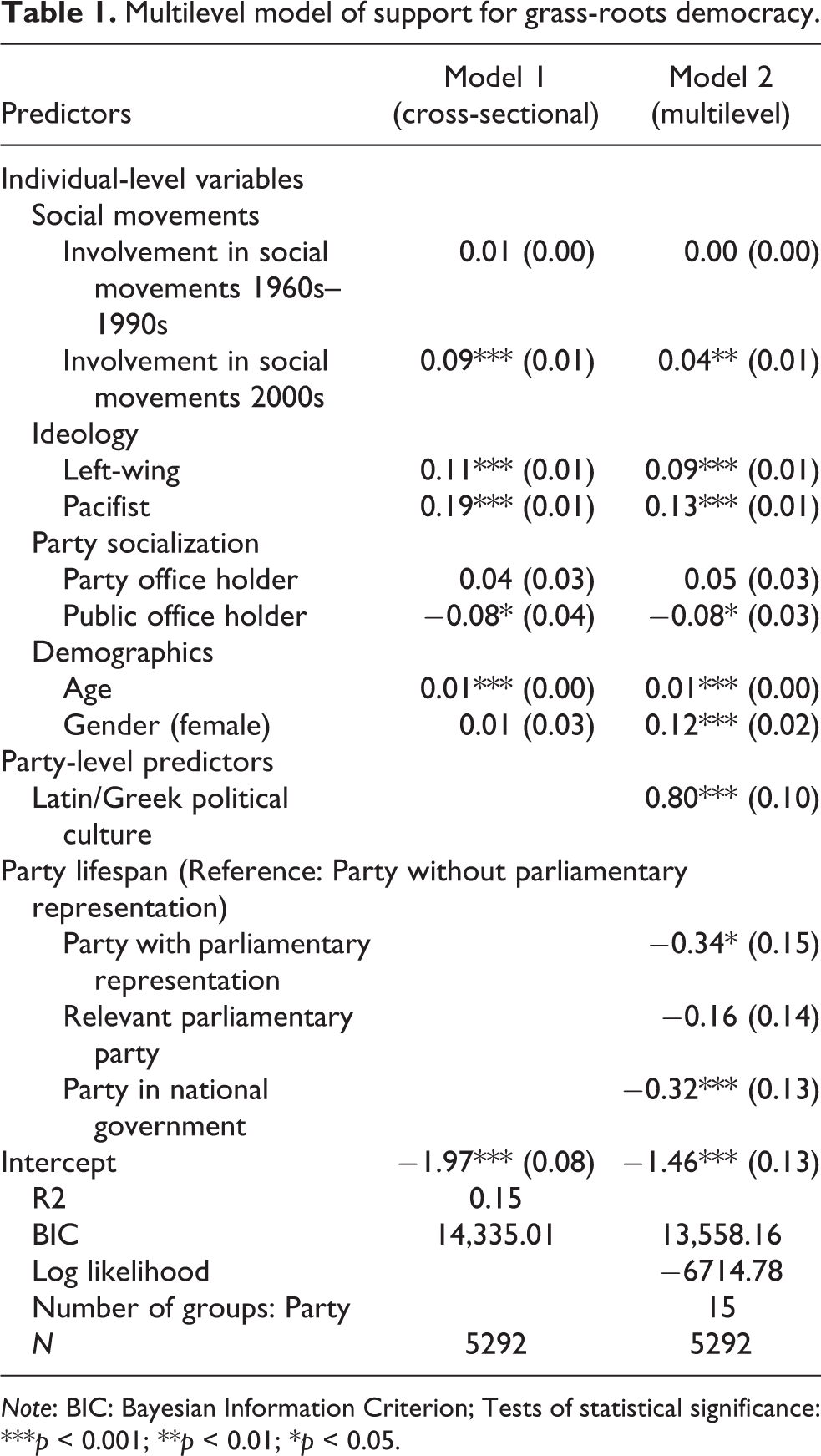
In order to test our hypotheses, we conducted a number of multivariate analyses whose results are displayed in Table 1. The first model is a standard ordinary least square regression model which includes all independent variables at the individual level. The second model presents the result of a multilevel analysis where we allow for varying intercepts by party, including the party-level type predictors.
Multilevel model of support for grass-roots democracy.
Note: BIC: Bayesian Information Criterion; Tests of statistical significance: ***p < 0.001; **p < 0.01; *p < 0.05.
The first important result concerns the influence of social movement activity. Our analysis suggests that social movement activities before and during the formation phase of Green politics have no impact on attachment to grass-roots democracy: Those members who had been student, anti-nuclear and peace activists in the 1960s, 1970s and 1980s were not more likely to support grass-roots democracy than others. Given the strong historical link, this finding is perhaps surprising. It appears that social movement experience does not have a sustained impact on the attitudes of participants, at least not as far as attitudes to grass-roots democracy are concerned. Hypothesis 1 is thus not confirmed.
What did make a difference was the recent involvement in social movement activity that appeared to be most strongly related to support for grass-roots democracy. Contemporary social movement activists who also joined Green parties are thus more open to the idea of grass-roots democracy, and thus hypothesis 2 could be confirmed. However, we need to be careful here in terms of inferring any direct of causal sequence. In the absence of panel data, we cannot really distinguish whether Green party members who support grass-roots democracy are more likely to go out and also become active outside of party politics, or whether social movement activists bring preferences about internal organization with them from the social movements into Green parties.
What can be said, however, is that a strong history of social movement activity does not translate into enduring preferences for grass-roots democracy. This seems to suggest that the call for strong internal party democracy is maintained by continuous social movement engagement. A discontinuity of such engagement may thus make it more difficult for Green party activists to maintain a strong focus on preserving the idea of grass-roots democracy.
Moving on to questions of ideology, here the coefficients clearly suggest that members placing them on the left of the left-right scale and those who have strong pacifist attitudes are more likely to be supportive of grass-roots democracy. Hypotheses 3 and 4 can thus clearly be confirmed.
Turning to questions of the effect of holding office in the party, our results provide at least partial confirmation for hypothesis 5. Holders of public office are less enthusiastic about grass-roots democracy. Holders of party offices have a tendency to go into the opposite direction, although the coefficient is not significant.
Overall, the individual-level model broadly confirms our hypotheses: Support for grass-roots democracy is driven by left-wing, pacifist members who are currently active in social movements and do not hold a public office. The results are fairly robust as they apply across the board and across countries fairly consistently. The regression coefficients do not change fundamentally once party-level variables are included in the second, multilevel model.
The two party-level variables that are part of the model are Latin/Greek political culture and political lifespan. Support for grass-roots democracy is clearly more widespread in Greece, Italy, Spain, France and the French-speaking parts of Belgium. This divide is quite stark, and it cannot therefore surprise that this variable is a statistically significant predictor of support for grass-roots democracy.
This effect has to be seen together with the lifespan variable. Contrasting parties that have entered parliament have become a relevant force in the political system and have entered national coalition government with parties that have been not had much success and are still struggling to establish themselves shows that parties in the latter parts of the development tend to be less likely to support grass-roots democracy. It is noteworthy that, at the bivariate level, it seemed that there is no statistically significant correlation here but once the preponderance of pro-democracy views within the French and Italian Green parties that experienced government at the time of the survey is taking account of, the lifespan model seems to work, and hypothesis 6 is thus confirmed.
In Figure 1, we plot the predicted values for different types of Green parties along the various party ‘lifespan’ phases. In order to estimate the uncertainty of the predictions, we rely on pseudo-Bayesian simulations, while keeping all the other variables at their means or modal categories. What becomes clear here is that the difference between the attitudes of party members to grass-roots democracy are not very strong at different development stages. Once parties enter ‘mainstream’ politics, preferences change, but moving further ahead on the ‘lifespan’ path does not appear to have a major impact.

Predicted values for party lifespan (fixed effects).
Conclusions
Even after more than 20 years of Green party development, the main forces behind demands for grass-roots democracy in Green parties are still the same: It is the social movement oriented, pacifist membership identifying with the political Left that is pushing for grass-roots democracy. However, we found no evidence that past involvement in social movements that were of key importance to Green parties in their formative phase, such as the student, anti-nuclear and peace movements, is positively associated with support for grass-roots democracy. Support for grass-roots democracy in Green parties does not involve Green ‘oldies’ harking back to the good old times of social movement politics. What makes a contribution is current involvement in protest politics. Social movements thus continue to play a role in influencing the organizational agenda in Green politics.
We have to be careful, of course, about the direction of any causal links claimed. The history of Green parties sees social movement activities preceding Green party formation. We thus can be fairly confident that key social movement experiences, particularly in the 1960s and 1970s, preceded Green party activity, and thus we have a possible causal sequence here that starts with social movements and influences attitudes to grass-roots democracy within Green parties. As we found, there is actually no link between past social movement activity and support for grass-roots democracy. For the 2000s, however, the nature of the causal sequence is not so clear. It is possible that members engaged in social movement activities in the 2000s were drawn into the party, thus establishing a causal sequence starting with the social movement experience. On the other hand, it is equally possible that Green party members holding certain views on internal party democracy were more likely to engage in social movement activities. In any case, the association of contemporary social movement activity and support for grass-roots democracy does suggest that ongoing social movement activity is an important element. This would suggest that support for grass-roots democracy is thus likely to decline in the context of an absence of any strong social movement mobilization, but that it may revive in the context of new social movements emerging.
Equally, the association between pacifist beliefs and left-wing orientation and support for grass-roots democracy suggests that changes in the ideological make-up of parties may have an important influence on attitudes to internal party democracy. However, this does not necessarily suggest that all parties will follow the same development model. Some Green parties may move away from radical positions and adjust their internal structure accordingly. Other parties may be re-energized by new social movement involvement and move from more moderate to more left-wing positions. The contrasting recent development of the English and German Greens provides a case in point. It will be interesting to examine attitudes to grass-roots democracy over time to examine these questions further.
Also, the results on the influence of party ‘lifespan’ on attitudes to grass-roots democracy does not fully support the notion of a simple development path from ‘movement’ to ‘normal’ parties. Green parties do not abandon all notions of grass-roots democracy once they enter parliament or become part of national government. Our results suggest that while members of ‘outsider’ parties not able to enter parliament are somewhat more likely to embrace grass-roots democracy, there is very little difference between further steps on the lifespan model. Other forces must be at work here. Looking at the strength of support for grass-roots democracy across countries, a clear North–South divide is apparent, with members of Green parties in ‘Latin Europe’ and Greece displaying rather more support for grass-roots democracy irrespective of their party’s development phase. The exact reasons for this finding are somewhat unclear. Some of these countries, in particular Greece, Spain, Italy and France, have a well-developed protest culture which may more readily feed into Green parties’ ideas associated with grass-roots democracy. Another element which might be worth exploring is the influence of anarchist thinking. Preferences for participatory democracy in general could, indeed, be seen primarily as part of the anarchist political philosophy (Barber, 1984). Anarchist thinking has historically had a strong influence in left-wing political discourses in some European countries, for example, in Spain, France and Italy. Apart from the influence of social movements, different traditions of left-wing politics might thus have an influence here on cross-national differences in the attitudes of Green party members.
Looking forward, what are the implications of our findings for the future research agenda? First, the question of grass-roots democracy still is of topical importance. Looking at developments since the early 2000s, Green parties clearly display a continued commitment to grass-roots democracy (Rihoux, 2016). Green parties thus maintain organizational structures that display some continuing commitment to the values of the party formation phase. What is required, though, is to analyse party members’ attitudes not only in a cross-national but also cross-temporal setting to come to a better understanding of the drivers of support and rejection of principles of grass-roots democracy over time.
Second, while the Green ‘model’ of grass-roots democracy endures as part of the Green party project, it does not appear to have been adopted by any other party family, and thus the wider Green project of changing the nature of party politics more widely has clearly failed (Rihoux and Frankland, 2008: 284). Green parties are, however, facing a new challenge to their philosophy of internal party democracy from other parties in the shape of plebiscitary elements of internal party organization. Poguntke et al. (2016) make a distinction between ‘assembly based intra-party democracy’ (AIDP) and ‘plebiscitary intra-party democracy’ (PIPD). The Green party model clearly fits the AIDP model. According to their cross-national analysis of party constitutions, Green parties come out rather well on the AIPD score which is higher than that of all other party families. However, in terms of their PIPD score, Green parties are merely average and have a lower score than Social Democratic and Liberal parties (Poguntke et al., 2016: 672). It will be one of the challenges for Green parties how their self-perception as parties with a very high level of intra-party democracy can be reconciled with their apparent reluctance to embrace the introduction of plebiscitary forms of decision-making. The attitudes of members here might be quite important, and it would be interesting to see what drives attitudes of Green party members to ‘plebiscitary’ measures.
Supplemental material
Supplemental Material, pp-2017-0201-File005_Appendix - Green party members and grass-roots democracy: A comparative analysis
Supplemental Material, pp-2017-0201-File005_Appendix for Green party members and grass-roots democracy: A comparative analysis by Gabriela Borz, Kenneth Janda, Wolfgang Rüdig and Javier Sajuria in Party Politics
Footnotes
Acknowledgements
We are grateful to E Gene Frankland and Robert Johns for comments on a previous version of this article. All shortcomings remain our own responsibility, of course.
Declaration of conflicting interests
The author(s) declared no potential conflicts of interest with respect to the research, authorship, and/or publication of this article.
Funding
The author(s) disclosed receipt of the following financial support for the research, authorship, and/or publication of this article: The research used for this paper was funded by the British Academy under its Large Research Grant programme (LRG-31746) and directed by Wolfgang Rüdig. Additional support was provided by the Research Development Fund of the University of Strathclyde. The financial support of the British Academy and the University of Strathclyde is gratefully acknowledged.

Supplemental material
Supplementary material for this article is available online.
Notes
References
Supplementary Material
Please find the following supplemental material available below.
For Open Access articles published under a Creative Commons License, all supplemental material carries the same license as the article it is associated with.
For non-Open Access articles published, all supplemental material carries a non-exclusive license, and permission requests for re-use of supplemental material or any part of supplemental material shall be sent directly to the copyright owner as specified in the copyright notice associated with the article.
