



Abstract
This article focuses on Korean parties to address the following gaps in the literature on party member activism: First, little attention has been paid to party members in non-Western democracies. Second, it is unclear how intraparty democracy is related to member activism. Unlike most industrialized democracies, South Korea has recently seen a notable growth in party membership. However, dues-paying remains the exception rather than the rule in the major parties, while the opposite is true for the minor, leftist parties. Using data from party member surveys, I examine the determinants of member activism across three Korean parties, focusing on the effect of members’ evaluations of the internal democracy of their party. I argue that dues-paying has risen as a new form of activism as democracy has been consolidated, and present evidence for a paradox of intra-party democracy that members positively evaluating internal democracy of their party remain less active.
Declining party membership and activism, observed in many established democracies, have attracted extensive scholarly attention over the past couple of decades. The literature on party organization has been variously concerned with the viability of party-based democracy that might be affected by shrinking memberships and the related organizational transformation of parties. This is because of several important roles that party members are believed to play, such as linkages between the party and citizens as political communicators, a solid basis of support in the ground as the most loyal voters, regular human and financial resources, and a source of legitimacy for the party. Attention has recently been moving toward more nuanced questions, such as individual-level factors of party membership and activism, based on surveys of party members.
This study focuses on Korean party members to address the following two issues in this scholarship. First, both theoretical and empirical scopes of research have been limited mostly to cases from Western democracies. The microlevel research has centered on the classic definition of party members: individuals affiliated to a party “to whom obligations and privileges are assigned upon a formal process of registration and the payment of membership fees” (Knut, 2006). Consequently, cases where this type of formal memberships is less relevant have been underexplored, beyond the American case. A recently growing recognition of varieties of party memberships (Ponce and Scarrow, 2016; Scarrow, 2015) can be understood as a serious call for research on party memberships and member behavior beyond typical settings. Expanding the scope of research may reveal more diverse patterns of party activism. It may also reveal that the centrality of parties as a key channel of citizen participation in politics in a modern representative democracy does not necessarily diminish with the rise of new technology and other structural changes.
Another gap in the literature concerns empirical investigation of the relationship between intraparty democracy (IPD) and party member activism. IPD concerns the distribution of powers within a party. While it has long intrigued researchers of party politics, some have suspected its importance from a realistic perspective. This suspicion appeared as early as in Robert Michels (1962 [1915]) who contended that democratic organization is oxymoron from his observation of the Social Democratic Party of Germany. Schattschneider also denounced it, saying “Democracy is not found in the parties but between the parties” (1942: 60). Nevertheless, facing the decline in citizen engagement in parties, IPD has gained considerable attention in recent years. Behind this reappraisal is the expectation that invigorating internal party democracy may reverse the near-universal trend of declining party activism. This expectation has led to discussions on theoretical aspects of—such as the normative values of IPD and possible trade-off between IPD and electoral democracy—and practical aspects—such as existing formal rules of IPD and their implementations (e.g. Cross and Katz, 2013; Loxbo, 2013; Scarrow, 2000, 2005; Von dem Berge et al., 2013). Evidence suggests that waning interests in parties among the general public is leading to the transformation of such parties toward more inclusive organizations. Nevertheless, evidence that IPD drives party members toward more activism is lacking.
This study investigates correlates of activism among party members across three Korean parties, focusing on the question of whether and how members’ subjective evaluations of the extent to which their party is internally democratic is related to the level of involvement in party activities. The rarity of research on party activism in Asian democracies is not the only reason why South Korea is an interesting case. The two major Korean parties display an intriguing deviation in running their mass membership. Formed in the pre-democracy days as cadre parties, they have alternately won in presidential elections since the democratic transition in the late 1980s. The major parties established and have maintained a mass membership, filled mostly with the so-called ghost members who exist in registration but do not pay membership fees while there are few dues-payers, that is “genuine members.”
By contrast, in more recently created leftist parties, dues-paying is an essential requirement for membership. Their extra-parliamentary origin, financial reliance on member contributions, and labor-intensive campaigning bear a close resemblance to the classic mass party. The coexistence of the two distinct types of parties in the operation of mass membership within the same party system allows a rigorous test for the effect of the evaluations of IPD. Where dues-paying is a basic duty, it is hardly regarded as a form of high-intensity participation. In such parties, member activism ranges from dues-paying at the minimum to attending party events or even seeking out a party position or a candidate position. However, for parties where dues-paying is neither a rule nor a norm, it may be safely used to distinguish active members from dormant ones. If so, testing the effect of the evaluations of IPD across different measures of member activism and different parties—dues-paying for the major parties and a more standard measure of member activism for a leftist party—will lead to a more robust conclusion, provided that the results are consistent. The findings in this article provide evidence that party members satisfied with internal democracy of their party are less likely to engage in party activities. While IPD may be effective in the recruitment of supporters or activists, it can hardly convert existing inert members to active ones.
Korean parties and party members
Over the past quarter century, the Korean party system has maintained a moderate multiparty system with two major parties alternating control of the presidency and a few smaller parties. While South Korea has often been hailed as a model achiever of democracy among new democracies, scholars have widely agreed that Korean parties are the weakest link in the democratic advance of the country. Korean parties are well-known for their weak party voter attachment and a low level of citizen trust in parties (Shin, 1999; Steinberg and Shin, 2006). As Joseph Wong (2014) has noted, Korean parties “change their names and are reconstituted with a selection of every new party leader” (p. 262). He adds, “the rise of civic groups and their tremendous influence in Korean politics are a reflection of people’s dissatisfaction with political parties and their ties to privileged groups” (p. 262).
As a main cause of the malfunctioning of parties, students of Korean politics have pointed out the deficiency of organizational structures of the parties encouraging citizens to become engaged in political processes beyond voting and electoral campaigning. Scholarly neglect of individual party members can be understood, in part, as the logical consequence of this dominant view of Korean parties. Coupled with the difficulty to access the information on individual members of the fringe leftist parties in this anti-communist state, this neglect has been extended to these parties of the mass party type.
However, at least in appearance Korean parties have a sizable membership, as presented in Table 1. According to the National Election Commission (NEC) to which parties are obliged to report their activities and accounting every year, the number of party members increased sharply during the last decade. In Korea, more than 10% of the total population are party members. If only eligible voters are counted, the ratio amounts to 12.6% (according to the NEC in 2015), far higher than the self-reported figures from surveys in most industrialized democracies. 1 Such a large membership contrasts with the prevailing view concerning Korean parties as ineffective channels of political participation. 2 A closer examination reveals that the lion’s share of party membership is from the two major parties, the conservative right-wing Hannara 3 and the liberal centrist Minju. In 2014, the members from these two parties accounted for 97.9% of the total party members (Ibid.). Overall, the notable growth in recent years suggests that Korean parties increasingly view membership as valuable. Accordingly, they are making greater efforts in membership recruitment. With the democratic consolidation of Korea, the parties appear to have escaped the global phenomenon of declining membership.
Party membership ratio in South Korea, 2004–2014.
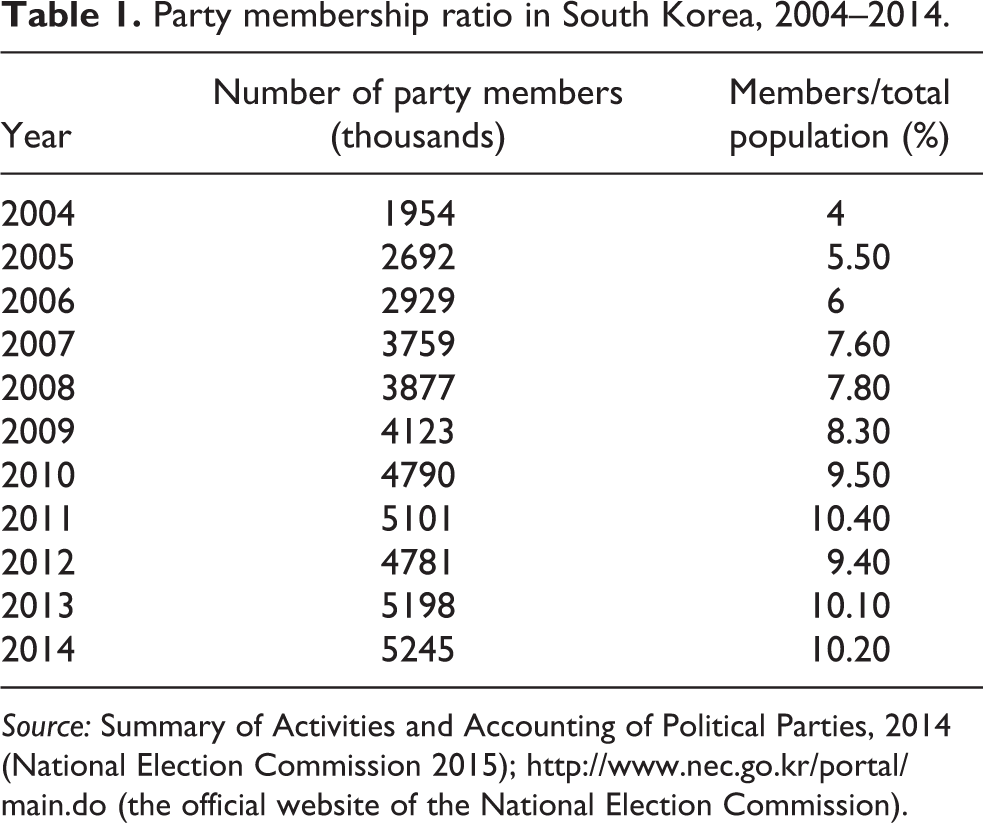
Source: Summary of Activities and Accounting of Political Parties, 2014 (National Election Commission 2015); http://www.nec.go.kr/portal/main.do (the official website of the National Election Commission).
On the other hand, in 2014, dues-paying members are only one in ten of the total party members, as shown in Table 2. Dues-paying is the exception rather than the norm in the major parties. Nonetheless, the Minju has a higher ratio (13%) than the Hannara (9.4%) in the same year, reflecting the former’s gradual, but more pronounced shift toward a more inclusive organization (while mostly limited to top personnel decisions) than the latter. In sharp contrast to the major parties, more than a majority of members are dues-payers in the leftist parties—the Justice, the Labor, and the Green—all of which originated in labor or environmental movements after the democratic transition. The Justice (like the Labor) stems from factional and ideological conflicts within the Democratic Labor Party (DLP; founded in 2000 and dissolved in 2012) in the late 2000s, which eventually led the DLP to break up. Founded in 2013, the Justice has recently been the only leftist party with parliamentary seats (five seats between 2012 and 2016, and six seats since 2016) and has the largest membership among existing leftist parties. It inherited much of the membership-based organizational structures of the DLP, including the dues-paying requirement. Its party leaders and delegates at all levels and party candidates are chosen by the votes of formal—dues-paying—members, with few exceptions. The high dues-paying ratio and membership rate of the Justice (and other leftist parties) can be understood as a combined result of the demand of the party for member contributions in party finance and the supply of enthusiasts who are dissatisfied with the major parties but still desire to be politically engaged.
Dues-paying ratio and monthly membership rate of Korean parties, 2014.
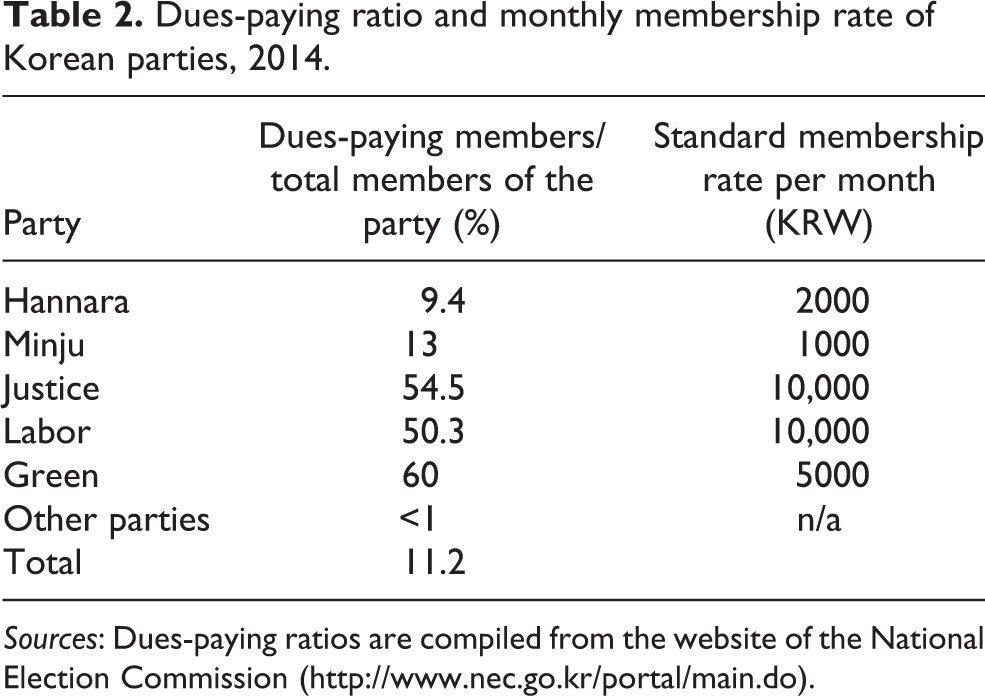
Sources: Dues-paying ratios are compiled from the website of the National Election Commission (http://www.nec.go.kr/portal/main.do).
A remarkable difference between the major parties and the Justice lies in IPD. The primary targets of the criticism that Korean parties are electoral vehicles of a few privileged politicians have been the two major parties, not the small leftist ones. The DLP was the organizational template of subsequent leftist parties. It had a clear vision on IPD, declaring in the preamble of its party constitution that the party will “not only fight for full democracy in the society but also strive to apply strictly and achieve IPD.” During its initial years, the DLP established specific formal rules as a mass party. The rules include recall, referendum, and initiative by members as well as specified processes of internal elections for local and national party leaders and delegates. Subsequent leftist parties have adopted most of the DLP’s visions and rules for internal democracy with some modifications. The manifesto of the Justice states, The development of democracy without the development of party politics is impossible. Only strong parties can protect and improve citizens’ lives. We will realize an alternative party model in which citizens engage, and members become the principals as an organizational basis.
4
Methodology
The analysis of member activism in Korea employs two preexisting survey data sets: the party member survey of the Korean Association of Party Studies (KAPS) conducted in February 2010 and the Justice’s internal survey data conducted in January 2016. 5 In the former, of total 3031 party members from 5 parties participated, 1600 respondents were from the Hannara, 1319 from the Minju, and the rest from 3 minor parties. Due to the small sample issue for the minor parties, I use the KAPS data to examine members of the two major parties only.
The Justice conducted the member survey for its own purpose. The party sent the survey via email to all the members whose email address was registered (around 15,000 members from a total of around 20,000 members at the time of survey), and for the next 10 days 1886 members sent back their survey responses. The response rate was approximately 12.6%. Since both survey data sets are not from a random sample, we should be cautious in generalizing findings in this analysis to the entire party memberships in Korea.
An inherent issue in use of different surveys is comparability of the data, especially, the difficulty to find equivalent measures for the same variable. For this reason, though specified as similar as possible, the models of member activism for the major parties and for the Justice are not identical. (see Appendix A for the survey questions from the survey datasets used to measure member activism and other variables in this study). In particular, it is crucial to address the measurement of the dependent variable. Member activism typically means the extent to which individual members devote their time and efforts to party activities, in addition to dues-paying. Dues-paying is usually a baseline of member activism, a relatively low-cost activity like voting, whereas inactive members refer to individuals who pay their regular dues but are not involved in any other party activities. In this regard, the Justice’s survey includes a measure relevant to this standard conceptualization of member activism, the respondents’ subjective level of party participation (“which level of party activities do you think is suitable for you?”). The six response choices of this question range from dues-paying only (1) to standing as electoral candidates (6), in the order from the least to the most intensive participation.
A problem arises from the lack of a similar, comprehensive measure of member activism in the KAPS survey. Furthermore, in the major parties, the opportunities for individual members to influence party decisions are largely limited. Their decision rules in selecting party personnel are poorly institutionalized, while institutional arrangements for engaging party members in making policy-related decisions are nearly missing. Altogether, party activism may need to be conceptualized far more loosely for the major parties. This leads to the following discussion on dues-paying as an alternative measure of party activism.
Dues-paying as member activism in the major parties
In South Korea, dues-paying is a recent phenomenon. The early 2000s was an important political juncture in several aspects, such as three Kims’ retirement from politics and the looming sign that regionalism as a single most important political cleavage began to wane. It was also marked by a change in the nature of citizen participation in politics. While democratized Korea in the 1990s saw the growth of several new civic movement organizations, most of the organizations were driven by professionals, failing to engage individual citizens, namely “citizen movement without citizens.” The Minju’s introduction of an open primary for its presidential nomination in 2002 created the possibility for non-elite citizens to have a voice over a previously offstage decision. The nation-wide enthusiastic grassroots support was critical for the outsider politician, Roh Moo-hyun, to win the Minju’s nomination and the subsequent presidential election. It is symbolic that “participatory government” was the official nickname of his administration. Facing the public opinion shift for participatory democracy, along with the rise of a mass party from the left (the DLP)—a “contagion from the left” in Duverger’s (1954) term—the major parties created a new membership category for dues-payers, first the liberal Minju in 2003 and then the conservative Hannara in the following year.
Nevertheless, in these major parties, dues-paying has never been an essential element of membership and has been practiced by only a minuscule fragment of members. 6 Not only dues-paying memberships, political participation in Korea—in general, but especially the types of action involving the risk of the actor’s political preferences to be revealed publicly, such as political donation, attending political meetings or rallies—has remained relatively low, compared to other industrialized democracies. 7 Dues-payers may be those who are more publicly ambitious, while most of their fellow party members keep a low profile, even though the physical cost of dues-paying is relatively low. In Korea, dues-paying may be a signature of political commitment, an emphatic declaration of being a stakeholder, self-distinguishing oneself from those who are passively mobilized by elites.
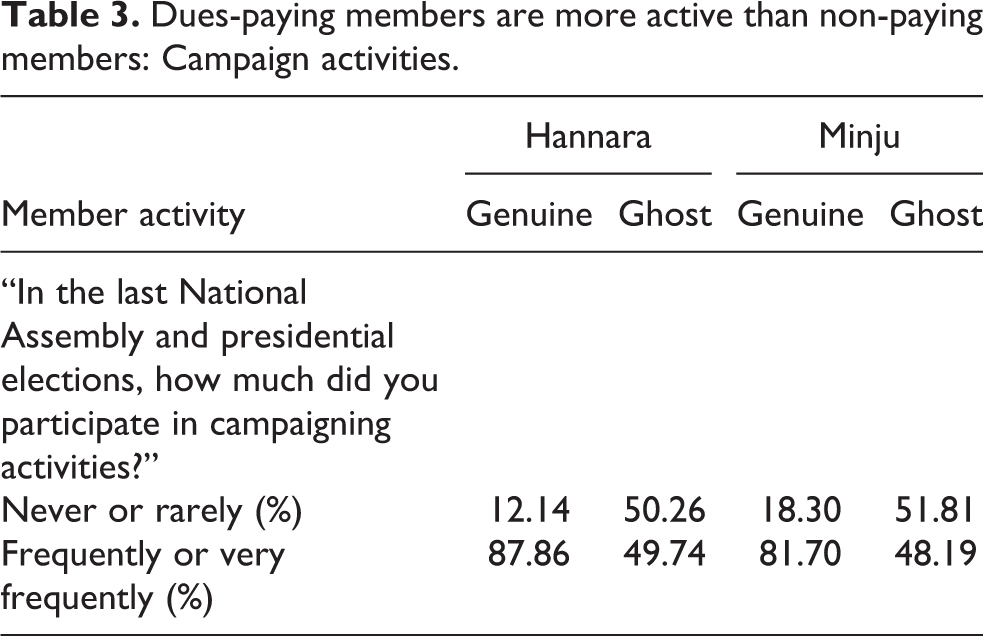
To consider dues-paying as a proxy measure of member activism, we need further evidence that the dues-payers are more intensively engaged in party activities than non-payers. Tables 3 and 4 present member response patterns to the questions asking the extent to which members are involved in two specific types of party activities, based on the KAPS survey data set. In Table 3, dues-payers appear to join election campaigning more intensively than non-paying members, and the pattern is consistent across the parties. Among respondents, more than 80% of dues-payers participated in campaigning “frequently” or “very frequently,” while the percentage drops to less than 50 for non-paying members. Furthermore, in Table 4, dues-paying members far outperform others in the average number of interactions for opinion exchanges with local or national leaders of the party, with more than three times per month for dues-payers and about twice for non-payers. The difference appears statistically significant and, again, consistent between the Hannara and the Minju. In addition, from the two major parties, 65% of dues-paying respondents interact with leaders at least once a month, while the percentage drops to 25 for their ghost counterparts. The clear differences between the two groups in the level of campaigning activities and in the frequency of interactions with party leaders support that dues-paying members can safely be categorized into a relatively active membership. 8 Hence, in the model of member activism for the major parties, the question of “are you currently paying your membership dues?” is used to measure a dummy dependent variable of dues-paying.
Dues-paying members are more active than non-paying members: Campaign activities.
Dues-paying members are more active than non-paying members: Average number of interactions with leaders per month.
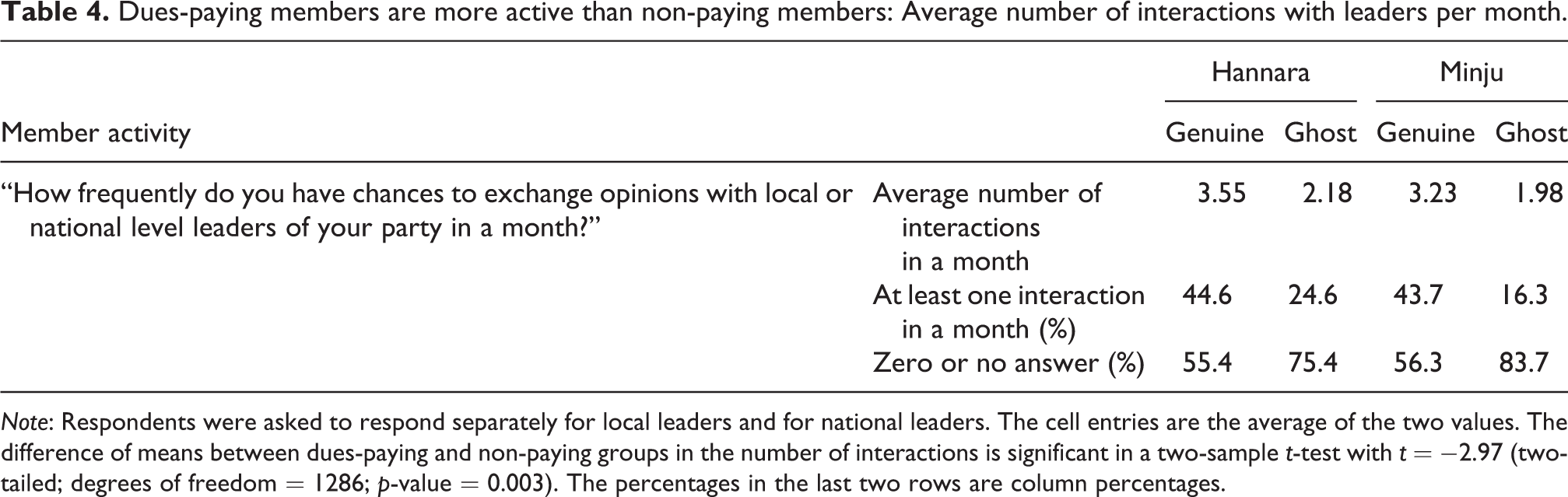
Note: Respondents were asked to respond separately for local leaders and for national leaders. The cell entries are the average of the two values. The difference of means between dues-paying and non-paying groups in the number of interactions is significant in a two-sample t-test with t = −2.97 (two-tailed; degrees of freedom = 1286; p-value = 0.003). The percentages in the last two rows are column percentages.
IPD and other independent variables
An internally democratic party provides members with ample opportunities to be involved at various levels of party decision-making. Significant academic attention paid to IPD in recent decades is closely related to the concern about party membership decline in the democratic world. Some view IPD as a crucial instrument with which parties can reverse the decline. As summarized by Cross and Katz (2013), “many of those who view a decline in party membership negatively argue for more robust forms of IPD as a way of providing an increased incentive for party activism” (p. 7) However, it is not yet clear whether and how member empowerment can influence party activism. In her article devoted to organizational reforms in German established parties, Scarrow (1999) argues that parties’ enhancing IPD is a response to decreasing citizen engagement, but not the other way round.
Arguably, the reputation of a strong IPD may signal even individuals unwilling, or unready, to be active that “once you voice your opinion, it will be counted.” Hence, the presumed effect of IPD as a membership booster may be extended to member activism. If this is the case, how members perceive the quality of internal democracy (in institutional design and implementation) of their party will also have a strong bearing on understanding the effect of IPD. No matter how democratic intraparty decision-making is, it may not produce intended outcomes (boosting activism among members) unless properly appreciated by party members. In other words, if members are dissatisfied with a given provision of IPD, their expected utility from participation in party activities may also be reduced. Accordingly, members negatively evaluating IPD will reduce their time and energy devoted to party activities.
Nonetheless, considering the weak empirical evidence of IPD as a membership booster, an alternative possibility is that IPD is ineffective in transforming inert members into activists. Katz (2013) supports this view, pointing out structural changes in the sociopolitical environment as a primary cause of party in decline. He contends that “forces largely exogenous to the internal arrangements of the parties have made partisan involvement less attractive to citizens” (p. 49). He adds, “the opportunity to seriously contribute to the shaping of party decisions may be more relevant to the recruitment and retention of activists than the recruitment of ‘mere’ members” (p. 53). A possible extension of this argument is that, however relevant IPD may be to the recruitment of activists (and even “mere” members), it cannot persuade existing members towards more activism.
There probably is more than one reason why members with strong confidence in the internal democracy of the party may hesitate to be active. First, abundant opportunities may be less cherished than rare ones. The firm belief that chances to influence party decisions will recur can lead one to discount the value of being active in the here and now. Second, the perception that the party equips proper arrangements of internal democracy may assure individual members that decisions will be made appropriately, and thus participation as a single individual is not crucial. This line of thought leads to the primary hypothesis in this study that confidence in the internal democracy of the party is negatively associated with member activism. If this hypothesis is correct, we would observe a negative effect of member evaluation of IPD consistently significant across different parties and different measures of member activism.
Von dem Berge et al. (2013) conceptualized IPD based on the two criteria: inclusiveness (the extent to which individual party members can be engaged in intraparty decision-making) and decentralization (the extent to which decision-making is not centralized at the highest national level). Although imperfect, the KAPS and the Justice surveys provide a set of measures satisfying at least one of the two criteria. Specifically, for the major parties, IPD is measured by the responses to three questions asking members’ evaluations of decentralization from the KAPS survey. For the Justice, it is measured by the responses to two questions about the party’s inclusiveness from the Justice survey.
Potentially relevant explanatory variables identified by surveys of party members conducted over the recent decades include sociodemographic and socioeconomic variables. Since parties are typically hierarchical organizations, compared to advocacy groups, parties tend to be male-dominated and less appealing to youth (Cross and Young, 2004; Henn et al., 2005; Norris, 2003; Whiteley and Seyd, 2002; Young and Cross, 2002). Also, consistent with the classic “resource” theory that explains activism with resources that individuals possess (see especially Verba and Nie, 1972; Verba et al., 1978), party members tend to be disproportionately from high socioeconomic classes (Scarrow and Gezgor, 2010). Moreover, in their study on British party members, Whiteley and Seyd (2002) found that socioeconomic variables are also positively associated with party member activism.
However, the effects of these variables may vary across parties, especially between “established” parties and fringe leftist parties. First, Michels’ recognition that organization is “the weapon of the weak in their struggle with the strong” (Michels, 1962: 61) will be more relevant to leftist parties. Embracing new left visions, the Justice has explicitly advocated the interests of “the weak” in the post-industrialized Korea, including women, youth, and LGBT groups, in addition to the interests of the traditional working class. Also, the Justice has instilled more progressive organizational culture and formal rules about gender quotas in the selection of key party personnel, compared to the major parties. Second, the different operationalization of member activism between the major parties and the leftist party will also contribute to the differing effects of age. Dues-paying, the dependent variable for the major parties, is the lowest-intensity activism for the Justice. Party activities beyond dues-paying typically require more time and energy, hardly affordable for the elderly. On the whole, I expect that dues-paying of the major parties is more likely to be dominated by men, the elderly, and the high social class. However, the correlations between the higher-intensity activism and the sociodemographic and socioeconomic variables may be less obvious in the Justice as a party for the week.
Political preference, often summarized by left-right ideological orientation, also may motivate individuals to take part in party activism. Predicted by rational choice theory, the correlation between ideological conviction and party activism has been firmly established in the US contexts. Nonetheless, the relationship is less clear in other countries (Hansen, 2002; Narud and Skare, 1999; Norris, 2003). Both survey data sets provide a self-placed ideology of the respondents. Thus, we can test its effect on dues-paying for the major parties and on higher-intensity activism for the Justice. I expect that the effect of ideology will not be significant for the then governing party, the Hannara (ideology makes little difference between dues-payers and their counterparts). However, I expect that the effect of ideology will be manifest for a small, leftist, mass party of integration, the Justice (the more leftist, the more intensive in party participation).
Theories of organizations have emphasized the need to understand the supply side (Clark and Wilson, 1961; Panebianco, 1988). This view understands individuals’ participation in party activities as a response to incentives that parties dispense to their members and activists. Despite slight difference in the classification across scholars, a common set of incentives in the literature includes selective incentives (public offices; networking for career or material rewards); purposive incentives (public policies); and sociality incentives (solidarity emerging from social interaction, the feeling of belonging, or the joy of socializing and meeting like-minded people). As the incentives have consistently found to be important in explaining party activism in Western democracies (e.g. Cross and Young, 2008; Hansen, 2002; Whiteley and Seyd, 2002), they may also be relevant confounders for Korean parties. To probe the extent to which individuals become active as a response to various incentives, I use five questions about respondents’ motives. One question pursues a purposive motive (“to influence policies and government”). Two ask about selective motives (“to develop a political career” and “to build a network with prestigious people”) and two ask about sociality incentives (“sense of community belonging” and “campaigning is exciting in itself”). Responses to each are scored on a five-point scale. Moreover, the mechanism of how one decided to join the party, by one’s own will or at someone’s request (Voluntary), may also influence one’s level of activism. Unfortunately, the incentive variables and the variable of subscription mechanism are available in the KAPS survey, but not in the Justice survey. Accordingly, these variables are included only in the model of dues-paying for the major parties.
Lastly, political efficacy is among the strongest predictors of one’s political participation. If applied to activism mediated by parties, the belief that one can influence party affairs may affect one’s commitment decision toward the party (Party efficacy). In the model of member activism of the Justice, I use a variable of members’ sense of accomplishment of the goal that one espoused at the time of membership subscription, as a proxy variable for party efficacy.
Results
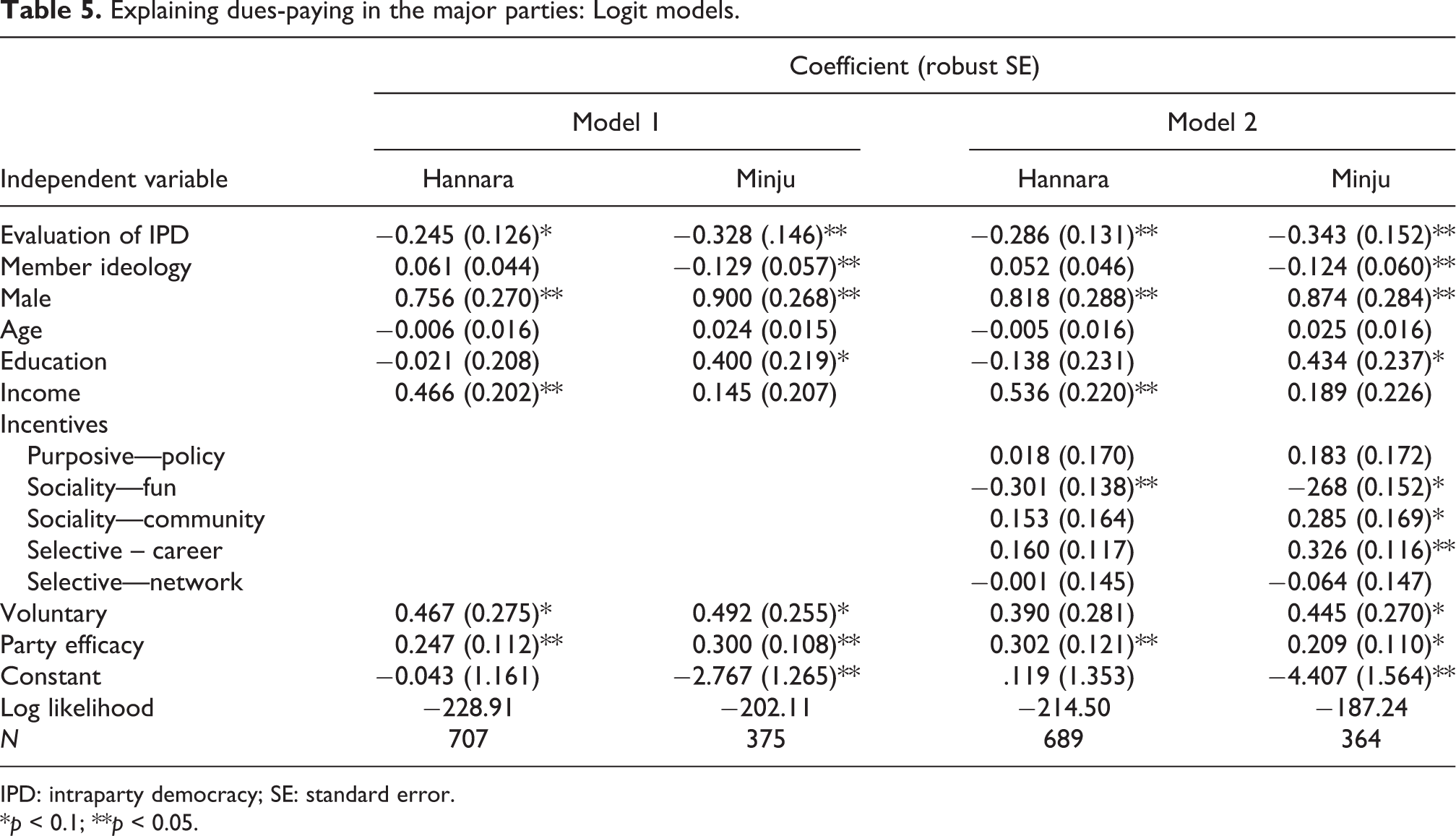
I test the effects of evaluations of IPD on two different measures of party activism: dues-paying for the major parties and higher-intensity participation for the Justice. Table 5 displays the results of a logistic regression analysis for the major parties. This analysis allows us to identify which differences between dues-paying members and non-paying members persist, holding other factors constant. The hypotheses are tested first without the incentive variables in model 1 and, then, with them in model 2. The findings presented in Table 5 highlight how distinctive dues-payers are in several aspects. First, the effects of member evaluations of IPD are consistently negative and significant for both parties, even when the incentive variables are controlled. This finding provides evidence undermining the idea that IPD can be an effective tool to promote party activism, at least among existing party members. In fact, members with a more optimistic view of the internal democracy of the party are likely to remain inactive ghost members. IPD assures many ordinary members that “it is ok to stay away,” instead of the opposite that has often been presumed.
Explaining dues-paying in the major parties: Logit models.
IPD: intraparty democracy; SE: standard error.
*p < 0.1; **p < 0.05.
Most sociodemographic and socioeconomic factors are correlated with dues-paying in the predicted direction. Being male increases the likelihood to pay one’s membership dues. Similarly, income (measured by subjective household well-being) and education are positively related to dues-paying. Although only one of the two socioeconomic variables appears significant in each model, the results affirm the relevance of the resource model in explaining dues-paying membership in Korea. However, age appears not significantly associated with dues-paying. This may reflect the fact that in general the elderly are the most deprived age group due to the weak provision of social welfare in South Korea. An alternative explanation may be that the elderly lived through the time when dues-paying was hardly considered as an option.
Respondents’ political ideology, as measured by self-placed left-right orientations, proves significant only for the Minju in distinguishing dues-payers from their non-paying counterparts. Dues-paying membership of the center-liberal Minju is ideologically skewed toward the left. This suggests that the party may face internal pressure to take less moderate policy positions and, therefore, face the increased risk of electoral loss, once it substantially opens the intraparty decision-making in favor of dues-paying members. This may explain the party’s enduring hesitancy to build more inclusive structures beyond its limited forms of party primaries for candidate selections. The right-wing Hannara does not exhibit a pattern such that right-leaning members are more likely to pay their dues than more moderate members, providing counter-evidence that activists are ideological extremists.
Among the five types of incentives known to motivate individuals to join a party or become active, as included in model 2, only some of them are significant. For the Hannara, sociality incentives seeking fun from party activities is the only relevant predictor among the five. In the Minju, on the other hand, both sociality (seeking fun and seeking the sense of community belonging) and selective incentives (specifically, seeking political career) are among the predictors of its dues-paying membership. Although space does not permit a discussion on each, it is noteworthy that excitement-seekers tend to remain as non-payers. This finding supports that dues-paying is a deliberate decision of members, rather than an offhand choice, in both parties.
We also find that in both major parties how respondents view their ability to shape party decisions affects the likelihood of paying one’s membership dues. Members with strong efficacy are more likely to join a dues-paying membership than their fellow counterparts. Another control variable included in the model of dues-paying memberships is how an individual initially decided to join a party. The mechanism of membership subscription also exerts a significant effect on the likelihood of being a “genuine” member, with the effect consistent between the major parties. Dues-paying memberships are disproportionately filled with those who voluntarily joined the party, rather than those who were requested by someone else, holding other variables constant.
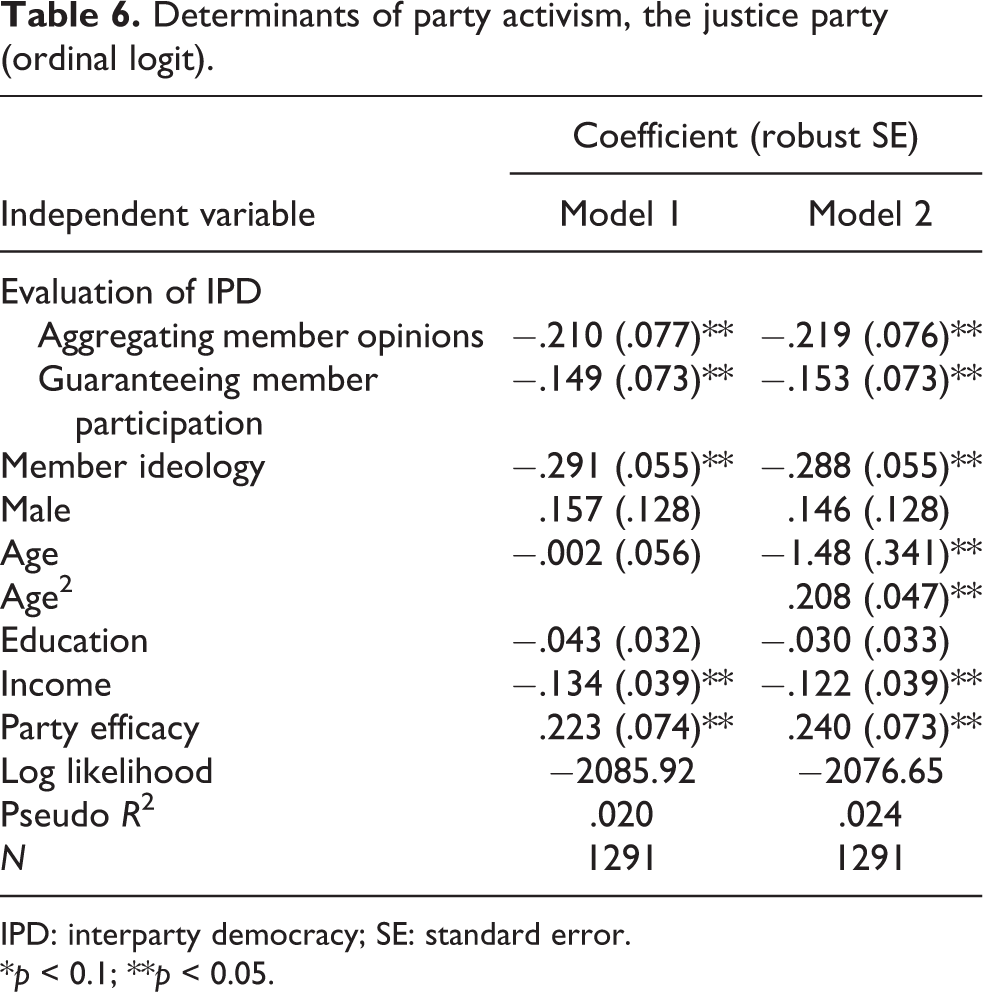
Next, Table 6 presents the results of an ordinal logit analysis for the Justice. While dues-paying is the least-intensive form of activism for members of this party, the most intensive form of activism is standing as a party candidate in elections. Indeed, being an electoral candidate of this party usually involves enormous costs for such an individual, due to the slim chance of winning with the party label and the limited financial resources of the party.
Determinants of party activism, the justice party (ordinal logit).
IPD: interparty democracy; SE: standard error.
*p < 0.1; **p < 0.05.
Who participates in high-intensity activism in this marginalized party? In the first place, the results provide robust evidence for the negative correlation between evaluations of IPD and member activism. Both measures of the inclusiveness dimension of IPD are negative and significant, reaffirming the pattern found in the analysis of dues-paying for the major parties. Across different parties and different measures of activism, member activists are consistently more discontented with their party’s decision-making processes than their inert counterparts.
Also notable is the finding that the socioeconomic variables are nonsignificant or significant but not in a predicted direction in the “resource” model. The coefficients of both education and income are negative, although only the latter is significant, perhaps reflecting that the Justice is indeed the weapons of the weak. Activists are drawn disproportionately from lower-income groups among members in this party. This suggests that the effects of resources vary across different types of parties, calling for a more nuanced, party-level explanation of the effects of resources on party activism. Furthermore, there is no significant difference between gender groups in the level of activism. The organization of this party is not dominated by male activists, probably reflecting the party’s efforts to accommodate female members in its internal decision-making mechanisms.
There is no clear linear pattern between members’ age and their level of party activism. The nonsignificant relationship between members’ age and activism of this party may reflect the fact that the party leadership is filled mostly with elderly veterans in labor and democratic movements, whereas this is offset by the party’s recent appealing to youth with its progressive orientations in LGBT and feminist issues. In model 2, this explanation is tested by adding a squared age variable. The results corroborate the curvilinear effect of age on member activism. Holding other factors constant, members in their mid-30s are the most inactive group among all age groups. The finding suggests that the Justice may face a crisis of leadership reproduction at national or local levels, if the current trend is not reversed.
The results also indicate that leftist ideology has a significant effect on party activism in the Justice. In this party, radical members participate in more intensive forms of party activities, whereas ideological moderates tend to stay away from party affairs. This finding conforms to the idea that political preferences are relevant for understanding member activism in opposition parties in which the supply of selective incentives is relatively inadequate. In such parties, ideology serves as the serious alternative to selective incentives (e.g. Panebianco, 1988). Members’ efficacy in the party, measured for the justice by the extent to which respondents believe that they have achieved their goal at the time of membership subscription, is positively correlated with member activism. Members’ confidence in their ability to interact with their party makes a significant difference, consistently on both measures of member activism and across the three parties examined in this study.
Conclusion
Where a tradition of voluntary civic associations is lacking, the parties can easily be subject to political maneuvering by elites. In such parties, members are mobilized primarily for the interests of the party elites and their contributions, if any, are regarded as trivial. Korean parties have long been among notorious examples. However, this study reveals a notable discrepancy in the party membership trend between South Korea and most other industrialized democracies. Over the past decade, Korea has seen the creation and growth of dues-paying membership as a new membership category, as well a rise in overall party membership. The gradually increasing emphasis on “genuine membership” in the Korean parties corresponds to the transformation of the major parties from “personalistic parties” or “elite parties” to “political market parties,” in Scarrow’s (2015) terms. Their notions of party members are still mostly fans and volunteers, but not so much nowadays as before. The recent changes in South Korea suggest that the rise of new technology and other structural changes in the post-industrial society does not necessarily reduce the centrality of parties as a key channel of citizen participation in politics in modern representative democracy.
Despite the positive development in party memberships in Korea, evidence from the analyses of Korean party members supports the claim that IPD is not a savior of party activism. Specifically, the results highlight IPD from members’ perspective to understand why most members remain inactive. Party activism is dominated by members who are more skeptical about the internal democracy of the party. Although the direction of causality needs further inquiry, this study provides a clue to understanding the mechanism by which parties’ increasing efforts to enhance internal democracy do not lead to members’ increased activism. On the one hand, strong confidence in IPD may have a discounting effect on the value of active participation. Individuals who believe that they can participate whenever they want and, once they participate, that their voices will be heard may take a rain check on higher-intensity participation. Accordingly, they are more likely to remain as free riders, instead of paying the costs accompanying such participation. On the other hand, this may result from the frustration that only active members experience, as they struggle for their opinions to get through hierarchical party structures. Inactive members are unlikely to experience such frustrations. Parties’ increasing efforts to strengthen the political rights of individual members as an attempt to offset shrinking party memberships may result in a paradox that members’ greater approval of the provision of internal democracy of the party assures the members to stay inert, while activists’ discontents remain unresolved by party reforms for better IPD.
Supplemental material
Appendix - Can intraparty democracy save party activism? Evidence from Korea
Appendix for Can intraparty democracy save party activism? Evidence from Korea by Gabriela Borz, Kenneth Janda and Sejin Koo in Party Politics
Footnotes
Declaration of conflicting interests
The author(s) declared no potential conflicts of interest with respect to the research, authorship, and/or publication of this article.
Funding
The author(s) received no financial support for the research, authorship, and/or publication of this article.
Supplemental material
Supplementary material for this article is available online.
Notes
References
Supplementary Material
Please find the following supplemental material available below.
For Open Access articles published under a Creative Commons License, all supplemental material carries the same license as the article it is associated with.
For non-Open Access articles published, all supplemental material carries a non-exclusive license, and permission requests for re-use of supplemental material or any part of supplemental material shall be sent directly to the copyright owner as specified in the copyright notice associated with the article.
