




Abstract
Do economic policy preferences distinguish populist voters from mainstream ones? We compare the preference profile of the voters of the Five Star Movement (M5S), one of the most successful southern European populist parties, with the profile of voters of other parties at both the 2013 national and the 2014 European Parliament elections by means of a conjoint analysis experiment on economic policy programs. Despite economic insecurity and recent recessions being key drivers of populist voting, we provide evidence that M5S supporters are fiscally moderate: they are happy with the current size of government and oppose more spending. Their Euroscepticism, shared with right-wing voters and representing a new domestic divide, takes the form of a lukewarm support for the euro, which they would readily ditch if it were to improve economic performance.
Introduction
Populist parties are making their mark on European politics. The United Kingdom Independence Party (UKIP) won the Brexit referendum. In Austria, Alexander Van Der Bellen, the Green Party’s candidate, defeated Norbert Hofer, the leader of the Austrian Freedom Party (FPÖ) only at the final round of the 2016 presidential elections, and less than a year later the FPÖ has become the country’s second-largest party and a possible government coalition partner. After the elections in March 2017, Geert Wilders’ Party for Freedom is now the second-largest party in the Netherlands. In France, both the center-right and the center-left mainstream parties (i.e. The Republicans and the Socialist Party) failed to progress to the final round of the 2017 presidential elections. In the runoff, Marine Le Pen, the leader of the National Front (FN), got one-third of the votes, doubling those obtained by Jean Marie Le Pen in 2002. In the 2017 federal elections, the right-wing nationalist Alternative for Germany became the country’s third-largest party, thus entering the Bundestag for the first time. Europe is also experiencing the rise or repositioning of left-wing parties with strong populist traits, such as Podemos in Spain, the Left Bloc in Portugal, Syriza in Greece, The Left in Germany, Sinn Féin in Ireland, and the Socialist Party in the Netherlands (e.g. Hakhverdian and Koop, 2007; March, 2011).
Economic insecurity arising from globalization and opposition to immigration are considered the main drivers of populist voting (e.g., Hernández and Kriesi, 2016; Kriesi and Pappas, 2015). These parties indeed address these concerns by pledging various forms of government intervention. In north-western Europe, they propose barriers to labor mobility, protectionism, and even substitution of import from China (e.g., Guiso et al., 2017). In southern Europe, they put forward basic income schemes in overt opposition to the European Union (EU) budgetary oversight (e.g., Hernández and Kriesi, 2016). The electoral success of right-wing populist parties seems to rely on a ‘new winning formula’ (De Lange, 2007) which combines interventionism on socio-economic issues with authoritarianism on cultural issues (Grande and Kriesi, 2012). So far, the ‘winning formula’ of left-wing populist parties seems less clear (March, 2011), although they all tend to frame their political discourse on a class-based anti-élitism that is harshly critical of capitalist institutions (e.g. De Vries and Edwards, 2009).
Most scholarly works investigate the rhetoric, organizational modes, and policy positions of populist parties (e.g. Jagers and Walgrave, 2007; Rooduijn and Pauwels, 2011). And, as far as the latter are concerned, results appear to vary depending on the methodology employed, such as expert surveys or party manifestos analysis (e.g. Van der Brug and Van Spanje, 2009).
Instead of what populist parties ‘supply’ to the political market, we contribute to this literature by looking at the ‘demand side’ (Mudde, 2007), that is, the policies voters of these parties prefer. We provide a comprehensive portrait of the economic policy preferences of the voter of the Italian Five Star Movement (M5S), one of the most successful southern European populist parties (e.g. Rooduijn et al., 2014; Verbeek and Zaslove, 2016).
M5S entered the Italian party system in 2009 and his performance has been breathtaking. Between 2009 and 2014, the Italian economy experienced twelve quarters of negative growth, while the government posted a primary budget surplus throughout the whole period, bar 2009. Disappointed voters started to abstain or support outsiders. M5S secured 26% and 21% of the votes in the 2013 national and 2014 European Parliament elections respectively—the first and second most voted party.
We investigate whether and how the policy preferences of M5S voters differ from those of other voters in these two electoral contests by means of a conjoint analysis experiment on economic policy programs. Our results show that, despite its recessionary origin and the left-wing populism label attached to M5S by several scholars, its voters are fiscally moderate. They are happy with the current size of the government and oppose more spending and taxation. We actually find evidence of a rightward shift in their economic policy preferences: while in 2013 they were especially critical of government spending and tax cuts, like supporters of the center-left Democratic Party (PD) and the extreme left Left Ecology Freedom (SEL), in 2014 they primarily opposed increases in taxation and spending, thus behaving like voters of the center-right Go Italy (FI/PdL). They also share with the FI/PdL and Northern League (LN) supporters a critical attitude toward the EU and the euro, which they would readily ditch if that would improve employment—a policy priority that most clearly distinguishes M5S voters from supporters of other large (especially government) parties.
In the next section, we discuss how globalization reshaped the political space over the past decades, engendering the conditions that enabled populist parties to combine egalitarian economic agendas with a strong opposition toward cosmopolitanism. Next, we focus on the M5S, highlighting the difficulties encountered so far in positioning this party in the political space. We then present our research questions and describe the conjoint analysis experiment. Results are provided in the analytical section.
The winning formula of populist parties
Since the 1990s, international interdependence is fostering the emergence of a new politically salient divide that pits winners against losers of globalization (Kriesi at al., 2006). 1 Winners include entrepreneurs and skilled workers in sectors that are open to international competition as well as cosmopolitan citizens. Losers include entrepreneurs and skilled workers in traditionally protected sectors, as well as unskilled workers and citizens who strongly identify themselves with their national communities. Winners tend to support the opening up of national borders, while losers are more likely to endorse protectionism. 2
This new divide has reshaped the political space along two dimensions. The first corresponds to the traditional economic left-right division pitting leftist pro-state intervention egalitarians against rightist pro-market anti-egalitarians. Instead, the second dimension reflects a new integration-demarcation divide that sets individuals and parties with a cosmopolitan view of society against those mobilizing in defense of national identities and communities. For Kriesi et al. (2006), this integration-demarcation divide has evolved from the cultural conflict-dimension or ‘new value’ cleavage that was identified by Inglehart (1977). Originating in the late 1960s, it pits individuals and parties advocating libertarian post-materialistic values, such as civil rights and environmental protection, against defenders of traditional and materialistic values, including Christian principles and traditional forms of family (see also Kitschelt and McGann, 1995).
Kriesi et al. (2006) maintain that globalization has added new concerns onto Inglehart’s ‘new-value’ cleavage and, ‘central among these, are the issues of European integration and immigration’ (Kriesi et al., 2006: 924). The economic left-right dimension continues to be relevant, but European integration has become a new major force reshaping the political landscape (e.g., Grande and Kriesi, 2012).
The political space depicted by Kriesi et al. (2006) integrates Szczerbiak and Taggart’s (2003) argument on the relationship between party attitudes toward the EU and party positions on the economic left-right dimension. For Szczerbiak and Taggart (2003), the position of a party toward the EU is largely given by its centrality in the political spectrum. Mainstream parties, 3 located close to the center of the political spectrum, are broadly EU supporters, while peripheral parties are usually Eurosceptic (see also Hooghe et al., 2002; Sitter, 2001). Of course, left-wing mainstream parties will attempt to combine the economic integration fostered by the EU with the preservation of welfare entitlements, while right-wing mainstream parties will try to amalgamate the need to expand market-liberalizing EU competences, which reduce the role of the state, with their more nationalist stances. This is a rather traditional pattern of political competition on European integration (e.g. Aspinwall, 2002; Marks and Wilson, 2000; Marks et al., 2002; Hix and Lord, 1997; Taggart, 1998). The key difference is that the increased salience of the European issue has induced party leaders to take more clear-cut stances on this topic, thus providing the opportunity for new parties to exploit a potentially new divide in the domestic party system.
Populist parties, usually located at the periphery of the political space, are hostile to all kinds of intermediation between citizens and decision-makers (Mény and Surel, 2002) and thus oppose transferring decision-making power to non-majoritarian or supranational institutions (Hooghe et al., 2002; Kriesi and Pappas, 2015). The bureaucracy and alleged democratic deficit of the EU constitute an ideal target of their criticisms (Taggart, 2004: 91, 277). For right-wing populist parties, the EU represents a challenge to national sovereignty (Taggart, 2004: 281). Their new ‘winning formula’ (De Lange, 2007: 439) consists in occupying the demarcation extreme on the integration-demarcation dimension and in sharing an egalitarian economic agenda with left parties (Grande and Kriesi, 2012). Indeed, right-wing populist parties denounce the inequalities triggered by globalization. They strongly oppose international finance, labor and capital mobility and industrial offshoring and they support state intervention in the economy to counter-balance these processes.
Left-wing populist parties, instead, frame the EU as an elitist capitalist project that ignores the interests of ‘the common working man’ (Kriesi and Pappas, 2015). So far, their ‘winning formula’ appears less clear (March, 2011). Like their right-wing counterparts, these parties tend to identify supranational institutions, such as the Troika and the European Commission, as the objects of their populist wrath, even if they frame their anti-elitism in class terms. 4
The five star movement: A populist party with an undefined winning-formula
The M5S is a prime example of the rise of populist voting in Europe. M5S’s rhetoric fits perfectly Mudde’s (2004: 543) definition of populism as ‘thin’ ideology which depicts society as ultimately separated in two homogenous and antagonistic groups—the pure people versus the corrupt élite—and politics as the expression of the general will of the former. Indeed, M5S’s public discourse describes Italian citizens as oppressed by politicians, mass media, and large businesses and claims that decision-making power must be returned to common people (e.g., Bordignon and Ceccarini, 2013; Corbetta and Gualmini, 2013). M5S takes the form of ‘pure populism’ (Tarchi, 2015: 333) also because of the presence of a charismatic leader, Beppe Grillo, who employs an everyday language, often spiced with slander (Ceccarini and Bordignon, 2016).
However, if M5S is a populist party, a label claimed by Grillo himself (Tarchi, 2015: 354), the question is how its political agenda fits into the bi-dimensional political space depicted above. Does the M5S combine its ‘thin’ populism with a ‘thick’ ideology (i.e. substantive demands) inherited from the ideological baggage of the left or the right? There is no consensus.
Starting with the economic left-right dimension, several scholars maintain that the M5S is neither left nor right wing but a post-ideological party or a ‘hybrid creature’ (Bordignon and Ceccarini, 2013). Mosca (2013: 11) describes the M5S as a ‘catch all’ party able to successfully overcome the left-right cleavage. Bordignon and Ceccarini (2013) define the M5S as a ‘bus’ where everybody can find something appealing. Colloca and Corbetta (2015: 131) add that ‘the ideological uncertainty of the M5S is the clearest example of fact that populism can be dressed in any political color’. Hooghe and Oser (2016) show that M5S voters are motivated neither by anti-immigrant acrimony, which typifies right-wing populist voters, nor by left-wing policy demands. Rather, they are solely driven by a negative evaluation of the functioning of the Italian political system. These assessments seem coherent with M5S behavior after the 2013 national elections, when it rejected any alliance with other parties—described as an indistinct ‘cartel’ defending its own privileges (Tarchi, 2015: 351).
However, expert surveys and quantitative analyses of its policy proposals clearly locate this party on the left end of the economic left-right dimension. An expert survey conducted by Di Virgilio et al. (2015) during the 2013 national elections shows that the mainstream center-left PD and the M5S are very close to each other on the economic left-right dimension. Even more sharply, the Comparative Manifestos Project (CMP) locates the M5S on the left of both PD and SEL.
Tronconi (2015) however cautions against these findings since they rely on the 2013 electoral manifesto, which did not reflect fully M5S’s positioning. Over time, the party has produced other documents containing typical right-wing stances. Caruso (2016) actually concludes that the M5S is closer to right-wing populist parties because its economic discourse advocates the interests of small and medium businesses, described as oppressed by public bureaucracy, taxation, and unfair competition from multinational companies. M5S has reached the point of even justifying tax evasion and displays negative attitudes toward trade unions, seen as ‘a structure as old as the political parties’ (Tarchi, 2015).
Assigning the M5S to right-wing populist parties seems coherent with the choice, after the 2014 European Parliament elections, of joining the right-wing Eurosceptic parliamentary group Europe of Freedom and Democracy (EFDD), where UKIP is the largest delegation, rather than the European Green Party. However, in January 2017, Grillo called an online referendum on leaving EFDD and joining the Alliance of Liberals and Democrats for Europe (ALDE) and 79% of M5S supporters agreed with his proposal. Eventually M5S representatives did not leave EFDD because ALDE rejected their application, but roll-call votes still indicate that M5S representatives vote more with the greens than with UKIP representatives (Franzosi et al., 2015; Salvati, 2016). This episode exemplifies once again the difficulty in identifying M5S’s ideological position.
Difficulties arise also in locating the party on the integration-demarcation dimension. Between 2008 and 2012, the M5S belonged to the GAL end of the so-called GAL/TAN cleavage. 5 Indeed, its policy proposals were mostly devoted to environmentalism, renewable energies, fighting big businesses, and promoting the Internet (Corbetta and Gualmini, 2013; Salvati, 2016). However, these post-materialistic positions have been later combined with conservative stances on migration (i.e. opposing the repeal of the crime of illegal immigration and abstaining in a bill extending citizenship to children born in Italy from immigrant parents), civil rights (i.e. opposing the possibility of adoption by same-sex couples), and with harsh critiques toward the EU and the euro. According to Di Virgilio et al.’s (2015) expert survey of 2013 national elections, M5S was one of the most Eurosceptic party in Italy. Similarly, the Chapel Hill 2014 expert survey labels the M5S as ‘a true Eurosceptic party’, together with UKIP and FN (Polk et al., 2017).
Other studies are more nuanced. According to CMP data for example, the M5S did not express any policy position on the EU in its 2013 electoral manifesto. Similarly, a fine-grained content analysis conducted during the 2014 European electoral campaign finds that M5S’s online communication completely avoided tackling EU issues. Elements of Euroscepticism were present only in Grillo’s public speeches (Cremonesi, 2017).
Research questions
Studies on populism and populist parties have so far focused on the so-called ‘supply side’ (Mudde, 2007) by underlining the anti-elitism and unconventional communication style in their political discourse (e.g., Rooduijn, 2017; on the Italian case, see: Bobba and McDonnell, 2016) and the charismatic leadership as their organizational feature (e.g., Van der Brug and Mughan, 2007). But, clearly, understanding voters’ policy motivations for choosing populist parties is crucial for identifying their position in the political space (e.g., Birch and Dennison, 2017; Schumacher and Rooduijn, 2013; Van Der Brug and Van Spanje, 2009). Accordingly, this article focuses on the demand side of the M5S. It investigates whether the underlying policy motivations for voting M5S significantly differ from the motivations for choosing other, and especially mainstream, parties. We cover both the 2013 national elections and the 2014 European Parliament elections.
What is the policy profile of M5S voters? How do they trade off alternative policy objectives that are associated with economic left-right and integration-demarcation cleavages? Do they support state economic intervention, like left-wing voters, or do they demand tax cuts and welfare retrenchment as right-wing voters do? What are their policy preferences on the European dimension and how do these preferences relate to their priorities on the economic dimension? Answering these questions will allow us to make a step forward in understanding the winning formula of one of the most successful southern European populist parties.
Data and method: A conjoint analysis experiment
Most studies on individual policy preferences and voting behavior are based on survey data. A major limitation of this kind of data is that the researcher does not randomly assign the treatment, but individuals in the sample self-select themselves into treatment according to their observables and unobservable traits. Instead, we employ an experimental method, known as conjoint analysis, which can assign the treatment randomly and allows isolating the aspects that simultaneously influence choice probabilities over issues that are characterized by multiple features (Hainmueller et al., 2014). 6
This article uses the randomized variant of conjoint analysis proposed by Hainmueller, Hopkins, and Yamamoto (2014). After explaining the exercise, we asked respondents to choose between pairs of economic policy programs, which consist of both policy measures and economic objectives. Each program is composed of six attributes and each attribute takes between two and four values. Table 1 lists the attributes and their values, while Figure A1 in the Online Appendix illustrates an example of a choice task. Respondents have two comparison tasks, each displayed on a new screen. In each task, they are first asked to choose between two programs and then, as a robustness check, they are asked to rate them on a Likert scale. Attribute values are randomized across programs, while the order of attributes, as it appears in Figure A1, is randomized only across respondents in order to minimize recency and primacy effects without being cognitively too demanding. Diagnostic tests for framing effects are reported in Figure A3 of the Online Appendix.
Attributes of economic policy programs.
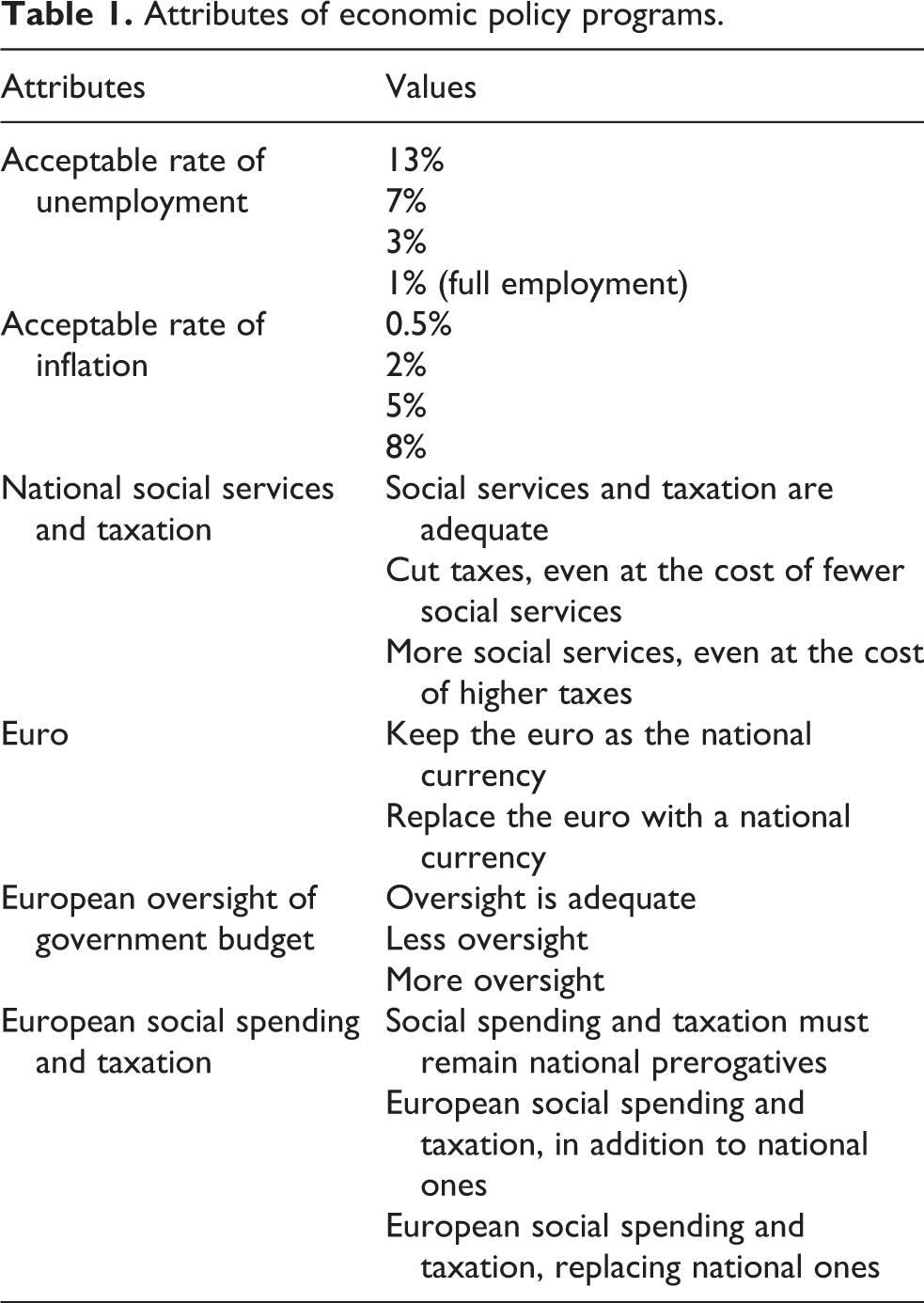
The first two attributes of these programs are economic objectives related to unemployment and inflation. We selected the rates at the time of the experiment, which were respectively the highest and lowest reported since at least the 1970s, then we added three more values up to full employment and high inflation. 7 The third attribute captures the traditional economic left-right dimension: programs may propose to increase the provision of social services, even at the cost of more taxation, to maintain the current levels, or to cut taxes, even at the cost of fewer social services.
The last three attributes are designed to capture attitudes toward the EU. The first one offers the possibility of keeping or ditching the euro. Strictly related to the single currency are the rules overseeing national fiscal policies: a program may propose maintaining, loosening, or tightening the current oversight. Finally, reflecting an important debate about whether to expand Eurozone fiscal capacity for dealing with economic shocks, the program may propose the provision of social services and taxation to remain as national prerogatives or to develop EU-wide welfare state provisions, either adding or replacing national policies.
Unemployment, taxation, and the cost of living are frequently top priorities for Italian public opinion (European Commission, 2010: 24), while loosening EU fiscal oversight was a major campaign topic of M5S (e.g., Giannetti et al., 2016). A referendum of the euro has also been a long-standing M5S campaign pledge.
The experiment was embedded in the second wave of the population-based Internet panel of the Italian National Election Survey (Vezzoni, 2014). The wave is part of the Panel Study on Political Representation in the 2013–2015 electoral cycle and was administered in June 2014, right after the European Parliament elections when attention about these issues was very high. Overall, 3026 Italian subjects have taken part in the experiment, resulting in 12104 ratings of and 6052 choices over pairwise compared programs. Figure A2 compares the actual vote shares of the parties with those from the panel study. Although supporters of large mainstream center-right parties are less likely to report their vote choice, the study approximates well the actual support for the M5S, boosting our confidence about external validity of our analysis.
Do policy preferences of M5S voters differ?
Do economic policy preferences of M5S voters significantly differ from those of other voters? The left panels of Figure 1 report the average marginal effects of selected attribute values on the probability to choose a given program, conditional on respondent’s vote choice at the 2013 national elections, which is available from the panel study data. Reference categories are the conditions at the time of the survey (13% unemployment rate, 0.5% inflation rate, no changes to taxation and spending and to budgetary oversight, euro as the national currency, and no expansion of EU fiscal capacity). Positive values mean that a program with a given attribute level is preferred to one with the reference category. Parties are ordered top down along the standard left-right economic policy cleavage. The right panels of Figure 1 report the differences between the marginal effects of M5S and other voters. 8 Higher positive values mean that M5S voters reward (or punish) a given measure or objective more (less) strongly than other voters. Higher negative values mean that they reward (or punish) it less (more) strongly. In the following analysis, we disregard inflation and EU spending since a higher cost of living and the expansion of EU fiscal capacity are opposed across the board and M5S supporters do not differ from other voters (see Figure A4 for the full results).
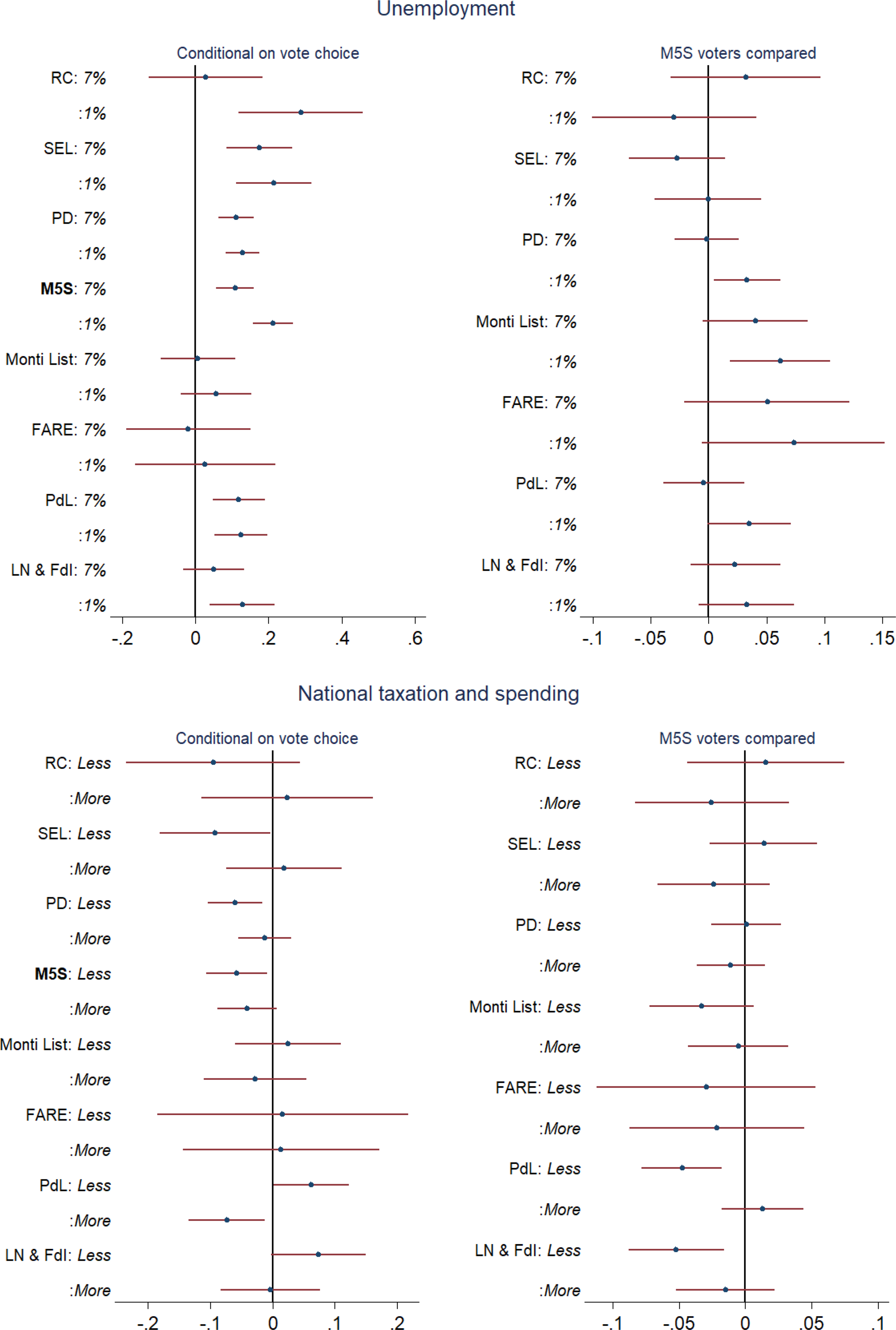
Marginal effects of program attributes, conditional on 2013 vote choice, and compared to M5S voters. Parties’ names and acronyms are listed in Table A1 of the online appendix.
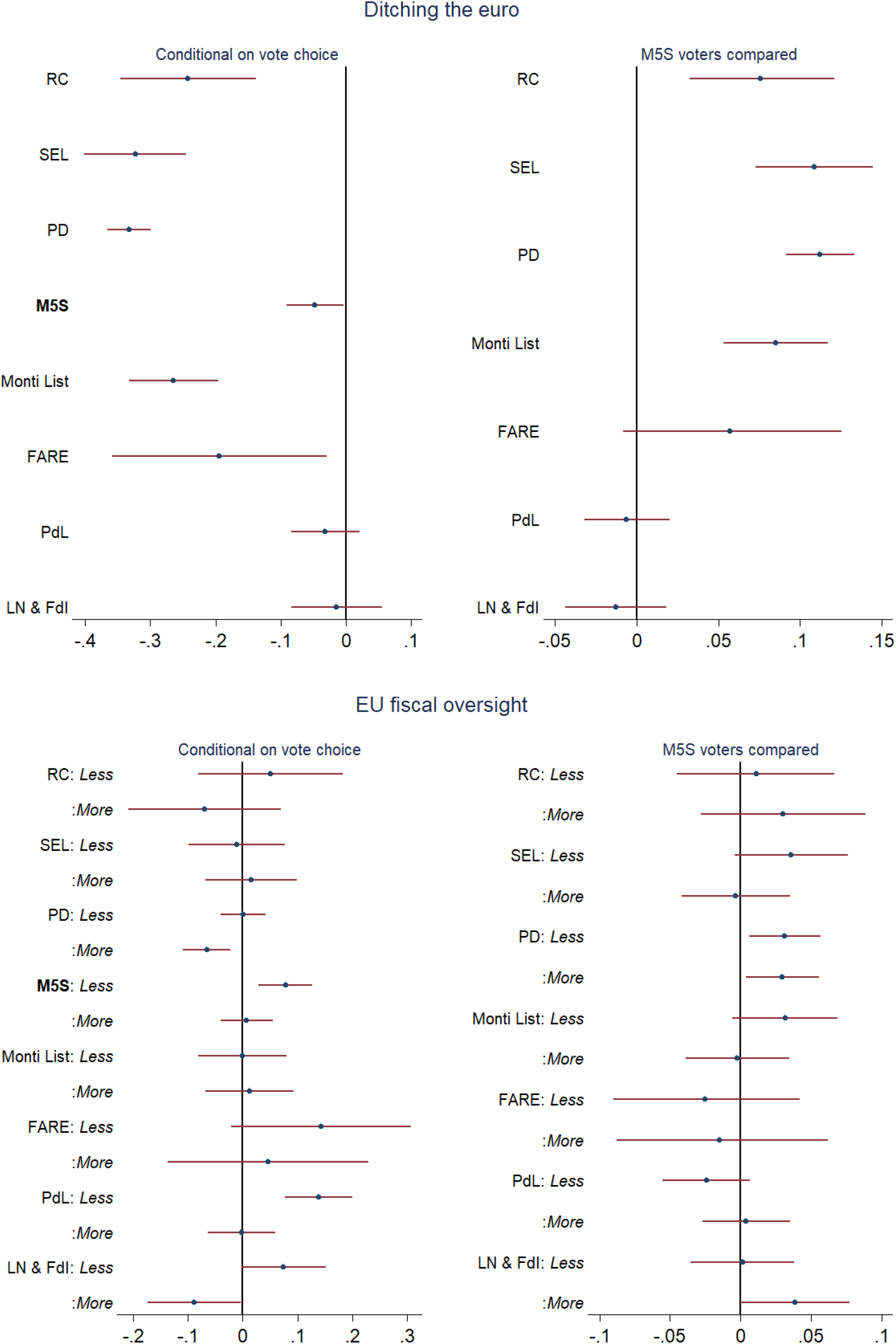
(conitnued).
The likelihood of choosing a program monotonically increases with the promise of lower unemployment, mostly regardless of partisan choice. Only voters of two small centrist liberal parties, Monti List and Act to Stop the Decline (FARE), appear insensitive to this issue. There are no differences across voters in the likelihood of preferring a program promising an improvement of the unemployment rate from 13% to 7%. 9 Instead, M5S voters reward a program promising full employment (i.e. 1% unemployment rate) significantly more than voters of the other two large parties (center-left PD and center-right People of Freedom – PdL, see right panel of Figure 1) and of Monti List. They share this support with both extreme left (Civil Revolution – RC, SEL) and extreme right (LN and Brothers of Italy—FdI) parties’ voters.
Perhaps surprisingly, M5S voters are fiscally moderate. They do not even differ significantly from Monti List voters. They oppose changes to the current size of government, but only significantly so when a program proposes a decrease in taxation and spending. Here, they share the views of PD and SEL voters and they clearly differ from PdL and LN/FdI ones, who instead support spending and tax cuts (see right panel of Figure 1). On the other hand, M5S voters’ (insignificant) opposition to more taxation and spending does not differ from most of other voters’ (including PD and PdL) attitudes.
European issues, instead, set M5S supporters clearly apart from center-left voters, who harshly penalize ditching the euro (so do voters of the pro-European Monti List, see right panel of Figure 1). Even though they still punish this option, they do not differ significantly from the indifference of PdL and LN/FdI supporters. We find the same alignment between M5S and center-right voters in their support for loosening EU budgetary oversight (note however how center-left PD and right-wing LN/FdI voters punish more oversight more harshly than other voters do).
In sum, M5S supporters are fiscally moderate (indeed, a notable result), who share with left-wing voters a strong opposition to tax and spending cuts. However, their lukewarm attachment to the euro and strong support for loosening EU budgetary oversight align them with right-wing voters along clearly Eurosceptic lines (a mild Euroscepticism emerges among center-left PD voters as well in their strong opposition to more oversight). On the other hand, the exceptional support for full employment is the feature that distinguishes M5S supporters the most from large parties’ voters. They share it with both extreme right and extreme left party supporters and it is perhaps their most populist trait. This hybrid policy profile is consistent with the recent findings of Russo et al. (2017) showing that, in the 2013 elections, 40% of M5S votes came from left-wing parties and 46% from right-wing parties. Vote switching from PD and PdL—the two mainstream parties—and mobilization of non-voters were the key drivers of its electoral success.
Figure 2 provides the best depiction of how voters trade off policy objectives. It displays the differences in the estimated probability that a program that advocates full employment, more spending and, at the top (bottom), keeping (ditching) the euro is chosen over one that maintains current unemployment, cuts spending, and keeps the currency. Positive values mean that the former program is preferred. M5S supporters significantly reward full employment by between 7.3 and 9.1 percentage points, despite their aversion to spending 10 and with no regard for the euro. PD voters instead reward keeping the euro by 6.2 percentage points, despite their aversion to spending cuts and high unemployment. PdL voters instead display no strong preference because their dislike of spending does not overcome the demand for lower unemployment and because of their lukewarm support of the euro.
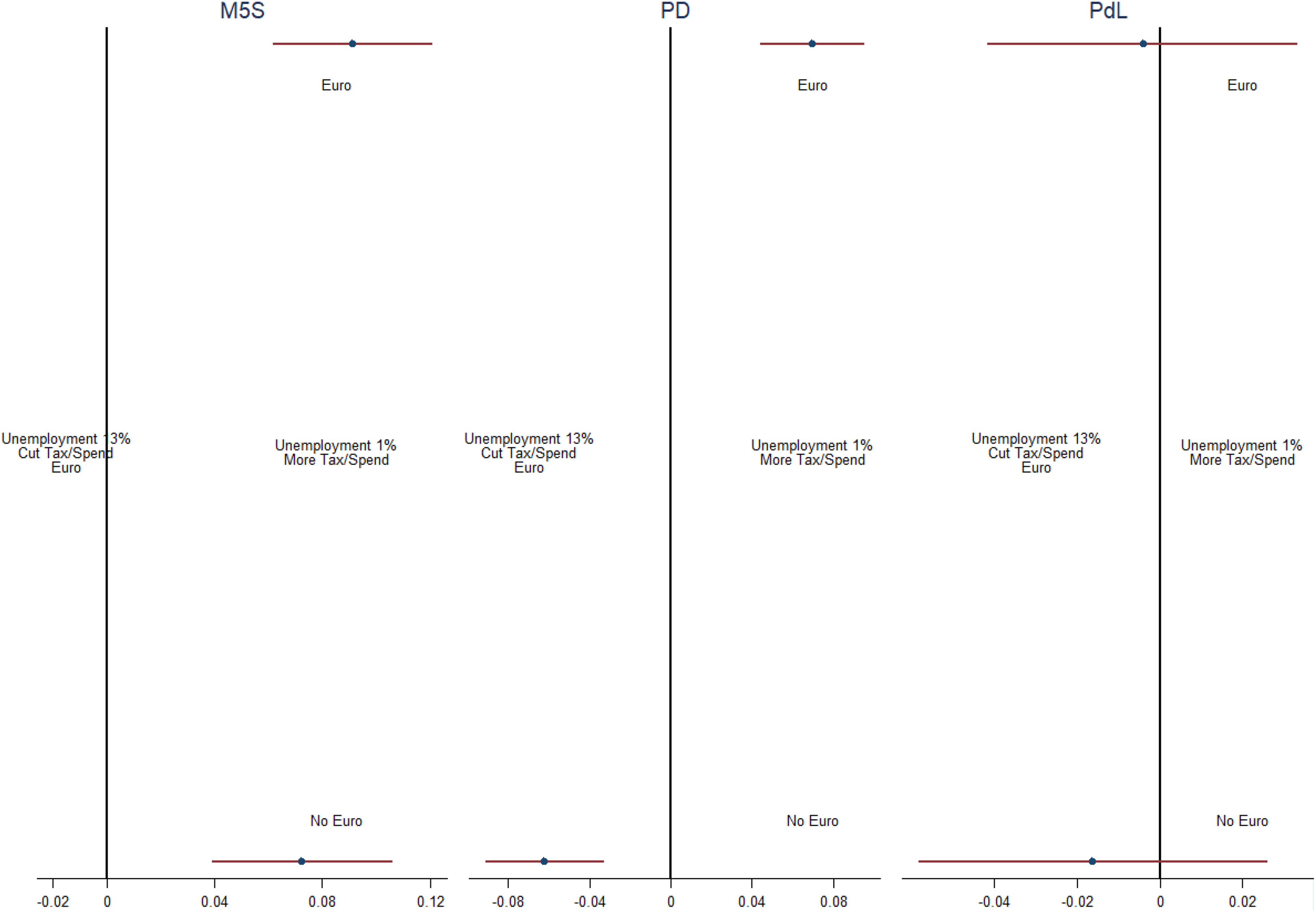
Differences in the probability of preferring a full employment-spending program. Other program attributes are kept at their current values. Parties’ names and acronyms are listed in Table A1 of the online appendix.
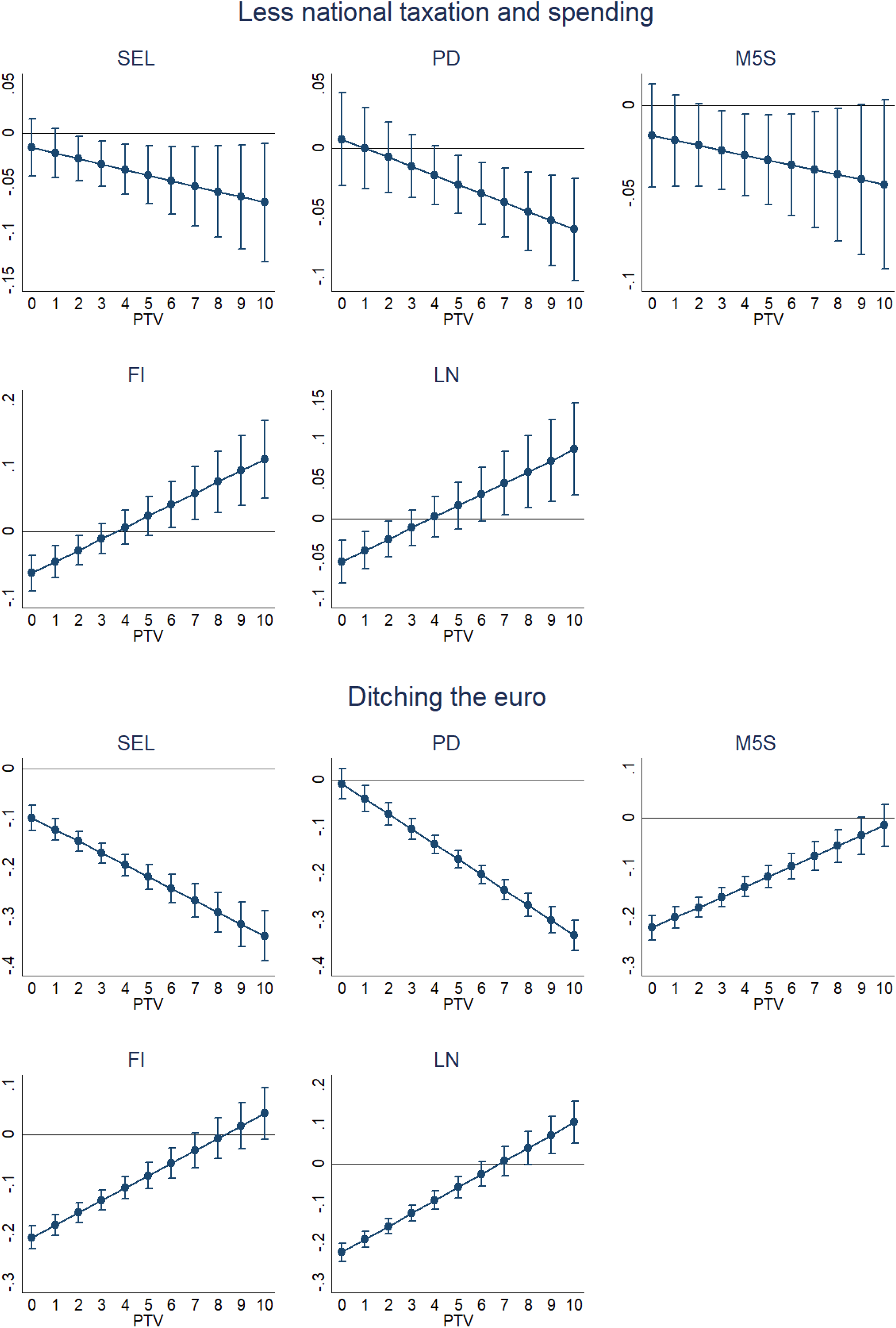
Marginal effects of selected attributes, conditional on respondents’ propensity to vote. Parties’ names and acronyms are listed in Table A1 of the online appendix. PTV: propensity to vote.
Changes at the 2014 European Parliament elections
We replicate the analysis with respondents’ vote choice and, alternatively, propensity-to-vote scores 11 at the 2014 European Parliament elections (see, respectively, Figure A5 and Figure 3) to examine whether M5S voters’ policy profile has changed one year after the party’s entry into the Italian parliament. Results are by and large similar. Only three differences deserve mention.
First, M5S voters reward full employment significantly more than voters of two small center parties (NCD-UDC), in addition to PD supporters, but they are now indistinguishable from center-right FI voters (see right panel of Figure A5). This shift is likely to originate from the split of PdL into FI, which stayed in opposition, and the small center party NCD, which entered the governing coalition. Nevertheless, we confirm Rombi’s (2016) finding that unemployment has been the main driver of Eurosceptic parties’ success at these elections, although especially for those with left-wing inclinations.
Second, M5S voters now sanction significantly more spending increases than spending cuts, setting themselves clearly apart from extreme left-wing voters of The Other Europe with Tsipras (AET that includes SEL, see right panel of Figure A5). The top panel of Figure 3 illustrates even more clearly this conservative shift in attitudes. It reports the average marginal effects of lower taxation and spending on the probability to choose a given program conditional on respondents’ propensity to vote for each party. As expected, programs proposing tax and spending cuts are penalized as the propensity to vote for SEL and PD increases and they are rewarded as the propensity to vote for FI and LN increases.
M5S supporters occupy an intermediate position. Spending cuts are not significantly penalized as the propensity to vote for this party increases. Moreover, a Wald test of joint significance demonstrates that the effect of more spending on the probability to choose a policy package for M5S supporters is statistically different from the one for PD supporters (p value = 0.022) and it is indistinguishable from the effect for FI supporters (p value = 0.946).
Third, the euro generates even less enthusiasm now among M5S supporters who, like FI and FdI voters, do not even sanction ditching the single currency (see left panel of Figure A5). However, despite the campaign pledge of holding a referendum, they do not support leaving the Eurozone. Only LN voters appear to toy with this option and they clearly differ from M5S voters (see right panel of Figure A5 ). The bottom panels of Figure 3 plot the average marginal effects of ditching the euro conditional on the propensity to vote. They illustrate the similarity between M5S and FI voters. A Wald test of joint significance shows that the effect of ditching the euro on the probability to choose a program for M5S supporters is statistically different from the one for PD supporters (p value = 0). Conversely, the same test cannot reject the null hypothesis that the effects of ditching the euro on the probability to choose a policy package for M5S and FI supporters are similar (p value = 0.330).
To sum up, fiscal moderation remains a trait of M5S supporters, but opposition to spending cuts has been replaced by opposition to spending increases: a realignment to the right that does not turn these voters into traditional right-wing supporters of a smaller government, but reveals a gradual shift of the electoral base (see also Itanes, 2013; Pedrazzani and Pinto, 2015). Lukewarm attachment to the euro (and support for loosening budgetary oversight) align M5S voters more neatly with their Eurosceptic right-wing counterparts, falling short however of the strong anti-euro traits of LN supporters. Support for full employment is now less exceptional since it is shared by FI voters. The opposition status of both M5S and FI during the 2014 elections may have turned their voters either more demanding or less realistic in terms of economic performance.
Conclusion
The Brexit referendum, early elections in the UK, the French presidential elections, and the German federal elections are only the latest examples of the impact of EU issues on domestic politics. Their potential to structure party competition depends on the extent to which preferences over EU-related topics do not align with policy preferences that are associated with the traditional economic left-right dimension (e.g., Hix and Lord, 1997; Hooghe and Marks, 1999). According to Kriesi et al. (2008), the Western European political space is two-dimensional and attitudes toward European integration are a main constituent of a new integration-demarcation divide that stands separate from the traditional economic left-right division. This divide primarily opposes conservatives believing that national identity should be sheltered from immigration and European integration and progressives who favor multiculturalism and a European sense of belonging. The economic and migration crises have exacerbated this divide and have played an important role in the rise of populist voting across Europe. Nevertheless, poor economic performances have reinvigorated traditional economic left-right divisions as well. Fringe parties have tried to gain support from low income and economically insecure voters by promising more government intervention (e.g., Guiso et al., 2017), usually in open contrast with EU budgetary oversight.
This article has investigated the policy profile of M5S voters both on the European and the economic left-right dimensions by means of a conjoint analysis. This experimental technique allows a) examining how respondents trade off different objectives and measures and b) comparing the policy profiles of M5S voters with those of other, especially mainstream, voters. This focus is valuable because the M5S is a primary example of the rise of southern European populist voting, but there is limited consensus on the position of this party in the political space.
We limit here our comments to the supporters of the three largest parties (M5S, PD, and PdL/FI). First, the conjoint experiment unsurprisingly shows that Italians share similar preferences for low unemployment and inflation, no matter their partisan choices. They also oppose EU-wide spending, especially if financed through additional taxation. The poor performance of the Italian labor market explains the strong demand for employment (Rombi, 2016). This issue will probably be salient during the forthcoming national elections in 2018. However, this broad agreement masks large differences in emphasis. M5S voters display an exceptionally strong demand for full employment, especially at the 2013 elections, and they share this attitude with both extreme right and extreme left party supporters.
Second, our results indicate that voters’ distribution in Italy appears to conform to the two-dimensional space depicted by Kriesi et al. (2008). The tax-spend divide sets center-left PD voters, who penalize reducing public spending, clearly apart from center-right PdL/FI voters, who reward this policy. Perhaps surprisingly, given the recessionary origin of this party, M5S voters occupy an intermediate position: they consider current government spending adequate and their initial opposition to cuts, which was shared with left-wing voters, turned over time into a right-wing like opposition to spending increases.
Once we move on to the integration-demarcation dimension, lukewarm support for the euro sets M5S voters clearly apart from center-left PD voters and moves them closer, and increasingly so, to right-wing counterparts. This is in line with Passarelli and Tuorlo’s (2017) analysis of M5S voting at the 2013 national elections, according to which Euroscepticism is a defining feature of M5S support. These results further suggest that in Italy we do not observe the overlapping between pro-anti EU dimension and economic left-right dimension that Otjes and Katsanidou (2017) discover in Greece, where citizens with economic left-wing orientations are more Eurosceptic while citizens favoring small government are more Europhiles.
Therefore what could M5S’s winning formula be? Van der Brug and Van Spanje (2009) show that across Western Europe a large group of voters with progressive socio-economic positions and conservative demarcation positions is not well represented at the party level. With some caveats, especially regarding government size, M5S appears to be filling this gap. Consider Figure 2. When faced with two programs, which both advocate full employment but differ on whether to keep or not to keep the euro, M5S voters are insensitive: they have no qualms about ditching the single currency if that means full employment—a feature that sets M5S voters far apart from mainstream ones. It seems that they are more willing to accept the disputable argument that leaving the Eurozone would benefit the Italian economy—a claim that mainstream voters are significantly more sceptical about. Indeed, the M5S’s manifesto of the 2018 national elections explicitly refers to this issue. 12
More cynically, M5S winning formula seems to rely on the promise of better economic performance, oblivious of responsibility. The short-term consequences of the third-largest sovereign bond market in the world leaving the Eurozone cannot be anything but cataclysmic, both domestically and internationally. The risk of default would not be trivial. Hence, the carelessness with which M5S treats the issue betrays a lack of responsibility—an unwillingness to act prudently, following accepted norms and practices (Mair, 2009) and to take into account claims of audiences other than the national electorate, such as financial markets and international organizations that are at the root of a country’s credibility (Bardi et al., 2014).
Lastly, our results question the classification of M5S as a left-wing populist party. It was probably appropriate during the 2009–2012 period, when its policy proposals focused on environmental issues, sustainable development, and the digital economy. It was also consistent with the composition of electoral support in this period: at the 2012 administrative elections, 48% of M5S voters were former left-wing supporters. However, this share is shrinking. At the 2013 national elections only one-third of its supporters had previously voted for left-wing parties, while one-third came from right-wing parties or did not express a clear political background (Itanes, 2013). 13 Our experiment provides further evidence of the gradual rightward shift in both electoral support and party policy platform at the 2014 European elections (see also Tronconi, 2015). The weakening of the center-right coalition, so far led by Silvio Berlusconi, probably represents a good opportunity for this repositioning. It might turn out to be a successful electoral strategy.
Supplemental material
Supplemental Material, Online_appendix_PP_2018 - The fiscally moderate Italian populist voter: Evidence from a survey experiment
Supplemental Material, Online_appendix_PP_2018 for The fiscally moderate Italian populist voter: Evidence from a survey experiment by Fabio Franchino and Fedra Negri in Party Politics
Supplemental material
Supplemental Material, Replication_material_PP_2018 - The fiscally moderate Italian populist voter: Evidence from a survey experiment
Supplemental Material, Replication_material_PP_2018 for The fiscally moderate Italian populist voter: Evidence from a survey experiment by Fabio Franchino and Fedra Negri in Party Politics
Footnotes
Declaration of conflicting interests
The authors declared no potential conflicts of interest with respect to the research, authorship, and/or publication of this article.
Funding
The author(s) disclosed receipt of the following financial support for the research, authorship, and/or publication of this article: We kindly acknowledge the financial support from the Italian Ministry of Education, University and Research (Research project 2010943X4L_003, 2013–16 ‘How Political Representation Changes in Italy. Voting Decisions over the 2013–2015 Electoral Cycle’) and from the Cariplo Foundation (Research project CP3—Finanziamenti Cariplo 2013 ‘The Effects of the Economic Crisis on the Attitudes towards Europe of the Italian Voters (with a Special Focus on Northern Italy) in the 2014 European Elections’). The experiment has been administered by SWG on behalf of the Italian National Election Studies Association ( ). Finally, we thank the two anonymous reviewers: their detailed comments improved the quality of the article.
Supplemental material
Notes
References
Supplementary Material
Please find the following supplemental material available below.
For Open Access articles published under a Creative Commons License, all supplemental material carries the same license as the article it is associated with.
For non-Open Access articles published, all supplemental material carries a non-exclusive license, and permission requests for re-use of supplemental material or any part of supplemental material shall be sent directly to the copyright owner as specified in the copyright notice associated with the article.
