



Abstract
Immigration is often perceived as a political topic that overlaps traditional ideological cleavages. Much research has focused on the positions of the extreme right, and little research has examined mainstream parties and their public stances on immigration. This shortcoming hampers broader understanding of political competition on this issue. Drawing on a political claims analysis of seven countries between 1995 and 2009, we present the salience, position and overall coherence of claims made by mainstream parties on immigration control and immigrant integration. Mainstream left parties adopt a more positive/expansive position on immigration and exhibit higher levels of coherence than centrist and right-wing parties. We also show that the impact of extreme-right parties on the political claims of mainstream left parties seems to be limited. Our conclusions highlight that immigration does not necessarily constitute a cross-cutting cleavage across mainstream left parties: Their ideological preferences remain aligned with their positive/liberal discourse on immigration control and immigrant integration.
Keywords
Introduction
International migration is one of the most complex challenges Western political systems have faced in the last two decades (Givens, 2012). Recently, immigration played an important role in the debate around the 2016 British referendum on European Union (EU) membership (commonly known as ‘Brexit’) and in the campaign of Donald Trump in his successful 2016 bid for the presidency of the United States of America. Political competition over immigration control and immigrant integration has been associated with the electoral success of extreme-right parties (ERPs) in Europe, especially since the mid-1990s (Kitschelt, 1995; Messina, 2007). Much research has focused on ERPs and their use of immigration as a political topic (Mudde, 2016), but there is surprisingly little research on mainstream parties and their political stance on immigration and integration (Bale, 2008; Helbling, 2014; Odmalm and Hepburn, 2017). In comparison with the limited research available on the mainstream right and immigration (see Bale, 2008; Carvalho, 2019; Meguid, 2008), left-wing parties in particular have been neglected by political scientists working on immigration (Alonso and Fonseca, 2011; Hinnfors et al., 2012). This shortcoming limits our knowledge about the political competition between mainstream parties on this contentious topic, which enhances intense controversy and diametrically opposed observations in the literature.
Within this context, immigration is frequently highlighted as a new political cleavage in European political systems that, potentially, cut across traditional party cleavages of political competition (Alonso and Fonseca, 2011; Hampshire, 2012; Money, 1999). Other authors, however, suggest that the competition over immigration conforms to the left–right model since the ideological position of political parties still provides a consistent indicator of their liberal/ restrictive stances on this topic (Bale, 2008; Helbling, 2014). To some extent, these opposite conclusions can be related to the distinct research methods employed by the studies. In an attempt to shed light on the nature of mainstream political competition on immigration, in this article, we compare the relationship between the ideological position of left-wing mainstream parties and their political claims on immigration control and immigrant integration across seven European countries. Typically, we can expect the stances of mainstream political parties on the aforementioned issues to reflect the preferences of their constituents, but also that they guide and structure the political reasoning of constituents on political topics (Bale, 2008; Morales et al., 2015). With their seats in the legislature and direct access to cabinet positions, left-wing mainstream parties hold significant influence over policymaking and policy change as their centrist and right-wing counterparts (unlike most ERPs); thus, their role merits closer examination.
Based on the analysis of France, Germany and the United Kingdom between 1990 and 2002, Givens and Luedtke (2005) argue that the ideological positions of mainstream political parties play an important role in the design and reform of policies concerning the integration of settled immigrants. However, their work suggests only a feeble relationship with policies of immigration control. We follow this distinction between immigration control – attempts to bring in new immigrants or, typically, keep them out of the country – and immigrant integration, where the focus is on the incorporation of immigrants settled in the receiving country. This distinction is also emphasized by Meyers (2002), Geddes (2003) and Hammar (2010). As Bale (2008) highlights, however, the analysis by Givens and Luedtke should be tested on a wider range of countries and over time. We heed this call by examining four expectations related to the salience and the position of mainstream left parties on immigration control and immigrant integration in seven different countries between 1995 and 2009. This includes an evaluation of the influence of ERP on the political positions on immigration that mainstream left parties adopted in the public sphere.
Past studies focusing on the positions adopted by governing parties on immigration assessed the relationship between being right-wing and having a negative stance on immigration (e.g. Breunig and Luedtke, 2008; Koopmans et al., 2010). Using data from the Comparative Manifesto Project (CMP) between 1987 and 1999 concerning 18 Organisation for Economic Co-operation and Development countries, Breunig and Luedtke (2008) highlight that there is no significant statistical relationship between the positions of governing parties on immigration and the ideological orientation of the parties. 1 Drawing on a longer period – 1975 to 2005 – and 18 West European countries, Alonso and Fonseca (2011) come to a contradictory conclusion, namely that ‘the more to the right a party stands, the more sceptical its attitudes to immigration’ (Alonso and Fonseca, 2011: 873). Alonso and Fonseca also suggest that this relationship between left–right ideology and position on immigration is weaker for left-wing parties, which are supposedly more vulnerable to the challenge of the extreme right than the mainstream right. Focusing on frames employed by parties in claims in newspapers, Helbling (2014) finds that left-wing parties are more likely to highlight moral universal arguments (involving fairness and equality, group discrimination, or human rights; see also contributions in van der Brug et al., 2015; Ruedin, 2017; Rosenberger and Ruedin, 2017).
The present study contributes to this literature by comparing the political claims of mainstream left parties and their competitors on immigration control and immigrant integration drawing on an extensive media analysis by van der Brug et al. (2015). Claims analysis of newspapers seems more suitable to examine the political competition on immigration from a dynamic longitudinal perspective than party manifestos, which are mostly driven by short-term electoral objectives, possess weak dissemination (Carvalho, 2014) and remain unchanged until the subsequent election. Notwithstanding the observation of media’s selection bias and descriptive bias, newspapers allow claims by parties to have an impact on a much broader audience and provide a better source from which to develop a longitudinal and cross-national analysis of the reported mainstream parties’ positions in the public sphere (Helbling, 2014). It can be argued that only by passing the media filter the claims and positions in party manifestos become more generally politically relevant (van der Brug et al., 2015), but – focusing on institutional settings – Boräng (2012) highlights that in Sweden some parties publicly defended ‘generous’ asylum policies yet supported more restrictive policies in parliament. In the present study, news reports about parliamentary actions are included, which should alleviate some of the differences between electioneering and party position.
Past research concluded that press reports are generally accurate and not deviate from accepted standards of reliability and validity when the focus is not on absolute numbers (Earl et al., 2004; Koopmans and Statham, 2010). In the present study, we capture public statements and are not interested in relating these to policy outcomes. We assume that policy outcomes have little impact on party politics and voting unless they are debated and politicized – in which case they are captured in the data used. In contrast to existing studies, we examine both salience and position. Salience measures the relative frequency at which parties make public claims about immigration, while position distinguishes between positive/expansive (if they are open to immigration flows, support cosmopolitanism and multiculturalism) and negative/restrictive claims (expressing opposition to inflows or pronational and monocultural positions; see van der Brug et al., 2015).
The article initially explores the dilemma posed by immigration to the mainstream left parties and presents the expectations tested in the cross-national analysis. The comparative analysis first examines the salience of immigration in the claims made by mainstream left parties, before exploring the position of these claims. We consider positions on immigration control and immigrant integration, as well as the levels of coherence of the claims by left-wing parties. Mainstream left parties make proportionally fewer claims about immigration, adopt a more positive/expansive position on immigration and exhibit higher levels of coherence than those of centrist and right-wing parties. We highlight a consistent link between the left-wing ideology of mainstream parties and the position of claims on immigration control and immigrant integration, which challenges the conclusions in the literature suggesting that immigration constitutes a cross-cutting cleavage. These associations can be found for both immigration control and immigrant integration. In a separate section, we examine whether the presence of ERP affects the salience or position of mainstream left parties. We argue that the presence of ERP in national legislatures or governments does not have a substantive impact on the overall strategies of left-wing parties on immigration as has been suggested. We conclude that the ideology of political parties provides a consistent indicator of their stances on immigration: Immigration generally does not cut across traditional ideological boundaries of party families in the selected countries.
The left’s immigration dilemma
Although the impact of immigration control and immigrant integration on political competition has been studied in the context of centre–right parties’ electoral strategies (Bale, 2008), these topics also pose salient challenges to the mainstream left. The strategies of centre–left and left-wing parties on immigration control and immigrant integration must attain a delicate balance between competing political pressures (de Haas and Natter, 2015). On the one hand, an important section of the electorate on the left is formed by voters with high levels of education and income who tend to have cosmopolitan worldviews and liberal sociocultural values (Alonso and Fonseca, 2011; Rennwald and Evans, 2014). On the other hand, left-wing parties often depend on the electoral support of the working class, members of which often feel threatened by globalization and direct competition with unskilled immigrants in the lowest segments of the labour market (Norris, 2005; Pecoraro and Ruedin, 2018), not least in a context of deindustrialization. By imposing limits on immigration, left-wing parties can retain collective power and social harmony in the labour market, while a ‘laissez-faire’ approach might lead to wages being undercut and to the undermining of collective bargaining (Odmalm and Bale, 2015). With this internal division, parties on the left are likely to alienate (potential) voters if they adopt a clear stance on immigration control and immigrant integration and are strategically better off when focusing on issues which unite their electorate. We can formulate the following expectations:
Salience expectation
Mainstream left-wing parties make fewer claims on immigration (including immigration control and immigrant integration) than centrist and right-wing parties.
Past research suggests that left-wing parties are likely to perceive immigrants as potential new voters, because immigrants tend to belong to the working class – the historical voter base of the left (Givens and Luedtke, 2005; Rennwald and Evans, 2014). This perception supports a positive/expansive approach to the expansion of immigrant rights and access to naturalization in light of the potential electoral benefits derived (Money, 1999). Most European states, however, restrict the political rights of immigrants, congruent with public opposition to expansive positions (Breunig and Luedtke, 2008): This works as a strong disincentive to the adoption of positive/expansive positions on immigration control. Following an interests-based approach, we can expect mainstream left parties to support positive/expansive integration policies but converge with right-wing governments on negative/restrictive policies of immigration control (Givens, 2012; Givens and Luedtke, 2005). Nonetheless, research conducted on the development of immigrant rights in 10 European countries between 1980 and 2008 failed to identify a consistent relationship between a higher level of immigrant rights and government incumbency of left-wing parties (Koopmans et al., 2010; see also de Haas and Natter, 2015). With the claims data from newspapers, we can systematically test the potential difference between the stances adopted by mainstream parties on immigration control and immigrant integration and need not rely on policy outcomes where multiple stakeholders may share responsibility:
Positional expectations
Mainstream left-wing parties adopt more positive/expansive positions on immigration control than centrist and right-wing parties and
mainstream left-wing parties adopt more positive/expansive stances on immigrant integration than their competitors.
Generally, mainstream left-wing parties adhere to social egalitarianism and solidarity, values embodied in a universalist approach that embraces immigrants and rejects nationalist stances (Alonso and Fonseca, 2011). In their party manifestos, left-wing parties emphasize socioeconomic equality, a strong and universal welfare system and a widespread public school system (Hinnfors et al., 2012). These priorities are inclusive and extend to many disadvantaged groups in society, including members of ethnic minority groups (Messina, 2007). Research conducted on members of the European Parliament in the early 2000s suggests that ‘partisans of the left’ were more likely to favour an extension of immigrant rights and an increase in immigration than their right-wing counterparts (Lahav, 2004). In this context, centre–left parties can also face pressures from new postmaterialist parties – notably the Greens – that regard immigration as a fundamental human right and the acceptance of newcomers, in particular refugees, as demonstrations of international solidarity (Alonso and Fonseca, 2011; Odmalm and Bale, 2015; Rosenberger and Ruedin et al., 2018). These pressures can divert voters with cosmopolitan views and members of ethnic minority groups away from mainstream left parties. Given the shared left-wing ideology, we expect stronger coherence and less polarization in the position of political claims on immigration control and immigrant integration among mainstream left parties than among their right-wing competitors:
Polarization expectation
Mainstream left-wing parties are less polarized on immigration control than right-wing parties, and
mainstream left-wing parties are less polarized on immigrant integration than right-wing parties.
Mainstream left parties face three additional challenges regarding political competition on immigration when there is a successful ERP (Bale et al., 2010; Meguid, 2008). First, ERPs adopt valence strategies to capitalize on their issue ownership of immigration, a tactic that benefits the centre–right parties to the detriment of the mainstream left. Second, the extreme right can attract voters from mainstream left parties, particularly those with authoritarian attitudes and those on the left of the state–market cleavage (Norris, 2005). Third, ERPs recurrently provide direct or indirect support to centre–right minority or coalition governments – in several countries, to the detriment of left-wing governments (Bale et al., 2010). It follows that, in the face of a challenge by centre–right or ERP, mainstream left parties will shift their stances closer to the attitudes of the median voter and adopt a more negative/restrictive position towards immigration control and immigrant integration (Alonso and Fonseca, 2011; van Spanje, 2010). We assess this expectation across four selected case studies with electorally successful ERP.
Competition expectation
Mainstream left-wing parties adopt relatively more negative/restrictive positions on immigration control if there is an electorally successful ERP, and
mainstream left-wing parties adopt relatively more negative/restrictive positions on immigrant integration if there is an electorally successful ERP.
Case selection and methods
We draw on the claims analysis conducted by van der Brug et al. (2015), thus following their country selection. The data cover claims by a broad selection of political actors in seven European countries between 1995 and 2009. van der Brug et al. (2015) justify their country selection – Austria, Belgium, Ireland, the Netherlands, Spain, Switzerland and the United Kingdom – as a means of observing variation with regard to two characteristics: the intensity of immigration and the date when substantial immigration flows started on the one hand and the nature of the party systems (two-party vs. multiparty systems) on the other. The countries include old countries of immigration with and without a colonial past (Belgium, Netherlands, the United Kingdom, Austria and Switzerland) and new countries of immigration (Spain and Ireland). For the purposes of this article, there is also a variation in the presence of ERP (Austria, Belgium, the Netherlands and Switzerland). With this, the data are well suited to examine patterns of mainstream party competition on immigration control and immigrant integration.
The claims analysis by van der Brug et al. (2015) randomly selected 700 days for each country or the two dominant language areas in the case of Belgium and Switzerland. For each selected day, all articles on immigration control and immigrant integration were sampled from two national newspapers. Sampling was done manually by checking all articles in the newspapers – no keywords were used for this; van der Brug et al. collected over 7000 articles from broadsheet and tabloid newspapers and manually coded over 10,000 claims in these articles. The selection of different media outlets in each country provides a more heterogeneous analysis of the way political parties’ positions are portrayed in the mass media, enhancing the reliability and validity of the analysis by minimizing problems of journalistic bias (Koopmans and Statham, 2010). The share of claims by left-wing parties as part of all claims by political parties is our first outcome variable.
A relevant claim consists of a purposive public political demand, a criticism or a comment that (potentially) affect the interests of immigrants, and newspaper articles may contain multiple claims. For each claim, van der Brug et al. coded many characteristics, like who made the claim (actor), what justification they used, about which immigrant group they talked or whether the claim would have a positive or negative bearing on an immigrant group (position). The position is measured on a 5-point scale ranging from negative/restrictive to positive/expansive. We derive our positional outcome variable, the position of parties, by averaging the position of their claims about immigration. This is sometimes referred to as the ‘tone’ of claims. From the overall data, we focus on a particular subset: 1550 claims by (representatives of) political parties. During coding, the ‘name of the organization an actor is affiliated with’ was noted, of which we only consider formally organized political parties.
We drew on documentation by van der Brug et al. (2015) to identify parties as left-wing and verified this information against Manifesto Research on Political Representation (MARPOR) (Lehmann et al., 2016). At this stage, we also classified the smaller parties not covered by van der Brug et al. We also used information by MARPOR to identify major party families, which allows us to check whether the results presented for left-wing parties are generally applicable to all kinds of left-wing parties or unique to socialist, communist or green parties. This analysis is carried out as a robustness check, and we have no expectations about likely differences between different kinds of left-wing parties.
The data by van der Brug et al. (2015) differentiate between claims about immigration control and immigrant integration. Immigration control (or immigration policy) refers to the regulation of flows of immigration as it relates to border crossing (labour, family reunion, asylum and irregular immigration), as well as the control of foreign citizens settled within the country (Geddes, 2003). Therefore, it refers to the rules and procedures that frame the admission (either temporary or permanent), settlement and removal of foreign citizens in and from the host countries, which remain a prerogative of national governments (Hammar, 2010). Foreign citizens can evade immigration control when they access full citizenship of the country of destination through naturalization. By contrast, immigrant integration (also referred to as immigrant policy) considers the conditions provided by the host state for the settlement of foreign citizens in their territory (Hammar, 2010). This category includes the implementation of provisions and policies such as basic legal and social protection, anti-discrimination legislation, multicultural education or access to full citizenship through naturalization (Favell, 2001).
Analytically, we draw on descriptive statistics, as well as hierarchical models where periods are nested in countries, using a Gaussian identity link. To capture salience and position, the share or interpolated median position of claims by left-wing parties is calculated for each country-year, yielding 105 observations. The predictor variables are the share of left-wing parties in parliament, whether left-wing parties were in government and the presence of ERP in parliament or government. These models also control for the relative salience of immigration (compared with other years and countries), the share of immigrants in the population, gross domestic product (GDP) growth, period and country. Modelling was carried out in R (R Core Team, 2017) and the package brms (Bürkner, 2017).
Salience of political claims on immigration control and integration
In Figure 1, we show that right and centrist parties systematically make more claims on immigration than mainstream left parties in the selected timeframe. The figure uses aggregate data and shows the share of claims on immigration made by left-wing parties over time. The dominance of right and centrist parties is only disrupted in 2001 and 2003, when the number of claims associated with left-wing parties is larger. It appears that, for centrist and right-wing parties, immigration is more salient in their electoral strategies than for mainstream left parties. With this, we find support for the salience expectation.

Share of claims by left-wing parties over time. Note: The dashed line indicates 50% of claims; overall 57% of claims are made by right and centre–right parties, with 43% of claims being made by left-wing parties; see Tables A1 and A2 in the Online Appendix for the distribution by country and the distribution of different kinds of left-wing parties over time.
The analysis of the patterns of claims-making observed at the country level in Table A1 in the Online Appendix suggests that mainstream left parties were more present in the political debate on immigration in Austria, Ireland and Spain, whereas in Belgium, Switzerland, the Netherlands and the United Kingdom, centrist and right-wing parties dominate claims on immigration. This dominance of centrist and right-wing parties was particularly strong in Switzerland and Britain. The analysis by country highlights that there is a substantial variance in the extent to which left-wing parties draw on immigration in their debates. This variance suggests that endogenous explanatory factors should be explored to explain the cross-national differences. Table A2 in the Online Appendix shows that the dominance of left-wing parties can be observed across different party families on the left. In a multivariate regression analysis (Table A3), the share of claims by left-wing parties is primarily determined by a left-wing government (predicted 6 percentage point increase, with a 95% credibility interval [CI] from 3 to 9 percentage points) and not the strength of left-wing parties in parliament (predicted 10percentage point decrease, with a 95% CI from −37 to +14 percentage points).
Political claims on immigration on immigration control and integration
We observe a positive relationship between the ideological affiliation of parties and the position of their claims on immigration control. Drawing on aggregate data at the national level, mainstream left parties consistently adopt a clear positive/expansive position on immigration control from 1995 to 2009 (left panel of Figure 2). During the entire period, left-wing parties clearly made more positive/expansive claims in the news than centrist and right-wing parties (see also Ruedin, 2017); when averaged across time, the interpolated median for left-wing parties is 0.78 and −0.37 for centrist and right-wing parties. Centrist and right-wing parties tend to adopt negative/restrictive positions, although in the late 1990s, we observe rather neutral positions. This trend suggests that the competitors of left-wing parties radicalized their discourse on immigration during the 2000s compared with the late 1990s. In multivariate regression analysis, left-wing position is a consistent positive covariate, even after controlling for left-wing parties being part of government, as well as (unspecified) time and country specificities (Table A4, top). Partisanship is an important predictor of the position of political claims on immigration control in the public sphere. Overall, there is a consistent relationship between left-wing ideology of political parties and a positive/expansive stance on immigration – irrespective of whether we examine immigration control or immigrant integration.

Position on immigration by party family over time. Note: All countries are combined. The dashed line indicates a neutral position; interpolated median positions are calculated for each year: red (top) line for left-wing parties; blue (bottom) line for right and centre–right parties.
Drawing on the analysis of political claims on immigration control at the country level, mainstream left parties adopted a consistent positive/expansive position across six of the seven countries (Table 1). In Britain, the interpolated median value of the claims by the British Labour Party is neutral (Tables 1 and A6): The British centre–left has adopted an ambiguous approach on immigration control, as the Labour Party seemed less prone to adopt a positive/expansive position than their counterparts in the other countries. The British centrist and right-wing parties adopted the most negative/restrictive position on immigration control among the countries covered, as indicated by the interpolated median value of −0.83. These can help to understand the prominence of immigration in the British political agenda from 2000 onwards, including the 2016 referendum on EU membership (Carvalho et al., 2015; Hobolt, 2016).
Position on immigration by party family at the national level.
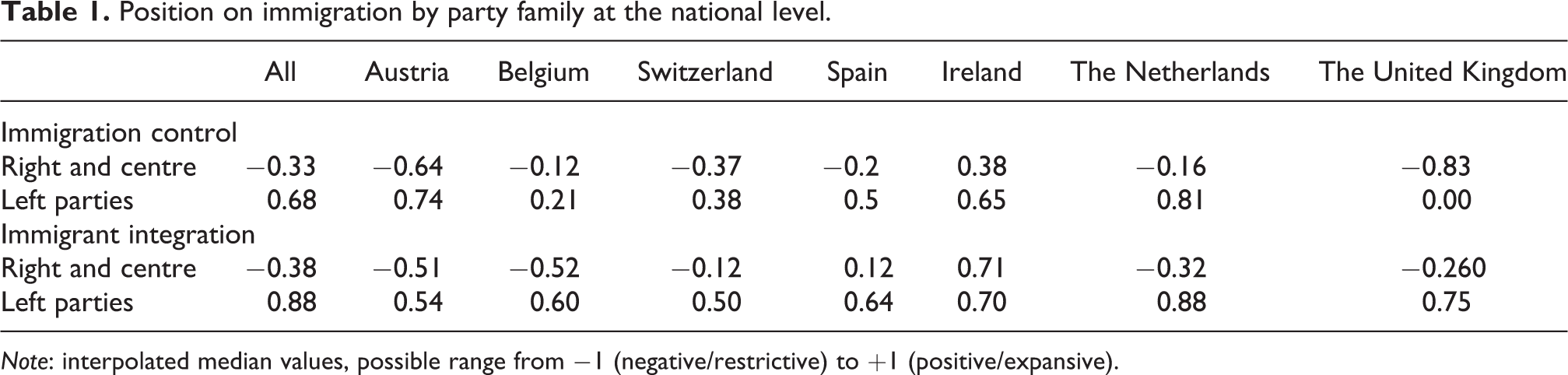
Note: interpolated median values, possible range from −1 (negative/restrictive) to +1 (positive/expansive).
Remarkably, the countries where mainstream left parties made more claims on immigration control and integration than centrist and right-wing parties (Austria, Ireland and Spain) are also the countries where the left-wing parties adopted a clearly positive/expansive position towards immigration control (Table 1). Furthermore, a positive/expansive mainstream party consensus spanning both the left and the right was identified in Ireland – both for immigration control and immigrant integration – although the number of claims recorded in Ireland is smaller than in other countries. Considering all countries, the patterns observed at the national level indicate that convergence between the political claims of mainstream parties on immigration control is uncommon, while polarization is intense in most countries. This tendency for left-wing parties to have a more positive/expansive stance on immigration can be found across countries, time, issues and party families of the left (Tables A4–A7 in the Online Appendix).
The analysis of the position on immigration control suggests a lower degree of polarization among left-wing parties than among centrist and right-wing parties (Table 2). Here, we use Van der Eijk’s (2001) measure of agreement, subtracted from one to express polarization. Larger values indicate greater polarization. Levels of polarization are substantially lower among left-wing parties: There is strong coherence between their ideological preferences. Given this, we find clear support for our polarization expectation. We suggest that this reflects the fact that the position of left-wing parties on immigration is constrained by their ideology, which prevents them from taking negative/restrictive stances on immigration.
Polarization over immigration by party family.

Note: polarization ranges from 0 to +1, with higher values indicating more polarization.
Looking at political claims on immigrant integration (right panel of Figure 2), mainstream left-wing parties adopt an overwhelming positive/expansive approach. In the period under study, we observed the least positive/expansive claims on immigrant integration by mainstream left parties in 2003 and 2006 (0.57 on a scale from −1 to +1). Compared with the patterns observed on immigration control, mainstream left parties seem to adopt a slightly more positive/expansive stance on immigrant integration than on immigration control. Figure 2 also suggests that the positive/expansive positions become more consistent over time. By contrast, centrist and right-wing parties adopted a restrictive stance on the integration of immigrants, especially after the end of the 1990s. Between 1996 and 1998, centrist and right-wing parties converged on a positive/expansive position on this issue, but this deviant pattern was not repeated during the 2000s. Like the mainstream left, centrist and right-wing parties adopt a less restrictive position on immigrant integration than on immigration control, which suggests that immigrant integration is less divisive than immigration control – both within and across parties (refer Table 2).
Drawing on the analysis of political claims on immigrant integration at the country level, mainstream left parties overwhelmingly adopted a positive/expansive position on immigrant integration across the seven selected countries (bottom of Table 1). By contrast, the political claims of centrist and right-wing parties on integration policy were more restrictive/negative in five of the seven selected European countries. Ireland and Spain were the only countries where mainstream left parties and their competitors converged on a positive/expansive approach. The integration of immigrants seems to be a less contentious topic regarding political competition among mainstream parties in new rather than in old countries of immigration.
The examination of the position of political claims within the category of mainstream left parties from a longitudinal perspective indicates a strong degree of coherence over time: The mainstream left parties in the seven countries have consistently supported the integration of foreign citizens in their host societies. Moreover, the polarization among mainstream left parties on the issue of immigrant integration is lower than on immigration control, but this difference is probably negligible (Table 2). Similarly, the longitudinal analysis of political claims on integration policy of centrist and right-wing parties reveals a higher level of polarization than with their left-wing counterparts. As with mainstream left parties, the variation across centrist and right-wing parties on integration policy is lower than for immigration control (Table 2). Hence, the mainstream left parties in the seven European countries demonstrated a high level of coherence between their ideology and the position of their claims on integration at the national level, which supports our expectations.
ERP’s influence on the salience and position of mainstream left parties
A final influence on the positions of left-wing parties on immigration we examine is the presence of ERP. In Table A8, we show that the share of claims by left-wing parties is lower when ERPs are present in the national legislature, both on immigration control (56% vs. 35%) and on immigrant integration (60% vs. 52%). The Dutch case may shed some light, here, since, contrary to the other cases, ERPs were present in only some of the years under consideration. In line with the picture presented, the share of claims by left-wing parties was 50% in years without ERP in the national legislature and 40% in years when ERPs were present in the national legislature. For the presence or ERP in government rather than in the legislature, we find no substantive differences on the share of claims by left-wing parties.
In multivariate regression analysis with the share of claims by left-wing parties in a country and year as the outcome variables and as predictor variables the presence of ERP, the share of left-wing parties in the legislature, a binary indicator whether a left-wing party was in government, the share of immigrants, GDP growth and years nested in countries, the presence of ERP in the legislature credibly includes zero (coefficient −0.01, with 95% CI from −0.07 to +0.05, Table A10
The presence of ERP may affect the position of claims by left-wing parties rather than their share in claims-making. In Table A9, we look at the interpolated median position by left-wing and centrist and right-wing parties when ERPs are present in or absent from the national legislature. If anything, it appears that left-wing parties react to the presence of ERP with slightly more claims that are more expansive on immigration control (compare van Heerden and van der Brug, 2017). However, in multivariate regression models with the position of left-wing parties as the outcome variable, the presence of ERP in the legislature or government plausibly includes zero: The coefficient for ERP presence in the national legislature is −0.22 [95% CI, −0.56, +0.12]; the coefficient for ERP presence in government is 0.03 [95% CI, −0.29, +0.35]. We conclude that there is no clear evidence that the presence of ERP – in either national legislatures or governments – has a substantial impact on the salience or position of claims on immigration.
As a test of robustness, we considered whether the position of claims differs by the kind of immigrant group discussed, or whether it was an election year. The data do not include a sufficient number of claims about immigrants from the EU in particular, so we cannot examine whether the positions of claims on immigrants from within the EU differ substantively from those associated with immigrants from outside the EU. The reason for this is that van der Brug et al. (2015) seem to have prioritized other forms of classification during coding. By contrast, we can observe that the positions to asylum seekers and refugees (mean position by left parties, 0.80) do not vary substantively from the positions to other immigrants (mean position by left parties, 0.72). Similarly, like for centre- and right-wing parties, left wing parties’ positions in election years (mean position, 0.51) are around 0.2 points more restrictive on the scale from −1 to +1, compared with other years (0.73). Substantively, the large difference to right-wing parties seems unaffected by elections, while there might by a general shift towards more restrictive positions that future research should examine in more detail.
Discussion and conclusion
We have explored mainstream parties’ political competition on immigration in the seven Western European countries, using claims analysis to capture the positions parties adopted in the public sphere. Given the dilemmas presented by immigration, we can expect left-wing parties to downplay immigration and focus on other issues (Odmalm and Bale, 2015). In line with issue ownership, we find that between 1995 and 2009 mainstream left parties made relatively fewer political claims on immigration control and immigrant integration than their centrist and right-wing competitors. Yet, the relationship between the political party ideology and the salience of the selected topics at the national level was challenged by the trends observed in three (Austria, Ireland and Spain) of the seven countries studied. Except for the trends observed in Switzerland and Britain, mainstream left parties seemed engaged on political competition over immigration control or integration policy despite the recurrent issue ownership of immigration by right-wing parties (Bale, 2008; Norris, 2005). This trend suggests that immigration may not constitute such a deep or even fundamental strategic dilemma for centre-left parties as it was previously assumed (de Haas and Natter, 2015).
Contrary to previous studies (Alonso and Fonseca, 2011; Breunig and Luedtke, 2008; Givens and Luedtke, 2005), our analysis suggests that the ideology of mainstream left parties is a consistent predictor of a positive/expansive approach on the political claims on immigration control and integration of immigrants. A remarkable level of congruence was identified between the mainstream left’s ideology and the position of their claims on immigration and immigrant integration. This is contrasted by high levels of polarization among centrist and right-wing parties (Table 2). Our empirical analysis challenges interest-based approaches to the stances political parties take on immigration control and immigrant integration. Except for Britain, the adoption of an overwhelming positive/expansive position on immigration control by mainstream left parties suggests that parties may be less preoccupied with responsiveness to voter positions on immigration than was suggested in the past (Givens and Luedtke, 2005; Morales et al., 2015). Left-wing parties seem to integrate claims on immigration in their general liberal profile and use these claims to underline their ideology. In line with this interpretation, the positive/expansive position of political claims of left-wing parties was comparable for immigration control and immigrant integration.
Political convergence between mainstream parties regarding a positive/expansive approach to immigration was identified in Ireland and Spain (‘new’ countries of immigration), while it was hardly observed in the other countries with an older history of large-scale immigration. 2 At a general level, the influence of ERP on the strategies by mainstream left parties on immigration control and integration policy is apparently weaker than initially expected. Generally, we found no clear evidence that the presence of ERP in national legislatures or governments would affect the claims made on immigration by left-wing parties substantively – in terms of neither salience nor position (Alonso and Fonseca, 2011; van Spanje, 2010). Therefore, our analyses challenge suggestions that mainstream left parties are particularly vulnerable to the challenges of the extreme right. The British case suggests that mainstream left parties can shift their approach towards the median voter when facing a deeply negative campaign by right-wing parties. However, similarly negative campaigns in Switzerland failed to incentivize the Swiss mainstream left to drop their positive/expansive approach. We tentatively conclude that mainstream party convergence on immigration is a more contingent political process than previously assumed and further research is needed to identify these processes.
Except for Helbling’s (2014) research, the significant divergence between our conclusions and past investigations may reflect the distinct methods employed to map the stances on immigration political parties take, the case selection or the selected period. In our view, it is more appropriate to explore political claims in the public sphere to understand the position of left-wing parties than looking at the policy outcome as do, for example, Koopmans et al. (2010) or de Haas and Natter (2015). Contrary to studies focusing on policy outcomes or on party manifestos, at the level of claims-making, we find clear differences between left-wing parties’ stances on immigration in comparison with centrist and right-wing parties. We argue that there are two reasons why expectations of a direct transformation of the claims and preferences by mainstream left parties into policy outputs should be downplayed: First, immigration policies are typically the outcome of a compromise between distinct stakeholders with different political inputs (Czaika and de Haas, 2013; de Haas and Natter, 2015). Second, the policymaking process is mediated by the presence of veto players in domestic political systems and the institutional context of policymaking (Abou-Chadi, 2016; Carvalho, 2016).
In short, our analysis on the political claims analysis across the seven countries suggests that the ideology of political parties is closely associated with their public stances on immigration control and immigrant integration. Put differently, the topic of immigration is not orthogonal to the left–right ideological cleavage nor does it constitute a crosscutting cleavage. Left-wing ideology is an important predictor for taking a positive/extensive position on immigration control and integration policy. By contrast, the ideological preferences of political parties seemed a weaker predictor for the salience of these topics. Notwithstanding the dilemmas posed by immigration to left-wing parties, our empirical analysis fails to support the thesis that these parties downplay political claims on these topics in their political strategies. Instead, we highlighted the intense polarization of political competition over immigration in Austria, Belgium, the Netherlands and Switzerland despite the lack of contagion effects of ERP on mainstream left stances on immigration in these countries.
Our analysis suggests that politics (in particular the ideology of mainstream left parties) trumps interest-based approaches towards political competition on immigration control and immigrant integration – at least on the level of political claims-making. Contrary to previous studies on mainstream political competition on immigration, we failed to identify a distinctive pattern between mainstream left claims on immigration control from those associated with integration policy. Therefore, the ideology of mainstream left parties seems to hold a stronger influence over their public stances than previously expected. The data suggest that political competition between mainstream parties on immigration control and integration policy has not moved ‘beyond left and right’ and effectively distinguishes centre-left parties from their competitors – especially in countries with a longer tradition of large immigrant inflows. Put differently, parties seem to compete over positions, not just whether immigration is emphasized. The ideologies of political parties must be considered by research on immigration even if their impact on the policy process is mediated by other exogenous and endogenous factors. Further investigation should extend this comparative analysis into a contemporary period to prevent speculative comments on the parties’ positions on immigration. The British case suggests that the 2005 terrorist attack failed to produce substantial variations on the parties’ positions on immigration. Future research should assess the extent to which this trend was observed after the wave of terrorist attacks across Europe in the 2010s or the so-called refugee crisis of 2015 and 2016.
Supplemental material
Supplemental Material, sj-pdf-1-ppq-10.1177_1354068818780533 - The positions mainstream left parties adopt on immigration: A cross-cutting cleavage?
Supplemental Material, sj-pdf-1-ppq-10.1177_1354068818780533 for The positions mainstream left parties adopt on immigration: A cross-cutting cleavage? by João Carvalho and Didier Ruedin in Party Politics
Footnotes
Authors’ note
JC and DR designed the study; DR conducted the statistical analysis; and JC and DR wrote the paper. We gratefully acknowledge the comments provided by the two anonymous reviewers, which helped to improve this original article.
Declaration of conflicting interests
The authors declared no potential conflicts of interest with respect to the research, authorship, and/or publication of this article.
Funding
The authors disclosed receipt of the financial support for the research, authorship and/or publication of this article: This work was supported by the Portuguese Fundação para a Ciência e Tecnologia under Grant PTDC 1069/2014.

Supplemental material
Supplemental material for this article is available online.
Notes
References
Supplementary Material
Please find the following supplemental material available below.
For Open Access articles published under a Creative Commons License, all supplemental material carries the same license as the article it is associated with.
For non-Open Access articles published, all supplemental material carries a non-exclusive license, and permission requests for re-use of supplemental material or any part of supplemental material shall be sent directly to the copyright owner as specified in the copyright notice associated with the article.
