




Abstract
Party membership is usually explained either by resource-based models such as the socioeconomic standard model or with the incentives that a membership can provide. The former approach stresses the role of skills, availability, and social position, while the latter explains membership as an individual cost–benefit calculation. These two aspects are likely interlinked, but so far no empirical combination of both explanations exists. This analysis conventionalizes a typology of young party members that links incentives and resources. A survey among young party members of the German Social Democratic Party (N = 4006) shows that three different types of members can be identified combining incentives and resources. I present a membership typology where the basic conflict between members is whether they seek professional benefits.
Introduction
Based on the literature on party membership, both individual motivations and structural conditions, such as the resources that an individual possesses, influence the decision to become a party member (Bruter and Harrison, 2009b; Seyd and Whiteley, 1992; Whiteley, 1995). Interviews with young party members showed that members have heterogeneous motivations and their resources differ remarkably. These resources often influence why they join the party: Knowledge about the party and respective networks made it likely that someone becomes a member despite a lack of individual motivation. But also the lack of knowledge about politics can be a reason to join a party to acquire such knowledge (Weber, 2017b: 77–105). Despite this obvious connection between incentives and resources, both a conceptual integration and an empirical test of the interrelation are missing in party membership research. This work seeks to fill that gap. It combines two important strands of literature on party membership to give answers to two questions: First, can different motivational groups of young party members be identified empirically and if so, what kind of characteristics do they have? Second, how do individual resources differ among the different groups of young members? The work combines members’ incentives for joining with their relevant resources and tests whether such an integrated concept exists empirically using data from young party members in the German Social Democratic Party (SPD).
Party membership is usually explained using either incentive- or resource-based approaches. Incentives refer to the benefits that someone expects to gain from becoming a member. Young activists in several countries seem to have a dominant set of incentives for joining a party, allowing for their grouping into ideologically, socially, or professionally motivated party members (Bruter and Harrison, 2009a: 30–39). Resources refer to the time, money, and skill an individual has (Brady et al., 1995). The better people are equipped with resources, especially with education and skills, the more likely it is that they participate in politics and become party members (Biehl, 2006; Klein, 2006; Persson, 2014). Longitudinal analyses revealed that party members recently came to be more heterogeneous regarding their social and educational backgrounds (Scarrow and Gezgor, 2010). This underlines the importance of a conceptual combination of resources and motivations. If the heterogeneity of party members regarding their resources increases, it becomes essential to understand why someone joined and how resources influenced such a decision. This analysis examines the connection between resources and incentives among young party members. It includes different resources as independent variables in a latent class regression model to analyze how resources influence different groups of this type of party members.
The methodological approach of this work addresses an empirical shortcoming within the scholarship about party membership. The empirical analyses of incentives focused so far on the relation between different motivations, but they have not yet applied a case-oriented focus. Bruter and Harrison (2009a: 30–39) revealed the existence of moral, social, and professional motivations for party membership among young people, but their methodological approach, factor analysis, cannot grasp differences between members. Therefore, this work applies latent class analysis to identify similar groups among the members based on the incentives they consider as important. These models can be generalized with covariates to analyze the influence of independent variables on subgroup composition. Political scientists have recently started to apply latent class analysis, especially in studies on political participation and democratic attitudes (Hooghe and Oser, 2015, 2016; Hooghe et al., 2014; Oser et al., 2013; Weerts et al., 2014). For the analysis of motivations for membership, such a case-centered approach allows to identify groups among young party members and to analyze the influence of resources on the members’ motivations.
This article elaborates the relationship between incentives and resources for party membership. It empirically identifies three groups of young party members and defines their characteristics. The first and largest group has a comprehensive set of motivations, covering moral-ideological, social, and professional incentives. The second group clearly disregards professional motivations but it considers moral-ideological and social incentives as important. The (small) third group is not motivated by either of these incentives; their motivation remains undefined. The dividing line between the members is how they accept professional incentives, meaning those that are for their individual benefit. This transcends the idea that members are either moral-ideologically, socially, or professionally motivated (Bruter and Harrison, 2009b). The conceptional combination of resources and incentives highlights that prior experiences with politics and milieu ties influence what kind of motivation to join someone has. These results confirm that membership is not motivated exclusively by one type of incentive. The understanding of motivations for party membership needs revision, and it is necessary to integrate resources and incentives to fully understand who joins a party and for what reason.
Resources and incentives for membership
The literature on reasons for party membership is split into explanations that emphasize individual resources such as time, money or knowledge and explanations that understand a decision to join a party as a result of a cost–benefit calculation (Weber, 2017a). The following section introduces these arguments and discusses a potential combination of the two.
Time, money, and skills for party membership
The most prominent resource-based explanation for political participation is the socioeconomic standard model. According to this, participation is related to the individual socioeconomic status. In this, more privileged individuals are seen to be able to contribute time and effort more easily, the decisive aspects being a person’s job, education, and income. The more time, money, and civic skills someone has, the more likely they are to participate in politics (Brady et al., 1995; Harding, 1991; Verba and Nie, 1976). The resources are interrelated: Education, implying skills and knowledge, usually results in advanced jobs with higher income and potentially more flexible working hours. This makes it easier for the better educated to participate, both timewise and financially.
Individual resources also influence decisions about membership in political organizations. Time has to be understood as flexibility or availability. The amount of time is the same for everyone but the daily amount of spare time differs. The flexibility that comes with disposable time is important for the likelihood of participation. Being in the labor market as opposed to in education restricts time flexibility and, with it, political participation (Brady et al., 1995: 274). Party events taking place in the evening might prevent parents or shift workers from taking part. Studies confirmed that party members have problems to participate in their parties’ activities due to scarce time resources (Bruter and Harrison, 2009a; Dose et al., 2016; Weber, 2017b).
Education influences participation indirectly. It increases civic skills and individual capacities, which both influence political participation, including party membership (Plutzer, 2002; Verba et al., 1995). But education affects participation also through status and networks (Persson, 2015). Political participation increases because longer educational processes bring better positioning in social networks. The time spent in education increases relevant contacts and it gives access to people who are more likely to participate (Persson, 2014). The existing educational bias among party members increases the likelihood to meet other party members the longer individuals remain in education.
The third resource for party membership, knowledge, is usually a result of the socialization process of young people. Young people are influenced during their formative years by experiences they make within their social environment and through institutions. Discussions about politics with family and friends as well as the exposure to politics in school are important indicators for the formation of political interest and activity of young people (Dostie-Goulet, 2009; Jennings and Stoker, 2002; Levinsen and Yndigegn, 2015). Young people having access to information about party membership through their social networks can be an important factor to participate, making party membership something that can be inherited from family and friends.
Incentives motivate party membership
Incentive-based explanations understand joining a party as the result of a cost–benefit calculation of the potential gains and necessary investments. Potential members anticipate membership costs, such as time and money, but they also expect to gain from their membership. The benefit of group membership was traditionally understood as the potential to influence groups’ decisions toward one’s own interests (Downs, 1957; Olson, 1965). Newer approaches separate different types of incentives: The general incentives model distinguishes between individual gains and collective incentives that serve a larger group. Both are important for party membership (Seyd and Whiteley, 1992; Whiteley et al., 1994). Another distinction is between outcome and process incentives (Seyd and Whiteley, 1992: 60). An outcome incentive could be a job opportunity, a mandate for the party or networks for a professional career. Process incentives focus the experiences of participation, such as getting to know people and expand social networks (Seyd and Whiteley, 1992; Whiteley et al., 1994). These divers’ incentives cover aspects that someone might consider when deciding about party membership.
Young people likely differ in their motivations from older party members. They are still forming their political orientation, influenced by family and friends (Dostie-Goulet, 2009; Levinsen and Yndigegn, 2015). They are preparing for the labor market, making decisions about their future professional paths. Party membership may help a young person to gain access to jobs in the public sector (Bruter and Harrison, 2009b: 1263). The party could also be an opportunity for young people studying disciplines like political science to gain practical experience in the real world of politics (Dominguez et al., 2017). These reasons suggest that the motivational settings of young party members require special consideration.
Recently, incentive-based explanations have been revised regarding younger people in parties. Bruter and Harrison (2009a) identified three types of young party members, each with a predominant motivation. The social-minded members use their party mainly to find like-minded others. They engage occasionally, have the least ambitions, and are most critical toward their party. The moral-minded members perceive party activism as their moral duty. They are motivated by the aim to change society. Professional-minded members emphasize their individual ambitions. They invest a lot of time in their activity, but their ideological orientation is weak. The professional-minded members are likely to “be more efficacious than the rest, revealing a sense of power within the party organisation, pledge their allegiance to the party by being more positive about it than other members, and consider politics to be a profession” (Bruter and Harrison, 2009b: 1279).
Combining resources and motivations for party membership
This article seeks to understand how far resource-based and incentive-based explanations are connected. Researchers of political participation are aware that rational action-based models of participation have shortcomings and individual resources might explain some of these shortcomings (Whiteley and Seyd, 1996). Others argue that motivations and resources are difficult to distinguish, taking the example of political interest, which can be both a resource (as it potentially increases knowledge), but also a motivator for participation (Goerres, 2009: 28-29). This raises the question about the direction of the relation between resources and incentives.
To highlight the potential relation between resources and incentives, one can consider the following example: If a young member joins a party based on well-founded information about the party from two of her classmates who are party activists, she has a certain idea about what to expect from this membership. Maybe she even knows projects or activities of the party and wants to influence them. Another new member with theoretical knowledge about parties from civic education classes likely thinks differently about what the party could offer him. He will probably have a general idea of the role of parties in society and wants to be a part of that. Both have different resources (knowledge) about the party, so they likely differ in their motivations. This small example demonstrates that resources influence motivations and that this connection requires further examination.
This analysis assumes that there are typical patterns of motivation among young party members who are influenced by their resources. A latent class model will test this surmise by identifying statistically backed latent groups within the population. It will test whether the theory of one dominant motivation (Bruter and Harrison, 2009b) holds true or whether motivations are heterogeneous, meaning that different types of motivations, such as moral-ideological, professional, and social overlap. It is further assumed that resources will influence the motivation in such a way that different motivational types of party members have different resources.
Data and methods
The analysis uses a latent class approach to identify groups of young party members which have a similar pattern of importance that they attribute to incentives for party membership. In a second step, the basic latent class model is generalized to investigate the influence of resources on the groups. It is based on data from an online survey (N = 4006) among members under 36 years in the SPD. 1 Data provide a sample of young party members in a traditional catch-all party that recently professionalized (Bukow, 2013). 2
A latent class analysis to identify groups in a population is superior to other latent variable models. Latent class models group cases with similar answer schemes together. The model with the best number of classes is selected by objective goodness-of-fit statistics, allowing for a straightforward approach to decision-making (Masyn, 2013). Therefore, this approach is well-suited to analyze whether theoretical groups, such as ideologically, socially, and professionally motivated party members, exist based on a probabilistic model (Collins and Lanza, 2013). The latent structure underlying data is expressed as a categorical latent variable. This makes it convenient to use the latent structure as independent variables for further analyses.
Once the best model is identified, the likelihood of response to the indicators is estimated as probability conditional on class membership. Posterior probabilities of class membership are estimated to identify the party membership type for each respondent. Based on the latent class model fit, the questions of whether and how many different types of party members exist can be answered (Collins and Lanza, 2013). The assumption of this analysis is that individual resources influence the motivation to become a party member. The basic latent class model covers this as it is generalized into a regression model by adding covariates (Figure 1). This method uses a multinomial logistic regression technique with a latent outcome variable (Collins and Lanza, 2013: 149). The two-step latent class modeling mirrors the twofold research question about different groups of party members and the characteristics of these groups.

The latent class model of party membership based on indicator variables measuring incentives (basic model) and covariates measuring resources (regression model).
Indicator variables and covariates
The analysis uses 13 indicator variables measuring incentives for party membership (Table 1). These 13 items are used similarly in different studies on party membership, covering three dimensions of incentives (Bruter and Harrison, 2009a: 22–24) such as moral-ideological, 3 professional, and social incentives. Each item could be answered on a four-point scale, stating whether the aspect was 1 = Not important at all, 2 = Not important, 3 = Important, or 4 =Very important for joining the party. For the analysis, the four-point scale items were recoded into a binary scale (not important/important) to reflect the bipolar logic of the items and to reduce the complexity in the model (Weerts et al., 2014: 149). These items are the basis for the latent class model.
Indicator variables for the latent class analysis.

Note: Share of answers very important and important to the question: “Please indicate how important the following reasons were when you joined the SPD.” N = 4006.
SPD: Social Democratic Party.
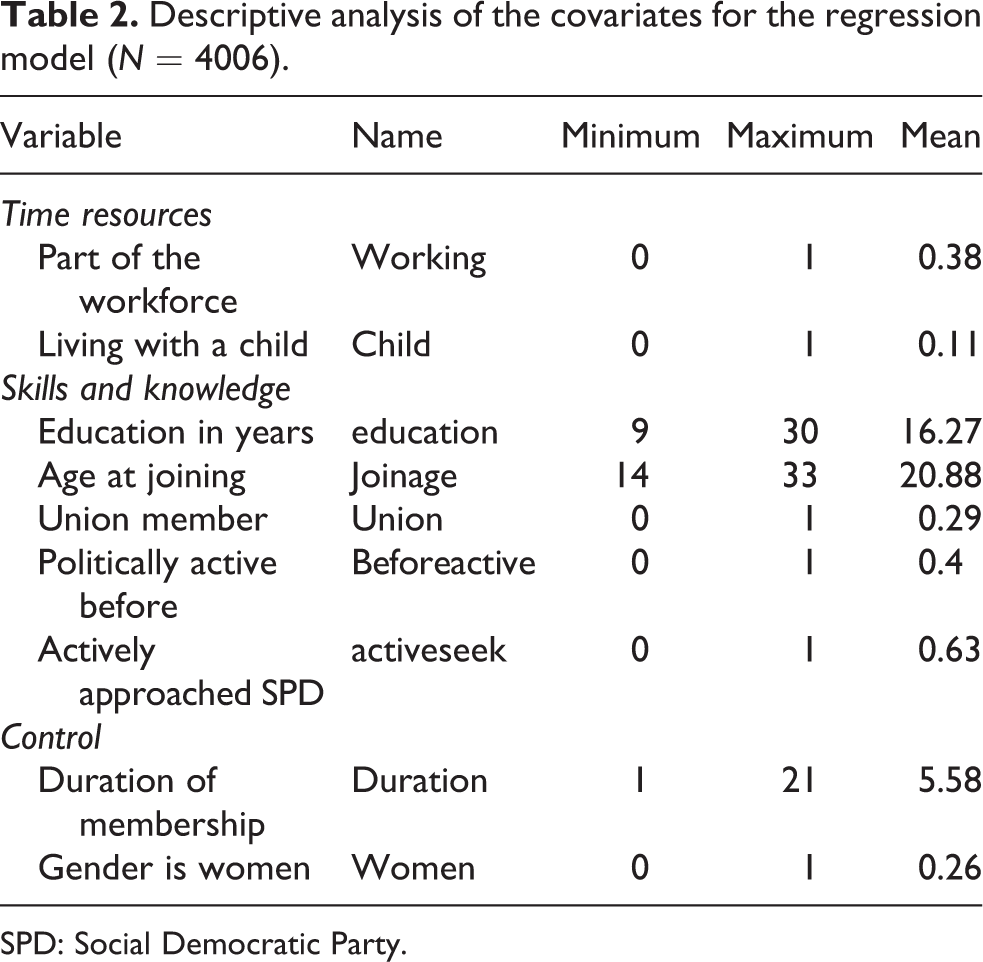
Descriptive analysis of the covariates for the regression model (N = 4006).
SPD: Social Democratic Party.
The descriptive analysis of the incentives for party membership (Table 1) shows that the importance of incentives differs among the respondents. The most important incentive is to change society, which almost everyone considers to be important. Doing something meaningful, supporting the goals of the party, and enjoying political activities are also important for three of four members. The first three items are moral-ideological incentives, while the last one is a social incentive. The least important item is to gain personal or professional benefits. From the first descriptive view, moral-ideological and social incentives seem to matter more for young members than professional incentives when joining a party.
A first correlation analysis shows only weak correlations between the incentives (Online Appendix Table 6), but one can identify patterns of relationships that were also prevalent in other studies (Bruter and Harrison, 2009a). There is a weak to medium (
The basic latent class model is expanded using covariates that measure resources. These resources follow the logic of time, money, and skills (Brady et al., 1995). It is difficult to operationalize money resources, as the target population is mostly still in education and without established own finances. The party accommodates this by offering a special low membership fee for students that a majority of the young members pay. The analysis, therefore, focuses on time- and skill-related resources. The covariates cover aspects of time, especially flexibility and availability, and of skills and knowledge related to the party. Some of these are partly related. For example, both the duration of membership and education in years correlate with the individual age of the member. For that reason, age is not included in the model. Additionally, the educational situation of young people influences the choice of variables that can measure or stand as a proxy for the resources. The variables are elaborated along the divide of time and skills.
Time
The time-related variables measure proxies for how flexible someone is to invest time in the party.
working: This is a dummy variable for those working full-time or part-time. The target population is in a life stage between education and the labor market. Young people in education are typically more flexible with their time than those already working. It can be expected that those who are already working have less time available for party activities and, therefore, a higher threshold for becoming a party member.
child: This is a dummy variable for those who are living in a household with a least one child. Living with children usually implies care work, especially in the evenings. Party activities, for example, internal meetings, typically occur in the evenings. It is expected that living with children causes time restrictions and influences the reasons why someone becomes a member.
Skills and knowledge
This set of variables measures different resources that provide young people with skills and knowledge that are relevant for joining a party.
education: This variable measures the time spent in formal education in years. The duration of education is usually associated with increased knowledge about politics. It can be expected that the less educated need stronger motivations to become a member.
joinage: This variable measures the age when a member joined the party. The age of when someone joins a party hints at the potential knowledge about the party, as knowledge might increase with higher age. Joining at young age also influences the sources of information about the party. Teenagers are rather influenced by their families and less so by colleagues from work or education than adolescents.
union: This dummy variable identifies union members. Membership in a labor union leads to knowledge about politics and collective organizations. Being a member of a labor union is also a signal of attachment to the workers’ movement. It is expected that members belonging to labor unions have a more ideological relationship to the party.
parentsmember: This is a dummy variable for those who had at least one parent who is a party member. In previous studies, this has been identified as an important factor influencing young members. Having a party member parent can lower the threshold for joining and, therefore, decrease the need of individual incentives.
beforeactive: This is a dummy variable identifying those politically active in a group or nonparty organization before they join the party. Political activism before joining a party suggests a general interest in political activism. It is expected that former political activists are more clear in their motivation to join.
activeseek: This dummy variable measures whether the member actively approached the party. This variable allows to distinguish between those who became a member out of their own effort and those who have been recruited. As actively seeking membership requires basic knowledge about the party, it can be expected that those who approached the party are more distinct about their motivations.
These variables are the covariates for the model. Besides them, the model controls for the duration of party membership in years (duration) to incorporate the fact that members’ perspectives on their reasons for membership may have been influenced by the time that lies between joining and the moment when they answered the questionnaire. The model also controls for gender, using a dummy for women as commonly identified factor for differences in political participation (Table 2).
Motivation and resources among young party members
The following section consists of three parts. First, a three-class latent class model is derived from the data. Second, this model of motivational groups of party members is elaborated and third, covariates are added to the model into a latent class regression model to analyze the influence of resources.
Identifying groups in the population
In the first step, it is necessary to define a latent class model that best represents the data. Models with different numbers of classes have been applied to the data, beginning with the null model with one latent class up to a high number of classes beyond a maximum of theoretically useful classes. The model choice is based on statistical criteria. Additionally, the reduction in the likelihood-ratio χ 2 statistic is compared to the null model and to a model with one fewer class (Bacher and Vermunt, 2010; Magidson and Vermunt, 2004).
The statistics suggest to select a three-class model. A BIC and log-likelihood comparison between models for different numbers of classes highlights three possible solutions: a model with two, three, or five classes (Table 3). The BIC of the five-class model was the lowest, but the log-likelihood ratio comparison shows that the relative improvement was highest between the null model and the two-class model (4.52%). The three-class model provided a relative improvement to the null model of 5.81%. This is higher than the recommended minimum improvement of 5% for accepting a solution to be preferable to the null model (Bacher and Vermunt, 2010). Based on these statistics, the three-class model has been selected for further analysis. This model is the most appropriate one as it offers more explanatory power than the two-class model and is less complex than the five-class model. As a robustness check, the five-class model has also been tested, but the classes were not distinct. 4 Following Oser et al. (2013), it is common in latent class analyses that a better BIC is reported, while the log-likelihood of the model improves only slightly. In such a case, the model with fewer and more distinct classes is the better option.
Latent class model selection statistics.
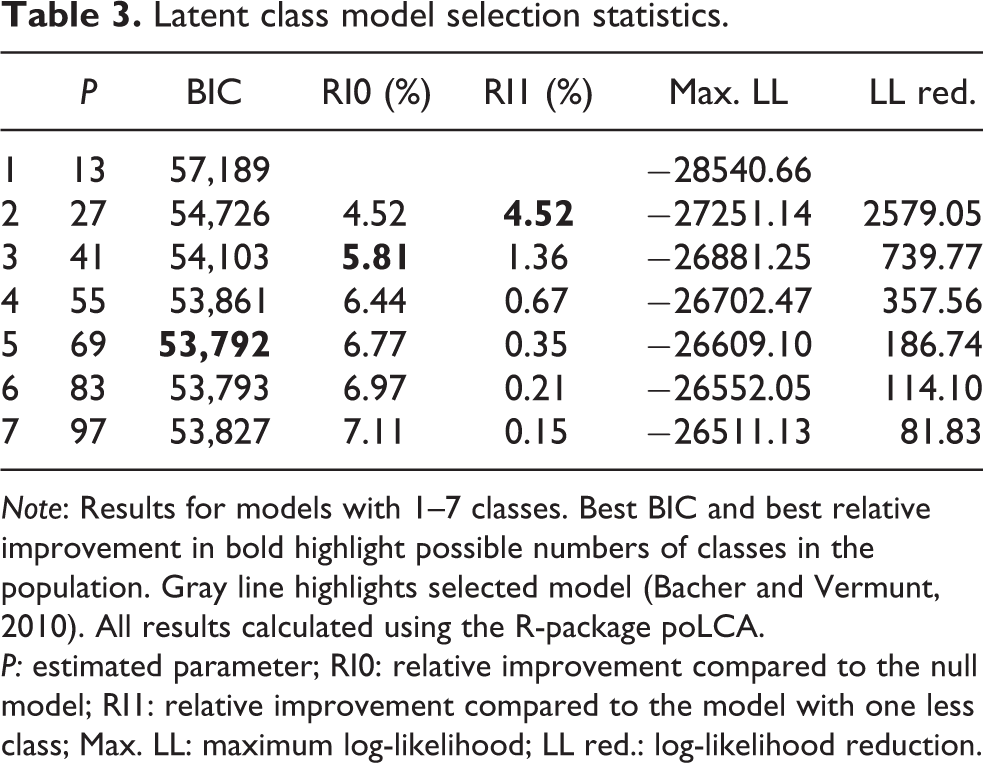
Note: Results for models with 1–7 classes. Best BIC and best relative improvement in bold highlight possible numbers of classes in the population. Gray line highlights selected model (Bacher and Vermunt, 2010). All results calculated using the R-package poLCA.
P: estimated parameter; RI0: relative improvement compared to the null model; RI1: relative improvement compared to the model with one less class; Max. LL: maximum log-likelihood; LL red.: log-likelihood reduction.
Three groups of young party members
The selected model provides three motivational groups of young party members based on 13 manifest binary variables. The classes have an estimated population share of 48% (class 1), 39.1% (class 2), and 12.8% (class 3), providing two larger groups and one small group of young party members. The next step checks whether these three groups are well-defined and elaborates their characterization.
The quality of a latent class model is based on its level of homogeneity and distinctness. The classes should be homogeneous regarding answers of class members to the items. A class is well-characterized if the conditional probability of a particular answer to an item is either very high (>0.7) or very low (<0.3) (Masyn, 2013). Table 4 shows the high level of homogeneity in the chosen model. The classes also need to be distinct from one another. The posterior probability of class membership of each case in the sample should be high for one class and low for all other classes. The mean probability for class membership in the three-class model was higher than 0.8 in all classes, so the model provides three distinct classes. Both criteria, homogeneity and distinctness, support the three-class model as being sufficient to describe motivational groups of young party members.
Results of the basic latent class analysis.
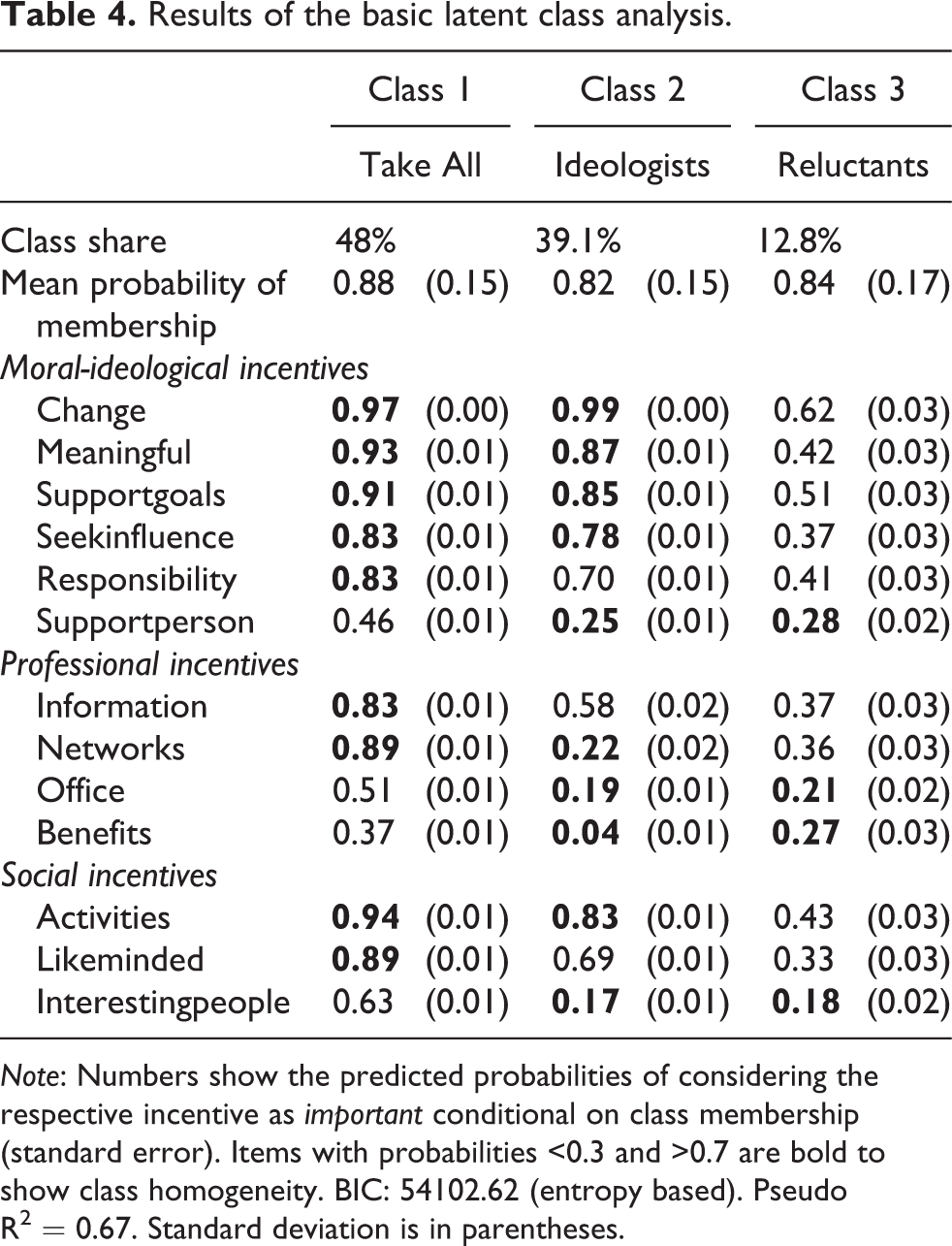
Note: Numbers show the predicted probabilities of considering the respective incentive as important conditional on class membership (standard error). Items with probabilities <0.3 and >0.7 are bold to show class homogeneity. BIC: 54102.62 (entropy based). Pseudo R2 = 0.67. Standard deviation is in parentheses.
The next section elaborates the three groups of party members. Figure 2 visualizes their characteristics. The first class is the biggest one, covering 48% of the sample. Members in this class considered a diverse set of incentives as important, covering moral-ideological, professional, and social incentives. They are called the Take All group. The second class is called the Ideologists. Its members considered social and moral-ideological incentives important, but they did not attribute importance to professional incentives. They constitute nearly 40% of the members. Members in the third class had a low probability of considering any of the given incentives as important. They seem to be a distinct class of party members who did not consider the given incentives as important. They are called the Reluctant members, meaning that they were reluctant to consider the usual incentives of party membership. This last group is rather small compared to the other groups (13%).

Predicted probabilities for the model. Graphs show the predicted probabilities of attributing importance to incentives for each latent class (the error bars showing the standard error). The y-axis shows the conditional probability that members of a latent class consider items to be important for joining the party.
The results confirm that the 13 incentives capture well what young party members consider to be important when joining a party, but there is a small group that is not motivated by these incentives. The majority of young members are motivated by moral-ideological and social incentives, confirming results from previous research (Bruter and Harrison, 2009a). The Ideologists and the Take All groups have these types of motivation in common. However, the two groups are distinct in how they respond to professional incentives that may be important for future careers. While the Take all group considers building networks and seeking party or public office to be relevant, these incentives are irrelevant for the Ideologist members. This highlights that the main divide between young party members is about professional incentives. The Reluctant members are different from the rest. Their existence goes beyond what is known so far about motivational settings and requires further analysis.
The basic latent class model shows that three distinct groups of young party members exist based on the incentives they consider important. Moral-ideological incentives are important for all young members when they join the party. They want to change society and support the goals of the party. This is the baseline of party membership. The main divide is between young members who consider professional benefits as important and those who are only moral-ideologically and socially motivated. The two groups together make up 86% of the membership. A minority remains uncovered by the classic benefits that a party provides. As Seyd and Whiteley (1992: 60–64) argue, it is impossible to understand reasons for membership only based on costs and benefits. Social norms, like the connection to the party milieu, may also play a role. This could be the case for members in the Reluctant group. The influence of individual resources on this typology of young party members is investigated in the following section.
Resources across groups of party members
The model to explain the influence of resources on the three groups of young party members is chosen based on a forward testing strategy. The trichotomous structure of young party members is the dependent variable in the analysis, with the group of Take All members as the reference class. As we lack empirical analysis on the influence of resources on incentives for group membership, a forward testing strategy is the best choice. Model fit is based on a BIC comparison and a significance test of the log-likelihood improvement. The basic latent class model without covariates serves as the null model against which models are tested for improvement. Each covariate is introduced in the model to test whether its effect is statistically significant. The significant covariates are combined step-by-step, and the new model is tested again to investigate whether its increased complexity provides an improvement.
The best model includes the covariates working, a dummy variable for those in the workforce; education and joinage, measuring the age when joining the party; union, a dummy for union members; beforeact, a dummy for those who were political activists before they joined the party; and activeseek, a dummy for members who actively approached the party. Additionally, the model controls for the duration of membership. The variable living with a child was not significant. The variable parentsmember did not improve the model. 5 The control variable women was neither significant as a single covariate nor did it improve the model when added. 6 The following analysis is built on this model.
The regression results show that all covariates, except for the dummy working, differentiate significantly between the motivational groups. This means that the lack of flexibility that is connected with being in the workforce does not influence the incentives for joining. All skill- and knowledge-related resources have a significant effect on the groups. Table 5 summarizes the regression results. The coefficients indicate that the three motivational groups are different in their resources. For a better understanding, the results of the multinomial logistic regression are visualized using a comparison of the predicted class sizes when the values of the independent variables are at minimum and maximum. Figures 3 and 4 visualize this comparison.
Results of the latent class regression analysis.

Note: Regression coefficients based on reference class: Take All. Results of Wald statistics.
*p < 0.05; **p < 0.01; ***p < 0.001.
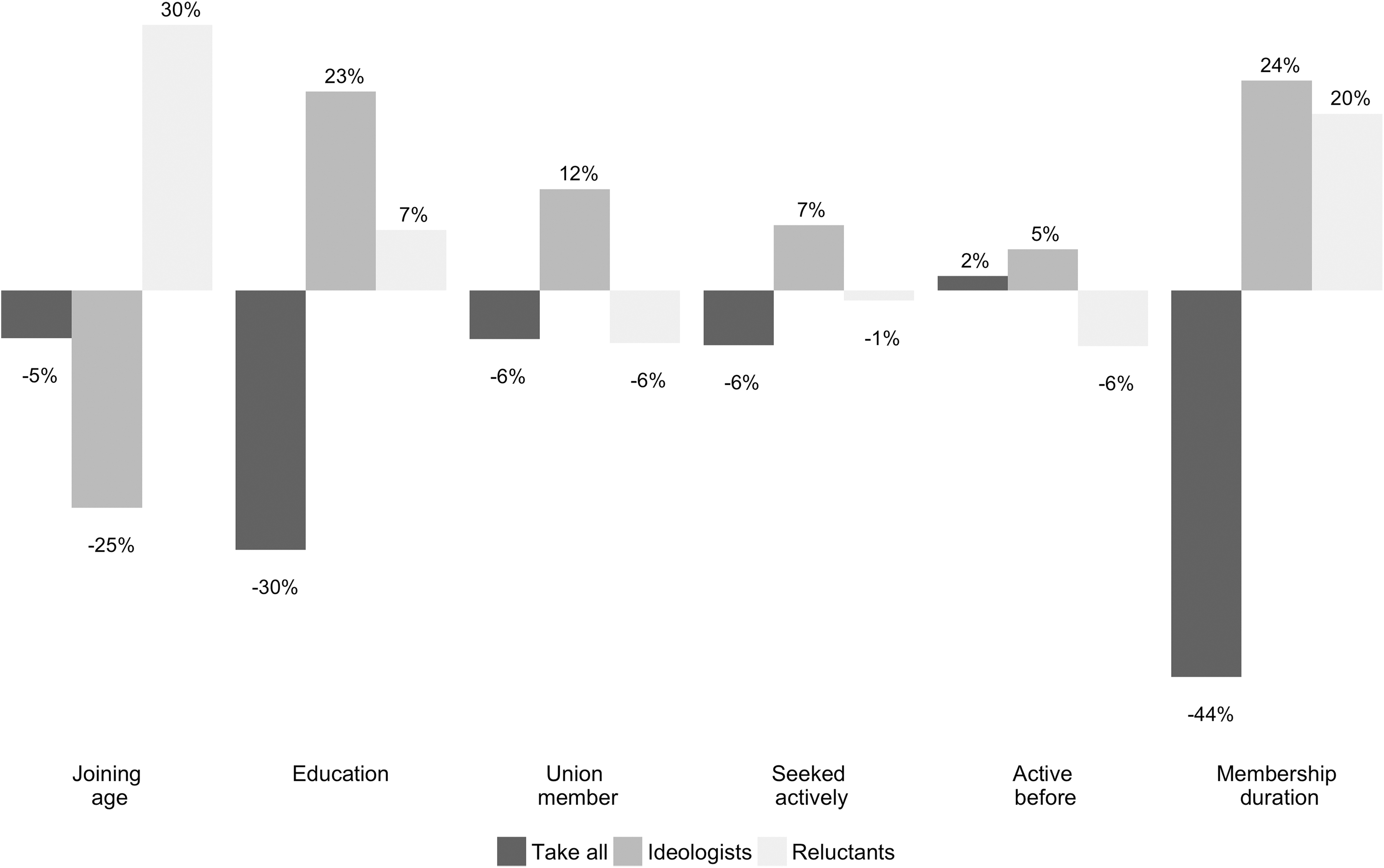
Change in predicted class across covariates. Bars show the difference in predicted class size when the value of the independent variable changes from its minimum to its maximum. All other variables are kept at a mean.
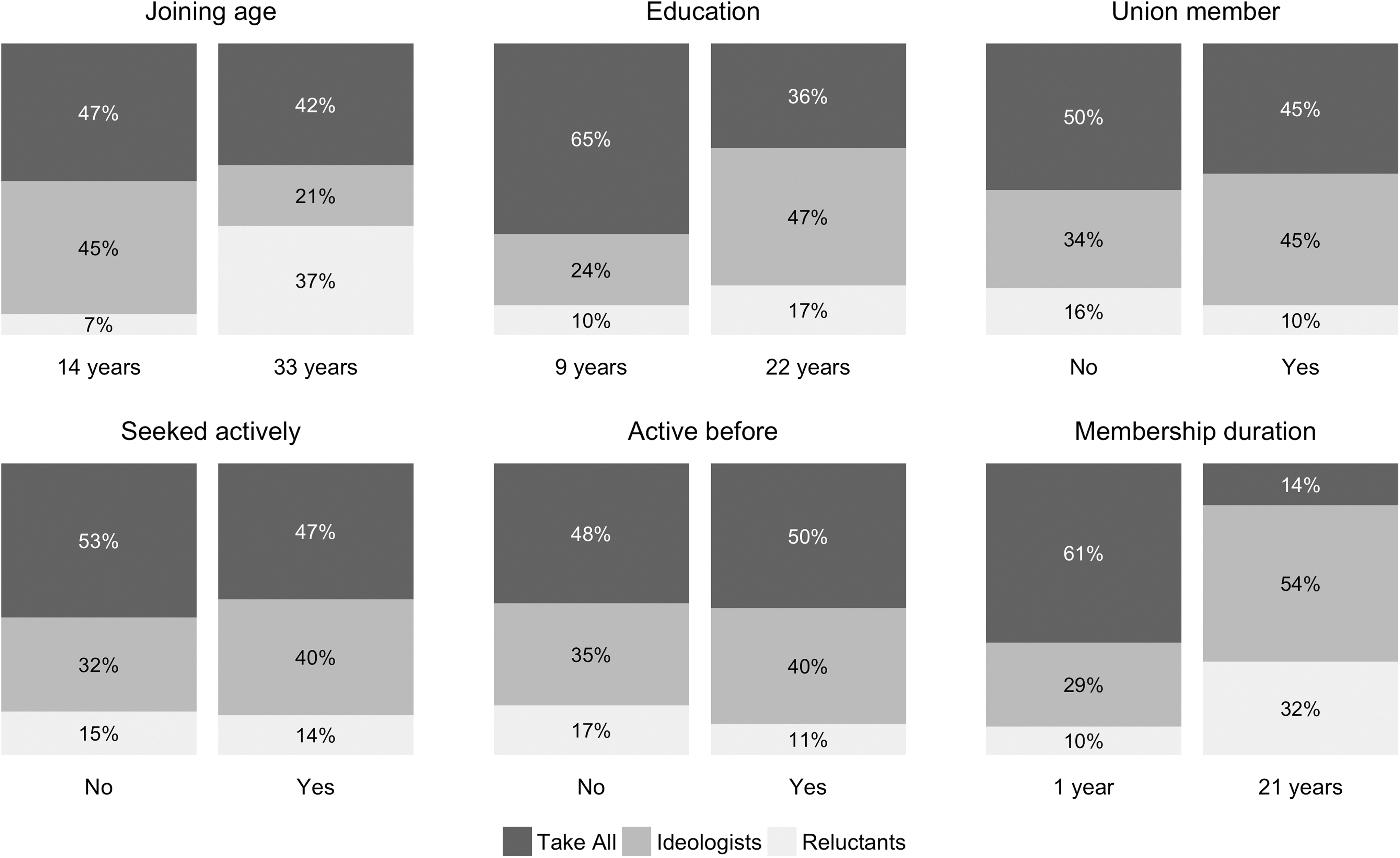
Composition of motivational groups across covariates. Bars show the composition of the groups when the value of the independent variable is at a minimum (the left bar) and at a maximum (the right bar). All other variables are kept at a mean.
The results support the assumption that resources help to understand the differences between the three groups. The joining age, education, union membership, and whether someone actively sought to become a party member differ clearly between the groups. Also previous political activity seems to influence the motivation of the young members. The main divide between the two large groups, Take All members and Ideologists, was their attitude toward professional benefits. The analysis of the resources shows that long educational processes, union membership, and actively approaching the party make it more likely that members disregard professional benefits and belong to the Ideologist group.
The main differences are about the relevance of professional incentives. Joining age influences the ideologist motivation. Those who join relatively late are either motivated by a heterogeneous set of incentives or do not consider any incentives to be important. Those who join at young age are almost equally either Take All members or Ideologists. This means that members who made an early decision to join the party are more clear in their motivations. They equally do and do not consider professional incentives as important, but only a very small minority has no incentives at all. The late members disregard professional benefits more seldom. This indicates that a late decision for becoming a party member is driven more by personal interests.
Three other resources explain who does not consider professional benefits. Both union members and those who approached the party actively are more likely to focus on moral-ideological and social incentives. It can be hypothesized that young people with a connection to the social democratic milieu tend to be union members more often and they potentially are exposed to the party earlier. This indicates that the main dividing line between the young members, namely, the consideration of professional benefits, can partly be explained by their attachment to a certain social milieu. Also the duration of education influences whether the members are motivated by professional benefits. More time spent in educational processes reduces the attractiveness of personal benefits. A possible explanation is that less educated members are more interested in gaining information and seeking networks to compensate for their lack of education. This indicates a compensating effect of collective organizations for lacking individual resources (Kabeer et al., 2013). Another explanation is that members in education are still planning their career and might need networks for their future. However, these interpretations need to be approached with caution. A large share of the members has not yet finished education and may reach higher levels of education in the future.
Additionally, controlling for membership duration is important. Due to the strong effect, it can even be hypothesized that duration has a causal effect on motivation. A longer membership may change the importance of incentives. The large group of Ideologists among the long-term members shows that professional incentives are not as important for those with several years of membership. This could be a time effect: Members with a longer membership may have experienced that some of their motives did not materialize and, as a result, these motives lost relevance. A different explanation may be that those members who are interested in all incentives might have left after they did not see them materialize, and the long-term members are already a preselected subgroup. Neither assumption can be analyzed based on our data.
The strong effect of membership duration indicates that incentives develop over time. Since the analysis uses cross-sectional data, it is impossible to follow individual changes, but it seems feasible to examine how the effects of the other variables change when membership duration changes. Figure 5 shows the change in class size of four predictors at different values of membership duration. The figure shows that joining age, former activism, union membership, and education differ across membership duration. There is no difference regarding an individual actively seeking membership or not.
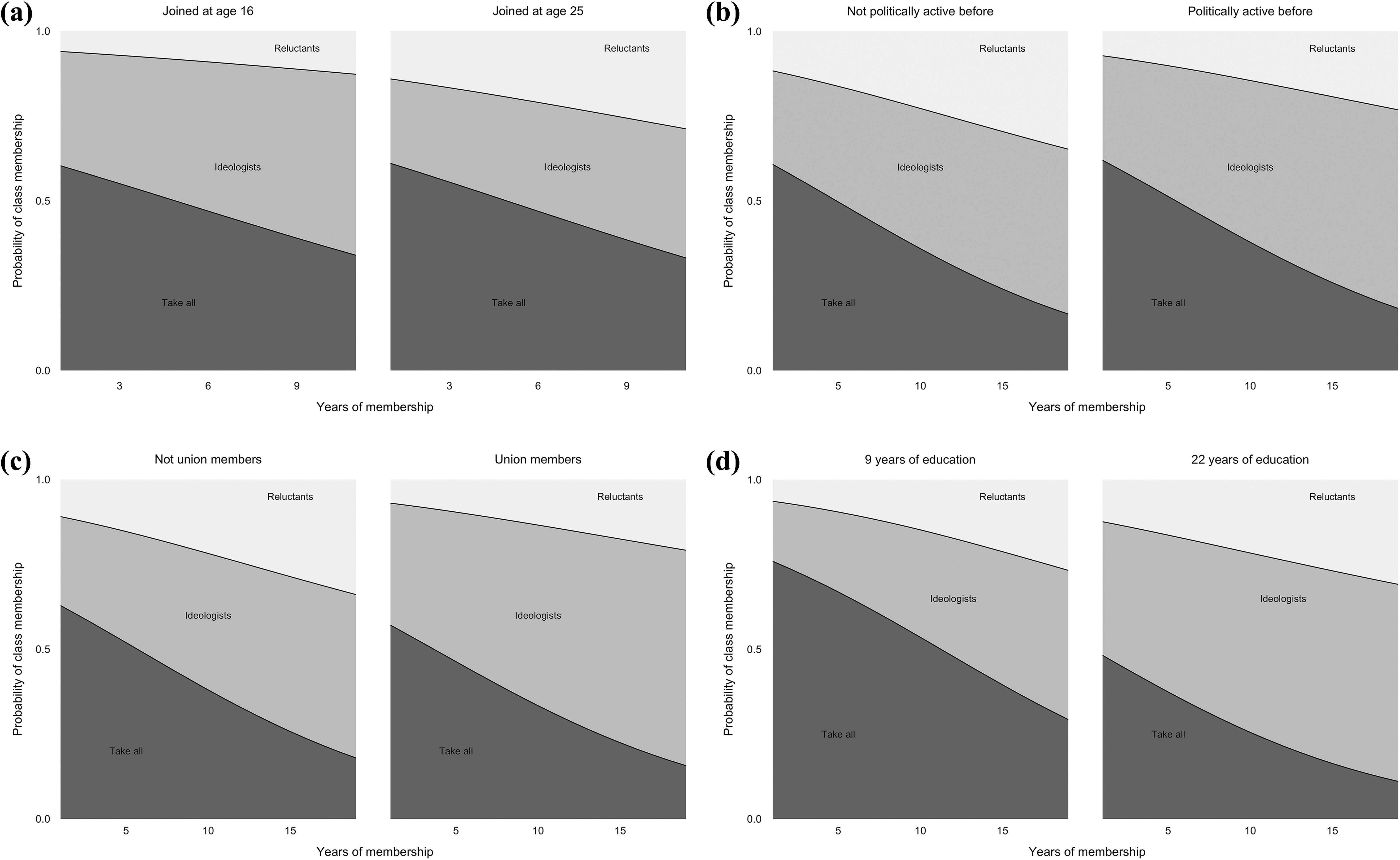
Effects of regression variables at different membership durations. Figures show predicted probability changes when membership duration changes for (a) joining age, (b) political activism before party membership, (c) union membership, and (d) education. Values show the fitted values for the respective variable at different values of membership duration. All other predictors were kept at a mean.
The probability of being in a certain class differs strongly when looking at the influence of joining age at different stages of membership duration. According to the model, the members who join the party at age 16 are relatively seldom reluctant to select the membership incentives, and they are split almost equally between Ideologists and the Take All groups. For longer durations of membership, the change is mainly between these two groups. But for members who join as late as at age 25, a longer duration of membership increases the chances of being among the Reluctants, while the Ideologist group is relatively small. This means that those joining late are motivated by all kinds of incentives, but they tend to “lose” their incentives after some years.
The former activists and the union members display similar patterns of class membership at different durations of membership. Both are much more likely to become reluctant after being a member for a long time, but on a much lower level than those who have not been active before or those without a union membership. Both aspects seem to “stabilise” the moral-ideological and social incentives over time, while the interest in professional incentives vanishes equally among members who have no union membership or previous activism.
The duration of education has a similar effect. The members with the longest educational periods are more likely to have no professional incentives and are Ideologists, and this increases with longer membership duration. The least educated are very likely to be open for all different kinds of incentives. Again, it is necessary to take into consideration that the target group of the study was to a large extent still in their educational processes.
Discussion
This analysis integrated incentive- and resource-based explanations for party membership and tested it empirically using data of young party members in the German SPD. It aimed to answer two questions: Which groups of young members can be identified based on their motivation to join the party? And, how do individual resources of the members influence their motivation? The analysis has two important results. First, individual resources influence the motivation to become a party member. This confirms the need for an integrated concept of incentive- and resource-based explanations of party membership. Second, motivations of party members are divers, but party members cannot be grouped along traditional distinctions of professional, moral-ideological, and social incentives. While the vast majority was moral-ideologically motivated to join, the dividing line between members is the relevance they attribute to professional incentives. A small minority even does not consider the known incentives to be important and seems to have (had) other reasons to join.
It can be confirmed that individual resources influence young people’s motivations to join a party. The three groups of members each had distinct skills and knowledge, constituting important resources for political mobilization. Union membership, actively approaching the party and longer education, reduced interest in professional benefits; those members were more likely to be solely ideologically motivated. Members who spent less time in education were most interested in all membership benefits, including individual career opportunities. These results require cautious interpretation; as by nature of the population of the study, many had not yet finished their education and there is a small chance that the sample is biased toward higher educated members. Despite these restrictions, the results fit arguments about the life cycle of young people: Young people in education value the professional incentives that a party has to offer more because they are still on their way of settling into a professional life. They need such career opportunities more than older people who are more likely already established professionals (Bruter and Harrison, 2009b: 21-22).
An important sideline of the analysis is that the duration of membership influences the type of motivation. Members who just joined the party consider all kinds of incentives as important. Such an encompassing motivational setting is not present among members with several years of membership. The latter either give up their professional motivation and remain ideologically motivated or they disregard all incentives. The cross-sectional data limit the explanatory power of this aspect, but the strong role of membership duration highlights a potential time effect on motivation. The survey, by nature, can only capture ex post rationalizations of incentives at the time of the survey and not any “true” reasons from the past. This methodological aspect likely reflects a change in motivations among the young members over time. Further analysis of longitudinal data is required to investigate this aspect more systematically.
The latent class modeling of motivational groups revealed that different types of incentives are not exclusive in motivating someone to join a party. The majority of young members are motivated by heterogeneous incentives, covering what has earlier been seen as more exclusive categories. The Take All group had a trichotomous structure of incentives and the Ideologists group had two main motivations. The crucial difference between these two groups was whether they considered professional incentives as important or not. The Take All group was interested in incentives that could advance a political or professional career, but they were motivated as much by moral-ideological and social incentives as were the Ideologists group who disregarded individual benefits. This shows that moral-ideological incentives for joining a party are common sense for young party members. They constitute a base line for becoming a party member. Even career-driven young party members cannot be seen as only careerists, their moral-ideological motivation is as important for them.
The results support the assumption that a combination of incentive-based and resource-based explanations advances the explanations about joining a party. The influence of resources on motivation highlights differences between types of members, especially when controlling for membership duration. It seems that young members experience their party very differently depending on the resources they possess. Three aspects were important to “keep” them interested in moral-ideological incentives also after several years of membership: joining at an early age, being a union member, or having a history of former activism. These three aspects proxy different socialization processes that might be helpful in maintaining motivation over time and providing party members with reasons to stay in the party. Those joining at a young age were potentially closer connected to the social democratic milieu, as their socialization influence is more likely coming mainly from the family. Members with a higher joining age have potentially already been influenced by friends or colleagues at work. Similarly, union members can be considered to be closer to the traditional labor milieu. Former activists, on the other hand, experienced politics before and they probably know better why they choose a party. These results have to be interpreted cautiously due to the cross-sectional nature of the data, but it seems as if young party members need a certain socialization element to keep up their motivation for their party over time.
The scope of the analysis is naturally influenced by its data. It should be discussed in how far the findings of this analysis are potentially limited. The results highlight the relevance of career-related motivations as a potential conflict line between party members. Previous research found the modest differences in motivations among young party members across countries and party families, but their main patterns of motivation were similar (Bruter and Harrison, 2009b). This supports the assumption that the main conflict line of career-related benefits is present beyond the specific case of the SPD, but the intensity of such a conflict line may be influenced by the relevance of parties in a political system as well as by the party family. Also the socialization within a potential milieu will likely be quite different in other countries and party families. The particular socialization agencies will differ, as for conservative parties labor unions will probably not be as important, but maybe other institutions, such as the church. These questions require further analyses in other countries and party families. This work opened the floor for future investigation into the motivation of party members combining incentive- and resource-based approaches to membership.
Supplemental Material
Supplemental Material, sj-docx-1-ppq-10.1177_1354068818792576 - Why do young people join parties? The influence of individual resources on motivation
Supplemental Material, sj-docx-1-ppq-10.1177_1354068818792576 for Why do young people join parties? The influence of individual resources on motivation by Regina Weber in Party Politics
Footnotes
Declaration of conflicting interests
The author declared no potential conflicts of interest with respect to the research, authorship, and/or publication of this article.
Funding
The author received no financial support for the research, authorship, and/or publication of this article.

Supplemental material
Supplemental material for this article is available online.
Notes
References
Supplementary Material
Please find the following supplemental material available below.
For Open Access articles published under a Creative Commons License, all supplemental material carries the same license as the article it is associated with.
For non-Open Access articles published, all supplemental material carries a non-exclusive license, and permission requests for re-use of supplemental material or any part of supplemental material shall be sent directly to the copyright owner as specified in the copyright notice associated with the article.
