




Abstract
Are parties “high discipline, low cohesion” in Westminster legislatures? This study applies network analysis to voting behavior among members of parliament (MPs), a novel approach that measures not deviation from party-line voting, but rather whether MPs with similar voting patterns are co-partisans. We study the Canadian Parliament from 2006 to 2015, during which time the governing party under Prime Minister Stephen Harper maintained tight central control and discipline, a likely source of elevated cohesion. We find that “low cohesion” generally holds, and parties do not always conform to commonsense expectations about how cohesively they “should” behave in various parliamentary situations, though they show themselves capable of learning over time. Moreover, we find that party cohesion stems less from shared voting behaviors and more from simple partisan identity. Further research should consider to what extent parliamentary behavior is based mainly on party alignment.
Introduction
How much conformity does the party whip impose in a Westminster parliament? And how fundamental is that conformity to the functioning of the parliament? In any Westminster parliament predicated on responsible government, at least moderately-strong party discipline seems a natural outgrowth of the need for the executive to maintain the confidence of the legislature. Systematic study of the extent and nature of parliamentary cohesion and partisan polarization, however, is becoming more frequent (Godbout and Høyland, 2011, 2013, 2017), with evidence of intensifying partisan sorting and left–right polarization in many democracies (Cochrane, 2015; Kevins and Soroka, 2018). At times, the findings reinforce the perception of a highly disciplined parliamentary party system (Grenier, 2017). This seems fair enough, considering that the result of most quantitative techniques for measuring parliamentary behavior—see, for example, Grenier (2017)—would likely reinforce just such an impression: that members’ votes are strongly whipped and their messaging tightly controlled by party leadership. Alternately, it could be suggested that the behavior of those parliamentarians clusters on the basis of ideological alignment, but even then, measuring the fidelity of legislators to a set of ideological positions could simply yield another map of partisan membership in an adversarial legislative system. While this would be consistent with the understanding of Westminster systems as fundamentally premised upon the existence of political parties, in this article, we take a novel approach to the problem of measuring legislative cohesion, one that does not necessarily rely on the presupposition of parties’ existence.
Using vote-alignment network analysis to examine the parliamentary behavior of Members of Parliament (MPs) provides a new method for measuring the cohesion of members (and not just political parties) in the House of Commons as well as offering a look at the extent and intensity of partisan polarization within the legislature, as shown by Dal Maso et al. (2014). As political polarization becomes an ever-more-salient topic of discussion in Western democracies, it is useful to investigate not only how prevalent partisan cohesion and polarization are among the electorate and in the electoral party system but also in the parliamentary party system, where the dynamics of vote choice and partisan alignment are much more instrumental (Abramowitz and Webster, 2016; Caruana et al., 2015; Cox, 1997; Mayer, 2015, 2017; McGregor et al., 2015). We argue that vote--alignment network analysis furnishes an improved understanding of the extent and intensity of party cohesion and polarization, specifically as an emergent property of member behavior within the legislature.
If polarized, parties might be expected to take diametrically-opposed positions based on whether they are in government or in opposition, and depending upon whether the assembly in question is congressional or parliamentary, and whether it is a majority or hung legislative session. We remain agnostic about the cause of polarization and the ideas around which partisan identity (in the legislative, team-membership sense) coalesces and do not purport to measure discipline itself (though we recognize that it has been previously shown—Kam, 2001, 2009; Malloy, 2003; Sieberer, 2006—to be inabsolute). Instead, we focus on behavioral cohesion among members in a Westminster legislature, presupposing neither discipline nor even parties themselves. Naturally, their relative propensity to cooperate with one another or close ranks and oppose one another should be affected by which benches—government or opposition—they occupy, and whether they can govern or oppose freely, as in a majority parliament, or must cooperate and make concessions to one another to get anything done, as in a minority parliament. We propose some general, commonsense expectations for how cooperative or competitive members will be in each of these situations, predicated on a model of rational behavior aimed at winning seats in the legislature and taking executive office or keeping them. Do members actually behave in the ways we expect?
An excellent test case exists in Prime Minister Stephen Harper’s leading successive Conservative Party of Canada (CPC) administrations lasting from 2006 to 2011 as a minority government in a pair of hung Parliaments and then from 2011 to 2015 as a majority government. During this period, there should be evidence of how parties behave under both majority and minority parliamentary conditions, and we expect that any evidence of pronounced partisan polarization in the legislature should be most abundant during this time, when media and insider accounts suggested a period of intense partisan rivalry and acrimony as well as very strict central management in the governing party (Fitzpatrick, 2013; Savoie, 2008). Through investigation of vote-alignment networks during that period, a picture will emerge of how cohesive and polarized members in the Canadian House of Commons really were, and whether this matches expectations of how parties “should” behave under varying parliamentary conditions.
Our work tests the latter half of the “high discipline, low cohesion” thesis, and we find it still holds even during a period of ostensibly strict central management (Malloy, 2003). We find surprisingly weak intraparty cohesion in the governing Conservative Party at times and variable behavior in opposition parties corresponding to periods of opposition fragmentation and disarray and later consolidation. We also find that MPs and parties seem to learn over time to converge on behaviors in line with expectations, as parliamentary sessions progress. A main source of low interparty cohesion is partisan identities themselves, and these divisions may in turn spur brief, highly cohesive behavior within party groups when it appears necessary. These brief spurts of cohesive behavior may in part be influenced by the government’s control over the legislative agenda and the sometimes seemingly arbitrary order in which parliamentary business appears on that agenda (since some items of business divide parties while others cause them to close ranks).
Discipline and cohesion in the Canadian House of Commons: Some perspectives
Extant scholarship aimed at measuring the intensity of party discipline has had to grapple with multiple problems, including that measuring it with respect to recorded parliamentary votes does not rely on a random sample of votes but rather a sample dictated by the priorities of the party with legislative control (Depauw and Martin, 2008). Indeed, much regarding legislative voting patterns can be explained with respect to the governing party’s almost complete control over the legislature’s agenda (Godbout and Høyland, 2011). Even minor decisions regarding the order in which to pursue a parliamentary agenda can affect patterns of intraparty (and interparty) cohesion over time. A clear problem, however, is that if votes are whipped, there should be little point in studying the voting patterns of party members to measure cohesion; Kam (2009) addresses this by noting a history of studies of Westminster parliamentary voting patterns increasingly revelatory of a lesser degree of cohesion than was previously thought to exist. In other words, amid ostensibly stifling party discipline, a fair amount of dissent still occurs. MPs have options, therefore, beyond mere abstention (Longley, 2003) should they disagree with the party line on a given issue. Previous work, however, tends to focus mainly on whether MPs voted with their parties or not, while this article’s approach is instead subtly different, studying whether MPs who have similar voting patterns are co-partisans. Rather than examining parties to catch instances of internal dissent, as in traditional methods for measuring party discipline, we examine individual parliamentarians and the networks of like-minded voters that they form and then compare this to the existing partisan structure of the legislature to see whether the picture that emerges is one of primarily ideological bonds or of partisan bonds, and how tightly woven the networks are. In other words, we are not seeking to organize members into categories of behavior or allegiance but are investigating what categories the data tell us exist.
This effort builds upon a broad base of methodologically-diverse scholarship regarding Westminster party discipline and offers a new framework for measuring the ostensible goal of that discipline—that is, cohesion—that does not presuppose deviance like previous methods of measurement. This changes the focus from counting dissenters to examining emergent behavior. Since this behavior ebbs and flows across vote time (over the life of a parliament), our model includes broad expectations about when we should see more or less cohesion within and among party groupings.
Despite the near-folk-wisdom status of the assertion that Canadian party discipline is especially strong among Westminster polities, some effort has been undertaken to understand its nature. Malloy (2003) characterizes Canadian parties as “particularly skilled ideological chameleons” (p. 121), acknowledging the historical perception of Canadian party discipline as unusually strong while noting that their internal cohesion, at least in ideological terms, appears to be fairly low. He conjectures that a lack of strong ideological grounding for most Canadian parties spurs them to compensate by imposing tighter party discipline in order to foster organizational unity. Kam (2001) also develops this idea, suggesting that party discipline in part fosters what cohesion the parties actually do have, and foreshadows Hazan’s (2003) attempt to make clearer the distinction between discipline and cohesion, which concludes that even beyond cohesion in terms of ideological preference, party labels still matter for partisan unity. Malloy’s and Kam’s conclusions prefigure those of this article, suggesting that strong discipline not only coexists with weak internal cohesion but may in fact be a reaction to it and even an attempt to influence it. While we remain agnostic about the relationship between the two, and do not seek to test the prevalence and intensity of party discipline, our findings do show that Canadian political parties maintained their weak cohesion in Parliament throughout a period associated with strong central management and tight control over messaging, especially on the part of the governing Conservatives. The pattern identified by Malloy (2003) is still visible—weakly cohesive parties that nonetheless are strongly whipped when it comes to parliamentary interactions with other parties—and fits the old image of Tweedledee and Tweedledum, the two traditional bourgeois parties alternating in power and not terribly different from one another (McHenry, 1949).
Why is party discipline important in the first place? Majority governments can use it to ensure the legislature cannot obstruct their agendas, and minority governments can use it as a survival tool, to ensure their own MPs vote the same way and to predict how opposition votes will line up—this can help minority governments engineer both legislative victories and confrontations. From an MP’s perspective, party discipline is the price to pay to have access to the advantages of party membership, which include funding and communications apparatus for campaigning, the use of the party brand and other benefits which come with being affiliated with it, and, of course, the expectation that one will be voting as part of a larger bloc to work toward one’s policy preferences. This distinction is key to our conceptions of discipline and cohesion: that they are separate, the former is a way to encourage the latter, and the latter may arise for reasons beyond the former.
The literature on concentration of executive power in Westminster systems generally, for example, Smith (1999), Savoie (2008), and in the Canadian parliament specifically Savoie (1999), devotes plenty of attention to party discipline as a key factor in executive dominance of parliamentary systems. In Canada, it is sufficiently prevalent that a government’s defeat via a failed confidence vote is rare even considering Canada’s frequent incidence of minority parliaments relative to other Westminster democracies (Lemco, 1988, but see Sieberer, 2006, which shows this scenario to be more likely in other jurisdictions). Scholarship produced in part as a response to Savoie (1999) tempers his critique somewhat, but notes that this centralization of power, without reform, results in decreasing accountability in Parliament and could exacerbate perceptions of a democratic deficit (Aucoin et al., 2013; Bakvis, 2001; Docherty, 2011; Malloy, 2004; White, 2011).
In contrast to this drawback, there are useful aspects of party discipline and cohesion that can help to explain their persistence. A commonsense idea of Westminster parliamentary government suggests that discipline is necessary to ensure governments are not defeated, but as noted, Lemco (1988) explains that the rarity of these defeats means that avoiding them cannot be the only reason that discipline persists. Lemco suggests that its persistence is in part tied to the advent of mass parties that could credibly compete at the ballot box election after election; because these two parties were unusually light on ideological content and rather mutable in their policy positions from cycle to cycle, there was not much to distinguish them in the legislature save party membership (Clarke et al., 1996), much in keeping with the ideologically-muddy established pattern of Tweedledee and Tweedledum. As a result, they turned to the practice of strong discipline in order to prevent their members from voting across party lines. The ideological vagueness of the two brokerage parties spurred the formation of smaller parties based on ideological tendencies, which in turn amplified the need for cohesion in the major parties. Lemco’s analysis presages the conclusions of this article, underscoring the primacy of partisan membership relative to other factors influencing legislative party cohesion. These uses and pitfalls of party discipline inform the model we present for rational, office-seeking party behavior.
In terms of intraparty and interparty cohesion during any given parliamentary session, we can settle on a few commonsense, rational expectations for how parties should behave if their goal is to expand and maintain their legislative presence and attempt to take or hold executive office. In a minority government situation, one might expect the governing party to enforce very strict cohesion, and to be willing to cooperate and compromise with opposition parties, since no legislation could be passed otherwise. Opposition parties in that situation similarly have much incentive to cooperate, thanks to policy concessions they could extract or simply because they do not wish to fight another election so soon, especially when they could be blamed for having precipitated it. On the other hand, there is little incentive for opposition parties in a hung parliament to be particularly cohesive, and small portions of party caucuses may in fact vote with government or not as the need or opportunity presents itself; opposition parties do not have a plurality to protect, and low cohesion on their part will not topple the government.
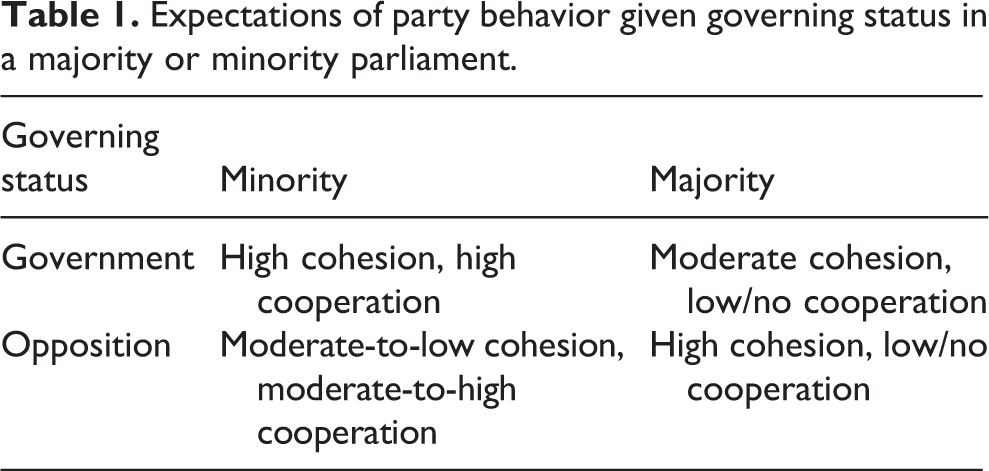
In a majority situation, conditions are different. The governing party has somewhat less pressure to be cohesive, since critical votes will be subject to party discipline anyway, and the danger of losing power through a nonconfidence vote is vastly diminished. This also means the majority party no longer has any need to seek interparty cohesion, that is, cooperation with opposition parties; they can do what they want without needing to broker compromises. Opposition parties, meanwhile, face a different set of incentives. They cannot stop the governing party’s agenda through votes alone, so they have nothing to gain in offering cooperation, but there is also no risk to them in opposing the government’s agenda, since they cannot topple it. But an additional incentive appears absent the risk and uncertainty of a hung parliament: opposition parties seek to present themselves as alternative governments in waiting, and so must distinguish themselves in terms of their own positions and policy agendas. Thus, opposition parties can usually be expected to offer no cooperation at all, but they should display higher cohesion, since they want to present a united front not only against the governing party but also to some extent against other opposition parties, since they will be competing to unseat the government at the next election. Our expectations for interparty and intraparty cohesion based on whether the party is in government or opposition, and whether the parliament is majority or minority, are summarized in Table 1. As we examine the task of voting, interparty cohesion serves to quantify the prevalence of cooperation between parties.
Expectations of party behavior given governing status in a majority or minority parliament.
What vote-alignment network analysis can tell us about the House of Commons
This article has twin objectives: to measure cohesion among members in the House, and polarization among the partisan groupings we expect will emerge from such MP behavior. Again, we are not testing discipline, because to do so would simply replicate previously-used methods that do not measure cohesion in the way that this study does; while these extant methods are ideal for classifying members by partisan alignment and investigating the development of those partisan groupings, our work does not presuppose such groups and is valuable for the similar yet distinct task of testing whether existing patterns of cohesion among members warrant classification into such bins, and what they might be. We create a vote-alignment network to demonstrate the agreement between parliamentarians; from this, the agreement between MPs can be used to show both the cohesion of a given party’s members as well as the extent to which the various parties agree or disagree with one another. These findings offer valuable new insight into the nature of cohesion in the Canadian parliament and should be helpful for understanding other Westminster legislatures as well.
The techniques of network analysis have begun to see application in political science. Godbout and Høyland (2011) also apply a spatial model to legislative voting in the Canadian House of Commons, specifically, estimating the positions of MPs in order to show that parliamentary voting is best explained by a combination of a government/opposition dimension and a Quebec nationalist/federalist dimension. In their hitherto most expansive efforts (2013; 2017) to apply these network analysis techniques to the Canadian House of Commons, they study voting patterns across the entire history of the House up to the time of writing, using multiple models to show the development of strong party voting patterns—in short, the evolution of party discipline and the growth of cohesion. Notably, they echo Lemco’s (1988) narrative of partisan sorting, in that MPs (or candidates) not comfortable representing ideologically-vague parties sorted themselves into newly formed ideological parties, both increasing the cohesion of those parties and reducing the dissent to be found within the larger parties. This scholarship also produces a finding critical to our analysis in this article, namely that institutional rules and structures within parliament (e.g. the government’s vast influence over the agenda of legislative business) spurred emergence of party groups over time as they learned and adjusted their behavior to reflect those institutional pressures. We suggest that despite fluctuations in cohesion, party identity and brand gave members something to grasp while adapting to these pressures, and thus it remains central to our understanding of how MPs make choices about their behavior, including when to behave instrumentally as a loyal party member and when to allow concerns like ideology, region, or constituency demands to take precedence in their decisions about how to vote on this or that item of business.
Using networks constructed from parliamentary votes, community detection (Cherepnalkoski et al., 2016) is similar to optimal classification (Dewan and Spirling, 2011; Giannetti and Laver, 2005; Spirling and McLean, 2006). Our methods differ, however, in that optimal classification is akin to sorting members into bins, whereas our approach is bottom-up and is akin to investigating whether bins exist and their boundary and nature. In other words, we seek to investigate a subtly different puzzle than that which is tackled in both the optimal classification literature and Godbout and Høyland’s work, one to which our bottom-up approach is particularly well-adapted.
Dal Maso et al. (2014) and Cherepnalkoski et al. (2016) demonstrate how network analysis can be applied to parliamentary voting patterns in order to discern a community structure within a legislative assembly. Incidences of votes cast by MPs are linked to other matching votes cast by other members, which can be visualized as a spatial map that shows the relative distance of these MPs on various issues, and as a result can be used to map whether the MPs closest to one another—in other words, the groups of MPs that feature the most cohesion—are indeed co-partisans, and how cohesive they really are. This study thus investigates what cohesive networks of legislative voting emerge from the behaviors of MPs acting under frequently partisan incentives, rather than asking the subtly different question of whether and how frequently MPs vote against their own parties, which would invoke the difficulties noted earlier with this sort of investigation.
Why choose Canada as an exemplar of Westminster parliaments and, specifically, why study the parliamentary sessions in question? After the 2003 merger of the two right-of-center parties to form the current Conservative Party, the House of Commons displayed a tidy ideological division, with the Conservatives on the right, the Liberals in the center, and the New Democratic Party (NDP) on the left; the presence of the Bloc Quebecois simultaneously represents both the social democratic tendency and a persistent regional cleavage in Canadian politics, visible in the regional parties that have formed and disappeared since the 1920s. With clear divisions like these, there exist obvious lines along which polarization in the party system could occur, furnishing good conditions under which to study partisan polarization and cohesion. Some specifics of the Conservative Party’s time in government from 2006 to 2015 make this period yet more amenable to investigation for signs of polarization and party cohesion. The strict central management of parliamentary communications and behavior by the governing party in particular can be attributed to the Prime Minister whose name and personal brand were tightly connected to the Conservatives’ brand during that period: Stephen Harper.
The “Harper Government” was the moniker (self-chosen as a branding exercise) frequently applied to the Government of Canada from 2006 to 2015 (39th to 41st parliaments). This shorthand, and its promotion by the communications arm of the CPC, is indicative of the top-down control exhibited by the Prime Minister’s Office (PMO) (Brown, 2003; Inwood et al., 2011). A summary of the broad strokes with which the Prime Minister has been described, emphasizing his strict control over the Conservative Party, can be found in Bruce Livesey’s journalistic series on Prime Minster Harper’s record in the National Observer (2015). Further analysis can be found in books: Brooke Jeffrey’s Dismantling Canada: Stephen Harper’s New Conservative Agenda (2015), and Christian Nadeau’s Rogue in Power: Why Stephen Harper is Remaking Canada by Stealth (2011). This extremely centralized leadership and management style was evident through Harper’s entire tenure as Conservative Party leader and as Prime Minister; two of the three terms the Conservatives served in power were in minority parliaments, where one could expect even more careful management of party messaging and parliamentary behavior.
The backbench is where intraparty cohesion could be expected to be at a local minimum, because backbenchers are not subject to cabinet solidarity, but they maintain cohesion anyway, in part because of party discipline. Furthermore, for the period from 2006 to 2015, intraparty and interparty cohesion were affected by significant changes in leadership among all opposition parties, both through the normal process of party leadership conventions and through turbulent life events such as premature resignation, death, and successive interim leaders. In other words, opposition parties’ platforms and ideological positions as well as management and communications styles were in flux against a backdrop of an unchanging governing style on the part of the Conservatives.
If there is any period in recent decades in which we might expect intraparty cohesion to match the high apparent levels of discipline in the Canadian parliament, this is it. Our findings here shed light on whether the commonsense expectations of how parties should behave in various parliamentary configurations are in fact borne out by the evidence. Aldrich’s (1995) analysis presages to some degree our findings with respect to the crucial party function of providing a brand and identity around which parliamentarians may unite in the legislature as well as on the campaign trail and an incentive to “behave themselves” in the legislature.
What we expect to learn from this case does not differ markedly from the findings of Malloy (2003), Kam (2001, 2009), and Lemco (1988), that is, we should find limited cohesion within the parties, especially within the brokerage parties (and perhaps more within the ideological parties), which would give them a reason to exercise strong discipline but which would show that such strong discipline is limited in the level of cohesion it can impose. Again, our analysis is meant to measure cohesion while taking the strong party discipline identified in previous work at face value. Sieberer (2006) refines our expectations, suggesting that holding power as a governing party can actually decrease a party’s unity—thus, we should consider that the governing Conservatives might, during the time we study, feature even lower cohesion. 1 Our analysis takes this into account as well.
Given the expectations discussed above, we hypothesize that parties should in fact behave in the simple, rational, and office-seeking ways we outlined earlier in the article, whether they are in government or opposition, and based upon whether it is a majority or minority parliament. Thus, with respect to intraparty and interparty density, we expect the governing Conservatives will display high cohesion and moderate-to-high cooperation during the minority 39th and 40th parliaments, and less cohesion and no cooperation during the majority 41st Parliament. Meanwhile, we expect that members of the opposition parties will display little cohesion, but notable cooperation, during the minority period, and higher cohesion but no cooperation during the majority period. The degree to which MPs adhere to our model will show the extent or limits of the cohesion that party discipline can impose.
Methods
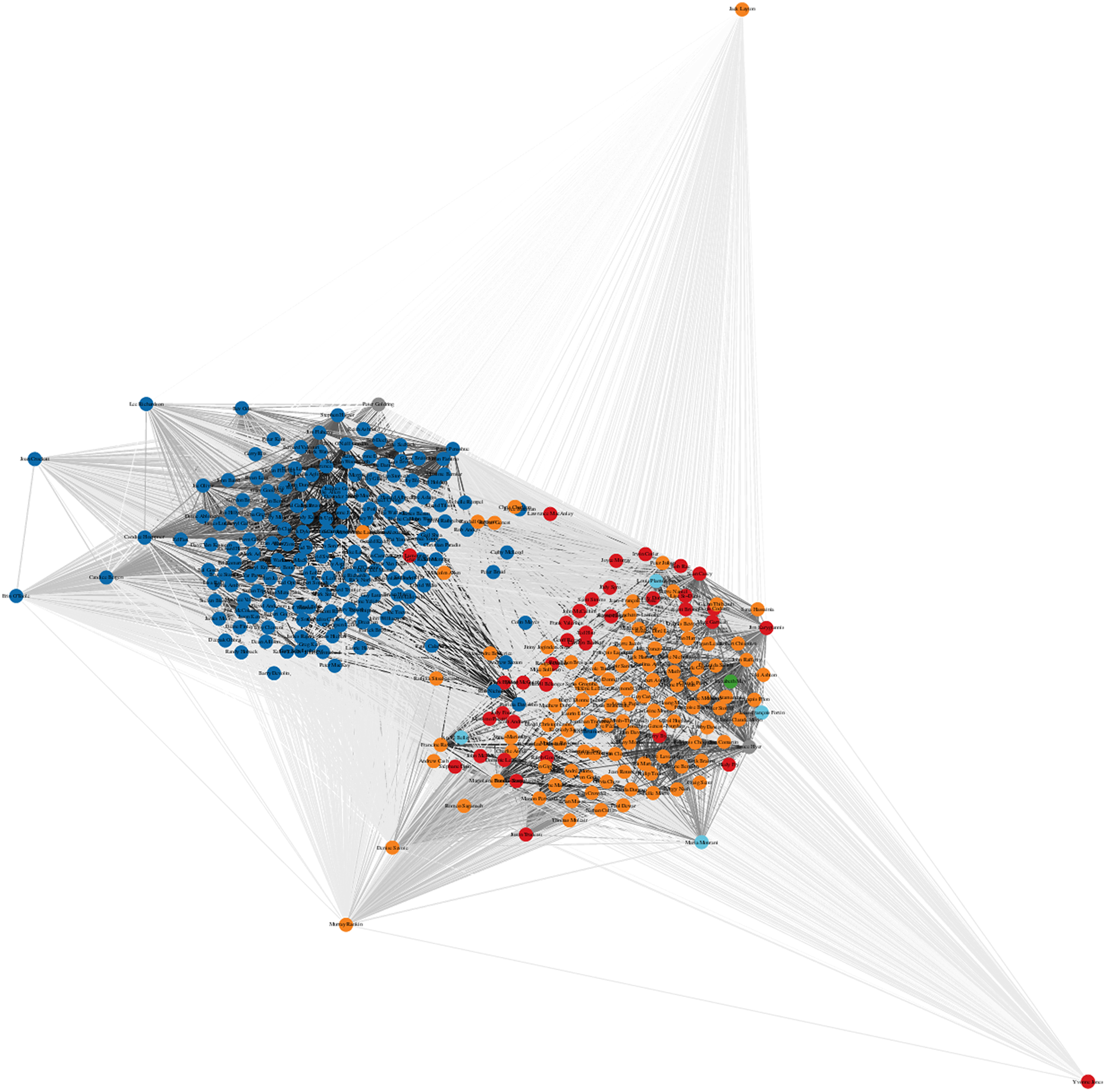
Vote-alignment networks were constructed for each parliament and session from the 39th to the 41st parliaments. To construct such networks, each MP was connected to each other MP, with the connection referred to as an edge. Each such edge was weighted by the number of votes within that session upon which the MPs agreed; more voting together means a higher edge weight. Numerically, each aligned vote contributes a single unit of edge weight. Absence or abstaining from a vote does not count for or against alignment. By quantifying the number of votes in common between MPs, edge weights represent the degree of agreement between any two given MPs. For example, we might expect MPs in the same party to vote together frequently and, therefore, have high edge weights with one another. Connecting all MPs within a parliament and session together, therefore, provides a complete vote-alignment network for that period. For the 40th parliament, first session, only one vote was cast, with 286 of 308 members in attendance, rendering a network that is fundamentally useless for our purposes; it lacks a distribution of edge weights, as all edges have a weight of one or zero and as such would be disconnected. Figures 1 to 3 visualize the vote-alignment networks for the aforementioned sessions using the ForceAtlas2 algorithm (Jacomy et al., 2014). In this algorithm, connections between MPs are modeled like springs are in physics. Were the network to be visualized as a literal network of springs, which is how it behaves mathematically, it would appear much like a box spring does, only without a frame and with wide variation in the size and tension of interconnected springs. Each spring’s individual tension represents a differing tendency to “pull” other MPs close or “push” them away, as indicated by the edge weights assigned to each connection. The result is a network that displays spatial affinity between pairs of MPs, and among MPs as a whole, representing visually the edge weights and therefore the tendency of MPs to agree or not. This form of visualization is intuitive to understand, placing MPs closer if they vote together more frequently, and further apart if they vote together less frequently. Within each figure, subfigures are colorized by party brand color so that nodes (MPs) are labeled clearly with respect to party affiliation. Liberals are red, Conservatives blue, Greens green, Bloc Quebecois cyan, New Democrats orange, and independents gray.
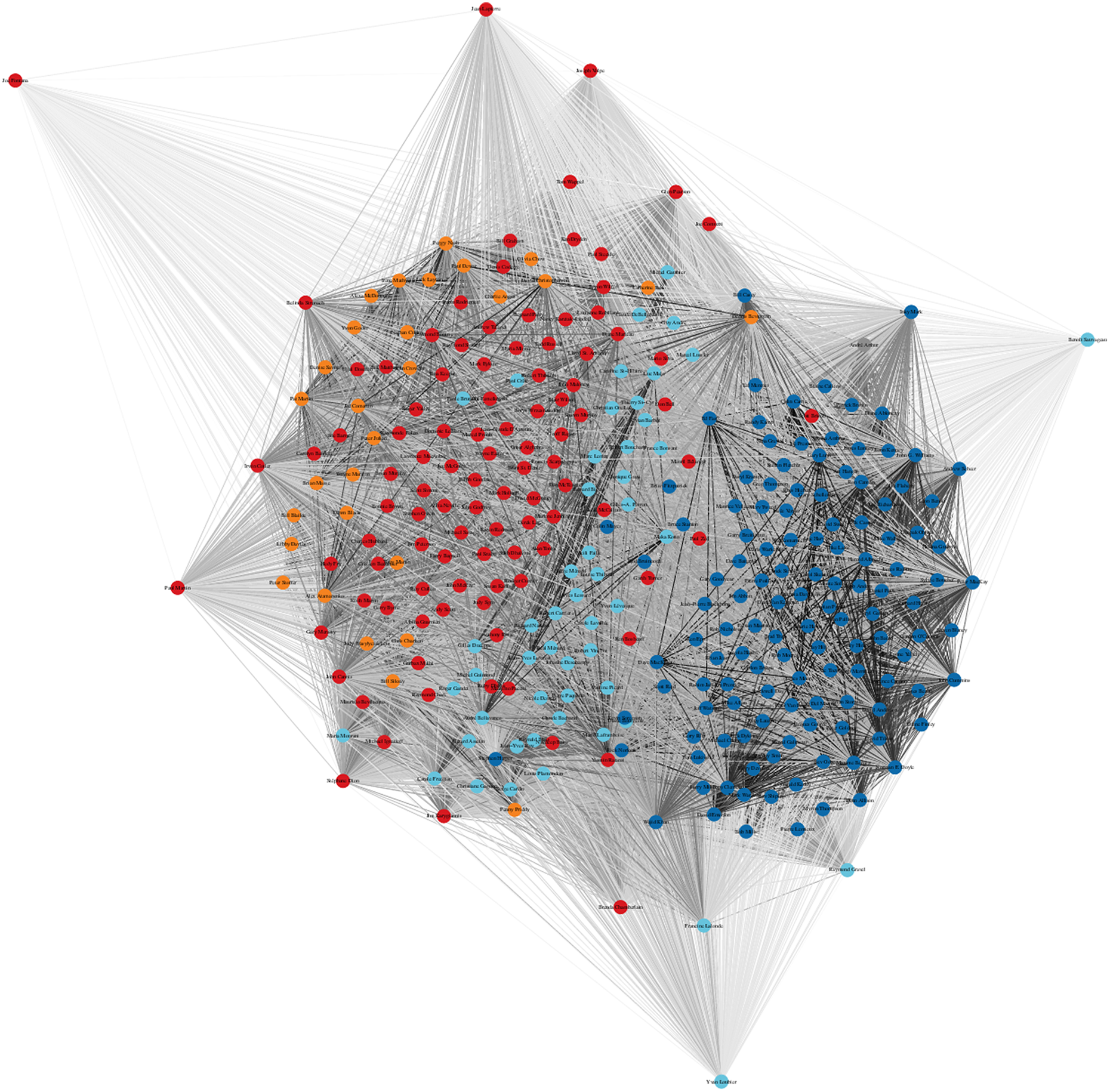
Vote-alignment network colorized by party for the 39th Parliament Session 1. Blue for the Conservative Party, red for the Liberal Party, orange for the NDP, cyan for the Bloc Québécois, green for the Green Party, and gray for independents.

Vote-alignment network colorized by party for the 40th Parliament Session 2. Blue for the Conservative Party, red for the Liberal Party, orange for the NDP, cyan for the Bloc Québécois, green for the Green Party, and gray for independents.
Vote-alignment network colorized by party for the 41st Parliament Session 1. Blue for the Conservative Party, red for the Liberal Party, orange for the NDP, cyan for the Bloc Québécois, green for the Green Party, and gray for independents.
Cohesion within and between/among parties is, therefore, fairly straightforward to discern visually. Parties with sparsely distributed nodes are not particularly cohesive, whereas more tightly-clustered parties are more cohesive, and so on (this also applies to the distance between given party clusters, where interparty cohesion is concerned). We can explicitly measure cohesion via the property of network density within the entire network or a subnetwork. Taking each party as a subnetwork, we can calculate density as it relates to both the rest of Parliament and its internal structure. Therefore, we have two metrics with which we can analyze party behavior: intraparty density and interparty density. Intraparty density, unsurprisingly, represents the propensity of a party’s own members to cooperate when voting—obviously, to some extent, this is a reflection of party discipline in action. Interparty density, on the other hand, represents whether the various parties in Parliament cooperate with one another or not; more cooperation on votes results in higher density, whereas more dissent and opposition among parties in the House would result in lower density. Intraparty density is calculated using a ratio of the sum of edge weights within a party divided by the number of possible edges (i.e. network connections) within that party. Interparty density is calculated in a similar fashion, but instead uses a ratio of the sum of edge weights for connections between that party and any other nodes outside it and the number of possible connections of this kind.
Results
Vote-alignment networks
Figures 1 to 3 display the aforementioned ForceAtlas2 visualization of each vote-alignment network by parliament and session. Generally, the clustering present in each figure demonstrates that party cohesion is visually identifiable using the algorithm. During successive sessions, banding effects can be seen as parliamentarians stake out partisan turf, but they also occasionally display noncohesive behavior, with the Liberal Party in particular showing signs of disarray during its various sessions spent on opposition benches; this corresponds to the succession of leaders during this period. The NDP and Liberals appear almost to trade places from time to time, though the Liberals stabilize in the middle ground in the sessions just preceding their election to the government in 2015.
A few more detailed interpretations of select network maps follow to aid understanding of what is implied by visualizations like these.
Figure 1 represents the first session of the 39th Parliament, in other words, the Harper administration’s first months in government. A relatively unified cluster of CPC nodes is evident, suggesting unity within the party in the heady days after an election victory and a coordinated effort to begin to get the party’s agenda passed into law. A small gap is evident between the preponderance of CPC nodes and the bulk of opposition nodes, with a few MPs as outliers. This separation between government and opposition is to be expected, but within the broad cloud of opposition nodes, banding is noticeable most clearly in the Bloc’s members. This shows that they frequently voted (perhaps inevitably) as a bloc, but also maintained voting patterns relatively distinct from the bulk of other opposition members. The Liberal contingent, unsurprisingly, is more scattered, likely for reasons ranging from disarray after an electoral defeat to being a larger voting bloc that is harder to keep together. The NDP shows somewhat consistent banding but appears largely adjacent to the Liberal Party in its voting patterns, suggesting moderate cohesion but also that both the Liberals and the NDP probably tended to oppose the same kinds of motions and legislation put forth by the governing Conservatives.
Figure 2 represents the second session of the 40th Parliament, through the Conservatives’ second term in government. Clustering on the government benches is again evident, as the CPC weathered a significant confidence crisis during this term in government that culminated in a controversial prorogation of the legislature. Clear banding is once again visible, keeping most Liberal members together and keeping government separate from opposition, with another, looser band representing somewhat-concurrent NDP and Bloc voting patterns. Notably, several members of each party appear as outliers, voting consistently with another party bloc or simply unlike any other members; in many cases, these are backbench MPs in a chaotic legislative environment, though two of the CPC nodes embedded within the Liberal band were Keith Ashfield and Gail Shea, who held multiple maritime-related portfolios during this government and who repeatedly voted against their party in the session in question. This is an example of members acting in an instrumental fashion and toeing the party line while consistently dissenting on matters of ideology, region, or constituent interest.
Figure 3 represents the first session of the majority 41st Parliament and shows the clearest government-opposition separation of any of these figures. While there are still outliers among all parties, this map shows a fairly cohesive majority and typical banding in the opposition, with the Liberals fairly consistent and the more-populous (for the first time ever) NDP clustering further from the Conservatives; the Bloc was reduced to a scattered rump. Consistent opposition by both the Liberals and NDP is clearly visible and is the behavior that would be expected in a conventional majority. These visualizations are useful for understanding how ForceAtlas2 renders vote-alignment networks in a format that is relatively intuitive to read and interpret. The structures that lead to intraparty and interparty cohesion, or lack thereof, are plainly visible; these figures are illustrative of less stable cohesion in minority situations and much more predictable banding in a majority configuration. If, for example, parties engaged in a great deal of multipartisan cooperation with one another, the characteristic separations between party clusters would not be evident, and nodes from different parties would clump together. Similarly, parties unable to maintain cohesion (of which there are some examples in these figures) would appear more scattered. Generally speaking, though, what we see in these figures is indicative of what we expect in minority and majority parliaments.
Interparty and intraparty cohesion metrics
Figure 4 describes the interparty and intraparty density of each party over vote-time. One unit of vote-time is indicative of a temporally-sequential vote. Network density measures the fraction of edges present given a subset of the network and, therefore, can be considered a cohesion metric (Newman, 2010). In displaying both the level of a party’s cohesion and the stability of that level of cohesion, these figures show that the opposition Liberals, for example, remained only somewhat coordinated for long periods until party density became stable toward the end of the CPCs time in power, as the party found its footing and prepared to fight the 2015 election. The small, tight clusters of points represent temporary periods of high consistency at a certain cohesion level, common when a party’s internal divisions are consistently reflected in the same period over a sequence of votes on the same topic (e.g. Liberal Party splits over genetically modified organism (GMO) seeds regulation in 2011 or animal cruelty measures in 2007). 2 While this is an issue of intraparty cohesion, it is in fact most visible in the plots for interparty density in Figure 4(a). Meanwhile, it is important to note that the results for the Conservatives, while seemingly reasonable for a governing party that needs to exercise discipline on confidence matters, do show that Prime Minister Harper did not exercise quite the degree of top-down control that is generally assumed (Jeffrey, 2015; Nadeau et al., 2011). Although dissent in CPC ranks did generally decrease over the party’s time in power, it was still meaningfully present during this entire period. This is particularly visible when comparing pre- and post-June 2011 patterns of intraparty cohesion as shown in Figure 4(b).
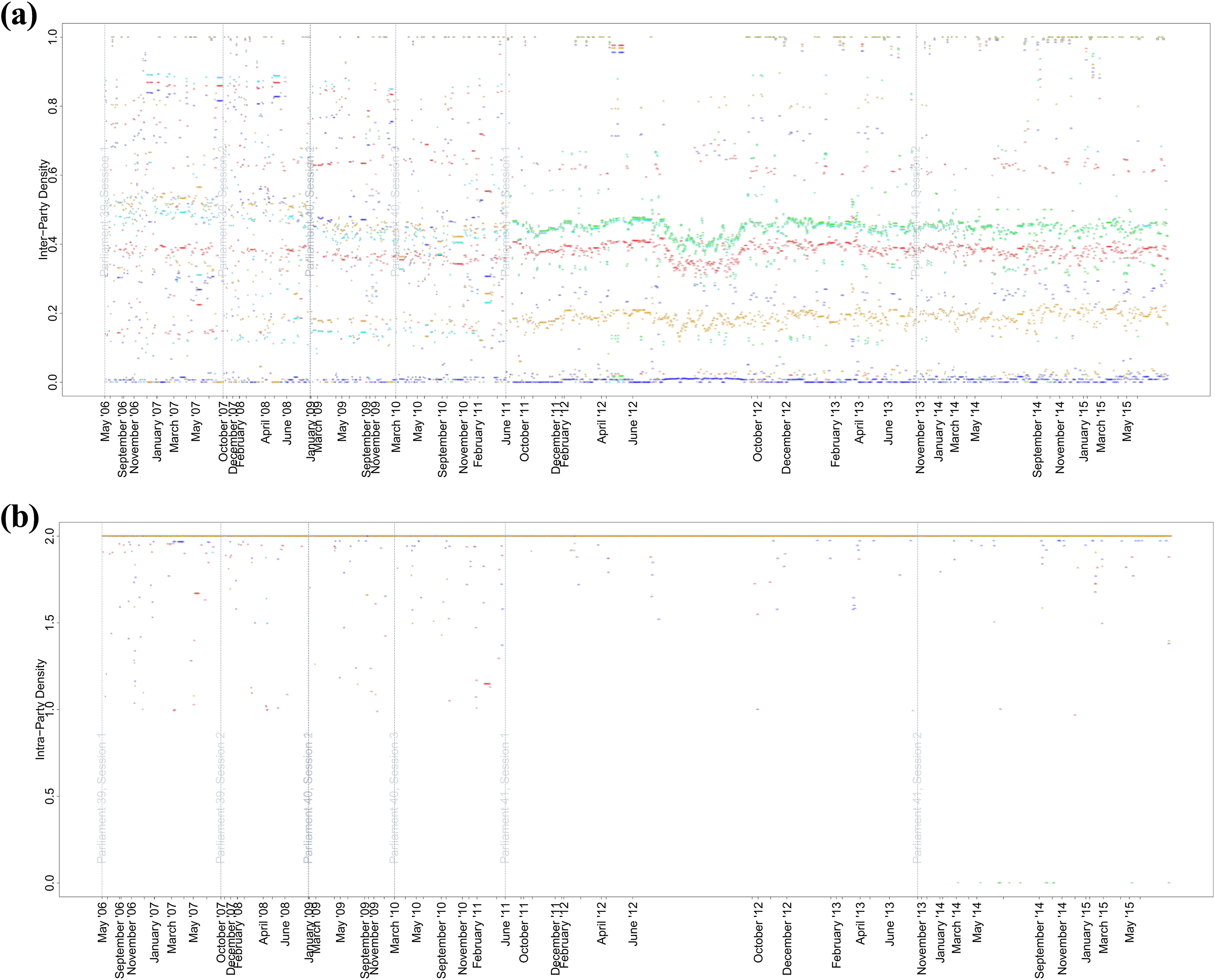
Intraparty and Interparty density for vote-alignment networks over time within the Harper government period. Points are indicated by grayscale cross, with party-colorized numerical vote number identifier overlaid. (a) Interparty density for vote-alignment networks over time. (b) Intraparty density for vote-alignment networks over time.
Figure 5 applies a 158 vote-time window moving-average filter to the interparty and intraparty density vote-time series. This filter reduces each point to the average of the density within the window, centered on the point in question. In these figures, we are using a window of 158 vote-time units, the minimum session width in vote time. Our intent is to provide a visualization that is more intelligible, yet contains the core signal inferred from Figure 4.

Moving average filtered intraparty and interparty density for vote-alignment networks over time within the Harper government period. Points are indicated by grayscale cross, with party-colorized numerical vote number identifier overlaid. Moving average filter at a width of 158 votes is applied. (a) Interparty density for vote-alignment networks over time, moving average filtered. (b) Intraparty density for vote-alignment networks over time, moving-average-filtered
The use of a moving-average filter is unconventional in cases such as this, given that its primary purpose is to compensate for noise, of which there is none in our data set—it is not a sample, but rather a perfect record of voting behavior through the parliaments in question. A simple justification of its use here is that it renders intelligible a visualization that requires much time and knowledge of the data and the time lines of those parliaments to interpret. Nonetheless, there is a more comprehensive reason to use such a filter to render the graphical output more intelligible.
Once again, recall the importance of the government’s agenda-setting power and the potentially arbitrary results of a particular order of items of parliamentary business. Individual vote events, or even a day’s worth or a week’s worth of votes, cannot capture a party’s cohesion in a meaningful way since there is no rhyme or reason to whether an individual vote, or a day’s worth or a week’s worth of votes, will cause a party to behave in a cohesive or fractured fashion. No window of parliamentary business of that length will give a sufficient account of a party’s general cohesion; the order in which items on the parliamentary agenda come up is not random, but decided by government, and certain items of business may prompt very divided or very cohesive patterns of behavior in a given party, depending on how divided its membership is on that topic. Therefore, a longer window is needed. We believe that the minimum parliamentary session length, in terms of how many votes were held during the span of that smallest session, is the most sensible time unit to use for smoothing out the density visualizations, since it makes party cohesion intelligible on a scale useful to our discussion and does not rely on the vagaries of what parliamentary business comes up in a span as short as a day or week, or even a month, thus compensating for some potential effects of government agenda setting. To use such short windows as the basic unit of analysis only marginally mitigates the unintelligibility of the raw-data graphical presentation.
The results we see suggest that changes in cohesion within and among parties during the two minority terms were, comparatively speaking, rather minor, with the much more noticeable variations in interparty density coming during the first half of the majority government period, mostly among the larger parties. While the minority period appears to have been unsettled, at least on a local scale, interparty density nonetheless stayed within a comparatively small range, reflecting the precarity of a hung parliament. Intraparty density varied even less, with only a few anomalous periods as the Liberals adjusted to opposition in a minority parliament, and then as the Green Party finally gained more than one member so that interparty density became possible to measure at all.
Cohesion summary table
Returning to the expectations articulated above about how parties will behave in varying parliamentary situations, we can examine whether the behavior of the major Canadian political parties in the House of Commons bears this out, beginning with the Conservatives (for a summary, see Table 2).
Examination of party behavior, given governing status in a majority or minority parliament.
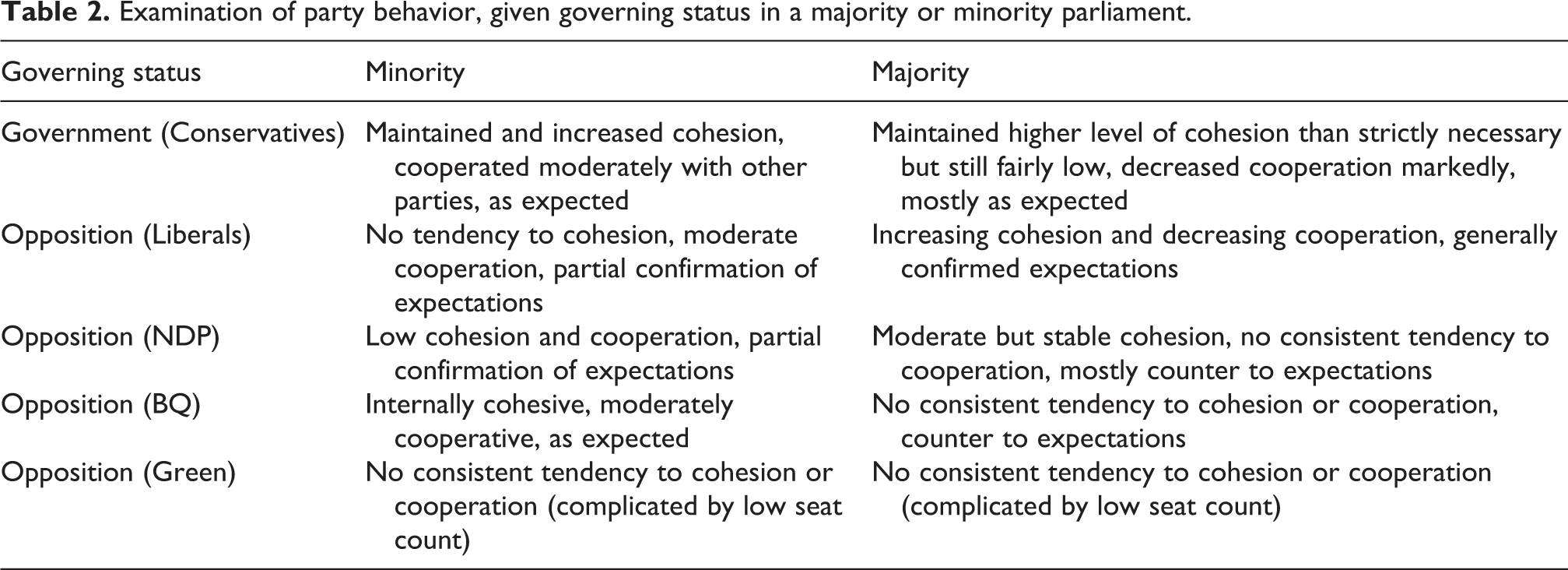
Through the period of minority government, the CPC is expected to maintain strict internal cohesion while cooperating with other parties on opposition benches. We find that the Conservatives did maintain internal cohesion during the minority period but also that it intensified over time, and this trend continued even into the period of CPC majority government, when that cohesion would not have been so critical. Thus, this expectation finds only partial confirmation in our results, though it is true that the governing party maintained sufficient cohesion to keep the confidence of the House. In turn, the Liberals in the minority period displayed no particular tendency toward strong cohesion, as expected of an opposition party in a minority situation (the party may also have been experiencing internal dissent after a defeat ending a long period in government). Their intraparty cohesion did recover during the period of majority government. Our findings show that the tendency of the Liberals to cooperate is roughly on par with that of the Bloc during the minority period, though when comparing the minority and majority periods, this cooperation shows up in different ways. During the minority sessions, temporally-inconsistent short periods of close cooperation between parties are visible, whereas during the majority sessions, the Liberals display a consistent pattern of these clusters, both short and long, for the entire period. The Liberals thus took on a similar temporal configuration to that of the other third parties, distinct from the government and opposition. The Bloc’s behavior is cohesive and distinct during the minority period, though under majority conditions it and the Green Party display very similar behavior, which is emphasized because the Green Party never had more than two MPs, and the Bloc had far fewer than ever before (and parties small in number, especially when not subject to party discipline, show up in similar fashion in such a plot). As minor parties, the Bloc and Greens had little incentive to display high internal cohesion and did not often show any evidence of consistent cohesion or cooperation. Finally, the NDP presents an interesting case of a party that dramatically bolstered its numbers over the time period studied. The NDP was consistently distinct in the structure of its behavior from other opposition parties, first as a minor party and subsequently as the largest opposition party in the 41st Parliament. During the minority period, the NDP is not particularly prone to cohesion or cooperation, which is only partially commensurate with our expectations for opposition parties, but during the majority period, under new leadership, its behavior came to resemble that of a larger brokerage party. In the majority period, the NDP is less variable over time in terms of its cohesion, displaying a pattern similar to that of the governing Conservatives. As such, the NDP does not behave particularly like what we expect an opposition party to do while in a majority parliament, displaying less internal cohesion and no particular tendency to cooperate with either government or opposition parties; this could be the result of a large influx of inexperienced first-term MPs in the NDP caucus and its progression from perennial third party to its first stint as Official Opposition.
Conclusions: A deserved, but exaggerated, reputation?
While the classic low-cohesion (despite party discipline) pattern of MPs’ behavior in the Canadian Parliament is confirmed by this analysis, we find that even during a period of expected intense polarization and strong cohesion, especially in a tightly-managed governing party, cohesion is not especially high. Some support is found for Sieberer’s contention that holding power can reduce a governing party’s cohesion because of the unique challenges inherent in governing (but not in occupying opposition benches). If the folk wisdom regarding party discipline in Canada is to be believed, and discipline is indeed abnormally strong, then it is not sufficient to herd MPs, and discipline may be overruled in the moment for a given member by other, more pressing incentives, including constituent concerns or matters of personal conscience. Strong party discipline may thus be useful to a point but limited in the degree of partisan cohesion it can promote. This suggests that the behavioral adaptation found over time by Godbout and Høyland (2013, 2017) is indeed spurred by legislative rules and structures as they have argued, but that this adaptation may have its limits and still permit a fair amount of dissent as members choose whether to play alongside their teams or go it alone when matters warrant.
More specifically, the analysis of vote-alignment networks within the House of Commons provides a novel picture of the Canadian parliamentary structure inaccessible with more traditional methods. Party groups are separated by their partisan identities themselves and can, as Sieberer notes, display unified behavior when required. Thus, while patterns of behavior in the Canadian House of Commons are guided by various manifestations of party discipline, be it the political will of the leader/PMO and Cabinet or party whips, divergence from absolute control and party obedience is nonetheless observed.
Our commonsense model of how rational legislators and political parties ought to behave in various parliamentary situations is borne out to some extent. Our analysis suggests that there is sufficient variation and nuance in the day-to-day operations of the legislature to warrant further empirical analysis in order to understand when, how frequently, and why parliamentary behavior in fact departs from these expectations. For example, in jurisdictions with Westminster parliamentary systems, much could be revealed about the nature of party cohesion as contrasted with traditional narratives regarding the strength of party discipline and the influence of central party management, especially while in the executive. In general, in any parliamentary or even congressional system, this style of analysis can reveal a lot about whether parties are held together because they are consistent voting blocs, displaying consistent cohesion in their voting patterns, or whether their unity stems from something else, such as partisan in-group/out-group thinking or the parties’ function as brands. The distinctions between party allegiance among voters in the electorate and among members in a legislative environment could also be made much clearer through further analysis of this sort.
Since the Harper years offered samples of both minority and majority parliamentary configurations, our findings can address all of our expectations, as shown in the previous section. Further, the Harper government, while presented as an outlier in terms of its strict central control and management by commentators, has been shown instead to be a more complicated case. While messaging, communications, and public relations strategies may have reflected strong control by the central executive, the reality of parliamentary behavior during that period is simply that executive control can only influence the behavior of MPs so much. It serves as a reminder that surface impressions of a government’s strategy and general governing style may belie the reality of what they can accomplish in the legislature and that analysis of this sort can be profitably applied to understand the degree to which a governing party may live up to its reputation, whether for collegiality or for top-down control.
While the popular narrative of the Harper government is challenged, or at least qualified, by our analysis, the same should be noted regarding our expectations of how parties should behave when faced with various parliamentary situations. We find that broadly speaking, the expected patterns hold, but there is more nuance than the commonsense view can communicate. Parties governing in a majority can be expected to maintain at least a certain floor of intraparty cohesion in order to win recorded divisions on matters of confidence, but the voting tendencies of Harper’s majority show that this floor is somewhat lower than one might expect and that a majority government can pass a robust legislative agenda while still maintaining low levels of cohesion. Meanwhile, the notion that parties in opposition to a majority government behave cohesively in order to present themselves as an alternative government in waiting is borne out by the behavior of the minor opposition parties, that is, the Liberals, Bloc, and Greens, but counterintuitively not supported by the behavior of the NDP as Official Opposition. (Their comparatively low cohesion on opposition benches remains puzzling, even if it reflects learning and a transition to brokerage-like behavior.) Finally, during the minority period, we see the opposition parties become less cohesive over time, but they did display a marked increase in the consistency of their cohesion over that same time; in other words, it took some time for them to settle into the pattern we had expected. An important lesson for the study of legislatures and emergent behavior within them is that cohesion within and among party groupings can be highly situational and constrained in sometimes surprising ways by the rules of the institutions within which legislators operate.
Our findings illustrate the utility of approaching party cohesion in a novel fashion, using a bottom-up analysis of MPs’ behavior as a starting point and permitting partisan alignment patterns to emerge from there. Moreover, instead of the traditional view of party discipline as an indicator of cohesion, with deviations from that discipline forming the main subject of study, our findings show that much can be learned from measuring cohesion separately and prior to consideration of party affiliation, such that cohesion itself can be seen as an indication of where party lines might be rather than simply taking party affiliation for granted. Discipline is thus simply one of many incentives and pressures to which members must adapt, and their behaviors, including voting cohesion, can be seen as responses to these pressures. An interesting pattern in these findings is that over the course of one or more parliamentary sessions, MPs and parties can learn and adapt in terms of their cohesive behavior, and start far from our expectations of how they should behave in a given situation but then steadily converge on those expectations over time to display more rational behavior. This is an interesting foundation upon which to build more involved investigations of emergent behavior among parliamentarians and party groupings, which further highlights the importance of understanding the incentive structures imposed upon MPs not only by parties but also by the rules, protocols, and procedures of the Westminster-style legislature itself. Finally, this analysis can form part of a larger body of research, showing that in the Canadian parliamentary context, what holds parties together may be less the traditional markers of unity-like cohesion in voting or adherence to and articulation of clear ideological positions, but rather, merely the party brand itself. Team members may change, the coaches may change, play styles may change, and of course, members may veer between instrumentalism in toeing the party line and true-believer behavior in defending ideological, regional, or constituency interests, causing periodic local fluctuations in cohesion. Nevertheless, the core of the competition between parties in the House of Commons is the jersey the players are wearing.
Supplemental Material
Supplemental Material, sj-pdf-1-ppq-10.1177_1354068818795196 - When the team’s jersey is what matters: Network analysis of party cohesion and structure in the Canadian House of Commons
Supplemental Material, sj-pdf-1-ppq-10.1177_1354068818795196 for When the team’s jersey is what matters: Network analysis of party cohesion and structure in the Canadian House of Commons by David Chartash, Nicholas J Caruana, Markus Dickinson and Laura B Stephenson in Party Politics
Footnotes
Acknowledgements
The authors would like to acknowledge the contribution of Bradford Demarest, PhD, and Rebecca Hale for their initial support in developing the ideas for this project.
Declaration of Conflicting Interests
The authors declared no potential conflicts of interest with respect to the research, authorship, and/or publication of this article.
Funding
The authors disclosed receipt of the following financial support for the research, authorship, and/or publication of this article: This analysis was facilitated by the use of supercomputing resources at Indiana University, which result in this research being supported in part by Lilly Endowment, Inc., through its support for the Indiana University Pervasive Technology Institute, and in part by the Indiana METACyt Initiative. The Indiana METACyt Initiative at Indiana University was also supported in part by Lilly Endowment, Inc.
Supplemental Material
Supplemental material for this article is available online.
Notes
References
Supplementary Material
Please find the following supplemental material available below.
For Open Access articles published under a Creative Commons License, all supplemental material carries the same license as the article it is associated with.
For non-Open Access articles published, all supplemental material carries a non-exclusive license, and permission requests for re-use of supplemental material or any part of supplemental material shall be sent directly to the copyright owner as specified in the copyright notice associated with the article.
