



Abstract
The question how voter preferences relate to preferences of representatives under different electoral rules has attracted scholarly attention for some time. Although theoretical work suggests that proportional rule leads to more dispersion of representatives than plurality rule, empirical studies of this nexus have not yet reached a consensus. We argue that this is because they are plagued by serious problems as they rely on measures that differ for both sets of actors. We use behavioral data to estimate ideal points of voters and representatives on a common scale by taking advantage of the high frequency of referendums in Switzerland. We find that members of parliament elected in proportional representation systems are more widely dispersed around the median voter. Probing at what stage this difference in dispersion occurs, we also demonstrate this is the voters’ doing, as it only applies to candidates who are elected.
All democracies in the world are representative democracies. Citizens choose representatives to whom they delegate decision powers, mostly in the legislative realm. Numerous studies have attempted to assess whether policy congruence between the electorate and the political elite depends on the electoral rules. In particular, the question how the dispersion of representatives varies under different electoral rules has attracted scholarly attention for some time. At the theoretical level, few would dispute that plurality elections should lead in equilibrium to centripetal competition (candidates, and thus members of parliament (MPs) locate closely to the median voter of their respective districts), and proportional representation (PR) should favor centrifugal competition. However, empirical support for these claims has been hotly disputed.
In this article, we show that this sorry state of affairs may be largely due to measurement issues. Indeed, questions of representation only make sense if for citizens and MPs (and candidates for that matter) we have positions on the same meaningful scale. Policy preferences of citizens and representatives, however, are generally deduced from distinct surveys or distinct survey questions. It follows that these measures may not be comparable. We argue here that our best chance to arrive at positions on identical and meaningful scales for both citizens and MPs is by relying on behavioral data. We do so, following Hug and Martin (2012), by taking advantage of the frequent referendum votes in Switzerland, and the fact that MPs, elected under different electoral systems depending on their constituency and chamber, also vote on proposals submitted to a referendum vote. As we rely on referendum results as well as voting decisions in both chambers of the Swiss parliament, we can assess with much more confidence how electoral rules affect issues of representation (Hug and Martin, 2012, only have available data from the lower house, and thus only a very small number of MPs elected in plurality elections). Consistent with the theoretical predictions, we find that plurality elections lead to MPs with positions on average closer to their respective median voter, and this even when controlling for district magnitude.
We then turn to addressing the question at what stage of the electoral process these differences in dispersion between the two types of electoral system appear. Does the effect of the electoral rule on dispersion occur through the behavior of candidates (as suggested by the theory), the behavior of voters, or both? Drawing on additional information from a candidate survey, we show that at the level of candidates, dispersion hardly differs according to the electoral system. However, when considering only successful candidates, the differences in dispersion according to the electoral system suggest that voters do the heavy lifting in making MPs less dispersed around the median’s preferences in plurality elections compared to PR elections. This new finding shows that the electoral rule does not restrain the range of options available to the voters.
We begin with a discussion of the literature. We then discuss the empirical problems that in our view lie at the heart of the divergent results found in the literature and present the solution we adopt in this article. Afterward, we test the effect of PR on dispersion (we use the terms dispersion, deviance, and centrifugal trend interchangeably in this article). Then, we assess at what stage of the electoral process changes in dispersion occur. Finally, the last section concludes.
Why electoral systems should affect MPs’ positions
For theories assessing how electoral systems affect candidate and MP positions, Hotelling’s (1929) study is an important precursor. Developing a model on the optimal location of firms on “main street,” he finds a tendency for competitors to imitate each other, leading to very similar offers available to the buyers. This economic theory assumes a one-dimensional ideological space and single-peaked symmetric preferences. As a spatial dimension can mimic any satiable dimension, Hotelling (1929) suggests that his theory could be applied to electoral competition in plurality systems too. Still regarding plurality systems, Black’s (1948) median voter theorem establishes that candidates and representatives have a clear incentive to appeal to the median voter in majority elections, implying a centripetal trend. The intuition behind this is that in a two-party system, under proximity voting and if voters do not abstain, a party can only increase his vote share when moving toward the median voter. Downs (1957) explains, however, that in a two-party plurality system, parties may not fully converge as extremists might prefer to abstain if parties are ideologically too similar, causing a decrease in vote share. In PR systems, however, various ideological preferences are represented. According to Lijphart (1999), “…the basic aim of PR is to represent both majorities and minorities and, instead of overrepresenting or underrepresenting any parties, to translate votes into seats proportionally.” PR systems are thus generally multipartite, and we should expect the distribution of ideological preferences of representatives in PR systems to resemble (more or less) the distribution of the ideological preferences of voters. Moreover, Downs (1957) explains that parties in PR multiparty systems have an incentive to keep ideological distance between them, as a party generally loses votes if it becomes ideologically too close to another party. An early attempt to model PR systems appeared in Greenberg and Shepsle (1987). These authors show that the equilibrium positions of candidates and parties in a one-dimensional electoral competition have to be spread along the policy continuum (see also Shepsle and Cohen, 1990; Shepsle, 1991). Cox (1990) proposes a systematic assessment of how the dispersion of candidates should differ in a plurality system, compared to the one in a PR system. He finds that centrifugal and centripetal trends exist in both systems. In each system, the trend depends differently on the number of candidates, the number of seats, and the number of votes each voter can give. 1 To summarize, with the exception of Cox’s (1990) findings, spatial theory of voting suggests that plurality generates centripetal trends while PR generates centrifugal trends. This is because parties in plurality systems tend to converge toward the median voter, while parties in PR systems not only represent various preferences existing among citizens but also have an incentive to stay away from each other.
All these studies above assume perfect information and proximity voting. It is interesting to note that other studies based on different assumptions also lead to similar conclusions. Authors who assume probabilistic voting find that plurality rule should lead to convergence (Schofield et al., 1998), while PR should lead to divergence (Lin et al., 1999). Moreover, Kedar (2005) finds that directional voting is more likely in consensual systems. This finding also suggests higher dispersion under PR, as directional voting should lead to more dispersion and plurality systems are generally less consensual than proportional ones. Thus, the theory on electoral competition tends to expect a centrifugal effect of PR on representatives.
Empirical results, however, do not lead to a consensus. Dow (2001, 2011) finds that PR gives rise to less centrist legislative parties than plurality. On the other hand, Ezrow (2008, 2010)
2
comes to the conclusion that there is no effect of PR on the dispersion of legislative parties (see also Ezrow, 2011 reply to Dow, 2011).
3
Some studies focus on the effect of the electoral rule on the dispersion of parties in the government. For example, Blais and Bodet (2006) find that there is no effect of PR on government dispersion,
4
while Warwick (2011) shows that the government will follow a party’s wishes far less under PR than under plurality. Finally, regarding legislators, Bingham (2009)
5
finds the effect of PR on dispersion to vary over time. Thus, empirical results diverge, and this is likely due to the fact that they are based on various problematic measures. We propose the following hypothesis, based on the theoretical work discussed above and in order to provide additional insights for the empirical work:
To test this hypothesis, we use behavioral data, allowing to locate voters and representatives on a common scale. We believe that this will lead to more reliable results.
Empirical problems and solutions
Empirical studies investigating ideological congruence between citizens and representatives use various measures based on survey data. Some studies use measures of ideal points from different sources: for example, combining an election survey with an expert survey or an election survey with a candidate survey. When proceeding like this, there is a risk that the two scales are not directly comparable, as survey questions can be affected by systematic and measurement errors (Achen, 1978; Feldman, 1991). Answers to the same question in two different surveys may thus not be directly comparable.
In other studies, the location of voters and representatives is estimated by the same respondents. Respondents give their own ideal point, as well as their perception of the ideal point of each party. In this case, some distortions may also occur. For example, more informed individuals are likely to respond differently to abstract questions of ideological positions than less informed ones (e.g. Feldman, 1991), and projection effects can occur (see e.g. Judd et al., 1983).
Finally, other studies infer the position of the median voter from the parties’ positions and their vote share (the Kim and Fording’s (2003) method) or infer the parties’ positions from voters’ positions in order to have all actors in one policy space. However, both techniques implicitly rely on strong assumptions, namely, that voters are located exactly where the party for whom they vote is located or that the electoral system correctly translates voters’ preferences. 6 Thus, the data and methods used by scholars to measure ideological congruence present drawbacks that could potentially lead to erroneous results.
None of the studies discussed above uses behavioral data for locating both types of actors in a common space and tests the effect of PR on dispersion, except Hug and Martin (2012). The estimation of ideal points based on behavioral data allows one to locate different types of actors on the same scale. Several studies have included in the same database the votes of actors from different institutions and, using the method proposed by Clinton et al. (2004), positioned these actors in the same political space (Bafumi and Herron, 2010; Bailey, 2005, 2007; Bailey and Chang, 2001; Hug and Martin, 2012; Jessee, 2009; Masket and Noel, 2011; Treier, 2011). 7 Clinton et al. (2004) assume single-peaked preferences and propose to use Bayesian inference to estimate the ideal points. As referendums are quite frequent in Switzerland, we follow Masket and Noel (2011) and Hug and Martin (2012) and use them as bridging observations between the median voters and legislators. Hug and Martin (2012) use behavioral data from votes in parliament and in referendum campaigns to place both MPs and the median voters in each electoral district on the same scale (for a related use of similar data, see Giger and Kluver, 2016). We will proceed similarly and test with more confidence the effect of PR on dispersion as we include the upper house in our analysis.
The voters, the members of the upper house as well as the members of the lower house vote on proposals later voted upon in referendums in Switzerland. As we do not have individual-level data for the voters, and as we are interested in the dispersion of representatives around the median voter, we use the median of each canton (i.e. the electoral districts) for each vote. We will thus locate legislators and median voters on one ideological dimension.
Since assuming constant preferences of legislators over time is a strong assumption (Treier, 2011), we estimate separately the ideal points of the 47th Legislature (2003–2007) and the 48th Legislature (2007–2011), and test our hypothesis for both separately. Between 2003 and 2007 (47th Legislature), the 200 MPs of the lower house and the 46 MPs of the upper house voted on the same 245 final passage votes. Between 2007 and 2011 (48th Legislature), both houses voted on 291 similar final votes. 8 Thus, the final passage votes play the role of bridging observations across both chambers. All the final votes in the lower house are roll call votes. 9 In the upper house, except the few roll call votes, votes are not recorded, but on the basis of videotapes of the upper house sessions, we have manually recorded the final votes. The Online supplemental appendix provides more detail on the coding. Among the 245 final votes of the 47th Legislature and 294 votes of the 48th Legislature, respectively, 19 and 29 are also popular votes. 10 Thus, the referendums and initiatives are the bridging observations between the parliament and the voters. 11 The summary of the matrices used to estimate ideal points is displayed below.
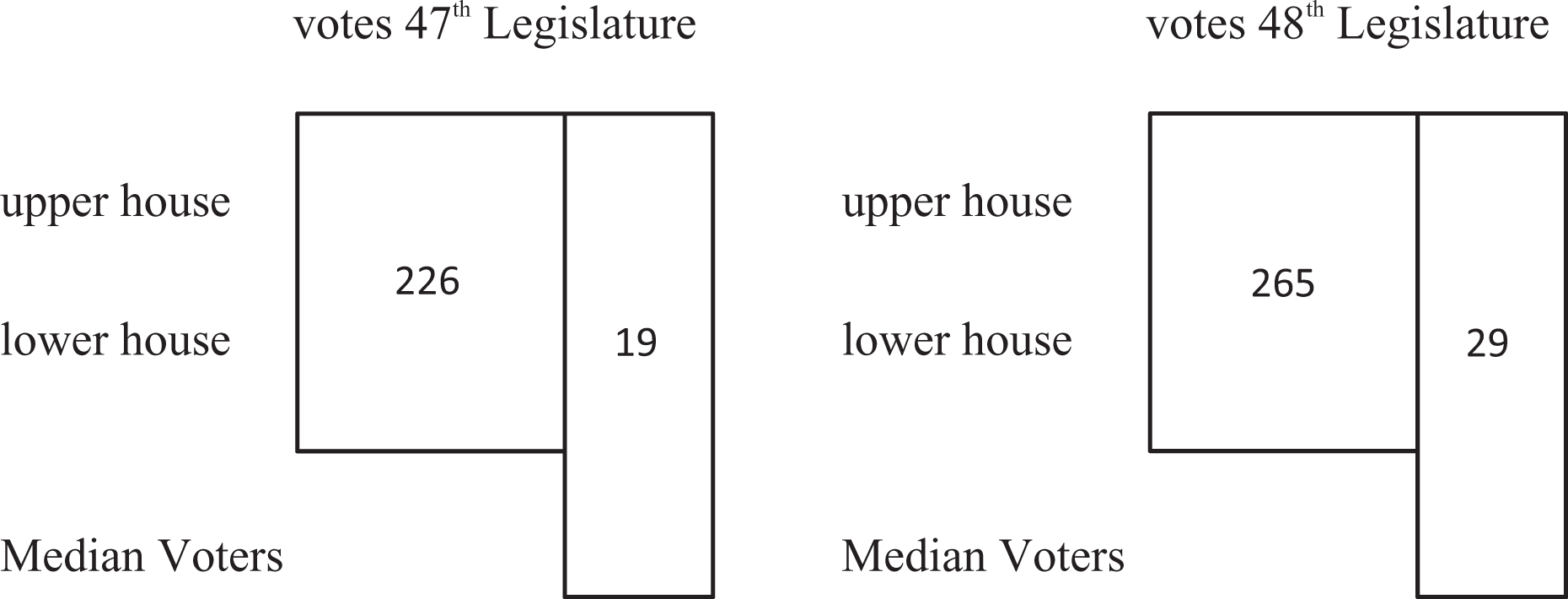
Concerning the bridging observations, they are either referendums or initiatives. For referendums, once the MPs agree on a bill, the bill only passes if it is accepted by popular vote. Some referendums are mandatory (e.g. in the case of a revision of the Constitution) and others are optional. Optional referendums occur when requested in a petition. In the case of an initiative, the voters alone decide to accept a bill or not. MPs vote, and these votes are made public, but are not decisive. This is why they are often seen as recommendations from the MPs to the voters. 12
We use Clinton et al.’s (2004) method to estimate our ideal points. Figures 1 and 2 display the estimated left–right positions of the members of the upper house, the members of the lower house, and the cantons for the 47th Legislature and the 48th Legislature, respectively. The horizontal axis is the left–right scale and the vertical axis is an index, ranking in each institution separately, the persons from the left to the right. The horizontal lines are the 95% confidence intervals of each ideal point. The members of the upper house are much less dispersed than the members of the lower house. The legislators are very dispersed compared to the cantons, and this is because median votes are aggregate measures.

The ideal points of the legislators and the cantons—47th legislature.
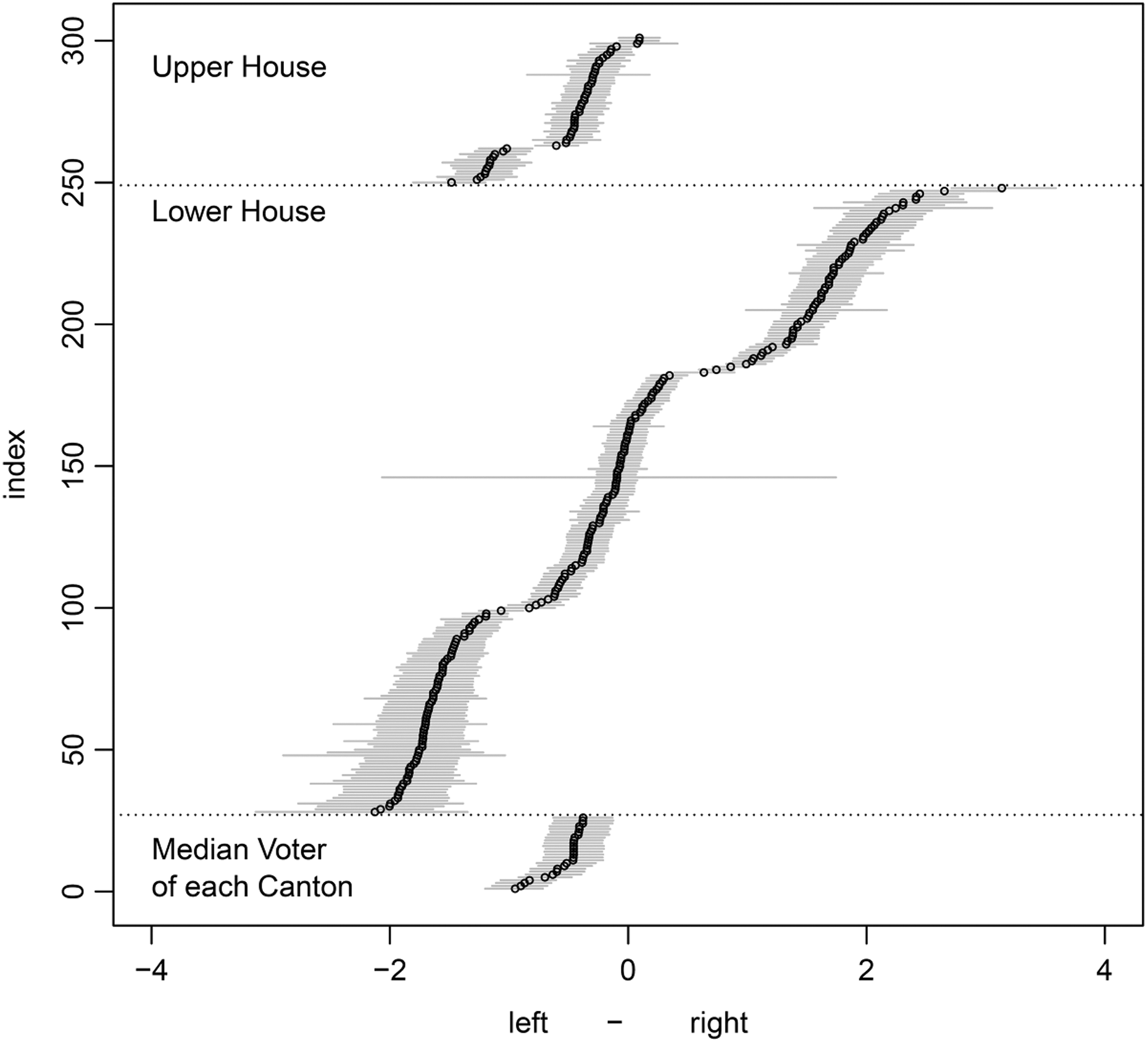
The ideal points of the legislators and the cantons—48th legislature.
Now that ideal points are estimated, as the electoral rule differs among cantons and chambers, a direct comparison between the effects of PR and plurality rule on legislators’ dispersion can be carried out. In Switzerland, the number of legislators per canton is proportional to the population size of the cantons in the lower house, with a minimum of one in the small cantons. In the upper house, the number of legislators equals 2 for each canton, except for the six cantons that used to be called “half cantons” where the number of legislators equals one. The electoral rule for the lower house, specified in the Federal constitution, is PR except for the cantons with a single MP. The electoral rule for elections to the upper house, defined by the cantonal law, differs among cantons. In the Online supplemental appendix, Table 1A presents the numbers of MPs in each canton and the rule by which they are elected (plurality rule is denoted as MA), for the two houses, respectively. Now that we have median voters and representatives on the same scale, and given that elections do not all take place under the same rule, we can test the effect of the electoral system on deviance.
Because we will test the effect of the electoral rule at the level of the electoral constituency (i.e. within one country), one may question whether the results will be generalizable to a comparison across countries. When discussing the effect of the electoral rule on the number of parties, Duverger (1951/1954) pointed out that this effect occurs at the level of the electoral constituency. A distortion can occur at the national level, and this is nicely showed by Chhibber and Kollman (1998). This should also be true for the effect of the electoral rule on dispersion. Representation at the national level can be influenced by other factors, such as the level of centralization of the party system or the heterogeneity of preferences across districts. However, although testing the effect of the electoral rule at the level of the electoral constituency should lead to more reliable results, this does not mean that the effect of the electoral rule should not occur at the aggregate (national) level.
Testing the effect of the electoral rule
Using these estimated ideal points, we measure what we call the deviance of each MP, that is, the absolute distance between an MP’s position and the median voter of his or her canton. Yet, in districts with low (high) heterogeneity of policy preferences, we should expect a lower (higher) dispersion of representatives, all else being equal. Indeed, high dispersion of the voters tends to increase the deviance of the legislators (see Gerber and Lewis, 2004). Consequently, we also create a measure of standardized deviance by dividing each MP’s deviance by the standard deviation of its canton. 13
We use a regression to test the effect of PR on the deviance (and standardized deviance). The units of observation are the legislators and the main independent variable, PR, is a dummy variable equal to 1 if the system is PR and 0 if the system is plurality. We expect the MPs elected under plurality to have a smaller (standardized) deviance than the MPs elected under PR. As control variables, we include upper house, a dummy equal to 1 if the legislator is a member of the upper house and 0 if the legislator is a member of the lower house. Indeed, it may be that an MP in the upper house will not behave the same way as an MP in the lower house, given that in the upper house, the MP represents his or her canton.
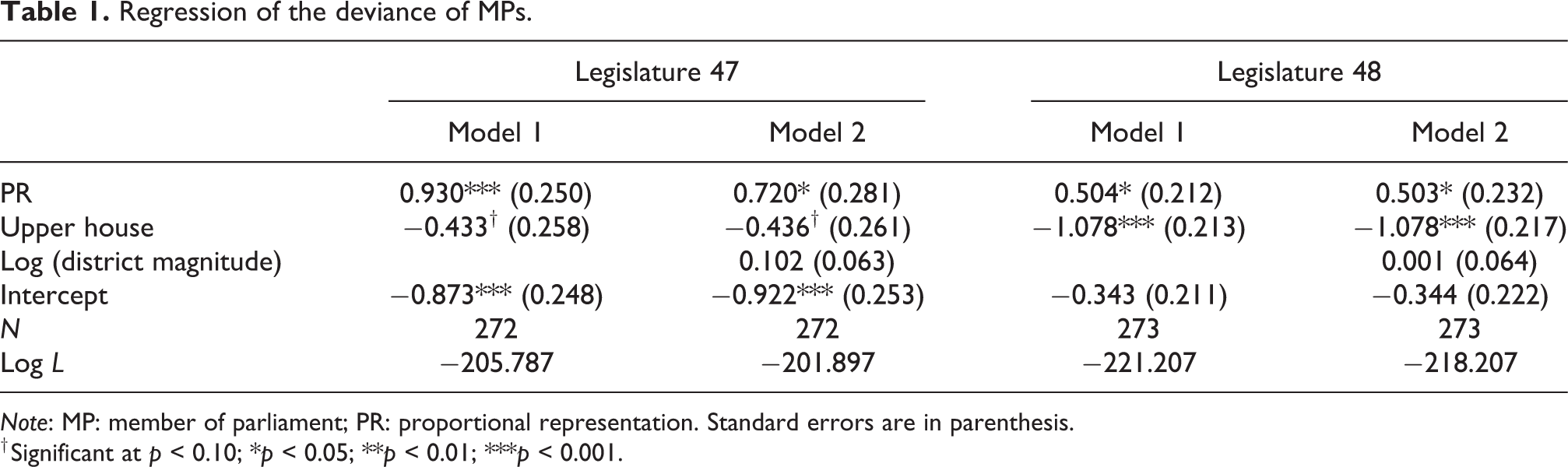
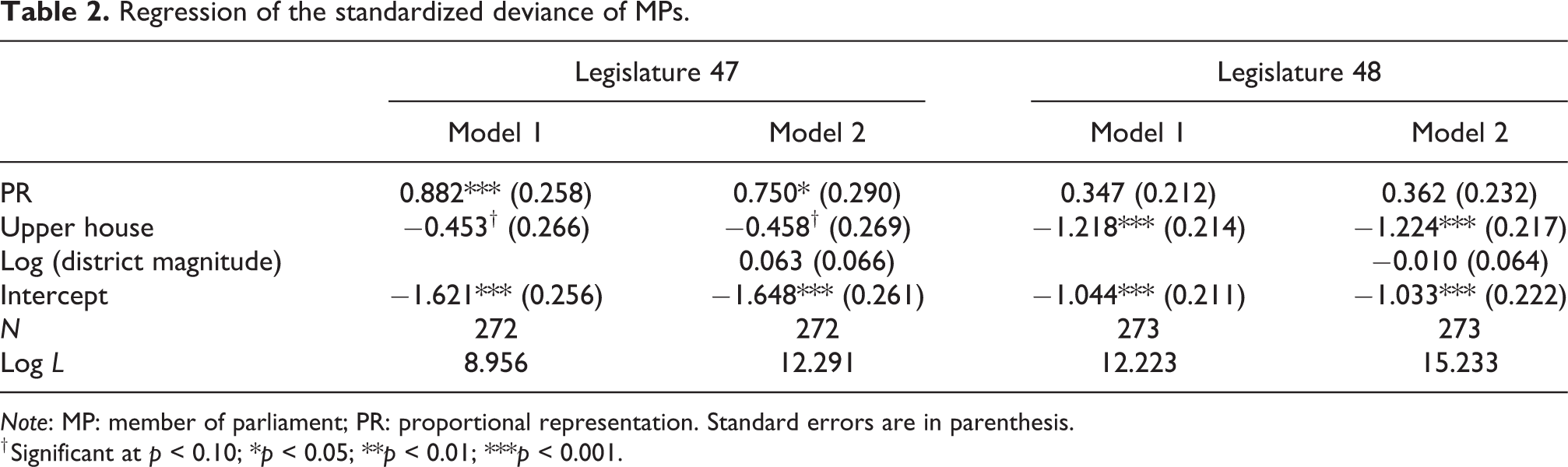
Another factor that could influence the dispersion, as argued, for example, by Cox (1997) and Lijphart (1999), is the district magnitude as measured by the number of seats to be gained in a given district (these are listed in Table 1A, above). As we expect the effect of the district magnitude on the deviance to be higher at small district magnitudes than at large district magnitudes, we include the logarithm of district magnitude as a control variable in an additional regression. Finally, as our dependent variable cannot take negative values, we use a generalized linear model from the gamma distribution family and the logarithm as the link function. The results are displayed in Tables 1 and 2. 14 In Table 1, the dependent variable is the deviance, and in Table 2, the dependent variable is the standardized deviance.
Regression of the deviance of MPs.
Note: MP: member of parliament; PR: proportional representation. Standard errors are in parenthesis.
† Significant at p < 0.10; *p < 0.05; **p < 0.01; ***p < 0.001.
Regression of the standardized deviance of MPs.
Note: MP: member of parliament; PR: proportional representation. Standard errors are in parenthesis.
† Significant at p < 0.10; *p < 0.05; **p < 0.01; ***p < 0.001.
The results in Table 1 show that PR has a positive and significant effect on deviance, as suggested by our hypothesis. The members of the upper house tend to have a lower deviance, and this is coherent with Figure 1. This latter effect is much larger in the second Legislature considered, which might explain the reduced effect for the electoral rule. Finally, the district magnitude has a positive effect in the 47th Legislature and a negative one in the 48th Legislature, although in both cases the estimated coefficients fail to reach statistical significance. In Table 2, the regressions on the standardized deviance show similar patterns. However, the effect of PR is not significant for the 48th Legislature, and the effect of the upper house is larger.
The results confirm that PR leads to more dispersion than plurality rule, as suggested by the theory. We argue that the contradictory empirical findings present in the literature come from the measures of deviance deduced from survey data. This is also consistent with the last analysis presented in the Online supplemental appendix of this article, where we test the effect of the electoral rule on two measures of “party extremism” (see Ezrow, 2008); one based on survey data and the other on behavioral data.
Exploring the mechanism
The results reported so far suggest that our hypothesis appears confirmed. We do not know, however, at what stage of the electoral process the electoral rule exerts its impact on dispersion. It might operate through the voters’ decision, through candidates’ strategy, or both. To test this, we first need to locate voters and candidates on a common space, in order to estimate the deviance of each candidate. As we have no behavioral data on candidates, we cannot completely proceed as we did in the main part of this article. However, in the Swiss election studies of 2007, all candidates of the 48th Legislature are surveyed (no similar survey exists for the previous Legislature), and the respondents answered a question on self-positioning on a left–right scale. 15 We could of course use a candidate survey and a voter survey that both include a question on self-positioning on the left–right scale, 16 but we would have to assume that the two scales are comparable. As explained above, this assumption may lead to biased measures of dispersion. We decide to employ this candidate survey and use the elected candidates who answered this survey as bridges:
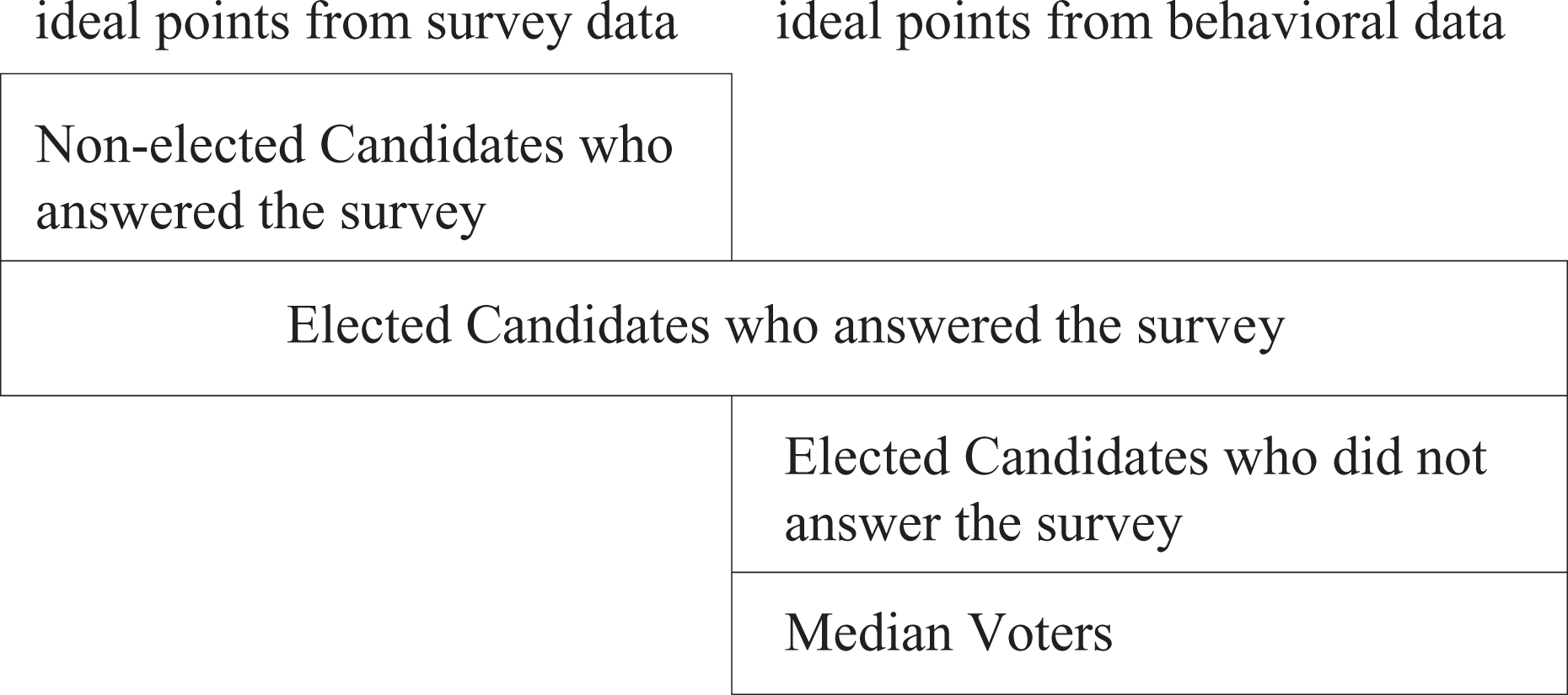
Using “survey locations” (self-locations) of the MPs as well as their behavioral locations estimated for the main analysis above, we link the two spaces (survey and behavioral) applying a moving average function. This function allows to estimate ideal points for all candidates who answered the survey in the “behavioral space.” In other words, using the MPs who answered the survey, we estimate how each value of the left–right self-positioning question translates into the behavioral space. We then estimate the ideal point for each nonelected candidate, in the behavioral space, based on his or her answer to the left–right self-positioning question.
Using this common space, we then estimate the deviance and the standardized deviance of the candidates and test if the effect of the electoral rule applies to all candidates or only to elected candidates. Table 3 presents an analysis similar to the analysis in Tables 1 and 2 but includes all candidates. The variable elected is a dichotomous variable equal to 1 if the observation is an elected candidate and 0 otherwise. 17 The interaction between elected and PR allows to see if the electoral rule affects the dispersion of all candidates or only elected ones.
Testing the dispersion of all candidates—Legislature 48.

Note: PR: proportional representation. Standard errors are in parenthesis.
† Significant at p < 0.10; *p < 0.05; **p < 0.01; ***p < 0.001.
The results reported in Table 3 suggest that among the unelected candidates, the electoral rule has no significant effect. Among the elected candidates, however, PR has a positive effect on deviance. Conversely, in PR systems, being elected has a positive effect on dispersion, while in plurality systems, being elected has a negative effect on dispersion. The results are similar in Models 3 and 4, where the dependent variable is the standardized deviance. Finally, the effect of being a candidate for a seat in the upper chamber on dispersion is negative but not significant. These results suggest that the effect of the electoral rule on dispersion operates through the voters’ decision.
Conclusion
Our main empirical analysis confirmed the theoretical implication according to which PR systems produce more centrifugal trends than plurality systems. In the literature, empirical studies testing for this assumption do not lead to a consensus. The studies are, however, based on survey data and thus encounter the problem of comparability of different scales. We avoided this problem by taking advantage of the high frequency of Swiss referendums and estimate the ideal points from behavioral data to locate MPs and the median voters in an identical space. As part of the Swiss MPs are elected through PR and others through plurality rule, we tested the effect of the electoral rule on MPs’ dispersion and found that PR has a positive effect on dispersion, even when controlling for district magnitude. It is interesting to note that these results are also related to Ezrow’s (2010) finding that “niche” parties, defined by him as those occupying extreme positions on the left–right scale, are more frequent in countries with PR. Our results suggest, however, that PR has a more general effect, namely through allowing more dispersed candidates to be elected to parliament.
Aside from our main hypothesis, we showed that the effect of electoral rules on dispersion mainly operates on elected representatives, not on all candidates. This means that voters do have the choice between candidates with various levels of dispersion and do opt for more or less dispersed candidates depending on the electoral rule. This is not fully consistent with economic voting theory, according to which all candidates are expected to follow the centripetal (centrifugal) trend in PR (plurality) systems. It is an interesting result; however, it may also depend on country-specific factors (as the entry costs for a candidate or the influence of interest groups). Thus, further analyses in other contexts are certainly warranted to confirm this finding.
Supplemental Material
Supplemental Material, sj-docx-1-ppq-10.1177_1354068818798861 - Constituency preferences and MP preferences: The electoral connection
Supplemental Material, sj-docx-1-ppq-10.1177_1354068818798861 for Constituency preferences and MP preferences: The electoral connection by Danielle Martin and Simon Hug in Party Politics
Footnotes
Authors’ Note
Earlier versions of this article were prepared for presentation at the Annual Meeting of the Midwest Political Science Association (Chicago, March 31–April 3, 2011) and a seminar at Hebrew University.
Acknowledgements
The authors gratefully acknowledge the helpful comments by the discussant Michael McDonald and other participants at our MPSA panel, as well as those by John Jackson, Liran Harago, Maayan Mor, Omer Yair, Raz Sheinerman, Odella Oshri, and Orit Kedar. The data collection efforts by Sarah Bütikofer and Simone Wegmann are equally well appreciated. The authors are also very thankful to the anonymous reviewers for their excellent comments.
Declaration of Conflicting Interests
The authors declared no potential conflicts of interest with respect to the research, authorship, and/or publication of this article.
Funding
The authors disclosed receipt of the following financial support for the research, authorship, and/or publication of this article: The work was supported by the Swiss National Science Foundation (grant no. 100012-111909).

Supplemental Material
Supplemental material for this article is available online.
Notes
References
Supplementary Material
Please find the following supplemental material available below.
For Open Access articles published under a Creative Commons License, all supplemental material carries the same license as the article it is associated with.
For non-Open Access articles published, all supplemental material carries a non-exclusive license, and permission requests for re-use of supplemental material or any part of supplemental material shall be sent directly to the copyright owner as specified in the copyright notice associated with the article.
