



Abstract
This article analyses the extent to which radical left parties (RLPs) and radical right parties (RRPs) invoke fear of the EU in their voters by cueing on the economic, immigration and integration dimensions. In the West, mainstream theories of party cueing hold, although not in the predicted direction. RLPs cue on the economic dimension, with more protectionist cues resulting in less EU fear. RRPs are cueing on immigration, although respondents who vote for a more xenophobic party are less Eurosceptic. In the East, RLPs cue on immigration, with the anticipated outcome that a more xenophobic cue conditions greater EU fear. At the same time, RRPs cue on integration directly, with respondents who vote for a more Eurosceptic party exhibiting less fear. Overall, the most Eurosceptic respondents in the West are those who vote for a RRP, while the same is true for RLP voters in the East.
Introduction
How do radical parties (RPs) on the right and left of the political spectrum cue their respective voters on European integration? De Vries and Edwards’ (2009) seminal work on RP cueing in Western Europe shows that both party families use fear-based rhetoric to marshal public opposition to European integration, albeit through different party platforms. Radical right parties (RRPs) prey on unease over immigration, while radical left parties (RLPs) capitalize on economic anxiety over unbridled capitalism. This argument has subsequently become mainstream in the literature, while few studies have attempted to replicate or further build on the work of De Vries and Edwards. Indeed, more recent works call into question these assertions by pointing out that the two party families, at times, exhibit overlapping positions on the economy and immigration (Halikiopoulou et al., 2012; Helbling et al., 2010), leaving open the possibility that RLPs are additionally cueing via immigration, while RRPs are cueing via economic protectionism. Furthermore, given the increasing salience of European integration as a distinct policy dimension (Bakker et al., 2012), De Vries and Edwards miss an opportunity to evaluate the degree to which RLPs and RRPs are cueing fear of the EU based on integration-specific policies directly.
This article builds on De Vries and Edwards’ work by analysing the extent to which RPs invoke fear of the EU by cueing on the economic, immigration and integration dimensions. Additionally, this analysis aims to resolve a methodological issue present in the extant studies of party cueing in the EU (e.g. Ray, 2003; Steenbergen et al., 2007). These studies do not operationalize party cues at the individual level, but rely on national aggregates, and use proxies for the actual cue received. I remedy this problem by carrying out an analysis that charts the cue a voter receives on the three dimensions based specifically on the voter’s party of choice.
This article contributes to the literature on public opinion and Euroscepticism in two additional ways. First, it incorporates Central and Eastern European (CEE) member states into the analysis and examines whether the behaviour of parties and voters in the East has converged on the established patterns in the West. Second, it sheds light on the attitudes of radical left voters and how they compare to the supporters of RRPs and non-radical parties (NRPs). While RRPs have drawn much scholarly attention over the past decades, RLPs have been largely ignored. This is surprising given the electoral and governmental success of RLPs: Between 1989 and 2009, RLPs consistently garnered nearly twice as much of the European vote as RRPs in parliamentary elections (March, 2011). RLPs are increasingly finding their places in governing coalitions and warrant more scholarly attention.
The analysis utilizes data from 2008 European Values Survey (EVS) and the 2006 Chapel Hill Expert Survey (CHES) and tests the impact of party cueing with a three-level hierarchical linear model (HLM). The findings reveal that parties across the West and the East successfully cue on all three dimensions, although there are notable differences across the two regions. In the West, mainstream theories of party cueing hold, although not in the predicted direction. RLPs are cueing on the economic dimension, with more protectionist cues resulting in less EU fear. RRPs are cueing on immigration, although respondents who vote for a more xenophobic party are less Eurosceptic. In the East, RLPs cue on immigration, with a more xenophobic cue conditioning greater EU fear. At the same time, RRPs cue on integration directly, with respondents who vote for a more Eurosceptic party exhibiting less fear. Overall, the most Eurosceptic respondents in the West are those who vote for a RRP, while the same is true for RLP voters in the East.
Party cueing theory and support for integration
In most political and social matters, citizens are not generally well informed and cognitively active, and rely on signals (i.e. cues) sent by political elites to formulate their opinions (Iyengar, 1991; Zaller, 1992). The premise of cue theory is that underlying values and interests need to be primed to become politically salient (Hooghe and Marks, 2005: 424) and that political elites use framing to increase the salience of an issue that will maximize vote-share (Carmines and Stimson, 1986). For voters, cues provide cognitive shortcuts that help them decide what is in their interest.
How do RPs arrive at their positions towards the EU and what types of frames do they use to marshal opposition towards integration? Rational RPs pick up issues that maximize consistency with their ideological platform, while simultaneously minimizing potential distance with some untapped public concern (Hinich and Munger, 1993). In that sense, RP positioning on integration is strategic and depends on the party system dynamics of each country (Taggart, 1998). Mainstream parties find it difficult to oppose integration, as these parties have been part of the governing coalitions responsible for integration. Given their marginal positions within the party system, RPs have greater incentive to oppose integration in the effort to differentiate themselves from mainstream parties, leading them to take a more Eurosceptic stance.
At the same time, party positioning on integration is rooted in the ideological underpinnings of party platforms. To predict how parties will react to new issues, such as integration, one must follow a party’s historically embedded predisposition on the left/right dimension (Marks and Wilson, 2000) and on the newer social GAL/TAN 1 dimension (Kriesi et al., 2006; Vachudova and Hooghe, 2009). Competition along the economic dimension is characterized by diverging views on the role of the market and attitudes towards inequality, with left-wing parties advocating state-sponsored redistribution to alleviate inequality and right-wing parties opting for neo-liberal economic policies to preserve individual economic freedoms. Because the single market opens borders, facilitates movement of capital, and encourages privatization, mainstream right parties have been the leading supporters of integration. The advent of globalization has forced parties to take positions on these processes, and they have done so by linking the policies to the economic left/right dimension (Marks and Wilson, 2000).
At the same time, contemporary societal conflict is driven by cultural competition between natives and immigrants, and political competition between defenders of national institutions and proponents of supranationalism (Vachudova and Hooghe, 2009: 181). As these new societal divisions are not easily absorbed into the existing economic dimension, parties are forced to compete for votes on the social dimension. Losers of globalization and integration will seek out TAN parties that advocate protectionist measures, both economic and social, to delineate natives from foreigners, while winners will seek out GAL parties that promote international integration and cosmopolitanism. Hence, parties assimilate integration into their existing platforms, for example, their positions on neo-liberalism, globalization and immigration. They, then, frame the integration debate along the lines of competition on the economic and social dimensions.
While the literature on RP positioning on integration is well developed (Halikiopoulou et al., 2012; Helbling et al., 2010), few studies explicitly evaluate how RPs cue public opinion towards integration. One exception is the work of De Vries and Edwards (2009), which shows that both RLPs and RRPs capitalize on growing uncertainties of citizens towards European integration, but utilize different cues to mobilize anti-EU sentiment. While RLPs draw upon feelings of economic uncertainty and criticize the neo-liberal character of the EU, RRPs embrace exclusive national identity and frame integration as a loss of sovereignty.
I depart from De Vries and Edwards in three critical respects. First, I contend that both radical and mainstream parties are also cueing on integration, alongside economic and social issues. As EU-related issues become more salient, it is likely that parties incorporate positions on integration directly into their platforms. Van der Brug and Van Spanje (2009) demonstrate that the attitudes of citizens towards the EU are distinctly separate from their attitudes towards economic issues, suggesting that citizens are able to discern between multiple dimensions of party competition. Additionally, Bakker et al.’s (2012) analysis of dimensionality in Europe reveals that, in most countries, parties compete on economic, social and integration issues simultaneously.
Second, I propose that the content of the cues emanating from both extremes of the political spectrum is not as black and white as previously discussed. While issues of national identity and sovereignty are the mainstay for RRPs, economic issues are not absent. RLPs have similarly expanded their cues. Some of these parties, particularly those in CEE states, are adopting a more sceptical attitude towards immigration in an attempt to appeal to traditional working-class voters, who worry that globalization undercuts wages and job security (Keith and McGowan, 2014). Therefore, I test for an economic cueing effect emanating from RRPs and an anti-immigration cueing effect from RLPs.
Third, I deviate from De Vries and Edwards by refining the target of partisan cues. The authors do not assume a correspondence between parties and their respective supporters. Rather than assigning party-specific cues to individuals in their data set, the authors calculate national-level average cues that tap into left-wing and right-wing Euroscepticism. While not rejecting the notion that the cues of radical political parties shape the larger political debate on European integration, I argue that the economic and cultural protectionist messages espoused by these parties have greater resonance with their respective voters. My analysis therefore links the positions of parties on the extremes of the political spectrum with the individuals who actually support these parties.
RLPs and RRPs: Definitions and hypotheses
In defining the two party families, I begin with Freeden’s (1997: 5) central assumption that each party family’s ideology contains core and peripheral concepts. For RLPs, the core concept is anti-capitalism (March, 2011), while the core concept for RRPs is the nation, as manifested in nationalism and nativism (Mudde, 2007: 16–20). The radical classification of a party is based on its extreme position on one of two dimensions relevant for party competition in the national arena: the economic left–right and the social GAL/TAN.
RLPs constitute a cohesive party family in that they take a consistently anti-capitalist position on the economic dimension, despite intra-family cleavages on other issues (March and Rommerskirchen, 2015). RLPs advocate a radical transformation of capitalism to take power away from political and economic elites and espouse collective economic and social rights (March, 2011; Ramiro, 2016). RLPs have benefited significantly from the failure of social democratic parties to articulate a viable solution to the inequality spurned on by globalization (Lavelle, 2013). This has opened up the political space for RLPs to more aggressively push for socialist economic policy, criticizing European integration for spurring inequality and perpetuating class struggle (March, 2011). Integration interferes with the state’s ability to protect the economic well-being of its citizens by requiring privatization, deregulation and the influx of foreign goods and investors (Vachudova and Hooghe, 2009). Hence, RLPs are more likely to cue their voters against integration on the basis of economic policy, tapping into the voters’ feelings of economic anxiety tied to being the ‘losers of globalization’, (De Vries and Edwards, 2009: 9).
RRPs distinguish themselves as a party family through their consistent positions on immigration and cultural protectionism. RRPs advocate for nativism, or the belief that the state should be inhabited exclusively by members of the native group, and argue that non-native elements are threatening to the homogenous nation-state (Betz and Johnson, 2004: 323; Mudde, 2007: 22; Rydgren, 2007: 242). RRPs play to voters’ fears about the implications of open borders and the subsequent influx of foreigners, particularly from non-EU member states. Hence, RRPs are more likely to cue their voters against integration on the basis of cultural protectionism, tapping into the voters’ fears of immigrants and their potential to dilute the national culture (De Vries and Edwards, 2009: 9).
The theoretical underpinnings for the first two hypotheses are well-documented in the literature. However, I assert that it is also plausible that RPs invoke secondary issues in cueing voter support for or opposition to integration.
RP supporters are a diverse group even within their own party families. RLPs and RRPs attract both blue-collar and white-collar workers and individuals of varying education levels (Bustikova and Kitschelt, 2009; Evans, 2005). Not all RRP supporters are xenophobic and some are motivated to vote for RRPs on the basis of secondary issues, such as dissatisfaction with the country’s democracy (Oesch, 2008: 359), which is also a key predictor of voting for a RLP (Ramiro, 2016: 14). If niche parties are interested in vote maximization, they will incorporate secondary issues to expand their electoral bases, and we should see party cueing effects on multiple dimensions of party competition. I approach this assertion with caution. Rovny (2012) demonstrates that while RRPs are compelled to include economic issues in their campaigns and manifestoes, they also engage in issue blurring on the economic dimension so as not to deter supporters with divergent economic outlooks and to attract a broader coalition of voters. Bearing in mind the possibility that blurring may render secondary issue cueing statistically insignificant, I develop three additional hypotheses.
First, I contend it is possible that RRPs are cueing voters against integration on the basis of both cultural and economic protectionism. While earlier studies linked right-wing populism with neo-liberalism (Kitschelt and McGann, 1995), present-day socio-economic programs of RRPs hardly conform to the neo-liberal model. To the extent that RRPs put forth economic prescriptions, their policies revolve around welfare chauvinism and nativist economics (Mudde, 2007). Although they are broadly supportive of capitalism, they are also economically protectionists, catering to the declining middle class and the economic losers of the unskilled working class. The outcome is a set of policies that eschew foreign labour and the potential for capital flight as a result of globalization. For example, the French Front National has significantly changed its socio-economic appeal since the 1980s by increasingly adopting economic egalitarianism in an effort to make itself more electorally competitive and to ‘de-demonize’ the party following its earlier positioning as xenophobic and anti-Semitic (Ivaldi, 2015). Similarly, the new-found success of UKIP can be partially attributed to the disaffection of the traditional working class with New Left policies and their resulting collapse in living standards and the availability of good jobs (Ford and Goodwin, 2014).
Second, I evaluate the possibility that RLPs are cueing on integration via cultural issues and immigration policy. The mainstream view is that RLPs do not extend their opposition to integration to the cultural dimension. While Eurosceptic, these parties are supportive of more open immigration policies; after all, international worker solidarity is a cornerstone of the RL platform. Helbling et al. (2010: 509) show that, at times, RLPs engage in EU-friendly framing by playing up the EU’s multicultural-universalist potential. They also occasionally refer to the EU’s social-driven aspects when taking a favourable position on integration. Helbling et al. suggest that RLPs may be using cultural frames to marshal support for integration, if they choose to play up cross-border worker solidarity.
Third, I propose that both RRPs and RLPs are cueing directly on integration. While this assertion appears self-evident, recall that much of the earlier literature argues that European citizens have limited political knowledge about the EU (Hobolt and Leblond, 2014); therefore, parties must rely on economic and social cues to marshal support for/opposition to integration. However, Helbling et al. (2010: 501) show that most parties also invoke utilitarian frames that centre on the political efficiency and efficacy of the EU, along with issues of internal and external security. Negative frames point out the diminishing action capacity of a state within the EU’s complex structure, the poor governance of European institutions and Brussels corruption, while positive frames centre on improving the country’s position in the international arena and the attainment of regional peace and stability. Negative security frames are the third-most frequently used by RRPs, while RLPs engage in positive security framing. This finding is bolstered by Gómez-Reino and Llamazares (2013), who demonstrate that RRPs have managed to establish direct links with their voters regarding European integration.
Additionally, recent studies indicate that EU citizens have a greater understanding of the relationship between national governments and the EU than previously thought, especially with the onset of the 2008 economic crisis (Foster and Friedan, 2017). In the eurozone periphery countries that were the hardest hit by the crisis, citizens are aware that external actors are to blame for harsh austerity policies (Armingeon et al., 2015). The post-2012 electoral successes of the radical left SYRIZA in Greece can be attributed to ‘austerity fatigue’ following the eurozone crisis (March and Rommerskirchen, 2015: 41). SYRIZA’s surge in vote share from 4.6% to 26.9% reflects the popularity of anti-establishment parties that defy the Brussels bureaucracy and the neo-liberal economic policies of the EU. Therefore, I assert that parties appeal to citizens by directly cueing on the integration dimension.
A caveat on Central and Eastern Europe
Thus far, I have discussed the literature as it relates primarily to Western Europe, as there has been very little research into party cueing effects in CEE states. While some scholars argue that the EU’s geopolitical pull has caused convergence between the party systems in the East and West (Camia and Caramani, 2012: 75; March and Rommerskirchen, 2015), I expect that the region’s post-communist legacy affects the cueing dynamics in the East in the following ways.
At the time of the post-communist transition, political discourse in CEE states revolved around the question of EU membership, with mainstream parties taking a decidedly pro-EU stance. This displaced economic partisan conflict between centre-left and centre-right parties by political issues and removed the economic dimension as an area of competition (Bustikova and Kitschelt, 2009; Ladrech, 2011: 219). In the early 2000s, the certainty of EU membership allowed mainstream parties to repackage their electoral appeal by introducing a more nationalist discourse and to structure party competition along issues of ethnic minority rights (Rovny, 2014). This process of changing party platforms has prevented the development of stable linkages between voters and parties and explains the low level of party system institutionalization in CEE countries (Ladrech, 2011: 220). If this reading of CEE history is correct, then party cues, in general, are weaker in the East. The absence of meaningful party competition on the economic dimension in the 2000s should produce a weak economic cue in this analysis for all types of parties. Additionally, while party competition on the social dimension was present in the 2000s, the discourse revolved largely around ethnic minorities and not particularly around immigration, suggesting a weaker immigration cue.
How similar are Eastern RPs to their Western counterparts? Do the aforementioned hypotheses hold in the East as well?
Economically, RLPs in the East have much in common with the West. The mainstream left in CEE states has shifted dramatically to the right on the economic dimension, in some countries outpacing their mainstream right counterparts in proposing neo-liberal policies and embracing integration. The logical strategy for the radical left has been to differentiate itself on the basis of pro-welfare and anti-integration policies. However, given the stigmatization of communism, obtaining electoral support for RLPs has proven difficult, (the Czech Communist Party being an exception). One such way has been to adopt more traditional and conservative positions on the social dimension, catering to the Soviet nostalgia for social stability and endorsing ‘nationally authentic socialism’ (March, 2011). RLP positioning on the immigration issue has gone largely unexplored in the CEE literature. However, if we assume that immigration is part and parcel of the social dimension and acknowledge that Eastern RLPs are socially conservative, then it is likely that Eastern RLPs are less amenable to immigration than Western RLPs and are less likely to endorse open borders and internationalism.
As in the West, it is difficult to pin down the economic positions of RRPs. Vachudova and Hooghe (2009) argue that the radical right in the East is more neo-liberal and pro-integration than in the West. ‘As the unravelling of the communist system put the transition process in motion, proponents of marketization and liberal democracy converged’ to the right/GAL pole (Vachudova and Hooghe, 2009: 188). EU conditionality ensured that EU-friendly parties delivered market-oriented economic reforms and supported liberal democratic standards. As a result, Vachudova and Hooghe find that the main sources of opposition in the East are bundled in the left/TAN corner. However, their analysis relies on 2002 CHES data and more recent works cast doubt on the neo-liberal and EU-friendly character of RRPs in the East. Mudde (2007: 127) finds that the RRPs in the East and the West equally subscribe to protectionism and nativist economics. Furthermore, the distinctly Eurosceptic platforms of parties like Jobbik, the Slovak National Party, and the League of Polish Families lead one to question Vachudova and Hooghe’s earlier findings. While RRPs were willing to ‘play nice’ during the accession process, their positions shifted to both the economic left and TAN dimensions once EU conditionality was lifted. This is evidenced by the fact that RRPs are consistently xenophobic and exclusionary when it comes to ethnic minorities (Mudde, 2007: 71). Hence, I expect a congruence in party cues on the economic and social dimensions between RRPs in the West and East.
Data and operationalization
Individual-level data come from the 2008 EVS, which was selected due to several desirable qualities. Respondents were surveyed in every EU member state and asked explicitly to state their party preference. The list of parties in each country was extensive and included all possible RLPs and RRPs, thereby minimizing the number of missing cases. The EVS includes three sets of questions relevant for the empirical analysis. The first is a battery of questions that probes into why individuals fear the EU. Given that RPs mobilize Euroscepticism via economic, cultural and political anxiety, these questions were used to construct the dependent variable. The second and third batteries of questions asked respondents about their positions on the economic left–right scale and on immigration. These questions serve as important controls in evaluating the degree to which respondents’ own attitudes drive Euroscepticism, independent of party cues.
Party cues are derived from party positioning data from the 2006 wave 2 of the CHES (De Vries and Edwards, 2009; Gómez-Reino and Llamazares, 2013; Hooghe and Marks, 2005; Steenbergen and Jones, 2002; Steenbergen et al., 2007). The CHES project asks experts to evaluate how parties position themselves on integration, the general economic left–right dimension and immigration, among other issues. These party positions serve as cues to party supporters, who use the positions to inform their own opinions about these issues (Steenbergen and Jones, 2002: 228).
Party cues
Several steps are involved in the operationalization of party cues. First, I identify the radical voters in the EVS data. At the individual level, the data are taken from 24 EU member states, excluding Cyprus, Luxembourg, and Malta, which are not represented in the CHES. I am interested only in respondents who express an affinity for a particular political party and receive a direct party cue. I use two EVS questions to narrow the sample: (1) ‘If there was a general election tomorrow, can you tell me which party you would vote for?’ and (2) ‘If you would not vote in a general election tomorrow, can you tell me which party appeals to you most?’ Based on the party selected, I create two dummy variables to reflect whether the respondent is a RL voter or a RR voter.
Second, I identify RLPs, RRPs and NRPs in the CHES and record their party positions on the economic, immigration and integration dimensions. The CHES codes parties according to their party families. I differ with the CHES in the coding of the Italian Lega Nord, the League of Polish Families, and the Slovenian National Party, which I argue are RRPs. Party codings have been cross-validated using Mudde’s (2007) seminal work on RRPs and March’s (2011) work on RLPs. Table 1 shows the 23 RLPs and 19 RRPs 3 identified in the EVS 2008 that are present in the CHES 2006.
RLPs and RRPs in the analysis.
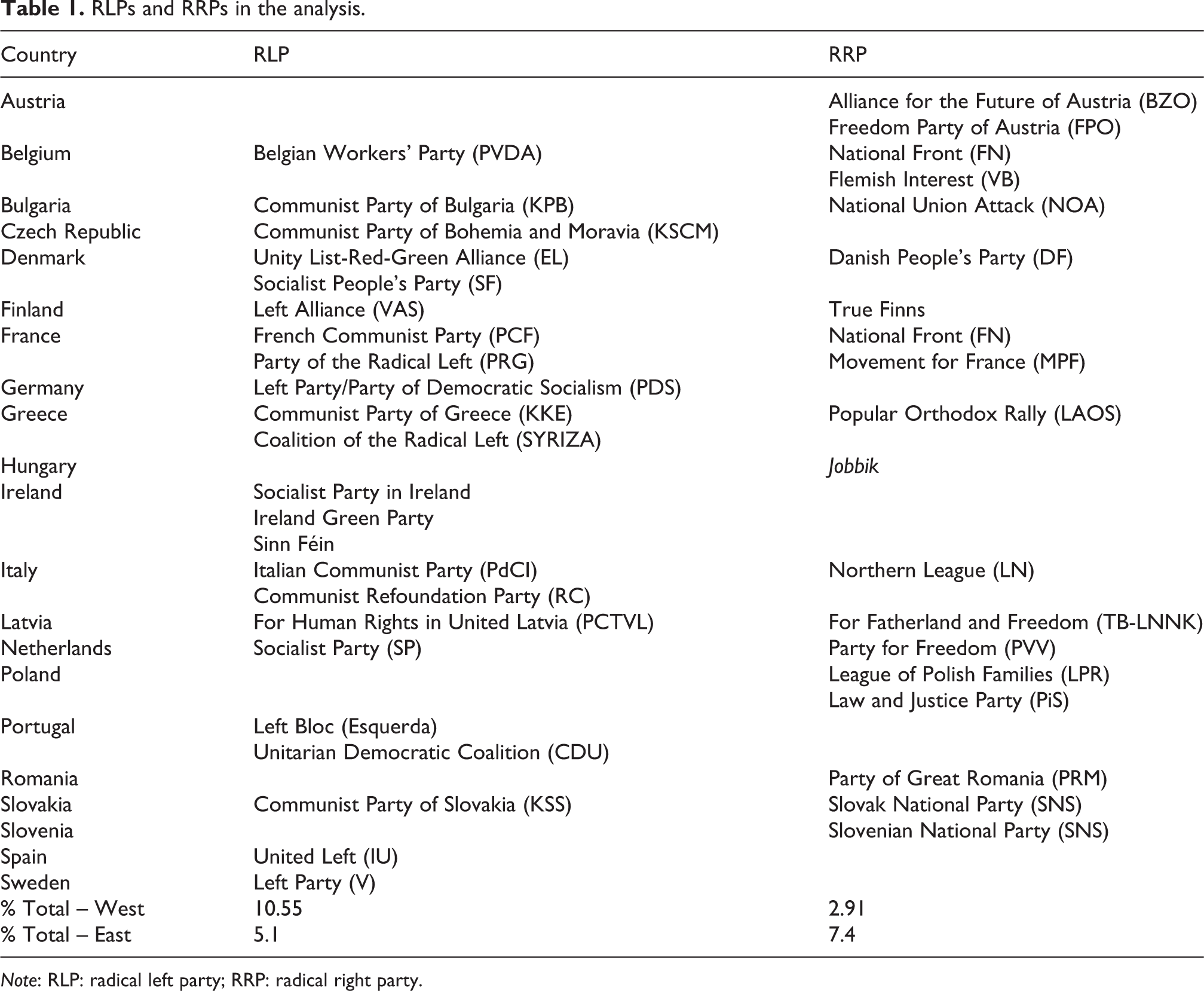
Note: RLP: radical left party; RRP: radical right party.
All respondents in the EVS are coded with their preferred party’s positions on three CHES items. The first cue is the party’s overall economic position, where 0 = extreme left and 10 = extreme right. The second cue is the party’s immigration position, where 0 = strongly opposes tough immigration policy and 10 = strongly favours tough policy. The final cue is the overall orientation of the party leadership towards European integration, where 1 = strongly opposed and 7 = strongly in favour.
Table 2 reports the average size of the party cues across the three groups of interest (RL voters, RR voters and NR voters), weighed by the number of each party’s supporters and parsed out into West and East samples. To ascertain whether there are intra-regional differences in party cues, non-parametric analysis of variance (the Kruskal–Wallis test) is performed and reveals that there are significant differences (p < 0.01) among all three groups across the three dimensions of party competition, in both regions. The only exception is the difference in the integration cue for RLPs and RRPs in the East. The analysis indicates that the RP families differentiate themselves from mainstream parties on economics, immigration and integration and justifies the inclusion of interaction effects between party families and party cues.
Independent sample t tests (with unequal variances) evaluate the interregional differences in how parties cue on the three dimensions. Only the test statistic for NRPs on integration fails to reach significance (p < 0.01). This bolsters the methodological decision to run separate regression models for the West and the East. In both regions, the RLP economic cue is substantially more to the left than that of the RRPs and the NRPs, as anticipated. In the East, RRPs are more economically left-wing than NRPs, indicating that the radical right is more economically protectionist than mainstream parties. RLPs have the most immigrant-friendly positions, although RLPs in the East are tougher on immigration policy than their Western counterparts. As predicted, RRPs, particularly in the West, are the most xenophobic and Eurosceptic. That being said, the difference between Eastern RLPs and RRPs on integration is marginal, while Western RRPs are significantly more Eurosceptic than RLPs.
Respondent positions on economics and immigration
While attitudes towards Europe are partially driven by party cueing, I expect that individual-level beliefs about the economy and immigration also condition support for integration. If De Vries and Edwards (2009) are correct, then RL voters should be motivated to oppose integration based on their economically left-wing policy preferences, while RR voters are impelled by their xenophobic attitudes.
I include two variables that measure a respondent’s position on economics and immigration. I operationalize the economic position using an index of six questions, each on a 10-point scale, that ask about state intervention in the welfare state, unemployment, competition, state control of firms and industries and income redistribution. Lower scores indicate more left-wing attitudes and mirror the CHES economic cue variable. As is the case with parties, economically right-wing respondents should be less fearful of the EU. The immigration position is operationalized using five questions concerning immigrants, also on a 10-point scale, that query about the various problems associated with immigration, that is, the dilution of national culture, loss of jobs for natives, increased crime rates and strains on the welfare state. Lower scores indicate more immigrant-friendly attitudes and mirror the CHES immigration cue variable. More xenophobic respondents are expected to fear the EU more.
Table 2 reports the average respondents’ economic and immigration positions by voter type and compares them across regions. In the West, the differences between the three types of voter on their economic and immigration positions are significant (p ≤ 0.05). 4 RL voters are more economically left-wing (5.27) than their RR (6.32) and NR (6.23) counterparts. They are also less xenophobic (5.45) than RR (7.66) and NR (5.94) voters. However, in both cases, RL voters are more centrist than one expects. In the East, the voters are more ideologically similar. There is no difference between RL (5.57) and RR (5.82) voters on the economy, and RR (6.13) and NR (6.11) voters on immigration. As the post-communist literature suggests, RL voters are the most xenophobic (6.71), while the NR voters are the most economically right-wing (6.01). Cross-regionally, all differences in means are significant (p < 0.01). 5 RL voters are less xenophobic in the West than in the East (difference = −1.23 points), while the reverse is true for RR voters (difference = 1.53 points). Economically, RL voters in the West are slightly more left-wing than in the East (difference = −0.3), while RR voters in the West are more right-wing than in the East (difference = 0.5).
Any analysis of party cueing is confronted with the critical problem of ascertaining the direction of partisan cues (Steenbergen et al., 2007). Are the masses induced by elites through a process of information and persuasion to buy into party platforms or are parties following the preferences of the masses through a process of representation? While I model causality as elite driven (Hooghe and Marks, 2005; Ray, 2003; Steenbergen and Jones, 2002), it is conversely possible that voters seek out parties ideologically closest to them, hence negating the notion of a top-down cueing effect. In this regard, it is useful to examine ideological congruence between parties and their constituents. If party cues and voters’ positions on the economic and social dimensions are closely aligned, then it becomes harder to argue that we are witnessing top-down cueing effects. As seen in Table 2, respondent positions are not perfect corollaries of party cues. The starkest difference is between RL parties and voters in the West. RLPs are much more economically and socially left-wing than their supporters, who are marginally left of centre; the same pattern holds in the East. RRPs in both regions are more economically left-wing than their voters, while RRPs in the West are notably more xenophobic than their constituents. NR parties and voters are more closely aligned. Additionally, correlation analysis reveals that in the West and East, the economic party cue and the respondent’s economic position are correlated at Pearson’s r = 0.38 and 0.18, respectively, while the immigration party cue and the respondent’s immigration position are correlated at 0.17 and −0.06. If party cueing effects are found to be statistically significant in the analysis below, this bolsters the claim that attitude formation is at least partially a top-down process.
Intra-regional and interregional differences across types of voters.
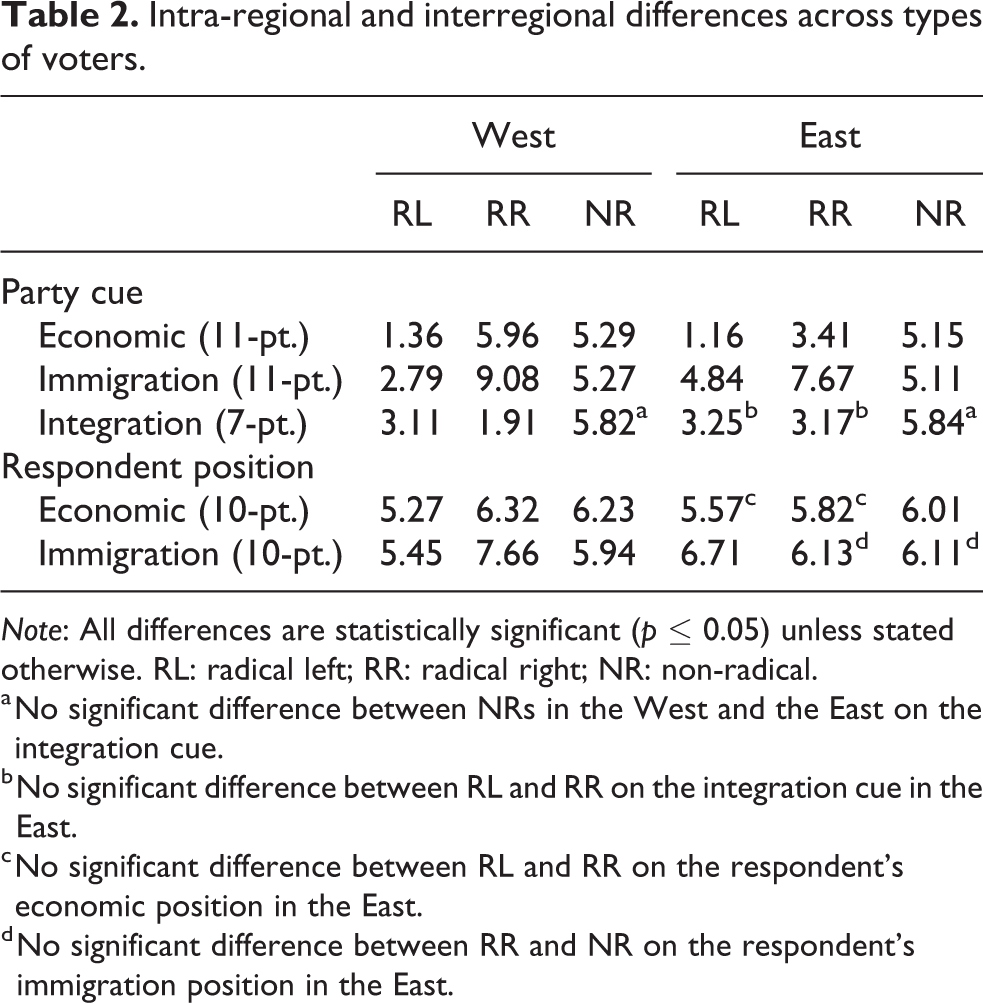
Note: All differences are statistically significant (p ≤ 0.05) unless stated otherwise. RL: radical left; RR: radical right; NR: non-radical.
a No significant difference between NRs in the West and the East on the integration cue.
b No significant difference between RL and RR on the integration cue in the East.
c No significant difference between RL and RR on the respondent’s economic position in the East.
d No significant difference between RR and NR on the respondent’s immigration position in the East.
Dependent variable: Fear of the EU scale
As the EU has expanded in size and the scope of its competencies, the grounds for opposing the project have become more diverse. The literature highlights that Euroscepticism is fuelled by concerns surrounding issues of national sovereignty, the dilution of national culture, financial contributions, and the neo-liberal nature of the single market (Carey, 2002; McLaren, 2006; Vasilopoulou, 2011). To tap into respondents’ opposition to integration on these various grounds, I take the average of a battery of five EU-related questions and construct an index that captures fear of the EU. The question set asks respondents: Some people may have fears about the building of the European Union. I am going to read a number of things which people say they are afraid of. For each tell me if you – personally – are currently afraid of: 1) the loss of social security; 2) the loss of national identity and culture; 3) our country paying more and more to the European Union; 4) a loss of power in the world for [COUNTRY]; 5) the loss of jobs in [COUNTRY].
Control variables
The literature shows that EU support is determined by trust in the national government (Anderson, 1998; Armingeon and Ceka, 2014) and satisfaction with democracy in one’s country (Armingeon et al., 2015). According to this proxy argument, citizens are generally uninformed about European integration and lack the sophistication to act in their self-interest. Instead, citizens rely on assessments about their own political system when forming opinions about integration. Greater trust and satisfaction in national institutions results in greater EU support. To capture the proxy argument, I utilize two questions. The first enquires about how much confidence the respondent has in her government, and the second about how satisfied she is with her country’s democracy. Higher values indicate greater confidence and satisfaction.
Territorial identity also impacts integration support. Individuals with a strong national identity are less likely to support the EU, as it dilutes national sovereignty (Carey, 2002), while those who incorporate a European identity into their conceptions of self are more likely to support the EU (Citrin and Sides, 2004; Hooghe and Marks, 2005). I operationalize the impact of territorial identities using two questions. The first asks how concerned a respondent is with the living conditions of her fellow countrymen, while the second asks about the living conditions of Europeans. If the national identity literature is correct, a respondent with a strong concern for fellow countrymen is more likely to oppose integration, while the reverse is true for strong concern for Europeans. Higher values indicate stronger concern.
Inglehart (1970) argues that cognitive mobilization – greater exposure to the news and better knowledge of political issues – increases support for integration. Hence, I include a question that asks respondents how often they follow politics in the news on television, radio or daily newspapers. I also control for a respondent’s education, income, gender and age (Carey, 2002; Gabel, 1998; McLaren, 2006). Respondents with higher levels of education are more likely to have greater knowledge of the benefits of integration and thereby fear the EU less. Individuals with higher levels of income are more likely to be the beneficiaries of integration and market liberalization and therefore support the European project. Younger people are assumed to be more cosmopolitan in outlook and thereby more open to integration (Inglehart, 1970). Women and the unemployed are typically perceived as the ‘losers’ of integration given their position in the labour market and are expected to fear the EU more.
Finally, national economic performance drives public opinion towards integration (Armingeon and Ceka, 2014; Sanchez-Cuenca, 2000). I control for whether the country is a net recipient or donor of EU funds. I operationalize recipient/donor status by looking at the percentage of a country’s GDP that it has contributed to the EU’s budget, with negative values indicating donor status. I expect that respondents in recipient countries are more supportive of integration given they are the beneficiaries of a fiscal transfer. Additionally, I control for the health of a county’s economy by including variables that measure a country’s deficit, debt, GDP growth, unemployment rate and level of social spending. 6 I predict that poor economic performance translates into greater Euroscepticism.
The summary statistics for all variables in the analysis are presented in Table A in the Online Appendix.
Empirical analysis and results
I employ a three-level HLM, as I am concerned with variation in EU support at the individual, party and country levels (Steenbergen and Jones, 2002). Although EU support varies significantly at the individual level, country- and party-level characteristics provide important political contexts that interact with individual attitudes (De Vries and Edwards, 2009: 15). ANOVA testing on the Fear of the EU scale reveals that the national and party levels account for 5.8% and 7.8%, respectively, in the West, and 11.2% and 2.6%, respectively, in the East. As I anticipate different effects of party cueing in the West and the East, I estimate two separate models for the EU Old-15 (minus Luxembourg) and the EU New-12 (minus Cyprus and Malta).
The estimates of the fixed effects and the variance components of the HLM are presented in Table 3. 7 The marginal effects of moving from the minimum to the maximum in the independent variables on fear of the EU are reported in Table 4.
Determinants of EU fear (HLM).
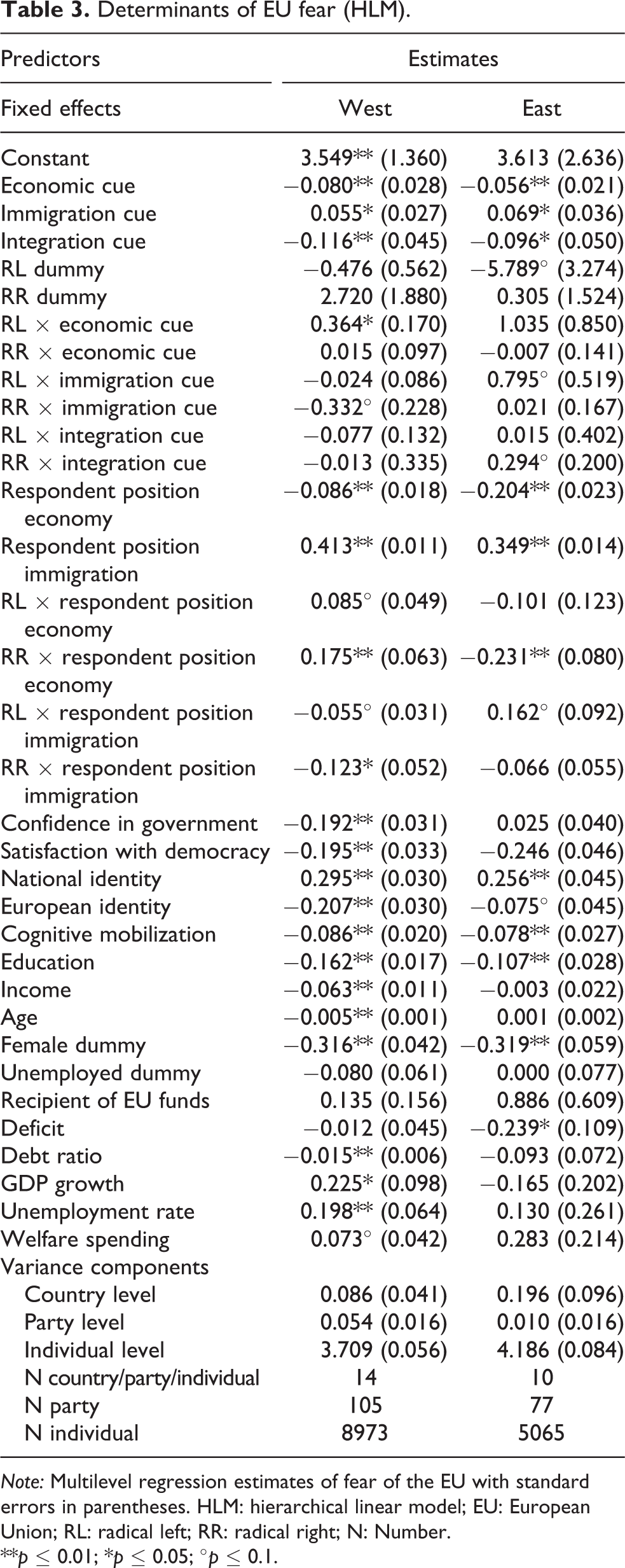
Note: Multilevel regression estimates of fear of the EU with standard errors in parentheses. HLM: hierarchical linear model; EU: European Union; RL: radical left; RR: radical right; N: Number.
**p ≤ 0.01; *p ≤ 0.05; °p ≤ 0.1.
Marginal effects of predictors on fear of the EU, percent change of moving from the minimum to maximum.
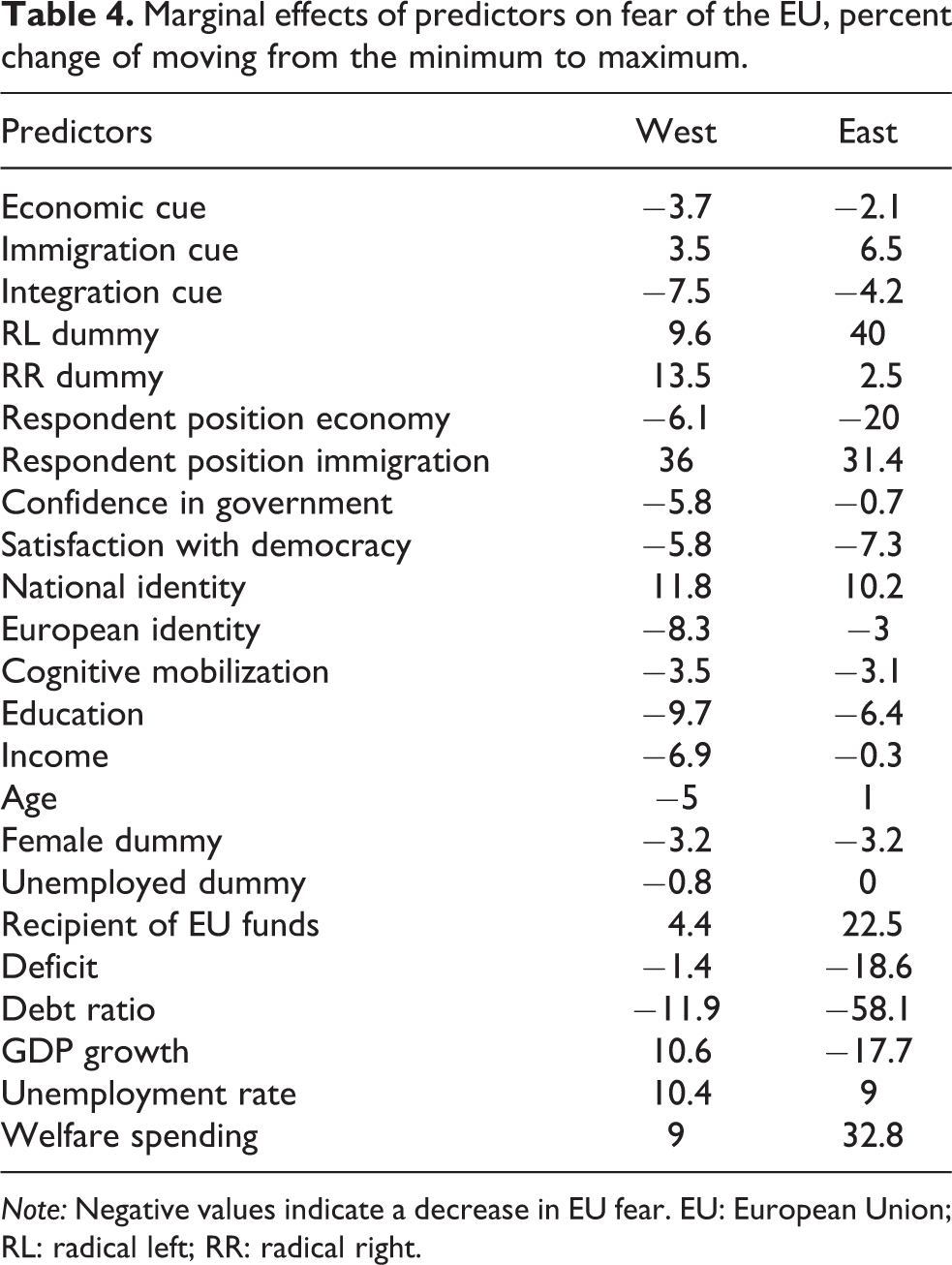
Note: Negative values indicate a decrease in EU fear. EU: European Union; RL: radical left; RR: radical right.
I begin by analysing the effects of the party cues in the West, all of which reach statistical significance. Parties are successfully cueing on integration in their own right, but their integration cue is complemented by their positions on the economic and immigration dimensions. The integration cue has the largest effect of the three. Individuals who vote for a highly Eurosceptic party are 7.5% more likely to fear the EU than those who vote for a highly Europhile party. Respondents who vote for a right-leaning party are less likely to fear the EU, while those who vote for a xenophobic party are more likely. The change in marginal effects for the latter two variables is quite small; moving from the minimum to the maximum values on the economic and immigration cues results in a 3.7% decrease and a 3.5% increase in fear of the EU, respectively. These findings are in line with the expectations laid out above.
The fact that neither party dummy reaches statistical significance suggests that the party-specific cues individuals receive are more important in determining integration support than their party family affiliation. This makes sense if we consider that party families are highly variegated internally. Compare, for example, the French Front National, which has an economic cue of 6.63 and an immigration cue of 7.86, with the Dutch Party for Freedom, which has an economic cue of 8.29 and an immigration cue of 9.4. Similarly, Germany’s Die Linke issues different cues (economic cue = 0.91, immigration cue = 3.17) from its Danish counterpart, the Socialist People’s Party (economic cue = 2.25, immigration cue = 2).
To better understand how intra-party family cues impact integration support, I turn to the party cue interaction effects. Only the RL × economic cue variable reaches significance, while the RR × immigration cue variable is significant at the 0.1 level. The results indicate that RLPs are cueing on economics in a manner different from mainstream parties, while RRPs are cueing differently on immigration. However, the coefficients of these two interaction effects call into question our assumptions about the directionality of these cues. To illustrate the impacts of cueing among each party family, I graph the interaction effects. Figures 1 to 3 show the marginal effects of moving from the minimum to the maximum on the three cues by party family. The minimum, mean and maximum values of the cues and the respondent’s position on the economy and immigration are specific to each voter type, given that there are significant differences across the voter categories. All other variables are held at their mean.
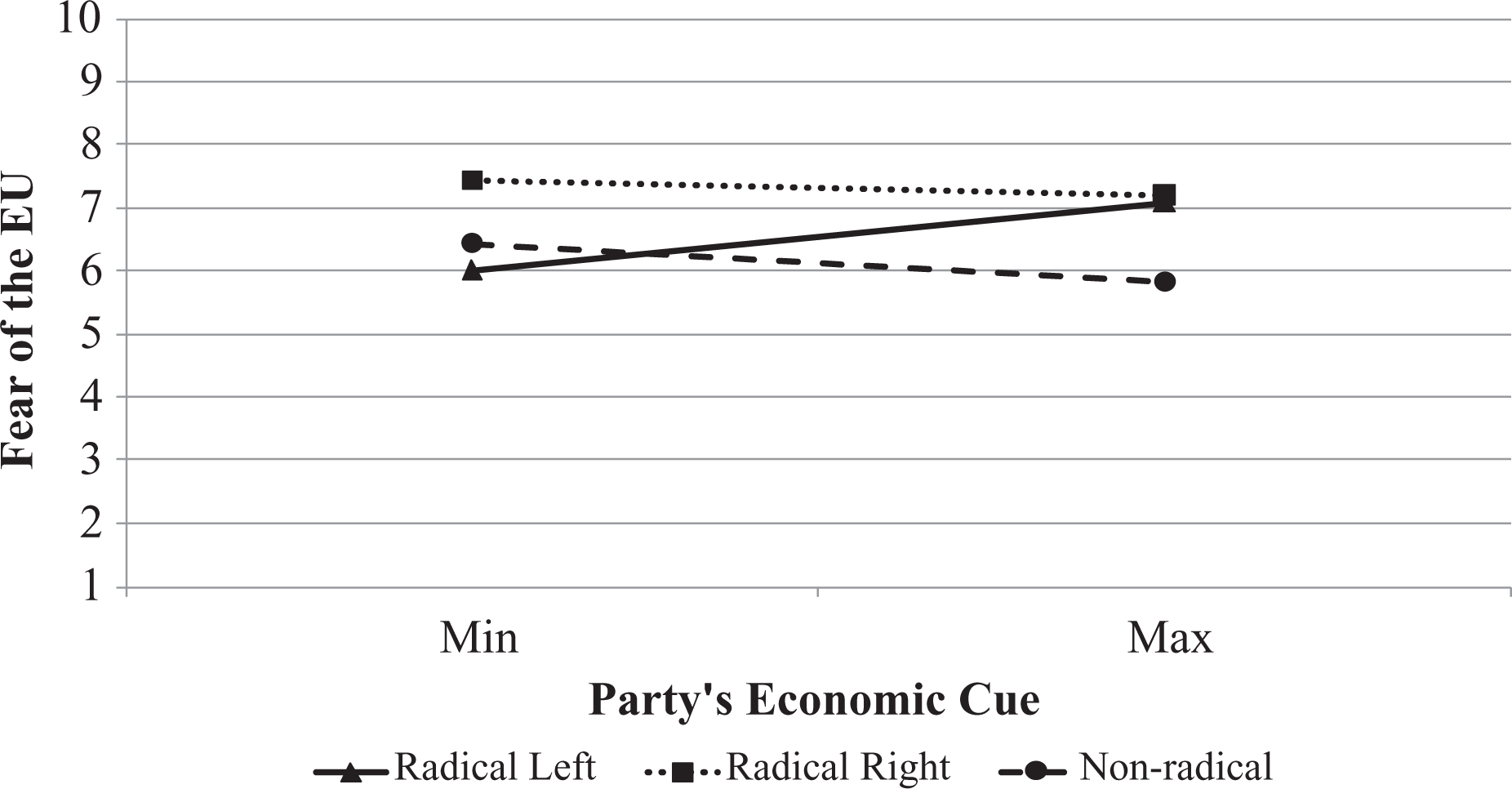
Party cueing on economics, West. EU: European Union.
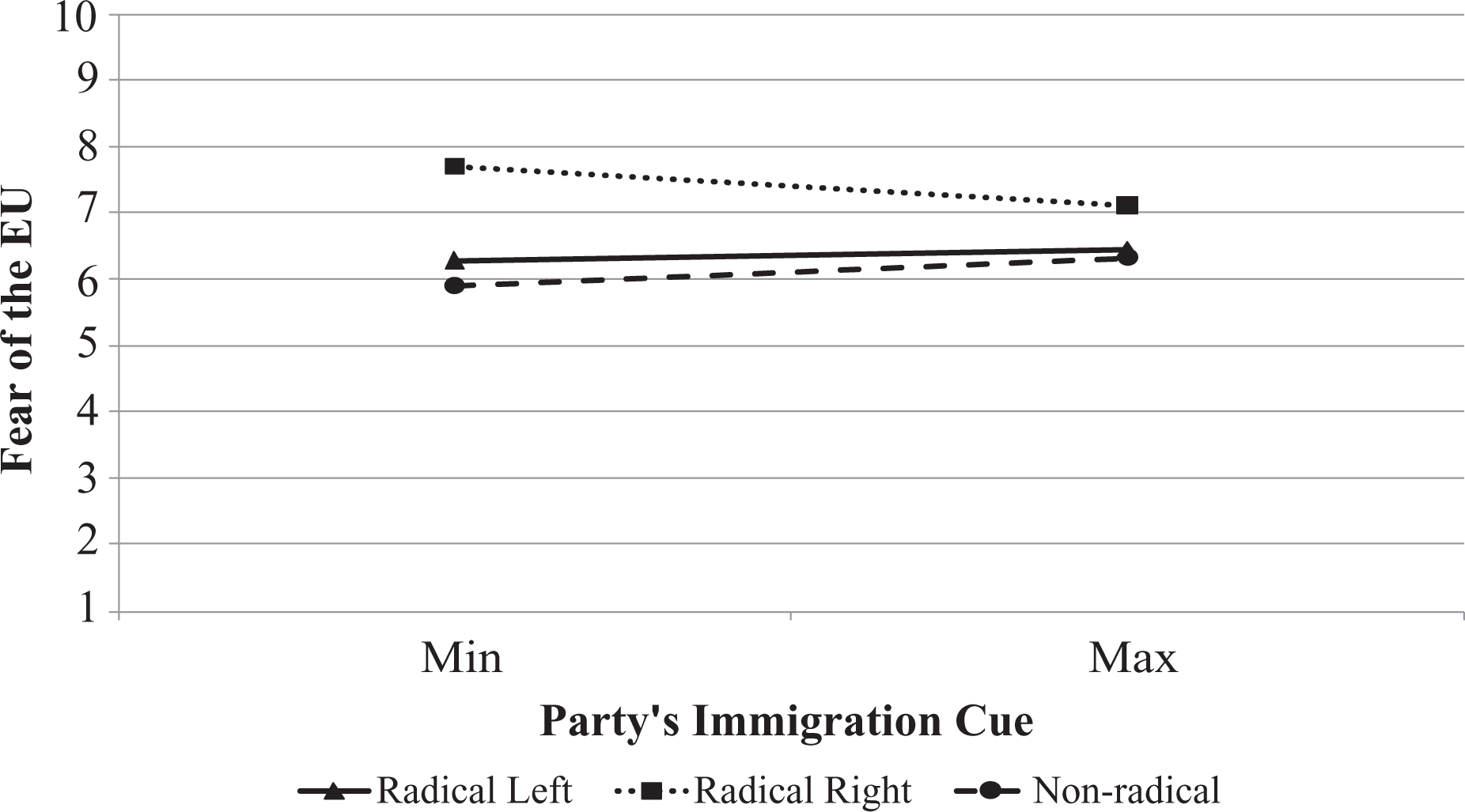
Party cueing on immigration, West. EU: European Union.
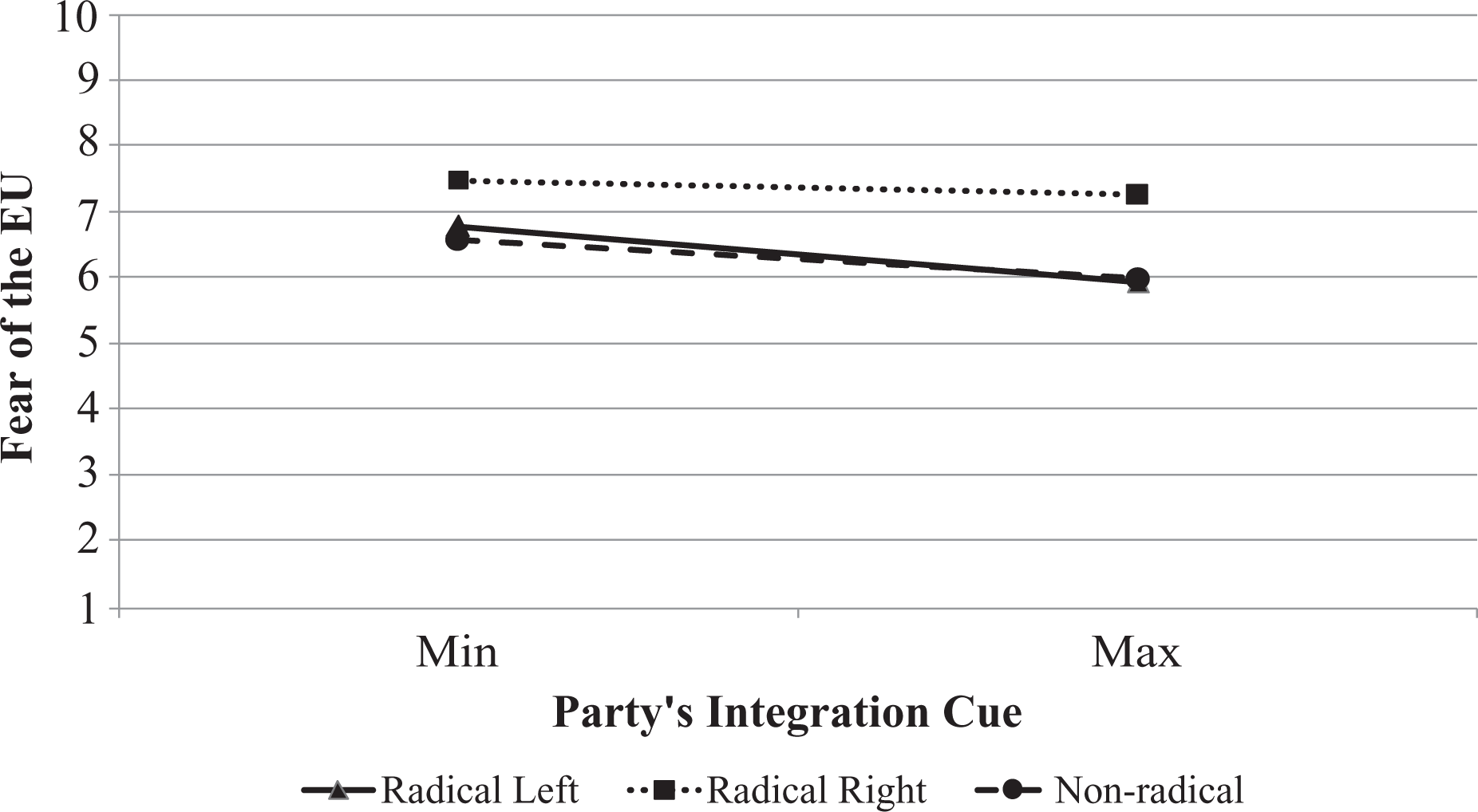
Party cueing on integration, West. EU: European Union.
For both NR and RR voters, economically right-wing cues result in less fear of the EU, with the former displaying less overall fear than the latter (Figure 1). While the RR interaction effect is not significant, the results do indicate that RRPs with a more protectionist position produce more Eurosceptic voters (hypothesis 3). This stands in stark opposition to RL voters, for whom highly protectionist economic cues translate into less fear of the EU, counter to hypothesis 1. While this result may seem surprising, evaluating the difference across RLPs offers a plausible explanation. Communist parties in Greece, Italy and France produce the most Euro-friendly constituents. I attribute this to the internationalist dimension of these parties’ platforms, which are bound to attract more cosmopolitan voters who are less fearful of the EU. This result underscores that it is not enough to simply differentiate between radical and non-radical voters, but to also explore the intra-party family differences. On the whole, moving from the minimum to the maximum on the economic cue decreases EU fear by 2.4% and 6% for the RR and NR voters, respectively, and increases it by 10.7% for the RL voter.
For RL and NR voters, more immigrant-friendly cues translate into less fear of the EU (Figure 2). However, the flat slope of the RL interaction effect indicates that the cue has no predictive power, leading me to reject hypothesis 4 that RLPs cue on immigration. For RR voters, a stronger anti-immigration cue results in less fear of the EU, contrary to hypothesis 2. On the surface, this finding appears counter-intuitive, but makes sense when one looks at the various ways RRPs combine integration and immigration in their platforms. The parties most hostile to immigration are in Belgium, Austria, the Netherlands, Greece and Denmark, scoring a 9.2 or higher on the CHES immigration scale. Parties that are comparatively less hostile to immigration are found in France, Italy and Finland, ranging from 7.86 to 8.57 on the immigration scale. However, it is this latter set of parties that are the most hostile to integration – their scores on the integration scale range from 1 for the French Front National to a 1.64 for the True Finns. The former set of parties are marginally less Eurosceptic, averaging a score in the 2–2.5 range. In the case of the Belgian parties, anti-immigration sentiment is a much stronger indicator of their RR nature than their position on integration. Moving from the minimum to the maximum on the immigration cue increases EU fear by 1.7% and 4.2% for RL and NR voters, respectively, and decreases it by 5.2% for RR voters.
Integration-friendly cues result in less fear of the EU for all groups in the analysis (hypothesis 5), although the impact is more pronounced for RL voters. Moving from the minimum to the maximum on the integration cue decreases EU fear by 8.3% for the RL voter, 2.1% for the RR voter and 5.8% for the NR voter. On the whole, the impact of the integration cue is commensurate to the economic and immigration cues, validating hypothesis 5.
Along with party cueing, individual positioning on economic policy and immigration has a significant impact on support for integration. Economically, right-wing respondents are less likely to fear the EU, while xenophobic respondents are more likely to do so. Moving from the minimum to the maximum on the economic position scale increases EU support by 6%, and by 36% on the immigration position scale. As Table 4 indicates, the largest individual determinant of EU fear is the respondent’s immigration position.
To evaluate whether the impact of individual positioning is mediated by party affiliation, I interact the RP dummies with the respondent’s positions on economics and immigration. The analysis reveals that there is a significant difference between RR and NR voters on both dimensions (p < 0.01) and a weak difference between RL and NR voters (p < 0.1). I graph the interactions effects in Figures 4 and 5. Moving from the minimum to the maximum on the economic position variable produces no change for RL voters, increases fear of the EU for RR voters by 8% and decreases it by 7.7% for NR voters (Figure 4). The immigration position has the largest interaction effect in the model and is consistent across the three groups. Highly xenophobic RL and NR respondents are 32% and 37%, respectively, more likely to fear the EU than pro-immigration respondents, while RR respondents are 26% more likely. In both figures, it is obvious that RR voters are the most Eurosceptic.
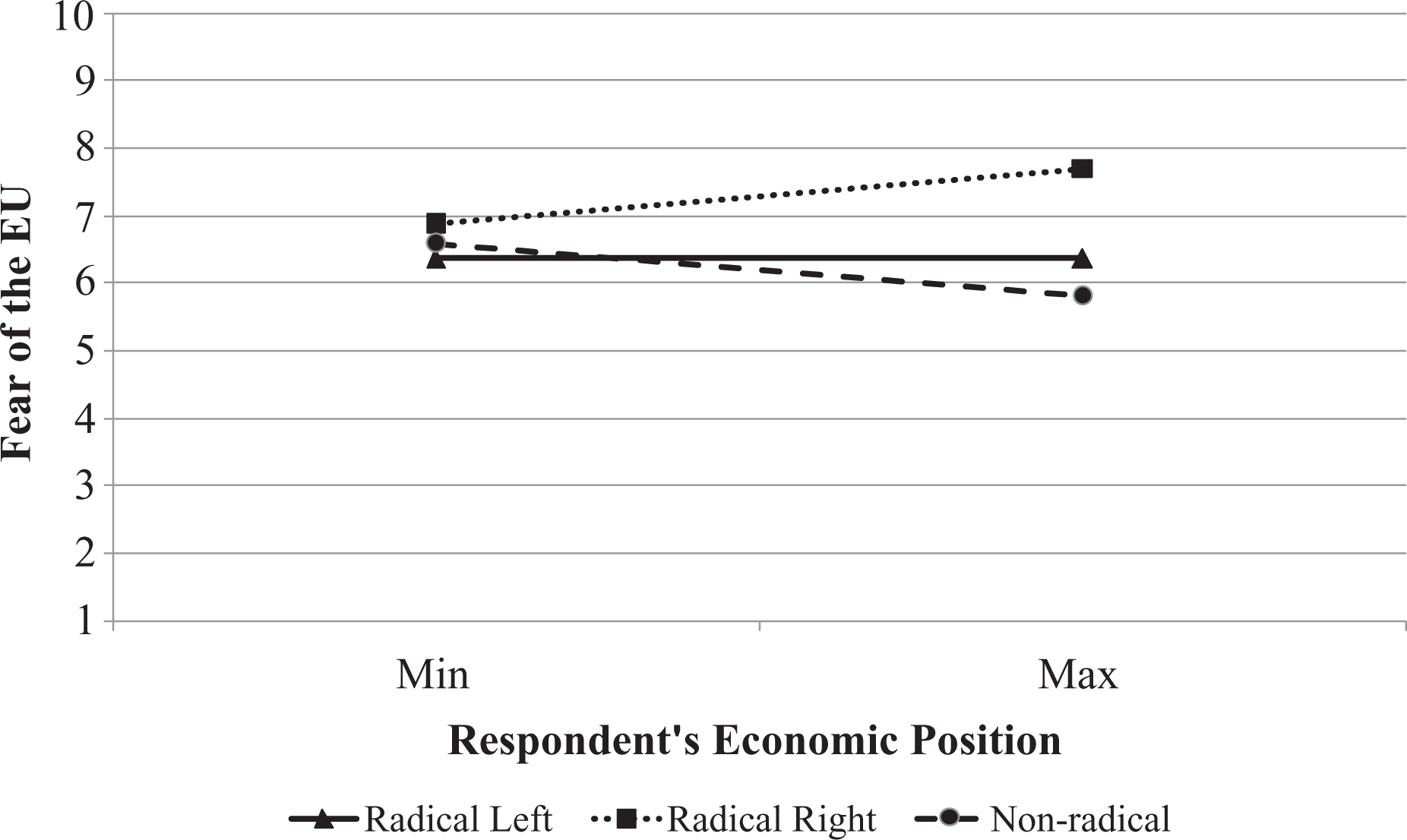
Respondent’s economic position, West. EU: European Union.
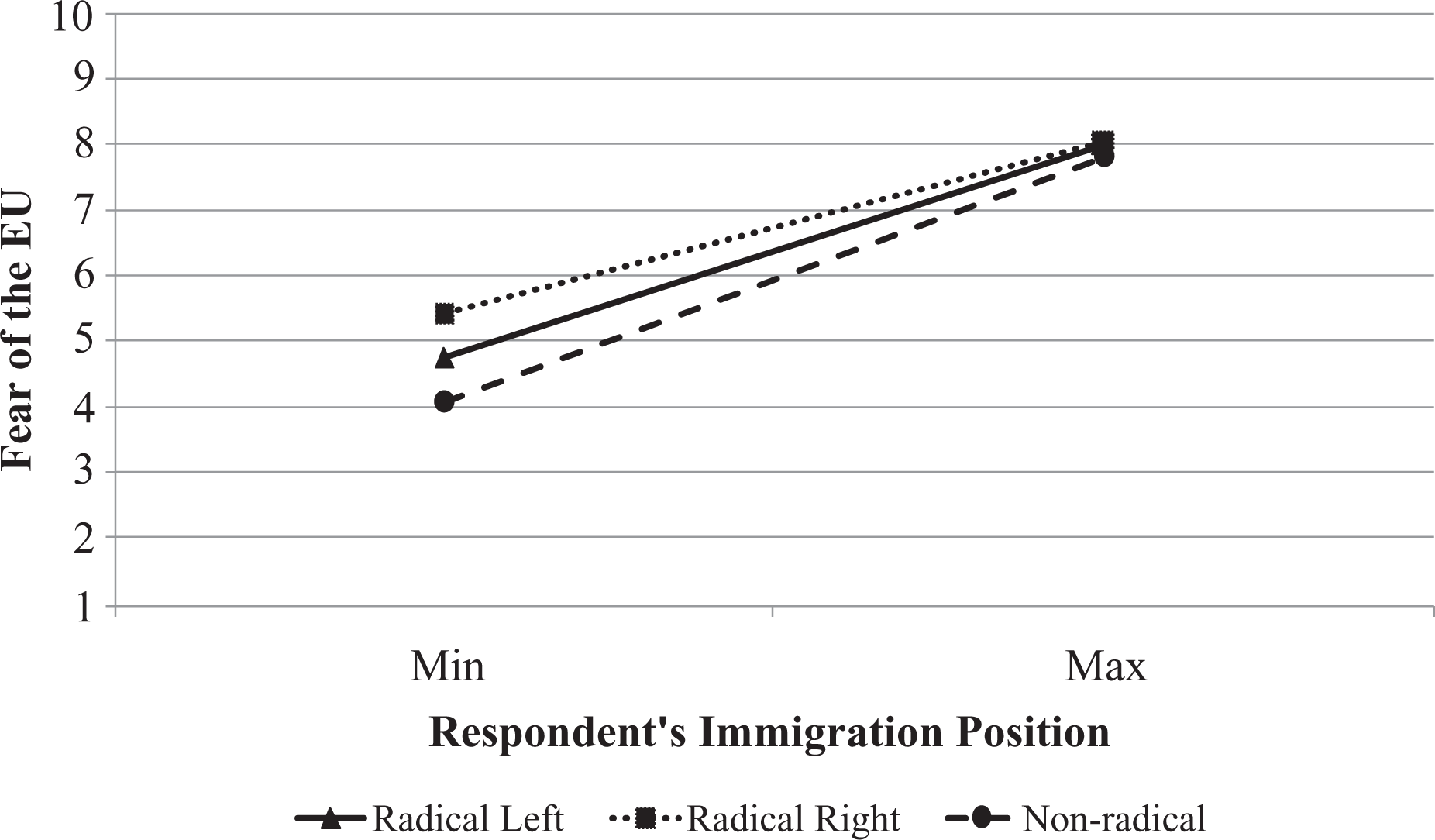
Respondent’s immigration position, West. EU: European Union.
The assertion that party cues exert independent effects on integration support apart from the respondent’s position on economics and immigration is confirmed by the facts that (a) the slope for the RL economic cue is steeper than the slope for the RL economic position; (b) the RR slopes move in different directions in Figures 1 and 4, on the one hand, and Figures 2 and 5, on the other; and (c) the slope for the RL immigration position is steeper than the slope for the RL immigration cue.
The control variables validate the proxy argument and the literature on national and European identities. Respondents who have more confidence in their government and are more satisfied with democracy in their country are less likely to fear the EU. A strong national identity bolsters EU fear, while a strong European identity dampens it. Individuals who are more politically engaged are less likely to fear the EU, as are more educated and wealthier voters. Countries with higher debt ratios are less likely to fear the EU, presumably because they are the beneficiaries of EU subsidies. In contrast, wealthier countries are more fearful, as are countries with higher unemployment rates. This reflects the economic protectionist mentality of voters in economically strapped states.
The results in the East largely conform to those in the West, with some notable exceptions. The model demonstrates that CEE parties significantly cue on all three dimensions. As anticipated, the economic cue has the weakest effect, producing only a 2% decrease in EU fear when moving from the minimum to the maximum. Contrary to the West, the immigration cue has the largest impact, yielding a 6.5% increase in EU fear, while the integration cue decreases fear by 4.2%. Two of the interaction effects reach significance at the p ≤ 0.1 level: the RL × immigration cue and RR × integration cue. The interaction effects for the East are graphed in Figures 6 to 8.
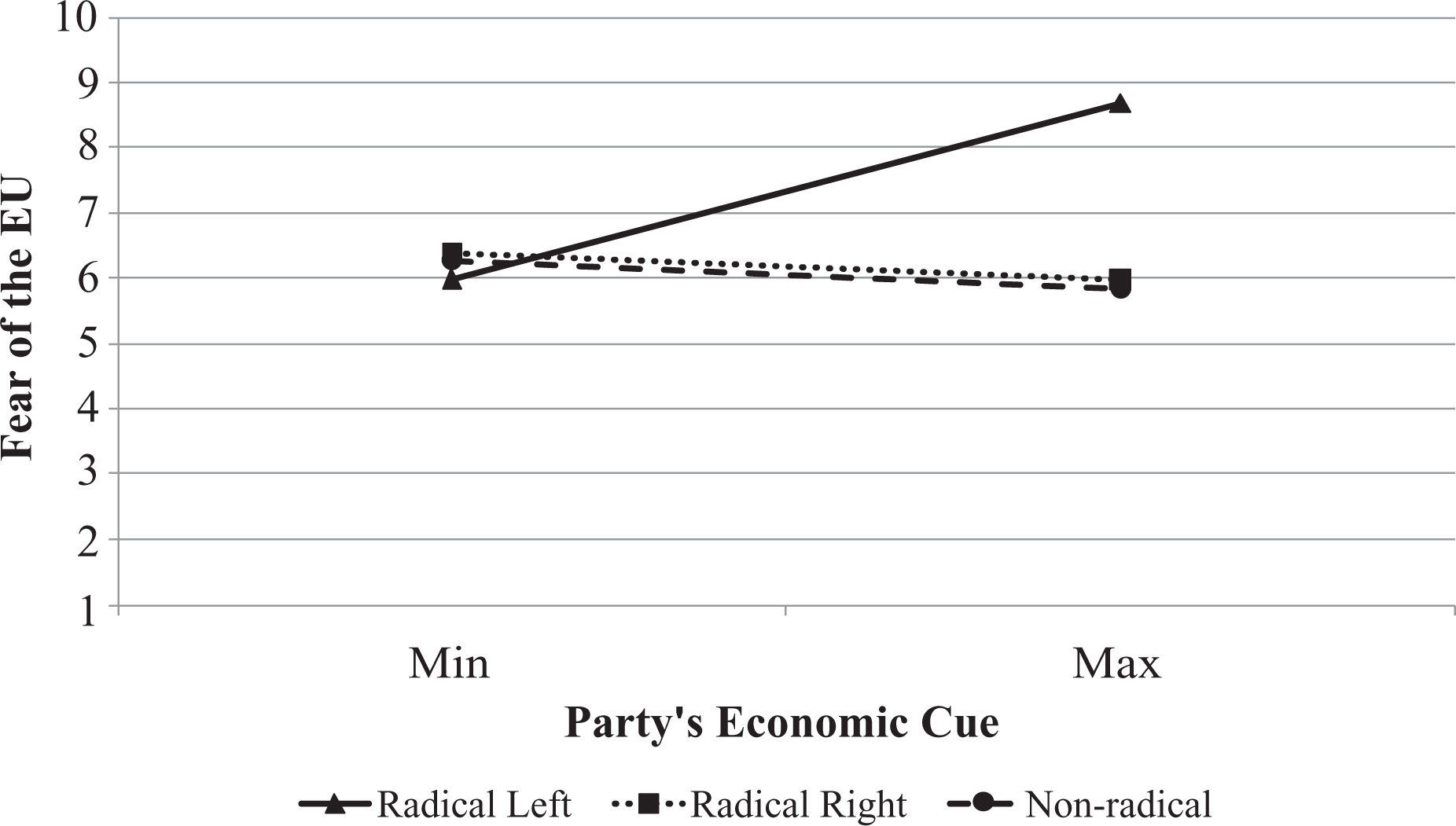
Party cueing on economics, East. EU: European Union.
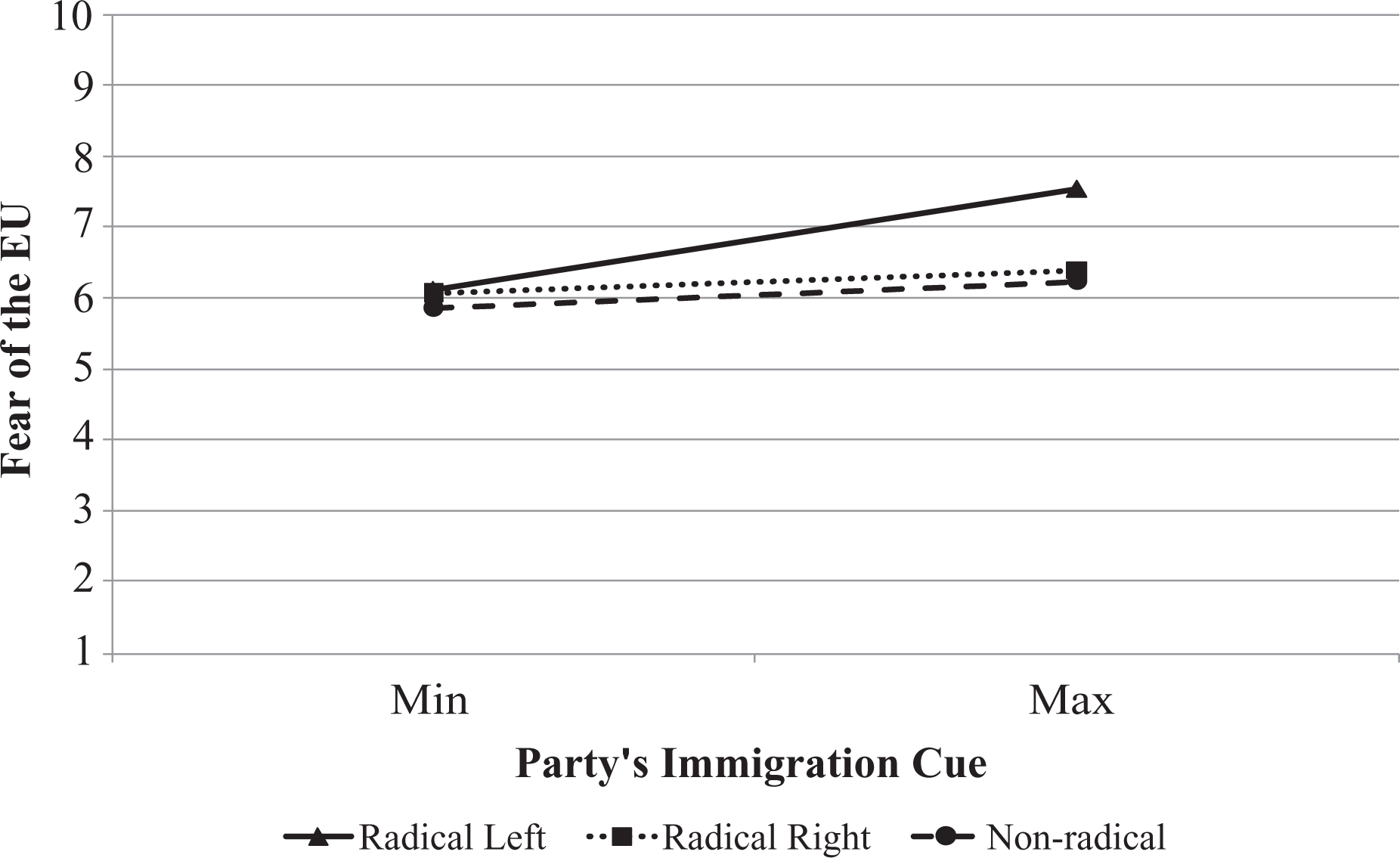
Party cueing on immigration, East. EU: European Union.
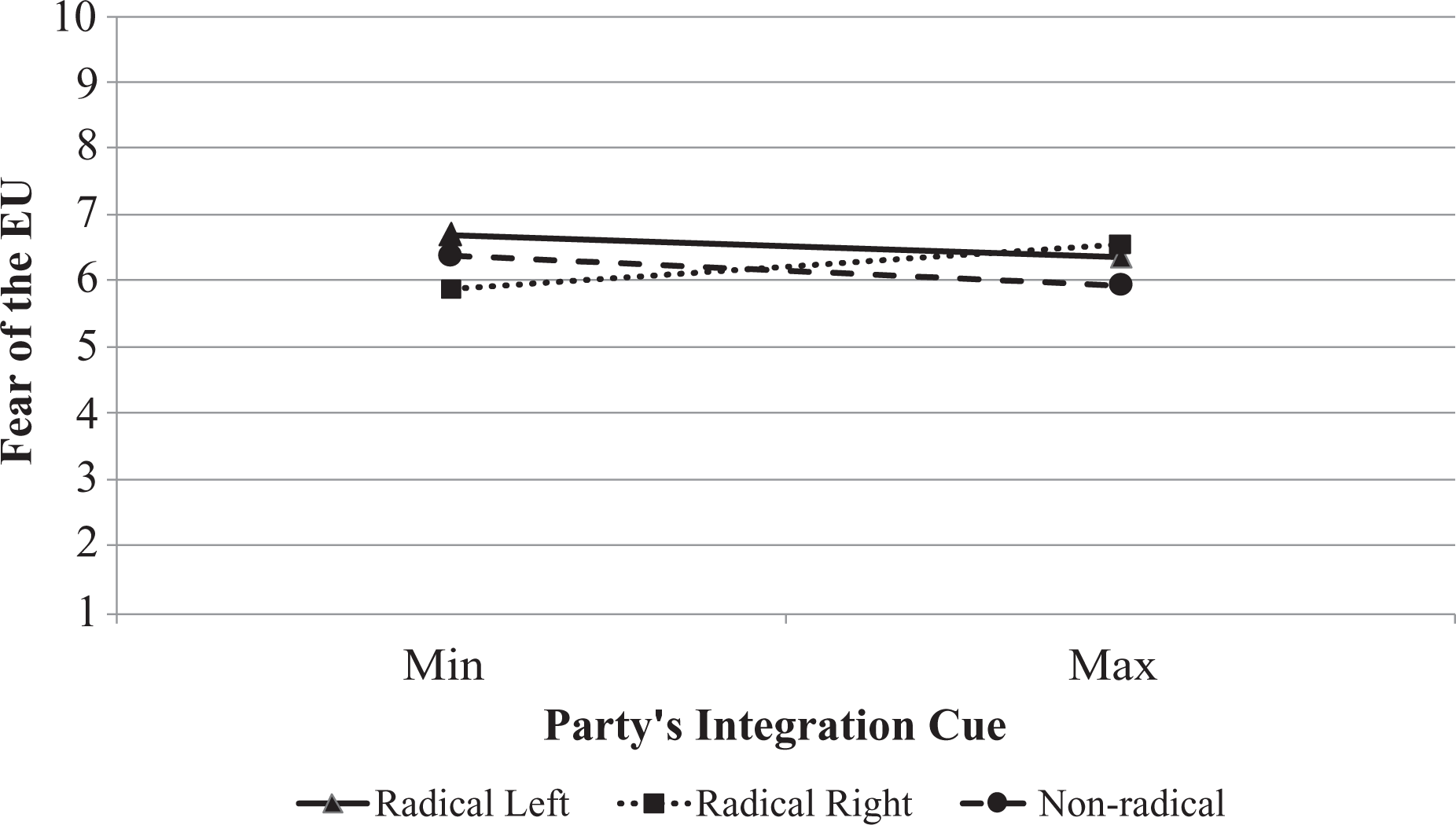
Party cueing on integration, East. EU: European Union.
Turning first to the economic cue, the results in Figure 6 show that there is no difference between RR and NR voters. In both cases, moving from the minimum to the maximum of the economic cue lessens EU fear by 4%. As in the West, a right-wing cue for the RL voter increases EU fear, producing a 27% change when moving from the minimum to the maximum. This drastic percent increase and the steep slope of the interaction effect is somewhat misleading and driven largely by one party – the Communist Party of Bulgaria (KPB). While the other RLPs in the East have an economic cue in the 0.5–1.5 range, the KPB’s cue is 3.25, while its proportion of total RL voters is miniscule (n = 5). This is reflected in the large standard error for the RL × economic cue interaction effect (0.85). Hence, although the slope for the RL interaction effect is steep, there is no significant difference between the RL voter and the other two groups.
The impact of the immigration cue is consistent across all three types of voter – more xenophobic cues increase fear of the EU (Figure 7). This effect is most pronounced for the RL voter, where a shift from the minimum to the maximum results in a 14.2% increase in EU fear. This confirms hypothesis 6 that RLPs in the East are more likely to cue on anti-immigration than in the West. For the RR and NR voters, the percent change is minimal: 3.2% and 3.7%, respectively. While the RL interaction effect fails to reach significance at the 0.05 level (p = 0.126) in 2008, the recent migrant crisis has intensified the salience of immigration in CEE member states. This can potentially produce two divergent results in more recent data. On the one hand, the shift to a more xenophobic position in mainstream parties in the Czech Republic, Poland, Hungary and Slovenia may narrow the divide between RLPs and NRPs, thereby weakening the RL interaction effect. On the other hand, the traditional anti-outsider stance of RLPs may be extended to account for recent non-EU migrants, producing an increase in xenophobic cueing on behalf of RLPs. Either way, much more research must be done on cueing effects in the East.
There is a mild difference in how parties cue on integration directly (Figure 8). For RLPs and NRPs, the results conform to expectation; moving from the minimum to the maximum on the integration cue decreases EU fear by 3.3% and 4.5%, respectively. However, the opposite is true for RRPs, where the same shift results in a 6.7% increase, although the interaction effect is weak (p = 0.141). While this result is surprising, recent work by Gómez-Reino and Llamazares (2013) shows that, in some countries, RRPs that adopt Eurosceptic positions have pro-EU voters. This is particularly the case for three parties in this analysis – the Bulgarian NOA, the Polish Law and Justice Party, and the Slovak National Party. Additionally, the Latvian TB/LNNK displays a pro-EU position but has Eurosceptic voters. The finding suggests that, in the case of the East, a RRP’s integration position attracts voters who are not necessarily Eurosceptic, but are drawn to other facets of the party’s platform, perhaps the party’s position on law and order or social lifestyles, (both of which are outside the scope of this article).
As in the West, the respondent’s economic and social positions significantly impact EU fear: decreasing it by 20% for highly neo-liberal versus highly protectionist voters and increasing it by 31% for highly xenophobic versus completely immigrant-friendly voters. The interaction effects between voter type and their positions are graphed in Figures 9 and 10. In all cases, moving from the minimum to the maximum on the economic position sharply decreases EU fear (Figure 9), in contrast to the West where the slopes are much less pronounced and the RR slope is positive. The difference between RR and NR economic positions is significant, and moving from the minimum to the maximum decreases EU fear by 39.1% for RR voters, 22.4% for RL voters and 18.3% for NR voters. Moving from the minimum to the maximum on the immigration position drastically increases EU fear for all voter types and is consistent with the West (Figure 10). Highly xenophobic RL and NR respondents are 45.9% and 31.3%, respectively, more likely to fear the EU than pro-immigration respondents, while RR respondents are 25.4% more likely.
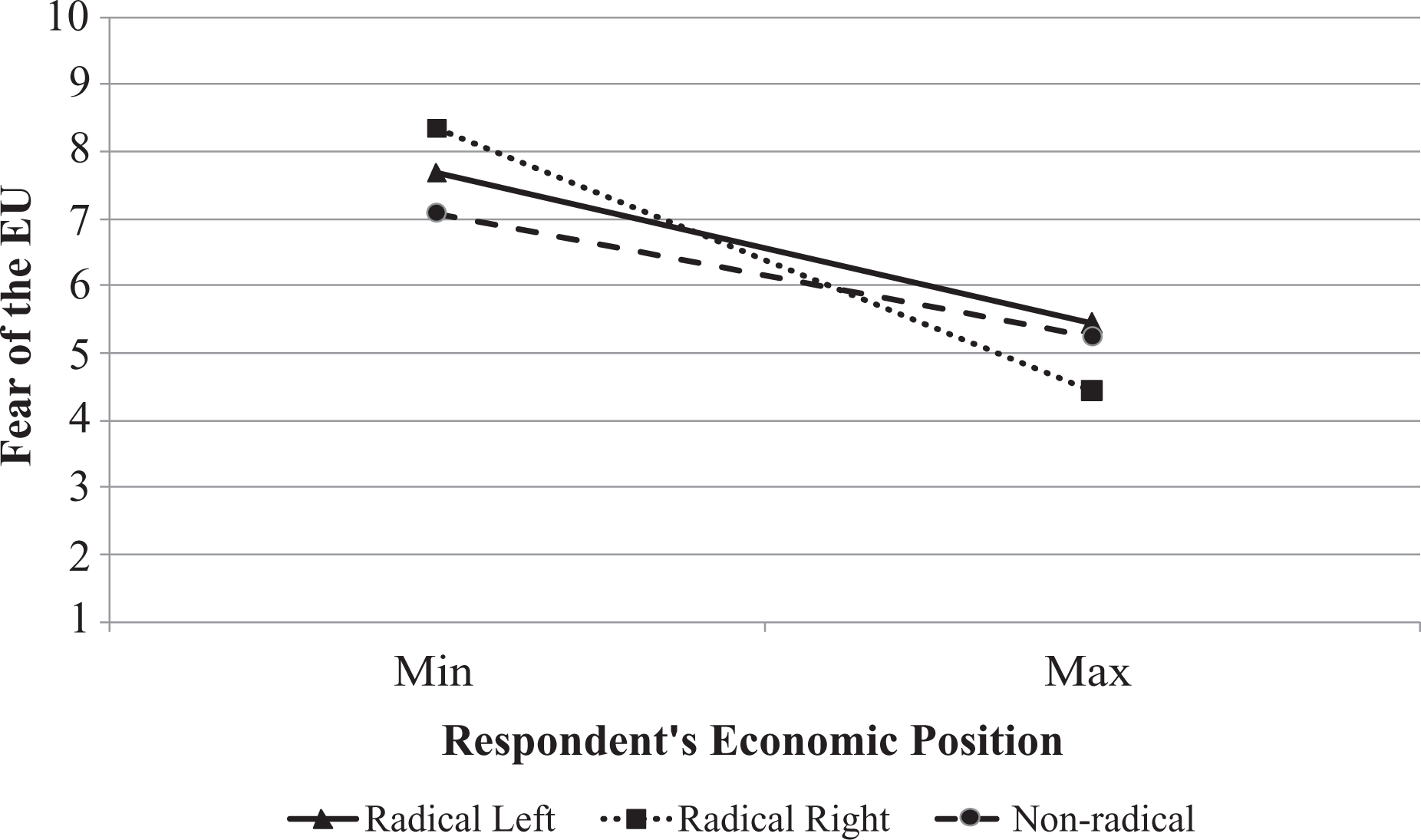
Respondent’s economic position, East. EU: European Union.
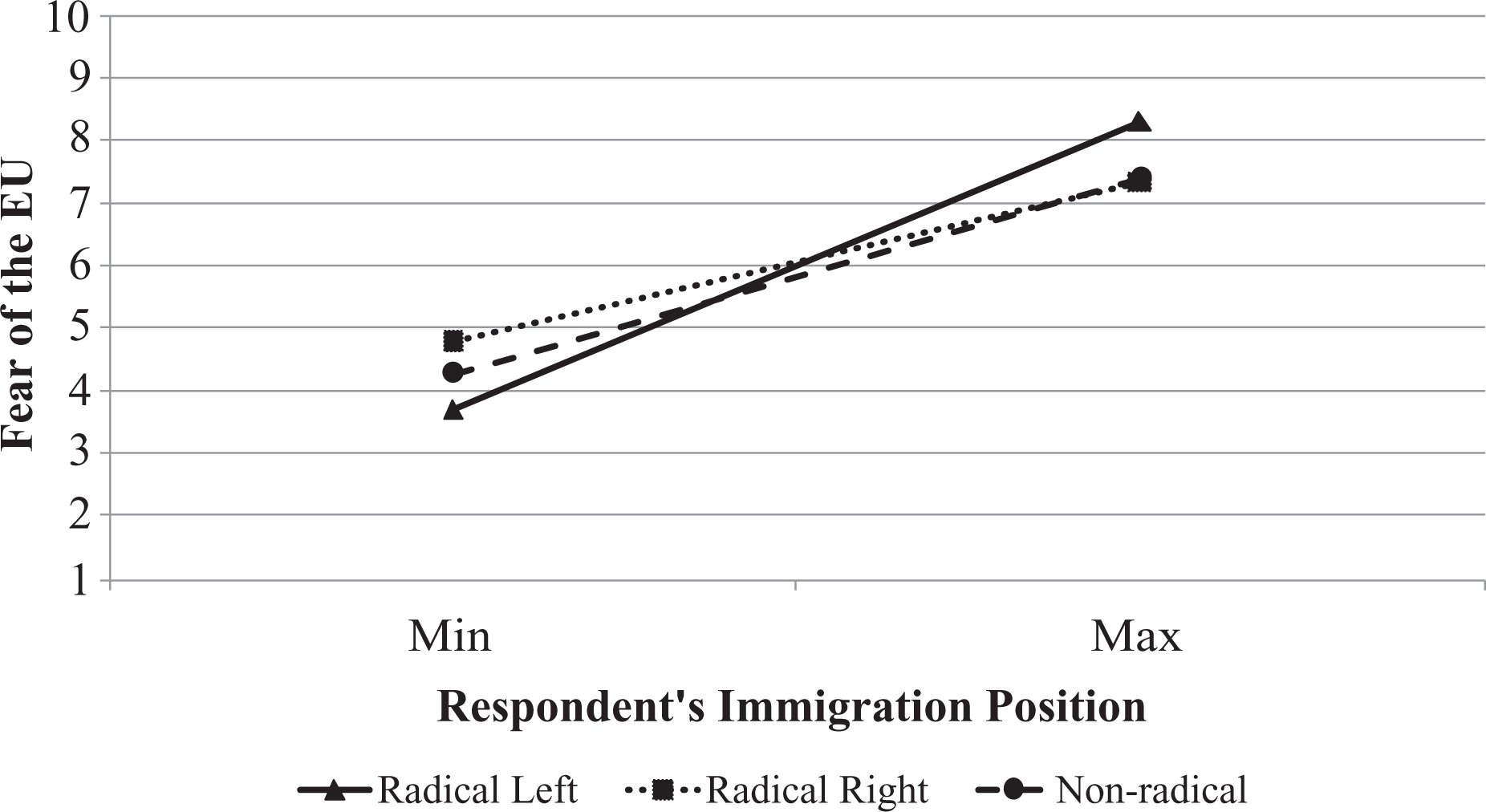
Respondent’s immigration position, East. EU: European Union.
The remaining results in CEE states mirror those found in the West. A departure from the West is that confidence in the government, age and income has no significant effect and that country-level characteristics are poor predictors. Only one of the six country-level variables is significant; a larger economic deficit makes one less likely to fear the EU.
Figure 11 brings together the information from the two models. The average predicted values of fear of the EU across the three types of voter and across the two regions are graphed. The RR voter in the West is the most fearful (7.37), while NR voters in both regions are the least fearful (6.14 and 6.06 in the West and the East, respectively). In the West, RL voters exhibit the second-most fear (6.38), although they are much closer in position to their NR counterparts than to the RR voter. In the East, the RL voter is the most fearful (6.64), followed by the RR voter (6.26). The difference in EU fear is smaller for the RR and NR voters than for the RL and RR voters in the East. Comparing across the two regions, the most pronounced difference is between the RR voters, with Western RR voters exhibiting more than a point more EU fear than Eastern RR voters (difference = 1.11).
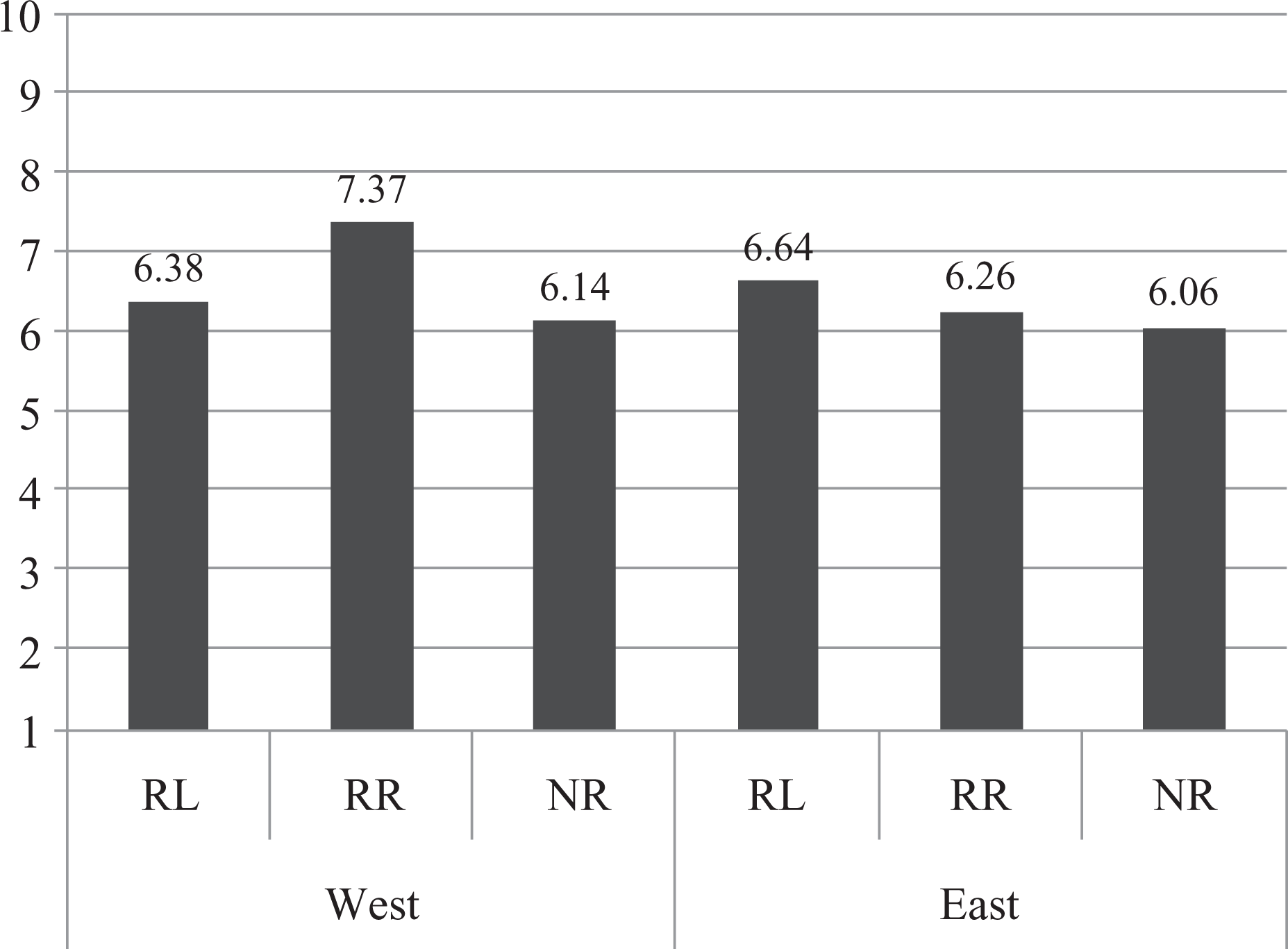
Average predicted values of EU fear across three types of voter. EU: European Union; RL: radical left; RR: radical right; NR: non-radical.
Conclusion
This article evaluates the effect of party cueing on individual-level support for European integration. I find that parties are cueing on integration directly and that citizens who vote for a pro-EU party are less likely to fear the EU. Parties also use their positions on the economy and immigration to cue integration support. Individuals who vote for an economically right-wing party are more likely to be Europhiles, while those who vote for a more xenophobic party are more likely to be Eurosceptics. In the West, the integration dimension is the most significant determinant of fear of the EU, while the immigration dimension is the most significant in the East.
The analysis is particularly concerned with RPs and voters. The expectation in the literature is that RRPs cue Euroscepticism via their anti-immigration platforms, while RLPs use their economic protectionist positions to do the same. However, the results show that intra-party family differences condition EU fear in surprising ways. In the West, more economically protectionist RLPs produce voters who are less fearful of the EU than their more centrist party counterparts. At the same time, a more xenophobic cue among RRPs actually lessens EU fear. This analysis makes clear that it is not sufficient to simply delineate whether an individual votes for a RP, but to analyse the specific cues she receives from her RP of choice.
One of the main contributions of this article is the incorporation of the CEE member states into the analysis, which is ignored in the cueing literature. The analysis reveals that party cueing patterns are fairly similar across the West and the East, with a few notable exceptions. In the case of RLPs, there is a weak cueing effect on immigration – RLPs exhibit stronger xenophobic cues than RRPs and NRPs and produce the most fearful voters. Among RRPs, there is a weak interaction effect with integration, although not in the predicted direction. An EU-friendly RRP cue conditions a more fearful response among RR voters.
The analysis draws on 2008 data, a moment when the European economic crisis was just underway. I expect that more recent data will reveal a more Eurohostile trend across the board, for both radical and non-radical voters, particularly given the significance of the European migrant crisis. Future work must expand our enquiry to other time points both prior to and after the onset of these crises. Additionally, more ethnographic research is warranted to unpack the policies that resonate with radical right and left voters. Qualitative studies (e.g. interviews and focus groups) will provide a better picture of how radical voters perceive the interrelated dynamic of Europeanization, economic globalization and immigration.
Supplemental material
Supplemental Material, sj-docx-1-ppq-10.1177_1354068818808324 - Cueing the radical voter: The impact of economic, immigration and integration cues on public fear of the EU
Supplemental Material, sj-docx-1-ppq-10.1177_1354068818808324 for Cueing the radical voter: The impact of economic, immigration and integration cues on public fear of the EU by Anna Brigevich in Party Politics
Footnotes
Declaration of conflicting interests
The author(s) declared no potential conflicts of interest with respect to the research, authorship, and/or publication of this article.
Funding
The author(s) received no financial support for the research, authorship, and/or publication of this article.
Supplemental material
Supplemental material for this article is available online.
Notes
References
Supplementary Material
Please find the following supplemental material available below.
For Open Access articles published under a Creative Commons License, all supplemental material carries the same license as the article it is associated with.
For non-Open Access articles published, all supplemental material carries a non-exclusive license, and permission requests for re-use of supplemental material or any part of supplemental material shall be sent directly to the copyright owner as specified in the copyright notice associated with the article.
