



Abstract
Immigration, economic hardship, and the European Union (EU) are typically emphasized as key concerns for the electorates of European populist radical right (PRR) parties. At the subnational level, however, these parties perform increasingly well in areas relatively unaffected by ethnic diversity, postindustrial economic decline, or transnationalism. What explains this paradox? Through a novel longitudinal analysis of rich municipal electoral, economic, and demographic data from Finland, this study uncovers the conditions under which immigration, economic hardship, and EU transfers influence support for the PRR. Although levels of ethnic diversity or economic hardship poorly predict support for these parties, they find fertile ground in areas undergoing rapid ethnic changes or economic decline. Growing reliance on EU funds, in contrast, decreases their anti-EU appeals. Thus, by clearly differentiating structural conditions from cyclical effects, this study helps reconcile rival theoretical perspectives on social contact and receptiveness toward immigrants and debates over the economy’s effects on these parties’ performance.
Introduction
Over the past decade, populist radical right (PRR) parties 1 have gained strongholds in many European countries. A wealth of research has attempted to identify the causes of their (re)emergence. Seminal work on these parties has typically emphasized immigration and economic hardship as key drivers of their performance. Scholars have argued that globalization and growing transnationalism have created new cleavages that cut across socioeconomic classes and the traditional left–right political axes (Kriesi et al., 2008). By politicizing these “modernization grievances” (Golder, 2016), that is, anti-immigration, anti-globalization, and anti-European Union (EU) sentiments, PRR parties cater to the “losers of globalization” (Kriesi et al., 2008) or the “common man”: low-income voters in competition with immigrants for jobs or public resources (Kitschelt and McGann, 1995; Mudde, 2007). Academic and popular discourses have similarly relied on narratives of ethnically diverse and economically depressed areas as fertile grounds for the PRR (Gest, 2016; Goodwin, 2012).
Yet prior research on PRR parties has some notable limitations. First, by primarily focusing on either individual-level or national-level determinants (Arzheimer, 2009; Golder, 2016; Jesuit et al., 2009), scholars have overlooked a key dimension affecting receptiveness toward the PRR: the local context. PRR support varies considerably at the subnational level (Golder, 2016; Stockemer, 2017), a puzzle that is masked by national-level aggregates. Moreover, conventional explanations typically rely on assumptions and theories that underscore personal experiences, direct contact, and living environment as central for triggering a PRR backlash. However, these studies have relied on levels of aggregation that are too abstract to meaningfully capture such experiences, much less identify the local-level contextual influences on them. And while several scholars have stressed the importance of local contexts influencing electoral choice and PRR support (e.g. Mayer 2002), the ways in which they shape this support remain inadequately understood. Consequently, studies on PRR parties’ success have yielded inconsistent. Findings that vary by methodology, across different national settings and over time.
Relatedly, while past research offers key insights on the macro or microlevel determinants of these parties’ initial success, it falls short in explaining why their electoral bases change and performance varies over time, especially as they have moved from the margins to the mainstream. Current scholarship thus offers few explanations as to why such parties fare increasingly well in areas unaffected by their core programmatic appeals or, conversely, fail to attract voters in places where these appeals would appear to be highly salient. Indeed, a closer look at the subnational level suggests that PRR parties are increasingly popular in relatively homogeneous (Colantone and Stanig, 2018; Rothwell and Diego-Rosell, 2016) and/or economically thriving areas (Fitzgerald, 2016).
Taking these puzzling spatial patterns as a point of departure, this study investigates the conditions under which local contexts influence “radical” political behavior. Through a longitudinal, local-level approach and analyses that allow for holding national contextual factors constant, it sheds light on how and why the PRR’s appeal in national elections varies considerably within countries. In other words, why does the PRR’s rhetoric on, and arguments about, national policies and issues related to immigration, globalization, or Europeanization resonate strongly with residents in some localities but not in others?
Finland provides an important and particularly useful setting to examine this paradox. The radical Finns party experienced one of the highest increases in PRR support at a time when Finland was one of the least affected countries of the Eurozone crisis. Moreover, it has one of the lowest (and stable) immigration rates in Europe, in addition to its citizens holding more positive views about the EU compared to other member countries. As such, Finland stands out as a “hard” case for evaluating the processes through which these contextual factors become politically salient.
This study argues that these factors can and do significantly influence PRR support. However, the conditions under which they shape political preferences matter greatly. Employing a novel empirical research design and a local-level approach that distinguishes between structural and cyclical conditions, it shows that PRR support is not higher in municipalities with high levels of immigration, unemployment, and economic dependency on state support or EU transfers. Areas undergoing rapid ethnic changes or economic decline, in contrast, furnish fertile ground for PRR parties, whereas their Eurosceptic rhetoric is less appealing in areas where reliance on EU funds has increased. In short, dynamic rather than static local conditions differentiate localities where PRR support has expanded most rapidly.
These findings make important contributions to the field. Contributing to debates over ethnic diversity breeding threat versus tolerance (Allport, 1954; Key, 1949), the evidence suggests that initial contact with immigrants can provoke hostile reactions over immigration’s effects on localities and influence electoral behavior. PRR voting can thus at least partly be considered a reflection of fear or prejudice against outsiders in the short term. However, in line with theories of social contact, these findings also posit that sustained contact with immigrants is likely to decrease prejudice toward these out-groups, the PRR recording weaker support in areas with higher levels of diversity.
A symmetrical logic is also at work with respect to unemployment and reliance on state support. The surge in PRR support does not take place in chronically depressed areas with higher shares of “losers of globalization” but in localities that have experienced worse short-term downturns. These findings thus challenge the growing consensus over the limited role economic conditions have played in explaining the PRR’s recent success (Bartels, 2017; Kaufmann, 2016; Schwander and Manow, 2017). Similarly, while the level of EU transfers has little influence on PRR voting, areas where reliance on these funds has increased are less receptive to the PRR’s anti-EU appeals. These results highlight the need to systematically incorporate measures of EU influence in future research on PRR parties.
These findings demonstrate the importance of both disaggregating analyses of PRR support to levels at which contextual factors meaningfully depict lived experiences and paying attention to the temporal dynamics under which local contexts are favorable to PRR parties. By unpacking the inconsistent evidence surrounding contextual explanations of PRR support, this study provides a better substantive understanding of PRR parties’ growing performance and appeal in areas seemingly untouched by economic hardship, immigration, and transnationalism in Western democracies.
The local context and the PRR
Contextual explanations of PRR voting have traditionally emphasized ethnic diversity and (globalization-driven) economic anxiety as key predictors of these parties’ rise and performance. Indeed, across advanced democracies, both academic and popular discourses have predominantly relied on narratives of the most deprived and ethnically diverse postindustrial localities as particularly receptive toward PRR appeals (eg. Gest, 2016; Goodwin, 2012).
However, studies on these contextual factors’ effects have yielded inconsistent findings (Arzheimer, 2009; Golder, 2016; Kaufmann, 2017). For example, whereas hostility toward immigration, xenophobia, and racism has been identified as strong predictors of radical right support (Lubbers et al., 2002; Norris, 2005; Rydgren and Ruth, 2011), the question of how ethnic contexts shape attitudes toward immigrants is subject to ongoing debates. For one, scholars have suggested that high levels of ethnic diversity lead to heightened perceptions of threat and intolerance toward out-groups (Key, 1949; Stein et al., 2000). Several studies suggest that PRR is particularly appealing in ethnically diverse areas (Bowyer, 2008; Coffé et al., 2007) or close to such neighborhoods (Mayer, 1992; Rydgren and Ruth, 2013). Others again have challenged these assumptions, finding evidence in favor of the social contact theory (Allport, 1954), according to which exposure and contact can decrease hostility toward immigrants (Barlow et al., 2009; Biggs and Knauss, 2011; Sørensen, 2016).
Moreover, scholars have argued that globalization and denationalization have led to structural social transformations that partly alter the “traditional” cleavages underlying European party systems (Kriesi et al., 2008; Lipset and Rokkan, 1967). Globalization leads to a division between “the winners” and “the losers,” which, in turn, can strongly affect PRR parties’ success (Minkenberg, 2003; Swank and Betz, 2003). According to theories of socioeconomic marginalization, voters in areas most (negatively) affected by globalization and Europeanization are likely to find PRR rhetoric particularly appealing (Fitzgerald, 2016; Gest, 2016; Rydgren and Ruth, 2011). “Natives” in poor localities are also more likely be receptive to PRR parties’ anti-immigrant and welfare chauvinistic rhetoric, given competition over jobs or public resources (Coffé et al., 2007; Dancygier, 2010; Kitschelt and McGann, 1995).
And yet studies have found no consistent effects of globalization—most notably postindustrial economic decline—on sympathy toward the PRR. Unemployment rates have commonly been used as a proxy to capture these effects. However, national and cross-national evidence remains mixed (Lubbers et al., 2002; Swank and Betz, 2003), some finding a positive (Jackman and Volpert, 1996) while others a negative effect (Arzheimer and Carter, 2006; Knigge, 1998) Subnational evidence is also inconclusive, with unemployment and PRR support being negatively correlated in Belgium (Coffé et al., 2007), but positively in Sweden (Rydgren and Ruth, 2011).
This inconsistent evidence highlights the limitations of current scholarship in providing leverage to understand the PRR’s growing performance and notoriety. Specifically, these studies fail to explain why parties with a predominantly anti-immigration, anti-globalization, and anti-EU agenda perform increasingly well in homogeneous localities unaffected by economic downturns or fail to attract voters in ethnically diverse and economically precarious areas.
A local-level approach to analyzing the effects of immigration, economic hardship, and EU influence provides ample opportunities in this regard. Indeed, several studies suggest that local ethnic and economic contexts significantly influence individuals’ opinions on the economy, immigration, and political behavior. Moreover, local concerns are not only contested locally but also shape considerations about the state of the national economy or immigration attitudes on a broader scale. For example, local economic conditions, such as unemployment, fuel prices, or house foreclosures, play a key role in shaping perceptions of national-level economic performance and incumbent support (e.g. Bisgaard et al., 2016; Reeves and Gimpel, 2012; Simonovits et al., 2018). Many scholars have also found attitudes toward immigration to be considerably shaped by local ethnic contexts (e.g. Hopkins, 2010; Kaufmann, 2017; Newman, 2013).
Moreover, and crucially, conventional explanations of PRR voting rely and draw on theories that highlight personal and lived experiences and contact as key determinants of receptiveness toward PRR appeals, yet studies that meaningfully capture such relationships remain scarce. Whereas macrolevel studies shed light on the cross-country differences in these parties’ rise and success, they also obscure significant variation and relationships between contextual characteristics and PRR voting at the local level. Insufficient attention to the local context in which electoral choices are made can also lead to biased estimates in microlevel analyses, in addition to issues related to social desirability and stigma surrounding PRR parties in survey research. A local-level approach enables the examination and identification of these relationships and contextual influences while holding national contextual factors constant, deepening understanding of subnational variation in support and receptiveness toward the PRR’s rhetoric and arguments about the national issues these parties exemplify in turn.
A longitudinal perspective, on the other hand, elucidates the processes through which local contexts influence electoral behavior. While the importance of investigating subnational variation is increasingly acknowledged (Golder, 2016; Jesuit et al., 2009; Stockemer, 2017), changing local dynamics’ effects on changing support for the PRR remain underexplored. To the author’s knowledge, only few studies have systematically examined the effects of such processes on variation in these parties’ performance. Most studies paying attention to such temporal dynamics have investigated how levels of ethnic diversity affect natives’ perceptions of immigration (Kaufmann, 2017). While much of this work has focused on ethnic minorities’ effects on attitudes rather than voting behavior, it offers some important insights on how temporal dynamics may shape the ways in which these factors matter. For example, some studies of the US context suggest that over-time increases in diversity are likely to lead to heightened hostility and backlash toward immigrants (Hopkins, 2010; Newman, 2013). Newman and Velez (2014) also found over-time increases in localities’ share of immigrants to provoke hostility over immigration, whereas the size of immigrant populations had little effect on hostile attitudes. Similarly, Kaufmann’s (2017) analysis of the UK context suggests that ethnic change is likely to increase anti-immigration attitudes and boost PRR support, whereas higher rates of ethnic minorities have the opposite effect.
For economic hardship and EU influence, these temporal dynamics are yet to be tested in a systematic manner. Recent scholarship examining trade effects of globalization, however, suggests that a similar dynamic might apply for economic conditions. Analyses of Brexit, for example, showed that areas particularly favorable to leaving the EU were those most affected by “the surge of Chinese imports” over the last 30 years (Colantone and Stanig, 2018). These findings suggest that there may be important differences between the structural and cyclical effects for these key demographic and economic characteristics that need to be better understood. This study aims to advance this understanding through an in-depth examination of such processes in the Finnish subnational context.
Several predictions arise from the discussion above. From a structural perspective, higher levels of ethnic diversity should lead to higher salience of immigration as an issue, and stronger support for the Finns. From a dynamic perspective, PRR support should be higher in areas where immigration has increased more rapidly, voters contesting recent ethnic diversification of their communities. Consequently, the structural and cyclical predictions are as follows.
Similar structural and cyclical logics follow for economic anxiety: Finns should fare better in areas with higher proportions of “losers of globalization” and rates of economic hardship. PRR voting should also be higher in areas where economic conditions have deteriorated more rapidly.
Finally, although greater EU presence at the local level might well lead to greater resentment over supranational decision-making and loss of national sovereignty in a broader sense, EU subsidies are an economic gain and thus rarely contested by local inhabitants or PRR parties. On the contrary, such transfers are typically considered as positively affecting regional economies (Becker et al., 2017). The bulk of these transfers are farming subsidies, and local economies in agriculture-heavy areas are often dependent on farms. Higher reliance on farming subsidies should therefore negatively affect PRR support. Greater increases in subsidies over time should also correlate with greater decrease in PRR support.
The rise of the Finns
Finland provides a particularly useful context to systematically evaluate the temporal dynamics of local conditions on PRR voting. In 2011, the radical Finns experienced an unprecedented electoral success that moved the party from exerting marginal political influence into winning the third biggest vote share in the parliamentary elections. Since entering the government in 2015, Finns arguably became one of the most influential contemporary European PRR parties. While it was officially established in 1995, the development of a PRR movement in Finland started as early as 1959 with the creation of the Finnish Rural Party (FRP). Despite some, albeit marginal, success, FRP’s internal divisions led to its disappearance in the 1990s. It was replaced by the Finns, which from 1997 until June 2017 was led by its cofounder, Timo Soini. 2
Finns’ performance remained modest until the 2000s (Figure 1). From 2006 onward, however, it experienced a gradual rise in support that culminated in an unprecedented victory in the 2011 parliamentary elections. With 39 seats and 19% of the total vote share, the Finns became the third biggest party in Finnish politics. In the 2015 elections, it maintained its position alongside the traditional parties and entered a center–right coalition government.

Finnish parliamentary elections 1995–2015, vote share by party.
Although the Finns has at times been characterized as one of the more moderate PRR parties (Mudde, 2013), its rhetoric closely echoes its counterparts in Western democracies (Ylä-Anttila and Ylä-Anttila, 2015). 3 Finns have pushed an economically and culturally conservative agenda, opposing global capitalism, the EU, (large-scale) immigration and emphasized the need to protect Finnish cultural values. Moreover, their rhetoric can easily be characterized as populist, party representatives accusing the “political cosmopolitan elites” of being fundamentally disconnected from the “real people.” This is exemplified in the party’s name, which translates as the “True” or the “Ordinary” Finns.
Beyond contributing to understandings of PRR parties more generally, aggregate trends in both economic and demographic conditions point to Finland being a “hard” case for contextual explanations of PRR support. First, its success cannot be attributed to economic conditions (Ylä-Anttila and Ylä-Anttila, 2015), as Finland experienced one of the highest increases in PRR support following the 2008 financial crisis, despite being among the least affected countries by the Eurozone crisis and the Global Recession at the time of the Finns’ breakthrough (Mudde, 2013). During this time, Finland’s government also increased spending on welfare benefits (Ylä-Anttila and Ylä-Anttila, 2015). As such, it challenges common perceptions and theories that have attributed the rise of the PRR and electoral volatility in advanced democracies to the economic downturn (Dassonneville and Hooghe, 2015; Hernández and Kriesi, 2016). 4
The picture is also puzzling for immigration. Finland has one of the smallest immigrant shares across the EU: Only 4.2% of the population were “foreign” in 2015 (OECD, 2017). Excluding the global refugee crisis, immigrant inflows have not substantially increased either. Moreover, the Finns’ electoral success does not correspond to a similar increase in anti-immigration sentiments (FBPF, 2018).
These is a similar disconnect between Finns’ support and attitudes toward the EU and globalization. On average, Finnish citizens have been more supportive of the EU than other Europeans over the past decades and their views on globalization have remained relatively stable (ibid), illustrating a puzzling divide between attitudes toward the Finns’ core issues and its performance. Finally, the Finns’ rise is not attributable to corresponding decline in support for a traditional mainstream party either (Figure 1).
Despite Finland not experiencing any major demographic or economic shocks when the party broke through, there is nonetheless considerable geographical and over-time variation in both its vote share and the demographic and economic conditions across the 336 Finnish municipalities (see the Online Appendix for descriptive statistics). 5 For example, Finns’ performance varied from 1% in Korsnäs to 53.2% in Kihniö in 2011. The spatial patterns across these municipalities—half of which are characterized as rural—are also puzzling. As shown in Figure 2, the party is more successful in homogeneous localities with few immigrants. Furthermore, while slightly positive, the correlation between the per capita amount of farming subsidies and Finns support is very small, suggesting that its support is not concentrated in areas neglected by the EU. Their population averaging ∼17,500 inhabitants, Finnish municipalities also provide a fruitful, disaggregated setting to draw inferences about the processes through which such contextual characteristics influence everyday experiences and shape support for PRR parties in turn.
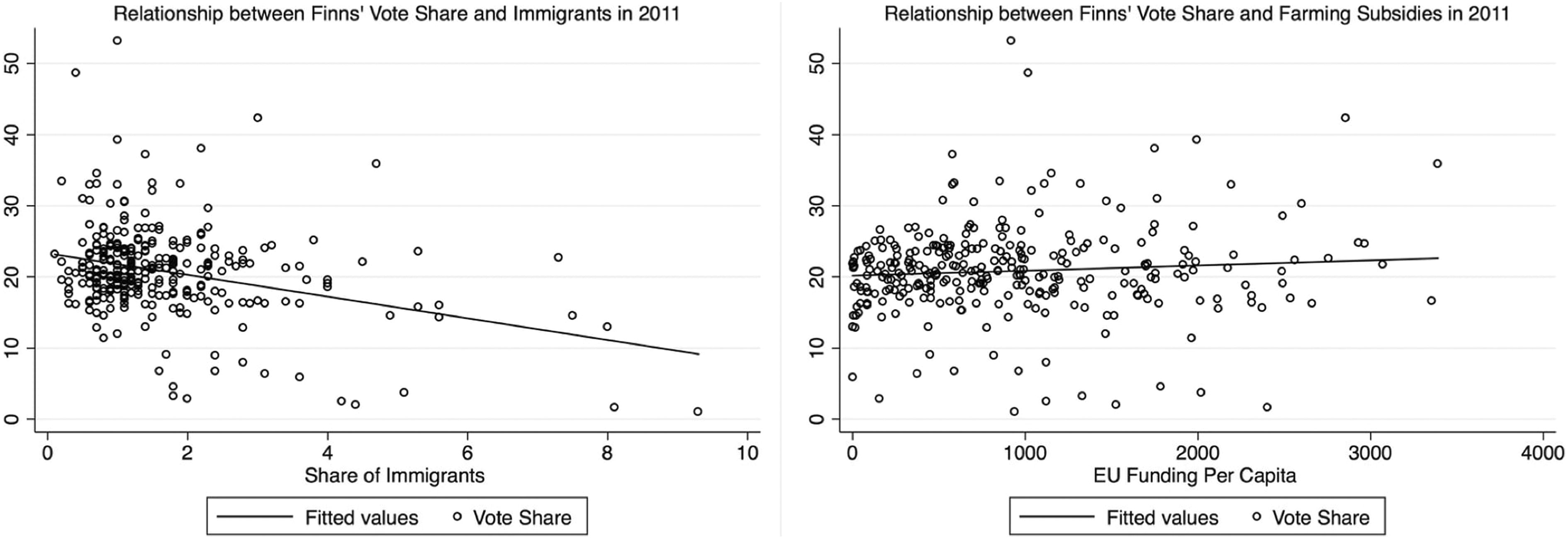
The relationship between Finns’ vote share, immigration, and farming subsidies.
Data and methodology
This study draws on an original data set spanning from 1995 (Finns’ first national elections) to 2011 (Finns’ electoral breakthrough), with municipality as the unit of analysis. This rich longitudinal data set compiles administrative electoral (Statistics Finland (2018)), economic and demographic (The National Institute of Health and Welfare (2018)), and EU subsidy data (National Land Survey of Finland (2018)). 6 The data points for the dependent and independent variables correspond to the five election years during this period.
The dependent variable is the Finns’ municipal-level vote share in national parliamentary elections. I focus on national rather than municipal elections for several reasons. First, municipal governments have little influence over the key issues the Finns capitalize on (i.e. immigration, the EU, and globalization). Second, being a centrally led, leader-oriented party (Arter, 2013), its local organizational capacities also remained relatively weak especially prior to the 2011 breakthrough elections. As a result, the party had a relatively weak presence and few candidates in many municipalities. Third, party priorities also differ in local elections and they are considered as of lesser importance, which is reflected in a lower turnout rate. 7
I estimate cross-sectional (structural) and time-series cross-sectional (cyclical) models that include several key contextual variables. To evaluate H1, I control for the proportion of foreign nationals. 8 For economic hardship (H2), I include the unemployment rate and economic dependency on state support, measured as the social assistance recipiency rate (as percentage of inhabitants).
The data set also includes other potentially important economic characteristics, including income inequality (Gini-coefficient), the percentage of households at risk of poverty (<60% of the median disposable income), and the dominance manufacturing jobs (percentage of labor force) as areas with higher income inequalities, risk of poverty, or dependency on manufacturing could be conductive to perceptions of being marginalized or “left behind” (Kriesi et al., 2008). Finally, as some studies (e.g. Golder, 2003) suggest that there may be a possible relationship between immigration and unemployment, I include an interaction term for these variables.
To investigate the influence of EU transfers (H3), I control for the amount of national and EU farming subsidies, operationalized as the per capita amount (per 100 euros) of total transfers as in the study by Becker et al. (2017).
I also include other plausibly pertinent local characteristics, including the crime rate, given that insecurity resulting from high(er) crime rates could be perceived as an indirect effect of increasing globalization (Rydgren and Ruth, 2011). Further, as low(er) educational attainment is often correlated with PRR support, I include the proportion of inhabitants with higher education qualifications. Similarly, I include the proportion of inhabitants whose native language is Swedish. As the Finns strongly favor abolishing mandatory Swedish education and often portray the Swedish-speaking minority as the “elite,” its support should be weaker in areas with larger Swedish-speaking populations. Finally, I control for population size (per 1000) to investigate the rural/urban dynamics that might be underlying these relationships. I also include region fixed effects to examine any differences in traditional party dominance across the 19 Finnish regions. Indeed, the geographical variation in traditional parties’ performance and strongholds is considerable and long-standing, notably between the more rural, agriculture-heavy Center-party dominated Northern, Central, and Eastern regions—in which the Finns predecessor FRP also had its electoral bases—and the more urban, industrialized, and socially heterogeneous Southern and Western regions where the Conservative and Social-Democratic parties have traditionally fared better (Helander, 1971; Rantala, 1967; Westinen, 2013). The conditions under which the Finns perform well could therefore differ across regions.
Results
Structural conditions and PRR support
I first evaluate the structural hypotheses and empirically examine the relationship between the levels of demographic and economic conditions and the levels of Finns’ support by estimating a cross-sectional ordinary least squares (OLS) regression model with the municipal-level vote share for the Finns in the 2011 national parliamentary elections as the dependent variable. The year of the Finns’ breakthrough provides a useful setting for this, as it enables deepening understandings of why and how the Finns surged forward and for the first time gained serious political influence alongside the traditional parties in a national and international setting that defied conventional explanations of its rise.
How do levels of ethnic diversity, economic precariousness, or EU transfers affect PRR voting? Interestingly, this spatial exploration of the Finns’ performance in the 2011 breakthrough elections (Table 1) suggests that higher rates of immigration or economic hardship do not translate into stronger PRR support. From a structural perspective, these dominant contextual explanations bear little explanatory power in the Finnish local context, the analysis revealing a weak correlation between these factors. 9
Notably, immigration has a rather substantive, negative effect on support for the Finns, but its magnitude and statistical significance dissipates when controlling for additional local factors. While these negative and inconsistent results further question the importance of high levels of immigration as a key predictor of PRR support, they do, however, lend some support to the social contact theory, suggesting that hostility toward ethnic minorities is perhaps most prevalent in homogeneous, segregated communities with little contact with immigrants.
For indicators of economic hardship, the findings are also inconsistent, but clearly not supportive of the conventional wisdom that support for these parties is concentrated in economically depressed areas. First, higher unemployment does not predict higher support for the Finns at the municipal level, its coefficient being very small and statistically insignificant except when the interaction term is included. Immigration and unemployment, similarly, have no significant interactive effect on Finns’ support either.
The evidence is equally mixed regarding economic dependency on state support. Social assistance recipiency has a positive effect on the Finns’ popularity, but the substantive and statistical significance of this effect dissipates when additional local-level characteristics are included. Thus, no strong conclusion can be drawn on this relationship, although the results lend some support for arguments emphasizing welfare chauvinism, that is, higher dependence on state support, as a key determinant of PRR voting. Similarly, higher rates of poverty and income inequality have little effect on the Finns’ performance. The structural analysis also shows a weak correlation between EU subsidies and Finns’ vote share.
Some findings, however, conform with theoretical expectations. Indeed, Finns record weaker support in areas with larger Swedish-speaking populations. Population size, similarly, is negatively correlated with Finns support, suggesting that the party performs better in smaller, relatively homogeneous towns rather than the bigger, urban and more diverse municipalities. Crime rates, higher education qualifications, or the dominance manufacturing, in contrast, exert little influence on the Finns’ performance. The determinants of PRR support do not appear to significantly differ across the Finnish regions either, suggesting that spatial variation in traditional party strongholds has little influence on these dynamics.
Changes in local context and PRR support
No strong conclusions on the effects of immigration, economic hardship, or the EU can be drawn from the structural analysis. Yet a wealth of cross-national evidence suggests that there is a strong correlation between individuals’ attitudes toward these key issues and their likelihood to support PRR parties. Furthermore, as the PRR predominantly capitalizes on strong opposition against immigration, globalization, and supranational decision-making, it would be unwise to conclude that such factors exert little influence on PRR voting.
Thus, instead of placing focus on these structural determinants of PRR support at one point in time, it becomes crucial to systematically investigate the conditions under which they might matter. Consequently, I estimate a first-difference, time-series cross-sectional model that examines the relationship between changes in local contexts and changes in the municipal-level vote share for the Finns in national parliamentary elections from 1995 to 2011.
A cyclical approach has several advantages when it comes to estimating causal relationships. From a theoretical perspective, a time-series cross-sectional (TSCS) model measuring changes in both the dependent variable (DV) and independent variables (IVs) can elucidate how short-term dynamics (e.g. rapid ethnic or economic change) may more strongly influence individuals’ political behavior (Wooldridge, 2011). Indeed, residents in relatively prosperous and homogeneous localities experiencing rapid changes in these conditions may be prone more strongly react to and contest such transformations relative to more diverse and chronically depressed areas where similar dynamics might be less visible.
Methodologically speaking, a TSCS model with first differences also has the advantage of addressing issues related to the data structure and model specification, such as nonstationarity, trending of the data, and spurious correlation. Accordingly, I estimate a first-difference TSCS OLS regression model with fixed effects. 10
In stark contrast with the structural analysis (Table 1), the cyclical model (Table 2) yields noteworthy, and substantively significant, findings. When measured as changes, immigration, unemployment, and social assistance have a strong, positive, and statistically significant effect on Finns support. 11 Notably, immigration appears highly salient and strongly affects the PRR’s success in areas where ethnic diversity has rapidly increased. On average, 1% increase in the local immigrant population is expected to increase the Finns’ vote share by approximately 3%. Contrasted with the weak, inconsistent effect of levels of ethnic diversity, these results thus help to reconcile rival perspectives over ethnic contexts’ effects—while exposure to immigrants in the long term can decrease prejudice, rapid ethnic change can in turn (at least initially) provoke hostile reactions over immigration’s effects.
Structural conditions and Populist Radical Right (PRR) support.

Note: FE: fixed effects; Table reports nonstandardized OLS regression coefficients. Robust standard errors clustered by municipality in parentheses.
*p < 0.1; **p < 0.05; ***p < 0.01.
Changes over time in local conditions and PRR support.

Note: PRR: populist radical right; OLS: ordinary least squares. Table reports nonstandardized OLS regression coefficients. Robust standard errors clustered by municipality in parentheses.
*p < 0.1; **p < 0.05; ***p < 0.01.
The story is similar for changes in unemployment and social assistance. A percent increase in unemployment, ceteris paribus, is expected to lead to approximately 1.5% increase in the Finns’ popularity. Changes in social assistance also have a positive effect, suggesting that welfare chauvinism does play a role in these parties’ performance. On average, a percent increase in social assistance recipiency is expected to increase the Finns’ performance. Interacting changes in immigration and unemployment, on the other hand, appear to exert little impact on the Finns’ performance.
Moreover, the models imply a negative and significant relationship between changes in the per capita amount of farming subsidies and Finns’ vote share. As opposed to the weak association between Finns’ performance and the level of EU funds, a €100 increase in EU transfers decreases PRR support by approximately 0.3%. This makes intuitive sense, as the Finns’ Eurosceptic rhetoric should be less appealing in localities where dependence on EU funds has increased. Although farming subsidies may not be the best proxy for local dependence on EU funds, the results are robust to alternative model specifications that control for the rural/urban divide that may be underlying this relationship (see the Online Appendix). These findings thus suggest that the EU can affect PRR support and that measures of its influence should be more systematically incorporated in research on the PRR.
Surprisingly, increases in economic inequality and risk of poverty have a significant, negative effect on PRR voting. A percent increase in income inequality is associated with a 0.25% decrease and a percent increase in the risk of poverty rate with a 1.2% decrease in the Finns’ performance. While these rather contradictory findings merit further investigation, it is possible that—as opposed to unemployment or social assistance—such changes could be characterized as being less visible indicators of economic precariousness at the local level, thus having a less direct effect on inhabitants’ everyday lives. This also calls for further examination of economic anxiety as a key determinant of PRR support, suggesting that existing analyses could be sensitive to how it is conceptualized and measured.
The rural/urban dimension also merits further investigation. The structural analysis suggests that the Finns’ bases are stronger in smaller, relatively homogeneous communities with little exposure to immigrants at the structural level, and thus rural and urban communities could also be expected to react differently to changes in such contextual characteristics. The cyclical analysis, however, does not give a strong indication that such dynamics might be confounding this relationship. These findings thus allow to reconcile the different theories on reactions to ethnic diversity: while initial confrontations and rapid ethnic change provoke prejudice and a PRR backlash, sustained contact with immigrants can instead alleviate hostility toward these out-groups.
Discussion and conclusions
Building on past research on PRR parties, and contextual theories of how immigration and economic hardship influence electoral choice, this study advances understanding of the processes through which these key conditions become salient and texture political behavior. By adopting a novel local-level approach to examine whether and how the national issues the Finns capitalize on resonate more with people in some local contexts than others, this study argues that there is a strong but highly context-dependent association between immigration, economic hardship, and PRR voting, revealing important differences between the longer term structural patterns and shorter term cyclical effects.
The empirical design and evidence from a particularly useful, “hard” case of Finland that defies conventional explanations of PRR voting have a number of broad implications. First, in the context of PRR parties’ recent and considerable electoral gains and ongoing debates about its causes, this study makes an important contribution to current scholarship by elucidating how the PRR’s electoral bases are changing and particularly why these parties fare increasingly well in areas where their programmatic concerns might appear to be less salient. Second, it underscores the importance of disaggregating analyses of PRR voting to levels at which contextual environments’ effects can be meaningfully captured as well as paying attention to the temporal dynamics underlying such relationships.
This study finds that PRR parties’ exclusionary rhetoric strongly resonates in relatively homogeneous, rural, and small-town localities where demographic and economic conditions are changing at a higher rate. The differences between the long-and short-term effects of immigration thus help reconcile the common perceptions of PRR vote being driven by fear and prejudice against outsiders with arguments in favor of social contact and familiarity building tolerance. Likewise, economic anxiety breeds PRR support and is contested in areas that have experienced worse economic downturns instead of the chronically depressed ones. Growing dependence on EU funds, on the other hand, decreases anti-EU parties’ appeals.
While few studies thus far have systematically examined the effects of both levels of and changes in economic hardship or EU funds, these findings are largely consistent with recent studies documenting the effects of economic shocks and changes on PRR support at the subnational level (Colantone and Stanig, 2018; Stockemer, 2017), the level of EU transfers (Becker et al., 2017), or on the importance of welfare chauvinism on PRR support (Jesuit et al., 2009). The evidence also aligns with scholarship on the influence of local-level ethnic change on immigration attitudes, showing how rapid changes can also lead to a PRR backlash (Becker et al., 2017; Hopkins, 2010; Kaufmann, 2017; Newman, 2013; Newman and Velez, 2014), but contradict the results from a recent regional-level analysis in 17 European countries (Stockemer, 2017). These diverging findings could be partly driven by the large size of regions relative to municipalities within which levels of ethnic diversity are likely to vary, thus making inferences about direct contact and experience with ethnic change more difficult.
These results should nonetheless be interpreted with caution. While offering a novel analysis of how local contexts influence PRR support, controlling for a range of key local-level characteristics or testing the sensitivity of the results to different model specifications may not fully address concerns related to endogeneity resulting from a possible omitted variable affecting this relationship.
By deepening understanding of how local contexts motivate “radical” political behavior, this study raises interesting questions for further research on the processes and mechanisms through which local grievances transform into transnational concerns and how the European electoral landscapes are changing more generally. In addition to demonstrating the importance of moving down to the local level to draw valid inferences on contextual factors’ effects, the disconnects between PRR voting and the salience of these parties’ key issues at the subnational level in many Western democracies suggest that the temporal effects found in this study should exist in other contexts, and that such dynamics might be even more pronounced in countries in which national-level conditions are more favorable to their rise. Distinguishing between the structural and cyclical effects and recognizing how they interact may also help explain a number of anomalies, such as strong PRR support in relatively homogeneous areas with little long-term exposure to immigration, but more rapid short-term change.
Supplemental material
Supplemental Material, sj-docx-1-ppq-10.1177_1354068818810283 - Changes in local context and electoral support for the populist radical right: Evidence from Finland
Supplemental Material, sj-docx-1-ppq-10.1177_1354068818810283 for Changes in local context and electoral support for the populist radical right: Evidence from Finland by Pauliina Patana in Party Politics
Footnotes
Acknowledgements
The author would like to thank Ken Roberts, Chris Way, Alex Kuo, Sid Tarrow, Peter Enns, Bryce Corrigan, colleagues at the Government Department at Cornell University, and the two anonymous reviewers for helpful feedback on earlier versions, and also thank the Cornell Institute for European Studies for supporting the initial fieldwork that spurred this research.
Declaration of conflicting interests
The author(s) declared no potential conflicts of interest with respect to the research, authorship, and/or publication of this article.
Funding
The author(s) received no financial support for the research, authorship, and/or publication of this article.

Supplemental material
Supplemental material for this article is available online.
Notes
References
Supplementary Material
Please find the following supplemental material available below.
For Open Access articles published under a Creative Commons License, all supplemental material carries the same license as the article it is associated with.
For non-Open Access articles published, all supplemental material carries a non-exclusive license, and permission requests for re-use of supplemental material or any part of supplemental material shall be sent directly to the copyright owner as specified in the copyright notice associated with the article.
