



Abstract
The reasons pushing parties to politicize noneconomic dimensions of competition, and the consequences of this for the representation of public opinion, are badly understood in the party competition literature. This is a pressing research gap, especially given the recent and significant reactivation of territorial or center-periphery conflicts in Western Europe. In this article, we first argue that bad macroeconomic performance increases the incentives of incumbent parties to deviate the attention toward territorial conflicts in order to avoid electoral punishment. Second, we also argue that the opposite is true for public opinion: it is precisely during periods of bad economic performance and high economic concern, when the electorate moves away from territorial interests. The dynamic emerging from our findings is thus far from an ideal bottom-up representation: elites divert the attention toward territorial conflicts to mask periods of poor economic performance, which is precisely when public opinion is less interested in center-periphery issues. We validate our claims using text analysis of party attention in Spain and time series models covering four electoral cycles (1996–2011).
Introduction
Understanding why parties emphasize some issues over others has important implications for the analysis of party competition strategies and political representation. Political scientists have been increasingly interested in how parties modify the saliency of different issue dimensions in order to increase their electoral returns (Adams and Somer-Topcu, 2009; Adams et al., 2004, 2006, 2009; Clark, 2013; Hobolt and de Vries, 2015; Rovny, 2012). Economic left–right issues have dominated the scholarly agenda over the last decades, but the analysis of when and why elites decide to emphasize noneconomic dimensions lags quite behind (Tavits and Potter, 2015). While immigration, sociocultural values, and ethnicity are increasingly studied, the analysis of territorial or center-periphery conflicts is particularly absent (Alonso et al., 2015; Field and Hamann, 2015; Rovny, 2015). Moreover, the link between party strategies and public opinion is usually ignored or under-theorized in the previous literature. For instance, it is unclear whether the puzzling and very significant rise of territorial conflicts and secessionist movements in some Western European societies has been fueled by party strategy, or vice versa.
This article aims to fill these two related gaps: why do parties decide to emphasize territorial issues over economic ones, and what are the consequences of this party strategy on public opinion issue priorities? While the literature on party competition and public opinion responsiveness tends to grow in parallel, we believe that combining them can lead to a more nuanced understanding of the dynamics of political representation on these less well-understood second dimensions of competition. On the basis of issue entrepreneurship theories expecting parties to give more weight to alternative and more favorable dimensions of competition (Carmines and Stimson, 1989; Hobolt and de Vries, 2015; Riker, 1986), our Incumbent Diversion Hypothesis argues that the incentives of governing parties to highlight center-periphery issues will increase when the economy goes badly. However, contrary to the assumption that party emphasis on identity and territorial matters will mitigate political unrest among disadvantaged social strata in bad times (Solt, 2001), our Exogenous Public Opinion Hypothesis argues that mainstream electorates will not easily adopt party cues when experiencing economic unrest.
We test our hypotheses using content analysis techniques of parliamentary speeches in Spain covering four electoral cycles (1996–2011) and time series analyses regressing monthly party issue emphasis on macroeconomic fluctuations, public opinion concerns, and media attention. The geographical and temporal scope of this case study is ideal for three reasons. First, the Spanish political spectrum is basically characterized by a two-dimensional and relatively cross-cutting structure composed of a left–right economic dimension, and a center-periphery or nationalistic one (Sanchez-Cuenca and Dinas, 2012). This ensures a certain level of public demand for representation on those two axes of competition, which has been pointed out as a necessary condition for second dimensions to operate (Tavits and Potter, 2015). Second, the time span covered in our analysis encompasses very high levels of economic variation, from sustained economic growth until a dramatic financial meltdown with skyrocketing levels of debt and unemployment. This allows us to more easily identify the effect of economic indicators on party emphasis. Third, this time span has an unusual degree of variation in government’s ideological orientation, including two single-party mainstream right governments, and two single-party mainstream left governments. More importantly, both right- and left-wing incumbents experienced good and bad economic times, which allows us to disentangle ideological orientation and economic performance in a way that a cross-country analysis would not allow us to do.
Our contribution is threefold. First, we confirm that state-wide incumbents turn to territorial issues when the economy goes badly, and that this strategy is not driven by regional parties. Contrary to what it has been shown in the past research for other noneconomic dimensions based on social or cultural issues (Tavits and Potter, 2015), however, party strategies on territorial dimensions do not respond to a left–right logic, but rather to an incumbent–opposition logic (Seeberg, 2013; Schumacher et al., 2015). The unusual variation of macroeconomic conditions within ideologically different incumbencies in our case study shows how both right-wing and left-wing incumbents tend to focus on territorial matters to divert attention from bad performance. Our results are rather consistent with Solaz and De Vries (2017) in this volume, who expect governments to emphasize libertarian–authoritarian dimensions (on the basis of expert surveys) when macroeconomic conditions deteriorate. This stresses the importance of government–opposition dynamics and confirms strong diversion strategies in a variety of second-dimension issues, contexts, and ways to measure party emphasis (parliamentary speeches and expert surveys).
Second, we show that diversion strategies can also be adopted by the winners of primary and more established dimensions of competition as a proactive strategy to minimize potential electoral losses (Schumacher et al., 2015). This extends recent research based on heresthetics and issue entrepreneurship, which usually focuses on niche, small, or losing parties in the primary political dimension to be the ones more likely to reshuffle the structure of party competition.
Third, we show that the effectiveness of party strategy in shaping the public’s priorities is more limited than usually assumed. Our findings are consistent with the literature on framing effects, showing that party cues do not easily penetrate personal experiences and ideological orientations (Flynn et al., 2017; Zaller, 1992). This means, for example, that the recent increase in secessionism and territorial concerns in Western Europe (i.e. Scotland and Catalan cases) is not primarily due to party rhetoric, as sometimes assumed. While other studies in this volume focus on the consequences of party strategies for accountability and responsibility attribution (Solaz and De Vries, 2017), our analysis focuses on representation and congruence between parties’ and public opinion’s agendas. Our findings reveal a pessimistic pattern of representation in center-periphery issues: while public opinion is less concerned about second political dimensions precisely when economic performance is poor and economic worries are prominent, the opposite is true for governing parties.
Territorial conflicts as a political dimension of competition
Previous research on party strategy and issue positioning has overwhelmingly focused on economic dimensions of competition. Economic issues are usually summarized in reliable left–right scales that have proved to be useful heuristics for voting behavior, and strong anchors structuring party competition (Benoit and Laver, 2006; Castles and Mair, 1984; Huber, 1989). The state redistribution versus free market axis with roots in social class conflicts has started to give way to newer and more or less orthogonal dimensions. These second dimensions of competition are a major distinctive feature of postindustrial societies. They have received a myriad of names in the literature, but they usually summarize social, cultural, or moral issues that are not economic in nature (Kitschelt, 1994, 1995).
Identity is a key component of noneconomic dimensions of competition, which tend to confront nationalistic and cosmopolitan views of the world (Kriesi et al., 2008). Traditionalist and nationalistic views have increased their popularity among left-wing and right-wing populist parties and electorates. These views tend to frame globalization, free transnational markets, blurred European borders, and immigration as the triggers of a new distribution of winners and losers in postindustrial economies. The political economy literature has started to gain interest in identity-based considerations explaining why poor people do not always prefer redistribution (Alesina and Glaeser, 2004; Shayo, 2009), or why some people do not vote according to their economic interests (Finseraas, 2008).
While identity, cultural values, and immigration are attracting most of the current scholarly attention, territorial lines of conflict are a key but understudied second dimension of competition in the issue competition literature (Amat, 2012). Political and economic disparities across regions have increased dramatically in a globalized world, where some territories attract more foreign investment, tourism, and highly skilled workers than others within the confines of the same national state. Perhaps because of this, mainstream versus populist patterns of electoral competition are more territorialized than ever. For instance, interregional disparities in radical right or anti-immigrant voting are now even bigger than disparities between individuals and national states (Golder, 2016).
Apart from the pivotal role of regions in current conflicts over redistribution and recognition typical of global advanced democracies, territorial concerns can also tap into a classical center-periphery dimension of political conflict. Center-periphery conflicts concern the structure of authority within the state, where political actors in territorially distinct communities contest the state’s right to rule uniformly across its territory (Elias et al., 2015). This line of conflict is typically found in some regions that did not completely adapt to the political, cultural, and institutional homogenization undertaken by political elites in national states emerging from the 16th century onward (Tilly, 1975). Over time, some constituencies in those regions have crystallized a permanent line of conflict against the central state, demanding more political and fiscal autonomy, cultural recognition, and even secession.
Even if this type of nationalistic demands does not necessarily fit well into libertarian versus authoritarian axes of competition, it can constitute a second dimension of competition by itself. In fact, Rovny and Polk (2018) on this issue show how economic and cultural dimensions are actually fused in a single axis of competition in predominantly Catholic societies where secular–religious cleavages were strong. This description fits well our Spanish case study, where territorial and not cultural conflicts are arguably the second key dimension of competition (Sanchez-Cuenca and Dinas, 2012). Since Lipset and Rokkan’s (1967) seminal contribution on the freezing of modern party systems, the center-periphery cleavage has generated less research and more inconclusive findings than other types of conflict along social class or religious denomination lines (Evans and Graaf, 2013). The recent rise in secessionist sentiment in Western Europe (the Scottish and Catalan cases being the most paradigmatic examples), however, shows that territorial politics can still have major political consequences, even in moderate political spaces and established democracies.
Despite the increasing importance of noneconomic dimensions of competition and center-periphery conflicts more specifically, the current knowledge about when and why parties will prefer to engage with those issues over classical economic issues is still limited. In the scarce research on the topic, regional parties are assumed to be the key entrepreneurs of territorial conflicts. In an important contribution, for instance, Alonso et al. (2015) show how regionalist parties in Spain strategize simultaneously along territorial and economic dimensions of competition, while state-wide parties react to the presence of regionalist opponents by incorporating the territorial dimension into the agenda. However, less is known about whether state-wide mainstream parties use territorial conflicts to their advantage, regardless of what smaller regional parties do. In fact, Field and Hamann (2015) show that regional parties in Spain only frame a small share of their policy proposals in center-periphery terms. This is consistent with the idea that regional parties are more mainstream than niche and operate in a two-dimensional structure exactly as state-wide parties do (Rovny, 2015). Apart from knowing little about how state-wide parties use center-periphery dimensions to their advantage, the study of the impact of party rhetoric on the intensity of territorial concerns among the population is usually either assumed or ignored (Solt, 2001).
Theoretical expectations
The literature on issue competition and responsiveness focuses on when and why parties will highlight some issues over others, and the extent to which public opinion is a driver of political parties’ agendas (Adams and Somer-Topcu, 2009; Adams et al., 2009). While previous research has traditionally focused on parties’ and voters’ ideological positions, there is an increasing interest in understanding the dynamics of issue saliency or emphasis. Positional ideological shifts are theoretically less frequent given the stability of political attitudes in public opinion and the need for parties to keep a decent level of ideological consistency and credibility from a spatial competition perspective (Downs, 1957). Issue saliency, however, is an easier parameter to manipulate by political elites and potentially very effective for strategic purposes (Rovny, 2012; Vis and van Kersbergen, 2007). This is based on issue saliency or issue ownership theory (Budge and Farlie, 1983; Pardos-Prado et al., 2013; Petrocik, 1996; Vavreck, 2009), which expects parties to highlight those issues in which they enjoy a high reputation of competence and management (Green and Jennings, 2012).
On the basis of issue saliency theory, it is reasonable to expect that parties will strategically attach more weight to favorable issues or dimensions of competition and try to divert the attention from unfavorable ones. This reasoning is based on influential issue evolution (Carmines and Stimson, 1989) and heresthetics (Riker, 1986) theories, whereby parties aim to structure competition by competing on a preexisting and advantageous dimension, or by introducing a new issue dimension that allows them to change the current structure of party competition to their advantage. Hobolt and de Vries (2015) have extended these expectations to multiparty contexts and found that issue entrepreneurs are more likely to compete on a new issue dimension when they are less likely to be in office, when they have received electoral losses, or when they are far from the mean ideological position.
When directly testing the issue entrepreneurship logic on the effects of macroeconomic performance on party strategy, it is reasonable to expect that bad economic times should push incumbent parties to talk about noneconomic issues. This is consistent with classical issue ownership theories expecting governing (opposition) parties to talk about the economy in good (bad) times (Vavreck, 2009), and with established retrospective models of economic voting expecting bad performance to harm the electoral prospects of incumbent parties (Lewis-Beck and Stegmaier, 2000). The implication of this reasoning is that the winners of established dimensions of competition (i.e. incumbents) can also incur in diversion and entrepreneurial strategies to change the issue agenda in order to prevent potential electoral losses. Consistently with Schumacher et al. (2015), this means that issue entrepreneurship is not only a reactive strategy from niche or small parties in order to find a space in the political spectrum, but also a prospective or anticipation strategy by actors dominating the agenda and with high expectations to govern.
Tavits and Potter (2015) examine these questions from a party heterogeneity approach and hypothesize that economic inequality should increase left-wing parties’ attention to economic and redistributive issues and right-wing parties’ emphasis on identity-based issues. The reasoning is again based on issue ownership theory (Petrocik, 1996), predicting that social democratic parties have a better reputation than their competitors in dealing with socioeconomic inequality. When the number of voters falling below the mean income distribution increases, the electoral constituency demanding more redistribution and being inclined to vote for the left also increases (Meltzer and Richards, 1981; Romer, 1975). By contrast, the incentive for right-wing parties is to deviate attention from social inequality, prevent mainstream left domination of the issue space, and highlight other issues where they are better equipped vis-à-vis public opinion like identity or moral concerns.
While indisputable from a point of view of socioeconomic inequality, the expectation of left–right heterogeneity fits less well into a bidimensional pattern of competition between economic performance and center-periphery issues. The expectations based on socioeconomic inequality and retrospective economic voting would be contradictory. While issue entrepreneurship theories based on socioeconomic inequality would predict right-wing governments to avoid economic issues even in scenarios of growth with high inequality, the economic voting expectation would be the exact opposite: governing parties should talk about the economy if the economy goes well, in order to secure reelection. This stresses the importance of disentangling macroeconomic performance from economic inequality and redirecting the attention to the former. The theoretical focus on government versus opposition is consistent with the previous research on issue ownership considering the economy to be a performance issue, whose ownership can be alternated by left-wing and right-wing parties depending on objective conditions (Petrocik, 1996). Recent research on issue competition highlights the importance of government–opposition dynamics over left–right and even mainstream–niche dynamics (Pardos-Prado and Sagarzazu, 2016; Schumacher et al., 2015; Seeberg, 2013).
If one accepts the basic premises of retrospective economic voting models and the performance-based character of the economy as a political issue, the incumbent versus opposition logic should overshadow other party categorizations like left or right. The assumption of course is that neither center-left nor center-right parties are exceedingly far away from the median voter position in the center-periphery dimension, which seems like a reasonable assumption in our Spanish case study. We argue that in the context of a strong center-periphery cleavage, governing parties will resort to noneconomic territorial issues. This is summarized in our first hypothesis:
What are the consequences of party strategy considerations on public opinion? When turning to the literature on economics, nationalism, and public opinion, diversionary theory has been a successful analytical framework (Solt, 2001). According to this theory, when economic inequality rises, the state has more incentives to increase its attention to nationalist beliefs and deviate public attention from a bad economic situation. Despite the intuitive appeal of this theory, however, previous tests of the relationship between economic stress and nationalism at the individual level have suffered from endogeneity biases and have missed crucial steps in the causal mechanism, especially as regards the relationship between macroeconomic variation and attention to nationalism by the incumbent party. The intermediate role of state or elite rhetoric in this process has not been observed empirically, probably due to the difficulty of defining, measuring, and tracking state rhetoric across countries and over time.
Recent research on other cleavages like class politics shows that parties are able to activate or deactivate political dimensions of conflict by polarizing more or less ideologically. However, party strategy has not proved to be able to change left–right orientations among the public in this process (Evans and Tilley, 2011). There is thus no reason to expect center-periphery lines of conflict to operate differently than other established cleavages like class politics. While polarization and changing emphasis along territorial dimensions may allow voters to channel their concerns and to vote for their most preferred party on the basis of that issue, parties’ strategic attempts are not necessarily going to be effective in changing the distribution of issue concerns themselves.
The expectation that public concerns are not a systematic and direct cause of party rhetoric is consistent with recent research on framing and persuasion effects, showing that opinion changes in public opinion are not so easy to manipulate. Prior ideological considerations and interest on the issue should have a very prominent role in building cognitive shields against external party cues (Flynn et al., 2017; Zaller, 1992). More specifically, we expect voters who are concerned with the economy and who are experiencing bad macroeconomic conditions to lose rather than gain interest in territorial issues. Especially given that the economy can be considered as an easy (Carmines and Stimson, 1980) and obtrusive issue that people can directly experience in their lives, we expect party messages deviating the attention toward less direct issues in bad economic times to be less effective than what is usually assumed.
Research design
In this section, we describe the data and methods used to understand the relationship between economic conditions and party attention to center-periphery issues. We do this by first describing our case of study, followed by a description of the dependent and independent variables needed to carry out the analysis.
Spain: A bipartisan-multiparty system
We test our argument by using data from Spain. While having a multiparty system, up until the last election in 2016, Spain has functioned with a bipartisan government dynamic, where the two largest parties have alternated in heading single-party governments. Whenever the legislative math did not allow for a single-party majority government, agreements were made with third parties, mainly of nationalistic tendencies. For the purpose of our analysis, we cover a period of 15 years (from 1996 to 2011). This period saw two 4-year periods of government by the center-right Partido Popular (PP), followed by two other periods of center-left government in the hands of the Partido Socialista Obrero Español (PSOE). These four periods not only provide variation in the ideological orientation of the party leading the government but also see varying macroeconomic conditions which go from a relatively good position to being one of the hardest hit democracies during the global economic meltdown starting at the end of last decade.
Party questioning of government
As the purpose of our study is to measure the attention that Spanish political parties devote to issues, we rely on questions made by party members in the plenary sessions (‘plenos’) of the ‘Congreso de los Diputados’ (the Spanish parliament). It is standard practice that during these sessions, MPs ask questions to the representatives of the government present, as shown in other studies these questions can provide insight into the agenda priorities of the different parties (Green-Pedersen and Mortensen, 2010; Hanna et al., 2014; Martin and Vanberg, 2008; Pardos-Prado and Sagarzazu, 2016; Slapin and Proksch, 2014; Vliegenthart and Walgrave, 2011).
Plenary debates data were obtained from the publicly available data of the Spanish parliament. Figure 1 shows the total number of questions each party asked per Legislature. As it can be seen, the debate in parliament is dominated by the two largest parties, the Partido Popular and the Partido Socialista. On average, both the PP and the PSOE have a similar number of interactions per plenary despite their role as government or opposition. The last legislature (2008–2011) sees a big drop in the number of sessions with questions and of questions (specially by the PSOE). This behavior is consistent with mechanisms of agenda control implemented by the PSOE to minimize its exposure due to the financial crisis. 1
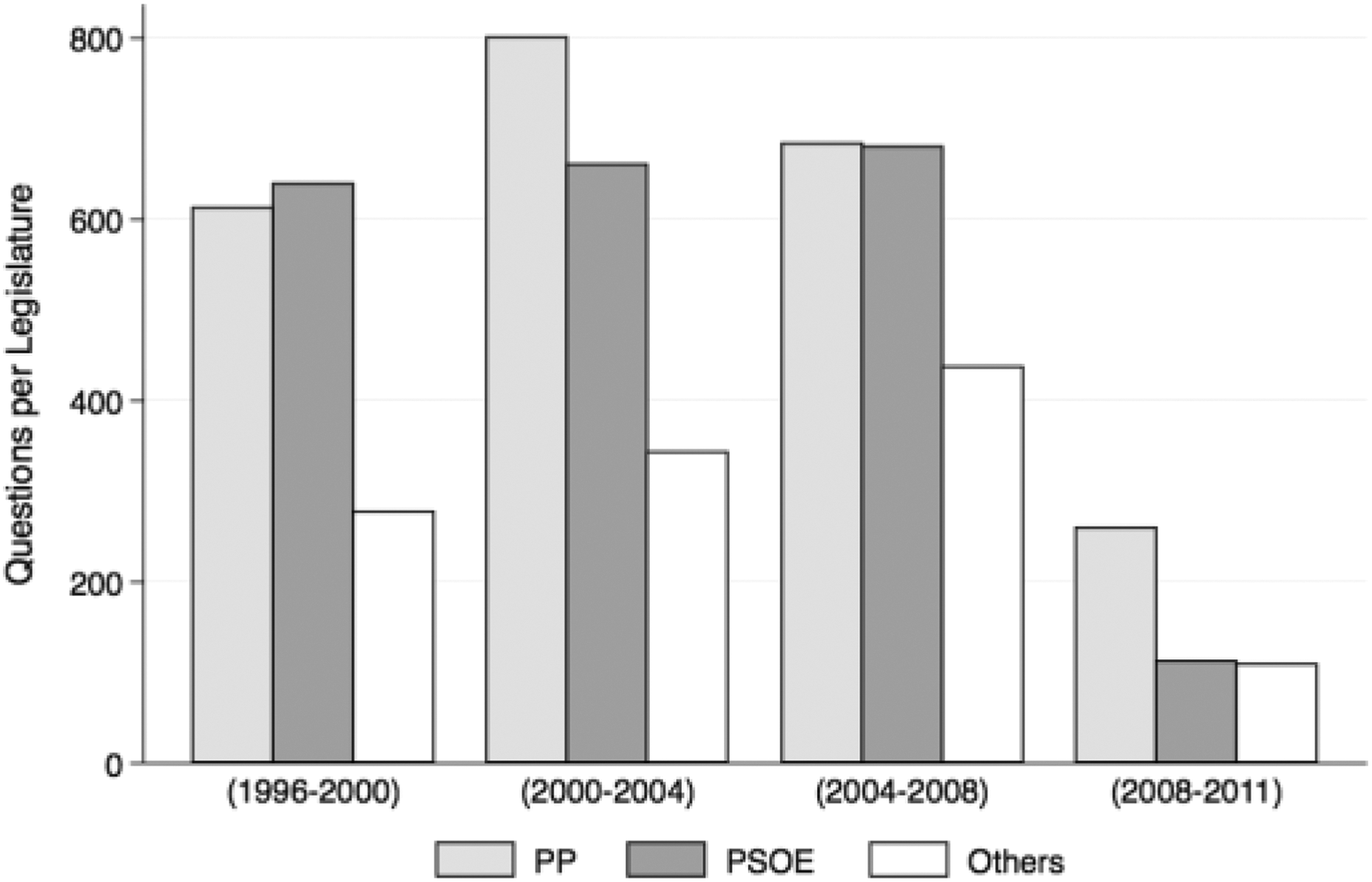
Questions asked per party legislature.
We use these questions as the input data for the quantitative text analysis clustering algorithm, described at length in Pardos-Prado and Sagarzazu (2016, 2017). This algorithm estimates the distances between words and through means of proximity defines the different word clusters or topics. The words for each topic are then used to define a dictionary which is applied back to the questions. The output of this process is measures of issue attention by the different parties on seven different issues, of which we will solely focus on the economy and territorial matters (i.e. center-periphery issues). 2 Table 1 shows a sample of sentences regarding Territorial Matters. 3 Each issue attention variable is the percentage of attention to an issue obtained from the counts the total number of words in that issue mentioned by a party for a given month over the total number of words mentioned by a party in a month. 4
Examples of questions to the government.

In order to illustrate how the attention to center-periphery issues varies over the course of the four legislative terms, Figure 2 plots the attention that the government and the main opposition party paid to the topic of Territorial Matters as a proportion of the total time the party spoke. This figure shows two interesting dynamics that occur in the four legislatures. First, the fact that for the most part of the period, the opposition speaks much more than the government. Second, during the VIIIth legislature, the main opposition party (the PP) increases significantly the attention to this issue in comparison to the two previous periods. This is not only a consequence the PP trying to link the 2004 Madrid bombing before the election with nationalistic Basque terrorism, but also to a very confrontational approach to the issue of nationalism and terrorism that the PP had developed over the years (Bali, 2007; Montalvo, 2011).

Government and opposition attention to territorial matters over time.
Independent variables
To test the theoretical expectations outlined in the previous section, we collected data on the economy, public opinion, and the media.
Economy
We obtained economic data from the publicly available data sets of the Spanish Instituto Nacional de Estadistica. 9 We considered three indicators of interest: unemployment, consumer price index, and economic growth. While the unemployment and inflation (CPI) data are collected monthly, the data on growth (GDP) are only available on a 3-month basis, as such we only focus on unemployment and inflation as the main macroeconomic indicators. 10
Public opinion
We obtained public opinion data from surveys conducted by the Spanish Centro de Investigaciones Sociologicas (CIS). 11 The CIS is the national body in charge of conducting population surveys in Spain. Of particular interest for our project are the monthly barometers of Spanish public opinion which are carried every month except August, when no surveys are conducted. Each barometer surveys a random sample of the Spanish population with valid answers to our dependent variable between 2376 and 4874 individuals.
To measure the degree of public attention to Territorial Matters, we used the Most Important Problem (MIP) question. Respondents were asked an open-ended question to name the most important problem facing the country today. Those who answered “problems linked to Autonomous Regions,” “political problems in the Basque country,” “nationalism,” “Autonomous Regions statute reforms,” “Catalan statute,” and “terrorism” are aggregated. We therefore use the share of respondents concerned over these topics as a proxy for public opinion saliency. We also use the share of respondents mentioning the economy in the MIP question as a proxy for public opinion concern over the economy.
Media
Data on media attention were obtained from the Policy Agendas Project (Chaqués-Bonafont et al., 2014). The Policy Agendas Project coded the front page of the two most important Spanish newspapers El Mundo and El Pais for the presence of stories on 21 topic areas. As our interest is stories about Territorial Matters, we aggregated their data and estimated for each month in the data set the proportion of news stories on the topic of Domestic Politics and Justice over the total number of stories. The result of this aggregation is a time series of overall coverage on Territorial Matters by the two main Spanish newspapers.
Finally, we have also included in our models the attention of the Catalan and Basque parliamentary groups to center-periphery.
Statistical models
Given the structure of our data, we will specify a time series model to take into account the serially correlated and co-integrated nature of some of our variables. More specifically, we will specify a series of Error Correction Models including the lagged dependent variable, the lagged independent variable of interest, the monthly increase of the independent variable of interest, and a set of lagged and differenced control variables 12 (De Boef and Keele, 2008). The three dependent variables to be regressed in this part of the analysis will be the increase in government, opposition, and public opinion attention to territorial matters (via parliamentary speeches and MIP survey questions, as explained above). We have replicated our models with more flexible Autoregressive Distributed Lag models just predicting the contemporaneous value of our dependent variable with lagged predictors, and our substantive conclusions remained unchanged. 13 Figures A.1a, A.1b, and A.1c in the Supplemental Appendix show the autocorrelation functions of the residuals from the time series models reported in the manuscript and do not suggest any obvious pattern beyond first-order serial correlation. Table A.1 shows a number of broadly satisfactory serial correlation tests for the models presented below. 14
More specifically, the main models implemented below can be expressed as follows

where ΔY is the monthly increase in the level of attention of a given party to center-periphery issues, α is the intercept of the equation, Xt− 1 is the lagged effect of the main independent variable of interest, ΔX is the monthly increase of the main independent variable of interest, Zt− 1 is a vector of lagged control variables, ΔZ is the monthly increase of control variables, and Et is the prediction error of each observation.
Subsequently, we will further test hypothesis 2 (Exogenous Public Opinion Hypothesis) with individual-level data in order to analyze the full variation of the MIP question without aggregating it. We have pooled all the available monthly surveys and fitted a series of Hierarchical Logit Models where individuals (level 1) are nested within months or time points (level 2). This model specification will allow us to take full profit of the individual-level measurement of the dependent variable and to control for potentially omitted individual-level variables in the time series analysis such as unemployment status (1 = unemployed; 0 = everything else), perceptions of the current state of the national economy (5-point scale from very good to very bad), left–right ideology (1–10 scale from left to right), gender (where 1 = male; 0 = female), age, and university education (1 = yes; 0 = no). More importantly, these models will also avoid an artificial deflation of standard errors associated with the effect of macroeconomic, party, and media attention variables measured at level 2 (Hox, 2010). More specifically, the Hierarchical Logit Models implemented below can be expressed as

where Yit is the level of concern over territorial issues by individual i at time t; α is the average level of concern over territorial issues in the sample; Xit is a vector of individual-level covariates; Zt− 1 is a vector of lagged covariates measured at the month level, like macroeconomic fluctuations, party, and media attention; Tt is a time trend; λ is the random intercept parameter between months; and Eit is the individual-level error term.
Results
Table 2 presents three Error Correction Models with government attention, opposition attention, and public opinion attention to center-periphery issues as dependent variables, respectively. Model 1 will allow us to test our Incumbent Diversion Hypothesis (hypothesis 1), which expected bad macroeconomic conditions to push governing parties to talk about territorial issues. Model 2 serves as a way to evaluate what makes opposition parties talk about territorial issues. The third model in Table 2 regresses the share of respondents who mentioned territorial issues as the most important problem facing the country and constitutes a preliminary test of hypothesis 2.
Error Correction Models predicting party and public opinion attention to territorial matters.

Note: Standard errors in parenthesis.
*p < 0.1; **p < 0.05; ***p < 0.01.
Overall, the results from model 1 in Table 2 show a government that is apparently attentive to public concerns over territorial issues, as shown by the strong, positive, and statistically significant coefficient of the percentage of citizens who consider their Most Important Problem to be related to territorial matters at t−1. This highlights a government that is responsive to public opinion. At the same time however, and most interestingly, the results of model 1 also corroborate our theoretical insight. Governments in bad macroeconomic conditions will try to divert attention from economic problems and highlight noneconomic territorial issues. This is not only evident in the positive and significant coefficient for the lagged unemployment rate, but also for the positive and significant coefficient for public concern over the economy. It is important to note that the coefficient of economic MIP has a stronger magnitude than the coefficient of territorial MIP, and that the difference between both coefficients is statistically significant. 15 This suggests that the deviation strategy is slightly stronger than being responsive to public opinion. Lastly, model 1 shows that when the PP was in government, its parliamentary group spoke less about center-periphery issues than when it was in opposition (p < 0.1) ceteris paribus.
Table A.4 in the Supplemental Appendix reports a series of interactions between macroeconomic indicators and a dummy indicating PP (vs. PSOE) incumbency, to assess whether macroeconomic effects are conditional on the left–right orientation of the government. When predicting government attention, the interaction between unemployment and PP incumbency is not significant. This validates our claim that the average effect of unemployment increasing the incumbent’s attention to territorial issues is not dependent on the party in government being center-left or center-right. However, the interaction between PP incumbency and inflation is negative and barely significant (p < 0.1). This means that when there is inflation, PP incumbents are less likely to talk about territorial issues than PSOE incumbents. This could be consistent with Hibbs (1987) and Hibbs and Vasilatos (1982), who expect right-wing parties to be more affected by inflation and left-wing parties by unemployment. The marginal significance and small magnitude of the interaction, however, push us to be cautious regarding the interpretation of this result. When analyzing opposition attention, only the interaction between PP opposition and unemployment is significant. This means that when there is unemployment, PP is less likely to talk about territorial issues than when PSOE is in opposition. This just shows that PP has no incentives to divert the attention to territorial issues if in opposition and with high unemployment, which is something very intuitive and consistent with issue ownership theory, but not a direct test of any of our hypotheses.
Model 2 in Table 2 shows a slightly different story. The opposition seems to be much more responsive to the media than to anything else, as shown by the positive and significant (p < 0.1) coefficient of the attention to Territorial Matters on the front page of two of the main Spanish newspapers. This is consistent with previous research analyzing party attention to the economy and showing that opposition discourse tends to follow the media when highlighting issues that can harm the incumbent (Pardos-Prado and Sagarzazu, 2017). Model 2 also shows that when in the opposition, the PP speaks significantly more about territorial matters than the PSOE (as shown by the negative and robust effect of the dummy capturing PP incumbency).
Model 3 in Table 2 regresses the share of respondents concerned with territorial conflicts and reveals several important findings. First, the lagged unemployment rate is an important driver of public opinion concern. More specifically, a unit of increase in unemployment from one month to another is associated with a decrease of more than half a standard deviation of territorial MIP (0.57 units). If one takes into consideration the wide range of unemployment figures that Spain has experienced over the last decade, the magnitude effect is quite considerable. Second, media attention is also heavily correlated with public attention. This is consistent with an intuitive agenda-setting effect, even if it is impossible to disentangle the direction of causality (i.e. whether media attention shapes public opinion concern or vice versa). Third and more importantly, the effect of government and opposition rhetoric is far from reaching conventional levels of significance. This is consistent with hypothesis 2 above, expecting partisan cues to be less effective when a direct and obtrusive issue (i.e. bad economic conditions) can be directly observed by individuals themselves. This suggests that partisan diversion strategies are less effective at setting the public debate than what one may expect. More intuitively, the worse the economy is doing, the less the public concern toward territorial issues is likely to be observed. Public concern over center-periphery issues can be associated with media attention (as shown in our models) or with structural or bottom-up changes in public opinion that are beyond the scope of our study.
It is important to focus on the effects of regional or nationalist parties in the first model of Table 2. Contrary to the intuitive assumption that center-periphery issues are an exclusive domain of regional parties, the coefficients of Basque and Catalan party attention to regional issues have a null impact on the government and opposition agendas, as well as on national public concerns. If anything, the effect would appear to be negative for Basque party attention on the government’s agenda (b = −0.06; p < 0.1), and for Catalan party attention on public opinion (b = −0.17; p < 0.05). Table A.5 in the Supplemental Appendix replicates the models shown in Table 2 but with Catalan and Basque party attention to regional matters as dependent variables. Those models show consistently insignificant effects of macroeconomic variables, and negative (though barely significant) effects of state-wide incumbent attention to territorial issues. This confirms the previous research (Field and Hamann, 2015) suggesting that regional parties do not systematically frame their discourse in center-periphery terms at the national arena, and that both state-wide and regional parties can unilaterally turn to regional matters without being pushed to do so by other parties. Our models are consistent with the idea that state-wide incumbents try to divert the attention toward territorial affairs when the economy goes badly, but that regional parties do not do the same. Our analyses, however, do not test whether regional parties are able to directly shape public opinion at the regional level.
It could be argued, however, that model 3 in Table 2 aggregates an essentially individual-level variable (i.e. MIP) and masks important patterns in the data. In order to rule out this possibility, we pooled all the available individual-level monthly data sets from 1996 to 2011 using individual concern over territorial issues as our dependent variable. We modeled its variation through a myriad of Hierarchical Logit Models in Table 3, clustering individuals within time points (i.e. surveys or months). No matter whether modeled on their own (model 1), with macroeconomic covariates (model 3), or in a fully specified model with individual-level controls (model 4), measures of party attention to territorial and identity issues are always far from reaching statistical significance. By contrast, bad macroeconomic conditions (both unemployment and inflation rates) are consistently associated with less concern over territorial issues. These findings go along the prediction of our hypothesis 2. As the economy worsens and public opinion shifts to more concern over the economy, the public’s attention to state matters will diminish. Unemployment, inflation, and bad economic evaluations reduce the likelihood of being concerned with territorial issues. Right-wing ideology, being female, being older, and having a university degree also increase the probability to be concerned with territorial issues.
Hierarchical Logit Models predicting MIP territorial.

Note: Standard errors in parenthesis.
*p < 0.1; **p < 0.05; ***p < 0.01.
Finally, it is important to stress once again that there is no evidence in our data that diversion toward territorial issues in bad economic times is only a right-wing strategy. We tested whether government attention has a more persuasive effect on public opinion only when the conservatives are in power. Contrary again to the idea that territorial diversion is only a right-wing strategy (i.e. as right-wing narratives could be more associated with the idea of a unified and centralized Spain), the interaction between government rhetoric and PP incumbency (see the last model in Table A.4 in the Supplemental Appendix) is very far from reaching conventional levels of significance.
As regards the Hierarchical Logit Models, it is important to stress that government rhetoric does not have a significant impact when the PP is in power either. When looking at whether conservative incumbents are at least able to condition concerns among conservative voters or right-wing individuals, the interactions turned up as insignificant. As shown in Tables A.8, A.9, and A.10 in the Supplemental Appendix, our hierarchical models predicting individual-level issue concern are robust to the inclusion of regional party rhetoric, media attention, electoral terms fixed effects, and interactions between party discourse and macroeconomic conditions.
Conclusion
Governments in bad economic times rely on short-term rational strategies intended to avoid electoral punishment and try to distract voters into other topics where they might fare better (Pardos-Prado and Sagarzazu, 2017; Vavreck, 2009). Paradoxically, however, this short-term office-seeking behavior can widen the gap between the incumbent and public opinion’s agenda and exacerbate the so-called representation crisis in contemporary liberal democracies. This is consistent with the contribution of Solaz and De Vries (2017) in this volume, who show a similar dynamic by looking at different dimensions of competition (i.e. libertarian–authoritarian), units of analysis (i.e. country–year), and sources of party emphasis (i.e. expert surveys). As opposed to the previous literature focusing on economic inequality (Tavits and Potter, 2015), when analyzing macroeconomic fluctuations and incumbent versus opposition strategies, important diversion strategies emerge both in the left and the right sides of the political spectrum. This finding makes sense as a pure electoral strategy, as governing parties want to avoid having an issue that is hurting them in the agenda no matter whether they are right-wing or left-wing (Petrocik, 1996; Vavreck, 2009).
In light of the fact that governing parties sometimes need to shy away from the topic of the economy, it is necessary to explore to what topic(s) they divert attention to. Based on the literature on issue entrepreneurship and heresthetics (see for instance, Solt, 2001; Tavits and Potter, 2015), we have argued that when economic indicators are not performing governing parties will increase the attention they devote to center-periphery and territorial issues if they are salient, regardless of their political orientation. Contrary to the common expectation that diversion strategies are ultimately followed by losers of the political game trying to shift competition toward a more favorable dimension, our findings suggest that regional issue entrepreneurship can also be proactively undertaken by winners or incumbents without being pushed by any regional party (Schumacher et al., 2015). Our findings confirm that regional or nationalistic parties do not have the monopoly of center-periphery narratives (Alonso et al., 2015; Field and Hamann, 2015), and that they are not particularly effective at driving the agenda of state-wide parties or public opinion.
At the same time, however, we have argued that citizens do not directly respond to partisan diversion strategies. Instead, in the presence of bad macroeconomic conditions, citizens’ concern over economic issues will increase while public opinion’s attention to territorial issues will diminish. This novel and more direct test of the consequences of diversion strategies on representation complement the pessimistic implications of other studies focusing on different outcomes like accountability (Solaz and De Vries, 2017). Concerns over territorial, identity, or center-periphery issues seem to be more associated with media attention and with structural indicators proxied by gender, age, education, and left–right ideology. While our study refutes the idea that the reactivation of center-periphery conflicts in cases like Scotland or Catalonia is directly due to party emphasis, it rather highlights an important mismatch between citizens and their representatives, especially in bad economic times. This can only exacerbate a possible disconnect between mainstream governing parties and significant sectors of the public.
By using a novel data set of parliamentary speeches in Spain over four electoral cycles (1996–2011) that witnessed major economic shocks under different ideological incumbencies, we are able to partially avoid the endogeneity problems of previous research in the area. Our speeches data allow us to measure the attention that different parties give to different issues. Of particular interest in this article is the attention that parties give to territorial issues. We merged these data with indicators of public opinion concern over the economy and center-periphery, macroeconomic indicators, and media attention. Our focus on longitudinal variation, our tests on serial correlation, and the myriad of robustness checks shown in the Supplemental Appendix were reassuring about the validity of our findings. However, no observational study is immune to unobserved variable biases. Future research should both narrow down the identification of the drivers of issue emphasis and test whether the diversion and representation mismatch that we found can be exported to new geographical and institutional contexts.
Supplemental Material
Supplemental Material, PPQ816978_ed-online_appendix - Economic performance and center-periphery conflicts in party competition
Supplemental Material, PPQ816978_ed-online_appendix for Economic performance and center-periphery conflicts in party competition by Sergi Pardos-Prado, and Iñaki Sagarzazu in Party Politics
Footnotes
Authors’ note
The order of authors’ names reflects the principle of rotation.
Author contribution
SP and IS have contributed equally to all work.
Declaration of conflicting interests
The author(s) declared no potential conflicts of interest with respect to the research, authorship, and/or publication of this article.
Funding
The author(s) received no financial support for the research, authorship, and/or publication of this article.
Supplemental Material
Supplemental material for this article is available online.
Notes
References
Supplementary Material
Please find the following supplemental material available below.
For Open Access articles published under a Creative Commons License, all supplemental material carries the same license as the article it is associated with.
For non-Open Access articles published, all supplemental material carries a non-exclusive license, and permission requests for re-use of supplemental material or any part of supplemental material shall be sent directly to the copyright owner as specified in the copyright notice associated with the article.
