



Abstract
According to spatial theories of voting, voters choose parties that are ideologically close to themselves. A rich literature confirms the presence of a close connection between the positions of voters and parties, but findings from cross-sectional analyses of spatial voting might be driven by endogeneity biases. We argue that for investigating the impact of ideological distance on the vote, spatial theories of voting should be tested dynamically. Taking a Downsian perspective on voting behaviour, we assume that changes in parties’ ideological positions should cause voters to switch parties from one election to another. In doing so, we also contribute to work on responsiveness to political parties. For testing the role of spatial voting dynamically, we make use of election panel surveys in four established democracies: Germany, the Netherlands, New Zealand and Sweden. The results presented in this article suggest that parties’ ideological shifts may indeed cause voters to switch parties, in particular when the party closest to them changes positions, but that the overall impact remains limited.
Introduction
Ideological congruence between voters and representatives is considered a key characteristic of a well-functioning democracy (Powell, 2000). Importantly, when parties and voters share similar positions it helps voters to be substantively represented in the democratic process (Pitkin, 1967). Different mechanisms may contribute to realizing ideological congruence between voters and parties. First, congruence is stronger when voters support parties that share similar positions to their own (Dalton et al., 2011). Second, representatives and parties can contribute to ideological congruence by being responsive to changes in public opinion (Golder and Ferland, 2018). Third, when parties change positions, voters should also update their voting utilities and – if necessary – switch parties.
Scholars doing research on political parties have provided strong empirical evidence pointing out that parties and their voters indeed have largely similar ideological opinions and especially on the left–right policy dimension (Costello et al., 2012; Dalton, 1985, 2015). Regarding the mechanisms that lead to close ideological connections, a substantial literature also suggests that ideological proximity considerations inform voters’ choices (Dalton et al., 2011; Jessee, 2012; Joesten and Stone, 2014), which is in line with Downsian theory (Downs, 1957). Studies that have investigated the congruence between voters and parties dynamically, for their part, have focused on the strategic behaviour of parties. This literature suggests that parties adjust their positions in response to the changes in the electorate (Adams et al., 2004; Adams and Somer-Topcu, 2009; Ezrow et al., 2011; Ferland, 2020).
As far as we know, no study has offered direct evidence for the third mechanism. Earlier work has shown that citizens are perceiving shifts in party stances (Adams et al., 2011, 2012, 2014). But evidence of responsiveness from the part of voters is limited to the aggregate level (Adams et al., 2011; Joon Han, 2017; Tavits, 2007). Consequently, our understanding of the mechanisms triggering voter responsiveness at the individual level remains mostly limited and untested. In sum, research on proximity voting mostly takes a static perspective while scholars interested in voters’ responsiveness to shifts of parties have failed to explicitly capture voting behaviour as a mechanism of responsiveness. Studying whether voters change parties in response to ideological shifts of parties is also of foremost importance given that static analyses suffer from endogeneity issues. 1 A dynamic analysis will better allow evaluating the extent to which ideological considerations indeed inform voters’ choices.
In this article, we address this gap in the literature and study the impact of shifts in parties’ ideological positions on voters’ electoral choices. Our main expectation, based on spatial theories of voting, is that voters are more (less) likely to support parties that move towards (away from) their position in between elections. This would be consistent with spatial models of party competition. For testing spatial voting in a dynamic way, it is important that we account for the fact that both parties and voters can change their ideological positions over time. As a result, for testing our hypothesis we need information on voters’ and parties’ ideological positions in two consecutive elections. We hence constructed a comprehensive data set of election panel survey data from established democracies. We make use of national election study data with a panel component from four established democracies (Germany, the Netherlands, New Zealand and Sweden), covering a total of 25 elections. Before studying voters’ responsiveness to parties’ ideological positions dynamically, we confirm that there is a connection between the ideological position of voters and parties. That is, voters support parties that are closer to their position. The evidence for voters responding to ideological shifts from parties, however, is substantially weaker – although we find voters to respond to ideological position shifts of the party that is closest to them.
Proximity voting and party position shifts
Spatial theories of voting, as introduced by Downs (1957), are based on the assumption that voters choose parties that give them the highest utility. While there are different models of spatial voting, that each calculate the utilities somewhat differently (Bolstad and Dinas, 2017; Rabinowitz and Macdonald, 1989), proximity voting is probably the most influential for explaining voters’ choices. The proximity model of voting rather straightforwardly assumes that voters choose the parties or candidates that are closest to them. Several empirical studies show evidence that is in line with the proximity model of voting. Being closer to a political party (or candidate) increases a voter’s likelihood of voting for this party (or candidate). Even though there is substantial variation between individuals in the effect of proximity voting (Joesten and Stone, 2014; Shor and Rogowski, 2018), the observation that citizens are more likely to choose a proximate party holds across countries and in different electoral systems (Blais et al., 2001; Jessee, 2012; Joesten and Stone, 2014; Singh, 2010). As a result, when examining voter–parties congruence in terms of the left–right ideological dimension, there is substantial empirical evidence for the claim that voters have policy opinions that closely match the positions of the parties they vote for (Costello et al., 2012; Dalton, 1985; Dalton et al., 2011).
Moving beyond a static look at the impact of proximity on the vote, theories of proximity voting can be thought to influence the changes in vote choice as well. When taking a dynamic perspective, spatial theories can affect the vote in either prospective or retrospective terms (Downs, 1957). First, voters could vote prospectively and evaluate at each election which party is closest to their own position. If parties are changing positions over time, a similar prospective evaluation could result in voters changing parties from one election to another. Second, it could be claimed that changes in parties’ positions can influence the decision of those who vote retrospectively. That happens when voters are evaluating a change in parties’ ideological position over time and punish parties that moved away from them while reward parties that moved towards their position. Regardless of whether shifts in party positions affect vote choice prospectively or retrospectively, the result should be that if parties change their ideological positions this affects the likelihood that voters switch parties.
For the assumption that party switching from voters is indeed driven by ideological shifts of parties to be a possibility, a number of conditions should be met. Self-evidently, voters should vote for parties that have ideological positions that closely match their own opinions. That is, when looking at cross-sectional data, voters should vote for ideologically proximate parties. As indicated before, a large number of studies confirm that proximity considerations matter for the vote choice. However, two additional conditions apply. First, for party shifts to inform vote switching, there should be at least some movement in parties’ positions from one election to another. Second, voters have to perceive change when parties shift their ideological positions or policies since the previous election. The literature offers evidence validating the latter two conditions as well.
First, parties have previously been found not to be inert actors, but to change ideological and policy positions over time. Different mechanisms are generally referred to as why parties do so. Somer-Topcu (2009) found parties winning elections to be less likely to subsequently change positions than parties losing elections. Adams et al. (2004), by contrast, do not find indications of parties responding to previous election results by changing their ideologies. Furthermore, parties have been found to react to competing parties, with Adams and Somer-Topcu (2009) showing that parties tend to shift positions in the same direction as their rival parties have done before. Importantly, parties have been found to change positions in reaction to changes in public opinion as well (Adams et al., 2004; McDonald et al., 2004). As a refinement to this observation, while mainstream parties are generally responding to the mean voter, niche parties are sensitive to changes among their own supporters (Ezrow et al., 2011; Ferland, 2020) or to the most salient issue dimension only (Tromborg, 2015).
Second, evidence accumulates showing that citizens perceive change when parties shift policy positions (Adams et al., 2011, 2014). Even though voters do not seem to respond to changes in manifestos or to shifts communicated through campaign communication (Adams et al., 2011; Busch, 2016; but see Seeberg et al. (2017) for evidence that voters perceive important policy shifts), voters are responding to perceptions of change – as for example observed by experts (Adams et al., 2014). Such party position changes seem to be more easily perceived when they are preceded by a change in the party leadership (Fernandez-Vazquez and Somer-Topcu, 2017). It has also been shown that voters update their perceptions of parties’ positions based on parties’ participation in coalition governments (Fortunato and Stevenson, 2013), and that differences between the positions of parties in a coalition are more easily perceived when there is some degree of disagreement within the coalition (Spoon and Kluver, 2017).
In sum, it seems as if all conditions are met for dynamic spatial voting. This is that voters adjust their vote between elections as a result of ideological shifts of parties. Tavits (2007) has already shown that – at an aggregate level – ideological shifts have an impact on the electoral results of parties, albeit only positively so if parties shift on pragmatic issues. Building on the work of Tavits (2007), Joon Han (2017) has further argued that parties’ position shifts are only consequential if it concerns issues on which parties take strong positions. Adams et al. (2011) have also provided evidence of partisan sorting at the aggregate level where party supporters either update their perception of party positions or change their party support in response to shifts in party positions. It remains to be seen, however, whether at an individual level as well, we can observe a link between ideological shifts of parties on the one hand and party switching by voters on the other. Examining whether we observe such mechanisms at an individual level is important, as ecological inference problems prevent us from drawing conclusions on individual behaviour from aggregate-level phenomena.
Hypothesis
A Downsian framework of vote maximization makes us think of two related mechanisms that would link parties’ ideological shifts to shifts by voters. We illustrate both mechanisms in Figure 1. First, a voter can think that the party she voted for no longer represents her preferences because of the party’s changed policy positions – that is, the party is shifting away from the voter (Party B in Figure 1). In this case, the voter can decide to switch away from it. Second, parties are thought to change positions because they hope to attract new voters (Downs, 1957; Williams, 2015). Consequently, as parties move positions and come closer to the ideological position of a voter of another party – that is, the party is shifting towards the voter (Party A in Figure 1), this voter can decide to switch towards it. 2 These two mechanisms can be summarized in a single, dynamic, proximity hypothesis.

1. Parties’ ideological shifts and party shifts by voters.
Data and methods
In order to test our hypothesis, we need panel data where the same respondents are surveyed at consecutive elections and locate themselves on a left–right ideological scale. This is necessary given that both voters and parties may move ideologically between elections. Not taking into account these movements from voters would lead to an overestimation of the impact of parties’ shifts on voter behaviours in the empirical models – that is, parties’ shifts may capture voters’ movement away/towards parties. Currently, no cross-national panel data exist where respondents are asked to locate themselves and parties on a left–right ideological scale. National election studies in several established democracies, however, have a panel component in their survey. We gathered all studies where the same respondents were asked to locate themselves and parties on a left–right ideological scale at consecutive elections. We limit our analyses to legislative elections because party competition is inherently different in more personalized elections for an executive office. Overall, the analyses cover 9775 respondents in 25 elections and 18 pairs of elections that took place in the following four countries: Germany (2002–2005, 2005–2009, 2009–2013), the Netherlands (1982–1986, 1986–1989, 1989–1994, 1994–1998), New Zealand (1990–1993, 1993–1996, 2002–2005, 2005–2008, 2008–2011, 2011–2014), and Sweden (1982–1985, 1988–1991, 1991–1994, 1998–2002, 2002–2006).
Measuring parties’ ideological shifts
To test our hypothesis, we examine the impact of three variables, in separate models, that capture in different ways the relationship between the ideological positions of a voter and a party: distance (the distance between a voter and a party), rank (the rank of a party to a voter in terms of distance and compared to the other parties) and closest (which indicates whether the party is the closest party to the voter). For each of these variables, we validate its importance in a static sense (see Online Appendix 2) before constructing dynamic indicators (Δ distance, Δ rank and Δ closest party) that allow testing our hypothesis (we detail how we measure each of these variables below).
A Downsian calculus justifies straightforwardly the examination of the effect of distance and closest. According to this calculus, the utility that a voter derives from voting for a party is a function of the voter’s distance from the party. The first implication is that a voter is more likely to choose parties that are closer to her position (i.e. the effect of distance). The second implication is that a voter is more likely to choose the party that is closest to her position (i.e. the effect of closest). While we recognize that rank is subsumed in distance, this is not necessarily the case in the dynamic specifications. In particular, parties may change positions between elections without changing their relative rank from a voter position. Consequently, what may also matter to voters – and presumably more so – is whether parties’ ideological shifts are significant enough to change the party ranking between the positions of parties and voters. For this reason, we also examine the effect of Δ rank in our empirical models.
Voters’ and parties’ positions
To measure the ideological position of a voter, respondents were asked to locate themselves on a 0–10 left–right scale where 0 means left and 10 means right. 3 In each survey, respondents were also asked to locate each party on the same left–right scale. Party positions were computed by taking the median position as perceived by all respondents. 4 We prefer this aggregated measure of party position to an individual-specific measure because of a possible endogeneity issue where voters may tend to locate parties they prefer closer to their position. These individual biases – if they exist – cancel out, presumably, when aggregated given that survey-based and expert-based measures of party positions are highly correlated (Dalton and McAllister, 2015). By using perceived positions, we take into account recent research pointing out that voters do not react to manifestos but do react to perceived ideological positions (Adams et al., 2014). This measurement strategy is also consistent with Dalton and McAllister’s (2015) findings that survey-based and expert-based measures of party positions are highly correlated while correlations of these measures with Comparative Manifesto Project (CMP)–based measures are much lower. Finally, using a survey-based measure of voter positions and a CMP-based measure of party positions is problematic given that we cannot know whether a given score in survey data represents the exact same score in CMP data. This is problematic for testing our hypothesis given that we need to know whether a party moves closer or away from a voter between elections. This is only possible if both the positions of voters and parties are measured on the same scale.
Modelling strategy
To test our hypothesis, we need a model that allows assessing the impact of all parties’ ideological shifts on respondents’ likelihood of voting for each party. The dependent variable for testing the hypothesis is thus a dummy variable coded 1 if a voter voted for the party at the current election and 0 otherwise. 5 Alvarez and Nagler (1998) argue that unlike what holds for logistic and multinomial logistic models of the vote, a conditional logistic model where the dependent variable is the vote choice and where observations are grouped by individuals precisely allows modelling this type of intra-party system dynamics. 6 To this end, we have transformed the data into a stacked data matrix of respondent–party dyads. As such, we can model the reactions of voters to all ideological shifts in the party system. 7 Note that a conditional logistic model is essentially a fixed-effects logistic model on individuals that controls by design for individual-specific variables (e.g. age, sex, education, etc.) and allows assessing the impact – across individuals – of party-specific factors. 8
A possible issue with this modelling strategy, however, is that the conditional logistic regression imposes the independence of irrelevant alternatives (IIA) property on voter choice. This is that a voter’s likelihood of voting for a party over another is presumably unchanged with the introduction or exit of another party. For this reason, Alvarez and Nagler (1998) propose to use the multinomial probit model which does not imposes the IIA assumption and which also allows the estimation of both individual and choice-specific variables simultaneously. Empirically, however, if the objective is to model vote choice and researchers are not interested in a logic of party replacement or entry/exit, Dow and Endersby (2004) show that the substantive results are the same whether we impose or not the IIA assumption.
While the conditional logistic specification takes into account the hierarchical structure of the data where respondent–party dyads are nested in respondents, respondents are also nested in surveys (elections) and these elections are nested in countries. Because the conditional logistic model is equivalent to a fixed-effects logistic model on individuals it is not possible to include variables that do not vary at the individual level. Consequently, it is not possible to pool all data and estimate a single model with fixed-effects at the country–election level nor a single model for each country with fixed-effects at the election level. Importantly, the choice set also differs across countries but also within countries in some cases (over time). Given that estimating a vote choice model with a conditional logistic regression necessitates the introduction of a dummy variable for each party choice (Alvarez and Nagler, 1998), it is not possible to pool together several elections with different choice set (some parties are just not an option in other elections). 9 For these reasons, we estimate models separately for each pair of elections. This appears to be the more flexible empirical strategy given that it will not mask possible heterogeneity in the effects of the independent variables of interest across elections. The interpretation of these individual regression results, however, could be cumbersome. Moreover, the results of conditional logistic regressions are difficult to interpret since the impact of the regression coefficients cannot be interpreted directly as a change in probabilities, that is, as an increase or a decrease in the probability of an outcome on the dependent variable. A more straightforward way of interpreting the impact of the different variables is to examine directly their marginal effects. To ease the interpretation of the results, we therefore present in the ‘Results’ section the average marginal effects (AMEs) of our main predictors associated with each party in percentage points. The full results of the conditional logistic regressions are displayed in Online Appendix 3.
Results
Before testing our dynamic hypothesis, we have verified whether – when studying proximity voting in a static way – our data offer evidence in line with a spatial voting logic. That is, we verify whether the likelihood that a voter votes for a party increases when this party is ideologically closer to her position. The results in Online Appendix 2 handsomely confirm this expectation. From a static perspective, our findings are consistent with those of previous studies (Blais et al., 2001; Jessee, 2012; Joesten and Stone, 2014; Singh, 2010). These findings hold, furthermore, regardless of what operationalization of ‘distance’ we focus on; the absolute ideological distance, the rank of a party, or an indicator of what party is closest to the voter.
Next, we turn to testing our hypothesis, which means analysing the effect of changes in parties’ ideological positions on voters’ likelihood of voting for them. We estimate separate models for pair of country–elections with a panel component (18 pairs in total). The dependent variable in all these models is vote choice at the current election. To capture changes in parties’ ideological position, we focus on three different operationalizations: Δ distance, Δ rank and Δ closest party (explained in detail below). Each of these three variables capture different aspects of changes in parties’ ideological positions between the previous and the current elections and their relation to a voter position.
It should be noted that in these models, we cannot control for individual-specific factors (as explained above). However, it is possible to control for the impact of partisanship, as this variable is measured at the voter–party dyad level. We thus control for party identification which is a dummy variable coded 1 if the voter identifies herself with the party and 0 otherwise. It is important to control for party identification given some evidence which suggest that citizens’ ideological positions may be endogenous to partisanship. 10
Given the panel structure of the data, it is essential that we also control for changes in individual positions between the two elections. We are interested in examining the impact of parties’ shifts on the vote choice. Voters, however, may also move their ideological position between elections and the models should account for these movements. Doing so, we assure that the estimated effect of the party shift variables is only the result of changes in party positions and not of movements from voters. Hence, we control for Δ voter position, which captures how much a change in a voter’s position increases or decreases the distance with a party between elections – that is, whether a voter has moved towards or away from a party. Δ voter position is thus constructed based upon the difference between a voter position at the current election and her position at the previous election but with the transformation that positive (negative) values mean that the voter has moved towards (away) the party and decreased (increased) the distance. To clarify this measure, take as an example a voter who was located at 5 at the previous election and is located at 4 at the current election and a party located at 2 at the previous election and located at 4 at the current election. The absolute distance between the voter and the party at the previous election equals 3 (5 − 2) while it decreases to 0 at the current election (4 − 4). The total change in distance equals −3 (0 − 3). The objective is to separate changes in distance associated with the party shift and the voter movement, respectively. In this example, the variable Δ voter position accounts for the voter movement of one unit towards the party. As a result, the shift from the party accounts for two units in the −3 change. Not controlling for Δ voter position would result in attributing all the decrease in distance to the party shift, leading to an overestimation of its effect.
Even if a conditional logistic model of vote choice models all parties’ ideological shifts relative to a voter’s position, estimating such model in a conventional way – that is, only with the vote choice as the dependent variable and some predictors – does not provide any inferences with respect to the likelihood that voters change their vote in response to changes in parties’ ideological positions. To address this issue and directly test our hypothesis, we include in the model a voter’s previous vote at the last election. Previous vote is coded in the same way as the current vote: a dummy variable coded 1 if a voter voted for the party at the previous election and 0 otherwise. 11 Essentially, by controlling for the previous vote choice, we transform the conditional logistic model of vote choice in a dynamic model of vote choice where voters adjust their vote in response to shifts in party positions.
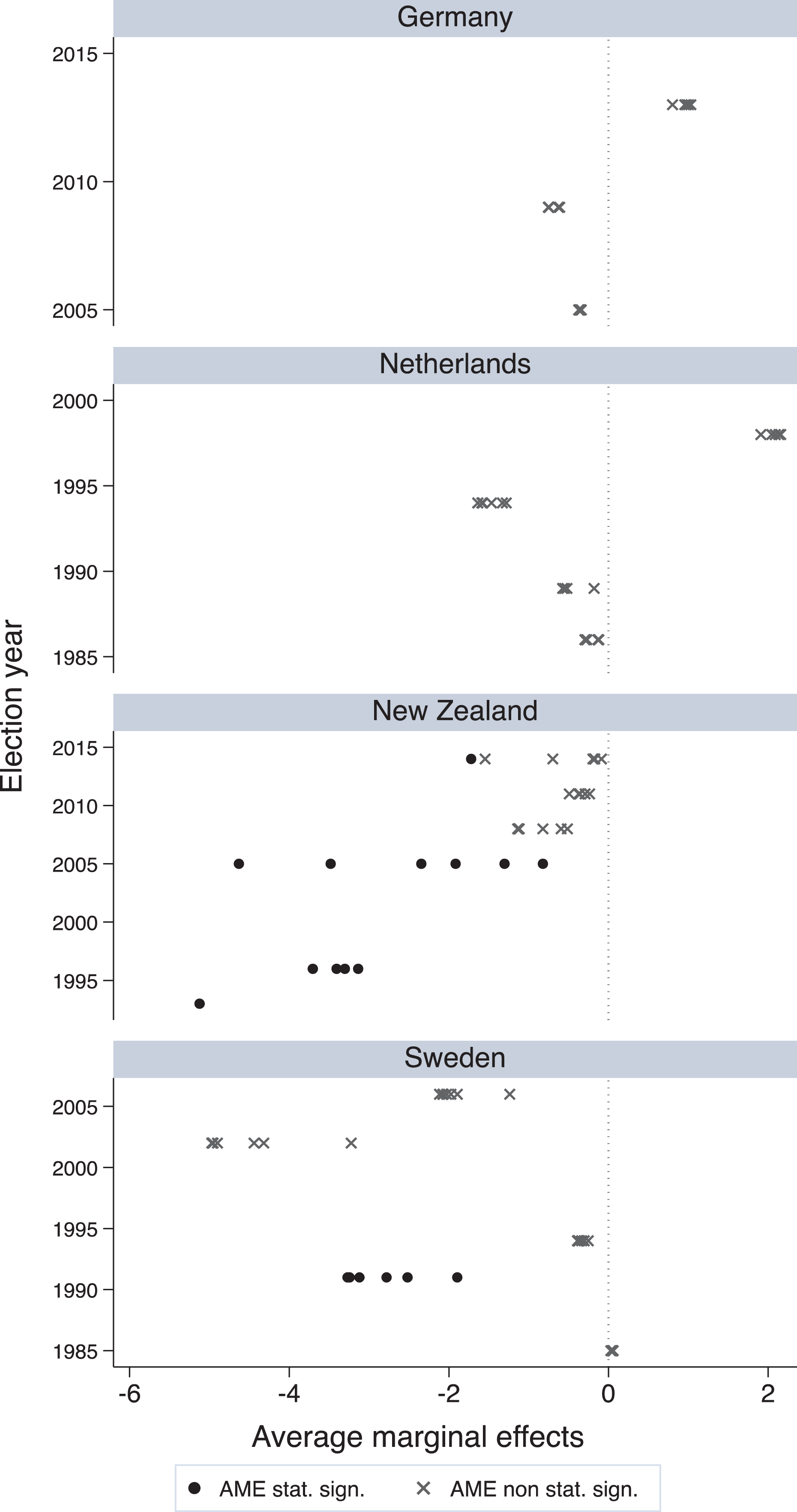
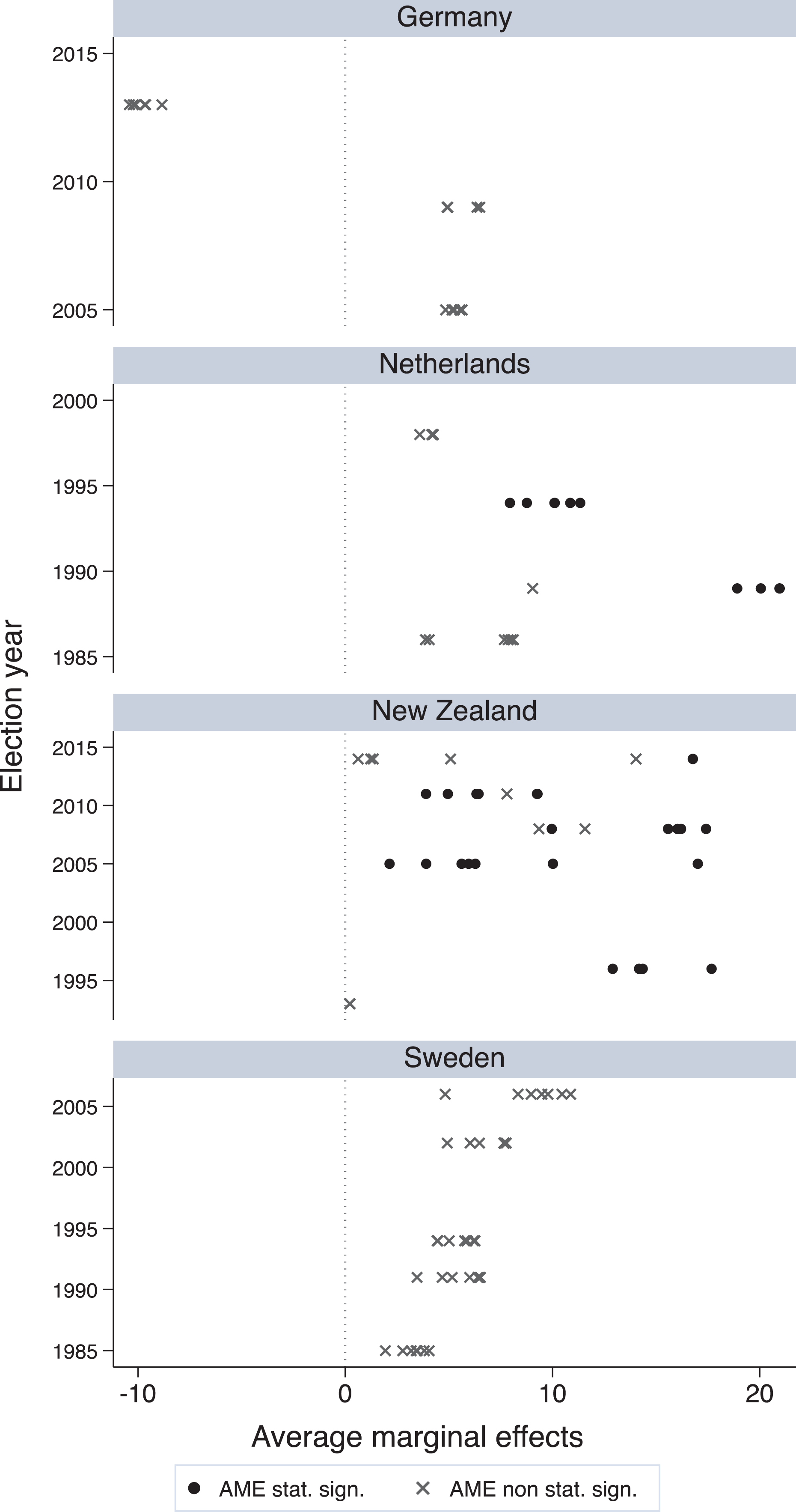
The results presented in Figures 2 to 4 have been estimated separately for each country–election with a panel component (18 in total). In each Figure, the dots (and crosses) represent the AME of the independent variable for a given party. The dots represent AME that are statistically different from zero at the 0.05 level of statistical significance. The crosses represent AME that are not statistically different from zero.

The impact of Δ in distance on vote choice. Elections displayed are Germany (2005, 2009, 2013), Netherlands (1986, 1989, 1994, 1998), New Zealand (1993, 1996, 2005, 2008, 2011, 2014) and Sweden (1985, 1991, 1994, 2002, 2006).
The impact of Δ in rank on vote choice. Elections displayed are Germany (2005, 2009, 2013), Netherlands (1986, 1989, 1994, 1998), New Zealand (1993, 1996, 2005, 2008, 2011, 2014) and Sweden (1985, 1991, 1994, 2002, 2006).
The impact of Δ in closest party on vote choice. Elections displayed are Germany (2005, 2009, 2013), Netherlands (1986, 1989, 1994, 1998), New Zealand (1993, 1996, 2005, 2008, 2011, 2014) and Sweden (1985, 1991, 1994, 2002, 2006).
In Figure 2, we present the impact of Δ distance on vote choice. Δ distance captures whether and to what extent the ideological distance between a respondent’s position and a party’s ideological position (on a 0–10 left–right ideological scale) at the current election has changed since the previous election. It is measured by subtracting the absolute ideological distance between a voter and a party at the previous election from the absolute distance between the voter and the party at the current election. Consequently, a negative Δ distance value implies that the party has moved towards the voter’s position, while a positive value implies that a party has moved away from her. As mentioned before, controlling for Δ voter position assures that Δ distance only captures the effect of shifts in party positions. 12 To support our hypothesis, the impact of Δ distance should be negative. This would indicate that when a party shifts its position away (towards) from a voter – that is, Δ distance increases (decreases) – her likelihood of supporting this party decreases (increases).
The results presented in Figure 2 are mixed. On the one hand, it appears that many of the marginal effects of Δ distance are negative and statistically significant in New Zealand. The AMEs remain small, however, with most of the AMEs smaller than 5 and an average of −4 points for those statistically significant AMEs. On the other hand, Δ distance does not appear to have much impact in Germany, Netherlands and Sweden, none of the AME are statistically different from zero in these countries.
The variable Δ distance captures all parties’ ideological shifts from a voter’s position since the last election. What may matter to voters, however, is whether parties’ position changes affect the party ranking between the positions of parties and voters. We thus construct a Δ rank variable by subtracting the rank between a voter and a party at the previous election from the rank between the voter and the party at the current election. A rank score of 1 means that the party is the closest party to a voter’s position, a score of 2 means that the party is the second closest party, and so on. Our expectation is that Δ rank will have a negative impact on a respondent’s likelihood of voting for a party. This would suggest that if the party has moved away ideologically from the respondent (i.e. Δ rank increases), she is less likely to support that party.
The results presented in Figure 3 are also mixed. In Germany and Netherlands, the AMEs are never statistically different from zero. The results in New Zealand and Sweden are more consistent with our hypothesis. All of the AMEs are negative in these countries (except seven cases in Sweden). Moreover, many of these effects are statistically different from zero at the 0.05 level. The effects remain small, with an average of −3 percentage points for those AMEs that are statistically significant in New Zealand and Sweden but a total average of −2 for all the AMEs in these two countries.
The previous results, that focus on the impact of Δ rank and Δ distance, do not provide strong evidence that party shifts influence voters’ choice systematically. Another possibility, however, is that voters are much more influenced by the party that is closest to their position (which is confirmed in a static way by the results that are reported in Online Appendix 2) and by a position change of this party. In Figure 4, we thus examine the impact of Δ closest party. This variable captures whether a party is the new closest party to a voter (coded 1) or not (coded 0) since the last election. Given that a positive change in Δ closest party necessarily requires that the previous closest party loses its position as the closest party, we also include as a control previous closest party which indicates which party was the closest party at the previous election. To be consistent with our hypothesis, we expect Δ closest party to have a positive impact on vote choice. This would indicate that a voter is more likely to support a party that becomes the closest to her position.
The results presented in Figure 4 are mostly consistent with our hypothesis. The impacts of Δ closest party are all positive as predicted (except Germany 2013). In addition, most of the AMEs are statistically different from zero in New Zealand (23 on 35) while half of them in Netherlands. The average AME is about 8 and 9 percentage points in New Zealand and Netherlands, respectively. Finally, all the AMEs are also in the expected direction in Sweden but most of them do not reach the conventional level of statistical significance.
Discussion
The aim of the article was to examine whether shifts in party positions influence voters’ choice. In particular, we tested the impact of three different variables that capture the relationship between the positions of parties and voters and how it may change between elections. Our main claim, based on spatial theories of voting, was that shifts in party positions influence voters’ likelihood of supporting parties. While our data set allows confirming a basic static proximity voting hypothesis – as shown in Online Appendix 2 – the results with respect to dynamic proximity voting are much less conclusive. Most of the AMEs of Δ rank and Δ distance turned out to be not statistically significant. It is only in New Zealand elections that these effects were in the expected direction and statistically different from zero. Even in that case, the magnitude of the effects is small. The results associated with Δ closest party are more consistent with our prediction but still mixed given cross-national heterogeneity in the effect. In particular, the AMEs were mostly significant and of great magnitude in Netherlands and New Zealand, while they were not in Germany and Sweden.
An important issue, therefore, is how to reconcile these mixed results in terms of the influence of shifts in party positions on voting behaviour on the one hand, and static results which are consistent with proximity voting on the other. Indeed, our results indicate that voters, in exactly the same elections that we included in the dynamic specifications, do tend to vote for parties that are closer to their positions (see Online Appendix 2). While proximity voting works statically, it does not appear to matter dynamically.
A first explanation for these mixed results relates to the first condition that we detailed above for dynamic proximity voting to occur: parties should move from one election to another. It appears that most changes in party positions are actually of modest magnitude (see Online Appendix 6 for more details). The median (absolute) change is of 0.17 points in Germany, 0.15 points in Netherlands, 0.28 points in New Zealand and 0.22 points in Sweden. Interestingly, parties moved least between elections in Germany, which is the country for which the results were negative. It is thus possible that this lack of party movements in Germany has impeded dynamic proximity voting. On the other hand, parties have moved most in New Zealand, the country where the results are most supportive of our expectations. These results speak to recent findings by Dalton and McAllister (2015) who indicate that party positions are mostly stable between elections. If parties do not move much, as argued by Dalton and McAllister (2015) and as confirmed by our results, this would make it difficult for voters to adjust their vote accordingly with changes in party positions given the absence of changes from the latter.
A second potential explanation for the rather weak evidence of dynamic spatial voting is that parties do not always campaign on ideological and policy issues. Electoral campaigns are more and more personalized and leader-oriented (Aarts et al., 2011) which may decrease the salience and importance of these parties’ ideological shifts in the mind of voters. Holding governments accountable for their management of the economy (Duch and Stevenson, 2008) and the fulfilment of their electoral pledges (Naurin, 2011; Thomson, 2011) are other factors that may dominate ideology and the influence of parties’ ideological shifts on voting behaviour.
Finally, a number of factors that we did not consider might condition the impact of parties’ ideological shifts on party switching. For example, the number of parties in competition and the polarization of the party system may influence voters’ set of choices and their distance from each party. Furthermore, electoral rules might be an important conditioning factor of proximity voting. In particular, under non-majoritarian electoral rule, the coalition-governing process is thought to push voters to vote for more extreme parties in the hopes of influencing the policies of the incoming government (Bargsted and Kedar, 2009; Ferland, 2014). This is also consistent with the findings of Singh (2010: 432), who found that proximity voting is weakened when ‘the complexity of elections increases’. Our current sample is simply too small to verify whether all these factors that have been found to matter when studying proximity voting in a static way, also matter when evaluating dynamic spatial voting. As more data become available and more diverse samples can be looked at, this represents an important avenue for future research.
Our results have important implications for the functioning of representative democracies. Ultimately, alternations in government rest with the voters who change parties in election time. More than 50 years ago, Converse (1962) stated that ‘it is the least informed members within the electorate who seem to hold the critical “balance of power,” in the sense that alternations in governing party depend disproportionally on shifts in their sentiment’. Similarly, Berelson et al. (1954) investigated the characteristics of voters changing parties in the course of an electoral campaign and came to the conclusion that ‘Stability in vote is characteristic of those interested in politics and instability of those not particularly interested’ (Berelson et al., 1954: 20). These conclusions have sparked a normatively loaded debate since then on the effective role of elections as instruments of democracy, to paraphrase Powell (2000). The more recent representation of this argument comes from Achen and Bartels (2016), who also argued against what they refer to as the folk theory of democracy – a theory that assumes that voters support parties based on policy and ideological considerations. On the one hand, our results challenge this pessimistic picture of the democratic process. We confirm, as many others before us have indicated, that voters do support parties that are closer to their positions. On the other hand, our results are not definitive with respect to the dynamic form of proximity voting. We find that in some elections voters do respond to how parties are perceived to move ideologically, confirming the role of party switching as an important accountability mechanism for voters. This is a reassuring picture for the functioning of electoral democracy. The occurrence of such voter responsiveness, however, appears to be small and varies strongly within and across countries. From our perspective, this conclusion points to the importance of contextual factors which should be carefully examined in future works.
Supplemental material
Supplemental Material, sj-pdf-1-ppq-10.1177_1354068819829207 - Shifting parties, rational switchers: Are voters responding to ideological shifts by political parties?
Supplemental Material, sj-pdf-1-ppq-10.1177_1354068819829207 for Shifting parties, rational switchers: Are voters responding to ideological shifts by political parties? by Benjamin Ferland and Ruth Dassonneville in Party Politics
Footnotes
Acknowledgement
The authors wish to thank Patrick Fournier, Russ Dalton, Matt Golder, Marc Hooghe, and the journal reviewers for their helpful comments.
Declaration of conflicting interests
The author(s) declared no potential conflicts of interest with respect to the research, authorship and/or publication of this article.
Funding
The author(s) received no financial support for the research, authorship and/or publication of this article.
Supplemental material
Supplemental material for this article is available online.
Notes
References
Supplementary Material
Please find the following supplemental material available below.
For Open Access articles published under a Creative Commons License, all supplemental material carries the same license as the article it is associated with.
For non-Open Access articles published, all supplemental material carries a non-exclusive license, and permission requests for re-use of supplemental material or any part of supplemental material shall be sent directly to the copyright owner as specified in the copyright notice associated with the article.
