




Abstract
In parliamentary systems, political parties must often bargain with each other in order to form a government. Do parliamentary rules regulating government formation impact the type of government that is formed? Existing scholarship suggests that the need for an investiture vote—a requirement that a new government must face a parliamentary vote at some point during its formation—reduces the likelihood of a minority government. This article suggests that while real-world investiture rules can vary across several dimensions, only the investiture decision rule—which specifies the size of the majority required for a decision to be made—impacts the propensity for parties to form minority governments. Using new data on investiture rules for 26 European countries since 1946 or the first year of democracy, we find that parliamentary democracies that have an investiture requirement are not less likely to experience minority governments than those where governments come to power without an investiture vote. However, when an absolute majority is required for a government to succeed at the investiture stage, minority governments are considerably less likely to form; absolute majority investiture rules reduce the frequency of minority governments.
Introduction
Political parties compete in elections primarily in order to win office. The absence of a majority party in most parliamentary systems together with the rise of cabinet government renders the game of government formation particularly important. Understanding which parties coalesce and the form of the government remains the subject of significant scholarly inquiry. One important avenue of research has explored the role of political institutions and rules, including the formal role of parliament in determining whether a majority or minority government will form (see, e.g. Bergman, 1993; Bergman et al., 2015; Conrad and Golder, 2010; Diermeier et al., 2002; Eppner and Ganghof, 2017; Müller and Strøm, 2000; Rasch et al., 2015a; Sieberer, 2011; Strøm, 1990; Strøm and McClean, 2018; Tsebelis and Ha, 2014). A minority government (or minority cabinet) is one where the parties holding ministerial portfolios do not control a majority of seats in the legislature. Despite being common in many countries and notwithstanding the existence of seminal research on the topic (Strøm, 1990), minority governments remain something of a puzzle for scholars of parliamentarism (Field, 2016; Rasch, 2011).
Building on this body of research, we investigate the relationship between parliamentary investiture rules and minority governments. Investiture consists of a vote in parliament to demonstrate that an already formed or about to be formed government has legislative support. There is a general belief among scholars of parliamentarism that the existence of an investiture requirement for a government to be formed makes the emergence of minority governments less likely (Bergman (1993) provides a seminal contribution in this regard). Investiture rules, however, vary across several dimensions: the decision rule, the point in the formation process when a vote is taken (timing), the actor in charge of proposing a formateur, the number of legislative chambers required to vote, the subject of the vote, and the consequence of an investiture failure (Rasch et al., 2015b). However, the extent to which these features of investiture matter for the formation of minority governments varies. We argue and show that investiture votes decrease the likelihood of minority governments only when they require an absolute majority in order to be successful, that is, the support of more than half of the members of parliament. The mere presence or absence of an investiture vote does not impact the rate of minority government formation.
We base our empirical analysis on newly collected longitudinal data on national constitutions and parliamentary procedures and practices in 26 parliamentary democracies. This is the first multivariate analysis of complex investiture rules, where we move beyond treating investiture votes as being either absent or present in a parliamentary democracy. Our goal is not to provide a full explanation of minority governments. Rather, we simply investigate which—if any—features of the complex investiture procedures we find in practice matters for the formation of minority governments.
The remainder of the article is organized at follows: Next, we review the extant literature on institutions and government formation, with particular attention to the role of institutions in the emergence of minority governments. In the third section, we describe investiture procedures while paying attention to the reasons why each may or may not affect the frequency of minority governments. The fourth section presents our data and tests our main hypothesis. The article concludes with a review of the consequences of our findings and suggestions for further research.
Institutions and (minority) government formation
Initial office-oriented approaches to who gets to govern under parliamentarism, originating from rational choice accounts of party behavior, emphasized government formation as a game involving the distribution of a fixed prize, generally conceived of as seats at the cabinet table (Laver, 1988). Later work emphasized parties’ concern with policies but remained largely devoid of institutions (Axelrod, 1970; DeSwaan, 1973). Departing from the institution-free nature of both the office- and policy- based approaches, and in tandem with the new institutionalism of the 1980s, coalition scholars began investigating the role of rules and institutions in government formation. For example, Austin-Smith and Banks (1988), Baron (1991), and Bäck and Dumont (2008) focus on the role of formateurs, and the importance of the order in which different players get to attempt to form a government, for helping to determine which parties will govern. Laver and Shepsle’s (1996) portfolio allocation model similarly elevates the importance of institutions, suggesting that how cabinets work, and more specifically the degree to which individual cabinet ministers enjoy policy autonomy, shapes the preferences of parties with regard to coalition government.
It is in the context of models such as these that other work focused on some of the specific parliamentary rules presiding over government formation. After all, as Bagehot (1928) noted, “the elective function,” that is, the function of choosing the executive, may be the main task of a parliament in a parliamentary system of government. Along these lines, scholars have largely, though not exclusively, focused on the presence or absence of an investiture requirement for the formation of governments. In some political systems, parliament must vote to invest a government; in other systems this is not the case. Investiture, in turn, may affect both the process of government formation and the type of government that ultimately emerges. The reason is that a formal investiture vote may impose an immediate and significant hurdle for parties outside of the government since they would have to publicly express their support for the government as a whole. To the extent that some parties may be willing to tacitly but not publicly support a government (Strøm et al., 1994, 311), an investiture requirement may lead to longer government formation processes while its absence may lead to more frequent minority governments.
In this article, we are interested in the last effect. 1 Bergman (1993) distinguishes between ‘positive parliamentarism’ (a situation where an incoming government needs to be explicitly supported by the parliament) and ‘negative parliamentarism’ (a situation where the government must only be ‘tolerated by’ the parliament). Looking at patterns of government formation in Canada, Israel, and 13 West European parliamentary democracies between 1945 and 1987, and focusing only on countries with electoral systems likely to return ‘hung’ parliaments, he finds that 48% of cabinets are minority governments in systems with negative parliamentarism as compared to 25% in systems with positive parliamentarism. Subsequent empirical research appears to largely confirm the relationship between the presence of an investiture procedure and patterns of minority government (as well as other outcomes, such as duration of the formation process and cabinet termination). 2
Yet the reasoning supporting the impact of investiture rules is sometimes challenged. The primary argument as to why an investiture vote should not affect the nature of the government in a parliamentary democracy relates to what some see as its intrinsic redundancy in the face of no-confidence procedures. Golder et al. (2012: 430) summarize the logic of this argument as follows: Ultimately, a parliamentary government may be removed from office any time a majority of legislators decides that this is what should happen. As a result, any incoming government must be able to survive a vote of no confidence and, hence, enjoy the support of a legislative majority even if it never has to explicitly demonstrate this through an actual vote.
Dimensions of parliamentary investiture
Investiture rules are complex. We identify several dimensions along which investiture procedures differ in real-world settings. However, we argue that only one—the decision rule—plays a role in preventing minority governments from emerging as the outcome of interparty bargaining over government formation. We briefly discuss each of these dimensions and then turn our attention to the differences in the decision rule required to invest a government.
We identify six dimensions of parliamentary investiture votes: the timing of the investiture; who nominates the formateur or the government; who votes to invest the government; the target of the vote; the consequences of investiture failure; and the decision rule for successfully investing a government. We believe that only the last dimension is likely to impact the likelihood that a minority government will emerge.
Timing
A vote of investiture can happen at two moments in the process of government formation: before a (full) government is appointed (ex ante) or after appointment (ex post). In the first case, investiture happens after a government formation process is set in motion (i.e. immediately after a new election or a government resignation) but before a new government is appointed by the head of state. In the second case, the government has already been appointed by the head of state and is formally empowered to act—it has control of the state—but it is required to face a parliamentary vote. If it succeeds in that vote, it remains in office; if it fails, it is required to resign and the process of forming a government starts anew. 3 While the timing of a vote can be important in many ways, we do not believe it should impact the ability of parties to form a minority government. Where an investiture vote exists, all players will anticipate that vote, regardless of which stage of the formation process the vote takes place. Additionally, even at the ex ante stage, parliamentarians often know what government the prime minister they are about to vote on will establish. This was clear in the March 2018 government formation in Germany, where members of the Bundestag already knew the name of ministers when Merkel was voted into office. This is also illustrated by Ireland, where there is a vote on the prime minister and one on the members of the government, typically with only a few hours between the two. Thus, most of the information about the type of government to be formed is already known or easily anticipated, even if the parliament is formally not voting on the government but on the prime minister.
Right to nominate
There are two basic approaches to nomination of a prospective prime minister. In many countries, the head of state nominates candidates formally and with complete discretion. In other countries, nomination is generated in the parliament or is mandated by the constitution. Nominations from parliament include cases in which it is done by the president of parliament (as in Sweden or the Czech Republic), by groups of MPs, or even by individual MPs. In Germany, for example, nomination requires 25% of deputies, while in Poland it requires only 10%. In Finland and Ireland, every deputy has nomination rights. The constitutions of Bulgaria (1991) and Greece (1975), in turn, predetermine who should be nominated as formateur. The nomination rule may be more significant as an agenda setting power in countries lacking an investiture vote; if an investiture vote exists, the nominator needs to anticipate what will happen at the investiture stage, where the decision rule is crucial. Therefore, we do not consider this dimension in itself as important for the formation of minority governments.
Who votes
Parliaments can be unicameral or bicameral. In unicameral systems, the question of who votes is obvious. Bicameral systems, however, may require that only one of the chambers participate in the formation of the government (e.g. Germany), or that the government face an investiture vote in both chambers (e.g. Italy and Japan). All else equal, involving more than one chamber adds a veto player and makes bargaining more complex (Tsebelis, 2002). On the other hand, very few second chambers play a formal role in government formation (Rasch et al., 2015b). Thus, although it is theoretically possible that having a second chamber participate in investiture may affect the likelihood of minority governments, we do not consider this feature in our empirical analysis because not enough cases exist. 4
Target of the vote
Although they all happen with the goal of forming a government, investiture votes differ as to what exactly is being voted on. These votes are focused on electing or confirming confidence in one or a combination of the following: a head of government, the cabinet, or the government’s policy platform. It may be the case that it is easier for a non-coalition party to offer legislative support in an investiture vote when the vote concerns only the personnel of government and not the details of the government’s policy platform. On the other hand, it is unlikely that any party will support an investiture vote absent some coordination on what the government plans to do in terms of public policy. For this reason, again, while potentially important for the government to be formed, we do not expect that this dimension of the investiture process will matter for the formation of minority governments.
Investiture failure
With the exception of Norway, assembly dissolution and early elections always loom in the background of any government formation process in parliamentary systems. In some countries, even though a government must be invested by parliament, the rules are silent as to what happens in case of failure. In these cases, practice and the distribution of seats determine whether a new attempt is made or whether new elections are called. In other systems, however, the constitution stipulates not only the sequence of moves in the government formation process, but also the number of times it can be repeated, the actor who nominates candidates in each attempt, the decision rule to be adopted in each of them, and the reversal point if all attempts fail. In some cases, the identity of the actor moving first and the decision rule changes with each attempt. The shadow of elections should encourage parties to facilitate minority governments, all else equal. But we do not know, and have no reason to believe one way or the other, whether making dissolution a requirement after a finite number of attempts makes actual dissolution more or less likely than having it as an implicit (and discretionary) possibility. Our sense, however, is that few cases of mandatory dissolution after successive failed investiture attempts reach that point.
Decision rule
By decision rule, we mean the actual rules governing the vote on the investiture of the government. It defines the requirement for winning and translates individual votes into an unambiguous collective choice (Rasch, 1995). Three decision rules seem to be employed in practice (at initial stages of voting): negative majority, simple majority, and absolute majority. Absolute majority means that the investiture is successful if more than 50% of the chamber’s members vote in favor of the formateur or government. A simple majority means that a successful investiture requires that a majority of those present and voting (assuming a quorum of less than the full membership) are in favor of the government to be formed. A negative majority assumes a successful investiture unless a majority (typically an absolute majority) votes against the government.
Each of these rules gives rise to different strategic situations (Vermeule, 2007) and, as we will see below, poses increasing hurdles for the formation of minority governments. Generally speaking, this is so due to the role abstentions play under each of them. In a chamber of N legislators, absolute majority requires that the government receive more than (N
How will different decision rules affect the likelihood that a minority government will form? First, consider the situation in which no investiture is required. This means that governments will be formed without the direct participation of parliament and parliamentary involvement in whether the government will exist can only occur ex post facto. In this case, a minority government may come about unless a majority of parliamentarians finds it in its interest to block it by proposing and voting in favor of a motion of no confidence following the installation of the government. Typically, the anticipation of such an event is sufficient to ward off the potential government. But if a sufficient number of MPs are reluctant to openly support no confidence at this initial stage, a minority government might be the consequence. Similarly, in the case of a negative majority investiture rule, it takes an absolute majority to hinder a minority government from emerging, and if feelings toward the potential minority government are mixed in the opposition camp, this type of government may form. The relevant point here is that in both cases, a minority government may emerge because preventing it requires that the opposition bears some cost of mobilizing for action. Under negative investiture rules, the action consists of mobilizing opponents to vote against the government being invested; under no investiture rules, the action consists of mobilizing opponents to vote against a government already in power. In both cases, the status quo favors the government and the costs of change are borne by the opposition.
The situation is more restrictive in the case of a simple majority investiture. A minority government can only form if some section of the opposition abstains from voting (or vote in favor of the government they do not participate in). In contrast to the case with no investiture at all, it is not sufficient that parts of the opposition do nothing or just refrain from supporting a no-confidence motion; at the least, for a minority government to form under a simple majority decision rule, part of the opposition must behave as if it were indifferent toward the government by abstaining. Thus, compared to the cases in which no investiture is required, or the decision rule is a negative majority, a simple majority requirement for a successful investiture makes it slightly harder for minority governments to emerge (everything else equal).
The formation of a minority government is considerably harder if an absolute majority is required for a successful investiture: a minority government can only form if enough opposition MPs are willing to vote in favor of a cabinet they are not part of. Under normal circumstances, this should be rare and mainly happen in cases where the minority government has reached an agreement with the part of the opposition that provides the necessary votes at the investiture stage. This means that if minority governments emerge at all under absolute majority investiture, they are only formal minority governments (resting on a formal agreement of some kind with parts of the opposition). In other words, we expect minority governments to become less likely as the hurdle of the investiture decision rule increases from completely absent or negative to simple majority and from simple to absolute majority: absolute majority requires parts of the opposition to explicitly support the minority government; simple majority requires parts of the opposition to (at least) abstain from voting; and no investiture just requires the opposition to remain passive, that is, not initiate and support no confidence.
Let us give some examples of investiture decision rules. In Sweden and Portugal, for instance, the vote that takes place at the moment of investiture requires a negative majority for success: a candidate for Prime Minister (Sweden) or a government that presents itself to the parliament for a required vote (Portugal) survives unless an absolute majority votes against it. In these countries, investiture represents the formalization of a procedure that is actually weaker than the situations in which governments come into power without any formal participation of parliament. The investiture vote in Sweden in 1978 represents an extreme example of this scenario. The candidate for Prime Minister, Ola Ullsten, was supported by 39 of the 349 members of the Riksdag, 11.1%. A majority of 66 MPs voted against Ullsten, and a total of 215 abstained. One year later Torbjörn Fälldin was a candidate. He was supported by 170 MPs. It did not matter that a majority of 174 voted against Fälldin, as long as this number was less than an absolute majority of at least 175 MPs (i.e. 349/2) (Wockelberg, 2015). As a final example, the government that was invested in Sweden on January 21, 2019, received 115 votes in favor and 153 votes against, with 77 abstentions. Success was obtained because some of those who voted against the formateur in earlier investiture votes now abstained. 5
Simple majority is the most common investiture procedure: a government is invested if, given a quorum, more MPs vote in favor than against it. Examples are the French Fourth Republic between 1954 and 1958, Belgium before the constitutional amendment that became effective in 1995, Bulgaria and the United Kingdom. 6 Finland introduced a simple majority investiture in the new constitution of 2000. The rules in Finland are, however, slightly more complex. Three possible investiture rounds are specified: in the first two, the parliament votes on a prime minister (who has previously negotiated the government program and composition) by simple majority; if none of the previous rounds are successful, in the third and last round, the parliament votes by plurality (first-past-the-post). The candidate with more votes than any other is elected (any abstention not registered or counted). It is easy to see that the party with a plurality of seats has a privileged bargaining position: if the last stage of the process is reached and other parties do not coalesce to form a bigger plurality, it can reasonably expect to get its candidate for prime minister elected. Finally, in Greece, investiture requires simple majority of those present and voting, provided that this majority constitutes at least 40% of the MPs. This means that a simple majority of less than 25 of the assembly is not sufficient to install a government. This provision limits, but does not eliminate, the strategic use of abstentions.
A number of countries have or had absolute majority investiture. The Fourth French republic used absolute majority until 1954, as has Germany since 1949. More recently, several countries in the Eastern part of Europe introduced absolute majority investiture rules, like Croatia, Hungary, Poland, and Slovakia. Like Finland, some of these countries also have complex rules. Germany potentially conducts two rounds with absolute majority, before the decision partly slips into the hands of the president. To be more specific, if a third round is needed, the decision rule is lowered to plurality. The president may however ignore a third-round vote and dissolve the parliament and call new elections. This has never happened, and one should expect that parliamentary actors would be very reluctant to lose the power of the decision to the president (Sieberer, 2015). Therefore, it is natural to regard Germany as a case of absolute majority investiture. Spain also has a complex investiture procedure, with an absolute majority requirement in the initial round. If unsuccessful, the decision rule in the next round is simple majority. Second round decisions have occurred several times in practice (Ajenjo, 2015). This means that in the Spanish case, formateurs need no more than the backing of a simple majority in order to be successful; if there is no absolute majority, parliamentary actors just move to the second stage. Thus, even if both Germany and Spain have absolute majority initially, they differ in what happens in successive stages. While in Germany the last move belongs to the president, the absolute majority required in initial rounds becomes effective; because in Spain the majority required to invest the government is lowered after the first failure, the system works in practice as a case of simple majority investiture.
Thus, minority governments are unlikely only when the decision rule presents a significant hurdle, that is, when it requires that opposition parties or representatives either have to abstain from voting or support a government of which they are not part. The latter case, which occurs under absolute majority investiture, clearly makes minority governments less likely.
We next examine the relationship between investiture votes based on absolute majority and the emergence of minority governments. Table A.1 in the Online Appendix characterizes each of the 26 European countries in our data set in terms of the six investiture characteristics discussed in the section. In light of the argument developed here, we expect minority governments to be equally likely in countries with no investiture of any type and those with an investiture regime based on decision rules other than absolute majority. For this reason, we structure our analysis as a comparison of investiture regimes that call for the support of an absolute majority of legislators versus all other cases.
Investiture procedures in action
Our goal is to empirically examine the impact of absolute majority investiture rules on the emergence of minority governments. We do not expect to find a correlation between the mere presence of an investiture requirement and the incidence of minority governments. The lack of such relationship can be eyeballed in Table 1, where countries are ranked by the frequency of minority governments. As we can see, investiture votes are required in countries located in every section of the table: the presence of an investiture requirement combines with majority as well as minority governments. This is also true, as we will see, in multivariate analysis.
Cabinets by majority status in European parliamentary democracies, 1946–2015.

Source: Bucur et al., 2019.
Note: Gray rows are countries with some kind of investiture requirement (excluding those countries where parliament votes on a government but the rule is a negative majority or lower level plurality). The time period is 1946–2015. Multiple entries for the same country represent different decision rules for investiture. The years for each of these cases are as follows: Belgium I (1946–1994) and II (1995–2015); Finland I (1946–1998) and II (1995–2015); France I (1946–1953), II (1954–1958), and III (1959–2015); Poland I (1989) and II (1990–2015); Sweden I (1946–1973) and II (1974–2015).
Our investiture data set is original (Bucur et al., 2019). The original data set includes 26 European countries observed between 1918 and 2017. Due to limitations regarding other data, the analysis here only covers the post-1945 period. We have information on investiture and legislative support for 780 governments, of which 75 were caretaker and hence excluded from the analysis. 7 One hundred and eight of the 705 remaining cabinets were formed in majority situations, that is, situations in which one party held a majority of legislative seats. We also exclude these cases from our analysis. In the end, we have 597 fully empowered cabinets in minority situations.
In the data set, 312 of the 597 cabinets (52%) were formed under constitutions that required an investiture vote in parliament. Regarding the decision rule, the most common is simple majority, which was used in the formation of 45.1% of the cabinets in countries where investiture was required. These include Spain and Slovenia, where the first attempt to invest a government is based on absolute majority and the last one is based on simple majority. In these cases, the absolute majority rule does not bite since actors know they can form a government by simple majority in the absence of an absolute majority (as discussed above). Three countries adopt a negative majority rule: Belgium since 1995, Portugal since its democratization in 1976, and Sweden since 1974; 39 full cabinets were formed under these rules. Finally, 42.8% of the cabinets in countries where an investiture vote is required adopted absolute majority. They include Croatia, France between 1946 and 1953, Germany, Romania, and Hungary.
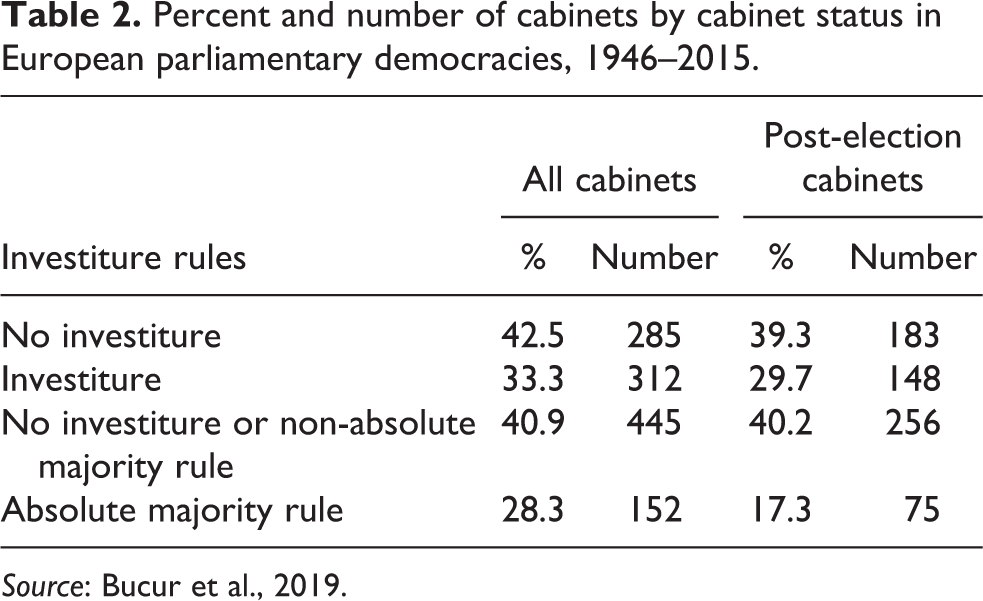
Table 2 presents the frequency of full-power minority cabinets, conditioned on two dummy variables: the “investiture dummy,” which flags all cases of investiture, and the “absolute majority dummy,” which indicates the cases in which the support of an absolute majority is required for a successful investiture. The first variable, thus, contrasts cases with and without an investiture, that is, the cases the literature refers to as positive and negative parliamentarism. 8 The second variable allows the comparison between the cases of investiture by absolute majority with those cases with no investiture or with investiture based on a different decision rule. The literature on coalition formation universally counts any change in the partisan composition of a cabinet as a new government. Some of these changes, however, do not trigger a vote of investiture for the “new government.” For example, if a party leaves a minimal winning coalition midterm, the government becomes a minority cabinet even as the prime minister and most other ministers remain in power. It is rare for cabinets like these to be the subject of a vote of investiture. But in this case, whatever association the investiture variables may have with the emergency of minority governments will be weakened. Thus, we also distinguish the cabinets that were formed following an election. In so doing, we can be assured that all governments in which some kind of investiture vote is required did in fact face one. The drawback, as can be easily noted, is that we also sharply reduce the number of governments we have to work with.
Percent and number of cabinets by cabinet status in European parliamentary democracies, 1946–2015.
Source: Bucur et al., 2019.
Turning to the table, we can see that countries with investiture requirements—of any type—have fewer minority governments than those with no investiture. The same is true, although less markedly, when we exclude cabinets formed in the middle of the legislative term. Countries with an absolute majority investiture requirement too have fewer minority governments than both countries with investiture based on a decision rule less strict than absolute majority, and countries without any type of investiture. The question, of course, is whether these differences are also observed when we consider other aspects that also affect the emergence of minority governments. We turn now to such an analysis. To anticipate, we find that the “investiture dummy” is not associated with minority governments, and that the “absolute majority dummy” is, but only in formations that follow an election.
In order to analyze the relationship between investiture and minority governments in a multivariate context, we replicate Strøm and McClean’s (2018) analysis, which represents, to our knowledge, the most complete and systematic effort to assess empirically the impact of different factors on the frequency of minority governments. 9 We add to their empirical model (in separate estimations) the two dummy variables related to investiture defined in the previous paragraph. Our expectation is that the “investiture dummy” will not be associated with the incidence of minority governments, while the “absolute majority dummy” will have a negative, statistically and substantively significant association with minority governments. This should be particularly true in post-election government formations.
In their analysis, Strøm and McClean consider four groups of factors that may affect the emergence of minority governments. The first group includes a measure of ideological distance of the parties represented in parliament (polarization) and a measure of the fragmentation of the legislative party system. This group also includes a measure of the bargaining power of the largest and of the median parties (median party bargaining power and largest party bargaining power). All of these variables are expected to be positively associated with the emergence of minority governments. In the original analysis, Strøm and McClean also include an indicator of post-election formations, which we will use not as an independent variable but as a factor to create a subset of formation cases (as we did in Table 2).
The second group of variables consists of indicators for the country’s institutional structure: the strength of prime ministerial powers, the constitutional structure (semi-presidential or not), and investiture (which they refer to as positive parliamentarism). The first two variables are expected to be positively associated with minority governments (both an institutionally powerful prime minister and a directly elected president, they argue, “may offset the lack of a parliamentary majority” (Strøm and McClean, 2018: 10). The variable about positive parliamentarism is, of course, our variable of interest here and will be replaced with the two dummy variables previously defined. The third factor is related to the policy-making strength of the opposition, a factor that is expected to be positively associated with minority governments. It is measured through a count of permanent legislative committees in the lower or only chamber. The final set of variables consists of a measure of the bargaining environment (the duration in days of the formation process) and a measure of electoral volatility. Both variables are expected to be positively associated with minority governments.
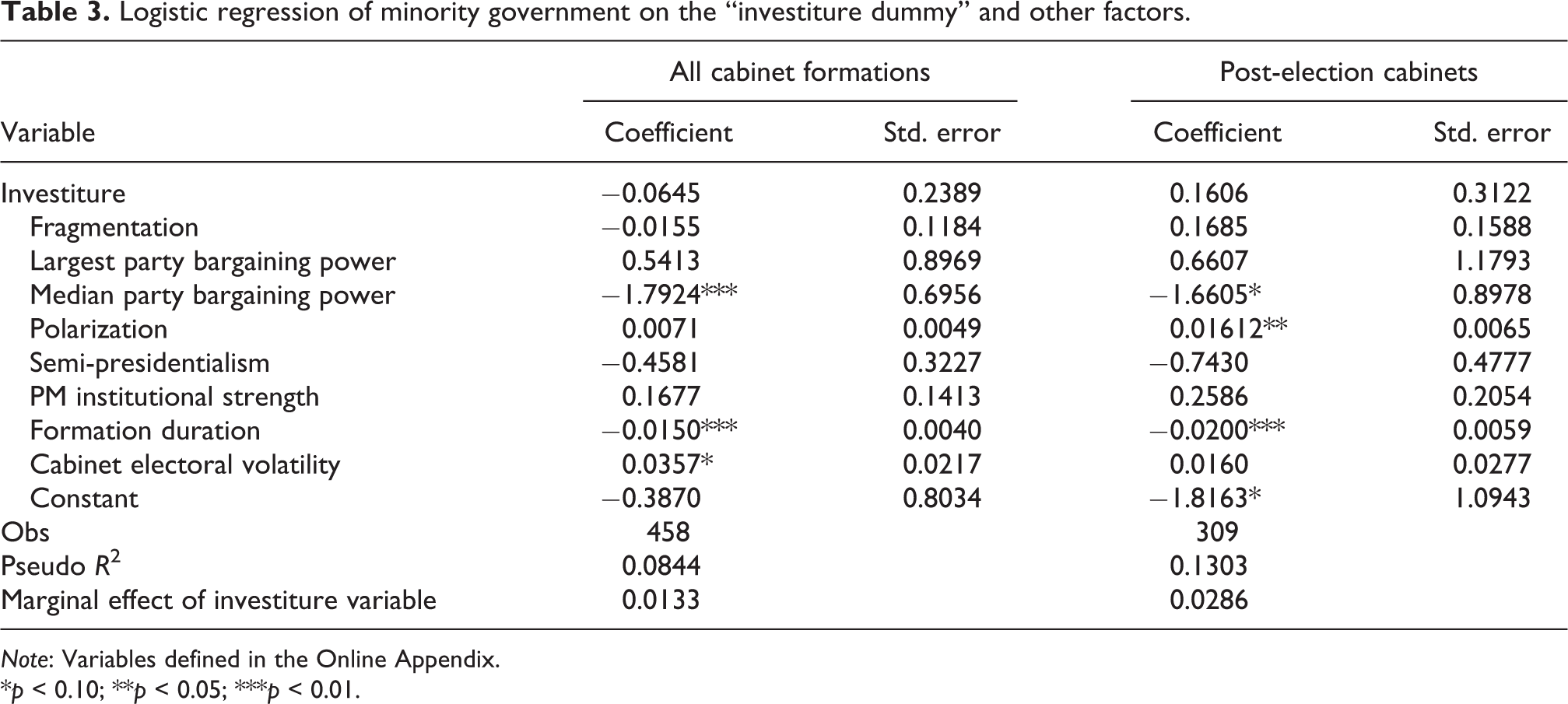
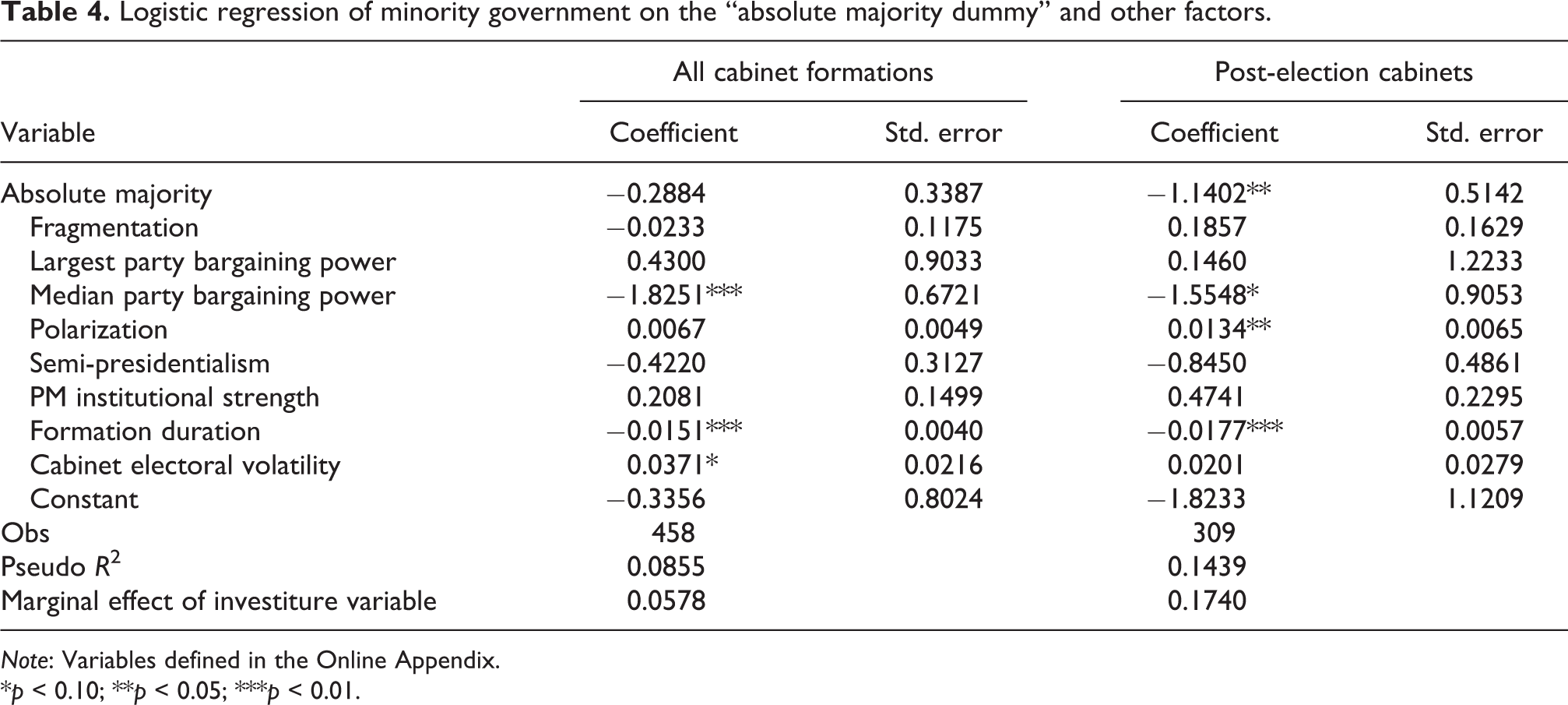
Tables 3 and 4 present the estimates of logit coefficients resulting from regressing an indicator of minority governments on the investiture and other variables just discussed. There are three differences with respect to Strøm and McClean (2018), which we wish to highlight: first, we use the investiture variables that we created; second, instead for including a control variable for post-election cabinets, we separately estimate a model for all cabinets and one for post-election cabinets only; finally, because we were not able to obtain the variable on the number of committees, it is not included it in the regression.
Logistic regression of minority government on the “investiture dummy” and other factors.
Note: Variables defined in the Online Appendix.
*p < 0.10; **p < 0.05; ***p < 0.01.
Logistic regression of minority government on the “absolute majority dummy” and other factors.
Note: Variables defined in the Online Appendix.
*p < 0.10; **p < 0.05; ***p < 0.01.
As can be seeing in Table 3, simply having some kind of investiture is not associated with the emergence of minority governments, either when we consider all cabinets or when we only consider post-election cabinets. The estimate is that the likelihood of observing a minority government decreases by 17% points when one moves from a country in which there is no investiture or investiture is not based on absolute majority, to one in which a successful government needs to be explicitly supported by more than 50% of the members of parliament. When it comes to minority governments, countries like Italy, Ireland, Spain, and Slovenia, where the constitution requires that governments be invested by parliament are equivalent to governments like Denmark, where parliament is not directly involved in the formation of the government. Thus, when other factors that impact government formation are held constant, we find that only a specific type of investiture vote likely prevents the formation of minority governments: systems such as the one that existed in France between 1946 and 1954, and now exists in Croatia, Germany, Hungary, Romania, and Slovakia, where a majority larger than 50% of members of parliament needs to vote in favor of government for it to be formed.
Note that the model of minority governments in post-election cabinet formations in Table 4 does help predict minority governments: the unconditional probability that a minority government will emerge is 30%; information about the covariates in the table improves prediction to 77%. If all we knew were the frequency of minority governments conditioned on absolute majority rule investitures, we would be able to correctly predict 66% of the cases. Yet, of eight covariates, we find that, in addition to absolute majority investiture, only two are associated with the incidence of minority governments: the bargaining power of the median party and the duration of the bargaining process leading to the formation of the government. Both variables are associated with less frequent minority governments across all four models estimated in Tables 3 and 4. As mentioned above, both were expected to be associated with more frequent minority governments. 10
Conclusion
Under parliamentarism, governments emerge from, and remain responsible to, the legislature. How parliament determines who governs is a question of theoretical and normative significance. Despite the advanced nature of coalition research, we still know relatively little about the rules of the government formation process and how they impact the type and composition of governments.
In this article, we questioned existing research on the relationship between investiture procedures and the prevalence of minority governments. Including an indicator for whether governments must face an investiture vote, of any type, has become the rule in cross-national studies of government formation. We argue, however, that the mere requirement that an investiture vote be taken is not sufficient to characterize investiture procedures that really bite. Not all forms of investiture effectively constrain the options available to parties and affect the calculus by parties and individual legislators about the kind of support they will give the government to be formed. Our empirical analysis provides support for this more nuanced view of the investiture vote. This vote modifies the government formation process, that is, it makes the emergence of minority governments less likely, only when it requires that an effective parliamentary majority make the decision, that is, a majority of all members of parliament. Otherwise, investiture is irrelevant for the type of government—minority or majority—that will emerge.
There is, of course, more to be explored about investiture procedures than what we did here. Our analysis can be extended in at least four ways. First, by broadening the set of dependent variables. Beyond shaping the formation process, do investiture rules impact the survival rate of governments and in particular the longevity of coalition and minority governments? As with government formation, the termination of coalition governments is an advanced area of study in comparative politics. The general expectation is that governments facing an investiture process are more likely to have shorter durations, all else equal (Warwick, 1994). One would want to investigate how variation in the detail of investiture rules, cross-nationally and also over time within the same legislature, impacts the longevity of governments. Second, our analysis could be extended by expanding geographic coverage to include less traditional parliamentary systems, that is, parliamentary systems in non-European settings. Third, an additional important issue is to investigate the reasons why investiture procedures were first adopted. As we have shown elsewhere (Cheibub, Martin and Rasch 2015). formal investiture requirements are not a feature of early parliamentary (not necessarily democratic) regimes. Moreover, we also found that there is a correlation between constitutions that grant the executive strong powers to affect the legislative agenda and investiture rules that require an absolute majority for the government to be formed.
Finally, one may want to explore in detail what we believe to be “off the regression line” deviant cases. The deviant cases include countries such as Italy, Ireland, the Czech Republic, and Romania, which have an investiture mechanism but in which the rate of minority government is relatively high. Part of the reason for this, as we learned here, is that, except for Romania, the investiture procedures in these countries are weak; but what are the factors that, in these other countries, account for the high incidence of minority governments? Another set of deviant cases includes countries such as the Netherlands, Iceland, and Austria, which have no formal investiture requirements, no majority parties, but in which we observe almost always majority governments. This could arise because there exists other norms or rules in these systems that are functionally equivalent to (or even stronger than) the investiture mechanism. We believe both types of deviant cases to be somewhat puzzling, particularly from within the generally accepted paradigm that institutions matter. 11 We hope a closer analysis will provide new insights into, and information about, the nature of party politics, legislative rules, and the politics of government formation.
Footnotes
Acknowledgements
Earlier versions of this paper were presented on several occasions, during which many people offered useful feedback. We would like to thank all of them, especially Hanna Bäck, Cristina Bucur, and Bonnie Field.
Declaration of conflicting interests
The author(s) declared no potential conflicts of interest with respect to the research, authorship, and/or publication of this article.
Funding
The author(s) disclosed receipt of the following financial support for the research, authorship, and/or publication of this article: This work was supported by the Norwegian Research Council [grant number 222442 (FriSam Project)].

Supplemental material
Supplemental material for this article is available online.