



Abstract
Personalization of politics describes a process in which the power of individual politicians rises, ostensibly at the expense of the parties. This is manifested, among other ways, by the manner in which politicians use parliamentary tools. In this study, we focus on one such tool, the private member bill, assessing whether its use necessarily expresses personal behavior, which weakens the party, as suggested in the literature—or not. To test this, we conducted an in-depth analysis of the way Israeli legislators use private member bills in the Knesset, which is regarded as an indicator of personalized politics. We found that partisan-oriented behavior can be found even when using such a highly personal tool. This suggests that personalized politics does not always weaken the party. We also examined under which conditions Knesset members demonstrate partisan-oriented behavior while using private member bills. Testing institutional party-level variables revealed that MKs from parties with exclusive candidate selection methods, opposition parties, and small parties are more likely to exhibit such behavior.
“Football is a team sport and not an individual sport. We win as a team, and every individual is better if we are part of the team.”
Introduction
In football (soccer), the superior playing skills of individuals are gaining dominance and attention—just look at Cristiano Ronaldo and Lionel Messi. Yet, despite this, the team is still the most important entity in the game. It is the team that wins titles, mobilizes players, and enjoys the support of fans. In that respect, political parties in representative democracies are not unlike football teams. Although individual politicians are attracting increasingly more attention than their parties, it is the parties that serve as the main entities, aiming to win the policy game by promoting ideas and bills that suit their agendas and by putting as many of their representatives as possible in office.
Some experts would argue that parties are on the wane, losing their sway in the political game to individual politicians. According to this argument, when individuals have more power than the party—a phenomenon known in the literature as personalized politics—the significance of the party drops, and with it its ability to serve as a platform to promote an ideology (Karvonen, 2010; Mancini and Swanson, 1996; Rahat and Sheafer, 2007). However, just as in football, having star players on the team does not necessarily lead to a drop in the team’s power as a whole. It can actually be beneficial for the party, or at least not harmful, if skilled individuals work together to promote the party’s policies (Rahat and Kenig, 2018). Some studies on the potential benefits of personalized politics for parties have been conducted through the lens of the media (Bøggild and Pedersen, 2018; Kuikemeier et al., 2013). Here, we explore the topic in the political equivalent of the top league of Israel- the parliament (known as the Knesset).
We address two main questions: (1) does the use of personal parliamentary tools always express personalized behavior of members of the Knesset (MKs), which weakens the party? And, if the answer to that is no, then (2) under which conditions do MKs demonstrate partisan-oriented behavior while using such tools, meaning that their conduct does not come at the expense of the party? To answer these questions we focus on private member bills as they are considered to be a highly personal tool in the Knesset, and are often used to measure personalized political behavior (Balmas et al., 2014; Rahat and Sheafer, 2007). We argue that despite the personal nature of this tool, the way it is utilized does not necessarily reflect personalized behavior of politicians, and therefore, does not always lead to the weakening of the party. We also argue that institutional factors at the party level—inclusive candidate selection methods, coalition affiliation, and party size—influence MKs’ behavioral patterns when using private member bills—as personalized or partisan-oriented—and thereby the strength of the party.
In order to better understand the use of private member bills by MKs, we offer an in-depth analysis from a new perspective. We measured two aspects of this tool at the party level, which can serve as indications of partisan-oriented behavior even when a personal tool is employed. The first is declarative support, expressed by legislators cosigning bills proposed by fellow members of the same party. The second is active support, given by voting in favor of a bill during its preliminary reading in the plenum. When legislators rally behind bills of their party colleagues they increase the likelihood of the bills being passed, and in doing so they are also reinforcing the party. Both measurements were verified as credible indicators of partisan-oriented behavior in interviews held with MKs and party officials.
Israel is a strong test case to examine our questions. First, it has a multiparty system, allowing us to explore variation across parties within the same political context. Second, in recent years this system experienced a rapid process of personalization (Rahat and Kenig, 2018), which led it to be characterized by high levels of personalism (Zamir and Rahat, 2017). In this context, finding partisan-oriented behavior would be noteworthy but beyond that we hope it will also reinforce our claim that personalized politics is not a zero-sum game and does not automatically weaken the party. Our findings will show that even while highlighting individual players, the group still matters, just like a successful football team.
Party status in the age of personalization
Political parties have been key players in representative democracies ever since their establishment, serving as mediators between the citizens and the decision-making Elites (Kölln, 2015). However, the relationship between parties and citizens has changed over time mainly due to modernization processes: an increase in individualization and globalization, technological advances that influence the media coverage of politics and easier access to education. All this has affected the public’s trust and engagement in politics, as well as citizens’ ties with the parties that are supposed to represent them (Rahat and Kenig, 2018). As a result, in recent years we have witnessed a change in the status of parties in the political arena and in the linkage between them and society.
This change has spawned a debate on the significance and relevance of parties in the political sphere in current times. Some scholars argue that parties are declining. The indicators for that are a decrease in party membership as well as in the share of people who identify with it, low voter turnout in elections, minor ideological differences between some parties, a decrease in public trust in parties, and an increase in voter volatility. This implies that parties are gradually drifting away from civil society and do not fulfill the role they were supposed to render (Rahat and Kenig, 2018; Mair, 2013). The party decline argument is often connected to personalization, a process in which the political role of individuals increases while that of the political group, mainly the parties, decreases (Karvonen, 2010; Mancini and Swanson, 1996; Rahat and Sheafer, 2007). The result of this process is that individual politicians enjoy greater attention than parties do. Following that argument, there is necessarily a trade-off in political power between parties and individual politicians.
Other scholars have argued that parties are not weakening, but merely adapting to the new circumstances (Dalton and Weldon, 2007; Katz and Mair, 1993; Yanai, 1999). Parties, they say, still serve a significant role in the decision-making process by nominating candidates for public office, affecting public policies and mobilizing support. A different angle for the party adaptation theory suggests that parties are merely institutions shaped by the ambitions of individual politicians to enjoy a long and successful career in politics (Aldrich, 2011). In other words, the party institution still exists, as it serves the purpose of the individual politicians to achieve power. Parties, then, still serve as a paramount tool to solve the problem of collective action and collective choice. If that is the case, politicians should be expected to act in a partisan manner—but this contradicts the way we understand personalization today.
Following that line of thought, it is possible that spotlighting individual politicians does not necessarily have to come at the expense of the parties. Rahat and Kenig (2018) have suggested that personalization might not be a zero-sum game and can actually benefit the party, or at least not harm it. For example, it can be claimed that policies are more attractive and relatable when they are represented by actual people (as opposed to abstract entities such as parties) reducing the distance between abstract concepts and attracting the public’s interest in them (Bøggild and Pedersen, 2018). It was found that using personalized communication online (mainly interactive tools) enhances the political involvement of citizens (Kuikemeier et al., 2013).
Rahat and Sheafer (2007) created a typology of personalization, dividing it into institutional, media, and behavioral arenas. This research measures personalized behavior from the party’s perspective, focusing on intraparty support among legislators. The personalized behavior of politicians occurs when they work as individuals, instead of as a group. Personalization can also be divided into centralized personalization, a process in which power is shifted from the party to one dominant politician, usually the leader, and decentralized personalization, which occurs when the shift is toward multiple politicians (Balmas et al., 2014). Private member bills—as stated, our focus here—fall into the latter category. This study can thus be classified as a study of decentralized, personalized political representation according to the scheme provided in the introductory article of this symposium (Pedersen and Rahat, 2021).
Legislators’ behavior, as individuals or as team players, has been extensively researched, predominantly by examining private members bills and voting patterns (Akirav, 2010; Carey, 2007; Shomer, 2009; Sieberer, 2006). However, past studies rarely made a connection to personalized politics specifically. Among the scholars who did tackle this issue directly are Rahat and Sheafer (2007), who used private member bills to measure the personalized behavior of politicians in Israel since such bills are formally classified as an individual tool (see the Knesset Rules of Procedure, Part 7, article 75). After identifying an increase in the number of private member bills that MKs submitted during the years, they concluded that the Knesset was undergoing a personalization process. Moreover, they found that institutional personalization (examined by changes in the candidate selection process) led to media personalization, which eventually affected politicians’ behavior. A study of Belgian legislators that dealt with patterns of personalization in their behavior found that infusing a personal feature into the election process (allowing voters to cast a personal vote in addition to a party vote) increased intraparty competition and created a new personal vote-seeking incentive for politicians. This was found to affect politicians’ behavior, leading to an increase in the initiation of private member bills (Bräuninger et al., 2012).
Yet parties continue to retain their importance in this era of personalization. Van Vonno et al. (2014) explain that party unity among legislators is usually high due to three main reasons: party agreement, party loyalty, and party discipline. The first two emanate from the legislators themselves, either due to an agreement within the party policy or to an understanding of their role within the representational democratic system. The third reason motivating MPs to follow their party stems from enforced party discipline (Uslaner and Zittel, 2006). It allows the party leadership to impose punishments in the form of fines or suspensions on MPs who dissent from the party line. As a result, it is not likely that MPs will work against their own group, except in extreme cases in which they are targeting different audiences and have more to gain by acting in favor of their constituencies, even when that means rebelling against the party. This is the reason for high levels of party cohesion in the parliamentary system, which can imply that legislators work as a group (Kam, 2009).
Personalization can harm parties when individual politicians are more dominant in politics than the group. In parliament, this can be expressed by a drop in party unity. An inevitable result is that the party becomes less stable and less effective, preventing it from serving its purpose to carry out policies and ideologies to the benefit of its voters, and ultimately hurting representative democracy. On the other hand, personalized politics can also benefit the party. When legislators from the same party support one another, they might use personal tools, but still maximize the power of the party to fulfill its main purpose—passing policies through bills that reflect the party’s platform.
In light of these opposing possibilities, we seek to understand the ramifications of personalized politics on the party. When legislators use a personal tool but still exhibit intraparty support, it can indicate that the party group still matters and that both the party and the individual politician can benefit from personalized politics. Moreover, examining the partisan-oriented behavior of legislators through their usage of a personal parliamentary tool, as we do here, can also be used as an analogous, novel way to measure party behavioral cohesion.
The effect of institutional factors on politicians’ behavior
Our aims, as formulated in our research questions, are, first, to understand whether the use of personal parliamentary tools, such as private member bills, always expresses personalized behavior of MKs, which weakens the party. And, second, if that is not the case, then under which conditions do MKs demonstrate partisan-oriented behavior while using such a tool?
Despite the rising power of individual legislators and their use of personal parliamentary tools, which often point to an increase in personalization, the fact that the party still has the potential to influence its representatives’ behavior led us to hypothesize for the first research question as follows:
To answer the second research question, we focused on three institutional factors at the party level; candidate selection methods, coalition affiliation, and party size. Candidate selection methods were found to be a key factor in shaping politicians’ behavior, as this is the first hurdle they must overcome to win a place in parliament (Itzkovitch-Malka and Hazan, 2017). Depauw and Martin (2009) suggested that when the leader of the party selects the candidates, party unity is higher. This implies that intraparty competition affects the teamwork within the party. Rahat and Sheafer (2007) added that the rise in the rate of private member bills, which indicates increased personalization, was prompted by the change in candidate selection processes as they became more inclusive. This was supported by Akirav (2010), who stated that MKs elected in primaries become more independent and more oriented toward individual concerns, measured by a hike in parliamentary activity such as private member bills, among other elements. In addition, Itzkovitch-Malka and Hazan (2017) found that exclusive candidate selection methods lead to higher levels of party agreement and party loyalty among legislators.
It seems that MKs selected by a small selectorate will tend to act more like team players and support their fellow party members due to higher levels of party unity. In contrast, when candidates are selected by an inclusive selectorate, the intraparty competition between them is higher, and this incentivizes them to differentiate themselves and work as individuals when elected, to win greater attention and boost their chances of subsequent reelection (Bøggild and Pedersen, 2018; Itzkovitch-Malka and Hazan, 2017; Katz and Cross, 2013). Following this line of thought, we hypothesize that:
A second institutional factor that can influence politicians’ behavior is coalition affiliation. Logically we would assume that coalition parties will have higher levels of party cohesion, mainly in parliamentary systems, as deviating from the party line has a greater impact on legislation and on the government’s stability (Carey, 2007). Yet, several studies have found contradictory evidence for such an assumption, showing higher levels of party cohesion in opposition parties compared with those in the coalition (Rahat, 2007; Shomer, 2009; Sieberer, 2006). This can be explained by the fact that opposition parties need to protect their alternative position, which could be harmed when an individual deviates from the party line. Moreover, coalition parties are more prone to make compromises in order to preserve their ruling status in parliament, which might lead to a higher risk of MKs’ defection (Patzelt, 2003; Rahat, 2007; Sieberer, 2006). Cohesion can therefore be an indication of partisan-oriented behavior and serves as a sufficient basis for the following hypothesis:
Lastly, party size can also influence the patterns of legislators’ personalized behavior but the literature on this is inconclusive, producing inconsistent findings (Hazan and Itzkovitch-Malka, 2020). Tavits (2012) and Sieberer (2006) showed that it is large parties that demonstrate higher levels of party unity, probably due to the resources at their disposal that can be used to reward loyal legislators (thereby affecting party discipline). Other scholars argued oppositely that parties with a higher parliamentary seat share are more likely to vary in their members’ viewpoints, while small parties are more homogenous. This will lead to higher unity levels in smaller parties (Carey, 2002; Lanfranchi and Lüthi, 1999). Similar logic was illustrated in Olson’s “free rider problem” (1965): the activities of individuals from smaller groups are more noticeable, therefore they experience higher pressure to act as team players. In light of the second argument, we hypothesize that:
Methodology
The Israeli case
Israel has a parliamentary, multiparty system, without the option of casting a personal vote in the general elections. Parties are able to independently determine their own candidate selection methods, with no legal restraints. The resulting range allows us to explore the effect of different candidate selection methods on the behavior of politicians (Itzkovitch-Malka and Hazan, 2017).
Israel serves as an extreme case study because it has experienced a rapid personalization process and is considered to have high levels of personalized politics, measured, as discussed, by the extensive use of private member bills and other elements (Balmas et al., 2014; Rahat and Kenig, 2018; Rahat and Sheafer, 2007; Zamir and Rahat, 2017). Since the late 1980s, the number of private member bills has surged. In the last 20 years, Israeli MKs tabled more than 30,000 private member bills, though less than 5% of them became laws. This makes Israel an outlier, compared to most Western democracies, where the number stands somewhere between several hundred to several thousand bills, at most, over the same period. The reasons for the enormous number in Israel are related to the fact that MKs are not limited in the number of bills they may submit. Nor are there boundaries on the content of those bills, other than that they cannot be racist or deny the existence of Israel as a Jewish state (Friedberg and Hazan, 2018). Finding indications of politicians’ team behavior in such a personalized case is expected to be more surprising than in other examples with stronger party incentives, making Israel such a strong, interesting test case.
Variables
The first independent variable in this research is candidate selection methods. Rahat and Hazan (2001) proposed a framework to systematically analyze candidate selection processes. One of the key aspects of their analysis is the level of inclusiveness, which indicates who can participate in the candidate selection process. Here it was measured as a binary variable. Exclusive methods are those in which the leader or a small intraparty committee select the candidates, while inclusive methods are those in which the party members elect the candidates directly (primary) or elect the electing committee, that choose the candidates. This allows us to see if the motivation for legislators to work as team players or as individuals changes, based on how their intraparty competition is conducted. It is important to note that we chose to use a binary scale due to the small number of parties tested. The second variable, which was also categorized as a binary variable, is the party’s position in parliament, that is, whether it is in the coalition or in the opposition. Party size is our third independent variable. Since party size is a component of the dependent variables’ formulas, we measured size using three categories; a small party (1–9 MKs), medium-size party (10–19 MKs), and a large party (20 or more MKs).
The dependent variable in this research is based on the analysis of submission of and vote on private member bills. These are initiated by individual MKs and do not require official party approval. Despite being an individual tool, private member bills can be an effective way for parties to promote their agenda and maximize their power within the parliament. Hence, we expect legislators to exhibit partisan-oriented behavior while using this tool, in two ways. First, MKs can formally join a bill as cosigners before it is submitted, and in that way they express declarative support of the bill. The second, and a more active way that demonstrates the significance of the party’s power in the process is voting for the bill, mainly during the preliminary reading. We focused on preliminary reading since it is the most crucial stage of the bill, and it supplies a very large data set. When all MKs from the same party attend the voting and vote for the bill, it improves the likelihood of the bill passing. It is very rare for MKs to vote against their party’s private member bills, especially when party discipline is demanded. This alone can indicate that the party still plays a significant role in parliament. Indeed, when abstaining or by not attending the vote, MKs can avoid supporting the bill without incurring party discipline, but in doing so they do not help their fellow party members and do not strive to maximize the power of the party. These two measurements were examined on a scale between 0 and 1 (further explanation is in the “Operationalization” section below).
It is important to note that these two measurements—declarative support and active support of private member bills—were validated as a credible way to measure group behavior in interviews conducted with MKs and party officials from 6 out of the 10 parties represented in the 20th Knesset. The advisers of two of these parties also affirmed that these measurements (declarative and active support) are exploited as a tactic of the party.
Research sample
The research sample contains all private member bills that were submitted during the first 2 years of the 20th Knesset (March 2015 to March 2017), a total of 3987 bills; 417 of them were voted on in the preliminary stage. We examined the first 2 years of the Knesset term since we had a full, accurate, and large data set for these years. Furthermore, we wanted to avoid the proximity to the intraparty elections (usually held in the last year of a Knesset term, closer to the general elections), which could influence the results.
For each bill, the official initiator was classified as the first MK signed on the bill, in line with Knesset procedures. In some of the interviews, it was mentioned that rarely does an MK from the opposition give the credit for his bill to an MK from the coalition in order to increase the likelihood of it to pass. In that case, the initiator will not be the first signer. While collecting the data, a few bills were thought to follow that pattern; however, they totaled less than 0.5% of the sample and therefore did not affect the results. Moreover, if an MK is willing to accept someone else’s bill and get the credit for it, we assume that a united party would have rallied behind this as well.
Operationalization
In conducting the research, we posed two questions for each of the bills (Figures 1 and 2): (1) how many party members cosigned the bill? And (2) how many of them voted for it in the preliminary reading in the plenum? When testing for collaborating MKs, we calculated for every bill the share of co-partisans MKs who joined the bill out of all the potential MKs from the same party to do so. As to parties in the coalition, we excluded ministers, deputy ministers, and the speaker of the Knesset from the tally, as they are not allowed to sign private member bills (Knesset Rules of Procedure, Part 7, article 75(a)). When testing for partisan voting, we used a modified Rice index, comparing the number of MKs who voted for the bill out of all the potential voters on behalf of the party, including those who did not vote. Here, we calculated only preliminary readings, as this is the most crucial stage, in which many bills are rejected. Due to accessibility limitations, only electronic votes were collected. All the data were retrieved programmatically, using a Python code. A sample was verified manually (25%).

Measurement calculation—declarative support within the faction calculated for every bill. 1

Measurement calculation—active support within the faction calculated for every bill.
The calculation of both measurements was tallied on a scale between 0 and 1 for each bill. The value 0 indicates maximum individualistic behavior as either none of the co-party MKs joined the bill (calculated for declarative support) or none of them attended the bill’s preliminary reading and voted for it (calculated for active support). Findings as such will lead us to conclude that legislators work only as individuals. The value 1 indicates maximum level of team behavior, as all co-party MKs joined the proposed bill when calculated for declarative support or attended the preliminary reading and voted for the bill when calculated for active support. The findings in this case will lead us to conclude that legislators work as a team, even while using a personal tool.
In addition, we controlled for two variables, focused on the individual MK level, with regard to the bills’ initiator. The first is seniority, measured by the number of terms the initiating MK has served (expressed on a numeric scale). We control for seniority because of the influence that previous experience in the legislature might have on MKs’ behavior while initiating a new bill (Shomer, 2009). The second controlling variable is the gender of the initiating MK (measured as a binary variable), as previous studies show that gender can lead to different personal behavior patterns of politicians (McGregor et al., 2017).
Results
In order to answer our two research questions, we first established a baseline of the levels of personalized politics, expressed by the number of private member bills submitted by legislators in each party in the 20th Knesset. This enabled us to identify variance in the use of private member bills between the parties. Next, we presented the variance between the parties on the measurements of the dependent variable: average scores of declarative and active support at the party level (expressed by cosigning bills and voting for them in the preliminary reading, respectively). In this way, we were able to answer the first research question, which seeks to find whether the use of personal tool always expresses personal behavior and weakens the party or whether we can trace partisan-oriented behavior even while using such tools. Finally, we used a fractional logit model clustered by party to answer the second question—whether candidate selection methods, coalition affiliations, or party size methods influence teamwork within the party.
Table 1 exhibits the average number of bills proposed by active MKs according to party (active MKs are those who are not included in the cabinet). There is a distinctive variance between the parties. The ruling party—Likud, for example—has the lowest average number of bills proposed by a single MK during the time measured, 24.64 bills per active MK. On the other end of the spectrum is Meretz, an opposition party, with an average of 70.40 bills per MK. Both parties have an inclusive candidate selection method, suggesting that the selection method does not affect the number of bills proposed, that is, the levels of personalized politics in parliament. 2 We can also trace variation between parties with the same coalition affiliation (e.g. Shas and United Torah Judaism both of which are coalition parties) and the same size categorization (Meretz and Shas, both classified as small). This finding nullifies the possibility that the levels of personalized politics, expressed by the number of private member bills, are influenced by our three independent variables.
Fractional logit model (with clustered standard errors) for declarative support (1) and active support (2).

Note: Standard errors in parentheses.
**p < 0.01; ***p < 0.01.
When testing the average scores of the two measurements—declarative and active support within the party—the variation between the parties is evident (see Figure 3). When testing the results for the median score of each party, similar results for each of the parties were found. It is noticeable that declarative intraparty support is lower than active support in all parties. This can be explained by the fact that voting has a more practical influence on the outcome of the proposed bills. Therefore, we can see that while the lowest score in the declarative measurement is 0.065 (Shas), the lowest one for the voting measurement is 0.422 (Likud).
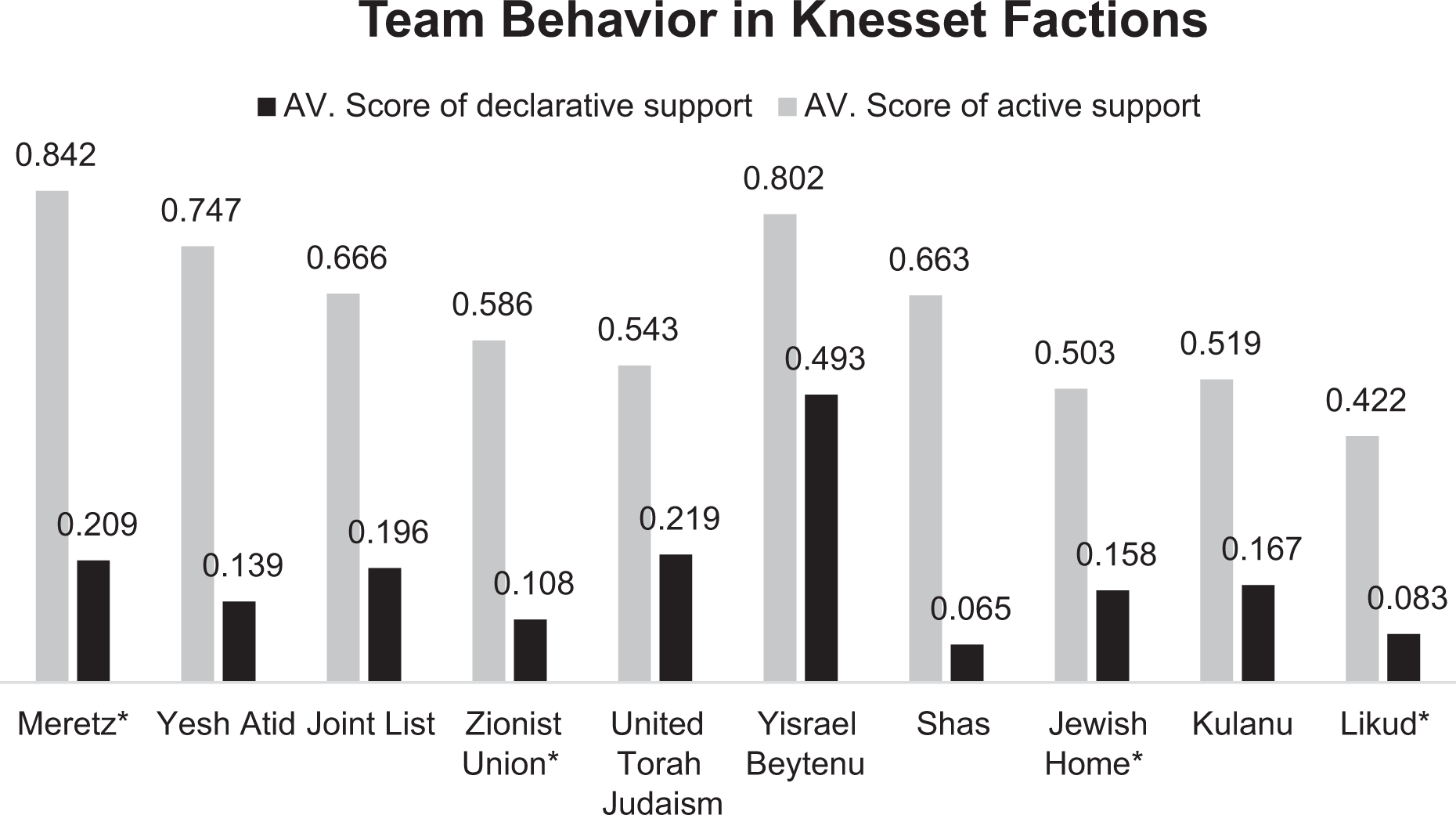
Average score of declarative and active support for bills by factions. * marks parties with inclusive candidate selection method.
The party that seems to be characterized by the highest team support is Yisrael Beytenu. In both measurements it scored high, especially in declarative support within the party, expressed in cosigned bills. On this measurement, its score is more than double the second highest score (United Torah Judaism, 0.219). As explained by a senior Yisrael Beytenu staff member in an interview, this is part of the party’s strategy, aimed at maximizing the influence of the party as well as exhibiting faction unity. On the other end of the spectrum, Likud scored the lowest on voting and second lowest on cosigned bills (0.422 and 0.083, respectively). Likud was the ruling party throughout the examined term, having the largest number of MKs as well as being the leading party in the coalition. This might have an effect on the number of tasks its MKs have, as well as their availability.
Variance between the parties is also visible when examining the active support variable. Some parties tend to rally behind their members’ bills at the crucial stage of the preliminary reading; others are less likely to do so. While the average score on active support is 42.2% in the Likud, Meretz’s score is 84.2%. It is interesting to see that Meretz has the highest number of bills proposed by its MKs, yet that does not affect its level of intraparty active support, which is the highest compared to other parties. In this case, party cohesion and party discipline can influence the results.
We can see that though, generally, the scores for parties on declarative support are lower than on active support, there is still variance between the parties in both measurements. Regarding our first question, the variance in declarative and active intraparty support indicates that personalized politics does not affect the parties in the same manner. Partisan-oriented behavior of MKs is still visible in some cases more than others. Thus, we can accept our first hypothesis by affirming that extensive use of private member bills, which are defined as a personal parliamentary tool, does not necessarily lead to a weakening of the party since partisan-oriented behavior was observed at different levels even while using this tool.
To verify this finding, and review our second question—under which conditions do MKs display partisan-oriented behavior (while using private member bills), and thus act as team players—we conducted a fractional logit analysis with standard errors clustered by party on the declarative and active measurements separately (Table 2). This method was used due to the characteristics of the dependent variables, as positioned on a scale between 0 and 1. In both models, we controlled for two intervening variables; initiator’s seniority and gender. While gender was treated as a dummy variable, seniority was measured as a continuous variable.
When examining the effect of candidate selection methods, we can see that holding all other variables at their means, a bill initiator from a party with an inclusive candidate selection method decreases declarative support from his co-party MKs by 19%, compared to an initiator from a party with an exclusive method. This is significant at a 99% level. However, when examining the same effect on active support, expressed by attending the plenary and voting for the bill, this variable becomes irrelevant. These findings allow us to accept hypothesis 2a, stating that inclusive selection methods lead to more individualistic behavior of MKs compared to exclusive methods, only with regard to declarative support. Coalition affiliation, the second independent variable, has a negative effect on intraparty support in both models. Holding all other variables at their means, a bill initiator from a coalition party decreases declarative support by 6.8% and active support by 21.8%. Both findings are significant at a 99% confidence level. Accordingly, we can accept hypothesis 2b, claiming greater intraparty support in opposition parties than coalition parties with regard to both models.
When examining the size variable, the active support model shows that holding all other variables at their means, a bill initiator from a medium-size party decreases partisanship by 12.7%, compared to an initiator from a small party. This figure rises to 16.2% with regard to an initiator from a large party compared to a small one (at 99% and 95% significance levels, respectively). The declarative support model also supports these results but in a more complex manner. Although an initiator from both a medium-size party and a large one decreases partisanship levels in comparison to a small party, the effect is not linear. Holding all other variables at their means, a bill initiator from a large party decreases intraparty support by 13.9% compared to an initiator from a small party, while one from a medium-size party decreases it by 23.2%. Both of these findings were significant at a 99% level. This still allows us to accept hypothesis 2c, indicating that MKs from smaller parties will act more like team players than MKs from medium and large parties.
These findings were found significant while controlling for two other variables at the individual MK level; gender and seniority. While gender was not found to be statistically significant in either model, seniority seems to be relevant only in the first. It was found that, holding all other variables at their means, a bill initiator who was an MK for more than just the current term decreases the declarative support of his co-party MKs for his bill; however, this effect is relatively small (3.2%).
Discussion and conclusions
In this research, we investigated the use of private member bills, an individual tool employed by MKs in the 20th Knesset. We sought to understand whether the widespread use of such a tool expresses personalized representatives’ behavior, which as it is believed, weakens the party. If this is not the case, then when do MKs act like team players even while using this tool. To answer our questions, we conducted an in-depth examination of private member bills in the Knesset. We measured intraparty support in two ways: declarative support, expressed by cosigning bills proposed by their faction, and active support, exhibited by attending the plenary and voting for these bills during the preliminary reading. We found that intraparty support can be traced within the use of private member bills, leading to the conclusion that personalized politics does not always weaken the party. We then sought to understand what factors sway MKs to demonstrate intraparty support, focusing on institutional variables at the party level. We found, first, that party-oriented behavior is more likely to be observed in parties with an exclusive selection method, but this finding only applies to declarative support. Such team behavior is more likely to occur in opposition parties for both measurements but more so for active support. Lastly, small parties (up to 9 Knesset seats) are characterized with higher levels of intraparty support, whereas MKs from medium-size parties (10–19 seats) are least likely to demonstrate such group behavior.
Our findings show that personalized politics, which is expressed by using a highly personalized tool, does not always lead to individual-oriented behavior that comes at the expense of the party group. This result challenges the way personalized behavior of politicians was measured so far, which contends that excessive use of a personal tool always harms the political group. Politicians can promote bills and policies in line with their party’s ideology by getting support from their party members. This helps support Rahat and Kenig questioning (2018) of the perception of personalized politics and personalization as a zero-sum game, in which power is divided between the party and its candidates.
In addition, our findings show that institutional factors influence the patterns of personal versus partisan-oriented behavior of politicians. When examining candidate selection processes, we can assume that when candidates are selected by an inclusive selectorate (party delegates or party members), intraparty competition will be high, leading to MKs working more individualistically. On the other hand, in parties with an exclusive method, MKs need to leave an impression on a very small and dominant selectorate, such as the leader or a small committee of the party elite, in order to be re-selected. In this case, MKs will want to be perceived as team players, putting the party before themselves, and intraparty competition will be significantly lower. The results of the declarative support model validate the findings of Bøggild and Pedersen (2018) and Itzkovitch-Malka and Hazan (2017) showing that the candidate selection method has sway over the levels of team behavior of politicians within the party. However, when examining this variable for active support, that is, attending the plenary and voting for the bill, this variable was not statistically significant.
The lack of statistical significance of the candidate selection variable on active support might be explained by the inclusion of MKs who serve a role in government as well as in parliament in the second model, as opposed to their exclusion in the first one. These dual roles affect their availability to participate in plenary votes, might be leading to a drop in partisan-oriented behavior in parliament. The increase in the coalition affiliation effect variable between the two models supports that claim. However, in order to validate this claim further research is needed, testing not only if the dual role of this representatives harms their availability to attend the plenum, but also if this is done in a coordinated way.
Our analysis reveals a paradox regarding the status of the party institution. On the one hand, inclusive candidate selection methods lead to a greater influence of party members on the party and its representatives, which supposedly strengthens the linkage between the party and the public. However, this also causes legislators to compete with one another. This leads to the understanding that by getting further away from the public, which was claimed to weaken the party’s status, the parties incentivize their representatives to work more as a collective, thus enhancing the power of the party. Additional conflict is added when considering the party’s strength in parliament. Coalition parties enjoy more power in parliament as they are part of an inherent majority. The same logic applies to large parties, as they hold more parliamentary seats. Yet they were both found to be correlated with lower levels of intraparty support, which eventually weakens the party.
Though interesting, our findings are not sufficient to complete the picture. More research needs to be done regarding personalized politics and its influence on the party in the parliamentary arena. By expanding the research over time and testing for personalization, we will be able to understand the process that Israeli parties have undergone and to examine it in light of the party decline hypothesis. That will also allow us to measure changes in candidate selection methods, coalition affiliation, and party size, and their effect on the balance of power between parties and their legislators. That can be done by using additional variables, both on the party and individual levels. Doing so could shed new light on the theory of party decline, adding to the already lively debate. In addition, an international comparison would be useful, enabling an expanded research sample and deeper examination of this phenomenon—exploring, for example, how it manifests in other political systems and cultures; or is it unique to the Israeli context? Finally, in order to fully understand the implications of personalized politics on the party, this topic should be examined beyond the level of parliament, mainly within the party organization.
Number of private member bills submitted on average by active MKs, by party.

Footnotes
Declaration of conflicting interests
The author(s) declared no potential conflicts of interest with respect to the research, authorship, and/or publication of this article.
Funding
The author(s) received no financial support for the research, authorship, and/or publication of this article.
