



Abstract
Whereas much of the existing literature on coalition formation has focused on the disparity between Gamsonian payoffs and the outcomes of bargaining models, dangers of ministerial drift, party ideal points, issue salience/emphasis, and negotiation complexity, very little has been said on the role of the way public opinion affects political behavior via expectation of future electoral returns. Following the logic of “issue yield,” this article argues that politicians allocate ministerial portfolios according to the distribution of public opinion in the hopes of obtaining better returns in subsequent elections and find compelling evidence linking public opinion with portfolio allocation.
Introduction
In multiparty parliamentary systems, parties must negotiate with each other to form coalitions and allocate cabinet ministries. Both coalition membership and portfolio allocation reflect the preferences of the parties’ leaders, who are thought to have preferences over policy, office, and votes (Müller et al., 1999: 5–8; Strom, 1990). At the same time, party leaders must always be cognizant of the next election and make decisions that will retain and increase support in the future. Therefore, anticipation for future electoral concerns matter for the bargaining over coalition formation. As Martin and Vanberg (2018) also emphasize, coalition bargaining “happens before an audience.”
In this article, I argue that the manner with which parties allocate portfolios among coalition partners is affected by future electoral concerns. Specifically, I argue that electoral concerns should affect the interparty bargaining that leads to allocation of cabinet ministries among coalition partners.
Conventionally, parties should value cabinet ministries to the extent that delegation allows them to enact policies that are in accordance with their policy preferences. Both theoretically and empirically, these policy preferences are thought to be driven by various factors, such as office benefits, party organizational imperatives, and activist influence (Strom, 1990: 574–575), as well as parties maneuvering to retain or increase voter support. Empirically, expert surveys evaluate some aggregate outcome of these factors, while manifesto data estimate this output from electoral materials that parties produce strategically, as a result of compromises between party members and the leaders’ intent to retain and increase support among the general public.
Party leaders should take this concern into account when bargaining over cabinet portfolios. Given that the information necessary to derive these potential electoral consequences consists of distributions of opinion and party support among the electorate, it should be possible to construct an empirical measure of anticipated change in voter behavior, based on the known distribution of opinion among voters. I implement this by applying the concept of issue yield, first introduced in De Sio and Weber (2014) as an indirect proxy measure of issue emphasis to measure the anticipated electoral payoffs of obtaining a ministry.
Thus, this article is able to provide both empirical and theoretical contributions to the literature on coalition formation. Empirically, it proposes a direct measure of party incentives derived from public opinion that suggests a direct mechanism rather than expert opinion or party outputs that are aggregates of various inputs. Theoretically, it makes an explicit case for connecting this type of elite behavior to voter preferences and explicitly specifies one component of party behavior which is usually aggregated into policy preferences. This article does not propose a challenge to the existing theories and measures of party ideal points and salience but rather proposes an alternative perspective.
For the argument to hold, voters must be aware of the outcomes of coalition negotiations and hold parties responsible for policy outcomes. A large literature examines cabinet membership as a heuristic that voters use to estimate party ideology (Adams et al., 2016; Fortunato and Stevenson, 2013). Duch and Stevenson (2008) show that when junior coalition partners obtain economic ministries, they tend to be disproportionately affected when voters punish incumbents for poor economic performance. Finally, Hjermitslev (2018) explores the differences in the costs of coalition participation and finds that the junior coalition partners tend to be penalized more than the party of the Prime Minister. While these works do not show how voters may perceive specific portfolio allocations, they demonstrate that voters obtain salient information from coalition formation.
Furthermore, this article contributes to the literature on qualitative portfolio allocation. This literature shows that party families tend to obtain certain ministries related to their focus (Budge and Keman, 1993; Laver and Shepsle, 1996). They also show that issue emphasis estimated through manifesto data is associated with the pursuit of the ministry, which holds jurisdiction over that issue (Bäck et al., 2011). Ecker et al. (2015) find similar results using an alternative framework, which supposes that parties have priority rankings for the ministries and that they engage in sequential bargaining to allocate posts between coalition members. Building upon Bäck et al. (2011), Greene and Jensen (2017) find that salience and disagreement at the issue level within the coalition “moderate the effect of issue salience on portfolio allocation.”
On the one hand, the coalition formation literature demonstrates how political elites interact strategically according to their policy preferences in coalition formation. This literature largely takes party policy preferences as given by assumption. On the other hand, the behavioral literature on coalition membership shows that voter behavior is influenced by coalition membership. Furthermore, an extensive and variegated literature beginning with works such as Downs (1957) also examines the manner with which voter preferences affect party behavior and policy preferences. Thus, it would be logical to surmise that party leaders should anticipate the electoral aftereffects of coalition membership and would therefore factor these concerns into their strategic calculus.
Yet the existing literature does not address how public opinion structures coalition formation, except Debus and Müller (2013) who examine the effect of voters’ preferences over potential coalitions on coalition formation. This article takes the implicit assumptions and implications of the existing literature and tests them in a novel way, demonstrating that party leaders act as if they are strategically reacting to voter opinion in a manner not previously explored. Thereby, this article explicitly demonstrates how existing understanding is consistent with democratic accountability in qualitative portfolio allocation, where elite preferences should be highly influential.
The empirical section of the article demonstrates that parties pursue cabinet ministries in a manner consistent with the notion that they maximize their electoral payoffs. The actual allocation of the ministries follows the same logic; once in coalition, parties attempt to obtain ministries that are most conducive to future electoral success.
The article is organized as follows. The second section introduces the argument for a theoretical connection between electoral pressures and portfolio allocation, as well as the use of issue yield to this end. The third section describes the data, and the fourth section analyzes the correlation between public opinion and portfolio allocation. Finally, conclusions are drawn in the fifth section.
Electoral pressures in coalition bargaining
In order to connect portfolio allocation to the manner in which parties may perceive the distribution of public opinion, I argue that the benefit that a party obtains from obtaining a ministry is similar to the benefit that a party obtains from emphasizing an issue. If a party controls particular ministries, voters are more likely to associate the party with policies in this issue area and may disproportionately hold the party accountable for them (Duch and Stevenson, 2008).
Unlike emphasizing issues on manifestos and other election materials, which is infinitely manipulable in theory, cabinet portfolios differ in that the parties must negotiate with other parties and make costly compromises to obtain them, making each allocation a costly signal rather than cheap talk, similar to commitment mechanisms such as internal party plebiscites or the production of joint manifestos (deMarchi and Laver, 2019; Moury, 2011). As such, the mechanism that ties issue yield to portfolio allocation remains distinct from issue emphasis, though arising from the same needs of the party to satisfy both supporters and the public at large.
A critical concern for parties must be how the results that flow from a portfolio allocation—including its policy implications—will play among voters whom the parties rely on for future support. To investigate this connection between portfolio allocation and voter perceptions, I construct a measure of electoral anticipation that is derived directly from the distribution of public opinion, which provides a direct link between a party’s strategic electoral calculus and party behavior in forming a government. This measure allows this article to demonstrate the plausibility of a specific mechanism through which inputs into a party’s decision-making (public opinion) are processed by party leaders (electoral anticipation) resulting in concrete outcomes (portfolio allocation), which serves to clarify the empirical results of the existing literature that use party ideal points as inputs.
Conceptually, a party should anticipate the degree to which emphasizing some issue or obtaining some cabinet portfolio leads to electoral outcomes. For example, it seems intuitive that a green party should pursue the environmental ministry. In a conventional schema, the degree to which a party pursues a cabinet portfolio is determined by the position that the party takes on the issues related to that issue and the degree to which this issue is salient for the party. This article takes the approach that the party could also be looking at the direct payoffs of obtaining a ministry, as it might do when taking positions on issues or emphasizing them. Parties see issues as a matter of both taking positions and emphasis, and the manner in which ministry-related issues play out is treated as such for the voters. Voters have specific positional sides and parties will stand to gain support from such voters by obtaining ministries, thereby implementing policies on their side of the issue, and also by emphasizing the association between that issue and their party. This approach does not contradict the theoretical and empirical use of party ideal points but rather serves as a clarification of one possible mechanism through which parties may develop and act upon preferences in the context of coalition bargaining.
For example, imagine that some hypothetical ecologist party is about to enter a coalition and its supporters are near-unanimously in favor of implementing stringent environmental policies and that these policies are also generally popular among the electorate as a whole (albeit not as much as among the ecologist party supporters). If supporters of other parties in the coalition are more divided on this issue, it is reasonable to think that the ecologist party will benefit electorally from obtaining this portfolio more than would the other parties. A party that holds the environmental ministry must (a) take a more specific position on the issues under that ministry’s jurisdiction, (b) associate itself with those issues related to that ministry, and (c) have more leeway over the policies under that ministry; other parties risk losing their current supporters and perhaps gain some new voters, whereas the ecologist party is set to keep their current voters and possibly obtain new ones. In this framework, the payoffs need not be zero sum for coalition members; if different members of coalitions have different issue yields for different issues, then they can mutually benefit by assigning ministries to parties that stand to benefit from them. However, if coalition partners have similar issue yields across ministry-related issues, then it may look much more like a zero-sum game as they would covet the same ministries.
Heresthetics and issue yield
In order to understand the electoral benefits of holding specific cabinet ministries, this article utilizes the concept of issue yield. Issue yield is a measure of the potential electoral benefits from emphasizing a given issue, which measures the degree to which emphasis on an issue allows parties to maintain their current supporters and obtain new ones. This measure takes the degree to which a party’s supporters are in favor of an issue and the degree to which the public at large is in favor of that issue, assuming that issues that have large followings in both will allow parties to attract new supporters without alienating their current supporters. In the context of portfolio allocation, a party would want to obtain a ministry which allows it to appeal to the public at large without splitting its own support base.
De Sio and Weber (2014) develop the notion of issue yield to measure the efficacy of focusing on different issues based on the relative distributions of support for an issue both within the party’s current supporters and in the general public. It measures the “degree to which an issue allows a party to overcome the conflict between protection and expansion of electoral support” (De Sio and Weber, 2014: 871). De Sio and Weber (2014) show that issue yield can predict issue emphasis in manifestos, and De Sio et al. (2017) predict issue emphasis in messages posted on parties’ Twitter accounts. De Sio et al. (2016) explain how difference in the issue yields for the European integration issue between pro and anti-integration parties during the Eurozone crisis encouraged pro-integration parties to forestall politicization of that issue. This concept can be used to think about electoral concerns on portfolio choice and only requires readily available mass survey data.
Issue yield divides issues into four categories. “Bridge” which is supported by both the electorate as a whole and the party’s supporters, which allows parties to keep their supporters while expanding support. The two second-best cases are “venture” with high support in general electorate but low support among party supporters and “pamper” with low support in the general electorate and high support among party supporters. The worst is “dead-end” issues, which are issues that have low support among both electorate and party supporters (De Sio and Weber, 2014). Issue yield maps this framework onto a two-dimensional space where the dimensions are supported among electorate and party supporters, which can be projected into a unidimensional score that measures the degree to which emphasis on the issue is advantageous. Relative issue yields should then predict issues that are advantageous to emphasize for each party. It also assumes that gaining a new supporter is valued equally as keeping an existing one.
De Sio and Weber (2014: 877) define issue yield as

where i is the “proportion of the electorate supporting a policy,” which is obtained by taking the proportion of the survey respondents who are in favor of some policy. p is the “proportion of the electorate supporting a party,” which is also taken from survey data, and f is the “proportion of the electorate supporting both policy and party” by computing how many are simultaneously in favor of that policy and in support of the party in question.
This result is a scaled score for and against each issue that is comparable across parties for each issue, where greater magnitude signifies greater potential benefit from emphasizing that issue. Assuming that parties would not emphasize issues in the less beneficial direction, the analysis takes the higher value between the for and the against issue yield scores as the score for that party for that issue.
The greater the issue yield is for a party regarding a given issue related to a specific ministry, the greater is the expected electoral benefit from the association that voters will have between that issue and the party. Thus, each party is to have some idea of how beneficial each issue/ministry is for it going into coalition negotiations, contributing to the payoffs that parties expect ex ante for any given potential portfolio allocation.
Bargaining
To study the dynamics of portfolio allocation, we must have some prior ideas on why parties may or may not pursue ministerial portfolios, what utility parties gain from them, and how parties bargain over portfolios. The subsequent analysis assumes that Gamson’s law holds, so parties are constrained to receive the number of ministries roughly in proportion to their legislative seat contribution and also restrict scope to portfolio allocation alone rather than allocation and coalition formation jointly. These assumptions and scope restrictions are maintained to keep the analysis tractable to reduce the possible portfolio allocations at the conceptual stage.
First, cabinet ministries can be seen as inherently valuable to political elites and as sources of rents and patronage. Second, cabinet ministries are valuable for the agenda control and policy control they provide; while institutions exist to enforce coalition agreements and prevent ministerial drift, delegation means that parties will be able to influence policy for issues under ministerial jurisdiction than for those that are not. For the component of portfolio payoffs that are related to voter perception and therefore future electoral returns, we must keep in mind that a party must (a) take a more specific position on the issues under that ministry’s jurisdiction, (b) associate itself with those issues related to that ministry, and (c) have more leeway over the policies under that ministry and be seen as such. This study focuses on the role these payoffs play in portfolio allocation.
For this mechanism to work, elites must think that voters attribute responsibility for policymaking over a given issue to the party controlling the ministry with jurisdiction over that issue more than those that do not. There is some evidence in the literature for voter reactions to partisan cabinet ministers. For example, Duch and Stevenson (2008: 271–275) discuss how “voters attribute more responsibility for economic policy making to parties holding economic ministries.” Thus, we can formulate the main hypothesis to predict qualitative portfolio allocation (which parties obtain what ministries).
Given that a set of parties have agreed to form a coalition, party elites take the distribution of voter preferences as given and anticipate the potential benefits from obtaining specific ministries from the current distribution of voter preferences. They would do so through judging which issues are favorable for them to associate with.
Subject to the Gamsonian constraint, party leaders face incentives to obtain ministries that provide them with large issue yields. As a result, we expect party leaders to work harder to obtain a ministry as the issue yield associated with that ministry increases. Of course, their ability to do so is going to be constrained by the issue yields placed by other parties on the same ministry. Thus, if there is no conflict over ministries, the theory would imply that all portfolio allocations can be predicted with issue yields, since all parties will receive the proportional number of ministries that they want the most. If there is complete conflict, that is to say, all parties have the same issue yield for each ministry, issue yield would not be particularly informative, as the situation is now completely zero sum and the parties have no complementarities in their preferences over ministries. When there is conflict over some ministries but not others, issue yield should generally be correlated with the outcome.
Demonstrate that this method is able to capture the effect of issue yield on outcomes with a theoretical Monte Carlo, using synthetically generated cabinets with 10 ministries and 3 parties. This simulates a series of scenarios where parties are allocated ministries proportionately to their seat share, first randomly, and then according to multiple plausible scenarios where parties are assigned ministries according to randomly generated “issue yields.” This shows that the coefficient for the issue yield variable in a regression similar to the one carried out in the main analysis of this article is zero when assignment is random and positive with the plausible nonrandom allocation.
Thus, there should be a positive correlation between the ministry actually obtained and the strategic benefits that a party obtains from it.
Data
Data sources
This study uses survey data from the European Values Survey (EVS) for the 1990, 1999, and 2008 waves to measure the distribution of preferences across the electorate and among party supporters. This is because the EVS consistently covers certain questions pertinent to ministerial jurisdiction in a consistent manner over time and across countries. These data can be used to derive issue yield in the manner of De Sio and Weber (2014). Other surveys have not been conducted over a sufficient period of time, do not contain survey items that correspond to enough ministries, do not keep enough survey items over time, or do not ask for party preference. The latest wave of EVS is not used because data for some of the controls do not cover the period after 2017.
The list of ministries is taken from Bäck et al. (2011), 1 but exclude ministries with insufficient coverage. Due to the lack of fine-grained data and for conceptual clarify, this article does not account for portfolio structure, or how politicians merge, divide, create, and abrogate cabinet-level ministries for political gain. Table 1 maps the correspondences between the cabinet ministries and the EVS questions, using the question codes from the Integrated Values Surveys 1981–2014. The full wording of each question is reproduced in Online Supplemental material. The list of cabinets used in this article in Online Supplemental material also shows how many ministries were included in the analysis for each formation opportunity. Ministries with nonpartisan ministers are dropped from analysis.
Correspondences between ministries and survey items.

These questions are reduced to a for/against binary and used to compute issue yield, and then averaged across issues for ministries with multiple questions. For each issue–party pair, separate scores for “for” and “against” are computed, since the scores are not symmetrical for “for” and “against.” The “for” scores are taken as that party’s issue yield for that issue based on the assumption that the expansionary side of a given issue will be more important for parties competing over portfolios. When questions have neutral options (as would be the case on a Likert scale), the neutral respondents are divided into half, where one half is assumed to be for and the other half assumed to be against.
For the issue yield framework to work, questions on specific issues with clear agree/disagree positions should be used, such as “the state should own major public services” or “private enterprise is best” (De Sio and Weber, 2014: 874). Given the lack of consistent data for some ministries, not all ministries are matched with the sort of agree/disagree questions used in De Sio and Weber (2014). Some of the questions for this study measure confidence rather than issue approval. This is justified as a proxy for approval on what the cabinet ministry could do regarding these institutions, such as the European Union or the armed forces, where the approval of the institution is interpreted as a for/against policies of the status quo position, whatever that may be. For the environment, this study also used “would give a part of my income for the environment,” which is more of a personal question rather than a question about issues or policy. However, this question is used as a proxy for the degree to which voters may be willing to trade off material/economic benefits for environmental protection.
For ministries that are associated with the same set of questions, such as the finance, economics, labor, and industry portfolios, they are treated as separate ministries but have the same independent variables predicting assignment. To increase coverage, the questions may not be the exact question pertinent to that ministry’s jurisdiction at that point in time, but it is necessary to sacrifice exact correspondence to get a large enough sample to conduct analysis on.
Thus, each coalition formation opportunity was matched with the relevant issue yields derived from data from the most recent survey wave. In many cases, coalition formation opportunities contained parties that were either never measured because of the time between the survey waves or only measured after the coalition formation took place. Given that all the choices have to be specified for the choice model to work, formation opportunities that contained parties for which no survey data prior to the coalition formation opportunity were available were dropped entirely. Online Supplemental material shows that the results still hold when using the temporally closest survey wave, which increases coverage to 69 cases, but raises the problem of reverse causation, as the model is effectively predicting past events from future data. Further analysis in the robustness checks section also demonstrates that the results are robust to censoring the data to use data within 4 years rather than all usable survey data.
As a caveat, this measure is rather indirect and comes with some limitations, both theoretically and in terms of operationalization. This analysis is not able to account for the issues pertinent to sections of the party apparatus, which may have preferences that diverge greatly from supporters at large, as it counts all supporters in the same manner. Furthermore, it fails to account for cases in which the pertinent issues for a given ministry change over time or when the weight of importance given to different issues for a given party changes. This measure also does not account for cases in which parties may perceive different issues as salient to different individuals or groups of individuals. Issue yield may not be useful, for example, if a group of party supporters cares about a particularistic issue that is neither relevant to the voting public at large nor covered under the opinion surveys used in this article. The analysis in this article is also unable to account for changes in relevant issues over time, even though issues pertinent to a given ministry in one election are bound to be different from issues pertinent in the following election, and such issues are also bound to vary considerably across countries. Finally, the lack of questions with sufficient coverage and consistency over time severely limits the ability of the issue yields to closely match the types of issues relevant to the ministries in question, even if we ignore the issue of cross-national and over-time variability in ministry-relevant issues. However, these issues highlight the indirectness of the measure used and should tend to bias against finding significant results.
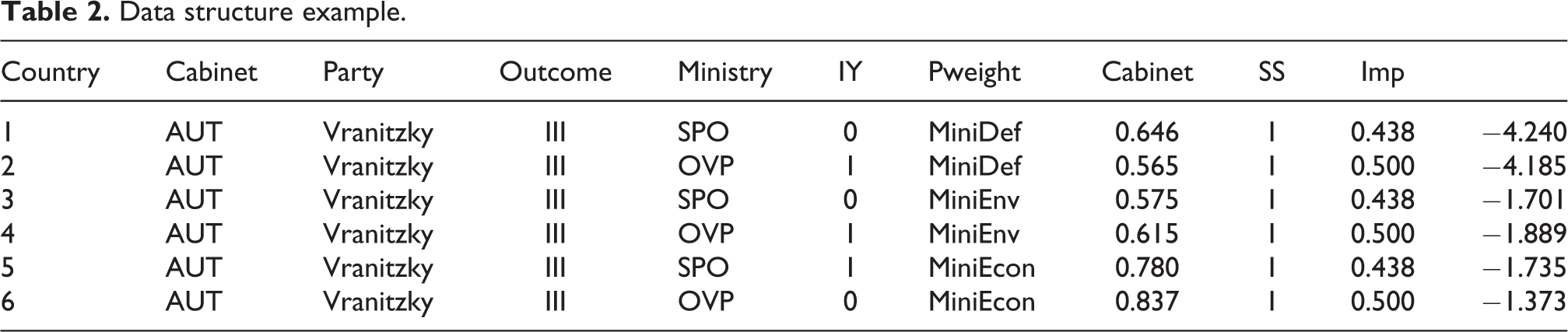
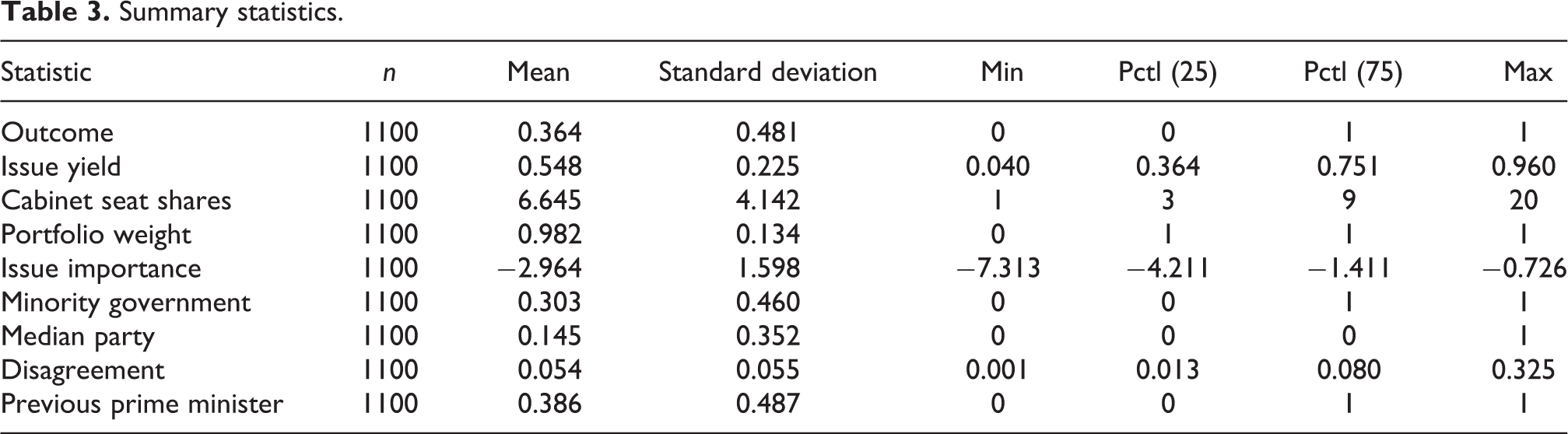
Data for coalition membership and party-level characteristics are obtained from replication data for Cutler et al. (2016), and data on portfolio allocation are obtained from Martin and Vanberg (2018). Data for party ideological positions are obtained from Lowe et al. (2011), and general left–right scores are obtained from the Comparative Manifestos Project, which uses manifesto data to measure party position and importance per dimension. Each ministry is matched with a dimension, with the economic ministries matched to “state economy,” defense with “militarism,” social/health with “traditional morality,” foreign ministry with “European Union,” environment with “environment,” and justice/interior with “multiculturalism.” These measures are not scaled to be comparable with survey results but are included to control for per-issue ideological proximity between the parties. In order to estimate the effect of issue yield, which varies across both parties and issues, each row in the data set is a combination of cabinet formation opportunity, party, and ministry, as presented in Table 2. Table 3 presents the summary statistics for this dataset.
Data structure example.
Summary statistics.
Data structure
Given the data availability, this article examines portfolio allocation for 40 coalition formation opportunities from 1990 to 2011 for a set of West European countries with parliamentary governments for which sufficient data were available (full list of coalition formation opportunities listed in Online Supplemental material). 2 This translates to 1100 possible allocations (potential party–ministry pairs for each coalition formation opportunity). The outcome variable indicates whether that party actually received the ministry or not.
Each row in the data set is a possible allocation of a party to a ministry for a particular coalition formation opportunity, which is grouped into choice sets by ministry. The choices are stacked in coalition formation opportunities. For example, for the Vranitzky III government, the SPÖ did not receive the Defense Ministry, whereas the ÖVP did, and vice versa for the Ministry of Economy. Each row also contains covariates that either vary across ministries (portfolio weight), parties (cabinet seat share), or across parties and ministries (issue yield, issue importance, median party). These variables will be described in greater detail in the following section.
Analysis
This article examines the effect of electoral concerns on how the ministries are allocated, given that a coalition has already formed, and demonstrates that public opinion as it relates to potential electoral gains plays a role in coalition bargaining. The estimation strategy subsection explains the problems in estimation, given the object of analysis and why conditional logistic regression was the appropriate method for this analysis. The subsection on confounding variables explains the logic for choosing the controls in the models, and the results subsection interprets the outcomes.
Estimation strategy
In this instance, the unit of analysis is the party–cabinet–ministry–coalition–formation–opportunity pair, and the alternatives are the parties in a coalition. Following Bäck et al. (2011) and Greene and Jensen (2017), a conditional logistic model is estimated to test the hypothesis by determining the effect of issue yield on portfolio allocation. This article employs the following empirical specification:

where i indexes ministries, j indexes parties, and c indexes coalition formation opportunities. Similar to a choice model commonly used to model phenomena such as voter behavior in choosing between multiple parties, the outcome is the allocation of a party to a ministry, where the ministry “chooses” between different parties for the coalition formation opportunity.
Since this model does not estimate a baseline, what matters for the choice outcomes are the relative values of the likelihoods estimated for each alternative, since the likelihood for a given outcome is divided by the sum of the exponents of the likelihoods for all alternatives. In substantive terms, this means that the model captures the competitive nature of parties fighting over portfolios and accounts for the attributes of the other parties in the coalition to calculate the probability of one party obtaining a ministry.
While the model assumes that the outcomes are not systematically related across choice opportunities, there are reasons to think that they might be. To begin with, there is clear dependency across choice opportunities within coalition formation opportunities (i.e. different ministries within the same formation opportunity).
First, Gamson’s law implies that parties that already have their proportionate share of ministries would be less likely to obtain additional ministries, regardless of the other parties’ characteristics. Second, parties trade off certain ministries for others, and this model does not capture the nature of these exchanges. To deal with within-formation, standard errors have been clustered at the coalition formation opportunity level, and controlling for seat share partially addresses the Gamsonian dependencies.
Furthermore, we can expect to see dependencies between cabinet formation opportunities in the same country. Such factors may include non-time-variant factors of the political or party system that vary across countries, such as portfolio allocations that are given out of path dependence or as a matter of tradition rather than as an electoral concern. For example, the German CDU/CSU (Christian Democratic Union Parties) has been known to consistently obtain the finance ministry in Germany. To address this, I provide robustness checks where the main model is rerun with each country dropped to make sure that no one country is driving the results. They show that the results are robust to dropping single countries.
Finally, the model assumes that the parameters do not vary across portfolio allocation opportunities, that is to say, if issue yield affects portfolio allocation for the defense ministry in Austria, it should have the same effect when allocating a party to the foreign ministry in Sweden. We may think of several reasons as to why this may be violated. For example, ministries differ in the degree of attention they receive, and some countries can have ministries that are more or less independent of the governing coalition due to differential effectiveness of oversight mechanisms. However, we would expect that this should bias against finding a positive result, since the cases where issue yield matters less would lower the estimate.
A concern with any model that estimates allocation per ministry is that Gamsonian distribution implies that when one party obtains their proportional share of the ministries, the rest goes to the other parties, creating dependencies between the ministries. To control for this, the model includes a control for seat share, since without any prior information on qualitative portfolio allocation, Gamson would predict that the likelihood of a ministry going to a party is proportional to that party’s seat share.
Control variables
Theoretically, cabinet seat share, issue importance, median party, past Prime Minister’s party, and issue disagreement arise as potential confounders that generically affect the likelihood that any given ministry goes to any given party.
All analyses control for cabinet seat share. Laver and Shepsle (1996) argue that parties that are the median party for that issue dimension should be favored in portfolio allocation. Median party measures whether that party is the median party on that issue dimension, and issue importance is a measure of issue importance derived from manifesto data proposed in Lowe et al. (2011).
The literature also shows that parties that have relatively more extreme positions on the issue place greater value on that portfolio (Bäck et al., 2011; Greene and Jensen, 2017; Laver and Shepsle, 1996). The literature on formateur power argues that the formateur party has an advantage in obtaining portfolios and that the previous prime minister’s party is more likely to obtain formateur status. Controlling for party that provides the Prime Minister for that coalition would amount to regressing outcomes on outcomes, since the current prime minister’s party is chosen simultaneously with portfolio allocation as part of coalition negotiations, barring countries where formateurs are appointed ex ante. Therefore, formateur power is proxied by a dummy variable for parties that provided the Prime Minister in the previous cabinet.
Issue disagreement has also been shown to positively affect portfolio allocation. Disagreement is the per-issue distance between the party’s policy position and the median position in the coalition. Following the logic of logrolls theoretically stipulated in, Greene and Jensen (2017) show that the effect of salience is mediated by the issue-level disagreement between the party and the median position in the coalition.
Results
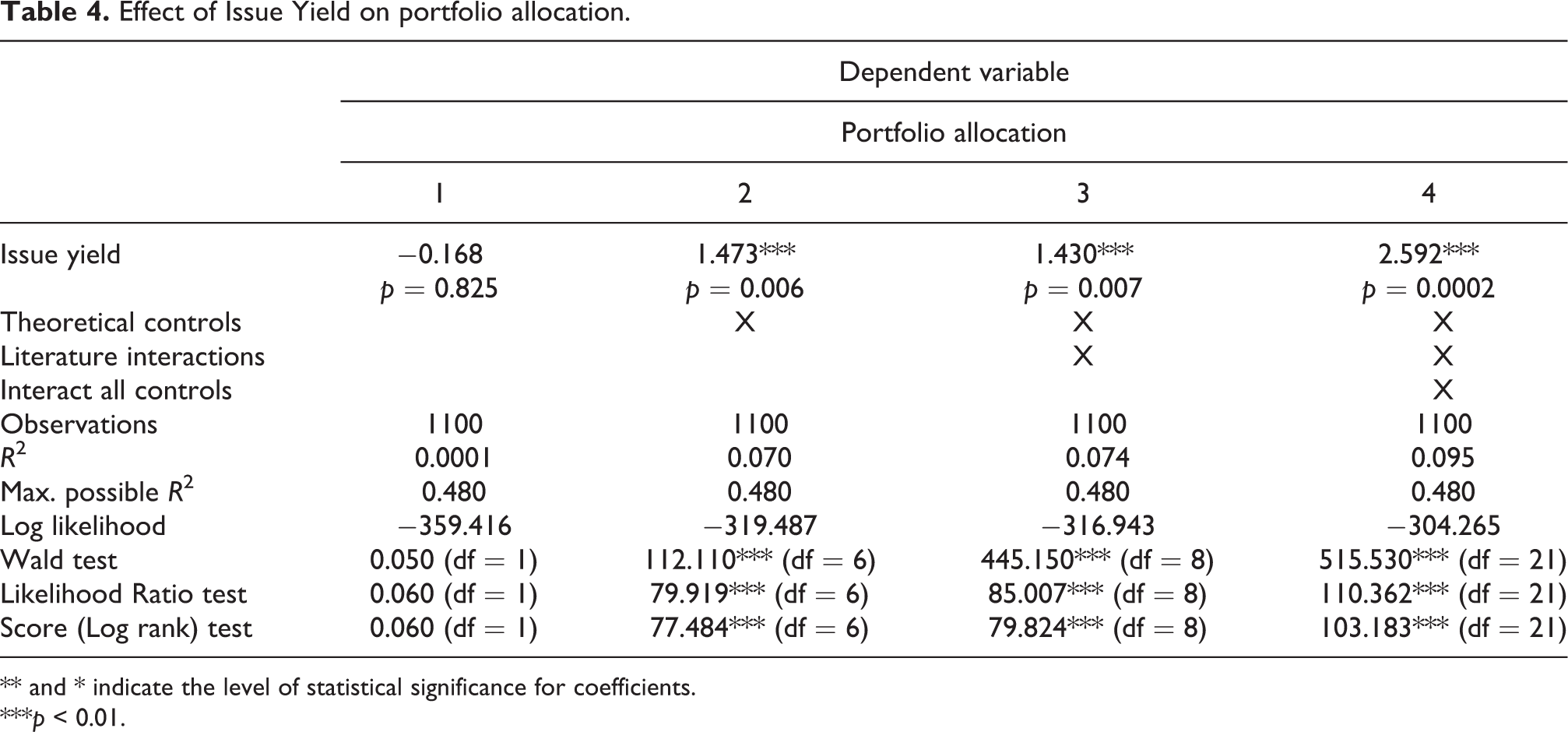
The first model in Table 4 shows a model that predicts portfolio allocation solely based on issue yield and is insignificant; this is expected, since this model effectively ignores Gamson’s law. The second, main model adds theoretical controls without interactions and demonstrates the positive effect of issue yield with a theoretically defined model. The third model demonstrates that the issue yield variable is statistically significant when adding the interaction variables from Bäck et al. (2011: 463) for the purposes of comparison. Finally, model 4 includes the second-order interactions of all the control variables, which provides an atheoretical robustness check against nonlinear dependencies among the control variables. The full models with coefficients for all covariates are available in Online Supplemental material.
Effect of Issue Yield on portfolio allocation.
** and * indicate the level of statistical significance for coefficients.
***p < 0.01.
Figure 1 demonstrates how issue yield can affect the predicted probability of a party obtaining a ministry in a specific scenario to substantively illustrate that effect. Using the second model from the main analysis, this scenario holds all covariates at their actual levels for the Foreign Ministry in the Schluter V government and varies the relevant issue yield for the Conservatives from the minimum to the maximum level. There is a statistically significant and positive change in the predicted probability of the FPÖ (Freedom Party of Austria) obtaining this ministry, as issue yield is manipulated from the lowest to the highest value.
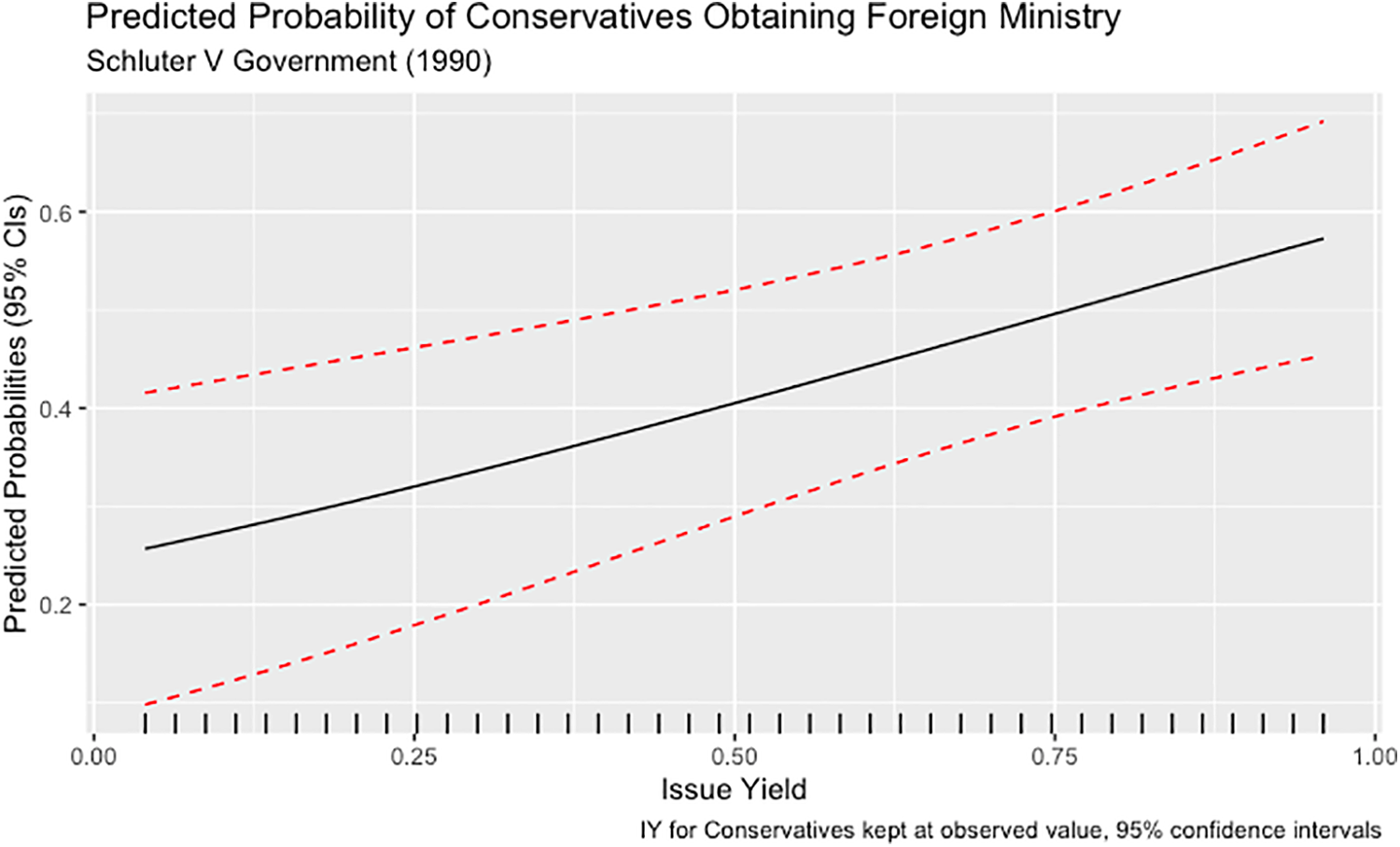
Prediction plot.
Thus, we find evidence to support the main hypothesis and reject the null hypothesis that issue yield does not affect portfolio allocation. This demonstrates that cabinet portfolio allocation does seem to be affected by parties’ reckoning of future electoral prospects for obtaining specific ministries, measured through issue yields. Robustness checks in the Online Supplemental material demonstrate that these results are robust to restricting year sampling, excluding single countries, and controlling for portfolio allocations of the previous cabinet.
Conclusion
To this date, little has been known about the direct effect of public opinion on coalition formation excluding Debus and Müller (2013) who address the connection between voter preferences for potential coalitions and coalition outcomes. This article “brings the voters back in” by looking at the plausibility of a direct relationship between the potential electoral benefits from holding office derived from the distribution of voter preferences and the behavior of parties forming coalition governments.
It also bridges the gap between the literature on government coalitions and the literature on the effect of party coalition membership on voter behavior, by proposing and testing the hypothesis that party behavior is conditioned by their recurring need to perform in the next election. Whereas the first literature ignored voters and took party preferences as given, the latter literature takes coalition membership as treatment and demonstrates that voters are affected by their perception of coalition government.
This article shows that an alternative perspective can be used to bridge the empirical and theoretical underpinnings of the existing literature. It relaxes the assumption of party preferences as given in the coalition formation literature and explores the implications of existing research by directly linking portfolio allocation to voter preferences, thus demonstrating the plausibility of a direct relationship between party elite behavior and mass opinion.
This could be seen as evidence in favor of a dynamic view of party politics, where the voter constrains and shapes strategic party behavior in coalition formation in the same way that voters have been shown to react to parties’ coalition behavior.
Given the findings of this article, qualitative evidence examining the specific mechanisms through which party leaders perceive voter preferences and act upon them could strengthen the findings of this article. Survey items on cross-national surveys that correspond more closely to the actual policy areas covered by cabinet ministries would also allow for further research in how public opinion shapes interparty strategic behavior.
Furthermore, a survey measure of ministry-oriented issues that are specifically relevant for the environment in which coalition bargaining takes place for that specific coalition formation would allow for a more precise test of the theory. For example, De Sio and Weber (2019) predict issue emphasis in party communications on Twitter using the issue yield framework for six European general elections in 2017 and 2018 by selecting a set of issues specifically relevant for that election. If a set of election-relevant issues related to each ministry could be determined systematically, and measured around election time over time, it would be possible to provide a more fine-grained analysis of how party leaders react to the specific ministry-relevant issues that are salient during coalition negotiations. Collecting data on public opinion that corresponds more precisely with issues pertinent to cabinet ministries during a given coalition formation would allow researchers to overcome the necessarily indirect and noisy measures of party motivation used in this article.
To further test the findings of this article, future research could examine the effect of holding specific ministries on future votes. The logic of this article would imply that governing parties that obtain the ministry that maximizes issue yield should perform better in subsequent elections. Insofar as parties cannot always obtain the ministries that they want, the degree to which a party gets what it wants should be correlated with electoral returns in the next election.
Supplemental Material
Supplemental Material, sj-pdf-1-ppq-10.1177_1354068820914547 - The effects of electoral anticipation on portfolio allocation
Supplemental Material, sj-pdf-1-ppq-10.1177_1354068820914547 for The effects of electoral anticipation on portfolio allocation by Harunobu Saijo in Party Politics
Footnotes
Acknowledgements
I thank Georg Vanberg, Scott DeMarchi, Ida Hjermitslev, Herbert Kitschelt, Daniel Stegmüller, Zeren Li, Till Weber, Marco Morucci, and anonymous reviewers for helpful comments. The data and the replication instructions can be found at my website.
Declaration of conflicting interests
The author(s) declared no potential conflicts of interest with respect to the research, authorship, and/or publication of this article.
Funding
The author(s) received no financial support for the research, authorship, and/or publication of this article.

Supplemental material
Supplemental material for this article is available online.
Notes
Author biography
References
Supplementary Material
Please find the following supplemental material available below.
For Open Access articles published under a Creative Commons License, all supplemental material carries the same license as the article it is associated with.
For non-Open Access articles published, all supplemental material carries a non-exclusive license, and permission requests for re-use of supplemental material or any part of supplemental material shall be sent directly to the copyright owner as specified in the copyright notice associated with the article.
