



Abstract
The literature has pointed to a change in radical right-wing parties’ (RRWPs) position regarding the welfare state. Those parties have abandoned the neoliberal approach on distributive issues and have become defenders of social expenditure for deserving groups. Nevertheless, as RRWPs have joined with right-wing mainstream parties to form governments, their distributive policy position might cause conflict in a coalition. This study, therefore, addresses this puzzle by analysing the social policy outcomes of RRWPs’ government participation. The conclusion is that those parties contribute to the welfare state retrenchment. However, policies are not affected evenly. Expenditure that targets groups regarded as undeserving by the radical right is retrenched the most.
Introduction
The increasing electoral success of radical right-wing parties (RRWPs) has led to their recurring participation in Western European democracies. Mainstream parties’ ambitions to gain government power and implement policies have caused them to turn to RRWPs as coalition partners (de Lange, 2012). This partnership has also provided the opportunity for RRWPs to influence policymaking on core issues; for example, scholars have pointed to their direct and indirect influence on the adoption of restrictive immigration and integration policies (Akkerman, 2012; Minkenberg, 2001; Schain, 2006; Williams, 2006). Particularly, studies focusing on immigrants’ entitlement to social rights have noted that RRWPs have successfully influenced the adoption of chauvinist welfare policies (Afonso, 2015; Careja et al., 2016; Koning, 2013). However, once these parties achieve government power, it is expected that they will influence policy also outside their core issues, including economic and social policies (Röth et al., 2017).
Significantly, the differences between mainstream and RRWPs’ positions regarding distributive issues pose a potential conflict between these parties within a government coalition. Mainstream right-wing parties prioritise economic performance; they cast votes based on their economic proposals and want to be perceived as fiscally responsible, which often means supporting welfare state retrenchment. Conversely, by the early 1990s, many RRWPs that had begun promoting neoliberal agenda expanded their vote share by embracing welfare state defence (Afonso and Rennwald, 2018; Betz, 1994; Kriesi et al., 2006). Moreover, RRWPs’ distributive agenda often includes support for excluding immigrants from social protections, which is a policy not generally embraced by mainstream parties.
While this dilemma is documented in the literature (Afonso, 2015), the outcome of RRWPs’ incumbency in terms of social policies has barely been explored. Afonso (2015) and Röth et al. (2017) are valuable exceptions. The first study showed that RRWPs might jeopardise the coalitions’ stability by pursuing a welfare defence strategy. Conversely, the latter found a positive relation between RRWPs’ government participation and welfare state generosity. This piece revisits this open question about the relationship between RRWPs and welfare state, but innovates by addressing, separately, their impact on the social policies that target groups considered deserving and undeserving.
This separation is crucial to understand and theorise RRWPs’ influence on welfare state. Although the literature reports that RRWPs have become more supportive of welfare state expenditure since the 1990s (Afonso, 2015; Careja et al., 2016; Rydgren, 2004; Schumacher and Kersbergen, 2016), this support is not unrestricted and comes with limitations on who deserves access to social benefits. Based on narratives about which groups contributed to the nation, the RRWPs draw a line between deserving and undeserving of welfare benefits. Such rhetoric not only serves as a justification to exclude immigrants’ access to welfare state but also to restrict welfare state for larger social groups, as social assistance recipients and unemployed people. Thus, to disregard the RRWPs’ double-edged sword position on welfare state expenditure may lead scholars to overlook their influence on social policy reforms.
The analyses in this article suggest an exchange process resulting from the partnership between RRWP and mainstream right-wing parties. RRWPs compromise with the mainstream right on the adoption of sharp welfare state retrenchment. On the other hand, RRWPs shape this retrenchment, as groups regarded by those parties as undeserving are the main target of welfare cuts. This interpretation is corroborated by the fact that RRWPs’ government participation led to the adoption of direct restrictions on immigrants’ entitlement to social rights.
The article will proceed as follows. First, I will discuss the RRWPs’ policy position on distributive issues. Second, I will present the hypotheses of the study, introduce the methodology and present the results of the statistical studies. Third, I conduct a case study on the Danish Peoples’ Party’s (DPP) influence on two welfare state reforms in Denmark. This case addresses the negotiations on welfare chauvinist and welfare retrenchment measures that occurred during the period that this party participated in the government. The goal is to verify the causal mechanism behind the results observed in the quantitative studies. Last, I will present the conclusion of the studies.
RRWPs’ profile vis-à-vis distributive issues
In their influential work, The Radical Right in Western Europe (1995), Kitschelt and McGann (1995) analyse the positioning of RRWPs in two dimensions, socialist/capitalist and libertarian/authoritarian. The authors point out four possible positions for these parties: (1) authoritarian and capitalist, (2) populist, (3) antistatist and (4) authoritarian ‘chauvinist welfare’. They consider the authoritarian capitalist appeal the ‘winning formula’. Moreover, they affirm that the authoritarian ‘chauvinist welfare’ strategy is associated with limited electoral returns; it may be effective in a short period of depression or unemployment, but parties lose votes if they abandon the master strategy.
In fact, this ‘winning formula’ corresponds to the initial economic agenda of many RRWPs. Those parties defend a strong liberal agenda that includes reducing taxes to a minimum, which attracted mainly small business owners, and white-collar workers (Kitschelt and McGann, 1995). However, scholars have pointed out that the master strategy that coincides with the emergence of those parties is not the one perused during their electoral expansion (Betz, 1994; de Lange, 2007). By 1990, to increase the number of working-class voters and to avoid losing the support of the petite bourgeoisie, RRWPs on the left–right scale became centrist. This has been empirically confirmed by de Lange 1 (2007) and the Chapel Hill Expert Survey 2 (1999, 2002, 2006, 2010, 2010).
Rovny (2013), however, questions the possibility of placing RRWPs on the left–right scale, as these parties deliberately blur their economic position. Nevertheless, as RRWPs assumed power, it became difficult to avoid taking a position on distributive issues (Röth et al., 2017). Additionally, the research suggests that rather than obscure their economic agenda, RRWPs have increased the salience of the redistributive issue in their manifestos over time (Afonso and Rennwald, 2018). Currently, there is a relative consensus in the literature that RRWPs’ position on the welfare state, the central aspect in left–right positioning, has become more similar to that of the traditional left-wing parties (Betz, 1994; Marks et al., 2006; Röth et al., 2017).
Nonetheless, it is important to highlight some specificities of RRWPs’ rhetoric in relation to the welfare state. RRWPs’ nativist ideology prevents true egalitarianism, as these parties usually support restricting immigrants’ access to social schemes. They justify this position by the cultural distance between natives and aliens, as exemplified by foreigners’ alleged non-commitment to gender equality and freedom of speech (Reeskens and Van Oorschot, 2012). The social construction of immigrants as undeserving of social benefits, welfare abusers and welfare tourists is also used to justify restrictions on immigrants’ entitlement (Thomann and Rapp, 2017). Accordingly, RRWPs advocate that aliens’ access to social benefits should be based on previous contributions, proof of attachment to the country, or long periods of residence.
The deservingness rhetoric also serves as a justification for RRWPs’ preference for policies that benefit the elderly, a group they perceive as having worked hard to build the nation. However, the unemployed, especially long-term unemployed (along with ethnic minorities), are often regarded as lazy and as abusers (Afonso and Rennwald, 2018). Finally, the authoritarian appeal also shapes RRWPs’ distributive preferences; they are generally critical of the status quo and accuse existing social institutions of being permissive of cheating, endorsing laziness and creating privileges for politicians and civil servants (Derks, 2006; Van der Waal et al., 2010). Consequently, RRWPs often defend stricter rules for benefit entitlement and a tougher approach to deal with cheaters.
In summary, RRWPs have become more supportive of welfare state expenditure since the 1990s 3 (Afonso, 2015; Careja et al., 2016; Rydgren, 2004; Schumacher and Kersbergen, 2016). This support, however, is not unrestricted and comes with limitations on who deserves access to social benefits: immigrants, social assistance recipient and the unemployed are regarded as undeserving of public expenditure (Afonso, 2015; Careja et al., 2016; Rydgren, 2004; Schumacher and Kersbergen, 2016), and the elderly are regarded as most deserving.
Policy outcomes of RRWPs’ government participation
Many scholars have argued that political parties have a decisive impact on policy outcomes. Previous research, for instance, has shown a significant relationship between right-wing parties and welfare state retrenchment (Allan and Scruggs, 2004; Castles, 1982; Hicks et al., 1989). Nevertheless, the presence of RRWPs in government muddies this relationship. While they join right-wing parties in cabinets, which generally push for welfare state adjustments, RRWPs defend the welfare state to the deserving’s.
As Afonso (2015) describes the dilemma: by prioritising a vote-seeking strategy and seeking to preserve or expand the welfare state, RRWPs might create tension within coalitions and jeopardise their office-seeking strategy. Supporting chauvinist welfare measures is equally problematic, as mainstream right-wing parties might be cautious about adopting populist measures that might alienate moderate voters. However, as issues are not equally important to all parties, it is expected that negotiations between coalition parties will lead mainstream parties to seek concessions in terms of economic policies and to grant RRWPs latitude concerning integration and immigration policies (Christiansen, 2017). Based on this discussion, the first hypothesis of this study is put forward as follows:
Considering the particularities of RRWPs’ distributive preferences and the constraints imposed by coalition parties, RRWPs might concentrate their efforts on preserving the welfare state for deserving recipients, namely the elderly, while consenting policy retrenchments that target undeserving recipients (Afonso, 2015; Van Oorschot, 2006). By preserving their core electorate’s interests and conceding support for mainstream parties to promote budget cuts, RRWPs accommodate vote- and office-seeking goals.
This outcome is supported by the fact that welfare chauvinism has become a crucial component of the anti-immigrant agenda (de Koster et al., 2013; Rydgren, 2004) and that this rhetoric is vital to right-wing populist voting (de Koster et al., 2013; Ivarsflaten, 2008). Therefore, RRWPs will concede legislative support of welfare state adjustment and, in exchange, will implement restrictions on immigrants’ entitlement to social rights. Foremost, retrenchment focusing on undeserving recipients can be communicated to the electorate as indirect welfare chauvinism. While direct chauvinist welfare measures entail governments restricting immigrants’ access to social rights and preserving the rights of other groups, indirect chauvinist welfare measures entail restrictions that do not target immigrants specifically but, allegedly, harm them the most (Emmenegger and Careja, 2012). Examples include restrictions on unemployment benefits, social assistance and family benefits (Hansen and Lofstrom, 2009).
In line with this perspective, Arndt and Thomsen (2019) show that some voters link unemployment benefits, social assistance and family benefits with ethnic minorities, while pension policies are positively associated with native elderly people who are said to have worked hard and contributed to society. These perceptions have been shown to have political consequences, as voters who are less inclined to support policies benefit mostly ethnic minority groups have abandoned left-wing parties in favour of right-wing parties. This study agrees with that of Burgoon (2014), who finds that immigrants’ dependence on the welfare state diminishes citizens’ support for redistribution and social protection.
The idea that welfare recipients are not regarded as equally deserving of social policies is also corroborated by Van Oorschot’s (2000) empirical work. The author found that Europeans citizens regarded elderly, the sick and family with young children as the most deserving, while unemployed, social assistance clients and immigrants as the least deserving. Parties also contribute to building the public image of welfare recipients (Schneider and Ingram, 1993). The social construction of deserving and undeserving groups, based on narratives about who is believed to be a burden and who contributes to the nation, serves as justification for inclusion and exclusion of groups from the welfare state. The construction of immigrants as welfare scroungers justifies the adoption of chauvinist welfare measures (Jørgensen and Thomsen, 2018). The deservingness rhetoric also helps to build public support for welfare state retrenchment in general. By arguing that the retrenchment of policies that target undeserving recipients is necessary for preserving social benefits for the deserving groups, governments minimise the political costs of unpopular measures (Slothuus, 2007). Hypotheses 2, 3a and 3b address this dichotomy:
Hypothesis 3a deals with restrictions on social policies that affect the entire (underserving) population. However, as ethnic minorities are overrepresented among the recipients of certain social policies, such as social assistance and unemployment benefits, the retrenchment of those schemes can be considered indirect welfare chauvinism. Also, an additional hypothesis is made to capture exclusively direct chauvinist welfare measures:
Statistical studies
The study of RRWPs’ influence on general welfare state expenditure and public social expenditure on deserving and undeserving recipients will be assessed separately from the analysis of RRWPs’ impact on the adoption of direct restrictions on immigrants’ entitlement to social benefits. The studies are based on the data of 17 Western European countries: Austria, Belgium, Denmark, Finland, France, Germany, Greece, Ireland, Italy, Luxembourg, the Netherlands, Norway, Portugal, Spain, Sweden, Switzerland and the United Kingdom, from 1980 to 2014.
RRWPs’ influence on changes to public welfare state expenditure
Following previous studies (Kwon and Pontusson, 2010; Lupu and Pontusson, 2011; Römer, 2017; Röth et al., 2017), the statistical analysis relies on a linear or ordinary least squares regression with panel-corrected standard errors. 4 In such a model, the dependent variable is expressed in the first difference, and the lagged and first difference of each independent variable is included. The rationale is to distinguish the effect of transitory and enduring changes in independent variables on the variable of interest (Kwon and Pontusson, 2010). All models include country dummies; however, they were excluded from the result table to improve readability.
Dependent variables
Changes in welfare state provisions are operationalised as the annual change in the public social expenditure per head in US dollars, at constant prices, and constant purchasing power parity (PPP) (OECD, 2010). Three variations of this measure are employed: the total public expenditure per capita; the old-age 5 expenditure per capita, policies that target deserving recipients6; and the sum of public social spending per capita in unemployment schemes, 7 social assistance and income maintenance, policies that benefit undeserving 8 recipients.
The literature notes that social spending is not a complete measure of welfare state effort because it does not consider how the resource is allocated. However, as the analysis focuses on changes in expenditure within a country, differences in programmes’ entitlement rules and benefit types across countries are less critical (Jensen, 2011).
Independent variables
A large academic debate occurred regarding the conceptual clarification of these new parties that emerged in the right side of the political spectrum. Mudde (2004) proposed an influential definition for this new family: parties whose ideologies include a combination of nativism, authoritarianism and populism. Following Rydgren (2017), however, this study I opted to classify them simply as RRWP. The justification is that ethnic nationalism and authoritarianism, not populism, are the main features that influence those parties’ position on welfare state. These criteria of selection exclude, for instance, parties that are considered populist, but not radical, such as Forza Italia, in Italy, and Alternative Democratic Reform Party in Luxembourg (see Online supplemental material B for the list of parties considered in the study).
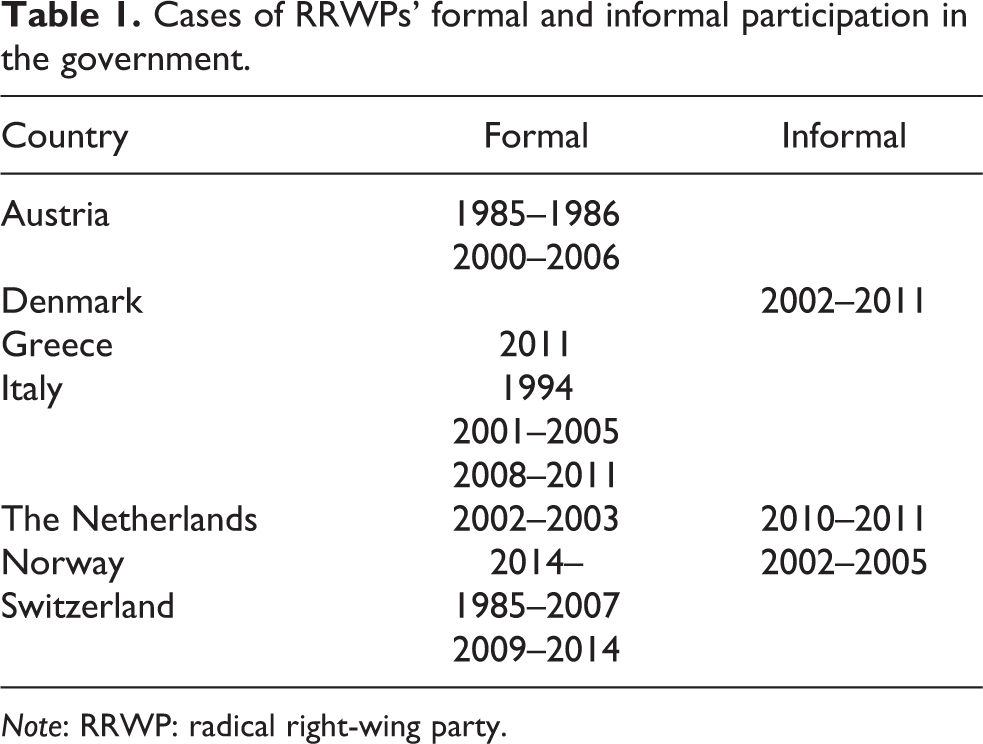
The variable of interest in this study is RRWPs’ government participation, measured as a binary variable (participation and non-participation). I also consider as government participation the stable legislative support of an RRWP to a minority government, without receiving portfolios. The cases considered are given in Table 1.
Cases of RRWPs’ formal and informal participation in the government.
Note: RRWP: radical right-wing party.
The participation of RRWPs is interacted with the government orientation, as the research has associated right-wing government with the adoption of welfare retrenchment (Allan and Scruggs, 2004; Huber and Stephens, 2001; Korpi and Palme, 2003). As a result, five categories are considered: left-wing, grand-coalition, grand-coalition with RRWP, 9 right-wing and right-wing with RRWP. The weighted sum of government parties’ positions on the left–right scale is used as an alternative continuous measure of government orientation (refer to Online supplemental material C for details).
Finally, RRWPs’ share of seats in parliament is used as a proxy for overall anti-immigrant sentiment in society. The increase in the presence of those parties in parliament might signal to the mainstream governments that anti-migrant policies have become relevant among voters and lead those parties to adopt RRWPs’ policy position. Those variables above are collected annually. In election years, I consider the data of parliament and government formations that stay more time in power during the year.
Economic and demographic factors can also lead to the adoption of welfare retrenchment policies. Budget deficits and unemployment increase the likelihood of welfare state retrenchment (Pontusson, 1995). A high elderly dependency rate may also negatively affect welfare state sustainability and lead to the adoption of restrictive measures. Finally, some studies have concluded that ethnic homogeneity is essential to building trust, which is critical to supporting collective action (Putnam, 2007; Soroka et al., 2006). Interestingly, Soroka et al. (2016) showed that the negative effect of migration on welfare state spending is not homogeneous across policy areas and is more pronounced in domains susceptible to the moral hazard discourse, such as unemployment benefits. Table 2 details the study’s independent variables.
Independent variables in the first statistical study.

Note: RRWP: radical right-wing party; OECD: Organization for Economic Co-operation and Development; ParlGov: Parliament and government database; IMF: International Monetary Fund; GDP: gross domestic product.
Results
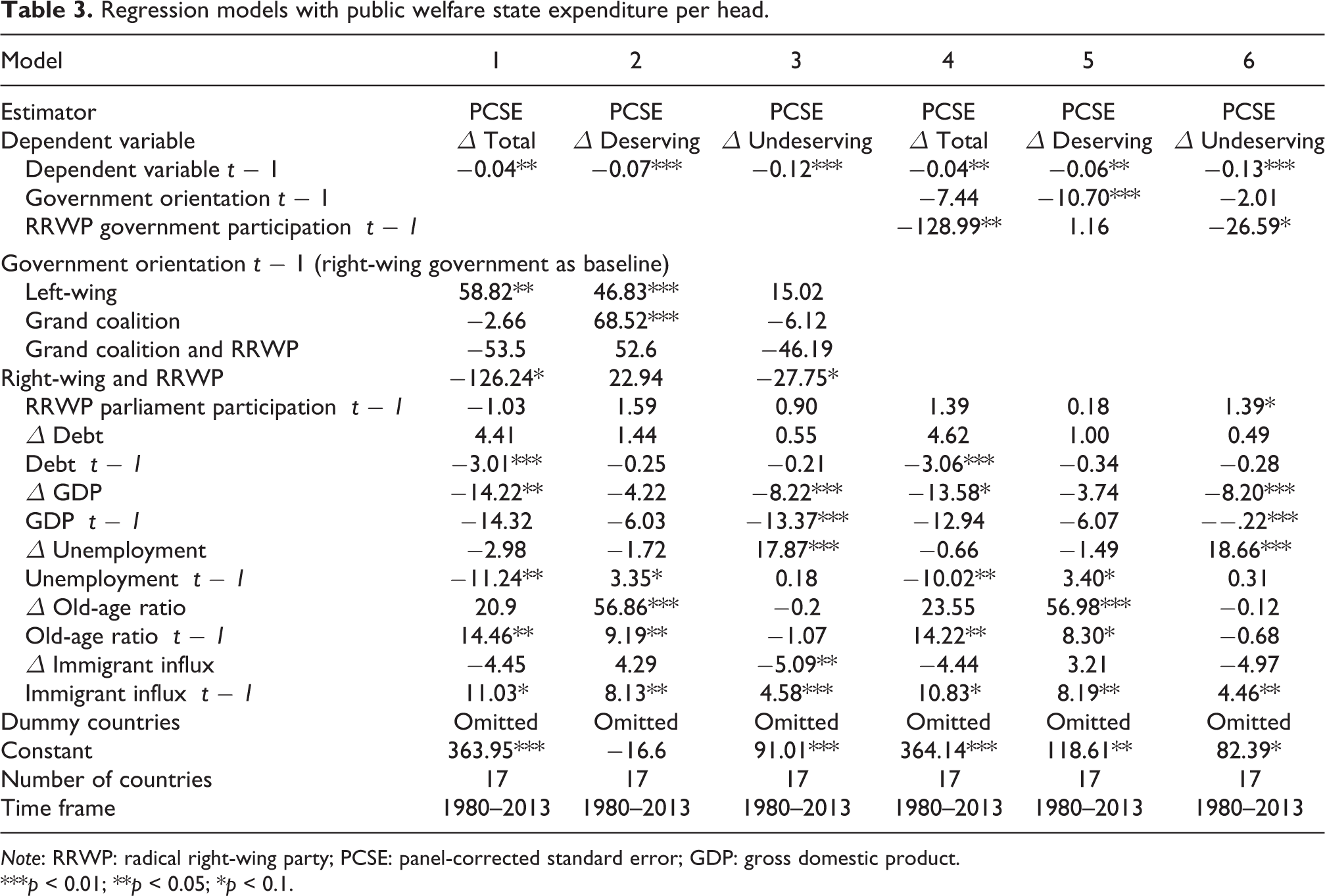
Table 3 includes the results of the models with the first difference of public welfare state expenditure as the dependent variable. Models 1–3 have a category measure of government orientation, and models 4–6 have a continuous measure of government position on the left–right scale. Models 1 and 4 have the first difference of the total public welfare expenditure per capita as the dependent variable, models 2 and 5 have the expenditure for deserving recipients as the dependent variable, and models 3 and 6 refer to changes in public expenditure for the undeserving recipients.
Regression models with public welfare state expenditure per head.
Note: RRWP: radical right-wing party; PCSE: panel-corrected standard error; GDP: gross domestic product.
***p < 0.01; **p < 0.05; *p < 0.1.
The results of model 1 indicate that, in relation to right-wing governments, right-wing governments with RRWPs are associated with a reduction in total public social expenditure per capita; the analysis showed that the presence of an RRWP in a coalition leads to an annual reduction of social expenditure of approximately 126 US PPP dollars per capita. Left-wing governments, conversely, are associated with expansion of total public social expenditure per capita; grand coalitions and grand coalitions with RRWPs participation are also comparatively more restrictive than right-wing governments; however, this result is not statistically significant. Immigrant influx and old age ratio are also positively related to public social expenditure per head; whereas, public debt level and unemployment are negatively associated with the dependent variable. The first difference of the gross domestic product (GDP) growth is also negatively associated with expenditure.
Model 2 considers public social expenditure per capita for deserving recipients: compared to right-wing governments, all other forms of government are associated with an increase in expenditure. This result, however, is only statistically significant for left-wing governments and grand coalition governments. Thus, although the coefficient indicates that right-wing government with RRWPs are comparatively more protective of old age social programmes, this result does not have statistical validity. The annual increase of the old age ratio and the level of this variable in the previous year are positive associated with social expenditure on old-age policies. Immigrant influx is also positively related to the dependent variable.
Model 3 shows that, having right-wing governments as baseline, left-wing governments are associated with increases in public expenditure for undeserving groups, whereas other types of government coalition are associated with expenditure cuts. This outcome, however, is only significant for right-wing parties with RRWP participation. The model shows that this type of government leads to a decrease of social expenditure that benefits the undeserving of 28 US dollars PPP per capita. Both the GDP growth of the previous year and the first difference of the measure are associated with the decrease of social expenditure for the undeserving. Immigrant influx in the previous year is also positively related to the dependent variable; however, the annual increase of this variable leads to a decrease of the dependent variable.
Models 4–6 partially tell the same history. Model 4 confirms that RRWPs’ government participation is associated with a reduction in total public social expenditure in 129 US PPP. The coefficient of the variables public debt and unemployment are also negative and significant, whereas the increase in old-age ratio and immigrant influx leads to an increase in total public expenditure. Model 5 shows that a marginal shift of government orientation to the right leads to a decrease in the expenditure of 10.4 US PPP dollars. In contrast to previous models, RRWPs’ government participation is associated with an increase in expenditure for the deserving recipients. Nevertheless, this coefficient is small and non-significant. Finally, model 6 also indicates that RRWPs’ government participation is associated with a reduction in welfare state expenditure for undeserving recipients in 26.59 US PPP dollars. The coefficient of government orientation is also negative but non-significant.
The analysis confirms hypothesis 1, which states that RRWPs’ government participation leads to a restriction in public social expenditure. A coalition of mainstream right-wing parties and RRWPs are the most restrictive (model 1); also controlled by government orientation, RRWPs’ government participation is associated with general welfare state retrenchment (model 4).
Models are inconclusive regarding the impact of RRWPs on social expenditure that targets deserving groups, hypothesis 2. Nevertheless, those non-significant coefficients suggest that indeed, RRWPs’ government participation might corroborate to a lesser reduction of old-age expenditure, in comparison with governments of mainstream right-wing parties. Finally, the models show clearly that RRWPs’ government participation is associated with the restriction of expenditure on policies that focus the undeserving, confirming hypothesis 3a. Compared to right-wing coalitions, governments that count on RRWP support are the most restrictive in terms of undeserving social expenditure (model 3) and controlled by government orientation, RRWPs are associated with restriction in social expenditure for the undeserving (model 6).
To check for robustness, the same analysis is performed with the first difference of welfare generosity as the dependent variables. This dependent variable is an index that considers the replacement rate, duration of the benefit, waiting period for entitlement and time of contribution required for entitlement for three insurance programmes – unemployment insurance benefits, sickness insurance and public pension. The data come from the Comparative Welfare Entitlements Dataset (CWED2) (Scruggs et al., 2017). The dependent variable was applied in three forms: the complete index, the index for pension policy generosity – policy that targets deserving recipients –, and the index for unemployment benefit generosity – a policy associated with the least deserving of public support.
The results are compiled in Tables 4 and 5 of Online supplemental material F. Here, it suffices to mention that the analysis does not present a significant coefficient for the variables of interest. Also, the coefficients of models that focus on total welfare generosity, policy generosity for deserving and undeserving recipients, have the same sign as models of Table 3.
RRWPs’ influence on the adoption of chauvinist welfare measures
The assessment of RRWPs’ influence on immigrants’ entitlement to social rights is be based on a study of the adoption of chauvinist welfare legislation. Therefore, I will perform two statistical analyses of the Determinants of Migration Policy database (DEMIG, 2015). The empirical analysis is based on an ordinal logistic regression. 10 The dependent variable will be transformed to obtain an ordinal dependent variable that takes into account the severity and scope of the restrictive measure (see Online supplemental material E for detailed information about the coding process).
Dependent variables
The data of legislation that restricts immigrants’ entitlement to social rights 11 come from the DEMIG POLICY database at Oxford University. Note that I consider citizens’ entitlement as the baseline, so a decrease in immigrants’ social rights represents a change that increases the gap between immigrants’ and citizens’ entitlement to social rights. Changes in legislation that target both immigrants’ and citizens’ rights are not considered. Figure 1 shows the amount of restrictive legislation by country.
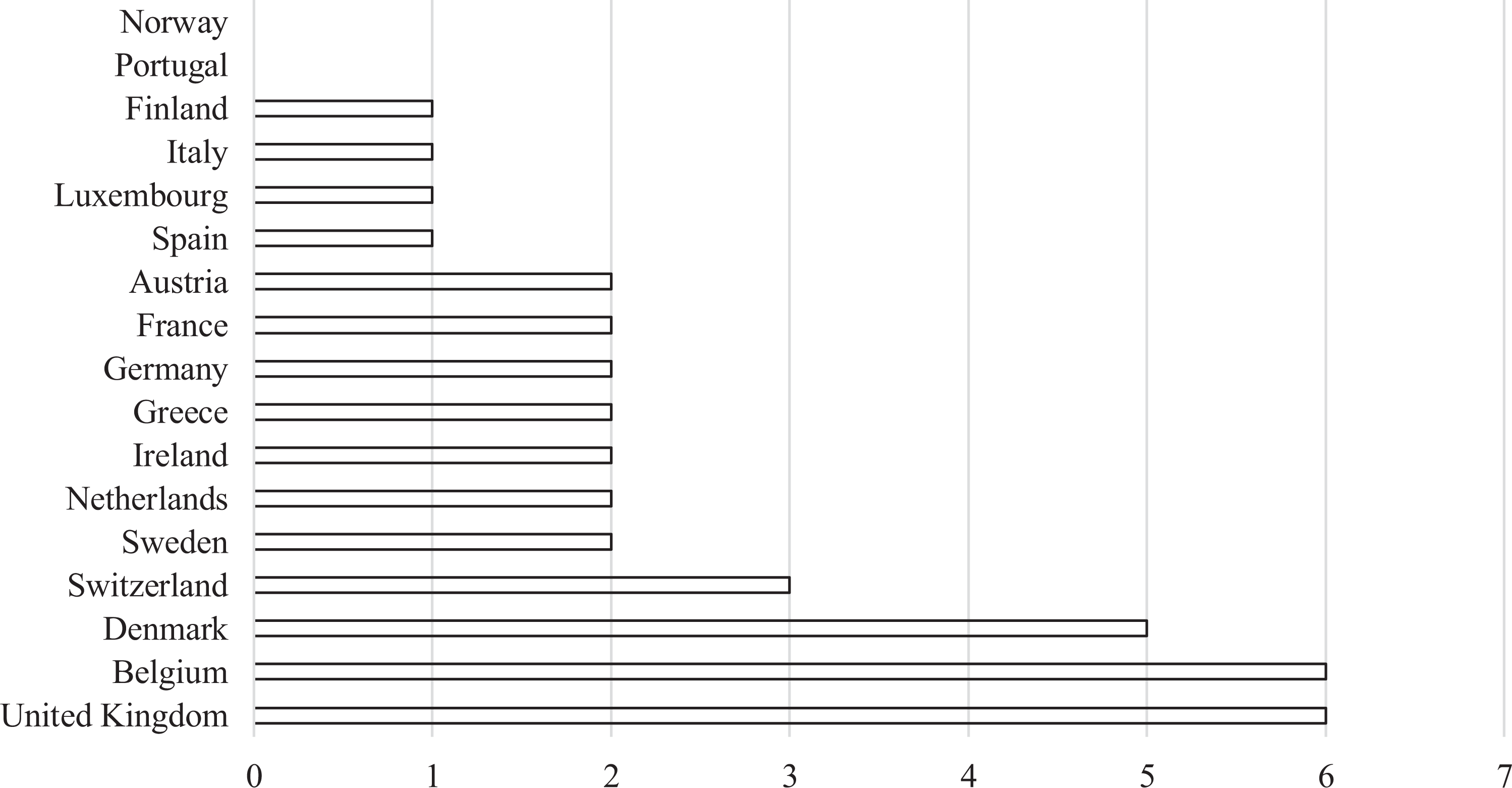
The number of approved legislations that decreased immigrants’ entitlement to social rights from 1980 to 2014. Source: DEMIG policy data. Note: The number of policy changes enacted by country.
As shown in Figure 2, asylum seekers were by far the group most targeted by restrictive legislation, with 24 restrictions. EU citizens and temporary immigrants are in the second place.
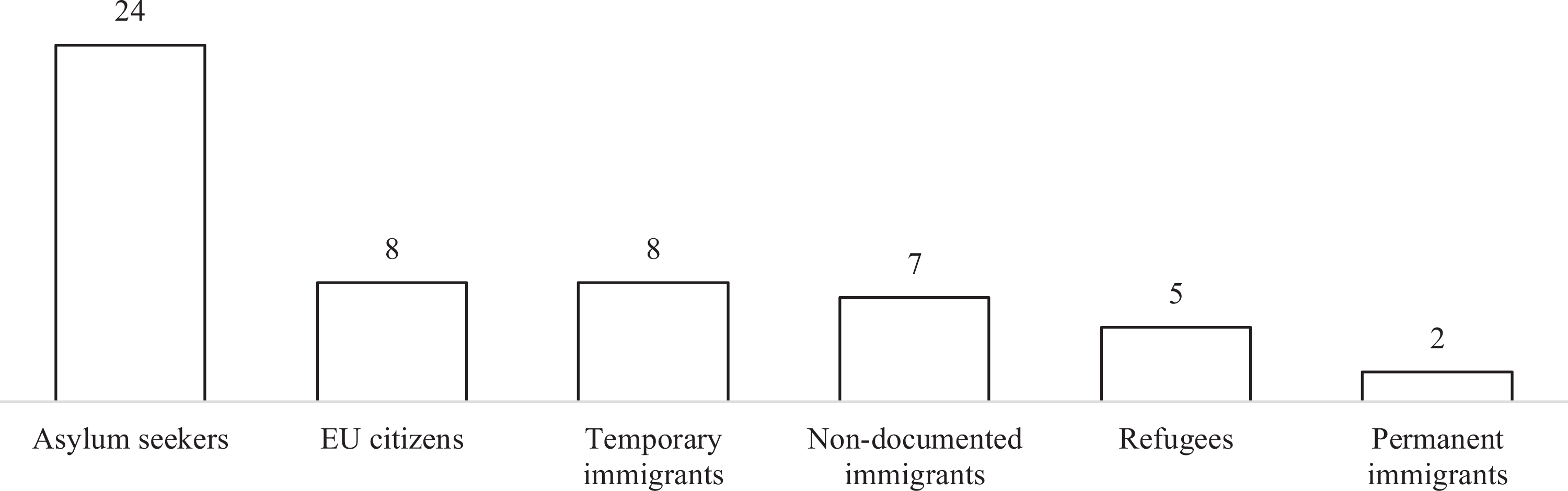
The number of restrictions on immigrants’ entitlement to social rights from 1980 to 2014 in the 17 countries of the study by immigrant group. Source: DEMIG policy data. Note: The number of policy changes enacted by immigrant group targeted.
To account for the fact that bills might target more than one immigrant group and restrict more than one public policy at once, the construction of the dependent variable was based on the qualitative information about legislation provided by DEMIG POLICY database. The coding followed three criteria – change in coverage engendered by the law, the number of immigrant groups targeted and the number of polices affected by the legislation. As a result, I have a four-level variable where the dependent variable 0 represents no legislation change, 1 represents legislation that entails a minor restriction of immigrants’ entitlement to social rights, 2 represents a middle-range restriction and 3 represents a major restriction as shown in Figure 3.
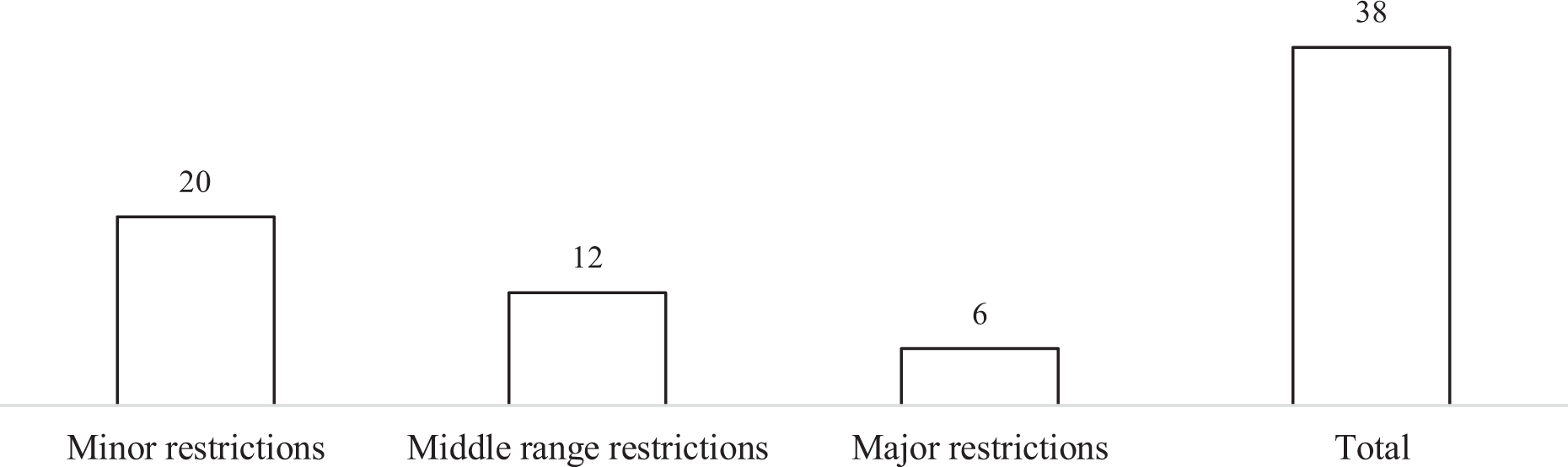
Table of frequency of the dependent variable of the ordinal logistic regression (zeros were excluded). Source: DEMIG policy data. Note: The number of policy changes enacted by the change in restrictiveness.
Results
Table 4 reports the results of the ordinal logistic regression. Models 1 has a continuous variable for government orientation and model 2 has categories for the interaction between government orientation and RRWPs’ participation in the government. The table below reports odds ratios; in general terms, odds ratios above 1 imply that a marginal increase in the explanatory variable increases the odds of an event.
Regressions on RRWPs’ influence on chauvinist welfare measures; the table reports odds ratios.

Note: Odds ratios are the exponential transformation of the coefficients. The odds ratio represents the odds of obtaining greater values for the dependent variable for a unit of change in the predictor variable. RRWP: radical right-wing party; OLR: ordinal logistic regression method of estimation; GDP: gross domestic product.
***p < 0.01; **p < 0.05; *p < 0.1.
Model 1 shows that a marginal increase in government orientation towards the right increases the odds of the adoption of a legislative restriction on immigrants’ entitlement to rights. The RRWPs government participation also has a positive but insignificant result. Model 2, however, shows that the adoption of a category variable discloses the influence of RRWPs on immigrants’ access to social rights; compared to right-wing governments, coalitions between mainstream right-wing parties and RRWPs’ increase the odds of adopting a restrictive measure by 406%. This conclusion supports hypothesis 3b, which states that RRWPs government participation increases the chance of restriction of immigrants’ entitlement to rights, as the group considered most undeserving of welfare benefits. The United Kingdom is an outlier in the analysis: despite not having a successful RRWP, the country was the most restrictive in terms of immigrants’ entitlement to social rights (Figure 1). This result might be associated with the bipartisanship dynamics (Bale, 2008); nevertheless, further research is necessary to explain this case.
Also, model 1 indicates that a rise in public debt and in the level of immigration influx increases the likelihood of adopting chauvinist welfare measures. Model 2 indicates that a rise in unemployment decreases the chance of the adoption of welfare chauvinist legislations. Finally, both models indicate that, compared to Conservative welfare states, South European ones are associated with a lower odd of a restriction of immigrants’ entitlement to rights. This result is probably related to the fact that those countries are, traditionally, emigration countries, a condition that is expected to generate a sense of identification with immigrants and increase welfare solidarity (Vala et al., 2004).
DPP’s influence in welfare state retrenchment
The case study focuses on two welfare reforms that occurred in Denmark when the DPP was the external supporter of the minority right-wing government from 2001 to 2011. The DPP was a pioneer among the RRWP in adopting a pro-welfare state position. The party is also considered one of the most successful RRWPs; the literature argued that, in exchange for legislative support, the DPP received significant policy latitude to influence immigration and integration policies (Careja et al., 2016; Christiansen and Pedersen, 2014).
The Welfare State Agreement, adopted in 2006, entailed restrictions on the Danish pension system, and the Recovery Package of 2010 retrenched unemployment and family benefits. Notably, these bills were negotiated along with integration reforms that restricted immigrants’ entitlement to welfare-state benefits. These reforms, therefore, provide an interesting framework to analyse parties’ negotiations and social policy outputs resulting from the collaboration between the right-wing government and an RRWP.
This research relies on qualitative analysis of newspaper articles of the following newspapers: DR, Information, Jyllands-Posten and Politiken. For each welfare reform, I searched in the newspapers’ search engine the name of the policy and the coalition parties. I read, with the help of Google Translate, the first paragraph of each article. News items directly related to policy negotiations were read in full.
The Welfare State Agreement
Prime Minister Fogh Rasmussen (Liberal) stressed his intention to adopt the welfare reform under a broad political consensus, conceding veto power to the Social Democrats and the DPP (DR, 29 September 2003). There was a relative agreement on the need to increase the minimum retirement age from 65 to 67 years. Parties, nevertheless, diverged on the early retirement reform: Conservatives and Social Liberals favoured abolishing the benefit (DR, 8 September 2005), while social democrats and liberals were against the complete elimination of the benefit. The DPP’s leaders were against any changes to the benefit (DR, 7 December 2005; Politiken, 11 July 2005, 1 November 2005).
The DPP’s position, nevertheless, changed after the Social Democratic party presented a reform proposal, which consisted in the raise of early retirement age from 60 to 62, with a 10-year transition period, and the adoption of an indexation rule to adjust the retirement age to the increase of population longevity. The RRWP accepted the terms but demanded a 12.5-year transitional period, and declared that it would not accept any further restriction on this policy (Jyllands-Posten, 14 January 2006).
By postponing engagement in policy negotiations, the DPP aimed to shift the blame of the retrenchment initiative to other parties. This strategy is also present in Pia Kjærsgaard’s, DPP’s leader, declaration that social democrats betrayed workers by accepting the indexation rule (Jyllands-Posten, 14 January 2006). She also communicated the increase in 2.5 years in the transitional period as an important policy achievement and a commitment to pensioners’ interests (DR, 12 June 2006).
The link between the sustainability of the Danish welfare state and immigration was patent in the discussions of the reform, and the bill included a chapter on integration: ‘Agreement on the Future of Immigration’. The legislation established an integration exam for immigrants and refugees accessing cash benefits, which required full-time work for two and a half years and proof of Danish language skills. In contrast to the other sections of the legislation, this piece was fully negotiated between the government and the DPP. The support of other parties could only be on an all-or-nothing basis, which, as expected, excluded Social Democrats and Social Liberals from the deal. This compromise allowed DPP to claim full credit for the bill and accuse non-signatory parties of ignoring the threats of immigration on welfare state sustainability (Dansk Folkeparti, 24 June 2006; Politiken, 21 June 2006).
The Recovery Package
The second bill was adopted by the government and the DPP in June 2010 and aimed to deal with the fiscal deficits. The package reduced the duration of the unemployment benefit from 4 years to 2 years, lowered the family benefits by 5%, and established an annual benefit ceiling of DKK 35,000, approximately 4700 euros. It also reduced the duration of adult education for unskilled workers from 80 to 40 weeks.
Contrary to the Welfare Agreement, this reform was adopted under a strong objection of opposition parties (Politiken, 16 June 2010). The Social Liberals conditioned their support for the bill on the retrenchment of the early retirement benefit (Information, 25 May 2010; Politiken, 8 June 2010). The DPP, however, vetoed further cuts on the early retirement scheme (Jyllands-Posten, 13 June 2010), showing party’s commitment with the social rights of the deserving’s. The RRWP, nevertheless, did not offered resistance to support the restriction on the other policy domains, framing those retrenchments as indirect welfare chauvinist measures. Pia Kjærsgaard, for example, declared that cuts in the family benefits would mainly affect immigrants, as they have comparatively more children than Danish (Jyllands-Posten, 10 June 2012).
In the days following the bill’s approval, DPP’s leader stated that she would prefer the cuts in child benefits to focus only on foreigners (Andersen, 31 May 2010). In this context, the DPP negotiated a bill that barred newly arrived immigrant families from receiving child and youth benefits for 2 years. This deal evidenced the policy trade inside of the coalition: the DPP gave support for the government’s retrenchment plans in exchange for policy space to implement welfare chauvinist measures.
Discussion
The literature has reported a change in RRWPs’ welfare agenda. These parties have abandoned the liberal approach regarding the welfare state and have adopted a rhetoric that combines welfare state protection and the exclusion of groups perceived as undeserving, particularly immigrants. Nevertheless, as these parties have joined with right-wing mainstream parties to form governments, their policy positions on distributive issues might cause a conflict between coalition parties (Afonso, 2015). Mainstream right-wing parties have economic performance as their primary goal, which often involves the adoption of welfare state retrenchment. Additionally, the risk of alienating moderate voters could prevent these parties from adopting populist measures.
This article aimed to assess policy outcomes of RRWPs’ government participation in relation to distributive issues by addressing their influence on changes in public social expenditure. The study showed that, despite having become a pro-welfare state, RRWPs compromise with mainstream right-wing parties on retrenchment initiatives. A finer-grained evaluation, nonetheless, showed that RRWPs not only have adopted a consonant position on the welfare state, but it also showed they were able to influence policymaking accordingly. The analysis that focuses on a specific set of policies shows that the RRWPs’ negative influence on welfare state expenditure occurs mainly on polices that target groups regarded as undeserving of benefits, namely the unemployed, those dependent on social assistance and ethnic minorities. This conclusion is corroborated by the fact that their support also increases the likelihood of chauvinist welfare measures. On the other hand, it is not possible to affirm that the participation of RRWPs in the government is associated with restrictions on policies that target the elderly, the group perceived as most deserving of benefits.
The Danish case study has ripened the conclusion of the quantitative analysis, and it confirmed the causal mechanism behind the observed results. The DPP supported welfare retrenchment initiatives in exchange for restrictions on immigrants’ entitlement to social rights. This exchange is illustrated by the fact that DPP negotiated measures that directly and indirectly affected immigrants’ social rights along with welfare retrenchment reforms. The RRWP also sought to preserve the social rights of priority groups but offered no resistance to restrict policies that target social groups considered undeserving of welfare state benefits. For example, the party agreed on a pension reform slightly more moderate than the one proposed by Social Democrats on the 2006 Welfare State Agreements and vetoed the retrenchment on the early retirement scheme on 2010.
The present study collected strong evidence on how RRWPs shape social policy outputs, speaking to a novel corpus of literature, which addresses RRWPs’ influence on policymaking. Furthermore, it did so on an issue that is not normally considered to be part of their core ideology. This article also speaks to an extensive research on parties’ influence on the welfare state but innovates by including the RRWPs as a central piece in explaining the politics of redistribution. The main conclusion of this study is that ignoring RRWPs’ distributive preferences and their role in enabling and shaping social reforms hinders our understanding of the recent welfare transformations and intra-group resource transferences. Future research thus is necessary to analyse the impact of those transformation on the increase of inequality, poverty and immigrants’ integration.
This research also contributes directly to the public debate on the responsiveness of RRWPs’ on distributive issues. The RRWP claim to be the ‘true’ representatives of working-class interests. Indeed, in some countries, the electoral growth of the RRWPs occurred at the expense of the mainstream left-wing parties. Here, however, it was shown that governments with RRWPs’ are more restrictive than mainstream right-wing government, leading to the vehement rejection of RRWPs’ claims. The nuances of RRWPs’ distributive preferences and their double-edged influence on the welfare state, nonetheless, make the inquiry into their responsiveness to the electorate’s preferences on distributive issues less evident.
Supplemental material
Supplemental Material, sj-pdf-1-ppq-10.1177_1354068820923496 - Social policy outcomes of government participation by radical right parties
Supplemental Material, sj-pdf-1-ppq-10.1177_1354068820923496 for Social policy outcomes of government participation by radical right parties by Juliana Chueri in Party Politics
Footnotes
Declaration of conflicting interests
The author(s) declared no potential conflicts of interest with respect to the research, authorship, and/or publication of this article.
Funding
The author(s) received no financial support for the research, authorship, and/or publication of this article.

Supplemental material
Supplemental material for this article is available online.
Notes
Author biography
References
Supplementary Material
Please find the following supplemental material available below.
For Open Access articles published under a Creative Commons License, all supplemental material carries the same license as the article it is associated with.
For non-Open Access articles published, all supplemental material carries a non-exclusive license, and permission requests for re-use of supplemental material or any part of supplemental material shall be sent directly to the copyright owner as specified in the copyright notice associated with the article.
