



Abstract
In the face of the trend toward more participatory candidate nomination methods, studies increasingly focus on its consequences for the selection outcome. Yet, this literature has brought to light some inconsistent findings. They do not surprise given the complexity of selection decisions and the dependence of nomination results on who is running for a candidacy. Drawing on representative survey data collected before the 2017 Bundestag election, this article looks at the potential implications of different procedures by examining how the selection criteria of membership and delegate conferences vary. It shows that both selectorate types differ as to process-related selection criteria but less regarding candidate-related features. More specifically, membership conferences can be associated with more open decisions as their participants attach less importance to coordination mechanisms like leadership proposals. At the same time, they take less account of the external consequences of their choices since criteria that increase a candidate’s chances to enter parliament play a smaller role than among delegates. The study points to implications of inclusive procedures which might not be desired by the party leadership and may not serve the party’s electoral interests in the worst case.
Movements toward intraparty democratization can be regarded as a widespread trend (Bille, 2001; Cordero and Coller, 2018). Recently, it is also considered as a reaction to perceptions of a democratic crisis (Coller et al., 2018). Beside some other facets of party life, it particularly includes the selection of candidates for parliamentary elections which is a vibrant issue within the scholarly community (Close and Kelbel, 2019; Cross and Pruysers, 2019; Detterbeck, 2018; Rombi and Seddone, 2017). The case of Germany shows that even if reforms toward more participatory nomination procedures are not (yet) initiated or implemented, they resound throughout the political landscape from time to time leading to discussions within parties and a broader public (Höhne, 2013; Jun, 2009).
A major question that emerges from this reform momentum is: Does it matter if parties change from having rather exclusive selections to having more inclusive ones? In general, inclusiveness (i.e. the circle of groups formally involved in decision-making) 1 can be regarded as a main dimension of intraparty democracy (see e.g. Close and Kelbel, 2019: 270f.). Yet, the formal mode of picking candidates is not only relevant for the party and its internal functioning. As it can affect the composition and quality of almost all professional politicians within representative democracies, it is of crucial importance for the whole political system (Gallagher, 1988: 1; Rahat and Hazan, 2001: 312f.).
While the literature has identified several dimensions as to how the nomination type matters, that commendable work has also sparked an intense discussion due to partly inconsistent findings (see e.g. Detterbeck, 2018) and new paths of decision-making within parties (see Cordero and Coller, 2018). We want to contribute to this debate by exploring the selection criteria for district nominations in Germany which presents an interesting case since law prescribes nominations either by a membership meeting or a delegate conference. Thus, only those two variants can be used in all parties. In addition, we might also shed light on whether the nomination type in the district interacts with party list selections at state level given the country’s mixed-member electoral system (see below). Specifically, we draw on representative survey data collected among the selecting party members before the 2017 Bundestag election.
Investigating how different selectorate types evaluate various nomination criteria is a seldom used approach to look at potential implications of institutional choices. Yet, it seems particularly valuable since the analysis depends less on who and how many contenders actually step forward for a candidacy. In general, it is not easy to disentangle the extent to which selection outcomes follow from varying procedures. Looking at the selection criteria of those who actually pick the candidates, however, lowers the analytical problem that results are affected by context and the set of aspirants. 2 Thus, it provides an insightful approach through which to examine the relevance of different selectorate types.
This article is structured as follows. In the first section, we set up our theoretical arguments and formulate some expectations as to whether selectorate types vary in their selection criteria. Second, we introduce our data for the German case and also provide some descriptive information on the groups of delegates and nondelegates. The empirical investigation in the third section comes in two parts: We first inspect whether and how both groups differ in their nomination preferences. Subsequently, we apply a multivariate discriminant analysis that uses both selection types as dependent variables and our selection criteria as independent variables to examine how well the latter separate membership conferences from delegate conferences. We end by drawing some general conclusions.
Previous research, theoretical arguments, and expectations
During recent decades, a broad debate on the potential effects of selection procedures has unfolded. True, it can make a difference whether we look at list nominations or district nominations for parliamentary elections, and whether we investigate the selection of legislative candidates or of party leaders. Yet, these forms of intraparty personnel selection are usually discussed together (see Sandri et al., 2015). Travelling through this literature, it can be systematized by three broad lines of research with several analytical subdimensions: organizational development in terms of membership activism and membership recruitment (Close and Kelbel, 2019; Cross and Pruysers, 2019), selection process and selection results (Pilet and Cross, 2014; Rahat et al., 2008; Spies and Kaiser, 2014), and external effects regarding electoral prospects (Kernell, 2013; Pedersen and Schumacher, 2015) and the behavior of candidates elected to parliament (Rombi and Seddone, 2017; Sieberer, 2006). Here, we primarily take up the second strand of research concerning the influence of selectorate types on the nomination process and its results since this may help to clarify our expectations.
To begin with, however, we have to introduce one conceptual division as to how selectorates arrive at their nomination choices. On the one hand, members of the selection body can base their decisions on individual candidate attributes like experience in politics, education, gender, or being a representative of the party with respect to policy preferences. On the other hand, interactional aspects during the (pre)selection process can play a role for a selector’s choice, for example, consultations with other party members or negotiations among different party branches. Hence, decisions can be based on broader process-related conditions in addition to (maybe even instead of) candidate-related characteristics. We capture both sets of selection criteria by different survey questions and items (Table 1).
Process- and candidate-related selection criteria used in questionnaire.

Note: Response categories were very important, important, slightly important, and unimportant.
Source: Institute for Parliamentary Research.
In general, we can formulate conflicting expectations. Our nil hypothesis states that participants of membership meetings and delegate conferences do not vary in their selection criteria at all. This is plausible since we do not deal with largely different groups. In particular, the participants at delegate and membership conferences overlap to a considerable extent as the latter are also joined by party leaders, functionaries, and activists who are likely to become delegates if relevant. Moreover, both groups consist of persons interested in politics and party politics (otherwise ordinary members would not take the hurdle to show up at the selection convention).
However, our theoretical premise in this article is that delegates can be regarded as selectors with some distinctive features if we take a more nuanced second glance. Especially, they should by conventional wisdom be more experienced in intraparty business and decision-making. After all, becoming a delegate often is a kind of reward for long-time party activity. Besides, delegates may not only be active party members (like others too). If they can be characterized also by their office-seeking motivation (see Lübker, 2002: 721), being a delegate should more likely go together with taking other intraparty positions as well as other political offices in general. Accordingly, this group’s advanced knowledge and involvement in (party) politics could lead to dissimilar selection priorities vis-à-vis nondelegates.
Based on the idea of their stronger involvement in the party business, we can assume that delegates care more than nondelegates about the process-related aspects, as shown in Table 1. This is most obvious for the item to represent the position of one’s local party association (as the latter authorizes delegates to be its representative) but should also hold for consultations with others, agreements between intraparty groups and the renomination of MPs (due to a closer contact to incumbents compared to ordinary party members). Some previous research at least indirectly supports this general expectation as to the selectors’ coordination efforts. For instance, there is evidence that more inclusive selectorates make it harder to accomplish a better demographic or descriptive representation (Reiser, 2018; Spies and Kaiser, 2014; Vandeleene, 2014) which is all too plausible regarding party list selection: A balanced set of candidates requires compromises that necessitate coordination. Translated to selections in the district in our study, it would mean that the participants at membership meetings are less prone to rely on process-related (coordination) mechanisms. Yet, this string of literature also brought to light some counterevidence that more inclusiveness does not work against group representation (Ashe et al., 2010; Gauja and Cross, 2015), thus providing us with ambiguous arguments.
A special case for our expectations is leadership proposals. On the one hand, we can refer to assumptions that ordinary party members are more inclined to follow them, which is a key argument for hypothesizing that enfranchising the rank-and-file offers leaders opportunities to circumvent critical mid-level activists (Katz and Mair, 1995: 21). On the other hand, we can suppose that delegates are more likely involved in the decision-making process or at least more likely know how leadership proposals come about due to a broader intraparty activity. From this perspective, the motivation to circumvent mid-level activists only comes into play in the (rare) case that the leadership was not successful in its preselecting activities and coordination. Overall, our general expectation is that all process-related selection criteria are more relevant among delegates than among nondelegates.
Regarding our candidate-related criteria, it seems more difficult to justify the overarching expectation that they are weighed differently among the participants at delegate conferences and membership conferences. As we deal with overlapping groups of people who are all interested in politics and party politics, candidate characteristics could count similar among delegates and nondelegates maybe reflecting the idea of an ideal candidate. Yet, one might also argue that delegates due to advanced knowledge have different preferences how a good candidate should look like. In any case, the theoretical argument that the delegates’ stronger political involvement should lead to different selection priorities is less pervasive for candidate-related criteria than for interactional aspects. On these grounds, we expect no relevant differences for our items except for one criterion: Given that delegates have more chances to get to know the aspirants before the selection event, the latter’s nomination speech should play a bigger role among the participants at membership meetings. This assumption can also be derived from interview findings that the rank-and-file attend German district nominations rather uninformed which means that the aspirants’ conference performance is “central” to their selection decision (Reiser, 2011: 247f.).
In sum, we expect that both selectorate types do not use completely dissimilar yardsticks but show some different emphases when evaluating their selection criteria. We built our argument around the distinctive character of the group of delegates and analytically differentiate between process- and candidate-related selection criteria. To the extent that delegates are more broadly involved in politics and intraparty politics, they should weigh process-related selection criteria stronger than the participants at membership conferences. Predictions as to our candidate-related items are more debatable as they cover a heterogenous group of items. However, our general expectation is that membership and delegate conferences do less vary in those selection aspects.
District selections in Germany: Data and sample
Germany’s mixed-member electoral system opens two routes to parliament: 299 MPs are elected by relative majority in single member districts and at least a further 299 deputies are elected from closed party lists in the 16 German federal states. 3 However, both selection levels are entangled as most candidates run simultaneously for office in the district and on the party list (see Manow and Nistor, 2009). More importantly, a district candidacy can be regarded as precondition to gain a list position with a good prospect for entering the Bundestag (Schüttemeyer and Sturm, 2005: 548f.). This interaction between district and list selection provides an additional local screening mechanism for list candidates. From the aspirants’ view, double candidacies enhance their chances of being selected and winning a parliamentary mandate.
According to the electoral law (§21 and §27 Bundeswahlgesetz), candidates for the Bundestag can only be chosen by a membership meeting or a delegate conference. The procedural decision how to pick a district candidate rests first with the state party organization and second, if there is no (clear) stipulation in its statute, with the party units in the districts. Yet, only a third of state-level statutes among the Bundestag parties enshrine a clear preference which is mostly in support of the more inclusive method (see Hellmann and Höhne, 2020). Regarding the actual practice, there exists variation between the parties and within almost all parties. Besides, there are changes within parties over time which are difficult to track given the undecidedness of most statutes and the lack of publicly available data. Broadly speaking, the picture is as follows (see Höhne, 2017: 236; Reiser, 2011: 245; Schüttemeyer and Sturm, 2005: 542): The Green Party and the Alternative for Germany (AfD) routinely apply membership meetings. To a lesser degree, this selection mode is also preferred within the Liberals (FDP). Among the Christian Democratic Union (CDU), more than half of the district candidates are chosen by membership conferences. This is also the case for the Left Party although decisions by delegates prevail in the Eastern part of Germany. While delegate conferences constitute the majority within the Social Democratic Party (SPD), the Christian Social Union (CSU) exclusively relies on this nomination mode.
Data are drawn from a representative survey in the run-up to the 2017 election that included all current Bundestag parties. The questionnaire was distributed at the beginning of the selection events and collected at the gatherings’ end. It contained the two abovementioned questions and selection criteria (see Table 1). 4 With respect to sampling, 90 nomination conferences were randomly chosen at district level 5 : 15 each for the Green Party, the Left Party, the Liberals, and the SPD; 14 for the AfD; 12 for the CDU; and 4 for its Bavarian sister CSU. In case the local party organization denied access to our research team, another district of the same party was selected. Since this procedure could not be applied for one nomination event of the CSU (which was the last one taking place), 89 of 90 district selections have been attended from September 2016 till July 2017. This study, however, rests on 72 district selections as we excluded all nominations with fewer than 10 respondents. 6 At the individual level, the data include 2916 selectors (1416 respondents are delegates, while 1500 belong to membership conferences), meaning a comparatively high response rate of 65.3%.
One-third of the nomination events (24) in the data set were delegate conferences, two-thirds represent membership meetings (48). This matches the selection mode distribution in those party statutes which contain provisions (see Hellmann and Höhne, 2020). Membership conferences spread among all parties except the CSU: 7 are conducted by the AfD, 6 by the CDU, 13 by the Liberals, 14 by the Greens, 3 by the SPD, and 5 by the Left Party. Among the nominations by nondelegates are 6 by the CDU, 3 by the CSU, 1 of the Liberals, 12 by the SPD, and 2 by the Left Party. 7
The next tables provide some descriptive information. The first one (which refers to the whole sample of 89 district nominations) reveals that the sizes of the selection bodies vary considerably (Table 2). For instance, the number of CDU selectors ranges from 36 to 271 at membership meetings and from 22 to 183 delegates (see Reiser, 2011: 249 for similar data). The large spreads also indicate that the former are not always populated by more participants than delegate conferences. The Social Democrats and the Left Party even present cases where the mean of delegates is above the mean of nondelegates. This illustrates that formal inclusiveness (selectorate type) and actual inclusiveness (selectorate size) can be treated as different aspects. Striking are the low minimum values for some membership meetings: Sometimes, only six or eight party members gathered to choose the district candidate. Certainly, the parties’ organizational strength comes into play here (see Niedermayer, 2018 for membership data at state level in 2017).
Selectorate size by party and nomination mode (sample of 2016/2017).

Note: SD: standard deviation; CSU: Christian Social Union; CDU: Christian Democratic Union; SPD: Social Democratic Party; FDP: Liberals; AfD: Alternative for Germany. N = 89 (CSU: n = 3, CDU: n = 12, SPD: n = 15, Left Party: n = 15, FDP: n = 15, Green Party: n = 15, AfD: n = 14).
Source: Institute for Parliamentary Research.
Referring to the 72 district selections we use in our further analysis, Table 3 compares the groups of delegates and nondelegates as to some information reported in the questionnaire. Keeping in mind that the participants at delegate and membership conferences theoretically overlap to some extent, it does not surprise that we do not see huge differences. Yet, some varying characteristics support our theoretical premise that delegates are selectors with distinctive features. While the share of delegates who are professionally employed within the political sphere (as holders of executive offices at various levels or employees of parties and MPs) is 50% higher compared to nondelegates, the former also slightly more often hold honorary parliamentary mandates at district level (city council or county council). This provides experience and allows to take advantage of synergies between different activities. Similarly, delegates occupy twice as frequently positions within the party’s suborganizations (the youth branch, the women’s branch, and so on) and slightly diverge regarding leadership affiliation at district level. The biggest difference, however, concerns the share of selectorate members who do not hold any position within the party: Roughly every second participant at membership conferences is such an “ordinary” party member. The group of delegates, in contrast, is clearly dominated by functionaries that make up 76% of the selectorate’s members. Importantly, virtually all differences exist irrespective of party. 8 In conclusion, delegates are more active in politics and party politics as to assuming an office and assuming responsibility. 9
Differences between the groups of delegates and nondelegates.

Source: Institute for Parliamentary Research; n = 1500 (participants at membership conferences), n = 1416 (delegates).
Investigating selection criteria for district nominations
Do selectorate types vary in their nomination criteria?
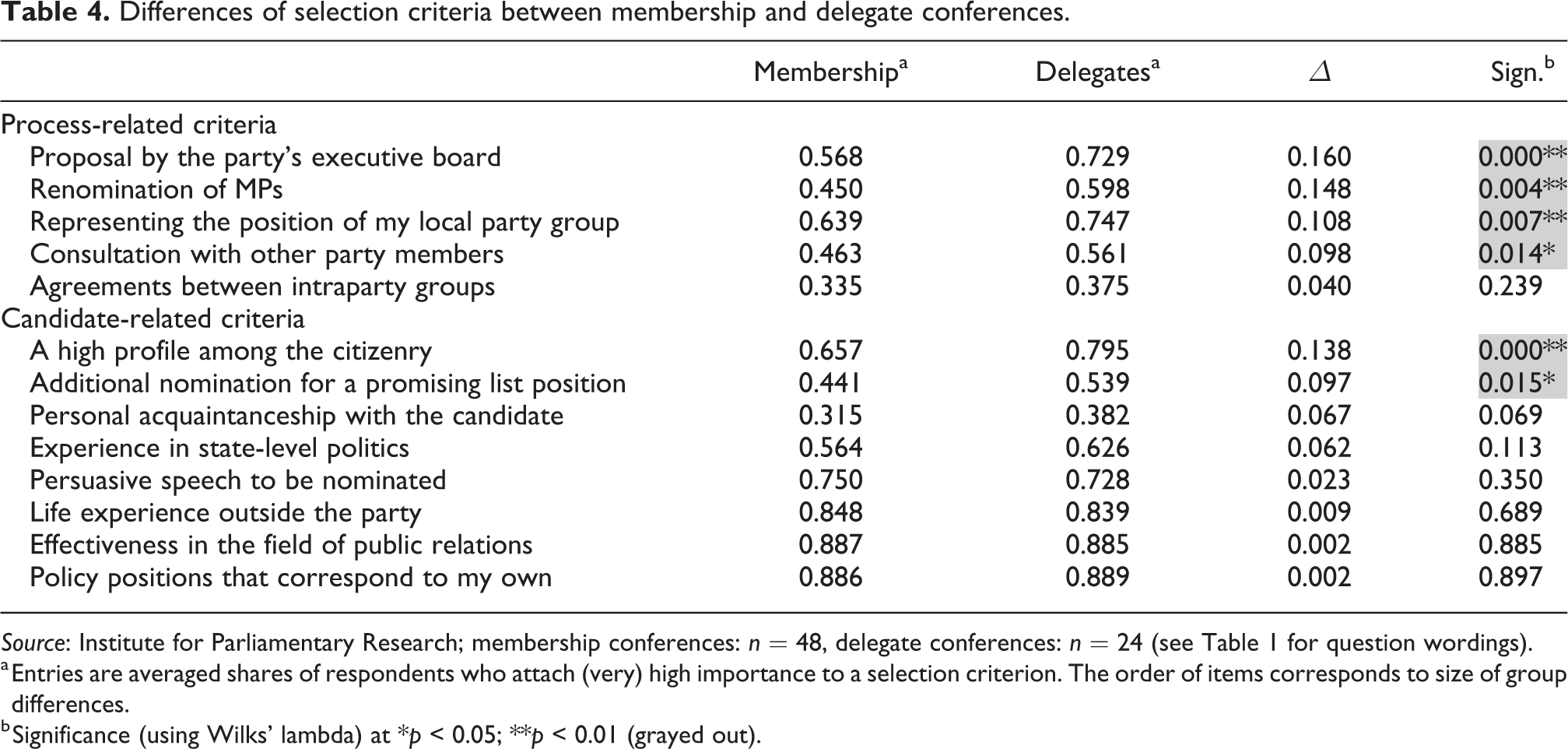
In a first step, we inspect whether the participants of membership and delegate conferences vary in the selection criteria investigated in our survey. Table 4 shows the shares of respondents who attach (high) importance to an item. Six differences reach statistical significance (shown grayed out) mostly at the 1% level. Overall, divergences between both selection groups are not impressive, but obvious.
Differences of selection criteria between membership and delegate conferences.
Source: Institute for Parliamentary Research; membership conferences: n = 48, delegate conferences: n = 24 (see Table 1 for question wordings).
a Entries are averaged shares of respondents who attach (very) high importance to a selection criterion. The order of items corresponds to size of group differences.
b Significance (using Wilks’ lambda) at *p < 0.05; **p < 0.01 (grayed out).
The highest difference can be found for proposals by the party’s executive board which play a bigger role at delegate meetings. Hence, their participants are more inclined to follow leadership suggestions. This does not simply say that delegates are more docile followers. On the one hand, they rather know how proposals come about or are more likely involved in the leadership process due to their intraparty offices (see above). On the other hand, their stronger political involvement might teach them the importance of leadership. In this sense, the data corroborate the finding for list selections that delegate conferences more likely result in compromises (see e.g. Vandeleene, 2014): If the executive board is engaged in preselecting activities and coordination (which in fact corresponds to its leadership role), its recommendation more likely represents a negotiated outcome in the party’s collective interest. The data also challenge the argument that the leadership should favor inclusive procedures because the rank-and-file is more likely to endorse its proposals which then provides opportunities to circumvent activists (Katz and Mair, 1995). Since participants at membership meetings attach less importance to what the executive board suggests and, thus, decide more independently, it seems rational instead that leaders have higher odds for preferring delegate conferences (see Schindler and Höhne, 2020: 301 for empirical evidence regarding the Bundestag parties).
The second biggest difference refers to the renomination of incumbent MPs which is regarded as more important at delegate conferences. In general, the criterion might play a minor role as German MPs striving for reselection rarely face competition (see Detterbeck, 2016: 842). However, the difference conforms with our data for proposals by the executive board which regularly recommends the renomination of incumbents. From that perspective, looking at the selectorate’s nomination criteria underpins the finding that democratizing nomination procedures can reduce the probability of incumbents to get re-elected (Pilet and Cross, 2014).
Both selectorate types also diverge as to the item of a high profile among the citizenry (third largest difference) which is more heavily weighed at delegate conferences. This is against our expectation that candidate characteristics should count irrespective of nomination type. We can argue that the delegates’ advanced knowledge and involvement in (party) politics come into play. Assuming that a high profile helps to gather voter support allows for the conclusion that delegates give stronger consideration to the external, that is, electoral consequences of their decisions. This is also relevant for electorally small parties that do not realistically compete for district mandates but hope to increase the votes for the party list by having a recognizable “human face” running in the district (see Cox and Schoppa, 2002: 1031). 10 In that light, formally inclusive bodies may make less far-sighted decisions as they look a little less beyond the selection horizon. Hence, the data are also relevant for the string of research that asks for a nomination method’s external effects in terms of electoral prospects: They make plausible that inclusive selections can entail an electoral disadvantage (see Kernell, 2013; Spies and Kaiser, 2014).
Besides, the respondents at membership conferences significantly less often emphasize to take the position of one’s local party group into account. This is highly plausible as they participate in the selection on their own initiative (thus, the rather high value is maybe more striking). In contrast, delegates are representatives of the party subunit that authorized them to take part. Accordingly, they are more prone to consider their local association’s opinion (even though not in the sense of being just a mouthpiece by strictly following its instructions).
The process-related criterion of (prior) consultations with other party members points into the same direction: It is less important for nondelegates providing evidence for assumptions that inclusive rather than exclusive methods cause a coordination problem (Kenig and Pruysers, 2018: 41). In general, delegates should be more strongly involved in consultations through their party offices. The outcome is also interpretatively in sync with our data for leadership proposals: The participants at membership conferences apparently decide more independently than delegates. The more open decision situation might also attract more aspirants for a candidacy and, thus, helps to explain why inclusive procedures go together with more contenders (as Kenig, 2009 found for leadership selections).
The last significant difference between both selection variants concerns the question whether it is important that a district candidate is nominated or will presumably be nominated for a promising party list position. As said above, candidates usually run simultaneously for office on both tiers (district and state party list), while a candidacy in the district can be regarded as precondition to gain an upper list place. Contrary to our general expectation for candidate-oriented criteria, the data show that delegates consider (subsequent) nominations for a promising list position more relevant than the participants at membership meetings. However, this criterion is maybe a mixed type as it is also process-related. 11 The finding again tells us that delegates are more inclined to bear the implications of their decisions in mind, while nondelegates focus more strongly on the current selection process and care less for external criteria and consequences. In this regard, the choices of more inclusive selection bodies can also result in bad news for the local party branch if it picks a candidate without good prospects for the list who consequently does not enter parliament. In general, it is debatable whether “local party branches routinely anticipate the selection criteria for the state party list during the nomination process at the district level” (Reiser, 2014: 64). According to our study, this assumption does not apply to the same extent at delegate and membership conferences in any case. In this way, the district nomination type can interact with party list selections.
In sum, the data thus far entail two main conclusions: First, membership meetings can be regarded as more open decision procedures as its participants pay less attention to leadership proposals, the local party branch’s position, consultations with others, and the reselection of incumbents than delegates do. 12 Second, selection choices by the membership are less motivated by an external perspective since a candidate’s public profile and his or her (potential) nomination for the party list play a bigger role for delegates. In a nutshell, participants at membership conferences come to their choices more independently but think less outside the selection box, while the delegates’ decisions more strongly result from coordination efforts and are more outward-looking. These differences in selection priorities are obviously not based on the size of the selectorates which vary considerably within the nomination types. Plausibly, the higher share of delegates holding intraparty offices and the responsibility they entail come into play here.
The other differences are insignificant and rather small. They refer almost exclusively to candidate-related criteria from which we can infer that process-related aspects are more relevant for differentiating between both selection modes. However, we should not disregard the huge commonalities for the last four aspects in Table 4 which are also noteworthy given the magnitude of support. In particular, life experience outside the party, effectiveness in the field of public relations, and policy congruence are the highest rated items both within the selectorate types and in general. Accordingly, those candidate criteria seem to be crucial in any case and rather reflect the properties of an ideal aspirant. Similarly, this holds true for a persuasive nomination speech: The aspirants’ performance in presenting themselves is comparatively important and unexpectedly counts almost the same among delegates and nondelegates.
Using the selectorate type as dependent variable
As a second step to investigate attitudinal differences between both selectorate types, we applied a multivariate discriminant analysis. This procedure serves the purpose of examining given groups on the basis of a combination of metric variables. By inspecting several criteria simultaneously, it allows to investigate whether both modes can be distinguished from another and to identify the discriminating power of each variable (Hair et al., 2019; Klecka, 1980; Press and Wilson, 1978). The analysis uses selection type as categorial dependent variable, while our selection criteria (i.e. the shares of respondents who attach (high) importance to an item) serve as metrically scaled independent variables. 13 More technically, it builds a predictive model for group membership by a discriminant function composed of linear combinations of predictor variables that discriminate between the objects in the groups. 14 At first, the analysis examines the collective discriminatory power of the discriminant function, that is, the explanatory power of our selection criteria to predict the group membership according to the nomination method. A second question is which criteria are relatively more important to differentiate between membership and delegate conferences. Hence, we can compare the effects between our independent variables.
To test the goodness of the discriminant function, that is, to examine how well, in total, it separates cases into groups, we rely on the Wilks’ lambda value as the most common measure (Hair et al., 2019: 492; Schendera, 2010: 304). It tells us the variance in the dependent variable that is not explained by the model. A value near zero shows a high discriminatory ability, whereas a value approaching one indicates little discriminatory power. In our analysis, Wilks’ lambda amounts to 0.64. Thus, 36% of variance can be explained by the discriminant function. In general, we did not expect that both selection types would be perfectly separated since they do not imply totally different settings for choosing candidates and since their participants overlap to some extent. Accordingly, the discriminatory ability of the function is acceptable. Moreover, the latter is highly significant (p = 0.008).
In addition, we can assess predictive accuracy by testing whether the function assigns each single selection event in our sample rightly or wrongly to a selection group. 15 While 38 of 48 membership meetings are correctly categorized as such, the other 10 were wrongly classified as decisions by delegates. As to the sample’s delegate conferences, 21 of 24 were accurately categorized. In total, 59 of 72 selection events (82%) are correctly assigned according to the selection type by the discriminant function of selection criteria. 16 Again, we can conclude that it sufficiently separates our groups (selection types).
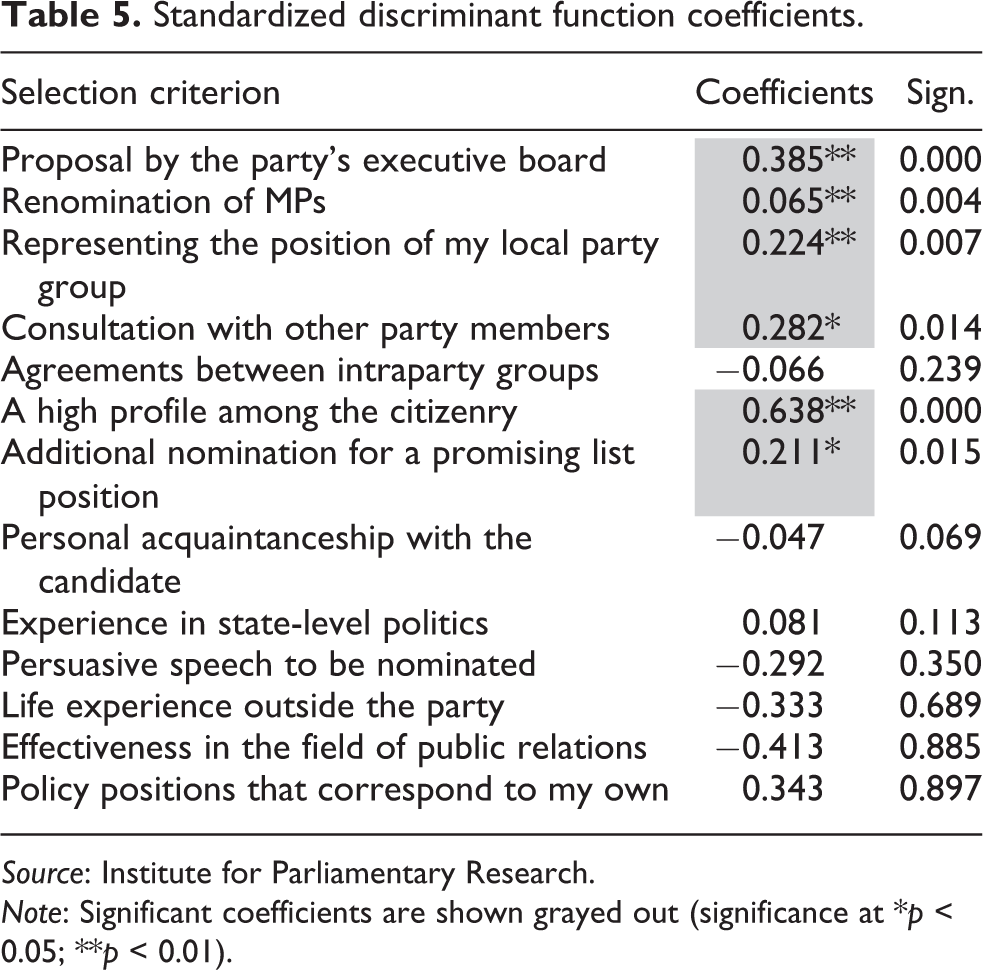
Since the discriminant function is significant and classification accuracy is acceptable, the analysis finally enables us to investigate the discriminatory ability of each independent variable. 17 We can compare the effects of our selection criteria by looking at the standardized discriminant function coefficients (Table 5). They serve the same purpose as beta weights in multiple regression as they indicate the relative importance of the independent variables in predicting the type of selection (see Schendera, 2010: 307). Coefficients with large absolute values correspond to variables with greater discriminating ability. Among the six variables that help to separate the groups significantly, the criterion of a high profile among the citizenry clearly provides the best discrimination between our selectorate types. Its effect is almost 10 times higher than the least influential item of MP renomination. The second biggest influence can be found for proposals by the party’s executive board (showing a six times higher coefficient). Hence, those candidate- and process-related selection criteria most account for differences between membership and delegate conferences. Moderate effects can be ascribed to the items of representing the local party association, consultations with other party members, and additional list nomination. The criterion of MP renomination (which provides the second biggest difference in Table 4) contributes less to the discriminating power of the function. Based on the combination of our selection criteria, the analysis hence leads to similar but slightly different results than Table 4 reveals.
Standardized discriminant function coefficients.
Source: Institute for Parliamentary Research.
Note: Significant coefficients are shown grayed out (significance at *p < 0.05; **p < 0.01).
Conclusion
Admittedly, it is not easy to unravel to which extent selection results follow from different procedures as various (micro-political) intervening factors come into play. In this study, we examined whether and how membership and delegate conferences differ as to (reported) nomination criteria instead of using an ex post perspective (e.g. by analyzing the set of candidates). While some excellent articles have directly or indirectly investigated selection mode effects, those questions have not been broadly addressed within the existing research. We arrive at three key findings that enrich the vibrant debate on the effects of different nomination methods. In general, both selectorate types for the German Bundestag can be statistically separated, although the groups of participants overlap. In line with the argument that delegates are more strongly involved in party politics (which is corroborated by the descriptive data), they mainly weigh process-related criteria stronger than the participants at membership conferences. Notwithstanding, we should not overestimate group differences given the low percentage of explained variance and the huge degree of commonalities. The latter primarily concern candidate-related aspects among which we also find the highest ranked features. This empirically underpins our conceptual distinction between two different sets of selection criteria. What is more, it indicates that we deal with similar rather than totally different settings for choosing candidates.
More specifically, the analysis brought to light that delegates are more “outward-looking” than participants at membership conferences. On the one hand, they mind more strongly the candidates’ public profile which strengthens electoral attractiveness. This supports studies implying that formally wider selectorates can go along with an electoral disadvantage (see Kernell, 2013; Spies and Kaiser, 2014). On the other hand, the question whether an aspirant for a candidacy is (going to be) nominated at a promising list position gains more relevance for delegates. In contrast, participants at membership meetings do not consider the broader outcome of their choices to the same extent since they attach lower importance to both criteria. To put it pointedly, delegates show a more “professionalized” view as they consider the external environment of their party unit to a greater extent than participants at membership conferences who may have narrower selection interests.
Lastly, selectors at membership meetings can be regarded as more “free floating” since leadership proposals and consultations with other party members apparently play a smaller role for their selection choices. This leads to a more open selection process irrespective of selectorate size. Consistent with their stronger commitment toward intraparty offices, delegates reach their decisions in a more coordinated and structured manner instead. This result fits in with the literature that found that exclusive selectorates are more likely to accomplish compromises which require coordination and consultation (Vandeleene, 2014). It also goes together with evidence that the party leadership is more inclined to prefer nominations by delegates (Schindler and Höhne, 2020) and that inclusive procedures entail more intraparty competition (Kenig, 2009; Vandeleene and Sandri, 2019). Eventually, it helps to explain why new aspirants could stand better chances at membership meetings (see also Pilet and Cross, 2014).
Certainly, examining the German example is a first step. Since it due to the two-tier selection system provides a rather complex case, it is interesting whether the findings are transferable to other countries. Further investigations could extend the analysis and compare the selection criteria of even more inclusive procedures: Do open primaries work in the same direction as membership meetings or even intensify the effects we found? Additionally, future studies can apply an equal approach for list selections and party leadership selections. As we were not able to control for party owing to our small sample of selection events, a third important avenue for further inquiry is to include party variables. The outlined differences can be plausibly attributed to the higher share of functionaries among delegates which exists irrespective of party. However, party influences might additionally come into play.
Inclusiveness in participation rightly is a pivotal yardstick for evaluating intraparty democracy. Yet, the relationship to other democratic values may be nonlinear (see Rahat et al., 2008) what might help to explain why intraparty groups differ about the desirability of democratizing decision-making. While this article does not directly aim at those topics, we can add two observations for the domain of candidate selection. First, the strikingly low turnout at some membership meetings suggests that formally inclusive selectorates might coincide with very low participation. The need to separate formal inclusiveness (selectorate type) and actual inclusiveness (selectorate size) can be further illustrated by two nominations of the Left Party: Whereas the membership conference in Heinsberg (North Rhine-Westphalia) attracted 7% of the party members in the district, 59% of the membership showed up in the district of Worms (Rhineland-Palatinate). 18 Second, our findings support assumptions according to which wider selectorates are not only good news for parties as organizations (see also Spies and Kaiser, 2014: 586). In particular, formally inclusive procedures might have adverse effects on the local party branch if its participants less appreciate the candidate’s chances to enter parliament (via the district or on a promising party list position). This argument applies both for parties that realistically compete for districts and for those who do not: Even local units of the parties which rely on list mandates are plausibly interested in having an “own” MP acting in parliament and being accessible on the ground. Besides, membership meetings may also put pressure on the party since coordination and compromise are harder to achieve if its participants act on a more individualized basis.
This poses a challenge: Nowadays, parties can hardly refuse to grant their members a say in intraparty decision-making given membership decline and their crumbly reputation in established democracies. While participatory procedures entail benefits (like rendering party membership more attractive), formally enlarging the selectorate also seems to include external and internal consequences not desired by the party leadership. One step forward, however, could be modified reforms with shared selection authority between the rank-and-file and party elites (see Gauja and Cross, 2015; Kenig et al., 2015). They so far occur only as an exception in Germany. A rare example provides the SPD in the district Berlin Charlottenburg-Wilmersdorf in which there was no sitting MP rerunning in 2017: As five aspirants wanted to become candidate the party conducted a consultative membership ballot, while the final decision was taken by delegates who chose from the two best ranked names. Such institutional choices might be better able to balance various democratic principles and party goals.
Footnotes
Acknowledgements
For valuable suggestions, I would like to thank the three anonymous reviewers as well as Suzanne S Schüttemeyer, Benjamin Höhne, Daniel Hellmann, Paul Rundquist, Oscar W Gabriel, and Audrey Vandeleene. Malte Cordes deserves my gratitude for excellent methodological support. Finally, my thanks go to the Foundation for Science and Democracy (Stiftung Wissenschaft und Demokratie) for enabling this research.
Declaration of conflicting interests
The author(s) declared no potential conflicts of interest with respect to the research, authorship, and/or publication of this article.
Funding
The author(s) disclosed receipt of the following financial support for the research, authorship, and/or publication of this article: Data collection for this research was funded by the Foundation for Science and Democracy (Stiftung Wissenschaft und Demokratie).
