




Abstract
The conventional view of Africa
Introduction
Political parties are a vital element in the quality of representative democracy. By providing a vehicle for disperse, but like-minded voters to voice their concerns, well-organized political parties help to overcome collective action problems, and encourage political participation (Gunther and Diamond, 2003; Key, 1964). Effective and responsive parties also enhance both vertical and horizontal accountability (Auerbach, 2016; Wegner 2016), while the presence of multiple independent parties provides individual voters with meaningful choice over who governs them, and creates a degree of electoral competition (Randall and Svåsand, 2002a).
While organizationally strong, competitive, and effective parties are widely acknowledged to play an important role in democratic governance, parties in Africa are typically seen as anything but (Erdmann, 2004). Indeed, the conventional view is that Africa’s political parties are organizationally weak, with little grass roots presence, and thus limited capacity to engage citizens, represent their views, or mobilize voters (Erdmann, 2004; Rakner and Van de Walle, 2009; Randall and Svåsand, 2002b; Storm, 2013; Van De Walle and Butler, 1999). Despite the prevalence of these claims, the reality is that we actually know relatively little about the organization of political parties at the local level in Africa, in large part because we lack the sort of systematic, cross-national data that would allow us to evaluate this in any sort of rigorous way. Too often, the cost and difficulty of obtaining data on the ground means that research is based on single-case, or small-N country studies, often with a strong urban bias. Where cross-national data does exist, moreover, it is typically based on the views of a small number of experts, located in urban centres, with limited evidence that their views accurately reflect the situation on the ground. The consequence is that we can make only limited generalizations about the quality of African parties, their organizational strength, and their effects on the quality of democracy, significantly limiting our understanding of the role that they play (e.g. Arriola, 2013; Elischer, 2013; Kalua, 2011; LeBas, 2011; Osei, 2013; Riedl, 2014).
Better data is therefore needed, and in this paper we begin this process, by focusing on one crucial aspect of party organization – the local presence that enables parties to engage with and mobilize citizens – and developing a new, survey-based measure that allows us, for the first time, to compare this aspect of party organization across the continent in a systematic and rigorous way. The rest of the paper proceeds as follows. First, we briefly discuss the literature on party organization in Africa, and the relationship between organization and local-level presence. Following this, we introduce the components of our new measure – the Party Presence Index (PPI) – before moving on to demonstrate that it not only provides a valid and reliable measure of party presence, but also improves on existing measures in a number of important ways. Finally, we conclude by including our new index in a study of public attitudes towards democracy, and showing that it helps to illuminate important questions in the literature.
Party organization in Africa
Scholars of African politics often make a number of claims about the continent’s political parties, almost all of them negative. With some few exceptions (see below), the common starting point is the assumption that Africa’s parties are starved of resources, organizationally weak, and temporally ephemeral (Erdmann, 2004; Rakner and Van de Walle, 2009; Van De Walle and Butler, 1999). Lacking any sort of real presence at the grass roots, political parties are said to depend on discontinuous local structures, which are (re)activated for election campaigns solely in order to win votes, and/or on local brokers who mobilize support without necessarily having any allegiance to the party (Erdmann, 2004; Koter, 2016; LeBas, 2011; Rakner, 2011; Uddhammar et al., 2011).
It should be noted, of course, that the level and extent of party organization is seen slightly differently by a small set of scholars who focus on the long enduring dominant liberation movements of Southern and East Africa (e.g. TANU/CCM in Tanzania, SWAPO in Namibia, Frelimo in Mozambique, ZANU-PF in Zimbabwe, and the ANC in South Africa). In these cases, political parties have been built on the back of predecessor revolutionary structures, and are often seen as characterized by relatively high levels of administrative development, local presence, and organizational discipline (e.g. Butler, 2015; Giliomee and Simkins, 1999, Pitcher, 2012; Southall, 2016). Even for these scholars, however, the underlying assumption is typically that well-developed parties are the exception, not the norm, with local-level party organization and presence generally limited to the dominant liberation movement within a country, and opposition parties seen as more fragmented and weak (Pitcher, 2012).
There are at least two problems with this characterization of Africa’s political parties. First, while scholars describe African parties as fragmented and organizationally weak, they often simultaneously assert their ability to distribute patronage effectively (Randall and Svåsand, 2002b). One is left wondering whether the latter is possible, if the former is true. Second, most of these accounts rely solely on illustrative evidence, or provide detailed empirical and comparative data, but only for a small number of parties in a small number of countries (Arriola, 2013; Basedau and Stroh, 2008; Elischer, 2013; Gilliomee and Simkins, 1999; Kalua, 2011; LeBas, 2011; Mac Giollabhui, 2013; Riedl, 2014; Southall, 2016; Wahman, 2014). This seriously limits our ability to understand party organizational strength and presence on the continent, or to test its effects on the quality of democracy in any sort of rigorous way.
From organization to presence
In order to understand better the state of Africa’s political parties, as well as their capacity to support or retard democratic governance, we propose a new measure of local party organization – the Party Presence Index (PPI). Presence is only one aspect of party organization, of course, but it is a critical one, central to the capacity of parties to carry out many of their primary functions. Being able to measure party presence accurately, therefore, enables us to gain important insights into the organizational structure of political parties on the continent.
To understand the centrality of presence to party activity, consider the following. Perhaps the most basic function of political parties in a multi-party system is to provide electoral contestation (Dahl, 1971). Parties do this by recruiting candidates to stand for election under their label, and providing them with at least some common rationale for winning office (often expressed in a party manifesto), as well as coordinating the stances and actions of winning candidates once in office. These are all things that can, in principal, be provided by a relatively small party organization located in the national capital and large urban centres.
But political parties also play at least two other crucial functions in a democracy, by aggregating and articulating voter interests (Easton, 1965), and generating citizen participation (Dahl, 1971). They do this by divining and representing voter preferences, advertising party and candidate attributes and positions, helping voters get to the polls, and – between elections – providing a place and person to which voters may take their questions, problems or policy concerns. This requires direct engagement between parties and citizens, and thus, at least some presence at the local level.
Political parties can achieve this grass-roots presence in several different ways. The ideal (and possibly idealized) method would be through formally employed local party officials, who establish and maintain an office in their community or district, recruit and organize volunteers who become involved in periodic election campaigns, and arrange campaign events such as rallies and meetings where candidates can meet voters. But parties can also maintain a valid local presence in other ways. For instance, legislative or local council candidates standing under the party banner might organize and pay for campaign events themselves (Paget, 2020), while elected representatives may establish makeshift party offices in their business or home (Bob-Milliar, 2019). Party officials at national or regional headquarters might also hire independent brokers to act as local party representatives on the ground. Finally, a party might establish local presence simply through an extensive network of independent brokers or volunteers who arrange informal meetings or mount posters throughout the community (Bob-Milliar, 2019; Levitsky, 2001). While these other methods might not fit the idealized image of local party organization, much of which was drawn from mass parties in western democracies, we argue that the functional consequences are the same. That is, as long as citizens are aware that they have a local representative of the party to whom they can take their problems, or that party-branded campaign events occur, the relevant party function is fulfilled, and the party – for all intents and purposes – has a local presence. 1
The Party Presence Index
In order to measure party presence, we use survey respondents’ reports of engagement with political parties, or their representatives, both during and between election campaigns. Of course, citizen engagement with political parties at the local level also depends, to at least some extent, on their micro-motivations and cognitive and material capacities, as well as the broader organizational capacity of parties. But without party presence, such engagement would be impossible. In other words, we assume that ‘where there is smoke, there is fire’. That is, where we observe relatively high levels of contact between individuals and parties, we assume there must be at least some local party presence. And where we see low levels of party-citizen engagement, we infer that – regardless of how well-organized party headquarters may appear to be in the capital city – parties lack presence at the local level. While self-reported engagement is not a perfect measure of party presence, we argue that it provides a sufficient approximation, significantly improving existing data options, and allowing us – for the first time – to compare grassroots party presence across the continent in a systematic and rigorous way. Our data come from Round 6 of the Afrobarometer (2020), though as we will show shortly, a significant advantage of our new measure is that we can also construct it from other reliable survey data where surveys ask similar questions. Afrobarometer conducted Round 6 surveys in 2014 and 2015 in 36 countries, although we remove Eswatini (then known as Swaziland) from our dataset because one of the key questions around citizen-party engagement (Q24D) was not asked.
Our index combines four separate survey questions that measure various moments and types of party-citizen engagement, both during and between elections. We do this for several reasons. First, because people specialize in differing modes of participation (Dalton 2004; Verba et al., 1971), political parties are likely to engage or mobilize different types and amounts of people through different activities. Second, political parties often engage in multiple and different forms of activity simultaneously. Albert (2007), for example, shows that parties in Nigeria engaged in rallies, held meetings, and expanded the number of people working for the party during the 2007 elections, while Gilman (2001), and Masilo and Seabo (2015) find similar multi-strategy approaches in Malawi and Botswana respectively. While some parties use multiple approaches simultaneously, others may choose (or be forced) to rely primarily on just one or two. In the case of Tanzania, for example, a 2016 ban on public meetings forced political parties who had previously relied heavily on rallies as a campaign strategy to look to other alternatives (Paget, 2017), while Brierley and Kramon (2020) show in the case of Ghana that governing and opposition parties may strategically choose to use different forms of campaign activity in different regions. By combining four measures of party activity, therefore, we ensure that we capture a wide range of party activity across the continent, and avoid inadvertently biasing our measure in favour of certain types of parties or citizens.
At this point we also note that our use of survey data also allows us to measure party presence at different levels where appropriate questions exist. That is, where survey questions ask about party-citizen engagement generally, the data can be used to create a party system-level index. If the questions are asked with respect to specific parties, however, a party-specific PPI can also be calculated if desired – a feature of the index we will exploit below. Scholars could also create other versions of the index that capture other variations (opposition versus ruling parties, for example, or urban versus rural areas) provided the data includes these distinctions.
Party presence during election campaigns
In order to measure the presence of political parties during election campaigns, we use the following questions.
Q.23: Thinking about the last national election in [YEAR], did you:
Attend a campaign rally?
Attend a meeting with a candidate or campaign staff?
Work for a candidate or party?
All three of these questions ask about activities whose production requires at least some pre-existing party presence to arrange, but which also create public awareness of party presence.
Campaign rallies, for example, are public events at which individuals speak directly to an audience in order to mobilize them to vote. They are a common activity across Africa, and often function as a key form of citizen-party interaction during elections (Paget, 2020). In order to arrange a rally, parties must reserve and organize public spaces, coordinate speakers, advertise the event, and often arrange transportation, entertainment and food for attendees (Paget, 2019). This requires at least some pre-existing community presence, in order to make the necessary plans, know who to target, and how to get them to attend.
Campaign meetings, in contrast, are typically far smaller affairs, where candidates or other party representatives meet with discrete groups of people to listen and respond to their concerns. Once again, however, their production requires some form of local party presence to enable parties or their agents to deploy representatives, arrange venues, and identify appropriate people with which to meet, but also creates public awareness of such presence.
Finally, election campaigns at the grass roots often revolve around a relatively small number of full-time party officials or the personal retinue of a candidate, along with a larger contingent of temporary workers and volunteers (Brierley and Kramon, 2020). While these campaign workers and volunteers act as a form of local party presence directly, the ability of parties to utilize them at all once again suggests that they have at least some sort of local coordinating presence, as well as the ability to identify appropriate individuals to represent the party during the election period.
Party presence between elections
Of course, it could be the case, as is often alleged, that political parties in Africa simply come to town like a travelling circus during elections, unfolding their campaign tent and then leaving as soon as the votes are counted. Thus, it is also important to have a sense of whether parties maintain some form of regular presence between elections. To capture this, we use the following question:
Q.24: During the past year, how often have you contacted any of the following persons about some important problem or to give them your views?
D. A political party official.
Again, our logic is simple: in order for an individual to contact a party official, there needs to be a party representative, and probably an office or some form of structure – and therefore at least some sort of party presence – in the area. 2
Descriptive statistics
Across all 35 countries, just over one-third of all respondents (35 percent) reported that they attended at least one campaign rally during the most recent election campaign, while approximately one-quarter (27 percent) attended a campaign meeting (Table 1). Far fewer respondents (just 15 percent) reported that they had performed some form of work for a candidate or party campaign, which likely reflects the fact that this form of engagement requires a higher level of commitment. Finally, an identical proportion of respondents (15 percent) said they had contacted a political party official at least once in the previous 12 months. 3
Indicators of party presence, 35 countries (2014–2015).
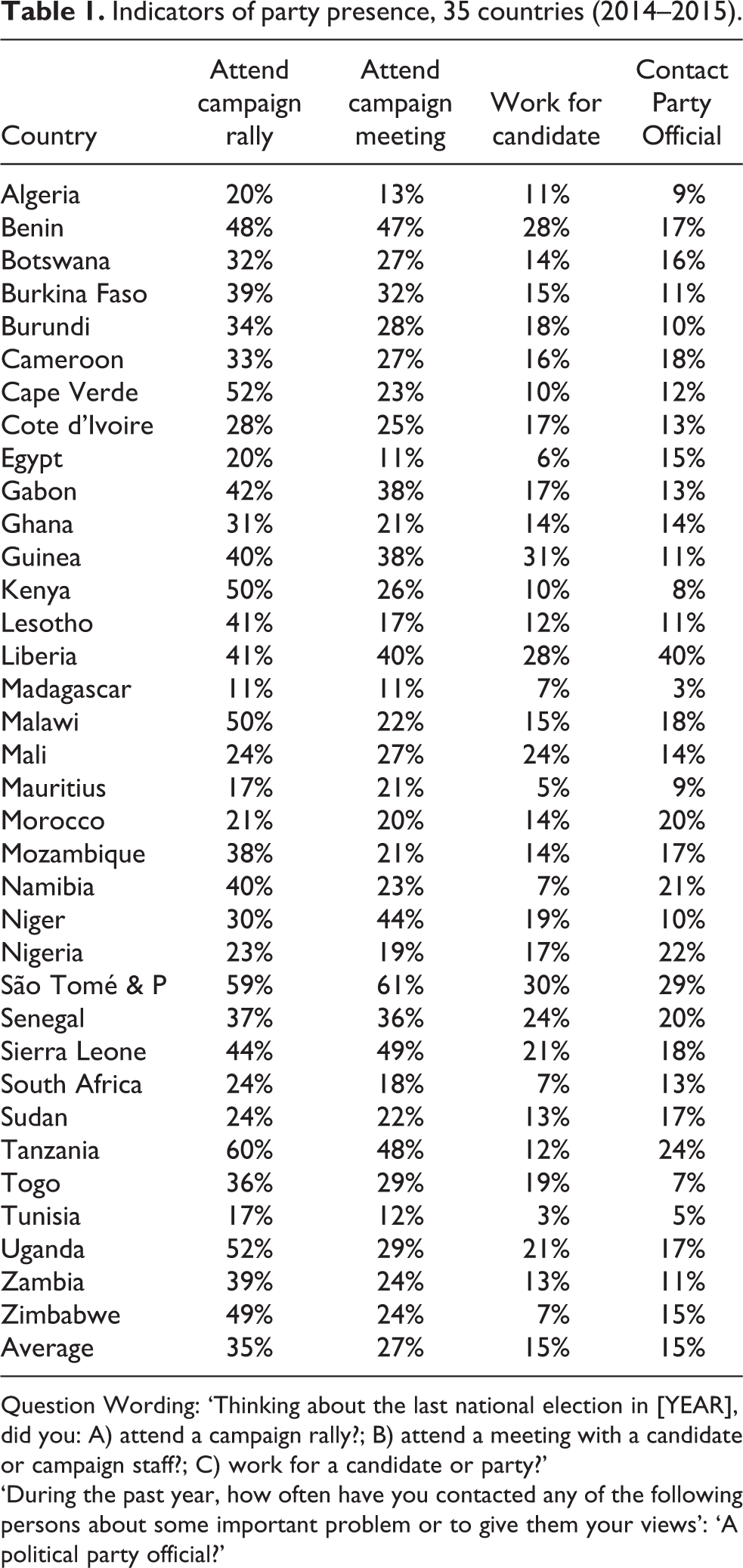
Question Wording: ‘Thinking about the last national election in [YEAR], did you: A) attend a campaign rally?; B) attend a meeting with a candidate or campaign staff?; C) work for a candidate or party?’
‘During the past year, how often have you contacted any of the following persons about some important problem or to give them your views’: ‘A political party official?’
The country variation on each of the four items is substantial, with cross-national ranges of 49 (rally), 51 (meeting), 37 (contact officials), and 28 (work for candidate/party) percentage points, suggesting very different levels of party presence across Africa. We can also see suggestions of significantly different patterns of campaigning. For instance, in most countries (29) party rallies engage more people than campaign meetings. However, in some, campaign meetings tend to be attended by larger or equally large proportions of people (for instance, Niger, Sierra Leone, Mali, and São Tomé and Príncipe). Similarly, parties in some countries, like São Tomé and Príncipe, seem to engage significant numbers of citizens in all four forms of activity, while others, like in Cape Verde and Malawi, seem to concentrate on just one or two activities.
Party Presence Index scores
To calculate the Party Presence Index (PPI), we combine the responses to these four questions to create a composite variable that estimates party presence as the proportion of citizens engaged by a political party in any one of the four ways (Figure 1). The results, once again, appear to support our argument that differing party activities engage different groups of citizens. Across the 35 countries, no more than one third of respondents participate in any single activity; yet political parties engage almost one-half of all citizens (46 percent) through a combination of all four.
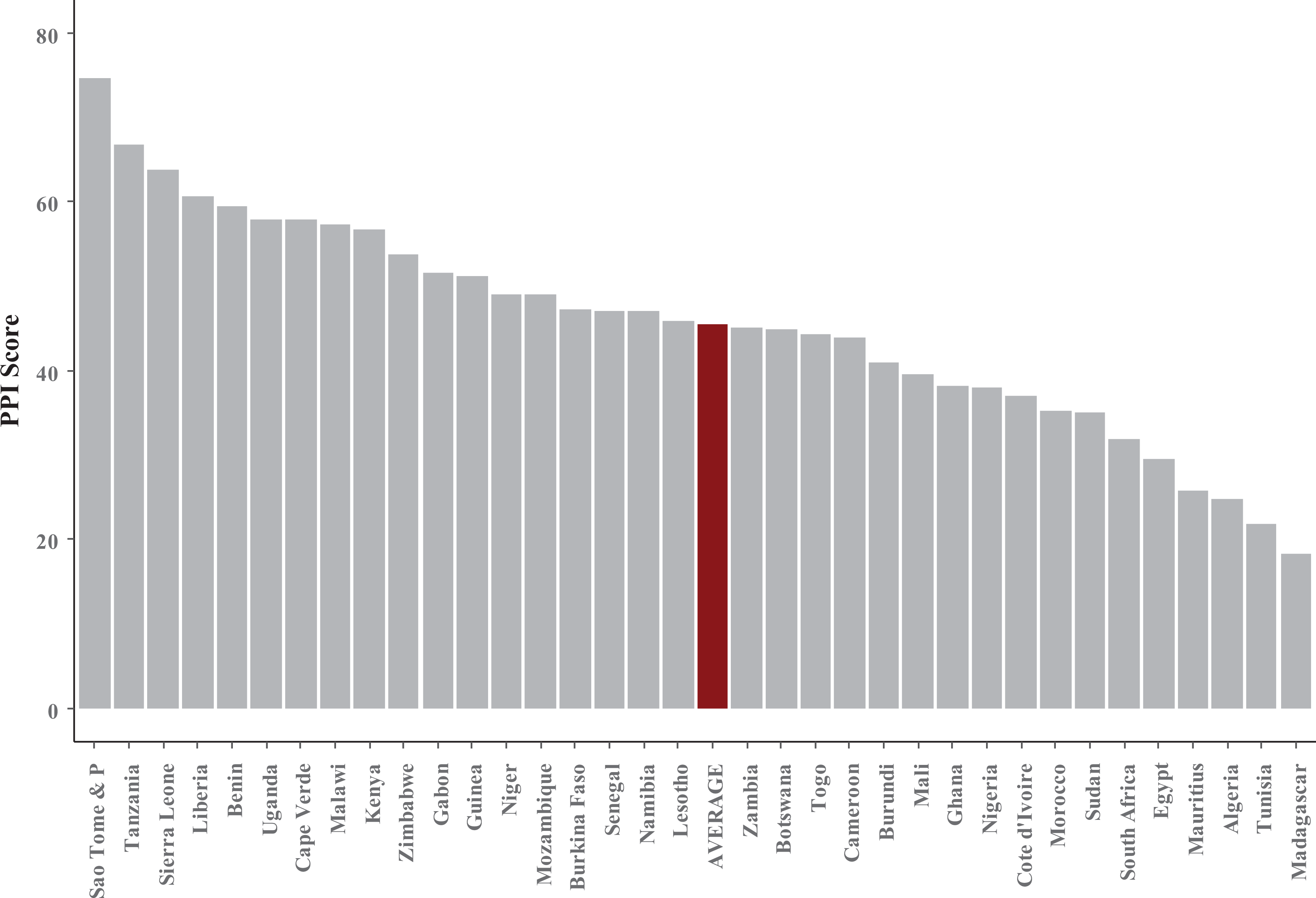
Party Presence Index, 35 countries (2014–2015).
As suggested by the responses to the constituent items, moreover, there is substantial cross-national variation around that average. The PPI shows that across the 35 countries in our sample, a person is most likely to encounter at least some aspect of local political party presence in São Tomé and Príncipe, where three-in-four respondents (75 percent) report engaging with a political party in some way. Yet the same is true of just one-fifth of respondents in Madagascar (18 percent). Thus, the scale discriminates our sample of countries quite effectively, with a total range of 52 points.
The country scores also immediately generate a number of apparently unexpected findings. First, they suggest that political parties in Africa have a far more extensive presence than typically assumed. Second, the index generates surprising variation in the levels of party presence between apparently similar countries. For instance, while São Tomé and Príncipe and Mauritius are both longstanding liberal democracies with compact geographies, two factors which might be expected to facilitate local party presence, these countries lie at almost opposite ends of the cross-national distribution. And finally, while most scholars see former liberation movements as uniformly well-organized at the local level, our index suggests that at least one – South Africa’s ANC – has a far smaller local presence than might be expected, raising questions about the mediating role of post-liberation incentives to maintain extensive grass roots networks. 4
Index validity and reliability
Given these unexpected findings, we anticipate and respond to a number of potential criticisms related to the validity and reliability of the index. First, do the individual responses to the survey questions tap a common, underlying macro-level dimension of local party presence? Second, do they do so in a stable fashion? Third, does the latent dimension really reflect cross-national, macro level differences in organizational presence (as we assert), or does it simply mirror national variation in individual, micro-level willingness to get involved? And finally, how does our index compare to other measures that seek to estimate similar concepts?
A common, stable dimension: Construct validity, reliability and robustness?
Does the Party Presence Index tap a single, valid and reliable dimension? Factor and reliability analysis of the data finds that it does. First, the responses to the four constituent Round 6 Afrobarometer question items are all positively correlated with one another at the country level, confirming that the items are empirically related (Table 2). Second, factor analysis extracts a single valid and reliable latent dimension from these responses, suggesting that the items reflect the influence of a single, latent variable (Table 3).
Correlations of PPI question items (Round 6).
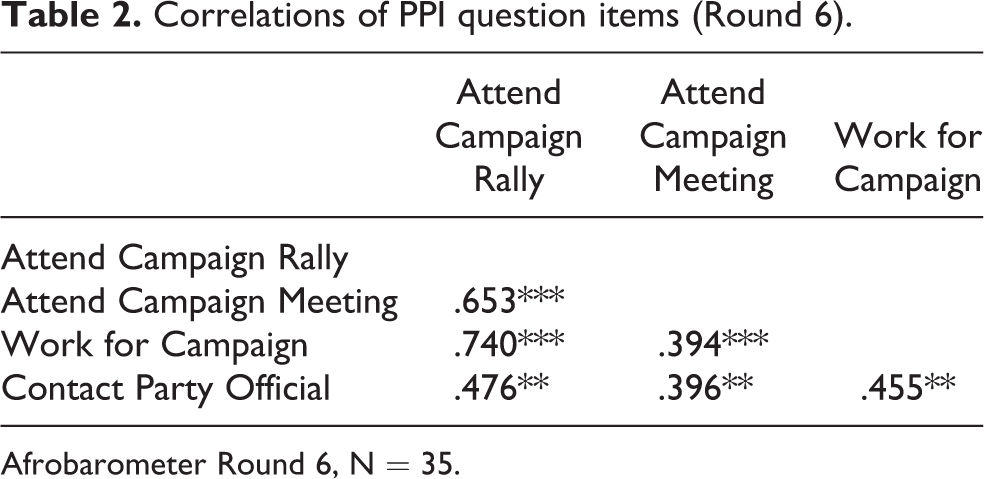
Afrobarometer Round 6, N = 35.
Validity and reliability scores (Round 6).

Afrobarometer Round 6, N = 35.
Index stability
While we would expect the index to be able to detect real changes in the strengthening or weakening of individual parties or party systems and change accordingly, we would not anticipate wild fluctuations in either country estimates or the rank orders of country estimates over time. Using a truncated 3-item version of the index for the 30 countries included in Rounds 5 (2011/2013), 6 (2014/2015), and 7 (2016/2018), 5 (one of the four questions – the item on campaign meetings – was asked only in Round 6), we test the stability of the index and find important over-time differences (defined here as a difference of 10 percentage points or greater) in the reported level of party organization in around one-quarter of all countries. 6 At the same time, however, the rank-order of reported levels of party presence remains very consistent, and the between-round correlations are high, confirming the relative stability of the index over time. 7 We return to the issue of over-time change in a subsequent section.
Finally, because the index consists of three campaign related items, but just one non-campaign related item, it is possible that this biases results towards countries with parties that are more effective in campaign mode. To check this, we ran a series of robustness checks by combining the two types of variables in different ways. We reduced the campaign related variables to a 2:1 ratio. We also treated the non-campaign related item as equally important to the three campaign related items (1:1). Despite the different aggregation rules, the country rank order remained very consistent for all versions across a 35-country sample (for more details on the aggregation rules, as well as a comparison of the mean values of each index, as well as the Pearson and Spearman correlation coefficients, see Appendix B).
Party presence or individual willingness to engage? Predictive/criterion validity
While these results provide confidence that the PPI taps a common underlying dimension, some critics might still question whether this underlying dimension simply reflects cross-national differences in individual motivations or ability to engage with political parties, rather than the differences in grassroots presence we claim. In order to explore this possibility, and demonstrate that our index reflects party presence on the ground, we conduct three separate tests.
The PPI and party canvassing
We first turn to new data on party canvassing, an activity clearly initiated by political parties, rather than by individual citizens. Questions on canvassing were included for the first time in Afrobarometer Round 8 (conducted in 2019/2020), and data is currently available for 14 countries. 8 If, as we argue, the PPI really measures local party presence and not just individual willingness to engage, our estimates should predict variables, such as this, that are clearly a function of party organizational structure. In line with this argument we find that party presence across all 14 countries, as measured in R7 (2016/2018) is indeed a strong predictor of party canvassing approximately three years later (r = .508, p = 0.064) (Figure 2). 9

PPI (2016–2018) and party canvassing (2019–2020). Note: This is the truncated three-item version of the PPI using Round 7 data, and the canvassing data from R8. The Pearson Correlation coefficient r = .508, p = 0.064.
Regional variation in PPI and party branches in South Africa
For our second test, we exploit local level data on party branches in South Africa to show the strong sub-national correlation between this measure and PPI recalculated at the provincial level. The South African case is a particularly useful one for our purposes, because reasonably accurate data on the number of branches per province is available for the ruling African National Congress Party (ANC), a relative rarity in Africa. This data is drawn from the ANC’s 54th National Conference Report, which lists the number of branch delegates that were entitled to attend the party’s 2017 national conference from each province. 10 Because the number of branch delegates roughly reflects the number of local branches, 11 we are able to develop a reasonably accurate measure of local party presence in each of the country’s nine provinces (number of delegates per 10,000 residents of a given province).
To construct the PPI for comparison with this branch data, we take advantage of the 2019 South African National Election Study (SANES). 12 The SANES survey contains two of the PPI items on attending meetings/rallies and working for party election campaigns. More importantly for our immediate purpose, SANES explicitly asked respondents whether they had attended an ANC party meeting or rally during the 2019 campaign. 13 Unfortunately, the same level of specificity was not included in the question on working for a political party, 14 (Q59: ‘Did you work for any party or candidate during the election campaign’), so for this question we counted only respondents who said they identified with the ANC, as we feel reasonably confident that this category of respondents are most likely to be talking about the dominant ANC when reporting partisan election work.
As can be seen in Figure 3, the correlation between the ANC specific Party Presence Index and the number of branches per province is strong, and in the expected direction: provinces with a higher ANC delegate-to-province population ratio (and thus, a denser grassroots network), also have higher scores on the ANC-specific PPI (r = .821, p = .007, N = 9). The Western Cape, the only province in which the ANC is not the majority party, scores lowest on both indices, while the Northern Cape and Free State, traditional ANC strongholds, score high on both. 15 Once again, therefore, we find that the PPI does measure local party presence, rather than simply individual willingness to engage. In addition, this test also showcases three important benefits of our new measure – the relative ease with which the index can be calculated at sub-national levels (in this case, provinces), for specific parties (the ruling African National Congress), and using data from other survey projects.
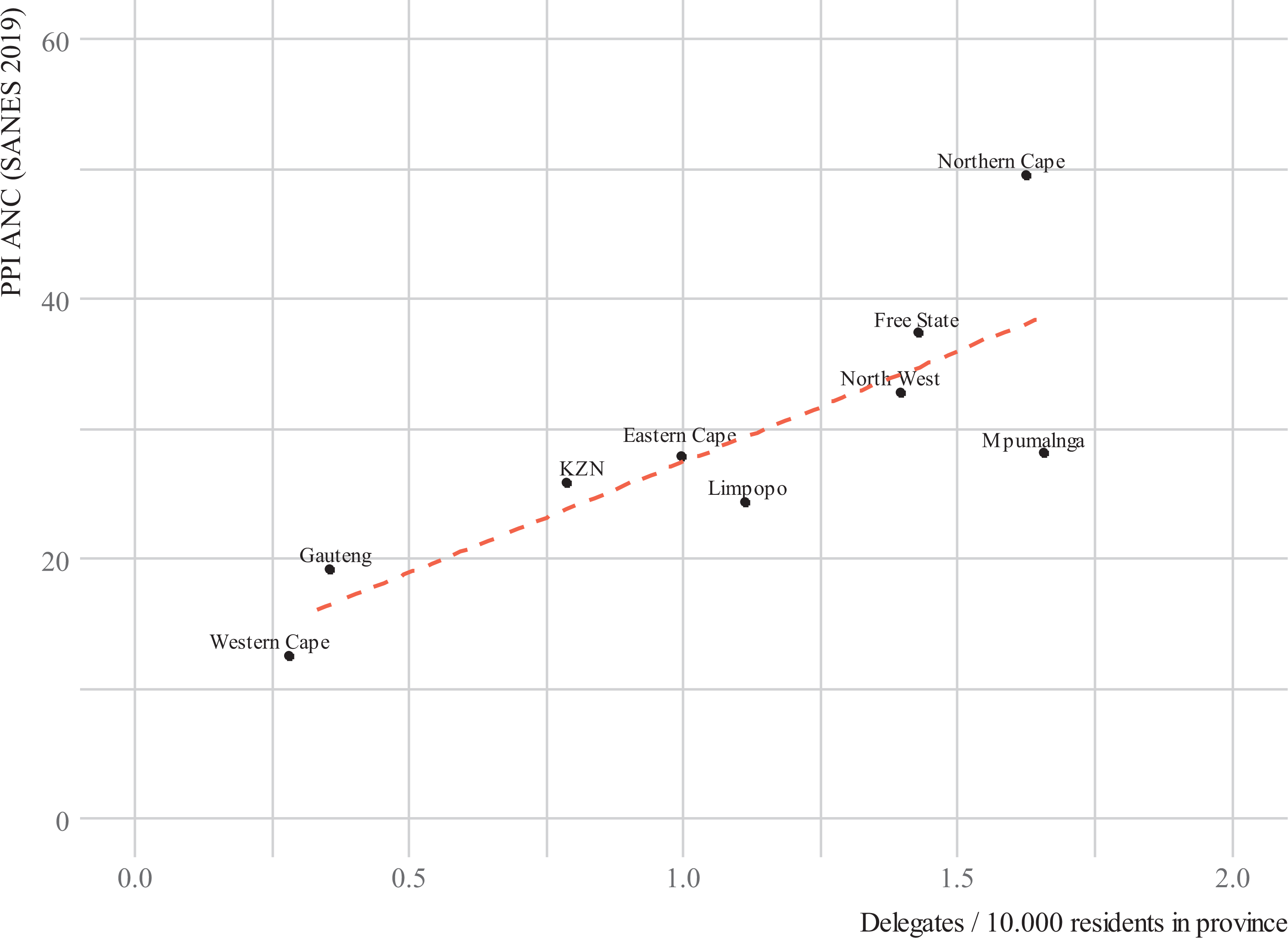
ANC branch delegates (2017) and SANES measures of ANC PPP (2019), by province. Sources: South African National Election Study (2019), Stats SA (2019) and African National Congress (2017). The Pearson correlation coefficient is r = .821, p = .007.
The PPI and party change in Zambia
For our third and final test, we construct party-specific and subnational versions of the PPI in Zambia, and use these to show that our index accurately captures known changes in party presence over time in this context. In contrast to the SANES data we have just discussed, the Afrobarometer survey questions we have used to construct the PPI do not refer to a particular political party. However, Afrobarometer does ask respondents whether they identify (‘feel close’) with any party, and if so, which one.
Assuming that people are most likely to engage with the party with which they identify, we use this question to construct a party-specific version of the PPI for Zambia’s ruling Patriotic Front (PF), and the two major opposition parties between 2013 and 2017 – the Movement for Multiparty Democracy (MMD), and the United Party for National Development (UPND) (Figure 4). 16 As can be seen, trends in party presence reflect the widely documented collapse of the MMD after 2011, as well as the maintenance of party presence by the ruling PF and a sharp rise for the opposition UPND over the same period (see Beardsworth, 2020; Siachiwena, 2020).
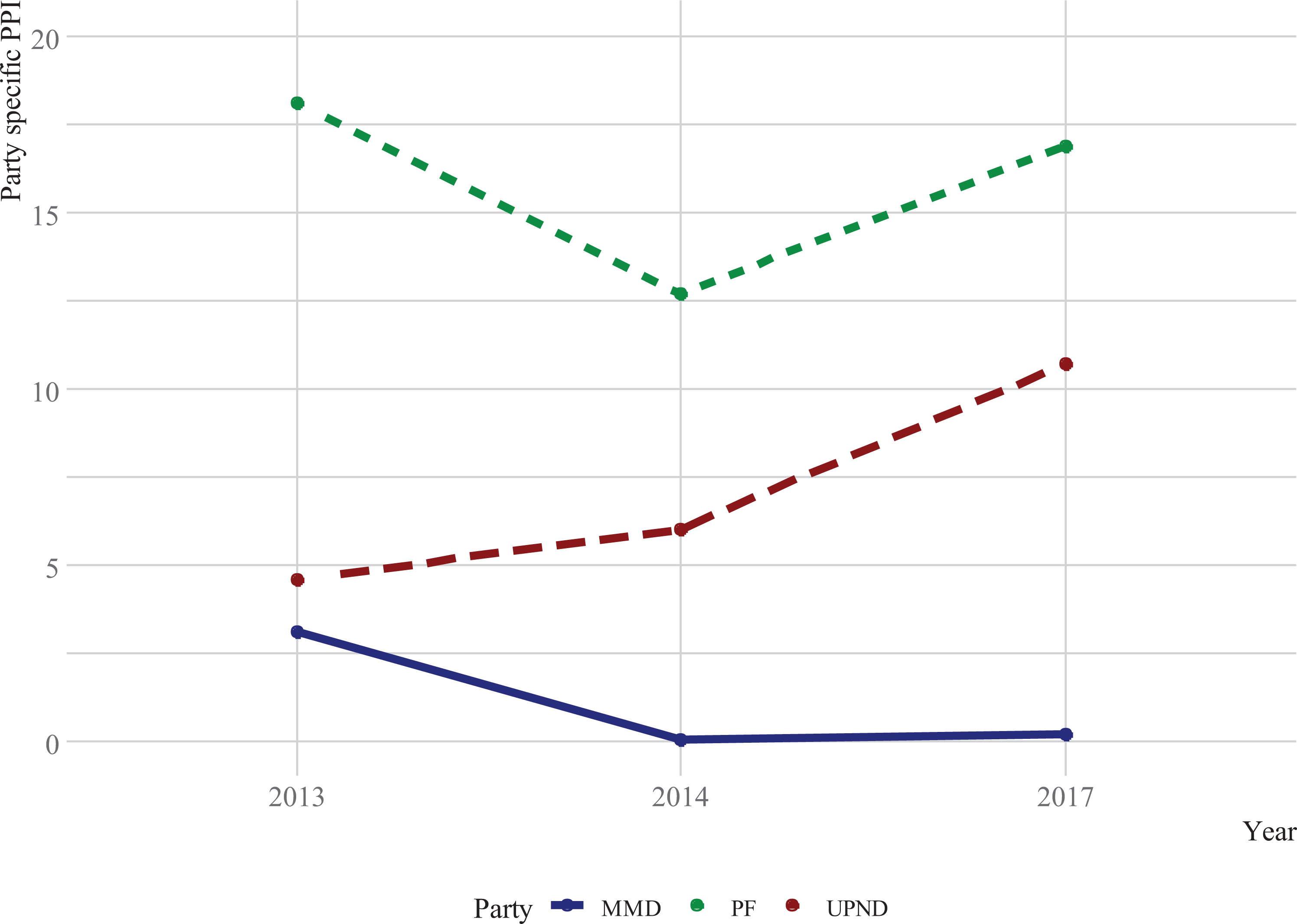
Zambia Party specific PPI 2013–2017.
We also move to the subnational level to demonstrate that the index correctly identifies the regional strongholds of each party (Figure 5), 17 again giving us confidence that PPI captures party presence on the ground, rather than citizen willingness to engage. 18
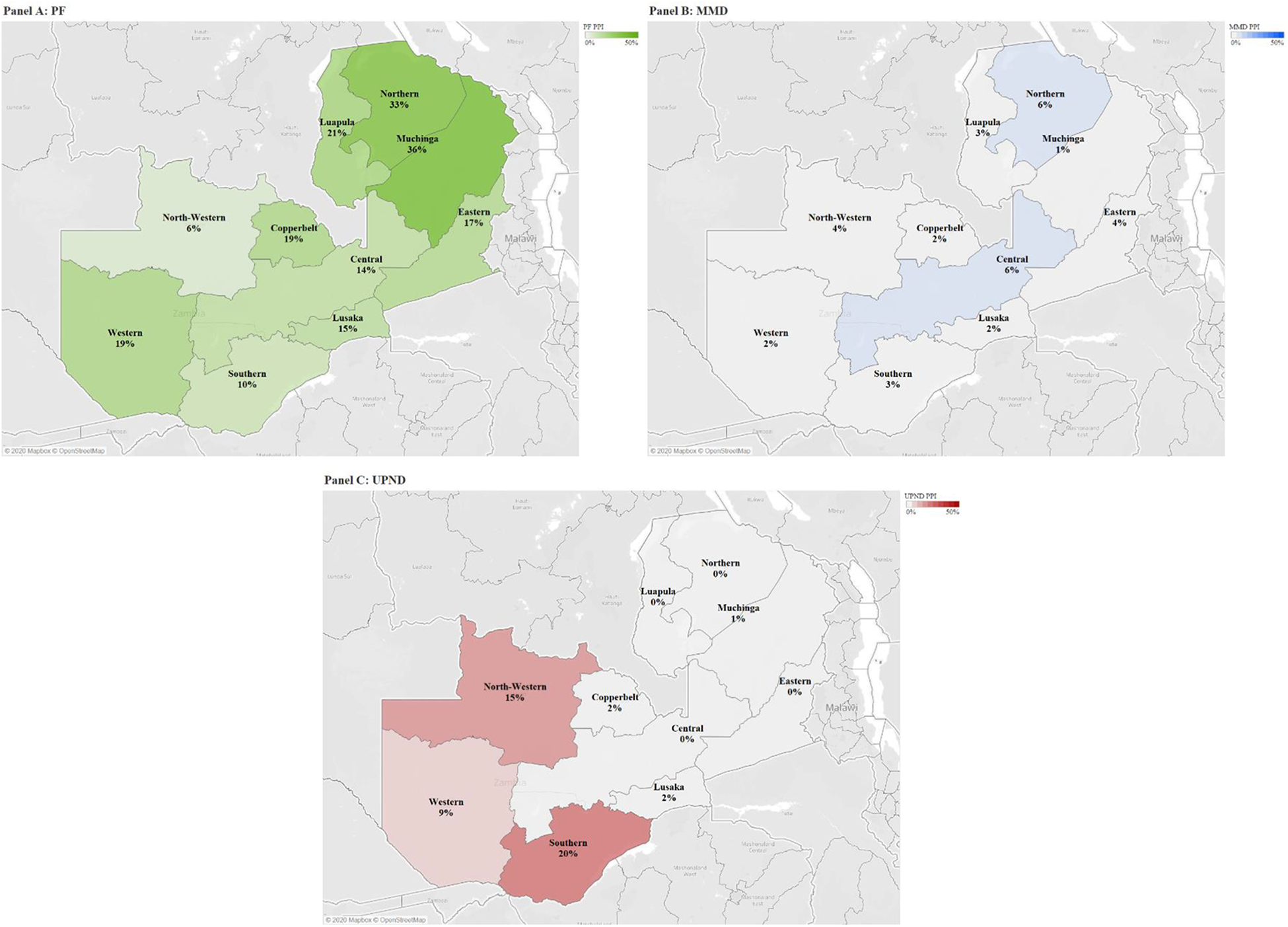
Zambia Party specific PPI 2013 by party.
Convergent validity
Having demonstrated that PPI provides stable, valid and reliable estimates of local party presence, we conclude this section by examining a final form of validity – convergent validity – by comparing its results with those of a separate project that seeks to measure similar concepts. While we have noted several times the dearth of reliable cross-national data on party presence in Africa, a very recent contribution from the V-Dem project called V-Party does attempt to tap a similar idea. A strong correlation between PPI and the results generated by V-Party would, therefore, provide further confidence in the reliability of our measure.
V-Party, like V-Dem, collects regular estimates of country expert judges. In this case, experts provide estimates of a wide range of characteristics about each party with a vote share of more than 5% in a legislative election between 1970 and 2019 in each respective country. Two variables are conceptually closest to our mass-based survey measure of party presence, measured by expert answers to the following questions. The expert judges record responses to each question on a five-point scale. 19
– Does this party maintain permanent offices that operate outside of election campaigns at the local or municipal-level?
– To what degree are party activists and personnel permanently active in local communities?
We compare the expert responses on these variables with our party-specific PPI estimates for the 40 largest parties across the 20 countries for which both Afrobarometer (2014/2015) and V-Party (2012–2015) have data. This reveals a correlation that is both strong and in the expected direction (Figure 6). 20
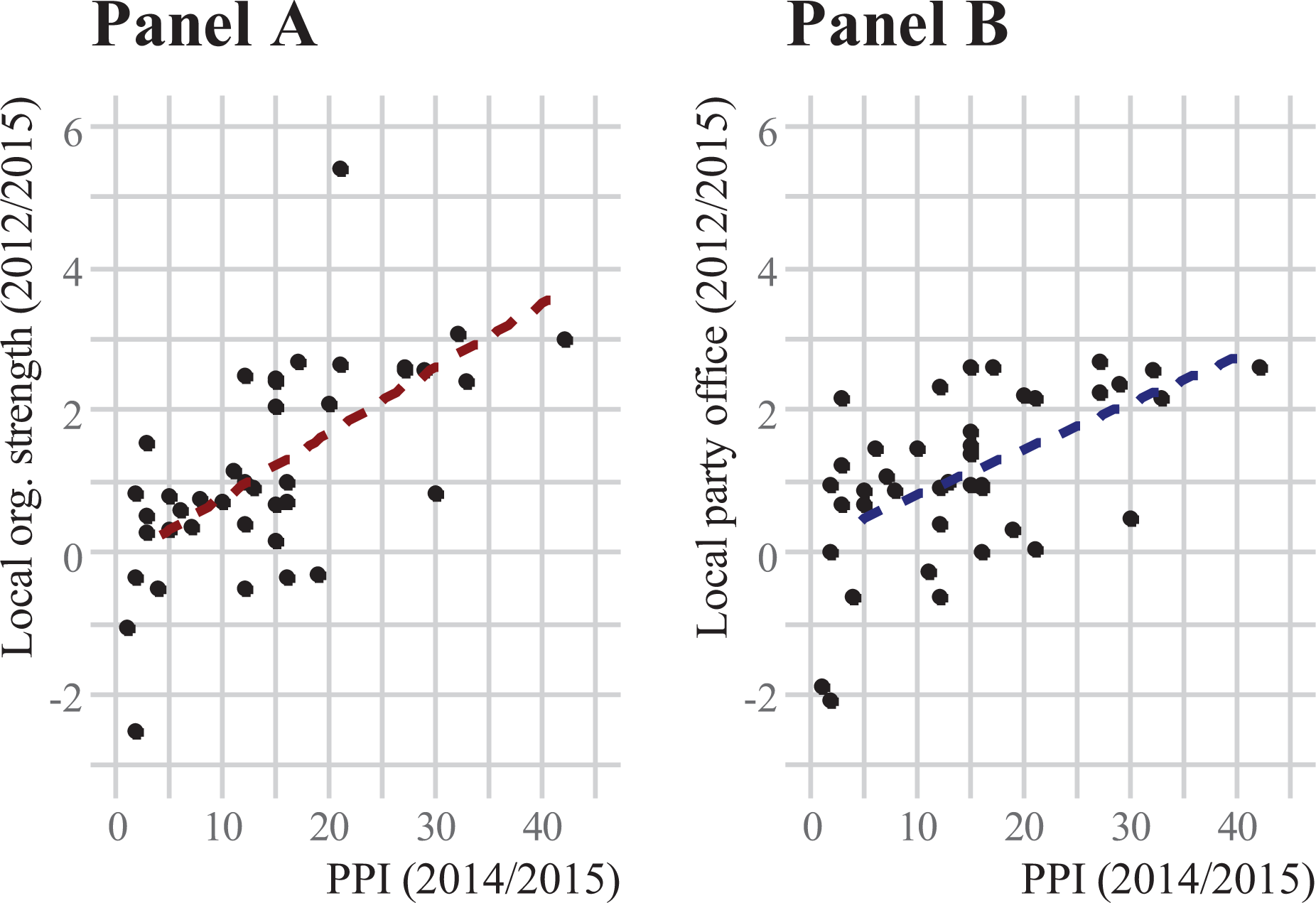
Party specific PPI (2014/2015) and V-Party Estimates of Local Party Strength and Local Offices (2012/2015).
However, while the correlation is strong, the scatterplot highlights a number of differences between the two measures. In Panel A, for instance, the V-Party judges award 11 parties similar scores of local activism between ‘2’ and ‘3’, while citizens report radically different levels of presence for those same parties (ranging from 12 percent to 42 percent). At the same time, the V-Party experts see significant differences among 10 parties (which receive scores ranging from +1.5 to −2.5), yet which are all equally absent according to citizens, engaging five percent of respondents or fewer. Similar patterns are evident in Panel B.
One possible reason for these differences is that – in contrast to citizen reports of actual engagement – expert coders are likely to base their judgements on news media reports, or party documents, all of which may be heavily shaped by party officials’ attempts to present themselves in the best possible light. Moreover, definitions of official and active membership or branches often differ across parties, and data – if available at all – is likely to over-estimate effective party presence. This not only raises questions about the accuracy of expert judgements who might rely on such data, but also makes it difficult to compare estimates cross-nationally, a problem that is not limited to Africa (Foster, 1982; Ponce and Scarrow, 2016). Another possible reason is the simple number of citizen observations versus expert judgments: while national level PPI estimates are based on at least 1,200 reports of citizen interaction per country, the current V-Party codes reflect the views of, on average, 4.2 and 4.3 experts for each variable. Moreover, more than half of the parties (21) included in Panel A, do not meet the V-Party recommended minimum of 4 or more party experts for point estimates, while the same is true for 19 parties for the ‘local party office’ variable in Panel B (Lührmann et al., 2020).
All of this illustrates the advantages of constructing an index based on citizens’ experiential reports of interactions with political parties, rather than relying on expert judgments. Additionally, as we have already shown, another significant advantage of our survey-based measure is that it allows scholars to create national, subnational and party-specific measures of presence. By contrast, V-Party currently only provides country level scores limiting the kind of questions one can investigate.
Consequences and implications for future research
Having concluded our discussion of validity and reliability, the obvious question now is, ‘so what?’ The purpose of the PPI is both to measure levels of party presence across Africa, and, perhaps more importantly, to provide a new measure that can be used to test a range of hypotheses about the consequences of political party strength (or weakness) in Africa. To what extent, for example, does organizational strength affect parties’ ability to persuade and mobilize voters, to represent voters, or to enable legislatures or voters to hold executives accountable? While future research should explore all these avenues, we end by illustrating one important consequence of party presence: its ability to shape public attitudes towards democracy.
Popular attitudes towards democracy
If political parties fulfil important functions by aggregating interests and representing citizens, mobilizing voters, and providing effective electoral contestation, might their presence at the local level help produce more positive attitudes towards parties in general, elected representatives, and even the democratic system as a whole?
To examine these possibilities, we devise a multi-level model to test whether respondents who live in areas with high levels of party presence (aggregated to the provincial or regional level) 21 are indeed more likely to hold positive attitudes towards key aspects of the larger democratic system.
To ensure we are isolating the effect of party presence, we include controls for a range of national, regional and individual level covariates. At the macro level, we control for GDP per capita PPP, ethnic heterogeneity, democratic history, and type of electoral system. At the meso level, we include the provincial level of lived poverty, as well as the provincial level PPI score. And at the micro level, we build on standard models of trust in government (Mattes and Moreno, 2018) and the perceived supply of democracy in Africa (Mattes and Bratton, 2007). These include a range of demographic characteristics (age, gender, rural location, employment, and occupation), and factors related to political sophistication (education, cognitive engagement, and news media use) and community participation (active membership in community and religious groups, attending community meetings, and joining with others to address community problems). We also control for the potential confounding effects of co-partisanship (whether respondents identify with the ruling party), neo-patrimonialism (whether they approve of, and trust the President), economic evaluations (an index of past, current, and future economic trends), and perceptions of the freeness and fairness of the most recent election. 22 More details on all variables can be found in Appendix D.
As Table 4 shows, we find that even after controlling for this large range of national and individual level characteristics, provincial levels of PPI have consistent and strong impacts on citizen attitudes. Africans living in regions with higher levels of local party organizational presence are substantially more likely to say that elected local councillors and Members of Parliament are ‘interested’ in their opinions (b = .355, p ≥ .01) (Table 1, Model A). They are also more likely to trust both governing (b = .529, p ≥ .001) (Model B) and opposition parties (b = .368***, p ≥ .01) (Model C). And finally, they are more likely to feel that they are being supplied with democracy (a construct of respondent’s evaluations of the level of democracy, and their satisfaction with the way democracy works) (b = .425, p ≥ .001) (Model D). These findings, of course, require more interrogation and extension, but even this brief analysis demonstrates the value of the PPI, and the ways in which this new cross-national measure of party presence opens up important new lines of research.
PPI and citizen attitudes, 35 countries (2014/2015).
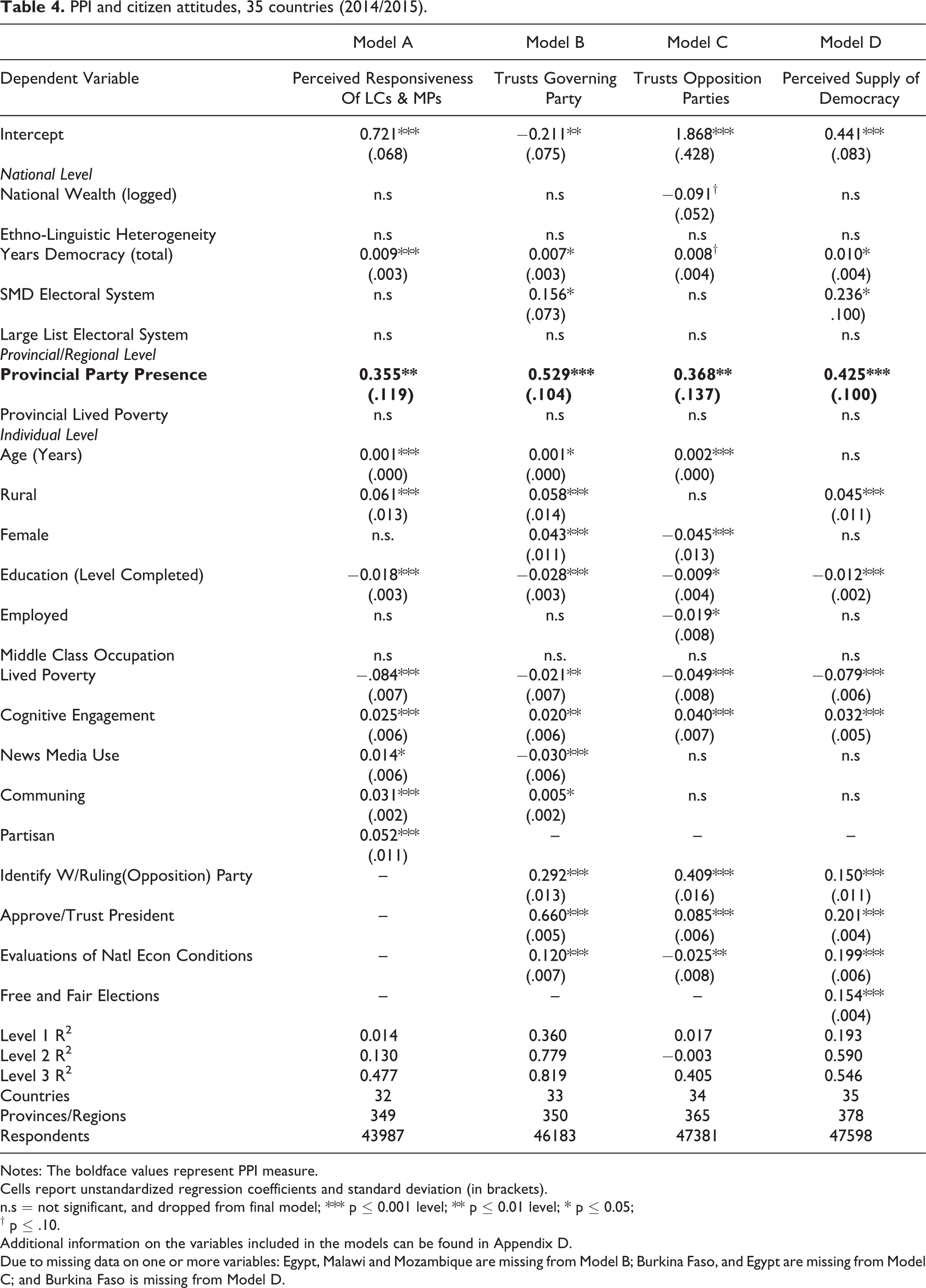
Notes: The boldface values represent PPI measure.
Cells report unstandardized regression coefficients and standard deviation (in brackets).
n.s = not significant, and dropped from final model; *** p ≤ 0.001 level; ** p ≤ 0.01 level; * p ≤ 0.05;
† p ≤ .10.
Additional information on the variables included in the models can be found in Appendix D.
Due to missing data on one or more variables: Egypt, Malawi and Mozambique are missing from Model B; Burkina Faso, and Egypt are missing from Model C; and Burkina Faso is missing from Model D.
Conclusion
While the social scientific study of African politics contains many standard assertions about political parties, few are based on systematically collected data about more than a handful of parties or countries at any given point. In this paper, we have attempted to remedy this situation by focusing on one crucial aspect of party organization – the local presence that enables political parties to engage with and mobilize voters during and between elections – and developing a new measure that uses readily available survey data to measure the extent of this presence. We have shown that this measure is both valid and reliable, and by demonstrating substantial correlations between the PPI and a variety of other data, we have provided evidence that the measure truly reflects local level party presence, and not simply individual motivation. In other words, we have shown that there is good reason to believe our opening statement that, ‘where there is smoke there is fire’, and that the Party Presence Index provides a valuable measure of local party presence across the continent. Finally, we have briefly examined one substantive implication of our new measure, using it to explore the role that parties play in the legitimization of democracy more broadly.
This paper makes a number of important contributions to the literature. First, it provides the first systematic, survey-based cross-national measure of local party presence across the continent. While other cross-national measures assessing the organizational strength of African parties do exist (for example, V-Party and DALP), all the measures of which we are aware are focused on the existence of formal party branches at the local level. 23 As a result, they do not capture the realities of local party presence in the same way. Additionally, because these measures rely on expert opinions rather than survey data, they measure the extent to which formal party branches are believed to exist, rather than parties’ effective presence on the ground. The PPI also enables a clearer, more accurate understanding of grassroots party activity and allows the examination of subnational as well as cross-national variation.
Second, this paper shows that a clearer understanding of local party presence can substantially improve our understanding of party behaviour more broadly, opening up new lines of research and casting new light on existing debates.
And finally, we recognize that our reliance on survey data raises the usual concerns around social desirability bias and question availability. But we maintain that the benefits of a survey-based cross-national measure of local party presence in a region where it is otherwise difficult and costly to gather information, means that the PPI will be an important tool for scholars of African political parties, and potentially add to our understanding of grassroots party organization in other regions around the world.
Supplemental material
sj-pdf-1-ppq-10.1177_13540688211008352 – Supplemental Material for Party footprints in Africa: Measuring local party presence across the continent
Supplemental Material, sj-pdf-1-ppq-10.1177_13540688211008352 for Party footprints in Africa: Measuring local party presence across the continent by Matthias Krönke, Sarah J Lockwood and Robert Mattes in Party Politics
Footnotes
Acknowledgements
The authors are grateful to Jeffrey Conroy-Krutz, Dan Paget, Jeremy Seekings, Michael Wahman, to attendees of the “Political Parties in Africa” conference at the University of Cape Town (2018), and to participants in the “Party Behavior in Africa” panel at the 2019 APSA Annual Meeting, as well as the anonymous reviewers for their invaluable comments on earlier versions of this paper. Matthias Krönke would like to acknowledge the generous support of the Institute for Democracy, Citizenship and Public Policy in Africa (University of Cape Town).
Declaration of conflicting interests
The author(s) declared no potential conflicts of interest with respect to the research, authorship, and/or publication of this article.
Funding
The author(s) received no financial support for the research, authorship, and/or publication of this article.

Supplemental material
Supplemental material for this article is available online.
Notes
Author biographies
References
Supplementary Material
Please find the following supplemental material available below.
For Open Access articles published under a Creative Commons License, all supplemental material carries the same license as the article it is associated with.
For non-Open Access articles published, all supplemental material carries a non-exclusive license, and permission requests for re-use of supplemental material or any part of supplemental material shall be sent directly to the copyright owner as specified in the copyright notice associated with the article.
