



Abstract
Although the position of the party on the ground has been weakened by cartelization, grassroots activists remain an important recruitment pool for political professionals. Based on unique survey data collected among the staff of 14 Belgian and Dutch parties (N = 1009), this article offers an in-depth analysis of party activism among this under-researched population. Introducing a new supply and demand framework, I argue that staff recruitment is shaped by candidate preferences (supply) and party preferences (demand). The findings demonstrate that most political staffers are high-intensity activists with a strong commitment to their party. Moreover, the theoretical model accurately predicts that non-activists are more common among policy and communication experts, ministerial staff, and those working for ideologically moderate parties. These findings show that paid staffers do not necessarily widen the gap between parties and activists. They also raise normative questions about internal congruence within parties in coalition governments.
Introduction
Despite the central position of political staffers in contemporary parties, only a few top advisors are known to the public. However, infamous advisors such as Steve Bannon, Alastair Campbell or Martin Selmayr are just the tip of the iceberg. Below the surface, a much larger unelected elite of staffers remains hidden. Amid a growing research interest for parliamentary staff (Hertel-Fernandez et al., 2018; Pegan, 2017) and ministerial advisors (Shaw and Eichbaum, 2018; Taflaga and Kerby, 2019), political staff remains ‘one of the most under-researched fields in study of political parties’ (Webb and Keith, 2017: 40). A few notable exceptions aside (Karlsen and Saglie, 2017; Webb and Fisher, 2003), party scholars have refrained from studying this notoriously elusive population (Webb and Keith, 2017; Webb and Kolodny, 2006). In fact, public administration scholars have noted that the party perspective is often missing from this discussion (Hustedt and Salomonsen, 2014; Silva, 2017). This article lifts the veil on this unelected but pivotal elite by analysing original survey data (N = 1009) collected among 14 Belgian and Dutch parties.
In this article, I focus on staffers’ party activism to examine whether political professionals remain active as volunteers at the grassroots level. This connection is important because the increase in public funding and paid staffers has made parties less dependent on their members (Katz and Mair, 2002). Yet, at this point, it remains unclear what this ‘marginalization’ of the party on the ground means for the recruitment of staffers. Influential models such as the electoral-professional party (Panebianco, 1988) and the cartel party (Katz and Mair, 1995) suggest that political professionals emphasize ‘the cash nexus of an employment contract instead of partisan loyalty or ideology’ (Katz and Mair, 2009: 759). This suggests that rather than motivations of political activism, contemporary political professionals are motivated by vocational values such as technical expertise, career development and professional autonomy. Although research on staffers is scarce (Webb and Keith, 2017), the few existing studies suggest that professionalism and activism are not mutually exclusive as the party on the ground remains an important recruitment pool for political staff (Fisher and Webb, 2003; Karlsen and Saglie, 2017).
This in-depth study of staffers’ party activism aims to contribute to this topic via two research questions. First, I analyse staffers’ party activism from a general perspective. To what extent are political staffers involved in party activism (RQ1)? Second, I examine whether their party activism is similar across the population of political staffers. Which types of staffers are the most involved as party activists (RQ2)? Based on an original supply and demand framework, I argue that both the preferences of aspiring staffers (supply) and party preferences (demand) stimulate the recruitment of party activists. However, I argue that Panebianco’s description of professionalization (1988) has affected specific subgroups of staffers. Non-activists are more likely to be recruited for staff positions requiring extra-political expertise, in ministerial offices and mainstream parties. The empirical analysis aligns with earlier studies and supports the proposed framework.
This contribution advances research on political staff on several fronts. First, the theoretical section fills a theoretical gap by proposing an original supply and demand approach to explain why most staffers in parliamentary democracies are party activists. Moreover, I reinterpret Panebianco’s seminal work (1988) to identify which types of positions are more likely to attract non-activists. Second, the empirical analysis is based on extensive data collection that overcame the practical hurdles of researching parties’ inner workings. To my knowledge, it is the first time a survey project covers more than a thousand staffers spread across three party faces (central offices, party groups and ministerial offices) from 14 parties in several countries. Third, the conclusion reflects on the democratic legitimacy of this unelected elite. On the one hand, recruiting party activists ensures that staffers share the political objectives of voters and members. On the other hand, this mechanism appears to be the weakest for those staffers who matter the most.
Conceptualizing political staff
Political staffers are an elusive, understudied population in party politics (Webb and Keith, 2017). However, they are receiving increased scholarly attention from various disciplines. While only a few party scholars have focused on party employees working in parties’ central offices and parliaments (Fisher and Webb, 2003; Karlsen and Saglie, 2017; Webb and Fisher, 2003), congressional staffers have been a more regular subject for legislative scholars for some time now (Hertel-Fernandez et al., 2018; Romzek and Utter, 1997; Salisbury and Shepsle, 1981). Similarly, public administration scholars are increasingly interested in the activities of ministerial advisers (Hustedt et al., 2017; Shaw and Eichbaum, 2018). Recently, others have taken a broader approach by analysing the larger network of policy professionals working for parties, governments, think tanks, lobbyists and interest organizations (Svallfors, 2020). Although these studies share a mutual fascination for the unelected elites who affect politics, they do not share a common conceptual framework. In this section, I introduce a definition of political staffers to clarify who exactly has been surveyed for this study. I also build on the typology developed by Karlsen and Saglie (2017) to demonstrate which types of staffers are included in this diverse population.
This study defines political staffers as individuals with a remunerated, unelected position that have been politically recruited within a party’s central office, parliamentary party group or ministerial office. This definition sets out four necessary conditions for belonging to the population of interest studied in this article (Table 1). First, political staffers receive a salary in return for their activities, which sets them apart from volunteers like party members. Although volunteers remain relevant to the political process, the focus of this article are the individuals who are directly employed within party organizations, party groups or ministerial offices. The origin of their salary can either be the party payroll, the parliamentary party group or a ministerial office (Monroe, 2001; Webb and Kolodny, 2006). Second, political staffers hold unelected positions, which sets them apart from elected officials like party leaders, members of parliament, or ministers. In contrast to elected elites, staffers are appointed by party organizations or elected officials after a non-public recruitment process. In general, they operate behind-the-scenes, remaining invisible to the public at large (Laube et al., 2020). Third, political staffers are directly recruited by party organizations or elected elites, which sets them apart from civil servants. Admittedly, the civil service can itself be subject to party patronage (Kopecký et al., 2012) and a considerable portion of staffers have professional experience or future ambitions as a civil servant (Karlsen and Saglie, 2017). However, such ‘hidden professionals’ within the civil service (Panebianco, 1988: 234) are excluded from this study because this would make the population of interest very heterogeneous and practically impossible to identify. Fourth, staffers are employed by party organizations, parliamentary party groups or ministerial offices, which sets them apart from external campaign consultants (Farrell et al., 2001) and firms who offer parties PR – and digital services (Dommett et al., 2020).
Key characteristics of political staffers.
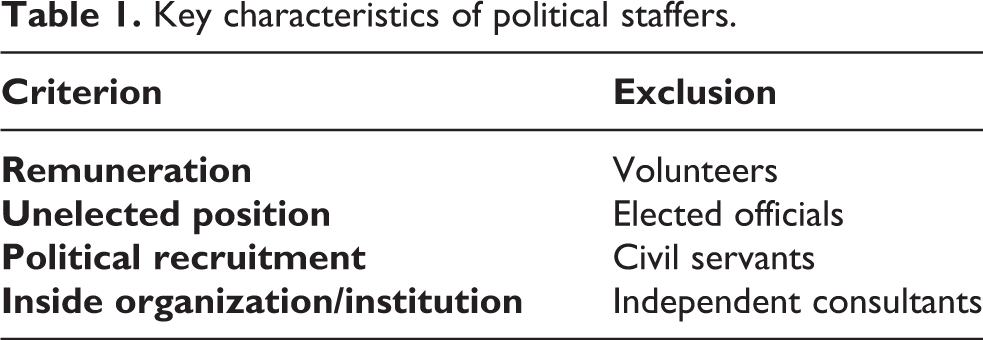
By including both party (group) staff and ministerial staff, this study is the first to bridge the conceptual divide between two separate research traditions: one focusing on ministerial policy advisors (Shaw and Eichbaum, 2018), another consisting of party politics scholars who have studied party staff (Karlsen and Saglie, 2017; Webb and Fisher, 2003). This broadly defined population includes a diverse set of staffers, ranging from administrative clerks to spin doctors and policy wonks. To distinguish between different groups of staffers, several authors have developed typologies based on staffers’ roles and tasks. As the existing typologies of ministerial staff focus on staffers in advisory roles only (Connaughton, 2010; Maley, 2000), this article builds on the typology proposed by Karlsen and Saglie (2017). The authors describe four types of staffers based their tasks: communication adviser, political adviser, organizational adviser, and administrative position. Using this categorization as the conceptual backbone, I make a fine-grained distinction between six types of staffers based on staffers’ principal activities: managers, policy experts, communication experts, political assistants, party organizers and administration & support (Table 2).
Staffers’ individual tasks.
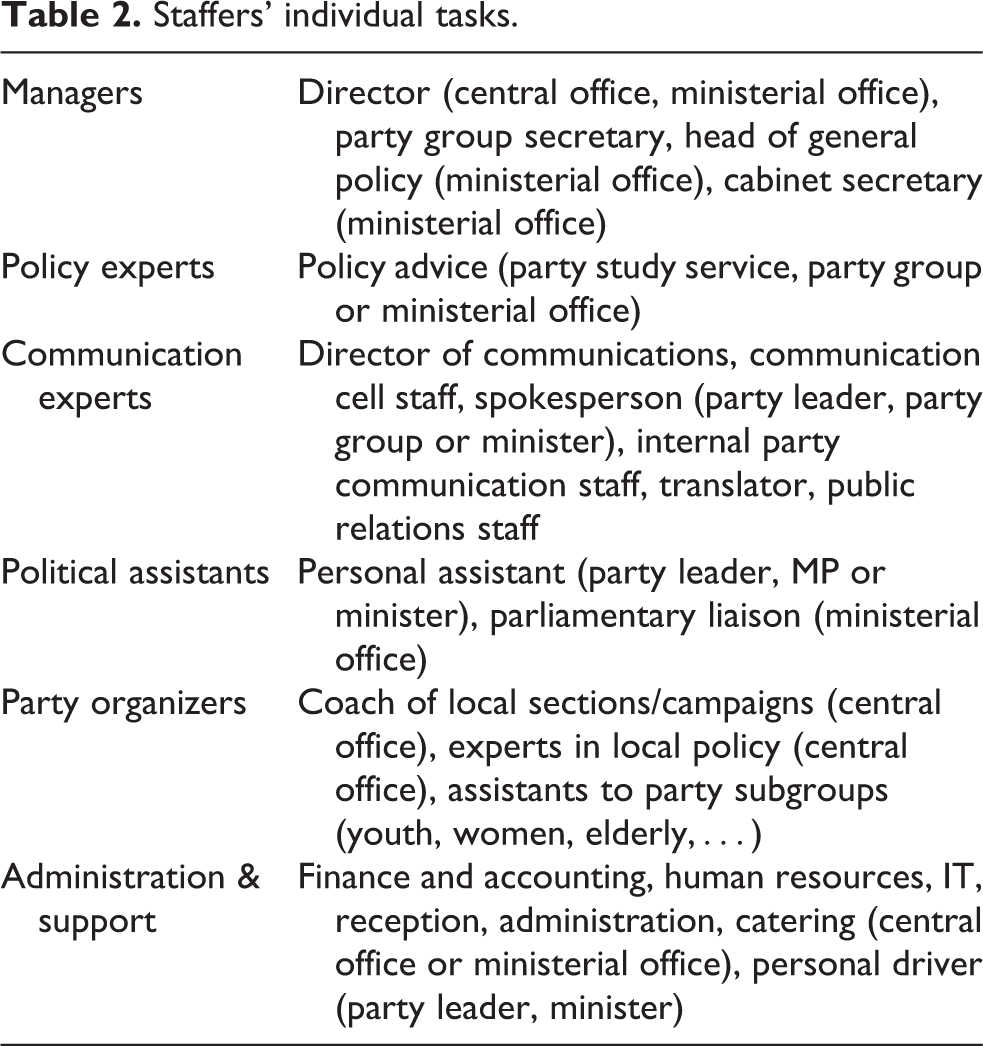
One of the categories developed by Karlsen and Saglie (2017) was adapted to fit the needs of this study. More specifically, the extensive group of political advisers was split into three subgroups: managers, policy experts and political assistants. I consider this adjustment necessary because managers, policy experts and political assistants bring in different levels of extra-political expertise (Panebianco, 1988). The specialization of policy experts originates outside of politics as they provide elected elites with tailored policy advice on specific issues (Busby and Belkacem, 2013; Gouglas et al., 2015; Maley, 2000; Pittoors et al., 2017; Wolfs and De Winter, 2017). Their knowledge of these issues can easily be applied in other contexts, such as industry, academia, or the civil service. In contrast, managers and political assistants specialize in areas that are unique to politics. As central figureheads, managers ensure that the political machine runs smoothly by overseeing procedures and implementing a party’s political-strategic goals. Political assistants are the main sidekick for many individual politicians as they manage their daily schedules (Busby and Belkacem, 2013) and organize constituency service (Landgrave and Weller, 2020). The more fine-grained categorization presented in Table 2 is a prerequisite for testing this assumption empirically as the theoretical framework of this article draws a connection between staffers’ expertise and party activism.
Staffers and party activism
Despite the origins of many contemporary parties as movements driven by volunteers, parties have transformed into professionalized, capital-intensive organizations supported by paid staffs (Farell, 1996; Katz and Mair, 1995; Panebianco, 1988). In Europe, the growing presence of political staffers has coincided with a sharp decline in party membership (Kölln, 2015; Krouwel, 2012; Van Biezen and Poguntke, 2014). Moreover, the overall relevance of the de-energized party on the ground (Seyd and Whiteley, 2002) has been called into question by the emergence of memberless parties (Mazzoleni and Voerman, 2017) and parties’ increasing financial reliance on public subsidies rather than membership contributions (Van Biezen and Kopecký, 2014). Similarly, the voluntary labour of party activists has lost significance due to the paid labour delivered by staffers. However, these developments have not made membership organizations redundant or obsolete.
Most contemporary parties value their members as a source of legitimacy, votes, and candidates for elected office (Scarrow, 1994). Indeed, a significant portion of young activists become party members in pursuit of a professional career in politics (Bruter and Harrison, 2009; Weber, 2020). Parties’ membership organizations are not only a recruitment pool for future politicians, but they are also a valuable reservoir of potential staffers. Even within professionalized party organizations, Karlsen and Saglie (2017: 17) note that ‘party grassroots and the party organisation continue to be of relevance and serve to socialise not only future politicians but also future party professionals’. In this section, I develop an original supply and demand framework explaining why the preferences of aspiring staffers (supply) and parties (demand) favour the recruitment of party activists into staff positions. Moreover, I elaborate the framework to explain why party activists are less prevalent within some staff positions, party faces and parties.
Supply and demand
The recruitment of political staffers is shaped by forces of supply and demand. On the supply-side, the preferences of aspiring staffers determine which types of candidates are available. On the demand-side, the preferences of parties determine which candidate are selected. On the supply-side, the preferences of aspiring staffers can be approached as an individual cost-benefit calculus. Evidently, candidates will only apply for a position when they perceive its costs to be outweighed by certain benefits. Existing literature indicates that the costs of being a political staffers are related to career stability and development. Firstly, electoral dynamics make politics an insecure professional environment with high turnover rates (Dickinson and Tenpas, 2002; Salisbury and Shepsle, 1981). Secondly, returning to the non-political labour market is not without risk. Former political staffers might face discrimination due to political affiliation (Baert, 2018). Moreover, potential employers outside the political bubble tend to undervalue their professional skills (Svallfors, 2016). These professional hurdles can be overcome by considering the benefits of being a political staffer.
So, what drives people to become a political staffer in the first place? Most importantly, staffers receive remuneration in exchange for their work. However, not all staffers consider their salary to be competitive from a purely economic perspective. Research has demonstrated that a considerable portion of staffers is convinced they can find a more lucrative position outside of politics (Fisher and Webb, 2003). Hence, I argue that working in politics requires additional motivation: the intrinsic desire to contribute to a party’s political objectives. Of course, such a cost-benefit calculus is the most favourable to passionate activists within the party network. As a result, the supply of candidates is dominated by party activists who fit this profile.
On the demand-side, party preferences determine which specific candidate is selected. From the perspective of parties, hiring staff is a process of delegation (Strom et al., 2003). As principals, parties instruct staffers (agents) to perform a set of tasks in exchange for remuneration. Once they are hired, staffers are granted professional discretion – a ‘space of autonomy’ in which they are allowed to make their own judgments and decisions (Wallander and Molander, 2014). This area of professional discretion often includes important aspects of political decision-making. To ensure that staffers will successfully serve their interests within this space of autonomy, parties select candidates that are both competent and loyal. Loyalty is important to avoid that staffers would deviate from their principal’s preferences, namely a party’s strategic and ideological goals (Lupia, 2003). This preference for loyalty is key to understanding why parties recruit staffers among their activists. Parties aim to minimize the risk that staffers might deviate from its primary goals in the future. Party activism signals intrinsic loyalty and requires only limited information and energy from recruiters. For this reason, I argue that party activism is a central selection criterion during staffers’ recruitment. Admittedly, the loyalty of staffers can be achieved by other means, such as closely monitoring daily activities. In comparison to the alternatives however, recruiting among a party’s support base is the most effective approach with several advantages. In effect, parties use a staffers’ party affiliation as an informational shortcut to discern which candidates are more likely to act in their interests later.
Recruiting non-activists
The balance between supply and demand does not always result in the recruitment of party activists. In this section, I expand the supply and demand framework to explain why some staffers are more likely to be non-activists than others. This variation between staffers is the result of a trade-off between loyalty and competence. Although political loyalty is valuable to parties, they will nonetheless recruit non-activists when the supply of competent party activists is limited. I argue that parties are more likely to hire non-activists on two conditions. Firstly, the supply of available candidates must include party outsiders who lack the strong commitment of party activists. Such non-activists are more likely to apply when positions offer higher benefits (remuneration, status, influence) or lower costs (career instability, risk of political discrimination). Secondly, the demand for candidates must be too high to be filled with competent party activists. Under these circumstances, parties will also consider hiring non-activists to maximize the competence of their staff. In the following paragraphs, I discuss how the forces of supply and demand explain variation in staffers’ party activism on three analytical levels. More specifically, I expect that party activists are less prevalent among staffers with extra-political expertise (individual level), ministerial staff (party face level) and staffers from mainstream parties (party level).
On the individual level, the recruitment of non-activists is more likely among policy and communication experts. These staffers correspond with the typical political professionals described by Panebianco as their tasks require ‘extra-political’ expertise (1988: 221). On the supply-side, non-activists are more attracted to such positions because they offer higher benefits. Panebianco’s example of an economic expert at a party research office illustrates the increased benefits connected to such expert positions (1988: 129–130). First, the scarcity of formally-trained economists in the labour market increases their remuneration. After all, this type of staff professional can easily fall back on an academic degree to develop a career outside of politics. Second, economic experts have some influence because their area of professional discretion includes devising detailed policies with potential societal impact. On the demand-side, parties will also hire non-activists for such positions because they are numerous but often require specific competences. As these positions account for more than half of all staffers (54%; see Online Appendix B), it is unlikely parties will find enough competent candidates among their membership base to fill in all vacancies for policy – and communication experts. After recruiting the available supply of competent activists to key (management) positions, parties will therefore resort to hiring competent non-activists.
On the party face level, the recruitment of non-activists is more likely among ministerial staff. On the supply-side, non-activists are more attracted to positions at ministerial offices because the benefits are higher. First, a prestigious position in a ministerial office is beneficial to a staffers’ social status. Second, the power of elected ministers has a spill-over effect on their staff. As staffers are often motivated by a ‘desire to affect politics and society at large’ (Selling and Svallfors, 2019; Svallfors, 2017), access to influential elected elites considerably increases the appeal of a particular position. Third, ministerial staffers’ access to a network of key decision-makers and their experience in government facilitates access to positions within the private sector, lobby organizations and civil service. These career opportunities compensate the costs related to career insecurity (Dickinson and Tenpas, 2002; Salisbury and Shepsle, 1981) which might otherwise hold back outside candidates. On the demand-side, parties will also hire non-activists for such positions when they are extensive and concentrate a large share of political staff. In this study, ministerial aides alone account for 49% of all political staffer in this study – about as many staffers as central offices and party groups combined (51%; see Online Appendix B). Regardless of the size of ministerial offices however, the recruitment of ministerial staffers is controlled by ministers and their senior staff rather than collective party organizations. Although their professional networks undoubtedly include many party activists, such individual networks will also include non-activist candidates with a more direct professional relation to ministers and their senior staff.
On the party level, the recruitment of non-activists is more likely among staffers from mainstream parties. On the supply-side, more non-activists will apply for positions at mainstream parties because they offer higher career benefits and lower costs. Firstly, the office-oriented nature of such parties offers additional benefits for staffers’ individual careers. In their immediate vicinity, both an established party infrastructure and collateral organizations offer many potential positions. Secondly, the moderate ideological profile of mainstream parties reduces potential costs. Aspiring staffers are reluctant to join ideologically extreme parties to avoid later discrimination based on political affiliation (Baert, 2018). In contrast, such discrimination is unlikely to affect the former staff of parties with a moderate ideological profile. Both factors positively influence the cost-benefit calculus of non-activists, who are less motivated by the desire to contribute to a party’s political objectives than party activists. On the demand-side, mainstream parties employ the most personnel: in this study, traditional party families (Christian democrats, liberals, social democrats) account for a clear majority of staffers (71%; see Online Appendix B). Moreover, the available supply of competent party members is more limited for mainstream parties, as the membership bases of established party families have been shrinking as well as ageing (Devroe et al., 2017; van Haute, 2014). As staffers are exclusively recruited among professionally active age cohorts, mainstream parties have fewer potential candidates among their party activists because they include larger shares of pensioners (Heidar and Wauters, 2019).
Data and method
The analysis will focus on political staffers from Belgium and the Netherlands. Including two countries shows that the findings are not limited to one case and increases the variation in party-level variables. For example, the analysis includes three social-democratic parties, each with their own specificities regarding staff size, government experience and ideological positions. Belgium and the Netherlands are most likely cases for strong party activism among staffers as a result of the institutional dominance of parties in both cases., As classic examples of consociational democracies (Lijphart, 1984), civil society and welfare state institutions were historically structured along party-related pillars. Party dominance is reflected in both electoral systems, which combine list proportional representation, multi-member districts and party leadership’s influence on the composition of ballots (Gallagher, 2005). These factors stimulate parties to behave as collectives and discourage personalized behaviour among elected elites (Carey and Shugart, 1995). In this sense, Belgium and the Netherlands are the exact opposite of the candidate-centred US context (Farrell, 1996; Farrell and Webb, 2002), where elected elites individually reside over an enterprise-in-office (Monroe, 2001) due to the weak position of party organizations. Despite many similarities however, the institutional habitat of Belgian and Dutch staffers is not identical. The total staff size of Belgian parties greatly outnumbers the staff of Dutch parties (Online Appendix A) due the higher levels of public funding (Van Biezen and Kopecký, 2014) and the existence of extensive ministerial offices (Brans et al., 2006; Walgrave et al., 2004).
Original survey data were collected among the paid staff of 14 parties (Online Appendix A). Since the support of party leadership was indispensable for contacting the target population, face-to-face interviews with senior party management were set up to gain an official endorsement. Although parties are often reluctant to provide access to their personnel (Webb and Keith, 2017; Webb and Kolodny, 2006), this approach resulted in the participation of 14 out of 25 parties represented in the Belgian and Dutch parliaments. Apart from the radical right family (which refused to participate), these cases mirror the diversity of the party landscape in electoral size, organizational resources, and ideological outlook. Before launching the online survey, a carefully-developed questionnaire was tested among party staffers during 31 face-to-face interviews.
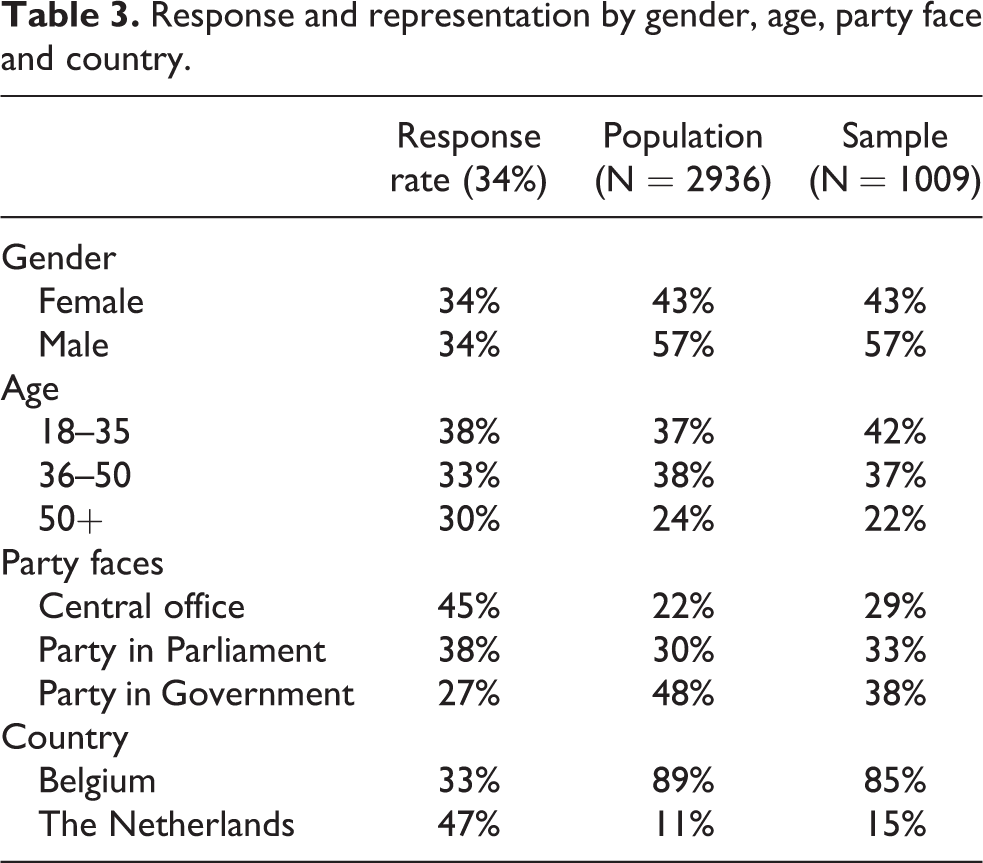
Designed to be completed in under 15 minutes, the questionnaire contained general background questions on staffers’ sociodemographic characteristics, day-to-day professional activities, and previous professional experiences. It also gauged their political attitudes, future ambitions and their interactions with peers and elected elites. Between December 2018 and January 2020, the complete population of staffers from the participating parties received a digital invitation to answer this online questionnaire, followed up by two reminders. Out of a population of 2936 individuals, the survey obtained a response rate of 34% (N = 1009). To calculate response rates and check the representativeness of our findings, participating parties provided population data. Based on the weighted cases approach (Parke, 2012), X2-tests were run to test under – or overrepresentation among specific subgroups within the sample. Post-stratification weights were calculated based on five indicators with significant differences between sample and population (country, party system, party, party face and age, see Table 3).
Response and representation by gender, age, party face and country.
The conceptualization of staffers’ party activism in this article connects earlier research on party staff (Karlsen and Saglie, 2017; Webb and Fisher, 2003) to literature on party activism (Whiteley and Seyd, 2002). Firstly, the analysis builds on existing work on political staffers by considering four indicators for party activism that were introduced by two prior in-depth studies: current party membership, membership prior to being hired, internal party positions and electoral candidacies (Fisher and Webb, 2003; Karlsen and Saglie, 2017). By including the same indicators as prior studies, I intend to produce similar data and inspire future researchers to compare staffers’ party activism across political systems. It is evident that this selection of indicators entails different levels of activism, ranging from low-effort activism such as being a passive party member to time-consuming activities such as standing for elected office. Therefore, the four selected indicators were used to group staffers into three mutually exclusive categories according to the work of Whiteley and Seyd (2002) on high-intensity participation. Firstly, high-intensity activists actively dedicate a portion of their leisure time to the party. These staffers dedicate considerable ‘time and effort’ to the party (Webb et al., 2020), either by holding a voluntary internal party position (e.g. local section, youth wing,…) or joining ‘the public face of the party’ by standing for elected office (e.g. municipal, regional, national or European elections) (Katz, 2001). Secondly, staffers who’s relationship to the party is limited to formal party membership without active involvement as volunteers were categorized as low-intensity activists. Thirdly, staffers without any link to the party outside of their professional activities were categorized as non-activists.
After discussing the general prevalence of party activism among staffers, the article examines the link between party activism and four independent variables: staffers’ individual tasks, the party face in which they work, their party’s government experience, and their party’s ideological profile. This explanatory analysis covers three distinct analytical levels. On the individual level, I examine the impact of staffers’ tasks. As discussed earlier, the differences between six types of staffers are analysed: managers, policy experts, communication experts, political assistants, party organizers and administration & support. On the party face level, I analyse the impact of staffers’ principal location. Based on the location where staffers spend most of their time during their professional activities, they were grouped into three mutually exclusive categories: the party’s central office, the parliamentary party group or a ministerial office. On the party level, I analyse the differences between staffers from mainstream – and challenger parties (De Vries and Hobolt, 2020) based on two dimensions: government experience and ideology. Government experience is operationalized as the proportion of time spent in national or regional government since the party’s founding (multiplied by 100 to facilitate interpretation). Parties’ ideological extremity was operationalized as the square of a party’s distance from the centre on the general left-right scale of the 2019 CHES data (Bakker et al., 2020). Party scores for both government experience and ideological extremity can be found in Online Appendix A.
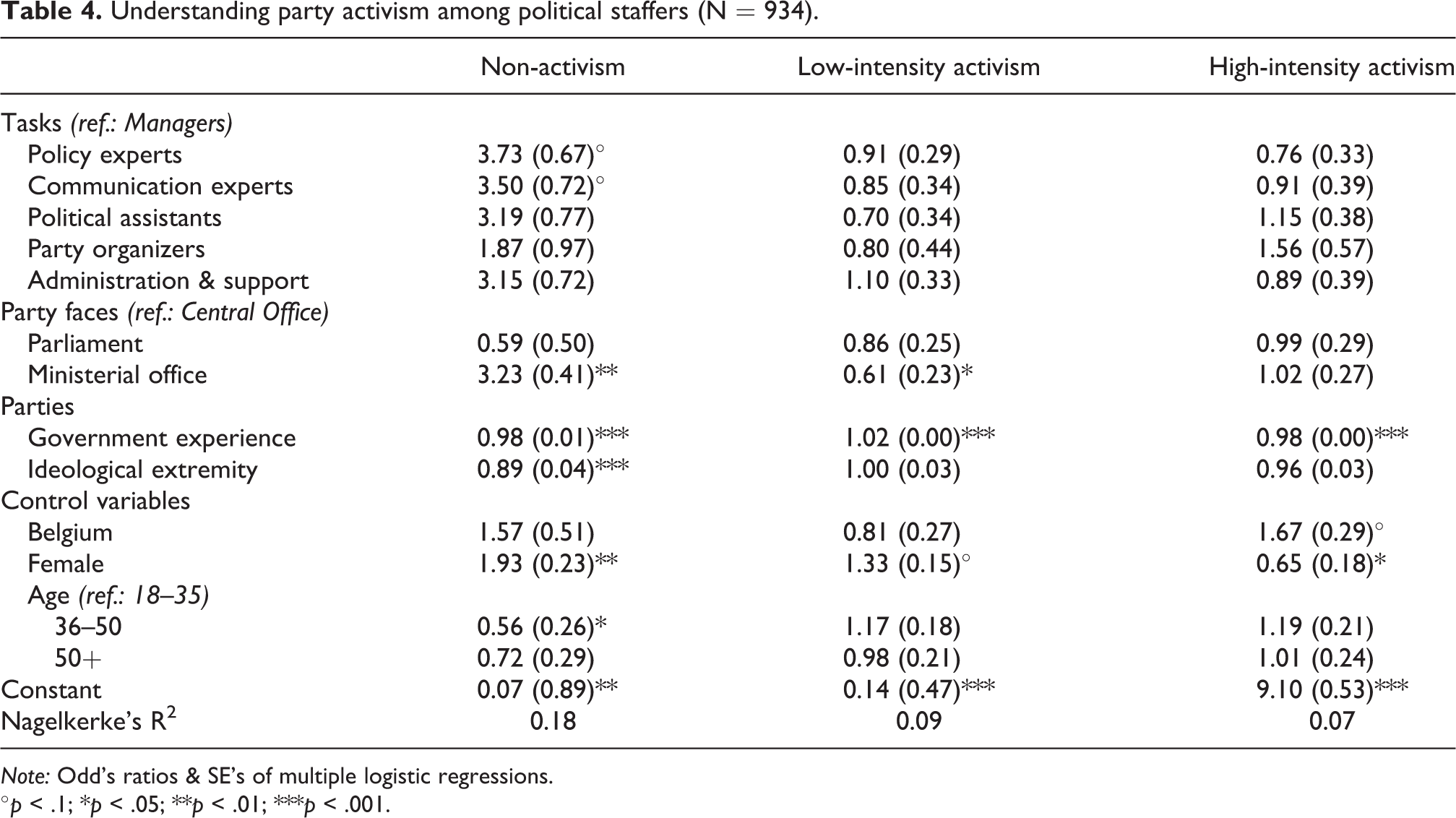
The explanatory analysis is supported by three binary logistic regressions in which the different categories of party activism (non-activism, low-intensity activism, or high-intensity activism) were dummy-coded as the dependent variables. For example, the first model explains staffers’ likelihood of being a non-activist as the two other categories (low-intensity activism and high-intensity activism) are the reference categories (Table 4). This approach was chosen for two reasons. Firstly, an ordered logistic regression with the three categories as the dependent variable violates the proportional odds assumption (parallel lines test: p < .001). Secondly, a multinomial logistic regression model offers less information because the estimates only show two categories, as the third category as the fixed reference category. However, Online Appendix D includes this multinomial regression model as well as separate regression models with a dummy coded variable of each indicator of party activism (current membership, prior membership, internal positions and electoral candidate) as a robustness check. All models include the independent variables discussed earlier: individual tasks, party face, government experience and ideological extremity. Furthermore, the models include three control variables: country, gender, and age. Country was added as a control variable to ensure that the observed patterns occur in both Belgium and the Netherlands. Gender was also included because an increasing number of studies shows that political staffers work in a gendered professional environment (Erikson and Verge, 2020; Snagovsky and Kerby, 2018; Taflaga and Kerby, 2019). Lastly, the models control for the age of staffers to account for the fact that older staffers have experienced more opportunities to get involved as a party activist during their adult years.
Results
To assess the general level of party activism among staffers (RQ1), I start with a descriptive analysis. According to the intensity of their activism, staffers were grouped into three mutually exclusive categories: non-activists, low-intensity activists or high-intensity activists (Figure 1).

Party activism among staffers.
The findings demonstrate that the majority of Belgian and Dutch staffers are committed party activists. Six in 10 staffers are high-intensity activists who take up an active role within the party, either through an internal position (e.g. local section, youth wing,…) or standing for elected office on a party list. These staffers can be considered passionate activists who ‘live for politics’ (Weber, 1921). About 3 in 10 staffers are low-intensity activists whose connection to the party remains limited to formal membership. Only a small minority of staffers are non-activists with an exclusively professional relationship to the party. These results firmly support the first hypothesis, that the majority of political staffers in parliamentary democracies are party activists (H1).
In addition to the general level of party activism, this article aims to identify which types of staffers have lower degrees of party activism (RQ2). To this end, a multivariate analysis was used to examine whether non-activists, low-intensity activists and high-intensity activists are distributed evenly across the population of political staffers. Bivariate analyses demonstrate significant differences between individuals, party faces and parties (Figure 2, detailed table in Online Appendix C). Non-activists are overrepresented among policy experts, ministerial offices, and Christian democratic, and liberal staffers. In contrast, high-intensity activists are significantly more numerous among political assistants, party organizers, central office – and parliamentary staff and conservative, and radical left parties. The group of low-intensity activists is significantly larger among social democrats.

Staffers’ party activism by tasks, party faces and party families. Note: Chi2/Fisher’s exact test of significance: *p < .05; **p < .01; ***p < .001.
To correctly identify which types of staffers have lower levels party activism, three binary logistic regression models were estimated. Each model examines which types of individuals are more likely to belong to a specific category of activists (non-activist, low-intensity activist, or high-intensity activist). As all three models have identical independent variables, this set-up facilitates a comparison of the relationship between staffers’ party activism and individual, party face, and party-level variables. While a comparison of all three models is presented in Table 4, detailed information on these regressions can be found in Online Appendix D.
Understanding party activism among political staffers (N = 934).
Note: Odd’s ratios & SE’s of multiple logistic regressions.
°p < .1; *p < .05; **p < .01; ***p < .001.
On the individual level, the link between staffers’ activism and their tasks is limited to a few significant results. Compared to managers, both policy and communication experts are more than three times as likely to be non-activists (p < .1). However, there are no significant differences between staffers with different tasks when it comes to understanding low-intensity or high-intensity activism. On the party face level, staffers who work in ministerial offices clearly stand out. Compared to their colleagues at central offices, ministerial staffers are more than three times as likely to be non-activists (p < .01). Conversely, ministerial staffers are less likely to be involved with the party as low-intensity activists (p < .05). However, there is no significant difference between staffers within different party faces when it comes to high-intensity activism. At the party level, both a party’s government experience and ideological extremity are significantly related to staffers’ party activism. Government experience is strongly related to all categories of party activism (p < .001). While party activism is more widespread among office-oriented parties (fewer non-activists), it is also more shallow (more low-intensity activists, fewer high-intensity activists). Lastly, staffers from ideologically extreme parties are less likely to be non-activists than their counterparts from more moderate parties. Surprisingly, ideologically extreme parties do not have significantly more high-intensity activists.
Although not the central focus of this article, the results also highlight contrasts between genders and political systems. First, women are significantly overrepresented among non-activists. This finding adds to existing studies on staffers’ career developments (Taflaga and Kerby, 2019) and the division of labour in political offices (Snagovsky and Kerby, 2018) by demonstrating that staffers’ party activism is also gendered. Second, Belgian staffers are more involved high-intensity participation (internal position, electoral candidacy) than their Dutch counterparts.
By and large, the theoretical framework is supported by the analysis. The results confirm that party activism is less prevalent among staffers in positions that require extra-political skills (H2). Indeed, both policy experts and communication professionals introduce outside expertise into politics. This observation applies less to managers, political assistants, or party organizers as they specialize in uniquely political activities. The findings also show that party activism is less prevalent among ministerial staff (H3). Compared to central office staffers, those who work in ministerial offices are more than three times as likely to be non-activists. The analysis only partially confirms the expectation that party activism is lower among staffers from mainstream parties (H4). Whereas parties’ ideological orientation has the expected effect on staffers’ party activism, parties’ government experience has a different impact. Compared to parties with less government experience, office-oriented parties have fewer non-activists among their staffs. However, their involvement as volunteers is weak: the staff of office-oriented parties includes significantly more low-intensity activists. Lastly, staffers from ideologically moderate parties are indeed more likely to be non-activists than those working for more extreme parties.
A key finding of the multivariate analysis is that staffers’ party activism is closely related to contextual factors. While the seminal work of Panebianco (1988) emphasized individual differences between professionals and bureaucrats, this analysis demonstrates that individual factors interact with the larger context. It is no coincidence that non-activist ‘professionals’ are more common among policy and communication experts, in ministerial offices, and within ideologically moderate parties. Of course, staffers’ party activism is not dictated by the specific position they happen to work in but instead, staffers’ party identification (or lack thereof) determines their party activism and affects the types of jobs they apply to and get selected for.
The original theoretical framework of this article works best to identify non-activists. Not only is the Nagelkerke R2 value of the first model considerable larger than the others, but the higher significance levels of the estimates indicate a stronger relationship with the dependent variable. This is not surprising, as both the existing literature and the theoretical framework developed in this article focus on the conditions that lead to the presence of non-activists. However, the framework’s emphasis on non-activists makes it is less informative for understanding the nuances between low-intensity and high-intensity activism as non-activists only make up a small minority of political staffers. Future research could benefit from a more fine-grained theoretical understanding of staffers as party activists.
Conclusion
Political parties have grown into well-funded, capital-intensive organizations supported by paid professionals (Katz and Mair, 1995; Panebianco, 1988). Meanwhile, the position of the party on the ground has been weakened by de-energization (Seyd and Whiteley, 2002) and shrinking party membership (Van Biezen and Poguntke, 2014). As the available pool of voluntary labour has grown smaller, parties have compensated for this loss by hiring a growing number of paid staffers to support their activities (Katz and Mair, 1993; Krouwel, 2012). However, this article shows that the presence of paid staffers does not necessarily widen the gap between parties and activists. Despite decades of professionalization, most political staffers in Belgium and the Netherlands remain strongly involved as high-intensity party activists. Admittedly, it is possible that staffers’ party activism was even higher in the past, but even if a limited decrease in activism has taken place since the catchallization of parties, the impact on staffers’ activism remains modest. As only cross-sectional data on staffers is available, the downward trend described by Panebianco (1988) cannot be analysed empirically. The findings here add to the existing evidence that professionalization has not resulted in the dominance of non-activist political staffers in several European cases (Karlsen and Saglie, 2017; Webb and Fisher, 2003) but rather, parties have established strong collective organizations with internal, party-affiliated staffers.
The high levels of party activism among staffers in parliamentary democracies can be explained by approaching their recruitment from a supply and demand perspective. On the supply side, staff positions are more attractive to party activists than to outsiders because they strongly identify with the party. On the demand side, parties prefer party activists to guarantee that staffers share the same political objectives. Importantly, however, the supply and demand calculations for staffers and parties vary between different types of staff positions. Reinterpreting Panebianco’s concept of extra-political expertise (1988), I anticipated that party activism is less prevalent among staffers with extra-political expertise (policy and communication experts), ministerial staff and staffers from mainstream parties.
I set up an extensive original survey project among staffers from 14 Belgian and Dutch parties (N = 1009) to test these hypotheses. The analysis examined variation on three analytical levels. On the individual level, policy and communication experts are less likely to be involved as party activists. On the party face level, non-activists are more common among those who work in ministerial offices. At the party level, the comparison between mainstream and challenger parties (De Vries and Hobolt, 2020) produces mixed results. On the one hand, party activism among staffers from office-oriented parties is widespread but shallow. A disproportionally large segment of their staff are low-intensity activists: formal party members without an active involvement as volunteers. On the other hand, staffers from parties with a more moderate ideological profile are less involved as party activists. These findings are not limited to one specific case as this study focused on both Belgium and the Netherlands. Future research can examine whether the same patterns can be observed in other parliamentary democracies with multi-party systems. From a theoretical perspective, these variations between different types of staffers demonstrate that party activism has not decreased universally as Panebianco initially suggested (1988). Instead, it seems plausible that party activism has eroded among a particular subset of political staffers: policy and communication experts, ministerial staffers and those who work for ideologically moderate parties.
From a normative perspective, the results support the responsible party model. It is beneficial to parties, voters, and party democracy in general that staffers share the policy preferences of their party. Voters transfer decision-making power to elected elites by legitimizing a party’s policy goals during elections (Mair, 2008; Thomassen, 1994). When elected elites delegate a portion of this democratic mandate to unelected staffers, their dedication to the party’s policy goals keeps them aligned with the preferences of voters. As the majority of staffers are recruited among grassroots activists, their commitment to the party is undisputable. However, the analysis raises some normative questions because this mechanism is weaker when it matters the most. More specifically, non-activists are more common among policy and communication experts and ministerial staff. Yet political loyalty is, in actuality, more important for these types of staffers because experts directly advise elected elites and ministerial staffers affect policy implementation. Even among experts and ministerial staffers, however, only a small minority are non-activists.
Supplemental material
Supplemental Material, sj-pdf-1-ppq-10.1177_13540688211027317 - Professional activists? Party activism among political staffers in parliamentary democracies
Supplemental Material, sj-pdf-1-ppq-10.1177_13540688211027317 for Professional activists? Party activism among political staffers in parliamentary democracies by Pieter Moens in Party Politics
Footnotes
Acknowledgement
I thank Benjamin de Vet, Richard Schobess, Bram Wauters, Nicolas Bouteca, Brit Anlar, Ann-Kristin Kölln, Helene Helboe Pedersen and participants at the Summer School on Political Parties (Aarhus University) and the CLP-GASPAR seminar (Ghent University) for their helpful comments. All remaining errors are my own.
Declaration of conflicting interests
The author(s) declared no potential conflicts of interest with respect to the research, authorship, and/or publication of this article.
Funding
The author(s) received no financial support for the research, authorship, and/or publication of this article.

Supplemental material
Supplemental material for this article is available online.
References
Supplementary Material
Please find the following supplemental material available below.
For Open Access articles published under a Creative Commons License, all supplemental material carries the same license as the article it is associated with.
For non-Open Access articles published, all supplemental material carries a non-exclusive license, and permission requests for re-use of supplemental material or any part of supplemental material shall be sent directly to the copyright owner as specified in the copyright notice associated with the article.
