



Abstract
The literature on comparative political institutions highlights a tradeoff between majoritarian/plurality and proportional/consensus models of democracy. The former arrangement is said to enhance having governing parties held accountable. The latter is said to promote representation of a range of views, with a coalition of multiple parties governing. A tradeoff may be that the representativeness of multi-party coalitions can make it difficult for voters to hold government accountable, while single-party governments that facilitate accountability might fail to represent a range of parties in government. The ability of voters to respond to such differences is, however, subject to some skepticism given that the public opinion literature finds serious limits on a person’s ability to know basic facts about political institutions, let alone have preferences for governments that reflect democratic norms of accountability and representativeness. We assess public preferences for single versus multi-party governments and find evidence of systematic preferences that suggests people may link democratic norms of accountability and representativeness to the governmental system that promotes the respective norm. Preferences are also associated with the party system that people are familiar with.
Keywords
Introduction
The literature on comparative institutions contains within it a long-standing distinction between majoritarian and proportional visions of democracy (Aarts and Thomassen 2008; Blais et al. 2017, 2021; Farrell 2011; Lijphart 2012; Norris 2004; Powell 2000). The former involves a set of institutions based on accountability, with the architype of this being centralized, unitary control, and winner-take-all plurality rules reflected in the Westminster model. The latter stresses representativeness, based on a set of institutions (e.g., proportional representation, a plural executive, a multi-party governments, regionalism) that emphasize shared powers and providing representation to a wide set of actors.
These differing visions not only offer different institutional forms of representative democracy but they also may involve a tradeoff between key attributes. More specifically, there may be a tradeoff between the properties of accountability and representativeness (Powell 2000) with these conflicting phenomena being something that political parties have a very difficult time balancing (Mair 2009). In very crude terms, multi-party governments may, by their very composition, reflect and represent a range of alternative perspectives. Single-party governments, by contrast, voters may find it easier to hold governments accountable in elections.
The purpose of this paper is to assess if people have preferences for majoritarian (single-party) governments and proportional (multi-party coalitions) governments that are based, if only in part, on democratic norms of accountability and representativeness. Using data from Round 6 of the European Social Survey we find evidence of systematic preferences for single-party governments versus multi-party governments. Preferences are associated with partisan self-interest and the party system that people are familiar with but our results strongly suggest that people link democratic norms of accountability and representativeness to the governmental system that promotes the respective norm.
Accountability, responsiveness, and representativeness
The distinction between responsiveness and representativeness is connected to a considerable body of work on the functioning of political institutions. Prompted largely by the work of Lijphart (2012) and Powell (2000) a great deal of work has emphasized how differences between responsiveness and representation map to differences between single-party and coalition governments (for examples, see Aarts and Thomassen 2008; Anderson 2007; Blais et al. 2021; Fisher and Hobolt 2010; Hellwig and Samuels 2008; Kayser and Peress 2012; Plescia and Kritzinger 2016; Vowles 2010; for normative discussion, see Sabl 2015; Linde and Peter 2020).
While accountability and responsiveness are conceptually distinct, the empirical relationship is a strong one. As Fisher and Hobolt write: “Single-party governments are commonly thought to be more clearly responsible for government policy than coalition governments” (Fisher and Hobolt 2010: 358). Single party governments can be more readily held to account i.e be held responsible. For that reason single party governments should also be more responsive. A great deal of empirical evidence shows this pattern to be the case (e.g., Anderson 1995 2007; Fisher and Hobolt 2010; Hellwig and Samuels 2008; Vowles 2010). Should citizens see this point and should they also value accountability as a property of democracy, this will push them to support one-party governments as opposed to coalition governments.
Coalition governments, however, seem better at representing political opinions. But with several parties in government voters have less capacity to know which party (or parties) to hold accountable if the government loses favor with voters (Duch and Stevenson 2008; Powell and Whitten 1993; also see Carey and Hix 2011; Dalton 2008) 1 .
It is worth underscoring that discussions on responsiveness and representation refer to distinctions between single- and multi-party governments. And while these attributes of governments are related to electoral systems there is still room for slippage: even proportional electoral system can produce single-party governments. It is perhaps for that reason that work on responsiveness shows a muddier link when the focus is between electoral systems per se and responsiveness. Wlezien and Soroka (2012) do find some relationship but Rasmussen et al. do not find an effect for the effective number of parliamentary parties (Rasmussen et al. 2019: 427). Work on veto players, however, contains clearer cut findings, in part perhaps because of a strong focus on government rather than parliamentary composition (e.g., Tsebelis 2002; Tsebelis and Money 1997) even with respect to discussions of specific policy changes (e.g., Kang and Powell 2010; Spoon and Kluver 2014; Soroka and Wlezien 2015).
One of the many contributions of Powell in this area (Powell 2000) is that his work can be read as highlighting a tradeoff between the properties of accountability and representativeness. That is, there may not be an institutional arrangement that fosters both clear accountability and representativeness at the same time: societies—and perhaps citizens—may have to choose which property to favor over the other. It is not just Powell who notes this point. A classic statement of this version of democracy can be found in the American Political Science Association’s mid-century statement on the need for “greater party responsibility” in America’s two-party system (APSA 1950). A two-party system is said to provide voters with accountability—choices between two disciplined parties that allow voters to hold government responsible if the governing party falls out of favor with voters. By producing clarity of responsibility and a means for voters to hold a single-party government responsible, a pure two-party system can lack a range of ideologically distinctive parties, 2 but it may facilitate accountability (Powell 2000; see also Aarts and Thomassen 2008).
In contrast, proportional democracy is tied to representativeness. Proportional election rules exist with multi-party systems where multiple (smaller) parties may be situated across a range of issue-space, and provide voters with a range of distinctive choices. Multi-party systems, by extension, are also tied to coalition governments that are formed to represent a potentially diverse set of parties. Coalitions may be based on inter-party negotiations that occur before, and after, the election. When selecting a party, voters may have limited information about the eventual composition of a coalition (Bahnsen et al. 2020; Bargsted and Kedar 2009; Bowler et al. 2021; Bowler et al. 2010; Freden 2017; Gschwend et al. 2017; Herrmann 2014). Elections in multi-party systems may produce potential government coalitions with a wide range of representation, but accountability may be weaker since elections often do not produce a new government that is fundamentally different than the pre-election government. All that said, it remains the case that with multiple parties forming a government, it may not be clear to voters which coalition party to reward or punish in the name of accountability. 3
Does the public connect democratic norms to views on party government?
For the academic literature, different democratic institutions offer different versions of democracy. It is important to see whether voters also recognize those as worthy values of the system. Whether citizens recognize the supposed strong points of their preferred institutional arrangements—in this case the number of parties in government—is relevant to the legitimacy of that government in the eyes of citizens. Our main question derived from this literature is whether citizens' preferences for single versus multi-party government reflect tradeoffs between democratic values of accountable and responsive government on the one hand and values of representativeness on the other.
We could, for example, reasonably expect that standard ideas of legitimacy would suggest that citizens should see a correspondence between the institutions of government and the normative values those institutions may promote. For example, if citizens in a given society value representativeness we would expect that representative institutions would be supported more and responsive ones less so. In a sense this kind of correspondence follows on from ideas found in Tyler (e.g., Tyler 1988, 2003) which emphasize process concerns as a source of the legitimacy of political institutions.
One difference between Tyler’s concerns and the distinction being made here is that the literature on comparative institutions sees, in effect, two broad flavors of decision-making between which citizens may choose. Both are legitimate, but each reflect different properties. On the one hand there is single-party government with presumed advantages of responsiveness and accountability and, on the other, multi-party government with its advantage of representation. The differences may be more continuum than a dichotomy but the endpoints have been defined in terms of the work of Lijphart and Powell. These endpoints provide two different definitions of the properties of institutions: there are more differences between multi-party and single-party governments than number of parties per se. Thus, an important question becomes: can we see evidence that citizens' preferences between single- and multi-party governments are driven by normative concerns in any meaningful way? Given the minimalist view of the public’s capacity to reason (e.g., Achen and Bartels 2016; Lippmann 1946) and evidence that few people possess basic facts about political institutions (Carpini and Keeter 1997), this may be a difficult task for citizens.
Another part of the difficulty in assessing such questions is that it is often not at all clear that citizens have well developed normative ideas about democracy, and especially not in relation to political institutions. Asking citizens about normative principles of democracy in abstract, then, may lead to a misleading picture. Just as, when asked about taxes and government spending, voter samples often reveal a collective preference for lower taxes and more spending—what Sears and Citrin (1982) called wanting “something for nothing”—so in the case we are examining citizens might expect to want to see more representativeness and more responsiveness: a possibility that the literature discussed above sees as being off the table in light of the tradeoff between the two.
One standard finding, for example, is that there is a great deal of “cheap talk” about support for democracy yet a shortfall between commitments to democratic principles and democratic practice among mass publics (Peffley and Rohrschneider 2003: 243 Sniderman et al. 1993; Van Ham et al. 2017). We know, for example, from decades of public opinion research that the public has a commitment to democratic practice that is at odds with their stated support for many principles: while most citizens across the world support democratic rights in the abstract, just as the democratization literature shows (see, however, Denemark et al. 2016; Foa and Mounk 2017), these same publics are usually considerably less likely to extend these rights to disliked groups (Gibson and Bingham 1985; Stouffer 1955). This “slippage” between supporting democracy without a corresponding application of the norm political tolerance is found in a range of countries (Peffley and Rohrschneider 2003: 243; see also Sniderman et al. 1993).
If there is slippage—a weak relationship between the support for the principle of democracy and the practice of civil liberties, we might expect to find even weaker (or null) logical relationships about democracy where the principles are more complex than they are with the case of civil liberties. In the context in which we are interested—that of attaching norms of responsiveness versus representation to preferences for coalition versus single-party governments—citizens' understanding of these competing democratic principles may be a much tougher hurdle to jump.
Put differently, if we assume the public has limited capacity link norms of accountability and representativeness to multi-party governments versus single-party governments, we might expect to identify patterns in the public’s reasoning that links normative values of accountability to preferences for multi-party government, or that link normative values of representativeness to preferences for single-party government. Or, if citizens lack the capacity to connect competing democratic values to specific political institutions, we may expect no relationship between the public’s attitudes about responsiveness, representativeness, and preferences for the number of parties in government. However, there is evidence that, in some settings, citizens reason about political institutions in ways similar to elites such as partisan elected officials (Bowler and Donovan 2013).
Hypotheses
To summarize, we have expectations over all three of the terms discussed so far—accountability, representation, and responsiveness. Where accountability is the sense that people want to be able to punish governments performing poorly; representativeness is that people want a variety of different sorts of parties in government (or “clear alternatives”); responsiveness is people wanting governments that have policies that move in line with public opinion. We expect support for the principle of responsibility in terms of accountability to be positively associated with support for one-party government (H1). We expect support for the representativeness principle to be negatively associated with support for one-party government and more associated with support for the representative model (H2). We also expect preferring responsiveness to popular will to be positively associated with support of single-party government (H3).
Although these primary hypotheses are concerned with the connection between normative democratic values and support for specific institutions there are, of course, additional factors which drive preferences that may be unconnected with values that we must account for when testing our hypotheses. Citizens do have “process” concerns (e.g., Lind and Tyler 1988, Tyler 1988, 2003) but often these are not, themselves, independent of whether a voter has a stake in the outcome: fairness is often in the eye of the beholder. One body of work shows that being a winner or a loser under particular institutional arrangements strongly condition opinion towards questions on political processes (Anderson et al. 2005). Given that citizens are being asked to assess whether they prefer single or multi-party governments then we need to take account of context and partisan self-interest: someone who supports a party in government will have a different response depending on whether they support a single party in government (in which case they are likely to prefer single-party governments) or support a party in coalition (in which case they are likely to oppose single-party governments). As additional control then, we expect those who win under single-party governments to be more supportive of single-party governments, while those who support winning parties under multi-party governments should be more supportive of coalition governments.
We also need to control for a number of factors that are known to shape how citizens see politics. We know, for example, that multi-party systems provide a stake for smaller parties. Whether or not a voter supports a large party or a small one should therefore shape opinions: supporters of small parties are likely to realize that coalition governments are the only path to power and, hence, not be supportive of one-party governments. The reverse is likely to be true for supporters of larger parties. A related expectation is that supporters of the largest parties in a system to be more inclined to support single-party government. Both these are expectations grounded in what we might see as partisan self-interest, but without much ideological content. In terms of ideology, it seems reasonable to control for the effect that, generally speaking, conservatives seem to prefer a more directive form of political life rather than a more participatory one (Barker and Carman 2012; Bowler 2017). We would then expect those on the ideological right to support one-party rather than multi-party rule. It also seems that citizens towards the ideological extremes may be more likely to be frustrated by coalitional governments and prefer single-party ones. That is, citizens on both extremes—both left and right—would have a preference for single-party governments rather than the compromises of coalition that.
Citizens, too, are likely to lean towards the familiar. Preferences for the number of parties in government are likely to be conditioned by the party system a person is familiar with. We expect respondents from countries with fewer parties to be more likely to prefer single-party governments. There also may be ideological factors pushing opinions. That is, while we expect the factors of partisan self-interest, ideological predispositions and familiarity to correlate in systematic and predictable ways with preferences for single-party versus multi-party government but they are not related to underlying values of governance. Ideological predispositions perhaps provide an exception to that framing. But to claim the relationship between ideology and preferences for form of government form would represent, at best, weak support for the relationships we think to be at play. In treating ideology more as a control than as a major factor at work we seek to provide more direct evidence of relationships at work. Our main focus, then, will be on the relationships outlined in H1 to H3.
Data and methods
The European Social Survey (Round 6, conducted in 2012 and 2013) allows us to test these hypotheses with large samples from 25 countries 4 , with data that are both cross-national and, also, contain an appropriate battery of questions relating to ideas on democracy and democratic values along with a survey item measuring attitudes towards single- versus multi-party government.
The ESS included an item asking respondents their preferences for single-party government or a multi-party government. The ESS asked respondents which condition they thought “best for democracy in general,” having “a single party form the government” or having “two or more parties in coalition form the government” (see online Appendix for full wording of survey questions). This item does not directly ask respondents about a majoritarian, two-party system, per se; however, we doubt survey respondents would grasp that concept when presented in those academic terms. In practice, a single-party government is epitome of the majoritarian accountability model, and single-party government is much less likely in a multi-party, proportional system.
Preferences for single-party versus coalition government, European Social Survey.
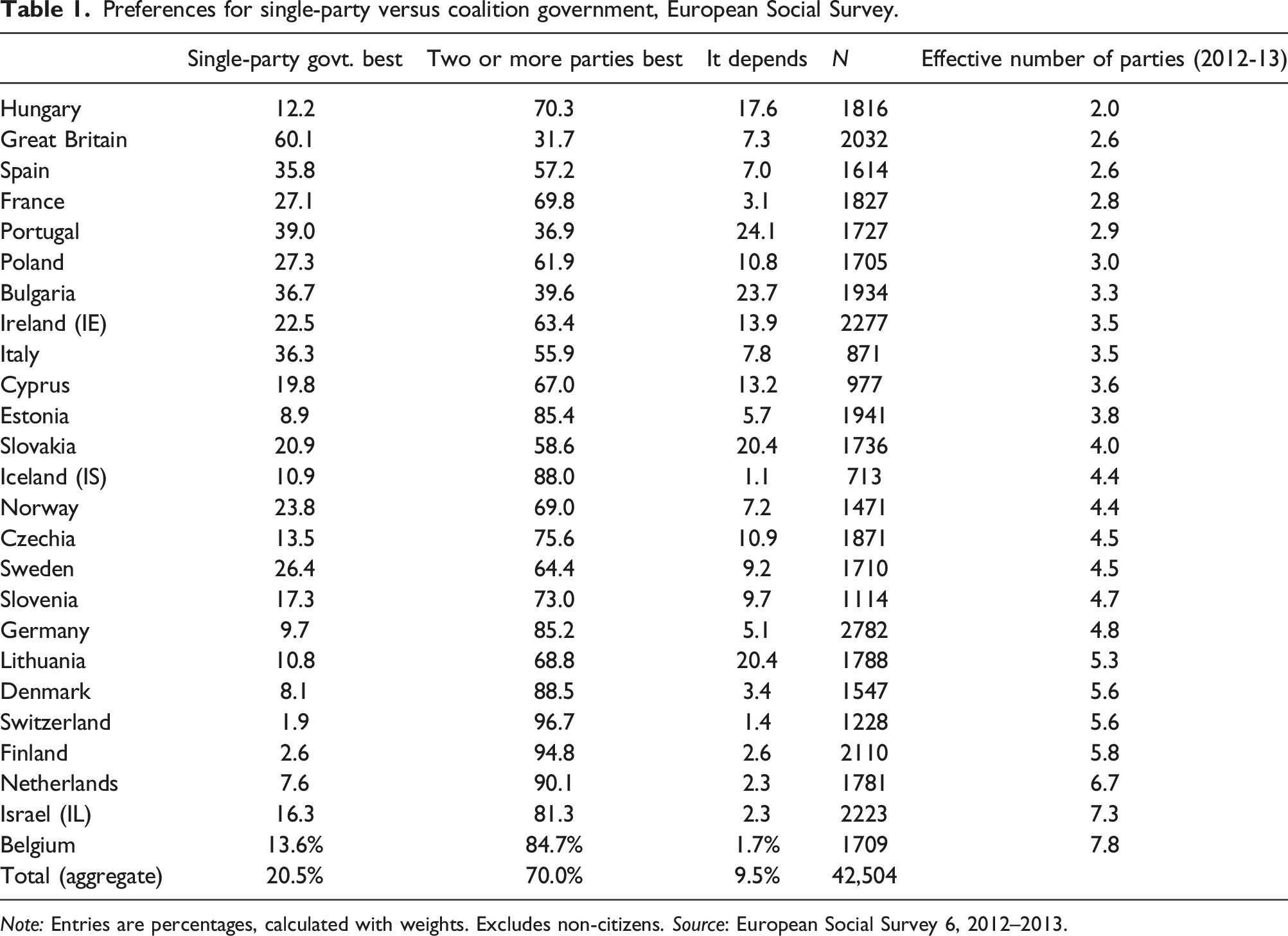
Note: Entries are percentages, calculated with weights. Excludes non-citizens. Source: European Social Survey 6, 2012–2013.
We construct our dependent variable representing a preference for majoritarian, single-party government from the responses displayed in Table 1. Table 1 lists responses to the ESS question about preferences for the number of parties in government, by country in order of the number of effective parties in a country. While by no means a crisp relationship, it appears that higher rates of preferences for single-party governments occurred in countries with fewer parties. The first dependent variable in our analysis is coded as 1 for respondents who expressed a preference for single-party government, and 0 if they preferred coalition government or responded “it depends.” In our second estimation, we exclude respondents who said “it depends.” “Don't know” responses are omitted in both estimations. Given the dichotomous dependent variable and the fact that we seek to account for individual-level and country-level factors that might affect preferences for political institutions, we test our hypotheses by estimating multi-level mixed effects logistic regression models, using sample weights.
Our primary independent variables used to test H1, H2, and H3 are the importance that the respondent places on principles of responsiveness and representativeness, respectively, as democratic ideals. The ESS included several items that asked respondents their evaluations of multiple principles democracy. Two of our measures of democratic principle are drawn from unique survey items which asked respondents the extent to which a party system should emphasize responsibility and responsiveness. As noted above (H1), one clear value of the majoritarian version of democracy is that governments are held accountable. The ESS included a question where respondents were asked to rate on a 0 to 10 scale, “how important do you think it is for democracy in general...that governing parties are punished in elections when they have done a bad job.”
H2 is tested with an item asked respondents to rate on a 0 to 10 scale, “how important do you think it is for democracy in general…that different political parties offer clear alternatives to one another?” The degree to which parties offer competing versions and clear alternatives speaks to the range of voters' views reflected in government and so speaks to representativeness of the party system. Greater value placed on parties offering clear choices should lead respondents to prefer something other than single-party governments. Further, the ESS included an additional question about responsiveness as a norm. H3 is tested with an item that asked respondents whether they thought governments should change policy in response to what most people want, or stick to its policies. We code this as 1 if the response was “government should change” and 0 if otherwise. 5
As for our hypotheses regarding control measures we account for versions of winners and losers by coding if respondents supported, respectively, a winning party (in government) in a single-party or in a multi-party system. Further, we code as 1 whether respondent supported the very largest party in the country in the country and 0 else. That is, we only code one party per system as “large.” Our expectation is that supporters of this party will be more supportive of one-party government than others. We also include a binary indicator of whether or not a respondent supported a right-populist party, with the expectation that as these parties rarely have sufficient support to win control as a single party, their supporters might prefer multi-party governments. Parties coded as right populist are listed in the online Appendix. As a broad measure of familiarity we also use a (country-level) measure of the effective number of parties. Respondents in countries with a larger number of effective parties could be accustomed to more representative institutions, and less supportive of majoritarian, single-party governments, with the reverse also being the case. Our expectation about ideological extremism is tested with a measure of left/right self-placement plus left/right self-placement squared. The non-linear (parabolic) form is used to capture what we see as a likely “U” shape relationship between ideology and preferences for single-party government. 6
As additional controls we include standard SES measures (age, education, and gender), whether or not someone reported being close to a party, whether or not someone reported participating in politics, and political interest. Those close to a party, those who participate more frequently, and those more interested in politics may have distinctive attitudes towards politics in general than other citizens. Two other country-level control measures included were whether the nation was a “New” democracy (i.e., from Central or Eastern Europe) and a dummy measure for Italy which was governed in 2012 by a non-party technocratic government.
Results
Estimating preferences for single verses coalition government.

Note: Mixed effects logit models (25 countries). *= significant at p < 0.05 (two-tail); ** at p < 0.01 (two-tail); *** at p < 0.00. Source: European Social Survey, Round 6.
As for the other factors we assess, we find additional results consistent with our expectations. People who supported winning parties in single-party systems were more likely to prefer single-party government, and people supporting a winning party in a multi-party system were more supportive of multi-party coalitions. Supporters of the largest party in any party system were also more supportive of single-party governments. These results suggest some manner of partisan considerations in preferences for single versus multi-party governments. Respondents in countries with more parties were also less likely to prefer single-party government. This consistent with the familiarity hypothesis.
As expected, there are significant effects of ideology on preferences for single-party government. When ideology is specified as a single linear term (not reported), those who place themselves on the right, as expected, appear more supportive of single-party government. When ideology is specified as a quadratic (“U” shaped) term, we find is those on both on the far left and far right who prefer single-party government. Right-wing populist party voters, however, were not more likely to prefer single-party government. As for additional control variables, we find women, those with more education, and those who participated more actively in politics were, respectively, less supportive of single-party governments.
The models in columns 1 and column 2 differ with respect to the sample used to produce the respective dependent variables. The model in column 1 includes respondents who replied “it depends” as being among those not preferring single-party government. In column 2 these respondents are excluded from the analysis altogether. As can be seen this change makes no substantive difference to the results.
Given the large sample sizes and estimation process, we need to illustrate the substantive effects of the key factors in our models. Figure 1 presents post estimation predictions (from Model 2in Table 2) of the probability that a respondent preferred single-party government over coalition government. The Figure plots the predicted effect of a shift in the continuous attitudinal variables from 2 deviations below the mean to 2 deviations above the mean (see Online Appendix for distributions), and plots the shift from 0 to 1 for the dichotomous variables. As can be seen, there is a noteworthy effect for what we term democratic norms. The estimated probability of preferring a single-party government for those who rated the importance to democracy of holding government accountable at 10 on the 10-point scale (our measure of the responsiveness norm) was 0.213. Those that rate this two deviations below the mean are predicted to have a 0.17 probability of preferring single-party government.
7
Conversely, people who prioritized representativeness (parties offering alternatives) are estimated to have a 0.19 probability of preferring a one-party government, compared to a 0.24 probability for those scoring two deviations below the mean on this item. These substantive estimates are modest yet significant and meaningful, with other estimated effects more substantial. As for familiarity, respondents from countries with a three-party system are predicted to have a 0.31 probability of preferring single-party government, compared to just a probability of just 0.13 for respondents in countries with six effective parties. Substantial effects of partisan considerations are also evident. The probability of winners in single-party system preferring single-party government is estimated to 0.10 greater than those who are not winners in single-party systems. Probability of Preferring Single-party Government versus Coalition government. Source: Postestimation predictions from Model 2 in Table 1, with standard errors.
It should be noted that a substantial number of cases are lost between Table 1 and the estimates in Table 2. This reflects that Model 1 in Table 2 omits respondents who replied, “it depends,” and a relatively high proportion of refusals on the left/right ideology measure used in the multivariate models in Table 2. Online Appendix Table A1 reports robustness checks with ideology is omitted from the models. With the increase in cases, results are quite similar to what is reported in Table 2. Online Appendix Table A2 reports further robustness checks of the estimates reported in Table 2. Online Appendix Table A2 presents ordered probit models where “it depends” is the middle category. The results are largely unchanged. Online Appendix Table A3 and Online Appendix Table A4 report replications of model 1 and model 2 reported in Table 2, with the addition of country fixed effects. These also produced results nearly identical to what is reported in Table 2.
Discussion
Surveys such as ESS 6.0 are especially useful in helping establish the broad outlines of citizen commitment to democratic principles. In fact ESS 6.0 is an especially useful data collection from that point of view. Our findings are encouraging in suggesting that there is scope for more study on citizen commitment to democratic values. In order to unpack those kinds of relationships, however, more work is needed. For one thing, research in this area would benefit from more refined measures of public views on attributes of democracy that are seen as important. The ESS item available here to measure views on representativeness limits our ability to make definitive inferences.
What we have suggest in this paper is that citizen responses to the distinction between single- and multi-party government are colored by normative concerns similar to those found in the academic literature which discusses the distinction between the two forms of government. This literature notes a virtue of single-party governments being accountability, while a virtue of multi-party governments is their representativeness. In one sense our results are consistent with previous literature. Citizen views on institutional arrangements reflect an apparent mix of partisan considerations (and especially winner/loser concerns), but we add to this by demonstrating the public’s views on the number of parties in government also suggests people apply relevant democratic principles to their preferences for governments. To be sure, there is overlap between principle and partisan considerations but there are also distinctions. Some of those principles, for example, may be driven by ideological concerns. It is worth noting that despite currents in the public opinion literature suggesting that citizens are ill equipped at understanding basic political institutions, we find modest sophistication in public attitudes about single-party versus multi-party governments, beyond markers for partisan considerations.
There is room for caution. Leaving to one side questions of statistical significance, the substantive significance of these results for democratic norms remains fairly modest (Figure 1) relative to the estimated effects of winning/losing and of familiarity with one’s party system. Yet these results demonstrate that citizens may have normative concerns about politics and want to see institutions realize those normative concerns. Our results suggest that citizens do have views on how government should be conducted and that these views do color assessments of current institutions.
Supplemental Material
sj-pdf-1-ppq-10.1177_13540688221081783 – Supplemental Material for Preferences for single-party versus multi-party governments
Supplemental Material, sj-pdf-1-ppq-10.1177_13540688221081783 for Preferences for single-party versus multi-party governments by Shaun Bowler, Todd Donovan, Justin Freebourn, Paul Teten and Jack Vowles in Party Politics
Footnotes
Declaration of conflicting interests
The author(s) declared no potential conflicts of interest with respect to the research, authorship, and/or publication of this article.
Funding
The author(s) received no financial support for the research, authorship, and/or publication of this article.

Supplemental Material
Supplemental material for this article is available online.
Notes
Author Biographies
References
Supplementary Material
Please find the following supplemental material available below.
For Open Access articles published under a Creative Commons License, all supplemental material carries the same license as the article it is associated with.
For non-Open Access articles published, all supplemental material carries a non-exclusive license, and permission requests for re-use of supplemental material or any part of supplemental material shall be sent directly to the copyright owner as specified in the copyright notice associated with the article.
