



Abstract
How does an authoritarian past shape voters’ left-right orientation? Recent studies investigate “anti-dictator bias” in political ideology, where citizens in a former right-wing (left-wing) dictatorship may display a leftist (rightist) bias in their ideological self-identification. In this paper, I provide evidence for a “pro-dictator bias” where citizens hold ideological positions close to those of the dictator, depending on their experiences prior to transition. In countries with high economic growth under dictatorship and without violent ruling party ouster, authoritarian successors could continue mobilizing the popular base and invoke positive sentiment on the past in democratic elections. Such positive sentiment can facilitate individual ideological orientation close to the ideological label of the former dictatorship. I test this hypothesis by combining individual- and country-level data covering 1985 to 2018 from 48 countries. I demonstrate that voters in countries with high economic growth during dictatorship and without violent party exit are more likely to have pro-dictator bias in ideology. I further show that voters in former developmental states show pro-dictator bias from the history of economic growth and more peaceful transition. The findings emphasize the role of pre-transition features in shaping alternative legacies on voter attitudes in post-authoritarian societies.
Introduction
Authoritarian rule may significantly shape citizens’ attitudes, behavior, and general worldview. An authoritarian regime’s attempts to dominate the populace with propaganda may breed explicit and tacit resistance from the people, and this everyday practice of autocratic rule may leave lingering effects on citizens even after the fall of dictatorship. Recent studies have investigated an anti-dictator sentiment where citizens hold ideological views that contrast with those of the former dictatorship (Dinas and Northmore-Ball 2020; Frantzeskakis and Sato 2020). They find that citizens under a left-wing dictator are biased towards the ideological right, and those under a right-leaning dictator hold more leftist attitudes compared to established democracy voters. Negative experiences under dictatorship are likely to draw citizens to reject ideological orientation related to the dictator’s dogmatic perspectives.
However, some citizens may still wish to remain in the shadow of an authoritarian past. While an autocrat often employs repressive tools to quell the opposition, he also needs to secure political legitimacy by satisfying a certain share of the population. The autocrat may target a few select elites in his coalition and provide private goods to them, but he can also furnish the general population with public goods based on programmatic policy goals (Gandhi and Przeworski 2007; Magaloni 2006). These satisfied authoritarian citizens might have positive views toward the dictatorship even after the fall of the dictatorship. The positive legacies of former dictatorship are present, for example, in the streets of South Korea with the nationalist protesters, Taegeuk-gi Rally, ardent supporters of former dictator Park Chung-Hee and his daughter and impeached former president Park Geun-hye (Han and Hundt, 2021). The recent rise in popularity of Bongbong Marcos has accompanied a social media fever playing on nostalgia for his dad, former autocrat Ferdinand Marcos in the Philippines.
This paper investigates this pro-dictator bias in post-authoritarian democracies by expanding studies on anti-dictator bias (Dinas and Northmore-Ball 2020; Frantzeskakis and Sato 2020). Previous studies provide ample evidence of voters discrediting the ideology of former dictatorships as they reject any reference to previous repressive policies. I argue that, in some post-authoritarian states with history of economic growth and former ruling party survival, voters are more likely to have favorable attitudes toward and ideological positions that align with the former regime. Strong successor parties may continue mobilizing the popular base of the former dictatorship using their authoritarian inheritance and invoking authoritarian reference to the past authoritarian achievements.
I test the alternative legacies in ideological bias with variables capturing different pre-transition features of post-authoritarian democracies. Using data from Latin America, Eastern Europe, and East Asia, I show that, in countries with (1) greater economic growth during dictatorship and (2) peaceful ruling party exit before transition, voters are more likely to have a pro-dictator bias in ideological orientation compared to voters in established democracies. I further show that this pattern of pro-dictator bias is more observable among former developmental states which share a history of economic success and survival of authoritarian ruling parties.
Findings from this article contribute to the growing literature on authoritarian legacies on voter attitudes and related behavior. Previous studies identified the influence of authoritarian socialization and inclusionary ruling strategies on democratic support (Mishler and Rose 2007; Neundorf et al. 2020), emphasizing their negative legacies on voter attitudes (Dinas and Northmore-Ball 2020; Frantzeskakis and Sato 2020). Recent research on post-communist regimes predicts left-authoritarianism that older voters lean towards leftist ideology and adhere to anti-democratic policies (Pop-Eleches and Tucker 2017, 2020). The current paper helps to explain the authoritarian legacies in the former right-wing regimes, emphasizes key forces that facilitate the persistence of the old order, and expands the logic of alternative authoritarian legacies across different features of authoritarian rule.
This paper further adds to our understanding of the role of authoritarian successor parties. Recent studies have investigated successors’ advantages in their inheritance of authoritarian institutions, party organizations, and history of past success, and how these factors have assisted electoral success of former ruling elites (Albertus and Menaldo, 2018; Loxton and Mainwaring, 2018; Miller, 2021). I contribute to this study of authoritarian successors by further discussing how their presence and strength shape certain voter attitudes and preferences in maturing democracies.
Alternative legacies of an authoritarian past
How does an authoritarian past shape voters’ ideological orientation? Two recent studies find negative legacies of an authoritarian past on individual ideological orientation, where citizens of post-authoritarian democracies display anti-dictator bias in political ideology based on two principles (Dinas and Northmore-Ball 2020; Frantzeskakis and Sato 2020). First, autocracies are not ideologically neutral and adopt ideological stances that often align with the traditional demarcation between left and right. Second, negative evaluation of the former dictatorship after democratization can draw voters away from the “ideological brands” that the dictator propagated (Frantzeskakis and Sato 2020). As the new regime attempts to distance itself from the ancien régime, citizens may discredit the old ideological rhetoric and avoid expressing preferences linked to the mentality of the former regime.
While tragic events occurring under repressive dictatorships cannot be unwritten, post-transition politics can leave room for reframing the authoritarian past, enabling positive attitudes toward the dictatorship. I argue for alternative authoritarian legacies that can facilitate citizens’ positive reflection of the past in the aftermath of democratic transition, leading to a pro-dictator bias. As compared to the concept of anti-dictator bias developed in Dinas and Northmore-Ball (2020), pro-dictator bias refers to an individual bias in ideology in favor of the ideological label of the former regime. Studies on anti-dictator bias emphasize the backlash against the authoritarian past where post-transition citizens consider the old regime’s brand unacceptable and adopt “preference falsification” in response to any authoritarian holdover (Dinas and Northmore-Ball 1962, 2020). The repressive aspects of the former regime engender stigmatization of the past, leading citizens to distance themselves from the brand of the old regime.
While democratic transition brings about the collapse of an authoritarian regime, it does not necessarily wipe out the entire system, often requiring the old apparatus to complete the transition process. In this process, autocratic elites can have much room for maneuvering their survival and securing their power even after transition (O’Donnell et al. 1986). This move “toward democracy by undemocratic means” may facilitate peaceful and stable transition (O’Donnell et al. 1986, 38), but also make authoritarian inheritance more likely via retaining the old authoritarian institutions and grassroot organizations of the party-state (Albertus and Menaldo 2018; Choi 1994; Loxton and Mainwaring 2018). Among 314 former authoritarian elites in Latin America, around 72.6% continued their career in political or business sector after regime transition (Albertus 2019). Of the 65 Third Wave democracies, 72% of them inherited prominent authoritarian successor parties that have gained stable electoral support after transition (Loxton and Mainwaring 2018).
Having these strong successor parties can facilitate positive evaluation of the past as they can mobilize voters through their authoritarian advantage and reference. Former elites and their successors have achieved electoral success utilizing authoritarian advantage, including inheritance of a strong party brand, national party organization and network, and abundant financial resources (Loxton 2015; Loxton and Mainwaring 2018). The inheritance of strong grassroots party organizations can secure the loyalty of former authoritarian voters in democratic elections, thus contributing to stable party support after democratic transition (Cheng and Huang, 2018; Miller, 2021).
With their strength remaining intact through transition, these authoritarian successors can frequently employ authoritarian reference back to the usable pasts to promote their programmatic competence to democratic voters (Grzymala-Busse, 2002; Miller, 2021; Slater and Wong, 2013). While some successor parties that secured their survival by breaking from the past in the early years of transition collapsed due to their weakened party brand, other successors who retained their links to the past have continued to survive after decades of democratization (Grzymala-Busse 2018; Loxton and Mainwaring 2018). Having a successful authoritarian past can foster the legitimacy of authoritarian successors, with the rhetoric of the past functioning as a heuristic cue for the image of competence and a strong party brand (Choi 1994; Kang 2018). 1 This party brand from the past can place authoritarian successors on higher ground compared to nascent opposition parties that have yet to secure strong party brands (Loxton and Mainwaring, 2018; Miller, 2021). Thus, the authoritarian reference back to the former performance may facilitate the formation of political attitudes and preferences favorable to the authoritarian past (Chang et al. 2007; Kang 2018; Neundorf et al. 2020; Wu 2008).
For example, in South Korea and Taiwan, electoral competition following political liberalization was shaped between parties representing the state and civil society, where the ruling party consolidated its power in the conservative political sphere while civil society was struggling to establish organizational structure and party identity as a reliable alternative (Choi 1994; Fell 2018). The successor parties’ advantages in strong organization and an image of competency contributed to their electoral dominance in subsequent democratic elections, with many political elites evoking nostalgia for the achievements of the former regime (Cheng and Huang 2018; Kang 2018; Kim 2014; Wu 2008). The level of authoritarian nostalgia, or positive evaluation of former dictators, is high in both countries, with a significant share of citizens selecting Park Chung-hee and Chiang Ching-kuo as the best leaders in their history (Chang et al. 2007; Global Views Research 2019; Kim 2020). This nostalgic sentiment is identified as one of the central determinants of voting behavior in recent elections, with party supporters favorably identifying with party brands (Kang 2018; Kim 2014; Wu 2008).
Thus, authoritarian performance and former ruling party survival may facilitate more positive authoritarian legacies on political preferences among post-authoritarian voters. Instead of assuming that voters in post-authoritarian regimes regard the past as negative and avoid identifying with the ideological label of the past, I test the following hypothesis on factors that may shape the post-transition political sphere and variation in the ideological orientation of citizens:
Similarly, I further test a hypothesis on the fate of authoritarian ruling parties on individual political preferences. A former authoritarian ruling party’s survival can ensure its electoral success in democratic elections (Miller, 2021) and positive reevaluation of the authoritarian past. Based on the discussion of the violent exit of former autocratic elites and its influence on post-transition politics, I test the following hypothesis on the type of authoritarian party exit:
Data and empirical design
I test the pro-dictator bias in political ideology by merging individual survey datasets included in the World Values Survey (WVS), the European Social Survey (ESS), and the Comparative Study of Electoral Systems (CSES). The combined dataset includes around 500,000 respondents from 1985 to 2018 across 48 countries across different former authoritarian regimes and established democracies. 2 The number of respondents included in the analysis varies depending on the availability of certain variables, ranging from 180,000 to 245,000 observations across different model specifications.
I create an outcome variable measuring the Ideological Bias of post-authoritarian voters in three steps. First, I calculate the average voter ideology only from established democracies by each birth-year cohort from each survey cycle included in the dataset. These values serve as reference points for the ideology that post-authoritarian voters might hold if they had lived in established democracies (Dinas and Northmore-Ball 2020). These values also account for trends in ideology shifts across birth-year cohorts in different survey years. Second, I subtract these averages of ideology from the left-right self-placement of post-authoritarian voters so that this difference can represent the degrees in which the individual ideology of post-authoritarian voters deviate from the average of established democracy voters that did not experience the history of authoritarianism. 3 Third, I re-code this variable such that a positive value indicates pro-dictator bias, and a negative value indicates anti-dictator bias. With the typical left-right ideology on a 0–10 scale, I simply reverse-coded the ideology difference among former leftist regime voters so that citizens who self-identify with leftist ideology take higher values.
I use two explanatory variables from former authoritarian countries, measuring country-level variation: Party Average Growth measures the average economic growth under a former authoritarian regime, which is retrieved from (Miller, 2021). The variable takes the average of economic growth during the former ruling party’s authoritarian tenure. I include this variable as a measure of former authoritarian performance. The second variable is Violent Party Exit which records the fate of former ruling parties before democratization. This variable is coded 1 if a ruling party lost power through coups, revolutions, occupations, or civil wars before democratization, and 0 if they lost power through negotiation, election, or other peaceful procedures (Miller, 2020). In the main sample, 28% of countries had violent party ouster.
The model further includes a variable measuring the time trend since democratization in order to account for temporal trends in survey responses and ideological positions after a regime transition. I use the actual year of democratization for each country included in the dataset. With the key variables described above, I run models of the following form:

Results
Authoritarian successors and ideological bias
Authoritarian legacies and pro-dictator ideological bias.
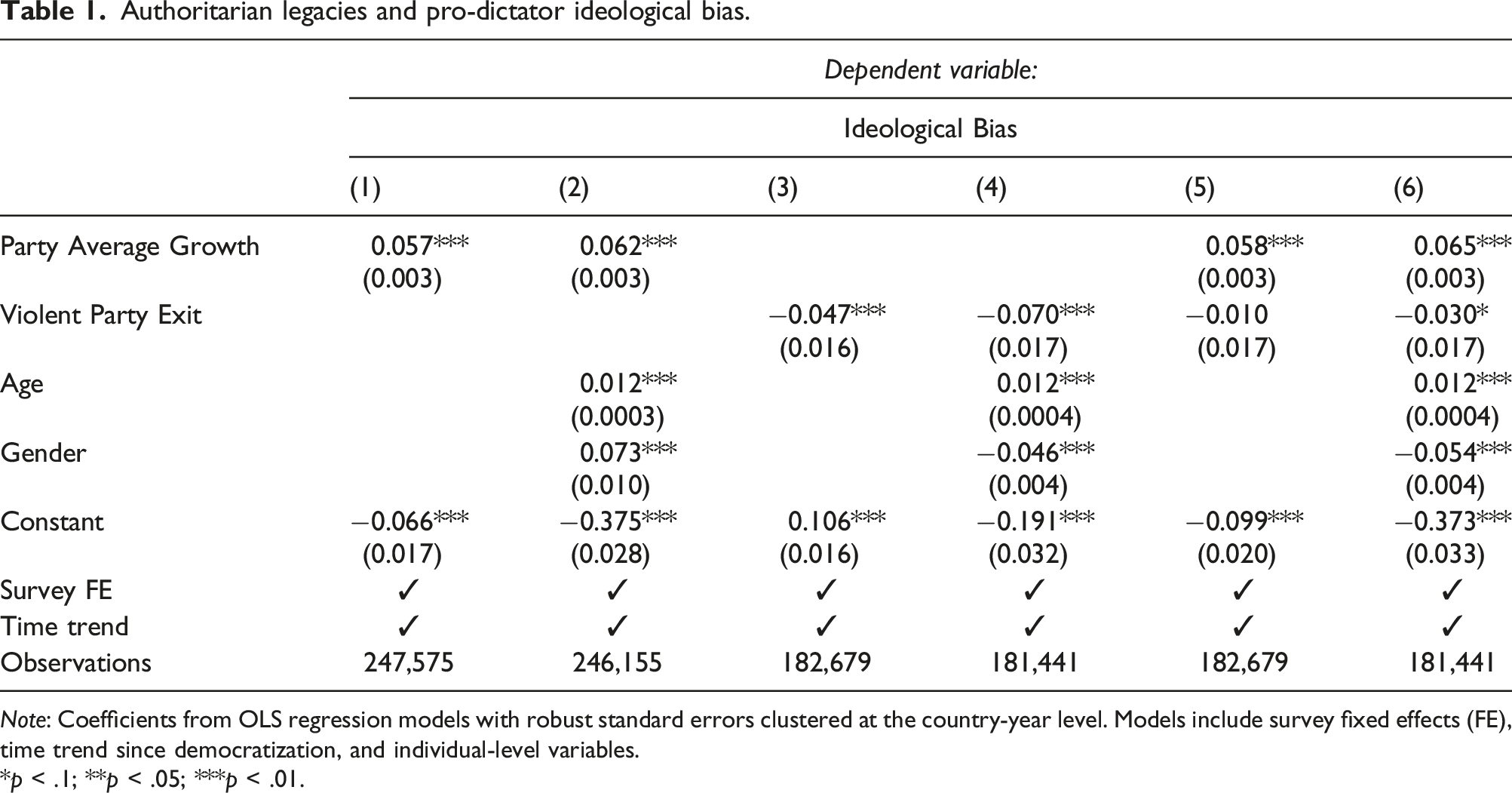
Note: Coefficients from OLS regression models with robust standard errors clustered at the country-year level. Models include survey fixed effects (FE), time trend since democratization, and individual-level variables.
*p < .1; **p < .05; ***p < .01.

Average economic growth under former dictatorship and ideological bias: the figure shows predicted effect sizes of ideological bias across the level of Party Average Growth using results from Model 6 in Table 1.
Violent Party Exit in Models 3–4 show consistent negative coefficients: voters from countries with a history of a violent ruling party ouster are less likely to identify with the ideological label of the former dictator. Considering that successors in only one out of three countries that experienced violent party exit succeeded electorally after transition, the results are consistent with the findings from Successor Vote Share. The coefficients remain unchanged when the two variables are included in the same regression equation (Models 5–6). The combined results show that the success of former ruling parties explains the ideological orientation of post-authoritarian voters. 4
I further show that this pattern of pro-dictator bias is more observable among former developmental states which share a history of economic success and survival of authoritarian successor parties. The former developmental states’ emphasis on national security, anti-communism, and economic growth places them on the ideological right similar to former RW regimes. However, contrary to the former RW regimes, their history of peaceful regime transitions and strong former ruling parties leads to a pro-dictatorship bias among the citizens, contrary to former RW voters. 5
I provide support for this expectation with the developmental state category that voters have a more rightist ideological orientation compared to that of established democracy voters (see Figure 2 below and Table A3 in the Appendix). Results in Figure 2 first confirm the findings of anti-dictator bias that voters in former leftist (rightist) dictatorship tend to have rightists (leftist) ideology. The coefficient from developmental states shows pro-dictator bias in ideology, with voters self-placing on the right ideological scale. Consistent with results in Table 1, the shared history of high economic growth and peaceful party exit among developmental states explains more favorable political preferences toward the former dictatorship. Predicted levels of ideological bias across former left-wing, right-wing, and developmental-state dictatorships compared to established democracies as reference points. The main outcome variable is the difference in individual ideology between post-authoritarian voters and the average ideological position of established democracy voters in the same birth-year cohort. A positive value indicates a more rightist ideological placement among post-authoritarian voters compared to those in established democracies.
In the Online Appendix, I extend the empirical analysis with regime types to investigate (1) the trajectory of the main effects over time and (2) between-cohort differences in ideological bias in post-developmental states. I find that the pro-dictator bias continues in developmental states even 25 years after regime transition (see Figure A2 in the Appendix). The between-cohort analysis demonstrates that younger voters in former developmental states show a smaller ideological bias compared to RW or LW counterparts, which may indicate further evidence of the lingering influence of favorable appreciation of the past regime shaped by a strong authoritarian successor party immediately after a regime transition, and how such images can prolong identification with the ideological labels of the former dictatorship (see Figure A3 in the Appendix).
Conclusion
Dictators adopt various tools during their authoritarian rule, which results in different trajectories of legacies in the new democratic regime after transition. The main focus of this paper was to emphasize that authoritarian histories are not identical to one another, and that this variation can leave dissimilar legacies on democratic voters. Survival of successor parties with authoritarian advantage and reference to the authoritarian past can employ electoral strategies that breed positive legacies of the authoritarian past, leading voters to adopt political attitudes that are close to the ideological label of the former dictatorship.
Former ruling parties often play an important role in shaping democratic design, party structure, or party system institutionalization (Albertus and Menaldo, 2018; Miller, 2021; Riedl, 2014). The findings from this paper add to our understanding of the role of successors in facilitating political attitudes and preferences favorable to the authoritarian past. Given the continued performance of authoritarian successors, future studies on these alternative legacies of authoritarianism can expand our understanding of how parties can shape other behavioral traits of post-authoritarian voters.
Supplemental Material
sj-pdf-1-ppq-10.1177_13540688221083559 – Supplemental Material for Alternative legacies of authoritarianism: Pro-dictator bias in ideology
Supplemental Material, sj-pdf-1-ppq-10.1177_13540688221083559 for Alternative legacies of authoritarianism: Pro-dictator bias in ideology by Sanghoon Kim-Leffingwell in Party Politics
Footnotes
Declaration of conflicting interests
The author(s) declared no potential conflicts of interest with respect to the research, authorship, and/or publication of this article.
Funding
The author(s) received no financial support for the research, authorship, and/or publication of this article.

Supplemental material
Supplemental material for this article is available online.
Notes
Author biography
References
Supplementary Material
Please find the following supplemental material available below.
For Open Access articles published under a Creative Commons License, all supplemental material carries the same license as the article it is associated with.
For non-Open Access articles published, all supplemental material carries a non-exclusive license, and permission requests for re-use of supplemental material or any part of supplemental material shall be sent directly to the copyright owner as specified in the copyright notice associated with the article.
