



Abstract
Gender quotas are generally regarded as the foremost measure for the promotion of gender equality in politics. While quotas and their impact vary across countries, a strong quota system is defined as including blocked electoral lists, large district magnitude, strong non-compliance sanctions, and rank-order rules like gender alternation in the candidate lists. Yet, also in the presence of strong quota rules, parties might attempt strategies aimed at mitigating their gender-balancing effect. By taking Italy as a case study, in this article we investigate whether and how parties competing in the 2018 elections were able to adapt their gender gatekeeping strategy to the new quota law. Our finding suggests that Italian parties relied on another characteristic of the electoral system—namely, the possibility of multiple candidacies—to successfully hinder women candidates' chances of election. Accordingly, we highlight that a wider set of electoral system characteristics should be taken into account in the design of a (strong) quota law.
Introduction
Gender quotas are generally regarded as the foremost measure for the promotion of gender equality in political representation. While they are not considered either necessary or sufficient for the enhancement of women’s descriptive representation, the introduction of legislative gender quotas is usually welcomed by women’s movements and politicians as a means of improving the gendered distribution of political offices. Despite this, comparative research has shown that the impact of gender quotas is not entirely straightforward (Dahlerup and Freidenvall, 2005; Jones, 2009; Krook, 2007; Paxton et al., 2007, 2010; Verge, 2010).
Quota designs vary greatly, and so does the level of enforceability connected to their actual observance. Generally speaking, quota rules are deemed to be more effective in the presence of an institutional framework with the following characteristics: a) blocked lists of candidates; b) medium to large district magnitude; c) sanctions for non-compliance (Dahlerup and Freidenvall, 2005; Htun and Jones, 2002; Jones, 2009; Krook, 2007). Moreover, the effect of quotas in blocked-list systems grows in the presence of: d) a large gender balance proviso, prescribing the maximum percentage of candidates for each gender (Schwindt-Bayer, 2009) and e) placement mandate/rank-order rules (Dahlerup and Freidenvall, 2005; Htun and Jones, 2002; Jones, 2009).
The Italian general election of 2018 can be considered a textbook case for the application of a strong quota system. Embedded in a mixed plurality-PR electoral system with closed lists in the PR tier, the quota arrangement that Italy employed in 2018 was rather complex as it included both gender alternation and gender restrictions in the composition of party lists. In particular, in the PR tier, not only did the party lists have to be filled in such a way as to guarantee the alternation of men and women (zipping rule), but neither male nor female candidates could be placed at the top of the list more than 60% of the time. Moreover, in the plurality tier, neither gender could be present in the single-member districts (SMDs) more than 60% of the time for any party. Most notably, the gender equality provisions introduced in Italy had coercive force: if they were not respected in the party list, the latter was declared inadmissible.
Although these requirements led to quite a balanced presence of male (52.78%) and female candidates (47.22%) in the party lists, the percentage of women elected to parliament in 2018 was significantly lower, reaching just 35.76%. The 2018 result certainly marked an increase compared to the previous elections, but it was not as high as expected. Focusing on the Chamber of Deputies (i.e., the lower house), between 2013 and 2018 the presence of female candidates grew by almost 18 percentage points, while the presence of women in the assembly increased by just 4.5 percentage points (the figures for the Senate are similar). Accordingly, while the quota system certainly had an effect on the number of women among the various party candidates in the 2018 elections, its actual impact on the increase in elected female members of parliament (MPs) still remains to be fully assessed.
In this article, we focus on the gatekeeping strategies that parties can adopt to influence women’s representation in the presence of a quota system. A strong quota system, as described above, poses particularly rigid constraints on parties’ gatekeeping strategies. Yet, parties might exploit other characteristics of the electoral system to mitigate the gender-balancing effects of the quotas, while at the same time formally complying with the quota requirement. By testing the effect of the introduction of quotas in the 2018 Italian elections on women’s chances of election, in this work we investigate whether and how parties took advantage of a specific feature of the Italian electoral system—namely, multiple candidacies—as a party gatekeeping strategy to counteract the quota effect.
The article is organized as follows. The next section presents the theoretical framework for our study. The Italian Case: Electoral Systems, Party Gatekeeping, and Multiple Candidacies section describes the main characteristics of the Italian case. The Hypotheses section outlines our explanatory hypotheses. The Data and Methods section introduces the data and operationalization of the variables. The Analysis and Results section illustrates our research strategy and discusses the results from the analyses. The concluding section summarizes and discusses our main findings.
Theoretical framework: Party gatekeeping and gender quotas
Women’s underrepresentation is often understood to result from interaction between a (low) supply of female candidates and (low) demand for gender-balanced representation on the part of the electorate (Norris and Lovenduski, 1995; Paxton et al., 2007). However, political parties play the most prominent role in shaping the gender composition of parliaments through political recruitment (Kenny and Verge, 2016; Luhiste, 2015; Murray, 2008; Norris and Lovenduski, 1995; Verge and Wiesehomeier, 2019).
Parties are the ultimate gatekeepers for access to political offices (Norris and Lovenduski, 1995), and through candidate selection they might reproduce gender inequality by limiting women’s chances to access parliamentary seats. Party gatekeeping might work to the disadvantage of aspiring female politicians in light of internal and external factors. Internal factors refer to the same logic of party organization. On the one hand, long-time party members might enact strategies aimed at protecting the existing internal distribution of power and office resources from the mass entrance of female “newcomers” (Caul, 1999; Childs and Kittilson, 2016; Kenny and Verge, 2016). On the other hand, party leaders have an incentive to strategically promote long-term, trustworthy members as a way to enhance the party label and mitigate problems such as parliamentary drift and agency loss (Cox and McCubbins, 1993; Kam, 2014; Pansardi and Vercesi, 2017). As for external factors, a society’s cultural background and gender stereotypes about women in politics may induce party leaders to replicate the electorate’s gender biases as part of their vote-maximizing strategy (Aldrich, 2020; Taylor-Robinson, 2014).
Ultimately, however, parties’ (s)electoral strategies are constrained by the opportunity structure shaped by the electoral rules (Luhiste, 2015; Verge and Wiesehomeier, 2019). The presence of legislative gender quotas, in particular, radically changes the environment in which political competition takes place and may represent a limitation to party gatekeeping. The introduction of a quota rule alters the structure of political recruitment, but—at least in the short run—does not necessarily affect the above-mentioned motivations underlying party gatekeeping. Accordingly, the establishment of gender quotas might induce a party to adapt to the new set of rules without abandoning its own goals in terms of vote maximization and the promotion of specific candidates. Parties may well learn how to “navigate”—or even “circumvent”—the quota rule by formally complying with it while, at the same time, mitigating its gender-balancing impact.
As the literature suggests, parties might attempt to adapt their strategies to overcome the constraints posed by quotas. In her study of the introduction of the parity law in the 2002 French elections, Murray (2004) showed that the low increase in women MPs was due to the parties’ choice to incur into financial sanctions rather than comply with the 50% gender balance proviso, and to the reluctance of both right-wing and left-wing parties to place women candidates in safe or winnable districts. Similarly, Esteve-Volart and Bagues (2012) observed party gatekeeping strategies at work after the introduction of gender quotas in the 2008 Spanish Senate elections, as female candidates were systematically placed in more difficult-to-win positions on the electoral lists also when their political experience was similar to that of their male counterparts and in the absence of unfavorable attitudes towards female politicians among voters. Focusing on Poland, moreover, Gwiazda (2017) pointed out that, in the absence of rigid non-compliance sanctions and placement mandate rules, the effect of quota law established in 2011 was entirely dependent on the specific party’s commitment to gender equality. In addition, Baldez (2004, 2007), in her study of the Mexican 2003 elections, cast light on the presence of further “blind spots” of quota laws that parties might exploit to mitigate quotas effect. In fact, she observed that Mexican parties made extensive use of a clause that allowed candidates selected by primaries to be exempted from the fulfillment of the quota 30% proviso. As a result, the three main parties ended up being subject to the quota only for the half of the ballots in which they were competing.
Parties’ chances to enact strategies that mitigate the effect of quotas, as those highlighted by the literature, are, however, conditional upon the strength of the quota system. A strong quota system, as described in the previous section, poses particularly rigid constraints on parties’ gatekeeping strategies and might be deemed to be one of the most relevant factors explaining the effectiveness of quotas: Quota laws characterized by sanctions directed at excluding non-complying lists—as opposed to merely financial sanctions—and by a rank-order rule imposing parties to nominate female candidates to winnable seats, for example, are quite effective in limiting the extent of party’s gatekeeping. Yet, as shown by Baldez (2004, 2007), other aspects of the electoral system might be used by parties to attenuate the effect of quotas.
In the rest of this work, we investigate whether and to which extent Italian parties took advantage of a specific feature of the Italian electoral system—namely, the possibility for multiple candidacies—as a party gatekeeping strategy to counteract the quota effect in the 2018 general elections.
The Italian case: Electoral systems, party gatekeeping, and multiple candidacies
Overall, the analysis of female representation in the Italian lower house between 1948 and 2018 reveals a positive trend. However, only in the two most recent elections has the share of women exceeded 30% of the elected MPs, the proportion that is generally considered necessary for a critical mass (Dahlerup, 1988). This is shown in Figure 1, which displays, for the Chamber of Deputies, the percentages of women out of the total number of candidates and out of the total number of elected MPs since 1948. An interesting result emerges by comparing the rate of elected women with the rate of women running as candidates in each election. In the very first period after the enactment of the Italian Republican Constitution (1948) and the introduction of women’s suffrage (1946), the rate of women elected in the lower chamber was higher than the rate of women candidates. However, the trend reversed in 1968. In other words, for the great part of the post-war period the “supply” of women candidates has exceeded the “demand.” A new inversion of the trend occurred in the 2013 election, only to be turned upside down again with the 2018 vote. Percentage of women among candidates and elected members of the Italian Chamber of Deputies (1948–2018).Source: Own calculations based on data from the Historical Archive of Italian Elections–Ministry of the Interior (http://elezionistorico.interno.it/).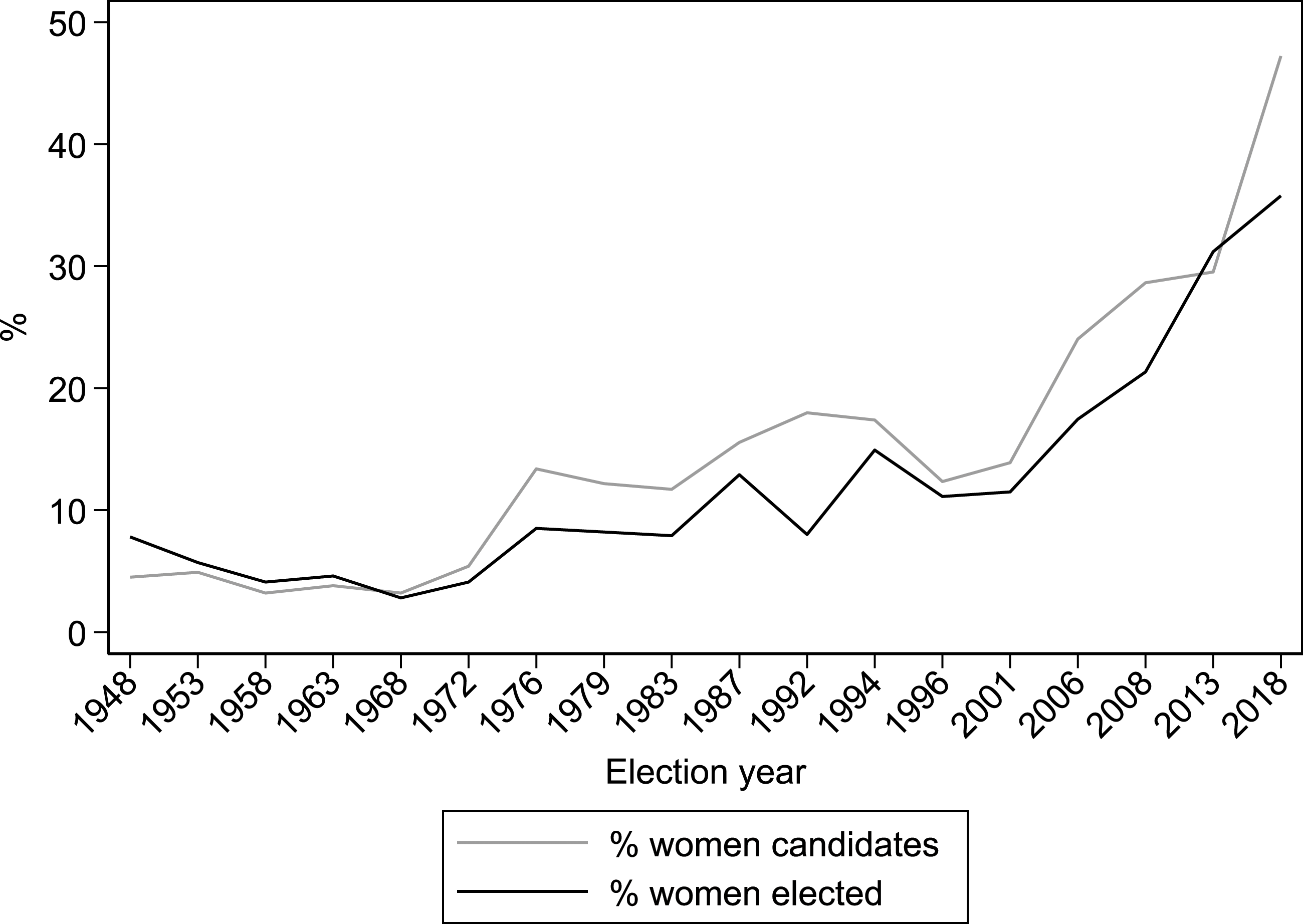
The share of female MPs in the Chamber of Deputies, however, has only shown a constant and substantial increase since the 2006 elections, the first to be held under the Calderoli Law. The electoral system established by the Calderoli Law, which was in place until the 2013 elections, consisted of a proportional system with a majority bonus (Bellucci, 2008). It featured blocked electoral lists, where the order of candidates was decided by each party before the elections (in the lower chamber, one list for each of the 26 multi-member constituencies). While formal gender quotas were not in force, two parties—the center-left Democratic Party (Partito Democratico, PD) and left-wing Left Ecology Freedom (Sinistra Ecologia Libertà, SEL)—introduced voluntary quotas for the 2013 elections.
The electoral system used in the 2018 general elections—and currently in force—is a mixed one. While a SMD plurality tier allocates 37% of the legislative seats (232 out of 630 in the Chamber of Deputies), 61% of seats (386) are allocated through blocked-list PR in multi-member districts (Chiaramonte and D’Alimonte, 2018). 1 In the same way as the Calderoli system, the electoral system established by the Rosato Law is characterized by the absence of preference voting, granting the parties an opportunity to arrange their electoral lists in such a way as to ensure the election of the candidates favored by the party leadership (Pansardi and Pinto, 2020a). The electoral rule, moreover, allows for multiple candidacy: the same candidate could run in the SMD tier and at the same time be listed as a candidate in up to five multi-member districts. In case a candidate is elected in a SMD and in one or more multi-member districts, by law she/he obtains the seat in the SMD. If a candidate turns out to be elected in more than one multi-member districts, she/he obtains the seat in the district where her/his party list has received the lowest vote share. 2
The quota system introduced in Italy with the Rosato Law can be regarded as a strong quota system: it is applied to a blocked-list PR system and includes both the requirement for a minimum percentage of each gender in the lists’ top positions and gender alternation within the lists, as well as a further gender balance proviso for the SMD tier. In addition, it assesses the party lists’ admissibility on the basis of their respect of the quota rule, with sanctions for non-compliance. In terms of district magnitude, however, the quota rules apply to mid-sized constituencies, with on average four seats for each district. 3
Presence of women among candidates and elected MPs, Italian Chamber of Deputies (2006–2018).
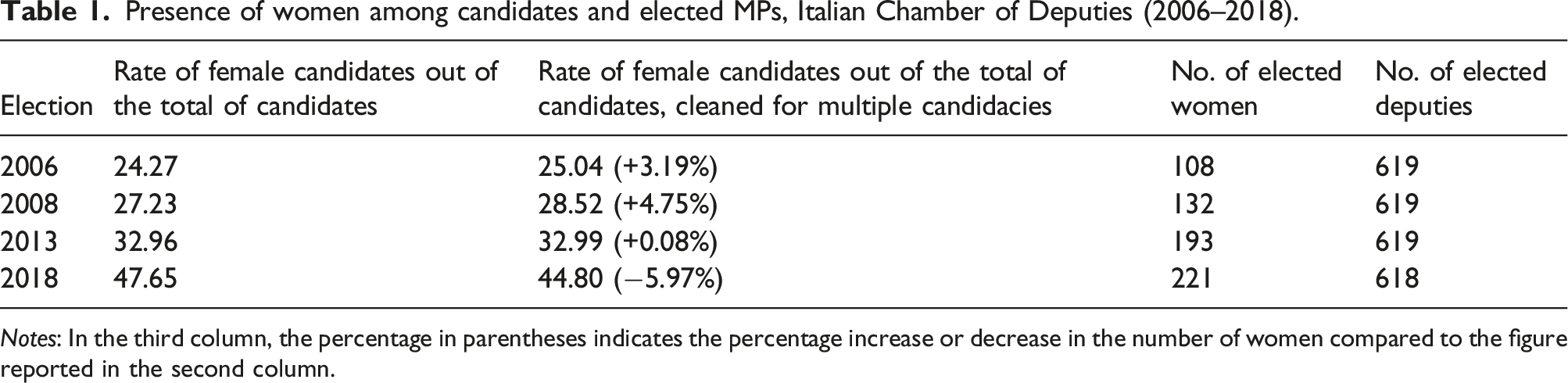
Notes: In the third column, the percentage in parentheses indicates the percentage increase or decrease in the number of women compared to the figure reported in the second column.
The second column reports the incidence of female candidates calculated by looking at the party lists in full, while the third column reports the incidence of female candidates after “cleaning” the party lists—that is, after removing multiple candidacies. 4 Although multiple candidacy was not new in 2018, the use and interpretation of multiple candidacy by parties radically changed under the Rosato electoral system. Multiple candidacies were also allowed under the previous electoral rules and were employed to secure the election of some prominent politicians as well as to give the list more visibility and appeal to voters by presenting recognizable “big names.” In the 2018 elections, parties made a more limited use of multi-candidacy, as the latter mainly served as a “parachute” for prominent party members whose election was at risk in the SMD. As a result, despite being defeated on the district level, several well-known politicians who ran in a single-member district managed to win a seat because they were also nominated at the top of their party’s list in one or more constituencies in the PR tier. Quite interestingly, as many as 50% of the multi-candidates were women (Pedrazzani et al., 2018).
As shown in column 3 of Table 1, for the elections between 2006 and 2013 the percentage of female candidates increases when multi-candidates are deleted from the candidate lists. The reverse is true, however, for the 2018 elections, where the rate of female candidates decreases once multi-candidates are removed. Some scholars (Pedrazzani et al., 2018; Regalia and Legnante, 2022) have suggested that multi-candidacies were employed by parties—whether intentionally or not—in such a way that the number of female candidates was reduced, accordingly mitigating the gender-balancing effect of the quota rule. However, to look at the data, although removing multiple candidacies certainly reduces the incidence of female candidates on the total of candidates per party, it does not do so in a way that dramatically violates the spirit of the quota law. Even when multiple candidacies are removed, the rate of female candidates to the Chamber reaches almost 45%, still an unprecedented result for the promotion of gender equality in Italian politics.
While not affecting the total number of female candidates, multiple candidacies can still be used strategically by parties to mitigate the effect of quotas. When a preferential vote is not allowed (as was the case in Italy during the considered period), the order in which candidates appear on the party list matters. Political parties compile their electoral lists to maximize the probability that their favored candidates will get elected. If women are placed in ineligible positions on a party’s slate, or if all women compete in SMDs where the party has no chance of winning, the mere presence of women in the lists will have no impact on the promotion of women’s representation. As a matter of fact, the multi-candidacy of female candidates might be used by the party leaderships as a strategy not to reduce the number of female candidates, but to remove female candidates from top-list positions: In fact, multiplying the number of lists in which the same female candidate is top-listed automatically results in promoting male second-listed candidates to the top position in up to four districts. As a consequence, the clause prescribing 40% of women in top-list positions can be circumvented and, given an average district magnitude of only four representatives per district and the fragmentation of the Italian party system, the gender alternation in the list rule can be rendered ineffective.
Hypotheses
In light of the evidence from international literature, a strong quota system like the one adopted for the 2018 Italian election was expected to have a positive impact on the number of female candidates elected. The data show, however, that while producing a notable increase in the rate of female candidates, the increase in female elected MPs was not as substantial. As we have already discussed, this may be due to a party strategy aimed at containing the impact of these quotas. Indeed, the parties might have learnt how to navigate the electoral system and pursue their gatekeeping strategy by exploiting some “blind spots” in the law (i.e., the possibility of multi-candidacy in the presence of a double tier and the allocation of candidates to winning positions) in order to mitigate the effect of quotas. The aim of this article is thus to investigate the presence of a gender gatekeeping strategy on the part of the Italian parties, as well as to identify the factors that characterize this tactic.
In the absence of specific strategies on the part of the Italian parties, in 2018 the increase in the number of female candidates should have led to an increase in the number of female elected MPs, following the trend already exhibited in the previous elections. By contrast, the presence of active gender gatekeeping strategies in 2018 would be attested by a significant reduction in the female candidates’ chances of election. Accordingly, our first hypothesis reads: H1: All else being equal, female candidates’ chances of election in 2018 significantly decreased, with regard to their male counterparts, in comparison to previous elections.
Descriptive data indicate that the possibility of multiple candidacies might lead parties to exploit this characteristic of the electoral system and hence compile electoral lists in such a way as to deflate the effect of the quota rule. As a matter of fact, placing the same female candidate in top positions in more than one list has the effect of formally complying with the “zipping” requirement of the quota rule while at the same time pushing other female candidates to lower list positions. As a result, while female with multiple candidacies are actually promoted by their party, female candidates who are listed only once on the electoral lists have lower chances of election than their male counterparts. H2: For female candidates put forward only once on the electoral list, the chances of election are significantly lower than those of their male counterparts.
Different parties’ gatekeeping strategies are also shaped by internal factors. Firstly, party ideology is often viewed as related to political parties’ explicit or implicit commitment towards gender equality. While mixed findings are present in the literature (Arcenaux, 2001; Matland, 1998; Santana and Aguilar, 2019), leftist parties, as well as their average electorate, are generally considered more concerned with women’s and minority rights and may show greater commitment to promoting gender equality in politics (Caul, 1999; Christmas-Best and Kjær, 2007; Kittilson, 2006; Reynolds, 1999; Rule, 1987; Wängnerud, 2009). Secondly, new parties tend to be more supportive of female candidacies than older parties. This is because new parties do not (yet) present a large group of incumbent members who may feel “threatened” by “newcomers,” which means that minority groups face fewer barriers impeding their entrance to the party. Compared to older and more institutionalized parties, parties that enter political competition for the first time are hence more likely to promote female candidates (Caul, 1999; Kittilson, 2006). Accordingly, ideology and party newness might play a role in mitigating party gatekeeping: H3: If compared to their male colleagues, female candidates have higher chances of election in more left-wing parties and a lower possibility in more right-wing parties. H4: If compared to their male colleagues, female candidates have higher chances of election in new parties than in long-established parties.
Lastly, there is a strand of the literature emphasizing that incumbency can have a positive impact on the future election of women. During their tenure, incumbent women have the chance to strengthen their position within the party and gain greater influence on how the party lists are put together in the next election (Jankowski et al., 2019; Murray, 2008). On top of that, women’s experience as legislators demonstrates their qualification as politicians, therefore overcoming prejudices against those female candidates that may exist among voters and party leaders when new elections come around (Bhavnani, 2009; Shair-Rosenfield and Hinojosa, 2014). As a result, female candidates’ incumbency might weaken the effect of party gatekeeping, while its full effect instead falls on non-incumbent female candidates: H5: For non-incumbent candidates, women’s chances of election are significantly lower than those of their male counterparts.
Data and methods
To empirically test the hypotheses put forward in the previous section we built a dataset covering the last four general elections held in Italy: 2006, 2008, 2013, and 2018. In other words, along with the election of 2018—the one with the quota provision—as a term of comparison, we included the three elections between 2006 and 2013, which were held under a closed-list PR electoral system. For the sake of simplicity, we only focused on the lists of candidates that the Italian parties presented for the election of the Chamber of Deputies. Moreover, for each election, we only considered those parties with at least one elected representative in the Chamber. 5
In our dataset, the unit of analysis is the individual candidate. As mentioned above, both the mixed electoral system adopted in 2018 (Rosato) and the PR system employed in the 2006–2013 period (Calderoli) allowed for multiple candidacies in the same election. In each election, we therefore cleaned the party lists, removing multiple candidacies. 6 The overall number of observations in our final dataset is 17,413 (6649 candidates in 2006; 2882 in 2008; 5132 in 2013; and 2750 in 2018).
The dependent variable in our analysis is a dummy indicator named Elected. This variable equals 1 if a candidate was elected to the Chamber of Deputies, and 0 if she/he was not elected. To test the hypotheses formulated in the previous section, we built a number of covariates to be included in our analysis. The first independent variable is Woman, a dummy coded as 1 for female candidates and 0 for male candidates. Secondly, we included a dummy named Multiple. This variable is coded as 1 if, in a given election, a candidate appears in more than one list (i.e., in more than one district under the same party label), and 0 if she/he appears in just one list. Thirdly, we created a party-level variable—Party LR—indicating the general position on the left-right axis of the party the candidate belongs to. Left-right scores were taken from Chapel Hill expert survey data (Bakker, 2015; Polk, 2017). As this variable ranges from 0 (extreme left) to 10 (extreme right), a negative coefficient on Party LR would indicate that moving from left to right decreases the likelihood of a candidate’s election. Fourthly, we built a dummy variable (New Party) whose value is 1 for those candidates belonging to parties running for the first time in a national election: M5S and Civic Choice (Scelta Civica, SC) in 2013, Free and Equal (Liberi e Uguali, LEU), and More Europe (+Europa) in 2018. In the 2006 and 2008 elections, no brand-new parties obtained seats in the Italian Chamber. Lastly, we incorporated a dummy called Incumbent, which is equal to 1 for candidates who are outgoing members of parliament at the time of election, and dummies for election years.
In our analyses, we also included a set of control variables. One of them is the dummy Experience, coded as 1 for individuals who had run as candidates at least once in the past, and 0 for those participating in the election for the first time. We also included candidates’ Age, measured in years. In addition, to take into account the presence of the two electoral tiers in the 2018 elections we incorporated a variable called Tier SMD. This is a dummy coded as 1 for those candidates running in a SMD, and 0 for those running in a party list in the PR tier. For the elections of 2006, 2008, and 2013, held under a PR system, we instead included a variable counting the number of seats at stake in the electoral district where a candidate runs (District Magnitude). Finally, we created three dummy indicators corresponding to different geopolitical areas: North, Red Belt, and Center-South. 7 These dummies allow us to check for possible differences across the Italian territory concerning the composition of party lists and the electoral performance of women.
Analysis and results
Before turning to the multivariate analysis, let us examine the share of women in “expected winning positions.” In particular, after cleaning for multiple candidacies, we identified expected winning positions as those positions in the electoral lists that the party expected to win by estimating the political climate through the electoral polls at the time of compiling the lists. 8 While full details are reported in the Appendix (Table A1), we note here that, on the whole, in 2018 the share of women in expected winning positions was less than 35%—that is, a much lower value than the rate of women among all candidates (more than 47%). This is because, with very few exceptions, all of the Italian parties competing in the 2018 elections displayed much lower rates of women in expected winning positions than the 40% of female candidates prescribed by the quota. For example, the share of women in expected winning positions was 38% for Forward Italy (Forza Italia, FI) and around 30% for the PD, Brothers of Italy (Fratelli d’Italia, FDI), and the League (Lega). The Five Star Movement (Movimento 5 Stelle, M5S) represented the main exception to this pattern, with more than 42% of women in the positions the party expected to win before the 2018 election. Accordingly, while multi-candidacies did not significantly affect the number of female candidates, they were used quite effectively by parties as a way to mitigate the gender-balancing effect of the quota rule.
To test our specific hypotheses, we run five logistic regression models: one for the 2018 elections, one for each of the previous three elections, and one model where the data regarding the four elections are pooled. In this article, we are primarily interested in the impact that the quota system had on women’s representation in the Italian elections of 2018. Accordingly, hypotheses H1 and H2 specifically regard outcomes that can be observed in the 2018 elections. However, to check if the effects hypothesized under H1 and H2 were only observed in the 2018 elections, we have presented not only a regression model for 2018, but also three regression models for the previous elections (2006, 2008, and 2013) held under a different electoral system. If the hypothesized effects were observed in 2018 but not in the prior three elections, we can argue that they can be reasonably attributed to the electoral rules adopted in 2018.
Determinants of candidates’ chance of election, Italy 2006–2018.

Notes: Logistic regression models. Standard errors (in parentheses) are clustered at the party/district level. Omitted category for geopolitical area: “North.” Statistical significance: * p < 0.1, ** p < 0.05, *** p < 0.01.
Figure 2 plots, for each election between 2006 and 2018, the impact of being a woman on a candidate’s chance of being elected to the Italian Chamber of Deputies. Marginal effects were estimated from the pooled model reported in Table 2. A positive estimated coefficient indicates that, controlling for all the covariates included in the regression models above, female candidates are more likely to obtain a seat than their male colleagues. Conversely, a negative coefficient implies that women are less likely to win a parliamentary seat than men. The graph shows that, all else being equal, the only year when female candidates had a lower chance of being elected compared to their male counterparts was 2018. In the previous three elections, the candidates’ gender had no impact on chances of election (the confidence intervals around the estimated coefficients for Woman cross the zero line). This is consistent with H1, whereby under the quota rules of 2018 female candidates’ chance of being elected significantly decreased compared to previous elections. In particular, if we convert the coefficient into an odds ratio, we note that in 2018 the chance of being elected for women was 5% lower than for men. Although this difference is not enormous, it is remarkable as it suggests that female candidates were penalized under the electoral rules adopted in 2018, which were specifically aimed at improving women’s electoral chances.
9
Impact of gender on candidates’ chance of election in Italy (2006–2018), by election year.Notes: Marginal effects are estimated on the basis of the pooled regression model reported in the last column of Table 2. Whiskers indicate 95% confidence intervals. All other covariates are set to their observed values.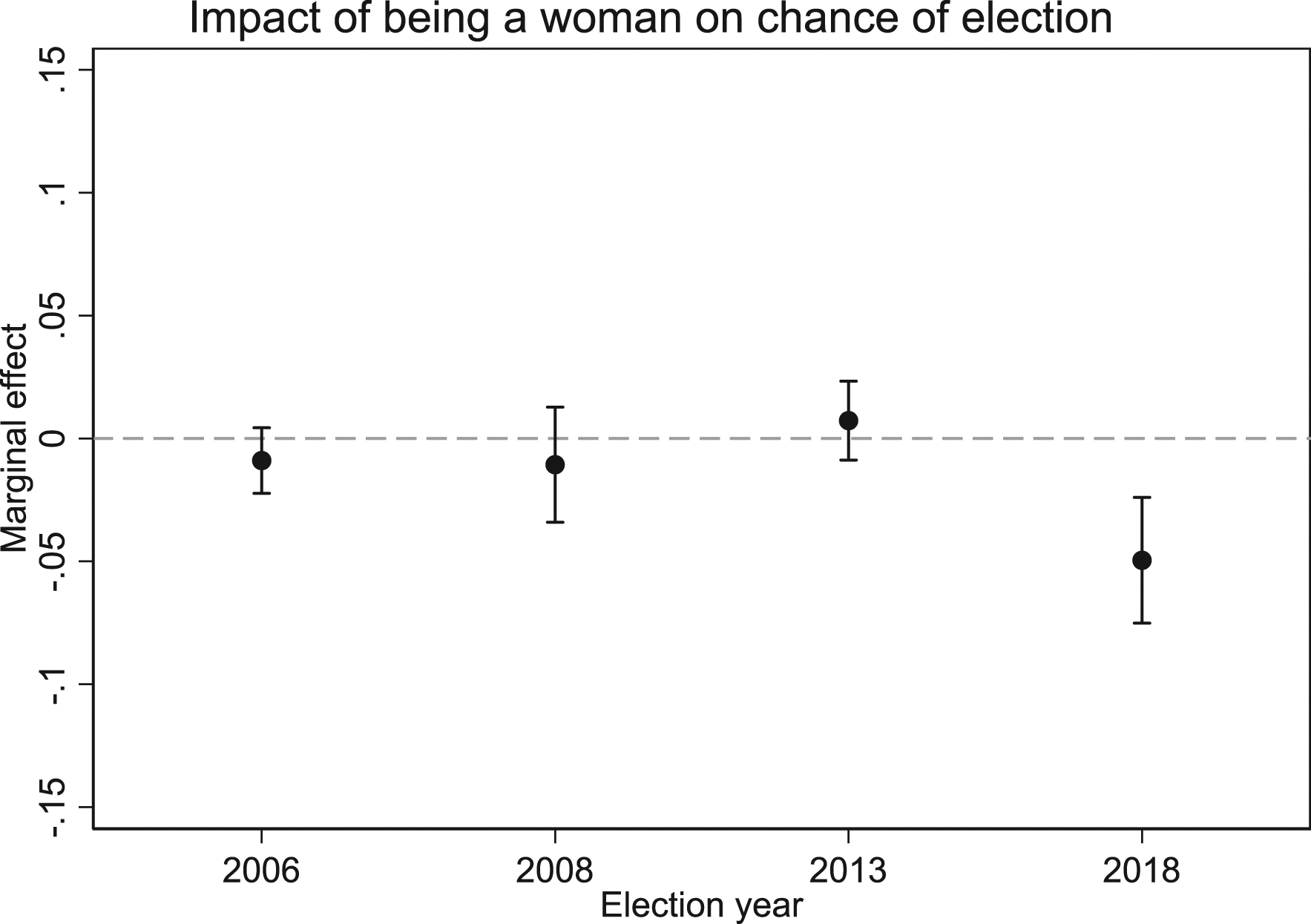
The other hypotheses regard the impact of being a woman (rather than a man) on a candidate’s chance of election given certain circumstances. Accordingly, Figures 3–6 report the estimated impact of being a woman on Italian candidates’ chance of election for each type of candidate (according to single/multiple candidacy and incumbency) and party (according to left-right score and newness) in the elections from 2006 to 2018. The bottom right panel in Figure 3 reveals that, for candidates only appearing in one electoral list in a given election (single candidacy), the chance of obtaining a parliamentary seat is significantly lower for women than for men in 2018. This is indicated by the estimated coefficient for Woman in the event of single candidacy, which is negative and has a 95% confidence interval below the zero line. The same does not happen for candidates with multiple candidacies, where gender does not matter for election to the Italian Chamber (the confidence interval around the estimated coefficient for Woman clearly encompasses zero).
10
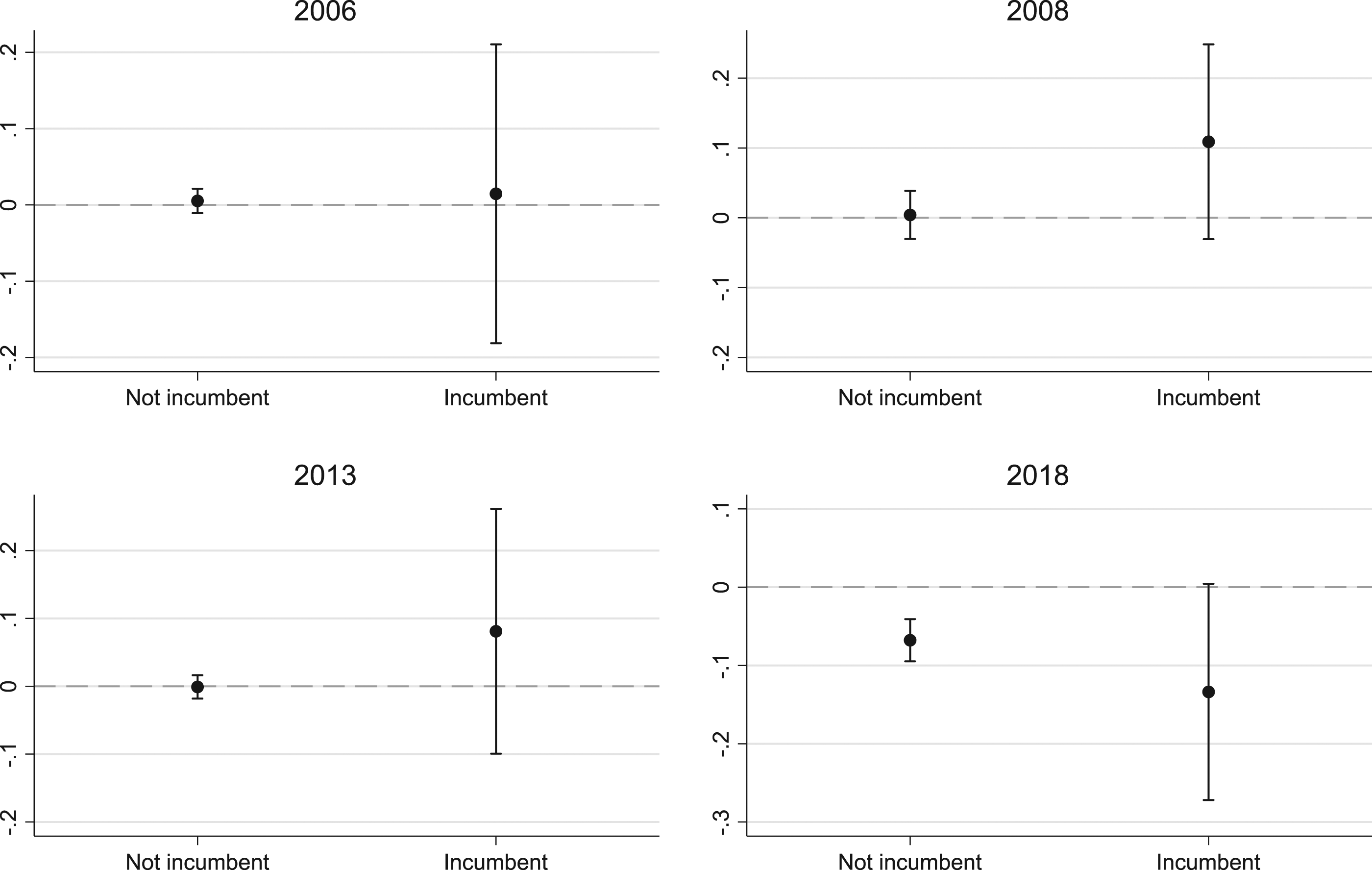
As the other three panels of Figure 3 show, in the 2006–2013 elections gender does not affect the election chances of candidates, whether they have single candidacies or multiple candidacies. Hence, this evidence supports H2. Impact of gender on candidates’ chance of election in Italy (2006–2018), by type of candidacy.Notes: Marginal effects are estimated from the first four models in Table 2. Whiskers indicate 95% confidence intervals. All other covariates are set to their observed values. Impact of gender on candidates’ chance of election in Italy (2006–2018), by party ideology.Notes: Marginal effects are estimated from the first four models in Table 2. Whiskers indicate 95% confidence intervals. All other covariates are set to their observed values. Impact of gender on candidates’ chance of election in Italy (2006–2018), by party newness.Notes: Marginal effects are estimated from the first four models in Table 2. Whiskers indicate 95% confidence intervals. All other covariates are set to their observed values. Impact of gender on candidates’ chance of election in Italy (2006–2018), by incumbency.Notes: Marginal effects are estimated from the first four models in Table 2. Whiskers indicate 95% confidence intervals. All other covariates are set to their observed values.


As for H3, as expected we find evidence that female candidates have a higher chance of being elected in more left-wing parties than in more right-wing ones. More precisely, the bottom right graph in Figure 4 illustrates that, in the 2018 elections, being a woman does not make any difference if a candidate belongs to a left-wing party list (i.e., with a left-right score between 0 and 3). Being a woman increasingly reduces chances of election if a candidate belongs to a more right-wing party list. 11 Let us note that this pattern cannot be observed in the three elections before 2018.
Our findings concerning the 2018 elections also support H4, whereby female candidates have higher chances of winning seats in new parties than in long-established ones. As displayed in the right panel of Figure 5, being a woman decreases a candidate’s chance of election in existing parties. In contrast, in a brand-new party list the chance of election is the same for both men and women. The left panel provides some support for the idea that also in 2013 women had less chance of being elected than men, especially in existing parties. This pattern is, however, less robust than in the 2018 elections.
In terms of electoral prospects, being a woman is a disadvantage not only for candidates with no multiple candidacies (see above), but also for other types of “weak” candidates (i.e., candidates with fewer political resources), namely candidates who are not incumbent. This pattern, which we observe in 2018 but not in the previous three elections, supports H5 (see Figure 6). In other words, in the presence of the quota rule, in 2018 the Italian parties apparently chose to arrange their electoral lists in ways that penalized female candidates with fewer political resources. Women’s chances of election are, by contrast, closer to men’s among incumbent candidates.
With regard to the control variables, marginal effects are reported in the Appendix (Supplemental Appendix Figures A1–A4). Our findings highlight that in 2018 being a woman (rather than a man) decreases electoral chances more for younger candidates, and less for older ones. The same did not occur in the previous three elections. We also find that, in the 2018 elections, being a woman is a disadvantage in terms of electoral prospects for individuals with no prior experience as candidates. Moreover, in 2018, women’s disadvantage in terms of electoral prospects does not depend on the electoral tier in which they run. If compared to their male colleagues, female candidates have lower chances of winning a seat both in SMDs and in the PR party lists. In a similar vein, chances of election for women do not depend on the geopolitical area where they ran as candidates. Female candidates are found to be less likely to obtain a parliamentary seat in all three areas into which we divided the Italian territory (North, Red Belt, and Center-South). Let us note that, in the previous elections held in 2006, 2008, and 2013, women did not display a lower chance of being elected than men, and this was true for all district magnitudes and in every geopolitical area.
Conclusion
In this article, we tested the effectiveness of gender quotas in limiting gendered party gatekeeping strategies and enhancing female representation by focusing on the Italian case, where a strong quota system was introduced in the 2018 general elections. In particular, we evaluated whether the quota rule had a positive impact on the chances of election of female candidates and we found that, although female representation in the Chamber increased slightly in 2018, it did not do so in a way that corresponded to the increase in female candidacies prescribed by the quota rule. Our results show that, after the introduction of the quota law, not only did female candidates’ chances of election not increase, but they were actually reduced in comparison to previous elections.
This testifies to the Italian parties’ attempt to formally comply with the quota rule, while at the same time finding ways to circumvent its expected effects. As this study shows, party gatekeeping worked in the Italian case by exploiting the possibility of multiple candidacies to counteract the effect of the zipping system: when the same female candidate was placed at the top in multiple lists, four male candidates from the same party were placed in the second position, virtually resulting at the top of the list. As a consequence, the election chances of those women who appeared in just one list were significantly lower than those of male single candidates.
Gatekeeping strategies, however, were not applied equally by all parties. As we highlighted, right-wing parties and more established parties were those most systematically associated with gatekeeping patterns. Their women candidates had significantly lower chances of election than their male counterparts. By contrast, leftist parties and new parties did not show significant differences between male and female candidates regarding the chances of being elected. Moreover, party gatekeeping is not indifferent to a candidate’s personal political resources and capacity to attract votes: while incumbent and experienced female candidates had the same election chances as their male counterparts, the chances of newcomer female candidates were significantly lower than those of male novices.
On the whole, this study supports the mixed findings of international literature on the effectiveness of gender quotas in enhancing female representation. Even when quotas are strong, they do not automatically lead to the election of gender-balanced legislatures. The persistence of parties’ gatekeeping attitudes and the possibility of gatekeepers taking advantage of other aspects of the electoral system may weaken the impact of the quota rule. In the 2018 Italian elections, party gatekeeping strategies were not thwarted by the quota rule but adapted to it by exploiting another feature of the electoral system, namely the possibility of multiple candidacy. Multiple candidacies were not used by the Italian parties to dramatically reduce the number of female candidates overall. However, they were used strategically to reduce the number of female candidates in winnable positions in the electoral lists.
Our findings show, accordingly, that the presence and the structure of opportunity for multiple candidacy should be taken into account when assessing the impact of electoral systems on gender representation and in the evaluation of the strength of gender quota provisions. Moreover, in terms of policy implications, while recognizing that quotas are not the definitive solution to the problem of gender equality in party politics—other actions, such as parties’ gender action plans, should be taken to effectively institutionalize gender equality within party structures, processes, and practices (OSCE, 2014; Verge, 2020)—this study suggests that quota designs aiming at producing a significant effect on gender descriptive representation should include provisions that either forbid multiple candidacy or prevent its strategic use by party gatekeepers.
Supplemental Material
Supplemental Material - Do (strong) gender quotas make a difference? Multiple candidacies as a party gatekeeping strategy in Italy
Supplemental Material for Do (strong) gender quotas make a difference? Multiple candidacies as a party gatekeeping strategy in Italy by Pamela Pansardi and Andrea Pedrazzani in Applied Party Politics
Footnotes
Declaration of conflicting interests
The author(s) declared no potential conflicts of interest with respect to the research, authorship, and/or publication of this article.
Funding
The author(s) disclosed receipt of the following financial support for the research, authorship, and/or publication of this article: The research was partially funded by a grant of the University of Pavia (Blue Sky Research—Young Investigators Grant, 2017).

Supplemental material
Supplemental material for this article is available online.
Notes
Authors biographies
References
Supplementary Material
Please find the following supplemental material available below.
For Open Access articles published under a Creative Commons License, all supplemental material carries the same license as the article it is associated with.
For non-Open Access articles published, all supplemental material carries a non-exclusive license, and permission requests for re-use of supplemental material or any part of supplemental material shall be sent directly to the copyright owner as specified in the copyright notice associated with the article.
