




Abstract
This study analyses a mechanism to explain how internal mobility in the dominant party enhances economic performance. We argue that authoritarian leaders incentivize their political agents to advance economic development by using age-based promotion and retirement rules. We empirically examine our theoretical claim using China’s cadre rejuvenation policy, which rewards younger leaders with more opportunities for career advancement. Drawing on panel data for prefectural party secretaries who were in office at some point between 2000 and 2012, we show that the principle of youthful rejuvenation leads the Communist Party of China to grant more promotions to party leaders who enter office at a younger age than to their older counterparts. Under such an incentive scheme, the regions served by younger entrants into the officialdom have better economic performance than those served by older entrants, holding ability and other regional characteristics constant.
It has been a growing consensus in authoritarian politics that single-party regimes outperform other types of nondemocracies in various aspects of economic development, including economic growth, private investment (Gehlbach and Keefer, 2012), and taxation (Jensen and Malesky, 2018). A central explanation for the economic advantage of single-party regimes focuses on the incentive structure of the party system. Scholars highlight the role of the hierarchical system in the dominant party that allocates benefits and duties to party members with different ranks (Manion 1993; Svolik, 2012). They argue that dominant party leaders incentivize subordinates to devote sufficient effort by carefully maintaining upward mobility through the party hierarchy.
The Communist Party of China (CPC) serves as an exemplar of such a dominant party that successfully manages its party members for economic development. Over the past four decades, China has achieved an economic miracle that has transformed a country with the largest population in poverty to the second largest economy in the world. While a sizable body of literature shows that the career incentives of officials drive economic growth (e.g. Xu, 2011; Li and Zhou, 2005), this study moves a step forward by examining the institutional features of the CPC that shape such career incentives. Specifically, we take the cadre rejuvenation policy in China as a case to examine how within-party upward mobility facilitates economic development in China. In 1982, the CPC adopted a fundamental principle for personnel management: cadre rejuvenation in its Party Constitution (Article 35). This principle calls for the constant introduction of younger cadres into leadership positions. Each year, millions of young officials are recruited, rotated, and promoted by the Organization Department at various levels and branches, replacing senior officials retiring from office.
We examine the effect of cadre rejuvenation by focusing on the way in which age-based promotion and retirement rules shape the time horizons of officials’ careers, thereby affecting the economic performance of municipalities in China. Our empirical analysis draws on a dataset of Chinese prefectural party secretaries who served in office between 2000 and 2012. We first conduct a premise check on the validity of cadre rejuvenation policy by showing an age advantage for promotion: Party secretaries entering office with a younger age are more likely to be promoted after serving the post. We then assess how the entry age of party leaders affects their economic performance using a fixed-effects model (individual, prefecture, and year FEs) that partials out unobserved individual confounders, such as leadership ability and charisma, prefectural-level unobservables such as economic endowment, and year-specific shocks. We show that party secretaries who are younger when they assume office perform better than those who are older when they assume office. The estimation shows that a 1-year decrease in age at office entry is associated with a 0.6 percentage point higher GDP growth rate. The age-at-entry effect is salient in the growth of the manufacturing sector, which is the main driving force of growth that accounts for over 45% of the gross GDP. In addition to our main result, we also rule out two alternative explanations. We show that the disparity in economic growth between younger and older party secretaries is not driven by economic data falsification or patronage connections.
This study speaks to the comparative understanding of the time horizon for political leaders’ careers. Research on electoral democracies shows that elected politicians reduce their efforts, voting less frequently and less congruently with constituents, during their final term because they are no longer eligible for re-election (Vanbeek 1991; Alt et al., 2011). Our study sheds light on how this time horizon affects the allocation of officials’ effort regarding economic policymaking in single-party regimes. Like term limits in democratic regimes, the age limits for promotion and the fixed retirement age result in lame-duck cadres in China who exert less effort toward advancing economic development than do their younger peers.
Within-party mobility and economic performance
After Mao’s death, the CPC adopted several policies to enhance internal upward mobility in the party hierarchy. In 1980, Deng Xiaoping first proposed the four principles of cadre management in his widely known speech, Reform of the Party and State Leadership System. These four principles—revolutionary spirit, youthful rejuvenation, knowledge, and specialization—were included in the Constitution of the CPC in 1982 (Article 35). Since the early 1980s, youthful rejuvenation has played a crucial role in shaping institutions related to political selections in China. To maintain a young group of cadres, the CPC introduced two age-based rules that determine officials’ retirement and promotion. After the end of the Cultural Revolution, the Party adopted a mandatory retirement age for officials of various administrative ranks, ending the life-long tenure of senior leaders (Manion 1993; Wu 2015). Although the legal retirement age for cadres is 60 for males and 55 for females, the enforcement of these retirement age restrictions varies across ranks. 1 Top-level political leaders are not constrained by these rules. For example, the average age of Politburo members at the time of appointment ranged from 60 to 63 from the 15th to 19th Party Congress (Miller 2018). While no formal rule specifies the exact age of retirement, an informal rule called “seven up, eight down” has prevailed in media coverage. 2 This norm suggests that standing Politburo committee members can stay in office when aged 67 but have to retire at age 68. In contrast to top leaders, intermediate- and lower-level cadres follow the mandatory retirement age rules. Officials who work at the bureau level or below have to retire or are transferred to secondary positions if aged above 60. Our data on the prefectural leaders in our sample verify the enforcement of this rule, as we find that no prefectural party secretaries stay in office past this retirement age.
Age of ineligibility for promotion by position rank.
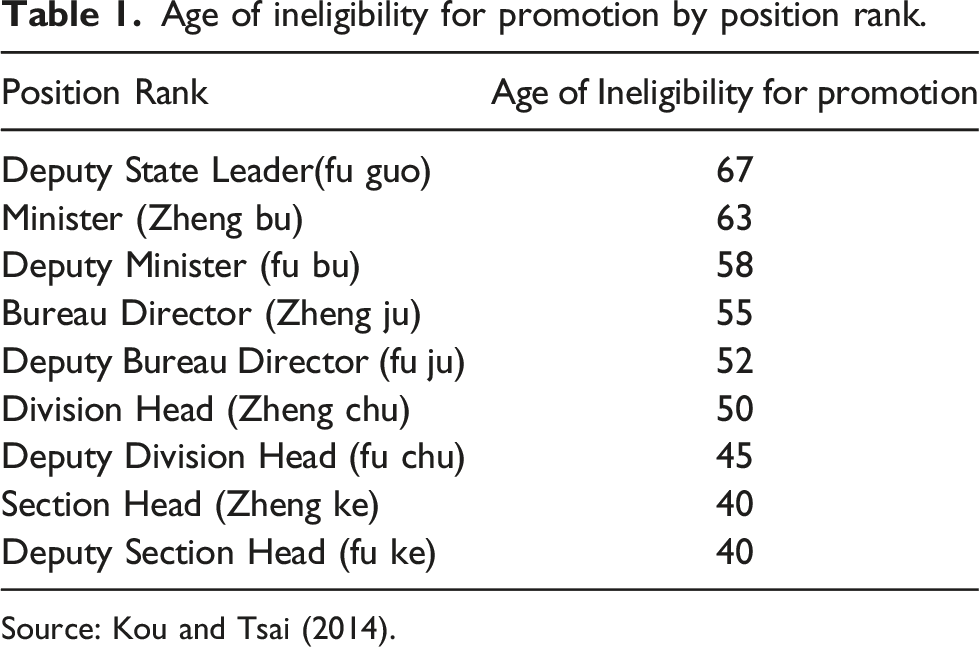
Source: Kou and Tsai (2014).
Broadly, the age-based promotion and retirement rules ensure a positive rate of official replacement at each level of the government, guaranteeing internal upward mobility along the rank ladder (Svolik, 2012). These rules serve as a strong incentive for party officials by shaping the time horizons of their careers. With a fixed retirement age, the time horizon of officials is determined by their entry age, which has considerable variations for officials with the same rank. According to Kou and Tsai (2014), officials obtain an age advantage in the career ladder, thereby assuming a certain post with various ages through three channels. One is the Communist Youth League (CYL) mechanism. Because the age threshold for promotion in the CYL system is lower than that in the regular cadre system, officials who transfer from the CYL system can obtain a career advantage. The second channel is the temporary transfer duty that officials are appointed to remote areas to gain political advantage. The third and most prevailing mechanism in the reform era is nonregulation promotion, in which officials are promoted beyond formal selection criteria such as fixed terms, allowing young cadres to advance further in the party system. These three mechanisms create variation in the entry age, thereby affecting the time horizon of officials. Facing a certain age limit for promotion, officials who enter office at a younger age have a longer time over which to advance their careers. In contrast, those who enter office at an older age are less motivated to exert effort because they are less likely to be promoted before retirement. We argue that this difference in effort among officials with various ages at entry is manifested in the economic performance of their jurisdictions, which was the major criterion for cadre evaluation in the years before Xi Jinping’s administration (Zuo 2015). In other words, party leaders tend to exert significant efforts to promote growth at the early stage of their tenure to signal their competence. Therefore, we formulate our main hypothesis as follows:
H1: The jurisdictions of party secretaries who assume office at a younger age have better economic performance than do those of party secretaries who take office at an older age.
Data
To analyze how the time horizon for officials’ careers affects economic performance, we use a panel dataset of China’s prefectural party secretaries who served in office between 2000 and 2012. The dataset was developed by Junyan Jiang and was constructed from multiple sources. The biographical and career information on the prefectural party secretaries is drawn from the China Political Elite Database (CPED) (Jiang 2018). Various prefectural-level socioeconomic indicators are collected from the Statistical Yearbooks for Regional Economies. In addition to the leader and municipal socioeconomic data, we also obtain the political turnover of prefectural leaders from Peking University’s China Center for Economic Research (CCER) Official Dataset (Yao et al., 2020).
To ensure meaningful comparisons, our sample excludes two types of cities. We first exclude vice-provincial-level cities because the party secretaries for these cities have a higher administrative rank than their peers in normal prefectures. We also exclude prefectures in Xinjiang and Tibet, as the literature suggests that the CPC is more concerned about regime stability than economic development in these two provinces (Lü and Landry 2014). After excluding these two types of cities, 297 prefectural cities remain in our sample. 4
Stylized fact
Before showing the regression results, we present three stylized facts about the retirement ages, age-at-entry windows, and career advancement opportunities of prefectural party secretaries. We first demonstrate that the mandatory retirement age is strictly enforced for this group of prefectural party secretaries. The left panel of Figure 1 shows the age distribution of prefectural party secretaries who held office between 2000 and 2012. The age of incumbent party secretaries varies from 37 to 60, with a median of 52. The result verifies one important premise about the mandatory retirement rule that prefectural party secretaries (bureau-level) cannot stay in office if aged 60. The age and age at entry of prefectural party secretaries, 2000 to 2012.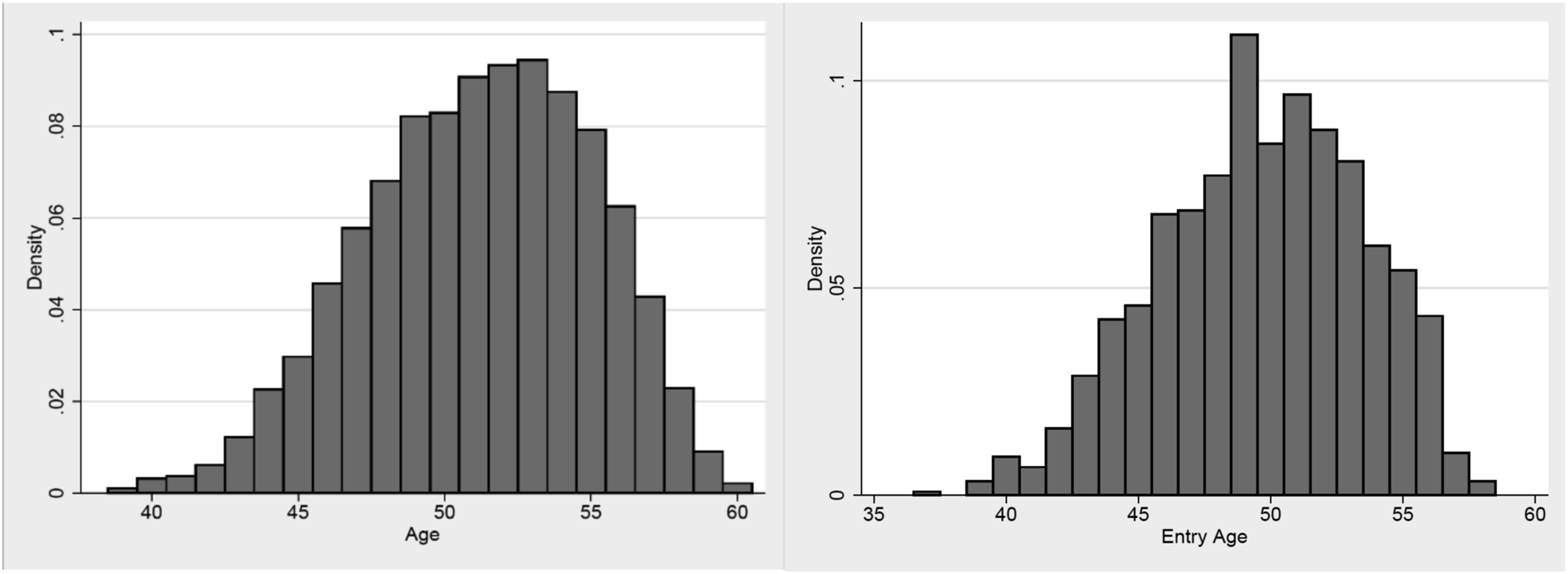
The right panel of Figure 2 shows a wide age-at-entry window, ranging from 37 to 58 years old. In other words, the youngest entrant expects to have a time horizon of 23 years to maximize the likelihood of career advancement, while the oldest entrant has at most merely 2 years in office. The median age-at-entry is 50, which suggests that half of the officials have at least 5 years until their ceiling age for promotion and 10 years until their retirement. Age at entry and promotion rate. Source: CCER Official Database. The point denotes the ex post probability of promotion by entry age. The gray line and zones denote the nonparametric fitted line. As officials with an entry age under 40 are few, we code all as 40 and below.
We also examine the relationship between the party secretaries’ age at entry and their career advancement opportunities. If cadre rejuvenation policy does provide an age advantage for promotion, we expect that party secretaries who enter office earlier are more likely to be promoted at the end of their current post. To verify this crucial premise, we compute the post-level correlation between entry age and career advancement as follows. We first calculate the party secretaries’ ages when assuming office in a specific city. We then obtain the promotion rate for different entry ages by computing the ratio of party secretaries who are promoted to a higher-level position after serving in a specific post to the total number of posts served by these party secretaries within each age-at-entry group. Figure 2 shows the bivariate plot. The dots denote the promotion rate across different entry ages. Approximately 60% of party secretaries who enter office before age 45 can obtain a promotion at the end of their term. The promotion rate declines to less than 20% if party secretaries enter office when they are older than 55. We fit a nonparametric line that shows that party secretaries who are older when they enter office (“older entrants”) are less likely to be promoted to an upper-level position than their younger peers (“younger entrants”). 5
The three stylized facts — a wide age-at-entry window, a fixed retirement age, and the age bias in promotions — suggest that younger entrants are likely to exert more effort on promotion-related policies. In contrast, the old entrant faces a career cap. These party secretaries, who are less likely to move up the career ladder before they retire, may be less motivated to exert such effort. The next section provides detailed empirical evidence supporting this hypothesis.
Research design and main results
To evaluate the effect of party secretaries’ ages at entry on their performance, we estimate a statistical model with the following specification:
where i, p, and t index the prefecture, party secretary, and year, respectively.
We include two sets of time-variant covariates in our specification. First, we consider two prefectural-level economic variables
We include the prefecture
The effect of party secretaries’ age at entry on performance.
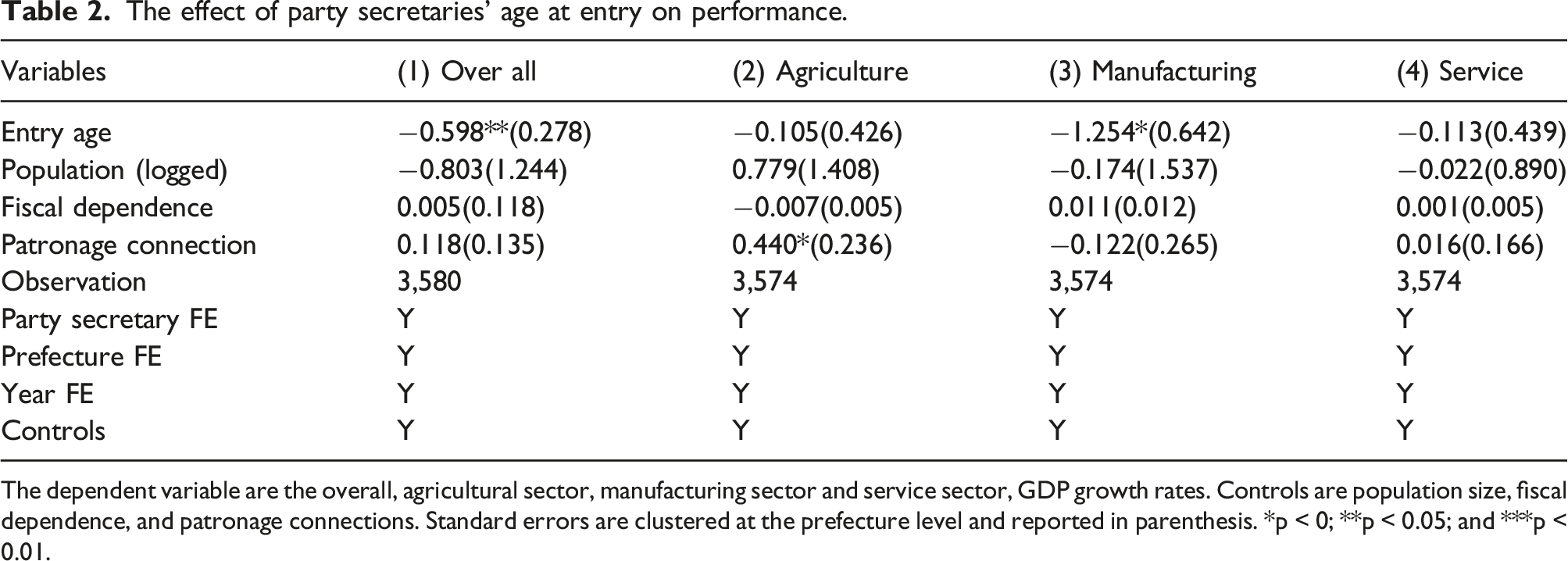
The dependent variable are the overall, agricultural sector, manufacturing sector and service sector, GDP growth rates. Controls are population size, fiscal dependence, and patronage connections. Standard errors are clustered at the prefecture level and reported in parenthesis. *p < 0; **p < 0.05; and ***p < 0.01.
Beyond the main result, we conduct additional analyses. To address the concern that GDP growth is captured by fixed investment, we first estimate the effect of the entry age on the growth rate of fixed asset investment (Table A.4). Consistent with the baseline finding, younger entrants also invest more in physical assets such as machinery, land, or infrastructures than do older entrants. We also consider using three alternative measures of economic development, including railway freight, power consumption, and nighttime brightness. These three alternatives proxies capture different aspects of economic development. Railway freight measures dynamic economic activities such as trade. In contrast, power consumption and luminance mainly capture the economic output from static objects (factory production, urban infrastructures, etc.). Table A.5 shows that entry age is negatively correlated with power consumption and nighttime brightness but has a weak positive correlation with railway freight. The results provide suggestive evidence on the development strategy shift between young and old entrants that party secretaries who enter office with a younger age devote more effort to physical asset investment, which is in line with our findings in Table A.4. Finally, we analyze whether the age advantage exists in the Xi Jinping administration. Given the data availability, we examine the effect of entry age on economic growth using data between 2013 and 2015. Table A.6 shows a much smaller magnitude of the entry age on the GDP growth rate, suggesting that the incentive effect of age-based promotions is weakened in the early years of the Xi era. 8
Alternative explanations
We conduct additional analyses to rule out two alternative explanations. One explanation is data falsification. Although China has experienced remarkable economic growth during the reform era, researchers have been concerned about the quality of China’s GDP data (Nakamura et al., 2016; Wallace 2016; Clark et al., 2017). Given the possibility of data manipulation, it is likely that young entrants perform better on economic growth metrics because they exert more effort falsifying GDP data.
To address this concern, we develop proxies for the level of data manipulation by computing the difference between reported GDP growth rates and three alternative indicators of economic performance used in the previous section. As Wallace (2016) notes, these indicators are less affected by the manipulation of Chinese political leaders. Moreover, we use a simple average of these three measures as the fourth measure for GDP manipulation. We then estimate the effect of age at entry on these four gaps.
Figure 3 shows that entry age has a null effect on three out of four measures of data falsification. The result for the railway freight measure is significant but in the opposite sign, which may be attributed to the policy shift of the development strategy, as discussed in the previous section. Moreover, we verify that our results hold when we do not standardize the three measures of data manipulation (Table A.7). Effect of age at entry on data falsification.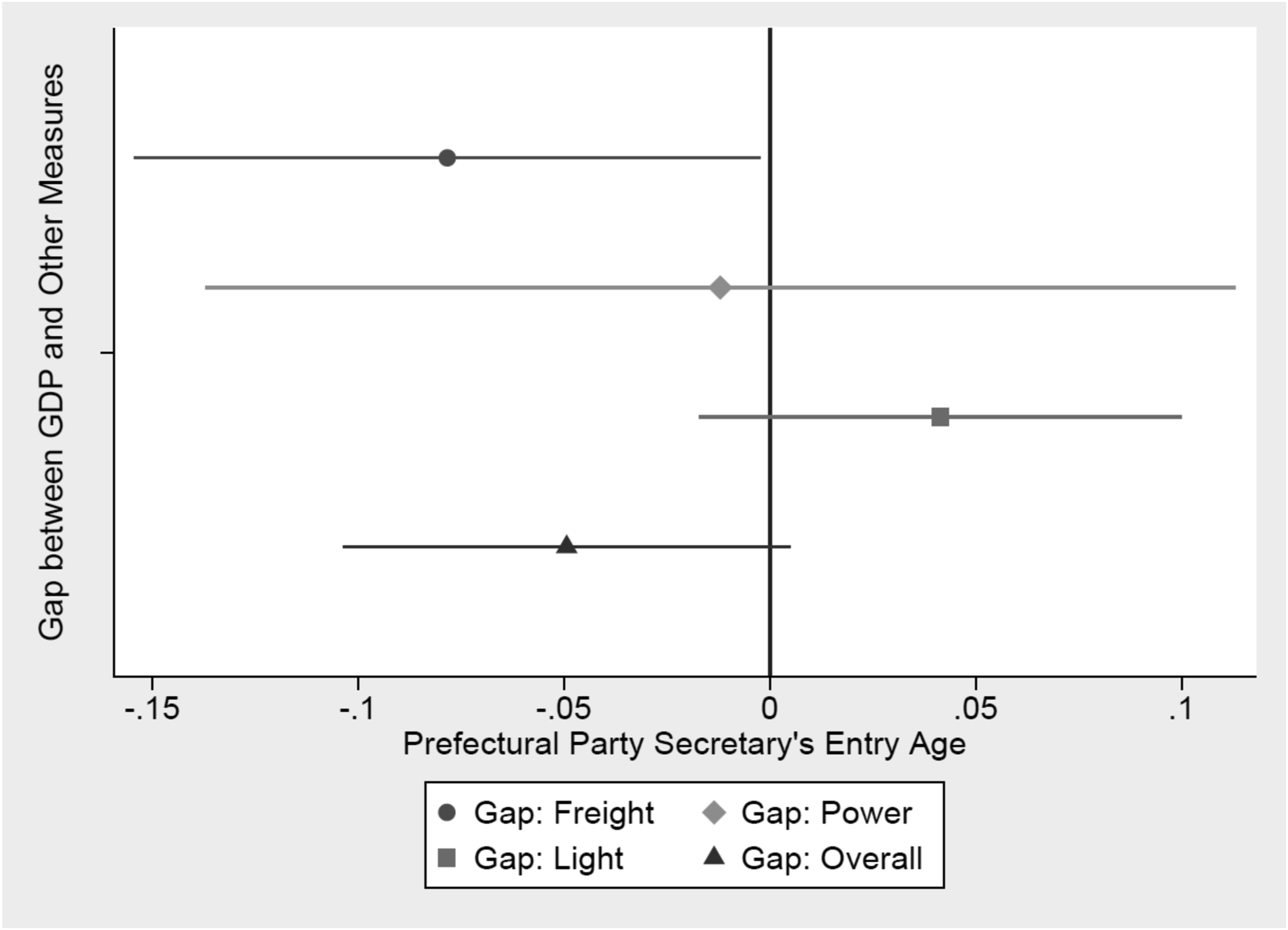
In addition to the data falsification mechanism, we are concerned that young entrants are political stars who were strategically promoted by provincial party bosses to positions with better growth potential (Shih et al., 2012; Jiang 2018; Shih and Lee 2020). If strategic appointments exist, the performance premium received by younger entrants is expected to be more salient for those who have connections than for those without such connections. Following the extant literature, we test the empirical implications of this speculation by using an interaction analysis (Lü and Landry 2014; Jia et al., 2015; Chen and Hong 2021). Specifically, we estimate the effect of an interaction term between age at entry and patronage connections on the GDP growth rate. Figure 4 presents the estimates for the interaction term. We do not find evidence supporting the endogenous appointment mechanism. All interaction estimates are statistically insignificant, suggesting that the strategic appointment hypothesis does not explain our baseline results. Beyond interaction analyses, the endogenous selection hypothesis also suggests younger entrants may be more likely to be appointed to economically developed areas in the first place. To test this conjecture, we analyze the effect of lagged economic performance on the political connection status (Table A.8). The negative correlation suggests that endogenous selection problem is not the case in this research, reassuring the validity our main findings. Marginal effect of patronage connections.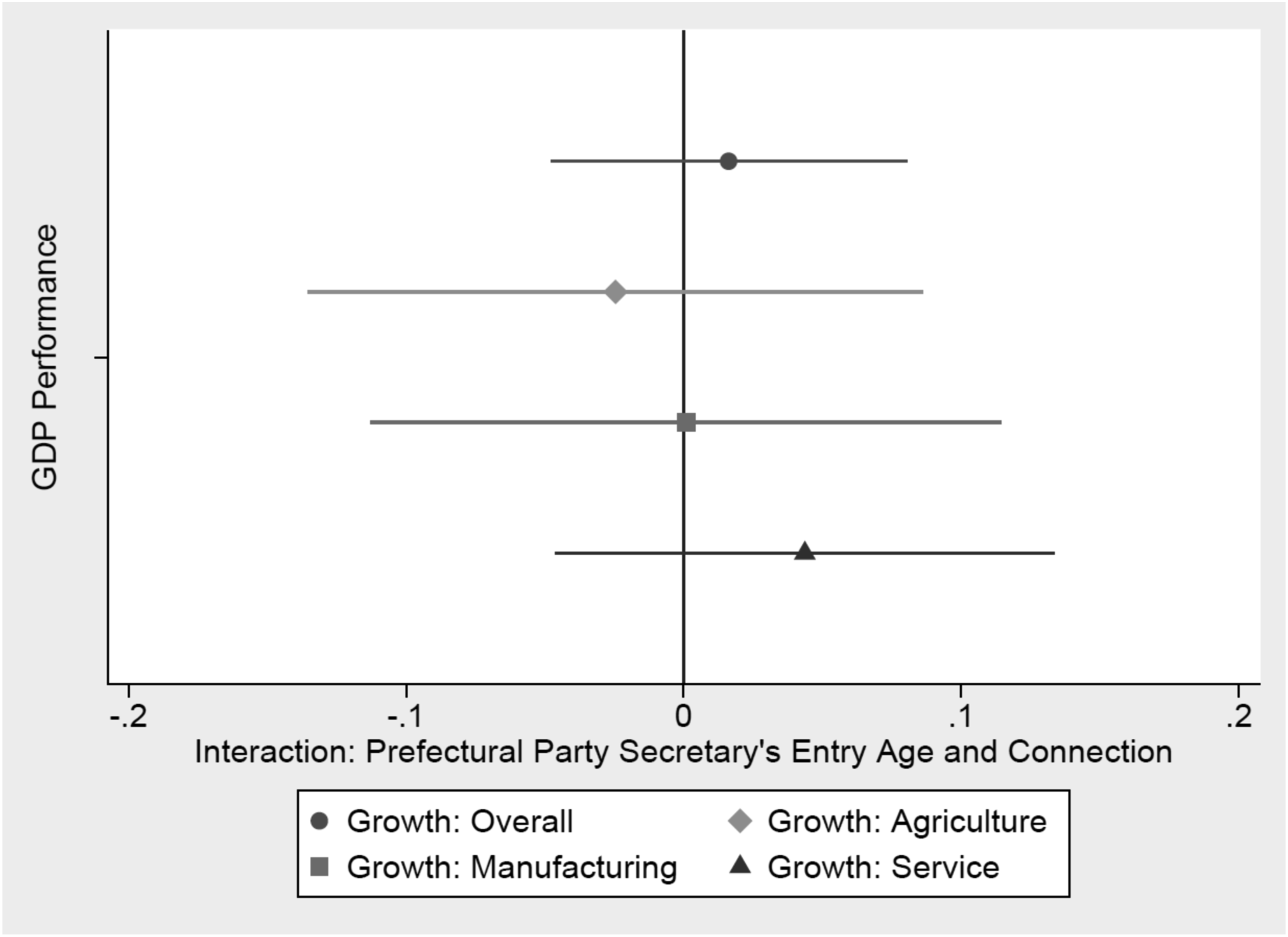
Conclusion
By documenting how the cadre rejuvenation policy affects economic development in China, our study offers a career incentive explanation to account for the remarkable economic development in China. While career incentives theory is by no means completely novel, early studies demonstrate the incentive effect primarily using a retrospective approach that examines the correlation between economic performance and ex post promotion rate (e.g. Li and Zhou, 2005; Jia et al., 2015 Lü and Landry 2014). To advance the understanding of career incentives, we follow a new stream of studies that focuses on the intuitional features of political selection in China (e.g. Guo, 2009; Li and Yu, 2022). We specifically highlight the importance of cadre rejuvenation policy and its implication for the age criterion in political selection. We show that the cadre rejuvenation policy effectively incentivizes younger officials to devote more effort to economic issues, leading to a significant boost in GDP growth. However, we acknowledge that formal institutions are not immune to the arbitrary changes made by top leaders in authoritarian countries. In recent years, we witnessed a policy shift against mobility in the CPC, as shown by the weakened role of age rules in CPC political selections. The latest CPC political selection guidelines state that the Party plans to utilize “cadres in different age ranges.” 9 These policy shifts may serve as an exogenous shock that future studies can utilize to examine the rise and decline in internal party mobility and its impact on economic growth.
Supplemental Material
Supplemental Material - Within-party mobility and economic performance in authoritarian regimes: Evidence from China
Supplemental Material for Within-party mobility and economic performance in authoritarian regimes: Evidence from China in Party Politics
Footnotes
Acknowledgements
We thank Junyan Jiang for sharing his Chinese Political Elite Database (CPED).We appreciate comments and suggestions from Scott Gehlbach, Robert Gulotty, and Melanie Manion.
Declaration of conflicting interests
The author(s) declared no potential conflicts of interest with respect to the research, authorship, and/or publication of this article.
Funding
The author(s) received no financial support for the research, authorship, and/or publication of this article.

Supplemental Material
Supplemental material for this article is available online.
Notes
7. We do not control for age in our specification because of the strong collinearity between the age of the party secretaries and the other controls.
8. We do not control the three-way fixed effects due to the insufficient sample size.
Author Biographies
References
Supplementary Material
Please find the following supplemental material available below.
For Open Access articles published under a Creative Commons License, all supplemental material carries the same license as the article it is associated with.
For non-Open Access articles published, all supplemental material carries a non-exclusive license, and permission requests for re-use of supplemental material or any part of supplemental material shall be sent directly to the copyright owner as specified in the copyright notice associated with the article.
