



Abstract
In recent years, there has been a considerable amount of work on the transformation of formerly rebel groups into political parties. However, there is little work that examines the organizational types of parties that formerly armed groups become. Are these parties more likely to exhibit certain organizational characteristics when compared to other parties? This is an important question especially as scholars consider the role these former rebel parties play in the development of peace and democracy in post-civil war politics. Using data from Daly (2020) and Tuncel and Manning (2022), as well as recently released data from V-Dem on political parties (Coppedge et al 2020) we find that former rebel parties are more clientelistic and personalistic than other parties, even compared to parties in countries where they compete. We suggest that these parties are unlikely to play a constructive role in post-conflict democratization.
Keywords
Born out of civil wars: are former rebel parties an organizationally distinct type of party?
At a recent conference held in June 2022 at the United Nations, which focused on the role played by former rebel parties in peace building after civil wars, there was considerable discussion over whether these parties constituted a distinctly different organizational type of political party and are uniquely equipped to help build peace after wars (Ishiyama 2022). 1 Although there has been an increasing amount of work on former rebel parties (Acosta, 2014; Ishiyama and Batta, 2011; Lyons, 2005; Manning, 2007; Matanock, 2017a, 2017b, Sindre, 2016a, 2016b; Lyons, 2016; Allison, 2006) these works have focused on the impact that this transformation has on party systems (Manning and Tuncel, 2022), or democracy and peace duration (Marshall and Ishiyama 2016). In particular, there has also been recent work that examines how the organizational features of former armed rebel groups developed during the course of the civil war impact the likelihood of the electoral success (or lack of) in post war politics (Manning and Smith 2019; Ishiyama and Widmeier 2020).
In this paper we build upon these previous efforts and combine the literature on political parties with the literature on conflict to address the question of whether there is something unique about the organizational features of parties that emerged out of groups that fought in civil wars (or former rebel parties) when compared to other parties. This is an important question especially as scholars consider the role these former rebel parties play in the development of peace and democracy in post-civil war politics. However, our intention in this article is NOT to explain the organizational differences when comparing the former rebel parties with each other (which has been the focus of previous works e.g. Ishiyama and Batta, 2011; Ishiyama and Widmeier, 2020; Manning and Smith, 2019), but to examine whether “rebel parties” represent an organizationally distinctive type of political party when compared to other parties (Parkinson and Sherry 2018; Matanock and Paul, 2018; de Zeeuw 2007).
Some scholars argue that, given the fact that rebel groups emerged from militant organizations, they should be very different organizationally when compared to other parties both generally and compared with other parties in the countries in which they compete. Indeed, some scholars, such as Zaks (2017) and Ishiyama and Widmeier (2020) suggest that wartime organizational structures helped contribute to their resilience as political parties. This suggests that there is something different about rebel parties, perhaps due to their legacies as militant organizations. This was certainly noted by earlier work by de Zeuww (2007) who argued that a key challenge facing a rebel group’s transformation into a political party is the necessary transformation of internal power configurations and the accompanying organizational restructuring. This is because the organizational demands for the pursuit of military operations are very different than the organizational demands required for electoral campaigns. He contended that rebel movements are generally hierarchically organized with a clear top-down chain of command that is most effective for military operations. In political parties, De Zeuww argues, by contrast, executive power is normally less concentrated and much more democratically diffused throughout the organization, though there are any variations. This stood in direct contrast to what he believed was the nature of decision-making within political parties, which is generally more participatory, bottom-up, and consensual, reflecting the character of popularly representative institutions (Bardi et al. 2017, de Zeeuw, 2007,14).
However, the proposition that former rebel parties are organizationally unique because of their origins as militant groups has never been empirically tested. Some of the earlier literature (Ishiyama and Batta, 2011) used principles from party organizational theory--especially the idea that the organizational features of the formerly rebel parties involve establishing a balance between “office seekers” and those motivated by ideational incentives—to explain the organizational development of parties like the Communist Party of Nepal-Maoist. There is also some more recent work that has sought to bridge the gap between the literature on parties and the conflict literature (Parkinson and Sherry 2018). Yet there is little in the way of a broad comparative empirical analysis that examines whether rebel parties are organizationally distinct from other parties, as has been claimed. Are these groups more likely to exhibit certain organizational characteristics when compared to other parties? After all, given that their origins were as armed rebel groups, one might expect them to develop in very different ways when compared with other parties. More importantly, beyond the academic questions, the kinds of parties formerly armed groups in a civil war become after the civil war ends is critical to the building of stability and democracy in post war politics. As scholars studying post-communist politics have argued (Van Biezen 2003; Gryzmala Busse 2002; Ishiyama 1995, 1997; Kopecky 1995; Ishiyama, 1995) the organizational types of parties that emerged after the collapse of communism had important effects on drawing post-communist constituencies into the political process, and ultimately to the acceptance of democracy by their followers.
Scholars studying formerly rebel parties argue this as well. Several have noted that the transformation of rebel groups into political parties provides channels for both interest articulation and political process engagement for former rebels. By doing so, this contributes to a sustainable peace, stability, and democracy (de Zeeuw, 2007; Ishiyama and Batta, 2011; Manning, 2007). Indeed, the organizational types of parties that emerge from former rebel groups affect how they organize voters, articulate interests, recruit new candidates, and integrate their followers into the democratic process – in other words, the crucial functions performed by political parties in deepening and expanding democracy.
Although it is tempting to try to identify the most important organizational feature of parties that affects their impact on the development of post war peace and democracy, that is not the question we address in this article. This is because we are less interested in the impact organizational characteristics of these parties on outcomes, such as peace, stability, and democracy, but rather a simpler, and more basic, “architectural” question. Are rebel parties organizationally different when compared to other political parties? Do they represent a different organizational “species” of party (Gunther and Diamond 2003). Thus, we address the basic issue of whether formerly armed groups are more likely to exhibit certain organizational characteristics as they become political parties, and how these organizational characteristics compare with other parties both globally and in the countries in which they compete.
Organizational types of parties
To begin, it is important to clarify what we mean by a “political party.” For our purposes, we use a variation of the classic definition of a political party offered by Giovanni Sartori that a party is a group that participates in elections in an organized fashion – it is an identifiable political group with an official labels that puts forward candidates for election (see Ishiyama and Marshall 2015; Sindre 2014). Thus, in this paper we are only interested in formerly armed groups that transformed into political parties.
As far as organizational features of parties are concerned, a very useful beginning point is the important work of Gunther and Diamond (2003). They point to three key organizational features of political parties that help identify different “species” of political parties. These include (1) how parties are linked to their constituencies, (2) whether they are organizationally thick or thin, and (3) the internal locus of power within a party (i.e. is power concentrated in the leadership of the party, or is it diffused within the organization)
Regarding the first dimension, or “linkage”, Herbert Kitschelt (2000) identifies three basic types of parties in terms of how they link with constituencies-clientelistic, programmatic, and charismatic. The types of parties are distinguished by how they link with their constituencies. It is through these linkages that parties become the most important institutions in the building of democracy (Lijphart 2000).
Kitschelt views all parties as facing two challenges, both of which are important in bringing constituencies into democratic practice. These are the dimensions of “collective action” and “collective choice” (Kitschelt 2000). Collective action is generally seen as how parties mobilize support while collective choice is seen as a deeper ideological connection to a constituent. The dimension of collective action involves the need for, parties need resources to mobilize supporters. In particular, they must provide a reason for individuals to turn out to vote. Parties can get people to vote by funneling public goods provisions in a certain direction. In this sense, collective action parties serve as redistribution heuristics to voters who assume that a vote for the party that represents their group will provide them preferential access to public goods (Chandra 2004).
Second, collective choice involves the reason associating the creation of an identity in the minds of voters that acts as a cue as to what to expect from that party. One way to address the challenge of collective choice is the deepening of the party label to the point of an ideological heuristic. If a party has developed an ideology coherent and deep enough to provide the voter with a greater indication of the candidates’ probable effects on future interactions within the political system, then the party provides an ideological cue and voter support is based on identification with that ideology. If this is not developed, then voter allegiance to a party is based largely on the expectation of redistribution and resources reward. According Kitschelt, labels based solely on redistribution provide less information to the voter. Redistribution gives information to the voters concerning a candidates’ informal relationships while ideologies provide information concerning a candidates’ policy position. Sometimes the two may be one and the same, such as a candidate whose ideological position favors certain types of redistribution, but an ideological heuristic will be accompanied by a much broader and more clearly identified position that gives more information to voters (Elischer 2013).
The three types of parties that Kitschelt identifies are distinguished by how they facilitate collective action and collective choice (Kitschelt 2000). For Kitschelt charismatic parties fail to solve collective action issues. This is because charismatic parties are bound together by the charisma of an individual, which is the opposite of a collective. In effect, this is an unsustainable method of resource pooling: once the individual is removed the linkage dissipates. Because collective choice cannot be solved without a stable constituency, this too is left unsolved. Kitschelt (2000, 855) writes “charismatic leaders focus the allegiance of their rank and file on their personal qualities by not permitting the emergence of party machines with routines or with fixed programs that could bind their hands and divert the attention of their supporters to more mundane and predictable bases of political mobilization.”
Clientelistic parties solve collective action but fail to provide a platform salient enough to solve the problem of collective choice. That is, they may provide a reason to mobilize voters, but they do not provide deeper ideological connections to voters, to establish more enduring linkages with their supporters. The nature of clientelism is an exchange of electoral support from voters for a particular service or good provided by elites which precludes indirect ideological connections. These parties organize and mobilize constituencies as a machine but only provide information indicating an informal and targeted redistribution of goods or services. The party label provided in this situation only indicates a candidates’ willingness to provide n public goods to specific communities.
Programmatic parties operate on both dimensions by mobilizing constituencies and providing enough of an ideological platform for voters to understand the implications of their vote beyond the immediate provision of public goods. A key feature of such parties is programmatic coherence—in other words, the program is what keeps the party united, and helps develop a deeper connection to the voter. The selectivity of exchanges is the key differentiator: “programmatic focal points that permit solutions to social choice problems in existing democracies are typically grounded in universalistic principles that militate against particularistic, informal practices of resource allocation” (Kitschelt 2000, 854). In short, for Kitschelt, clientelistic parties thrive in the directed exchange of private and club goods, and programmatic parties build connections to voters through coherent policy platforms.
There are of course other features that distinguish different political parties. One feature of political parties is what Gunther and Diamond (2003) call “party organizational thickness”. An organizationally “thick” party is one in which there is a distinct internal party bureaucracy, and a permanent staff, with local offices (i.e the dominance of the party as organization). Like the “Mass” parties described by Duverger, such parties have standing party bureaucracies that ensure that that party office holders toe the ideological line. These types of highly organized and bureaucratized parties tend to entrench old guard leaderships and inhibit the entry and rise of reformists and those that are more open and loosely structured (which facilitates ambitions of office seeking politician (Kitschelt, 1994: 17–21; Roberts, 1998: 47). In many ways this type of organizational thickness is characteristics of programmatic/mass parties. Mass parties create organizational linkages with voters, which help mobilize voters on ideological lines.
Still another feature of political parties is the extent to which “power is distributed amongst the different levels of leadership” (Duverger, 1954:52). Although Duverger (and others such as Kitschelt, 1994a) refer to the distribution of power within the party as “internal democracy”. Janda (1980: 180) refers to this feature as “centralization” and notes that centralization of power refers to “the location and distribution of effective decision-making authority within the party which are the national party organs, particularly the leadership” (Janda, 1980:108). An extremely important aspect of centralization is who has the power to select the representatives of the party or its parliamentary candidates (Lane and Ersson, 1991). This directly relates to the strategic autonomy of party leaders who hold public office, particularly the chief executive (Kitschelt, 1994: 212–213; Koelble, 1992: 58; Strom, 1990: 577). Parties whose leaders and elected officials can make decisions without extensive consultation with—or threats of a veto from—lower-level authorities, activists, or affiliated unions can be expected to be more flexible than those whose leaders are accountable to such groups. Such flexibility depends on the degree to which office holding leaders are subject to institutional mechanisms that make them answerable to party authorities as well as whether these intraparty actors have independent sources of power vis-á-vis office holding leaders (e.g. regarding legislative votes or candidate nomination procedures).
Are the organizational features of former rebel parties distinct?
Based upon the above, particularly the work of Gunther and Diamond (2003) and Kitschelt (2000), organizational types of parties are distinguished (1) by how parties are linked to their constituencies, (2) whether they are organizationally thick or thin, and (3) the internal locus of power within a party, particularly control over candidate selection. What types of parties are likely to emerge from formerly armed groups after civil wars? As Allison (2010: 106) notes, in many ways these groups confront a situation similar to those facing a new political party – they need to devise a political platform, raise funds to campaign, create a full time organization and devise procedures to select leaders and candidates. However, political parties with roots as militarized groups are not “new” organizations. Some have long histories dating back several decades to political parties, unions, student organizations, and peasant groups in the pre-civil war period. Further, each rebel group has its own internal organizational legacy – some were merely loose coalitions of disparate groups, held together by a common enmity vis a vis the government, whereas others were tightly knit organizations, complete with their own “bush bureaucracies”. Most of all, however, they have to confront the demand of redesigning organizational structures that were conducive to conducting an irregular war but not to compete and win elections.
Ishiyama and Batta (2011) Ishiyama and Widmeier (2020) and Manning and Smith (2019) suggest that the organizational features of former rebel parties are a function of how rebel groups were organized before particularly in terms of the legacies of wartime rebel governance (Huang 2016; Mampilly 2011). Scholar have noted that, as with other political organizations, like political parties. This literature suggests variations should emerge in organizational features of “rebel parties” given the variety of wartime governance structures that militant rebel groups developed. However, this might suggest variations when comparing among former rebel parties, but are such parties organizationally distinctive when compared with other “species” of parties?
This is suggested by some of the literature that has studied party organizational transformation of former rebel parties (Ishiyama and Batta, 2011). This literature is based on the distinction made (in the parties’ literature) between the different motivations people have to join in the activities of the political party (Panebianco, 1988; Schlesinger, 1984). Joseph Schlesinger, for instance, argues there are two fundamentally different kinds of participants in a party’s activities – those who are motivated to join and participate in the activities of a party in pursuit of ideational benefits (benefit seekers) and those who seek administrative or career benefits (office seekers).
Further, parties provide organizational resources to participants, which include two different kinds of capital – ideational and administrative (Hale, 2007). Ideational capital is the identity and values that attract voters to particular party symbols, such as sympathy for the party’s platform and proposed policies or psychological benefits. Administrative capital includes the offices and power that can be doled out to ambitious politicians.
In some ways, all parties must transform from relying on ideational capital to administrative capital in order to motivate followers. As Panebianco (1988) notes, parties develop over time they move from “systems of solidarity” to a “system of interest.” A system of solidarity is based on the concept of a “community” of equals in which the participants’ ideological ends coincide (and where ideational capital dominates). A system of interest, on the other hand, is where the party becomes a collection of individuals with different ambitions, goals and aspirations, and the party becomes an organizational means to manage these differences. The idea that “new” parties are motivated primarily by clientelistic ties between leaders and led, rather than programmatic ties has been identified in work by Petr Kopecky (1995) and Ingrid Van Biezen (2003) when examining the new parties that emerged after the collapse of communism in Eastern Europe.
Much of the literature on former rebel parties emphasizes the importance of the provision of selective incentives to bind individuals to the cause during the civil war (Weinstein, 2007). To be sure the provision of material incentives is not the only way to link leaders with followers—but it made for stronger rebel groups. For instance, Lichbach (1994) identifies four broad solutions to the collective action problem for rebel organizations, including Market, Contract, Community, and Hierarchy. The first three are related to the idea that organizations produce “capital” to provide incentives for individuals to follow the organization. Market solutions include the provision of material benefits (or lowering the costs of following). Groups that are endowed with access to material resources are more likely to promote organizational coherence via material selective incentives (and keeping to the agreement made by the organization) than are less well materially endowed groups. Collier and Hoeffler (2004) have argued that access to lootable resources (such as gemstones or drugs) can provide a rebel organization with income flows that help finance the selective incentives needed to recruit rebel soldiers (Weinstein, 2007).
The above suggests that former armed groups are likely to be distinct from other political parties for a few reasons. First, because they are often relatively “new” parties when compared to more established political parties, they should be more similar to what Panebianco calls a “system of interest” in which individuals are connected to the party in way similar to what Kitschelt identified as a “clientelistic” party organization. Second, since at least to some extent, armed groups during civil wars often rely on selective incentives to overcome the collective action problem, this would suggest that former armed groups in civil wars should be more likely exhibit clientelistic features rather than programmatic features. Although certainly not all rebel groups are “new” the fact that they have to build the “stuff” of party organization (headquarter and infrastructure) and fundamentally transform themselves into electoral organizations, would, according to the literature, incline them toward clientelism.
This suggests the following hypothesis:
Former rebel groups that transform into political parties will be much more clientelistic than either programmatic or charismatic party types. Regarding organizational thickness, although there are considerable variations in the extent to which rebel groups had developed governance structures (Ishiyama and Widmeier 2020; Huang 2016; Mampilly 2011) and clearly some were more organizationally thick than other rebel groups, overall, former rebel parties are much less likely to develop organizational thickness when compared to parties that were not former rebel groups. In part this is because rebel groups generally do not have access to the basic resources both material and human or the basic “stuff” on which political party organizations are built. This is because, for the most part, they are at a material disadvantage by locating rebellions in rural or remote areas, far from population centers. Second since much of the resources rebel groups possess are devoted to the war effort and not organization building, the parties that emerge from these groups are more likely to be organizationally thin than organizationally thick. This suggests the following hypothesis.
Former rebel groups that transform into political parties will be much less organizationally thick than other political parties. Finally, with regard to the internal dimension or the degree of internal party democracy, some suggest that former militant rebel groups are likely not to develop, at least initially, into internally democratic organizations. For instance, as de Zeeuw, 2007 notes, a key challenge facing a rebel group’s transformation into a political party is the necessary transformation of internal power configurations and the accompanying organizational restructuring. The organizational demands are very different when the purpose is military operations as compared to campaigning for elections. Indeed, rebel movements are generally hierarchically organized with a clear top-down chain of command that has proven to be most effective for military operations. In political parties, by contrast, executive power is normally less concentrated and much more democratically diffused throughout the organization, though there are any variations. Moreover, the nature of decision-making within political parties is generally more participatory, bottom-up, and consensual, reflecting the character of popularly representative institutions (de Zeeuw, 2007:14). Others argue that rebel groups are organized hierarchically as de Zeeuw, 2007 argues (Parkinson and Sherry, 2018; Staniland 2014). However, some empirical work suggests that some militant rebel organizations are not internally hierarchically organized as de Zeuww suggests. Indeed, in at least some cases, especially in civil wars where the top leadership was in exile (as with the case with Tajikistan and Nepal—Ishiyama and Widmeier, 2013) local ground units operated almost independently from the top leadership. This leads to a decentralized organization, where power is actually devolved This suggests the following two contending hypotheses.
Former rebel groups that transform into political parties will be much more hierarchically organized with control over candidate selection controlled by central party authorities than other political parties.
Former rebel groups that transform into political parties will much less hierarchically organized with control over candidate selection controlled by central party authorities than other political parties.
Data and methodology
To preliminarily test the above hypotheses, we use a cross national dataset developed by the Varieties of Democracy’s (V-Dem) Varieties of Party Identity and Organization (V-Party). The data base investigates major organizational characteristics of parties for the time period 1970–2019 and offers expert–coded assessments of party organization and identity. Using V–Dem methodology (Coppedge, et al., 2020), in January 2020, 665 experts rated the policy positions and organizational capacity of political parties across elections in a given country. The data base includes 1955 political parties across 1560 elections in 169 countries. 2 Because individual responses were aggregated to create party level measures for each of the parties, the data observations per party were continuous measures.
From this dataset we derived our measures of the dependent variables (which are the organizational characteristics of political parties). To measure clientelism the variable “clientelism” (v2paclient) is used, which is defined as the extent to which the party and its candidates provide targeted and excludable (clientelistic) goods and benefits - such as consumer goods, cash or preferential access to government services - in an effort to keep and gain votes. The measure is an average score of all coders on a scale ranging from 0 to 4, with 4 the low score on clientelism and 4 the highest level of clientelism.
To measure whether a party is more or less programmatic we use the variable “internal cohesion” (v2padisa), which measures the extent to which there is internal cohesion around policy or programmatic goals (which is consistent with Kitchelt’s definition of a programmatic party). This variable measure assesses the extent to which party leaders are unified over party policy goals. This ranges again from 0 where there is complete disunity among the party elites about policy and strategies, and 4 almost complete unity. This measure is admittedly an imperfect measure of a “programmatic” party but the idea that party elites are unity over principles suggests more of a “program” party than not. Further we take a similar measure for a “charismatic party” by examining the extent to which a party is “personalization of party” (v2paind) which is based on the question of “to what extent is this party a vehicle for the personal will and priorities of one individual leader?” Again, the coding is 0 where there the party does not reflect the personal will of the leader to 4 where the party is really an organizational expression of the ambitions of the leader.
To measure organizational “thickness” we use data from VdemP that measures “local organizational strength” (v2paactcom), where the party has developed a widespread and permanent presence of party activists and personnel in localities. This is used as a proxy measure of “organizational thickness” for the dependent variable in hypothesis 2 above. 3
For our third dependent variable “party centralization” we use the VdemP measure Candidate nomination (v2panom), which measures the extent to which candidates that run on behalf of the party are chosen by the party leader(s) or the membership as whole. As we noted above, control over candidate recruitment is a key indicator of the centralization of power (see also Ishiyama and Batta, 2011). The measure again ranges from “0” (or where the party leader unilaterally decides on which candidates will run for the party in national legislative elections) to 4 (where all party voters select candidates who run for national legislative elections). We use this as a proxy measure for party centralization.
To determine the measure of our primary “explanatory” variable, whether a party was formerly a participant in a civil war, we used Sara Zukerman Daly’s (2020). The “Civil War Successor Party data set” that identifies parties that emerged from civil war combatants. The dataset identifies 129 parties across 43 countries. A second data set we employ is from a recent project by Tuncel and Manning (2022) identifies rebel successor parties that have survived for at least five election cycles (meaning they put up candidates for national each election). They identified 16 parties from 14 countries where the successor parties competed in five elections over 20 years. For both the Zukerman Daly measure and the Manning and Tunsel measure we coded these parties as a dummy variable with “1” indicating a former civil war combatant successor party, and “0” otherwise.
In addition to this primary explanatory variable, we also include a number of organizational level controls derived from the V-demP dataset. First, we include the extent to which the party was an “identity” party, either as an “ethnic” or “religious party”. As several scholars have noted (Gunther and Diamond 2003; Horowitz 1985) identity parties are organizationally different from other parties. Previous literature has found that ethnic parties are more likely to be clientelistic than other parties, either because of a collective action strategy (Gunther and Diamond 2003) or because of sociological and identity-based explanations (Horowitz 1985) to explain ethnic party preference for redistributive forms of constituency linkage. To measure this variable we use the V-demP measure of “dependence on ethnic group support” (v2pagroup.5), which assesses the extent to which a part is dependent on a single ethnic group for its political support, with the coders responding yes or no. The resulting score ranges from 0–1 (with 1 indicating almost complete dependence on a single ethnic group) and is the mean score for all coders. For a religious party we use the variable “v2parelig”, which is based on the extent to which the party invokes God, religion, or sacred/religious texts to justify its positions. In this case the low score “0” indicates a highly religious party and the score “4” indicates a non-religious party.
Another organizational level control variable we employ is the placement of the party on a left-right ideological continuum (v2pariglef), which ranges from 0 (far left) to 6 (far right). As some classic literature on political parties note (Duverger 1954; Panebianco 1988) parties on the left, because of their link to labor unions, tend to be more programmatic and “mass-like” than parties on the political right. Further, left parties, because of this legacy, tend to be more ideologically drive and programmatic than their more right-wing counterparts.
Finally, we include the size party support (measure in terms of the number of voters who support the party). This was a classic indicator developed by Duverger (1954) who argued that the size of the party could be used as a measure of organizational density (or the number of party activists as a proportion of party supporters). The greater this proportion, according to Duverger, the more likely the party would be organizationally “thick” and would also likely be more mass like and programmatic. 4 Thus, the size of the party in terms of voters should affect party organizational characteristics. The larger the party the less likely the party will be programmatic and organizationally thick. To measure this, we use the variable “v2pavote” which is the Vote share in percentage terms the party gained in the election to the lower chamber (derived from Döring and Düpont, 2020).
The analytical technique we use for this paper is a Seemingly Unrelated Regression Estimation (SURE) technique with robust standard errors clustered by country. Since the dependent variables are continuous variables, we use an ordinary least squares regression technique to estimate the effects of our independent variables on the number of both purges, and positive increases in the number cabinet portfolios. However, the dependent variables are NOT mutually exclusive choices (i.e. they represent organizational characteristics of all parties and that all parties have some of these characteristics). Further we are interested not only if our independent variables are related to the dependent variables, but also in comparing across coefficients to determine whether the regression coefficients differ significantly from each other. In other words, we have two different dependent variables but the same independent variables in each model. The most appropriate estimation technique given these requirements is the seemingly unrelated estimation of an ordinary least squares analysis. Using the SURE approach thus allows us to determine not only if being a civil war successor party predicts party organizational characteristics, but which variable is a better predictor of each party organizational characteristic.
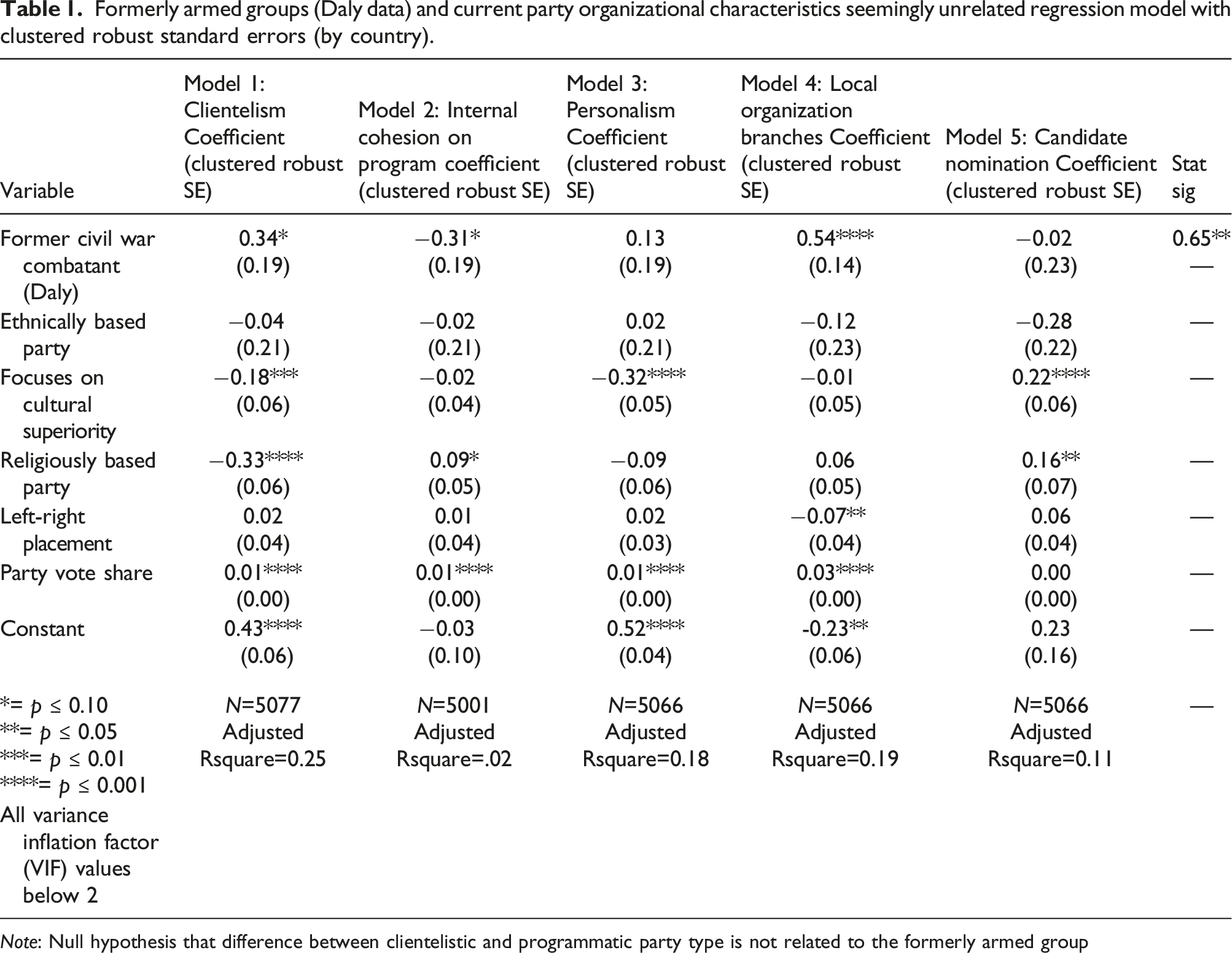
Formerly armed groups (Daly data) and current party organizational characteristics seemingly unrelated regression model with clustered robust standard errors (by country).
Note: Null hypothesis that difference between clientelistic and programmatic party type is not related to the formerly armed group
Formerly armed groups (Manning data) and current party organizational characteristics seemingly unrelated regression model with clustered robust standard errors (by country).

Note: Null hypothesis that difference between clientelistic and programmatic party type is not related to the formerly armed group
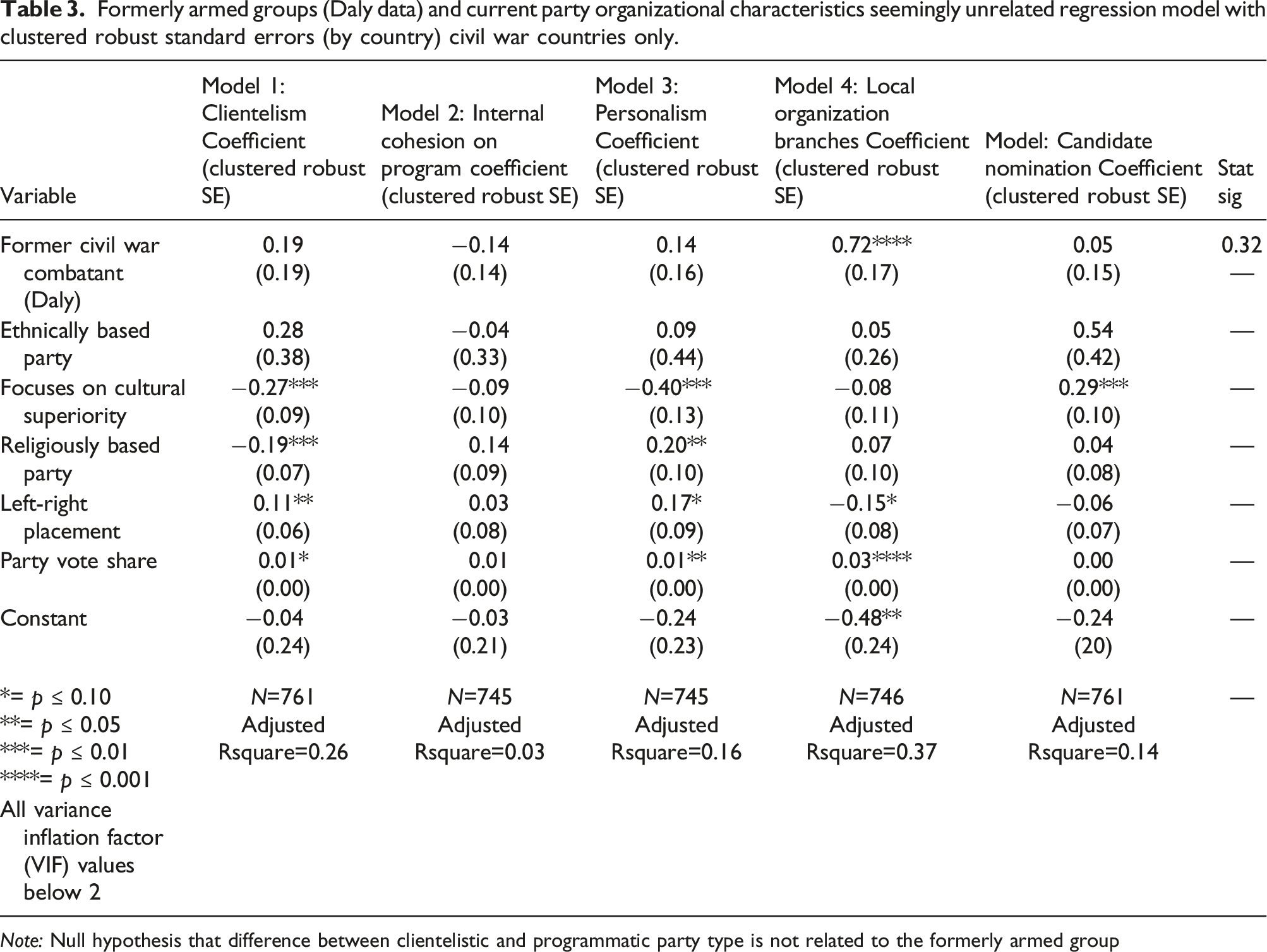
Formerly armed groups (Daly data) and current party organizational characteristics seemingly unrelated regression model with clustered robust standard errors (by country) civil war countries only.
Note: Null hypothesis that difference between clientelistic and programmatic party type is not related to the formerly armed group
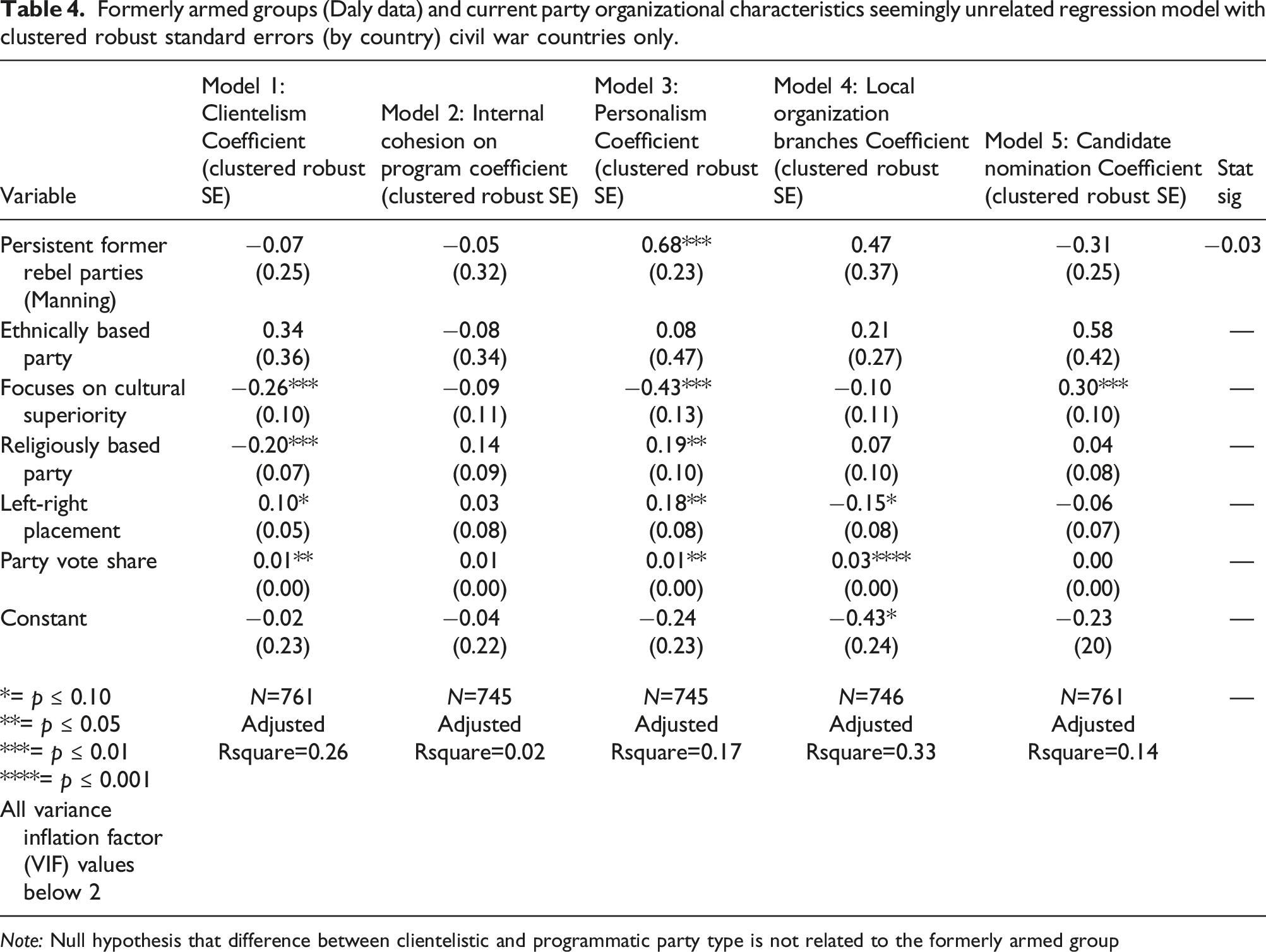
Formerly armed groups (Daly data) and current party organizational characteristics seemingly unrelated regression model with clustered robust standard errors (by country) civil war countries only.
Note: Null hypothesis that difference between clientelistic and programmatic party type is not related to the formerly armed group
The results reported in Table 1, which compares the successor parties with all parties in the data set, support hypothesis 1. Model 1 reports that successor parties as identified by Daly are significantly more likely to exhibit clientelistic characteristics and significantly less programmatic (as measured in terms of policy and programmatic cohesiveness). However, the results indicate that successor parties are no more or less than other parties (globally) to be more personalistic (or charismatic). Further when comparing whether successor parties better explains clientelism OR lack of programmatic characteristics, the final column (which compares the relative effect of successor parties clientelism and programmatic party)suggests that this factor explains lack of internal cohesion MORE than it explains support of the existence of clientelism. This makes sense in as much as some for the previous literature (see Ishiyama and Marshall, 2015) suggested that former rebel parties are often faced with major internal cleavages over the party’s identity after civil wars, pitting pragmatists against hardliners.
The results from Table 1 also rejects hypothesis 2, in as much as rather than being significantly less likely to be organizationally thick, successor parties are much more likely to have well developed local organizations. This finding, although contrary to hypothesis 2, is not entirely surprising. Many civil war combatants developed dense networks of connections between local organizational connections during civil wars to sustain their war time efforts. Indeed, many established “bush bureaucracies” in areas they controlled, so it is not surprising that this would carry over into the post-civil war period, when compared with all parties (Ishiyama and Widmeier 2020; Huang, 2016).
Finally counter to hypothesis 3 (both versions) according to the results in model 5, civil war successor parties are neither more nor less likely to exhibit characteristics of internal democratization (at least in terms of selection of candidates)
Table 2 replicates the analysis in Table 1, but rather than including all successor parties, we only include those parties that have survived and persisted over time. Indeed, examining these parties provide insights as to whether the remain organizationally different from other parties, if they have persisted. As indicated in Table 2 models 1 and 2, when comparing the persistent successor parties with other parties, the results do not support hypothesis 1 (although the signs are in the predicted direction). Thus, persistent successor parties are not any more or less clientelistic, nor more or less programmatic than other parties in the world. However, what is interesting is that these parties are significantly more personalistic than other parties in the world. This may suggest that one of the “survival” strategies of a persistent successor party is to be affiliated with a “great leader” and that a key to their persistence is being associated with a personality (which makes some sense in as much identification with a personality makes the party more recognizable by voters).
However contrary to all successor parties, persistent successor parties are not more or less organizationally dense than other parties. This might suggest that as successor parties persist, they lose their local organizational capacities and become identified with a national personality. Finally, persistent successor parties are not more or less internally democratic than other parties in the world, again contrary to hypothesis 3.
Table 3 and 4 report the results of comparing successor parties with only those other parties in the countries in which they competed. Thus, we compare successor parties with other parties within countries, not with all other parties. In Table 3 we compare the Daly coded parties with other parties in the civil war countries. Further, by clustering the robust standard errors by country we can interpret how these former rebel parties compare with other parties in their national post war party systems.
Although the signs are the same for clientelism and internal cohesion, the coefficients are not statistically significant, so we have to reject hypothesis 1. Further, successor parties as coded by Daly are neither more nor less likely to personalistic. However as indicated in Table 1 about, the successor parties are significantly more likely to be organizational dense (with well-developed organizations) when compared with other parties in the civil war countries (contrary to hypothesis 2). However consistent with the previous results, successor parties are not more or less internally democratic (contrary to hypothesis 3).
Finally, in Table 4 we compare the persistent parties with other parties in the post-civil war countries. In other words, we compare the persistent parties with other parties in the national party systems (as we did in Table 3). The findings are consistent with Table 2 above in that persistent successor parties are more likely to be personalistic parties and become less organizational dense when compared to all parties and when compared to other parties in post-civil war countries.
Personalization of party scores over time.
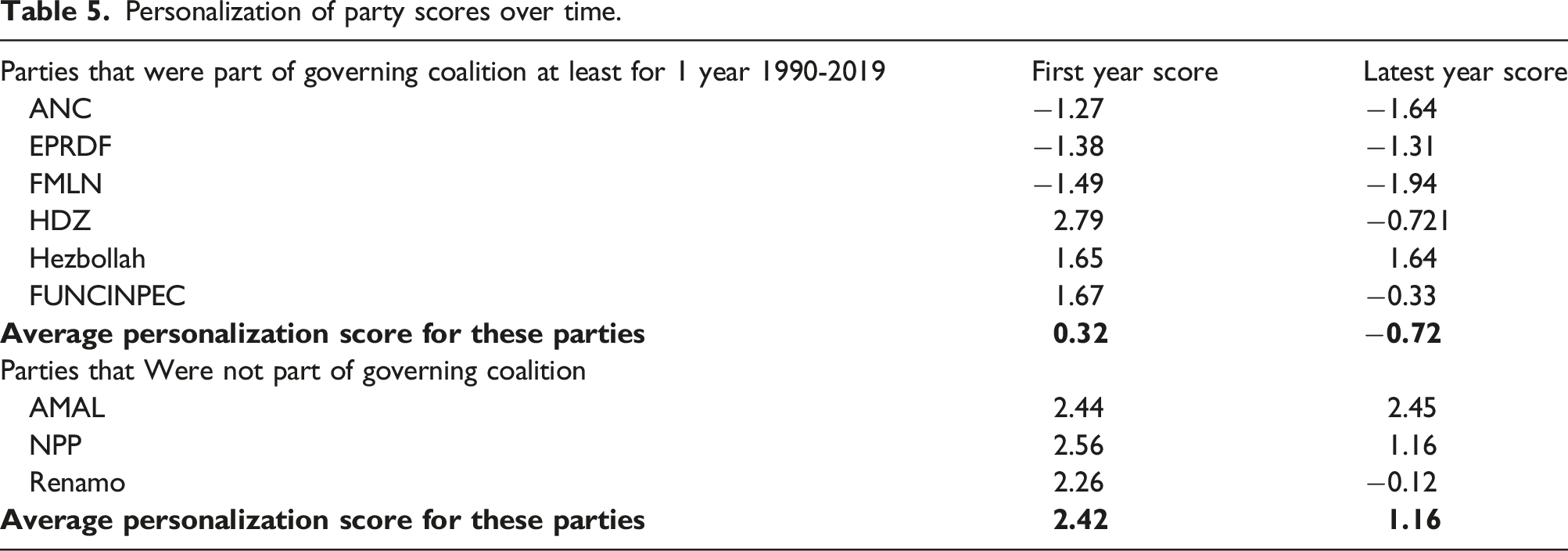
These results might suggest that rebel party persistence can be attained in two distinct ways. First rebel parties that are able to gain access to governing resources are more likely to persist. Hence parties that entered the governing coalition persist but are also much less personalistic than non-governing rebel parties. However, rebel parties that maintain loyalty to a charismatic leader, can also persist.
A case in point is Renamo in Mozambique. Renamo (the acronym for
Renamo was always a highly factionalized and fragmented organization, but its components were united during the civil war in opposition to Frelimo. This unity was also bolstered by Dhlakama creation of parallel political administration that oversaw the activities of both the military wing and ostensible political wings of Renamo, but who reported directly to Dhlakama, During the civil war this duplication of structures, with local personnel being supervised by handpicked representatives close to Dhlakama, pervaded Renamo (Manning 1998).
This personalization of the rebel party that Renamo became after the peace agreement was signed in 1992 continued for many years. In many ways the network of personal connections that Dhlakama created during the civil war that kept the organization together helped Renamo survive into the 21st century (Carbone 2005). As Cahen (1998:25) noted, the undisputed leadership that Dhlakama established during Renamo’s “bush” days played an important role in the post-civil war development of the party: “the history of a group completely centralized around its leader... hyper-concentration of power ... [that] could not avoid during Renamo’s process of civilianization.” Although Dhlakama was not only ‘a man alone’ (but one who wished to be so, and even under pluralist politics), he retained his unchallenged personalist control over the party by systematically undermining development of an effective party organization (Carbone 2005: 431). In many ways personal loyalty to Dhlakama, and his network of political connections that he created, substituted for both a coherent party ideology (which provides ideational incentives for members) and thick party organization (which could dole out regularized selective incentives) as the “glue” that held Renamo together. This type of “glue” also works to hold organizations together, especially those that lack resources and mass political appeal, and other “stuff” upon which parties are built. This pattern of personalism is repeated to a greater or lesser extent among other former rebel parties (such as the NPP in Liberia, or AMAL in Lebanon) where personal connections with the leader has helped promote the persistence of the former rebel party. Thus, if there is a characteristics of former rebel parties that differentiates them from other parties, even parties in the countries where they compete, is that they are significantly more likely to be personalistic and clientelistic than other parties.
Nonetheless, the demise or imprisonment of such a leader leads to less personalization of the party (which explains the patterns illustrated by Renamo, with the death of its leader Afonso Dhlakama in 2018, and the imprisonment of Charles Taylor, former leader of the NPP). 5 Whether the personalist rebel parties can survive as parties (or choose to enter the bush again to restart a civil conflict) remains to be seen. In many ways these parties are far more likely to be disruptive than parties that have entered the governing coalition.
Finally, although the purpose of this paper is not to examine the relationship between the control variables and organizational characteristics of civil war successor parties when compared to other parties, some observations from the above regression results bear mentioning here. For instance, ethnic parties really do not exhibit organizational characteristics that are different from other parties (which is contrast to some of the existing literature that suggests that ethnic parties are very different from other parties). Further parties that are religiously based tend to be less clientelistic, more programmatically cohesive, but less organizationally thick and more politically centralized than other parties in the world. However, in post-civil war countries, these parties are less clientelistic, but less programmatically cohesive and more personalistic. Finally, in terms of left-right placement, right wing parties are more clientelist, more personalistic and less organizationally dense that all parties, both globally and in post-civil war countries. At this point examining the implications of these findings are beyond the current scope of this paper.
Conclusion
The above paper addresses the question of whether former rebel parties represent an organizationally unique type of party. Indeed, given their militancy, some have suggested this makes parties that emerged from rebel groups who fought in civil wars distinctive from other parties. By using existing work on party organizational theory, this paper represents framework to ascertain whether former rebel parties represent a distinctive “species” of political party (using Gunther and Diamond’s terminology). Are formerly rebel parties unique when compared to other parties? As such does that uniqueness impact their role in the operation of democracy? Are they more likely to become parties that help promote political participation and help develop democracy after civil wars?
In general, we find, contrary to much of the literature, that former rebel parties are not any more likely to be different in terms of organization and internal centralization than other parties globally, and more importantly when compared to parties in the national party systems. So in many ways they do not represent a different organizational species of party. However, there is one organizational dimension that does distinguish former rebel parties. Unfortunately, we find that former rebel parties are more likely to become clientelistic and personalistic, which suggests that the political participation of such parties may not necessarily be good for the development of functioning democracy. The former promotes corruption. Personalism creates parties that may not survive the death of the leader or are more interested in capturing power for personal benefit, neither which are conducive to the development of a consolidated democracy. Although this does not mean these parties cannot change, in many ways parties are “captured” by their pasts. As Gunther and Diamond (2003: 175) point out a party’s organizational characteristics are often a product of its past, and “this ‘founding context’ can leave a lasting imprint on the basic nature of the party’s organization for decades to come.”
As to directions for future research, clearly organizational characteristics of parties are not static. Do former rebel parties evolve organizationally in the same way as other parties (a la Panebianco)? Are there any “rebel features” that may endure over time or might these parties slowly evolve toward more “conventional” party structures? Further what do these organizational changes imply for the development to stability and democracy? Although recent work on organizational development explores the likelihood of splits and the emergence of spoilers (Ishiyama 2022) there is still much more to be investigated as to effects of the organizational development of former rebel parties in post war politics.
Footnotes
Declaration of conflicting interests
The author(s) declared no potential conflicts of interest with respect to the research, authorship, and/or publication of this article.
Funding
The author(s) received no financial support for the research, authorship, and/or publication of this article.
