



Abstract
Intra-party factionalism and media fragmentation have emerged as two major trends in U.S. politics, especially on the right. We explore potential connections between these developments by analyzing the engagement of Republican members of the US House of Representatives with far-right alternative news media during the 116th Congress. We develop three discrete measures to scale representatives’ engagement using hyperlinks to news media on Twitter, demonstrating their validity against existing positional data: roll-call voting, ideological caucus membership, and political rhetoric. We then apply our scales empirically, showing that representatives with further-right media engagement became increasingly radical in their online communication during the Trump presidency. Representatives with more moderate media engagement did not radicalize in this way. These results suggest a dynamic relationship that reflects the ‘dual function’ of elite-media relations, where partisan elites serve as receivers of information and transmitters of intra-party signals in a fragmented media environment.
Intra-party factionalism and the fragmentation of the public sphere have emerged as notable trends in the study of American politics in recent years (Prior, 2007; Stroud, 2010; Noel, 2016; Bloch Rubin, 2017; Clarke, 2020). Both trends have been more pronounced on the right of the political spectrum, with the emergence of fissures within the Republican Party (Bendix and Mackay, 2017; Gervais and Morris, 2018; Blum, 2020) and the conservative media sphere (Faris et al., 2017; Heft et al., 2020; Yang, 2020), with right-wing politicians and media outlets both characterized as increasingly radical during Trump’s presidency (Benkler et al., 2018; Benkler, 2020; Rubin, 2021). We explore the relationship between these trends at the intra-party level, asking: do Republican representatives’ media engagement align with other intra-party cleavages? And if so, can patterns of media engagement help explain the recent radicalization of Republicans in Congress?
Elite media engagement is conceptualized as having a ‘dual function’ (Van Aelst and Walgrave, 2016) of informational input and as a public communication practice. To scale elite engagement, we analyze hyperlinks to news media to better understand connections between partisan elites and alternative news providers. We examine links to online news sites by scraping the Twitter activity of Republican members of the U.S. House of Representatives during the 116th Congress and classifying news sources into different sets of predefined media typologies to produce engagement scores on a left-to-right continuum. For robustness, we use codebooks based on three distinct approaches to gauge hyperlink partisanship, and demonstrate the validity of our approach against roll-call voting records, ideological caucus membership, and rhetorical similarity to Trump.
The scaling of representatives based on their news media engagement is a key contribution of this work. Methodologically, we offer an original approach to dynamically scale elites based on the news media sources they engage with. Given that our approach is not constrained by the news sources used, it can be applied to elites in other countries with fragmented news media systems. In application to Republicans in the U.S. House, our results indicate intra-party diversity in engagement with far-right alternative news media.
We then apply this approach to our empirical research question, hypothesizing that Republican representatives who engage with far-right alternative news media will become increasingly radical in their online rhetoric. Trump’s language has been considered unusual—if not unique—and significantly out of step with both Republican and presidential norms (McIntosh and Mendoza-Denton, 2020; Schneider and Eitelmann, 2020). At the same time, the ‘Trumpification’ of the congressional Republican Party has been viewed as a form of radicalization (Skocpol, 2020). We therefore test whether engagement with far-right alternative news media aligns with a more Trumpian communication style, with lexical similarity to the former president on Twitter (Cerrone, 2021) used as a proxy for rhetorical radicalization. We find that representatives who engaged more with far-right alternative news media also became more Trumpian in their online communication. Given the dual function of elite media engagement, we consider this as a dynamic, two-way, relationship that has served to radicalize the congressional Republican Party.
We proceed as follows. First, we discuss recent divisions in the congressional Republican Party in relation to media fragmentation and consider the function of news engagement for elite political actors. Next, we introduce our hyperlink scales, with clarification of how positions are operationalized both on Twitter and in Congress, and demonstrate their face validity. Third, we apply this measure to our empirical question, analyzing the relationship between media engagement and rhetorical radicalization of Republican representatives. We conclude by discussing the implications of our empirical findings and applications of our methodological approach.
Intra-party cleavages & media fragmentation
The past decade has been characterized by an increasingly fragmented media ecology and heightened factional conflict within parties. Both trends have manifested more prominently on the right of the ideological spectrum but have largely been analyzed separately; with scholars of U.S. institutions focusing on factional conflict, and communication scholars paying close attention to the changes in the media sphere. We examine these trends at their intersection: the media engagement of Republicans in the U.S. House of Representatives.
In examining the relationships between political elites and media engagement, we want to emphasize that reciprocally related dynamics and spiraling effects are likely at work here. It seems plausible that elites might shape media content but over time will also adapt to emerging media logics, by adopting positions that cater specifically to the demands of a narrower mode of political communication (Knüpfer, 2018). The demands and affordances of a more fragmented and politicized media environment also appear to be one factor contributing to intra-party division in Congress. Indeed, new conceptions of what political parties are (Bawn et al., 2012) means friendly partisan media are understood as part of the extended party network (Koger et al., 2009; Kolodny and Dwyre, 2018). We therefore expect to observe intra-party heterogeneity in elite media engagement, with an alignment between elites’ political positionality and the (increasingly fragmented and politicized) news media with which they engage. We also expect that representatives who engage with far-right alternative news media will become increasingly radical in their communication.
In the following, we first examine the broader trend of media fragmentation, turning next to the level of organizational division and modes of rhetorical radicalization within the Republican Party before finally honing in on the question of what motivates media engagement by individual political actors.
Media fragmentation & ideological asymmetries
Contemporary media environments have been shaped by an increased volume of information and novel affordances for network connections enabled by digital platforms. In this ‘high-choice media environment’ (Van Aelst et al., 2017) new dynamics have emerged between political actors and media formats vying for audiences’ (limited) attention. Previously established directionalities of information flows have been upended by the possibility for a broader spectrum of political actors to engage with new media formats (Blumler, 2016; Baum and Potter, 2019). Alternative news media outlets—whose very purpose is to challenge mainstream media narratives (Mayerhöffer and Heft, 2021, p. 1)—are one such example of new actors. Tightly interconnected networks of alternative websites and influential actors have given rise to specific forms of news ‘echo-systems’ with similar ideological worldviews (Starbird et al., 2018).
When considering interactions between elites and news media, partisans on the right are distinct in several ways. On the supply side, far-right alternative news sites often focus on topics that circulate almost exclusively in these networks (Benkler et al., 2017). In doing so, outlets form strong connections to like-minded sources of news (Heft et al. 2021) and consequently ‘police each other for ideological purity, not factual accuracy’ (Benkler, 2020, p. 48). On the demand side, conservative audiences exhibit lower levels of trust in ‘mainstream’ news sources (Jurkowitz et al., 2020), while being more likely to perceive these as ‘hostile’ and turn to alternative ideologically-aligned sources (Morris et al., 2020; van der Linden et al., 2020). Perhaps more importantly, data indicate a strong connection between right-wing media consumption and conspiratorial or factually incorrect beliefs (‘Dramatic Partisan Differences on Blame for January 6 Riots’, 2021).
Unsurprisingly, such asymmetries have also been observed in how political elites come to utilize new media formats. Republican Senators’ Twitter feeds have been shown to be more likely to feature uncivil forms of discourse than their Democratic counterparts (Russell, 2018). The somewhat symbiotic relationship between Trump and Fox News has been well documented (Benkler et al., 2018, pp. 75–99; Yang and Bennett, 2021), as has his administration’s embrace of outlets on the far-right, which lent legitimacy to disinformation and conspiratorial narratives (Tollefson, 2021). It is safe to assume that in a more fragmented media environment, the incentives that applied to Trump’s selective engagement with ideologically-aligned media outlets likely also apply to other elites within the Republican Party. As of yet, however, little research exists that studies these dynamics among lower-ranking members.
Intra-party division in the congressional republican party
Parallel to a fragmenting media environment, the past decade also witnessed a re-emergence of interest in the intra-party dynamics of both major parties (DiSalvo, 2012; Noel, 2016; Bloch Rubin, 2017; Clarke, 2020). Factions in the Republican Party have received particular attention (Bendix and Mackay, 2017; Gervais and Morris, 2018; Blum, 2020), despite having long been thought of as the more cohesive of the two major parties, characterized by a common conservative worldview and more deeply entrenched partisan identity (Grossmann and Hopkins, 2016; Mason, 2018).
Drawing on mediated narratives and novel modes of connectivity (Agarwal et al., 2014), the Tea Party proved an effective ‘insurgent faction’ (Blum, 2020), challenging party orthodoxy and reorienting the electoral coalition and policy preferences, and paving the way for the nomination of Donald Trump (Gervais and Morris, 2018). Tump's 2016 candidacy further exposed divisions in the party network, with elites unable to coalesce around an alternative candidate to prevent him from winning the nomination. Once Trump took office, Republican elites who did not support his presidency were sidelined and often chose to leave Congress (see e.g., Jolly, 2018). Though party unity scores remained high, metrics such as leadership challenges and press coverage indicate that the modern congressional Republican Party is far from cohesive (Lee, 2018).
Perhaps the most obvious way that Trump defied and redefined Republican orthodoxy was in his political rhetoric, which deliberately side-stepped traditional gatekeeping functions of the U.S. media, by communicating via Twitter or ideologically aligned sources. His rhetoric provided an emotional framework of ressentiment (Kelly, 2020), with overtly racist language on the subject of immigration (Austin-Hillary, 2018; Heuman and González, 2018) and a rejection of democratic norms and institutions more broadly (Stuckey, 2021). Though presidents’ rhetoric often sparks scholarly interest, Trump’s use of language has been analyzed like perhaps no other, with his presidency described as a ‘linguistic crisis’ (McIntosh and Mendoza-Denton, 2020). Adoption of Trumpian rhetoric has also become a site of intra-party division among congressional Republicans (Cowburn and Oswald, 2020; Cerrone, 2021). Allegiance to Trump has redefined perceptions about Republican elites’ positions, with ‘conservatism’ now understood in terms of loyalty to the former president (Hopkins and Noel, 2021). Given this perception, we consider the increased use of Trumpian language as a form of radicalization of the congressional Republican Party and expect this to be related to legislators’ media engagement. We further believe that this fault line will also be reflected in patterns of legislators’ engagement with far-right media formats, as we explain next.
Hyperlinks as indicators of political position
Previous studies have demonstrated the effectiveness of social media data in assessing partisan alignment, including text-based approaches (Boutet et al., 2013; Boireau, 2014; Sylwester and Purver, 2015; Sältzer, 2020), re-tweet and follower networks (Barberá, 2015; Ecker, 2017), and public political endorsements (Bond and Messing, 2015). In the context of elites, research indicates several use cases, perhaps the most obvious of which is the ability to bypass the gatekeeping mechanisms of the news media and professional journalism (Jungherr, 2016). Other scholarship demonstrates a direct link between members of Congress’s Twitter feeds and legislative behavior (Russell and Wen, 2021).
These forms of communication do not take place in a vacuum. Political communication scholarship demonstrates that news media fulfill a ‘dual function’ (Van Aelst and Walgrave, 2016) for political elites in democracies, serving as both a source of information and as an arena of competition for the attention and favor of an audience (i.e., voters). A ‘hybrid media system’ (Chadwick, 2013) complicates unidirectional information flows and provides new avenues for media and elites to interact within a broader informational environment, still largely governed by dynamics of news production and dissemination. Linking to news media sources therefore enables politically motivated actors to tap into larger informational networks for strategic purposes (Mayerhöffer and Heft, 2021).
Drawing on this literature, we stipulate that public postings of hyperlinks primarily fulfill a—slightly amended—‘dual function’ for political elites. First, these sites provide information that is then passed on by the respective account holder to raise awareness of agenda items or cast a favorable light on preferred policy choices. Second, sharing hyperlinks signals awareness of informational content. In the context of linking to alternative or highly partisan news sites, this signaling function might seek to establish an in-group dynamic through which public officials attempt to demonstrate being ‘in-the-know’ as part of an alternative counter-public (Krämer, 2017).
Twitter data can provide meaningful insights into real-world behavior and ideological alignment of political elites. We take the public sharing of hyperlinks to media sites as a proxy for preferences of which sources to highlight and engage with. We therefore expect to find ideological preferences reflected through this type of media engagement. We hypothesize that higher levels of engagement with far-right alternative news media will align with an increasingly Trumpian communication style.
Scaling legislator media engagement
We scale legislators’ engagement and demonstrate validity against three distinct measures of political positionality: voting behavior, group membership, and political rhetoric. We constructed a dataset of Republican members of the U.S. House of Representatives who served for the entirety of the 116th Congress. We manually collected Twitter handles for these representatives and downloaded their Twitter data for the period using the Brandwatch database. The dataset includes all tweets, including replies and shares, from representatives in our sample between 1st April 2019 and 31st January 2021. Representatives who did not send any tweets during the period were excluded, producing a dataset of 238,008 tweets from 180 Republicans.
Scaling hyperlinks based on ideological position
Operationalizing and empirically measuring political bias in news media output is a notoriously difficult undertaking, and any scales or set of defined categories into which sources are grouped will be contentious. Cognizant of such pitfalls, we construct three independent measures to indicate the ideological position of representatives’ media engagement. Our approach was to scale hyperlinks found on representative’s Twitter feeds, by assigning media outlets an ideological value derived from previously existing studies and collections. These provide a rating for specific domains, and thus allow us to aggregate scores with a value to each representative in our analysis.
Descriptive statistics of dictionary data.

The first collection of websites used to assign ideological positions to news media was Media Cloud’s partisan news collection, accessed via MediaCloud.org. The collection produced five lists of websites along the ideological spectrum; Left, Center-Left, Center, Center-Right, and Right. These lists were generated via large-scale analysis of Twitter users whose partisanship was determined via their propensity to follow conservative or liberal politicians. Links mostly shared by followers of conservatives were thereby classified as ‘right,’ while an even distribution of shares by conservatives and liberals would lead to the classification of ‘center’ and so on. Previous studies have used this collection to study the spread of specific topics during U.S. presidential elections (Faris et al., 2017; Benkler et al., 2018).
The second collection came from the organization AllSides.com, which similarly coded sites as Left, Lean Left, Neutral, Lean Right, and Right. AllSides uses blind bias surveys alongside editorial reviews, third-party data, independent reviews, and community feedback (How AllSides Rates Media Bias: Our Methods, 2016), and have been used in studies gauging social media users’ engagement with fake news and hyper-partisan websites (Osmundsen et al., 2021). Here too, we created an automated dictionary for each of the five lists, to measure which types of links would be featured within the collection of tweets.
Our third collection is a list of alternative right-wing online news sites (RNS) provided by Heft et al. (2020, 2021). These websites were classified and qualitatively coded based on a range of specific criteria, including whether the sites fulfill the criteria of providing news content, actively present themselves as an alternative to more mainstream forms of news, and pursue a right-wing ideological agenda.
A total of 87,613 (37%) tweets in our dataset featured at least one hyperlink. Of these, we automatically classified 66,378 (76%) with at least one of the dictionary-based approaches outlined above. The results of the dictionary-based, automated coding process are shown in Table 1. In all three collections, engagement with media sources on the right was commonplace. As an additional validation, we manually checked a random sample of 500 of the 1548 tweets that featured a link to one of the RNS websites. 1 This step also helped demonstrate the primary function of elites’ deliberate amplification of information fulfilled by these types of links: none of the coded tweets articulated disagreement with the linked source.
To scale elites using the Media Cloud and AllSides dictionaries, we aggregated tweets at the representative level, giving total numbers of tweets with links to each ideological category. Given that both collections assign media sources into one of five ideological dictionaries, we similarly assign scores to each tweet with a link to one of these dictionaries at −1, −0.5, 0, 0.5, and 1 from left to right respectively. We aggregate these scores at the representative level, taking the mean of all recognized links to produce a score between −1 and 1 along a left-right continuum. 2
Unlike the MC and AS collections, which place media sources at points along a continuum, the RNS links only show whether a tweet contained a link to one of the listed sites. We aggregate these at the representative level using a log transformed version of this variable, the log of the percentage of tweeted links standardized to the same −1 to 1 continuum as our other measures. 3 We construct independent estimates for each collection. As expected, these measures are correlated, 4 reflecting the overlap in the sources featured in the collections’ dictionaries: the websites Breitbart, The Daily Caller, The Federalist, and Townhall, for example, were the most prominently featured ‘right’ domains in all collections. Yet, there were also some notable differences, where FoxNews.com was in the ‘right’ dictionary in the MC collection but ‘lean right’ in the AS collection, and not included among the RNS links.
Demonstrating face validity
Having constructed our scales, we demonstrate face validity against three established measures of intra-party positioning: roll-call voting, ideological caucus membership, and rhetorical similarity with Donald Trump on Twitter.
Given that we are interested in representatives’ positions within a single congress, we validate against roll-call voting using one-Congress-at-a-time DW-NOMINATE (Nokken and Poole, 2004), referred to hereafter as Nokken-Poole scores. 5 Roll-call estimates are sometimes referred to as indicators of ideology, more accurately they are proxies for ideology, measuring the behavior rather than preferences of members of Congress. Legislators have diverse goals when casting votes (Mayhew, 1974; Fenno, 1978), meaning measures of roll-call voting are unable to distinguish between personal and operative preferences.
Figure 1 shows correlations between our three measures of media engagement and Nokken-Poole scores. All indicate a clear intra-party alignment, with correlations above 0.4. These intra-party associations are higher than other established positional metrics including CFscores (Bonica, 2014), which position elites based on their donor networks, or scores based on follower networks (Barberá, 2015).
6
Roll-call voting validity.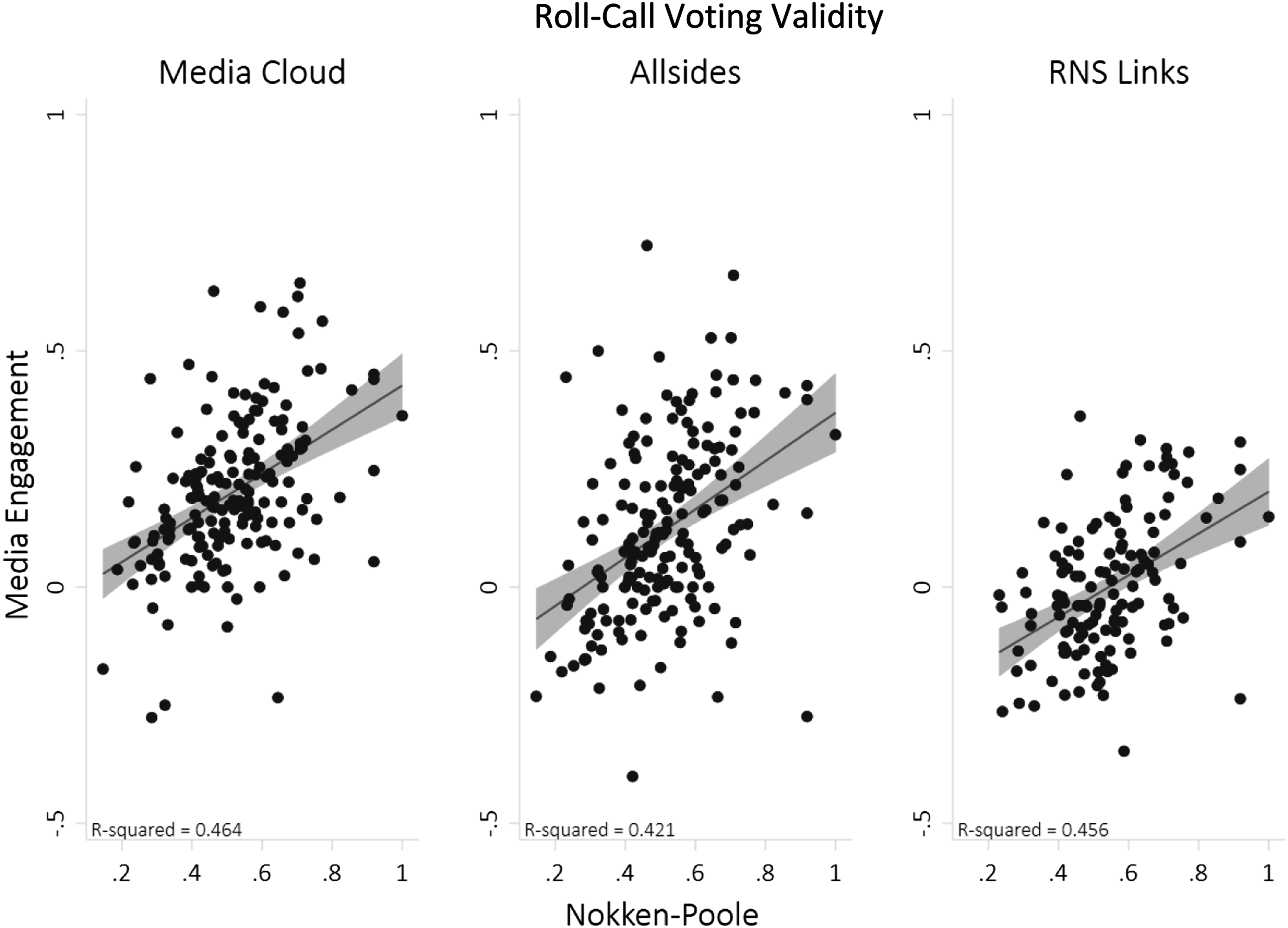
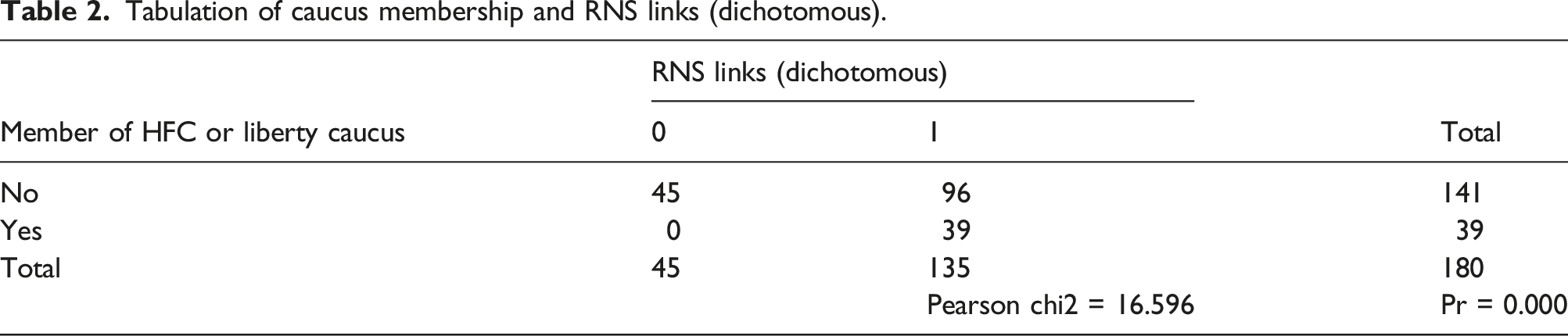
Given that roll-call voting may not reflect representatives’ personal preferences, we also validate our measures against ideological caucus membership. Caucuses exist outside the control of party leadership, meaning they are often the site of sub-party organization (Bloch Rubin, 2017) and membership is commonly used in factionalism scholarship (e.g., Blum, 2020). For the 116th Congress, we interpret current or historic membership of the House Freedom Caucus (HFC) or Liberty Caucus as an indicator of membership of the more ideologically extreme faction within the congressional party. Both caucuses are identifiably on the right of the party, meaning we expect historic membership to align with far-right alternative news media engagement. In Figure 2, we present the confidence intervals around the means for members and non-members of these caucuses on each of our media engagement scales. In all three cases, members of these caucuses had media engagement further to the right, as indicated by non-overlapping confidence intervals. Caucus membership validity.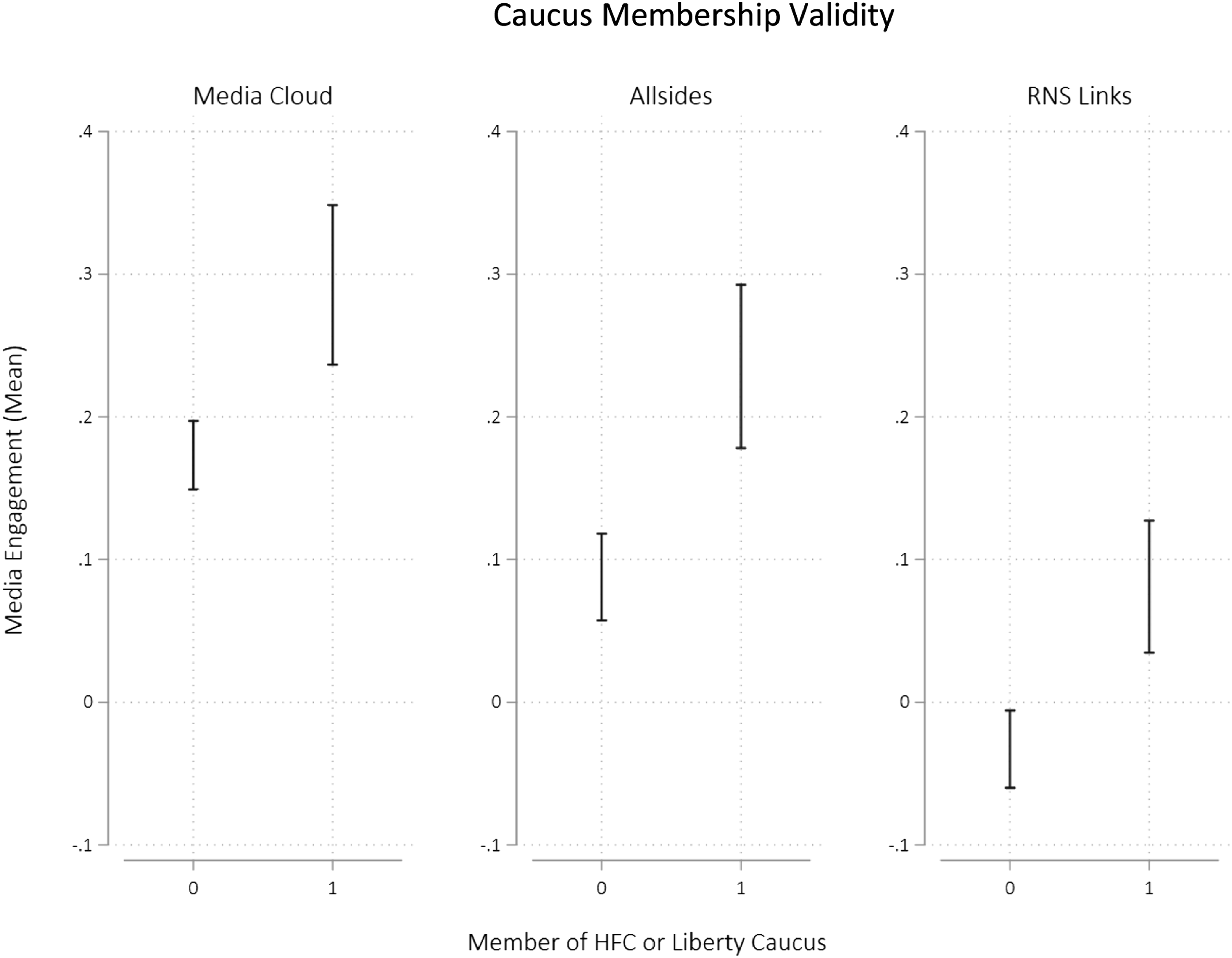
Tabulation of caucus membership and RNS links (dichotomous).
Given that Republican intra-party alignment is increasingly perceived in terms of loyalty and allegiance to Trump (Hopkins and Noel, 2021), we also validate our scales against a measure of ‘Trumpiness’. We use rhetorical congruence with the former president, operationalized using Joseph Cerrone’s measure of rhetorical alignment with Trump on Twitter, labeled here as representatives’ ‘Cerrone Score’ (Cerrone, 2021). The Cerrone Score measures the lexical similarity between tweets issued by Republican members of Congress and Donald Trump. The score is generated using a document-feature matrix to calculate the degree to which representatives mirror Trump’s vocabulary in their tweets, with the resulting score ranging from zero (low) to one (high).
We present our validation against Trumpian rhetoric in Figure 3. All three measures of media engagement are positively associated with Trumpian language, indicating validity along this—potentially alternative—intra-party continuum. Trumpian rhetoric validity.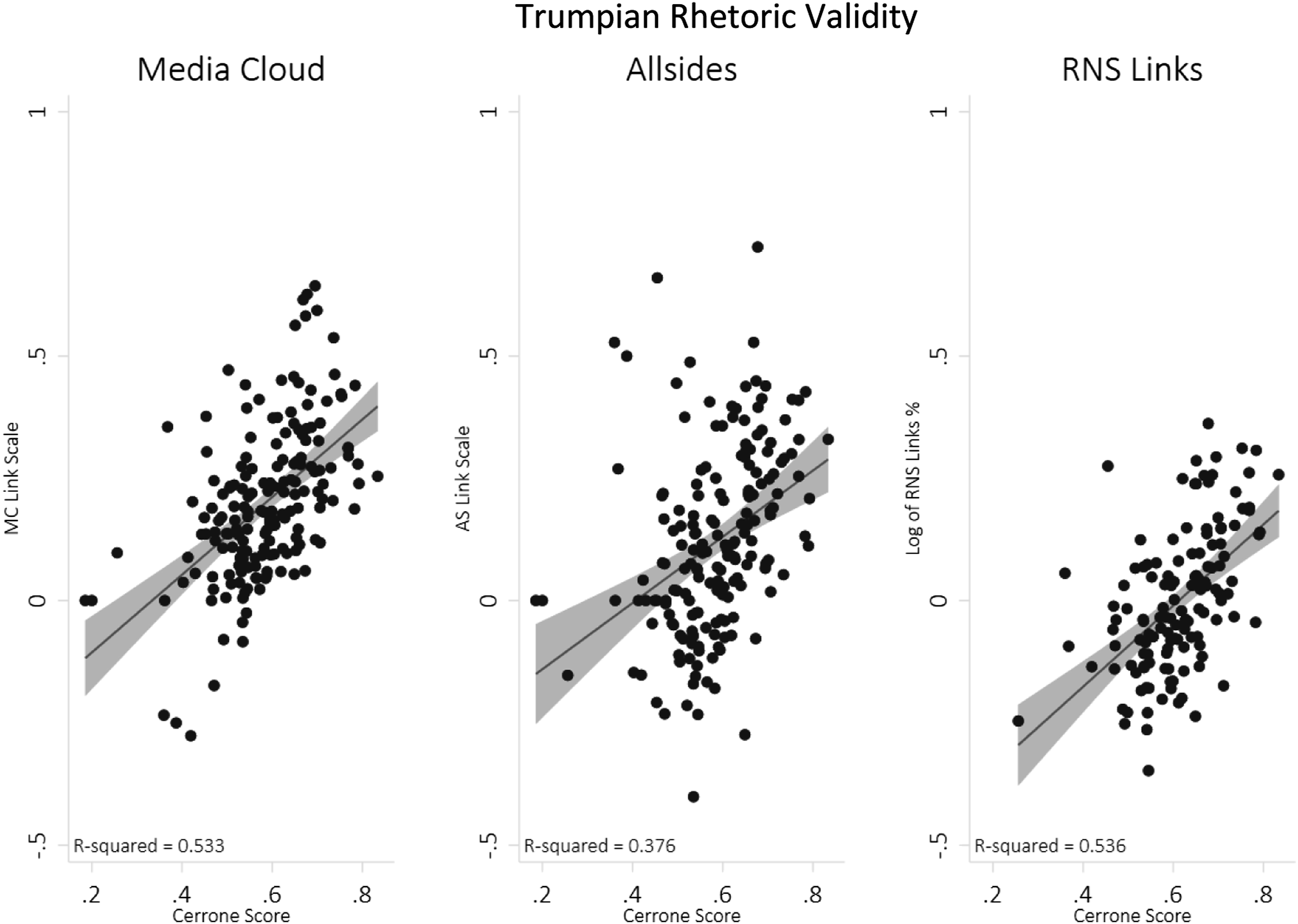
The correlations between our three measures of positionality from media engagement and their alignments with roll-call voting, caucus membership, and rhetorical alignment with Trump indicate their validity. Qualitatively, representatives such as Fred Upton, Dan Newhouse, and Jaime Herrera Beutler, commonly conceived as moderates, are further left on all three scales. Conversely, Paul Gosar, Mo Brooks and Brian Babin, understood as being to the right of the congressional party, scale further right across all of our scales. In the supplementary material, we also demonstrate the superiority of our scaling measures to an alternative, independently coded measure; the ratio of tweets that retweeted Trump.
Media engagement & rhetorical radicalization
Having demonstrated the validity of our approach, we now apply it to our empirical research question, namely, is far-right alternative news media engagement indicative of rhetorical radicalization? Given the association between these media outlets and the language and priorities of the then-president, we expect that engagement with far-right alternative news media will align with an increasingly Trumpian communication style. Using the Cerrone Score introduced previously, we consider the increased use of Trumpian language as movement between the 115th and 116th congresses, where further-right media engagement will align with a shift toward Trumpian communication. We therefore test the adaptative rather than the replacement effect, measuring intra-representative radicalization between congresses.
As a first step, we present the descriptive change in rhetorical radicalization. If the congressional Republican Party moved wholesale in adopting Trump’s communication style online, then identifying the intra-party variation in this movement has comparatively little analytical value. As shown in Figure 4, the mean Cerrone score of all Republican representatives in the 116th Congress was statistically indistinguishable from the 115th.
8
Not only did the entire corpus not radicalize, but we see a greater dispersion of rhetoric in the 116th Congress. We next attempt to identify the association between media engagement and this growing intra-party divergence. Trumpian rhetoric descriptive statistics.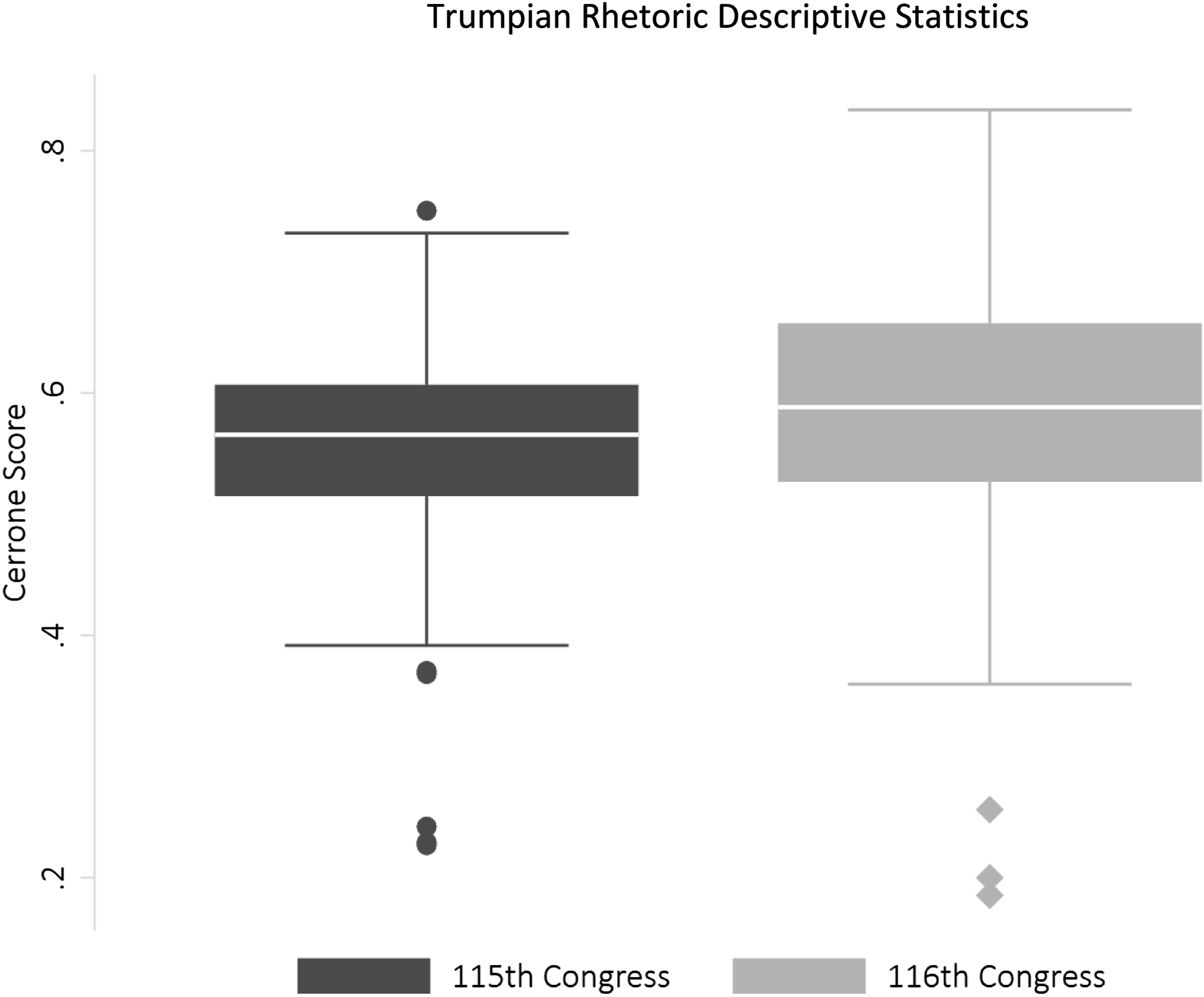
We control for factors other than media engagement that may make representatives more inclined to align themselves rhetorically with Trump during his presidency. Representatives in safe Republican districts have less to fear in a general election and more to fear from a primary challenger, and so may adopt more Trumpian rhetoric. We therefore include the standard measure of district partisanship, Partisan Voting Index (PVI), taken from the Cook Political Report (2017) and rescaled to a +/− Republican score.
We also include two demographic controls for districts: percentage White and median income. Estimates are taken directly from the U.S. Census Bureau’s American Community Survey (ACS) website (U.S. Census Bureau, 2021). Given our focus on the 116th Congress, we use the most recent figures. Due to the clear racial partisan divide during the period of study, the central influence of race on U.S. political attitudes (Hutchings and Valentino, 2004), and the saliency of White identity in the modern Republican Party (Jardina, 2019), we include district whiteness, measured as the percentage of the district’s voters that are White, as defined in the ACS. Republican representatives’ adoption of Trumpian rhetoric could vary in either direction based on the racial demographics of their district. Representatives from whiter districts may perceive electoral benefit from adopting Trump’s language, alternatively, given that Republican representatives rely overwhelmingly on White voters to win elections in all districts, they may perceive greater benefit in using more Trumpian rhetoric in districts with larger non-White populations.
We also control for district median income given that ‘economic anxiety’ is a commonly argued explanation of the rightward shift in the Republican Party (e.g., Autor et al., 2020), despite data indicating that affluent voters have more conservative attitudes and preferences (Gelman et al., 2007). Under the economic anxiety framing, we might expect that representatives from lower-income districts would be more likely to adopt more Trumpian rhetoric over time. We further control for the total number of tweets sent in the period, given that representatives who send a large volume of tweets may use Twitter in a meaningfully different way to other representatives.
We also include two controls relating to behavior in Congress, previously used for validation. We might expect that more conservative members of the House of Representatives are particularly likely to radicalize in their online rhetoric, regardless of their media engagement. We therefore control for roll-call voting during the 116th Congress, again using representatives’ Nokken-Poole scores. Beyond simply being more ‘conservative’, some representatives have signaled sub-party allegiance to a specific type of Republican identity, where members of the House Freedom Caucus or Liberty Caucus may be particularly inclined to adopt Trump’s rhetoric. Including these controls gives further confidence that our measures of media engagement, rather than alternative indicators of intra-party positioning, are what matters for recent rhetorical radicalization.
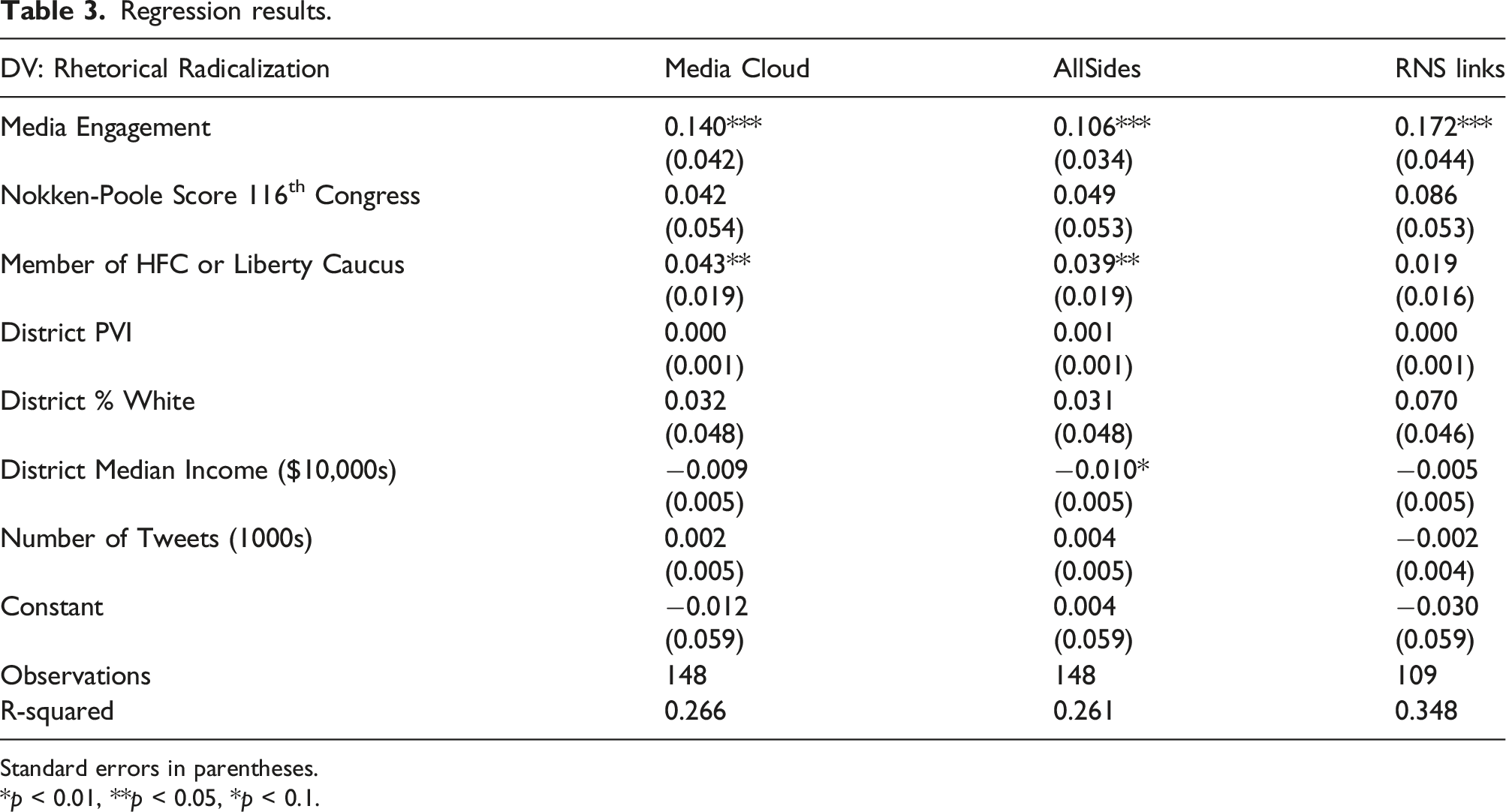
Regression results.
Standard errors in parentheses.
*p < 0.01, **p < 0.05, *p < 0.1.
We plot the predicted probabilities in Figure 5, which indicates that not only did representatives that engaged most with alternative far-right news sites become more Trumpian in their digital communication, but those representatives with more moderate media engagement scores became less rhetorically aligned with Trump. For example, the thirty-nine representatives in this sample who never shared a link to an RNS site became, on average, slightly less rhetorically aligned with Trump over time (−0.012). In contrast, the thirty-nine representatives that engaged most frequently with these far-right alternative news sites were almost fifty percentage points (0.475) more Trumpian in the 116th Congress than they had been in the 115th. Engagement with alternative far-right news media strongly conditioned whether representatives’ online language became more radical, a finding that is present across all three media collections. Rhetorical radicalization and media engagement.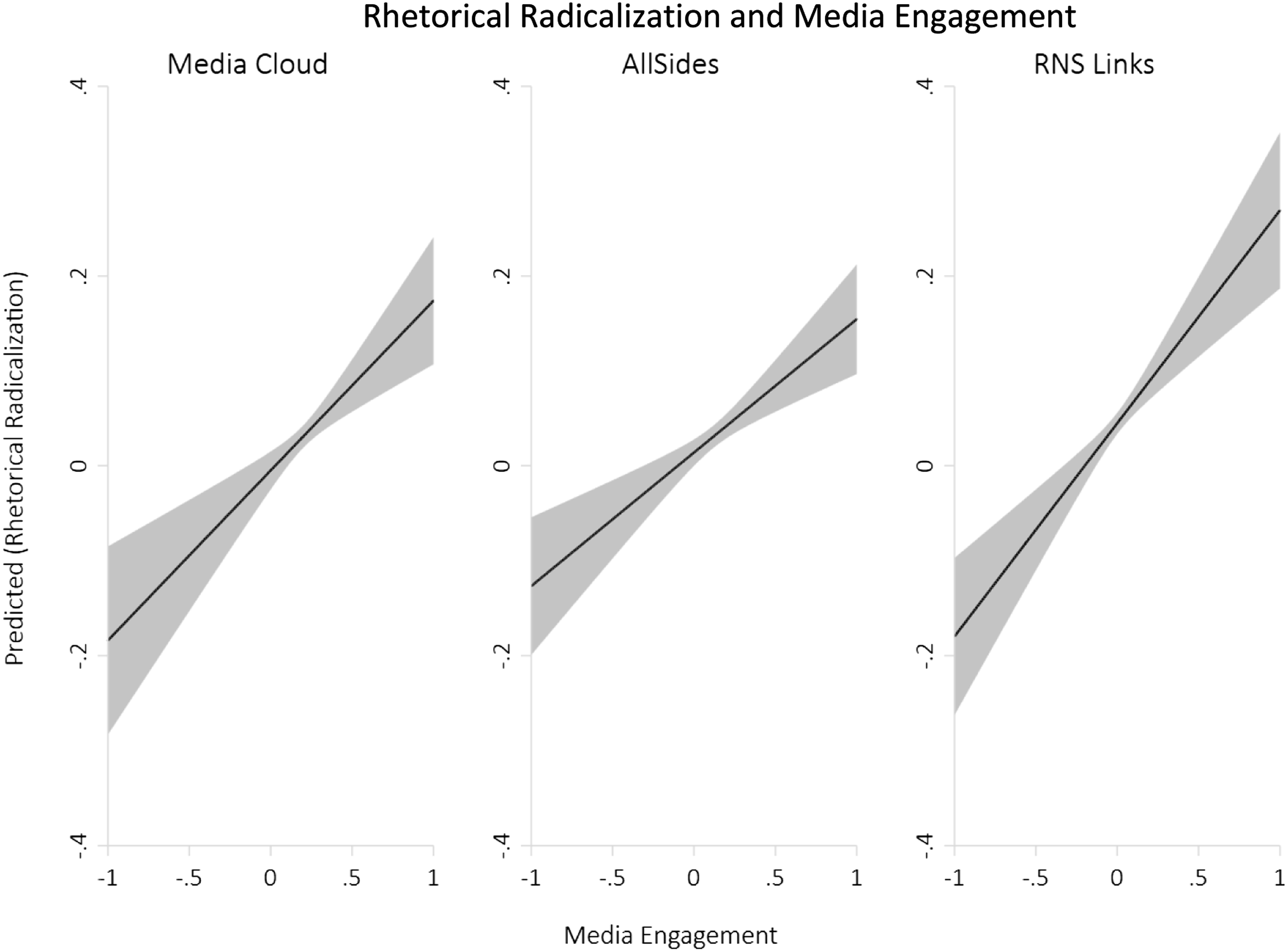
Given our understanding of elite media engagement as having a dual function of informing and signaling, we view the alignment of media engagement and increased Trumpian rhetoric as a dynamic two-way relationship which has radicalized (parts of) the congressional Republican Party. Representatives who did not engage with far-right alternative news sources became less Trumpian in their communication, meaning diversity of media engagement has likely contributed to increasing intra-party factionalism in Congress. Increased diversity of representatives’ rhetorical alignment with Trump between the 115th and 116th Congress is visible in the descriptive data (Figure 4) and appears closely connected to patterns of media engagement (Figure 5).
Discussion & conclusion
Engagement with far-right, alternative news media was widespread among Republican representatives in the 116th Congress. We demonstrate alignment between these elites’ political positions and their engagement with news media. Representatives who were further to the right in their roll-call voting behavior, were members of ideological caucuses, or were more rhetorically similar to Donald Trump, were also further to the right in their media engagement. These associations indicate the validity of our measures scaling representatives based on their media diet. In application to our hypothesis, we show that further-right media engagement, including engagement with far-right alternative news sources, aligned with increasingly Trumpian digital communication. We argue that this is a form of rhetorical radicalization of parts of the congressional Republican Party, contributing to behavioral factionalism and intra-party difference.
Methodologically, our scaling approach has several advantages over existing ideal point estimates. First, our measures have higher levels of intra-party validity than those based on donor (Bonica, 2014) or follower networks (Barberá, 2015). Second, our method can also be used to scale diverse political actors along the same continuum, enabling, for example, the comparison of local and national elites, or members of legislative and executive branches of government. Third, our approach provides dynamic positioning, enabling researchers to consider change in elites’ positions, as in our empirical application. Fourth, unlike follower networks, hyperlinking has a public-facing signaling function, enabling us to understand what elites think their audiences want to hear from them. Fifth, given the validity of all three scales in this paper, our approach appears robust to the collection of websites used. Finally, the increasing party unity scores and the growing ‘parliamentarianism’ of the parties in Congress (Noel, 2013) mean researchers need new approaches to identify intra-party differences. We envisage that, given fragmented media engagement, our measure can fill this gap.
That Republican elites are engaging with far-right alternative news sources is alone worthy of further consideration. This pattern may indicate a dynamic where political elites engage selectively with ideologically-aligned sources, prompting doubts about the notion of news media as a central arena where elites compete for the electorate’s attention. At the same time, this practice also indicates that information reaches political elites via highly partisan news sources and subsequently informs their political actions and decision-making. Far-right alternative news sites have been shown to be factually unreliable (Benkler, 2020; Yang, 2020), serving as sources of misinformation in the modern American polity.
We think the signaling function of hyperlinking is particularly important in this process, where the incentives to demonstrate awareness of in-group dynamics may be particularly high among representatives, who face re-election every two years and who must appeal to their base and other key ‘policy demanders’ (Bawn et al., 2012) who provide vital resources. Other members of these alternative counter-publics are likely to be the recipients of these digital signals of representatives’ far-right bona fides, where far-right users are more active online (Edelson et al., 2021) and particularly motivated by the out-group animosity promoted by these sources (Rathje et al., 2021).
That roll-call voting and group membership also align with media engagement indicates that ‘signaling’ is not all that is going on. Instead, we see that ideological preferences align with what sources of information are deemed to be important. This, to us, seems indicative of the function of hyperlinks to news sources: as providers of information that align with, and perhaps solidify, a specific Weltanschauung.
Extending our analysis back in time would include more NeverTrump Republicans, many of whom left Congress in 2018. Robustness to the inclusion of greater numbers of conservative but Trump-skeptical Republicans would give further confidence in our finding that media engagement, rather than ideology, is what matters for this form of radicalization. Broadening our analysis to also include representatives first elected in 2020, several of whom—such as Marjorie Taylor-Greene, Lauren Boebert, and Madison Cawthorne—are characterized as particularly radical in their communication, would be a further interesting extension. 10
We would expect similar results for a replication of this study in the U.S. Senate, with the potential for greater influence of state partisanship, given that states are comparatively competitive electorally. Replication at the state or local level would provide further insight into regional diversity and potentially about the nationalization of the political landscape (Hopkins, 2018). A more granular approach might entail differentiating at the hyperlink rather than the domain level, with analysis of articles’ content, rather than assigning a value to the entire news outlet. Future research could therefore analyze differences in the types of articles that get posted. For example: which agendas get set, and do they deviate, based on the ideological positions of members sharing them?
Many previous studies aiming to use social media data to assess political ideology take a holistic approach to analyze and position elites across the political spectrum. We believe it is worth considering partisan and ideological subgroups and the specificities of the networks they interact and engage with. A similar analysis of media engagement on the left is one further avenue for potential research. Though progressives and democratic socialists are smaller in number and less influential over the congressional Democratic Party, and a similar hyperpartisan media ecosystem on the left is comparatively small and largely disassociated from the party organization, analyses of Democratic elites’ media engagement could provide further insight into party asymmetry. However, this asymmetry may mean that the approach taken here would only work for the Republican Party, as the existence of a widespread alternative news ecosystem is simply not present on the American left. A comparison across the entire spectrum might therefore dilute the nuance we find in devoting closer scrutiny to specific groups of actors.
Beyond the U.S., our metric of elite engagement with hyperpartisan alternative media could serve as an ideological indicator in other democracies. In particular, legislators’ intra-party positions in parliamentary systems cannot easily be scaled using roll-call votes due to the high levels of party discipline. We see our measure as complementary to existing scholarship using language on Twitter to produce ideal points (Sältzer, 2020).
At a scholarly level, our findings highlight the continued need for academics working on practices of media engagement and those focused on institutions and elite behavior to cooperate more closely. Even within a single party, we find a clear alignment between media engagement and radicalization, suggesting that the links between legislator positioning and novel communication forms within a hybrid media system merit further research.
Supplemental Material
Supplemental Material - The emerging fault line of alternative news: Intra-party division in Republican representatives’ media engagement
Supplemental Material for The The emerging fault line of alternative news: Intra-party division in Republican representatives’ media engagement by Mike Cowburn and Curd B Knüpfer in Party Politics
Footnotes
Acknowledgements
We thank participants and discussants at the 2021 APSA and 2022 MPSA conferences for their important feedback. We also thank the two anonymous reviewers for their helpful feedback which improved this manuscript considerably. We are particularly gratefuly to Joseph Cerrone for allowing us to use his lexical similarity data, and Thilo Prange for his research assistance.
Declaration of conflicting interests
The author(s) declared no potential conflicts of interest with respect to the research, authorship, and/or publication of this article.
Funding
The author(s) received no financial support for the research, authorship, and/or publication of this article.

Supplemental Material
Supplemental material for this article is available online.
Notes
Author biographies
References
Supplementary Material
Please find the following supplemental material available below.
For Open Access articles published under a Creative Commons License, all supplemental material carries the same license as the article it is associated with.
For non-Open Access articles published, all supplemental material carries a non-exclusive license, and permission requests for re-use of supplemental material or any part of supplemental material shall be sent directly to the copyright owner as specified in the copyright notice associated with the article.
