



Abstract
What explains women’s underrepresentation in first-past-the-post compared to at-large elections? While existing studies emphasize candidate experience or party nomination to competitive districts, we argue that local party selectors are more likely to desire women to have a type of political experience that signals their connection to the national party. To test our argument, we use a novel dataset of over 10,000 local candidates nominated by South Africa’s African National Congress party. In South Africa’s Mixed Member Proportional system, we find that compared to men, women are more likely to be nominated in FPTP elections after having previous experience as PR councillors. Previous PR experience is distinct from other forms of experience such as incumbency, and contextual factors such as pre-electoral intra-party violence do not explain women’s nomination to FPTP seats. These findings contribute to our understanding of how electoral systems impact parties’ nomination of female candidates at the local level.
Introduction
How do the rules that govern elections impact political parties’ nomination of female candidates at the local level? Decentralized and inclusive candidate selection methods (Hinojosa, 2012) and electoral rules such as first-past-the-post (FPTP) are prone to low female representation compared to at-large elections (Valdini, 2013). Also, party elites have different perceptions regarding the skillset required to perform the duties of at-large and FPTP-elected positions (Huddy and Terkildsen, 1993; Eagly and Karau, 2002). In this article, we study how the incentives generated by electoral systems shape parties’ perceptions about the qualifications of female candidates and subsequent nomination decisions in FPTP elections, We argue that perceptions of role congruity - who parties view as capable of serving as an FPTP councilor, are gendered and disadvantages women at the nomination stage. Resultingly, women face an experience premium – parties hold them to a higher standard with regard to needing to have more political experience than their male counterparts to qualify for FPTP seats. To test our argument, we use an original dataset containing the gender, race, ethnicity, and political trajectory of over 10,000 local candidates nominated by the ruling African National Congress party in South Africa. South Africa has a two-tiered electoral system - half of the local council members are elected in FPTP Single Member District (SMD) ward elections, which are the smallest electoral units in the country after municipalities and provinces, and half are elected through closed-list proportional representation (PR). FPTP councilors hold visible positions and are responsible for representing the concerns related to their wards in the municipal council (Paradza et al., 2010). In contrast, PR councilors play more of an oversight role in the municipality, and because they are elected through party lists, they are primarily accountable to the party. 1 Additionally, the ANC applies a voluntary gender quota policy in the PR tier for local elections, but a gender quota policy does not exist in the FPTP tier. Descriptive data show that women in the ANC are nominated in proportion to or above their size in the population in the PR tier, but they are underrepresented as FPTP nominees. We argue that local selectors in the ANC hold women to a higher standard to be nominated in FPTP elections. Specifically, local party selectors are more likely to nominate female FPTP candidates after they have earned previous experience as a PR councillor because selection through the PR tier signals a local candidate’s closeness to national party elites.
We find that in the ANC, women’s chances of nomination to FPTP elections increase after they have earned prior experience as PR councilors. Our results hold after controlling for other possible determinants of women’s underrepresentation in FPTP elections, such as nomination to party stronghold districts and the threat of intra-party violence before elections. In addition, prior political experience as an FPTP councilor is not a predictor of women’s nomination to winnable PR list positions. Thus, for women, the experience premium only exists in FPTP elections. Taken together, these findings show that parties place a larger burden upon female candidates to be considered qualified, thus explaining the slower pace of women’s advancement in FPTP elections. These findings have significant theoretical implications. By comparing candidate nominations in two tiers of a mixed-electoral system by the same party, we show that parties respond strategically to the incentives created by electoral systems to decide when it’s best to nominate female candidates. Also, the case study in this paper shows that gendered standards for candidate competency are at play in the nomination process. Even in parties that support gender equality, such as the ANC, women are held to a higher standard than men, which contradicts such a principle. Lastly, in contexts where gender quota policies exist, our findings suggest that despite party elites’ gendered candidate selection standards, women’s experience in quota-mandated positions can serve as stepping stones to seats where quotas do not apply.
The explanations of women’s underrepresentation in FPTP elections
Existing studies show that supply and demand-side factors affect women’s representation in FPTP elections. On the supply-side, some argue that the lack of experienced female politicians available to run for competitive political office leads to women’s underrepresentation (Deen and Little, 1999). This explanation is particularly useful for understanding women’s advancement to prestigious political posts and the slower rate of women’s promotion compared to men (Deen and Little, 1999). One source of leakage in women’s political pipeline may be because women’s qualifications for prestigious office are commonly questioned, and women elected through gender quotas may be especially seen as less qualified than non-quota women or men. However, studies show that quota women are as qualified as men (Franceschet and Piscopo, 2012), or have better qualifications than the men they unseat (Huang, 2016).
Additionally, the impact of previous political experience on women’s likelihood of winning FPTP seats is mixed. In countries that use mixed-member proportional (MMP) rules, several studies examine whether women’s election through quotas in the PR tier translates to success in non-quota FPTP elections. In South Korea, Shin (2014) finds that almost half of the women elected to SMD seats are former PR legislators who were elected through the PR quota. The experience that women earn serving as PR legislators gives them an incumbency advantage in both the candidate selection and general election stages. Other studies on inter-tier contagion find limited contagion effects. In Germany’s MMP system, parties generally comply with the gender quotas in their PR list, however, the quotas have only a limited impact on women’s success in SMD elections (Davidson-Schmich, 2010). Even in their party’s district stronghold, all parties except the Left Party in Germany were unlikely to nominate female candidates (Davidson-Schmich, 2010). Evidence from South Korea also suggests a limited contagion effect for gender quotas. Lee (2019) finds that the informal rules governing the practices of candidate nominations by political parties create invisible barriers for women, and many female legislators’ careers are stalled after serving as PR legislators.
Another prominent supply-side explanation for women’s underrepresentation in FPTP elections focuses on the role that parties serve as gatekeepers in slowing down women’s political careers (Lee, 2019; Thomas and Bodet, 2013). Due to gender bias among voters, parties may consider women to be more politically liable than male candidates, and thus exhibit a preference for men over women in the recruitment, nomination, and election stage (Kunovich and Paxton, 2005; Niven, 1998, 2006; Niven, 1998; Niven, 2006). In some countries, women are disadvantaged when it comes to raising funds to run in FPTP elections, and women tend to receive less support from their party (Wang et al., 2021). Even in the context of gender quotas, parties design quotas in a way that ensures that men’s privileged position is not diminished (Murray et al., 2012). In addition, informal rules in parties work against the success of women. For example, in Chile, despite changes to formal electoral rules, the informal norms of parties having a “privileged candidate”, and the strategy of discouraging new candidacies in order to not “dilute the vote” makes it difficult for women to get nominated to the office (Hinojosa and Franceschet, 2012). Even in countries that adopt reserved seat gender quotas, the nature of candidate selection remains biased against women (Bjarnegard and Zetterberg, 2011).
One example of the role of parties as gatekeepers is the argument that women are underrepresented in FPTP elections because their parties are more likely to nominate them in competitive districts where they have a harder time winning (Thomas and Bodet, 2013). The winner-take-all nature of FPTP elections, particularly in emerging democracies with party systems that are not professionalized or institutionalized, allows parties to play an important role in whether women win elections in these districts (Bauer and Darkwah, 2020; Edgell, 2018). Candidates in FPTP elections have a better chance of winning if they are placed in party strongholds. However, women are less likely to be nominated in their party’s stronghold (Thomas and Bodet, 2013), and are more likely to be nominated in districts where there are a lot of competitors, for instance in multimember districts (Mitchell and Monroe, 2014). In South Korea, Lee (2019) finds that parties are more likely to place female candidates in unfavorable districts.
Finally, a ubiquitous yet less understood reason why parties are less likely to nominate women to FPTP elections is the role of violence. Violence in intra-party nominations before elections is common in developing regions (Seeberg et al., 2018), especially in Sub-Saharan Africa, and women running for FPTP seats are often targeted (Berry et al., 2017). Krook and Sanin (2020) categorize violence against women in political roles as a unique form of political violence. Particularly in election violence that occurs in developing countries, women candidates are more likely to be targets of threats and verbal aggression (Bjarnegard, 2023), and sexual intimidation (Bjarnegard et al., 2022). Violence against female candidates thrives in regions where there is impunity for this type of violence (Piscopo, 2016). In violent contexts, voters and parties may prefer male candidates, as they tend to view men as more competent at handling policy issues around national security and military crises (Lawless, 2004).
Electoral system incentives and gendered standards for candidate competency in party nominations
The structure of electoral systems impacts how parties select candidates (Norris, 2004; Matland, 1998; Matland and Studlar, 1996). When parties are faced with a parallel electoral system that combines both PR and FPTP rules, they consider that different candidate qualifications are necessary for different types of seats. In winner-take-all SMD systems, parties have an incentive to field a candidate who can attract a broad base of voters, and may hesitate to choose female candidates due to factors such as voter prejudice against female politicians (Clayton et al., 2020; Norris, 1996; Rule, 1994). As a result, women and ethnic minority candidates are viewed as electorally risky especially when parties can choose only one candidate per constituency. The candidates that parties nominate in candidate-centered electoral systems often need to cultivate a “personal vote” - the portion of a candidate’s electoral support that originates in his or her personal qualities, qualifications, activities, and record (Carey and Shugart, 1995). However, personalized electoral rules, such as SMD, disadvantage women, who parties may view as being less likely to attract sufficient support, when faced with electorates that are hostile to female leadership (Valdini, 2013). Especially in countries where traditional gender roles persist, parties respond to the fact that voters view the nature of different types of political office in a gendered way. Specifically, voters view that some positions require “masculine” or “feminine” traits, and parties respond by being less likely to nominate female candidates to types of political office that are viewed as more masculine (Bauer, 2020; Bernick and Heidbreder, 2018). Anzia and Bernhard (2022) find that women have a greater advantage over men when running for stereotype-congruent offices such as city council and school board races, and they are disadvantaged in mayoral races. In addition, compared to other elective offices, women tend to be better represented as county clerks across the United States – a political office that is seen as more compatible with traditional gender norms (Bernick and Heidbreder, 2018). Lastly, Clayton and Zetterberg (2021) find that female legislators in Africa exhibit higher levels of party discipline than their male co-partisans, and that gendered expectations about proper behavior limit women MP’s independence from their party.
The experience premium and women’s nomination to FPTP elections in the ANC
We argue that in the ANC, the more masculine characteristics associated with the duties of FPTP councilors advantages male candidates more than female candidates, and that the party holds women to a higher bar to qualify for FPTP seats. Specifically, we argue that compared to male candidates, the party is more likely to nominate women to FPTP elections after they have earned experience in the PR tier. Previous experience as a PR councillor signals to local party selectors that a candidate is an ANC insider because selection through the PR tier indicates a local candidate’s closeness to national party elites. In the ANC, PR lists in local elections are used by national party leaders as a tool to ensure that their preferred candidates and faction partners get positions in office (Booysen, 2012). While local ANC branches have the most say in which candidates are chosen in FPTP elections, national party leaders often intervene when it comes to the PR lists. In fact, the ANC’s PR lists are finalized by national party executives before they are submitted to the Electoral Commission. Du Toit and de Jager (2014) suggest that the ANC uses the PR list to deploy preferred candidates to particular political positions, and local communities are less consulted when it comes to the nomination of PR candidates (Lieberman et al., 2021).
Additionally, to local party selectors, experience in PR positions signals a candidate’s value because PR seats are generally more desirable than FPTP seats. For one, PR positions are more likely to serve as feeders to higher political office. Piper (2012: 38-39) suggests that FPTP councillors are considered to have lower standing in the party in comparison to PR councillors because mayors and speakers in municipalities are more likely to have a PR background. Another indicator of the prestige of PR councillors is the direction in which switching occurs between the two tiers. In other countries in Africa with gender quota policies, women use their experience in quota seats as stepping stones to constituency seats. Our data shows that switching more often occurs in the direction of FPTP councilors running as PR candidates in the future. In our data, 13.6% of FPTP councilors run as PR candidates in the future. In comparison, only 3.39% of PR councilors run as FPTP candidates in the future. Thus, the prestige of PR seats further reinforces why national party elites are more interested in intervening in nominations in the PR tier.
For female candidates, the fact that the gender quota policy is linked to the PR tier means that if they seek to advance to more visible political office (such as FPTP or mayoral positions), PR experience helps them demonstrate that they have established party insider credentials. At the nomination stage, the PR credential is more significant for female FPTP candidates because in comparison, male candidates can rely on informal networks such as support from party campaign operatives or vote brokers to demonstrate their capability. Female candidates are at a comparative disadvantage when it comes to informal networks, and formal political experience, particularly one that signals closeness to national party leaders provides a useful cue to local party selectors. Lastly, a female FPTP candidate who has previously served as a PR councilor, and is thus connected to national party elites, demonstrates to local selectors that as a FPTP councilor she can bring resources to the ward. Based on these factors, we expect that compared to male candidates, female candidates are more likely to be nominated to FPTP elections after they have previously served as a PR councilor.
We also expect the experience premium to be less central in the nomination of women to PR positions. In closed-list PR systems, a candidate’s ideological commitment and party loyalty are important for nomination, and these qualities are not sex-specific. PR councilors are elected off party lists, meaning that the necessity to cultivate a personal vote is not an especially relevant factor in closed-listed PR. Therefore, the prior political experience of a PR candidate as a FPTP councilor should be less significant in the ANC’s nomination decisions.
Women’s representation and local candidate nominations in the ANC
Since democratization, the ANC remains a frontrunner in women’s political representation in South Africa. The country has a voluntary party quota at both the national and local government levels, and the ANC is the only party to apply a gender quota policy to its candidate nominations (International IDEA, 2021). Ahead of the first democratic elections in 1994, the party put in place a 30% gender quota. For the 1999 elections, the ANC adopted the policy of having every third seat on its party list filled by a woman candidate, attempting to ensure that women are not placed in unelectable seats (Britton, 2008: 120). In 2006, after the party adopted a 50% gender quota policy for the PR tier of the MMP electoral system in local elections, it extended the policy to national elections in 2009. At the national level, the party’s gender parity policy had a significant impact on women’s presence in politics. The percentage of women in the National Assembly increased from 30% in 2004 to 44% in 2009 and reached 47% in 2019 (Inter-Parliamentary Union, 2021). In contrast, the ANC’s parity quota policy at the local level is a relatively modest success. Although the quota contributed to a gradual increase in the number of women in the PR tier, its power remained limited in FPTP seats and, thus, in the overall representation of women in local government within the ANC. Figure 1 shows data comparing the percentage of women as PR candidates and FPTP candidates in the entire country from the 2000 election to the 2016 election, alongside the same data for the ANC sample only. There is a similar pattern in the low number of female FPTP candidates compared to PR candidates in both our study’s sample and data from across the whole country. In the entire country sample, women are 44% of PR candidates, and only 30% of FPTP candidates. In our sample, women are 55% of ANC nominees for PR seats, and only 34% of nominees for FPTP candidates in the party. The data reveal a similar trend if we compare the percentage of women nominated as FPTP and PR candidates in the entire country and in the ANC sample by year (in Appendix A). These numbers show that the ANC selectors are more likely to nominate women to the PR tier than the FPTP tier of the mixed electoral system. Women as FPTP versus PR Candidates in the ANC Sample and the Entire Country. Note: This figure displays the percentage of women nominated as PR and FPTP candidates in the ANC. The entire country sample is data from all nine provinces. Data from the 2000, 2006, 2011, and 2016 local elections are used to produce all.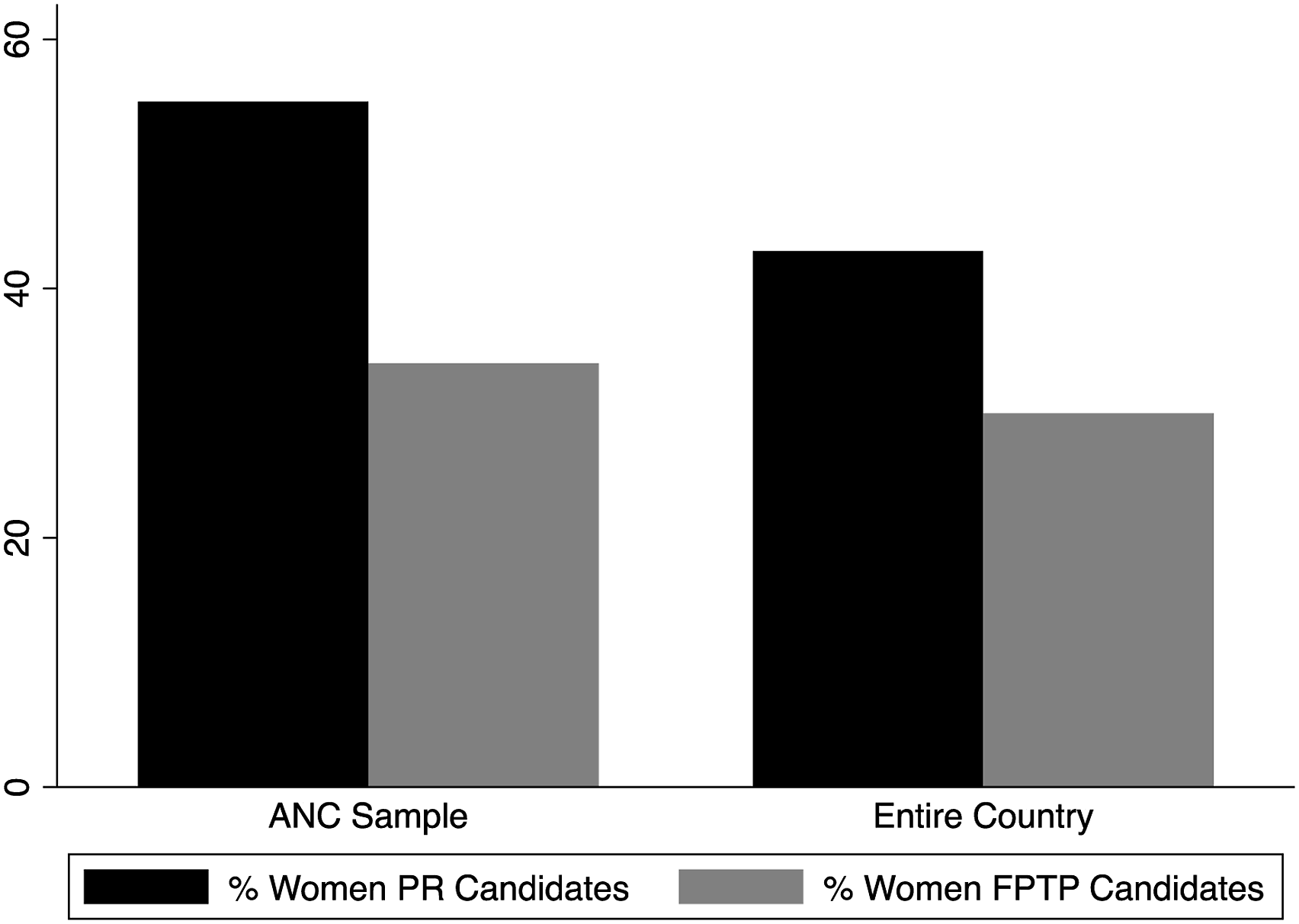
Local campaigns and the candidate selection process in the ANC
The success of parties in South Africa’s local elections depends a lot on the extent to which they can achieve a local presence. The ANC’s local candidates use face-to-face contact with voters through rallies, roadshows, meetings and house-to-house visits (Lodge, 2003: 106). As local elections have become more competitive since democratization, parties have spent significant amounts of money on them, directing the money particularly toward hotly contested races, such as mayoral elections (Dawson et al., 2023). In other contexts where candidates have to fundraise for their own races, there is often a gender gap in the financing of political campaigns, (Murray et al., 2023), however, the party-centric nature of election funding in South Africa makes this less of an issue. There is no difference in the funding of FPTP candidates and PR candidates. Despite their greater visibility, FPTP candidates do not fund themselves, but are funded by the particular party they belong to 2 the same applies to PR councilors. Thus, campaign finance is less decisive on women’s political fortune than the candidate selection process in the case of the ANC.
The ANC’s candidate selection process for national elections is both opaque and centralized (Giollabhuí, 2013). In comparison, the party’s local candidate selection process includes bottom-up community participation, yet, decisions are finalized by the party’s National Executive Committee (Piper, 2012: 36). In the early local elections that followed the end of apartheid, the candidate selection process in the ANC was heavily centralized. In response to increased concerns from constituents, the party promised greater community involvement starting in the 2011 election (Piper, 2012: 37). Both FPTP and PR candidates are nominated through the ANC’s branches, which are highly institutionalized local structures within the party. There is one ANC branch in each ward throughout the country, and they are required to have a minimum of 100 members to be considered functioning (Darracq, 2008: 589-599). Decisions made by the branch need the support of fifty percent plus one of the branch members.
In FPTP elections, branch members nominate four candidates – two male and two female. 3 In addition, branches are also required to nominate three candidates for the proportional representation list (Gottschalk, 2016). The nomination of candidates happens at the branch general meeting (BGM) (Ndenze, 2011). The proposed candidates are then sent to a screening committee, which consists of senior members in the ward who have no interests in running for a position, members of the ANC youth, and women’s and veteran’s leagues in the branch (Ndenze, 2011). The screening committee also reviews the CVs of the candidates. Then, the nominees are taken to public meetings where the community has a chance to provide input on the best candidate (Ndenze, 2011). Next, it moves to the regional list committee, which reviews the recommendations from the previous process (Ndenze, 2011). The regional committee makes the selection and sends its back to the branch for a response. The objective of the regional committee is to select and remove prospective candidates to ensure that certain objectives are met for the party’s candidate lists. Specifically, they are required to meet the ANC “zebra policy” for its gender quota (half male and half female candidates), intergenerational diversity, and demographic diversity (Gottschalk, 2016). Lastly, a report is forwarded to ANC executives in the relevant province, which makes an announcement as to which candidates are selected (Gottschalk, 2016). If there is a deadlock, the ANC’s provincial and national executives can intervene. As detailed previously, local PR seats hold more political value for national party elites, and it is at this stage of the candidate screening process where they can overrule the lists forwarded by the branches. Such political value attributed to PR seats put women who served as PR councillors ahead in the nomination process for FPTP seats, compared to women who don’t have PR experience, since these women are considered trusted insiders after earning this sort of experience.
Despite the rigorous candidate vetting process that exists to ensure that the ANC adheres to its gender quota policy and has diverse representatives, branch committees bring personal biases to the process. The ANC’s Electoral Chairperson, Kgalema Motlanthe, observed that despite the party’s effort toward gender equity, the patriarchal attitudes of branch committees means that the majority of FPTP councillors nominated are male (Solomons, 2021). The Chairperson went on to say that “to adjust for [the gender imbalance in FPTP nominations], more ANC women candidates form part of our proportional representation list (Solomons, 2021).” The existence of gender bias in branch committees aligns with studies showing that party gatekeepers more actively seek men to run for office than women (Fox and Lawless, 2010). Women’s candidacies in FPTP elections are stunted at the early stages by the biases of important gatekeepers. Additionally, this comment by the Chairperson reinforces how the national ANC is more likely to intervene in local PR nominations to achieve desired political objectives, while community preferences are often left to stand for nominations in FPTP seats.
Outside of nominating candidates, branch members are deeply involved in their communities. ANC branches are designed to be an interface between citizens and ANC-led municipalities, connecting ANC policies to ordinary citizens on the ground (Darracq, 2008: 601). In addition, branch members are involved in socializing communities into the ANC and engaging in acts of solidarity (Darracq, 2008: 599). For instance, they collect money to pay for the funeral costs of members who relatives died, advertise job vacancies, and provide meals to branch members during mass meetings (Darracq, 2008: 600). All of these acts are meant to create cohesion within the party in between election cycles.
Data and empirical strategy
The original data we use to test our hypothesis is a comprehensive dataset that contains the demographic characteristics of all the local government candidates the ANC nominated in Eastern Cape, Gauteng, and Western Cape provinces. Focusing on these provinces allows us to account for how the ANC’s candidate nomination strategies may vary in contexts where support for the party is strong, moderate, and weak. Eastern Cape province is an ANC stronghold. The province is heavily rural and populated mainly by the Xhosa community. Despite the unfavorable province-wide demographics, the opposition has mainly made inroads in the urban areas. Selecting this province sheds light on how the ANC nominates candidates in a largely uncompetitive political environment, where it is less politically costly to nominate risky candidates. Gauteng province has become increasingly competitive over time for both the ANC and the main opposition party, the Democratic Alliance (DA) party. In the 2016 local government election, the DA received 46% of the vote share, while the ANC earned 37%. If the gender diversification of its candidate pool is an effective strategy for the ANC, the choice of which candidates are nominated should be most consequential in a competitive political environment. Lastly, Western Cape province is a stronghold for the DA. Examining candidate nomination decisions in a context where the ANC faces a greater risk of losing elections allows us to determine whether the party’s objective of increasing women’s representation is a genuine policy or if the party is less likely to nominate candidates that can be perceived as riskier in competitive environments.
The dataset contains the gender, racial, and ethnic identity of every local candidate the ANC nominated in the three provinces. It should be noted that in an ideal situation the electoral commission would ask candidates before elections to self-report their gender, race, and ethnicity. In the absence of this information, we hired a South African research assistant to use the names of candidates to ascertain the gender, racial, and ethnic group they likely belong to. We included a detailed discussion of the coding exercise involved in the creation of the dataset in Appendix B.
In the FPTP nominations analysis, the dependent variable is the gender of the candidate nominated by the ANC to a ward. This variable is dichotomous and takes on the value of one if the nominee is a female ANC FPTP candidate, and 0 if it is a male candidate. We measure political experience with the variable PR Experienced, which is a dummy variable indicating whether the FPTP candidate has served as a PR councilor before. We run a linear regression model to test the experience premium hypothesis, including several control variables. First, we control for whether female candidates are less likely to be nominated to wards that are party strongholds. In local elections, the increasing competition the ANC faces from other parties has resulted in fewer seats than before, and intra-party competition for these seats is heightened. The logic follows that the competitiveness of a FPTP seat may impact the party’s nomination of riskier candidates, such as women, who are more likely to face bias from voters. We measure the “sacrificial lamb” control variable in two ways. The first measure is ANC vote margin, which is the difference in vote shares between the ANC if it lost the ward and the winning party, or if the ANC won the ward, the difference between its vote share and the runner up. The ANC vote margin variable ranges from -1 to 1, and higher values of this variable indicate that a ward is a more politically safe for the ANC. The second way we measure the safety of an ANC ward is the variable ANC Safe Seat, which is a dummy variable which takes on the value of one if the ANC won a ward by a vote margin of at least 30% points, and 0 otherwise. Dominant parties, including the ANC, often win elections with a wide vote margin, and 30% is a conventional cutoff used in studies that measure subnational competitiveness in these regime types.
Next, we control for intra-party violence, which is a supply side explanation for why parties are less likely to nominate women to FPTP elections. Most existing studies on violence against women in South Africa focus on gender-based violence outside of election cycles (Britton, 2020), and there is less attention on how intra-party election violence may inhibit women’s candidacy. In South Africa, political violence within the ANC is a significant issue in local elections. Due to the ANC’s electoral hegemony, positions in local government within the party are considered desirable. In a context of high unemployment, working as local councillor comes with a stable income for 5 years, significant say in the allocation of service delivery, and influence over contracts for houses, roads, and goods and services (Mbanyele, 2022). These financial stakes create competition over access to positions in local government and it increases the motivation to use violence against competitors. Thus, municipal councilors are often the targets of political violence in South Africa (Thomas, 2021). Pre-election violence within the ANC has become increasingly common in local elections. Candidates are subjected to death threats (Khumalo, 2022), attempted political killings (Mokhoali, 2022), assassinations (Bruce, 2016), shootings and injuring (Mabuza, 2021), hostage holding (Masungwini, 2021), and murder (Moatshe, 2021). Violence over candidate nominations within the ANC preceding elections may hamper the prospects of a female nominee. If pre-election violence is an indicator of future instability in the ward, a male FPTP candidate may be viewed as better suited to withstand violence than a female candidate. In contexts with intra-party violence, parties and voters are more likely to demand classically “male” characteristics like aggression and assertiveness. Alternatively, it is also possible that in areas where intra-party candidate nomination violence exists, women will be intimidated from coming forward as candidates. Without access to data on the entire universe of aspirants who put themselves forward at the branch-level, it’s not possible to entirely rule out that some women are afraid to come forward as candidates.
We merge our dataset on candidate demographics with data on violence from the Armed Conflict Location and Event Data (ACLED) Project. ACLED collects geo-coded data on violent events in countries throughout the world on a daily basis, usually from 1997 to present. We use ACLED data on South Africa to measure both intra-party violence in the ANC and general election violence, following the approach used by Reeder and Seeberg (2018). The variable intra-party violence measures violent incidents that occurred within the ANC in the lead up to a local government election. This measure of intra-party violence is focused specifically on violence within the party that is related to local candidate nominations. As a supplemental measure, we also include a measure for general election violence which combines inter-party violence, government crackdown on voters or protests, and election related protests and riots. Von Borzyskowski and Wahman (2021) have documented the limitations of media-based event data such as ACLED, including whether election-related violent events reflect the dynamics on the ground well. Despite these limitations of ACLED data, this is currently the best available data for measuring intra-party violence across time and space (Reeder and Seeberg, 2018). For each local election, we collected all violence variables in the 5 years preceding the election. We aggregate to the municipality because ACLED data is only available at the municipal level. Because ACLED data availability starts in 1997, for the 2000 local election we only had 3 years of data to include.
The next control variable we include in the model is candidate ethnicity. Given the centrality of race and ethnicity in local candidate nominations in South Africa (Farole, 2023), we control for candidate ethnicity, which is measured as the ethnic group the candidate belongs to. Within the ANC, ethnicity is the more relevant ascriptive characteristic than race, since most candidates are black. In the analysis we use Xhosa as the reference ethnic group. Also, we control for the Number of Wards available in a municipality. Previous studies show that women’s representation increase when district magnitude is larger (Jones, 1998). The number of ward seats available to contest in a municipality may impact a party’s decision to nominate candidates that are deemed riskier. We also control for Ward Population, which is a proxy for the level of urbanization in a ward. Women may be more likely to achieve representation in urban wards compared to rural ones, where traditional structures are biased against women’s leadership. We include the logarithmically transformed version of the Ward Population variable. Lastly, to check the robustness of our model, we include fixed-effects for Province and Year.
Finally, we argued that political experience will be less relevant for the nomination of female candidates to PR seats. We run a separate linear regression model with the dependent variable indicating whether the ANC nominates a female candidate to a winning PR seat. When parties construct their PR lists, the higher a candidate is placed on a list, the greater chance they have at winning a seat. We coded whether a candidate occupies a winning list position using the ANC’s vote share in each election to determine the percentage of seats the party won in each list. This approach is a more comprehensive means of determining candidate rank than using an arbitrary cut-off. The primary independent variable in this model is whether the PR candidate previous served as a FPTP councilor. All other control variables are the same as in the FPTP mode.
Results
PR experience and the nomination of ANC female FPTP candidates.

Note: Unit of analysis is the FPTP (or ward) candidate. The dependent variable is the nomination of a female ANC candidate to a FPTP seat. The coefficients are from OLS regression models with standard errors in parentheses.
*p < 0.1; **p < 0.05; ***p < 0.01.
To what extent is prior PR experience similar or unique to incumbent status as a form of political experience? Descriptive data in Appendix E show that there is minimal overlap between FPTP candidates who have PR experience and those who are incumbents. Also, we ran a linear regression that includes Incumbent status as the primary explanatory variable instead of PR experience. Incumbent status is a dummy variable that takes on the value of one if the candidate is the incumbent, and 0 otherwise. We find that incumbent status is negatively associated with the probability that a female candidate will be nominated to a FPTP seat (Appendix F). This finding suggests that prior experience as a PR councilor operates differently as a signifier of political experience than ward incumbency.
Turning to the control variables in the models in Table 1, we find that in ANC strongholds, female candidates are less likely to be nominated than male candidates. In Table 1, Model one shows the results with ANC vote margin as the control variable, and in Model two ANC safe seat (a dummy variable) is the control variable. The coefficients on both the ANC vote margin and ANC safe seat variables are negative, meaning that female candidates are less likely to be nominated in a ward that is electorally safe for the ANC. The predicted probabilities we obtained from Model one when we vary the ANC vote margin variable shows that the nomination of a female candidate to a ward seat decreases by 12 percentage points as the ANC’s vote margin in a ward goes from -90% to 90%. In a highly unsafe ward (where the ANC loses by 90% vote margin), women candidates have a 67% chance of being nominated compared to men. In contrast, in a very safe ANC ward seat (where the ANC wins by a vote margin of 90%), women have a 55% chance of being nominated compared to men. This finding shows that at the nomination stage, the election prospects of female FPTP candidates are less assured than male candidates.
In the models in Table 1, we also control for the impact of intra-party violence in the ANC on women’s nomination to FPTP seats. In all models in Table 1, the coefficients for both intra-party violence and general election violence variables fail to reach statistical significance. There is no support for the argument that the ANC is less likely to nominate female candidates to FPTP elections in areas with more intra-party violence and general election violence. Next, we also control for the candidate’s ethnic background. The reference variable is whether the candidate is likely from the Xhosa ethnic group. The coefficients on all the ethnic groups (Zulu, Afrikaans, and English) are negative, indicating that compared to Xhosa candidates, candidates from these ethnic backgrounds are less likely to be nominated to ward elections. However, the coefficients on the ethnic group the candidate likely belongs to are only statistically significant in all models for Afrikaans and English-speaking candidates. The Zulu coefficient is only significant in the full model (in Model 3). Next, the coefficient on the ward population variable, which we used as proxy for urbanization, is also negative. This indicates that female FPTP candidates are less likely to be nominated to ward seats in more urbanized areas. This result is counter to expectation, since studies on developing countries show that women are more likely to earn descriptive representation in urban centers (Warren, 2019). However, other studies show that ruling parties in many African countries face a disadvantage in urban areas (Harding, 2012). The urban disadvantage for ANC female candidates seems to be due to their association with the ruling party, which has experienced the most erosion in its support in urban centers. Lastly, the coefficient on the number of wards variable is weak, although it is positive and statistically significant in Models 1 and 2, indicating that women’s chance of nomination is greater where there are more seats available to contest. Finally, in Model three in Table 1 we include robustness checks for Year and Province fixed-effects. The findings remain consistent even with the inclusion of Year and Province fixed-effects.
Nomination of female ANC candidates to winning PR list positions.
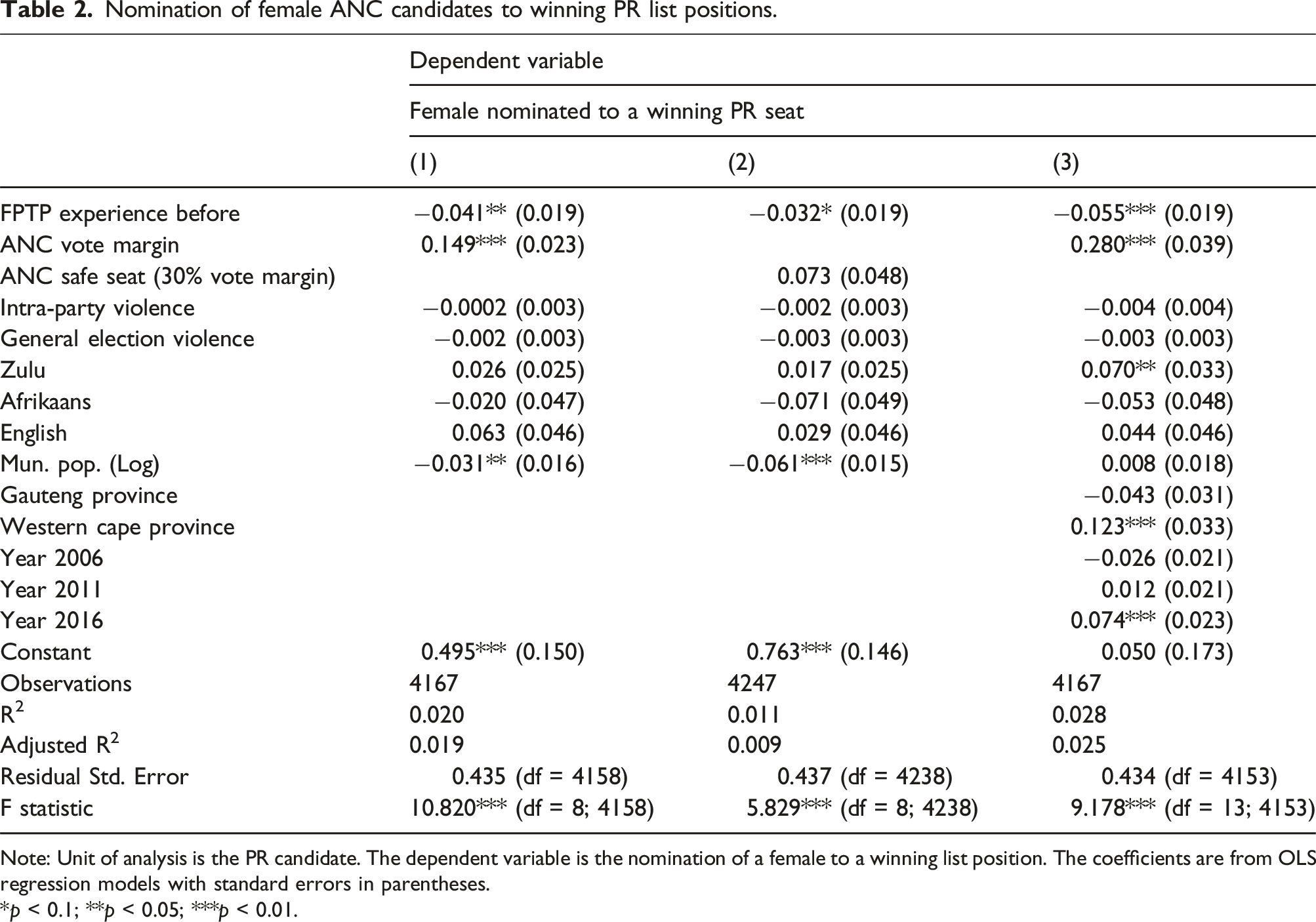
Note: Unit of analysis is the PR candidate. The dependent variable is the nomination of a female to a winning list position. The coefficients are from OLS regression models with standard errors in parentheses.
*p < 0.1; **p < 0.05; ***p < 0.01.
Conclusion
In this article, we studied the sources of women’s underrepresentation in nominations to first-past-the-post elections in local government in South Africa’s African National Congress party. We theorized that role congruity - the perceptions of who is viewed as capable of serving as FPTP councilors is gendered, and explains why women are underrepresented in FPTP elections at the nomination stage. Female candidates in the ANC are held to a higher standard by local party selectors, and are required to be more experienced than their male counterparts in order to be considered qualified for FPTP seats. We argued that previous experience as a PR councilor signals to local party selectors that female FPTP candidates have closer ties to the national party. Our results show that female candidates are significantly more likely to be nominated than men if they have previous experience as PR councilors. We also found that in South Africa’s mixed electoral system, prior experience as a PR councilor operates differently as a signifier of political experience than incumbency. Incumbent status is negatively associated with the probability that a female candidate will be nominated to a ward seat. In a political environment where there is a general negative incumbency bias, prior experience as a PR councilor sends a distinct signal to the party about a woman’s qualification for a FPTP seat.
Local governments, especially in more urbanized countries like South Africa, exert meaningful influence on the distribution of local resources. Studying how electoral institutions and impact candidate nominations expand our understanding of the role of parties in women’s representation at the local level.
Supplemental Material
Supplemental Material - The experience premium and women’s nomination to local elections in South Africa’s African national congress party
Supplemental Material for The experience premium and women’s nomination to local elections in South Africa’s African national congress party by Safia Abukar Farole, and Elif Sari Genc in Party Politics
Footnotes
Declaration of conflicting interests
The author(s) declared no potential conflicts of interest with respect to the research, authorship, and/or publication of this article.
Funding
The author(s) received no financial support for the research, authorship, and/or publication of this article.

Supplemental Material
Supplemental material for this article is available online.
Notes
Author biographies
References
Supplementary Material
Please find the following supplemental material available below.
For Open Access articles published under a Creative Commons License, all supplemental material carries the same license as the article it is associated with.
For non-Open Access articles published, all supplemental material carries a non-exclusive license, and permission requests for re-use of supplemental material or any part of supplemental material shall be sent directly to the copyright owner as specified in the copyright notice associated with the article.
