




Abstract
Is the mainstream news coverage of politics contributing to the legitimization and normalization of the radical right? To answer this question, we focus on two countries (Portugal and Spain) where Radical Right Parties (RRPs) emerged late and developed very quickly. A longitudinal dataset (2015–2024) of newspaper articles was employed to assess the salience of VOX and Chega, their leaders, and four core issues of the radical-right, before and after they first entered the national parliament. A major theoretical expectation was that parliamentary entrance might bolster the media salience of these parties and their leaders vis-à-vis other new political parties. While we find that Chega does indeed receive more media attention than other comparable parties, especially during election times, no such pattern can be detected for VOX. Concerning attention given to leaders, measured as salience and personalization index, we confirm that André Ventura, leader of Chega is given disproportionate attention, while that is not the case for VOX’s Santiago Abascal. Concerning issues, our findings indicate that although notable cross-national differences in media coverage persist, several key issues were already prominent before 2019 (consistent with the agenda-setting expectation) and may have helped advance the radical-right agenda in both Portugal and Spain.
Keywords
Introduction
Work by Berman (2021) examined the strengths and weaknesses of the most common demand- and supply-side explanations for the success of right-wing (populist) parties in the West. After revising economic, sociocultural, and structure and agency-based explanations, the study concluded that preferences on immigration policy and racial issues were the best predictors of support at the individual level. However, the relative stability of such set of attitudes is a challenge to explain the changing “electoral fortunes” of the (populist) radical-right (Berman, 2021: 82), especially in the short term. Therefore, explanations are needed that consider the dynamic nature of radical-right support, a phenomenon that can be intuitively connected with the role of media (Ellinas, 2018).
Several authors have emphasized the role of traditional media in the electoral success of Radical Right Parties (RRPs), especially in early stages where they struggle to gain reputation and visibility (Mazzoleni, 2008). A common scholarly contention is that news coverage is instrumental in legitimizing, or sanitizing, the stances of these political parties to a wider public (Knüpfer et al., 2024). Extant research indeed suggests that the visibility of far-right populist leaders (to Bos et al., 2011) and far-right issues (Walgrave and De Swert, 2004) facilitates the legitimization and electoral success of radical right actors. However, there is room to improve our understanding of how traditional media shape RRPs’ support in time. This gap arises not only from the challenges involved in collecting and analyzing large volumes of media content, but also from the fact that in most Western democracies the radical right began gaining prominence and influencing political debate as early as the 1980s and 1990s (Meguid, 2005).
This article investigates whether and how traditional media coverage contributes to the legitimization and normalization of the radical right. For that, we considered two mechanisms that can influence public support for RRPs; agenda-setting (the salience of issues commonly associated with RRPs) and visibility (the salience of radical right parties and leaders). Based on a diachronic analysis of traditional media news content, we investigate how these dynamics operated in Portugal and Spain, two latecomer cases where radical-right parties emerged abruptly.
While Portugal and Spain were long seen as European outliers in terms of the success of RRPs (Afonso, 2021; Alonso and Rovira Kaltwasser, 2015), a phenomenon often referred to as “Iberian exceptionalism” (Heyne and Manucci, 2021), recent electoral outcomes show that this exceptionalism has faded. Since 2018, both countries have experienced a rapid rise in radical-right support: VOX obtained over 12% of the vote in 2023 parliamentary election, and Chega reached more than 18% in 2024 (Ferrinho Lopes, 2025). These developments are particularly striking given that both parties have only recently emerged on the political scene – Chega was registered as a political party in 2019, and while VOX was established in 2013, it only gained institutional representation in the Andalusian regional elections of December 2018, a breakthrough confirmed in the April 2019 parliamentary elections. Their swift institutional ascent provides an ideal context to exploit temporal dynamics to examine how media visibility and issue salience evolved before and after RRPs gained representation in the national parliament.
To assess the role that traditional media coverage played in the emergence and/or consolidation of RRPs in Spain and Portugal, we analyze news articles from three major newspapers in each country over a 10-year period (2015–2024). More specifically, we assess the visibility given to VOX and Chega, their respective leaders, and four issues commonly associated with populist European RRPs (immigration, crime, corruption and the European Union - EU). This approach allows us to identify regularities in the media coverage of two countries that share relevant characteristics, such as aggregate levels of economic development, trends of social trust (Torcal, 2014), and legacies of authoritarianism (Manucci, 2020).
Our findings indicate that, in terms of diachronic patterns, coverage of RRP issues and parties did not differ substantially across the three major outlets analyzed in each country. Nevertheless, we observe that RRP issues tend to be more salient in newspapers that publish fewer articles per day. On the other hand, although notable cross-national differences in media coverage persist, several key issues were already prominent before 2019 (consistent with the agenda-setting expectation) and may have helped advance the radical-right agenda in both Portugal and Spain. Finally, although the normalization hypothesis finds stronger support with respect to the visibility of RRPs and respective leaders, the sharp increase in the salience of RRP issues during the last 2 years of Spanish news coverage suggests that the radical-right agenda has become increasingly embedded in mainstream media discourse.
The article is structured as follows. First, we provide an overview of the literature on the role of media and the success of radical right parties, and we briefly contextualize our case studies. Next, we outline the empirical strategy, introduce the hypotheses and present the findings. The article concludes with a discussion of the main results and their implications.
The media and the success of the populist radical right parties
It is largely undisputed that the media play a crucial role in transmitting political information to citizens, and abundant empirical evidence supports their influence on political attitudes and voting (Banducci and Karp, 2003; Druckman, 2005). While the media might not be able to tell their audience what to think per se, they are, as Cohen (1963: 13) put it, ‘stunningly successful in telling its readers what to think about’. For decades, mass media have served as a primary vehicle for citizens to get information about politics. Emphasising and ignoring certain political issues, the media seem able to influence the issues that their readers, or viewers, perceive as most important, thus creating the agenda-setting effect (Iyengar and Kinder, 1987). This has key consequences for electoral behaviour., as a large body of empirical evidence shows that a party’s or candidate’s electoral success depends greatly on voters’ perceptions of their competence in dealing with the issues they consider most important (Green and Hobolt, 2008). Furthermore, and moving beyond specific political issues, the attention granted by the media to different parties and candidates also influences their chances of electoral success. Ceteris paribus, the higher the visibility of parties and candidates in the media, the higher the share of votes they can expect to receive on the elections (Van Erkel et al., 2020).
Several factors influence the salience that different political parties and issues have on traditional news media. One of those factors, known as agenda-building (Lancendorfer and Lee, 2010), refers to the strategic efforts of candidates, and parties, to influence the media coverage by emphasising issues on which they hold an advantage. Studies have shown that political actors can indeed guide the issues that are reported by the traditional media using press releases (Lancendorfer and Lee, 2010) or social media engagement (Seethaler and Melischek, 2019).
In principle, traditional media coverage and agenda-building effects could benefit RRPs to a lesser extent. Not only because RRPs often face an “unofficial boycott” from the traditional media (Mudde, 2015), but also because it is usually the dominant or mainstream parties that can successfully influence the traditional media’s agenda (Hopmann et al., 2012). However, we believe that well documented changes in the functioning logics of traditional media may have also aligned with, and benefited, the agenda of RRPs. More concretely, the traditional media have evolved from a party logic - where content was largely determined by the partisan or ideologic alignments - to a public and, subsequently, media logic (Brants and Praag, 2006). While in the public logic the journalists assume the role of watchdogs that oversee the actions of public officials, which can, for example, increase the number of articles about corruption, in the media logic, following commercial principles, the media compete to attract more viewers and readers (Savigny, 2002). Ultimately, this logic facilitates negative campaigning, as well as the coverage of scandals and controversial topics (Gerstlé and Nai, 2019; Maurer et al., 2023), which should benefit RRPs. In this context, the goals and the incentives of contemporary media often align with the platforms of RRPs, increasing the visibility of their leaders, and legitimizing the political issues they emphasize the most (Mazzoleni, 2008; Mudde, 2004).
In fact, the great relevance of the media in the electoral fate of political parties, combined with recent media logics to attract attention, have led scholars to think of their role in the success and normalization of RRPs (Ekström et al., 2020; Jambrina-Canseco, 2023), the fastest-growing party family in contemporary politics (Golder, 2016). Despite their negative perception of mainstream media (De Cleen and Knops, 2019) and associated propensity to use alternative channels of communication (Figenschou and Ihlebæk, 2019), RRPs also depend on established outlets to spread their political ideas. While media visibility does not automatically foster party support (Bos et al., 2017), existing evidence indicates that media coverage of the radical-right increases propensity to vote for them (Katsourides and Pachita, 2023), makes them more sympathetic to the public (Berning et al., 2019), and may create opportunity structures (Thesen, 2018). Existing research also suggests that the news coverage of right-wing party leaders is determinant for their electoral success. According to Bos et al. (2011), the prominence in mass media affect positively the image, or perceived legitimacy, of radical-right populist leaders.
An indirect agenda-setting effect has also been found by means of which RRPs gain votes whenever their core issues appear more often in the media (Koopmans and Muis, 2009; Völker and Gonzatti, 2024). Research suggests that even innocuous media coverage of issues such immigration can, indirectly, contribute to the success of RRPs (Sheets et al., 2016). Similarly, Walgrave and De Swert (2004) found a correlation between the salience of crime news in the Belgium media, and support for the far-right. These results are not surprising when we consider three interconnected observations in the literature. First, RRPs have a very clear set of issues that they ‘own’ and consistently politicise, such as, ‘immigration’, ‘crime’, ‘corruption’ and European integration (Mudde, 2015), and, unlike most mainstream parties, RRPs can capitalize the salience of those issues without risking a loss of credibility (Meyer and Müller, 2014). Second, RRPs are more likely to emphasise conflict and relate to concrete cases, particularly the topics of crime and corruption, which have been shown to strengthen the agenda-setting effect (Jasperson et al., 1998; Wanta and Hu, 1993). Third, supporters of RRPs tend to be less educated males (Zaslove, 2004), who are more likely to be influenced by the agenda-setting effect (Stubager, 2015). In this research, we examine the media coverage of RRPs and their preferred issues in Portugal and Spain. Ultimately, our goal is to explore potential connections between the role of media and the emergence/consolidation of new radical-right parties in Europe.
Media and RRPs in Portugal and Spain
The long absence of RRPs in Spain and Portugal, sometimes justified by their past experiences with dictatorship and the mainstream right parties’ capacity to attract that electorate (Halikiopoulou and Vasilopoulou, 2014), came to an end in 2019. In the Spanish case, after entering the regional parliament of Andalusia in December 2018, the political party VOX, founded in 2013, won 24 seats, with 10.3% of the vote, in the general elections of April 2019 (Turnbull-Dugarte et al., 2020). The 2019 legislative elections in Portugal marked the entry of Chega, a party founded mere months earlier, into the parliament, as it captured a seat with 1.3% of the vote.
Since their entry into the national parliaments in 2019, the two parties have shown slightly different trajectories of electoral success. VOX initially increased its vote share in the elections of November 2019, called after no candidate secured enough support in April 2019 (from 10.3% to 15.1%), but lost part of these votes in 2022 (12.4%). In contrast, Chega’s vote share has only grown in the three legislative elections called since 2019. Chega received 7.2% of the vote in 2022, its vote share more than doubled in 2024, reaching 18.1% and consolidating its position as a mid-sized party (Santana-Pereira and Nina, 2024). In the snap elections of 2025, Chega effectively brought an end to the historical bipartisanship of the Portuguese system: with 22.76% of the vote, it fell just 0.07 points short of becoming the second most-voted party (Heyne et al., 2025).
The end of the Portuguese and Spanish ‘exceptionalism’ has stimulated a considerable amount of research focusing on the characteristics of Chega and VOX and the determinant factors to their electoral success. Despite their categorization as RRPs, they still have their own specificities. In the case of Chega, its online communication has neglected the topic of the EU, focusing instead on the issues of crime, corruption and, albeit to a much lower extent, immigration (Mendes, 2021). In the case of VOX, the focus on the centre-periphery cleavage, particularly the issue of the Catalan independence, gender and economic issues, demark more noticeably this party from the conventional radical-right family (Pardos-Prado, 2020). 1 There is however a broad agreement on the characterization of VOX as an authoritarian and nationalist party that fits into the radical-right family (Marcos-Marne et al., 2024; Rama et al., 2021).
Regarding the characteristics of their supporters, Heyne and Manucci (2021) found that education, age and religiosity are important predictors of the probability to vote for Chega and VOX. The supporters of these two parties tend to be less educated, more religious, and younger. However, while gender issues seem to be relevant only for supporters of VOX, who were likelier to reject feminism, the individuals from rural areas were, instead, likelier to vote for Chega in 2019 (Heyne and Manucci, 2021). Finally, while the perception of corruption did not seem to be a significant predictor of support for Chega and VOX when other relevant variables were controlled for, higher levels of political dissatisfaction contributed to explain vote for these parties in 2019 (Heyne and Manucci, 2021).
In addition to these individual-level explanations, and more in line with this paper’s framework, different studies point to the role of media in shaping the electoral rise of VOX and Chega. Mendes and Dennison (2021) argue that the news coverage of these parties was more frequent and less negative when compared to other radical right parties. They argue that the increased visibility, reduced stigmatization, and favourable opportunity structures—some of which were tied to the politicization of issues like Catalan independence—were crucial factors to explain VOX and Chega’s electoral gains. Similarly, focusing on Portugal, Braz (2023: 15) claims that traditional media fuelled Chega’s rise by providing disproportionately extensive coverage due to its leader’s “controversial and provocative tabloid-style language”. To examine the media coverage of RRPs and their preferred issues in Portugal and Spain, we lay out expectations that tap into party and issue salience in the media.
Party salience
An established finding in the literature is that political parties compete for media attention, with coverage space typically allocated as a function of parties’ size and perceived relevance (Hopmann et al., 2012). Due to audience-oriented routines, newness also enhances news value (Baum and Groeling, 2008), as does the presence of radical or extreme positions on socio-cultural issues (Gattermann et al., 2022). The implications of these findings for our study are twofold. First, because Chega and VOX are new political parties that improved their electoral results, increased attention is expected during the campaign and especially after the elections. Second, because Chega and VOX are RRPs, we could also see that their salience in the media is higher than other non-radical new political parties. Braz (2023) argues that Chega’s controversial and provocative language led to a disproportionately high visibility in Portuguese media. Moreover, the higher visibility of VOX and Chega is likely to persist after their entrance into national parliaments because, as Mutz and Reeves (2005: 13) contend, even though citizens condemn politicians’ attacks and uncivil behaviour, they are nevertheless drawn to that type of content in journalist pieces. The discursive strategy of these parties - marked by controversial issues, harsh rhetoric, and media savvy leaders – carries very high news value (Esser et al., 2016). Therefore, because both novelty and ideological radicalism increase newsworthiness, we expect RRPs and their leaders will receive greater visibility than non-radical new competitors. For those reasons, we expect that:
The presence of Chega and VOX in the news coverage increased after they first gained institutional representation.
The presence of Chega and VOX’s leaders in the news coverage increased after they first gained institutional representation.
The presence of new radical-right parties (Chega and VOX) in the news coverage was greater than that of non-radical new parties.
The presence of new radical-right parties’ leaders (Ventura and Abascal) in the news coverage was greater than that of non-radical new leaders.
Issue salience
A twofold scenario should be acknowledged to develop expectations about the media coverage of issues associated with the radical-right. First, in line with expectations above, it could be that increased media attention to RRPs may lead to greater media coverage of the issues they “own”. That is, more news about Chega, VOX, and their leaders would imply that their electoral platforms are more often present in the media too. In fact, and beyond the direct effect of RRPs, it could also be that these issues become more popular in the media because other parties adopt some of their ideas and talk about radical-right core issues too - an indirect effect stemming from the normalization and accommodation of radical-right discourses and demands. Supporting this approach, a study found that, in the last legislative elections in Portugal, the televised debates became noticeably shaped by Chega’s agenda (Santana-Pereira and Nina, 2024), and, a positive association has been found between gaining representation and the normalization of the radical-right at the voters’ level (Valentim, 2021), as well as the media (Ekström et al., 2020).
However, it could be that the electoral success of RRPs does not translate into increased media attention to their core issues, provided those topics were already highly salient before their breakthrough. This second scenario assumes that the success of RRPs can be influenced by the role of media when reporting key topics prior to the elections (Štětka et al., 2021), and sometimes prior to the emergence of successful RRPs. While the role of media matters in both scenarios, media coverage precedes more clearly the success of RRPs in the second one and runs in parallel with them in the first one. As both theory and empirical evidence point out into different directions, we simply ask:
Was there an increase in the salience of issues often politicized by Chega and VOX after they first gained institutional representation, or did media heightened attention to these issues exist before?
Data and methods
Our data consists of newspaper articles from Portuguese and Spanish media. Using Factiva, we systematically collected the articles that were published in the first 15 days of each month, for a period of 10 years, from 2015 until 2024 (thus covering a broad period before and after the elections where the radical-right entered the national parliaments). A total of 1,230,658 articles were collected from the print version of six major national newspapers. The selected newspapers 2 were ABC, El Mundo, and El País in Spain, and Correio da Manhã (CM), Jornal de Notícias (JN), and Público in Portugal. We chose to focus on newspapers for both technical and substantive reasons. Technically, newspaper content is easier to collect and analyse compared to other news media like television or radio. Substantively, newspaper coverage serves as a reliable proxy for broader media dynamics, as the press has traditionally functioned as a primary agenda-setter for other communication channels (Boomgaarden et al., 2010). This means that the observed results, particularly in terms of longitudinal variation, could be extrapolated to other newspapers with lower readership as well as to other media, such as television and radio.
Total number of articles analysed per newspaper, year and country.
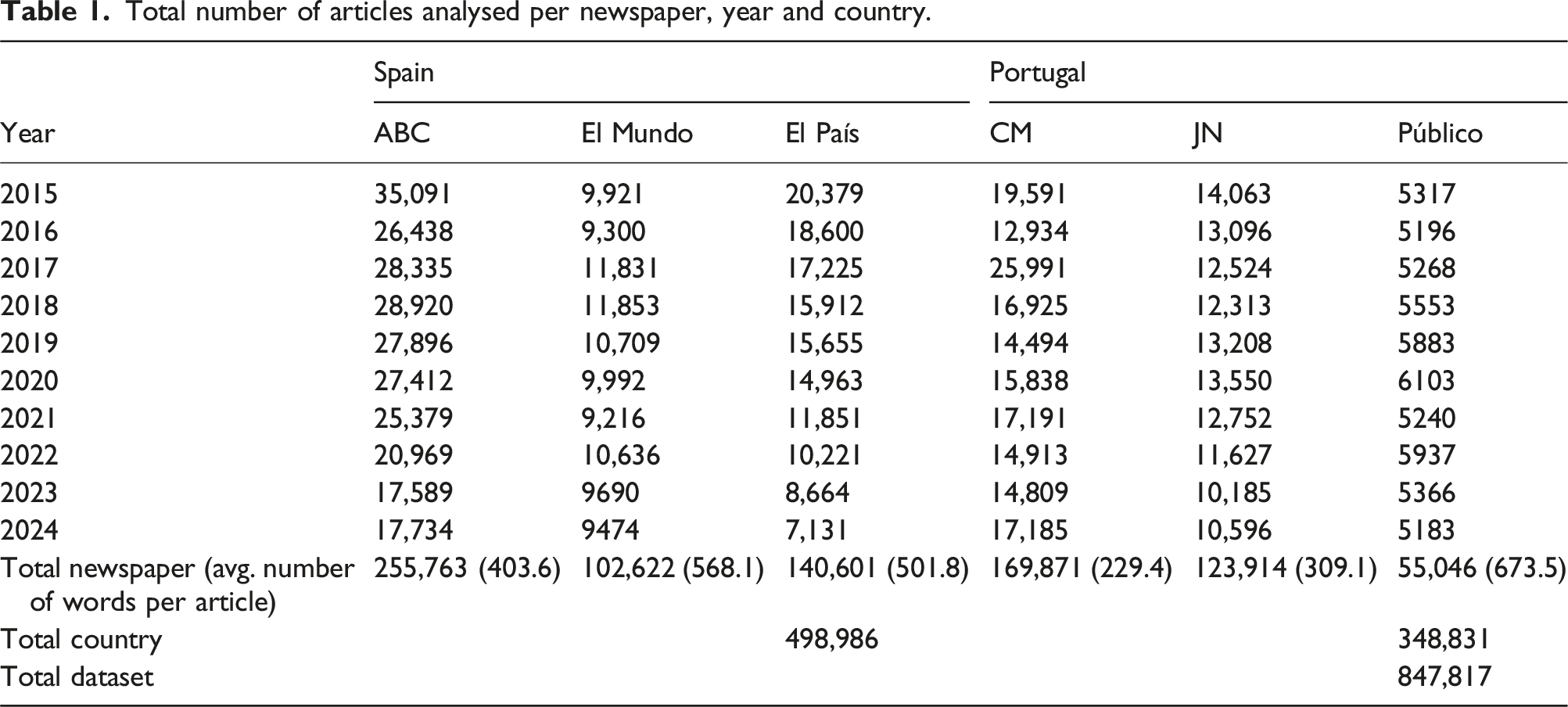
To measure the salience of political parties, actors, and issues, we focused on the proportion of articles referring to Chega and VOX, their respective leaders (Ventura and Abascal), and the four main political issues for far-right parties in Europe: immigration, crime, corruption and the EU (Mudde, 2015). 5 The topics and actors were identified using an extensive keyword approach that has been previously used, and validated, to study the politicization of the EU (Silva et al., 2022). Our script accounted for word changes from cases and possible lack of diacritical marks in the different words. We considered an article to deal with a particular actor/topic when the name of that actor, or a keyword belonging to the topic, was present in the article’s title, lead paragraph or body. The different classifications are not mutually exclusive, and we do not make any assumptions regarding the level of prominence that a particular topic has in the article. 6 The list of keywords for each issue, along with additional details on this approach, including the main challenges encountered and the validation of the results, is included in the Appendix.
Our approach can be, generally, less inclusive than other computer-assisted content analysis mechanisms such as supervised topic models or large language models. However, it is particularly well suited for our goal of examining diachronic variations in a predefined, limited set of topics and actors across a large dataset. This method is easier to replicate and interpret, and it also renders an objective and reliable comparison across time, newspapers, and countries, which is not affected by different contexts or journalistic styles. Differently from unsupervised and semi-supervised methods, the method we used does not require any subjective input from the researchers.
Descriptive results for the number of articles analysed per quarter.
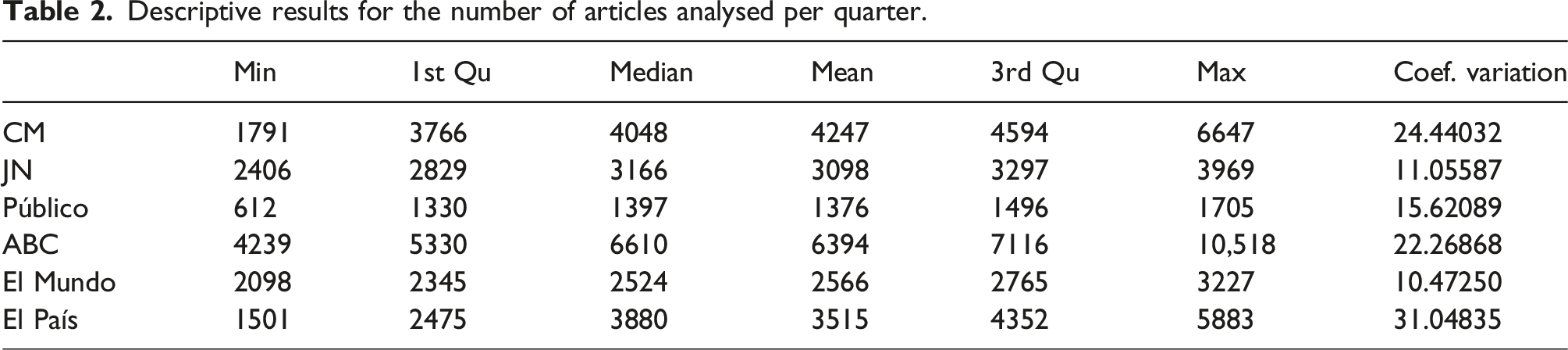
Our analysis focuses on three measures for political actors, and four more for political issues. Thinking of actors, we pay attention to (1) Party Salience (percentage of articles mentioning the party); (2) Leader Salience (proportion of articles mentioning a leader); and (3) Personalization (number of articles mentioning the leader divided by the number of articles mentioning the party and multiplied by 100). The four political issues’ measures correspond to the salience of (5) Immigration; (6) Crime; (7) Corruption; and (8) EU.
To properly measure the magnitude and variance in the salience of the two RRPs (Chega and VOX) and their respective leaders (H3 and H4), we also coded data for other new political parties that also obtained some electoral success in the same period. For Portugal, we included three parties (Pessoas-Animais-Natureza - PAN, Livre, and Iniciativa Liberal – IL), and their respective leaders. 7 While IL and Livre, similarly to Chega, entered the parliament with a single MP in 2019, PAN elected its first MP already in 2015. In the Spanish case we used data from Ciudadanos and Podemos, who first entered parliament in 2015 (no other party entered parliament in 2019 with results comparable to those of VOX). Although we acknowledge the limitations associated with comparing different points in time, data from Ciudadanos and Podemos can still be used as benchmark to see the media effects of gaining institutional representation at the national level for the first time. To further illustrate, from a comparative perspective, the diachronic changes in the media visibility of Chega and VOX, we also used the two main political parties of each country as benchmarks (see Figure A1 in the Appendix).
Results
Parties and leaders in the media
Figure 1 shows the percentage of articles that mentioned Chega and VOX (black solid lines) together with country benchmarks (grey lines).
8
As anticipated, the visibility of Chega noticeably increased after its electoral success in October 2019. Similar results are observed for VOX after December 2018, when it first gained institutional representation in the Andalusian regional elections, and again in April 2019, when it entered the national parliament. However, we do not find evidence supporting the expectation that the coverage of RRPs is consistently higher in both countries when compared to that of other new parties with different ideological profiles (see, for example, the salience of Podemos in 2016). In Spain, we confirm the general effect of entering institutions on salience (H1), although we do not find support for the idea that this effect is stronger for radical-right parties, which runs against H3. In Portugal, where the context is more suitable for testing H3, we find that Chega consistently received more media attention than parties with either more MPs (PAN) or the same number of MPs (Livre and IL), particularly during electoral periods (2022.1 and 2024.1). Furthermore, over the last 2 years in Portugal and the past 18 months in Spain, both Chega and VOX have been consistently more visible than other newcomer parties.
9
Salience of the newcomer parties in the Portuguese and Spanish media per quarter (2015–2024).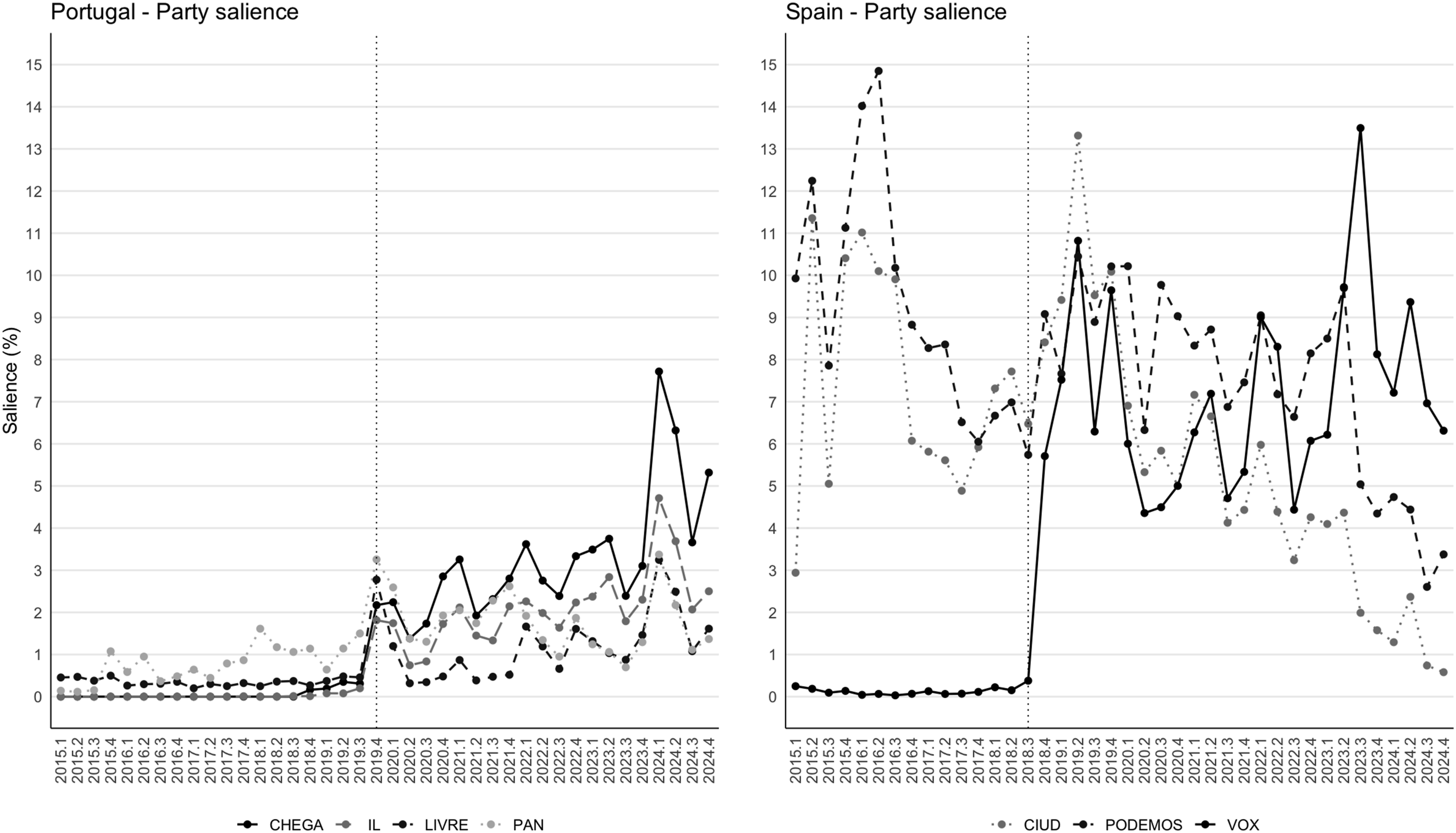
Complementing these results, Figure 2 contains data on party leader’s salience. They evidence that institutional representation matters and increased the visibility of party leaders in newspapers too (H2). However, while André Ventura received more attention than other leaders of newly created parties in Portugal after gaining parliamentary representation, that was not the case for Santiago Abascal in Spain until the second half of 2021. Because this shift in Spain coincided with leadership transitions in Podemos and Ciudadanos, we find only partial support for H4 – restricted to the Portuguese case. Salience of the leaders of the newcomer parties in the Portuguese and Spanish media per quarter (2015–2024).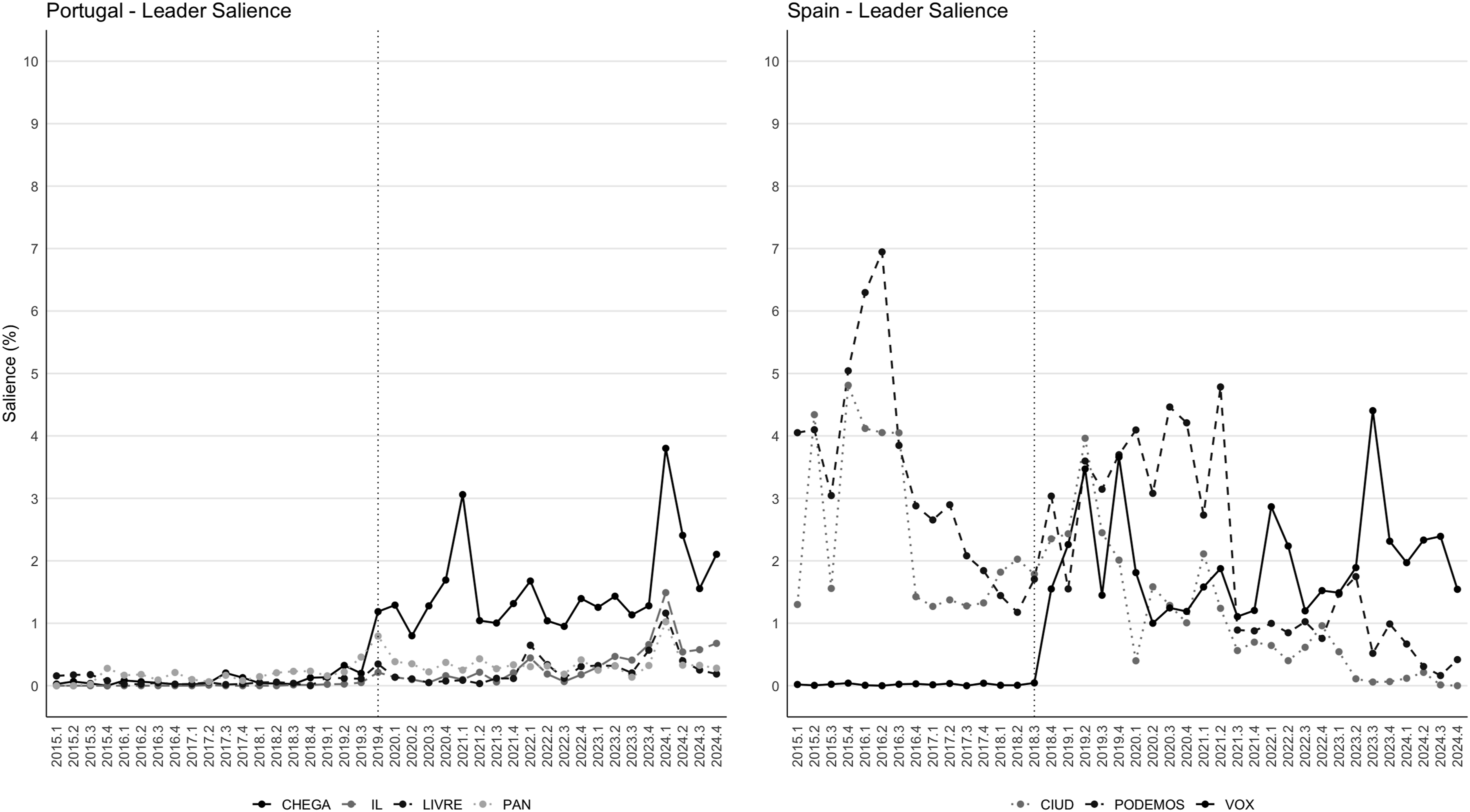
Figure 3 explores the degree of personalization, showing the percentage of articles about the leader in relation to the number of articles about the party, for each party (what we call a personalization index). Focusing on the period after 2019, the personalization values for VOX have been frequently lower than 30%, and regularly higher than 60% for Chega. Substantively, this means that more than half of the articles about Chega also mentioned its leader, Ventura. As a matter of fact, in the second quarter of 2019, the number of articles mentioning Ventura was higher than the number of articles mentioning his political party. Personalization of the newcomer parties in the Portuguese and Spanish media per quarter (2015–2024).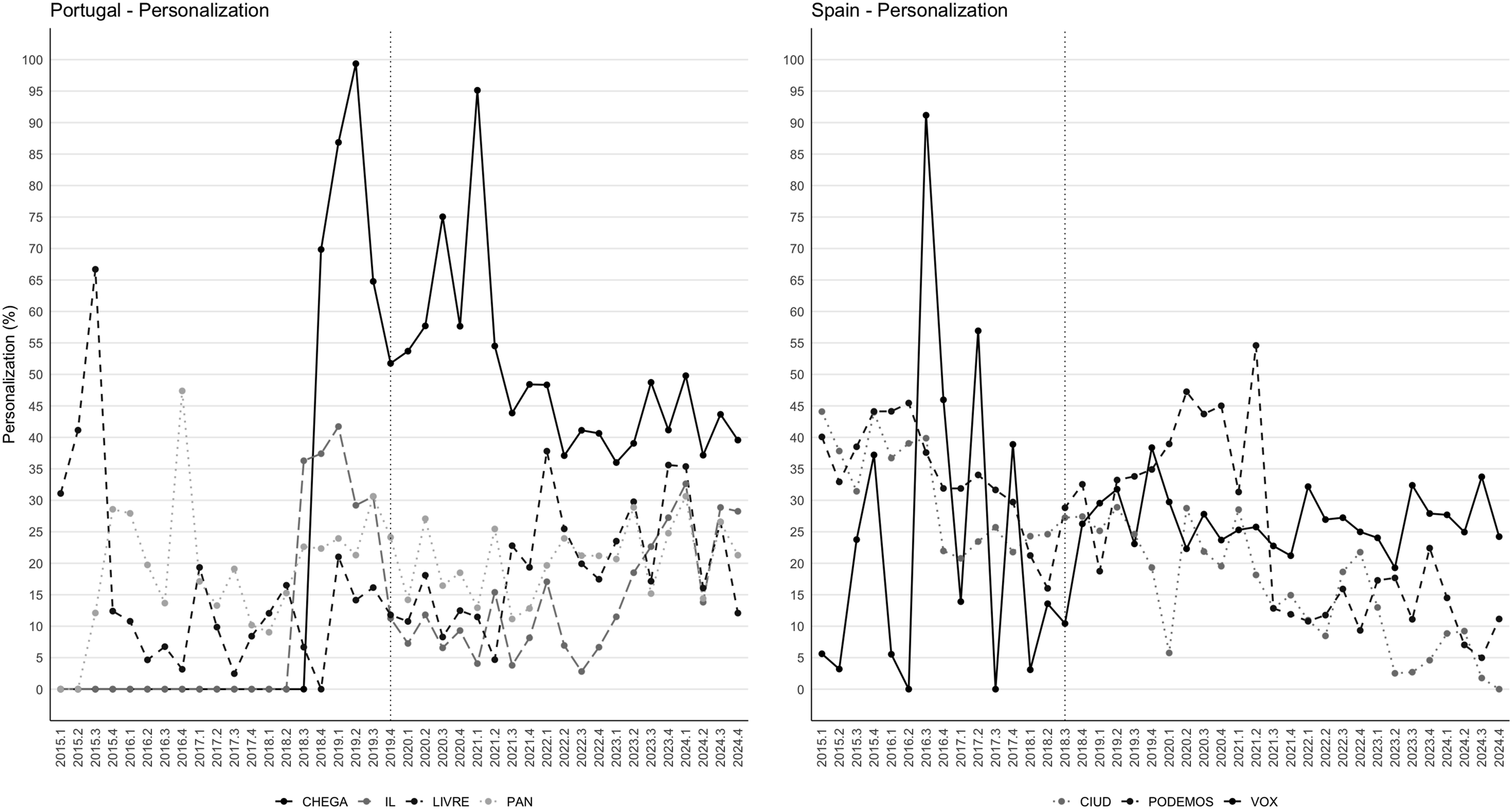
Overall, our analysis of the salience of Chega and VOX in the media yields two main outcomes. The first one is that both the parties and their respective leaders were largely absent from the media before their first electoral successes. The second one is that even if the salience of the parties and leaders increased considerably after entering regional and national parliaments, that increase is comparable to that of other parties gaining institutional representation for the first time. Yet, at the leadership level, Ventura attracted more attention than other new-party leaders in Portugal, whereas Abascal did not enjoy a comparable advantage in Spain.
Salience of issues in the media
A summary of the salience of the four main political issues associated with RRPs is included in Figure 4. Main results suggest that the response to RQ1 aligns more closely with these issues being salient in the media before RRPs entered parliament. Overall, the coverage of these issues did not noticeably change immediately after Chega and VOX’s parliamentary breakthroughs, suggesting that the overall upward trend in the EU and crime salience cannot be fully attributed to their institutional entry. However, as we will see, a case could be made for the politicisation of these issues in Spain, as their salience appears to have increased during the second half of the period analysed. Salience of the four issues in Portuguese and Spanish media per quarter (2015–2024).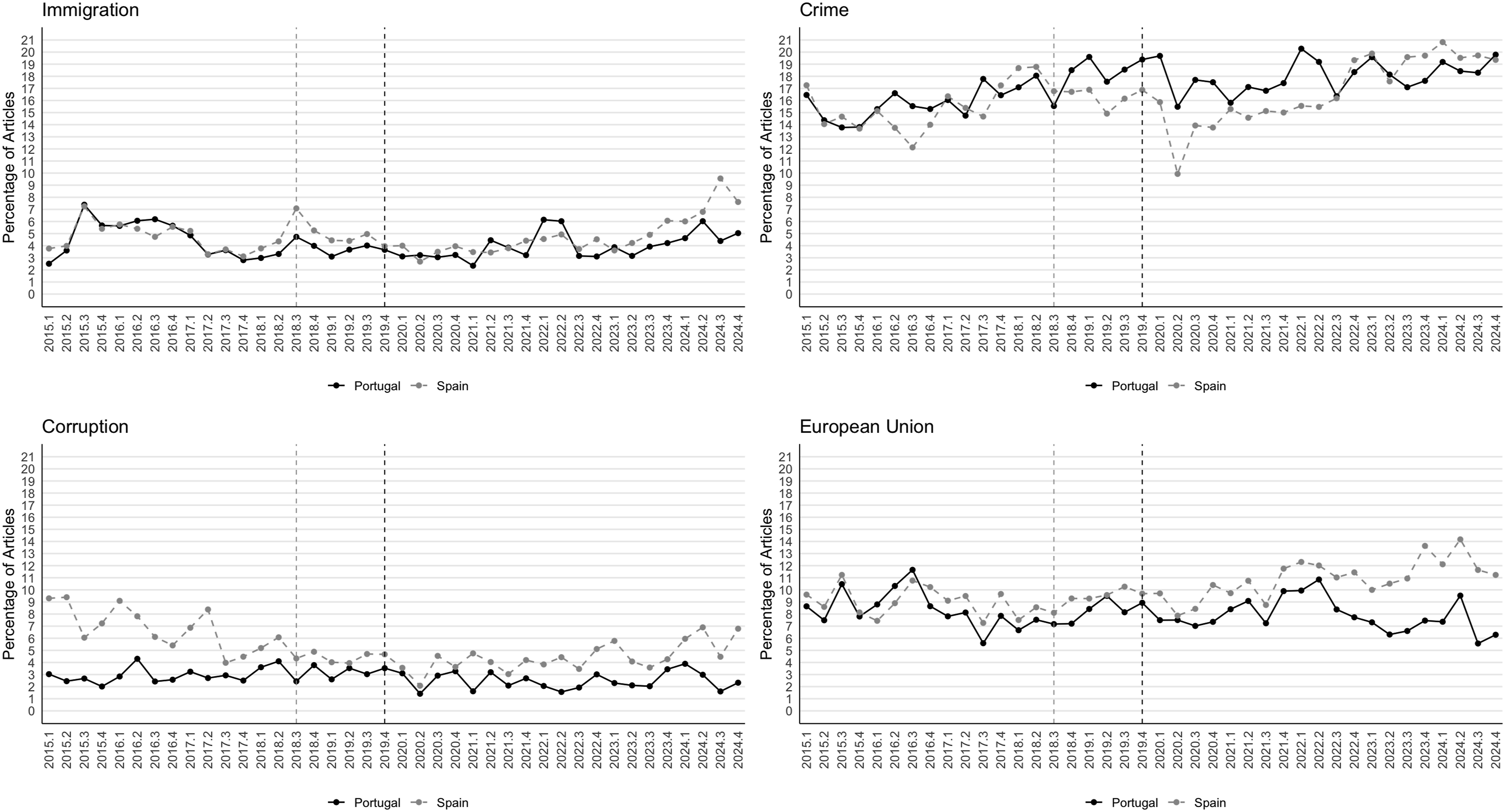
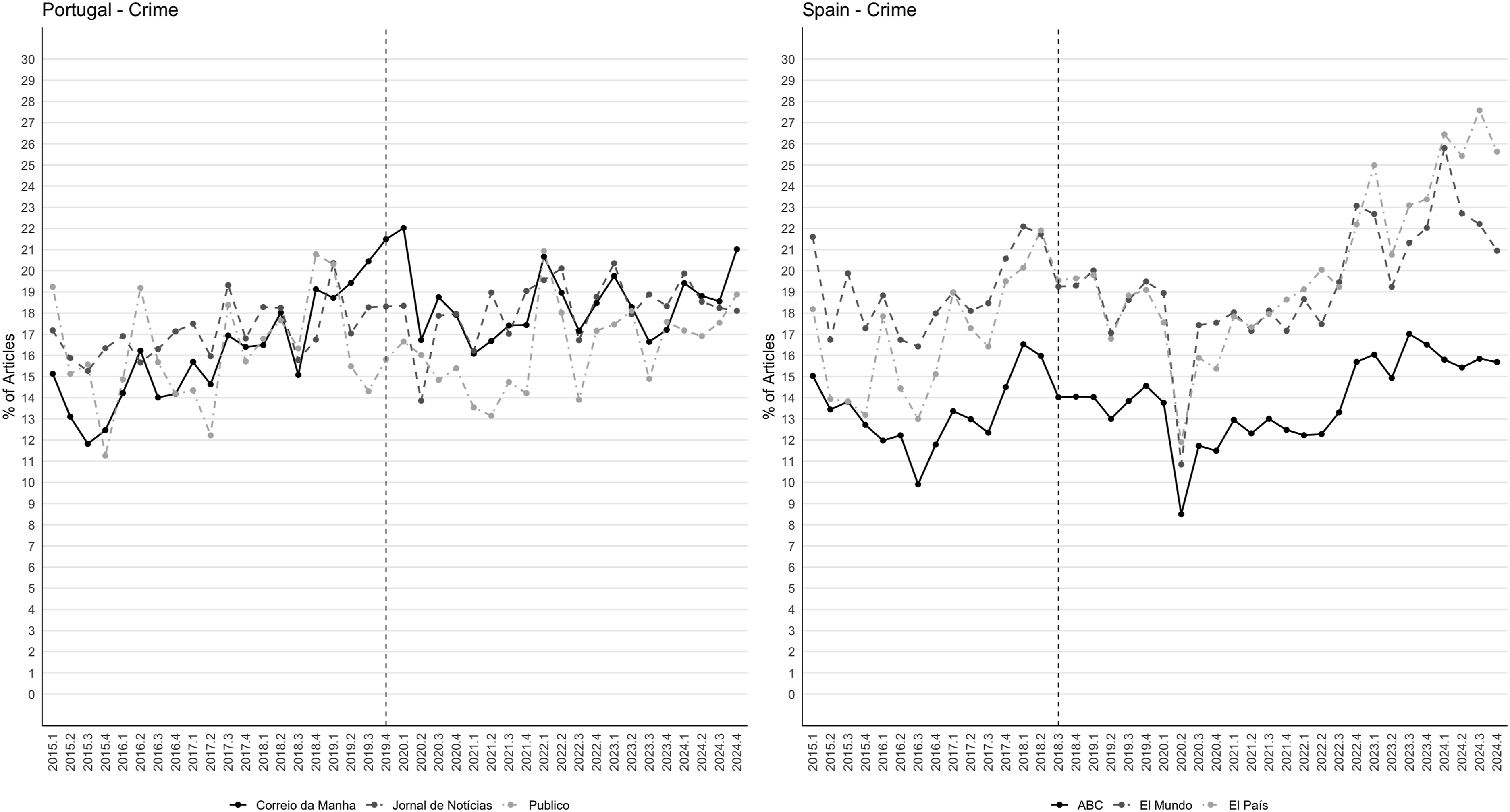
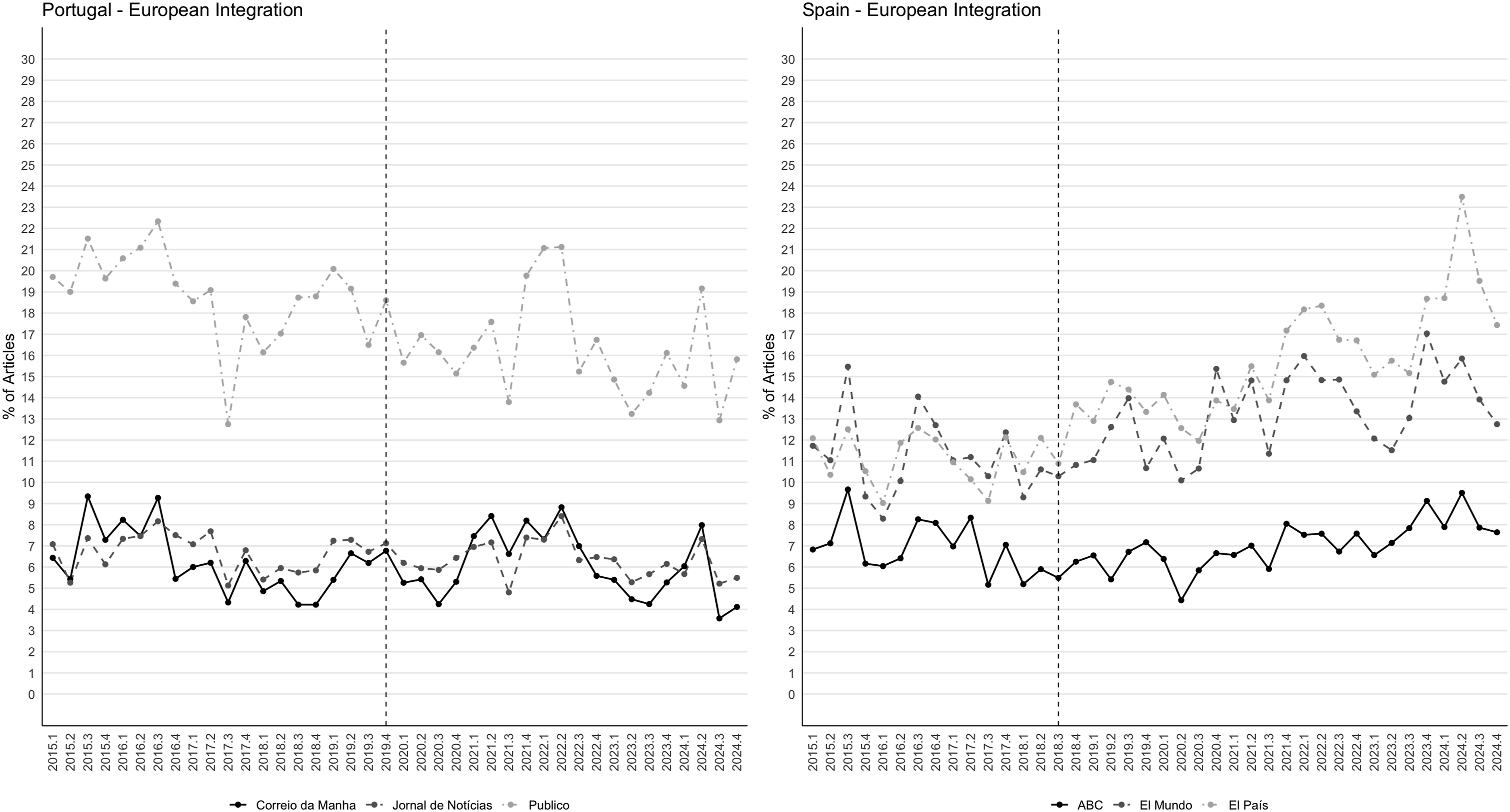
Regarding the salience of the four issues, there are noticeable differences between the newspapers analysed (Figures 5–8). Except for JN, the salience of the EU topic was considerably higher in the broadsheet newspapers (Público, El Mundo and El País). The difference is more evident in Portugal, where frequently more than 20% of Público’s articles mention the EU. In the case of Spain, however, there is a clear upward trend in the salience of the EU in the two main broadsheet newspapers analysed. For the remaining three issues, the newspapers with higher daily publication volumes (CM and ABC) consistently displayed lower levels of coverage of RRP issues, except for crime in Portugal, which appeared more frequently in Correio da Manhã. Interestingly, and contrary to common assumptions in political communication research, we find no evidence that media logic has been a decisive factor in shaping the salience of RRPs’ core issues in the news media of Portugal and Spain. Finally, the disaggregated analysis further shows that in Spain the salience of crime, the EU, and immigration increased substantially in the later years of the period analysed, particularly in El País and El Mundo. Salience of the immigration topic in the Portuguese and Spanish newspapers per quarter (2015–2024). Salience of the crime topic in the Portuguese and Spanish newspapers per quarter (2015–2024). Salience of the corruption topic in the Portuguese and Spanish newspapers per quarter (2015–2024). Salience of the EU topic in the Portuguese and Spanish newspapers per quarter (2015–2024).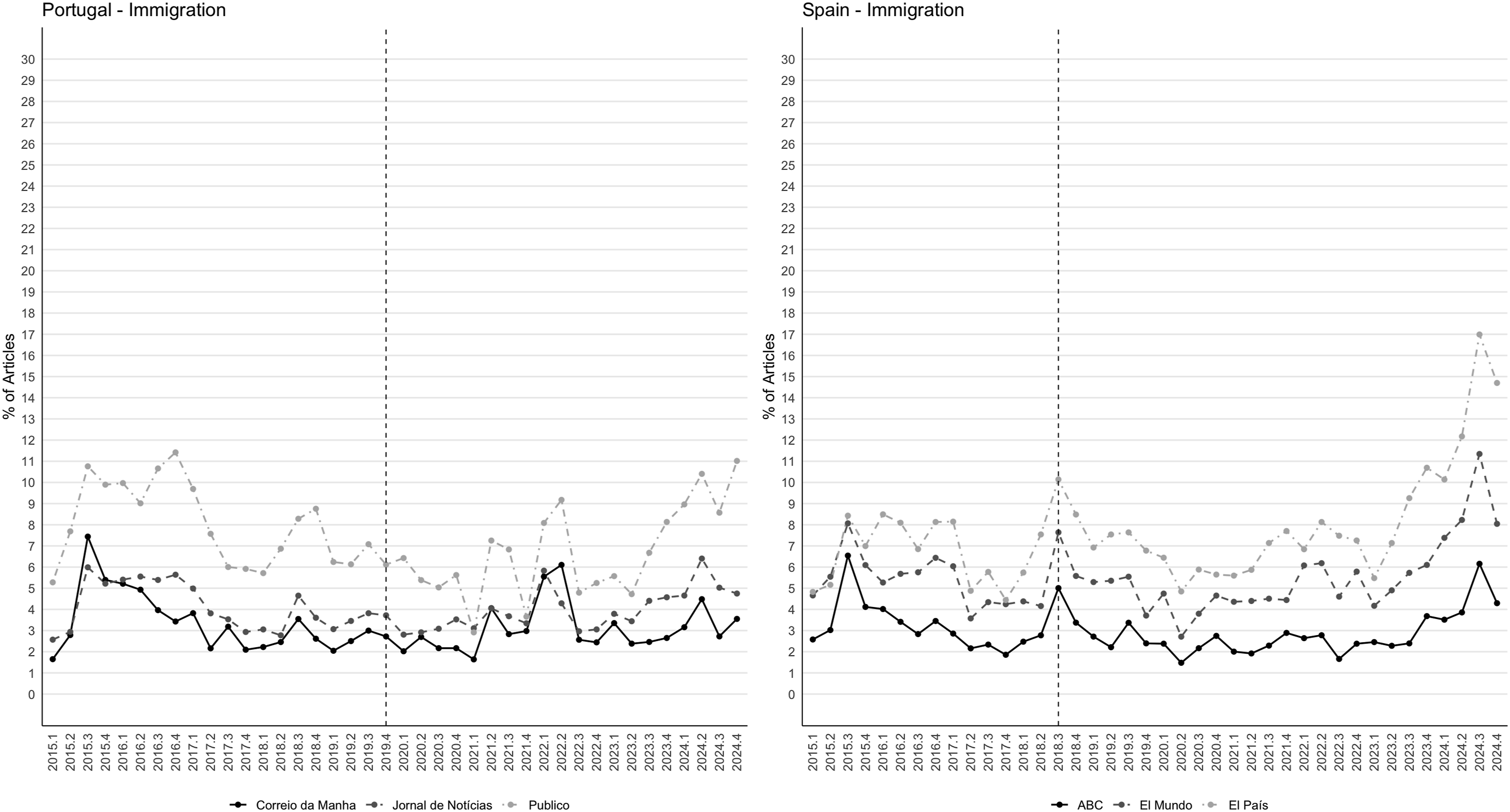
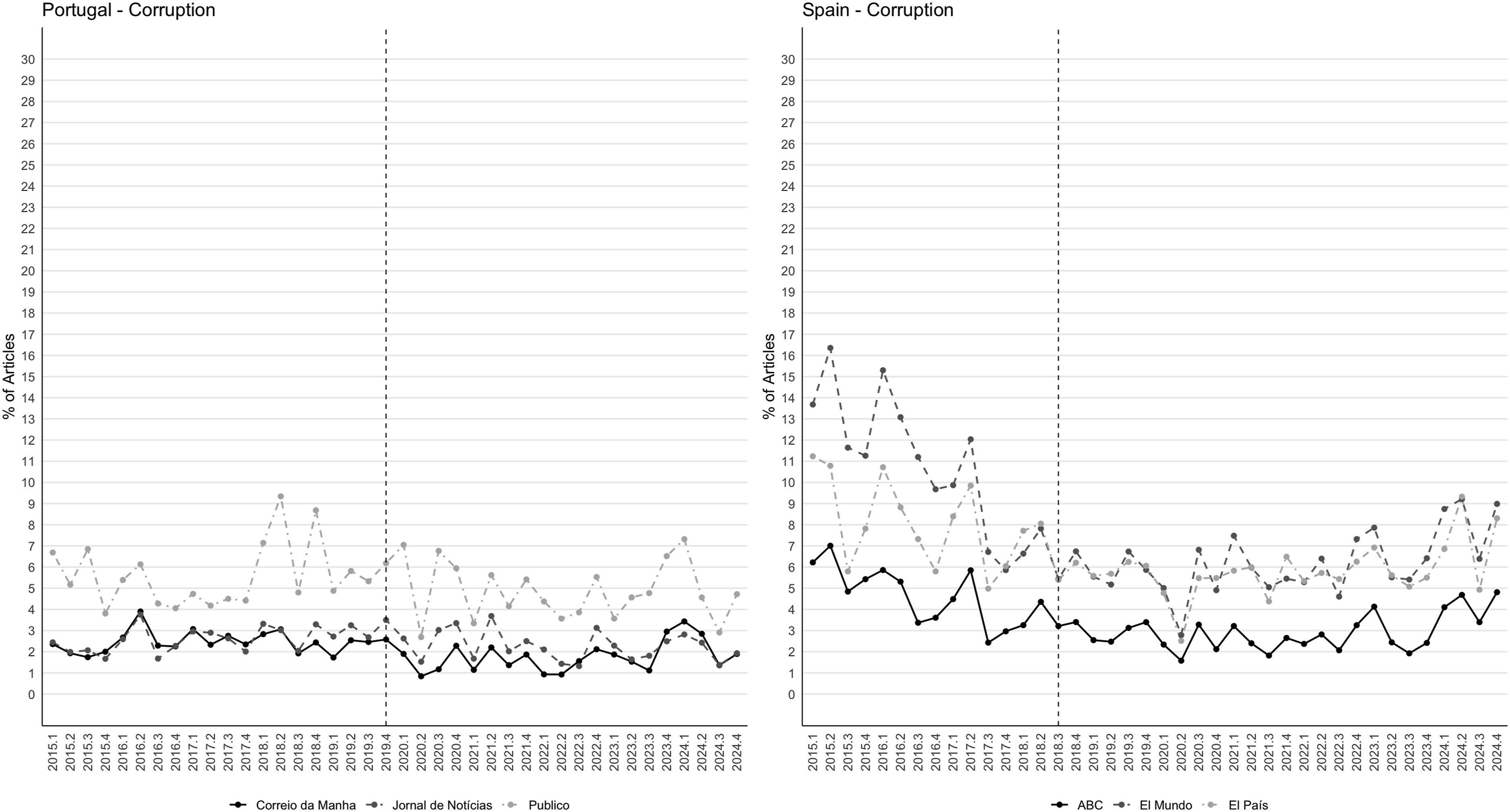
The last aspect we considered is the salience of the four issues within articles explicitly mentioning Chega and VOX (Figure 9). This analysis is important for two reasons: first, it reveals whether the issues commonly associated with European RRPs were also central to Chega and VOX’s media coverage; and second, it captures longitudinal variation in issue emphasis. Salience of the four issues in the articles about Chega and VOX.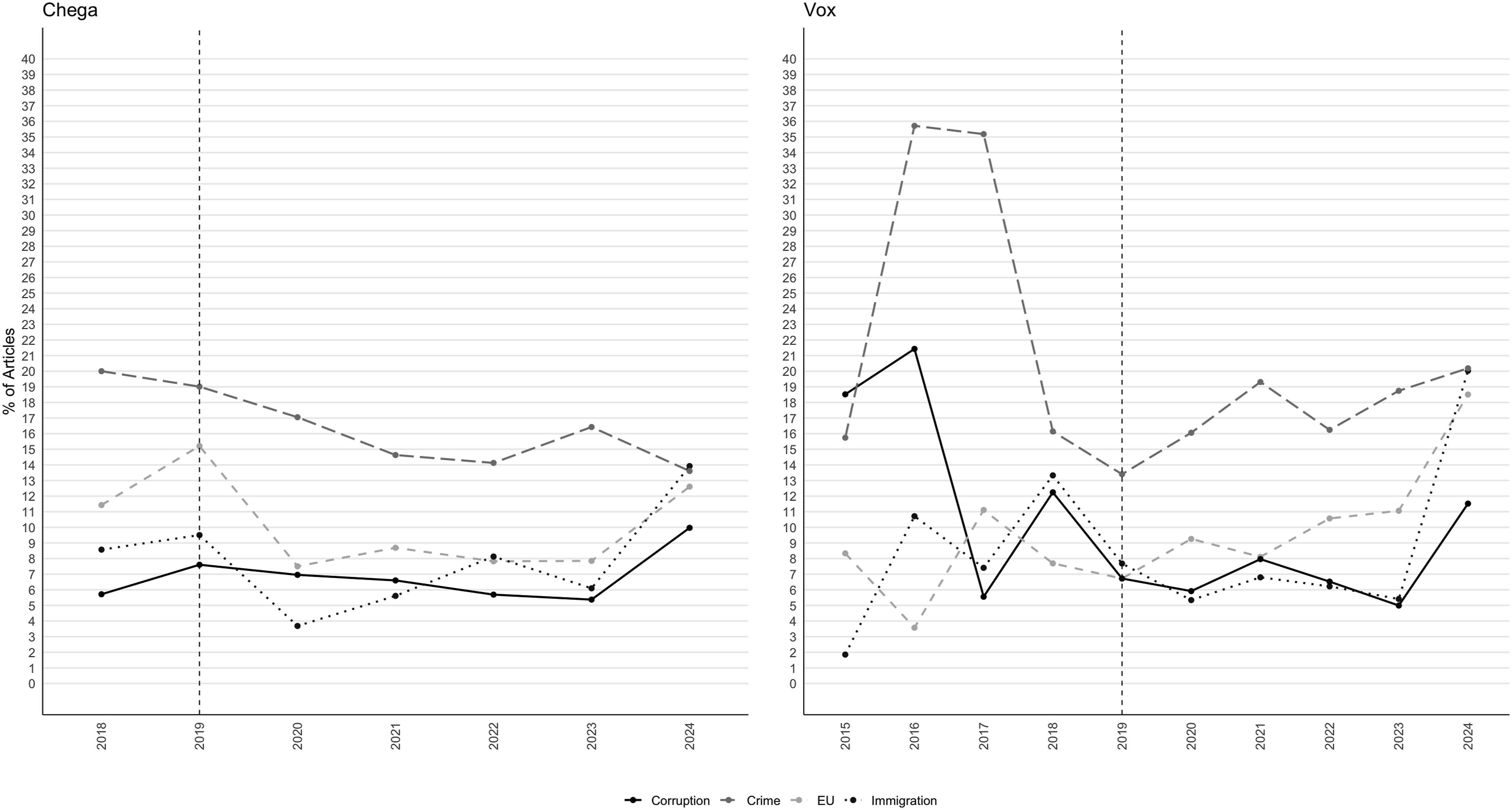
Figure 9 indicates that, in Portugal, crime was the most salient issue in articles referring to Chega until 2024, when the salience of immigration and the EU reached similar levels. The results for Spain show a very similar pattern. Since 2016, crime has been the most salient issue in articles mentioning Vox, but immigration and the EU became as salient as crime in the last year analysed. Interestingly, and unique to the Spanish case, the topic of corruption was relatively prominent in articles about VOX before its entrance into the regional parliament of Andalusia. Because crime - and, in Spain’s case, corruption - were already highly salient before 2019, our analysis provides some support for the idea that these two parties may have benefited, to some extent, from the agenda-setting influence of traditional media.
Conclusions
This study examined a decade of newspaper coverage in two countries, Portugal and Spain, to offer a diachronic assessment of the salience received by RRPs, their leaders, and their main political issues. Building on a combination of the agenda-setting theory and scholarship on media logics we have tested four expectations about the salience of Chega and VOX in the printed media. More concretely, we anticipated that the electoral success of these two radical right parties, in 2019, bolstered their salience, and the salience of their respective party leaders, in the traditional media. Moreover, we also expected that the increase in mediatic visibility received by those parties (and leaders) would be higher than new non-radical parties (and leaders) in similar conditions.
Our findings confirm that institutional representation matters. The visibility of both parties and leaders increased sharply after their first electoral successes in 2019 (supporting H1 and H2). However, this increase was not particularly evident in Spain when compared to the media coverage of the most suitable controls (Podemos and Ciudadanos). In Portugal, however, as anticipated, Chega’s visibility has been consistently and noticeably higher than that of other new non–radical-right counterparts, particularly during recent electoral periods. Overall, these results suggest that the radical-right character of these parties does not necessarily generate disproportionate media attention (against H3), although the Portuguese case shows that such patterns may emerge in specific contexts.
When looking at leaders and the personalisation index, however, the Portuguese case stands out, as Ventura received far more coverage than the leaders of other new parties (giving partial support to H4). This reflects not only Ventura’s centrality to Chega but also his previous experience as a sports commentator and his ability to perform according to the dynamics of contemporary media logic, where personalization, controversy, and emotional resonance increase news value. By contrast, the salience of Santiago Abascal in Spain grew more gradually and never fully outpaced that of other new-party leaders. This contrast illustrates how leadership style, rather than ideology alone, conditions the extent to which RRPs can capitalize on media visibility.
Turning to issue salience, our study also showed that the electoral success of RRPs in Portugal and Spain did not translate into an immediate increase in the coverage of radical-right issues in the media. Instead, topics such as immigration, crime, corruption and the EU were already salient in both countries’ news agendas well before the 2019 elections. This suggests that the ‘normalization’ of the radical right issues in Portugal and Spain did not result from their electoral rise but rather preceded it, facilitated by long-term media environment increasingly attuned to conflictual and moralized issues. In this sense, traditional media may have functioned as indirect catalyst of normalization - not by endorsing RRP positions explicitly, but by repeatedly amplifying the themes that underpin their appeal. This does not mean, however, that the agenda-setting influence of the electoral success of RRPs is negligible. On the contrary, the recent shift in VOX’s discourse in 2024, identified in Figure 9, towards a greater emphasis on EU and immigration issues may have played an important role in the increased salience of these topics at the national level (Figures 5 and 8).
Our findings also indicate that, despite some differences in media logics and ideological leanings across newspapers, the outlets showed remarkably similar patterns in the visibility of parties, leaders, and issues. The main variation emerged in terms of volume, with the salience of RRP issues being generally lower in newspapers with higher daily publication rates. At first glance, these results suggest that media logic, at least in Portugal and Spain, may be less consequential for the salience of RRP issues and actors than the literature typically assumes. However, this may reflect a broader convergence in the functional logics of traditional media in these two countries, which is increasingly blurring distinctions between major outlets and rendering classic dichotomies (e.g. tabloid vs broadsheet) less analytically useful.
There are, however, two important aspects of this study that need to be highlighted. The first is that we focus solely on the four issues that the literature has generally associated with RRPs. While these categories are useful for broader comparative analyses like the one conducted in this article, we must remain aware that individual countries and RRPs have their own specificities. These may, on the one hand, lead parties to avoid politicising certain issues, as in the case of Chega and the EU (Silva and Lobo, 2025), or, on the other hand, prompt them to politicise more specific issues, such as gender-based violence and gender-equality legislation, as seen with VOX (Anduiza and Rico, 2024). The second aspect is that, despite some similarities in the emergence of RRPs in the Iberian countries, Portugal offered a more suitable setting to test our research hypotheses. In Spain, not only had the two benchmark parties already emerged in previous elections, but Podemos also displayed several traits typically associated with populist and radical parties, which blurred the contrast with VOX (Luis and Gomez, 2017).
Future research should now focus both on more nuanced media effects and online communication. On the one hand, while the parliamentary entrance of Chega and VOX did not increase the visibility of the four RRP issues, it may have impacted, nevertheless, the way those issues were discussed or framed. In this sense, the traditional media’s normalization of the RRP can be happening in terms of ‘quality’, rather than ‘quantity’. Additionally, future research can move beyond our comparative designs, based on four common issues, in favour of more context-sensitive approaches that give greater attention to contextual specificities and the politicisation of case-specific topics. On the other hand, it is also worth investigating if social media, which is known for better accommodating more controversial, or alternative, actors and topics (Trippi, 2005), further accentuates some of the patterns that were found in this paper.
Supplemental material
Supplemental material - On visibility and normalization: Parliamentary representation and media attention to radical right parties, leaders, and issues
Supplemental material for On visibility and normalization: Parliamentary representation and media attention to radical right parties, leaders, and issues by Tiago Silva, Hugo Marcos-Marne, Susana Rogeiro Nina, Marina Costa Lobo and Filippo Pasquali in Party Politics
Footnotes
Declaration of conflicting interests
The authors declared no potential conflicts of interest with respect to the research, authorship, and/or publication of this article.
Funding
The authors disclosed receipt of the following financial support for the research, authorship, and/or publication of this article: This work was supported by Portuguese Foundation for Science and Technology (2022.05382.CEECIND/CP1756/CT0007), and Spanish Ministry of Science (PID2023-151721NA-I00).

Data Availability Statement
The data will be made available on request.
Supplemental material
Supplemental material for this article is available online.