




Abstract
Partisan loyalties have been found to stabilize voting behavior in democracies with strongly institutionalized party systems. This article considers how party exit and weak partisanship—two characteristics of weakly institutionalized party systems—undermine partisanship’s stabilizing effect on voting patterns. Drawing on the Indian National Election Study from 2019 and an original survey on partisanship in northern India, we show that whereas partisan voting does not look high at first glance, partisans are likely to support their preferred party when it is actually on the ballot. Further, when their preferred party is on the ballot, partisans have higher turnout and vote in a more stable manner than non-partisans. These patterns are stronger among those with longer-standing or more intensely felt attachments. Our findings highlight the importance of taking both the electoral landscape and variation in partisanship strength into account when studying the effects of partisanship in new contexts.
Introduction
Partisanship—voters’ affective attachment to a particular party—has been found to have a substantial impact on the stability and predictability of voting patterns in several democracies with strongly institutionalized party systems. Partisans are more likely to turn out to vote than non-partisans (Smets and Van Ham, 2013); there is a strong association between partisans’ preferred party and their vote choice (Campbell et al., 1960; Converse, 1969); and partisans are likely to support their party even when it has little chance of winning elections (Bol et al., 2024; Niemi et al., 1992). High levels of partisanship are therefore seen as an important reason why advanced democracies generally have more stable voting patterns than those in other parts of the world (Dalton and Weldon, 2007; Mainwaring and Torcal, 2006).
Even in democracies with weakly institutionalized party systems, we know that a substantial share of voters self-identify with a political party (Barthwal and Jensenius, 2025; Letsa, 2024; Lupu, 2015), but this does not necessarily make them loyal voters. As noted by Brader and Tucker (2001, 78), nascent forms of partisanship in new democracies may look very different from “party identification in the conventional sense.” Existing evidence on partisans in such contexts is mixed. Some studies find that partisans in Latin America turn out in higher numbers than other voters, are likely to support their preferred party in elections, and are overall more engaged in politics (Lupu, 2015; Rau, 2022). Other studies report that partisans may shift their loyalty if party brands become diluted, if their parties are caught in public scandals, or when chances of winning are low (Chong et al., 2015; Cornejo, 2021; Lupu, 2014).
This article contributes to the literature on voting behavior of partisans beyond advanced democracies by considering two characteristics of weakly institutionalized party systems that may help to reconcile some of these seemingly contradictory findings. First, that partisans may be unable to vote for their preferred party if it is not on the ballot. This is a minor concern in democracies with stable party systems, but in democracies with less institutionalized party systems, party exit is a frequent occurrence, which is likely to weaken the association between partisanship and voting patterns. Second, self-declared partisans may choose not to vote for their party because their attachment to the party is weak or malleable, as it may be in the context of weakly institutionalized party systems (Barthwal and Jensenius, 2025; Cornejo, 2021; Winters and Weitz-Shapiro, 2015). For this reason, we expect the strength of voters’ partisanship to be an important moderator of the association between partisanship and voting behavior.
We provide evidence of these conjectures from India, where surveys repeatedly find a fairly high level of self-reported partisanship, but where the party system is weakly institutionalized (Chhibber et al., 2014; Jensenius and Suryanarayan, 2021). The electoral landscape in India is quite fluid: most parties that have contested a national election since independence never returned to the ballot, and even major parties often opt out of races owing to resource constraints or pre-election agreements with coalition partners (Barthwal and Jensenius, 2024; Heath and Ziegfeld, 2018). Furthermore, due to the prevalence of non-programmatic interactions between parties and voters, and high electoral volatility, party–voter linkages are generally thought to be weak (Heath, 2005; Kitschelt and Wilkinson, 2007).
To examine the association between partisanship, voting, and vote choice given the options on the ballot, we draw on the nationally representative Indian National Election Study (INES) from 2019, merged with electoral returns from 2014 to 2019. In line with studies from Latin America, we find that Indian partisans overall are more likely than non-partisans to turn out to vote. However, many partisans also report abstaining from voting altogether when their preferred party is not on the ballot. The importance of who is on the ballot matters for vote choice too: about 79% of self-declared partisans across India report voting for their preferred party in 2019, but this figure rises by about 12 percentage points if we consider only the partisans whose preferred party was on the ballot in their constituency. When compared with non-partisan voters, partisans are also more likely to say they voted for the same party in 2014 and 2019, and more likely to stay loyal even if the party fared poorly in the previous elections.
Similar patterns emerge in the data from an original survey with 3200 respondents conducted in the northern state of Himachal Pradesh (HP). We find that partisans are more likely than other voters to turn out to vote and to repeat their vote. Here, we are also able to measure the strength and stability of individuals’ partisan attachment, and—consistent with our expectations—we show that the stronger the attachment, the more loyal the voting patterns.
Overall, our data provide evidence of partisans being more loyal than other voters in India, though this pattern is obscured by the fluid nature of the electoral landscape. This indicates that the already high levels of electoral volatility in India would probably have been higher were it not for these partisan loyalists. Further, we demonstrate great variation in the strength of partisans’ attachment, and that this matters for their voting behavior. Our findings indicate that in contexts with weakly institutionalized party systems, a partisan attachment does not necessitate partisan voting, and high levels of partisanship does not automatically translate into stable voting patterns. This implies that the relationship between partisanship and voting behavior should be approached as an empirical question rather than be taken for granted, and that both system-level and individual-level factors are likely to be relevant for efforts to understand the variation in the effects of partisanship on voting behavior across the world.
Party attachment and voting behavior
Partisanship is an emotional attachment to a party that remains stable under normal political conditions (Campbell et al., 1960; Converse, 1969). Because “party identification changes at a glacial pace” (Green and Platzman, 2024, 400), partisanship is widely understood to exert a stabilizing force on democratic politics. In a large meta-study on competing explanations for voter turnout in 90 articles, Smets and Van Ham (2013) find that partisanship consistently predicts individual-level turnout. The stabilizing effect of partisanship is especially apparent in vote choice. Partisans are likely to vote for the party they identify with and to care less about factors such as winnability when choosing how to vote (Bartels, 2000; Bol et al., 2024).
The bulk of the research on partisanship has been conducted in polities with strongly institutionalized party systems—largely a feature of advanced democracies. In newer or less consolidated democracies, party systems tend to be less institutionalized and electoral volatility high (see Heath and Ziegfeld, 2018; Mainwaring and Torcal, 2006). Such volatile electoral contexts used to be considered incompatible with the development of stable party–voter linkages (Mainwaring and Torcal, 2006). Yet, studies from contexts as different as East Asia, Latin America, and India have shown that, although not as common as in more stable party systems, at least some form of self-reported partisanship is prevalent (see Barthwal and Jensenius, 2024; Chu and Huang, 2007; Lupu, 2015).
This does not, of course, imply that partisanship always takes the same form or has the same effects. Available evidence on the effects of partisanship on voting behavior in less institutionalized party systems is mixed. On the one hand, some studies have found partisanship to matter for vote choice and turnout: Lupu (2015) shows that partisanship is a powerful predictor of vote choice across Latin American countries, with partisan voting being higher than 80% in some instances. Rau (2022, 1023) reports that partisans are willing to “pay material costs to express their partisan identities.” However, Cornejo (2021) shows that partisanship alone is no guarantee of loyal voting.
What these mixed findings indicate is that the stabilizing effect of partisanship on voting patterns cannot be taken for granted. In this article, we focus on two key characteristics of weakly institutionalized party systems that seem particularly relevant for understanding the variation in the association between partisanship and voting patterns: party exit and the strength of partisans’ attachment.
The first characteristic is a mechanical limitation of partisan voting related to the fluid nature of the electoral options that voters face in many parts of the world. The prevalence of parties splitting, merging, or disappearing altogether, results in voters having to choose from an ever-changing menu of options (Mainwaring and Su, 2021). Latin America, for instance, is known for great fluctuations regarding which parties appear on the ballot. Lupu (2015) accounts for this fluctuation by removing respondents whose preferred party did not appear on the ballot. He is thereby able to make inferences about how loyal partisans are, conditional on their being able to vote for their party. However, the higher the share of excluded partisans, the more relevant information is lost when this empirical strategy is employed. In fact, a fluid electoral landscape can have a major effect on overall turnout, as partisans may be unwilling to vote for another party if their preferred party is not on the ballot. This fluidity is also likely to be associated with high electoral volatility, as voters who support their preferred party in one election may not get the chance to do so in the next. Our expectation is that even in weakly institutionalized party systems, partisans are likely to vote for their preferred party when they can, that is, when their party is on the ballot. We also expect them to be repeat voters: that is, to be more likely to vote for the same political party across different election cycles, whether or not their preferred party is on the ballot. Relatedly, we expect the overall association between the share of partisans and repeat voting in a constituency to be weakened by parties not rerunning.
The second characteristic of weakly institutionalized party systems that we consider is the strength of partisans’ attachment. As noted above, several studies point to how partisanship in India and other democracies with weakly institutionalized party systems can be quite “malleable” (Brader and Tucker, 2001; Winters and Weitz-Shapiro, 2015). Previous work suggests that variation in the intensity of partisan attachment can matter for vote choice. For example, as shown in Cornejo (2021), Mexican partisans who self-report a long-term attachment to their party are also more likely to say they will vote for the party even when provided with negative information about it. Similarly, using the multi-item Partisan Identity Scale to tap the strength of people’s emotional attachment to parties, Bankert et al. (2017) find that partisans at the higher end of the scale are more likely to be loyal voters than those displaying weaker attachment in several European countries. Building on this, we expect the strength of partisanship to be an important moderator of the association between partisanship and voting behavior, meaning that we expect those with higher attachment scores to be more loyal voters.
Empirical approach
We test our expectations about the voting patterns of partisans on data from India. Despite a nearly unbroken tradition of electoral democracy since its independence from British rule in 1947, India’s party system continues to be weakly institutionalized, with many leader-oriented or dynastic parties, and a high share of candidates switching parties from election to election (Auerbach, 2021; Chhibber et al., 2014; Jensenius and Suryanarayan, 2021). Nearly 63% of the parties that have run for elections since 1962 appeared on the ballot only once (Barthwal and Jensenius, 2024). Though many of these short-lived parties are vehicles for single candidates and their entry and exit will not be felt by voters across the country, this high figure still provides an important cue about the fluid nature of the political landscape. This fluidity probably undermines voters’ tendency to form long-lasting bonds to parties.
There is considerable variation, however, both in the organizational strength of individual parties and how they link with their voters: the two most established national parties, that inspire the most partisan affinity—the Indian National Congress (Congress) and the Bharatiya Janata Party (BJP)—are both older and better organized than most other parties (Chhibber et al., 2014). Since the rise of the BJP as a dominant party in the 2014 elections—which made the ideological differences between the Congress and the BJP more evident—studies have also noted that some voters seem to have built stronger partisan ties (see Sardesai and Mishra, 2017). And whereas partisanship was hardly mentioned in studies of Indian politics just a few years ago, it has featured in several recent studies on opinion formation and motivated reasoning (see Badrinathan, 2021; Heath and Ziegfeld, 2022; Majumdar, 2023). Like other parties in India, however, the Congress and the BJP too keep changing which constituencies they run in owing to pre-election coalition agreements or to candidates jumping ship to other parties (Jensenius and Suryanarayan, 2021; Ziegfeld, 2012). In other words, this is a context where we should expect considerable variation both in parties’ rerunning patterns and in the strength and stability of voters’ partisan attachment.
Data
We draw on two large surveys to look at the relationship between partisanship and voting behavior in India. First, we use the Indian National Election Study (INES) from 2019, which surveyed 24,236 eligible voters on their vote choice and political attitudes after the 2019 national elections. 1 This survey covers 208 out of 543 parliamentary constituencies (PCs) across 26 Indian states and is representative at the state level.
We also report from an original survey conducted in the northern state of Himachal Pradesh (HP) immediately before the legislative assembly elections in 2022—elections for the state government, held approximately every 5 years. We chose to conduct our study in HP for four reasons: First, since our goal when designing the survey was to understand more about partisanship in India, we wanted a state where partisanship is relatively high to avoid getting a sample of respondents consisting mainly of non-partisans—in HP it is 33% compared with the national average of 27% according to INES 2019 (Figure 1). Second, we wanted to conduct the study immediately before an election because partisan identities are particularly salient at this time, and HP was one of the few states where elections coincided with the feasible timeline for the survey. Third, HP’s consistent competition between the BJP and the Congress resembles the two-party political competition of most other large Indian states, including Gujarat, Rajasthan, Madhya Pradesh, and Tamil Nadu, and also enabled us to focus the analyses on just two groups of partisans, which would have been challenging in more fragmented states like Uttar Pradesh. And fourth, since HP is a Hindi-speaking state, the authors had the language skills to fine-tune the survey instrument and assist in the survey implementation. State-wise proportion of self-reported partisanship in India.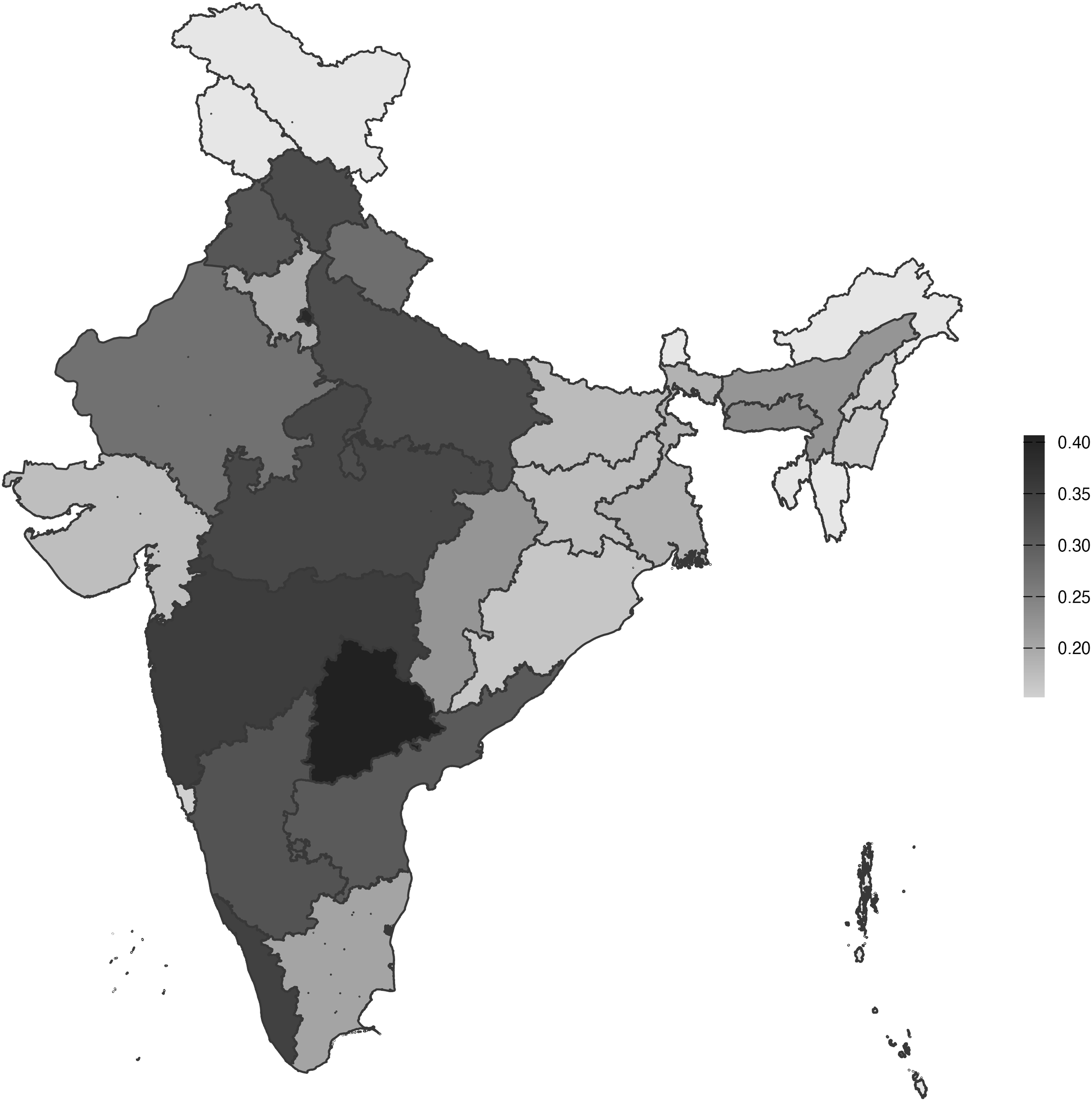
From HP, a total of 3200 respondents were sampled through systematic random sampling from 170 polling stations in 17 state assembly constituencies across 4 out of 12 administrative districts. The survey respondents were selected from electoral rolls and, therefore, were all eligible voters. We conducted a pilot study with 100 respondents and conducted follow-up interviews with some respondents on-site to test the language of the survey instrument, adjusting it to local conditions before fielding it to the full sample of respondents. The survey was administered in-person by teams of field surveyors trained by a survey company in collaboration with the authors. The authors also accompanied some of the survey teams in the field.
Variables
People’s self-reported partisanship serves as the main explanatory variable in our analyses. To capture partisanship, we rely on a question about feeling “close” to a party. In the INES surveys, the question has been formulated as: “Is there any political party you particularly feel close to?” Respondents were coded as Partisan if they responded “yes” to this question and as non-partisan otherwise. There is no standard question to measure partisanship, but “feeling close to a party” is a commonly used measure in multi-party systems and is considered appropriate for capturing the weaker forms of attachment that may characterize partisanship in settings with weakly institutionalized party systems (see Barnes et al., 1988; Brader and Tucker, 2001; Johnston, 2006). Those respondents who did not reveal a party preference when asked which party they felt close to (N = 325) or answered that they felt close to some independent (non-partisan) candidate were included in our non-partisan category. We therefore consider 6441 (26.7%) respondents to be partisan and 17,646 (73.3%) to be non-partisan.
To see how the options on the ballot affect voting behavior, we merged the survey data with constituency-level election returns (data by Agarwal et al., 2021). Since we know the parliamentary constituency of each INES 2019 respondent, we coded whether the party they voted for in 2014 was on the ballot in 2019, as well as whether the preferred party of each partisan respondent was on the ballot in the 2019 elections.
The binary measure of partisanship available in the INES 2019 does not provide us with insight into the strength of people’s partisan attachment. Since there is no measure of the strength of partisanship in the INES, we use the HP survey to create a continuous measure of Affective attachment, employing the four-item Partisan Identification Scale (see Bankert et al., 2017). 2 As an alternative measure of the strength of partisanship, we also consider responses to the question about how long a partisan has felt close to the party. Respondents could choose to say that they had “always” felt close to the party or that the feeling had increased or decreased recently. Given the stability of the sentiment reflected in saying “always,” we code the 78% of the partisans who said that they had “always” felt close to the party as having a Stable attachment.
Our first set of analyses examines the association between partisanship and Turnout. Here, we use the INES 2019, where the self-reported turnout is 91%. This is higher than the actual turnout in the elections, but this is probably not due to sampling issues or social desirability bias, but rather to the fact that non-voters often end up not responding to the survey even though they are sampled for it (Verma et al., 2019). In addition to observing turnout in itself, we are interested in whether the turnout of partisans and others is affected by the options on the ballot.
As noted above, we use actual election returns to observe voters’ behavior in the INES 2019 data. However, we used our original survey from HP to also capture people’s expressed intentions in this regard: “Suppose your preferred party is not going to run in the elections. What would you do? Would you vote for another, less preferred party or would you rather not vote at all?”
The second and third parts of our analysis examine partisanship’s association with vote choice. We focus on two indicators: Partisan voting and Repeat voting. The INES 2019 asked respondents what party they voted for in the 2019 national elections. 3 Partisans are considered partisan voters if they say they voted for the party they feel close to. We exclude from our analyses those partisans who did not respond to the question about who they voted for (N = 408), those who said they did not vote (N = 379), and those who reported voting for a party that was not on the ballot in their constituency (N = 185). In our analyses, we first consider the overall share of partisans who said they voted for their party, and then condition partisan voting on whether the preferred party was on the ballot or not.
The INES 2019 also asked respondents about their vote choice in the national elections held in 2014, as well as how they voted in the “three to four” elections held before that. Both age and recall bias may affect responses to these questions—for example, several young people respond to the question even though they cannot have voted in three to four elections—but we still present summary statistics based on these questions since they provide relevant information about how partisans choose to express their loyalty. Those who were younger than 18 in 2014 are coded as missing.
To gauge whether partisans act as a stabilizing force compared with non-partisans we look at repeat voting, since this allows for a comparison between partisans and non-partisans. We code a respondent as a repeat voter if they say they voted for the same party in 2014 and 2019. Here, respondents who did not vote in the 2014 or 2019 elections, or did not reveal their preference in 2019 (overall 43%) are coded as missing. Finally, we also exclude those who said they voted for a party that was not on the ballot in their constituency either in 2014 or in 2019.
In the HP survey, respondents were not asked about which party they would vote for, since this was a sensitive topic right before the elections, but were asked whether they intended to vote the same way as in the previous state assembly elections. Those who said that they would repeat their vote have been coded as repeat voters.
Finally, we look at stability in vote choice given party viability. Specifically, we look at whether a party’s performance in 2014 had an impact on people’s vote choice in 2019. For all voters, we consider the party they voted for in 2014 to be a Viable party if it was among the top three contenders in the constituency in those elections. As a robustness check, we also code a party as viable if it was one of the top contenders in the whole state in the 2014 elections. 4
From both surveys, we create various individual-level control variables, including gender, age, caste category (Scheduled Castes, Scheduled Tribes, Other Backward Classes, and General Castes), religion, and whether respondents live in an urban locality.
Findings
Turnout
Partisanship and turnout.
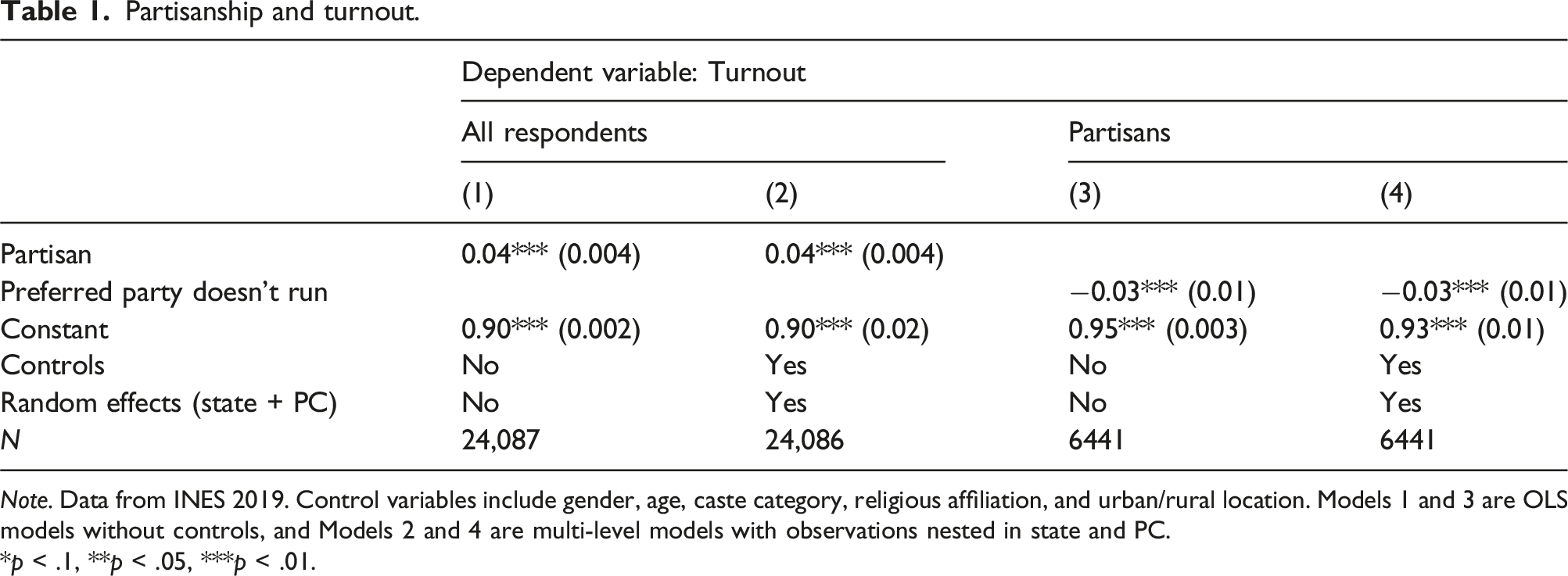
Note. Data from INES 2019. Control variables include gender, age, caste category, religious affiliation, and urban/rural location. Models 1 and 3 are OLS models without controls, and Models 2 and 4 are multi-level models with observations nested in state and PC.
*p < .1, **p < .05, ***p < .01.
These results indicate that partisans are more likely than others to vote, but only when they have the option to vote for their preferred party. Is this irrespective of whether their party endorses the candidate from another party? Though not the only reason, an important reason for parties disappearing off the ballot in India is seat-sharing agreements between pre-election coalition partners (Heath and Ziegfeld, 2018). We look at voting patterns among NES 2019 respondents in Maharashtra to understand more about what partisans do where their preferred party does not run, but there is a coalition partner on the ballot instead. The Maharashtra Lok Sabha elections of 2019 work well to exemplify such a scenario because the two major national parties—the Congress and the BJP—both contested the elections with coalition arrangements. As shown in Table B.2 in the Online Appendix, BJP partisans were only slightly less likely to turn out to vote if they resided in a constituency with the coalition partner Shiv Sena on the ballot instead of the BJP. Congress partisans, however, were nearly 17% less likely to turn out in seats where Congress was not on the ballot. This turnout was substantially lower than the average turnout among the non-partisan respondents in the sample (89.2%). Whereas the sample sizes are not large for this state-specific analysis, the patterns suggest that Congress supporters did not stay loyal to the alliance that their party had entered into, and in fact, in some instances, partisans may be even less likely than others to vote as a result of party exit.
The strength of partisanship and proposed turnout if the preferred party is not on the ballot.
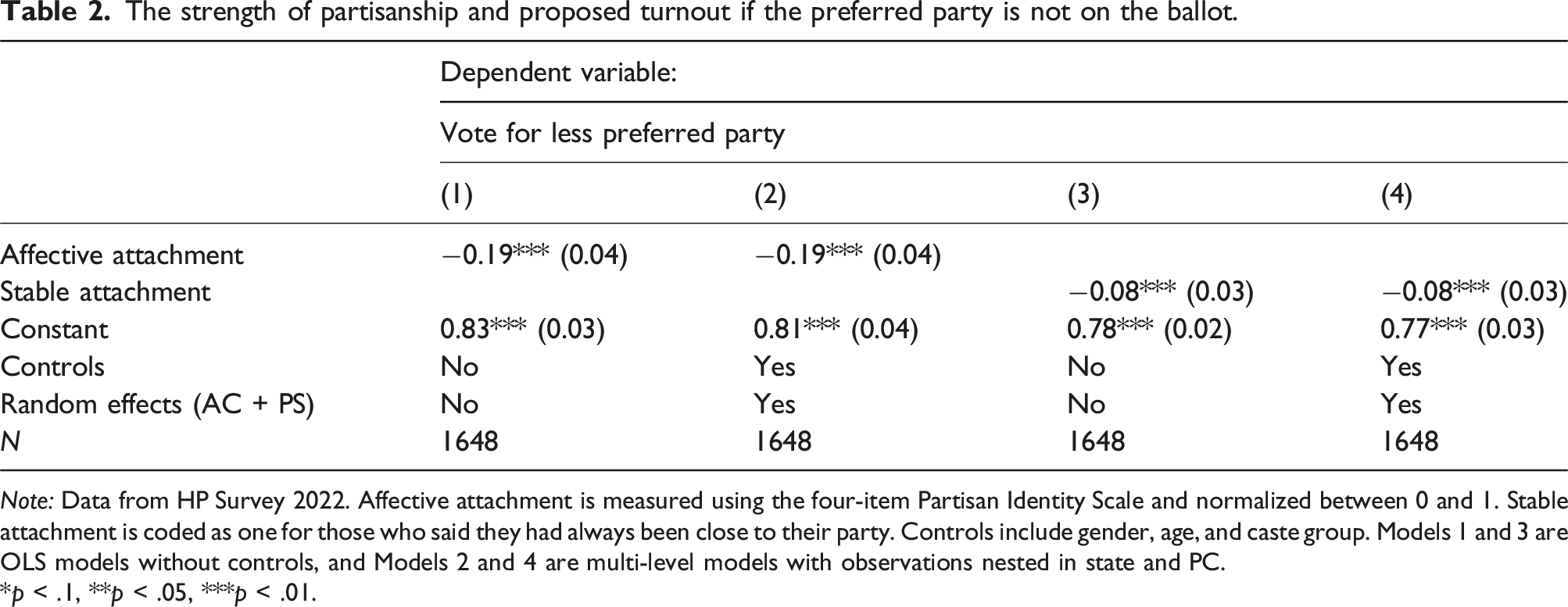
Note: Data from HP Survey 2022. Affective attachment is measured using the four-item Partisan Identity Scale and normalized between 0 and 1. Stable attachment is coded as one for those who said they had always been close to their party. Controls include gender, age, and caste group. Models 1 and 3 are OLS models without controls, and Models 2 and 4 are multi-level models with observations nested in state and PC.
*p < .1, **p < .05, ***p < .01.
Partisan voting
When asked which party they voted for in the 2019 elections, about 79% of partisans reported supporting their preferred party (Figure 2). This figure falls to nearly 63% when asked about their 2014 vote choice, and declines further to around 42% when asked about their vote choice over the past three to four elections.
6
Thus, at first glance, loyalty towards their preferred party does not appear to be high among Indian partisans. Expressed partisanship and vote choice. Data from INES 2019.
Once we exclude the partisans that were unable to vote for their preferred party in the 2019 elections, however, the rate of partisan voting increases to 91%. This is much closer to the kind of partisan voting we see in most advanced democracies, including the USA (Bartels, 2000). In other words, at the aggregate level, partisan voting looks much lower than it actually is due to party exit.
Whereas partisans support their preferred party in high numbers when given the chance to do so, it does not necessarily mean that they stay loyal to the party when it enters coalitions. Returning to the example of the “seat-sharing” arrangements of the BJP and the Congress with coalition partners in Maharashtra in 2019, we find that that some 91% of BJP partisans said they voted for the BJP in the constituencies where BJP ran, while only 79% voted for the BJP’s alliance partner Shiv Sena (Table B.3 in the Online Appendix). Among Congress partisans, the support for the coalition partners was even weaker: whereas 87% of the Congress partisans supported Congress where they ran, only 50% said they supported one of the coalition partners. This may have been one of the reasons why BJP and Shiv Sena won 43 of the 48 seats in the state in these elections, while the Congress-led alliance only won 5 seats.
The stabilizing effect of partisanship on voting patterns
We use repeat voting to explore the stabilizing effect that partisanship may have on voting patterns overall. Since all respondents, irrespective of whether they were partisan or not, were asked about their 2014 and 2019 vote choice, using this measure allows us to compare partisans with non-partisans and see whether partisans vote in a more stable manner than others.
Partisanship and repeat voting, conditional on parties rerunning.
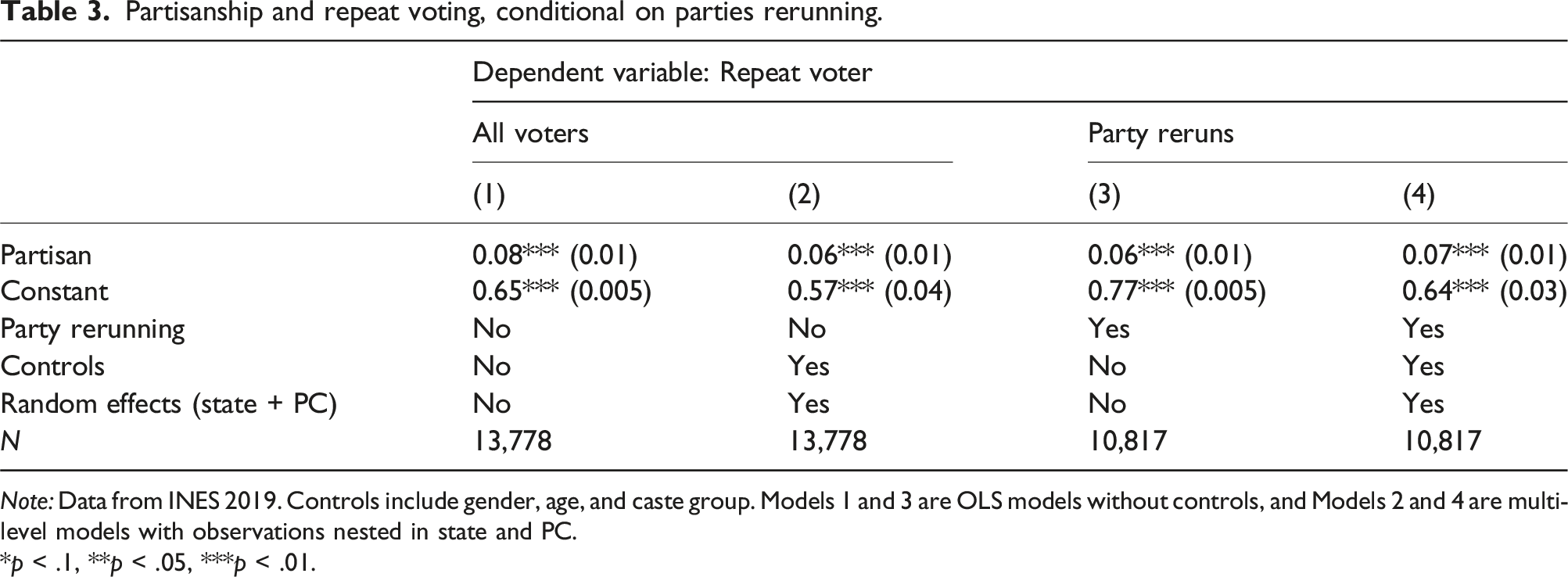
Note: Data from INES 2019. Controls include gender, age, and caste group. Models 1 and 3 are OLS models without controls, and Models 2 and 4 are multi-level models with observations nested in state and PC.
*p < .1, **p < .05, ***p < .01.
Here, too, party exit matters for whether voters are able to repeat their vote: some 19% of the voters surveyed in the INES could not repeat their 2014 vote choice in 2019 owing to party exit. Model 3 reduces the sample to those who had the option of voting for the same party. Here, the overall level of repeat voting increases to 77% among non-partisans and about 83% among partisans. In Model 4, which again includes individual-level controls and state and PC random effects, the coefficient capturing the difference between partisans and non-partisans is again at about seven percentage points, indicating that irrespective of party entry and exit partisans generally vote in a more stable manner than others.
To demonstrate how party exit may dampen the overall association between levels of partisanship and voting patterns in constituencies or states—the levels at which elections are often analyzed in India—we aggregate the individual-level INES 2019 data to create PC-level measures of the share of partisans and repeat voting in each of the 208 PCs in the data. In the left-hand panel of Figure 3, we show the association between the share of partisans in a PC and the share of voters repeating their vote in that PC. As we can see, there is a positive relationship between the two, but there is also considerable unexplained variation. The relationship is much stronger in the right-hand plot, where we show the association between the share of voters in a PC who are partisans and can repeat their vote since their preferred party is on the ballot, and the share of repeat voting in that PC. This stronger pattern is of course not only driven by partisans, as accounting for parties rerunning also means that more non-partisans can repeat their vote, but it illustrates that in contexts where many parties do not rerun, looking only at the correlation between share of partisans and the stability in voting patterns, may give an impression of voters being less loyal than they would like to be. Partisans and stability in PC-level voting patterns.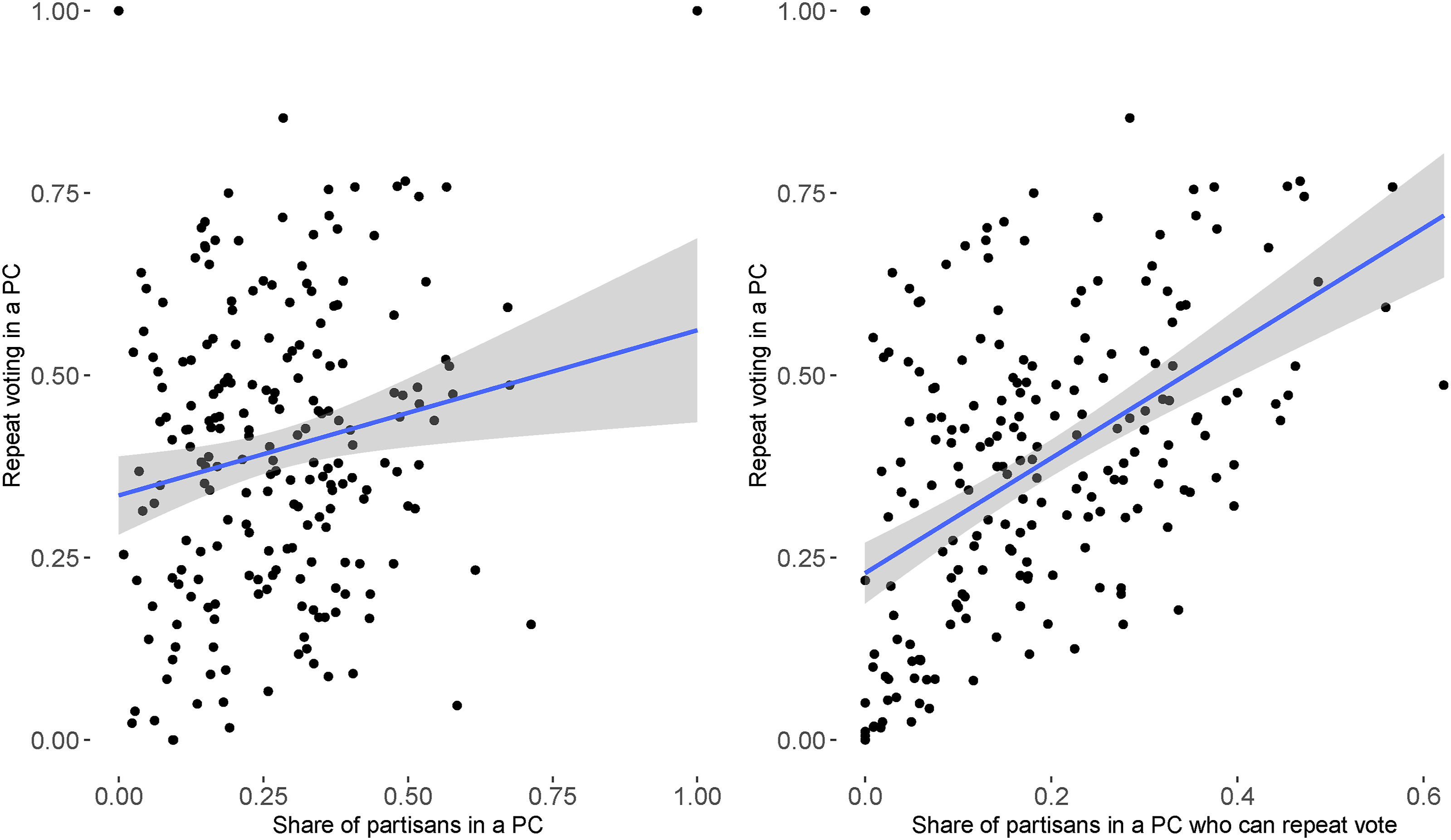
Strength of partisanship and stable voting.
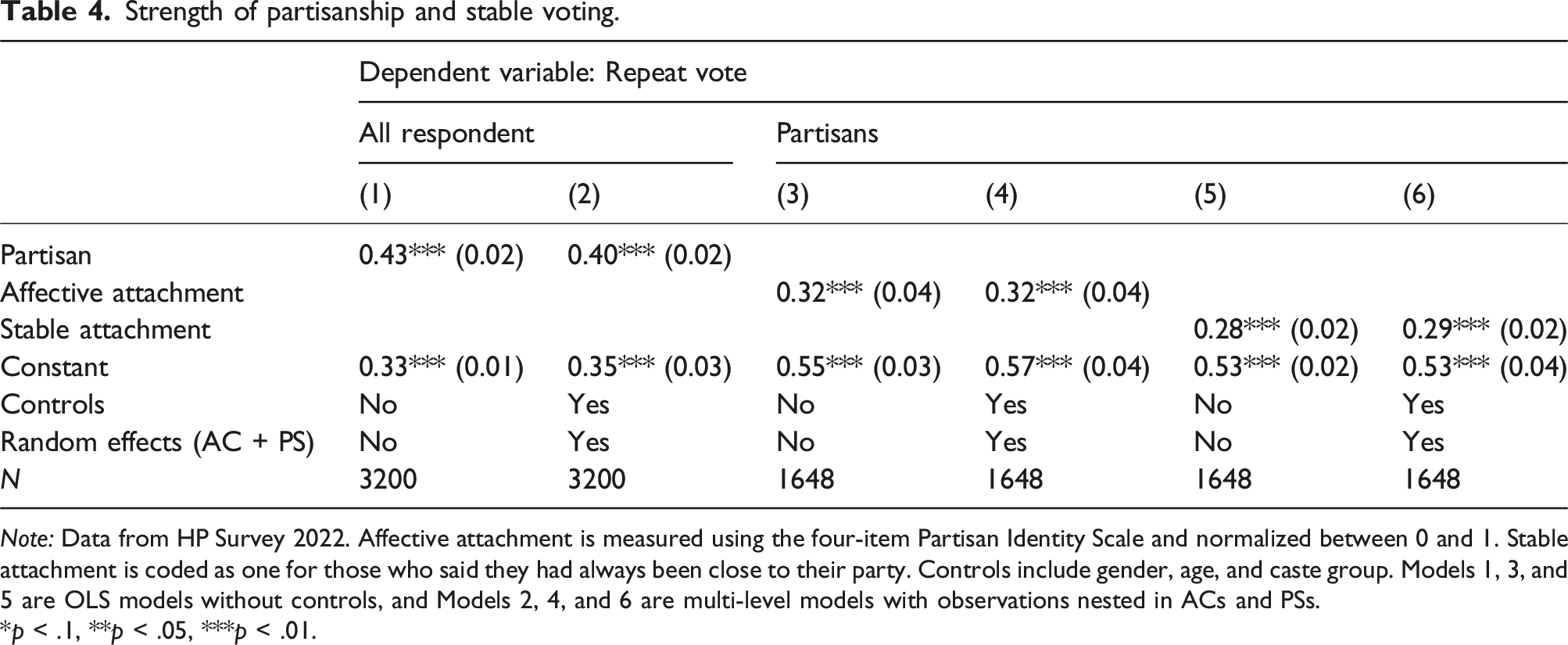
Note: Data from HP Survey 2022. Affective attachment is measured using the four-item Partisan Identity Scale and normalized between 0 and 1. Stable attachment is coded as one for those who said they had always been close to their party. Controls include gender, age, and caste group. Models 1, 3, and 5 are OLS models without controls, and Models 2, 4, and 6 are multi-level models with observations nested in ACs and PSs.
*p < .1, **p < .05, ***p < .01.
Consistent with our expectations, we also see that both a stronger affective attachment and a self-reported stable attachment are associated with a higher propensity to repeat the vote (models 3–6 in Table 4). Moving from the minimum to the maximum on the affective attachment score is associated with a 32 percentage point increase in repeat voting, while a long-term attachment is associated with a 29 percentage point increase. As noted above, these patterns cannot be considered causal since responses to the questions about partisans’ attachment and their intended vote choice are closely related, but they still provide some evidence for our argument that the strength of partisanship is an important moderator in the study of the association between partisanship and voting behavior.
Party viability and vote choice.
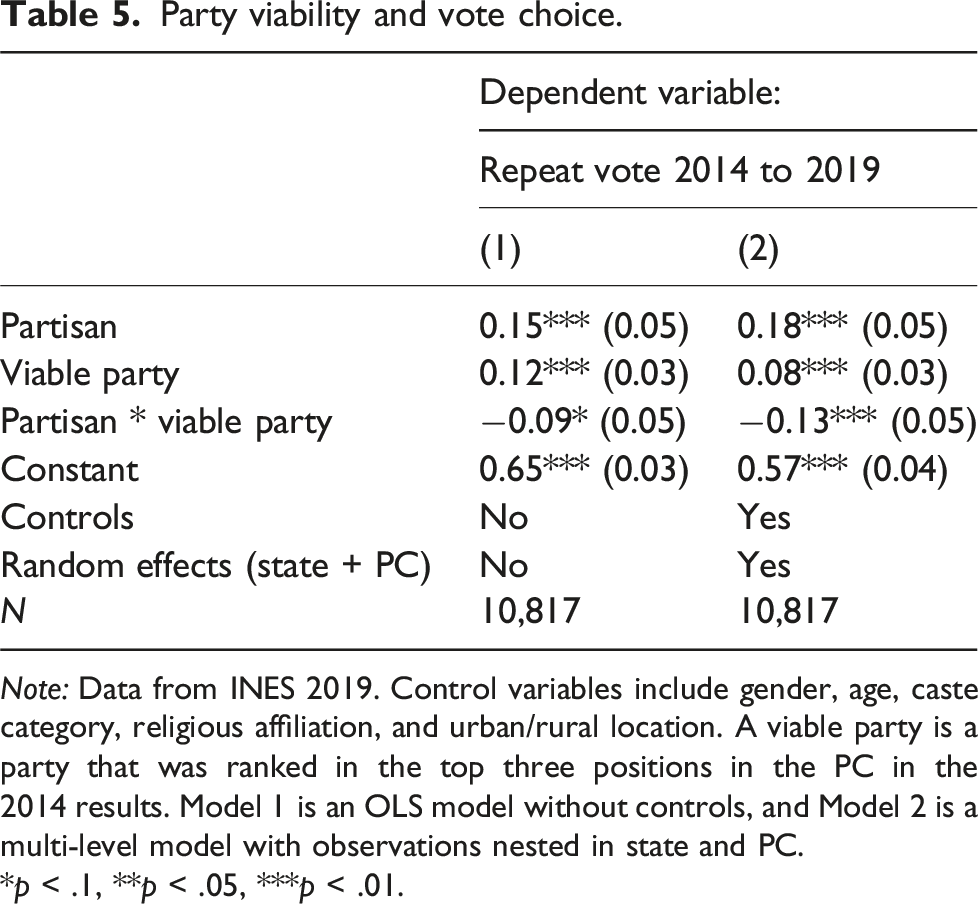
Note: Data from INES 2019. Control variables include gender, age, caste category, religious affiliation, and urban/rural location. A viable party is a party that was ranked in the top three positions in the PC in the 2014 results. Model 1 is an OLS model without controls, and Model 2 is a multi-level model with observations nested in state and PC.
*p < .1, **p < .05, ***p < .01.
Conclusions
This article set out to examine whether partisans in weakly institutionalized party systems behave differently from those in more institutionalized party systems. Our data from India show that partisans are more likely than non-partisans to turn out to vote, to vote consistently for the same party, and to avoid defection to other parties. These patterns are moderated by the strength of individuals’ partisanship (which varies greatly): those with a stronger attachment are more likely to vote in a stable manner. The stabilizing effect of partisanship on overall voting patterns is undermined, however, by parties disappearing off the ballot—a fairly common occurrence in India. Of course, there is variation across Indian states in both the share of the electorate identifying with a party and probably also in the strength of their attachment. Therefore, the extent to which partisanship stabilizes the party system will vary across the country. Still, our findings indicate that voters generally—and partisan voters especially—tend to be loyal voters, which means that electoral volatility would be lower if voters encountered a more consistent set of party options across election cycles.
The volatile political environment that we describe here is not unique to India. In fact, the patterns we observe are likely to be relevant for a host of other democracies where frequent party entry and exit and weak party–voter linkages contribute to party systems remaining weakly institutionalized. Our findings indicate that while meaningful party attachment can form in such settings, its influence on voting behavior is shaped both by the willingness of partisans to support their party and, more mechanically, by the electoral options they are faced with, at the national level or even more locally.
Whereas partisanship’s stabilizing effect on voting patterns generally seems to be viewed as normatively positive, our findings also point to some perhaps less desirable features of partisanship. For instance, the absence of one’s preferred party on the ballot can depress turnout, leading some partisans to opt out of electoral participation altogether. Moreover, the fact that the partisans in our survey report significantly stronger affective attachment to their parties than partisans in the more institutionalized party systems in Europe may be associated with more partisan bias, and to partisans being unwilling to consider political alternatives—contributing to partisan polarization and a more hostile political environment. An important avenue for future research is to consider the implications of such partisan loyalty for representation, political competition, and the broader health of democracy, in India and other similar weakly institutionalized party systems.
Supplemental material
Supplemental material - Loyal voters in volatile elections: Partisanship and voting behavior in India
Supplemental material for Loyal voters in volatile elections: Partisanship and voting behavior in India by Ankita Barthwal and Francesca R. Jensenius in Party Politics.
Footnotes
Acknowledgments
We have benefited from insightful comments and suggestions from many colleagues while working on this paper. We are especially grateful to Milan Vaishnav, Pradeep Chhibber, and Rahul Verma for their thoughtful comments, and to participants at the Norwegian Political Science Conference (2022) and the Seminar Series at the University of Oslo (2025) for their valuable feedback.
Declaration of conflicting interests
The authors declared no potential conflicts of interest with respect to the research, authorship, and/or publication of this article.
Funding
The authors disclosed receipt of the following financial support for the research, authorship, and/or publication of this article: This work was supported by Department of Political Science, University of Oslo, Centre for Advanced Study, Norwegian Academy of Science and Letters.
Ethical considerations
This study was approved by Sikt, Norway.

Supplemental material
Supplemental material for this article is available online.