



Abstract
The standard model of representative democracy is increasingly challenged. Partly because of the tight historical and theoretical connection between representative democracy and political parties, it is not well understood how the latter relate to other models of democracy. Whereas previous studies have examined ideology and populism to explain why parties differ in the conceptions of democracy they advance, we argue that personalism, as expressed in party organization, is part of the story. Combining data from PPDB and V-Party, we analyze the relationship between party personalism and opposing models of democracy for 194 parties from 38 countries. Centralized personalism goes together with supporting direct democracy, illiberalism, and majoritarianism. In contrast, parties exhibiting a high degree of decentralized personalism tend towards liberalism and consensus democracy. When the “rules of the game” are not universally accepted anymore, we need to understand better which players seek to make changes and why.
Introduction
Recent developments have complicated and diversified how democracy is practiced beyond the “standard” model of liberal representative democracy. We see an increasing use of participatory as well as deliberative democratic innovations layered next to traditional representative institutions (Farrell et al., 2019; Gherghina et al., 2019; Hendriks, 2019). At the same time, some polities experience a hollowing out of the representative mechanism, with leaders seeking to limit liberalism (Vachudova, 2020). Within political parties, as well, the authority and roles of collegial party institutions have shrunk and moved to party leaders (centralized personalism) or other politicians (decentralized personalism) (Rahat, 2024; see also Cross et al., 2018; Pizzimenti et al., 2022). Moreover, participatory and deliberative democratic innovations have not only been introduced by political parties (Farrell, 2025) but also within political parties, both by novel formations (e.g., Gad, 2020; Junius et al., 2023) as well as established ones (e.g., Barberà and Rodríguez-Teruel, 2020). Indeed, some of these changes are seen as a welcome response to the shortcomings of the representative model at the party level (Invernizzi-Accetti and Wolkenstein, 2017).
Partly because of the tight historical and theoretical connection between representative democracy and political parties (Schattschneider, 1942; Van Biezen and Saward, 2008), how the latter relate to other models of democracy is not completely clear and a matter of ongoing research. At the center of such efforts are accounts that try to link ideology, both in its “thick” and “thin” dimensions (Mudde, 2004), to how political parties practice democracy inside and out. Specifically, whereas parties of the (new) left seek to maximize individual autonomy in the political process, populist (radical right) parties want to dismantle representative institutions that supposedly put a straitjacket on the will of the people (Engler et al., 2023: 1966; Kitschelt, 1989; Mudde and Kaltwasser, 2017). Accordingly, the latter talk more about direct democratic institutions in their manifestos than about deliberative democracy (Gherghina et al., 2024; Gherghina and Mitru, 2025a). Parties of the left, in turn, have been found in some studies to exhibit more radical commitments to implementing participatory and deliberative processes within the broader political system (Becerril Viera et al., 2024; Font and Rico Motos, 2025; Goldfrank, 2007).
We argue here that examining parties’ ideologies is insufficient to explain why they promote conceptions of democracy that differ from the standard model of liberal and representative democracy. We need to consider, in addition, their internal organization and specifically whether they display either a centralization of power in the hands of the party leader or a decentralization of power in the hands of multiple persons within the party (Rahat, 2024a).
This is because party organization both reflects and shapes the worldviews of its personnel, activists, and voters, including their vision of democracy. For one, party organization needs to be somewhat consistent with the kind of democracy the party advocates in the political system writ-large. For example, when a party has the explicit goal to increase participatory opportunities within the state, it will also be expected to practice the same internally by its activists. Reversely, party organization can serve as a template for how partisans envision decisions to be made at the system level. For instance, when intra-party decision-making is centralized in the hand of a single leader, the party’s public will be more willing to accept centralization of decision-making within the political system as well. To be sure, we do not expect parties that support a specific type of democracy to internally practice their vision in full. Other considerations, such as the need to be competitive, national regulations, or limited resources, affect the nature of party organization. However, we expect parties to express their democratic vision, at least to some degree, in their organizational choices.
Combining data from the Political Party Database and V-Party for 194 parties from 38 countries (see Table A1 in the Appendix for the full list), we develop indices of personalism and correlate them with parties’ preferences with respect to system-level democracy. We show that the effect of personalism depends on the way in which it departs from collegialism (where party institutions, rather than individuals, coordinate and justify decisions, declarations, and actions in the party’s name). Specifically, we find that a high degree of centralized personalism goes together with direct democracy, illiberalism, and majoritarianism. In contrast, parties exhibiting a high degree of decentralized personalism tend towards liberalism and consensus democracy and are indifferent to direct democracy.
Our study makes three related contributions. First, we show that personalism impacts how parties envision democracy. We see this approach, which is rooted in organizational dynamics, as an addition to ideological explanations. Indeed, while powerful, the latter have not always found support; some studies indicate, for instance, that the predominance of left parties does not necessarily boost deliberation in the polity (Gherghina and Mitru, 2025b) and that populist parties are not more likely than non-populist parties to speak about direct democracy (Gherghina and Pilet, 2021). We thus join recent attempts to complement ideological explanations (Gherghina and Jacquet, 2023).
Second, existing studies have focused on the model of deliberative democracy. This is highly understandable given the hopes associated with related democratic innovations for mending the shortcomings of representative democracy (Invernizzi-Accetti and Wolkenstein, 2017). We take a broader approach to address the fact that representative democracy is not only challenged “from below” but also “from the top” with an increasing number of parties adopting anti-pluralist positions (cf. Engler et al., 2023).
Third, existing comparative studies have studied party rhetoric, analyzing manifestos or press releases (Engler et al., 2023; Gherghina et al., 2024; Gherghina and Mitru, 2025a; Gherghina and Pilet, 2021). We rely on expert survey data to measure parties’ “democracy preferences”. This approach provides a beneficial complementary perspective because it allows us to access practice, at least partly.
We first discuss three dimensions of envisioning democracy and then the conceptual and theoretical relationships between the different underlying models of democracy and differently personalized political parties. The following sections describe the data used in, and the findings resulting from, our statistical analysis. In the conclusion, we revisit the central argument with respect to its implications for democratic theory.
Three dimensions of envisioning democracy
While the concept of democracy has a more or less agreed-upon core, various models emphasize different elements. We are interested here in parties’ preferences concerning system-level democracy on three “dimensions” that are spanned by two opposing models each: representative versus direct, illiberal versus liberal, and majoritarian versus consensus. While this list is neither exhaustive nor representative, it covers central points of contestation regarding the desired nature of democracy and relates to available measures of parties’ democracy preferences. 1
The first dimension of democracy preferences is spanned by representative democracy and direct democracy. Representative democracy refers to a political system where citizens elect representatives that decide public policy; should these representatives have acted against the electorate’s desires, the latter can punish them by electing someone else (e.g., Budge, 2006: 1). In direct democracy, in turn, citizens directly set public policy. Direct democracy usually requires fashioning social choice in binary terms and then applying majority rule (Katz, 1997: 281), such as when a referendum is held. From the perspective of participatory democratic theory, direct democratic institutions and mechanisms can be seen as advantageous because they increase citizen involvement and serve as a corrective to representational deficits (see Kübler, 2024; Vatter et al., 2019).
The second dimension refers to liberalism and illiberalism. Liberalism starts from the pluralist idea that there is a “multiplicity or diversity of groups that exert influence within the polity” (Plattner, 2010: 89). Furthermore, it recognizes an inherent tension between “the rule of the people” and group and individual rights and envisions institutions and procedures that guarantee a balance between them. Illiberalism, in turn, rejects the idea of multiple legitimate interests in society. Instead, it poses a single unified will. In populist visions of democracy, for instance, the political system is supposed to realize the will of a homogeneous and pure “people” (Mudde, 2004; Mudde and Kaltwasser, 2017). As Galston (2018) bluntly puts it, “[p]opulism is the enemy of pluralism” (p. 12). It is questionable whether populism actually envisions a different kind of democracy or a lower-quality democracy. Yet, clearly, illiberalism is also at the core of even more sinister political worldviews.
The final dimension opposes majoritarian and consensus democracy. Majoritarian democracy refers to institutions and procedures that seek to fashion any existing pluralism in society into a binary choice between the majority and the minority (cf. Katz, 1997: 279). In Lijphart’s (1999) standard formulation, two parties vie for popular support within a disproportional electoral system. The winning party then rules essentially without intervention from veto players, such as a second chamber, a rigid constitution or a strong court system. Consensus democracy, in turn, describes an understanding of democracy that cherishes pluralism rather than restricting it into a binary choice. It intends to “share, disperse, and restrain power” (Lijphart, 1999: 34). This broad principle can be institutionalized in two ways. First, by giving every relevant group an absolute veto over joint decisions (Katz, 1997: 61, 66). Less demandingly, majority rule is upheld but institutions or norms that enlarge the ruling majority are in place (Lijphart, 1999: 33). Second, the consensus democracy principle can be realized in deliberative democracy. This strand of democratic theory treats preferences as fluid. It embraces the idea that “our views of what should be done can be developed under conditions where evidence-based reasons and arguments [… are] more consequential” (Fishkin, 2018: 2). The basic idea is that citizens can identify, under the right conditions, common ground through deliberation. Institutional instantiations range from the convocation of citizen assemblies for policy and even constitutional design (Farrell et al., 2019) to the use of deliberative opinion polling (e.g., Fishkin, 2018).
Note that, while the three dimensions do not perfectly overlap, there are linkages between them. Most clearly, liberal democracy and consensus democracy are both based on the notion that representatives sustain a pluralist consensual order. Indeed, it is hard to imagine parties that simultaneously favor consensus and illiberalism. But majoritarianism is not illiberal at its core, either; rather it is about reducing competition and choice into a binary. Direct democracy can be practiced in both majoritarian and consensus democracy (Lijphart, 1984). In the former it takes a more plebiscitary, that is, binary form. In the latter, it is part of more deliberative mechanisms. Similarly, parties can espouse illiberal orientations within representative as well as direct democratic visions. 2
Personalism and parties’ democracy preferences
This study argues that the magnitude and direction (i.e., centralized or decentralized) of internal personalism relates to parties’ system-level democracy preferences. Despite the broad shift towards more personalized politics in recent decades (Cross et al., 2018; McAllister, 2007; Rahat and Kenig, 2018), there is considerable variance in its magnitude (Rahat and Kenig, 2018). As some new parties have been explicitly established as platforms for politicians and leaders, some older parties remained wedded to their traditional collective ways of organizing. Others have “personalized” by layering personalist features on top of collective ones. The upsurge in personalization in the last decades and the resulting recalibration between the personal and the collegial requires a categorization that can make sense of the simultaneous existence of more and less personalized – as well as differently personalized – political parties.
Classifying political parties against the background of personalization
Party types and core units.

Source. Adapted from Rahat (2024a: 218).
In the middle, we find the collegial party as the “default” associated with the standard representative and liberal model of democracy. In this kind of party, power is balanced between intraparty institutions, such as the party convention and the party executive. Authority is legal-rational in nature (cf. Blondel and Thiébault, 2010) and exercised by collectives. Collegial parties used to be the blueprint for (mass) party organization. Most parties today still have the characteristics of collegial parties, at least on paper (i.e., in their regulations) but fewer than before continue to be highly collegial in practice (e.g., the Swedish Social Democrats and the Norwegian Labor Party). On the left hand of the spectrum, power is concentrated, and the party is controlled by a single individual (the personal party). On the right hand of the spectrum, power is diffused among active party members (the movement party). Intermediate options (the leader and the network party) are located between the collegial party and the two poles of the spectrum.
Note that the (de-)centralization at the heart of Rahat’s (2024a) classification captures the accumulation of power by an individual (or multiple individuals qua individuals) at the expense of collective decision-making bodies. The core unit of the collegial party type is made up of intra-party institutions (convention, executive committee, etc.) – a grouping of politicians that coordinates and acts in the name of the party – and power is balanced within and between them. In personalized parties, individual(s) are the core unit, and power is thus more, or less, concentrated than in the collegial type.
Of course, there are other kinds of centralization. Even in the heyday of collegial parties, for instance, power could be centralized in one institution or group (consider in this regard Michels’s 1911 description of party oligarchies) or dispersed among many party institutions or groups. We maintain here that the centralization at the heart of Rahat’s classification, centralization with respect to the relationship between individuals vis-à-vis collegial bodies, is important with respect to parties’ democracy preferences because it represents a shift in the very meaning of what a party is.
The expected democracy preferences of different party types
Specifically, we expect that the ways in which parties organize will both reflect and shape how they prefer democracy to work in the political system writ-large. Again, we do not expect parties to follow their vision of democracy internally to the dot – many factors intervene. But we do expect that their vision about the type of external (country-level) democracy will be expressed in their organizational choices to some degree.
Collegial parties practice (or at least claim to practice) representative, liberal, and consensus democracy internally (cf. Höhne, 2023: 481). Because of this and because it was these kinds of parties that “created modern [representative] democracy” (Schattschneider, 1942: 1) within political systems, they are uniquely associated with the liberal and representative model. As such, the basic expectation would be that any party that departs from the collegial type should evince greater openness for direct democracy, illiberalism, and majoritarian democracy. But Rahat's (2024a) classification suggests that the effect of personalism is not linear and depends on the way in which parties are personalized.
The democracy preferences of personalized-centralized parties
What democratic vision would we expect from a party in which power is centralized in the hands of a single person? Rahat's (2024a) typology suggests two ideal types of the personal party and the leader party to capture centralized personalism. In the personal party, an individual is the creator of the party, the one who “owns” it, and they provide the overwhelming source of popular support. Because the party is nothing more than a tool of the leader to gain power (Gunther and Diamond, 2003; cf. Hopkin and Paolucci, 1999) and “weakly institutionalized by design” (Kostadinova and Levitt 2014, 500; Kefford and McDonnell, 2018), it tends not to outlast the leader – unless it changes its type. Prominent examples for this party type are Victor Orbán’s Fidesz (Hungary) and Geert Wilders’s Freedom Party (The Netherlands). In leader parties, an individual politician dominates the party to a high degree. Yet, their authority is of legal-rational nature: The politician dominates due to holding the position of leader; the party and its institutions create the leader’s dominance rather than the other way around. Prominent examples for this party type are the Democratic Party (South Korea) and The Northern League (Italy).
We expect both kinds of personalized-centralized parties to follow our basic expectation, albeit to a different degree. Specifically, both should tend towards direct democracy, illiberalism, and majoritarianism with the personal party more so than the leader party. In its purest form, the personal party is not democratic at all. It may employ some mechanisms to establish a facade of democracy or a demonstration of legitimacy or control. Conceptually, internal pluralism is implausible in such parties. Institutionally, it is majoritarian in nature, with no veto actors that can limit the leader’s power. Internal plebiscites among supporters/disempowered members whose results are expected to be almost consensus on a specific policy, or the identity of the leader, may be employed; disempowered members may be recruited as a show of strength. The leader party retains a liberal-democratic order in principle, with intra-party institutions that vest the leader with power and can take it away hypothetically. In practice, however, the leader dominates these institutions during the day-to-day, albeit less so than their counterpart in personal parties.
These tendencies within personalized-centralized parties replicate “outside” – leader and especially personal parties want to remake the political system in which they are embedded in their internal image. That is, they seek to minimize liberal checks and balances and install or strengthen institutions that will bolster the majoritarian and direct democratic character of the polity (consider in this context the examples of Okamura in the Czech Republic and Orbán in Hungary; cf. Van Eeden, 2019; Mlejnková, 2024). If they are able to actually implement such changes, the leader will gain a more significant and steadier role within the political system. This change, in turn, will strengthen the position of the leader within the party: Dominance in the broader system enlarges and solidifies dominance within the party and vice versa.
HP: The more a political party approximates the ideal type of the personal party, the more it favors direct democracy, illiberalism, and majoritarian democracy.
HL: The more a political party approximates the ideal type of the leader party, the more it favors direct democracy, illiberalism, and majoritarian democracy. The effect should be smaller compared to HP.
The democracy preferences of personalized-decentralized parties
Which system-level democratic preferences would we expect from parties that have personalized by way of decentralizing power? Such parties eschew hierarchical organization and set themselves up as webs of relationships. They are not less personalized but rather personalized in a different way.
Rahat (2024a) distinguishes two ideal types of personalized-decentralized parties, the network party and the movement party. The network party is a party made up of individual politicians that have their own power base as well as their very own organizational machine. It is essentially a loose association of relatively autonomous personalized organizations that run together with the same brand. Intra-party competition between the constituent units is strictly confined to nomination periods regarding who can run under the party label for which office. Such parties are “designed around the ambitions of effectively autonomous politicians, responsible for their own electoral fates and therefore responsive to the concerns of their individual constituencies” (Aldrich, 2011: 306). While there is thus strict centralization of power around a person within each individual building block, the plurality of politicians simultaneously implies decentralization. Close approximations for this party type are the two US parties, the Democrats and the Republicans (more so in the pre-Trump era).
Network parties should follow our basic expectation (and tend towards direct democracy and majoritarianism), except for promoting illiberalism. Each of its politicians leads their own constituency and, rather than being embedded within a hierarchy, they relate laterally to one another (implying liberalism). Their authority stems from being directly selected and reselected via majoritarian and direct democratic methods (e.g., through primaries or referendums). Exactly because network parties are used to fashioning choice in binary terms, given the majoritarian logic underlying selection procedures, direct democracy is not antithetical to them. Externally, these parties thrive in majoritarian political systems with strong direct-democratic components, and this also gives them little incentive to seek changes in the direction of more consensus democracy or representation.
HN: The more a political party approximates the ideal type of the network party, the more it favors direct democracy, liberalism, and majoritarian democracy.
In a movement party, the core units are not politicians but activists. In attempts to counter the centralization of power, these parties use rotation and collective leadership along with attempts to integrate the grassroots in everyday business as much as possible. They advocate for a new model of politics that provides deep engagement by members (cf. Kitschelt, 1989). Prominent examples for this party type are the NEOS (Austria), Podemos (Spain), and the Austrian Greens.
Movement parties go against our basic expectation in that they support liberalism and consensus democracy. Although they see the classic liberal model as insufficient, liberalism and consensus democracy go hand in hand with their deep commitment to individualism, diversity, and power-sharing which they also practice internally.
Their stand toward direct democracy is ambiguous. They do not see representative democracy as an optimal model, but they also reject direct democracy in its plebiscitary sense. Specifically, movement parties agree that the latter often tends to polarize without encouraging substantive engagement by citizens and therefore fails deliberative standards (Gastil and Richards, 2013). Indeed, movement parties call for a more substantive inclusion of citizens in the political process and are often involved when deliberative routes are taken (consider for example the role of D66 in the creation of a citizen assembly on electoral reform in the Netherlands; Fournier et al. 2011: 25).
HM: The more a political party approximates the ideal type of a movement party, the more it favors liberalism and consensus democracy.
Overview of hypotheses.

Data and method
To evaluate these hypotheses, we take data from the Political Party Database (Round 2, Version 4) (Poguntke et al., 2022; Scarrow et al., 2022) and add to it data from the V-Party dataset (V2) (Lindberg et al. 2022a; Pemstein et al. 2020). 3 Specifically, we associate existing V-Party values from the year closest to the year the PPDB coding refers to, provided that the difference is less than 4 years. 4 We restrict the sample to all countries with a population of more than one million and “free”, according to Freedom House reports during the year when parties were surveyed (2015–2019) (Rahat, 2024b: 23). We further exclude Latvia and Slovakia because the information needed to construct the independent variables was insufficient. We end up with a data set containing information on 194 parties from 38 countries.
Dependent variables
Measuring parties’ system-level democratic preferences is no easy task. Because the “rules of the game” seemed set in the postwar era, such preferences were not systematically recorded. Previous studies have looked at manifestos (Gherghina et al., 2024; Gherghina and Mitru, 2025a) and press releases (Engler et al., 2023). One rationale is that (some) parties aim to make the “rules of the game” an electoral issue itself, integrating it into broader conflict of belonging (Engler et al., 2023: 1979). Our approach is different and focuses on experts’ assessments, which might be more “subjective”, yet encompass a broader view of parties’ preferences, that is, not only incorporating what they preach but also what they promote and implement (e.g., how they behave in parliament). Furthermore, drawing on expert assessments allows us to maximize the range of democratic countries studied and thereby control for the effect of the political system on parties’ democratic preferences. The wealth of different languages used makes studying political communication difficult for this purpose.
The first dependent variable records experts’ assessment of parties’ preferences with respect to the representative/direct democracy dimension. As part of the Chapel Hill Expert Survey of 2017 and 2019 (Jolly et al., 2022), 5 experts were asked: “Some political parties take the position that ‘THE PEOPLE’ should have the final say on the most important issues, for example, by voting directly in referendums. At the opposite pole are political parties that believe that ELECTED REPRESENTATIVES should make the most important political decisions. Where did the parties fall on this dimension during 2019?”. 6 The answer options ranged from 0 “Elected office holders should make the most important decisions” to 10 “‘The people’, not politicians, should make the most important decisions” (0–10). While the answer options are reminiscent of the way populist attitudes of citizens are measured (Akkerman et al., 2014), the CHES investigators adapted it here to capture parties’ appetite for direct democracy.
To measure the illiberalism–liberalism dimension, we use a V-Party variable that asked experts to indicate “to what extent […] the leadership of this political party [was] clearly committed to free and fair elections with multiple parties, freedom of speech, media, assembly and association” (ranging before aggregation of the experts' coding from 0 “Not at all committed.” to 4 “Fully committed.”) (Lindberg et al. 2022b: 27). Finally, as a measure of whether parties prefer majoritarian or consensus democracy, we use a variable that estimates whether parties believe that “the will of the majority [should] be implemented even if doing so would violate rights of minorities” (ranging before aggregation from 0 “Always.” to 4 “Never.”) (Lindberg et al. 2022b: 27-28).
Independent variables
The values of the independent variables are determined based on the existence (or lack) of indicators characterizing each of the four personalist party types. Personal parties are those in which the leader dominates, irrespective of the formal power structure of the party. We use the V-Party expert assessment on a five-point scale of whether a party is “a vehicle for the personal will and priorities of one individual leader” (solely = 4) or not (0) (Lindberg et al. 2022b: 35-36).
In the leader party, the leader’s position is strong because of the formal power structures of the party. We, therefore, use an index developed in Rahat (2024b) based on PPDB data that mainly examines the formal authorities of the party leader (e.g., rights to attend and summon meetings of party institutions and decision-making authority regarding candidate selection, the design of the manifesto and the election program as well as coalition entrance).
Due to a lack of existing measurements for decentralized personalism, we created them from scratch. To do so, we summed up characteristics of formal organization that indicate that power is dispersed based on the PPDB. These characteristics relate to members’ and non-members’ influence in candidate and leadership selection (for both party types) 7 and their involvement in referenda, rights in the party convention, and manifesto policy-making as well as the division of leadership roles (in the case of movement parties). This cumulative approach reflects that both party types disperse power to individual politicians (in plural), but only in the movement party is power dispersed further toward the activists. The exact indicators can be found in the Online Appendix (Table A2). In line with the approach developed in Rahat (2024b), we included an indicator in the sum whenever its condition was present (e.g., the party has more than one leader for the movement party), treating both a lack of the condition and missing data as zero. In doing so, we assume that when a condition is present, the PPDB experts should know about it. This approach is especially valid when the variable is missing only for a few parties within a country.
The different independent variables correlate in expected ways (see Table A3 in the Online Appendix): The correlation between the personal party measure and the leader index is positive and considerable. The same holds, unsurprisingly given how they were constructed, for the network and movement indices. Correlations across the centralized-decentralized divide are inexistent or weakly negative. Taken together, this is good news for our measurement strategy and corroborates a central assumption in Rahat's (2024a) party classification: Centralized and decentralized personalization are two different ways in which parties can diverge from the classic model of collegialism.
For our analysis, we regress each of the dependent variables described above on the party organizational measures. From the party family classification in the PPDB, we construct control variables that distinguishes mainstream party families (Social Democrats, Christian Democrats, Conservatives, Liberals) from Greens, right-wing populists, and other parties. We include these variables in the models because green parties and right-wing populist parties have been identified as central actors questioning how democracy should work (Engler et al., 2023). Furthermore, ideology is related to party organization: many Greens, for instance, organize as movement parties (cf. Kitschelt, 1989), and populist parties are significantly more likely to be personalized (Böhmelt et al., 2022). This approach allows our indices to capture the effect of personalism on democratic preferences that exists net of ideology and populism. Country dummies account for the data structure (parties are nested within countries) and control for the effect of the political system (in terms of the democratic vision it currently embodies and the legal framework it provides for party organization). We standardize the organizational measures so that all independent variables in the analysis range from 0 to 1.
Results
Representative versus direct system-level democracy preferences.

Notes. Standard errors in parentheses; * p < .10, ** p < .05, *** p < .01.
Illiberalism–liberalism system-level democracy preferences.
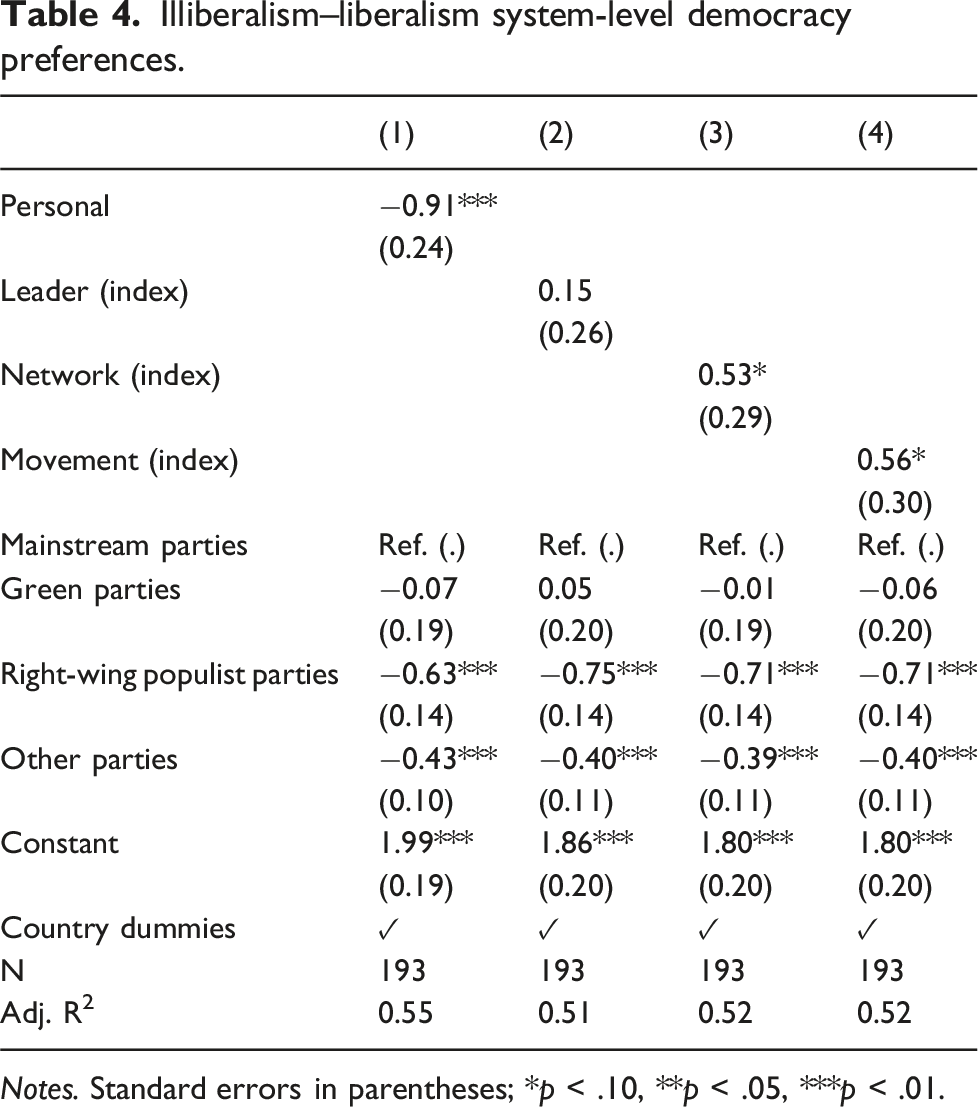
Notes. Standard errors in parentheses; *p < .10, **p < .05, ***p < .01.
Majoritarian versus consensus system-level democracy preferences.

Notes. Standard errors in parentheses; * p < .10, ** p < .05, *** p < .01.
The results hold up in several robustness checks (see, Online Appendix): First, when analyzing only cases where more than three V-Party experts coded liberalism preferences, consensus preferences, and the personal party measure (Table A4). The V-Dem measurement model ideally assumes five coders, and the creators of the dataset caution against using values that are based on less than four (Lindberg et al. 2022b: 6). Second, when using the mean of experts’ assessments for the liberalism preference variable instead of the V-Dem measurement model estimate because the latter, according to the V-Party codebook (Lindberg et al. 2022b: 6), did not converge according to strict criteria (Table A5). Third, when excluding US parties from analysis using the network and movement measures, for which we had recoded the original PPDB coding (Table A6; see note 7). Fourth, when clustering standard errors by country in addition to using the country dummies (Table A7).
Taken together, our analyses provide support for HP and HM. Personal parties tend to be illiberal, they seek to push through the will of the majority at the expense of minorities, and they support direct democratic measures. The movement party tends to be liberal, strongly oriented towards consensus, and is not specifically drawn to direct democracy in its plebiscitary form. It seeks a more fundamental deliberative transformation of the political system. Direct democratic measures do not go far enough in this regard. HL and HN fail to find unambiguous support.
Conclusion
At a time when liberal, representative democracy is increasingly challenged, the question of which visions of democracy parties espouse has become more pertinent. Our analysis of V-Party and PPDB data indicates that there is a relationship between how parties work internally on how they seek to practice democracy externally. While party ideology matters most consistently, this relationship holds even when we control for the contrast between Green and (right-wing) populist parties that previous studies identified as challenging the standard model of representative democracy (Becerril Viera et al., 2024; Engler et al., 2023; Font and Rico Motos, 2025; Gherghina et al., 2024; Gherghina and Mitru, 2025a): Parties exhibiting a high degree of centralized personalism espouse illiberalism, are aversive to consensus, and also to representation. Parties exhibiting a high degree of decentralized personalism favor liberalism and consensus, and they are indifferent to plebiscitarianism. Parties that only moderately diverge from the power balance of collegialism also do not show clear preferences to diverge from the standard model of democracy.
Our paper advances the literature on parties’ preferred ways of practicing democracy not only by providing an additional explanation rooted in party organization but also by measuring parties’ system-level democratic preferences in a way that goes beyond party rhetoric. We further adopted a broad comparative approach – in the number of parties and country contexts considered and in the high level of aggregation at which we conceptualized opposing visions of democracy. This approach proved a fruitful strategy to illustrate the plausibility of the expectation that party personalism matters for parties’ outlook on democracy. Future research should uncover the specific relations between party personalism and more nuanced models of democracy (such as deliberative democracy).
Centralized personalism is dangerous for democracy as we know it. At the country level, Rahat (2024b) found substantive and statistically significant negative correlations between centralized party personalism (as weighted by the strength of the different parties in the system) and a country’s degree of liberal democracy (V-Dem and Freedom House). Here, we show one pathway for why this correlation manifests: Personal parties have specific preferences concerning how the political system should work. These preferences reflect the leader’s desire to retain their position because centralization in the party and centralization in the polity mutually reinforce one another. When these parties gain influence, liberal democracy is endangered (Frantz et al., 2024).
In this context, it is essential to jointly consider the “formal” as well as the “real” story of how parties organize. Parties can be formally very centralized (leader party) but that does not necessarily mean they display preferences towards the broader political system inconsistent with liberal democracy. 8 In turn, parties can look very collegial formally but in practice be extremely centralized around the leader (those parties that rank high on the personal party measure but lower on the leader party index). Thus, formal party institutions are not always sufficient to keep the leader in check and we need to identify the conditions for when they are capable of doing so.
Supplemental material
Supplemental Material - Which democracy do political parties want? The role of party personalism
Supplemental Material for Which democracy do political parties want? The role of party personalism by Tristan Klingelhöfer and Gideon Rahat in Party Politics.
Footnotes
Acknowledgements
We are grateful to Theresa Reidy and all participants of the workshop “Political Parties and Models of Democracy” at the ECPR Joint Sessions in Lüneburg in March 2024; Hana Kubátová, Petra Guasti and all participants of the joint workshop of the European Forum and the Faculty of Social Sciences at Charles University in 2025; the special issue editors as well as the three anonymous reviewers for their crucial feedback. Needless to say, the responsibility for any errors lies exclusively with us.
Declaration of conflicting interests
The authors declared no potential conflicts of interest with respect to the research, authorship, and/or publication of this article.
Funding
The authors received no financial support for the research, authorship, and/or publication of this article.

Data Availability Statement
The replication data for this article is available at https://doi.org/10.7910/DVN/C7OP6O (Klingelhöfer and Rahat, 2026).
Supplemental material
Supplemental material for this article is available online.