




Abstract
The past decade’s trend toward super-sized cruise ships has enriched the experience for cruise passengers. Unlike a small number of mega cruises that have chosen to press on in a luxury–classic style, the vast majority are rapidly converging on a Las Vegas resorts-style tourism model. Aside from the traditional factor that Las Vegas and cruises have in common, that is, the casino, this article analyzes other aspects of this increasingly mimetic relationship, with the following standing out: the greater importance given to entertainment; the greater variety and quality of Food and Beverage (F&B) and shopping choices; an informal dress code; a complex, dynamic management as to both prices and extracting monopoly rents from passengers; the expansion of both models outside their original locations, Las Vegas and the Caribbean; and, lastly, in response to previous trends, an oligopoly market.
Introduction
Cruise ships have traditionally been defined as floating hotels or, more recently, to floating resorts (Kester, 2002) that, with their combination of Broadway and theme park-style attractions (Douglas and Douglas, 2004), seek to imitate the land-based resorts of Orlando and Las Vegas (Rodrigue and Nottemboom, 2013; Wood, 2000). However, this comparison between Las Vegas and cruise ships goes much further than their consideration as resorts with casinos.
The Las Vegas tourism model combines a broad offer of hotels, casinos, shopping malls, tourism attractions, and activities for families with eye-catching architecture to promote consumerism and addiction (Balsas, 2013). This Las Vegas model is extensive in its land use and so could not be replicated on a cruise ship at the beginning of the 1990s, when the maximum vessel size was under 74 k Gross Tonnage (hereafter GT) and the vast majority of vessels were under 50 k GT.
These space constraints have been smashed during the past decade, from 2010 onward, with cruise ships more than complying with the global trend in maritime transportation toward oversized ships, the greatest exponent of which is the mega-containership. Taking the three leading cruise lines as examples, Figure 1 shows the trend toward giant-sized vessels. This substantial increase in space has provided multiple opportunities to fill the new vessels with content.
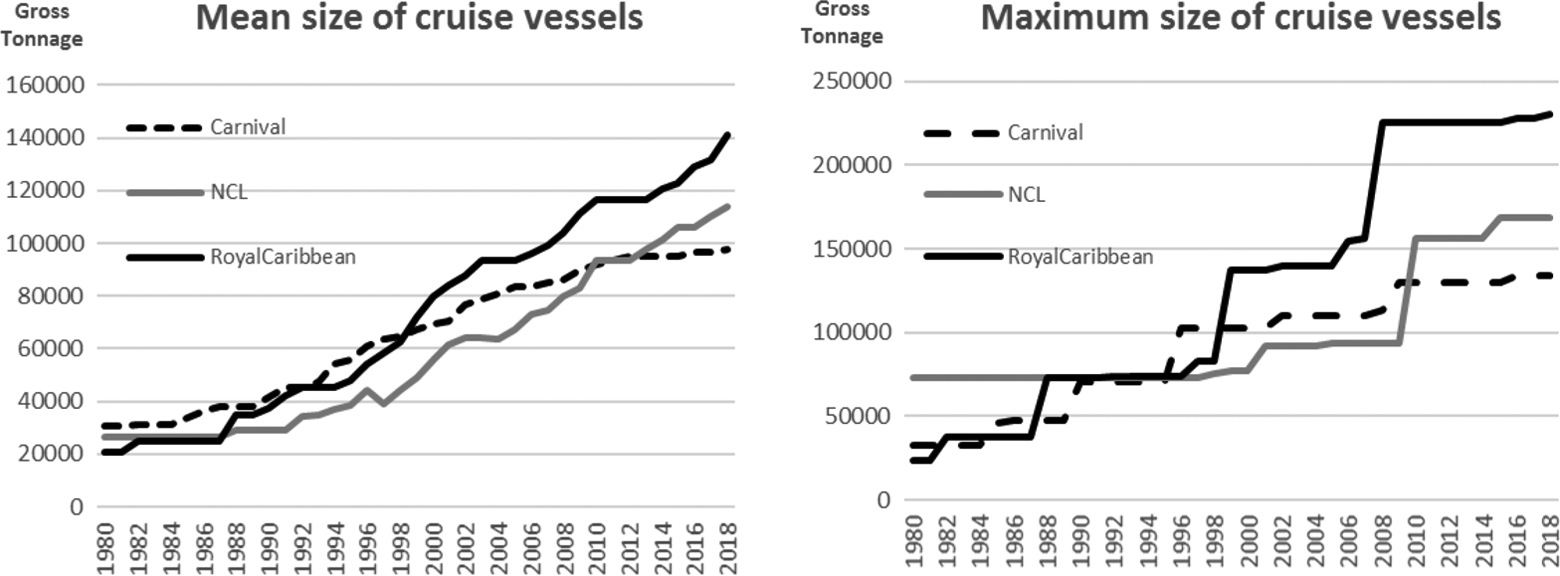
Mean and maximum sizes of cruise ships belonging to the three main lines.
The purpose of this article is to examine how these new mega vessels, the cruise ships, have developed the Las Vegas resort model much further, by making them much more sophisticated and varied than traditional all-inclusive resorts. We shall analyze multiple examples that support this hypothesis.
Discussion
Two distinct trends can currently be found among cruise ships. First, there are the mega ships that continue to pursue the same old luxury–classic style that could be referred to as Titanic first class. The greatest exponent of this style of mega ship is Cunard, with the 150 k GT Queen Mary 2, for example.
The opposing and, it has to be said, majority trend, especially among the four big international cruise lines (Carnival, Royal Caribbean, Norwegian Cruise Line (NCL), and Mediterranean Shipping Company (MSC)) is to use the greater space found on cruise vessels to copy many of the components of the Las Vegas large resort-casino model (which does not imply that considered individually these components were invented in Las Vegas) and on occasion they have become de facto seagoing replicas.
In contrast to these two extremes, there are cruise lines that have opted for hybrid models, and even notable exceptions, such as Disney Cruises, which continues to take its main inspiration from its own theme parks.
The mimetic relationship between Las Vegas and cruise ships can be observed in many instances, with the following standing out:
Capacity
According to Rodrigue and Nottemboom (2013), cruise operators are following a strategy of “creating” demand simply by providing new capacity. As such, new vessels with over 2700 cabins/rooms are approaching the average hotel capacity of the most famous Las Vegas resorts, such as the Paris Las Vegas (2916 rooms), Treasure Island (2841 rooms), and Bally’s (2814 rooms) and have an even greater capacity than some others, such as Harrad’s (2677 rooms), Riviera (2100 rooms), and New York-New York (2024 rooms).
Cruise ships’ greater capacity has also led to a greater variety of accommodation types than the traditional inside/outside cabin dichotomy and, with respect to the latter, porthole v balcony (Biehn, 2006). This is a trend that has traditionally been on offer at the big Las Vegas resorts. For example, the Paris Las Vegas offers some 30 types of room, from Classic Room-1 king to Marseille Suite-2 king. On cruise ships, it is possible to cite the Harmony of the Seas’ 19 types of stateroom which, basically depending on their location, translate into 43 different categories.
Dress Code
According to Papathanassis (2012), one of the reasons for the rejuvenation of cruise tourism is the softening of traditions such as the dress code. In fact, cruise vessels that have opted for the Las Vegas model have gone for a more casual style of dress that has reduced the number of tuxedos and formal gowns on formal nights. In fact, an attempt has been made to avoid the formal nights concept itself using expressions such as Night Out on NCL cruises and Evening Chic on Celibrity Cruises.
Food and Beverage
There are two quite distinct mimetic trends in this field. First, the model in which cruise F&B was based almost exclusively on a restaurant buffet and one or several main dining rooms (but all offering the same menu) has been superseded by a broad range of restaurants and bars that, in thematic terms, are akin to those in Las Vegas, with similarities between, for example, Mandalay Bay’s Ice Bar in Las Vegas and those found on various NCL vessels. To achieve this variety, cruises lines have used partnership policies similar to those previously used by the Las Vegas resorts. This is especially true of Premium or Luxury cruise lines with internationally renowned chefs, such as Oceania’s chef, Jacques Pépin, and Princess’ Norman Love. On the other hand, there is the partnership with successful catering chains that enables the latter to open establishments on the vessels. Such is the agreement between Royal Caribbean and Ben and Jerry’s Icecream Company and Starbucks Coffee Company, both of which can often be found in the foodcourts of the big Las Vegas resorts. In the same line, Carnival has linked up with Guy’s Burger Joint (which also has premises in Las Vegas).
The second mimetic trend in F&B is that there is also competition as to who has the biggest and most spectacular buffet of the sea, which has been one of the major Las Vegas resort attractions for decades.
Entertainment and shopping facilities
A move toward family-mass tourism has been one of the most recent trends in Las Vegas (Balsas, 2013) and also on big cruise vessels. Both tourism models are competing at having one or more facilities with a “wow” factor. There are many examples, from thematic pools with water parks, to replicas of Las Vegas fountains, son et lumière shows, with the Belaggio look-alikes standing out (e.g. the Princess Watercolor Fantasy on the three most modern Princess vessels). Or even the inclusion of attractions such as the Carnival Vista Sky Ride, which can be considered the equivalent of the roller coaster at the Las Vegas New York-New York Resort.
The trend toward increasing the size and variety of onboard shopping malls also stands out. This has similarities with the symbiosis between malls and resorts in Las Vegas, where it is impossible to tell where one ends and the other begins.
Shows
The switch of Las Vegas show artists to cruises has been nonstop over recent decades. Despite focusing more on the relocation of magicians at the beginning, we now see the big Las Vegas productions being adapted to cruise ships. The current main example of this trend is probably the agreement between the Cirque du Soleil, which has been responsible for some of the most successful shows in Las Vegas, and the MSC line, to have its shows included on its next four vessels.
But it is not only the big shows. This trend can be seen in other entertainment concepts such as the dueling pianos, traditionally found at the New York-New York Resort or at the Paris Las Vegas, which can now be seen at sea on the largest NCL vessels.
In short, this increase in mega cruises’ demand for first class shows has helped to provide a year-round portfolio of work for the performing arts, for example, opera singers when the normal opera season in the great opera houses is over.
Management
From the management point of view, cruise lines are using similar strategies to Las Vegas resorts; in the first instance, by leveraging direct reservations over the Internet to weaken the strong role that travel agents have played in the cruise industry (Toh et al., 2005).
Second, following Biehn (2006) and from a revenue management perspective, cruises are beginning to resemble Las Vegas resorts more and more, due to the sizeable portion of their revenues that comes from various onboard revenue streams. Thus, maximizing occupancy is imperative, even if some fares are below cost, as onboard revenues can compensate (Toh et al., 2005). This explains why, like Las Vegas resorts, cruise lines use dynamic price setting systems with major discounts to fill up empty cabins, depending on demand conditions (Toh et al., 2005) and date of sailing (Rodrigue and Nottemboom, 2013).
Captive demand
In the same way that the extreme weather and enormous distances in Las Vegas make people captive customers—at least during the hours of sunlight—from whom monopoly rents can be obtained, so cruise customers are also captive during the whole of the sailing period. For this reason, cruise companies usually include at least one sea day on a 7-day cruise (in the Caribbean, there are usually two or three), minimize shore time at urban ports, and favor shore time at private ports, such as Costa Maya and even islands owned by the cruise lines (such as NCL’s Harvest Caye and Great Stirrup Cay, and Disney Cruises’ Castaway Cay).
For Weaver (2005), super-sized cruise ships enable facilities that generate onboard revenue to be multiplied without a proportionate increase in maintenance and promotion-related costs.
Geographic expansion
Just as the Las Vegas model has been extrapolated to other areas of the world (see Macao and Singapore) without making any great changes, in the wake of its success in the Caribbean, cruise tourism is also spreading worldwide. Its expansion throughout Europe, both in the Mediterranean and the North-Baltic area, Asia, Arabia, and Australia (see Castillo Manzano et al., 2014 and Rodrigue and Nottemboom, 2013), is especially notable. Although cruise lines initially used to reserve their new mega ships for the Caribbean, they are now more and more regularly being seen in other parts of the world. The most common example of this is that some of their mega ships spend the spring–summer season in Europe while operating in the Caribbean in fall–winter.
This trend has further grown since the end of 2016 with the coming into operation of new mega ships, such as the NCL Joy and the Majestic Princess, both of which are destined for sole use in the Asian market all year round.
Toward an oligopoly market
In response to many of the above-described trends and the enormous need for financing that they demand (the cost of a mega ship is between US$700–1400 million), what is being seen both in Las Vegas and the cruise sector is a corporate concentration process. Casinos and independent cruise lines are merging to create enormous business conglomerates that are leading to a de facto oligopoly market. Oligopolies like these generally keep their original brands (e.g. the Carnival Group now comprises 10 different cruise line brands) which target different market niches, based on their customers’ income level and/or region of origin, and can continue to run their own loyalty programs.
Conclusions
The past decade’s trend toward super-sized cruise ships has enriched the experience for cruise passengers. Unlike a small number of mega cruises that have chosen to carry on in the luxury-classic style, such as those of the Cunard line, the vast majority are rapidly converging on a Las Vegas resorts-style tourism model. Aside from the traditional factor that Las Vegas and cruises have in common, that is, the casino, this article analyzes other aspects of this increasingly mimetic relationship, in which not only specific elements are copied but also strategies and partnerships.
The following common aspects stand out: the greater importance given to entertainment facilities and activities, which are more sophisticated and more spectacular; the greater variety and quality of F&B and shopping choices; an informal dress code which is ousting the classic formal nights from cruises; complex, dynamic management as to both prices and extracting monopoly rents from passengers; the expansion of both models outside their original locations, Las Vegas and the Caribbean, and, lastly, in response to previous trends, an oligopoly market. There are so many similarities between the two markets that it is logical that the major international conglomerates, such as Apollo Global Management and the Genting Group, should be leading shareholders in both casinos and cruises lines.
In short, the new mega cruises enable people whose first incursions into tourism, when they were children, may have been to classic land theme parks (see Wanhill, 2008 regarding theme parks in tourism), to travel all round the world and to visit a large number of the most famous international tourist landmarks on maritime theme parks.
Footnotes
Declaration of conflicting interests
The author(s) declared no potential conflicts of interest with respect to the research, authorship, and/or publication of this article.
Funding
The author(s) disclosed receipt of the following financial support for the research, authorship, and/or publication of this article: The authors would like to express their gratitude to the Spanish Ministry of Economy and Competitiveness (grant number ECO2015-64996-P) for their support.