



Abstract
This article assesses the economic impact of visitor expenditure in Macao and the impacts of major expense types to the visitor expenditure. As consumption habits are changing gradually, which can be reflected in the consumption habits of the tourists, we concentrate on the characteristics of visitor expenditure to analyze the factors that drive up the consumption. This article analyzes the relative statistical indicators from 2010 to 2016 in Macao using the ordinary least squares method. According to empirical analysis of this study, 1 Macanese Patacas (MOP) of visitor expenditure can create 7.896 MOP in additional gross domestic product (GDP) in Macao. Moreover, “transportation” and “shopping” present obvious equal status on the pulling function to the visitor expenditure, which indicates that a better transportation system can increase more consumption opportunities. The items of “shopping” and “cosmetics and perfume” have a distinctively high pulling function to the visitor expenditure. This indicates that the power of female consumer group should be emphasized. Compared with other commodities, we observed the obvious pulling function of “local food products,” which shows that the culture-based tourism experience will be helpful to promote the visitor expenditure. In discussing the results, relevant suggestions for developing the diversified tourism in Macao are presented in the article.
Introduction
Tourism is an important economic activity in most countries around the world. It contributes to the national production by creating a supplementary demand through intermediary consumption in different areas of the activity and by the demand for new investments (Silva, 2004). It is also hoped that tourism development will lead to a more effective implementation of appropriate policies for promoting regional development (Vaz et al., 2010), such as increases in foreign exchange earnings, income, employments, taxes, and investments (Archer, 1995; Dritsakis, 2004; Lee and Chang, 2008; Tang and Jang, 2009; Schubert et al., 2011), even in the background of economic crisis. According to The World Travel & Tourism Council (WTTC), in 2016, Travel & Tourism directly contributed US$2.3 trillion of revenue and 109 million jobs worldwide. Taking its wider indirect and induced impacts into account, the sector contributed US$7.6 trillion of revenue to the global economy and supported 292 million jobs in 2016. This is equal to 10.2% of the world’s gross domestic product (GDP), and approximately 1 in 10 of all jobs. This is primarily due to the economic activity generated by the tourist industries such as hotels, travel agents, airlines, and other passenger transportation services (excluding commuter services), its wider effects from investment, the supply chain and induced incomes, and so on. Besides, money spent by foreign visitors to a country (or visitor exports) is a key component of the direct contribution of tourism, which is also a major driving force of economic growth.
As modern society has changed into the consumer society in most countries and regions around the world, many tourists show substantial changes in their motivations and travel patterns. In the consumer society, the essence of consumption is consuming the symbol, not material itself, but the “effectiveness of material,” from the perspective of modern consumer. The value of commodity is no longer a dependent on whether the product can meet the needs of the people or the exchange value, but depends on the exchange system as a symbol of cultural functions (Baudrillard, 1998). One of the most noticeable points of consumer society is the rapid growth of individual expenditure. Behind this phenomenon, culture is a sort of capital to stimulate and induce the consumer behavior, which can interpret the characteristics of visitor expenditure as a special symbolic form and carrier. Moreover, in context of consumer society, the consumption behavior of tourists is constantly changing during the travels.
With a gaming history stretch back for more than three centuries, Macao has been renowned as “Monte Carlo of the Orient” and “Las Vegas of the East.” A major contribution to the tourism development of Macao is the gaming business, which is also the pillar industry of Macao. Gaming industry has a feature that can call for the revisits and create and possess a stable and continuous consumer market. However, it should not be neglected that such single economy may be vulnerable and may become a hindrance to the city development. Obviously, this may contribute to a narrow tourism market or the short staying time of visitors. In order to become a world-class tourist and leisure destination, Macao should adopt a full range of initiatives to improve the competitiveness of other industries in addition to the gaming industry and increase the value added of tourism-related industries to provide a variety of rich and diverse experiences to its visitors (Mao and Liu, 2016). Therefore, under the theoretical support of “consumer society,” the study of the characteristics of visitor expenditure in Macao and their impact on its economic growth will be helpful for the moderate and diversified development of gaming industry and maybe the whole economy in Macao.
This study collects data from DSEC from 2010 to 2016 quarterly. DSEC 1 is the “Statistics and Census Service” supported by Government of Macao Special Administrative Region. The method we use for this study is the ordinary least squares (OLS) method. The aim of this study is twofold: first, analyzing the relationship between visitor expenditure and economic growth in Macao; second, using the “visitor expenditure” as an observed variable to analyze the changes and characteristics of tourists consumption in Macao. The results indicate that a better transportation system, female consumption, and the cultural tourism products are the key points associated with high pulling function to the visitor expenditure. These findings may provide strategic insights for diversifying Macao tourism development, with the aim of achieving a greater economic impact and competitive advantage under the guiding of positive features of consumer society.
Literature review
Visitor expenditure
Tourism is an expenditure-driven economic activity. A fundamental issue for the tourism industry is to understand the nature of the competition among classes of products between tourism spending and other forms of discretionary expenditure (Crouch et al., 2007). Understanding tourism consumption is essential for understanding tourism’s economic impacts (Mihalič et al., 2002). Many empirical studies aimed at measuring the influence on economic growth by tourism development are commonly performed in terms of number of visitors and their expenditures. Besides, visitor expenditure is a key variable in the economic analysis of the costs and profits associated with the tourism industry (Perez and Sampol, 2000). There has been a great deal of researches devoted to estimating visitor expenditure, which is essential for producing comprehensive estimates of tourism’s economic benefits in an area.
Tourism expenditures represent a major component of the world economy. Both the International Monetary Fund and the World Tourism Organization (WTO) have recommended that tourism receipts and expenditures should be included in the national accounts of a country (Sheldon, 1990). The WTO (2000) conceptualized tourism expenditures as “the total consumption expenditures made by a visitor or on behalf of a visitor for and during his or her trip at a destination.” WTTC indicates that “visitor export” is a direct spending impact, “spending within the country by international tourists for both business and leisure trips, including spending on transportation, but excluding international spending on education, which is consistent with total inbound tourism expenditure.” In this study, we use “visitor expenditure” as the observed variable from DSEC, and the statistical indicator “visitor expenditure” follows the WTO’s definition.
Differences in expenditure are significant for various profiles in the process of travel (Perez and Sampol, 2000). Different factors decide the expense type of visitors. The decisions that consumers make reflect their judgments or preferences, such as type of accommodation, length of stay, travel party size, destination, travel distance, origin market, purpose of travel, mode of transportation, activities, age group, packaging, income, purchase channel, information sources, gender, first-time versus repeat visit, motives and season (Marcussen, 2011), and so on. It shows the various demands of visitors during the process of consumption. At the same time, visitor expenditure is also a criterion for tourism market segmentation, which will guide the regional policy, will promote the tourism product innovation, and will be helpful to generate higher levels of local development (Díazpérez et al., 2005). Some research also shows that traveling and visitor expenditure are expected to be more sensitive during economic crises (Eugenio-Martin and Campos-Soria, 2014).
Consumer society
Consumer society is a new stage in development of human society after industrial society. In the consumer society, the use value of materials is weakened, and the symbolic value of them is strengthened. As Baudrillard (1998) pointed out, what characterizes consumer society is the universality of the news items in mass communication. What mass communications give us is not the reality, but the dizzying whirl of reality. It is the allegorical sign of passion and of the event, and signs are sources of security. All these things we “consume”—the image, the sign, the message—represent our tranquility consecrated by the distance from the world, a distance more comforted by the allusion to the real (even where the allusion is violent) than compromised by it. Therefore, mass consumption and symbolic consumption are becoming the focus of social life. Moreover, the basic characteristics of the consumer society reflect the demand for “differences.” Commodities are more than just objects—they are shifting assemblages of social relations (Mansvelt, 2005). They will be useful and valuable if the code that determines them is associated with myth (Ahlava, 2002).
Usher and Rostow (1953) pointed out that a cultural economic development is dependent upon the extent to which members can turn their attention from basic necessities to higher level needs for the prestige and a self-actualization. In the consumer society, consumerism equates the personal happiness to purchasing and consuming of the items; therefore, people indulged in consumption without critical consciousness (Boulding, 1974).The traditional consumer being more inclined either to save or translate his extra wealth into leisure (Campbell, 1987), the modern consumer concerns more about the personality, which is becoming one of the greatest demands of human (Riesman, 1998). According to Maslow’s hierarchy of needs, the people’s consumption, from result to process, from product to meanings, is also for physiological safety, social status, self-esteem, and self-actualization needs (Maslow, 1999). During the social and economic development, people are gradually moving away from the shortage of material resources. Therefore, people concern more about symbolic value of the goods other than their actual use value. Following this trend, symbolic economy has become a unique phenomenon (Lv et al., 2010).
The value pursuing of the public makes shopping form the dominant culture of contemporary era (Zukin, 1995). In this context, consumption culture and shopping consumption space affect the development of contemporary society profoundly, which also creates a modern public culture (Benjamin, 2008). The nature of the consumption has also transferred from a kind of economic activity to a social and cultural activity, and this kind of social cultural activity becomes an important force to pull the economic growth. Therefore, mass consumption provides consumers with prestige and shows their personalities, characters, social status, power, and so on. From this perspective, tourism product can also be thought as a kind of symbolic product, which serves for tourism experience and creates a good memory to tourists.
Tourism and economic development of Macao
Macao, officially the Macao Special Administrative Region of the People’s Republic of China, is located on the south coast of mainland China, 60 km from Hong Kong. It is commonly said that around 1553, the Portuguese bribed officials in Guangdong to allow them to anchor and trade from Macao. On December 1, 1887, the Qing and Portuguese governments signed the Sino-Portuguese Treaty of Peking, which announced Macao turned into a colony by the official diplomatic procedures. The Chinese government resumed the exercise of sovereignty over Macao on December 20, 1999.
Macao is the only place where legal gaming is permitted in China, remaining the deregulation of the 150-year-old gaming business. Tourism has often been cited as a natural setting for gambling, which has been regarded as simply part of the tourism package and tied in with the higher-order economic goal of tourism promotion (Felsenstein and Freeman, 1998). Macao is a typical micro-economy society, because the land and other resources are more or less limited. The booming of gambling tourism industry brought substantial economic benefits. Driven by the government incentive policy and regional economic environment, Macao has created a miracle in the development of micro economy in the history of the world. As shown in Figure 1, the gambling revenue of Macao shows a dazzling growth, only showing a short-term stagnation due to the global financial crisis in 2009. Accordingly, the gross gambling revenue was 361.866 billion Macanese Patacas (MOP), reaching a high record, accounting for 87.9% of GDP in 2013. However, the Macao gambling industry fell in 2014 for the first time, down 2.5%, bidding farewell to 10 years of rapid growth. Then in 2015, gambling revenue was 231.811 billion MOP, down 34.3%. The reasons for this phenomenon include the anti-corruption policy in China, the tightening of Macao endorsement of the independent visitor, and the regulation of financial industry is more standardized to prevent money laundering.

Expenditure-based GDP at current prices of Macao and gross gaming revenue. Source: Statistics and Census Service (DSEC). GDP: gross domestic product.
Nowadays, legalized gaming has become a practicable means of economic development for the overall socioeconomic development in Macao. However, the single economic structure and heavy dependency on the gaming industry may bring a high risk and vulnerability to the economy, even the sustainable development of the whole city. Besides, gaming remains controversial because of its perceived association with crime and vice (Giacopassi et al., 2001). The risks of social instability would reduce the support degree of residents, which will hinder the sustainable development of tourism (Kwan and Mccartney, 2005). Furthermore, influenced by Chinese traditional culture, gambling tends to deliver a kind of negative image. Therefore, some people may stay away from this city, or just choose Macao as a transit depot, which will cause the size of visitors decline. Figure 3 shows the average staying time of visitors from 2011 to 2016—the average stay in Macao is relatively short with a period of 1.1 days. Even for the overnight visitors, the average staying time is less than 3 days, and the staying time of the non-overnight visitors is much shorter, with an average length of only 0.2 days.
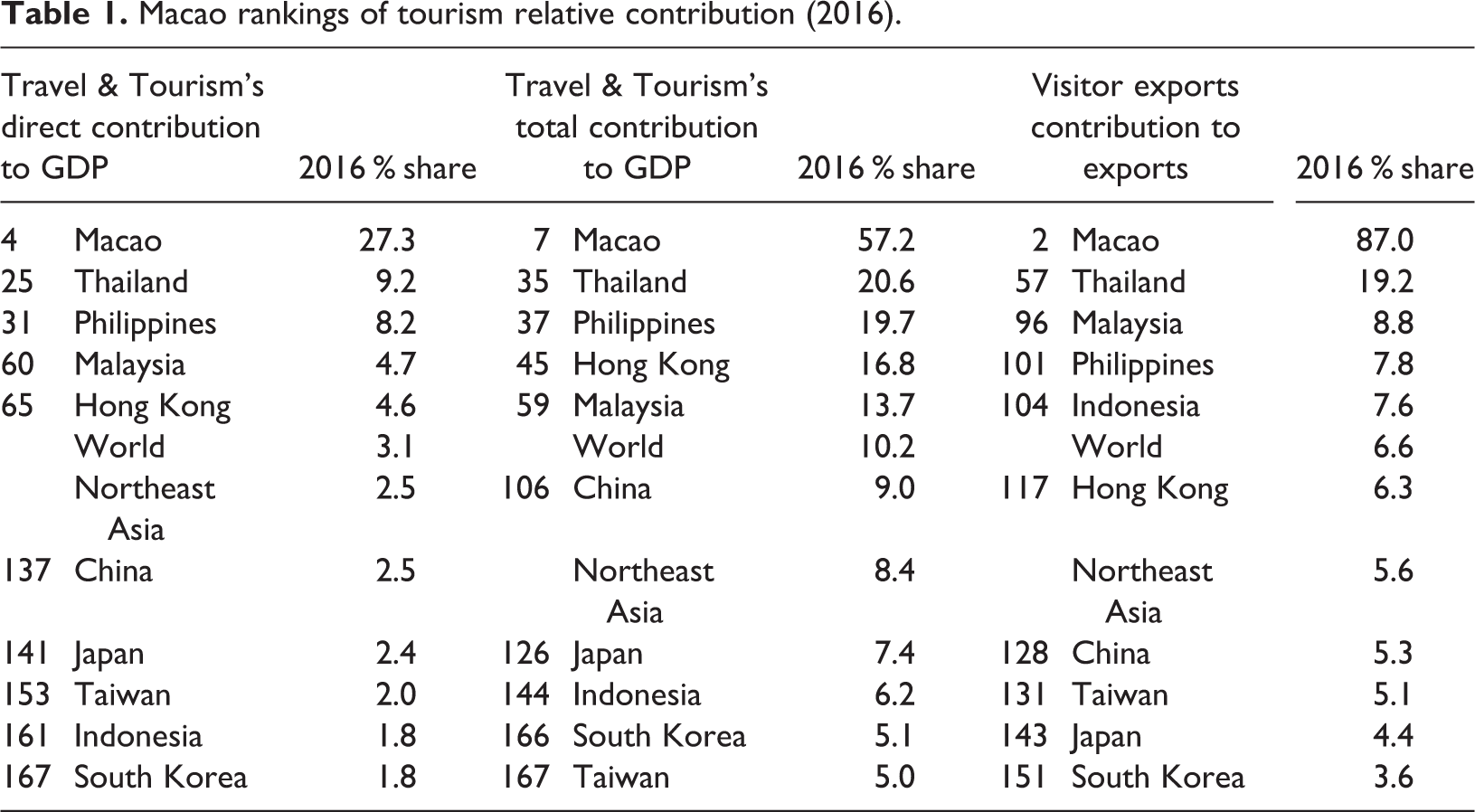
To diversify the economic development, the central government of China supports Macao to developing itself into a world center of tourism and leisure. A tourist destination is attractive only when it has an identity and a combination of different pull factors, such as natural or historical/cultural resources, climate, facilities, safety, accommodation, and accessibility of transportation and other services, which together contribute to the success of the destination (Neves, 2009). Besides the gaming industry, tourism industry also contributes to the economic development in Macao significantly. As shown in Table 1, in 2016, the direct contribution of Travel & Tourism to GDP in Macao was 97,857.8 million MOP (US$12,239.1 million), 27.3% of total GDP (ranking 4th in the world); the total contribution of Travel & Tourism to GDP in Macao was 204,813.0 million MOP (US$25,616.0 million), 57.2% of GDP (ranking 7th in the world). Visitor exports generated 233,535.0 million MOP (US$29,208.3 million), 87.0% of total exports in 2016 (ranking 2nd in the world). Compared with other Asian countries, tourism accounts for a large proportion of the economic development in Macao. The above data can be seen more directly in Figure 2.
Macao rankings of tourism relative contribution (2016).
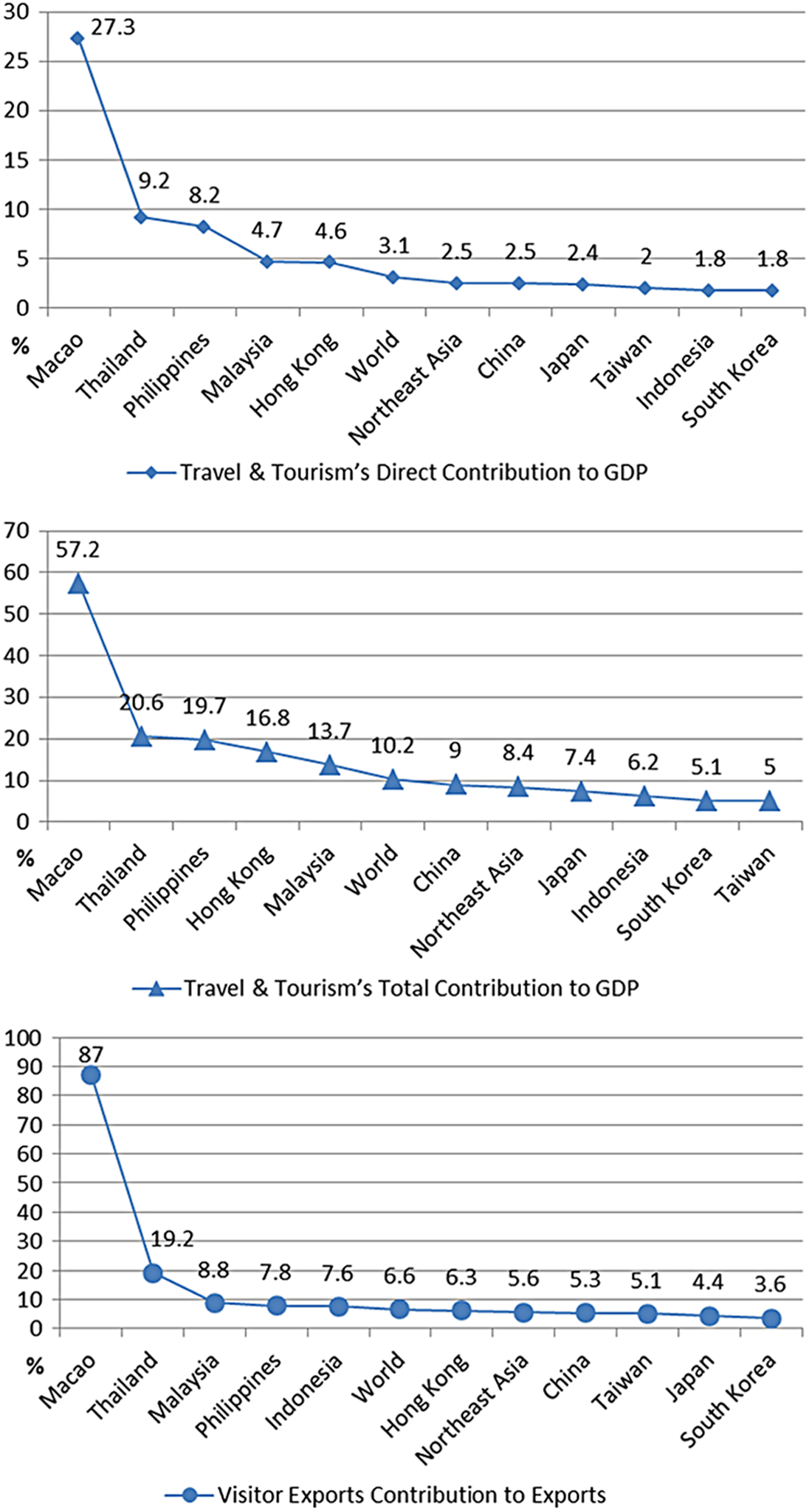
Macao rankings of tourism relative contribution (2016).
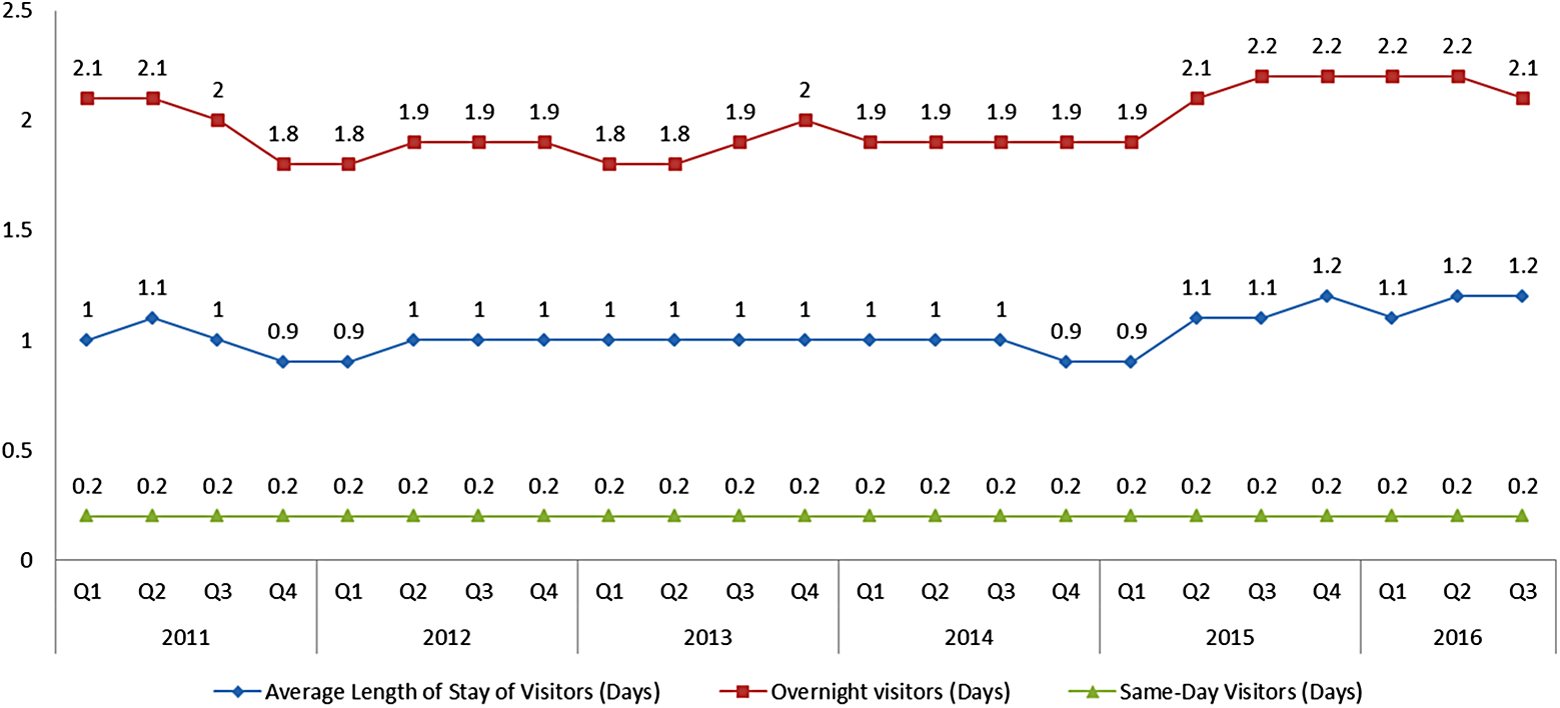
Average length of stay of visitors.
Empirical analysis
The empirical analysis is based on data resources from DSEC. The period of the shown data is from 2010 to 2016, quarterly. The study tries to analyze the impact of visitor expenditure on the GDP in Macao. GDP is an important indicator to measure a region’s economy, which is defined as “an aggregate measure of production equal to the sum of the gross values added of all resident and institutional units engaged in production (plus any taxes, and minus any subsidies, on products not included in the value of their outputs).” 2 According to DSEC, the gaming revenue does not include the visitor expenditure. The study tries to analyze the impact of per capita spending by the major types of expense on per capita spending of visitors. More specifically, our study aims to identify what kinds of per capita spendings act on the per capita spending of visitors the most. Based on the data, this study uses the OLS method to calculate the relationship of each variable by the software tool Eviews 6.0.
The first step of this study is to assess the impact of visitor expenditure on GDP in Macao. Figure 4 shows the relationship between the GDP in Macao and the visitor expenditure. Along the increasing trend of GDP, we can see that the visitor expenditure has a gentle fluctuation increase, different from the corresponding increase in gaming revenue (Figure 1). Therefore, we make a more thorough analysis to explore the internal relationship between the GDP in Macao and visitor expenditure.

Growth trend of GDP in Macao and visitor expenditure. Source: DSEC. GDP: gross domestic product.
The explained variable is GDP in Macao (Yi
) and the explanatory variable is the visitor expenditure (Xi
). According to the economical meaning of the data, we construct the estimation equation (1), where β
0 and β
1 are parameters to be estimated. The substitution coefficients and equation (2) are obtained from the regression results in Table 2.

Regression results for the relationship between the GDP in Macao and visitor expenditure.

In Table 2, R 2 = 0.905, which shows the goodness of the fitting is greater than 0.9. The results show that there is a positive correlation between Yi (GDP) and Xi (visitor expenditure). Moreover, 1 MOP of visitor expenditure can create 7.896 MOP in additional GDP.
This study has found that visitor expenditure has a positive effect on GDP. Based on this, the study continues to analyze the relationship between the per capita spending by major types of expense and the per capita spending of visitors through the multiple linear regression using OLS method. The explained variable is per capita spending of visitors (Yj
) and the explanatory variable is per capita spending by major types of expense (Xj
1
…Xj
4), where Xj
1
…Xj
4 refer to shopping, accommodation, food and beverage, and transportation. According to the economical meaning of the data, we construct the estimation equation (3), where βj
0
…βj
4 are parameters to be estimated. The substitution coefficients and equation (4) are obtained from the regression results in Table 3.

Regression results for the relationship between the per capita spending of visitors and the per capita spending by major types of expense.
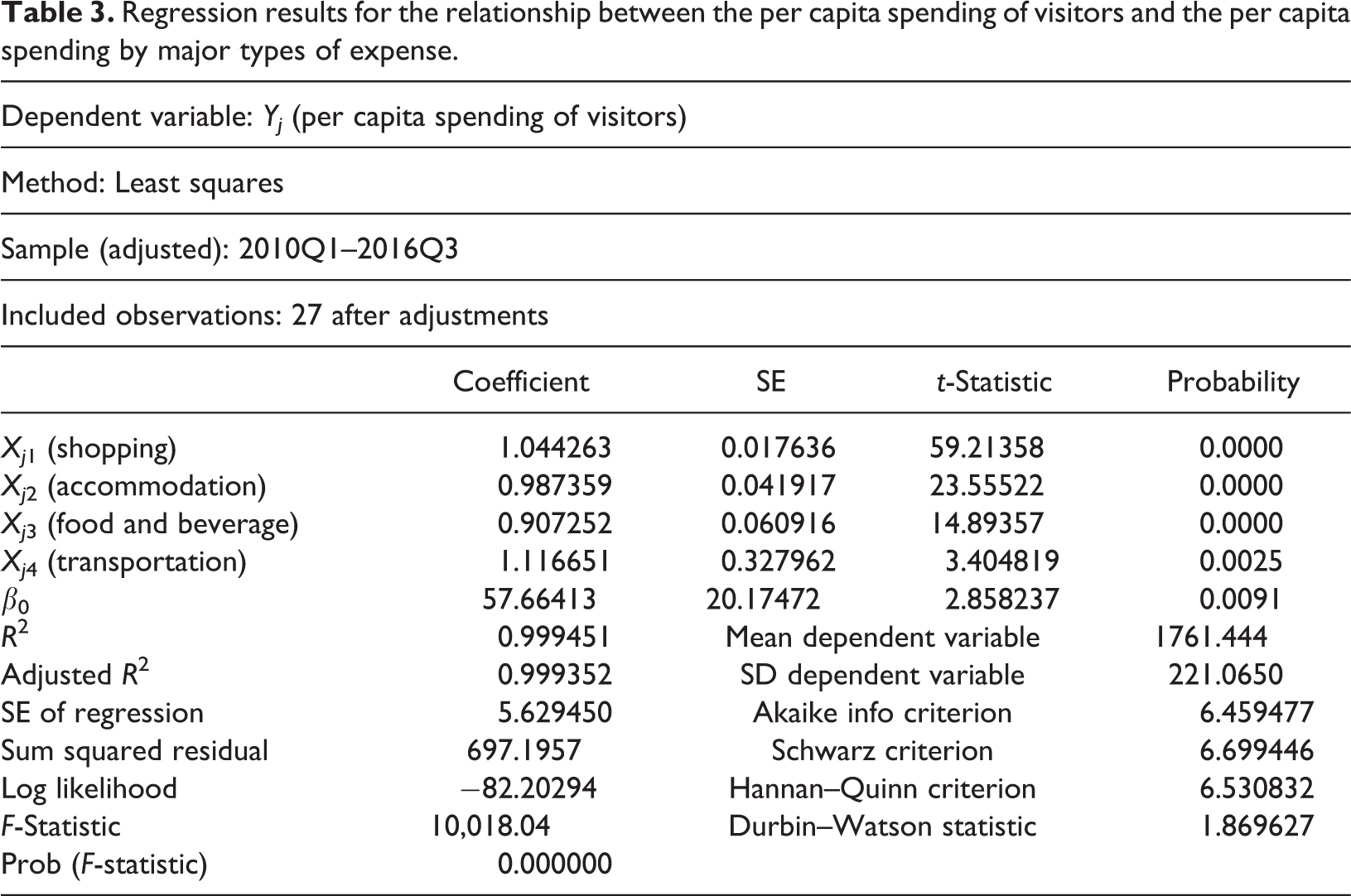
In Table 3, R 2 = 0.999, which shows the goodness of the fitting is greater than 0.9. The results show that “transportation” (1.1167) has the most significant pulling function to the per capita spending of visitors. According to Figure 5, shopping occupies the largest proportion of per capita spending of visitors. However, the pulling function of “shopping” (1.0442) is slightly lower than “transportation” (1.1167). This unique phenomenon can be interpreted that the reasonable transportation system will offer more consumption opportunities to the visitors. Furthermore, “accommodation” (0.9873) and “food and beverage” (0.9072) present a relatively weak pulling effect, which means that there should be more added value to these industries. The added value of accommodation and food industry will diversify the option of consumption, such as recreation, leisure, and cultural creativity. To increase the variety of consumption options may also be an important step to develop the tourism from the mass tourism into the leisure tourism in parallel to promoting the quality of tourist experience.
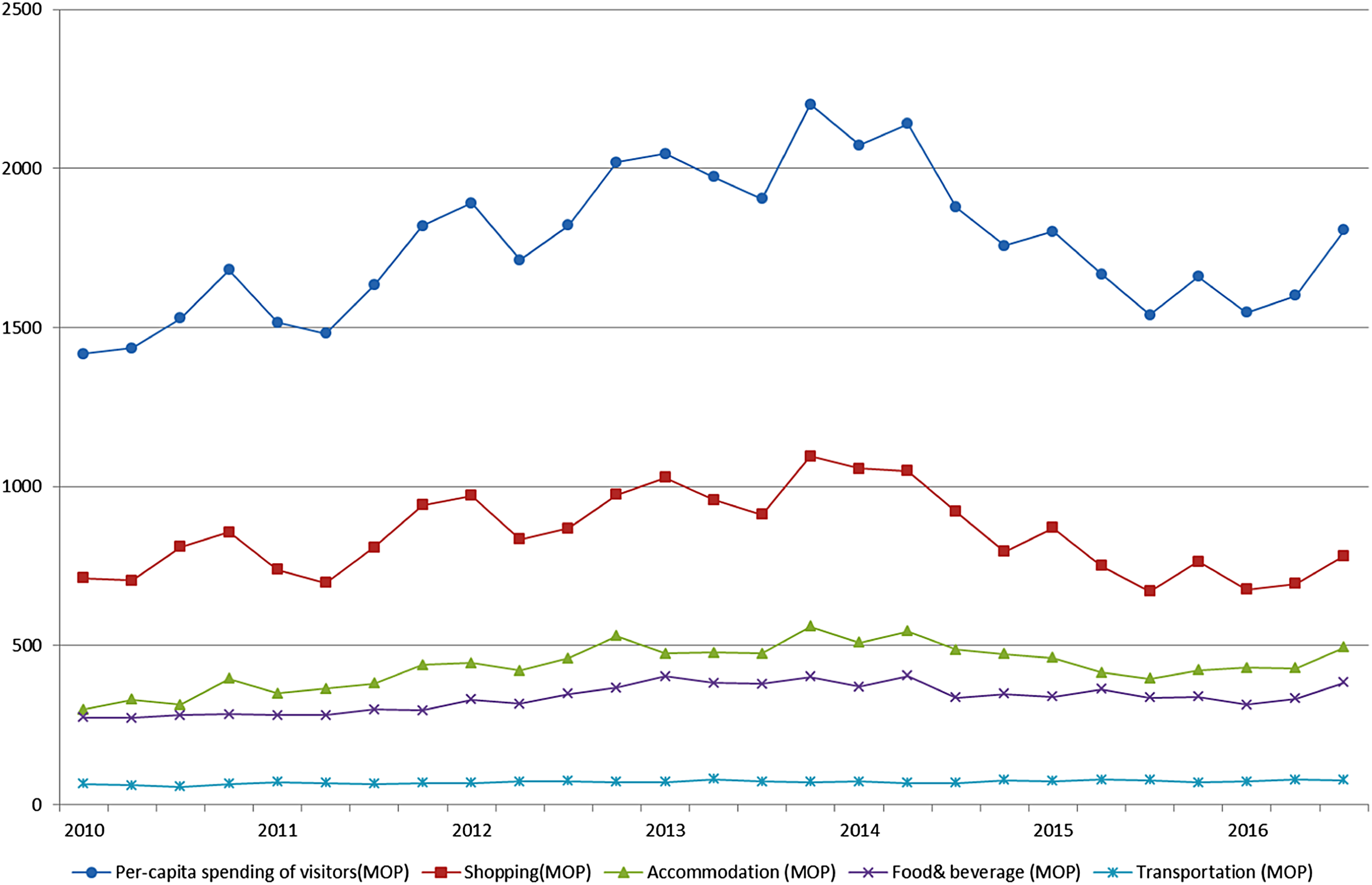
Spending of visitors by type of expense. Source: DSEC.
According to Figure 5, shopping is the main part of per capita spendings of visitors, which is also in accord with the characteristics of contemporary mainstream consumption culture from the perspective of the consumer society. Based on the results obtained, we find that “shopping” does not present an obvious pulling function to visitor expenditure. Compared with the stable industries, such as “transportation” or “accommodation,” which are in foundation of infrastructure construction, “shopping” is more flexible so that it can get better promotion in a short time. Therefore, our study continues to analyze the relationship between the per capita shopping spending by major types of expense and the per capita spending of visitors through the multiple linear regression using OLS method. Here, the explained variable is per capita spending of visitors (Yj
), and the explanatory variable is per capita shopping spending by major type of expense (Xk
1
…Xk
5), where Xk
1
…Xk
5 refer to clothing, jewels and watches, local food products, cosmetics and perfume, and handbags and shoes. According to the economical meaning of the data, we construct the estimation equation (5), where βk
0
…βk
5 are parameters to be estimated. The substitution coefficients and equation (6) are obtained from the regression results in Table 4.

Regression results for the relationship between the per capita spending of visitors and the per capita shopping spending by major types of expense.
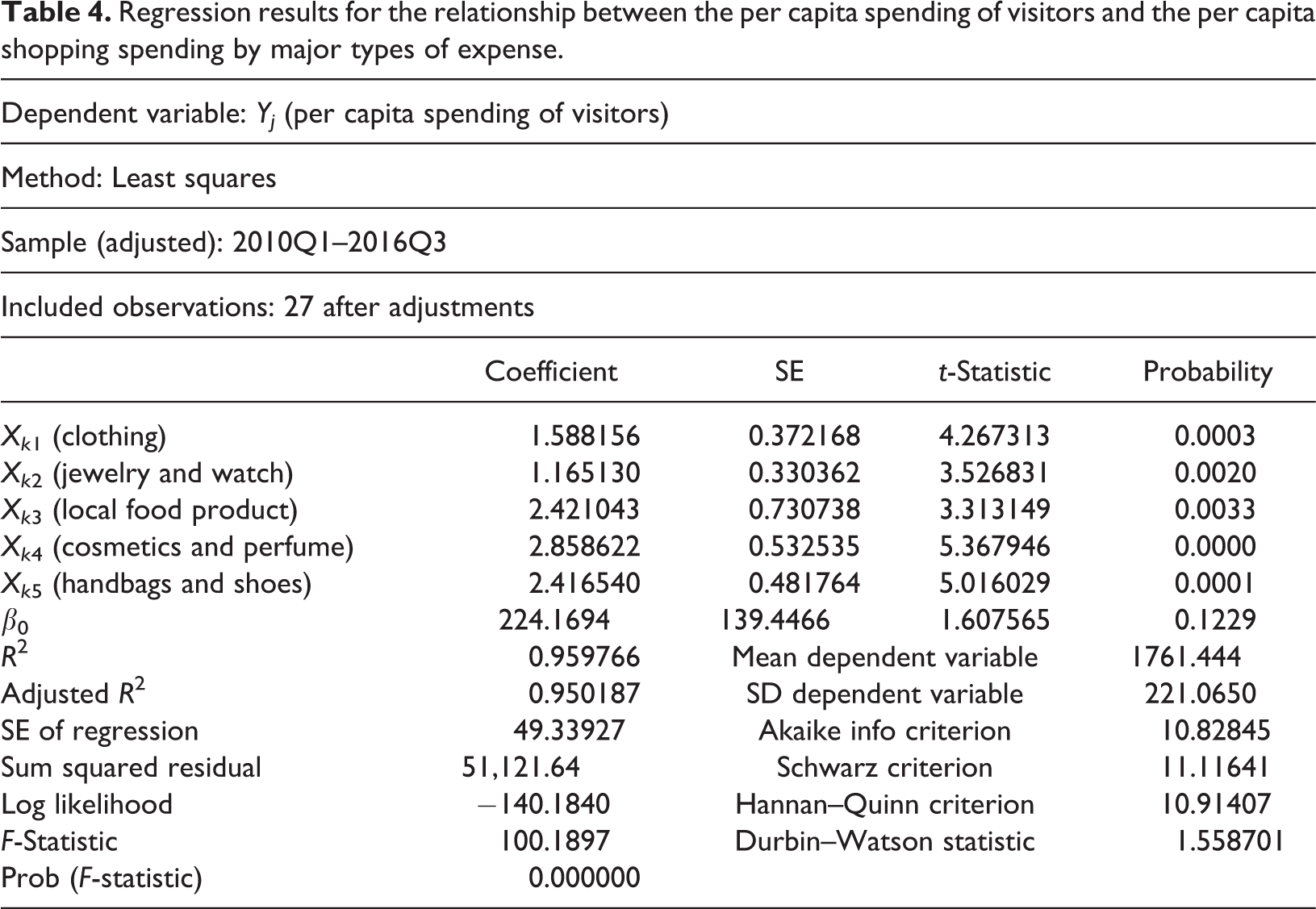
In Table 4, R 2 = 0.960, which shows the goodness of the fitting is greater than 0.9. The results show that “cosmetics and perfume” (2.8586) has a distinctively pulling function to per capita spending of visitors, followed by “local food products” (2.4210) and “handbags and shoes” (2.4165). Besides, “clothing” (1.5882) and “jewelry and watches” (1.1651) have a relatively weak pulling function to the per capita spending of visitors.
As shown in Figure 6, “local food products,” “jewels and watches,” and “clothing” occupy the three main parts of shopping. The consumption amounts of “cosmetics and perfume” and “handbags and shoes” are slightly lower than others. Individually, shown in Figure 7, “local food products” and “cosmetics and perfume” keep a rising trend in fluctuation. However, “jewels and watches” and “handbags and shoes” present an obvious declining trend after 2014. At the same time, the purchase amount of “clothing” also shows a downward tendency in fluctuation.

Per capita shopping spending of visitors by type of expense (yearly averages). Source: DSEC.
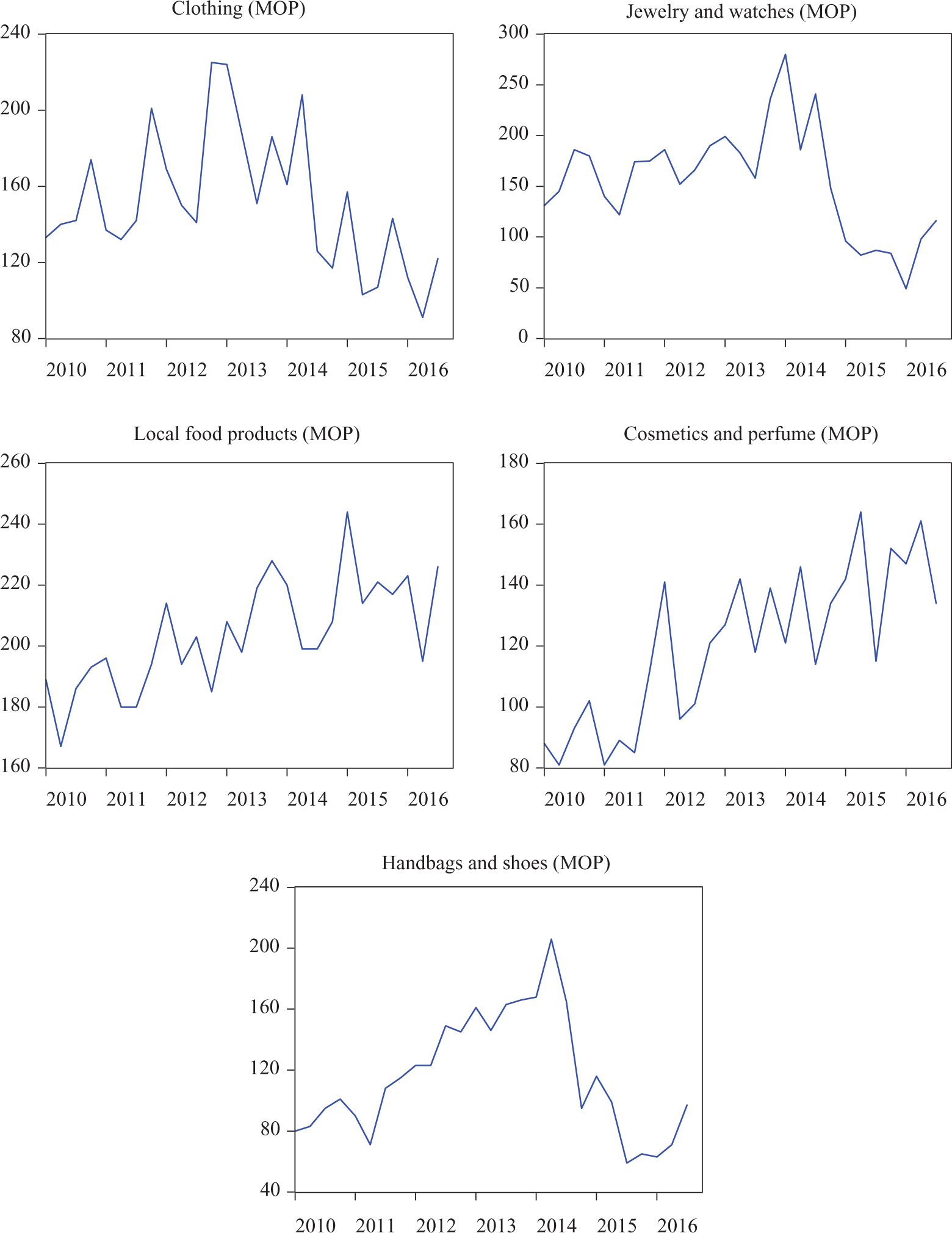
Per capita shopping spending of visitors by type of expense (quarterly averages). Source: DSEC.
It is deserved to note that “local food product” has an obvious pulling function to the visitor expenditure, which has proved its high level of popularity. Compared with other luxury and commodities, “local food product” has strong cultural attributes. It is a kind of cultural consumption with a powerful symbolic character, which shows that the traditional culture of Macao is alive and has strong attraction to the tourists. In addition, because of the geographic position near Hong Kong, Macao may not be able to compete in the mass consumption market and the luxury market of the shopping paradise, Hong Kong. However, the item “cosmetics and perfume” still presents the most obvious pulling function for per capita spending of visitors. This phenomenon indicates that woman consumers have a large spending power in Macao which is a representative group in the consumer society. Along with the changing process of consumer attitudes, mass communication expresses various new symbols that represent the individuality and status. Women tend to be fashion life chasers; they advocate the good symbols more. The “cosmetics and perfume” are the products with many symbols of femininity. Women buy them not only for the need, but also for the willingness induced by mass communication, such as advertisements and movies.
Discussion and conclusion
Despite the gaming is the pillar industry, the visitor expenditure has also contributed positively to the Macao economy, as confirmed by statistics and our analysis in this study. According to the results of our calculation, 1 MOP of visitor expenditure can create 7.896 MOP in additional GDP in Macao. However, there is only a slightly significant correlation between the GDP in Macao and the visitor expenditure. This may indicate that more attention should be paid on how to raise the level of the visitor expenditure. Undoubtedly, the long stay of visitors will increase the visitor expenditure. Moreover, long-haul travelers may have a relatively low price sensitivity, which in turn may lead to their higher expenditures (Kim et al., 2011). In the future development, there is a great need of increasing the consumption level and stay period of the visitors. To achieve this goal, the public administration, which in many cases makes generic promotion campaigns, may consider to target its promotion activities to the potential consumers that have a superior level of expenditure.
For more concrete and practical suggestions to improve the visitor expenditure in Macao, our second stage analysis tried to identify the items that directly affects the level of expenditure. The result shows that the “per capita spending by major types of expense” presents positive correlations to the per capita spending of visitors. Among the items of the per capita spending of visitors, “shopping” occupies a major portion. At the same time, “transportation” presents another obvious pulling function to the per capita spending of visitors. It indicates that the rapid growth of visitor consumption in Macao conforms with the characteristics of the consumer society. It suggests that the improvement of transportation will bring more consumption opportunities to promote the visitor expenditure.
To further study about the item “shopping” that occupies a major portion among the items of the per capita spending of visitors in Macao, our third stage study looked even closer to find the influence factors among the items of shopping spending. The result shows that “cosmetics and perfume” has a distinctively pulling function to the per capita spending of visitors. At the same time, the “local food product” not only occupies the main part of shopping spending, but also presents an obvious pulling function to the per capita spending of visitors in Macao. Therefore, these factors and the reasons behind these phenomena should be analyzed more to find the proper measure to stimulate and increase the visitor expenditure which may lead to the development of Macao’s economic diversification. It is worth to mention that the female consumer group, a representative group in consumer society, whose purchased attributes can somehow reflect the characteristics of consumer society in Macao. Therefore, creating a better shopping environment, catering to women’s special demand may also promote the tourists consumption in Macao. Furthermore, there should be a greater focus on cultural power behind the consumption. We believe that the cultural-based tourism experience will be helpful to stimulate the visitor expenditure in the context of symbolic economy in Macao. Moreover, enriching the cultural experience of tourists will be advantageous to avoid regional homogenization of shopping, especially in the distinction of destinations, as shown in Hong Kong, or other “shopping type” destinations.
From our step by step empirical analysis, we can conclude that the visitor expenditure is conducive positively to the GDP growth. Improved infrastructures, convenient travel environment, and diversified culture-based products can all bring better consumer experience, which will be helpful to promote the level of visitor expenditure.
Finally, we hope that this article can contribute to the tourism development in Macao. The econometric model we used may present some limitations. Other methods could be sought to overcome these limitations. The further study should focus far more on the individual factors of consumers. The measurement of tourist perception could be a method to further analyze the characteristic of tourism consumption in consumer society in Macao.
Footnotes
Declaration of conflicting interests
The author(s) declared no potential conflicts of interest with respect to the research, authorship, and/or publication of this article.
Funding
The author(s) received no financial support for the research, authorship, and/or publication of this article.