



Abstract
Pricing is a basic strategic tool in hotel revenue management (RM). This study proposes a particular demand function model for resort hotels for measuring their own-price elasticities, along with the different seasonal demands, and across the booking horizons. The model is applied to the online transient demand for two hotels in Majorca – a well-known, mature mass tourism destination – in order to estimate and compare different elasticities, which could be used by RM departments to correctly manage prices in the short run and establish optimum pricing strategies (over the medium and long run). The results show that the two hotels display completely different own-price elasticities during high season, while during low season, demand is quite inelastic at both hotels; secondly, common price variations among seasons or hotels may sometimes be an erroneous pricing strategy, such as the common early booking strategy. The model is easily adaptable to different hotels.
Introduction
Several factors determine hotel price variability, the most important ones in the resort tourism sector are (1) seasonality (Aguiló et al., 2001; Coenders et al., 2003; Narangajavana et al., 2014), where the price of a room booked in peak season is expected to be much higher than in low season; (2) the booking date (Padhi and Aggarwal, 2011; Schütze, 2008; Schwartz, 2008), since the price of a room booked 6 months in advance cannot be the same as that of a room booked on the start date of a stay, and the same applies to rooms booked 3 months in advance during either the low or high season (Noone and Mattila, 2009); and (3) the type of reservation, since the same hotel may have different kinds of rooms and/or services or different reservation conditions (Coenders et al., 2003; Ivanov and Zhechev, 2012; Padhi and Aggarwal, 2011; Narangajavana et al., 2014; Von Martens and Hilbert, 2009).
Certain characteristics of the hotel sector, such as perishability, capacity limitations or seasonality, make occupancy and demand management key factors in determining revenue. Revenue management (RM) deals precisely with this issue, since it can be defined as the application of an information system and pricing in order to ensure the right capacity at the right time in the right place so as to maximize revenue (Ivanov and Zhechev, 2012; Legohérel et al., 2013), meanwhile revenue managers only have past demand and price information at their disposal (Padhi and Aggarwal, 2011). However, short-term revenue maximization, due to the hotel capacity limitations – as the number of hotel rooms cannot be changed, is only determined by demand management (Coenders et al., 2003). Thus, the RM applicability depends on three factors (Ivanov and Zhechev, 2012; Legohérel et al., 2013; Vives et al., 2018): (1) the possibility of advance bookings, (2) the ability to manage price variations across the booking horizon and (3) the possibility of segmenting demand into homogeneous groups according to price sensitivities.
Pricing is the basic strategic tool in hotel RM (Cheng et al., 2011). Through price variations, a revenue manager can adjust demand at times when available occupancy differs from the occupancy that might maximize revenue (Vives et al., 2018). Thus, it is essential to estimate the different demand curves in order to set prices that will optimize revenue for the different seasons and across the booking horizon.
Plenty of articles can be found that attempt to establish the best pricing strategy in RM contexts, related particularly to the airline and hotel sectors. One basic pricing tool is price discrimination (Ivanov and Zhechev, 2012), where a hotel will vary prices according to the type of guest as opposed to the type of room or the cost of the service, mainly based on the different price sensitivities of each market segment; dynamic models are one example of price discrimination across the booking horizon (Aziz et al., 2011; Bayoumi et al., 2013; Chatwin, 2000; Feng and Xiao, 2000; Gallego and van Ryzin, 1994). Another popular tool is a price optimization consumer choice model, which measures individual demands and their relationships in order to ascertain market responses to price variations (Pachon et al., 2007; Ratliff et al., 2008; Suzuki et al., 2001; Talluri and van Ryzin, 2004; Vinod et al., 2009). However, the easiest and most direct way of measuring market reactions to price variations is to estimate own-price elasticities of demand through a demand function. Shy (2008) highlights that the demand function is the best way for representing the demand behaviour, because it allows representing the demand level as a function of prices and other variables, and at the same time, it is an essential condition in the election of the best strategy that allows revenue maximization. Lee (2011) points out that the demand function is easily estimable and provides measures of statistical validity that allow stating its performance. Additionally, she highlights that the demand functions can be easily reproduced for hotels that share similar characteristics as they exhibit similar driver variables, while the fact of missing some of these variable could significantly bias the estimations. Thus, with the demand functions, the price elasticity of demand is obtained, a key measure for studying and comparing the application of pricing policies and the financial performance of different hotels or segments. The elasticity measures the quantity demand changes to small price variations, so the fact of estimating different elasticities allows the costumers segmentation (Shy, 2008). For instance, the elasticities enable the demand segmentation across the booking horizon as well as to set the optimal prices that allow reaching the maximum revenue at the date of stay (Desiraju and Shugan, 1999). Therefore, price elasticity of demand is a key measure that has a direct and short-term effect on bookings and revenue, while it represents a homogeneous measure that allows the comparison of the demand behaviour across different times and hotels. However, although the literature on models analysing changes in demand and its sensitivity is widely extended, in most of cases, the variables from these models were not converted into elasticity figures. Some studies point out that the elasticity is something difficult to measure (Vinod et al., 2009; Jacobs et al., 2010), and the majority of the demand models available in the literature estimate general market price elasticities (Canina and Carvell, 2005; Cross et al., 2009).
A critical step for the RM department, in its bid to maximize revenue, is to estimate demand response to price variations, particularly in the case of the resort hotel sector, which is increasingly impacted by the emerging online transient segment. It is essential to identify different price sensitivities throughout different seasonal demands and across booking horizons in order to set the right price at the right time, especially at the property level when the objective is to maximize revenues with the traditional RM tools. Consequently, this article attempts to fill a current gap in the literature by presenting a specific demand model for resort hotels aimed at measuring own-price elasticity values throughout different seasonal transient demands and across booking horizons. The model simplicity makes it easily adaptable to different hotel typologies and also allows the aggregation of data in order to estimate joint demand functions of several hotels within the same or similar destinations, due partially to the transformation, simplification and harmonization process presented for the hotel data variables (these variables are detailed in ‘Methodology’ and ‘Data’ sections). The availability of own-price elasticity values will enable analysis and comparison across the different booking times, seasonal demands and among different hotels, in such a way as to allow the possibility of supporting or rejecting affirmations such as hotel resort demand during peak season is inelastic while low season demand is elastic or early bookings are more elastic when compared to bookings made close to the holiday date. Furthermore, we design a demand model specifically focused on measuring the seasonal and booking time effects and price variation effects of the online transient demand segment of resort hotels; and additionally, we present an empirical application to test the model applicability using data of two resort hotels in Majorca, where we estimate and compare seasonal elasticities. We have found no evidence in the literature on the resort hotel sector of studies that provide such a broad analysis of the estimation and comparison of elasticities at the hotel level.
Data from two four-star hotels in Majorca belonging to the same multinational hotel chain was used for testing the demand model empirical application. 1
The structure of this article is organized as follows. The second section presents a literature review focused on pricing and elasticity within the framework of RM. The third section describes the methodology, where the demand function model is presented. The fourth section describes the data from the two resort hotels used in the study. The fifth section outlines and discusses the results with regard to own-price elasticities and, finally, in the sixth section, we discuss the implications of the results in terms of pricing and RM strategies.
Literature review
External hotel price variation
Prices are a strategic factor for the tourism sector, especially when the product sold is perishable, with capacity limitations, large fluctuations and heterogeneous demand (Ivanov and Zhechev, 2012; Narangajavana et al., 2014; Von Martens and Hilbert, 2009). In an empirical study from a demand perspective, Varini et al. (2002) found that the price factor is considered the most important attribute for hotel guests. However, from the hoteliers’ standpoint, several factors influence prices, for example, the hedonic pricing method tries to capture hotel price heterogeneity among different hotel establishments (Vives et al., 2018). 2 Regarding the hedonic pricing methodology, the hotel star category is the most common attribute influencing the price level mentioned in the resort hotel sector literature (Abrate and Viglia, 2016; Aguiló et al., 2001, 2003; Balaguer and Pernías, 2013; Coenders et al., 2003; Juaneda et al., 2011; Vives et al., 2018). A second popular factor mentioned in the literature is hotel location or distance to the beach or city centre (Aguiló et al., 2003; Balaguer and Pernías, 2013; Coenders et al., 2003; Espinet et al., 2003; Juaneda et al., 2011; Thrane, 2007; White and Mulligan, 2002). Finally, other attributes are present in the literature such as board type (Aguiló et al., 2001, 2003; Juaneda et al., 2011; White and Mulligan, 2002), hotel and room characteristics (Abrate and Viglia, 2016; Aguiló et al., 2003; Coenders et al., 2003; Thrane, 2007; White and Mulligan, 2002) and hotel surroundings such as temperature or economic features of the region (Balaguer and Pernías, 2013; White and Mulligan, 2002).
Internal hotel price variation
At the hotel level, one of the main sources of price variation is seasonality; it usually comes from natural – associated with temperature, weather and climate– or institutional factors –associated with school holidays, religious festivals or other special events (Lim and Chan, 2009; Vives et al., 2018). This phenomenon can lead to high fluctuations in demand (i.e. between low and peak seasons) and customers may encounter different prices for the same product (Narangajavana et al., 2014). In this vein, Coenders et al. (2003) analysed resort hotel prices and found that peak season prices can double or more than double prices in low season. Varying prices can help to strategically shift purchases from periods with high demand to periods with low demand (Chávez and Ruiz, 2005). Juaneda et al. (2011) find that not only do low season prices double during the peak season in Mediterranean resort hotels but also that this phenomenon is more important in the Balearic Islands compared with other Mediterranean destinations. Their results also show slight seasonal differences among different accommodation establishments, hotels versus apartments.
The RM literature also deals with other types of resort hotel price variation. From an RM perspective, an unoccupied room represents a loss of revenue and so hotels can increase bookings by differentiating prices, offering rooms at discount rates in order to attract price-sensitive customers. Hotels face a trade-off between selling a high number of rooms at a discount rate versus selling fewer rooms at a higher price (Ropero, 2011). The fact of selling the same product at different rates is known as customer segmentation (Ivanov and Zhechev, 2012). In RM, heterogeneous demand and its fluctuations lead to customer segmentation, depending on sensitivity levels to price variations and interrelations among each of these segments. Another common form of customer segmentation in RM is by booking date (Schütze, 2008; Vives et al., 2018). However, other types of segmentation may be possible, depending on the type of product and customer expectations. Thus, pricing and appropriate forms of customer segmentation can help to push-up revenue (Badinelli, 2000).
Demand behaviour and dynamic pricing formulation
At the short run, the hotel industry aims to achieve the right number of guests at the right price, dependent on hotels’ limited capacity, as a means of maximizing income (Steed and Gu, 2005).
Specifically, the demand models used in RM are able to quantify the number of sales when price changes and to consider different demand behaviours. The main demand models used in relevant hotel literature are (Vives et al., 2018): (1) linear demand functions (Lee, 2011; Shy, 2008; Suzuki et al., 2001), (2) non-linear demand functions, such as the Cobb–Douglas function (Lee, 2011; Shy, 2008; Suzuki et al., 2001) and (3) customer choice demand models, such as a logit model (Suzuki et al., 2001; Talluri and van Ryzin 2004) or multinomial logit (MNL) (Akçay et al., 2010; Anderson and Xie, 2016; Pachon, 2007; Ratliff et al., 2008; Talluri and van Ryzin, 2004).
The way of considering the different demand behaviours in these models is through the market segmentation, where each segment comprises individuals with homogeneous demand patterns (Ng, 2009). Once the seller is able to differentiate markets, price discrimination can be applied in order to set different prices for each market (Vives et al., 2018), since each segment may display different elasticity values.
The interrelation of different hotel market segments forces to consider the different demand behaviours and how they can affect each other; for example, a room sold to one type of guest at a specific time cannot be sold in the future due to capacity constraints. In that sense, when considering the demand modelling together with the demand segmentation, Talluri and van Ryzin (2005), Vives et al., 2018, and Zhang and Weatherford (2016) identify deterministic and stochastic optimal models that present the following characteristics in the revenue maximization process (Table 1).
Characteristics of deterministic and stochastic approaches in optimal pricing models.

Source: Own elaboration.
In this context, deterministic dynamic pricing models are a popular tool that can be used to optimize demand through prices that seek to maximize hotel revenue (Aziz et al., 2011; Bayoumi et al., 2013; Lee, 2011), taking into account a hotel’s capacity constraints (Narangajavana et al., 2014). A hotel using dynamic pricing might be able to maximize its revenue by offering a price that reflects the current demand and occupancy levels (Vives et al., 2018). Therefore, the price it charges will vary according to the demand and occupancy levels (Ivanov and Zhechev, 2012).
Meanwhile, the stochastic dynamic pricing models have mainly been used in the airline sector. Normally, these models are used to describe air traffic as a whole, where different companies can operate each route and set different flight schedules. In that sense, the air traffic is segmented into different categories, and although price changes will directly influence one category, this just represents part of the sum of all the segments or categories (Jacobs et al., 2010; Pachon et al., 2007; Ratliff et al., 2008; Vinod et al., 2009; Vives et al., 2018). Therefore, each of these segments have their own elasticities, meaning that a price change to a specific segment will have a direct effect on this segment, but the demand variation will also affect the rest of segments, a phenomenon known as cross-price elasticity effects (Jacobs et al., 2010).
In terms of Internet dynamic pricing practices, Abrate et al. (2012) find that the dynamic pricing have presence in the majority of hotels located in the main European capital cities. Oses et al. (2016) obtain a similar result in hotels located in the Basque Country, but these prices do not change regularly. Guizzardi et al. (2017) detect that hotels located in business destination set larger discounts across the booking horizon to the business segment, particularly at special events.
Price elasticity of demand
Once we have described the main models used in the hotel RM literature, the next step is the analysis of the empirical evidence and available literature on elasticity strategies and their applications. In that sense, Roberts (2003) points out that measuring the price elasticity of demand allows for price optimization across time and hence revenue maximization. He argues that it is possible to measure how many people pay a certain price, but not how many people are willing to pay it. Thus, the solution he suggests for revenue maximization is to estimate a market demand, for measuring the price elasticity of demand, and he proposes to estimate the price elasticity for each customer segment. Desiraju and Shugan (1999) find that a pricing strategy in the service sector is more profitable when dealing with different markets arriving to purchase the service at different times, although each segment must display different price elasticities. Perakis and Sood (2004) explore the multiperiod pricing problem of perishable products in a competitive market. They observe that the price is higher in periods with lower price sensitivities, and that a lower price is set when the available inventory for the whole horizon is greater. Based on the assumption often considered in the RM hotel sector, according to which ‘customers who book later are willing to pay higher rates’, in an empirical analysis, Lee et al. (2011) prove that rates, particularly rates for the retail segment, do not increase as the day of arrival approaches. This result is different to the one found in the airline sector; where, for example, the leisure segment usually books earlier compared with the business segment, and the first segment is defined as the most sensitive, therefore, the typical price path is one where price increases along the booking horizon (Narangajavana et al., 2014; Talluri and van Ryzin, 2005). Lee et al. (2011) find three possible explanations for this: (1) different capacity constraints, (2) greater differentiation and (3) a greater ability to differentiate customer experiences through amenities and service quality.
Jacobs et al. (2010) use an algorithm to optimize RM factors as the pricing structure of the different airline segments and the origin and destination pair scheduled capacity – the elasticities of demand are used in the model as an input – and indicate that elasticity values are often difficult to measure. For these authors, the best models for estimating the demand elasticity are the MNL models. Similarly, Vinod et al. (2009) use a consumer choice model and show that in the optimization process, it is very difficult to calibrate price elasticities, due to the heterogeneity of data available among flights, that is, itinerary, timing, carrier, market share, fares information and so on.
There are several studies that estimate different demand models and display elasticity values related to the hotel sector (e.g. Damonte et al., 1998; Hiemstra and Ismail, 1993; Tran, 2015). Tran (2015) develops a demand model for luxury hotel rooms in the United States, where factors such as the income level of the origin country of the tourists, the average daily rate of a room at a certain date and the exchange rate are considered. He finds different types of reactions when facing hotel price and income variations depending on the nationality of the tourist, and in general, the demand is highly price inelastic. Hiemstra and Ismail (1993) find that the hotel demand is largely inelastic and it is more inelastic for the low-price lodging segment compared with the high-price segment. Damonte et al. (1998) compare the aggregate lodging demand from two adjacent different counties located in South Carolina and detect high statistical differences between the seasonal elasticities for the two counties. Rondan-Cataluña and Rosa-Diaz (2014) segment the hotel customers in two: an elastic demand segment and inelastic demand segment according to their price perception. The inelastic segment is not willing to pay more for the hotel product, while the elastic segment is willing to pay an additional 6%.
In practical studies of the application of RM using a database of private companies, Hormby et al. (2010) develop an optimal pricing model for helping Marriot International sales managers, it uses price elasticities for each market segment in order to set the optimal prices and also uses inventory controls. The customer segmentation comes from the hypothesis that their sensitivity varies according to the booking date, group size and season. Cross et al. (2009) point out that Intercontinental Hotels Group estimated price elasticity values for specific brands in specific regions, and now they are able to simulate multiple demand contexts that allow the revenue maximization at the hotel level.
Precisely, Cross et al. (2009), Canina and Carvell (2005), Enz et al. (2009) and Vives et al. (2018) observe that most of the demand models available in the literature estimate market price elasticities instead of hotel level demands. Graf (2011) indicates that the literature mainly focuses on absolute demand and it is not considering how demand moves from one segment to another. In that sense, Canina and Carvell (2005) point out that the level of sensitivity to economic factors is lower for property-level demand. They use the room prices, the income level and the rate of substitute products in order to estimate the number of rooms sold across different urban hotel market segments. Their results show that the higher elasticity values are found in the economic and mid-price limited service hotel markets. Lee (2011) analyses and compares different linear demand models across different hotels types – airport, suburban and urban – and different US locations where the hotel demand is explained by the following variables: price, days between the booking date and arrival date, length of stay and day of the week of arrival. Her results show that the demand is really inelastic, and the same type of individual hotels in similar locations show similar demand patterns.
Table 2 gathers the hotel elasticity values estimated in the literature. In general terms, the elasticities estimated are very static and the demand is usually inelastic, only Damonte et al. (1998) show seasonal differences in elasticity values. Furthermore, this literature does not exhibit different elasticity values across the booking horizon, something we try to do in this article.
Elasticity values for hotel demand in the literature.

Source: Own elaboration.
* Max.–min. seasonal elasticity values.
** Max.–min. elasticity values from different individual hotels.
Finally, the development of Information and Communication Technologies has had an enormous impact on pricing strategies in the hotel sector (Vives et al., 2018). Through online reservation systems, customers search for better deals and try to find better strategies to get better rates and increase total utility. In fact, Schwartz (2008) points out that price-sensitive customers make Internet reservations in order to protect themselves from future price fluctuations. The Internet helps to reduce the information gap between hoteliers and consumers, and, as Ropero (2011) indicates, customers try to get a better deal through Internet searches and by booking at the right time. Online transient demand has become an increasing demand segment in the hotel sector and, hence, tourism firms are devoting a lot of resources and efforts to this segment. Consequently, from the supply point of view, Internet represents a new market segment where rates have to be optimized in order to maximize revenues. Internet also represents an opportunity to analyse real-time data that may allow for better price and cost adjustments, while contributing to hotel differentiation (Ropero, 2011).
Concluding remarks
Various strategies can be used to identify and estimate different hotel demand behaviours. As mentioned in the ‘Literature review’ section, the most widespread models that enable demand behaviour to be taken into account are the dynamic models. However, the literature focuses on analysing changes in demand and sensitivities, but these are rarely converted into elasticity figures that allow their comparison along different seasons and booking times as well as among different hotels. Furthermore, in dynamic models, the demand curve only represents one step towards revenue maximization, since the objective is to set prices that maximize revenue, taking into consideration the hotel’s limited capacity.
Nevertheless, the main concept that can be taken into consideration with dynamic models is that demand shifts across the booking horizon. In practical terms, when it comes to the daily performance in the number of hotel bookings, there can be many days during the earliest stage of the booking horizon where no room is sold for a specific date of stay. Meanwhile, there will be certain points across the booking horizon, usually during the periods closest to the date of stay, when several rooms are sold. Similarly, at any point in the horizon, there may be days when several reservations are made, alternated with other days with no or very few bookings. Thus, in order to harmonize and take into account all these possible erratic daily variations, the proposed solution is to work with average daily reservations (demand intensity is used by Chatwin (2000) and Feng and Gallego (1996)).
Price is another essential factor in a demand function. When a reservation is made, the customer pays a price that, among other things, depends on the seasonal price, booking time, number of guests, board, type of room and payment method. Additionally, in the short term, the RM department varies prices in order to alter demand and obtain higher revenue from the hotel’s limited capacity. Therefore, in tactical terms, only those short-run price variations and early booking offers allow for revenue maximization across the booking horizon. Hence, these price variations can respond to the following factors: a change in demand behaviour or capacity limitations.
The purpose then of relating demand response to price variations, that is, demand intensity during the period of time where prices remain unaltered, is: (1) short-run tactical optimization of RM; and (2) data simplification and harmonization (less erraticism), without this representing a significant loss of information – this is the assumption where due to historical data availability and revenue manager experience, the reaction to any demand oscillation with a price variation response is immediate.
In short, estimating the demand function is the easiest direct way of assessing the demand behaviour, through own-price elasticity figures. Thus, the strategy followed in the article is to define different demand functions for homogeneous stay periods (under the assumption that the closer the date of stay, the more similar a demand pattern is) and booking periods, allowing for time differences within these periods, in order to capture the temporal and price effects on reservations (demand intensity). Therefore, the estimated own-price elasticity values are going to be directly comparable among these different seasons and booking times, and hotels, and will allow understanding the hotel differential pricing. The different elasticity values will be useful for analysing demand behaviour, setting the best pricing policy at each time (short run) and identifying the most elastic-inelastic periods in order to set the best pricing policy in the medium term.
Methodology
In the theoretical model, the hotel demand function is defined as follows

where Q represents the daily room reservations made for a specific date of stay in the booking horizon t (t = 1, 2,…, d where d is a specific date of stay); P is the price set for the hotel on the booking date; and R is the gap between the booking date and date of stay d – where the booking time period is a continuous interval (Chatwin, 2000).
As the demand for date of stay d might be very similar to the demand for d + 1, d + 2, d + 3…, all these demands can be grouped together in a homogeneous group, a, as Shy (2008) groups together homogenous periods of time in the same function

The next step is to transform the daily room reservations (Q) into the average daily room reservations (q) (i.e. we will obtain the demand intensity similarly to Chatwin (2000) and Feng and Gallego (1996)) for the period of time across the booking horizon, where P remains constant, that is, the period of time where the RM department does not shift the price, either by short-term price variations or early booking offers

Hence, the average daily room reservation can be defined as

where r is the average R during the period of time that P remains constant and s are the number of days that P remains constant.
The different demand functions are estimated every time the demand structure changes due to seasonal (Shy, 2008) and booking period effects (Ng, 2009). Specifically, the demand model specification is a log-linear functional form, as the log-linear form is quite extended in the literature given its coefficient can be easily interpreted, where a 1% price variation is associated with a β × 1% variation in the daily room reservations, that is, the price elasticity of demand (Canina and Carvell, 2005; Coenders et al., 2003; Shy, 2008; Thrane, 2007; Tran, 2015)

where the dummies are included as in Tran (2015) and the dummies considered specifically in our model are the following
where
y: 2013, 2014 and 2015, represents the year/season factor.
Dyy: the dummy variable year/season, which takes the value 1 when the observation belongs to a specific season and 0 otherwise.
d: mm-dd, mm-dd + 1, mm-dd + 2,…, mm-dd + A, represents the date of stay factor.
Ddd: the dummy variable date of stay, which takes the value 1 when the observation belongs to a specific date of stay and 0 otherwise (Lee, 2011). The date of stay variable is grouped in 20–25 days periods during the time the hotel remains open.
b: mm, mm + 1,…, mm + n, represents the booking period factor, it is usually grouped by month or half a month, depending on the moment along the booking horizon – normally the dates closer to the date of stay require more observations due to the booking activity.
Dpp: the dummy variable booking period, which takes the value 1 when the observation belongs to a specific reservation period and 0 otherwise. This group of dummies divides the booking horizon into discrete intervals (Lee, 2011; Perakis and Sood, 2004).
Data
The empirical demand model is tested through an application to two four-star hotels located in Majorca belonging to a multinational hotel chain from one of the top four in the Balearic Islands. Majorca is a well-known mature mass tourism Mediterranean destination mainly specializing in resort tourism (Aguiló et al., 2001, 2003). The importance of the island’s tourism industry cannot be denied, as many of Europe and Spain’s leading multinational hotel companies have their headquarters on the island and, in 2016, Majorca supplied more than 292,000 beds and welcomed almost 11 million tourists, almost one-third came during the summer months (June–September), with almost 70% of tourists choosing to stay at a hotel or similar (CAIB, 2017). The hotel sector generated in 2016 more than 45 million overnight hotel stays, generating a total expenditure of 11.6 billion euros (IBESTAT, 2018). Regarding the hotel chain, it owns fifteen four- or five-star hotels on the island and operates over 100 hotels in 16 countries worldwide (Iberostar, 2016a), most located next to a beach (97% of them are resort hotels). Its hotel and resort division has an international workforce of over 23,000 people and the company reported a turnover of 1.107 billion euro in 2013 (Iberostar, 2016b).
The two hotels are located in different tourist areas of the Majorcan coastline. The first hotel has 619 rooms (hotel 1) and the second has 360 rooms (hotel 2). The study focuses on transient online reservations from 2013 to 2015, accounting for a 32% of the total reservations in the hotel 1 and a 35% in the hotel 2 (data from 2016), while the rest are sold through tour operators (TO) channels. Nevertheless, during the last 3 years, both hotels have significantly increased their online transient demand, which demonstrates the importance and emergence of the online segment for resort hotels. Focusing on the seasonal prices, during the peak season, online prices are 115–120% higher than low season prices, and between 35% and 41% of the yearly reservations take place.
With regard to tourism profile, both hotels present the following features: In hotel 1, slightly more than 30% of demand comes from German tourists and 20% from Spanish tourists; while in hotel 2, almost 40% of demand comes from German tourists and 12% from Spanish tourists. In both hotels, 17–18% of demand comes from British tourists. Two-thirds of tourists going to hotel 1 are families and the rest are couples, while the percentage of couples in hotel 2 is 10% higher. Ninety per cent of reservations in terms of board type are all inclusive for hotel 1, while for hotel 2, only 50% are all inclusive. On average, hotel 2 has the longest stay reservations, 8 days versus 7.5 days. Thirty-three per cent of reservations in hotel 1 take place over the last 30 days before the date of stay, and just 26% of them take place during that period in hotel 2.
Three sources of information provided by the hotel chain were used: Contract information: This refers to seasonal prices. The prices are structured as per Baur et al. (2013), and they can vary depending on the stay period, type of room, type of board, guest type, booking date, length of stay and payment method. According to the demand pattern of tourism in Majorca, the lowest prices coincide with the opening and closure of the hotel while the highest prices are charged during the summer months of July and August (CAIB, 2017).
3
As for the booking dates, each contract sets two or three discounts in order to boost demand during the earliest booking period. Online reservations: This refers to online reservation data. All reservations contain the same information: the arrival date, booking date, cancellation date, room nights, number of guests, type of room, total price and so on. The information is displayed in a similar format to that described by Bordea et al. (2009). RM price variation: The revenue manager can change the price of one or more days’ stay depending on the booking date, sales rate and occupancy level.
We present an empirical application of the methodological model using the online transient reservation data for the two aforementioned Majorcan hotels. The online transient segment has been chosen as it is an emerging and dynamic new segment in the resort hotel sector, where RM departments are focusing most of their efforts. The objective is to analyse the different demand functions of the two hotels during homogeneous stay periods as the booking date draws closer to the arrival date. In other words, the aim is to analyse how own-price elasticities of demand affect hotel sales. The three available sources of information have to be transformed to meet our methodological requirements. This data transformation process is described in Figure 1.
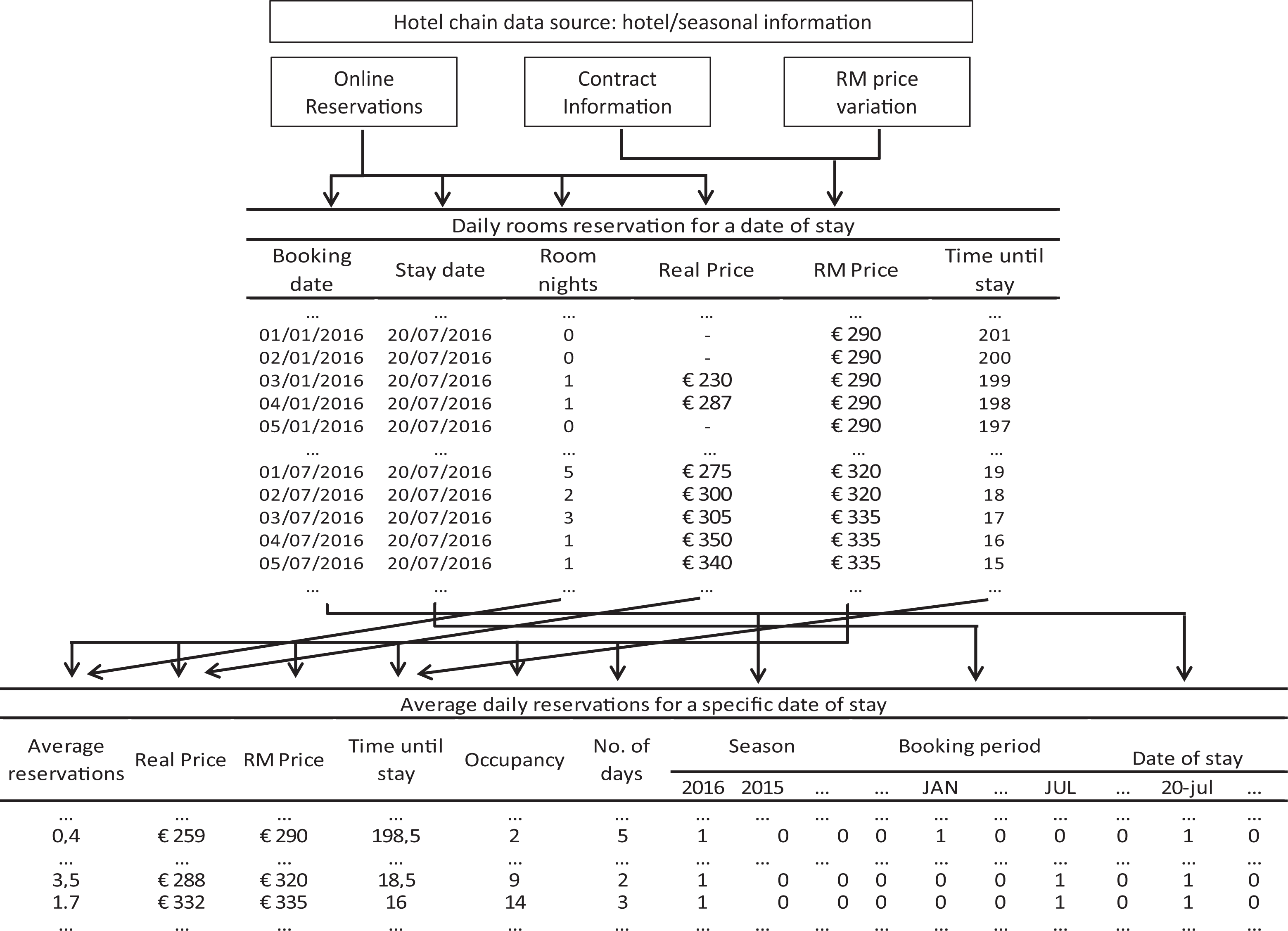
Data transformation process.
The supplied online reservations data are transformed into room reservations for each booking date and date of stay. The dates of stay are grouped into homogeneous periods, usually the stay periods where prices remain unchanged in the contract information. There are two available reservation prices: (1) the real price, which is the price paid by the customer when the reservation is made, dependent on the seasonal price, booking time, number of guests, type of board, type of room, payment method and so on, as reflected in the contract information; while (2) the RM price is the average room rate defined by the RM department. 4 The RM price only reflects seasonal price variability (i.e. price fluctuations due to the date of stay and booking time) and this theoretical daily price can be calculated from the contract information and RM price variation data. Hung et al. (2010) define the RM price as a proxy for the real price. Thus, both prices can be used. However, the real price is only observed when a reservation is made, while daily information for the RM price can be found even if there is no reservation.
The second step is to transform the daily room reservations for a specific date of stay in the booking horizon into the average daily room reservations (demand intensity) for homogeneous periods. The starting point for this is the RM price variability, which only fluctuates across the booking horizon due to temporal factors. Thus, each homogeneous period (observation) is the period where the RM price remains unaltered. During this time, there will be an absolute number of reservations and these are transformed into the average daily room reservations. The same transformation is carried out for the rest of the variables: real price (average), time until stay, and days.
Looking at the data for hotel 1, a comparison of the sales evolution of rooms for the period from 18 July to 5 August (an example of the peak season) and reservations across the booking horizon from 2012 to 2015 (Figure 2), we can identify two well-differentiated periods: (1) from the earliest booking period to 1 June, where the booking pace is very low (period A), while (2) during the last 7–10 weeks, the pace increases substantially and half the total room night reservations are made (period B). Figure 3 shows the evolution of prices for hotel 1. Period A displays the lowest prices (early booking offers) with rates that rise quite slowly, while prices undergo huge variations during period B, reaching a maximum at the end of the booking horizon. If the information from both graphs is combined, we can identify a structural change in the booking pace and prices and hence we can conclude that (1) period A accounts for the lowest levels of reservations and lowest prices; (2) prices are on average 20–25% higher during period B and this period accounts for half the total reserved room nights; and (3) bookings reach a peak when price discounts are given during the second period. These results might indicate that the second demand period is more elastic. Therefore, the booking horizon can be divided into two homogeneous demand periods (period A and period B).

Booking horizon reservations from 18 July to 5 August at hotel 1.
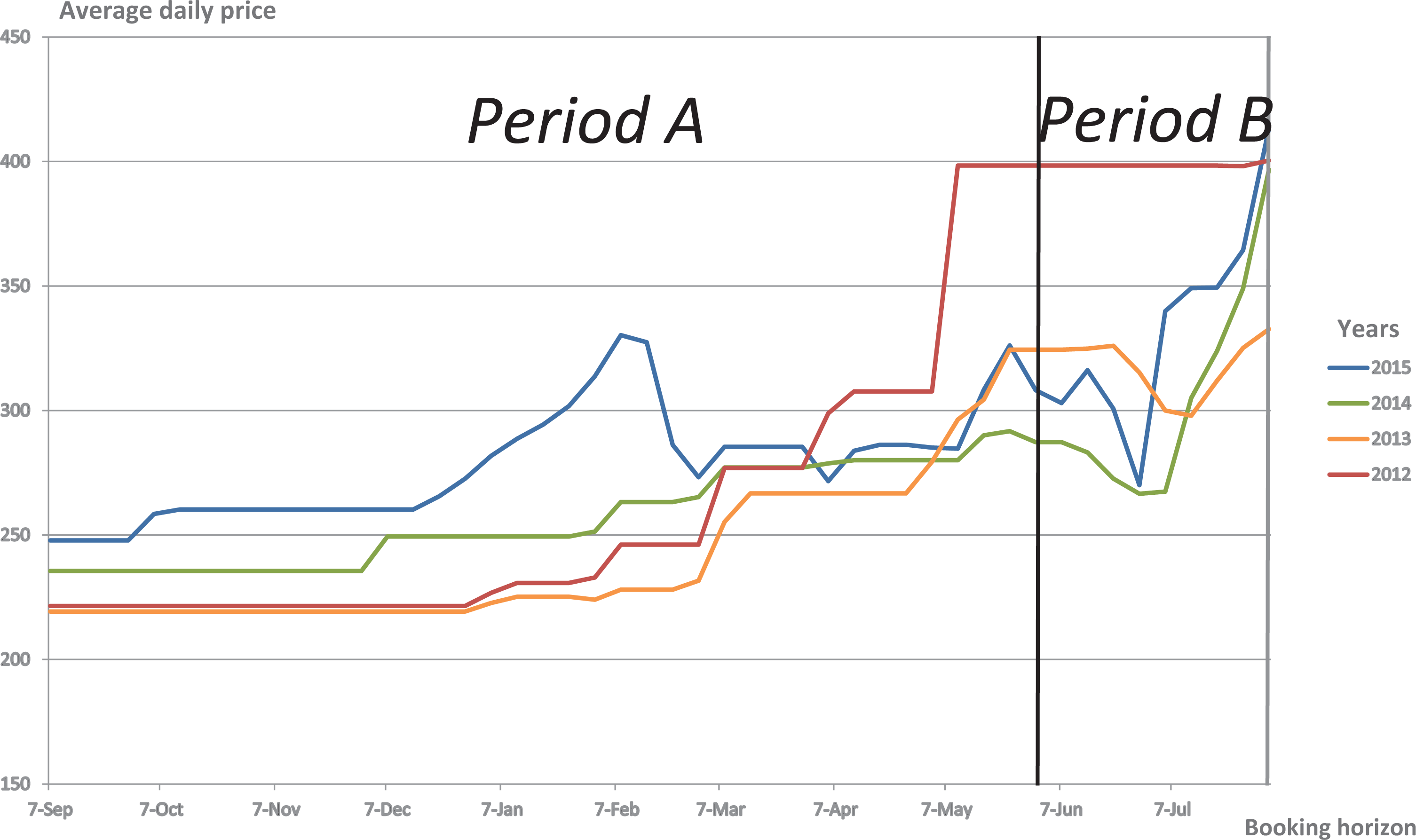
Booking horizon prices from 18 July to 5 August at hotel 1.
The same differences in price and booking paths across the booking horizon take place in all the periods of stay. According to what we observed in Figures 2 to 3, all these hotel stay periods can be divided in two different demands along the booking horizon (period A and period B).
In short, when the periods of stay with the lowest and highest demands are compared, prices for the online transient segment can be seen to increase exponentially, sometimes even tripling. The most extended segmentation strategy followed by the hotel chain’s RM department is based on price variations according to the date of stay and booking date.
Results and discussion
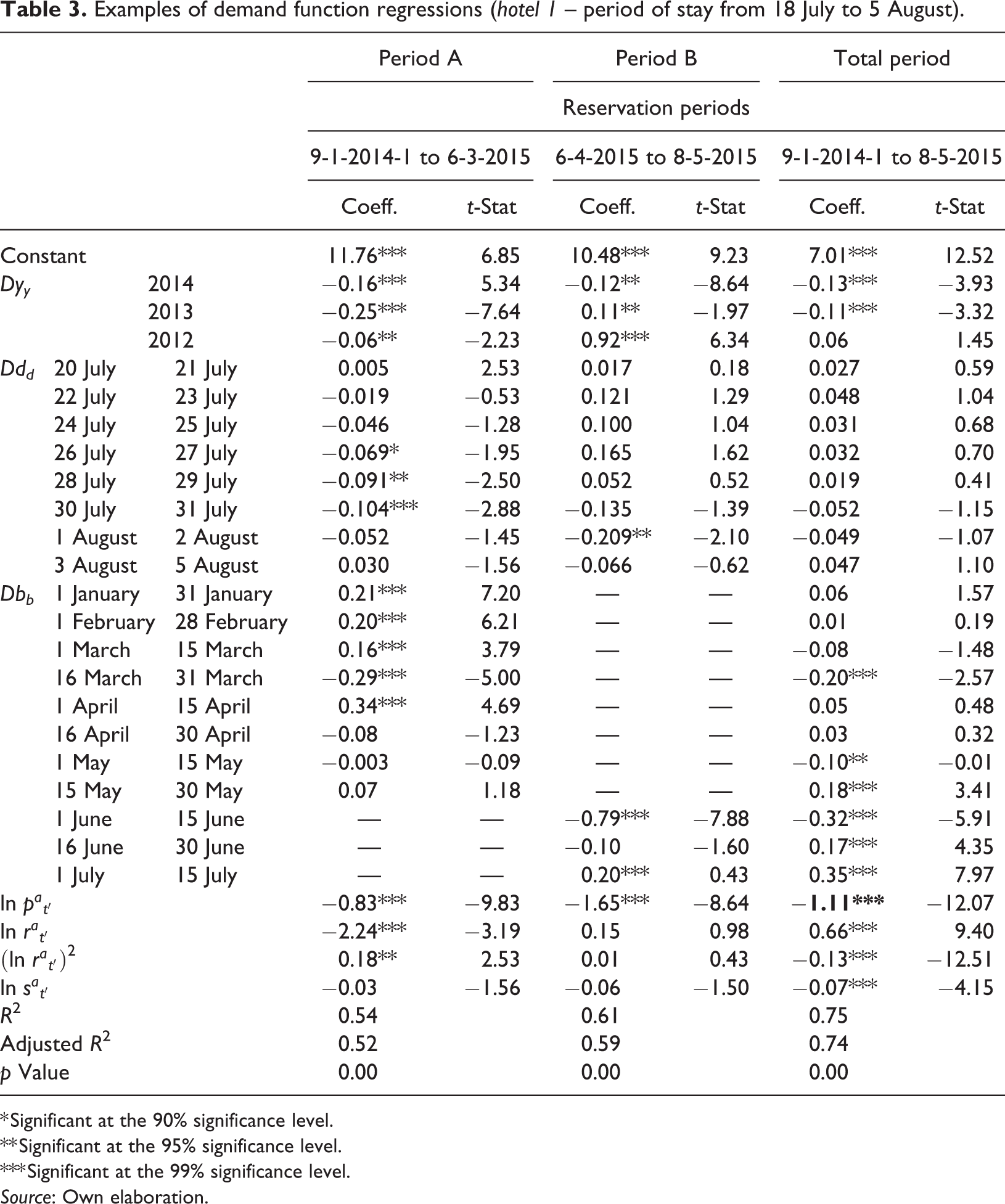
Taking as an example the information from the ‘Data’ section for hotel 1 – stays from 18 July to 5 August, Table 3 shows the values of the coefficients of the estimated variables in the three demand functions – depending on the different booking horizon considered. The Dyy – year/season dummy variables are seen to have a negative coefficient during reservation period A – meaning that sales were higher in previous years, as compared with the reference year (2015) – and a positive coefficient in period B, except for the previous year (2014). The results indicate that the Ddd – date of stay dummy variables are normally not significant and so the stay period considered is relatively homogeneous. The Dbb – booking period dummy variables have a coefficient with different values depending on the function definition and booking period. For example, in the first 2 weeks of June, sales drop, whereas in the first 2 weeks of July, they rise (period B and total period). When focusing on prices
Examples of demand function regressions (hotel 1 – period of stay from 18 July to 5 August).
* Significant at the 90% significance level.
** Significant at the 95% significance level.
*** Significant at the 99% significance level.
Source: Own elaboration.
Table 4 shows a comparison of hotel 1’s seasonal elasticities obtained from the different demand functions. The highest elasticities appear during period B, the period closest to the stay date. This might seem surprising, as the literature on RM usually regards the earliest booking periods as being the most elastic, which could explain the early booking discounts applied by the company, from the 28% discount for 2012 to the 15% discount for 2015. However, two additional factors should be considered: (1) prices during period A are 20–25% lower than those of period B, that is, the price of reference is different for the two periods. Thus, there is a bigger response by demand to price discounts in late reservations; and (2) as Lee et al. (2011) point out, the assumption that customers who book later are willing to pay higher rates does not always hold true, due to the greater differentiation and higher ability to differentiate customer experience in the hotel industry when compared to the airline sector. In this instance, a similar outcome was observed with the elasticities obtained for the different the seasonal periods of stay, that is, the most elastic demand coincides with the peak in high season, and the prices are two or even three times higher than those in low season. Regarding the real price elasticity values are more inelastic but equivalent to the RM price elasticity values.
Comparison of seasonal/year elasticities from both hotels 2015 and 2012–2015 and RM price and real price (absolute values).

** Significant at 95% significance level.
*** Significant at 99% significance level.
Source: Own elaboration.
Note: RM: revenue management.
Table 4 also shows information on own-price elasticity values obtained by estimating the different demand functions for hotel 2. Overall, hotel 2 seems to have a much more inelastic demand than hotel 1. Even so, both hotels have identical early booking strategies. The most elastic demand, in the case of hotel 2, corresponds to reservations made during period A of the high season, while this is precisely when hotel 1 has the lowest elasticities. Hence, the opposite elasticity values at the two hotels indicates that the same pricing strategy cannot be applied to both hotels, it could represent a badly formulated pricing strategy, particularly in the case of idle capacities on a stay date. Furthermore, the real price elasticity values for hotel 2 are closer to the RM price (i.e. the individual price of a specific date of stay). The main differences between the two hotels that could help to explain these elasticity differences are: (1) hotel 2 is located in a very well-known area of Majorca, with about 240% more beds than the area where hotel 1 stands (CAIB, 2017). According to Aguiló et al. (2003), a hotel’s location is an important source of price variation, and their findings indicate also opposite elasticity values depending on tourist nationalities. Consequently, factors such as the popularity and proximity of particular areas may determine the possibility of product differentiation, with direct effects on price and elasticity. (2) Hotel 1 has a 60% additional room capacity, as well as online reservations, than hotel 2, while hotel 2 sells rooms with an average price 14% higher than hotel 1. Indeed, Pan (2007) points out that a hotel’s room capacity negatively affects optimal room rates. (3) The consumer profile is different in the two hotels, hotel 1 is more specialized in the national segment, families, all-inclusive board and late bookings compared to the hotel 2. Therefore, according to Lee et al. (2011), it could involve different consumer willingness-to-pay.
Finally, Table 4 also proves the stability of all the elasticity measures for both hotels along the different seasons/years. We present the average elasticities for all the seasons considered in the demand functions (2012–2015) and we compare those with the actual values for year 2015. Results indicate that the differences of the elasticities between the season 2015 and the average values from all the seasons only present small differences. In general, the last season (2015) presents a slightly more elastic demand, especially in the case of hotel 1. Therefore, the differences of the elasticity values are due to the differences across the booking time demand behaviour, periods A and B, and between the characteristics of demand from the two hotels.
Figures 4 and 5 compare the two hotels seasonal and booking time (periods A–B) elasticities with observed RM prices – the prices set for the revenue managers in 2015 and the average prices between 2012 and 2015. We can see that although the price distribution is quite similar, the hotels’ elasticities take significantly different values. For instance, in high season, hotels 1 and 2 tend to increase prices during period A and to maintain or reduce prices in period B, while the hotel 1 usually has the most elastic demand in period B and hotel 2 during the period A, so it could indicate that an erroneous pricing strategy in hotel 2 is being used, particularly when we see that both hotels set the same early booking discounts (period A). It can be explained by the fact that in hotel chains, the same revenue manager administers several hotels, usually located in the same destination, and tends to use similar price strategies.
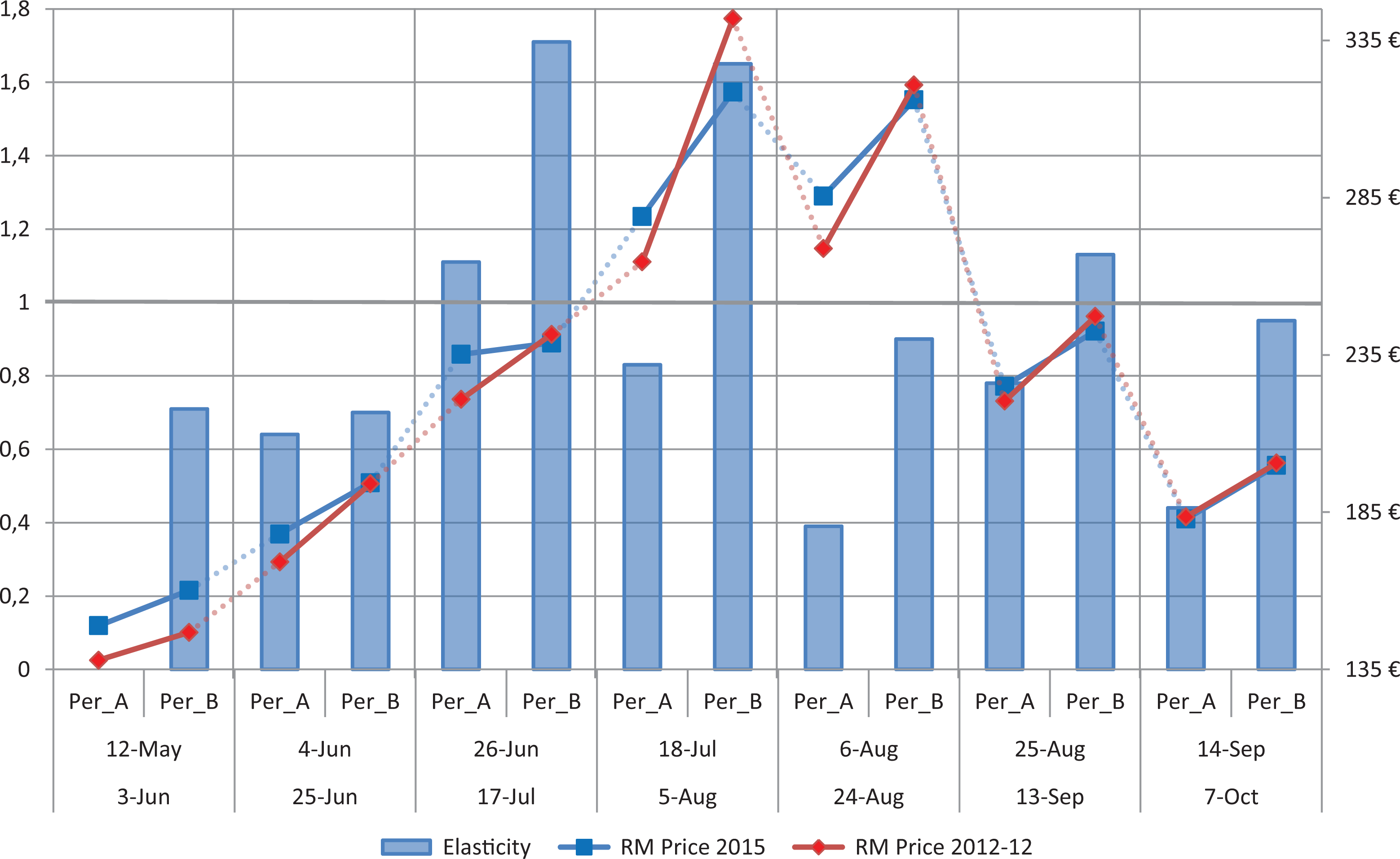
Hotel 1 elasticity values distributions and price evolution observed.
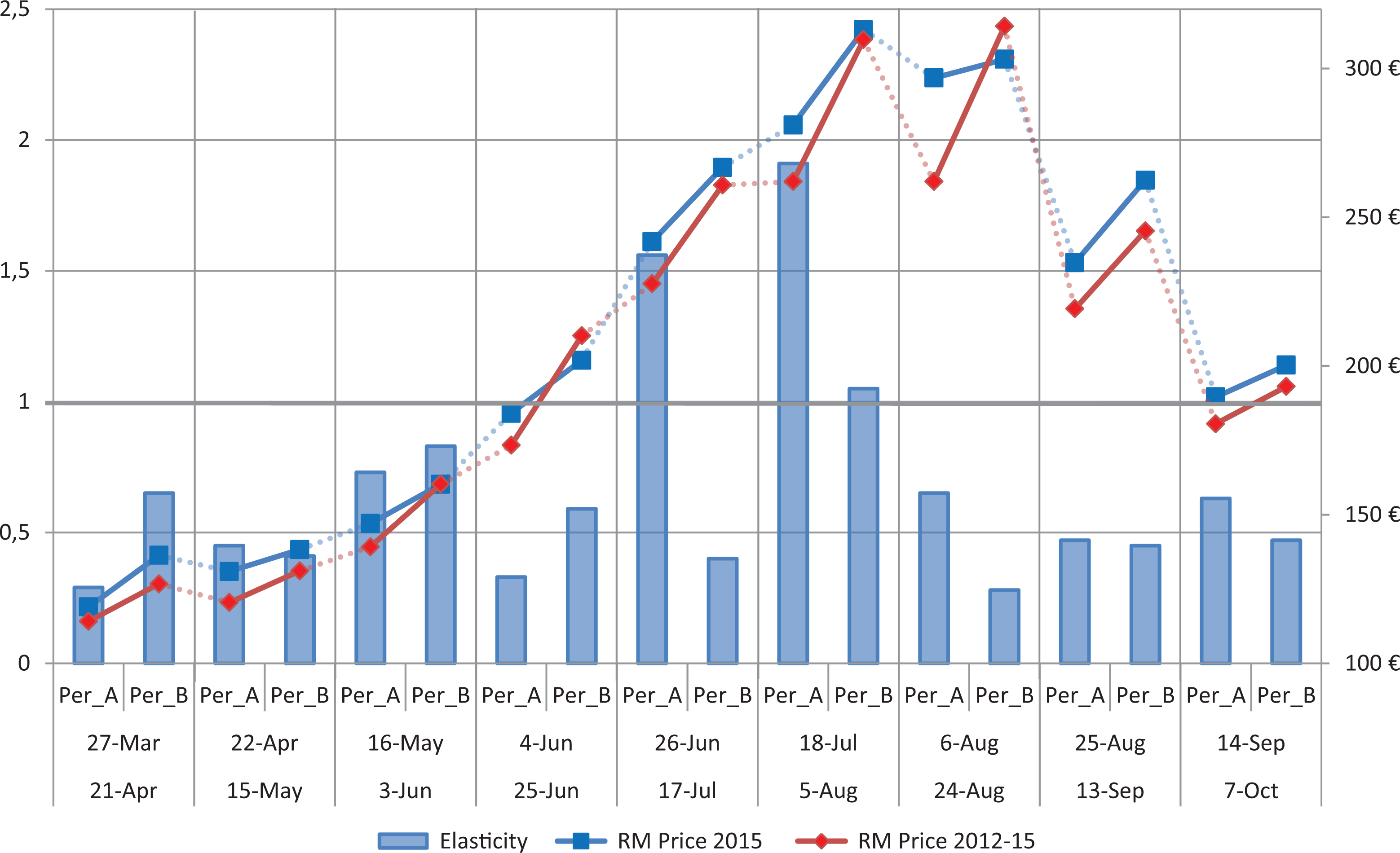
Hotel 2 elasticity values distributions and price evolution observed.
In summary, the demand model designed in the present article detects significant different demand behaviours along the different seasons and booking times and between the two Majorcan hotels.
Conclusions
Estimating a demand curve is a basic step in a pricing optimization process. When a pricing strategy is defined in order to maximize revenue, it is essential to measure the response of the demand to price variations. In fact, knowledge of demand response to price variations is a key tool in hotel sector pricing management. This is especially true in the emerging segments for resort hotels the online transient demand, particularly in the case of mature destinations needing to diversify in today’s current competitive scenario.
More specifically, this empirical study presents a particular demand model to measure the seasonal and booking time variation of different own-price elasticities of demand at hotel level. Furthermore, we present an empirical application to try to understand the different pricing strategies for online transient demand for two resort hotels in Majorca, where elasticity estimations allow comparison of own-price elasticity values across the different stay dates and booking times for the same hotel, as well as between the two hotels. The simplicity of the current model makes it easily adaptable and applicable to other hotel typology and it also allows the aggregation of the hotels’ data in order to estimate joint demand functions and the estimations will still be comparable among them. Another contribution of the present article is the transformation, simplification and harmonization process of the hotel data variables used by the RM department, which enables the application of this particular demand model to other hotels and makes their results’ comparison possible.
By measuring different price sensitivities, not only can this help the RM departments to set the best price at each point in the booking horizon (short term), thus maximizing revenue (Roberts, 2003), but it can also help to define the best strategy for each hotel in the medium term. The empirical application presented in this study, based on two similar hotels with a comparable demand located in different areas of the same destination, led to the following findings: (1) The elasticity values displayed by both hotels indicate that demands are not so inelastic as those values gathered in the hotel demand literature show; (2) in practice, the two hotels have completely different elasticity patterns during peak season and an awareness of these values could lead to changes in their shared early booking strategy; meanwhile in the low season, demand is quite inelastic for both hotels; (3) in the same way, the early booking strategy is proportionally constant throughout the season, while elasticity values are very different in low and peak season; therefore, setting different early bookings offers during the seasons and among hotels is highly recommendable; (4) the RM price can be considered as a proxy for the real price; and (5) knowing own-price elasticity values from past seasons can also have an impact on the long- to medium-term pricing strategy since it can help to answer important questions such as: Is there an homogenous demand for the defined seasonal stay periods where prices remain constant or should an alternative period be defined? Have prices been correctly set in the price contract information to fit in with hotel strategy?
In summary, the demand model is useful in defining the best pricing policy at the short run that allows the revenue maximization (tactical price optimization) as well as in the definition of an appropriate pricing strategy (medium and long-run pricing) for online transient demand in the resort hotel sector. Additionally, the demand model can be easily replicable for other hotels of the resort segment.
Further research will focus on the model adaptation and estimation to other type of hotels, as well as to hotels located in different destinations, in order to test different seasonal and booking behaviour effects which are measured in elasticity terms as a basic and comparable unit. Other research could focus on partial demand function estimations. The main argument for this would be that new booking data from a new season could be introduced into a demand model before the date of stay takes place and the elasticity obtained would be the price elasticity of demand of the reservations that have taken place until that specific booking date. When that estimation is carried out regularly, as the booking horizon goes on, the elasticities obtained would be similar to those obtained in a dynamic model.
One limitation in our study is that additional data from the hotel or competitor prices possibly could be included to improve elasticity estimations. Taking into account additional hotel booking information – such as number of guests, room type, board and so on – as well other segment data – such as TO demand – could allow the original own-price elasticity to be split into different elasticity values, that is, one elasticity for each of the heterogeneous demand segments to be considered. However, estimations using joint TO and online reservation data carry certain problems due to different underlying pricing objectives and strategies. In the case of TOs, prices and/or occupancy levels are set and agreed upon in long-term contracts between both parties (Aguiló et al., 2003 negotiations normally take place about 1 year in advance), while the online segment may have higher short-run price variation flexibility. In this sense, TO elasticities could be estimated in a similar model and compared with the online values in order to establish the best common pricing strategy for a specific hotel. Despite the hotel sector’s greater potential for differentiation than the airline sector, and its subsequent impact on pricing (Lee, 2011; Lee et al., 2011), competitor price information is another source of a demand model improvement. Indeed, competition plays a particularly important role in customer choice RM models (Pachon et al., 2007; Perakis & Sood, 2004; Ratliff et al., 2008) and in some dynamic models relating to the hotel sector (Bayoumi et al., 2013).
Footnotes
Acknowledgements
The authors gratefully acknowledge financial support provided by the Spanish Ministry for Science and Innovation, by the Spanish Ministry for the Economy and Competitiveness and by the Balearic Government. The authors also thank Jaume Rosselló for his helpful comments on a previous draft of the paper.
Declaration of conflicting interests
The author(s) declared no potential conflicts of interest with respect to the research, authorship, and/or publication of this article.
Funding
The author(s) disclosed receipt of the following financial support for the research, authorship, and/or publication of this article: This work was financially supported by the Spanish Ministry for Science and Innovation through Project ECO2011-28999, by the Spanish Ministry for the Economy and Competitiveness through Project ECO2013-47301-R and by the Balearic Government through Research Fellowship FPI/1574/2013.