



Abstract
This article aims to analyze the impact of Taiwan’s 2008 opening policy to Chinese tourists and the effects of cross-strait relations on both Chinese and non-Chinese inbound tourists into Taiwan, with controls in place for other factors. Using annual country-level panel data over the 2000–2016 period, along with the application of the generalized method of moments approach and several static panel data models, the empirical results suggest that while Taiwan’s opening policy to Chinese tourists has had an enhancement effect, there has been no crowding-out effect on either Chinese or non-Chinese inbound tourists into Taiwan. In addition, the cross-strait relations are found to have a negative effect on non-Chinese inbound tourists, but a positive effect on Chinese inbound tourists visiting Taiwan. We conclude that, compared to non-Chinese inbound tourists into Taiwan, the Chinese inbound tourists into Taiwan is both economically and politically oriented.
Introduction
A country’s tourism industry is widely recognized within the extant related literature as a major contributor to its progressive economic development 1 ; for example, applying an “exponential generalized autoregressive conditional heteroscedasticity in mean” (EGARCH-M) model to tourism in Taiwan, Chen and Chiou-Wei (2009) demonstrated that the island’s economic growth was significantly enhanced by inbound tourist numbers. The Taiwanese government has therefore implemented a number of aggressive tourism policies over the years aimed at boosting tourism growth throughout the island; these policies include the “Taiwan Double,” “Project Vanguard for Excellence in Tourism” and “Tourism 2020.”
The total numbers of inbound tourists visiting Taiwan over the 2000–2016 period are illustrated in Figure 1, which shows that inbound tourism into Taiwan soared from 2.62 million in 2000 to 10.69 million in 2016. Over the same period, the compound annual growth rate (CAGR) of international arrivals to Taiwan was 11.04%; according to World Tourism Organization (UNWTO) statistics, the CAGR of international arrivals to advanced economies over the 2005–2016 period was just 3.92%.
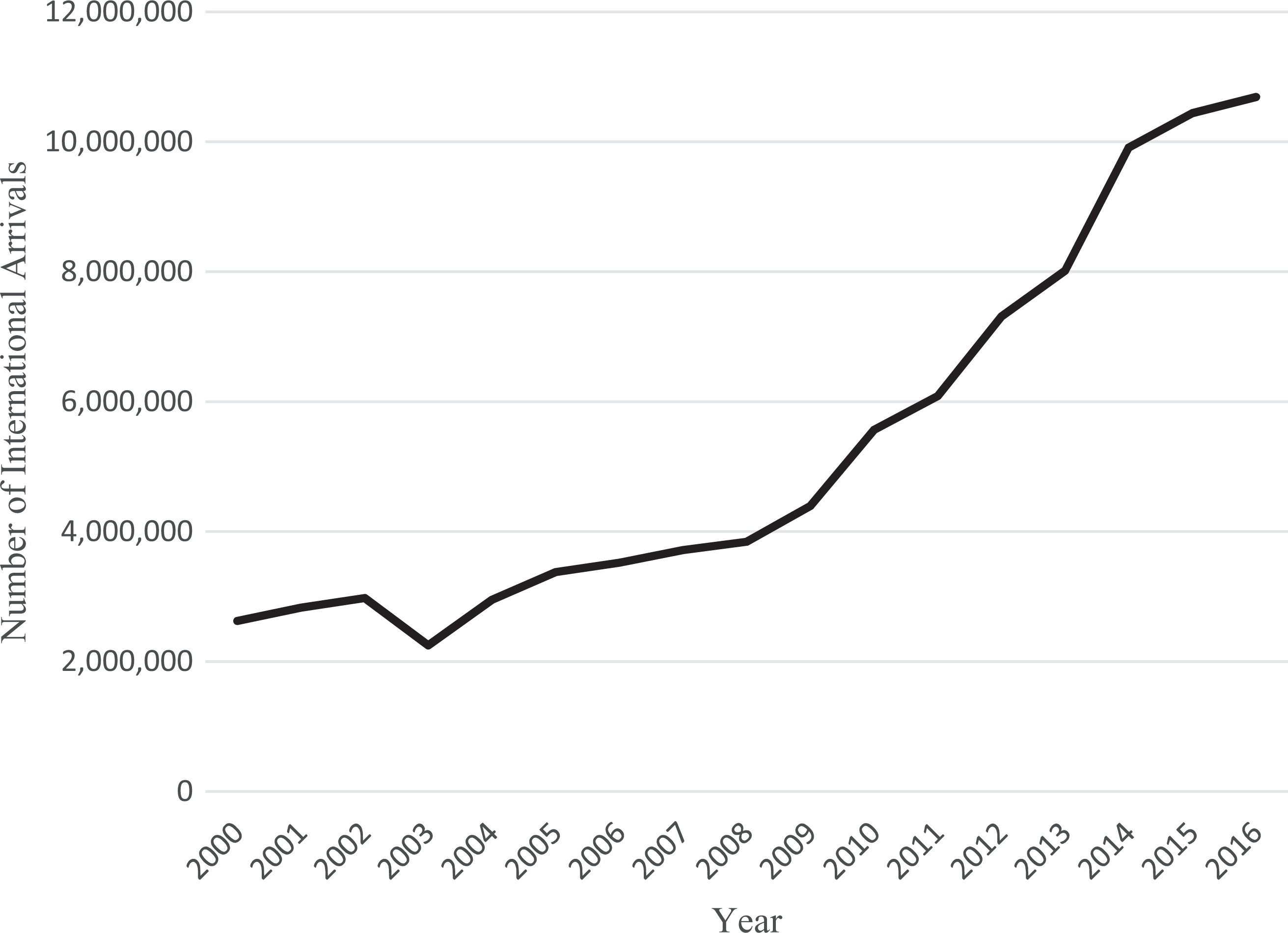
International arrivals into Taiwan, 2000–2016. Sources: Tourism Bureau, Republic of China (Taiwan).
Among all advanced economies, 2 Taiwan is the most rapidly growing tourism destination, which suggests the need for a systematic investigation into inbound tourism demand into Taiwan. Figure 1 further illustrates a rapid rise in the number of international tourists visiting Taiwan after mid-2008, a change that was mainly attributable to the increase in Chinese tourists traveling to the island following Taiwan’s opening policy to Chinese tourists in July of that year.
As shown in Figure 2, under this new opening policy, there has been rapid growth in the numbers of Chinese inbound tourists visiting Taiwan over a very short period, from just 329,204 in 2008 to 3,511,734 in 2016, representing a CAGR of almost 34.43%. This increase in total numbers has also given rise to a substantial increase in the proportion of Chinese inbound tourists, as compared to total inbound tourists, rising from 8.56% in 2008 to 32.85% in 2016. However, despite this shift in tourism resulting in Chinese tourists becoming the single largest source of inbound tourists for Taiwan, very little effort has been placed into investigating the factors affecting Chinese inbound tourists to the island.
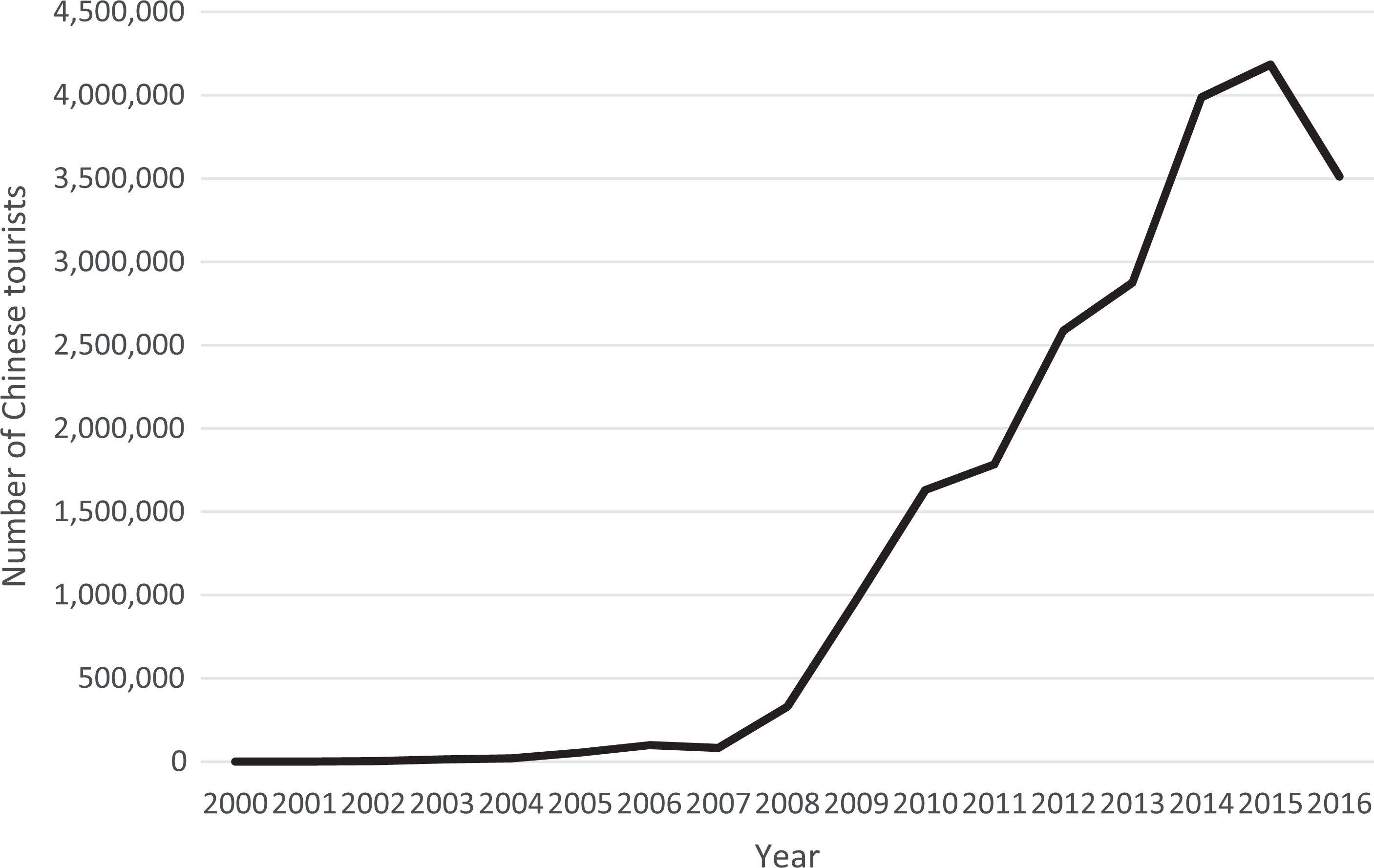
Total number of Chinese tourists entering Taiwan, 2000–2016. Sources: Tourism Bureau and Mainland Affairs Council, Republic of China (Taiwan).
This exponential increase in Chinese tourists has also contributed to the huge boost in the development of tourism-related infrastructure and facilities on the island, such as the construction of new hotels, airport expansions, and an increase in the overall numbers of professional tour guides. The resultant expansion in Taiwan’s tourism infrastructure has significantly improved the island’s tourism quality, which could, in turn, help to attract more non-Chinese tourists to the island (Chiang, 2012; Tseng and Huang, 2017).
However, given that China has the largest population of all countries, this may lead to unexpected negative impacts on tourism in various destinations if millions of Chinese tourists were to flock there, and indeed, it is argued by both Su et al. (2012) and Chou et al. (2014) that this huge increase in inbound Chinese visitors to Taiwan may have had a tendency to crowd out non-Chinese international tourists traveling to Taiwan; thus, the impact of the opening policy to Chinese tourists on non-Chinese inbound tourists remains unclear.
Given that China has become the world’s largest outbound tourism country, 3 it could potentially take advantage of its outbound tourism policy for its own national interests (Kim et al., 2016). Indeed, as argued by both Chiang (2012) and Rowen (2014), China has been attempting to intervene in Taiwan’s political and economic autonomy by manipulating Chinese tourist allowances to Taiwan; when cross-strait relations—the political atmosphere between Taiwan and China—are favorable (unfavorable), China seems to be prepared to allow more (less) Chinese tourists to visit Taiwan. Nevertheless, these studies lack any empirical evidence on the influence of cross-strait relations on Chinese tourists visiting Taiwan.
Although considerable effort has been placed into demonstrating that public safety and political unrest are major factors likely to be taken into consideration by tourists when engaging in their destination decision-making, 4 little attention has been paid to the impact of cross-strait relations on non-Chinese tourists visiting Taiwan. Accordingly, our aim in this study is to investigate the factors affecting Chinese and non-Chinese inbound tourism to Taiwan, with particular focus on Taiwan’s opening policy to Chinese tourists and cross-strait relations.
We collected annual panel data on the number of inbound tourists to Taiwan from China and fourteen other countries from 2000 to 2016, with our estimates including the annual number of negotiation meetings between Taiwan and China (our proxy for cross-strait relations between Taiwan and China), along with other control variables. To effectively deal with our panel data, we employ not only the pooled “ordinary least squares” (OLS) method and a fixed-effects model commonly used within the related literature but also the system “generalized method of moments” (GMM) approach, essentially because the serial dependence of international arrivals has been identified in several prior related studies. 5
Our research makes the following contributions to the literature. First, we provide empirical investigations of the influence on inbound tourism into Taiwan attributable to both the 2008 opening policy to Chinese tourists and cross-strait relations. Second, we provide an investigation into other factors affecting Chinese inbound tourists to Taiwan. Third, our study is the first to apply the system GMM approach to investigate the determinants of Taiwan’s inbound tourism.
The remainder of this article is organized as follows. Brief introductions to Taiwan’s opening policy to Chinese tourists in 2008, the cross-strait relations and the potential impacts on inbound tourism to Taiwan are provided in the section “Factors Affecting Tourism in Taiwan.” The model, data descriptions, and the econometric methods adopted for this study are presented in the section “Data and Methodology,” with our estimation results subsequently being provided in the section “Results.” Finally, the conclusions drawn from this study are presented in the “Conclusions.”
Factors affecting tourism in Taiwan
Taiwan’s opening policy to Chinese tourists
Prior to 2008, Chinese tourists were not allowed to travel to Taiwan; this was essentially because, following the end of the Chinese Civil War in 1949, the mainland China area and the island of Taiwan came under the control of two separate governments. This situation led to an extremely tense relationship between the two states, ultimately resulting in a “cold war” standoff which lasted for almost 40 years. However, the tension between the two states was eased in 2008 when the China-friendly Kuomintang (KMT) party was elected into government in Taiwan, as this resulted in the two sides engaging in negotiations aimed at deepening their economic cooperation and integration, including the removal of barriers to Chinese tourists traveling to Taiwan.
In accordance with a bilateral agreement signed in July 2008, quotas were agreed which would allow Chinese citizens to travel to Taiwan; however, strict regulations were set up, not only with regard to these quotas but also the method of travel. At the start of the opening policy, Chinese tourists were permitted to travel to Taiwan only through escorted tour groups, with a minimum tour expense requirement and a visit duration of not less than 7 days; self-guided tours to Taiwan were eventually opened up to Chinese tourists in 2011.
Over the years following the initial bilateral agreement, Taiwan opened up to Chinese tourists on a step-by-step basis, with the quotas on the numbers of Chinese tourists being allowed to travel to Taiwan expanding several times; thus, the Taiwanese government has clearly maintained a controlling cap on the number of Chinese inbound tourists. The changes in these quotas over the 2008–2016 period are reported in Table 1.
Quotas of Chinese tourists traveling to Taiwan, 2007–2016.
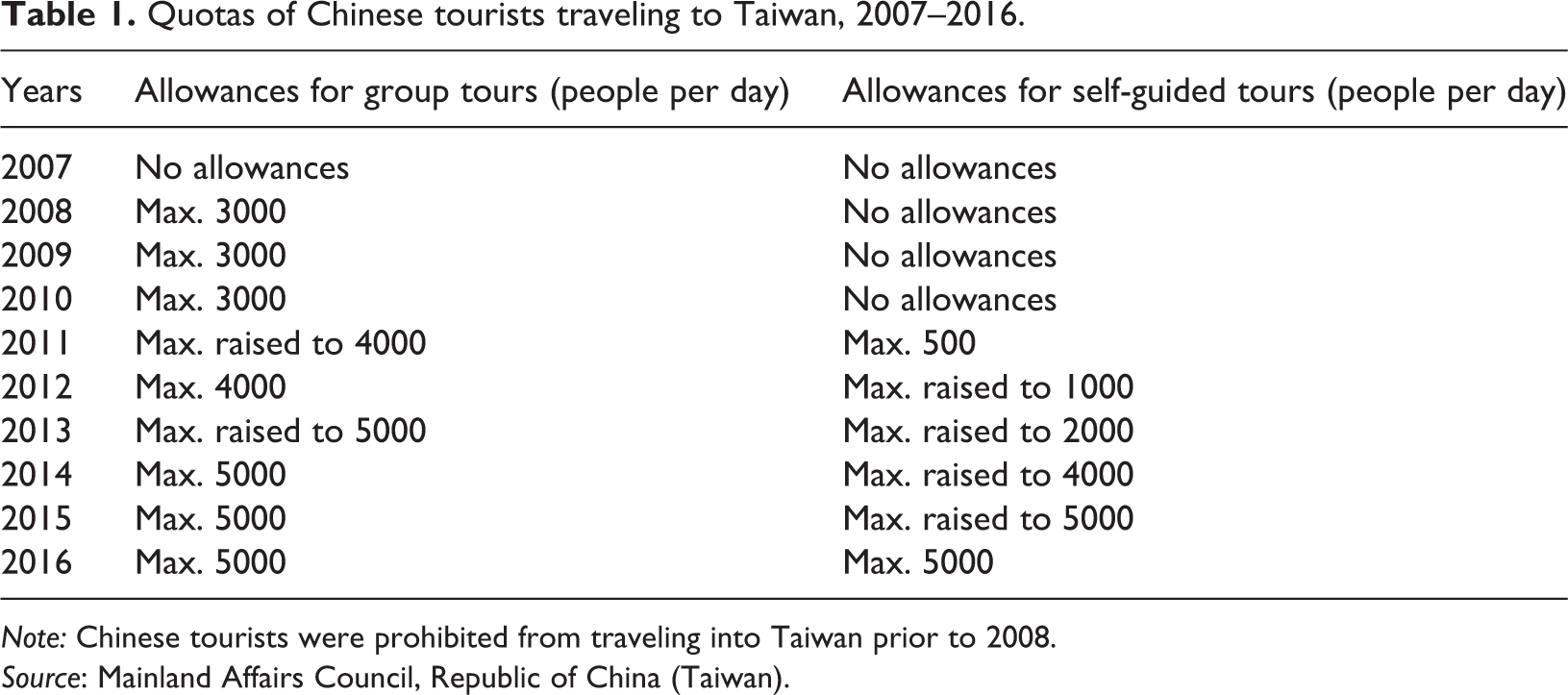
Note: Chinese tourists were prohibited from traveling into Taiwan prior to 2008.
Source: Mainland Affairs Council, Republic of China (Taiwan).
The policy of opening up to Chinese tourists had two potentially opposing impacts on tourism in Taiwan. On the one hand, such a policy might well boost the construction of tourism infrastructure and facilities in Taiwan, potentially improving the capacity and quality of Taiwan tourism services and eventually attracting more international arrivals to Taiwan. For example, using inbound tourism data on Taiwan over the 2001–2016 period, Tseng and Huang (2017) demonstrated that the opening policy increased the numbers of tourists from Hong Kong and Macau, with no crowding-out effect being discernible on Japanese tourists traveling to Taiwan. On the other hand, however, the capacity or quality of tourism services could decline if the increase in tourism infrastructure and facilities in Taiwan was unable to keep up with the growth in Chinese tourist numbers; this could result in lowering the attractiveness of Taiwan to international inbound tourists and a resultant decline in international tourism numbers.
Using monthly data on inbound tourism into Taiwan between 2008 and 2010, Su et al. (2012) reported that the policy of allowing Chinese citizens to travel to Taiwan had a crowding-out effect on tourist arrivals from both Japan and the United States, although there was a marked increase in the numbers of tourists coming in from Hong Kong. Based upon the application of a Monte Carlo simulation on 2001–2011 tourism data, Chou et al. (2014) also found a crowding-out effect with regard to tourists from Korea, Singapore and the United States. However, in both of these studies, the focus was specifically placed on the impacts of the opening policy on inbound tourists from certain countries.
Cross-strait relations
Over recent years, Taiwan has adopted aggressive policies aimed at attracting Chinese tourists to travel to the island; however, it is unlikely that Chinese tourists could travel to Taiwan without China’s cooperation. In the qualitative studies of Chiang (2012), Rowen (2014), and Kim et al. (2016), 6 it was emphasized that China used its outbound tourism policy as a “carrot and stick” approach for its own political interests. Although China was willing to allow more Chinese tourists to travel to Taiwan when cross-strait relations were favorable, the reverse was clearly the case when relations were less favorable. However, while the results of these studies reveal that China’s outbound tourism policy had become a tool for China to interfere in Taiwan’s internal affairs, they provided very little empirical evidence on this issue.
Numerous other related studies have also identified public safety in a tourist destination as one of the most important factors affecting destination choices (Hsu et al., 2009; Wang, 2009; Yang et al., 2010). Wang (2009) identified the negative impacts of disasters or epidemics in Taiwan, as well as the 911 attacks in 2001, on inbound tourism to the island. Other studies have also argued that political instability and unrest in a tourist destination will tend to sway inbound tourists away from that destination toward other competing destinations; however, these studies have tended to lack any thorough investigation into the ways in which the national security of a destination can influence its inbound tourism. 7
The political event of greatest relevance to Taiwan is the cross-strait relationship that it shares with mainland China. The Chinese government has frequently threatened to invade Taiwan, and indeed, there were occasions when China dispatched bombers to fly around the island, thereby heightening the possibility of war and increasing the perception of instability in national security and public safety in Taiwan. Such negative national security events could directly affect the incentives of non-Chinese tourists considering Taiwan as their holiday destination.
There is, therefore, a need to identify the extent to which cross-strait relations affect both Chinese tourists and non-Chinese tourists, based upon which information can then be provided on the potential impact of the cross-strait relationship. To achieve this aim, we employ the number of negotiation meetings between two associations, the Taiwanese government-authorized “Straits Exchange Foundation” (SEF) and the Chinese government-authorized “Association for Relations across the Taiwan Straits” (ARATS), as our proxy for measuring the cross-strait relationship. The main reason for using the number of negotiation meetings is stated as follows.
While Taiwan and China are currently governed separately, China insists, under its “One-China Policy,” that Taiwan is a part of China, a claim that is refuted by both the Taiwanese government and the vast majority of the island’s citizens. However, while the Taiwanese government would prefer to see its affairs with China handled by official institutions, China has refused to interact with Taiwan through any formal official authorities. This is essentially because China firmly believes that formal official interactions can only occur between two countries, but it refuses to accept that Taiwan is a country; thus, China is only willing to interact with Taiwan through government-authorized civil associations. As a result, the two states agreed to establish these officially authorized specialized civil organizations with responsibility for dealing with all affairs between the two states.
Under their joint consensus, the SEF was created in November 1990 and the ARATS was subsequently created in December 1991. Since the two associations have sufficient representation of their respective governments to enable them to reach formal agreements between the two states, the interactions between the SEF and the ARATS can be considered to be formal official interactions between Taiwan and China. The numbers of negotiation meetings taking place between the SEF and the ARATS between 1991 and 2016 are reported in Table 2.
Negotiation meetings between SEF, Taiwan, and ARATS, China, 1991–2016.

Note: SEF: Straits Exchange Foundation; ARATS: Association for Relations Across the Taiwan Straits.
Source: Straits Exchange Foundation, Republic of China (Taiwan).
As shown in Table 2, in 1996, as a result of the first ever presidential elections to be held in Taiwan, no negotiation meetings took place between the SEF and the ARATS; this was essentially because the candidates in the 1996 election had consistently emphasized the independence of Taiwan, an issue that was a source of considerable irritation to China. In retaliation for the proclamations of the various election candidates, China launched large-scale military and missile exercises in the “Taiwan Strait,” the sea between China and Taiwan, and suspended all meetings between the SEF and the ARATS.
Table 2 similarly shows that no negotiations took place between the two associations between January 2000 and May 2008; throughout that period, Taiwan had been governed by the “Democratic Progressive Party” (DPP), a political party that was unfriendly toward China, and this resulted in China declining to engage in any new official interactions with Taiwan. As a result, communications between the two associations lay dormant until mid-2008 when the KMT party won the election and formed the new government in Taiwan; this was very quickly followed by the restoration of interactions and communications between the two associations. Interestingly, however, there is currently a further pause in cross-strait interactions between these two associations following the re-election of the DPP into government in Taiwan in 2016. As shown in Table 2, while there had been several meetings during the years 2008–2015, there were no meetings at all in 2016.
The total number of negotiation meetings taking place between the SEF and the ARATS in any given year can therefore serve as a measure of the cross-strait relations between the two states at that time. To the best of our knowledge, our study is the first to use the number of negotiation meetings between the SEF and the ARATS as a proxy for cross-strait relations in support of our investigation of the influence of the current political status between Taiwan and China on both Chinese and non-Chinese inbound tourism to Taiwan.
Other factors
Other major determinants of inbound tourism identified in the prior empirical studies include the size of the population in the country of origin (Massidda and Etzo, 2012; Yang et al., 2010), the geographical distance between the country of origin and the destination country (Chou et al., 2014; Lim, 1997; Yang et al., 2010), the income level in the country of origin, 8 and the exchange rate between the currencies in the country of origin and the destination country. 9
It has also been argued in several other related studies that there are a number of other important factors that should be considered; examples include the relative prices in the destination country (which measure the cost of living in the destination country relative to that in the country of origin) 10 and the substitute prices (which measure the cost of living for tourists in competing countries relative to that of a destination country). 11 However, Dogru et al. (2017) provided evidence to show that in the tourism demand estimation, the separate use of relative prices, substitute prices, and exchange rates would give rise to a measurement error problem. 12 Accordingly, they proposed the standardization of relative prices and substitute prices using the bilateral exchange rates between the destination and corresponding countries, an approach that had previously been proposed by Saayman and Saayman (2015).
Data and methodology
In this section, we provide a description of our model specification, the variables, the data, and the data sources, along with the econometric methods used in our empirical study.
Model and data
As tourism is defined as a services trade by the World Trade Organization (WTO), we apply the gravity model of international trade proposed by Bergstrand (1985) in which the number of inbound tourists is regarded as a trade commodity. The gravity model of international trade is defined as follows:

where Qik is the number of tourists from country of origin i traveling to destination country k, Ai (Ak) represents the country-specific characteristics of country of origin i (destination country k), and DTik measures the distance between country of origin i and destination country k. Based upon the application of the gravity model, our empirical model is specified as shown in the following equation:

where lnVTit, the explained variable, is the logarithm of the number of tourists from country of origin i visiting Taiwan in year t; ui is the unobserved individual effect; and εit is the error term with normal distribution. The explanatory variables in equation (2) are stated as follows.
First, we introduce the variables of primary interest in this study. In equation (2), D_Opent is a dummy variable that takes the value of 1 if the sample occurred during the 2008–2016 period, it is designed to investigate the impacts of the opening policy to Chinese tourists in 2008 on inbound tourism; and Negt denotes the number of negotiation meetings between Taiwan’s SEF and China’s ARATS in year t.
Second, the control variables shown in equation (2) are introduced as follows. The relative prices, RPit, refer to the prices in Taiwan relative to the prices in the tourist’s country of origin i in year t (this variable is used to capture the impact on inbound arrivals of the cost of living in the destination country relative to the cost of living in the country of origin, which thereby highlights the price effect between Taiwan and the country of origin). Following the concept of purchasing power proposed by Dogru et al. (2017), which was used for the calculation of the relative prices, the relative prices variable is constructed in the present study by standardizing it with the bilateral exchange rate between the NT$ in Taiwan and the currency in the country of origin i, as follows:
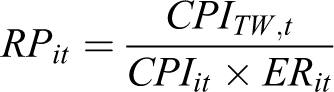
where CPITW,t is the “consumer price index” (CPI) in Taiwan in year t; CPIit is the CPI in the inbound tourist’s country of origin i in year t; and the values of both indices are set at 100 in the 2010 base year. ERit is the average direct quoted exchange rate between the currencies of Taiwan and the country of origin i (i.e. the amount of NT$ relative to one unit of currency in the country of origin i) in year t.
The substitute prices, SPjt, are the price levels in Taiwan relative to those in the competing country j in year t (this measures the cross-price elasticity between Taiwan and the competing destinations). Similar to the relative prices noted earlier, the substitute prices are constructed by standardizing them with the exchange rates between the NT$ and the currency of the competing destination j. This is constructed as follows 13 :

where CPITW,t refers to the CPI in Taiwan in year t; CPIHK,t (CPIChina,t) denotes the CPI in Hong Kong (CPI in China) in year t; and ERHK,t (ERChina,t) is the average exchange rate between the NT$ and the HK$ in Hong Kong (RMB in China) in year t. These two Asian destinations, Hong Kong and China, are combined in this study to provide a composite substitute price with an equally weighted index 14 ; however, the CPI in either Hong Kong or China is removed when calculating the standardized substitute price for these countries of origin, because they are regarded as one single competing destination.
GDPit refers to the per capita GDP, measured in US$, in the inbound tourist’s country of origin i in year t (this is used to estimate the influence of relative income on Taiwan’s inbound tourism); Popit is the population, in millions, of the inbound tourist’s country of origin i in year t; and DTi is the average distance in kilometers between Taipei and the three biggest cities in the inbound tourist’s country of origin i using Google; for example, taking China as the country of origin i, the variable DTi is measured as the average distance between Taipei and its three biggest cities, Shanghai, Beijing, and Chongqing. 15
As pointed out by Wang (2009), any outbreak of a disease or epidemic would clearly have direct impacts on inbound tourist numbers; we therefore include a dummy variable, D_2003t, which takes the value of 1 if the year of the observation was 2003 to capture the impact of the SARS epidemic on the total number of inbound tourist numbers in that year.
Finally, since our main area of interest in this study is our investigation of the factors affecting inbound tourists to Taiwan from China and other countries, we employ a dummy variable, D_CHINAi, which takes the value of 1 if the tourists (the dependent variable) originate from China, as well as the interaction term between each of the explanatory variables and the D_CHINA dummy, which is expressed as a vector, Zit.
Data sources
We identified the top 15 sources of international tourists to Taiwan (VTit) and collected 2000–2016 annual data on these countries for subsequent analysis 16 ; these 15 sources are mainland China, Hong Kong and Macau, Japan, Korea, Singapore, Indonesia, Thailand, Malaysia, the Philippines, Australia, the United States, Canada, the United Kingdom, France, and Germany, providing us with a total of 255 country-year level observations for subsequent analysis. Data on the annual numbers of Chinese tourists prior to 2008 were obtained from the Mainland Affairs Council, ROC, 17 while the post-2008 data were obtained from the Tourism Bureau, ROC, which also provided the numbers of international tourists visiting Taiwan from the remaining 14 countries throughout the whole sample period. 18
Data on the CPI of country of origin i in year t (CPIit) per capita GDP of country of origin i in year t (GDPit) and the total population numbers of country of origin i in year t (Popit) for all 15 countries of origin were obtained from the World Economic Outlook (WEO) databases of the International Monetary Fund (IMF), while the CPI data on Taiwan (CPITW, t) were obtained from the Directorate-General of Budget, Accounting and Statistics, ROC.
Finally, the annual average nominal exchange rates between the currencies of the fifteen countries of origin and the NT$ (ERIT) between 2000 and 2016 were obtained from the Central Bank Financial Statistics published monthly by the Central Bank of the ROC. Given that the Euro only came into effect in 2002, we employ the nominal exchange rates of the original currencies of Germany (Deutsche Mark) and France (French Franc) for the years prior to 2002.
Econometric method
To effectively deal with our panel data, we follow the regression methods commonly used in the prior related studies in which the pooled OLS method and a random/fixed-effects model were employed, with the regression model being expressed earlier in equation (2). Since the persistence in the number of inbound tourists to a destination country has been identified in several of the prior related studies, 19 this suggests that inbound tourism estimations may require a dynamic panel data model, because spurious regression problems can potentially arise when applying a static panel data approach (i.e. the pooled OLS method and a random/fixed-effects model). We therefore include a one-period lagged dependent variable in our model as an additional independent variable (VTi, t−1) to equation (2) model; this is expressed as shown in the following equation:

We then go on to employ the GMM approach for our regression estimation of equation (3), as proposed by Arellano and Bond (1991), with the inertia of the dependent variable.
Results
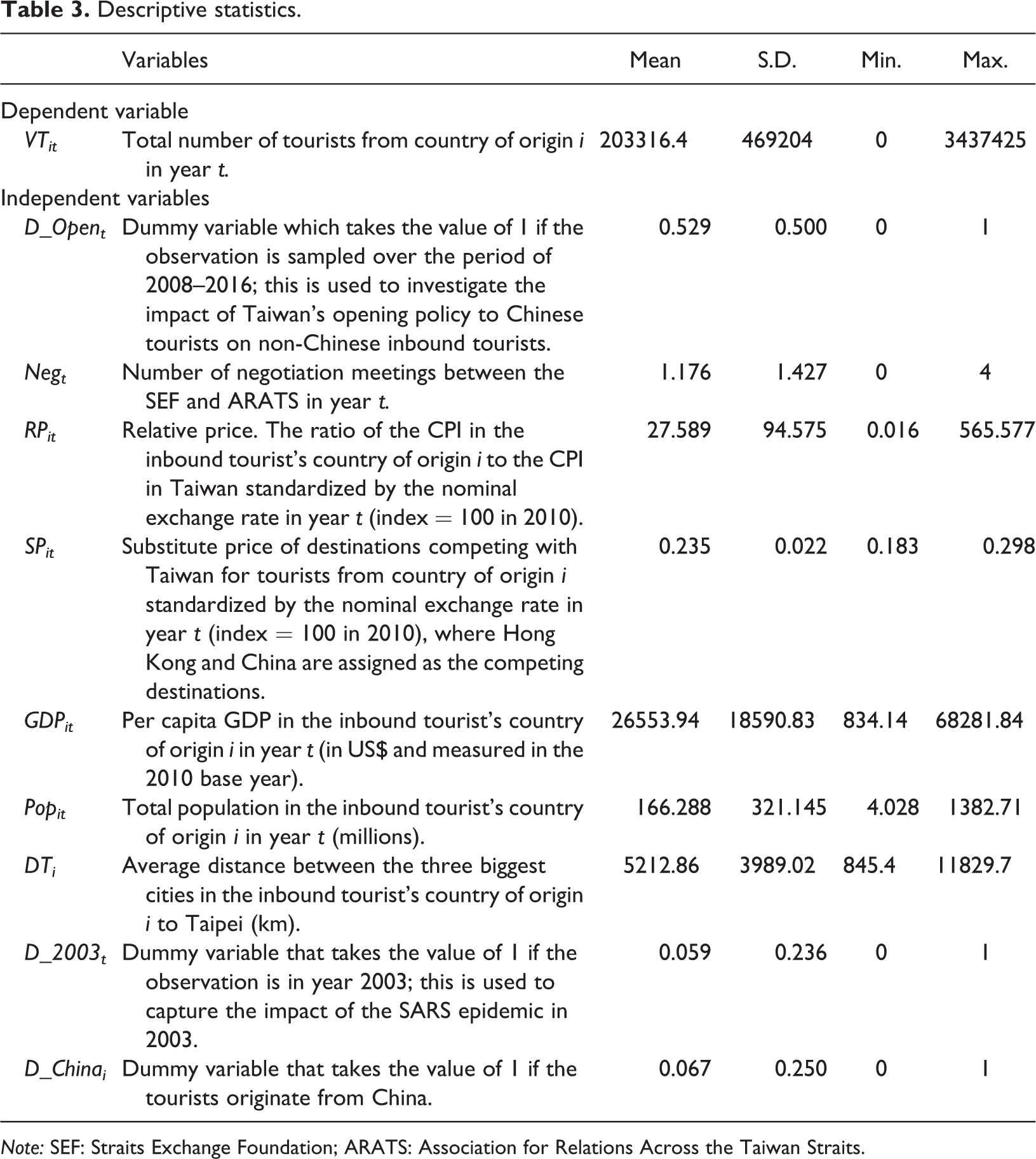
The estimation results are reported in this section, beginning with the presentation of the descriptive statistics of all of the variables included in our estimation model in Table 3. Prior to carrying out the regression estimations, it was necessary to estimate the “variance inflation factors” (VIFs) for the collinearity diagnostics of our sample for each of the explanatory variables. Given that the estimated VIFs were found to be between 1.09 and 7.13, with an average of 3.58 for our sample, our VIF estimations in the present study clearly indicate that there is no collinearity problem.
Descriptive statistics.
Note: SEF: Straits Exchange Foundation; ARATS: Association for Relations Across the Taiwan Straits.
We then applied a Hausman test to confirm the appropriateness of the random-effects or fixed-effects model in our static panel data estimations, with the test result indicating that the fixed-effects model provides a better fit with our panel data than the random-effects model.
Factors affecting inbound tourists to Taiwan
The estimation results obtained from our investigation into the impacts of Taiwan’s opening policy to Chinese tourists, cross-strait relations, and other control factors on inbound tourists into Taiwan from the fifteen countries are presented in Table 4, with model (1) reporting the estimates of the pooled OLS method, model (2) providing the estimates of the fixed-effects model, and model (3) reporting the estimates of the GMM approach. 20
Pooled OLS, fixed effects, and GMM results on inbound tourists into Taiwan.

Notes: Model (1) reports the pooled OLS results; model (2) reports the fixed effect results; and model (3) reports the GMM results.
* Significance at the 10% level.
** Significance at the 5% level.
*** Significance at the 1% level.
It is worth noting that to avoid the existence of weak instruments resulting from the use of a long-lagged period dependent variable as the instrument, we employed a two-period lag to the number of inbound tourists as the instrument in our dependent variable. The Sargan test in model (3) of Table 4 was found to be insignificant, which confirms that the instruments employed in this study are valid. The second-order autoregression AR(2) test was also found to be insignificant, which shows that the absence of second-order serial correlation in the disturbances is not rejected. Finally, we adopted a unit root test to determine the stationarity of our dependent variable. 21 The p-value of the test was found to be significant, thereby rejecting the null hypothesis of a stochastic trend 22 ; thus, the stationary dynamic panel data of our sample have been identified.
Prior to going on to explain the estimation results obtained from this study, there is a requirement to examine the appropriateness of our application of the GMM estimation. First, we examine the serial dependence of the variable, lnVTit, where the correlation of the one-period lagged dependent variable is 0.9026. Second, as shown in model (3) of Table 4, the one-period lagged dependent variable (lnVTi,t-1) is found to have a significantly positive impact on current inbound international tourist arrivals under the GMM approach.
Both of these results confirm the existence of serial dependence in inbound tourism, and because there is no consideration of any serial dependence of the dependent variable in the pooled OLS and fixed-effects model used in our study, these two approaches may well give rise to a problem of spurious correlations between the independent variables and inbound tourism to Taiwan. We therefore suggest that the results obtained under our system GMM approach should be taken as our main findings.
We now turn our attention to the estimation results. As regards the impact of Taiwan’s opening policy on non-Chinese inbound arrivals (those from countries other than China), the respective estimated coefficients on D_Opent in the pooled OLS, fixed-effects model, and system GMM approach are 0.986, 0.100, and 0.297, with all of these estimates and with the one exception of the fixed-effects estimation, having statistical significance.
Our findings show that the deregulation of tourist entries has had an enhancement effect on tourists visiting from other countries, and we find no evidence of any crowding-out effect on tourists visiting from these other countries. Although this empirical result is not consistent with the crowding-out effect reported by Su et al. (2012), we believe that this is because the capacity for tourism in Taiwan is catching up with the increase in Chinese tourists visiting the island, with the benefit induced by the increase in the quality of tourism services and the expansion in tourism facilities having surpassed the disadvantages of increasing numbers of Chinese tourists.
As an example, in the year 2000, the total number of hotel rooms available in Taiwan was 4,562,769; however, this had risen to 5,011,433 by 2008 and still further to 6,715,310 by 2016. 23 The CAGR of hotel rooms was 1.18% prior to the opening policy (2000-2008), as compared to 3.73% after the opening policy (2008–2016). This clearly demonstrates that the largest increase in the number of available hotel rooms occurred after the opening policy. As a result, the opening up to Chinese tourists and the increasing numbers of Chinese inbound visitors to Taiwan have had no crowding-out effect, and indeed, the policy may have even attracted more non-Chinese inbound tourists.
Turning to the impact of the deregulation on the numbers of Chinese inbound visitors, the respective estimates of D_CHINA×D_OPEN (the interaction term between the CHINA and OPEN dummies) under the three different approaches proposed in this study are −3.092 for the pooled OLS method, −2.220 for the fixed-effects model, and 0.678 under the GMM approach, with statistical significance for the OLS and GMM estimates, but not the fixed-effects estimate. As the use of the GMM approach is more appropriate for our estimations (as noted earlier), then as expected, the opening policy to Chinese tourists is found to have had a positive impact on the number of Chinese tourists visiting Taiwan.
As regards the impacts of cross-strait relations on inbound tourism into Taiwan, the respective estimates on Negt obtained under the three approaches adopted in this study are −0.165, −0.032, and −0.073 (with statistical significance, apart from the fixed-effects estimate). Although the impacts are negative, we find that the political atmosphere between Taiwan and China, as measured by the number of negotiation meetings between the SEF and the ARATS, has a statistically significant positive impact on the number of inbound visitors to Taiwan originating from China.
Combining the estimates of D_China × Neg with Neg (the interaction term between the D_CHINA dummy and Neg), the respective combined estimates under the three approaches are −0.165 + 0.326 = 0.161; −0.032 + 0.201 = 0.169; and −0.073 + 0.568 = 0.495. Comparing these with non-Chinese inbound tourists visiting Taiwan, the greater the number of negotiation meetings between the SEF and the ARATS, then the more favorable the political environment between the two states and the greater the number of Chinese tourists visiting Taiwan. Thus, it would appear that Chinese inbound tourists are more politically oriented.
Our empirical results complement the qualitative findings of Chiang (2012), Rowen (2014), and Kim et al. (2016). Chinese inbound tourism into Taiwan is found to be positively affected by cross-strait relations, with more Chinese tourists traveling to Taiwan when there is a favorable bilateral atmosphere between Taiwan and China; conversely, the numbers of Chinese tourists visiting Taiwan are reduced during any periods of tension in cross-strait relations. Thus, given the continuing uncertainty of the cross-strait relationship, the Taiwanese government should plan ahead and make preparations to avoid any impacts of such potential inconsistency in Chinese inbound tourism into Taiwan on both its tourism industry and overall economy.
Interestingly, our results also show that the cross-strait relationship has a negative impact on non-Chinese inbound tourism numbers into Taiwan, thereby implying that more non-Chinese tourists are prepared to travel to Taiwan when the cross-strait relationship is unfavorable. The Taiwanese government could therefore consider adopting policies aimed at attracting greater numbers of non-Chinese inbound tourists into Taiwan to reduce the negative impact of the reduction in Chinese inbound tourism on Taiwan’s tourism and economy under an ambiguous cross-strait relationship. For instance, the relaxation of non-Chinese tourist’s visa-free policy reduces their entry barriers traveling to Taiwan.
We now turn our focus to the impacts of the control variables on inbound tourism into Taiwan, all of which are related to economic and geographical factors. As the GMM approach is more appropriate than either the pooled OLS or fixed-effect estimations, our main emphasis is on the results obtained from the GMM estimation. First, ceteris paribus, the relative price standardized by the exchange rate (RPit) is found to have a negative effect on tourists visiting Taiwan from the fourteen countries (excluding China), albeit with no statistical significance; however, a significantly positive effect is found on the number of inbound Chinese visitors. This positive result may indicate that, as compared to their domestic destinations, Taiwan is regarded by Chinese tourists as a luxury good (Dogru et al., 2017). 24
Second, turning to the effects on inbound tourism attributable to the differences between the price levels in Taiwan and those of its competing countries (Hong Kong and China), our empirical results reveal that the substitute price (SPit) has a significantly negative impact; for example, relative to the price levels of Hong Kong and China, the GMM estimates indicate that a 1% increase in prices in Taiwan drives away an average of 0.874% of non-Chinese tourists potentially visiting Taiwan, as well as 41.562% (= 0.874% + 40.688%) of potential Chinese tourists.
Next, as expected, our GMM estimations reveal that the level of income (as measured by the GDP variable) has a significantly positive impact on both the number of non-Chinese inbound visitors to Taiwan (GMM estimate of 0.481) and the number of Chinese inbound visitors to Taiwan (GMM estimate of 0.481 + 23.382 = 23.863). Our results also reveal that the distance between Taiwan and the country of origin (DTt) has a significantly negative impact on both non-Chinese and Chinese tourists, which is in line with the findings of the prior studies; that is, the shorter the distance between Taiwan and the country of origin—which obviously implies lower transportation costs and traveling time—the greater the number of inbound tourists traveling to Taiwan from that country. Finally, we show that under all of our econometric methods, the outbreak of the SARS epidemic in 2003 (as measured by D_2003) had a strictly significant negative effect, a finding that is in line with the results reported by Tseng and Huang (2017).
Conclusions
We set out in this study with the primary aims of investigating the impacts of Taiwan’s opening policy to Chinese tourists in 2008 and cross-strait relations on both Chinese and non-Chinese inbound visitors to Taiwan, with controls in place for other factors. Our analysis uses data collected on the total numbers of tourists visiting Taiwan from fifteen countries between 2000 and 2016, including China and other non-Chinese countries. We used the number of negotiation meetings between the Straits Exchange Foundation (SEF) and the Association for Relations across the Taiwan Straits (ARATS) as our proxy for cross-strait relations, with our estimations involving the application of the pooled OLS method, a fixed-effects model, and the system GMM approach. We also standardized the relative and substitute price levels using the bilateral exchange rates between Taiwan and the corresponding countries in order to avoid any potential problem of measurement error.
Our main findings are stated as follows. First, our study is the first to apply the system GMM estimation to an investigation of the determinants of Taiwan’s inbound tourism, and since our system GMM estimations successfully identify the serial dependence of international inbound tourism into Taiwan, we recommend the use of the system GMM estimation approach. Second, Taiwan’s opening policy to Chinese tourists in 2008 has clearly had an enhancement effect, with no obvious negative impacts (crowding-out effect) on either non-Chinese or Chinese inbound tourists to Taiwan. Third, we find that cross-strait relations have a positive impact on Chinese inbound tourists and a negative impact on non-Chinese inbound tourists. Finally, we conclude from these main findings that as compared to non-Chinese tourism into Taiwan, Chinese inbound tourism to the island is both economically and politically oriented.
Since China has become the world’s largest outbound tourism country, many countries are now opening up their borders to more Chinese tourists to provide a boost to their economic development. We therefore propose some implications from a policy perspective, as follows. First, to avoid any rise in the “congestion effect” on a country’s tourism due to the opening up to Chinese tourists, the destination countries should consider increasing their investment in tourism infrastructure, including both the quantity and quality of its facilities and services. Second, our results show that Chinese inbound tourism is politically oriented, with a potential significant decline in the number of Chinese visitors to the destination country if there is any deterioration in the bilateral relationship between China and that country. Therefore, the destination country should also consider adopting policies aimed at attracting non-Chinese visitors in order to avoid the potential negative impact of any sudden reduction in Chinese visitors on both tourism industry and the overall economy of the destination country.
Our current research could be extended in a number of different directions in the future. First, given that China is the largest country and that it has increasing political and economic influence throughout the region, it would be interesting to extend our research focus to inbound tourism from other countries, particularly East Asian countries. Second, it may be worth investigating the impact of increasing numbers of Chinese tourists on productivity in the tourism service industry, both in Taiwan and other countries.
Footnotes
Authors’ note
Mateus Lee is now affiliated with Department of Diplomacy and International Relations, Tamkang University, Taiwan. All errors are, of course, our own.
Acknowledgements
The authors deeply appreciate the valuable comments and suggestions from Chin-Yi Fang and the help of Ming-Ren Chou in collecting the data. The authors also gratefully acknowledge the helpful comments and suggestions from the editor and two anonymous referees.
Declaration of conflicting interests
The author(s) declared no potential conflicts of interest with respect to the research, authorship, and/or publication of this article.
Funding
The author(s) received no financial support for the research, authorship, and/or publication of this article.