




Abstract
The Syrian crisis that started in 2011 is considered by many to have affected negatively the Lebanese economy. A possible transmission channel from the crisis to the economy of Lebanon is tourism. This article investigates the tourism–growth nexus in Lebanon controlling for the instability caused by the Syrian crisis. We use a vector autoregression model with five monthly macroeconomic variables: a novel index for income, number of tourist arrivals, number of Syrian refugees, and casualties in both Lebanon and Syria during the conflict. The results show that the Lebanese economy was resilient to the political instability engendered by the Syrian crisis. The findings support both the tourism-led growth hypothesis and the ancillary growth-led tourism hypothesis. The article concludes that the tourism sector in Lebanon is robust to the political instability engendered by the Syrian crisis.
Introduction
Tourism is an economic sector that is an important driver of economic growth in a number of developing nations. However, maintaining economic stability in such a sector is quite challenging given its significant dependence on political stability and security (Saha and Yap, 2014). Overall, safety and security concerns are considered the main determinants for tourists’ decisions to travel to a specific destination (Elshaer and Saad, 2017). In this respect, political instability, associated with violence, impacts negatively the perception of risk for tourists and thereby restrains the inflow of their potential numbers (Sönmez, 1998).
Since the start of the Syrian crisis in 2011, the world faced the largest wave of forced displacement since World War II (Fakih and Marrouch, 2015). The refugee “shock wave” was seen by some as constituting a “population pressure” on host countries. 1 Smaller economies in the Middle East and North Africa (MENA) region, such as Lebanon, were impacted the most by this crisis (Cali et al., 2015). As of March 2016, the total number of registered Syrian refugees stood at around one million leading Lebanon to hold the world record for the lowest ratio of natives to non-settled refugees, with a ratio of 4:1 according to the United Nations High Commissioner for Refugees (UNHCR). The economic pressures on Lebanon’s economy caused by the influx of Syrian refugees were considered substantial by some estimates. For example, the World Bank estimated the incremental costs in the public water sector at around 1.8% of gross domestic product (GDP) in 2014 and the total cost to the Lebanese health-care system was estimated to be around US$ 216–306 million in 2014 also (World Bank, 2015). However, the United Nations Development Programme (UNDP) have reported a positive impact on the economy resulting from the inflow of foreign aid to Syrian refugees including the effects of specific investments in infrastructure that benefited local businesses. 2 Moreover, the UNHCR (2015) has conducted, using a General Equilibrium model, an estimation of the various channels of the impact of the Syrian crisis on macroeconomic conditions in Lebanon. It considered three main channels: drop in tourism, drop in exports, and the fiscal stimulus generated by foreign aid to refugees. It finds that foreign aid has a multiplier effect of 1.6 contributing to 1.3% growth in GDP in 2014. However, when the downturn in tourism and drop in exports are taken into consideration, GDP growth turns negative reaching −0.3%. In addition, Cali et al. (2015) assert that the tourism was negatively impacted with spending, which was equal to 5.7% as share of GDP in 2010, dropping to 4.5% in 2012 in the immediate aftermath of the Syrian crisis.
The aim of this article is to examine the tourism–growth nexus in Lebanon controlling for the instability caused by the Syrian crisis. Specifically, we test the proposition stating that there is no effect of tourism on growth or growth on tourism against an alternative hypothesis that there might be a positive or a negative effect between the two variables. These hypotheses are defined in the literature as the tourism-led growth hypothesis (TLGH) and as the ancillary growth-led tourism hypothesis (GLTH), respectively. Our testing of these hypotheses takes into account the presence of a forced refugees shock. We use a vector autoregression model with five monthly macroeconomic variables: a novel index for income, number of tourist arrivals, number of Syrian refugees, and casualties in both Lebanon and Syria during the conflict. The model, hence, investigates the tourism–growth nexus in Lebanon controlling for the instability caused by the Syrian crisis. In this respect, our article also adds to the growing empirical evidence on tourism and growth in Lebanon (Bassil et al., 2015; Hamadeh and Bassil, 2017; Tang and Abosedra, 2014, 2016).
The remainder of this article is organized as follows. In the second section, we survey the literature on the tourism–growth nexus and the relationship between forced displacement and tourism; we then present the data and describe the empirical model in the third section. We discuss the results in the fourth section, and we make concluding remarks in the fifth section.
Tourism, growth, and forced displacement
Tourism and growth
According to the World Tourism Organization (UNWTO, 2008), the fourth largest industry in the world after the fuel, chemical, and automotive industries is international tourism. This fact encouraged many developing countries to promote domestic tourism, which they perceived as a potential resource for development (Ertugrul and Mangir, 2015).
In this respect, many studies have shown that international tourism boosts economic growth through various channels (Balaguer and Cantavella-Jordan, 2002; Brohman, 1996; Clancy, 1999; Gray, 1970; Hazari and Kaur, 1995; Hazari and Sgro, 1995; Lea, 1988; McKinnon, 1964). We can divide these channels into five main ones: First, Mckinnon (1964) proposes that the inflow of tourists attracts foreign exchange, which appreciates the domestic currency and reduces the price of imported intermediate and capital goods that are used as inputs for the production of goods and services, thereby increasing economic growth. Second, tourism plays a vital role in encouraging new infrastructure, private sector competition, and human capital accumulation (Brida et al., 2016). Third, tourism has a positive spillover on other industries. Cernat and Gourdon (2012) argue that linking the tourism sector with other sectors such as agriculture, fisheries, manufacturing, and construction integrates tourism into the local economy and improves economic performance. Fourth, the multiplier effects that result from business expansions due to international tourist arrivals represent a significant source of gains for both the private and public sectors (Li et al., 2013). In this respect, tourism services generate employment opportunities for natives as employment is stimulated by tourists’ expenditures on local businesses (Brida et al., 2016). Finally, the additional tourist demand of goods and services allows the host country to benefit from economies of scale and scope (Andriotis, 2002; Croes, 2006). For instance, when demand in the hotel and restaurant industries increases, those industries will expand to meet the additional demand through increased scale and through diversification, which lowers average total costs (Weng and Wang, 2004).
The empirical relevance of these economic channels has been mixed. We can classify the studies into four strands. First, the early studies found that tourism causes economic growth. This finding is often referred to as the TLGH (Mckinnon, 1964). An early study conducted by Balaguer and Cantavella-Jordan (2002) indicates that the TLGH was valid for Spain, known to be one of the largest international tourist recipients. The TLGH was also empirically confirmed for Turkey through a research conducted by Gunduz and Hatemi-J (2005) who find that a unidirectional causality running from tourism to growth exists. Brida et al. (2010) find a causal relationship between tourism spending from Argentina and real GDP per capita in Uruguay. Trang et al. (2014) also find support for the TLGH in Vietnam for the period between 1992 and 2011. In a multicountry setting, Lee and Chang (2008), using a panel of Organisation for Economic Co-operation and Development (OECD) and non-OECD countries over the period 1990–2002, find that the TLGH is valid for OECD countries only. Cárdenas-García et al. (2015), using a panel of 144 countries, also find supporting evidence for the hypothesis. More recently, Chiu and Yeh (2017) and De Vita and Kyaw (2017) confirm the TLGH for a sample of countries. Finally, Bassil et al. (2015) find evidence in supporting the TLGH for Lebanon over the period 1995–2013.
Second, another set of studies find the reverse causality whereby economic growth boosts tourism, which can be referred to as the GLTH. Oh (2005) finds that a unidirectional causality runs from growth to tourism in Korea over the period 1975 to 2001. Payne and Mervar (2010) find the same effect in Croatia. Cortes-Jimenez et al. (2011) also find evidence of GLTH in Tunisia during the period 1975–2007 while Suresh and Senthilnathan (2014) found a similar effect in Sri Lanka over the period 1977–2012. In contrast to Bassil et al. (2015), Tang and Abosedra (2016), using Lebanese data over the period 1995–2011, find support for the GLTH hypothesis.
Third, other studies find evidence of a bidirectional causality between international tourism and economic growth. Dristakis (2004) finds evidence in support of bidirectional causality in Greece over the period 1960–2000. In Cyprus, a long-run relationship between international tourism and economic growth was also validated by Katircioglu (2009a). Tang and Abosedra (2014) using Lebanese data over the period 1995–2010 also find a short-run bidirectional causality. Seetanah (2011) and Apergis and Payne (2012) using multicountry samples on 19 island economies and the Caribbean find strong evidence of a bidirectional causality. Chou (2013) finds the same effect in transition economies, while Tugcu (2014) reports a similar result for Mediterranean countries.
Finally, only few papers find that both the TLGH and the GLTH hypotheses are to be rejected. For instance, Katircioglu (2009b) and Arslanturk et al. (2011) find no relationship between tourism and growth in Turkey, while Tang and Jang (2009) find no effect in the United States.
Overall, despite the presence of some mixed evidence in the extant literature, we find that the majority of studies are supportive of the TLGH.
The impact of forced displacement on the economy and tourism
Keeley (1988) argues that when population density exceeds a nation’s resource density, the disequilibrium between the population and available resource leads to increasing infrastructure pressure and inability to provide adequate food, water, and other basic needs for the population.
Moreover, forced displacement has unique characteristics that distinguish it from the phenomenon of “voluntary” migration. The economic literature on forced migration appeared to provide conclusions and policy suggestions that are more applicable for forced migration cases (Ruiz and Vargas-Silva, 2013). Forced migration shocks affect the host nations’ economies through distinct channels. For instance, a forced migration shock can increase labor supply and intensify the competition for some occupations leading to lower employment and wages of natives (Ruiz and Vargas-Silva, 2015). Braun and Mahmoud (2014) add that the substitutability between natives and migrants is the main determinant of occupations that are affected the most. Del Carpio and Wagner (2015) reach similar conclusions that a forced migration shock increased labor supply and thereby decreased wages in Turkey. Their study emphasizes the substitutability effect of Syrian refugees in the informal sector where the flow of Syrian refugees caused a significant displacement of natives from the informal sector. They find that six natives were displaced for every 10 refugees in the informal sector. Moreover, Del Carpio and Wagner (2015) instrumental variable estimates indicate that the migration shock increased the propensity of uneducated male Turkish workers to join the formal sector by around three additional natives for every 10 refugees. According to Tumen (2016), the inflow of Syrian refugees significantly reduced informal native employment by providing an alternative cost effective labor input in labor-intensive sectors. Ceritoglu et al. (2017) claims that the Turkish employment rate decreased by 2.2% points in the informal sector. On the other hand, Fakih and Ibrahim (2016) find that the Syrian migration shock shows no relationship with the labor market in Jordan. Their findings are in line with the results of Ruist (2013) and Arthur (1991) indicating no significant effect of refugees on unemployment in Sweden and Ghana, respectively. Although some studies portray the negligible or insignificant effect of labor migration on unemployment, measures adopted by the host countries that prohibit firms from hiring refugees could be the main deterrent for such an impact. For instance, in an effort to regulate the labor market, the Jordanian government deported 5723 Syrian workers who were working illegally in the country (Fakih and Ibrahim, 2016).
The second channel of migration shocks transmission is the products market. The sudden increase in population caused by migratory shocks increases the demand for goods and services, especially for basic goods, food, and housing, which in turn increases the prices of those goods (Alix-Garcia and Saah, 2010). Taylor et al. (2016) argued that if the increased demand caused by migration shocks in Rwanda was not met with an increase in supply, prices within a 10-km radius around camps increased. Their simulations indicate that each additional refugee increases the consumer price index by 0.00034%, while the effect decreases when refugee aid is in the form of food instead of cash handouts. Akgündüz et al. (2015) argues that native households subjected to higher food and housing prices will subsequently face a decrease in real wages.
An econometric model of tourism in Lebanon
A brief on tourism in Lebanon
The tourism sector in Lebanon formed around 8.4% of GDP in 2016 according to the World Travel and Tourism Council. 3 However, the sector has historically bore the brunt of internal strife, regional wars, and political tensions despite the end of the civil war in 1991. 4 Since then, Lebanon has experienced a stop-go dynamic of political instabilities, wars with Israel and regional instabilities of which the latest Syrian refugee shock represents the most recent and by and large the most significant in its potential impact on the economy.
Data
To examine the tourism–growth nexus in Lebanon, we use four macroeconomic variables over the period between January 2011—beginning of the Syrian Crisis—and October 2016, when restrictions on refugee arrivals were enacted. First, we construct a proxy for monthly GDP (labeled GDP) based on Dibeh’ study (2008). 5 This constructed index is calculated using three variables which are total imports in value, number of cement deliveries (shipments), value of cleared checks in US$; where these variables are extracted from the Central Bank of Lebanon database. 6 We follow the methodology developed by the Conference Board in the United States, where the index It is calculated recursively

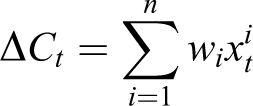
where
Standardization factors for wi .

Second, we consider the monthly number of tourist arrivals (TOU) of non-Lebanese at the Beirut airport 8 extracted from the Central Administration of Statistics (CAS) 9 . In fact, this variable reflects the number of visitors not holding a Lebanese passport, which includes both foreigners and some Lebanese holding a second citizenship (living abroad) who use a foreign passport on arrival. Third, we use the monthly number of registered Syrian refugees (REF) in Lebanon extracted from the UNHCR 10 . Fourth, we extract an aggregate variable for the civilian casualties (death and serious injuries) due to terrorist attacks in Lebanon during the Syrian crisis; this variable is taken from the National Consortium for the Study of Terrorism and Responses to Terrorism (START) 11 . Fifth, we calculate an aggregate variable for the civilian casualties (death) inside Syria (SYR) due to the war, which is extracted from the Syrian Revolution and Martyr Database (SRMD) and the Violations Documentation Center (VDC). 12 Table 2 provides the summary statistics of the five monthly variables. The average value of the monthly GDP index is 124. The average number of tourist arrivals is 411,418 per month. The average number of Syrian refugees is 638,472, while the average number of civilian casualties in Lebanon and casualties in Syria are 37 and 2277 per month, respectively.
Summary statistics of variables.

GDP: gross domestic product.
Econometric model
To examine the TLGH in Lebanon in the context of the Syrian crisis, we use the vector autoregressive (VAR) model. This technique has a number of advantages when examining the relationship between macroeconomic indicators. First, VAR does not impose strong identification restrictions on the estimates (Sims, 1980). Second, the VAR model allows us to identify restrictions on the variables that cannot be addressed in classical regression models, such as the ordinary least squares model, by assuming that all variables are endogenous. Endogeneity can arise when the flow of forced refugees may impact economic growth, while at the same time economic growth can have an effect on the flow of refugees into the host country. This helps to avoid making ad hoc assumptions about the macroeconomic variables (Marr and Siklos, 1994). Thus, this model is an appropriate technique to address the potential endogeneity problem by considering that a priori all variables are endogenous. Third, the use of the VAR model is in line with the empirical literature investigating the effects of migration on macroeconomic variables in the host countries (see for example, Boubtane et al., 2013a, 2013b; Damette and Fromentine, 2013).
We use the VAR model to first estimate the measurement of the Granger causality between the macroeconomic variables. The Granger causality is investigated through a joint Wald χ 2 test applied to the coefficients associated with the lagged variables in a single equation. Specifically, we test for the null hypothesis of the absence of a causal relationship between the variables. In each case, a rejection of the null implies the existence of Granger causality. Second, we use the VAR model to examine the system’s response to a shock in the number of Syrian refugees to economic growth and tourist arrivals through the estimated impulse response functions (IRFs). The IRFs are then used to analyze how shocks to any variable filter through the model to affect other variables.
The VAR model is specified as follows

where Yt
,





where β, δ, λ, γ, and ϕ are parameters to be estimated; i is the lag length; and t represents the time subscript. Following equations (1) to (5), Table 3 presents the key Granger relationships that may exist between the variables.
Key testable causal relationships.

GDP: gross domestic product.
Empirical findings
As a first step, we test for the stationarity of the five variables. For robustness, we perform four unit root tests, which are the Augmented Dickey–Fuller (ADF) test (1981); the Phillips–Perron test (PP) (1988); the modified Dickey–Fuller t test (known as the DF-GLS test) proposed by Elliott et al. (1996); and the Kwiatkowski–Phillips–Schmidt–Shin (KPSS) test proposed by Kwiatkowski et al. (1992). The null hypothesis for the first three tests is non-stationarity or the existence of a unit root, while the null of the KPSS test is the presence of stationarity. The results, which are reported in Table 4, indicate that all the variables are stationary at level (integrated of order zero I(0)) except for the refugees (REF t ) variable (integrated of order one I(1)), which is stationary at first difference. Therefore, in our regressions, we use the level of the GDP t , TOU t , LEB t , and SYR t variables, and the first difference of the REF t variable, which is the rate of change in the stock of refugees.
Unit root tests.
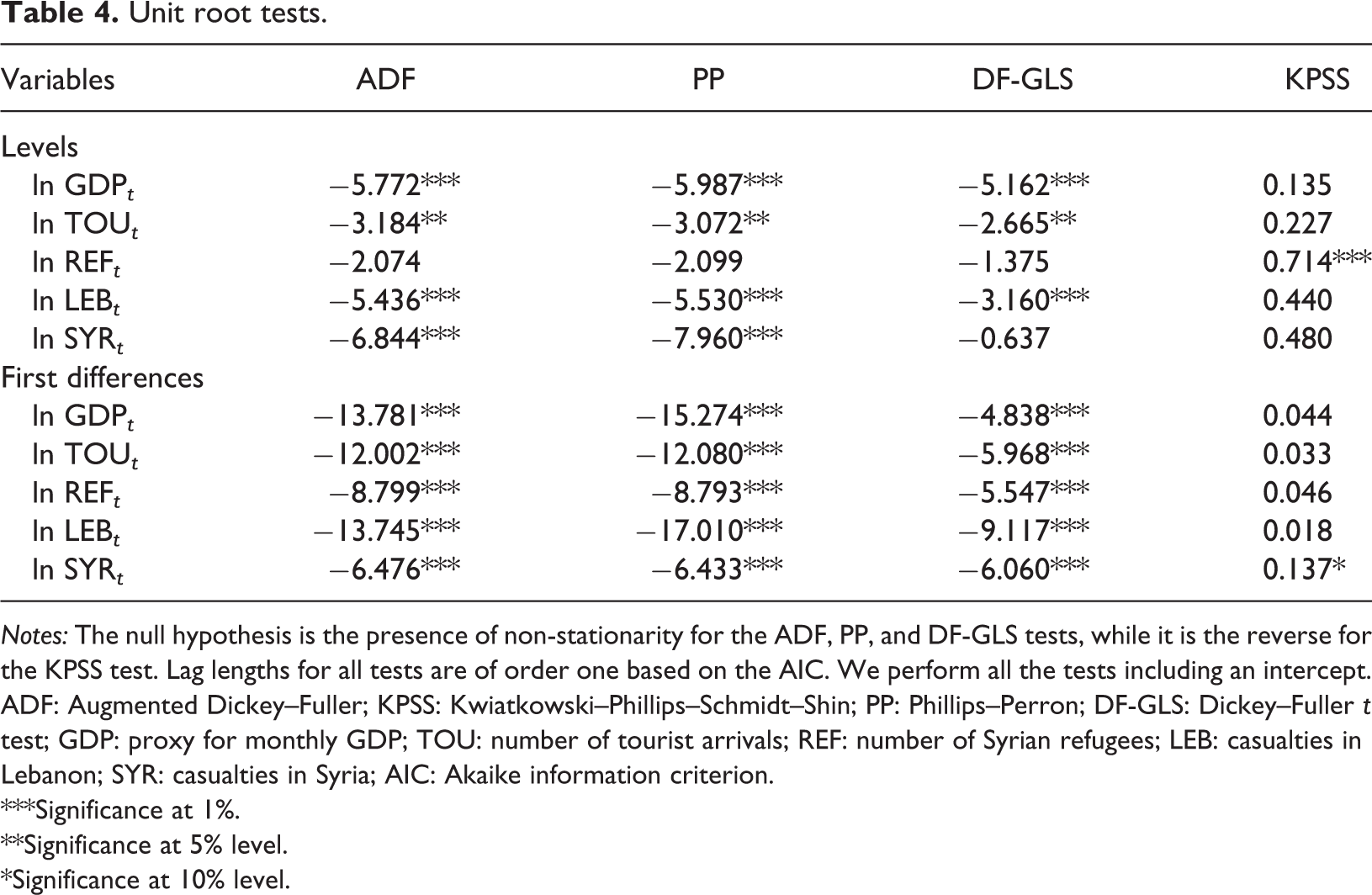
Notes: The null hypothesis is the presence of non-stationarity for the ADF, PP, and DF-GLS tests, while it is the reverse for the KPSS test. Lag lengths for all tests are of order one based on the AIC. We perform all the tests including an intercept. ADF: Augmented Dickey–Fuller; KPSS: Kwiatkowski–Phillips–Schmidt–Shin; PP: Phillips–Perron; DF-GLS: Dickey–Fuller t test; GDP: proxy for monthly GDP; TOU: number of tourist arrivals; REF: number of Syrian refugees; LEB: casualties in Lebanon; SYR: casualties in Syria; AIC: Akaike information criterion.
***Significance at 1%.
**Significance at 5% level.
*Significance at 10% level.
Second, we run three residual tests to verify that our VAR estimates are robust. First, we run the Breusch–Godfrey Lagrange multiplier (LM) test to check if the residuals are serially correlated. The LM test considers the null hypothesis where there is no serial correlation. Second, we use the Jarque–Bera test to check if our residuals are normally distributed (this is the normality null hypothesis). Finally, we use the White test for heteroscedasticity allowing us to test if the residuals are homoscedastic in the null hypothesis. The results of these tests are reported in Table 5. They indicate the absence of autocorrelation and heteroscedasticity problems in the two VAR models (with and without controls) since the null hypothesis is rejected for both tests. For the normality test, the null hypothesis is rejected in the case of the VAR model that includes all variables.
VAR residual tests.
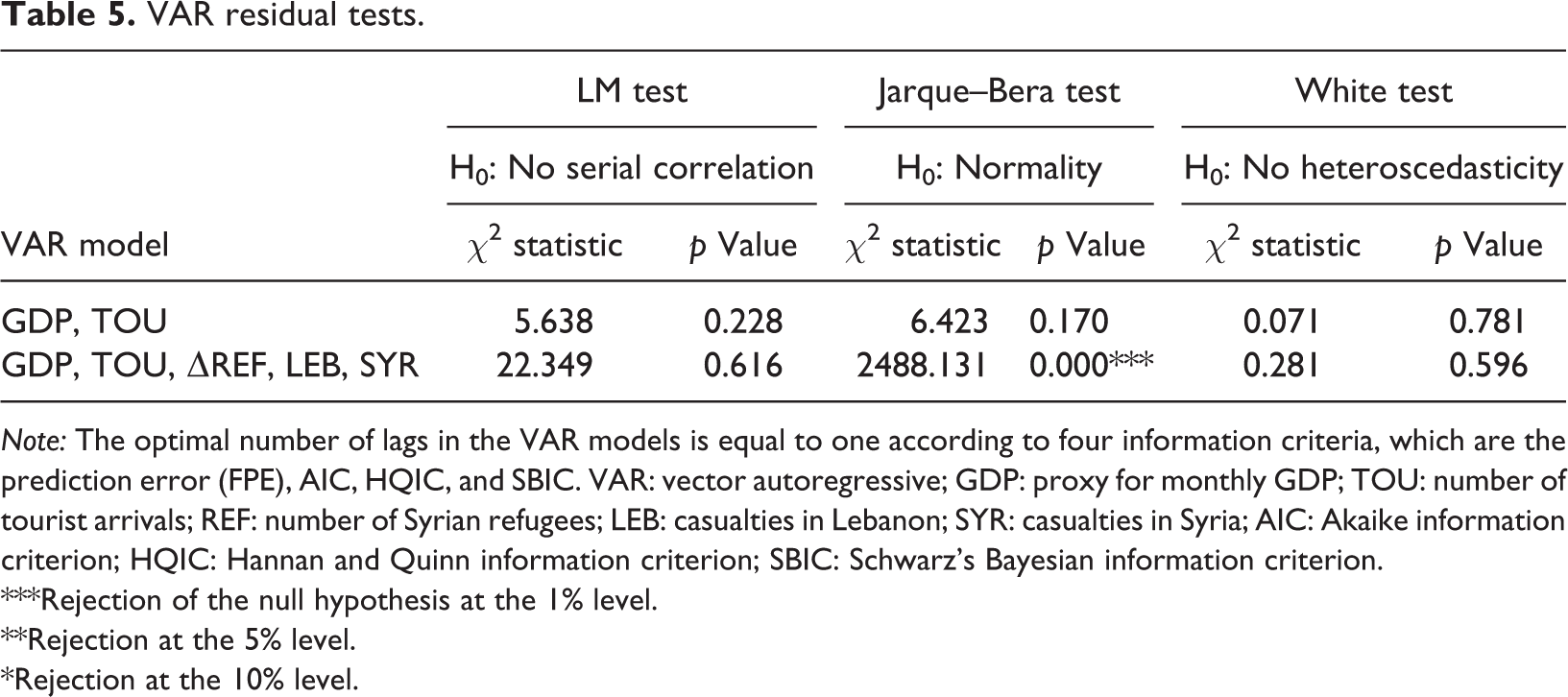
Note: The optimal number of lags in the VAR models is equal to one according to four information criteria, which are the prediction error (FPE), AIC, HQIC, and SBIC. VAR: vector autoregressive; GDP: proxy for monthly GDP; TOU: number of tourist arrivals; REF: number of Syrian refugees; LEB: casualties in Lebanon; SYR: casualties in Syria; AIC: Akaike information criterion; HQIC: Hannan and Quinn information criterion; SBIC: Schwarz’s Bayesian information criterion.
***Rejection of the null hypothesis at the 1% level.
**Rejection at the 5% level.
*Rejection at the 10% level.
Third, we conduct the Granger causality test for the benchmark bivariate model (GDP, TOU) without any control variable. This tests the pure TLGH and the GLTH. The Granger causality test is used for within-sample predictions. The results are reported in Table 6. Based on the p values, we reject the two null hypotheses stating that no causality between GDP and tourism exists. The results indicate the presence of a bidirectional Granger causality between GDP and tourist arrivals. These results are in line with those of Dristakis (2004) for Greece, a country with large dependency on tourism like Lebanon.
Causality tests (no controls).
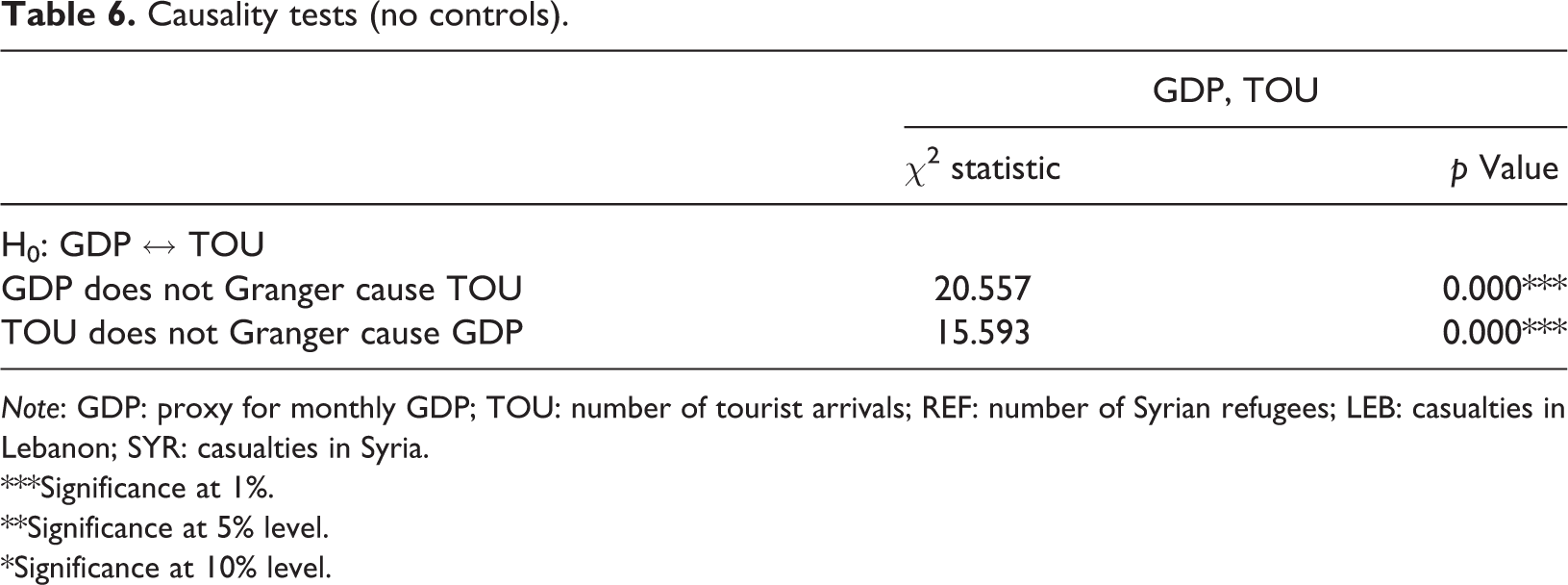
Note: GDP: proxy for monthly GDP; TOU: number of tourist arrivals; REF: number of Syrian refugees; LEB: casualties in Lebanon; SYR: casualties in Syria.
***Significance at 1%.
**Significance at 5% level.
*Significance at 10% level.
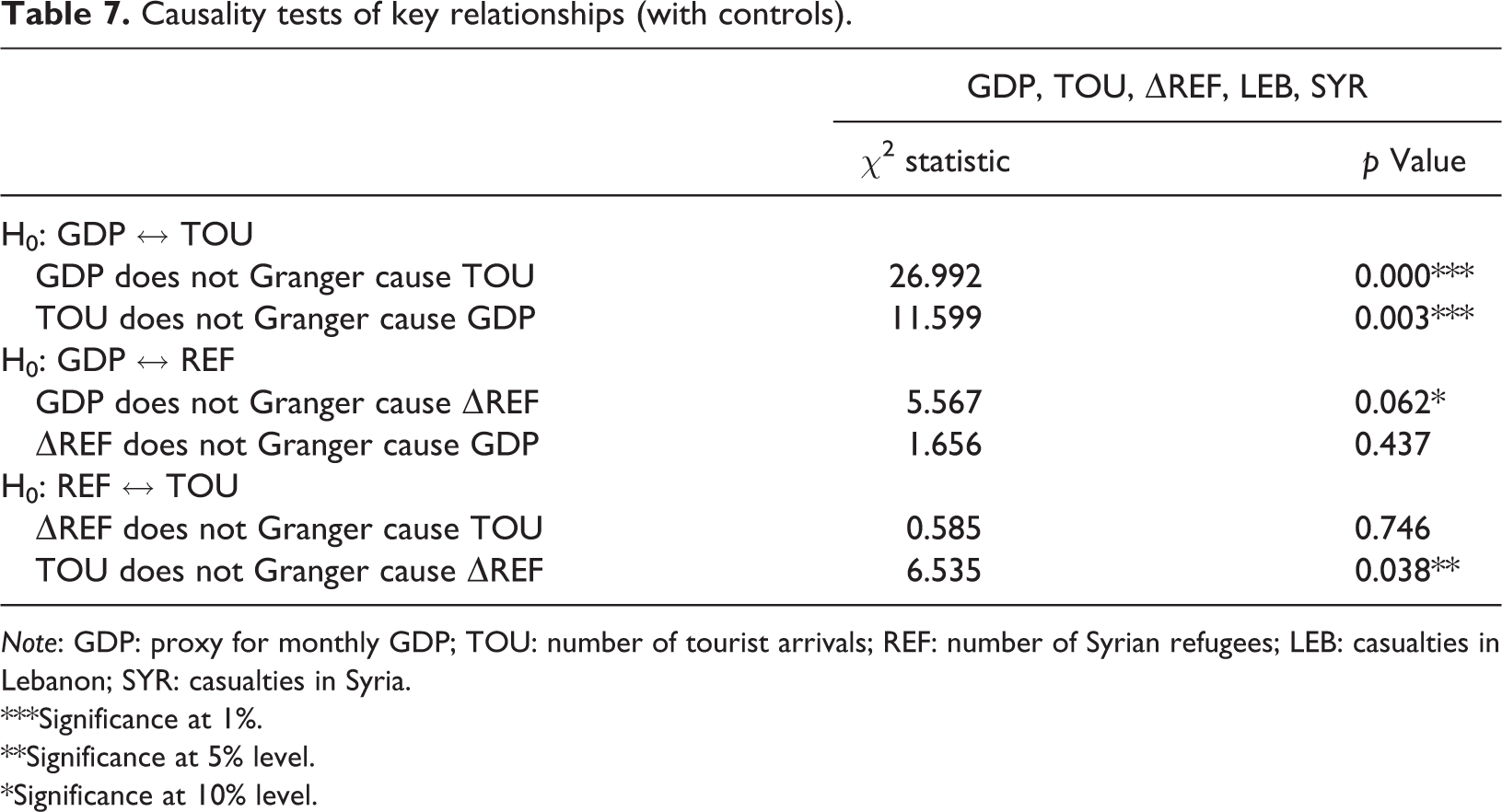
Next, we examine the causal model while controlling for the presence of Syrian refugees and the intensity of the Syrian conflict as reflected by casualties in Syria and internal political instability as reflected by casualties in Lebanon during the Syrian crisis. The results of this extended VAR model (GDP, TOU, ΔREF, LEB, SYR) are reported in Table 7. We only report the results for the key causal relationships listed in Table 3 focusing on the GLTH and TLGH.
Causality tests of key relationships (with controls).
Note: GDP: proxy for monthly GDP; TOU: number of tourist arrivals; REF: number of Syrian refugees; LEB: casualties in Lebanon; SYR: casualties in Syria.
***Significance at 1%.
**Significance at 5% level.
*Significance at 10% level.
First, the results show the existence of a bidirectional causality between GDP and tourist arrivals in Lebanon. In other words, the significance of tourism still holds in line with the results in Table 6. This result indicates that the impact of tourism on growth and the impact of growth on tourism is not affected by the rate of change in the number of Syrian refugees nor by the number of casualties (in Lebanon and Syria) due to the Syrian crisis. These findings maintain those of Tang and Abosedra (2016) who found that tourism is the main source of long-term economic growth in Lebanon when using monthly data from 1995 to 2011 prior to the Syrian crisis.
Second, we find the existence of a unidirectional causality from growth to refugees. Specifically, we find that the growth rate in GDP is causing the change in the stock of Syrian refugees in Lebanon. Although this causal relationship is only significant at the 10% level, it may suggest that economic conditions in Lebanon are attracting refugees. The results also show the existence of a unidirectional causality from tourism to refugees in Lebanon. These findings can be related to studies examining refugee movements due to civil wars and their relationship to economic conditions in neighboring countries (Murdoch and Sandler, 2002).
Finally, the influx of Syrian refugees in Lebanon is not found to exert any effect on economic growth. In addition, we find that change in the stock of refugees has no impact on tourist arrivals. This in line with some recent evidence on the economic effect of Syrian refugees in neighboring countries that shows that refugees do not affect economic outcomes (Fakih and Ibrahim, 2016). 13
To examine out-of-sample causal predictions, we turn to the IRFs analysis. The results of the IRFs are presented in Figures 1 and 2. The middle lines in the figures represent the IRFs, while the dashed lines represent the corresponding 95% confidence intervals. The IRF determines the response of the variable of interest (x) to a one standard deviation (a shock) in another variable (y). The steps indicate one month increments. Lack of statistical significance is observed when the horizontal line at zero is within the confidence interval, the null hypothesis indicating that variable y has no effect on variable x cannot be rejected in this case.
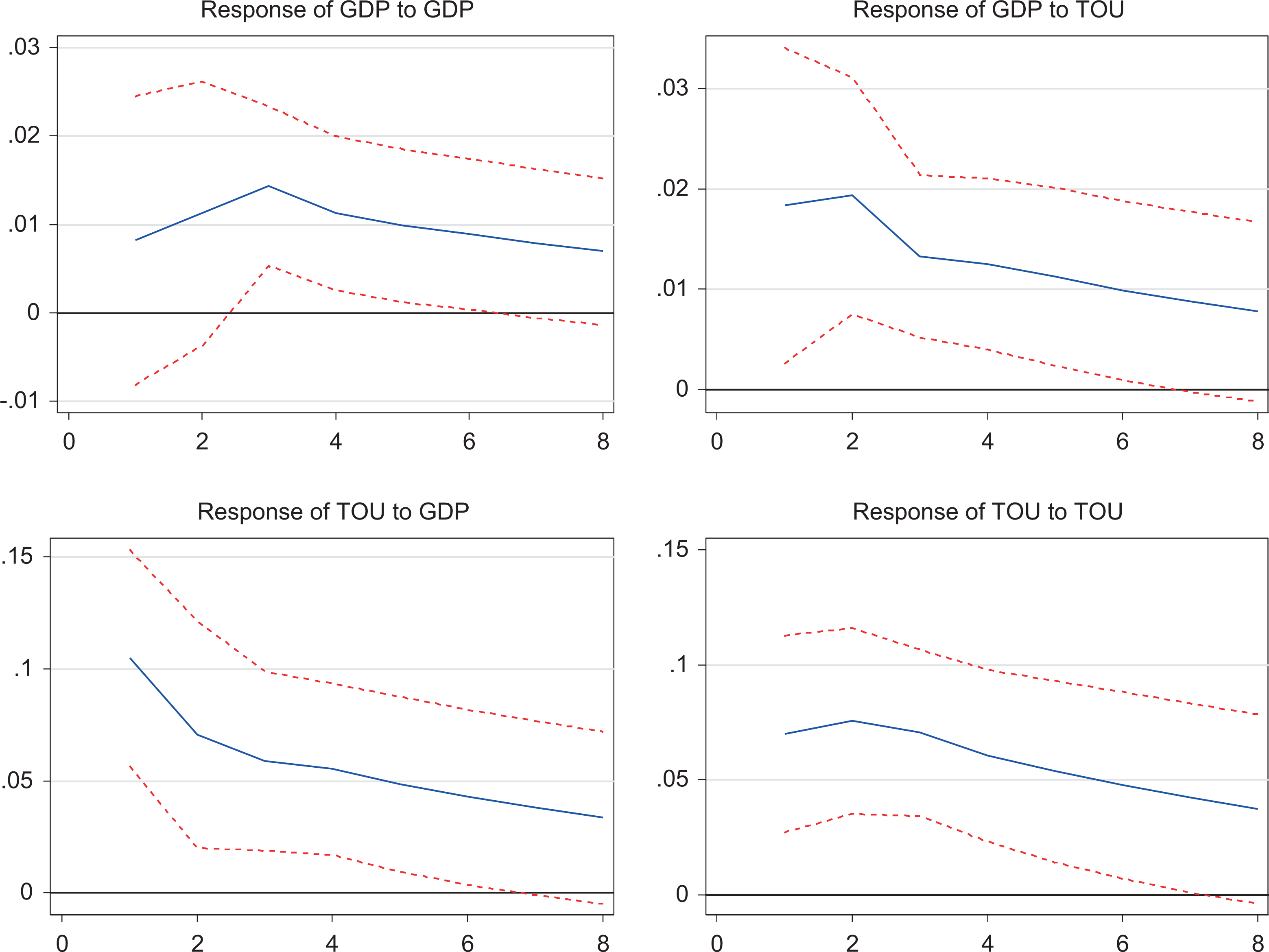
Impulse response function for VAR model (GDP, TOU). VAR: vector autoregressive.

Impulse response function for VAR model (GDP, TOU, ΔREF, LEB, SYR). VAR: vector autoregressive.
The results of the impulse response analysis are presented in Figure 1 for the benchmark model (GDP, TOU) without controls presented in Table 6. The figure shows the response of each variable to a shock in its own innovation and to innovations in all other variables in the system. We find that an increase in the number of arrivals will lead to an immediate increase in GDP. In addition, the IRF results show that an increase in GDP in Lebanon will also lead to an immediate increase in tourism arrival. Both of these results are statistically significant. The IRF analysis confirms the results of the Granger causality tests and thus we reject the two null hypotheses stating that no causality between GDP and tourism exists, which lends further support to GLTH and TLGH hypotheses.
Figure 2 reports the IRF results in the presence of controls (GDP, TOU, ΔREF, LEB, SYR) presented in Table 7. We only report the results for the causal cases listed in Table 3. The IRF analysis for the augmented model reveal that an increase in the number of arrivals will lead to an immediate increase in GDP, while an increase in GDP will also lead to an immediate increase in tourism arrival. These results are in line with those of the benchmark case reported in Figure 1, lending more support to the bidirectional hypothesis holding despite the presence of the Syrian crisis. Moving to the response of change in refugee stock to GDP and to tourist arrivals, the results are found to be statistically insignificant. These out of sample results are in contrast with those reported in the Granger analysis. Finally, we also find that the response of GDP to change in refugee stock and the response of tourist arrivals to change in refugee stock are also statistically insignificant. This is a similar result to that found in Table 7. Interestingly, the number of casualties in both Lebanon and Syria do not affect GDP in Lebanon. Taken together, these results are in contrast to the populist discourse that attributes a large negative impact of the Syrian crisis on the Lebanese economy.
Conclusion and policy implications
This article investigates the tourism–growth nexus in the context of political instability in Lebanon caused by the presence of a large stock of Syrian refugees. Specifically, it tests for the GLTH and the ancillary TLGH. To the best of our knowledge, this article provides the first empirical evidence on this issue in the MENA region, contributing to the current debate on the economic implications of forced displacement in host countries.
The results can be summarized by three main findings. First, there is strong evidence in support of both GLTH and TLGH hypothesis despite the external shock represented by the Syrian crisis. Second, both growth and tourism are found to cause a change in the stock of Syrian refugees.
Third, the Syrian crisis, as reflected by the change in the number of Syrian refugees in Lebanon and in its intensity as reflected by the number of casualties in Syria and Lebanon, did not have a detrimental impact on the linkage between tourist arrivals and economic growth in Lebanon. As such, recent political instability in Lebanon, measured by Syrian refugees’ displacement and the intensity of the Syrian crisis, seems to have had no significant effect on the tourism–growth nexus. We, therefore, believe that policy-makers and stakeholders within the tourism industry should be mindful of the absence of such a negative effect and hence focus on investing in infrastructure and other tourism-related facilities that are crucial to the future expansion of the tourism industry.
The robustness of the bidirectional tourism–growth channel in Lebanon also lends support for pro-growth macroeconomic policies aimed at boosting aggregate demand (see Weng and Wang, 2004). This channel could also be an impetus for sectoral linkages (Cernat and Gourdon, 2012) that would link the tourism sector with the industrial and agricultural sectors. Such linkages will also help create economies of scope rendering tourism’s contribution to growth less susceptible to any future external shock.
Supplemental Material
Supplemental Material, Appendix1 - Tourism–growth nexus under duress: Lebanon during the Syrian crisis
Supplemental Material, Appendix1 for Tourism–growth nexus under duress: Lebanon during the Syrian crisis by Ghassan Dibeh, Ali Fakih and Walid Marrouch in Tourism Economics
Footnotes
Acknowledgement
The authors would like to thank Mohammad Hammoud for excellent research assistance.
Declaration of conflicting interests
The author(s) declared no potential conflicts of interest with respect to the research, authorship, and/or publication of this article.
Funding
The author(s) disclosed receipt of following financial support for the research, authorship, and/or publication of this article: This work was funded by the National Council for Scientific Research – Lebanon (CNRS-L), Reference: July 1, 2016.

Supplemental material
Supplemental material for this article is available online.
Notes
References
Supplementary Material
Please find the following supplemental material available below.
For Open Access articles published under a Creative Commons License, all supplemental material carries the same license as the article it is associated with.
For non-Open Access articles published, all supplemental material carries a non-exclusive license, and permission requests for re-use of supplemental material or any part of supplemental material shall be sent directly to the copyright owner as specified in the copyright notice associated with the article.
