



Abstract
This article examines the effect of the Korean pop culture phenomenon also known as “Hallyu” on the inbound tourism demand of Korea. “Hallyu” products are exported throughout Asia and have been growing over the past decade. Using a Bayesian autoregressive model, we empirically investigate the product placement effects of “Hallyu” explained by the parasocial theory of previous literature utilizing inbound tourist data and show that “Hallyu” effects are also present in the overall tourism industry of Korea. The study illustrates that product placement can be a powerful marketing strategy in the tourism industry and highlights its importance for policy makers in creating a comprehensive joint plan for the development of long-term tourism.
Introduction
The popularity of Korean pop culture which includes TV dramas, films, and music has been increasing significantly in foreign countries since 2000. In the early 2000s, Korean TV shows such as Fireworks (2000), Winter Sonata (2002), and Dae Jang Geum (2003) became popular in Asian countries such as Taiwan, China, and Japan (Jin and Yoon, 2017; Kim, Chen, et al., 2009; Su et al., 2011). In the mid-2000s, Korean pop music and film as well as TV shows became popular in Asian countries (Jin and Yoon, 2017; Kim, Chen, et al., 2009; Kim et al., 2009; Lim and Giouvris, 2017; Su et al., 2011), and moreover, since the late 2000s, the Korean pop cultural industries have cultivated new fields including online games, music, film, fashion, and beauty products within the global market. With the expansion of K-pop product consumption in Asian countries, it has also been argued that increase in popularity of K-pop culture products not only has a positive effect on Korea’s image, perceived value, and association but also makes Korea a desirable tourist destination to K-pop consumers (Connell, 2005; Kim et al., 2007; Kim, Chen, et al., 2009; Su et al., 2011). Overall, one can argue that even though K-pop culture became popular through different channels and at different times in each country, it all contributed to the positive brand equity of Korea.
With the explosion of Internet and social media platforms, strategically placing products within the media has become an important marketing strategy for brand product sales. Wilbur (2008) claimed that since viewers with digital devices can skip ads with a push of a button, networks responded by increasing product placement on TV shows by almost 40% from 2005 to 2008. The product placement industry is estimated at $US3.4 billion and marketers have been working aggressively to secure bigger roles for their products in films (McCarthy, 2000) and television shows. From the current literature, product placement is regarded as more effective than traditional advertising since many consumers absorb the effects in a more natural manner (Avery and Ferraro, 2000; Su et al., 2011). Therefore, it is only natural that we borrow the notion of product placement in analyzing the effects of “Hallyu” on increased tourism as one can safely argue that Korea as a possible tourist destination is also the significant latent product promoted in all K-pop contents.
We note that there have been studies that analyze the positive effect of “Hallyu” in literature; more recently, there is a stream of tourism literature that studies the impact of “Hallyu” on its consumers and their desire to visit Korea using parasocial theory. These studies utilizing parasocial theory argue that consumers of Korean TV dramas and films develop positive attitudes toward Korea as a travel destination due to the increased familiarity to specific locations within Korea and their parasocial interaction with TV soap opera characters (Kim et al., 2007; Kim, Chen, et al., 2009; Russell et al., 2006). Although these are extremely insightful studies, most of these were survey-based behavioral studies focusing on consumer responses to visual entertainment products such as films and TV shows (Kim, 2012a, 2012b; Kim et al., 2007; Kim, Chen, et al., 2009; Whang et al., 2016; Yen and Croy, 2016) and the empirical evidence highlighting the quantifiable success of the general “Hallyu” phenomenon on overall tourism industry is not discussed in detail. First of all, these studies do not consider the “Hallyu” effect on consumers of other K-Pop-related products such as music and games. Consumers of other “Hallyu” products constitute a large proportion of all exported K-Pop contents and they may also be affected by parasocial interaction with the artists, affecting the tourism industry of Korea. Second, as these studies are behavioral studies focusing on establishing the parasocial theory within the K-Drama framework, they do not quantitatively measure the overall effect of “Hallyu” on the tourism industry by examining actual inbound tourist data. In this study, we try to fill this void in the literature on “Hallyu” by proposing an empirical model on a tangible proxy that gives evidence on the success of “Hallyu” in terms of product placement induced tourism with the “promoted product” being Korea as a travel destination and the “success” of product placement efforts in connection with “Hallyu” being the number of inbound tourists from East Asian countries traveling to Korea.
Methodology
To estimate the effects of “Hallyu” on inbound tourism demand for Korea, we used monthly inbound tourist data from January 1993 to December 2016 (288 observations total). We considered six major sources (China, Taiwan, Japan, Malaysia, Hong Kong, and Vietnam) as proxies of inbound tourism demand. The total number of tourists from the above six countries represents 72% of the total number of visitors to Korea as of 2016, most of which can be attributed to the K-pop wave (Lim and Giouvris, 2017). Although US tourists compose a significant portion (5.7%) of inbound tourist arrivals to Korea, we felt that the effects of product placement would take a backseat in driving the demand from the United States due to the great distance between the two countries and minimal exportation of K-Pop products to the United States. Hence, in analyzing the effect of product placement, it was logical to choose the above six countries as they are closer geographically and are members of the Asian countries most affected by the “Hallyu” effect.
Given the stochastic nature of the data and the latent nature of the variable, we used a two-state Markov switching model for univariate time series data, as illustrated by Kim and Nelson (1998). There has been a large increase in K-pop content exported to neighboring Asian countries and it is expected that the number of tourists to Korea from these countries should differ based on the product placement effect after the “Hallyu” phenomenon.
A number of empirical studies have estimated the international tourism demand function of South Korea and its covariates. For example, Kim, Chen, et al. (2009) used the simple Chow tests for a total number of Taiwanese visitors to Korea. Furthermore, Kim and Song (1998) and Song et al. (2000) used a univariate error correction model to estimate international tourism demand. More specifically, Kim and Song (1998), Song and Witt (2003), Oh (2005), and Oh and Ditton (2006) examined the relationship between tourism demand for Korea and other macroeconomic variables and found that macroeconomic variables, such as relative price levels of Korea and other competing destinations, as well as one-off events, such as the Olympics and SARS, do not have a significant effect on inbound tourism demand. Therefore, we took the univariate AR(2) models used in studies above to incorporate the macro-variable effects in general and extended them by adding a “Hallyu” effect variable. If this added variable is found to have a significant correlation with the number of inbound tourists to Korea, we will show “Hallyu” to be successful product placement since other possible explanations have been thoroughly explored and found to be ineffective in previous literature.
We formulated the Bayesian autoregressive model as follows:

where
Consistent with the work of Kim et al. (2007) on the “Hallyu” phenomenon, we defined Skt as a dummy variable with 0 for time periods before July 2002 and 1 for time periods from July 2002 onwards. Kim and Park claimed that the “Hallyu” effect began after July 2002, when the popular Korean TV series Winter Sonata was first exported to Japan and considers this time period as a significant change point. Also, Kim (2010) argues that viewing experiences of TV series create new touristic spaces and increase the desirability of touristic locations to the viewers of TV programs who want to experience and re-enact the characters in the show. According to the Korean National Tourism Office (2006), tourist arrivals to Korea from neighboring countries increased by 35.5% after the airing of Winter Sonata. This idea was extended to our study in that, as “Hallyu” products became prominent in Asian countries, consumers in this region were more exposed to Korea as a tourist destination as it is the latent product placed in all “Hallyu” products; therefore, we used a dummy variable for the “Hallyu” effect as in previous literature to assess its impact on inbound tourist demand, but differed in that we used monthly data, whereas Kim and Park used quarterly.
With these constructions of the variables and the properties of autoregressive time series, the conditional distribution of inbound tourism demand given the product placement effect variable follows a normal distribution:

Since we know the full conditional distributions of (1), after making a few assumptions on the prior distribution of the parameters, we employed the well-known Gibbs sampling algorithm to analyze and make inferences on the posterior distribution of the parameters. We also note that as tourism demand is highly seasonal, we adjusted for seasonality by running a monthly adjustment filter in our model.
Results
Figure 1 shows the number of incoming tourists over the study period with a vertical line representing July 2002, which we considered the starting time for “Hallyu.” The time series plots for China, Taiwan, Vietnam, Hong Kong, and Malaysia were consistent with expectations showing a dramatic change in inbound tourist patterns after 2002, suggesting the existence of a positive “Hallyu” effect on inbound tourist volume. The time series plot for Japanese tourist arrivals was more mixed. We see a continuation of a rising trend after the 2002 change point, but it appears that the “Hallyu” effect on inbound tourists to Korea is not as strong as China and Taiwan.

Time series plot of inbound tourists to Korea.
We only report the convergence results and density plots for the intercept and “Hallyu” effect parameter of Taiwan due space limitations; however, we observed simulation patterns to be nearly identical for other parameters. Due to high volatility of the time series, we needed a larger number of simulations; however, after 300,000 iterations, we see that the parameters converged in Figure 2 and the posterior distribution of the parameters were roughly normal in Figure 3. Full descriptive statistics for all estimated posterior parameters are also given in Table 1.

Trace plot of MCMC generated parameters. (a) μTaiwan0 and (b) μTaiwan1.
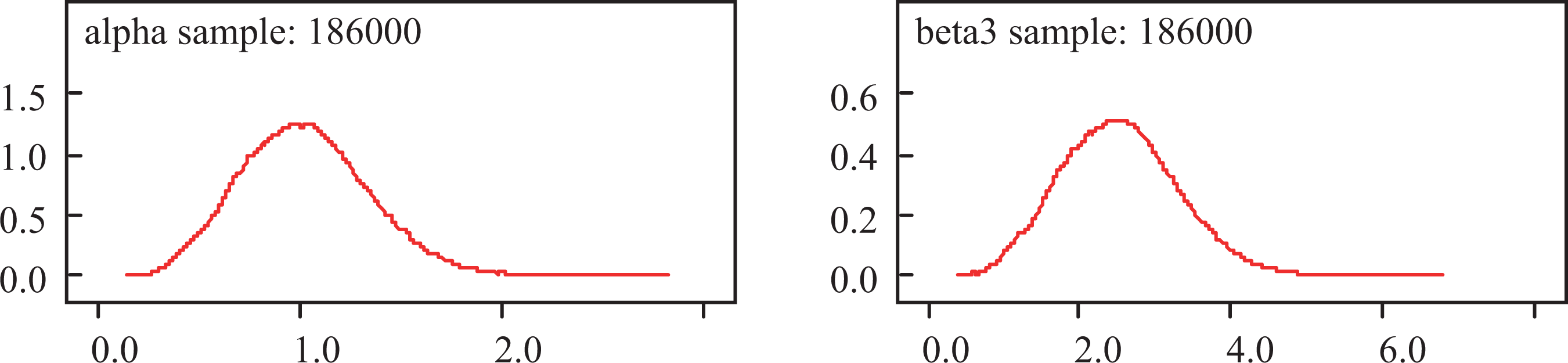
Posterior density plot for μ Taiwan0 and μ Taiwan1.
Descriptive statistics of parameters after 300,000 simulated runs.

Note: SD: standard deviation.
*Significant parameters at the 95% credibility level.
In Bayesian analysis, the parameter in question is considered to be significant if the 95% credibility interval does not contain zero. With this in mind, we see that other than the 95% credibility interval of the AR(1) and intercept parameter for Japan, zero is not contained in any of the parameter credibility intervals. This result suggests that the model overall is significant and the data are providing useful information in understanding our problem.
The interesting inferences can be found when we look closely at the posterior distributions of the “Hallyu” effect parameter μ 1 for each country. As expected, the 95% credibility intervals do not contain zero for all countries and are all positive, implying a strong positive impact of “Hallyu” on inbound tourism. This result confirms our expectation that with the emergence of “Hallyu” since mid-2002, the product placement effect also became evident, resulting in an increase in inbound tourists from these countries to Korea. Moreover, the 95% credibility interval for Japan is also consistent with our initial beliefs on “Hallyu” and tourism demand. Although we received mixed signals when we visually inspected the time series, after accounting for seasonality, the result confirmed our view that there would be a strong positive “Hallyu” effect on tourism due to the large volume of K-pop media exports to Japan (65% of all K-pop exports).
Conclusion
The scope and effects of pop culture in the modern world are increasing evermore with evolutions in audio and video technology. Using the Bayesian autoregressive model, we show that the “Hallyu” effect of pop culture contents is not only contained within the domain of expanding sales of products such as Korean TV dramas, films, music, game, and animation but also spills over to increasing inbound tourists to Korea due to the increased familiarity with Korea as a product embedded in all “Hallyu” products.
Korea has seen significant increase in the total inbound tourists to Korea, from 4.75 million in 2003 to 17.24 million in 2016 (KTO, 2019). Although tourism-related businesses still account for a relatively small segment of the Korean national economy, the contribution to total GDP has steadily increased from 3.5% in 1988 to 5.1% in 2017 (Lim and Giouvris, 2017; Seo et al., 2009). In addition, recently tourism-related business is expanding into other areas such as cosmetic, medical tourism, fashion, and education sectors (Lim and Giouvris, 2017), and there exists great potential in growing overall tourism economy of Korea. The findings of this article show tangible evidence that after the “Hallyu” phenomenon starts, the overall structure of inbound tourist demand to Korea changes as well, resulting in an increase in inbound tourist demand; therefore, policy makers in the tourism industry should work closely with creators of pop culture contents and devise a comprehensive plan to incorporate various locations of Korea in visual contents and promote a lifestyle one would want to experience firsthand, fully taking advantage of the current momentum generated by “Hallyu.”
As discussed earlier, empirical work is not vast in product placement effects in the tourism industry as of yet due to product placement effect variables not being observable in the real world. In this sense, we also empirically contribute to the literature by introducing Bayesian methods which can be easily extended to tackle latent and hidden effects, providing a path for incorporating the vast behavioral literature into empirical work by utilizing Markov Chain Monte Carlo (MCMC) methods, expressing expert opinions and making judgments related to priors and presenting econometric framework in studying more complicated effects of “Hallyu” in tourism industry.
Footnotes
Declaration of conflicting interests
The author(s) declared no potential conflicts of interest with respect to the research, authorship, and/or publication of this article.
Funding
The author(s) disclosed receipt of the following financial support for the research, authorship, and/or publication of this article: This work was supported by the Dong-A University research fund.
