




Abstract
The sensitivity of countries to the global macroeconomic uncertainty is directly related to the income level affecting, therefore, the demand for the outbound international tourism. Precisely, we observe that a higher economic policy uncertainty leads to more departures and more total expenditures but less expenditure per tourist – this finding is the first contribution of this article since it suggests that outbound tourism might be considered as an inferior good. In an uncertain context increasing the probability of decrease in the agents’ wealth, the population travel more but spend less money per trip suggesting that these travels are mainly made in neighbour countries. A higher uncertainty also induces a higher demand for outbound international tourism but less touristic expenditures in low- and lower-middle-income economies. These findings show the multifaceted aspect of tourism since it suggests an emigration effect that we discuss in this article.
Introduction
The influential work of Bloom (2009) combined with the new index of economic policy uncertainty (EPU) build by Baker et al. (2016) generated a huge literature devoted to the macroeconomic influences of EPU (Raza et al., 2018). An increase in global economic policy uncertainty (GEPU) is often presented as a negative factor for the domestic output, employment, investment and consumption across the globe (see Colombo, 2013; Carrière-Swallow and Céspedes, 2013). In this context, a lower output reduces the population’s disposable income reducing, therefore, consumption and especially expenditures for luxury consumption such as international tourism. In addition, a decrease in employment leads to a higher probability of losing jobs leading to a reduction of the demand for international tourism. Recent studies (e.g. see Balli et al., 2018; Demir and Gozgor, 2018; Gozgor and Ongan, 2017) in tourism economics examined the effects of EPU on tourism but they mainly dealt with influence of the national uncertainty on one aspect of tourism (i.e. departure or arrival for instance). Our article contributes to this existing literature by investigating the determinant of tourism demand in a global macroeconomic context by taking into consideration the global uncertainty (GEPU). Notably, we investigate the influence of GEPU on the outbound tourism in both aspects: departures and expenditures. Furthermore, our study also analyses this influence in different contexts and for different income levels (low- and lower-middle-income economies (LMEs), upper-middle-income economies (UMEs) and high-income economies (HIEs)). More specifically, we study the influence of GEPU on the annual data of international tourism departures and international tourism expenditures in combination with socio-economic–environmental factors (such as income level, personal remittance, internet usage, urbanization, unemployment, vulnerable employment, old population, CO2 emissions, inflation and forest area) for 82 countries over the period 2002–2014.
The major contribution of this article is to identify three different regimes in the way EPU and demand for tourism are related. Precisely, our article shows that all policies dealing with tourism must consistently be taken with the countries’ level of income. In HIEs, a higher GEPU leads to more departures and more total expenditures but less expenditures per tourist. In the UMEs, a higher GEPU causes less departures but it generates more expenditures implying that we can also observe a ‘concentration effect’ in which the population reduce the number but also the diversification of their touristic activities by spending more on fewer trips. For the LMEs, the story is different – a higher GEPU induces a higher demand for international tourism but less touristic expenditures. We explained this surprising finding by a ‘migration effect’ in which the population of these countries actually uses international tourism as a way of exploring potential professional opportunities abroad.
The article is structured as follows. The next section reviews the literature dealing with tourism and economic uncertainty. The methodology and data are presented in the third section while the results are reported and analysed in the fourth section. The final section concludes this article by suggesting some practical/political implications.
Literature review
Although uncertainty is difficult to estimate, it plays an important role in economic activities (Gozgor and Ongan, 2017; Schinckus, 2009). Most of current empirical literature focus on the influences of macroeconomic uncertainty on economic indicators such as output and employment (Ahmad and Sharma, 2018; Cheng, 2017; Gupta et al., 2018), the effectiveness of macroeconomic policy (Aastveit et al., 2017; Simmons et al., 2018) and financial markets (Balcilar et al., 2019; Fang et al., 2017; Ftiti and Hadhri, 2019; Mei et al., 2018; Phan et al., 2018; Tsai, 2017). Colombo (2013) found that a significant variation (one standard deviation shock) in the US EPU leads to a significant fall in the EU industrial production and prices. Cheng (2017) documented that both external (international) and internal (national) policy uncertainty shocks have a significant negative influence on the output in South Korea, but the shocks in international EPU have a stronger negative effect. In the same vein, Junttila and Vataja (2018) emphasized that the inclusion of EPU could improve the ability of forecasting models for future real economic activities in the United Kingdom and European economies, especially for the period before the 2008 global crisis. Related to that, Bloom (2009) documented a strong negative effect of the macro uncertainty shock on the output, employment and productivity growth in the United States for the same period.
The influence of the global uncertainty on tourism has been studied through different aspects such as economic crisis (Frechtling, 1982; Papatheodorou et al., 2010; Song et al., 2011), political instability (Fletcher and Morakabati, 2008), terrorism (Drakos and Kutan, 2003; Fletcher and Morakabati, 2008; Pizam and Fleischer, 2002) or natural disaster (Cooper, 2006; Faulkner, 2001). Recently, a new database measuring the EPU has been developed by using a methodology capturing how many times keywords related to EPU have been mentioned in the newspapers and public publications. In doing so, Baker et al. (2016) offered a new possible way to investigate the influence of economic policy on tourism. Although some studies exist on this issue, they usually just focus on one country (Gozgor and Ongan, 2017), on the inflow of tourists (Balli et al., 2018) or on the small sample dealing with one factor such as tourism departures (Demir and Gozgor, 2018), departures Dragouni et al. (2016) or tourism expenditures Gozgor and Ongan (2017). In other words, few articles deal with the global uncertainty and tourism; and this small number of works confirmed what one could expect: the existence of a negative influence of the GEPU on tourism. Specifically, Demir and Gozgor (2018) used the EPU of 15 countries (Australia, Brazil, Canada, China, France, Japan, Russia, South Korea, the United States, Germany, Italy, the United Kingdom, India, Netherlands and Spain) to examine its effect on tourism departure, showing that EPU of each country has a negative effect on the departures out of this country. On the same topic, Balli et al. (2018) used the monthly tourist arrival data in Australia, Canada, Germany, Italy, Japan, Sweden and the United States from January 1997 until August 2017 to find a significant influence of GEPU on tourism inflows.
To summarize, the existing literature mainly focuses on one aspect of tourism to show that GEPU has a negative impact on almost all these individual aspects. What is still missing in this literature is to consider the relationship between GEPU and the general demand for tourism. This is the objective of this article: to study the influence of GEPU on the determinant of the demand of international outbound tourism. The following section presents our methodology and the way we deal with our data.
Methodology and data
Research model and data
The aim of the study is to estimate the influences of GEPU on international outbound tourism (proxied by the departures and expenditures of international tourism). Because this macroeconomic uncertainty can be nuanced and moderated by contextual/national factors, we also include socio-economic and environmental indicators in our estimation of the demand for international tourism. Based on the theoretical framework developed by Demir and Gozgor (2018) and other studies (e.g. Eugenio-Martin, 2003; Gholipour et al., 2014), the general model describing the international outbound tourism demand of a particular country can be expressed as follows:

where Y is an international tourism variable. ECO, DEMO, ENVI and OTHER are vectors composed by the potential drivers of international outbound tourism including economic, demographic, environmental, and other factors, respectively. As evoked above, this article studies the influence of the macroeconomic uncertainty (EPU) that is related to economic risks is also assumed to negatively affect the international outbound tourism demand. By integrating the EPU in the function of international outbound tourism demand, the equation (1) becomes:

One of the originality of our methodology is to use three different proxies for GEPU: the value at January and the yearly mean are used to proxy GEPU. 1 In addition to that, we investigate the influence of this GEPU on a large number of variables. None of the existing studies proved a so comprehensive analysis. The international outbound tourism demand (Y) is measured by numbers of tourist departures from an original country (Tourism1). As suggested in some studies (Hassani et al., 2015; Song et al., 2012), outbound tourism demand can also be measured by the ratio between the total international tourism expenditures to GDP (Tourism2) and international tourism expenditures to the total number of tourist departures (Tourism3; to measure the expenditure per tourist).
Regarding our control variables, we use a set of common control variables – the economic factors (ECO) refers to several indicators: Disposal income (Income) is proxied by GDP per capita (Song et al., 2012), 2 Remittance (Remit) is measured by personal remittances received to GDP (Kumar, 2014) and the classical Inflation of the country (Inf; Otero-Giráldez et al., 2012). The Demographical factors (DEMO) refers to the Labour condition that is proxied by two indicators: the first is the unemployment rate (Unem) and the second is the vulnerable employment (Vulem; group of self-funded workers/family lacking decent working conditions and adequate social security; Alegre et al., 2013). Another demographic factor refers to ageing population (Oldpop) which is measured by the ratio of population above 65 to the total population (Pizam and Fleischer, 2002; Williams et al., 2000), and Urban population (Urban) measured by the ratio of urban population to total population (Xu et al., 2010). The environmental factors (ENVI) include some pollution indicators that might also influence the tourists’ choice. We use here the CO2 emissions per capita (CO2pc) and forest area remain (Forest) of an original country (Michailidou et al., 2016). Finally, we added another factor (OTHER) referring to the ratio of Individuals using Internet to total population (Internet) that would have important roles in information searching of tourists (Aldebert et al., 2011).
Given this general demand function for tourism and the definition of all these variables and by taking the natural logarithm of both sides of equation (2), we obtain the basic regression specified with implications for panel data:

where i = 1, 2, 3,…, N; N refers to the country; t is the time; μi captures the potential country fixed effect; τt is the time fixed effect and εit is the error term with i.i.d ≈ (δ, 0); α1, α2, α3, α4, α5, α6, α7, α8, α9, α10 and α11 are international tourism demand elasticities with respect to the inputs.
Due to the availability of data, our final sample includes 82 countries categorized into 3 subsamples including 20 LMEs, 30 UMEs and 32 HIEs for the period 2002–2014 (see Table 1).
List of countries.

Note: LME: low- and lower-middle-income economy; UME: upper-middle-income economy; HIE: high-income economy. The income levels are classified following the 2018–2019 income classification of World Bank (see https://datahelpdesk.worldbank.org/knowledgebase/articles/906519-world-bank-country-and-lending-groups).
The detail of data definitions, calculations, description and sources are presented in Table 2. All variables (except for inflation) are taken logarithm to normalize data and explain the estimation coefficients as the elasticity of the international output tourism to the changes in independent variables. 3
Variables, calculations, sources and data description.
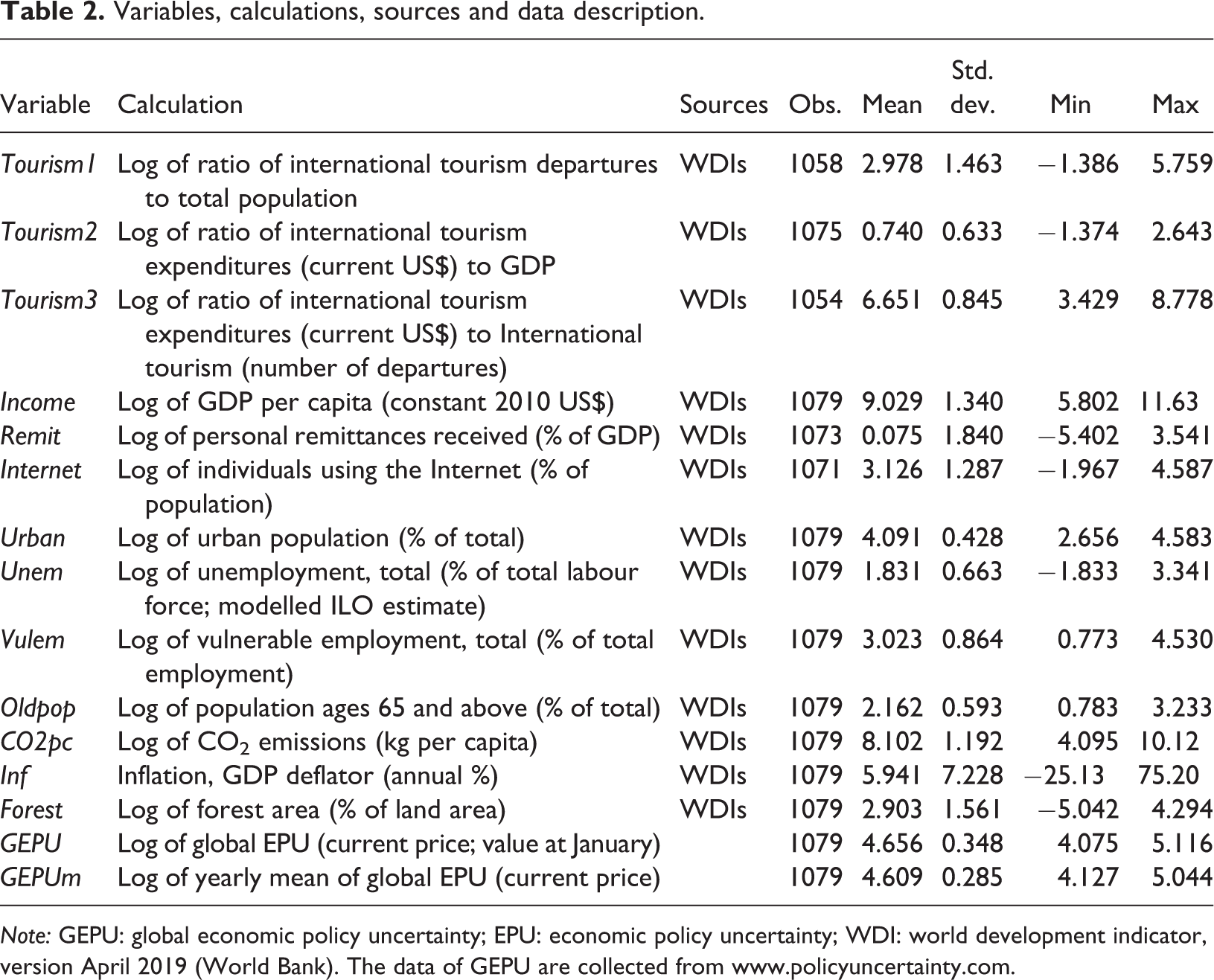
Note: GEPU: global economic policy uncertainty; EPU: economic policy uncertainty; WDI: world development indicator, version April 2019 (World Bank). The data of GEPU are collected from www.policyuncertainty.com.
The socio-economic and environmental factors are collected from the Indicators database offered by the World Bank (April 2019), while GEPU 4 is provided by Baker et al. (2018; available and free access at www.policyuncertainty.com).
Econometrically speaking, our sample includes 82 countries for 13 years forming an unbalanced panel data so that we first examine the cross-sectional dependence by estimating the Persaran’s test of Pesaran (2004). The results of this test indicate that all variables have a cross-sectional dependence (these results can be provided on request). The unit root test (Pesaran, 2007) is then applied to examine the stationarity of all variables confirming the stationarity of our variables (specifically, the vulnerable employment and inflation are consistently stationary). In relation to this, panel data exhibiting a cross-sectional dependence combined with stationary variables can lead to an endogenous problem in estimating the unbalanced panel data (Li et al., 2018; Perles-Ribes et al., 2017; Song et al., 2012). In such circumstance, our estimations might be inconsistent because the mean of the lagged dependent variable is correlated with the idiosyncratic error term. That particular methodological effect becomes particularly serious in dynamic panel data models (Nickell, 1981). To deal with this problem, we use the GMM estimator that has been developed by Arellano and Bond (1991), Arellano and Bover (1995; and extended by Blundell and Bond, 1998); and its extension the Sequential (two-stage) estimation of linear panel data models (SELPDM; Kripfganz, 2017) as the main model. A last technical point must be mentioned here: Roodman (2009) explained that applying GMM with a number of cross-sections of 20 might be worrisome (and it is the case for our LMEs sample) inviting us to repeat our analysis with several alternative techniques as robustness check (pooled ordinary least squares, robust pooled ordinary least squares, pooled ordinary least squares with year effects and two-step system generalized method of moments). Furthermore, we also add the control variables one by one into our estimations as another way of sensitivity check for the findings. All results indicate consistent results. 5
Empirical results and discussion
This section presents our results in two steps. The first subsection presents a global overview of our findings for our explanatory variables while the second section studies the role of this macroeconomic uncertainty on the outbound tourism in three subsamples by income levels.
A global overview of our explaining variables
During the period 2002–2014, GEPU exhibited a fall (in both level and volatility) in the period just before 2008 and then a sharp increase during the crisis period (see Figure 1). Figure 1 also indicates a strong increasing trend in international tourism in terms of tourist departures and expenditures with a small fall in 2009–2010 due to the 2008 global financial crisis.
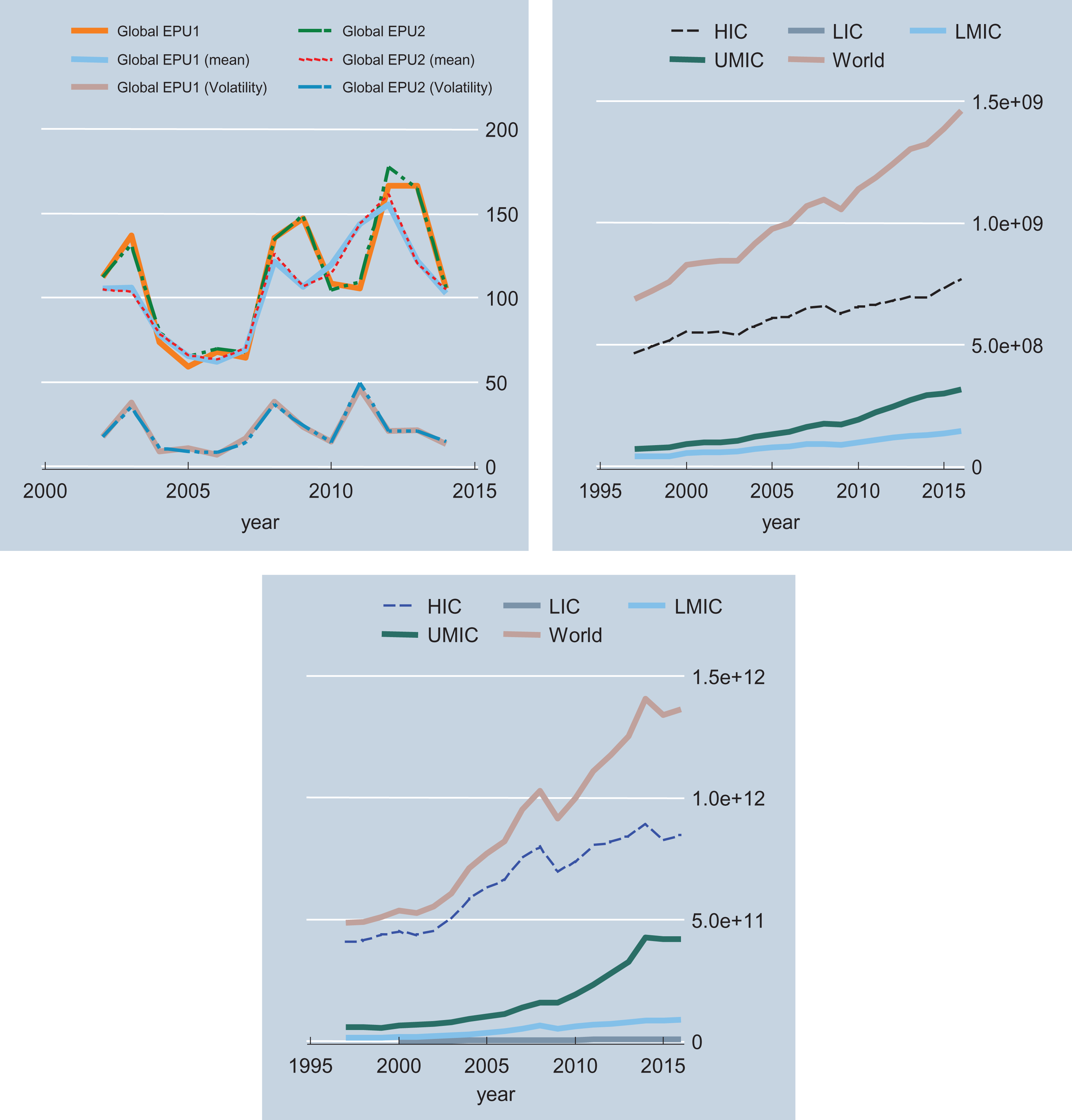
GEPU and tourism. GEPU: global economic policy uncertainty; HIC: high-income economies; UMIC: upper-middle-income economies; LMIC: low-middle-income economies; LIC: low-income economies.
Our main estimation to quantify the effect of GEPU on international tourism is reported in Table 3.
GEPU and international tourism: Full sample.

Note: GEPU: global economic policy uncertainty; EPU: economic policy uncertainty; SELPDM: sequential (two-stage) estimation of linear panel data models. Standard errors are in []. SELPDM with time effects.
* Significant level at 10%.
** Significant level at 5%.
*** Significant level at 1%.
Results in columns 1 and 2 in Table 3 show that an increase in GEPU has a significant negative effect on international tourism departures (Tourism1). This finding is the first attempt to quantify the effect of GEPU on tourism outflow. This observation actually contributes to the literature on tourism economics by clarifying the effect of uncertainty and how the tourism dynamics evolves in relation to this global uncertainty. More generally, our findings also confirm the need for incorporating EPU in measuring the tourism demand.
In term of tourism expenditures, the results in column 3 to column 4 in Table 3 show a significant positive effect of GEPU on the ratio total international tourism expenditures to GDP (Tourism2). This is a very interesting result because, a priori, one can expect that a higher uncertainty (higher GEPU) expect to reduce international tourism (see columns 1 and 2 in Table 3). However, the results in columns 3–4 in Table 2 show an opposite trend that can be explained as follow: tourists reallocate their expenditures portfolio by reducing the diversification of their activities (fewer departures) but spending more, on average, on fewer trips. From an economic point of view, this observation is interesting: a higher uncertainty is usually associated with a risk of reduction in the agents’ wealth (due to loss of job, decrease of income, etc.) implying that one could expect to see a reduction in the expenditure devoted to tourism. However, our findings indicate that agents rather spend more in their touristic activities, adjusting their behaviour towards EPU by travelling less. Such ‘concentration-effect’ echoes to the idea that outbound international tourism might have an ‘inferior good like profile’ since people increase their expenditures when the probability of having a decrease in their wealth is higher. In a situation characterized by a higher uncertainty, people consider touristic activities as a more specific event by allocating more resources but reducing the frequency. Such ‘concentration effect’ can also be associated with a general feeling of fear (towards terrorism, safety, etc.) that people might develop in an uncertain period leading them to travel less. Existing economic analysis usually deal with tourism as an inferior good in terms of products (i.e. one-star hostels) or destinations (cheap and short trips). Our analysis suggests that GEPU can also influence this economic characteristic of tourism. The identification of this ‘concentration effect’ for the global sample is the first empirical contribution of this article.
We investigate further these aspects by using a third proxy of international tourism: international tourism expenditures per tourist (Tourism3). The results are reported in columns 5–6 in Table 3. GEPU also appears to have significant positive effects on the international tourism expenditures per tourist. In relation to our previous results on tourism departures and total expenditures to GDP, the result indicates that a higher uncertainty would induce lower tourism departures (Tourism1) but higher expenditures per tourist so that the total expenditures to GDP (Tourism2) increased. This implies the fact that a higher GEPU causes the fall in domestic output and employment, the total international tourism departures decrease but the remained tourists who travel abroad would spend more. Another aspect can be mentioned on this point: the international tourists in the context of a sharp decrease in output would be the richer citizens who have the higher disposable income to spend explaining that their expenditures will still be significant. This observation is consistent with the aforementioned analysis and it confirms our first contribution to the existing literature. 6
The effect of GEPU on international tourism for different income groups
As discussed previously, the demand for international tourism is higher in HIEs and UMEs. Interestingly, the tourism expenditures related to GDP are not so different across income levels while international tourism expenditures per tourist changed significantly during these recent years, especially in the UMEs. Generally speaking, a higher income induces a higher demand for international tourism in terms of departures and expenditures. However, the effect of GEPU on domestic economic factors may not be similar across income levels (see Colombo, 2013; Carrière-Swallow and Céspedes, 2013). National economic environment can actually moderate the influence of global uncertainty – therefore, the negative effect of GEPU on international tourism departures may be heteroskedastic across the different income groups. In this context, we investigate further this aspect by repeating our estimations for three subsamples including LMEs, UMEs and HIEs. The results are presented in Table 4.
GEPU and international tourism: Three income groups.

Note: GEPU: global economic policy uncertainty; LME: low- and lower-middle-income economy; UME: upper-middle-income economy; HIE: high-income economy; SELPDM: sequential (two-stage) estimation of linear panel data models. Standard errors are in []. SELPDM with time effects.
* Significant level at 10%.
** Significant level at 5%.
*** Significant level at 1%.
In the case of LMEs, the results are reported in columns 1, 4 and 7 of Table 4. The results show that a higher GEPU has a positive effect on international tourism departures (Tourism1 – column 1). This result is in opposition with our earlier findings meaning that a higher uncertainty would induce a higher international tourism departure from LMEs. This fact can actually be explained from a migration perspective. In LMEs where population face with higher uncertainty, there are more incentives for citizens to use travels as a way of finding jobs or preparing themselves for an immigration process (Greenwood, 2015; Mehmood et al., 2016). Thus, when a higher GEPU causes the fall in the domestic output and employment, citizens from LMEs would be motivated to organize touristic activities as a way of finding a job abroad.
Interestingly, the results show that a higher GEPU reduces the international tourism expenditures to GDP (Tourism2 – column 4) and international tourism expenditures per tourist (Tourism2 – column 7); confirming the fact that GEPU causes negative shocks on economic activities and reduces the disposable income in the LMEs. Therefore, the expenditures for international tourism would be reduced. These results support our previous arguments and confirm that an increase in international tourism departures observed in a context of higher uncertainty is not due to rich citizens (since they spend less) but rather to the poorest ones who might use tourism as a way of finding a job abroad (in doing so, they increase the number of departures but they spend less money on their trips).
Columns 2, 5 and 7 in Table 4 show the results for the case of 30 UMEs. It is not surprising to find that a higher uncertainty might have a negative effect on international tourism departures (Tourism1 – column 2) and positive effect on international tourism expenditures in terms of ratio to GDP (Tourism2 – column 5) and per tourist (Tourism3 – column 8). UMEs are emerging economies with high economic growth implying that their income level is increasing quickly. In such context, the ‘migration effect’ evoked above is not observed simply because the population in these countries can find a decent socio-economic environment in their home country to face the global uncertainty. This implies that the negative effect of GEPU on the domestic output and employment reduce the international tourism departures for this population. However, this effect explains why tourists who can still travel during an uncertainty period (high GEPU) can have high expenditures in their touristic activities. The UMEs countries face with a high level of income inequality explaining why, in a context of high uncertainty, only the richer citizens would spend more when they travel even though they travel less (confirming the concentration-effect evoked in our previous section).
Finally, columns 3, 6 and 9 in Table 4 show the impacts of GEPU on international tourism in HIEs. The results show that a higher GEPU has a significant positive effect on international tourism departures (Tourism1 – column 3) in HIEs. This positive effect does not have the same origin than the one observed for the LMEs. Precisely, most of the HIEs have a good welfare system with decent unemployment benefits so that the negative effect of GEPU on their output (and employment) might induce a higher number of international tourism departures as we explained it earlier in this article. This observation is supported by the positive effect of the GEPU on the ratio total international tourism expenditures to GDP (Tourism2 – column 6) and the negative effect on the ratio international tourism expenditures per tourist (Tourism3 – column 9).
Conclusion
By clarifying the determinants of the demand for international tourism in a context of global uncertainty (EPU), our article provides interesting findings for the literature dealing with tourism economics. Firstly, we show that the sensitivity of countries to GEPU is directly related to the income level. Specifically, an increase in the GEPU has a negative impact on the international departures but it has a positive impact on the tourism expenditures – this finding is the first contribution of this article since it suggests that outbound tourism might be considered as an inferior good at a global level. In an uncertain context (increasing the probability of decrease in the agents’ wealth), the population travels more but spend less money per trip suggesting that these travels are mainly made in neighbour countries. Although this observation is interesting, it must be nuanced and analysed in line light of the countries’ economic environment. With this purpose, we investigate further the influence of the GEPU on the determinant of the demand for tourism by taking into account the countries’ level of income. The following table summarizes our major findings:

In HIEs, a higher GEPU leads to more departures and more total expenditures but less expenditures per tourist confirming our observation for the global sample. In the UMEs, a higher GEPU causes less departures but it generates more expenditures implying that we can also observe a ‘concentration effect’ in which the population reduce the number but also the diversification of their touristic activities by spending more on fewer trips. For the LMEs, the story is different – a higher GEPU induces a higher demand for international tourism but less touristic expenditures. We explained this surprising finding by a ‘migration effect’ in which the population of these countries actually uses international tourism as a way of exploring potential professional opportunities abroad.
Our article shows that all policies dealing with tourism must consistently be taken with the countries’ level of income and the three effects identified in the table above. This table also shows that an increase in the GEPU could actually benefit the UMEs since these countries can combine less touristic departures from their population with a higher number of tourists coming from LMEs and HIEs. In this context, UMEs tourism industry can take advantage of a higher GEPU. Alternatively, an increase in the GEPU also suggests that for the HIEs, tourism industry could target potential tourists coming from the UMEs since these tourists are keen to spend more money when they travel. This observation is a significant contribution for the literature dealing with tourism economics.
Beyond the identification of these three distinct regimes, our empirical study also provides interesting findings for future research, especially, regarding the positive influence of ageing population on the demand for international tourism (that actually appears to be in opposition with the existing studies). Our research shows that the use/access of/to internet promotes the demand for international tourism. Finally, our results related to environmental factors and urbanization consistently suggest that, in an uncertain context, the rural domestic tourism appears to be a strong substitute to international tourism. Due to the limited scope of this article, these aspects have not been explored in details in this article but these additional findings pave an interesting way for further research.
Footnotes
Declaration of conflicting interests
The author(s) declared no potential conflicts of interest with respect to the research, authorship, and/or publication of this article.
Funding
The author(s) disclosed receipt of following financial support for the research, authorship, and/or publication of this article: This work was supported by the University of Economics, Ho Chi Minh.
