




Abstract
This article examines the relationship between golf activities and tourist perceptions and intentions using data from 592 golf tourists on Hainan Island, China. The results obtained from structural equation modeling show that the attractiveness of the destination can improve the identity of the location, and both factors significantly increase the travel intentions of golf tourists (i.e. revisit intentions and word-of-mouth recommendations). The results also show that place identity has significant mediating effects between destination attractiveness and travel intentions. In addition, the results reveal that the disposable income of golf tourists has significant moderating effects on the attractiveness of the destination, the identity of the destination, and the intention to revisit. This study has some important economic implications for golf destination management. Golf course managers can improve the attractiveness of the destination and strengthen the identity of the location to enhance the behavioral intentions of golf tourists.
Keywords
Introduction
As a niche and profitable sector, the golf tourism industry has been growing rapidly, contributing to an increase of tax revenues, regional employment, and economic opportunities (Bárcena-Martín et al., 2017). Since 2000, the number of golf tourists worldwide has increased by 50%, and there are more than 60 million golf tourists across the world. Golf tourists spend a great amount of money on transport, hotels, entertainment, and other golf-related expenses, on average approximately US$280 per visit and 20% more than mass tourists (Song et al., 2017). It is likely that golf tourists will take an overnight trip to visit a golf course or club if it is more than an hour’s driving distance away from their place of residence.
With regard to the significant development of the global golf industry, golf tourism has become a growing research field (Jorge and Monteiro, 2011). Based on the data from ProQuest, ScienceDirect, EBSCO, Wiley, and Taylor & Francis, there were approximately 150 research articles on golf tourism over the period 2009–2018. Scholars have focused on golf tourists’ behavioral intentions (Hutchinson et al., 2009; Pereira et al., 2015) and golf destination management (Humphreys and Weed, 2014; Kim and Ritchie, 2012).
Given the significant economic impacts of golf tourism on destinations, it is becoming increasingly necessary for government authorities, industry practitioners, and scholars to better understand golf destination attributes and golf tourists’ behavioral intentions (Correia et al., 2007; Petrick and Backman, 2002). In the emerging golf tourism markets, some golf courses have been suffering a decline in their revenue due to the competition between destinations (Song et al., 2017). This study attempts to examine the determinants of golf tourists’ behavioral intentions, and how these intentions are affected by golf place identity (PI) as a mediator variable and by disposable income as a moderator.
Literature review
Destination attractiveness
Destination attractiveness (DA) is defined as the perceived ability of the destination to fulfill tourists’ goals or satisfy their needs (Hu and Ritchie, 1993). The more a destination is able to meet tourists’ needs, the more it is perceived to be attractive, and the more that particular destination is likely to be chosen (Henkel et al., 2006). Moreover, over the years, the importance of DA for tourists’ behavioral responses has received increasing attention (Moore and Graefe, 1994). Cheng et al. (2013) found that the extent of the attractiveness of a destination perceived by tourists is positively associated with PI and place dependence. It has been further suggested that DA is one of the critical determinants of tourists’ behavioral intentions (Sangpikul, 2018).
From a demand-side perspective, DA reflects tourists’ perceived value of the destination, which is likely to be an essential factor for golf tourists’ PI (Kim and Ritchie, 2012). The golf tourism destination, as an attractive tourism site, has been given increasing attention because of its influence on golf tourists’ behavioral intentions (Hutchinson et al., 2009). More specifically, golf tourism-related information often comes from friends’ recommendations (Song et al., 2017). When a golf course is perceived to be attractive, satisfied golf players are most likely to make positive word-of-mouth (WOM) recommendations for the destination they have visited (Moital et al., 2013). On the basis of these considerations, three hypotheses were proposed:
Sense of place and PI
Sense of place can be considered as a general attitude toward a spatial setting or physical environment, and a complex psychosocial structure that contains emotions, self-referent beliefs, and behavioral commitments (Jorgensen and Stedman, 2001; Pretty et al., 2003). The tripartite model of sense of place comprises PI, place attachment, and place dependence. Place attachment can be considered as an individual’s emotional connection to a spatial setting, and place dependence can be defined as the perceived behavioral advantage of a spatial setting relative to other settings (Jorgensen and Stedman, 2006).
PI refers to the link established between tourists and destinations (Wang and Chen, 2015), reflecting the degree of personal values associated with a particular environment and a person’s emotional connection to a certain destination place (Kyle et al., 2003). Tourism is essentially a place-based phenomenon involving the production of destination identity at different scales (Hall, 1998; Urry, 1990). For example, the scale of a destination can be a national, regional, or local place. Thus, destination PI is related to the stakeholders’ desire to position its uniqueness competitively in the policy-making, marketing, and promotional activities at different levels (Dredge and Jenkins, 2003).
In the golf tourism industry, Song et al. (2017) examined the impacts of PI on golf tourists’ revisit intentions (RI), suggesting that the golf tourism destination should upgrade its infrastructure to enhance golf tourists’ destination image, to strengthen their RI. The more favorable the perception by golf tourists of a golf destination, the more likely they are to intend to revisit and/or recommend that specific destination to other golf tourists (Hutchinson et al., 2009). Thus, it is essential for golf tourists to identify with a certain golf tourism destination, rather than others, to strengthen their behavioral intentions (Petrick and Backman, 2002). Accordingly, the following hypotheses were proposed:
Behavioral intentions
Behavioral intentions, as a multidimensional outcome variable, consist of intentions to revisit a certain destination in the future and to spread positive WOM recommendations to potential tourists (Lee et al., 2013). It has been suggested that RI have a positive effect on WOM recommendations, and tourists with RI are more likely to share their travel experience and tourism information with other potential tourists (Su et al., 2014). Although RI have attracted substantial attention from tourism scholars, WOM recommendations have rarely been empirically tested in a tourism context.
In the golf tourism field, players’ intentions to visit the same golf course are considered as RI (Petrick and Backman, 2002). Golf tourists often play with friends or family, so, if they are satisfied with a certain golf course, they usually recommend that course to those people they know (Song et al., 2017). It is likely that golf tourists would recommend a particular golf destination they intend to revisit to people who are planning a golf vacation (Hutchinson et al., 2009). Therefore, it is likely that RI contribute to WOM recommendations. On the basis of the empirical studies above, a hypothesis concerning the relationship between RI and WOM recommendations was proposed:
Mediating effect of PI
PI, as an individual emotion, involves bonding to the social or physical environment and has been found to have a significant mediating effect between destination and travel behavior (Cheng et al., 2013). Kyle et al. (2003) examined the relationship between PI, place dependence, and visitors’ attitudes concerning their spending preferences and found that PI was a significant mediator between destination and tourists. In line with this, it has been suggested that PI mediates the relationship between DA and tourists’ behavioral intentions (Cheng et al., 2013).
In golf tourism, Song et al. (2017) found that place attachment has a significant mediating effect between destination image and golf tourists’ RI. Given the close relationship between RI and WOM recommendations, it has been suggested that it is necessary to examine both of these factors in the context of golf tourists’ behavioral intentions (Hutchinson et al., 2009). Those two studies suggest that PI may mediate in the relationship between DA and golf tourists’ behavioral intentions. Hence, the following hypotheses were proposed:
Moderating effect of disposable income
The term, “disposable income,” refers to the amount of money available for a household to spend and save after paying income taxes (Hultkrantz, 1995). In tourism economics, as a way of examining tourists’ potential consumption, disposable income, a significant factor in affecting tourists’ behavior, is a relative concept compared with absolute personal income (Wang et al., 2018). Furthermore, Leonidou et al. (2015) found that income has a moderating effect on the relationship between tourists’ intentions and eco-friendly attitudes. Akinci and Aksoy (2019) further examined the moderating effects of household income on behavioral intentions via a moderated mediation model.
Golf has been defined as a sports activity that requires the players to have a solid financial position (Bárcena-Martín et al., 2017), since it is associated with a large cost (e.g. purchasing golf equipment and golf membership) and the availability of disposable income (Yoh et al., 2006). It has been suggested that golf tourists’ disposable income has a significant influence on their destination selection and behavioral intentions (Jorge and Monteiro, 2011). In line with those findings, Humphreys and Weed (2014) have also claimed that golf tourists’ decision-making is influenced by their perceived value and disposable income. It is believed that golf tourists’ disposable income affects the relationship between their travel behavior and golf destination. Accordingly, the following hypotheses were proposed:
In summary, DA may positively influence golf tourists’ PI and behavioral intentions, contributing to their perceived values of the golf tourism destination. Furthermore, golf tourism PI may mediate the relationship between DA and golf tourists’ behavioral intentions. Meanwhile, golf tourists’ disposable income may have a moderating effect between golf tourism DA/PI and RI. Based on the analyses described above, this research proposes five groups of hypotheses (10 subhypotheses) in a conceptual model of golf tourism (see Figure 1).
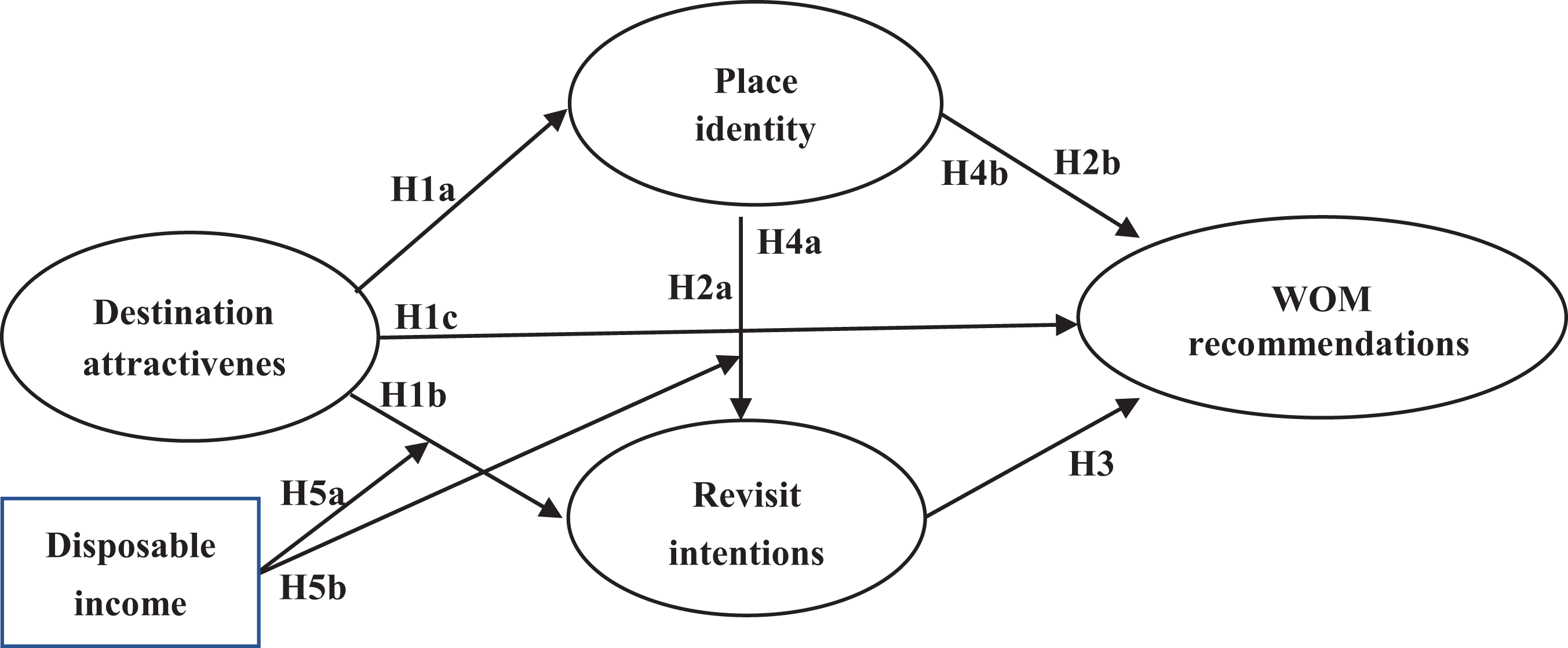
Hypothesized conceptual model.
Data description
Sampling
Hainan Island is well known as “the capital of golf tourism in China,” with 57 golf courses, which account for 12% of the golf courses in China. More than a million golf tourists (domestic and international) have played golf on the Hainan Island golf courses, resulting in expenditures of US$25 billion (Hainan Provincial Bureau of Statistics, 2018). Golf is considered as one element of the national strategic plans for Hainan Island. A set of golf-related events, such as the Blue Bay Masters 2018, the China Open 2017, and the Women’s Open 2017, were held in Hainan, to highlight its status as a golf tourism destination. In 2019, Hainan won the favorite golf tourism destination of Asian golf tourists. Due to its unique geographical location, weather conditions, and special natural resources, golf tourism is popular on Hainan Island, especially in the winter. For golfers, Hainan Island is a place with beautiful natural environment and attractive Golf Course. It is likely that Hainan Island could be regarded as a typical golf destination for island tourism.
The items in the questionnaire were originally developed in English and then translated into Chinese. A bilingual expert (English and Chinese) reviewed the translation to confirm that the translated version accurately reproduced the meaning of the original items. To confirm the validity of the questionnaire, five professors in the golf, tourism, and hospitality industry examined the content of the questionnaire. Then, the questionnaire was tested via a pilot test of 100 respondents to avoid any misunderstandings and bias (Podsakoff et al., 2003). Twelve students majoring in tourism management at the International Tourism College, Hainan University, were trained for 2 days, and 8 of them were eventually chosen to assist in the formal investigation. The data collection was conducted through an online platform (www.sojump.com) at the local airports and golf clubs on Hainan Island from June 1 to December 30, 2018, to cover both the off-season and the peak season.
In an attempt to guarantee the quality of the results, the IP address of the respondents was limited to Hainan Island. A total of 690 golf tourists met the requirement and were chosen to complete the survey. Furthermore, any incomplete survey was considered invalid, and those completed in less than 2 min were dropped. After filtering, 592 samples were coded and used for preliminary data analyses.
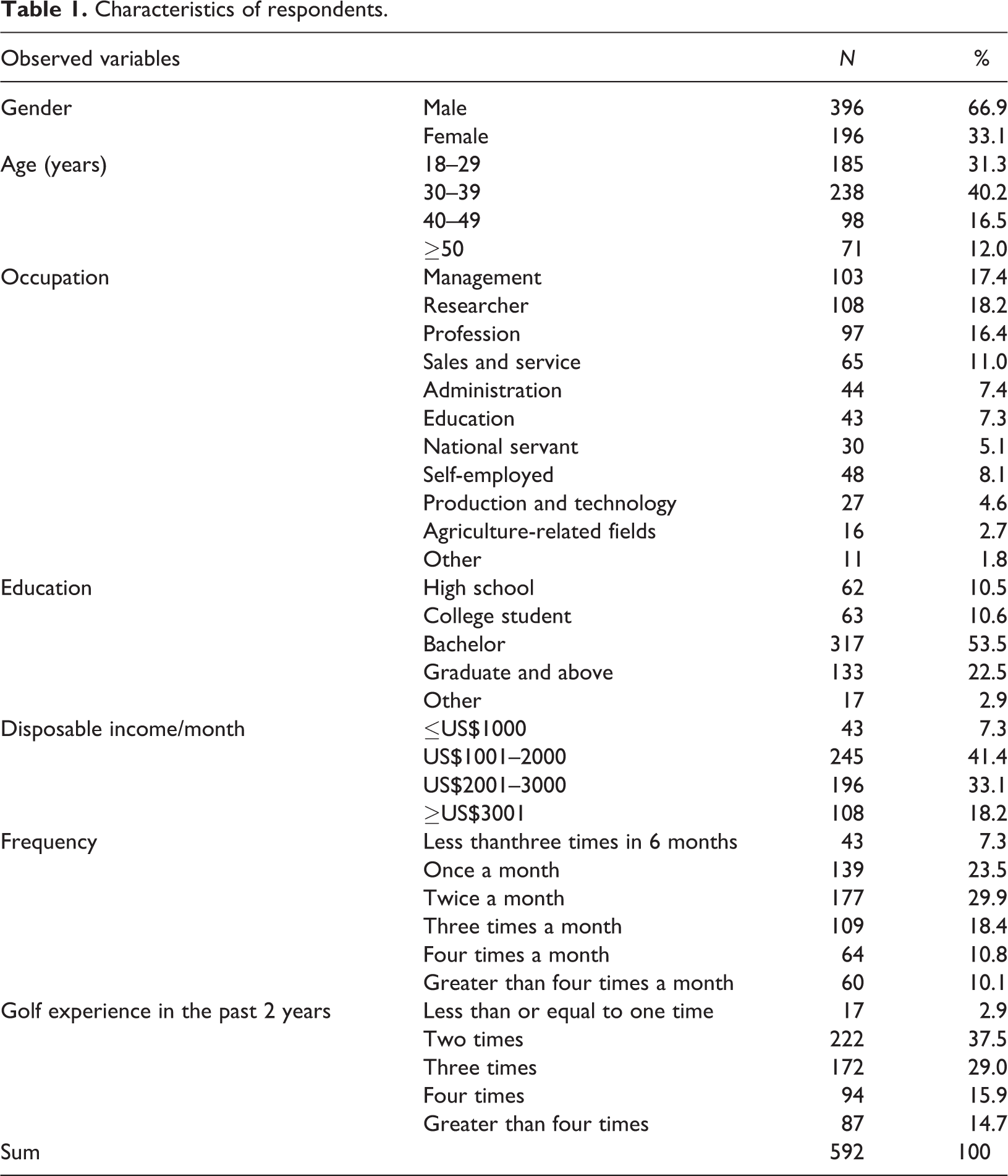
As presented in Table 1, the respondents included 196 women (33%) and 396 men (67%). The majority of golf tourists (72%) were aged 18–39 years and were well-educated (with 76% having higher education) and had a monthly disposable income of over US$2000. Nearly all the golf tourists have had golf tourism experience on two or more occasions in the past 2 years.
Characteristics of respondents.
Measurement scales
All items in the scales were measured using a five-point Likert-type scale ranging from 1 (completely disagree) to 5 (completely agree). DA was measured by 10 items relating to the destination’s accessibility, amenities, infrastructure, scenery, local community, and natural environment (Mikulić et al., 2016). Following Song et al. (2017), a five-item scale was used to test golf PI. A four-item scale was utilized to measure golf tourists’ RI (Song et al., 2017) and a four-item scale was utilized to test WOM recommendations to potential tourists (Gholipour Soleimani and Einolahzadeh, 2018). This study also applies a four-item scale to both golf tourists’ RI and WOM recommendations. The respondents were also asked to provide information about their disposable income, to empirically test its moderating effect on the relationship between DA, PI, and RI.
Empirical results
Confirmatory factor analysis
Using SPSS 22.0 to analyze 592 valid questionnaires, the Kaiser–Meyer–Olin (KMO) value and Bartlett’s test confirmed the suitability and reliability of the samples. The values of KMO (.926) and Bartlett’s test of sphericity (p < 0.001) demonstrate the suitability of the factor analysis (Field, 2009). The total variance explained for all constructs was 71.5%, which further indicates a satisfactory convergent validity (Hair et al., 2013). The number of missing values for every variable was below 5%, showing that the missing values occurred on a random basis (Parent, 2013).
Confirmatory factor analysis (CFA) was used to examine the validity of the measurement model (maximum likelihood estimation method) by testing the discrete nature and consistency of the latent variables (Anderson and Gerbing, 1988). All analyses were conducted with IBM SPSS Statistics 24.0 using the variance–covariance matrices. Measurement models are required to have acceptable goodness-of-fit indices (Cliff, 1983), including the Chi-squared/degrees of freedom (χ2/df) < 3.000, the goodness-of-fit index (GFI) > 0.900, the root mean square error of approximation (RMSEA) < 0.080, the comparative fit index (CFI) > 0.900, the Tacker–Lewis index (TLI) > 0.900, and the incremental fit index (IFI) > 0.900. The indices of the measurement model in this study are acceptable, with χ2/df = 2.952, p < 0.050, GFI = 0.913, RMSEA = 0.058, CFI = 0.964, TLI = 0.958, and IFI = 0.961.
As presented in Table 2, Cronbach’s α values which exceed 0.800 indicate high internal consistency (Fornell and Larcker, 1981). The composite reliability estimates of all constructs exceed the suggested threshold of 0.700, and all values which exceed 0.800 indicate that the measures are reliable (Bacon et al., 1995). The convergent validity of the measurement model was measured using standardized factor loading. All standardized factor loadings were above the threshold value of 0.500 (significant at p < 0.001).
Descriptive statistics and CFA results for the measurement model.
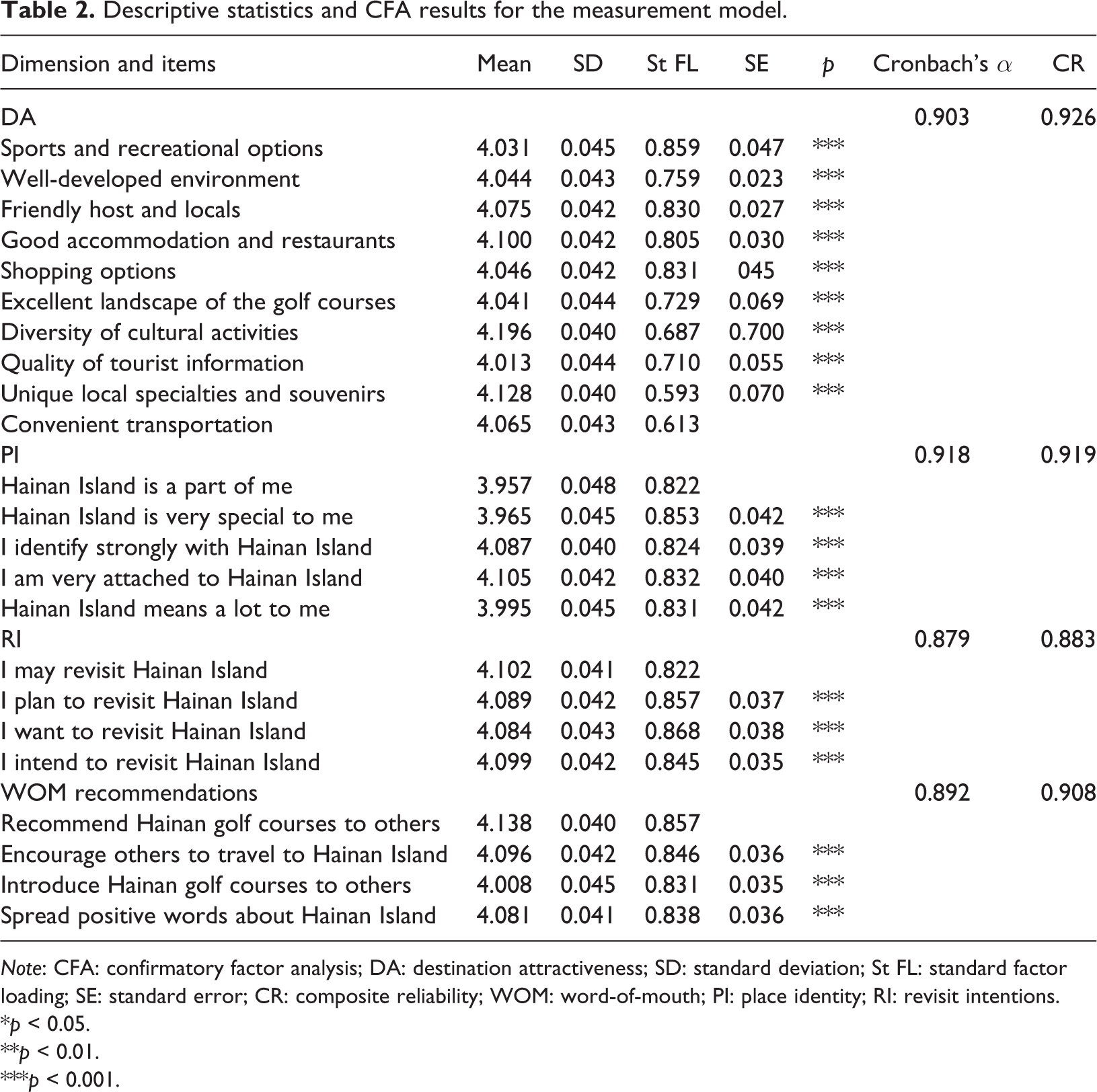
Note: CFA: confirmatory factor analysis; DA: destination attractiveness; SD: standard deviation; St FL: standard factor loading; SE: standard error; CR: composite reliability; WOM: word-of-mouth; PI: place identity; RI: revisit intentions.
*p < 0.05.
**p < 0.01.
***p < 0.001.
To evaluate the discriminant validity, the present study utilized a comparison of the square roots of average variance extracted (AVE) with the interconstruct correlation between variables. All the square roots of AVE values were greater than the interconstruct correlations between variables, indicating that each construct is statistically different from the others, and the constructs have good discriminant validity (Fornell and Larcker, 1981). Table 3 presents the satisfying AVEs of the four constructs: DA, PI, RI, and WOM recommendations.
Discriminant validity matrix.
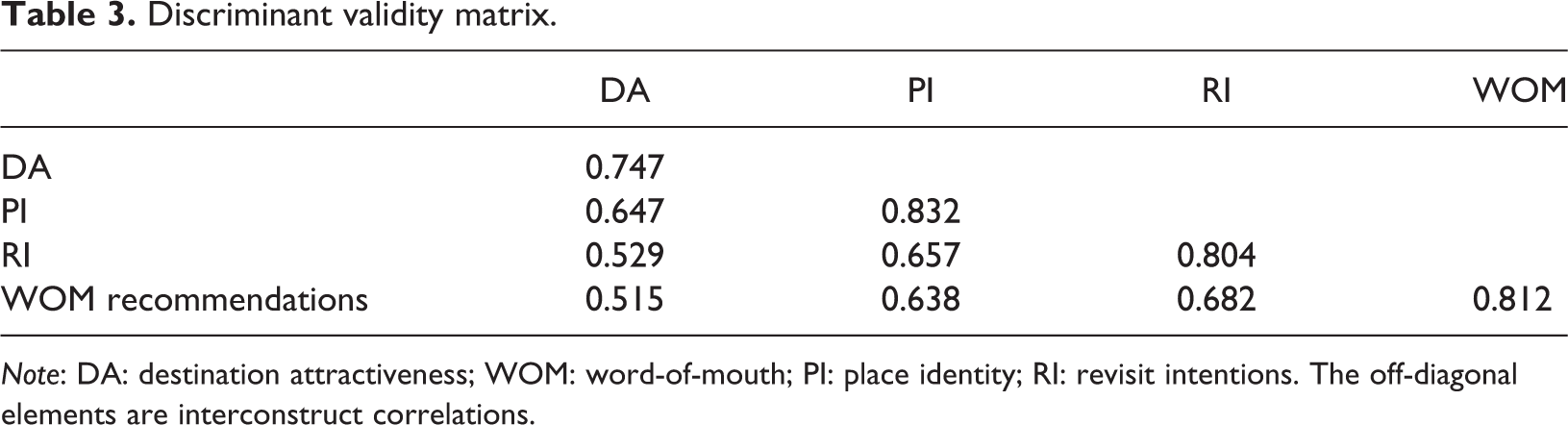
Note: DA: destination attractiveness; WOM: word-of-mouth; PI: place identity; RI: revisit intentions. The off-diagonal elements are interconstruct correlations.
Structural equation modeling
Structural equation modeling (SEM) was further employed, based on the results of the CFA model, to test the proposed relationship among the construct variables. The indicators were used to evaluate how well the structural models fit the data: χ2/df = 2.381, p < 0.050, GFI = 0.933, RMSEA = 0.049, CFI = 0.974, TLI = 0.969, and IFI = 0.974, all suggesting satisfying goodness-of-fit parameters (Hair et al., 2013).
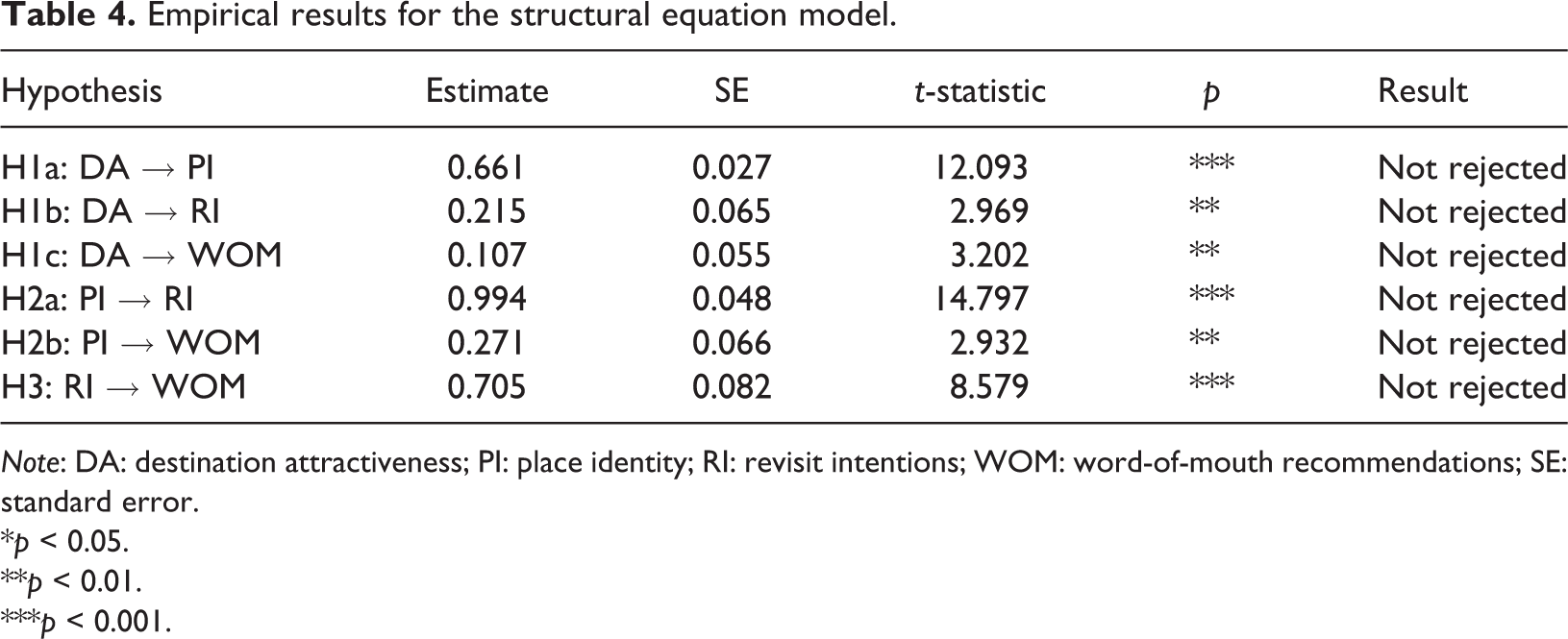
Table 4 presents the SEM results. DA is positively and significantly associated with PI (β = 0.661, t = 12.093, p < 0.001), and thus H1a is not rejected. It is also positively associated with golf tourists’ RI (β = 0.215, t = 2.969, p < 0.010) and their WOM recommendations (β = 0.107, t = 3.202, p < 0.010), so H1b and H1c are not rejected. Furthermore, PI is positively and significantly associated with golf tourists’ RI (β = 0.994, t = 14.797, p < 0.001) and their WOM recommendations (β = 0.271, t = 2.932, p < 0.010), and thus H2a and H2b are not rejected. Last, it was found that golf tourists’ RI had a positive and significant relationship with their WOM recommendations (β = 0.705, t = 8.579, p < 0.001), and thus H3 is not rejected.
Empirical results for the structural equation model.
Note: DA: destination attractiveness; PI: place identity; RI: revisit intentions; WOM: word-of-mouth recommendations; SE: standard error.
*p < 0.05.
**p < 0.01.
***p < 0.001.
Bootstrapping was further used to measure the mediating effect of PI. To obtain 95% confidence intervals (CIs) (MacKinnon et al., 2007), the Bootstrap estimates of the direct and indirect effects were based on 2000 bootstrap samples (Fritz and MacKinnon, 2008). This study further examined the full mediation role of PI in the relationship between DA, RI, and WOM recommendations. The goodness-of-fit indices of the mediation model were χ2/df = 2.460 (lower than the cutoff value of 3.000); RMSEA = 0.047 (lower than the cutoff of 0.080); and CFI = 0.968, TLI = 0.973, and IFI = 0.953 (all higher than the threshold value of 0.900). Therefore, the complete mediation model was a good fit.
Table 5 presents the 95% CIs (LLCI = 0.082 and ULCI = 0.144) for DA-PI-RI: indirect effect (β = 0.660), which means that, with a mediating effect, the indirect effect does not reach 0 with a 95% CI. It was found that DA indirectly affects golf tourists’ intentions through PI with indirect effects 0.660 (p < 0.001). Thus, H4a is not rejected. The indirect effects of DA and WOM through PI are also significant (β = 0.553, LLCI = 0.174 and ULCI = 0.430), so H4b is not rejected. In summary, PI significantly mediated the effects of DA on RI and WOM recommendations.
Bootstrapping of the mediating effects of PI.

Note: DA: destination attractiveness; PI: place identity; RI: revisit intentions; WOM: word-of-mouth recommendations; LLCI: lower limit confidence interval; ULCI: upper limit confidence interval; CI: confidence interval. The level of confidence for all CIs is 95%; the number of bootstrap samples for percentile bootstrap CIs is 2000.
*p < 0.05.
**p < 0.01.
***p < 0.001.
Hierarchical regression
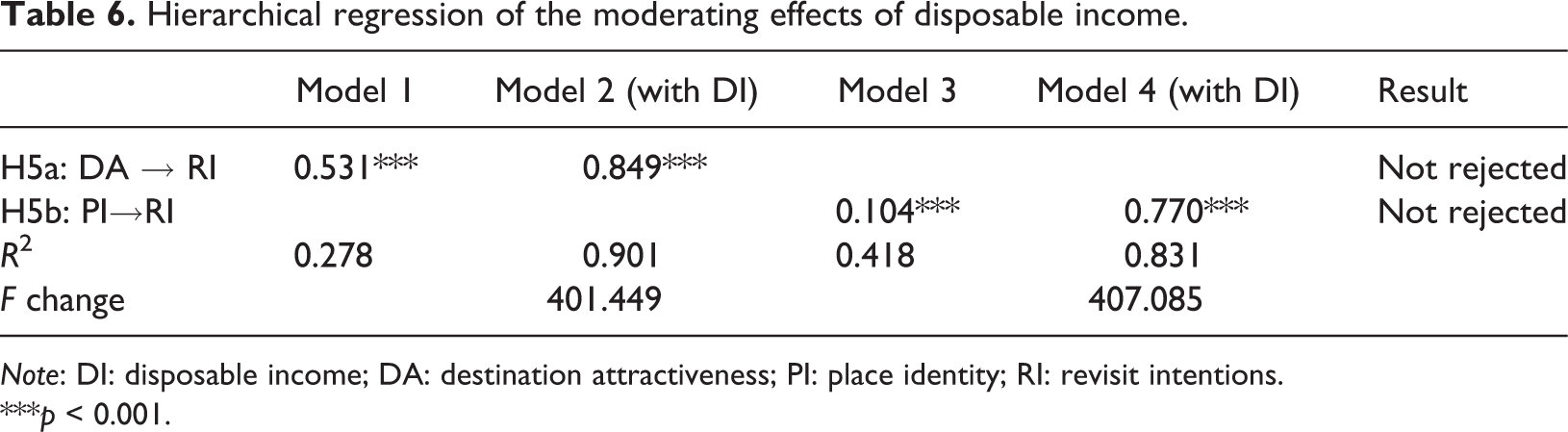
Hierarchical regression was conducted using IBM SPSS 22.0 to examine the moderating effects of the golf tourists’ disposable income on the relationship between DA, PI, and RI. Table 6 presents the results of the hierarchical regression analysis of the moderating effects of disposable income. Model 1 analyzed the relationship between DA and RI, and its explained variance was significant (R2 = 0.278, p < 0.001). Model 2 added the moderator of disposable income, which significantly increased the explanatory power of the model (F change = 401.449, p < 0.001). The regression coefficient in model 2 was also significant (β = 0.849, p < 0.001), showing that the golf tourists’ disposable income has a positive moderating effect on the relationship between DA and RI. Thus, hypothesis 5a is not rejected.
Hierarchical regression of the moderating effects of disposable income.
Note: DI: disposable income; DA: destination attractiveness; PI: place identity; RI: revisit intentions.
***p < 0.001.
Furthermore, model 3 was applied to test the relationship between PI and RI and its explained variance was significant (R2 = 0.418, p < 0.001). The moderator of disposable income was added in model 4, leading to a significant increase of the explanatory power of the model (F change = 407.085, p < 0.001). The regression coefficient in model 4 was significant (β = 0.770, p < 0.001), indicating that the golf tourists’ disposable income has a positive moderating effect on the relationship between PI and RI. Thus, hypothesis 5b is not rejected.
Robustness check
To test the robustness of the results above, subsamples were employed. In light of the variety of golf tourists’ experience, the respondents were divided into two groups: 239 respondents who had less golf tourism experience (≤2 times) and 353 with more golf experience (≥3 times). Table 7 presents that the results of regression, mediation, and moderation among the variables are robust.
Empirical results of robustness check with the subsamples.

Note: DA: destination attractiveness; PI: place identity; RI: revisit intentions; WOM: word-of-mouth recommendations; DI: disposable income; SE: standard error.
*p < 0.05.
**p < 0.01.
***p < 0.001.
Discussion
The present study first examined the relationship between golf tourism DA, PI, golf tourists’ RI, and their WOM recommendations and then further tested the mediating effect of PI and the moderating effect of disposable income.
The empirical results reveal that DA significantly increases PI, RI, and WOM recommendations. Thus, H1a, H1b, and H1c are not rejected, suggesting that the greater the golf tourists’ perception of DA, the stronger are their PI, RI, and WOM recommendations. It is likely that those golf tourism destinations which are attractive would enhance tourists’ PI and also attract a large volume of golf tourists who intend to recommend those destinations. This is in line with previous findings about the positive influence of the attractiveness of natural scenery, culture, and traditional buildings on PI (Cheng et al., 2013). It was further found that PI significantly enhances golf tourists’ RI and their WOM recommendations. Thus, H2a and H2b are not rejected. It is worth noting that golf tourists’ RI are likely to increase their WOM recommendations. These findings reflect that in the tourists’ decision-making process, PI plays a role in creating an emotional bonding between a tourist and a certain destination (Stylos et al., 2017).
Furthermore, the empirical results also suggest the mediation role of golf tourists’ PI in the relationship between DA, RI, and WOM recommendations. Thus, H4a and H4b are not rejected. This means that DA affects behavioral intentions (i.e. RI and WOM recommendations) via PI in golf tourism. These findings contribute to the golf tourism literature regarding the mediating role of PI. As evidenced in the literature, Song et al. (2017) found that place attachment (PI and place dependence) has a significant effect in mediating the relationship between destination image and golf tourists’ RI, and, in turn, place attachment was found to mediate the relationship between DA and environmentally responsible behavior (Cheng et al., 2013).
These results reveal that disposable income was the moderation variable which most positively affected DA and RI, PI, and RI. Thus, H5b and H5a are not rejected. One reason for these results is that golf is a luxury leisure activity, which requires comparatively more disposable income. It also shows that a high level of disposable income is a factor, which is positively correlated with tourists’ demand in the tourism economy (Papatheodorou and Pappas, 2017).
Conclusion
Theoretical implications
The present study has several important theoretical implications. It contributes to the theoretical foundation of golf tourism research by establishing both the construct validity and the reliability of measures for DA, PI, RI, and WOM recommendations in the field of golf tourism.
As one of the first attempts, this article has contributed to extending the research framework of golf tourists’ behavioral intentions by examining the moderating effects of golf tourists’ disposable income. Furthermore, this study shows that disposable income exerts a positive effect on golf tourists’ RI and WOM recommendations. Therefore, tourists’ disposable income should be reconsidered in the golf tourism research, in particular with respect to the economic context. Moreover, the analysis of the mediating effects of PI fills a gap in golf tourism research. The findings shed light on the relationship between DA, PI, RI, WOM recommendations, and disposable income, which goes further than the previous studies. The results of this study may attract the attention of scholars in general tourism research to the specific field of golf tourism, particularly in the emerging Asian markets.
Managerial implications
This study also has some important managerial implications for golf tourism management, industry practitioners, and government authorities at both national and regional levels. First, golf tourism developers and local residents should make an effort to stress the excellent natural environment of Hainan Island, thereby enhancing PI. The findings also reveal that DA plays a critical role in forming strong PI. To improve the attractiveness of Hainan Island, tourism practitioners should cooperate with local residents and provide unique cultural activities. In the long run, they may develop their own local innovation compared with other places (Pardey et al., 2014, 2016, 2018). For example, tourism developers could host golf-related events such as the Hainan Golf Open. Also, the local government could enhance the development by, for instance, improving its policy-making based on the investment evaluation (Hurley et al., 2014, 2016).
The findings of this study could help golf course practitioners to better understand the determinants of golf tourists’ RI and WOM recommendations. Golf clubs at the destination could create some market segmentation based on customers’ disposable income and focus on their target markets. For instance, golf has its own game features, such as handicap scoring, which allows participants of different skills to play together and provides opportunities for business partners to extend their collaboration. Therefore, launching pricing promotion packages or a membership system could stimulate golf tourists’ behavioral intentions. In addition, travel agents may also diversify golf tourism products and marketing strategies to accommodate the various needs of targeted golf tourists. The promotion of travel programs is likely to improve the reputation of Hainan Island and enhance its exposure, thereby attracting the attention of a greater number of tourists. In addition, it is worth noting that the emotional response of tourists to the physical environment and site-supported activities should be considered as an important factor in the promotion of golf tourism.
Limitations and future research
This study is based on an investigation of Chinese golf tourists, which has expanded the conceptual research framework for the study of golf tourism and also provided practical guidance to the golf tourism industry. As a case study, sampling bias may occur (Zainal, 2007) because this research collected data only from Chinese samples. Although the empirical models show robust results, the samples in this study are Chinese golf tourists, which may have biased the findings as a result of Chinese modesty or Asian politeness (Spencer-Oatey and Ng, 2001).
It has been suggested that the covariance-based SEM method has some limitations regarding the omitted variables, assumptions, and sensitive paths (Anderson and Gerbing, 1988; Cliff, 1983). In the light of this, the use of a Bayesian SEM (with prior information) could provide advantages in empirical tourism research (Assaf et al., 2018). As such, future studies could examine more samples from different markets to capture the influence of respondent heterogeneity by using more general statistical analytics such as component analysis, regression, and market segmentation (Engida et al., 2018). Furthermore, the influence of disposable income on consumer preferences needs to be further explored (Zhang et al., 2017), to satisfy the increasingly demanding and heterogeneous golf tourists. In addition, future studies may include regional differences to further examine the influence of characteristics among various areas (Rao, 2018; Rao et al., 2019). Future studies may also consider the possible effects of various types of golf tourists’ motivation, such as those of business golf tourists and leisure golf tourists, as their needs might be different.
Supplemental material
Supplemental Material, supplement_material - Mediating and moderating effects in golf tourism: Evidence from Hainan Island
Supplemental Material, supplement_material for Mediating and moderating effects in golf tourism: Evidence from Hainan Island by Huimin Song, Jamie M Chen and Yibin Chen in Tourism Economics
Footnotes
Declaration of conflicting interests
The author(s) declared no potential conflicts of interest with respect to the research, authorship, and/or publication of this article.
Funding
The author(s) received no financial support for the research, authorship, and/or publication of this article.

Supplemental material
Supplemental material for this article is available online.
References
Supplementary Material
Please find the following supplemental material available below.
For Open Access articles published under a Creative Commons License, all supplemental material carries the same license as the article it is associated with.
For non-Open Access articles published, all supplemental material carries a non-exclusive license, and permission requests for re-use of supplemental material or any part of supplemental material shall be sent directly to the copyright owner as specified in the copyright notice associated with the article.
