



Abstract
This study analyzes the intellectual structure of the sharing economy (SE) in the hospitality and tourism industry, starting from a sample of 189 papers. A co-citation analysis was performed on the 99 most frequently cited studies. The analysis carried out identified five clusters. These groups include the following: (i) the constituent elements of sharing, (ii) the SE and the sharing phenomenon, (iii) noncommercial website platforms and the social impact generated by sharing firms, (iv) economic impacts, and (v) some negative impacts. Each cluster is succinctly described, presenting the main theme and some subtopics.
Introduction
The sharing economy (SE) is considered to be the hottest trend in the hospitality and tourism (H&T) industry (Pizam, 2014). However, for some years, the academic literature has dedicated little energy to this emergent phenomenon (Andreu et al., 2020; Dolnicar, 2019). Some authors suggested that the SE is more commonly explored by the so-called “grey literature,” which includes research reports, commissioned studies or papers presented at conferences (Sigala, 2017). Therefore, it is not surprising that other authors, only a few years ago, defined this academic literature as in its infancy (Gant, 2016). This initial situation is reflected in the sample size of some literature reviews (discussed in the next section). For example, the co-citation study by Cheng (2016a) includes 66 papers, but only 10 refer to the H&T sector. More recently, researchers have dedicated much energy to the SE in tourism, and the number of academic papers is booming (Toni et al., 2018). Furthermore, as presented later, some conceptual papers and reviews were published with larger sample sizes. The recent study carried out by Sainaghi et al. (2019b) considers 79 articles, while the work of Prayag and Ozanne (2018) counts 71 papers.
Given the novelty of the SE in H&T, previous studies have focused their attention mainly on empirical topics, such as the business model of peer-to-peer accommodation platforms (P2P APs), and the disruptive effects generated for traditional hotels (Henama, 2018; Heo et al., 2019; Mody et al., 2019). Other studies have focused on demand, exploring consumer behaviors (Pappas, 2017), segmentations (Guttentag et al., 2017; Yang et al., 2019), and customer satisfaction (Tussyadiah, 2016). Moving to supply, studies have analyzed the motivations of hosts (Kim et al., 2018), location patterns (Adamiak, 2018), price mechanisms (Gibbs et al., 2018a, 2018b), and host attributes (Xie et al., 2019). Another sub-stream, which joins supply and demand, has investigated the interactions between hosts and guests (Geiger et al., 2018). The articulation of these sub-research streams epitomizes how the academic literature has considerably developed in just a few years.
Despite this acceleration in the number of empirical publications, little attention has been paid to the intellectual structure (Sainaghi et al., 2019a), as discussed in “The SE in tourism” section. For this reason, the present study contributes to closing this gap. This study, using a co-citation approach, identifies the intellectual capital, structured around five clusters.
Literature review: SE and co-citation approach
The SE in tourism
This section identifies the main conceptual and review papers that analyze the previous studies on SE (variously defined) in the H&T industry. The articles listed in Table 1 are predominantly based on the comprehensive and updated research carried out by Prayag and Ozanne (2018), plus some additional recent studies. Table 1 reports 22 studies; however, only two of those articles are based on a co-citation approach.
Literature reviews and conceptual papers focused on the sharing economy.
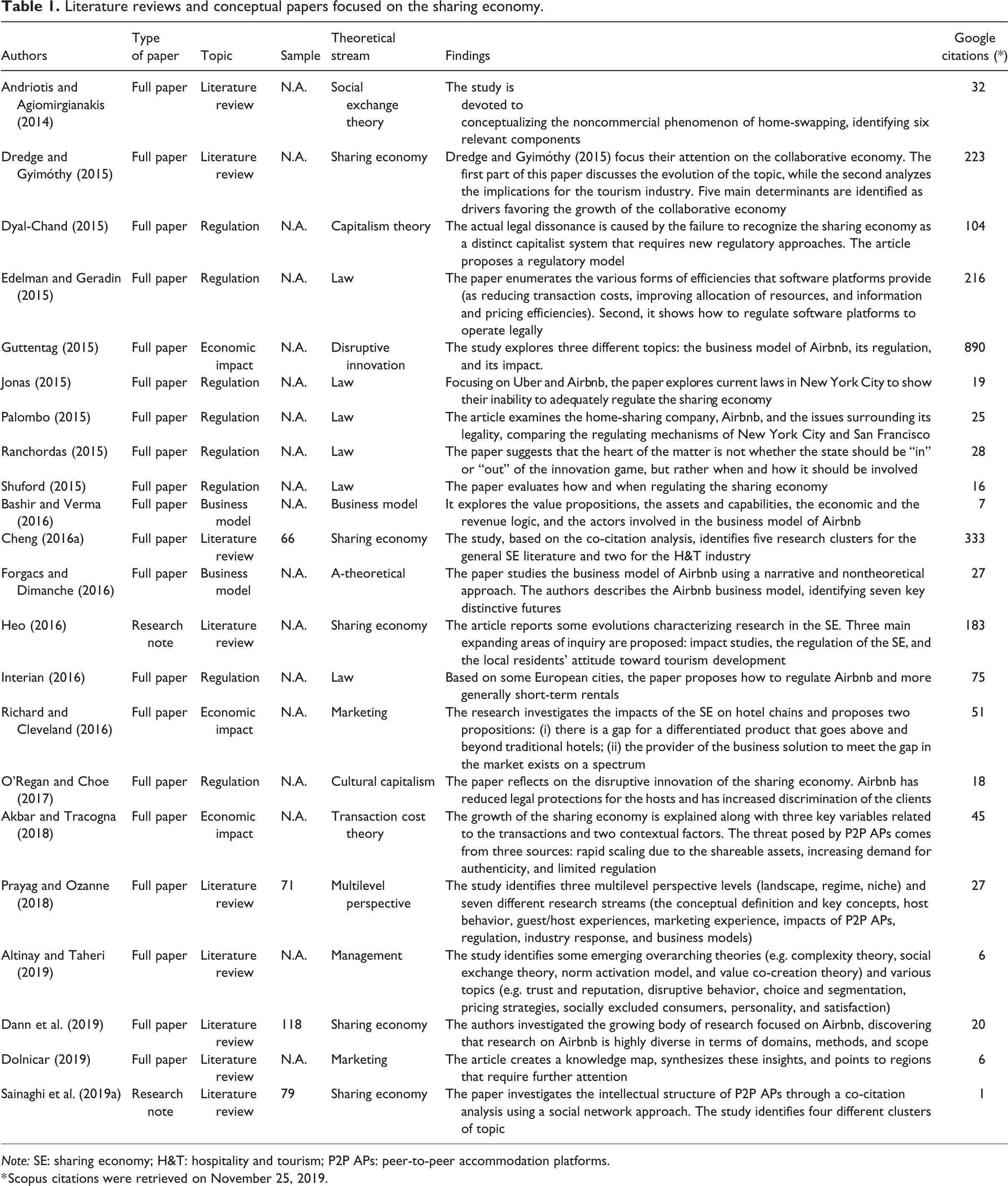
Note: SE: sharing economy; H&T: hospitality and tourism; P2P APs: peer-to-peer accommodation platforms.
* Scopus citations were retrieved on November 25, 2019.
The work of Cheng (2016a) used a sample mainly composed of non-H&T papers (56 of 66), and therefore, the findings are mainly focused on the SE in general. The paper proposes three clusters: (i) the business model analysis of some sharing firms and their impacts; (ii) the nature of the SE, as an alternative form of consumption practice; and (iii) sustainability development, a relatively marginal area with few papers. The author also proposes two clusters based on the 10 H&T papers: (i) the impact generated by sharing firms on tourism destinations and, more generally, tourism providers and (ii) the impacts on tourists generated by the P2P APs. Given the paucity of papers (10), these clusters are very case-sensitive.
The second co-citation paper is the work of Sainaghi et al. (2019b). This study focuses only on H&T papers, includes 79 articles, and proposes four clusters. Each group has been analyzed at three different levels: the individual level (mainly guests), the firm level (hosts and the effects on hotels), and the community and government level (the social impact). The paper by Sainaghi et al. (2019b) is a short research paper, and therefore, the four clusters are very succinctly presented and discussed. The first cluster mainly includes studies that analyzed the economic impacts generated by P2P APs. The second group is the only cluster composed of papers published in journals largely not related to the H&T industry. It includes some foundation studies, primarily rooted in the sociological mechanisms behind sharing and collaborative consumption. The third group is the oldest and develops two subtopics: authenticity and disruptive innovation. Authenticity is mostly analyzed by exploring the functioning of CouchSurfing, while the second is a paradigm used to understand the possible impact generated by the SE. The disruptive theory is well-described by the following citation: Initially it performs worse than mainstream providers because the offer is not speaking to present customer demand. Disruptive innovation caters for future customer needs. Once the market has transformed, mainstream providers have typically missed the opportunity to catch up with satisfying the needs under the new circumstances. (Karlsson and Dolnicar, 2016: 159)
Based on the evidence reported in Table 1, some conclusions can be drawn. First, the number of conceptual and review papers is huge, considering the novelty of this research stream. Second, the prevalent area of inquiry is related to regulation. Third, current studies have largely ignored the “intellectual structure” or “architectural structure” (Sainaghi et al., 2019a) of the SE. This is the gap that this article helps to fill.
The co-citation approach
The rising number of journals and papers focused on the H&T industry has fueled the increasing attention on literature reviews. These studies can be constructed around a content analysis procedure, classifying papers and topics, or can be supported by bibliometric approaches. This second procedure permits consideration of a wider sample of papers. Bibliometric studies remove two limitations on traditional literature reviews: limited sample size and reliability. Within this methodological field, researchers distinguish between relational and non-relational approaches (Benckendorff and Zehrer, 2013). Relational bibliometric articles aim to identify ties among studies, researchers, journals, or communities (Köseoglu et al., 2016). The use of a relational approach is very limited in the H&T field, but there has been some recent work based on this methodology (Jiang et al., 2017).
Document co-citation analysis, one of the relational methods, reveals the ties between the references of two or more documents (papers). The results obtained from the document co-citation analysis, via network analysis, help to elucidate, over time, the intellectual structure of disciplines that belong to the same school, paradigm, or theory. The results also identify the most influential research, or the central, peripheral, or bridging studies of the field, since the references of an output represent the theoretical and empirical foundations of the output (Zupic and Čater, 2015).
The relational approach, variously operationalized, depicts links among papers and their references, and these ties can be visualized using graphical networks. The use of network theory is widely accepted in the field of H&T. The usefulness of this approach in the field of P2P APs is related to the ability to understand the intellectual structure.
Methodology
As reported in Table 1, previous reviews and conceptual papers very rarely have explained the sample used and the criteria employed. This is surely a severe limitation that reduces reliability. To define the sample of papers, this study has used three parameters: the journals to be included, the keywords used to identify the papers, and the number of years analyzed (Sainaghi, 2010).
Concerning journals, some literature reviews focus only on certain leading ones, while other studies prefer to include a wide sample (Sainaghi et al., 2017). Both approaches have weaknesses and advantages. Leading journals assure more relevancy of the sample, but at the cost of excluding an important layer of studies; the opposite effect is generated when the sample is not focused on leading journals. To assure a wide coverage of the literature, the present study used the Scopus and Web of Science databases.
The second variable is centered on keywords used to identify the papers in the journals. This choice is necessarily based on the precise field of research. This article has used the keywords proposed in some previous studies (as later clarified). In particular, four keywords relate to the sharing phenomenon: SE, collaborative economy, collaborative consumption, and P2P (Cheng, 2016a, 2016b) and two identify the leading companies: Airbnb and CouchSurfing (Prayag and Ozanne, 2018). Finally, six other keywords were employed to define the tourism industry: tourism, tourist, and traveler and the hospitality sector: hospitality, hotel, and accommodation (Blal et al., 2018). The six sharing keywords were combined with the six industry keywords, and the two databases generated 72 (6 × 6 × 2) queries. There are many other emerging keywords in this field, such as “gentrification” and “overtourism.” However, the keywords used serve as a means of identifying these phenomena. In fact, gentrification and overtourism are usually associated with Airbnb (Aznar et al., 2016; Gant, 2016).
Finally, the number of years analyzed is usually large, enabling development of a longitudinal approach. In the present article, the time period is considerably limited because the so-called SE emerged in tourism mainly after the foundation of Airbnb (Guttentag, 2015), and academic research is therefore a very recent phenomenon. Although the research team did not apply any temporal restrictions, the gross sample included papers from 1982 to 2018. However, after a deep analysis of each individual paper, the final sample ranged from 2010 to 2019, in line with the study of Dolnicar (2019).
The 72 queries were researched in the Scopus and Web of Science database in November 12, 2018, generating an initial sample composed of 2526 articles. In line with the study of Prayag and Ozanne (2018), a two-stage inclusion/exclusion process was applied when selecting the final sample. During the first stage, all the duplicated papers were removed (1932), obtaining a gross sample of 594 studies. The huge number of duplicated papers suggests a wider correlation among the keywords. In stage 2, every document was analyzed, and the abstract as well as the full paper (if necessary) was read to verify that the study was relevant to P2P APs. During this second stage, 405 documents were excluded. The final sample included 189 papers. Finally, reference lists of 189 papers were analyzed. The sample is available on request. Document co-citation analysis was performed on the 99 most frequently cited references (each having at least seven citations throughout a sample of 189 papers). Due to space constraints, the sample is available on request. To prepare data for co-citation analysis via network analysis, the BibExcel software program was used. Then, to identify clusters, we performed network analysis for the co-citation data using VOSviewer software version 1.6.15. As a result of this clustering analysis, the association strength approach was utilized.
One of the main challenges in the analysis procedure is identifying the cutoff point to generate the co-citation data for network analysis. Some studies consider the stress value of the data (e.g. Hota et al., 2019), some use the trial-and-error method to identify the best interpretable cluster, and others simply assign a cutoff point of at least 50, 100, or more articles (Köseoglu et al., 2018; Zupic and Čater, 2015). In this study, the trial-and-error method was employed to identify the cutoff point of co-citation data. First, we did not apply the cutoff point. Because clusters include many articles, interpretation was not straightforward and may not represent the entire cluster. Second, the 50 most-cited articles were considered. Interpreting the results was straightforward, but the identification of clusters was unclear. Finally, we used the 99 most-cited articles to explore the subfield. This cutoff point has included articles cited a minimum of seven times.
We employed network visualization through VOSviewer to highlight the academic foundations as clusters for each period. VOSviewer uses a modularity-based clustering method to identify clusters (Van Eck and Waltman, 2010). For normalization, we used the association strength approach in the analysis of each period. Detailed data on the clusters generated for each period are provided. We used the network view of VOSviewer for mapping. The circles represent nodes, the lines show the links between the nodes, and the colors identify the clusters in which each node belongs. The size of the nodes represents usage frequency. The network analysis (Baggio et al., 2010) is largely adopted in relational bibliometric studies (Sainaghi et al., 2019a, 2019b; van der Zee and Vanneste, 2015), thanks to its ability to identify links among papers.
Clusters of topics
The analysis carried out identified five clusters (Figure 1, panel A). In this section, each cluster is succinctly analyzed, explaining the name used and identifying some subtopics. Finally, some descriptive variables are added, focusing on the journals where the 99 contributes are published (see “Journals” section).

The five clusters. SE: sharing economy; P2P APs: peer-to-peer accommodation platforms.
Cluster 1: Noncommercial P2P APs
The first group of papers, well-positioned on the right side of Figure 1, includes the largest community (n = 25). The unifying theme is the relevance of noncommercial P2P APs, mainly represented by CouchSurfing plus other experiences of home-swapping. This “authentic” and “sustainable” niche is opposed to commercial sharing experiences (Airbnb in primis) that can produce some negative social impacts. The cluster, therefore, embraces two main subtopics: (i) noncommercial P2P APs (the central theme) and (ii) social impacts (the adjacent theme).
The first topic focuses on noncommercial P2P APs, particularly CouchSurfing (mainly) and home-swapping (marginally). The general topic underlying this group of papers is the social interaction between strangers (the host and the guest). This interaction is online before the vacation and is very intimate during the stay. This is the reason why these authors focus on noncommercial P2P APs. In profit-oriented firms, the interaction, especially for the host, is partially driven by monetary benefits. In noncommercial P2P APs, the distinction between the host and the guest is blurred, encouraging each to embrace the other role. Next, some research streams are discussed and some papers are presented. Germann Molz (2012, 2013, 2014, 2016) is the leading author of this niche. Her reflections are primarily centered on trust mechanisms, and the role played by technology to sustain the development of the so-called “moral economy” embodied in the CouchSurfing experience. Another central topic for this author is the concept of “network hospitality,” where “friends” and “strangers” interact online and offline. In another contribution, network hospitality is operationalized around five key characteristics: sharing with strangers, feeling like a guest, engineering randomness, pop-up assemblages, and guests without hosts. Rosen et al. (2011) investigate the factors influencing the sense of belonging in the CouchSurfing community. The antecedents relate to the level of engagement and include the relevance of face-to-face interaction, attendance of gatherings, and hosting. The findings confirm the positive effects generated by these determinants. Bialski (2012) explores the role played by technology in facilitating interactions between strangers. Chen (2012) investigates interactions between strangers from a non-western perspective. The author is interested in verifying the ability of the CouchSurfing platform to assure reciprocity, which means cosmopolitanism experiences for the hosts and local authenticity for the guests. The same topic is explored by Buchberger (2012). Steylaerts and Dubhghaill (2012) present CouchSurfing as an allegedly more authentic form of travel, where this sharing experience is opposed to homogenization and globalization. Tan (2010) explores how the trust between the host and the guest can be generated in this hybrid online and offline community (CouchSurfing) and proposes a theoretical framework based on “suspension and the leap of faith.”
The second subtopic relates to impact, especially social impact, and the resulting need for regulation. A small but interesting group of papers develops a critical analysis of the SE, showing some evident limits. Dredge and Gyimóthy (2015) present five factors favoring the SE in H&T (redundancy, dead capital, idling assets, and latent expertise; high transaction costs and distorted information; asymmetries of regulation; postmodern tourist; and less destination innovation). However, the authors discuss these five claims and argue for a more balanced assessment. Richardson (2015) presents the SE as a paradox, framed both as part of the capitalist economy and as an alternative. The author explores three key factors: community, access, and collaboration. Martin (2016) investigates how the SE ranges from a potential pathway to sustainability to a nightmarish form of neoliberalism. According to this author, the SE has been prevalently reframed as an economic opportunity. Richard and Cleveland (2016) apply marketing theory, specifically the brand approach, and reveal a gap in the market for a differentiated product that goes above and beyond traditional P2P rental offerings. These papers represent the starting point for a second group of studies focused on regulation. They are mostly published in journals specialized in law or, more marginally, in planning.
Cluster 2: SE and the sharing phenomenon
The second group of papers, well-positioned in the lower part of Figure 1, includes the second largest cluster (n = 24), colored in green. The unifying topic of this cluster is the SE itself. In other words, this group presents some foundation papers on the sharing phenomenon. Not surprisingly, this cluster is mainly composed of articles that do not belong to the H&T industry. Inside this cluster, there are four subtopics: (i) papers exploring the SE and the sharing phenomenon (the heart of this cluster); (ii) studies presenting sharing experiences developed in non-H&T industries; (iii) methodological studies; and (iv) H&T papers.
The first subtopic focuses on the SE and sharing phenomenon. It accounts for the majority of papers, and this group clearly centers around the work of Belk (2007, 2010, 2014a, 2014b). The basic idea is the shift from the paradigm “you are what you own,” typical of the pre-Internet era, to “you are what you can access.” (original emphasis) The SE, presented as a fundamental consumer behavior, is fueled by two new factors: the use of temporary access non-ownership models of utilizing consumer goods and the importance of the Internet. There are different factors favoring (such as web diffusion and intellectual property rights) and limiting (such as the feelings of possessiveness and attachment toward things we own) sharing activity. However, it is important to distinguish between sharing and what is best regarded as “pseudo-sharing.” Pseudo-sharing is characterized by the presence of profit motives, the absence of feelings of community, and expectations of reciprocity. The idea of collaborative consumption was previously proposed in a seminal work by Felson and Spaeth (1978). They define this phenomenon as events in which one or more people consume economic services or goods by engaging in joint activities with others. The work of Hamari et al. (2016) is centrally positioned in the cluster (label A4) and is one of the biggest green bullets. Based on empirical research, the authors explored why people participate in collaborative consumption. The findings reveal the relevancy of sustainability and enjoyment of the activity as well as economic gains. Similar results are proposed by Schor and Fitzmaurice (2015); however, the authors pose some doubts about the ability of these collaborative connections to meet these goals.
A second subgroup presents some sharing experiences developed in non H&T industries. This cluster includes a few methodological papers. A couple of articles investigate the potentialities of structural equation modeling (Hair et al., 2011) as well as the statistical tests used by this method (Fornell and Larcker, 1981).
Finally, there is a small group of articles focused on the H&T industry. All these papers are empirical studies and analyze commercial P2P APs (Airbnb in primis). Tussyadiah and Zach (2015) study the competitive threat generated by sharing accommodation to traditional hotels in Oregon, suggesting important differences in the guests’ expectations. In a second more recent study, Tussyadiah and Pesonen (2018) analyze the drivers and barriers for P2P accommodation. The main drivers are social and economic appeal, while the barriers include trust, efficacy, and cost. Möhlmann (2015) makes enquiries about the determinants of satisfaction and intention to purchase again. The study identifies some relevant antecedents as utility, trust, cost savings, and familiarity. Geron (2013) enquires the factors favoring the continuing rise of Airbnb, while Stors and Kagermeier (2015) explore the motives for using Airbnb.
Cluster 3: Hotel impacts and demand studies
The third group, colored in blue, includes 19 papers. It is positioned in the upper part of Figure 1 but is variously interrelated with cluster 4 (yellow) and cluster 5 (purple). The union between the blue and yellow clusters divides the blue community into two areas. One is prevalently focused on hotel impacts and substitution threat, plus some related studies exploring the determinants of performance. The second is mostly oriented on demand studies exploring consumer behavior and guest segmentation.
The general topic of this community is the competitive threat to traditional hotels generated by commercial P2P APs. Despite this unifying topic, this group of papers adopts different methodologies. Gutiérrez et al. (2017) compare the spatial patterns of Airbnb listings and hotels in the city of Barcelona. The first part of this study reveals that both types of supply are centrally located. However, Airbnb predominates in the city center. The second part of this study explores the determinants of spatial patterns, identifying some positive (leisure and restaurants attractions, residential areas, tourist photographs) and negative variables (distance to city center, industrial activities, distance to the beach). The location patterns of Airbnb and hotels appear different. Varma et al. (2016) investigate the differences between Airbnb and hotel guests, considering consumer behaviors. The findings suggest profound differences. Guttentag and Smith (2017) developed a demand study approach to measure the substitute threat of commercial P2P APs, revealing that 64.8% of participants perceived Airbnb to be a hotel substitute. A second research question evaluated the accommodation performance of Airbnb in comparison with hotels. The results showed that Airbnb outperformed budget hotels and motels, along with midrange and upscale hotels, in terms of P2P’s supposed strengths (authenticity, uniqueness, and price). In contrast, Airbnb outperformed only budget hotels and motels based on some hotel strengths (cleanliness, comfort, and confidence that the overall quality would meet expectations). The authors conclude that these findings signal some (but not total) consistency with the concept of disruptive innovation. Karlsson and Dolnicar (2016) provide some evidence about the reasons for renting certain properties and identify three main high-level categories: income, social interactions, and sharing. Economic motivation is the most common. Mody et al. (2017) note that the competition between Airbnb and hotels is centered on customer experience.
The second group includes demand studies exploring consumer behavior or proposing customer segmentation or, more rarely, analyzing customer satisfaction. Apparently, this second group is considerably disconnected from the first, but in reality, demand studies can shed light on the purchasing process that guides the guests. This second group is centered on the work of Tussyadiah, alone (Tussyadiah, 2016) or in collaboration with co-authors (Tussyadiah and Pesonen, 2016; Tussyadiah and Zach, 2017). The first study explores the determinants of customer satisfaction and the intention to buy again, suggesting the relevancy of enjoyment and economic benefit. Similarly, Tussyadiah and Pesonen (2016) show that economic appeal (cost savings) and social benefits influence travel patterns. Tussyadiah and Zach (2017) segment Airbnb guests, identifying five groups.
Cluster 4: The rising SE and some negative effects
The fourth group, colored in yellow, includes 17 articles. It is positioned in the upper part of Figure 1, crossed by the blue cluster. Therefore, there are two distinct subgroups of papers, the smaller on the top of the figure, and the largest more centrally located. The unifying topic of this community is the disruptive growth of the SE (main topic) and some negative consequences created by this phenomenon.
Focusing on the first topic (disruptive growth), Schor (2016) defines the SE trend as explosive and investigates questions related to this phenomenon (e.g. why share, how green is the SE, the ability of the SE to create social capital, labor exploitation). Einav et al. (2016) identify some factors of P2P markets, including search and matching algorithms, pricing, and reputation systems. Malhotra and Van Alstyne (2014) describe the “dark side” of the SE, sharing some examples of negative externalities. For example, in the case of Airbnb, the listing diffusion can generate negative effects for residents and long-term rentals. The paper proposes ways to highlight the dark side: investing in the customer, creating reputation systems (at the platform level), and extending some forms of taxation to the sharing firms (such as the income and tourist tax paid by Airbnb hosts in Amsterdam).
These papers, strongly focused on the rapid SE growth, have supported a second group of studies exploring the negative effects. Some articles reflect on the negative economic impacts generated for hotels. However, the results are contradictory. For example, Choi et al. (2015) conclude that Airbnb listings have no effect on hotel revenue. By contrast, Zervas et al. (2017) found that a 1% rise in Airbnb beds resulted in a 0.05% reduction in revenues for hotels located in Texas. The effects are greater for budget hotels and those not serving business guests. Another negative effect is related to some trust mechanisms used by P2P APs. The literature suggests at least two important trust generators: host photos and guest reviews (Ert et al., 2016). However, the first mechanism (photos and, more generally, host information) has favored the creation of the so-called digital discrimination. This latter includes “a range of circumstances in which a person or group is treated less favorably than another person or group based on their background and/or certain personal characteristics with regards to the internet” (Cheng and Foley, 2018: 95). Focusing on the second trust mechanism (guest reviews), Zervas et al. (2015) note that the ratings are so high (nearly 95% of Airbnb hosts have an average rating of either 4.5 or 5 stars, the maximum possible) that it reduces their importance. Finally, given these described negative effects, there are some papers exploring various forms of regulation (Kaplan and Nadler, 2015; McNamara, 2015).
Cluster 5: Constituent elements of the SE
The fifth group is at the heart of Figure 1, encapsulated within cluster 1 (noncommercial P2P APs and social impact), cluster 2 (SE and sharing phenomenon), cluster 3 (hotel impacts and demand studies), and cluster 4 (the rise of the SE and some negative impacts). The purple community is the smallest (n = 14) and centers around conceptual papers identifying constituent elements of the SE. Two more peripheral subtopics are proposed: (i) online reviews (left side) and (ii) social impact (right side).
At the core of cluster 5 are some conceptual papers mainly focused on the constituent elements of SE. The barycenter of this cluster (and probably of the whole Figure 1) is the work of Guttentag (2015). This seminal study explored three main topics: the business model of Airbnb, regulation problems, and the impacts on hotels. Another important part of this group is the paper by Heo (2016). She proposes several research areas: the psychological facets of sharing, legal and financial perspectives, and the characteristics of P2P sharing transactions. Furthermore, Heo suggests the need to improve the theoretical discussion and the sociocultural aspect of sharing. Other papers have identified some constituent elements of the SE in the H&T industry. Sigala (2017) focuses on the advancement of technology, while Yannopoulou et al. (2013) put forward evidence that P2P APs are user-generated brands. Other papers developed in the general SE field are mobility (Cohen and Kietzmann, 2004), identifying the social logic of sharing (John, 2013) and showing the limits of the sharing paradigm.
The left side of this cluster includes a few papers related to the topic of online reviews. However, the papers are more methodological studies, rooted not in the SE but rather in the general field of the hotel industry (e.g. Ayeh et al., 2013). Apparently, this subtopic is completely disconnected from the general theme of the cluster (constituent elements of sharing), but in reality, this can be questioned. The literature has suggested that online reviews and, more generally, user-generated content represents one of the most relevant trust mechanisms (Cheng et al., 2019).
Finally, the right side (very close to cluster 1) focuses on the social impacts generated by the sharing platforms. Fang et al. (2016) analyzed the effect of Airbnb on tourism employment via a quantitative study in which employment is the dependent variable and the number of listings (Airbnb hosts) squared—which is useful for measuring the marginal effect—are the independent variables. The article distinguished between short- and medium-term impacts. Concerning the former, a rise in the number of tourist rentals increases occupancy; however, a larger P2P supply subsequently reduces the number of clients staying in traditional hotels, producing a second negative effect on employment. Another well-studied social theme is the need (or not) for regulation by local governments.
Journals
As anticipated in the Introduction, this section highlights some descriptive statistics concerning the journals, in which the 99 co-cited papers were published. Table 2 illustrates, for each cluster, the number and the percentage of “tourism and hospitality journals” and the opposite.
Clusters and type of journals.
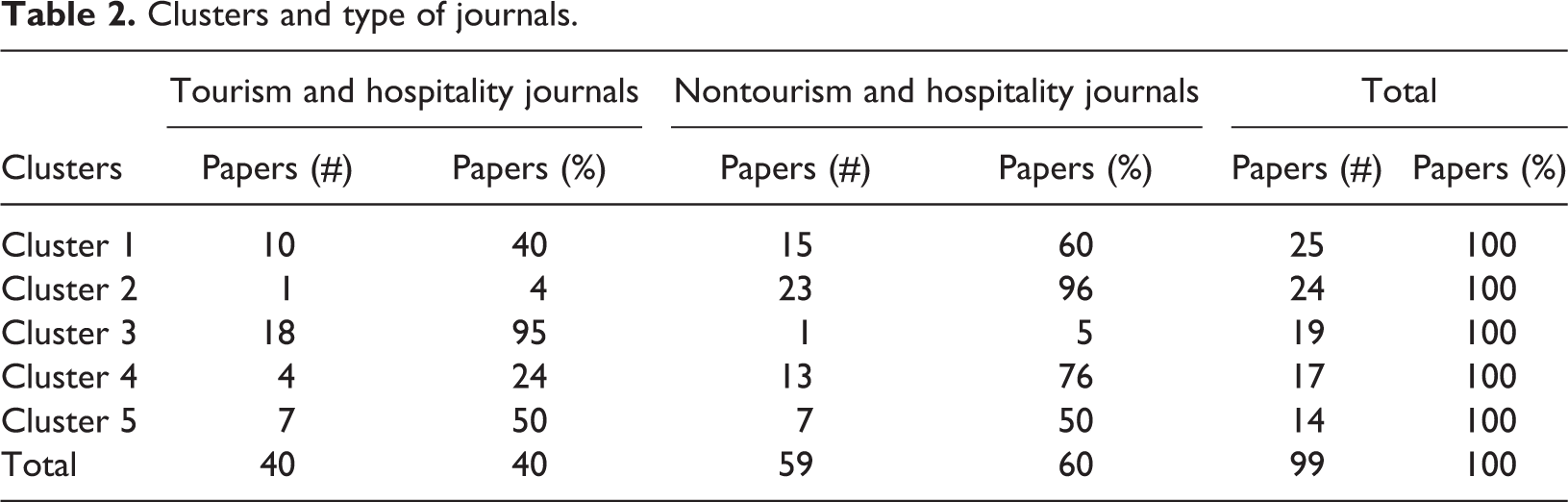
The results are mixed for the first (the largest) and the fourth (the smallest) clusters, where the two types of journals show similar values (especially for the last group). By contrast, the second (SE and sharing phenomenon) and the fourth (the rising SE and some negative effects) are strongly centered on nontourism and hospitality journals. The only singular group built around papers published in the tourism and hospitality journals is the third cluster (hotel impacts and demand studies). The numbers and percentages reported in Table 2 are in line with the topics.
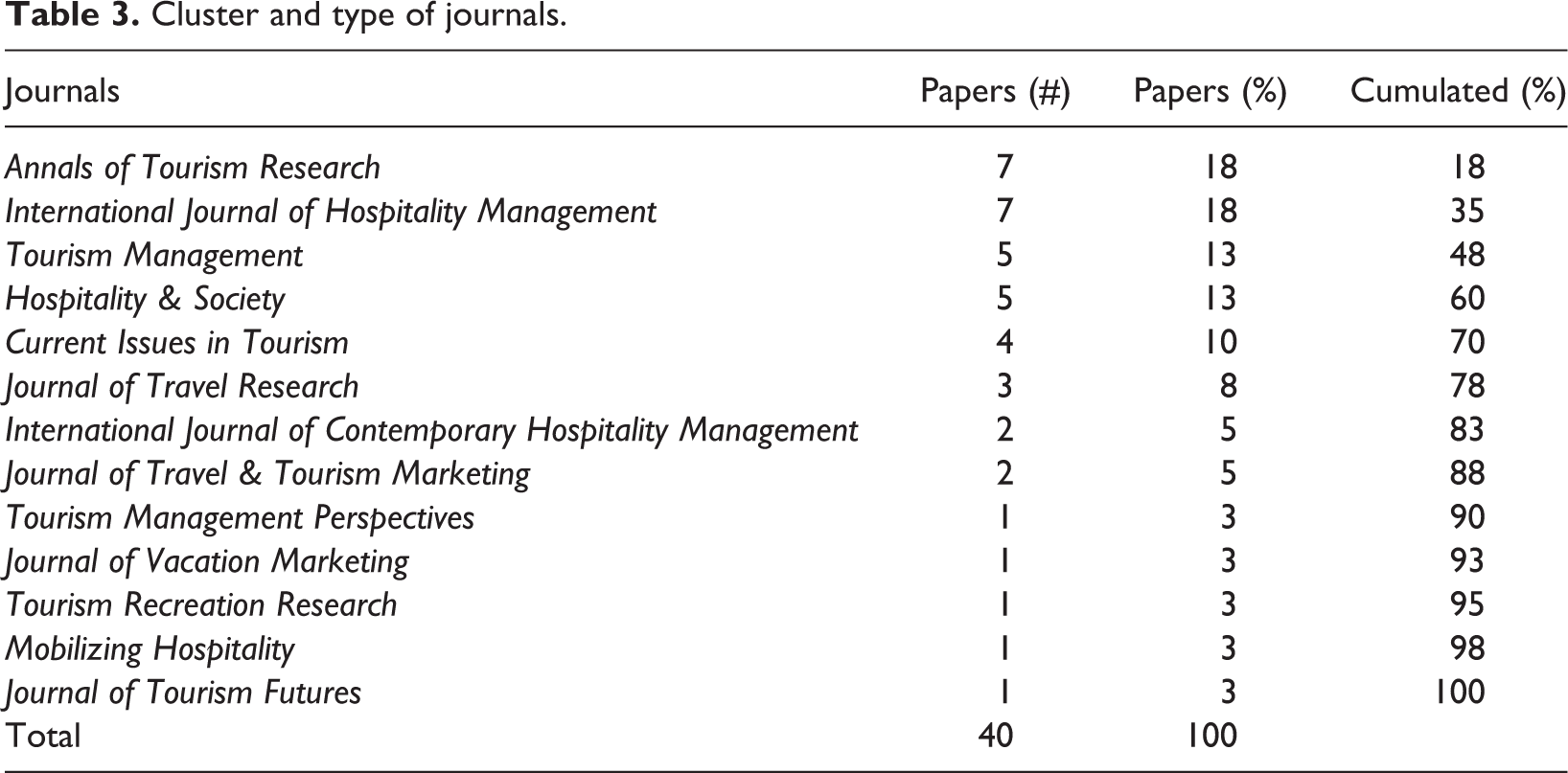
Finally, Table 3 reports the details of tourism and hospitality journals. The 40 articles are published in 13 journals, with a good concentration degree obtained from the first three journals (48%). In particular, Annals of Tourism Research (18%) and International Journal of Hospitality Journal both accounted the highest number of articles (18% for each journal).
Cluster and type of journals.
Conclusions
The conclusions are structured into three types: first, they outline some theoretical implications, particularly comparing the current results with some previous studies using the co-citation approach. Second, some empirical implications are identified. Finally, a future research agenda is developed.
Focusing on the theoretical contribution, this study has analyzed the intellectual structure of the SE in the H&T industry based on the most influential 99 studies cited by 189 papers. Five clusters can be identified. The empirical map proposed in this article (Figure 1) shows differences compared to the previous studies. The work of Cheng (2016a) included only 10 H&T papers, while in the work of Sainaghi et al. (2019b), there were only four clusters, covering 48 articles. Furthermore, the co-cited network in the work of Sainaghi et al. (2019b) is considerably less interconnected than those reported in Figure 1 of the present study. Therefore, a first conclusion can be stated: the intellectual structure shows a significant evolution.
A second feature focuses on the topics representing the “pillars” of the SE. There are five and they show strong interconnections. They include the following: (i) the constituent elements of sharing (cluster 5), (ii) the SE and the sharing phenomenon (cluster 2), (iii) noncommercial P2P APs and the social impacts generated by the SE (cluster 1), (iv) economic impacts (cluster 3), and (v) the negative impacts (cluster 4). Therefore, the research center includes the constituent elements of the SE, while other clusters explore different types of impacts (economic, social, and negative effects).
Third, the map is “under construction.” In fact, the clusters are strongly interconnected. Therefore, future studies can probably identify new topics and/or a more clustered map. At the moment, economic and negative impacts strongly overlap as the constituent elements are crossed by all the remaining groups.
Some conceptual papers are positioned in the center of the intellectual map, including the bigger bullets reported in Figure 1. Those are the most influential studies in SE literature. Interestingly, five of them are rooted in the H&T industry and represent the “pillars” of some clusters. Based on this result, we can conclude that the main foundation studies are rooted in the H&T field.
Certain conclusions can be drawn from a comparison of the results of this study and those reported in the work of Sainaghi et al. (2019b). The five clusters identified suggest, contemporarily, an important overlapping and some important differences with the four clusters of Sainaghi et al.’s (2019b) research note. Some similarities are evident: cluster 1 of the present study (noncommercial P2P APs) is similar to cluster 3 of Sainaghi et al. (2019b) (authenticity); cluster 5 (constituent elements of SE) and cluster 2 (SE and the sharing phenomenon) of this article are not far from Sainaghi et al.’s (2019b) cluster 2 (sociological mechanisms behind the SE and the collaborative consumption); and cluster 3 (hotel impacts and demand studies) is partially overlapped with cluster 1 (economic and social impact). The overlaps are positive, because it suggests that some theoretical pillars remain relatively stable when comparing different samples and adding new studies. However, some important differences emerge. The first is embodied in cluster 4 of the present article, including the rising SE and some negative effects. As previously described, these undesired effects are mainly focused on the social environment. A second difference is represented by the network density and the number of interconnections. In the Sainaghi et al.’s (2019b) study, the four clusters were more separated, showing less links. Figure 1 of this article, by contrast, shows five overlapped clusters and many interconnections among the different papers. Interestingly, in the new map, the constituent elements of SE (cluster 5) are in the center, suggesting that this is the hub for this research stream.
At the empirical level, the actual results show a prevalent negative approach for the SE and in particular to commercial P2P APs (Airbnb in primis). This can have many empirical consequences, especially for hosts, destination managers, and policy makers. In fact, in cluster 1, authenticity and social interaction reported more commonly by users of CouchSurfing, while Airbnb is associated more closely with negative social impacts. In cluster 2, the SE and the sharing phenomenon are explored using non-H&T studies. Cluster 3 explicitly describes commercial P2P APs as disruptors, and, similarly, cluster 4 stresses the explosive rise of Airbnb and the negative social effects this has generated. Along the same line, cluster 5 has at its center the study of Guttentag (2015) based on the disruptive theory. Therefore, the intellectual structure identified in this article reveals more a negative viewpoint, which is also most likely reflected by the point of view of many traditional stakeholders (hotel industry, tourism destinations, local stakeholders as residents and employees, etc.).
Finally, some research avenues are identified based on the findings of this study. They include the expected evolution of the five clusters and some additional emerging topics. Starting from the center of Figure 1, the fifth cluster (constituent elements of SE) could include new conceptual and foremost literature reviews necessary to order and interpret the growing number of published (and publishing) SE papers. The first cluster (noncommercial P2P APs) will continue to play a pivotal role in exploring host–guest relationships, authenticity and the “genuine,” “real” SE. In this group, some studies focused on nonprofessional Airbnb hosts could be added. Cluster 2 (SE and the sharing phenomenon) will remain a mixed community, including many non-H&T studies. However, the number of studies rooted in the H&T industry will increase. Cluster 3 (hotel impacts and demand studies) is expected to enlarge, but the economic impact studies will be more “destination-based,” distinguishing, for example, between mature tourism and overtourism contexts from emerging destinations. Finally, cluster 4 (the rising SE and some negative effects) will attract more papers, considering the wider effects (economic and social) generated by P2P APs. The intellectual map can host new clusters. Some possible emerging topics include an ad hoc community for social impacts (currently, it is a subtopic of cluster 1); regulation (regulation is now spread around the five clusters); demand-side studies, including consumer behavior, segmentation, and customer satisfaction studies (which at the moment is a subtheme of cluster 3); and supply studies focused on hosts, including the analysis of performance (a few studies are presently included in cluster 3).
Limitations and further research
This study identified the initial sample (189 papers) using keywords researched in the Scopus and Web of Science databases. Despite being a relevant source of information, these databases can miss some relevant studies. This work was based on co-citation and therefore explored the “intellectual structure,” while the links between studies (cross-citation) remain unknown. A future study could explore the link between these two perspectives. In this study, we elucidated the intellectual structure of the field based on the most frequently cited documents’ topics. A future study could highlight the intellectual structure by considering the most cited journals in the field. Further, as a relational method, a future study can investigate the contextual structure of the field using related keywords or abstracts of the studies in the field (Zupic and Čater, 2015). Finally, given the novelty of this research stream, this study has not developed a chronological map, like those proposed by Sainaghi et al. (2019a). In the future, this limitation could be removed.
Footnotes
Declaration of conflicting interests
The author(s) declared no potential conflicts of interest with respect to the research, authorship, and/or publication of this article.
Funding
The author(s) received no financial support for the research, authorship, and/or publication of this article.
