



Abstract
Tourism specialization has been studied so far at an aggregate geographical level and by considering tourism as a homogeneous product. The result is a simplistic and stereotypical image of tourism specialization, as for Europe where southern European Union (EU) countries are commonly viewed as highly specialized in tourism services and northern EU countries highly specialized in other activities. The purpose of this article is to provide a method for a deeper analysis of tourism specialization. We study comparative advantages and disadvantages of a sample of 20 European countries over the period 2010–2016 by considering bilateral flows of three different quality tourism services (high, middle, low). Our results show serious differences with those obtained by the traditional approach.
Keywords
Introduction
The aim of this article is to provide a method for a deeper analysis of tourism specialization, with an application to Europe. Studying tourism specialization is an important issue. First, it amounts to identify and measure the tourism competitiveness of a destination. Second, it could help to understand why empirical results on the tourism–growth nexus are mixed: according to Chiu and Yeh (2017), these mixed results could be due to the inadequate way tourism specialization is usually defined and measured. Third, as a worldwide export category, tourism services rank third after chemicals and fuels, and are the top export category for many countries. Yet, very little is known on international trade and patterns of specialization in tourism services, as compared to trade in merchandise. Fourth, the tourism industry is very strongly impacted by the COVID-19 pandemic. Destinations are already all affected, but in different ways and to different degrees. The study of tourism specialization could help to understand these differences.
The few existing academic studies (e.g. Algieri et al., 2016, and references within) display two major shortcomings. First, the analysis is usually conducted at a multilateral level (e.g. one country with respect to the rest of the world), giving rise to the risk of spurious conclusions due to a geographical aggregation bias. As has been known since at least the 1950s in the context of the Leontief paradox (Tatemoto and Ichimura, 1959), the appropriate level of analysis for international specialization is the bilateral one. Second, tourism is always considered as a homogeneous product. Yet available evidence suggests that tourism is a highly differentiated product, in particular regarding the dimension of quality (Hanna et al., 2015). This could have serious implications on the way tourism influences economy. For example, Albaladejo et al. (2014) showed that the quality of tourist services is important in maintaining tourism’s role in promoting long-term growth. In this article, we propose to shed new light on specialization in tourism by using a methodology addressing these two shortcomings, with an application to the European Union (EU). This article is organized as follows. The second section describes the index used to measure tourism specialization. The third section presents the results when using bilateral data. The fourth section adds vertical differentiation to the measure of specialization.
How to measure tourism specialization traditionally?
We analyze tourism specialization patterns on a strict bilateral level (each country with respect to each of its partners separately) and we introduce quality in tourism trade through the definition of three market segments (high H, middle M, low L). The study relates to a sample of 20 European countries (selected on the basis of data availability) over the period 2010–2016 and is based on bilateral intra-European trade flows (exports and imports) in tourism services from the OECD database. Mirrored data (exports to j reported by i and imports from i reported by j) were harmonized by using the method developed by Lejour and De Paiva Verheijden (2004).
We chose to measure comparative advantages in tourism by using the “contribution to the trade balance” indicator (CTB) developed by the Centre d’Etudes Prospectives et d’Informations Internationales (Lafay, 1992). This indicator has been preferred to the standard Balassa index as it combines together trade and production variables, and displays better empirical distribution characteristics.
The CTB index of country i for tourism quality s (

with
There are 19
A positive value for
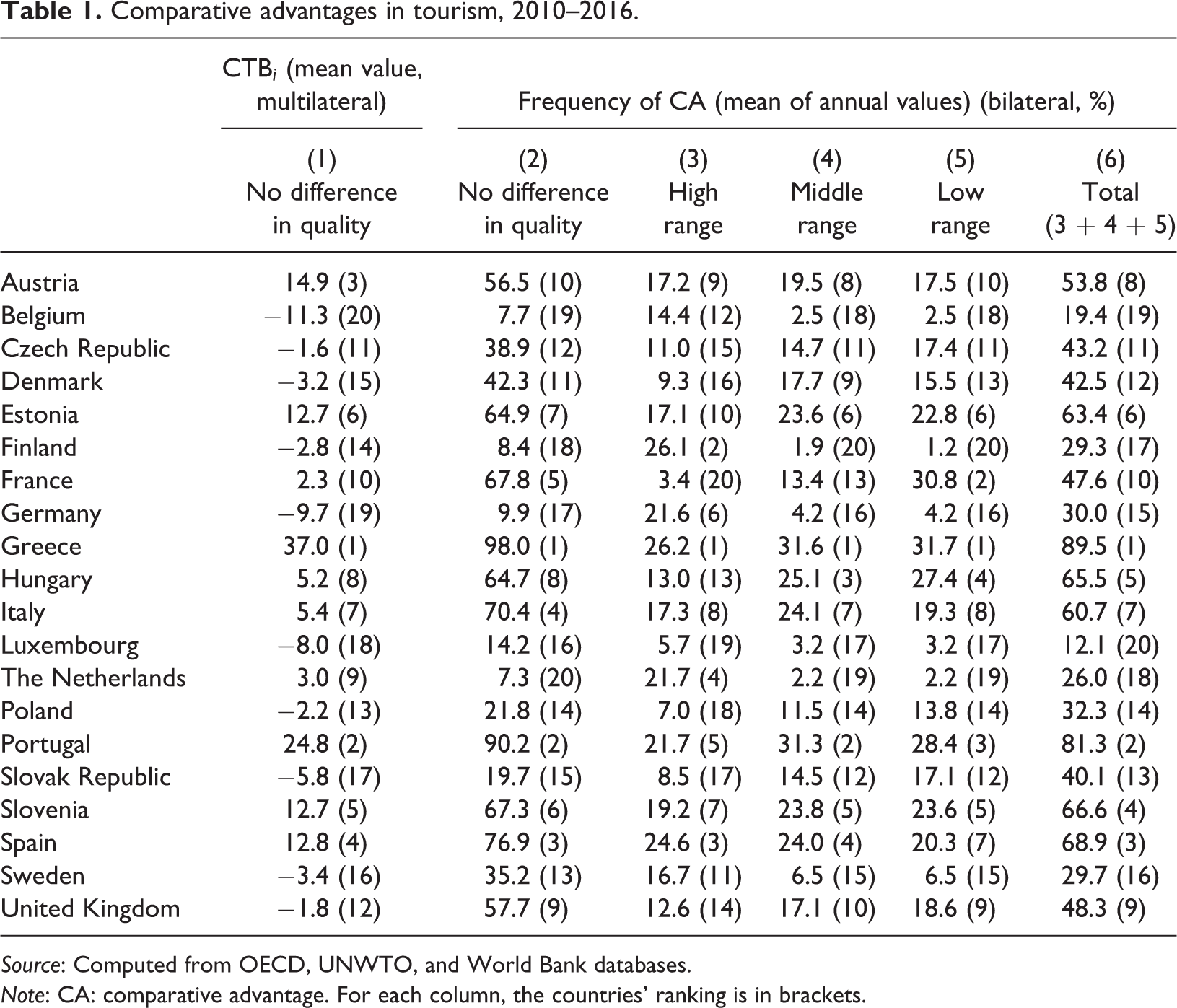
However, for the sake of comparability, let us start by analyzing tourism specialization in the usual way, that is, at a multilateral level and with tourism considered as a homogeneous product (no difference in quality). In equation (1), superscripts s and j have to be removed as we consider exports of total tourism services, irrespective of their quality, by country i to its 19 European partners taken together and its imports from the same set of 19 partners. Column 1 of Table 1 shows the mean values of the
Comparative advantages in tourism, 2010–2016.
Source: Computed from OECD, UNWTO, and World Bank databases.
Note: CA: comparative advantage. For each column, the countries’ ranking is in brackets.
Tourism specialization at the bilateral level
Let us analyze tourism specialization at a bilateral level, but still with no difference in quality. Subscript j has to be reintroduced in equation (1) in order to compute a
Tourism specialization across ranges of quality
As the final step, let us analyze tourism specialization at a bilateral level and along ranges of quality. We follow here Fleischer and Rivlin (2009) by assuming that, in tourism, differences in quality are reflected by differences in unit values, that is, the average tourist vacation expenditure per day. As we consider tourism exports, differences in quality will be supposed to be proxied by differences in export unit values. The unit value of country i’s exports to country j
The three ranges of quality (H, M, L) are defined by comparing these export unit values to a norm,
However, to avoid both threshold effects and the unrealistic classification of each tourism flow in a single range of quality, we use the following method, adapted from Fontagné et al. (2008), which allows to divide each tourism flow into the three ranges. For each tourism export flow (from i to j), we define its relative export unit value
If the flow’s share of middle range is the flow’s share of low range is the flow’s share of high range is
If the flow’s share of middle range is the flow’s share of low range is the flow’s share of high range is
The parameters α,
Finally, equation (1) is computed for each pair of countries and each quality. Columns 3–5 of Table 1 give the mean over 2010–2016 of annual frequencies (as share of total bilateral flows) of bilateral comparative advantages by range of quality. Taking quality into consideration strengthens the results of the previous step: all countries display comparative advantages and disadvantages at the same time, mostly in an even larger proportion than before (compare columns 2 and 6). Countries specialized in tourism according to the multilateral aggregate approach (e.g. Greece, Portugal, Spain) have a lower frequency of bilateral comparative advantages than without considering quality, while it is generally the opposite for countries known as nonspecialized (e.g. Belgium, Finland, Germany). Moreover, the results clearly show that tourism specialization is a more subtle phenomenon than suggested by the standard approach, taking place in Europe within the tourism sector itself, along the spectrum of quality. This is perfectly illustrated by the cases of France and the Netherlands. Although both countries have almost the same multilateral aggregate comparative advantage (+2.3 and +3.0, respectively), France appears to be mainly specialized in the lower segment (30.8% of comparative advantages in total bilateral flows, against 3.4% for the upper segment) while the Netherlands are almost completely specialized in the upper segment (21.7% against 2.2% for the other two segments). Finland is another striking case: classified as nonspecialized in tourism by usual standards (−2.8), this country is, along with Greece, the most specialized in high-quality tourism (26.1% of comparative advantages in total cases). Many northern EU countries follow a similar pattern (e.g. Germany) and prove to be at least as specialized in up-quality tourism as high positive
Finally, this new method of analysis can help to identify the nature and the form of specialization in tourism, besides the degree. In the context of the COVID-19 pandemic, it might be interesting to compare the different impacts of the crisis on destinations according to the nature of their specialization. For example, it would be worth studying if a specialization in high-quality tourism could help a country to adjust in a less painful way than a specialization in mass, low-quality tourism.
Footnotes
Declaration of conflicting interests
The author(s) declared no potential conflicts of interest with respect to the research, authorship, and/or publication of this article.
Funding
The author(s) disclosed receipt of the following financial support for the research, authorship, and/or publication of this article: This research had been funded by the CETOP.
