




Abstract
Coral reefs are at particular risk of overexploitation and extinction due to negative externalities from productive sectors such as tourism and fisheries. Increased reliance on tourism revenue means difficult trade-offs. This study proposes a community-based approach to conservation based on a bioeconomic model. We extend earlier work on exogenous reward-based conservation programs by specifying rewards contingent on the level of conservation effort. In addressing the question—whether effort-dependent revenue-sharing incentivizes local residents to engage in conservation activities—the findings indicate that what matters is the relative size of reward, the degree of reliance on coral reefs as a source of revenue, and how the stock is perceived by economic agents, that is, whether they view coral reefs as a commodity or a nuisance.
Keywords
Introduction
Coral reefs and their ecosystems serve as valuable sources of food, income, employment, pharmaceutical research, tourism, and shoreline protection to a large number of coastal residents (Cinner et al., 2012, 2016; Havinga et al., 2020; Spalding et al., 2017; Teh et al., 2013). The fear, however, is that anthropogenic stress on coral reefs from pollution externalities will irreversibly harm the resource. 1 These negative externalities stem from productive sectors such as tourism and fishing (Burke et al., 2012; Eastwood et al., 2017; Halpern et al., 2015; Hilmi et al., 2017; Richmond et al., 2018). Marine researchers and conservationists argue that taking decisive action against local threats such as overfishing, erosion, and pollution to optimize coral reef resilience is imperative and also note the effects of climate change 2 (including ocean warming and altered cyclone and rainfall patterns) presenting further uncertainty to the analysis (ICRI, 2018).
Policy makers have considered various punitive conservation methods which entail adopting regulation and sanctioning measures (Nolan, 2017; Yoder, 2019); however, in this study, we propose an incentivized collaborative conservation approach and examine its impact on the sustainability of coral reefs. These incentivized conservation approaches which attempt to influence human behavior have been categorized in three ways: promoting awareness and concern, incentivizing action on the part of stakeholders, and nudging behavior (Reddy et al., 2016; Stern, 2017). There are several related studies in the literature including Gonzales et al. (2017) which examined cases of collaborative behavior to restore regional water supply; Tanaka (2019) used integrative management approaches to conserve Japan’s national parks; Fischer et al. (2011) and Graves (2018) utilized collaborative management schemes to conserve endangered wildlife; and Nyakaana et al. (2019) and Thing and Poudel (2017) used these integrative approaches to conserve tropical forests.
The commercial value of US fisheries from coral reefs is over US$100 million and US economies generate billions of dollars from reef tourists via diving tours, recreational fishing trips, hotels, and restaurants (NOAA, 2019). In Southeast Asia alone, coral reefs provide economic benefits in the region of US$1.6 billion to Indonesia and US$1.1 billion to the Philippines on an annual basis (Burke et al., 2012). Tourism and recreation contribute US$9.6 billion of the world’s coral reef net benefits and reef tourism provides economic benefits to at least 94 territories, 23 of which reef tourism accounts for over 15% of gross domestic product (Reytar et al., 2011).
It has been argued that up to 90% of all coral reefs could be lost by 2050 (ICRI, 2018). Reytar et al. (2011) present risk projections for coral reef cover in the Atlantic, Australia, Indian Ocean, Middle East, Pacific, and Southeast Asia regions and globally. 3 In all regions, projected risk (at medium to critical levels) was over 80%. Marine researchers and environmental conservation advocates have been sounding the alarm for over two decades citing that “half of the world’s coral reefs may die within the next 40 years unless urgent measures are taken to protect them” (World Conservation Union, 2005: 13). Further, “24% of the world’s reefs are under imminent risk of collapse through human pressures, and a further 26% are under a longer-term threat of collapse” (Wilkinson, 2004: 21). These statements have drawn the attention of environmental interest groups and government officials in countries which harbor the reefs as they seek to implement policies to curtail this trend.

Reefs at risk projections: Present, 2030, and 2050. Note. “Present” represents the Reefs at Risk integrated local threat index, without past thermal stress considered. Estimated threats in 2030 and 2050 use the present local threat index as a base and also include projections of future thermal stress and ocean acidification. The 2030 and 2050 projections assume that current local threats remain constant in the future and do not account for potential changes in human pressure, management, or policy, which could influence overall threat ratings. Source: World Resources Institute. Reefs at Risk Revisited, 2011
For coral reefs and the marine life for which they provide a habitat, conservation is critical, and this requires the engagement of stakeholders at the local, regional, and national levels. However, there is a delicate dance in the bioeconomic realm where the choreography entails embracing the positive externalities or benefits of coral reefs and reining in the negative externalities or exploitation of the resource. This is the classic “tragedy of the commons” concept put forth by prominent biology researcher, Garret Hardin. He summarized the idea as one where multiple rational parties, 4 independently engaged in achieving their self-interested goals, ultimately deplete a limited common resource (Hardin, 1968).
Herein, the focus is on the alarming depletion of coral reefs stemming from the direct harvesting and trading of coral for sale in expanding aquarium markets (Armitage et al., 5 2017; Donaghey, 6 2011; Morcom et al., 2018) as well as the negative externalities imposed by marine-based tourism activities. The expansion among aquarium markets is fueled by the poor long-term survival rate of coral in artificial conditions, so they must be frequently replaced.
Policy approaches 7 adopted to conserve natural resources, designating protected areas to preserve biodiversity and to conserve the endangered natural resource, and thereby encouraging its resiliency, have been explored (Hilmi et al., 2017; Tanaka, 2019). Researchers argue that this “fences and fines” approach to conservation (particularly in developing countries with a history of colonialism) alienates local residents from the resource and undermines intrinsic interest in preserving the natural resource (Bluwstein and Lund, 2018; DeCaro and Stokes, 2008; Zanamwe et al., 2018). Instead, researchers have promoted natural resource management schemes that engage the cooperative efforts of local residents in conservation programs geared at creating a sustainable resource environment. Ostrom (1990) showed that the “tragedy of the commons” can be mitigated if users of the open-access resource cooperate with each other to monitor the sanctioned use of the resource. Formalized cooperative conservation approaches are also referred to as integrated conservation and development projects (ICDPs). 8 The main goal of ICDPs is to encourage the simultaneous conservation of the natural resource and the economic development among local communities via benefits transfers (Heil, 2017; Nyakaana et al., 2019).
But ICDPs also have their limits based on the community response to benefits transfers. Ferraro (2001) and Brandon and Wells (1992) questioned whether local residents who initially relied on income sourced from activities that threatened the natural resource would regard the new sources of income (transfers) as complementary or substitutive. They observed that these transfers may not necessarily lead to voluntarily refrain from activities that undermine the resource. They concluded that incentives need to be in the form of direct measures, that is, payments based on conservation results. McGillivray (2011) highlights the importance of mitigation and compensation measures when pursuing sustainable development of natural resources. Further, the author recommended that policy makers move toward options which carefully balance property rights/development interests with conservation objectives. Consistent with this approach, this study examines conservation incentives among local coastal residents who receive a revenue-share contingent on their own conservation efforts.
In the second section, a bioeconomic model is developed which is aligned with resource conservation literature (e.g. DeCaro and Stokes, 2008), studies on open-access poaching of the African elephant (e.g. Horan and Bulte, 2004; Muchapondwa and Stage, 2015), and with East African wildlife conservation cases (e.g. Holden et al., 2018; Shulz and Skonhoft, 1996; Skonhoft, 1998). This model is adapted to case of the coral reef where resource rights are poorly defined, governance is ineffective, and threats to the resource are alarming. Fischer et al. (2011) examine the use of fixed revenue shares as conservation incentives; however, this study analyzes endogenous revenue-shares contingent on conservation effort levels among local residents. The implications for coral reef sustainability are considered in a simultaneous open-loop differential game framework. The third section examines interaction between a representative profit-maximizing marine agency and local residents. This study addresses whether effort-dependent revenue sharing provides steady-state equilibrium conservation incentives. The findings indicate that this depends on (i) the relative sizes of revenue shares retained by the local residents and the marine agency, (ii) the rule used to award revenue shares, (iii) the sign and size of in situ and ex situ stock net marginal benefits, and (iv) how the stock is perceived by the economic agents—is the stock a commodity or a nuisance? 9
Model
A biological and economic framework is developed for the open-access resource case where the setting is a coastal territory which hosts a stock of coral reef, R. The interaction among three major stakeholders is studied in this bioeconomic model: a profit-maximizing marine agency, local residents, and coral reef poachers. 10 Two control variables are used: coral harvesting permits (y) and local residents’ conservation effort (E). The marine agency is a profit-maximizing entity which generates economic rents from coral harvesting permit sales to commercial interests linked to aquarium, jewelry, and curio markets, as well economic rents from benign 11 tourism. Given that the sustainability of the coral reef stock is central to the profitability objective of the marine agency, there is an incentive on its part to distribute some of these earnings to the local community to get them on board with coral reef conservation. The in situ coral reef biomass evolves according to 12

where



The stock’s growth equation is given in equation (2) where K is the carrying capacity and g is the intrinsic growth rate. In equation (3), the Schaefer (1954) harvesting function is used to describe coral extraction by the permit holders, where q is the marginal harvesting rate of permit holders, and Lq the number of authorized extractors.
14
Finally, coral reef harvesting by poachers is shown in equation (4), where
Local residents are motivated by the prospect of an increased revenue share fueled by their conservation efforts. A revenue-sharing model is developed in which the marine agency provides conservation incentives to local residents by awarding them a portion,
Local residents
Conservation effort by local residents refers to a variety of measures used to reduce coral poaching including site policing and reporting accounts of destructive behavior by coral poachers to the marine agency.
18
In studies which examine poaching behavior as it relates to wildlife and other endangered species, it is noteworthy that much of the poaching behavior can stem from the local residents themselves as they seek to generate black market economic rents. Their poaching involvement may even be incentivized by their desire to eliminate pesky wildlife which may be nuisances in their agricultural fields. However, in this analysis, the simplifying assumption is one where the majority of local residents are wholly invested in conserving the coral reef as its sustainability is critical to other key revenue-generating industries such as marine-based tourism and fishing. The focus is on the conservation effort solely by local residents, ignoring the possibility of the marine agency engaging in additional conservation behavior. Conservation costs incurred by local residents are assumed linear in effort,

where
First-order conditions for the local community yield the optimal effort level, E*,

The model finds that optimal effort level, E*, among local community members occurs when marginal benefits of conservation equal its marginal cost. Marginal benefits comprise two parts: (i) marginal revenue received by the local residents in the form of the revenue share awarded by the marine agency, and (ii) the imputed shadow value 25 of net increase in coral stock as a result of increased conservation effort.
Theoretically, conservation effort among local residents could be positive, negative, or undefined depending on the relative size of the marginal cost of conservation effort and the shadow value of the net increase in stock attributed to conservation effort as shown in equation (6) and λ is the costate variable. Negative effort translates to the local residents collaborating with the coral reef poachers. 26 The model abstracts from the possibility of negative conservation effort (collaboration to deplete the resource) by making two assumptions: (i) local residents are not negatively affected by the in situ coral reef stock, and (ii) local residents do not receive rents from the poachers as payment for collaboration effort to destroy to the coral reef stock; hence, there is no incentive for the local residents to engage in this activity.
Further, the result in equation (6) shows that positive conservation effort implies the condition
Interior steady states require
27

Given the marginal rents from harvesting permit sales and from benign tourism awarded to local residents are positive, the local residents perceive the coral reef as a commodity if their discount rate, r, exceeds the marginal net growth 28 (MNG) in the stock and as a nuisance otherwise.
Further insight is gained by examining the dynamics of the coral reef stock presented in Figure 2 as impacted by the conservation efforts of local residents.
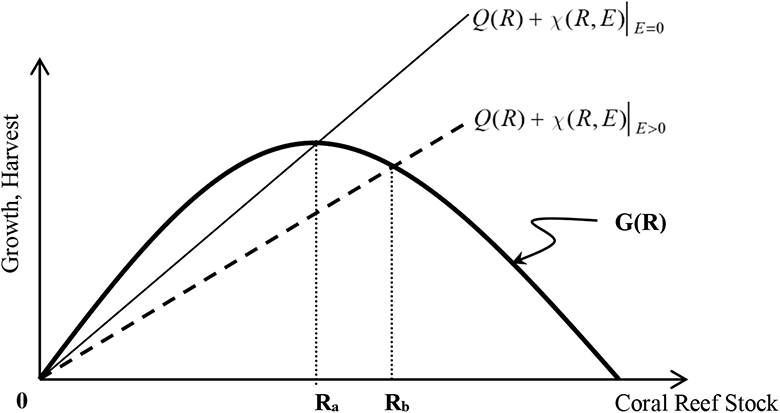
Steady-state stock levels and conservation.
The combined harvest from permits and coral poachers is mapped against the growth function of the stock for a given level of conservation effort. Two steady states are shown in Figure 2. Ra is the level of stock where no conservation is taking place, and Rb reflects the case where positive conservation effort is in effect such that E > 0 and Rb > Ra .The stability of the local residents’ optimization model is examined using the differential equation system:
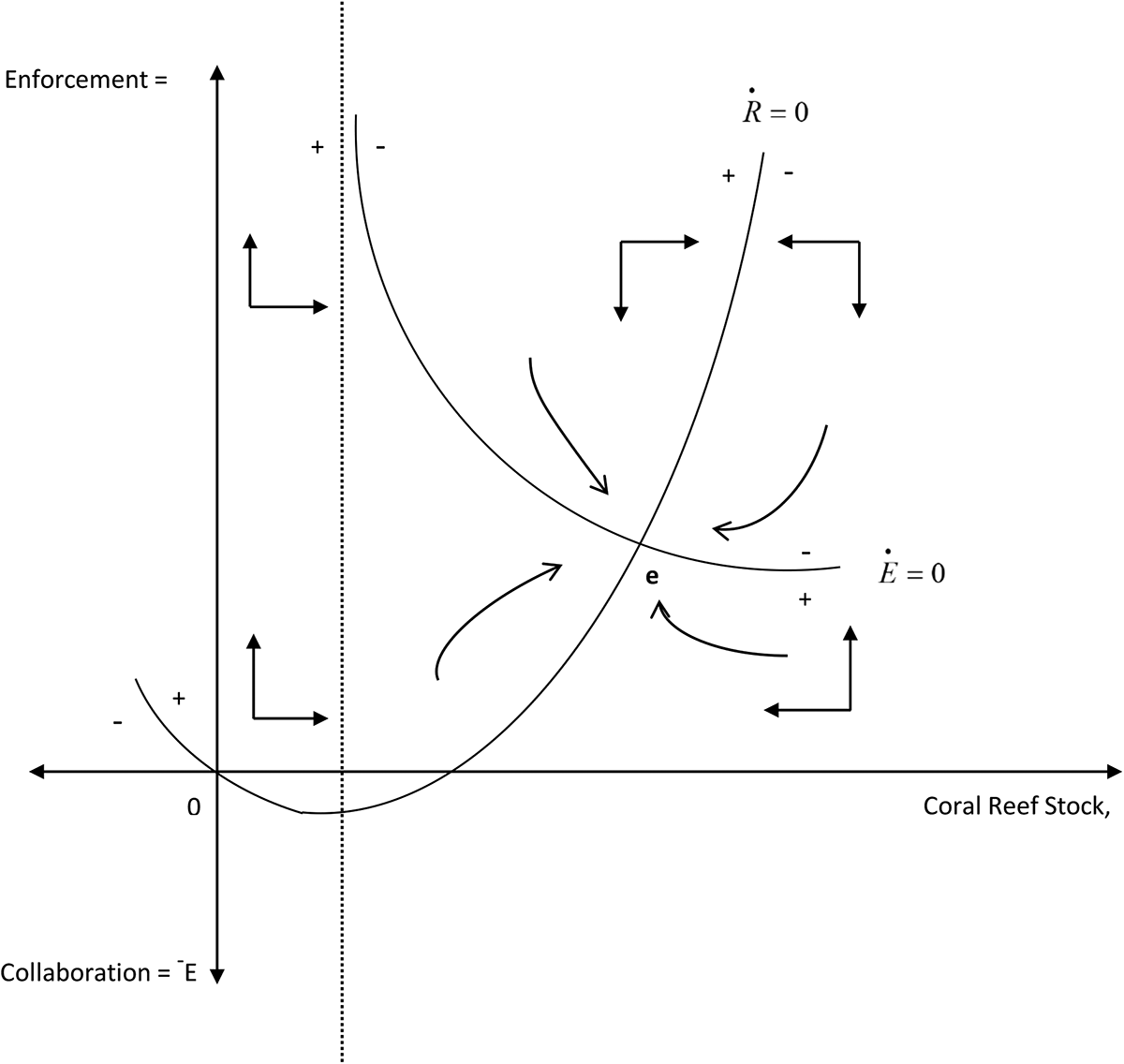
Local residents’ stability analysis—Phase diagram in state-control space.
There are at least four stable branches in the system. Local residents move to the steady state, e, by getting on to one of these trajectories. Given an initial value of the stock R0, local residents must choose an initial level of conservation effort E0, such that the ordered pair
The profit-maximizing marine agency
The marine agency derives economic rents from permit sales and benign tourism sales of which it retains shares,
The objective function of the marine agency, where

The marine agency will then choose to issue coral harvesting permits given by

where ω is the costate variable. This result suggests that the optimal number of permits occurs where the net marginal benefit from permit sales equals the shadow value of the stock. Given constant costs, net marginal benefit from permit sales amounts to the retained marginal permit sales revenue and the marine agency’s shadow value of the coral reef stock is

Analogous to the analysis of local residents’ behavior based on equation (7), how the marine agency perceives the stock of coral reef (commodity vs. nuisance) is a function of the relative sizes of its discount rate, rA, and the coral reef’s MNG. As coral reefs are its only source of economic rents, the model assumes the profit-maximizing marine agency perceives the coral stock as a commodity. 31
The differential equation system:

Marine agency’s stability analysis—Phase diagram in state-control space.
Equilibrium e1 is characterized by high harvesting effort, low stock, and high search costs, whereas e2 corresponds to low harvesting effort, high stock, and low search costs. The sustainable harvests are the same at these two equilibria, but the marine agency would gravitate toward e2. Further, the marine agency is unable to identify a stable branch which leads to e1. There is only one way the economy can move toward e2. It needs to get on to the unique branch—the “yellow brick road”
33
highlighted in Figure 4. Given an initial value of the stock R0, the marine agency must choose a number of permits y0, such that the ordered pair
Agent interaction and conservation incentives
The local residents and the marine agency select their strategy sets


An OLMN equilibrium exists if and only if
As shown in Figure 5, given the effort-dependent revenue share, equilibrium conservation is given by

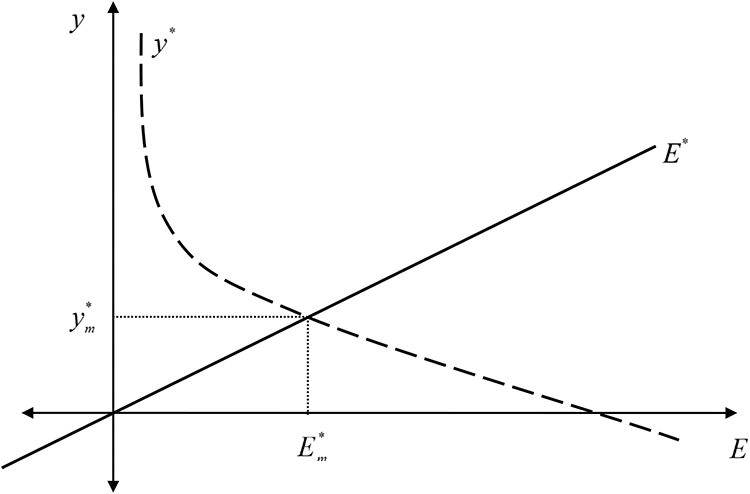
Reaction functions under simultaneous play and the OLMN equilibrium. OLMN: open-loop Markovian Nash.
By definition, the equilibrium revenue share,
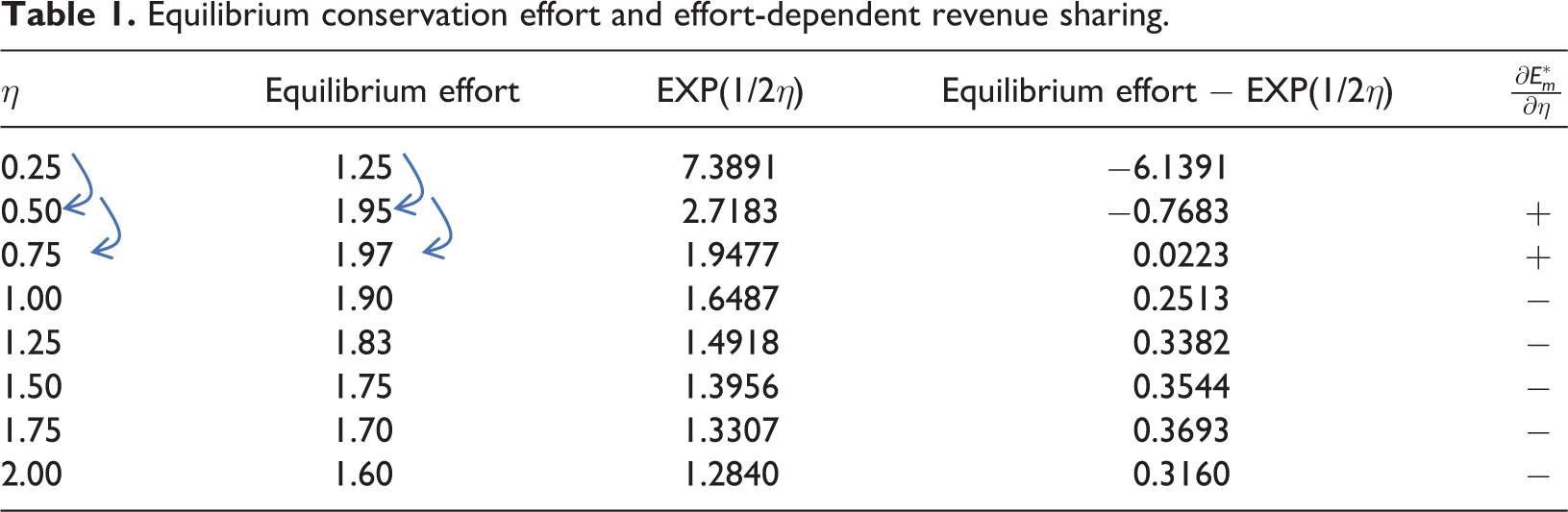
This brings us to the main question—does effort-dependent revenue sharing encourage increased conservation in a steady-state equilibrium? This question is addressed by examining the impact of the dependence parameter, η, on equilibrium effort and permits. 37 An a priori assumption may be that increasing the dependence of the residents’ revenue share on their level of conservation effort would lead to monotonic increases in their equilibrium conservation effort. While the study finds a monotonic decrease in the equilibrium permits set by the marine agency as residents receive increased revenue shares, the results show that changes to the equilibrium conservation effort are nonmonotonic resulting in nonmonotonic changes to the OLMN equilibrium.
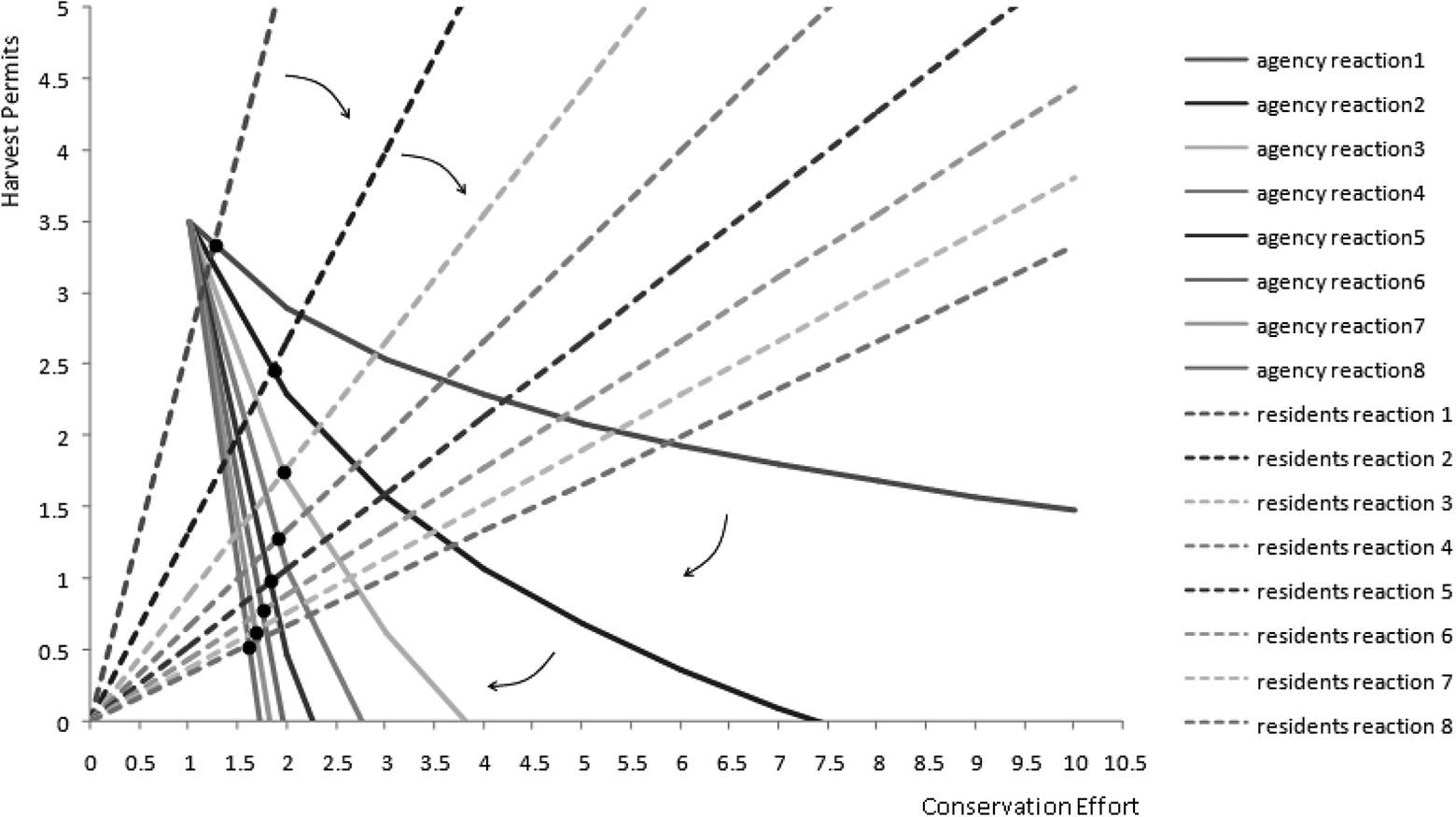
Reaction function shocks attributed to changes in η.
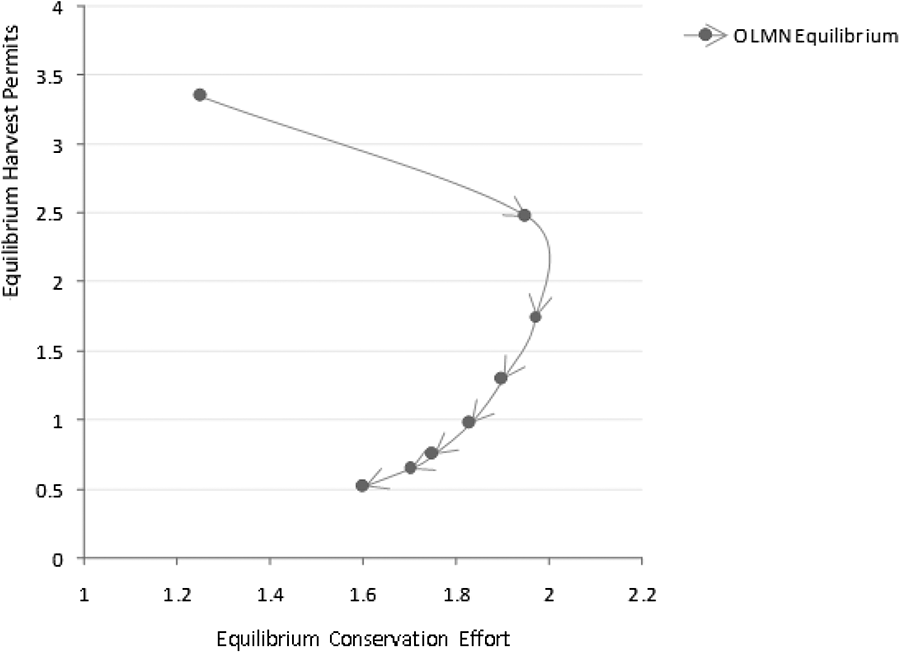
OLMN equilibrium shocks attributed to changes in η. OLMN: open-loop Markovian Nash.
There is a threshold beyond which increasing the dependence of the revenue share on conservation effort leads to an overall decrease in the equilibrium level of conservation effort. This threshold is identified by examining the relationships


Given the dynamics in equation (14), equilibrium conservation effort is increasing in η if
Equilibrium conservation effort and effort-dependent revenue sharing.
Impact of effort-dependent revenue sharing on the OLMN equilibrium.
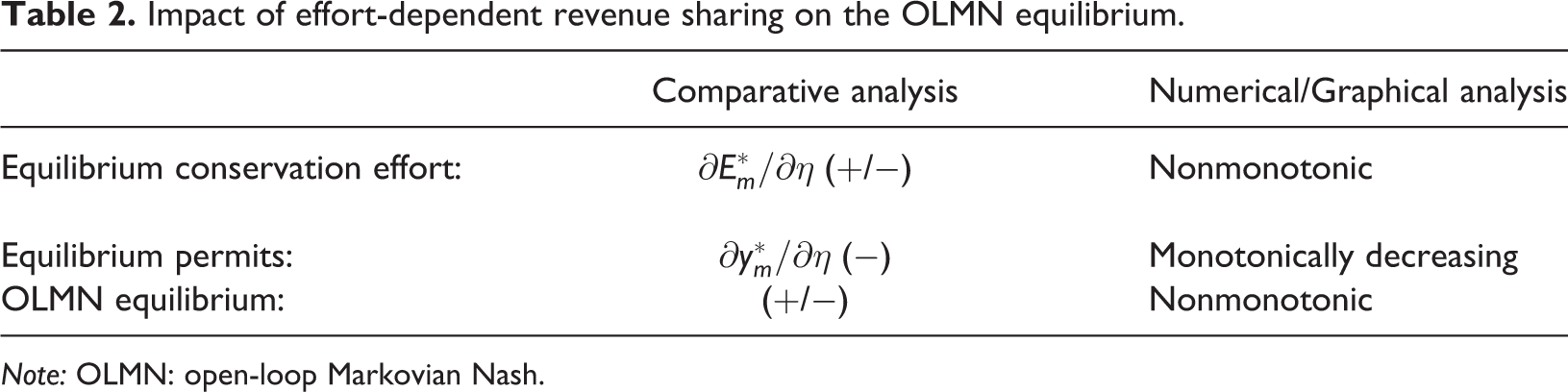
Note: OLMN: open-loop Markovian Nash.
In equilibrium, the residents’ revenue share,
Ecotourism welfare implications and summary
Having considered the impact of revenue sharing between the marine agency and local residents arising from coral reef harvesting permit sales, the impact of revenue sharing in benign tourism revenue on the OLMN pair of strategies 38 is now examined. The results are shown in the comparative analyses in equations (16) and (17):

where

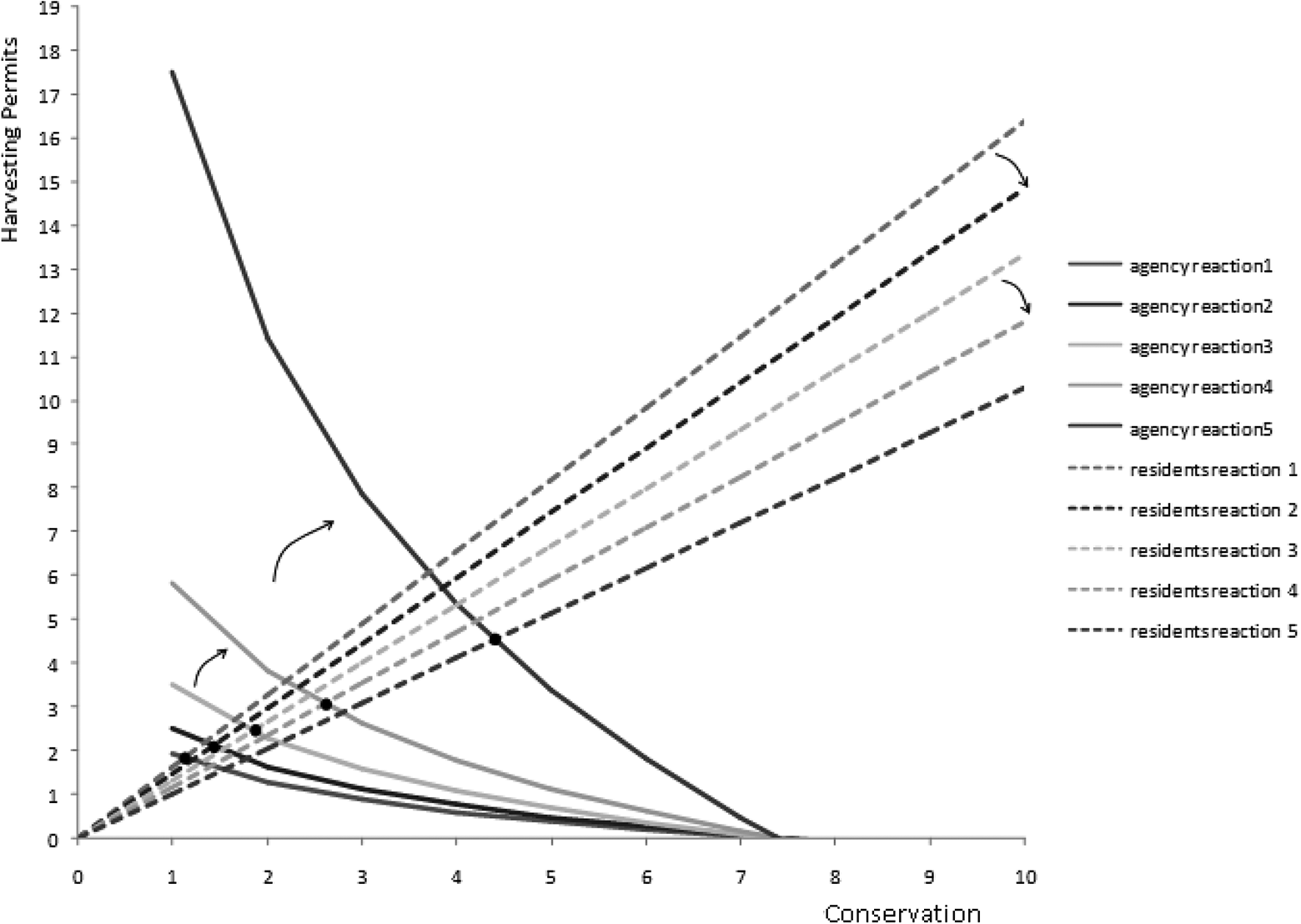
Reaction function shocks attributed to changes.
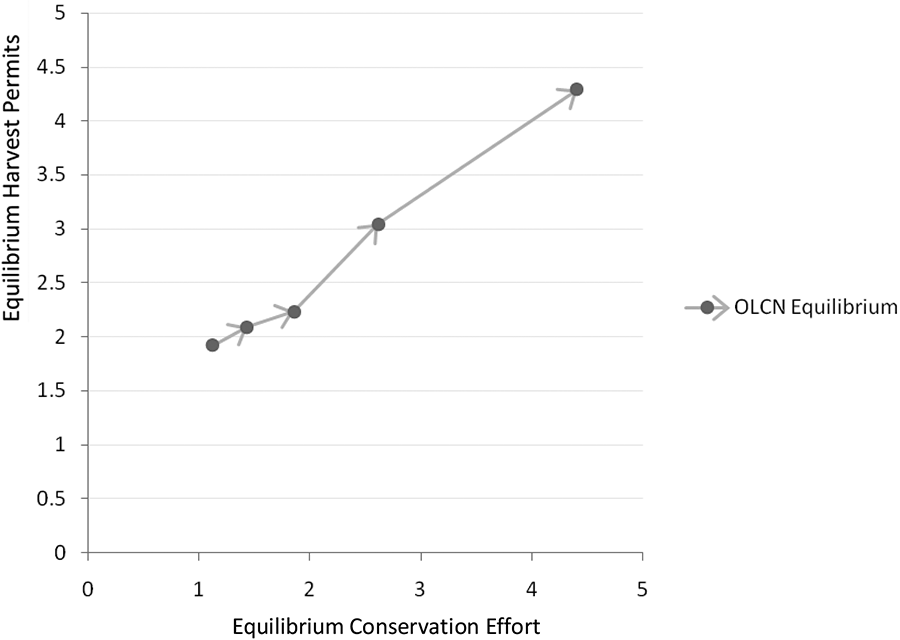
OLMN equilibrium shocks attributed to changes in β. OLMN: open-loop Markovian Nash.
The results show that increases in the fixed tourism revenue share lead to unambiguous increases in equilibrium conservation effort among local residents. Based on the comparative analysis in equation (17), the study finds
Impact of fixed revenue sharing on the OLMN equilibrium.

Note: OLMN: open-loop Markovian Nash.
A few different cases can also be considered along with welfare implications when the marine agency adopts extreme positions with respect to the revenues retained in the revenue-sharing program. When the revenue-maximizing marine agency retains all of the revenue from permit sales and benign tourism, when
In a different extreme scenario, if the local community were to be awarded all revenue from the sale of coral reef harvesting permits and none of the tourism revenues
Overall, the pre-revenue sharing and pre-conservation welfare level of the local residents’ is maintained or raised if the revenue share received by the marine agency at least offsets the cost of conservation effort. The welfare of the marine agency varies directly with the size of the retained revenue shares. In isolation, the marine agency seeks to retain the highest possible share of revenues from permit sales and tourism; however, equilibrium requires the marine agency’s behavior is bound by its net impact on the local residents’ welfare.
OLMN equilibrium and implications for the coral reef stock
The separate effects of effort-dependent revenue sharing and fixed revenue sharing on equilibrium conservation effort among local residents and on equilibrium harvesting permits issued by the marine agency have been examined. Now, the overall impact of the interaction between the two players on the stock is determined. The OLMN steady-state stock,

From equations (7) and (10), the discount rates of the residents and agency based on the shadow values of the stock can be restated

In the OLMN equilibrium, the MNG in the stock is given by
Finally, the impact of increased equilibrium conservation effort on the stock in the steady state by revisiting the steady-state condition is determined in equation (18). Totally differentiating equation (18)

The result in equation (20) shows the response of the stock’s equation of motion to exogenous shocks to stock or equivalently,
Conclusion
In this study, coral conservation incentives were examined via a revenue-sharing system between a profit-maximizing marine agency and an otherwise disengaged local community. The goal of the study was to determine whether effort-dependent revenue shares, that is, a commission-based approach, provided steady-state equilibrium conservation incentives within the local community. The analysis demonstrated that revenue sharing in and of itself does not automatically incentivize local residents to engage in conservation effort. The results show that a nonmonotonic conservation–reward relationship exists when the revenue shares from permit sales are contingent on effort. The study found that conservation behavior is influenced primarily by the relative size of the revenue shares and whether the local community perceives the stock as a commodity or nuisance.
This suggests more information should be provided to local communities on the intrinsic importance of the coral reef, and its vital role within the marine ecosystem. In addition to the commission incentive, once these communities recognize the intrinsic value of the resource, they would be more inclined to engage in conservation programs. But this does not occur in isolation, the results indicate that awarding a share of the rents from permit sales to local residents has an impact on the behavior of the marine agency as well. Although the marine agency may be incentivized to improve the quality of the coral reef stock and permit prices, the incentive to increase the overall stock of coral reef will depend on how much of the profits are retained by the agency.
The analysis of the rents from benign tourism reveal that conservation incentives among local residents depend on the reaction of the marine agency. The study finds that increases in the fixed tourism revenue share lead to unambiguous increases in equilibrium conservation effort among local residents. However, as the retained tourism revenue share,
It is also important to acknowledge the role and importance of well-functioning institutions to effectively set coral reef harvesting permits and to create an adequate level of trust between local residents and the marine agency, so as to encourage transparency in their interaction, mitigate the effects of coral reef poaching, and to enhance conservation incentives among local residents for the long-term sustainability of the coral reef.
An objective assessment of this study would reveal a few limitations stemming from inherent simplifying assumptions associated with the foundational modeling. Although, the use of explicit functional form equations facilitates increased clarity of results, the generality trade-off is noted. Further, in this model, revenue-sharing conservation incentives on the part of the marine agency were driven by a profit motive. It would be useful to examine an alternative scenario where conservation incentives were governed by ecological sustainability rules ensuring that coral reefs levels were maintained above a designated threshold. This approach would be more aligned with a societal welfare maximization, rather than profit, objective.
A final important note relates to inherent concerns associated with the concept of incentivizing behavior. The nature and quality of the relationship between those initiating revenue-sharing schemes (marine agency) and the target conservation practitioners (local residents) are the powerful drivers of desired outcomes or otherwise. The assumption made in this study is that the marine agency has factored into the revenue-sharing approach the relevant norms, values, and other intrinsic elements that are critical for inducing desired behaviors. We recognize that the prospect of being rewarded via revenue sharing is only one part of the relationship between the marine agency and the local residents. Two-way credibility, trust, effective monitoring, and feedback loops are also important components. Therefore, this study acknowledges that any prescribed conservation plan will inevitably be incomplete if not complemented by significant strides in relationship building. The goal is to develop lasting conservation approaches that will likely be resilient within evolving political, socioeconomic, and ecological environments.
Footnotes
Acknowledgments
The author wishes to thank Jason F Shogren for his wisdom, expertise, and immensely valuable contributions to this study. In addition, thanks to colleagues including Anita Chaudhry and Erdal Kara for their valuable comments during preliminary discussions.
Declaration of conflicting interests
The author(s) declared no potential conflicts of interest with respect to the research, authorship, and/or publication of this article.
Funding
The author(s) received no financial support for the research, authorship, and/or publication of this article.
